The HOA Hired Him to Fix an Overgrown Yard—Then He Arrived and Found the Wrong Property Perfectly Maintained
Chapter 1: The Yard George Was Supposed to Rescue
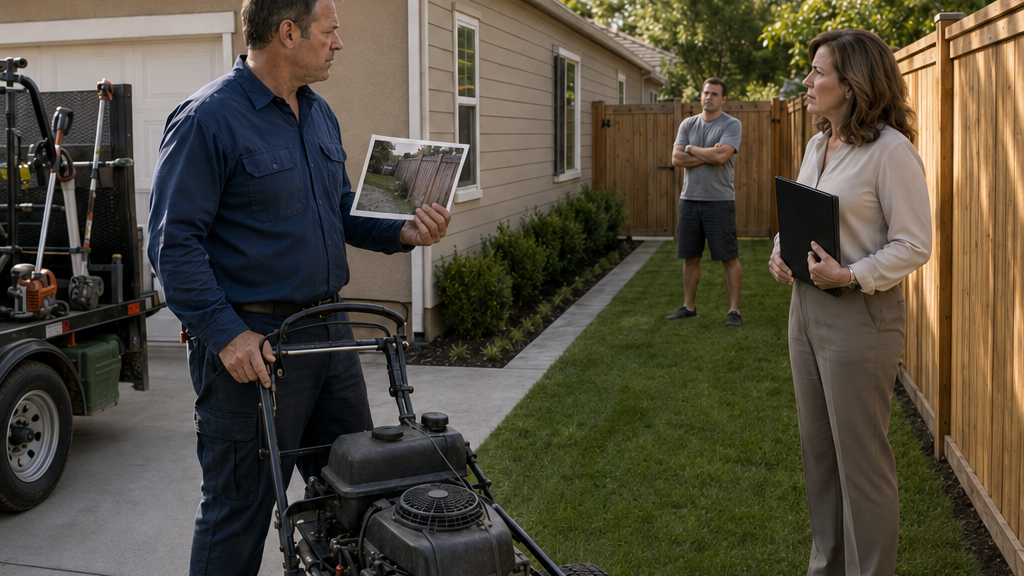
George Miller had one wheel of the commercial mower on the driveway when he realized there was nowhere to use it.
He stopped with both hands on the handle.
The photograph on his phone showed waist-high weeds crowding a wooden fence, ragged grass swallowing the edge of a narrow walkway, and two volunteer saplings bending over what looked like an air-conditioning unit. George had studied that photograph the night before until he could practically trace the job with his finger.
Cut the grass down in stages. Clear the fence line. Remove woody growth. Edge the concrete. Haul debris.
Three hours if things went well. Four if the wet growth clogged the deck.
The yard in front of him needed none of it.
A clean strip of green ran between the beige house and a recently stained privacy fence. The lawn had been cut within days, perhaps sooner. The edge along the concrete was sharp enough to make George look down at his own boots, as though he had somehow stepped onto the wrong property without noticing.
He checked the house number.
Then he checked his phone.
Then the number again.
“Morning.”
George turned.
A man in a gray T-shirt had come through the front door holding a coffee mug. He looked to be in his forties, broad through the shoulders, his expression halfway between relief and impatience.
“You George?”
“Yeah.” George pointed toward the mower. “Kevin Brown?”
“That’s me.”
George looked back at the grass.
Kevin followed his eyes.
For two seconds neither man said anything.
Then Kevin gave a short laugh. “Something wrong?”
George brought up the photograph on his phone. “I want to make sure I’m at the right place.”
Kevin’s smile disappeared. “You are.”
“This is the property you called about?”
“Yes.”
George held the phone out.
The photograph filled the screen: overgrown grass, tangled growth along a fence, a hard-to-see border buried in weeds.
Kevin stared at it.
“That’s what they sent me,” George said. “That’s what I quoted.”
Kevin frowned. “That’s my house.”
“I can see that.”
“So what’s the problem?”
George turned the phone toward the actual side yard.
“The problem is, that yard isn’t here.”
Kevin set the mug on the hood of his SUV.
For the first time, he studied the side yard as if it belonged to somebody else. George could see irritation building in him—not yet directed anywhere specific.
“The HOA said it had to be corrected by today,” Kevin said. “I told you that.”
“You did.”
“And you gave me a number.”
“Based on this.”
George tapped the photograph.
Kevin crossed his arms. “You said you could take care of it.”
“I can take care of what’s there.”
“Well?”
George pointed toward the grass.
“There’s nothing there.”
The words sounded worse once they were spoken aloud.
George knew it immediately.
He had built a business partly on being decisive. Customers sent pictures. George gave them numbers. He knew what overgrowth hid, how long thick grass took to cut, what a fence line looked like when roots had gotten established. He could usually look at four photographs and estimate labor within half an hour.
Usually.
Last night Kevin had forwarded three images from an HOA notice. George had zoomed in on each one at his kitchen table, written an estimate, and blocked most of Monday morning.
He had not driven by.
He had not asked when the photos were taken.
And he had not told Kevin that his confidence rested entirely on those images.
Kevin picked up his mug again, but did not drink.
“So you’re saying somebody did it already.”
“That was my first thought.”
“Not me.”
“Did you hire anyone else?”
“No.”
“Neighbor?”
“No.”
“HOA vendor?”
Kevin shook his head. “They don’t do private yards.”
George looked over the fence line.
The more he studied it, the stranger the explanation became.
Even if someone had arrived overnight with a crew, they would have left signs. Fresh piles. Scuffed turf. Sawdust. Clippings in corners. A difference in color where tall grass had been exposed to sunlight.
George saw none.
The shrubs near the house were established and neatly mulched. The edge of the lawn met the walkway without any pale line from recently removed growth.
This yard had not been rescued last night.
It had been this way for some time.
A white crossover slowed at the curb.
Kevin looked toward it and muttered, “You’ve got to be kidding.”
The vehicle pulled into the driveway behind George’s trailer.
A woman stepped out carrying a thin folder. She wore slacks, low shoes, and the kind of expression George associated with customers who had already decided what the conversation was about before they arrived.
“Kevin,” she said. Then she looked at George. “Mr. Miller?”
“Yes.”
“I’m Patricia Lewis. Board president.”
Kevin sighed. “Why are you here?”
“To confirm remediation before the deadline.”
George glanced at Kevin.
Kevin gave him a look that said he had not invited her.
Patricia opened the folder.
Inside was a printed version of the same photograph George had been studying.
“Perfect,” she said, looking at his equipment. “You’re already set up.”
“No, ma’am.”
She looked at him.
George nodded toward the side yard. “I’m not.”
Patricia walked two steps toward the gate and looked through.
Her expression barely changed.
“Well,” she said, “it appears substantially improved.”
Kevin stared at her. “Improved by who?”
“That’s not really the association’s concern.”
“It is if you’re saying I did something I didn’t do.”
Patricia ignored that and turned to George.
“You were contracted to correct the landscape violation?”
“I was contracted based on those pictures.”
“Then I assume the work can be documented as completed.”
George felt the first real heat of embarrassment.
His mower sat behind them like a prop in somebody else’s joke. Trimmers were strapped to the trailer. He had brought disposal bags, a pruning saw, edging blades, fuel. Anyone driving past would think he had just finished the job.
Patricia’s folder made that interpretation even easier.
George wiped his thumb along the edge of his phone.
“I didn’t do anything here.”
Patricia blinked once. “You just arrived?”
“About five minutes ago.”
“Then perhaps another contractor completed the work.”
Kevin said, “There wasn’t another contractor.”
Patricia gave him a restrained look.
“The association has photographic documentation of the condition.”
“And we’re standing in the yard,” Kevin said.
Patricia lifted the photograph slightly. “Records still matter.”
George heard the edge in Kevin’s breath and stepped closer before the conversation became something louder.
“Let me see the print.”
Patricia hesitated, then handed it over.
George walked to the side gate.
He held the photograph at chest height and looked past it into the real yard.
House wall on the left.
Fence on the right.
Walkway.
The general angle matched.
He shifted the paper.
In the picture, a dark wooden fence turned inward near the back corner. In the real yard, the newer fence continued straight.
He narrowed his eyes.
There was something else.
A small tree in the violation photograph leaned toward the house just beyond the air conditioner.
There was no stump in the current lawn.
No scar.
No fresh patch.
George lowered the page.
“When did you replace this fence?”
Kevin looked at him.
“What?”
“The fence.”
Kevin stepped closer. “Back in the spring.”
Patricia said, “That has nothing to do with the grass violation.”
George did not answer.
He raised the photograph again.
The old fence corner was unmistakable now.
He walked farther down the side yard until the concrete ended.
The photograph showed the fence turning exactly there.
The fence beside him did not turn.
It ran another twenty feet toward the backyard.
George looked at Kevin.
“You didn’t replace part of it.”
Kevin shook his head slowly.
“No. We changed the whole side layout when we redid the back.”
George turned to Patricia.
The embarrassment was still there, but it had changed shape.
He no longer felt like a contractor who had shown up for a job that did not exist.
He felt like the only person standing there who had finally noticed what the picture actually proved.
“This photo isn’t from this morning,” he said.
Patricia tightened her grip on the folder.
George pointed to the fence visible in the image.
“It isn’t even from this version of the yard.”
Chapter 2: The Photograph With the Correct Address
Kevin found the same photograph three times.
He was sitting at his kitchen table with the HOA portal open on a tablet, scrolling through notices while George stood over his shoulder.
“There,” Kevin said.
He opened the first violation.
The overgrown yard appeared beneath a block of text.
He backed out and opened the second notice.
Same photograph.
Third notice.
Same photograph again.
Patricia stood near the counter, arms folded.
“The image is attached to the address,” she said.
George looked at her. “That doesn’t tell us when it was taken.”
“The notice has an inspection date.”
“Do the pictures?”
“The system associates the photograph with the inspection.”
“That isn’t what I asked.”
Patricia’s jaw shifted slightly.
Kevin enlarged the image until the pixels softened.
“Look,” he said. “House number.”
A small plaque near the gate was partially visible.
It was Kevin’s number.
For several minutes, that had been the easiest explanation left—that the HOA had attached another homeowner’s photograph to Kevin’s file.
Now that explanation was gone.
George leaned closer.
The siding matched. The outdoor electrical box matched. Even the placement of the downspout was right.
It was Kevin’s house.
It just was not Kevin’s current yard.
Patricia seemed relieved by the confirmation.
“So there is no question that the violation documentation concerns this property.”
George straightened.
“There’s still a pretty big question.”
She gestured toward the tablet. “Which is?”
“When.”
Kevin scrolled farther down.
The notice language was repetitive: landscape standards, required remediation, compliance deadline. He had received the first warning weeks earlier, another after that, then the final notice that had caused him to call George.
“You never looked at these photos closely?” George asked.
Kevin rubbed the back of his neck.
“I looked enough to know they were talking about the side yard.”
“But it didn’t look like your yard.”
Kevin glanced at Patricia before answering.
“I assumed it was an old angle.”
George almost laughed, but stopped himself.
An old angle.
He had made his own version of the same mistake.
He had assumed the pictures were current because nobody had told him otherwise.
Kevin had assumed they were meaningful because they came from the HOA.
Patricia assumed the database meant the association had already verified everything.
Three people, one photograph, three different assumptions.
George picked up the tablet.
“Let’s go outside.”
Patricia followed reluctantly.
In the side yard, George positioned himself where he believed the original photographer had stood. He held the tablet up until the house wall in the image aligned with the real siding.
“See this tree?”
Kevin nodded.
It appeared in the photograph between the air-conditioning unit and the fence.
“That was a volunteer maple,” Kevin said. “We took it out when the fence contractor came.”
“When?”
“March.”
George lowered the tablet.
It was June.
Patricia said, “Removal of one tree does not establish the condition of the grass.”
George walked a few feet toward the backyard.
“What about this corner?”
The old image showed a privacy fence turning toward the house.
Kevin pointed beyond the current fence.
“That used to close off a little dog run.”
“And now?”
“Gone. We moved the fence out when the patio work was approved.”
Patricia looked at him. “Approved by whom?”
“The architectural committee.”
That silenced her.
Kevin looked almost pleased for half a second.
George noticed and disliked it. He did not want the conversation turning into a contest where every mistake by the association became a point scored by Kevin.
He cared about one thing: figuring out whether he had quoted nonsense because he had been careless, or because everyone had been working from bad information.
He walked to the rear corner.
The current mulch bed curved around a row of shrubs. In the violation photograph, no bed existed there. Tall weeds pushed against bare fence boards instead.
“Those shrubs new too?”
“April.”
George nodded.
“So this picture is at least older than April.”
“Probably older than that,” Kevin said.
Patricia took the tablet from him.
“The initial violation may have originated earlier.”
“Then why am I standing here on a June deadline?” Kevin asked.
“Because unresolved violations remain active.”
“Unresolved? The entire yard was rebuilt.”
“The association needs documentation that the condition was corrected.”
Kevin stared at her.
“What do you call this?”
He swept an arm toward the lawn.
Patricia did not raise her voice.
“That may be exactly what we need to close the file. Mr. Miller can document current compliance.”
George looked at her.
“Document current compliance? Sure.”
Patricia relaxed slightly.
“But that isn’t the same as saying I corrected the violation.”
Her expression closed again.
Kevin looked from one of them to the other.
George continued.
“My estimate says brush removal, heavy mowing, edging restoration, debris haul-off. None of that happened today. Not by me.”
“It may already have been completed.”
“That’s the problem.”
George tapped the image.
“If you close this as work completed because of this quote, your file says something happened that didn’t.”
Patricia sighed.
“The practical issue is that the property is compliant.”
“Then close it because it’s compliant.”
“It isn’t that simple.”
George gave her a tired look.
“It was simple enough to send three notices.”
Kevin made a noise that might have been a laugh.
Patricia ignored him.
“The deadline is four o’clock today. If the system does not receive confirmation, the matter advances automatically.”
“To what?”
“Board review and potential fine assessment.”
Kevin’s humor vanished.
“How much?”
“That depends on the review.”
George checked the time.
Ten forty-six.
He had already lost the morning route he had rearranged for this job. The next property on his schedule was across town and could no longer be fit in before lunch.
He could leave.
That would be the sensible business decision.
Kevin’s HOA problem was not his problem.
Except his estimate was now part of it.
George looked down at the tablet again.
There had to be something objective beyond shrubs and fences. Something that did not depend on whose memory was better.
He enlarged the photograph slowly.
The old dog-run fence.
The maple.
A concrete border near the air-conditioning pad.
He looked at the actual ground.
“Kevin.”
“What?”
“Was there another walkway here?”
Kevin came over.
George pointed.
In the photograph, a narrow strip of concrete ran beside the fence before disappearing beneath tall grass.
In the current yard, that concrete did not exist. The lawn extended uninterrupted to the mulch bed.
Kevin stared for a moment.
“That got removed with the patio work.”
“So the photo was taken before that too.”
“Yeah.”
“When was the concrete removed?”
“Late February.”
George looked at Patricia.
She said nothing.
The question had changed.
They no longer needed to determine whether someone had magically transformed the yard overnight.
The image itself contained physical features that had been gone for months.
Kevin took back the tablet.
“Where does it say when this inspection happened?”
Patricia pointed to a line beneath the case number.
Kevin read it once.
Then again.
His face tightened.
George leaned over his shoulder.
The date displayed beside the violation inspection was twelve days earlier.
Kevin looked toward the place where the concrete walkway had been removed in February.
“Twelve days?”
Patricia stepped closer to the screen.
For the first time that morning, she did not have an immediate answer.
George watched her eyes move over the date.
The official record said someone had inspected Kevin’s property less than two weeks ago.
The photograph said they had stood beside a fence and walkway that had not existed for months.
Chapter 3: A Twelve-Day-Old Inspection That Never Happened
Rachel Davis searched the inspection schedule twice before she looked up.
“There was no field inspection at that address on that date.”
George sat across from her desk with his estimate folded in his pocket and the violation photograph resting on the chair beside him.
Kevin had forwarded the HOA portal screenshots that morning. George had printed them before driving to the management office.
Now Rachel had the same date on her monitor.
Twelve days earlier.
No inspector.
“No vendor?” George asked.
Rachel shook her head.
“No landscape inspection vendor was scheduled in that section.”
“Board member drive-through?”
“I wouldn’t necessarily have that listed.”
“So somebody could have gone.”
“Possibly.”
“But you don’t know who.”
Rachel leaned back.
“Mr. Miller, I need to be careful here. You’re not the homeowner, and I can’t discuss every part of an owner’s account with a contractor.”
“I’m not asking about his account balance or complaints.”
“You’re asking about an internal inspection record.”
“I’m asking because my estimate is being used to support it.”
Rachel looked at him over the top of her glasses.
George placed his estimate on the desk.
The language bothered him now.
Heavy mowing.
Brush removal.
Fence-line clearing.
Debris disposal.
He had written every line confidently.
He had even told Kevin on the phone, “I’ve seen enough. I know what you’ve got.”
That sentence had replayed in his head several times since Monday.
Rachel glanced at the estimate.
“This is between you and Mr. Brown.”
“It became my business when Patricia asked me to document that the violation had been corrected.”
Rachel stopped.
“She asked you to certify remediation?”
“She asked me to document completion.”
“That’s not quite the same thing.”
“It is if my name ends up under a list of work I didn’t do.”
Rachel folded her hands.
“Did you perform any work?”
“No.”
“Did you invoice the association?”
“No.”
“Then I’m not sure what exposure you believe you have.”
George leaned forward.
“I don’t think I have exposure. I think you have bad information.”
That landed harder than he intended.
Rachel’s mouth tightened.
George exhaled.
“Look, I’m not trying to dump this on you.”
“That’s usually what people say right before they dump something on management.”
He almost smiled.
“Fair enough.”
She looked at the photograph again.
“This image is Mr. Brown’s property.”
“Yes.”
“And the current condition differs.”
“Not just the condition. The layout.”
Rachel picked up the print.
George pointed to the old fence corner, the missing maple, and the removed concrete strip.
“Those were gone before the date in your system.”
Rachel looked at each feature without speaking.
Then she turned back to her computer.
“This platform was upgraded earlier this year.”
George waited.
Rachel clicked through several screens.
“The association had records moved from the prior management database.”
“And?”
“And migrations are messy.”
“That sounds promising.”
“It isn’t.”
Her tone changed enough that George stopped treating the conversation like an argument.
Rachel opened a case history.
Lines of entries appeared.
Some were ordinary notes. Others were coded in abbreviated language George could not follow.
Rachel scrolled.
Then stopped.
“What?”
She did not answer.
She scrolled farther up.
George watched her face.
The defensive professionalism had drained out of it. She looked irritated now, but not at him.
“There’s a migration flag,” she said.
“What does that mean?”
“It means this violation record originated in the prior system.”
“So the case is old.”
“Potentially.”
“You didn’t know that?”
“I knew older cases were migrated. I did not know this photograph was attached to one.”
George leaned back.
That was the first thing anyone had said that made the entire mess begin to fit together.
An old violation.
An old photograph.
A new-looking date.
Rachel opened another panel.
The screen showed a sequence of entries with different formatting.
“Here,” she said.
George leaned closer.
He could make out a reference to a landscape condition and an older case identifier.
“How old?”
“I need to verify before I say.”
“Months?”
Rachel did not answer directly.
She reached for the phone.
“I’m calling the office administrator.”
The conversation lasted less than two minutes.
George heard only Rachel’s side.
“Can you check field assignments for Brown’s section?… No, not June. I need the legacy record if we still have it… Yes… Send it to me.”
She hung up.
“There definitely wasn’t an inspection twelve days ago?”
Rachel turned the monitor slightly away from him.
“There was no assigned field inspection.”
George felt some of his anger loosen.
Until that moment he had imagined someone taking shortcuts behind a desk, issuing notices without caring whether they were true.
Rachel did not look careless.
She looked like someone who had just discovered a trap hidden inside a system she was responsible for.
George knew that feeling.
He pulled his estimate toward himself.
“I should’ve driven by before I priced it.”
Rachel glanced at him.
“What?”
“The job.”
He tapped the paper.
“I quoted off the pictures. Never laid eyes on the property until Monday.”
“That’s common for contractors.”
“Doesn’t make it smart.”
Rachel studied him for a moment, then returned to the computer.
“Kevin sent you these images?”
“The HOA notice.”
“So you trusted them because they were official.”
George nodded.
Rachel gave a thin, humorless smile.
“You and everyone else.”
An email notification appeared on her screen.
She opened the attachment.
A legacy case record filled the window.
Rachel read silently.
Then she whispered, “There it is.”
“What?”
She turned the screen enough for George to see the header.
The original complaint was older than the current portal suggested.
Much older.
The violation began before Kevin replaced the fence.
Before the shrubs.
Before the walkway came out.
George felt the pieces settling into place.
“So the picture is old.”
“Yes.”
“And the system made it look new.”
“Not necessarily intentionally.”
“I didn’t say intentionally.”
Rachel nodded, appreciating the distinction.
She clicked between records.
“The image carried over. Some displayed activity dates appear to have been generated when the migrated case was reopened.”
“Reopened by who?”
Rachel paused.
Before she could answer, her phone rang.
She looked at the caller ID and closed her eyes briefly.
“Patricia.”
George sat back.
Rachel answered.
“Yes?”
He could not hear Patricia clearly, only a faint voice.
Rachel’s eyes moved toward him.
“No, he’s here.”
Another pause.
“I understand.”
Longer this time.
Rachel said, “The physical configuration does not match the photograph.”
The faint voice sharpened.
Rachel’s face went still.
“Yes. I understand your position.”
She hung up.
George waited.
“Well?”
Rachel placed the receiver down carefully.
“Patricia wants the violation to remain active until the board reviews the record.”
“Even though the picture is old?”
“She says current compliance still has to be verified through the proper process.”
George stared at her.
Rachel looked uncomfortable.
“That’s the instruction.”
“Did you tell her nobody inspected it twelve days ago?”
“Yes.”
“And?”
Rachel looked back at the legacy record.
“She said uncertainty is not the same as cancellation.”
George stood.
For a second he was angry enough to say something he would regret. Then he looked at Rachel and saw that she was no longer defending the system.
She was trying to understand it.
He folded his estimate and put it back in his pocket.
“What was the original date?”
Rachel had gone quiet.
She clicked once more, opening the first case entry.
Her eyes narrowed.
“George.”
He stopped at the door.
“This started before Kevin’s renovation application was approved.”
“How far before?”
Rachel turned the monitor toward him.
The original violation case predated not only the new fence and landscaping, but the entire rebuild of the side yard.
The photograph had not merely become outdated after enforcement began.
The HOA had carried the old condition forward even after approving the work that made that condition impossible.
Chapter 4: The Error Nobody Wanted to Own
Rachel Davis turned her monitor toward George before he had even taken the chair.
“Look at these two dates.”
One sat beneath the photograph in the current HOA portal.
The other was buried inside the legacy record.
They were months apart.
George leaned closer. The photograph was the same one he had studied at his kitchen table, the same one that had sent him to Kevin Brown’s house with a mower, trimmers, disposal bags, and half his Monday schedule blocked out.
Only now the image carried two histories.
The visible portal made it look recent.
The older record said otherwise.
“How old?” George asked.
Rachel pointed.
The original timestamp predated Kevin’s fence replacement, the new shrubs, and removal of the narrow concrete path.
George sat back.
“So that’s it.”
Rachel did not share his relief.
“That explains the photograph.”
“It explains the whole thing.”
“No.” She folded her arms. “It explains one part.”
George studied her.
Rachel clicked through another series of screens. “When records were migrated into the new management platform, some attachments retained their original files but inherited new activity dates when cases were reopened.”
“You knew that could happen?”
Her eyes lifted to his.
“We knew some dates were displaying inconsistently.”
“That sounds like yes.”
“It sounds like what I said.”
George felt irritation rising again.
He had come expecting the simple satisfaction of being proved right. The date should have settled everything: old picture, old condition, invalid current violation.
Instead Rachel looked more worried than she had the day before.
“How long have you known?”
“About the migration issue generally? A few weeks.”
“And this case?”
“I didn’t know this case was affected until yesterday.”
George tapped the desk once with his finger.
“Did Patricia know?”
Rachel’s expression changed by a degree.
Not enough to be an answer.
Enough to tell him the question mattered.
Before he could press her, his phone vibrated.
Kevin.
George almost ignored it, then answered.
“You at the office?” Kevin asked.
“Yeah.”
“Good. Because I need to tell you something before they make me look like I’ve been fighting them for months.”
George looked at Rachel.
“What something?”
Kevin exhaled.
“I got notices before the final one.”
“I know.”
“No. I mean before I called you. More than the ones you saw.”
George turned slightly away from the desk.
“How many?”
“I don’t know. A few.”
“You don’t know?”
“I stopped opening them right away.”
George closed his eyes.
“Kevin.”
“I know how it sounds.”
“It sounds like you ignored an HOA violation.”
“I thought it was the usual junk.”
“What usual junk?”
“Trash can visible from the street. Pressure wash the mailbox post. Trim something two inches. That kind of thing.”
Rachel could hear enough from George’s side to understand. She leaned back, saying nothing.
Kevin continued.
“I saw ‘landscape violation,’ glanced at the photo, figured they were recycling an old complaint. I had already redone the yard. I thought somebody would eventually update the file.”
George rubbed his forehead.
“So you never told management the picture was old?”
“Not until the final notice.”
“And when did you tell them?”
Kevin hesitated.
“When I called you.”
George let the silence sit.
Monday morning, he had been angry because everyone else seemed careless.
Now the shape of the problem was spreading.
The HOA had trusted its database.
Kevin had trusted the problem to disappear.
George had trusted photographs.
Nobody had stopped long enough to verify the thing in front of them.
“I’ll call you later,” George said.
Kevin’s voice dropped. “You think this is partly on me.”
“I think you could’ve answered them three notices ago.”
“That’s not the same as them being right.”
“No.”
George looked at the old photograph on Rachel’s screen.
“But it didn’t help.”
He ended the call.
Rachel had heard enough.
“At least he admitted it.”
George gave a humorless laugh. “Everybody’s getting honest all of a sudden.”
“That usually happens after the easy explanations run out.”
Rachel clicked open another internal note.
George watched her read it.
“What is that?”
“Management correspondence.”
“Can I see it?”
“No.”
“Can you tell me what it says?”
Rachel paused.
“I can tell you that the migration problem was raised before Kevin’s final notice went out.”
George leaned forward.
“By you?”
“By staff.”
“To Patricia?”
Rachel’s answer was careful.
“The board was told that several migrated cases might contain date discrepancies.”
“And they kept sending notices.”
“The cases were not all invalid.”
“I didn’t say all.”
Rachel’s voice tightened. “That was exactly the problem. We didn’t know which ones were wrong and which ones were legitimate. Some homeowners really had ongoing violations. If everything had been suspended, the board would have had complaints from the other direction.”
George looked at the monitor.
There it was: the beginning of an explanation he did not like but could understand.
A bad system had produced uncertainty.
Instead of stopping, the people in charge had chosen consistency.
They had kept the machine moving.
“What did Patricia say?”
Rachel glanced toward the closed office door.
“She wanted cases verified before being withdrawn.”
“That sounds reasonable.”
“It does.”
“But?”
Rachel did not answer.
George understood anyway.
“Except Kevin’s wasn’t verified.”
“No.”
“And you knew the photo might be wrong.”
Rachel gave him a flat look. “I knew the platform might be displaying some migrated dates incorrectly. I did not know the underlying condition was gone.”
George stood.
His frustration had shifted again.
He no longer wanted someone to blame. Blame was getting crowded.
He wanted out.
“I’ve got work.”
Rachel nodded.
“I understand.”
“No, I mean I’ve got actual work. Lawns that exist. Customers waiting. I lost Monday morning over this, then came here yesterday, now I’m back again.”
“You’re free to leave.”
George picked up his estimate.
That should have been the end.
He had no contract with the HOA. Kevin could fight his own citation. Rachel could untangle her software. Patricia could explain the board’s procedure.
George could go back to cutting grass.
He was halfway to the parking lot when Rachel called after him.
“George.”
He turned.
She stood in the office doorway holding a single sheet of paper.
“What now?”
“This came through while we were talking.”
He walked back.
At the top was Kevin’s property address.
Below it was a short completion form.
George scanned the language.
Contractor name.
Date of remediation.
Work performed.
Current condition.
Signature.
His stomach tightened.
“Why are you giving me this?”
“Patricia asked me to.”
George looked at the blank lines.
“What exactly does she want me to put?”
Rachel’s expression told him she disliked the answer.
“She wants confirmation that the landscape violation has been corrected.”
“By me?”
“The form can identify you as the contractor associated with the remediation.”
George stared at her.
“I didn’t remediate anything.”
“I know.”
“Does she?”
“Yes.”
George looked back at the paper.
There was a simple path out of the entire mess.
Write that the property was compliant.
Sign.
Let the HOA close its file.
Let Kevin avoid a fine.
Let Rachel stop digging through old records.
Let George invoice Kevin for whatever portion of his time they could agree on.
Everybody could go home.
His eyes settled on the line labeled Work Performed.
Heavy mowing.
Brush removal.
Fence-line clearing.
All the work he had priced.
All the work that had never happened.
If he signed the form loosely enough, perhaps nobody would ever question it.
That possibility bothered him more than Patricia’s pressure.
George folded the form once.
Rachel watched him.
“You don’t have to decide here.”
He put it beside his estimate.
The two papers looked almost like matching halves of the same mistake.
One described work he had believed existed.
The other invited him to confirm that the work had somehow been completed.
George picked both up.
“No,” he said.
Rachel raised an eyebrow.
“I think I do.”
Chapter 5: The Signature George Would Not Give Them
The blank signature line sat in front of George for almost thirty seconds before Patricia Lewis spoke.
“If you confirm the current condition, we can close the matter.”
George was seated at the end of the HOA clubhouse conference table. Patricia sat opposite him with Rachel beside her. Kevin occupied a chair near the wall, visibly uncomfortable in a room he had entered expecting an argument.
Two board members sat farther down the table.
Nobody had touched the bottled water in front of them.
George flattened the completion form with one hand.
“You keep saying current condition.”
“That is what matters now,” Patricia said.
“Then why does this ask what work was performed?”
“It’s a standard form.”
“Standard doesn’t make it accurate.”
Patricia’s mouth tightened.
George had promised himself he would stay calm.
That became harder every time she spoke as if wording were a technical inconvenience rather than the center of the problem.
One board member leaned forward.
“Mr. Miller, are you saying the property isn’t compliant?”
“No. It’s compliant.”
“Then I’m having trouble understanding the objection.”
George turned the form toward him.
“This asks me for a remediation date. It asks me what I did. I didn’t do anything.”
Kevin shifted in his chair.
Patricia said, “Nobody is asking you to falsify an invoice.”
“I didn’t say invoice.”
“Then what exactly do you believe you’d be misrepresenting?”
George looked at her.
“That I corrected something.”
Silence.
Rachel broke it.
“The photograph used for the current case predates the existing side-yard configuration.”
Patricia glanced at her. “We know that now.”
George caught the word.
“Now?”
Patricia looked back at him.
“Yes. Now.”
Rachel lowered her eyes.
George felt the question he had been carrying since Wednesday move closer to the surface.
“When did you first know there might be something wrong with the dates?”
Patricia did not answer immediately.
“This meeting is about Kevin’s violation.”
“No. It stopped being only about Kevin’s violation when you asked for my signature.”
Kevin sat straighter.
One of the board members looked toward Patricia.
She placed both hands on the table.
“We had been told there were inconsistencies after the software migration.”
“How long before Monday?”
“George,” Rachel said quietly.
He looked at her.
The warning in her voice was not meant to protect Patricia. It was telling him not to turn the room into a trial.
He eased back in his chair.
Patricia exhaled.
“A little over two weeks.”
Kevin laughed once, without humor.
“So before the final notice.”
“Yes.”
“And you sent it anyway.”
Patricia turned to him.
“We had also received complaints that enforcement was becoming inconsistent. Homeowners were accusing the association of pursuing some properties while ignoring others.”
“That doesn’t make my yard overgrown.”
“No. But it explains why we did not simply suspend every migrated case.”
Her tone had changed.
For the first time George heard less authority in it and more fatigue.
Patricia continued.
“We had one group demanding that violations be enforced exactly as written. Another group said management was harassing people. We had no reliable way, at that moment, to know which migrated cases contained bad dates.”
“So you treated all of them as good,” George said.
“We required verification.”
“But Kevin’s wasn’t verified.”
“No.”
“Yet you kept the deadline.”
“Yes.”
The admission hung there.
Patricia looked at the form.
“I believed pausing cases selectively without documentation would make the board appear arbitrary.”
Kevin muttered, “So I got to be consistent.”
Patricia looked at him.
“You also ignored notices.”
Kevin’s expression hardened.
George expected him to snap back.
Instead Kevin stared at the table.
“Yeah,” he said.
Everyone went quiet.
Kevin rubbed his palms over his jeans.
“I ignored them because I thought you people were sending me old junk again. That was stupid. I should’ve called.”
Patricia seemed surprised.
So was George.
Kevin looked at him.
“And I should’ve told you those pictures came from the violation notice and that I didn’t know how recent they were.”
George nodded slowly.
He had not expected the admission to help.
It did.
Not because it cleared anybody.
Because it stopped the room from being divided into innocent people and guilty ones.
George looked at his own estimate.
“My turn, I guess.”
Rachel watched him.
George tapped the paper.
“I quoted that job from three pictures.”
One board member said, “You didn’t inspect it?”
“No.”
Kevin looked at him.
George continued before pride could shut him down.
“I’ve done that plenty of times. Usually works. Customer sends photos, I know what I’m looking at, I give a number. I was confident.”
Patricia said nothing.
“I never told Kevin I hadn’t driven by. I said I’d seen enough.”
The sentence embarrassed him now in exactly the way he had been trying to avoid since Monday.
But saying it aloud also stripped it of some power.
“I trusted the picture because it looked clear,” George said. “You trusted it because it was in your system. Kevin ignored it because he thought it was old. We all made some version of the same mistake.”
Patricia looked almost relieved.
Then George put his hand on the completion form.
“But I’m the one being asked to put my name under the final version.”
The relief disappeared.
“I won’t.”
Patricia leaned back.
Kevin glanced at him.
George continued.
“I’ll sign a statement saying I arrived Monday morning. I’ll say the yard was compliant when I got there. I’ll say the condition in the photograph was not present.”
“That may not satisfy the standard remediation record.”
“Then don’t use a remediation record.”
Patricia looked toward Rachel.
Rachel said, “We could document it as a verification visit.”
One board member nodded. “Would that close the case?”
“Not automatically.”
“Why not?”
“Because the violation history would still show corrective action pending.”
George spread his hands.
“Then fix the history.”
Patricia’s eyes narrowed.
“That is precisely what we are trying to do without damaging the integrity of the records.”
George looked at her for a long moment.
“Patricia, the record is already wrong.”
The room went still.
He did not say it loudly.
That made the sentence harder to dismiss.
“The question isn’t whether changing it damages its integrity,” George said. “The question is whether leaving it alone does.”
Patricia looked toward the window.
Outside, the clubhouse landscaping was freshly edged. A sprinkler clicked somewhere beyond the glass.
Finally she said, “What are you proposing?”
George folded his estimate and placed it beside the unsigned form.
“Go to the property.”
Kevin frowned. “Again?”
“With everybody who needs to see it.”
George pointed toward the violation photograph.
“Take that. Take the old case. Take the renovation approval. Stand where the picture was taken.”
Patricia said nothing.
“Don’t trust me,” George continued. “Don’t trust Kevin. Don’t trust the portal. Look at the yard.”
Rachel nodded before Patricia could answer.
One of the board members said, “Saturday?”
Patricia looked around the table.
George could see the calculation in her face. A site visit would not simply verify Kevin’s lawn. It might confirm that the board had continued enforcement after receiving warnings about bad migration data.
But refusing to go would now look worse.
“All right,” she said.
“Saturday morning.”
George pushed the unsigned completion form back across the table.
Patricia looked down at the empty signature line.
For the first time all week, nobody tried to hand it back.
Chapter 6: The Yard They Finally Looked At
Patricia Lewis stood in the exact spot where the violation photograph said a wall of weeds should have reached nearly to her knees.
There were none.
George held the printed image at arm’s length, adjusting it until the siding of Kevin’s house aligned with the real wall behind it.
“Right there,” he said.
Patricia looked from the photograph to the lawn.
Kevin stood several feet away with his hands in his pockets. Rachel had brought a folder from the management office. The two board members from Thursday’s meeting waited near the side gate.
Nobody had brought chairs.
Nobody looked comfortable enough to want one.
George moved the photograph slightly.
“In the picture, the old dog-run fence turns here.”
He pointed.
Patricia followed his finger.
The current fence continued straight toward the backyard.
“And the tree?” one board member asked.
“Used to be beside the air unit,” Kevin said.
George pointed to the clean patch of lawn.
“It was removed months before the date shown in the portal.”
Patricia stepped closer to the house.
She had defended the file all week.
Now the physical property forced her to move through the contradiction one landmark at a time.
Old fence.
Missing tree.
Removed walkway.
New mulch bed.
None of it could have changed overnight.
Rachel opened her folder.
“I brought the renovation file.”
Kevin looked at her. “You found it?”
“Yes.”
She removed several pages.
The first was the architectural approval for the fence reconfiguration. Another authorized the patio changes and removal of the old side walkway.
Patricia took the pages.
Her eyes moved across the dates.
George watched her face.
The approvals had been issued by the same association that later treated the old landscape photograph as evidence of a current violation.
One board member said quietly, “So we approved the change.”
Rachel nodded.
“And then cited the pre-change condition.”
Rachel hesitated.
“The migrated violation remained open.”
“That sounds nicer.”
Patricia glanced at him.
He held up a hand. “I’m not trying to be difficult. I’m trying to understand how two parts of the same organization can say opposite things about one yard.”
Rachel looked toward the house.
“They didn’t talk to each other.”
Nobody answered.
It was almost disappointingly ordinary.
No conspiracy.
No hidden scheme.
The architectural records lived in one part of the system.
Violation history had been carried from another.
A photograph survived a migration.
A date changed meaning.
Kevin ignored messages.
George quoted from pictures.
Patricia chose not to suspend an uncertain case.
Each action alone was small enough to defend.
Together they had created a violation for a landscape that no longer existed.
George lowered the photograph.
“This is what I was trying to say Monday.”
Patricia looked at him.
“I know.”
There was no apology in the words.
But there was no argument either.
Kevin stepped forward.
“So we’re done?”
Patricia looked toward Rachel.
Rachel said, “The site condition is clearly compliant.”
“That isn’t what I asked.”
“I know.”
Kevin sighed.
Patricia handed the renovation approval back to Rachel.
“The board still needs to formally withdraw the violation.”
Kevin stared at her.
“You’re standing in the yard.”
“Yes.”
“With the approval in your hand.”
“Yes.”
“And you still need a meeting.”
Patricia’s patience thinned.
“That is how the governing process works.”
George saw Kevin’s shoulders tense.
He stepped between the conversation and the edge it was approaching.
“She came out here.”
Kevin looked at him.
“So?”
“So Monday she wouldn’t accept what was in front of her.”
Patricia said nothing.
“Today she did.”
Kevin’s mouth tightened.
George understood the frustration, but he also understood something he had not on Monday. Patricia’s problem was not that she loved rules for their own sake.
She feared what happened when rules bent differently for different people.
That did not excuse what she had done.
But it explained why she kept reaching for process even when process had failed.
One of the board members took the photograph from George.
“How many other cases were migrated?”
Rachel’s head turned.
Patricia said, “We are discussing Kevin’s property.”
“I know. How many?”
Rachel closed the folder.
“I don’t have an exact number.”
“More than ten?”
“Yes.”
“More than fifty?”
She hesitated.
“Yes.”
The side yard became very quiet.
The board member looked at the old picture in his hand.
“How many have reset dates?”
Rachel said, “We identified several during spot checks.”
Patricia turned toward her.
“Several?”
Rachel met her eyes.
“I checked more files after Thursday.”
George felt the focus of the morning shift.
Until that moment, Kevin’s case had been an embarrassing isolated mistake.
Now it was evidence of a wider procedural weakness.
Not that every migrated violation was wrong.
Not that every homeowner had been falsely cited.
Only that the association could not know which records were trustworthy without verifying them.
The distinction mattered.
George could see Patricia recognizing it.
“How many?” she asked.
“Seven with date discrepancies so far.”
Kevin gave a low whistle.
Patricia ignored him.
“Out of how many reviewed?”
“Twenty-three.”
One board member rubbed his chin.
“That’s not trivial.”
“No,” Rachel said.
Patricia looked back at Kevin’s yard.
George could almost see the argument she wanted to make: different files might have different facts, the system issue did not invalidate every case, the board could not assume all enforcement was compromised.
All of that was true.
It was also no longer enough.
George raised the old photograph again.
He no longer saw it as proof that Patricia had been wrong.
He saw something more uncomfortable.
The image itself was accurate.
At some point, Kevin’s yard really had looked like that.
The weeds had existed.
The old fence had existed.
The concrete path had existed.
The photograph had not lied.
They had.
Not intentionally.
They had lied by asking it to answer a question it could no longer answer.
“What happens now?” George asked.
Patricia looked at Rachel.
Rachel said, “Kevin’s case goes to the board next week with a recommendation for withdrawal.”
“And the others?”
Patricia answered this time.
“We review them.”
One board member raised an eyebrow.
“All of them?”
Patricia did not respond immediately.
George watched her look at the photograph, then at the real yard.
The difference between those two things had cost him a morning.
For Kevin it had nearly become a fine.
For the association, admitting the problem could mean reopening dozens of files and explaining why earlier notices had been treated as current.
Patricia finally said, “We determine the scope first.”
It was not the full answer.
But it was not a refusal.
Rachel reached into her folder for another sheet.
Then she stopped.
Her expression changed.
“What?”
Patricia looked at her.
Rachel held the page without handing it over.
“I ran another report before coming here.”
“And?”
“The seven files I mentioned aren’t all the same type of discrepancy.”
George watched Patricia carefully.
Rachel continued.
“Some have attachment dates that reset when the cases migrated. Others show inspection activity on days when no field inspection was assigned.”
One board member stared at her.
“How many of those?”
“Three that I’ve confirmed.”
Kevin looked at George.
George did not feel vindicated.
He felt tired.
Patricia took the report.
Her eyes moved down the page.
When she reached the bottom, her face lost the last trace of defensiveness.
Kevin’s yard was not the only property where the system had made old evidence look new.
Chapter 7: What Counts as Correcting a Mistake
Patricia Lewis made the motion herself.
“I move that the landscape violation against Kevin Brown’s property be withdrawn.”
George had expected a fight.
Instead, the first sentence of the board meeting removed the violation Patricia had defended for more than a week.
One board member seconded the motion.
Kevin sat two chairs from George, arms folded but otherwise still.
Rachel Davis was at the management table with a laptop open beside a stack of printed case records.
Behind the board, a projector showed two copies of the same violation photograph.
On the left was the date residents had seen in the new portal.
On the right was the original timestamp from the legacy system.
Months separated them.
The photograph itself had not changed.
Only what people had believed it meant.
“All in favor?” Patricia asked.
The vote was unanimous.
Kevin exhaled through his nose.
George expected him to smile.
He did not.
Patricia looked toward him.
“The violation is withdrawn. Any pending fine associated with that case will also be removed.”
Kevin nodded once.
“Thank you.”
It was the first time George had heard him say those words to anyone from the association.
Patricia turned to the next item.
“Vendor compensation.”
George sat straighter.
He had submitted a simple invoice that morning.
Not the original cleanup amount.
Not the full price of the work he had expected to perform.
Just his site visit, the reserved morning, and the disposal preparation he had made before discovering there was nothing to dispose of.
The amount was enough to matter to a small business.
Not enough to turn the meeting into a battle over money.
One board member looked down at the invoice.
“Mr. Miller, we discussed reimbursing you for the full contracted amount.”
George shook his head.
“I didn’t do the contracted work.”
“You lost the slot.”
“I did.”
“You also spent additional time dealing with this.”
“I did.”
“So why not bill for it?”
George looked at the projected photograph.
Because part of him wanted to.
That was the answer he did not say.
Monday morning had cost him more than fuel and time. He had shifted customers. He had spent hours in an office he had no reason to visit. He had been pulled into a board dispute because somebody else’s paperwork had collided with his name.
A larger payment would not have been unreasonable.
But it would have changed something.
He turned toward the board member.
“I’m charging for the time I actually lost and the site visit I actually made.”
“Nothing for the meetings?”
“No.”
Patricia studied him.
George continued.
“I came to those because my estimate was involved. And because I wanted to know what happened.”
Kevin glanced at him.
George added, “I made my own mistake too.”
The room went quiet.
He had said a version of that Thursday, but this felt different.
There was no argument around it now.
No one he needed to convince.
“I priced the work without seeing the site,” George said. “That was my decision. I’m not charging anybody else for that part.”
Patricia looked down at the invoice.
Something in her expression softened—not gratitude exactly, but recognition.
“The association will pay the submitted amount,” she said.
George nodded.
That should have closed his part of the meeting.
It did not.
Rachel touched a key on her laptop.
The projected image disappeared.
A table replaced it.
Rows of violation records filled the screen.
“Since Saturday,” she said, “management has completed an initial review of migrated landscape cases.”
Patricia’s posture changed.
George could tell this was the part she had been thinking about all weekend.
Rachel continued.
“Some records are clean. Some contain attachment-date resets that do not affect the underlying violation. A smaller number require direct verification because the visible activity date cannot be tied to an actual inspection.”
“How many?” one board member asked.
“Twelve currently.”
Kevin turned toward George.
George kept his eyes on the board.
Twelve was not hundreds.
It was not proof of widespread abuse.
But it was twelve properties where somebody could be looking at an official-looking record that no longer described reality.
Patricia folded her hands.
“The question before us is how broad the review should become.”
One board member said, “All migrated open cases.”
The other shook his head.
“That could mean weeks of staff time.”
“So?”
“So residents are already complaining about delayed responses.”
Patricia looked toward Rachel.
“What would a full review require?”
“Manual comparison of legacy attachments, original dates, current status, and field assignments. For uncertain cases, somebody needs to physically verify the property.”
“Management staff?”
“Staff or the existing inspection vendor.”
Kevin leaned forward.
“So basically what should’ve happened before the notices went out.”
Patricia looked at him.
He held up a hand.
“I’m not trying to restart the argument.”
“You just did.”
“Fair.”
George almost smiled.
The tension in the room was different now.
Nobody was pretending the failure had one cause.
The question had moved from who was wrong to what counted as fixing it.
One board member tapped the table.
“I’m concerned about precedent.”
Patricia looked at him.
“If we reopen every case because one homeowner challenged a photograph—”
“Seven date discrepancies became twelve cases needing verification,” Rachel said.
He stopped.
Rachel rarely interrupted.
That made everyone pay attention.
“I’m not saying every citation is invalid,” she continued. “I’m saying the data is not sufficient by itself in those cases.”
George looked at Patricia.
There was the decision.
She could still protect the institution by narrowing the problem. Kevin’s case could be called unusual. His citation was already withdrawn. George had been paid.
They could stop.
Patricia looked at the projected table for several seconds.
Then she said, “Put the twelve on hold.”
The board member beside her shifted.
“All twelve?”
“Yes.”
“Until when?”
“Until current condition is verified.”
Rachel nodded and began typing.
Kevin leaned back.
George watched Patricia.
She did not look happy.
That mattered to him.
If correcting the mistake had felt good, it would have been easy.
Instead she was choosing a process that would create more work, more questions, and probably more angry emails.
George understood that kind of decision.
It was the same feeling he had experienced when he admitted he should never have quoted Kevin’s job from three photographs.
Necessary did not mean comfortable.
Patricia turned to the final proposal.
“Management has drafted a verification requirement for contractor remediation orders.”
Rachel handed copies around the table.
George read the first paragraph.
Before an owner was instructed to obtain professional landscaping remediation based on photographic evidence, the association would require a current site verification. The record would identify when the condition was observed and by whom.
If old images were retained for history, they would remain labeled with their original dates.
No more photographs floating free of time.
One board member asked, “Do we need this as a formal rule?”
Patricia answered before Rachel could.
“Yes.”
The room went quiet again.
“Why?” he asked.
Patricia looked toward the screen where the old photograph still existed behind the minimized report window.
“Because consistency isn’t the same as accuracy.”
George lowered his copy.
It was the closest thing to an admission she had made.
Nobody applauded.
Nobody needed to.
The board approved the change.
After the meeting, chairs scraped back and papers disappeared into folders.
Kevin caught George near the door.
“So we’re even?”
George looked at him.
“You still owe me the site-visit invoice.”
Kevin laughed.
“I meant morally.”
“That sounds expensive.”
Kevin smiled for the first time since Monday without anger hiding underneath it.
Then his expression turned serious.
“I should’ve opened the notices.”
“Yeah.”
“You could say something nicer.”
“I could.”
Kevin shook his head.
“Appreciate you not signing that form.”
George glanced toward the conference table.
Patricia was speaking quietly with Rachel.
“I wasn’t doing you a favor.”
“I know.”
That was why the thanks mattered.
George stepped outside.
Patricia followed a moment later.
“Mr. Miller.”
He turned.
She held a copy of his unsigned completion form.
“I suppose we can shred this.”
George looked at the blank signature line.
“Probably.”
She hesitated.
“I could have suspended Kevin’s case when management first reported the migration issue.”
George said nothing.
“I didn’t.”
“No.”
“I thought holding every case to the same process was safer.”
“For the board.”
Patricia accepted that without flinching.
“Yes.”
She folded the paper once.
George recognized the gesture. He had done the same thing when Rachel first handed it to him.
Patricia said, “The new rule will be distributed before the next inspection cycle.”
George nodded.
Then she went back inside.
He stood beside his truck for a moment, thinking about the rule.
Current site verification.
A date.
A person.
An actual look at what was there.
He had spent a week demanding that standard from the HOA.
The uncomfortable part was knowing he had not demanded it from himself.
Chapter 8: The Photograph George No Longer Trusted Alone
Three weeks later, a customer sent George one photograph and asked for a price.
The image showed a backyard with grass halfway up a chain-link fence and weeds pressing around a small shed.
George zoomed in automatically.
His old habit took over before he noticed it.
Estimate the height.
Judge access.
Look for woody growth.
Figure disposal.
He could have named a number within five minutes.
Instead he typed:
I can give you a rough range from this, but I need current photos from all sides and a site check before I give you the final price.
The customer replied almost immediately.
Can’t you just quote from the picture?
George looked at the message.
A month earlier, he would have taken the question as a challenge.
Of course he could.
That confidence had been part of what customers liked about him.
No unnecessary appointments.
No dramatic estimates.
Send pictures, get a number, schedule the work.
Efficient.
George typed again.
I can guess. I’d rather verify.
He set the phone down.
On the shelf above his desk sat a thin folder he had almost thrown away twice.
Kevin Brown’s old estimate was inside.
So was a copy of the violation photograph.
George had no practical reason to keep either one.
The HOA had paid his invoice. Kevin’s violation was closed. Rachel had emailed him once afterward to say the twelve questionable records were being checked individually.
He had not asked for details.
They were no longer his cases.
But he kept the picture.
Not because it proved he had been right.
That interpretation bothered him now.
The photograph had been right.
At the moment someone took it, Kevin’s side yard really had been overgrown. The weeds were real. The old dog-run fence was real. The concrete walkway was real.
The problem started when people stopped asking when.
George slid the folder back onto the shelf and left for the new estimate.
The property was fifteen minutes away.
He pulled into the driveway expecting a job roughly consistent with the picture.
The homeowner met him near the garage and led him through a side gate.
George stopped.
The photograph had understated it.
Tall grass in the image covered only the first half of the yard. Behind the shed, vines had climbed into the fence. A fallen limb lay beneath the growth. The rear corner was soft from poor drainage, and what had looked like weeds beside the shed were actually woody stems thick enough to need loppers.
The homeowner watched him.
“Worse than the picture?”
George nodded.
“A fair bit.”
“So the price goes up.”
“Probably.”
The homeowner frowned.
George expected the usual tension.
Instead he took out his phone and photographed each section.
“The good news is, now I know what I’m pricing.”
The homeowner looked toward the back fence.
“I took that picture from the porch. Didn’t realize how bad it was behind there.”
“That happens.”
George walked the perimeter slowly.
He checked gate width.
Measured how far debris would need to be carried.
Looked at the soft ground where a heavy mower could leave ruts.
The visit took twelve minutes.
Twelve minutes that would have felt unnecessary to him earlier in the summer.
Now they felt cheap.
Back at the truck, he wrote the estimate.
He included a line he had recently added to his template:
Estimate based on current site condition observed on date of visit.
He read it twice.
There was nothing impressive about the sentence.
That was the point.
It simply said what he knew and when he knew it.
The homeowner accepted the estimate that afternoon.
Two days later, George completed the job without surprise.
The grass was the grass he had seen.
The vines were where they had been.
The fallen limb still lay behind the shed.
Reality had remained inconveniently ordinary.
He found himself appreciating that.
Near the end of the day, his phone rang.
Kevin.
George answered with one hand while loading the trimmer.
“What broke now?”
“Nothing.”
“That’s suspicious.”
Kevin laughed.
“I wanted to ask if you were near my neighborhood.”
“Not today.”
“Well, if you come through this week, stop by.”
“Why?”
“I’ve got an actual lawn problem.”
George paused.
“Send me pictures.”
Kevin laughed harder.
“You serious?”
“Current ones.”
“I’ll put today’s newspaper in every shot.”
“Don’t get cute.”
“It’s one brown patch by the back fence.”
George tightened the strap over the trimmer.
“I’ll look when I’m nearby.”
“So no quote?”
“Not from one picture.”
Kevin made a disappointed sound.
“You’ve changed.”
“Yeah.”
George ended the call smiling.
Later that week, he did stop.
The brown patch turned out to be minor, a dry section near the fence where water coverage was weak. It did not need a major cleanup. George told Kevin what he thought and declined to turn it into a paid job.
Before leaving, he walked through the side yard where the entire mess had started.
The grass was slightly longer now.
Not overgrown.
Just ordinary summer growth.
The shrubs had filled out.
The straight fence line that had exposed the old photograph’s age no longer caught his attention immediately.
Kevin stood near the gate.
“You know the HOA guy came by yesterday?”
“Inspector?”
“Yeah. Actual person.”
George looked at him.
“Took current pictures?”
“Timestamp and everything.”
“Imagine that.”
Kevin grinned.
“They closed two other old landscape cases on this street too.”
George did not ask whose.
That part belonged to the homeowners and the board now.
He returned to his truck.
That evening, while filing invoices, George opened the thin folder again.
His original estimate lay on top.
Heavy mowing.
Brush removal.
Fence-line clearing.
Debris haul-off.
Twenty minutes of careful professional judgment aimed at work that did not exist anymore.
He had once considered throwing the estimate away because it embarrassed him.
Now he kept it for the opposite reason.
It reminded him that being wrong was not the most dangerous part.
The dangerous part was becoming invested in staying right after the facts changed.
George placed his new estimating checklist in the folder.
Current photographs.
Property address confirmed.
Access confirmed.
Major cleanup requires site verification.
He slid the violation photograph behind it.
For a moment, only the top edge remained visible: green weeds, old fence, a yard frozen in a condition that had once been completely true.
Then George closed the folder.
The picture was not evidence that photographs could not be trusted.
It was evidence that they should never be asked to tell more than they knew.
Pictures could show you a place.
Sometimes they could even show it perfectly.
But they could only show yesterday.
The story has ended.