The HOA Kept Using His Private Dock for Weekend Parties—Then One Registration Changed the Entire Shoreline
Chapter 1: The Boats Were Already Tied to His Dock
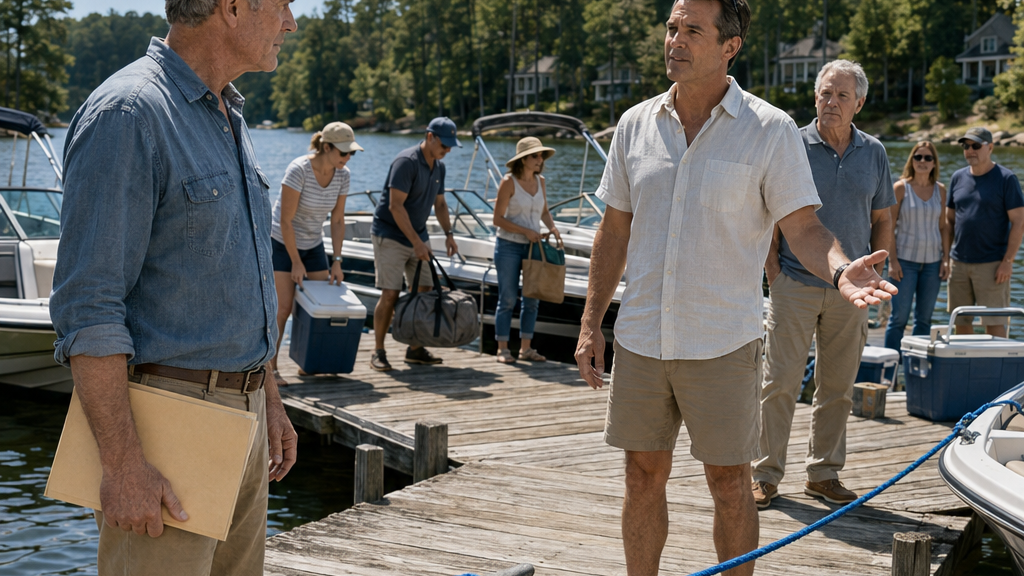
Three boats were tied to Jack Adams’s dock before he had even reached the bottom of his backyard.
He stopped halfway down the gravel path.
A red ski boat rocked against the outer piling. Beside it, a white bowrider sat crooked against two faded rubber bumpers. The third boat, a dark fishing boat with a polished windshield, had been tied to the cleat nearest the steps.
That cleat bothered him most.
A bright blue synthetic rope was cinched around the old galvanized metal, cutting across cedar boards Jack had replaced with his wife years ago.
There were coolers on the dock.
Someone had set a portable speaker beside his tackle box bench.
Six people stood talking as though they were waiting for a table at a marina.
Jack kept walking.
Patrick Baker noticed him first.
“Morning, Jack.”
Patrick stood near the end of the dock in sunglasses and a lake shirt, one hand around a canned drink. He sounded almost relieved to see him.
Jack looked past him.
“Whose boats?”
Patrick glanced around as though the answer were obvious.
“Couple of residents. Couple of guests.”
“I can see that.”
One of the women stepped around Jack carrying a canvas bag toward the lawn.
Jack moved just enough to block the path.
“Excuse me,” she said.
“This is my property.”
She looked toward Patrick.
Patrick gave Jack a small, calming smile.
“We’re only using it until the association dock is finished.”
Jack stared at him.
There had been no call.
No email.
No knock at the door.
The previous summer, one neighbor had tied up for twenty minutes during a storm. In May, Jeffrey Thomas had stopped long enough to pick up his grandson. Jack had said nothing either time.
Three boats and a cooler party were different.
“You didn’t ask me.”
Patrick lowered his voice.
“Jack, this has been done for years.”
“That doesn’t answer what I said.”
Another boat engine approached from beyond the cove.
Jack turned.
A pontoon carrying four people was slowing toward the dock.
Patrick raised an arm and waved them in.
Jack looked at him.
“No.”
Patrick’s hand stayed in the air for half a second.
“What?”
“They’re not tying up here.”
The pontoon driver was close enough now to hear voices.
Patrick walked toward the edge.
“You’re fine,” he called. “Come around this side.”
Jack stepped between Patrick and the cleat.
“I said no.”
Conversation stopped.
The approaching pontoon drifted several yards offshore.
Patrick’s face changed, not dramatically. The friendliness simply left it.
“Jack, don’t do this with everybody standing here.”
“That’s exactly why I’m doing it now.”
A man beside the red boat glanced from one of them to the other.
“We were told this was HOA overflow.”
Jack looked at Patrick.
“By who?”
Nobody answered.
Jack pointed toward the houses behind the trees.
“The HOA owns property over there. It owns the clubhouse lot. It owns the common shoreline parcel where you’re building the new dock.”
His finger lowered toward the boards beneath them.
“This isn’t that property.”
Patrick exhaled.
“You know what I mean by overflow.”
“No. I know what overflow parking is. I know what temporary access is. I know what permission is. Nobody asked for any.”
The woman with the canvas bag slowly carried it back toward the white boat.
That gave Jack a small sense of relief. Not victory. Just proof that someone had heard him.
Then Jeffrey Thomas spoke from behind the group.
“Jack.”
Jeffrey had lived two streets over longer than Patrick had. He was gray-haired now and moved carefully around the uneven edge of the dock.
“You know people have used this place before.”
Jack turned toward him.
“Yes. People have.”
Jeffrey frowned.
“For neighborhood events.”
“Sometimes.”
“So I think that’s where the confusion is.”
Patrick seized on the word.
“Exactly.”
Jack looked down.
The blue rope was pulled so tightly around the cleat that its fibers flattened against the metal.
There was something unpleasant about seeing it there. Not because the rope could damage anything. Because it looked settled.
Permanent.
As if someone had decided the argument before Jack knew there was one.
He crouched and touched the rope.
“Whose line is this?”
The man beside the fishing boat raised his hand.
“Mine.”
“Untie it, please.”
Patrick stepped closer.
“Jack.”
Jack stood.
“No. Everybody needs to hear this once.”
The dock went still except for water knocking gently under the boards.
“I have never given the association permission to use this dock as a common facility. I have never told the board it could send boats here. If I let somebody stop here before, that was me allowing somebody to stop here. It wasn’t a transfer of anything.”
Patrick folded his arms.
“You’re changing an established practice without notice.”
“I’m correcting an assumption.”
“Same result.”
“No, Patrick. It isn’t.”
Jack had intended to stop there.
His old habit was already pulling at him—the instinct to end the conversation before it became a scene, go back to the house, and send an email later.
That habit had probably helped create this mess.
So he stayed.
The owner of the fishing boat bent down and began untying the blue rope.
The pontoon offshore turned slowly away.
Patrick watched it go.
“You realize people scheduled around having access today.”
Jack almost laughed.
Instead he said, “Then whoever told them they had access created a problem.”
Patrick’s jaw tightened.
“We have a standing arrangement.”
Jack looked directly at him.
“Show it to me.”
Patrick said nothing.
“Lease. Easement. License. Board agreement. Whatever you’re relying on.”
“Carolyn has the records.”
Carolyn Lewis managed the association from an office near the clubhouse.
Jack nodded.
“Good.”
Patrick seemed surprised.
Jack pointed toward the remaining boats.
“Then we’ll look at those records. Until we do, nobody else ties up here.”
Patrick studied him for a long moment.
“You’re going to make this a lot bigger than it needs to be.”
Jack looked down again at the empty cleat where the bright rope had been.
“No,” he said. “I think it already got bigger while I was keeping quiet.”
Patrick picked up his drink.
“The agreement is in the association files. Carolyn will have it.”
Jack watched the boats push away from his dock one at a time.
For the first time that morning, the water beside the cedar boards was empty.
But now there was a harder question than why his neighbors had been using his dock.
There was supposedly paperwork saying they could.
Chapter 2: The Agreement Nobody Could Produce
Carolyn Lewis called Jack at 9:17 Monday morning.
He had expected to wait several days.
“Do you have a minute?” she asked.
Jack set down his coffee.
“That depends.”
There was a short pause.
“I’ve been through the current property files.”
“And?”
“I think you should come over.”
That was not the answer Patrick had promised.
An hour later Jack sat across from Carolyn in the association office with a yellow folder on his lap. Through the window, he could see the clubhouse parking lot and, beyond the trees, a thin stripe of lake.
Carolyn had three binders open across her desk.
She looked tired.
“I want to be precise,” she said. “I’m not telling you there was never an arrangement.”
“You’re telling me you can’t find one.”
“I can’t find a recorded easement. I can’t find a lease. I can’t find a signed license agreement.”
Jack leaned back.
“What can you find?”
Carolyn slid a page toward him.
Minutes from an old board meeting.
A paragraph halfway down referred to temporary shoreline access during construction work near the association’s original launch area.
No lot number.
No property description.
No duration.
No signature from Jack.
Carolyn tapped the page.
“There are references like this.”
“References aren’t rights.”
“I understand.”
“Does Patrick?”
Her expression tightened slightly.
“I’m still reviewing the older files.”
Jack looked at the binders.
“Patrick told residents Saturday that the HOA had an arrangement.”
“He may believe that.”
“That’s not what I asked.”
Carolyn closed one binder.
“Jack, I started managing this community four years ago. The dock use predates me. When I came in, people already referred to it as overflow access.”
“And nobody checked?”
“I assumed the board had.”
Jack let the silence sit between them.
Carolyn did not defend herself.
That made it harder to stay angry with her.
She turned her computer monitor toward him and opened a parcel map.
Jack’s lot ran from the road behind his house to the shoreline. The dock extended into the water from his parcel.
The neighboring common area was clearly separate.
“This matches county GIS,” Carolyn said. “Your dock isn’t listed among the association amenities.”
Jack nodded once.
He had known that.
Still, seeing it on the manager’s screen made the argument feel less like an opinion.
“So that’s it.”
“No.”
Jack looked at her.
Carolyn pulled another folder from a box beside her desk.
“That’s why I asked you to come in.”
Inside were old association newsletters.
Some were photocopies. Others had been printed from archived digital files. Their dates went back more than a decade.
Carolyn handed him one.
Jack scanned a paragraph about a summer picnic.
Residents were told that limited boat access would be available near the Adams property during the event.
Another newsletter mentioned storm-season emergency docking.
A third referred casually to “the neighborhood dock.”
Jack’s stomach tightened.
“That isn’t what it was.”
“I know what your deed says.”
“I mean we never called it that.”
Carolyn watched him.
“You remember allowing access?”
“Individual people. Sometimes.”
She gave him another sheet.
A board note thanked local homeowners for helping during a period when shoreline repairs had closed the association’s small launch.
Jack recognized the year.
His wife had still been alive then.
For a few seconds the office disappeared under the memory of wet towels draped over porch rails and people carrying folding chairs across his lawn. Back then, neighbors came to the door.
They asked.
His wife would call from the kitchen, “Jack, tell them yes before they wear out the doorbell.”
He had almost forgotten.
Carolyn said, “The problem is that the documentation gets less specific as the years go on.”
Jack looked back at the newsletters.
The earliest references said temporary.
Later ones simply said access.
The newest said overflow docking.
The language had changed without any obvious decision causing it.
“How did temporary turn into permanent?”
“I don’t know yet.”
Jack stood and walked to the window.
Downhill through the trees, he could just make out his dock.
The cleats were empty.
Sunday afternoon, he had photographed each one after the last boat left. He had taken pictures of scuffing on the boards, a loose bumper bracket, and a bent screw where someone had tied a heavy line too low.
He had thought the photographs proved the simplicity of the issue.
My dock. Their boats.
Now a stack of newsletters complicated that neat picture.
Carolyn spoke behind him.
“There’s one thing working in your favor procedurally.”
Jack turned.
“If the HOA believed it had permanent access, I should be able to find something stronger than newsletters and meeting references.”
“Meaning?”
“Meaning I haven’t found any document that gives the association a property interest.”
Jack returned to the desk.
“So Patrick was wrong.”
“Possibly.”
“Carolyn.”
“He was wrong to tell you I had an agreement ready to produce.”
That was enough for now.
Jack gathered the photocopies.
Carolyn placed her hand on the top sheet.
“I’d rather you not treat this as proof of bad faith yet.”
“I didn’t say I would.”
“You don’t have to. I’ve managed enough disputes to recognize the face.”
Despite himself, Jack almost smiled.
She released the papers.
“I’m going through archived board boxes tomorrow. There are older materials that were never digitized.”
“What are you looking for?”
“Something showing where the practice began.”
Jack thought about Saturday, about Patrick telling another boat to come in after Jack had already objected.
“I’m more interested in who decided it could continue.”
“That may be a different question.”
Tuesday afternoon, Carolyn emailed him three scanned pages.
Jack opened them at the desk in the room he still called the study, though most of the shelves now held tax records and tools instead of books.
The first two pages were ordinary.
Then he opened the third.
It was a summer newsletter from years earlier.
At the bottom was a photograph of neighbors carrying picnic supplies near the shoreline.
Jack recognized his own dock.
Under the picture, one sentence stopped him.
The association thanked the Adams family for providing lake access to neighbors during community activities.
Jack read the sentence again.
Not Jack.
Not his wife.
The Adams family.
His eyes moved toward the framed photograph on the shelf beside his computer.
He and his wife were standing at the end of the dock, both younger, both squinting into the sun.
For two days Jack had been demanding to know what agreement the HOA possessed.
Now he had to answer a more uncomfortable question.
What, exactly, had he once told everyone they could use?
Chapter 3: What Jack Had Once Allowed
The photograph had been taken on the dock.
Jack knew that before he remembered the day.
He found it Wednesday morning in a storage box beneath old insurance papers. Eight people stood behind him and his wife, some holding paper plates, one man barefoot on the cedar boards. A child sat on the edge with his feet in the water.
Jack’s wife had written the year on the back.
He remembered the picnic then.
He remembered saying yes.
That was the part he had not wanted to find.
He carried the photograph outside.
The dock creaked under his weight as he walked to the outer corner.
One of the cleats moved when he tested it.
“Of course you do,” he muttered.
He returned with a wrench and crouched beside it.
The cleat had been installed more than fifteen years earlier.
His wife had held the bolts underneath while Jack tightened them from above. She had complained that the metal was hot in the sun and accused him of measuring everything three times.
“You’re building a dock,” she had told him. “Not a bridge to Canada.”
He could hear the line with irritating clarity.
Jack tightened the loose fastener.
The memory made the dispute feel less clean.
They had allowed neighbors to dock during storms because the common launch had poor shelter.
They had let families stop during the summer picnic.
Once, when a tree blocked the road after heavy weather, several residents had come across by boat.
Nobody had signed anything because nobody imagined signatures were necessary.
People asked.
Jack and his wife answered.
That had been the arrangement.
The problem was that an arrangement built on asking could disappear once nobody remembered to ask.
Jeffrey Thomas was sitting on his front porch when Jack walked over that afternoon.
He looked at the photograph before Jack finished explaining.
“I remember that picnic.”
“So do I now.”
Jeffrey gave the picture back.
“You two were generous.”
“Generous isn’t the same as giving the dock away.”
“I didn’t say it was.”
Jack remained standing.
Jeffrey motioned toward the other chair.
Jack sat.
For several seconds neither man spoke.
Finally Jack asked, “When did people stop asking?”
Jeffrey rubbed his thumb along the rim of his coffee mug.
“That’s hard to answer.”
“Try.”
Jeffrey sighed.
“At first everybody knew it was your place. Somebody would call you. Or knock.”
“And later?”
“Later there were board events where somebody had already talked to somebody.”
“Meaning?”
“Meaning each person assumed the permission happened somewhere else.”
Jack looked toward the lake through the houses.
Jeffrey continued.
“Then after your wife died, you stopped coming to most association things.”
“That doesn’t transfer property.”
“No.”
“But?”
Jeffrey looked uncomfortable.
“But you also stopped objecting.”
Jack’s jaw tightened.
“I wasn’t paying attention to who tied up for twenty minutes.”
“I know.”
“Because I had other things going on.”
“I know that too.”
Jack heard irritation in his own voice and disliked it.
Jeffrey had not caused this.
He lowered his tone.
“Tell me how Patrick got from that to sending people down there.”
Jeffrey leaned back.
“The common dock project.”
“What about it?”
“Once the old association access got torn out, people needed somewhere to stop. Patrick started treating yours as the familiar alternative.”
“Without asking.”
“I don’t know who he asked at first.”
Jack gave him a look.
Jeffrey raised a hand.
“I’m not defending him. I’m telling you how people saw it.”
That distinction mattered.
Jack forced himself to listen.
Jeffrey explained that newer residents had never known the original arrangement. They had attended picnics where boats appeared beside Jack’s property and received HOA emails referring to temporary access. Some simply assumed the dock belonged to the association.
“Patrick didn’t invent the whole idea,” Jeffrey said.
Jack looked down at the old photograph in his hand.
That was the truth he had been resisting.
The confusion had roots.
Some of those roots belonged to him.
He had preferred informal arrangements when life was easier. He had been proud of being the neighbor who did not make everything a rule.
After his wife died, he had withdrawn without formally ending practices they had started together.
Silence had been easier than telling people that everything felt different now.
And other people had filled that silence with their own interpretation.
Jack said, “Saturday, I was ready to assume every person down there knew exactly what they were doing.”
“Some probably didn’t.”
“That doesn’t make it okay.”
“No.”
“But it makes it different.”
Jeffrey nodded.
Jack studied the photograph again.
His wife’s hand rested on his shoulder.
For years he had thought protecting the dock meant preserving it exactly as it had been when she was alive.
But she had invited people there.
What she had not done was surrender the right to choose.
Jack folded the photograph carefully.
“When did you first realize Patrick thought he had authority?”
Jeffrey’s expression shifted.
It was small, but Jack saw it.
“What?”
Jeffrey stared into his coffee.
“There’s something I figured you remembered.”
“That usually means I don’t.”
“Last summer. After that holiday weekend.”
Jack waited.
“You came down to my place because two boats had been tied up overnight.”
He remembered the boats.
One had left trash near the steps.
Jeffrey continued.
“Patrick was there.”
Jack’s eyes narrowed.
“You told him directly that the casual use needed to stop.”
The memory returned in pieces.
Patrick standing beside Jeffrey’s driveway.
Jack angry, but trying not to sound angry.
He had said he was tired of finding boats at the dock when nobody had asked.
Patrick had said he would handle it.
Jack leaned forward.
“What exactly did I tell him?”
“That people needed your permission from then on.”
“You’re sure?”
“I was standing three feet away.”
Jack felt something inside the dispute shift.
The historical confusion still mattered.
His own silence still mattered.
The newsletters still explained why ordinary residents might have believed they were welcome.
But Patrick was no longer one of those residents.
“He knew,” Jack said.
Jeffrey gave a reluctant nod.
“He knew you wanted the practice stopped.”
Jack stood.
“Then why is he still telling people they can use it?”
Jeffrey did not answer immediately.
When he finally spoke, his voice had lost its easy neighborly tone.
“You should ask him what happened to the new association dock.”
Chapter 4: The Temporary Solution That Became Permanent
Jack expected a records meeting.
Instead, when he entered the clubhouse the following Monday evening, twelve residents were already sitting in folding chairs facing the board table.
Patrick Baker stood near the wall with his arms crossed.
A woman in the front row turned toward Jack as soon as he stepped inside.
“So are we really losing lake access this weekend?”
Jack stopped.
Carolyn Lewis, seated behind an open binder, looked as surprised by the question as he was.
“I thought this meeting was about the property records,” Jack said.
“It is,” Carolyn replied.
Patrick pushed away from the wall.
“But people heard there might be changes.”
Jack looked at him. “From who?”
Patrick did not answer.
A man near the aisle said, “Some of us bought boats because this neighborhood was advertised as having lake access.”
“The association has lake access,” Jack said.
“Not right now.”
That came from another resident.
Patrick stepped forward before the exchange could spread.
“This is exactly the problem I’ve been trying to explain to Jack.”
Jack pulled out a chair but did not sit.
“No. The problem you’ve been explaining to people is that my dock is your temporary solution.”
Patrick’s face tightened.
“Because it has been used that way.”
“And last summer I told you it needed to stop.”
A few residents looked toward Patrick.
He glanced at Jeffrey Thomas, who sat in the back row.
Jeffrey did not look away.
Patrick said, “You said you were tired of overnight boats. That is not the same as saying nobody could use the dock under any circumstance.”
Jack felt his own temper rise.
He wanted to tell Patrick exactly how convenient that interpretation was.
Instead he put both hands on the back of the chair.
“I told you people needed my permission.”
Patrick spread his hands.
“And historically the neighborhood had permission.”
“Historically people asked.”
Carolyn closed the binder.
“Can we stay with what the records establish?”
The room quieted.
She laid out photocopies of old minutes and newsletters.
“There is documented history of residents being allowed to use the Adams dock during particular events and disruptions. There is no easement, lease, license, or recorded association property right that I have found.”
Someone in the front row asked, “So we never had access?”
Carolyn chose her words carefully.
“You had use. That is not necessarily the same thing as a continuing legal right.”
The distinction landed badly.
Murmuring spread across the room.
Patrick leaned toward the table.
“Which is why pulling the plug without notice creates a mess.”
Jack looked at him.
“Pulling the plug?”
Patrick’s voice sharpened.
“People planned around access, Jack.”
“They planned around something you didn’t own.”
The room went quiet again.
Carolyn glanced toward Jack, a warning in her expression.
He knew what it meant.
Do not turn this into a performance.
That was exactly what he had always tried to avoid.
But Patrick had turned his dock into a public expectation while Jack had been avoiding scenes.
Jack forced himself to sit.
Carolyn passed him another document.
“This is the current construction status for the common dock.”
Jack scanned the first page.
The project had been approved months earlier. The completion date had been revised twice.
Then he saw the figures.
“This is over budget.”
Patrick looked at the table.
The HOA treasurer cleared his throat.
“Material costs changed. There were permitting delays.”
“How far over?”
The treasurer gave a number.
Several residents reacted at once.
Jack looked at Patrick.
Now the pressure made sense.
The unfinished common dock was not simply late. It was a visible promise Patrick had made during his term as board president, and every delayed week left residents asking why their dues had produced pilings without a platform.
Jack said, “So my dock became the answer.”
Patrick rubbed a hand over his face.
“It became a bridge.”
“A bridge to what?”
“To finishing what we already committed to.”
Jack stared at him.
Through the clubhouse windows, the unfinished association shoreline was visible between the trees.
After the meeting, Carolyn walked with Jack and Patrick down toward it.
Four bare pilings stood in the water.
A stack of unused lumber sat behind temporary fencing.
Jack’s dock, several properties away, looked almost painfully complete by comparison.
Patrick stopped beside the construction fence.
“You think I enjoy this?”
Jack said nothing.
Patrick pointed toward the empty pilings.
“I told eighty homeowners they’d have proper access by Memorial Day. Then the contractor found a shoreline issue. Then the permit changed. Then the revised estimate came in.”
“That still has nothing to do with my property.”
“I know that now.”
Jack turned toward him.
“Now?”
Patrick held his gaze.
“I know we don’t have the paperwork Carolyn expected.”
“That isn’t the same as knowing you don’t have permission.”
Patrick’s jaw worked.
“What do you want me to do? Send an email tomorrow saying the lake-access plan everybody has relied on was never formalized? Tell residents the board has spent more money and delivered less access?”
“Yes.”
Patrick gave a short, humorless laugh.
“You can say that because you’re not the one answering to them.”
Jack looked at the half-built dock.
For the first time he understood why Patrick had kept stretching the old arrangement.
Not because he believed Jack’s deed was meaningless.
Because Jack’s functioning dock hid Patrick’s failed deadline.
The realization did not make Jack less angry.
It made the anger cleaner.
“You’re asking me to absorb your board problem.”
“I’m asking for two more weekends.”
“No.”
Patrick exhaled.
“One weekend.”
“No.”
“Jack.”
“People can ask me individually. You cannot advertise my dock as association access.”
Patrick looked toward Carolyn.
She said, “That is the clearest temporary position.”
Patrick’s eyes flashed.
“It creates chaos.”
Carolyn replied, “Less than continuing without permission.”
Patrick walked back toward the clubhouse without another word.
Jack watched him go.
He had expected the missing agreement to settle the issue.
Instead, he had discovered why Patrick needed the fiction.
That evening, Jack was standing at his kitchen counter when his phone buzzed.
Carolyn.
He answered.
“I thought you should know before tomorrow,” she said.
Jack set down the glass in his hand.
“What happened?”
“I was copied on a community message Patrick sent about an hour after the meeting.”
Jack went still.
“What did it say?”
Carolyn hesitated.
“That weekend lake access would continue under the existing temporary arrangement while the board reviewed the records.”
Jack looked through the dark window toward the shoreline.
“After I said no?”
“Yes.”
“And after he admitted there was no agreement?”
“Yes.”
Jack’s eyes settled on the faint outline of his dock.
Patrick was no longer relying on an old misunderstanding.
He had been told.
He had heard the answer.
And he had sent the email anyway.
Chapter 5: One Hundred Twelve Dollars for a Clear Boundary
The county shoreline clerk read Jack’s paperwork, then looked over her glasses.
“Have you revoked permission in writing?”
Jack had expected questions about parcel numbers, water frontage, or the age of the dock.
Not that.
“I told the HOA president directly.”
“That isn’t what I asked.”
Jack shifted in the chair.
“No.”
The clerk slid the application back toward him.
“Then I would.”
Jack looked down at the form.
“What difference does that make if it’s my dock?”
“Ownership and notice are different issues.”
She tapped the edge of the paper.
“If somebody can reasonably say they believed they were allowed to moor there, you create unnecessary argument. Written revocation removes most of that.”
Most.
Jack had learned to distrust words like all.
“What happens after that?”
“You register the private facility with us, post the required notice, and document the location.”
“And if somebody ties up anyway?”
“You call the number on the registration instructions. Depending on the circumstances, marine enforcement can verify the violation and order removal.”
Jack folded his arms.
“Impoundment?”
“Potentially.”
The word sat heavier than he expected.
He had come downtown wanting a boundary.
Impoundment sounded like punishment.
The clerk seemed to read his face.
“You don’t have to request enforcement because someone brushes against your dock for five minutes. The system exists for repeated or deliberate unauthorized mooring.”
Jack nodded.
That distinction mattered.
He spent the next hour completing the filing.
The fee came to one hundred twelve dollars.
He stared at the amount on the payment screen.
Months of irritation.
Years of ambiguity.
One hundred twelve dollars for a process nobody at the HOA had bothered to verify.
When the clerk handed him the stamped paperwork, she said, “Keep a copy at the property.”
Jack slipped it into his folder.
“And photograph the notice after you post it.”
“I will.”
“And send written revocation before enforcement becomes necessary.”
Jack almost smiled.
“You really don’t want any gray area.”
“Gray areas are where people spend money arguing.”
That afternoon Jack drafted an email.
He deleted the first version because it sounded angry.
He deleted the second because it sounded like a lawyer pretending not to be angry.
The third was six sentences.
The dock was privately owned.
Prior informal permission was withdrawn.
Future use required Jack’s direct consent.
The HOA had no authority to grant access on his behalf.
The notice would be posted Friday.
Unauthorized mooring after that point could result in removal under county procedure.
He sent it to Patrick, Carolyn, and the board.
Patrick replied eighteen minutes later.
This escalation is unnecessary and damaging to community relations.
Jack read it twice.
He did not answer.
Friday morning he carried a laminated notice, a tape measure, and his old staple gun down the gravel path.
The dock was empty.
He chose the cedar piling beside the cleat that had held the bright blue rope the previous Saturday.
The first staple bent.
Jack pulled it out with pliers.
The second seated cleanly.
He fastened all four corners, stepped back, then photographed the notice with the dock and shoreline visible behind it.
For a moment he felt something close to satisfaction.
Not because the sign was threatening.
Because the boundary was finally visible.
Then he imagined a resident arriving with children, tying up because Patrick had told them they could, and returning later to discover their boat gone.
The satisfaction faded.
Jack did not want strangers learning an expensive lesson because two men had turned a simple conversation into institutional stubbornness.
He called Carolyn.
“Did everybody receive the notice?”
“Yes.”
“Residents too?”
“The board sent a correction this morning.”
Jack paused.
“Patrick?”
“No. I sent it through management.”
“What did it say?”
“That private docks are not association amenities and residents should use only designated access unless they have direct homeowner permission.”
Jack felt some of the tension leave his shoulders.
“That should be enough.”
“I hope so.”
The call ended.
Jack remained on the dock.
He ran his hand over the cedar railing.
His wife would probably have told him the sign looked ugly.
Then she would have asked why it had taken him years to say what he meant.
A voice came from the path.
“So this is where we are?”
Patrick.
Jack turned.
Patrick stopped at the foot of the dock and read the notice.
“You registered it.”
“Yes.”
“For a hundred-dollar dispute.”
“One hundred twelve.”
Patrick stared at him.
“You think that makes it better?”
“No. I think it makes it clear.”
Patrick walked closer.
“Nobody was trying to take your property.”
“Then nobody should have trouble not using it.”
“You know that isn’t what this is about.”
Jack nodded toward the unfinished common dock visible through the trees.
“I know exactly what this is about now.”
Patrick’s expression changed.
“That project will be finished.”
“Good.”
“In the meantime, you’ve created a community problem.”
“No. I stopped being the solution you never asked me to be.”
Patrick looked at the notice again.
“You’d actually have somebody’s boat removed?”
Jack did not answer immediately.
“If they know they don’t have permission and refuse to leave, yes.”
Patrick gave a slow nod.
“Then I guess everyone knows where they stand.”
“I hope they do.”
Patrick turned and walked back toward the houses.
Jack watched until he disappeared between the trees.
The rest of Friday passed quietly.
At dusk, Jack checked the dock once more. Empty water. Empty cleats.
Saturday morning he made coffee and opened the back door.
For several minutes there was nothing but birds and the low mechanical hum of a lawn mower somewhere uphill.
Then an engine approached across the cove.
Jack set down his mug.
The sound grew slower.
Closer.
He walked outside.
Between the trees he saw the bow of a boat turning toward his dock.
Chapter 6: They Tied Up After the Warning
The rope landed over the cleat directly beneath Jack’s new notice.
He watched from halfway down the path as a man in the bow pulled it tight.
Not beside the sign.
Not at the far end of the dock.
Directly under it.
Jack stopped walking.
A second boat idled twenty feet offshore.
The first boat owner looked up and saw him.
“Morning.”
Jack continued down the path.
“Did you read the notice?”
The man glanced at it.
“Yeah.”
“And?”
He gave an embarrassed shrug.
“Patrick said it’s being worked out.”
Jack looked toward the second boat.
A woman at the wheel was waiting for an answer.
“Worked out how?”
“He said the HOA was disputing it.”
“There is no dispute about whether you have my permission.”
The man rubbed the back of his neck.
“We were told this was still okay for today.”
“By Patrick?”
“Yes.”
Jack felt the last trace of uncertainty disappear.
The history no longer mattered to this moment.
The newsletters did not matter.
His own past silence did not matter.
Patrick had seen the registration notice yesterday.
Management had sent a correction.
And still, residents had arrived believing Patrick could overrule him.
Jack looked at the second boat.
“You shouldn’t tie up.”
The woman nodded and backed away from the dock.
The first man did not untie his rope.
Instead he took out his phone.
“I’m calling Patrick.”
“That’s your choice.”
Jack remained where he was.
The man walked several steps down the dock, phone against his ear.
“He says he’s coming.”
Jack almost laughed.
Patrick had spent weeks turning every boundary into a meeting.
Jack took out his own phone.
The number from the county paperwork was already saved.
His thumb hovered over it.
The man noticed.
“You’re seriously calling enforcement?”
“I told you before you tied up.”
“I was told I could.”
“And now you’ve been told you can’t.”
The man looked at the sign, then at Jack.
“This is ridiculous.”
Jack could have ordered him off again.
He could have untied the rope himself.
He could have waited for Patrick and restarted the same argument in front of another group of residents.
Instead he made the call.
He gave the registration number, property location, and circumstances exactly as the clerk had instructed.
The dispatcher asked whether the boat owner was present.
“Yes.”
“Has he been told to leave?”
“Yes.”
“And the vessel remains secured?”
Jack looked at the taut rope.
“Yes.”
When he ended the call, the man shook his head.
“You’re going to cost me money over this.”
Jack looked at him.
“I’m asking you to untie your boat.”
The answer came slowly.
“I’m waiting for Patrick.”
That choice mattered.
Jack stepped away.
Ten minutes later another resident arrived on foot, followed by a couple carrying a cooler. Nobody moved onto the dock after reading the notice.
Then Patrick appeared.
He came fast down the path.
“What did you do?”
Jack looked at him.
“I followed the procedure.”
Patrick turned toward the boat owner.
“Why didn’t you leave?”
“You told me this was still being reviewed.”
“It is.”
Jack said, “No. The HOA’s policy might be reviewed. My permission isn’t.”
Patrick pointed toward the house.
“Can we talk privately?”
“We already did.”
The rumble of another engine crossed the water.
This one was deeper.
Everyone turned.
A marine patrol boat entered the cove at low speed.
The boat owner swore under his breath.
Jack felt no triumph.
That surprised him.
For days he had imagined this moment as the point where Patrick finally understood consequences.
Instead Jack saw the owner’s face and thought about storage fees, retrieval charges, and the possibility that the man had simply trusted the wrong person.
The officer secured the patrol boat and stepped onto the dock.
Jack handed over the registration paperwork.
The officer read the notice, checked its placement, then spoke separately with the boat owner.
Patrick tried to join the conversation.
The officer raised a hand.
“One at a time.”
The second recreational boat had drifted farther out into the cove.
Its driver watched from a distance.
After several minutes, the officer returned to Jack.
“He’s been instructed to remove the vessel.”
Jack nodded.
That was all he wanted.
Then the owner said, “I’m not leaving until the HOA president figures this out.”
Patrick turned toward him.
“Just move it for now.”
The man stared.
“You told me I had the right to be here.”
“I said the association was challenging the restriction.”
“No. You said I was fine.”
The words landed harder than anything Jack could have said.
Patrick’s face flushed.
The officer looked between them.
“You were advised by the property owner to leave before I arrived?”
The boat owner hesitated.
“Yes.”
“And you declined?”
Another pause.
“Yes.”
The officer’s tone remained even.
“Then this is no longer an innocent-access issue.”
Jack looked at Patrick.
Patrick looked away.
The officer explained the next step. If the vessel remained, it could be removed to the authorized impound facility.
The boat owner finally moved toward his line.
For one second Jack thought the entire thing might end there.
Then another man came running down the path.
“My boat’s on the other side.”
Jack turned.
A second vessel had tied to the far end while everyone was focused on the first.
The man pointed toward Patrick.
“He told me the same thing.”
Silence spread across the dock.
Patrick closed his eyes.
Jack looked at the two ropes.
Two boats.
Two owners acting on Patrick’s assurance.
The officer asked Jack quietly, “Do you want to request formal removal if they refuse?”
Jack stared across the water.
This was the power he had wanted.
Now that he had it, it felt less satisfying than he had imagined.
He faced both owners.
“I’ll give you one chance. Untie now, and I won’t request anything.”
The first man looked at Patrick.
Patrick said nothing.
The second owner frowned.
“So we paid dues for lake access and now we’re supposed to just leave?”
Jack answered, “Your dues aren’t paid to me.”
Neither man moved.
The officer waited.
Jack understood then that backing down would not restore neighborliness. It would simply recreate the same uncertainty, except this time everybody would know the posted boundary could be ignored.
He nodded to the officer.
“Proceed.”
The removal took almost an hour.
There was no dramatic confrontation.
Lines were transferred.
Paperwork was completed.
The two owners argued mostly with Patrick.
By the time the patrol boat escorted the vessels from the cove, the dock was nearly silent.
Jack stood beside the notice watching the wakes flatten behind them.
He should have felt vindicated.
Instead he picked up one of the loose mooring ropes left on the boards and coiled it slowly.
Patrick had caused this.
But Jack had made the final decision.
That distinction mattered too.
Carolyn arrived by car just as the patrol boat disappeared around the point.
She walked down and looked at the empty water.
“It happened?”
Jack nodded.
“Two.”
Patrick had already started up the path.
Carolyn called after him.
He did not turn.
Jack set the coiled rope on the bench.
“What happens to the owners?”
“Retrieval fee. Storage if they don’t collect them quickly.”
Jack rubbed his thumb along the rope.
Carolyn said, “You gave them a chance.”
“I know.”
But knowing did not erase the cost.
A few minutes later Carolyn left to contact the board.
Jack remained on the dock.
He looked at the laminated notice, the empty cleats, and the water where the boats had been.
For the first time in weeks, nobody was challenging his ownership.
Yet the victory felt incomplete.
Then he heard footsteps on the gravel.
Not hurried now.
Heavy.
Jack turned.
Patrick was walking back down the path alone.
He had no phone in his hand, no folder, no residents behind him.
He stopped several feet from the dock.
His voice was quieter than Jack had heard it all morning.
“I need you to help me fix what just happened.”
Chapter 7: The Price of Calling It Community Property
Patrick did not look angry when he reached Jack’s porch.
That unsettled Jack more than anger would have.
Patrick stood at the bottom step with both hands empty.
“I need you to help me fix what just happened.”
Jack stayed near the screen door.
“The boats were removed because their owners refused to leave.”
“I know.”
“They were warned.”
“I know that too.”
Patrick looked past Jack toward the lake.
“The association is going to reimburse them.”
Jack said nothing.
Patrick continued.
“I can get the board to cover the retrieval fees. Maybe the first day of storage if they don’t get there in time.”
“That sounds like a board decision.”
“It can be.”
“Then why are you here?”
Patrick finally looked at him.
“Because if you tell them this was a misunderstanding, we can contain it.”
Jack almost answered too quickly.
That had always been his weakness: letting people offer a softer version of an ugly situation because the softer version made the next conversation easier.
He folded his arms.
“It stopped being a misunderstanding yesterday.”
Patrick’s shoulders dropped slightly.
“I’m trying to keep two residents from turning this into a legal fight.”
“Then tell them the truth.”
Patrick gave a small, tired laugh.
“You think the truth makes this cleaner?”
“Yes.”
“No, Jack. It makes everyone look worse.”
Jack stepped onto the porch.
“Everyone?”
Patrick glanced toward the road.
“The board looks incompetent. I look like I overreached. You look like you let this happen for years and then suddenly decided to enforce it with marine patrol.”
The words hit harder because part of them was true.
Jack felt the old instinct to defend himself.
Instead he said, “I did let too much slide.”
Patrick seemed surprised.
Jack continued.
“I should have put the boundary in writing a long time ago. I should have corrected people instead of assuming they knew what I meant.”
Patrick nodded.
“Exactly.”
“But that doesn’t erase what happened after I corrected you.”
Patrick’s face hardened again.
Jack went inside, picked up the coiled mooring ropes from beside the mudroom bench, and carried them back out.
He placed them on the porch rail.
“These came off the boats.”
Patrick looked at them.
“You knew Friday.”
Patrick said nothing.
“You saw the notice. Carolyn sent the correction. I told you directly. And you still told those owners the HOA would sort it out.”
Patrick rubbed both hands over his face.
“I thought you’d back off once you realized how much disruption this was causing.”
Jack stared at him.
“So you tested it.”
“I was trying to buy time.”
“With my property.”
“With a community problem.”
“There it is again.”
Patrick frowned.
“What?”
“You keep saying community as if that changes ownership.”
Patrick stepped closer.
“For two years I’ve had residents asking when the new dock will be finished. Every month the answer got worse. Permit delay. Contractor delay. Cost increase. People are angry about dues. They’re angry about the board. Every weekend somebody asks me why they’re paying for access they can’t use.”
“And you decided my dock could absorb that anger.”
Patrick’s silence answered.
Jack looked at the ropes.
“You didn’t need my permission. You needed me not to object.”
Patrick’s voice dropped.
“I needed another month.”
“You had a year.”
“That project wasn’t supposed to fail.”
The sentence came out without defense.
For the first time, Patrick looked less like the HOA president and more like a man who had been standing too long in front of a promise he could not fulfill.
Jack understood him.
That did not excuse him.
“I’m not helping you call this a misunderstanding.”
Patrick’s jaw tightened.
“What do you want?”
“A board meeting.”
“We can meet Monday.”
“Emergency meeting.”
Patrick gave him a sharp look.
“Today?”
“Today.”
“That’s excessive.”
“So was telling people to ignore a posted private-property notice.”
Patrick looked toward the lake again.
Jack said, “If you want the reimbursement issue handled, put it in front of the board. Put the dock issue in front of the board too.”
“And say what?”
“The truth.”
Patrick laughed once, but there was no humor in it.
“You really think everyone wants the truth?”
“No. I think they need a rule.”
By early evening, folding chairs filled the clubhouse again.
This time the mood was different.
The two boat owners sat together near the front. Carolyn had a stack of printed materials. The HOA treasurer kept checking figures on a calculator.
Jack carried the two coiled ropes inside.
Patrick saw them and frowned.
“You brought those?”
“Yes.”
Jack set them on the board table.
One was the bright blue line from the week before.
The other was gray and stiff with age.
They looked ordinary.
That was the point.
Carolyn opened the meeting by reading a summary of the property records and the written revocation Jack had sent.
Then she described what had happened that morning.
No speeches.
No dramatic accusations.
Just dates.
Notice.
Refusal.
Removal.
When she finished, Patrick leaned toward the microphone.
“I want to say something.”
The room shifted.
Patrick looked at the two boat owners.
“I told you the access issue was still being reviewed.”
One of them shook his head.
“You told me I was fine.”
Patrick swallowed.
“Yes.”
He looked down.
“That was my mistake.”
The room went very quiet.
Jack had expected resistance.
He had not expected that.
Patrick continued.
“I believed we could preserve the temporary practice until the common dock was operational. I knew by Friday we did not have a written access right. I still thought the board’s historic use gave us room to negotiate.”
Jack watched him.
Patrick’s fingers tightened around the edge of the table.
“I also did not want to send another message telling residents the dock project had failed another deadline.”
There it was.
Not hidden in a file.
Not forced out by a witness.
A choice.
Patrick had known where the line was and stepped over it because admitting failure felt worse.
The treasurer looked at him.
“You authorized use after management sent the correction?”
Patrick nodded.
“Yes.”
Murmurs moved through the room.
Jack stood.
Several people turned toward him.
He felt the temptation to let Patrick carry all of it now.
That would have been easy.
Instead Jack said, “There’s something else people should hear.”
Patrick looked up.
Jack touched the bright rope.
“My wife and I did let neighbors use the dock years ago. Storms. Picnics. Short stops. We did it informally.”
A woman in the second row said, “So people weren’t making it up.”
“No.”
Jack shook his head.
“They weren’t.”
He looked around the room.
“I should have clarified it when circumstances changed. I didn’t.”
Patrick watched him carefully.
Jack continued.
“But permission that was given informally can still be withdrawn. What I did wrong was wait too long to say it clearly. What Patrick did wrong was continue after I did.”
The distinction settled over the room.
Not equal blame.
But not purity either.
Carolyn opened a draft document.
“This would establish that privately owned docks are not association amenities unless there is a written recorded agreement. It would also prohibit board members or management from granting access on behalf of an owner.”
The treasurer added that the association could reimburse the two boat owners for retrieval charges because they had relied on Patrick’s representation.
One of the owners looked at Jack.
“You’re okay with that?”
Jack nodded.
“I didn’t want you paying for his mistake.”
Patrick looked down.
The board discussed the common dock next.
Funds could be shifted from a postponed landscaping project. The contractor could return sooner if the revised schedule was approved. It would cost more than waiting.
Nobody liked the numbers.
But this time the inconvenience would belong to the association instead of being quietly pushed onto Jack.
The debate lasted nearly an hour.
At the end, Patrick looked toward Jack.
“If we adopt this, is the matter closed?”
Jack looked at the ropes on the table.
He thought about years of saying nothing because saying something felt unneighborly.
Then he thought about the notice beneath those ropes.
“One condition.”
Patrick waited.
“Don’t make it a handshake.”
Carolyn understood first.
Jack pointed to the draft.
“Recorded vote. Tonight. Private docks stay private unless the owner gives written permission. No more temporary assumptions.”
Patrick leaned back.
Around the table, board members exchanged looks.
Then the treasurer raised his hand.
“I move we vote.”
Chapter 8: The Dock Became Private Again
Several weeks later, Jack stood at his kitchen window and watched six boats cross the cove.
None of them turned toward his dock.
The association’s new access platform was finally open two properties down from the clubhouse. It was smaller than originally planned, and the landscaping around it was still unfinished, but boats were tied there in an orderly row.
Jack’s cedar dock remained empty except for his own small fishing boat.
The new HOA policy had passed unanimously that night.
The association reimbursed the two boat owners, paid for the damaged bumper bracket on Jack’s dock, and formally removed every reference to his property from its lake-access materials.
Patrick had stayed on the board.
That surprised some people.
It did not surprise Jack.
A public mistake did not automatically make a person useless.
Pretending the mistake never happened would have.
Jack walked down the gravel path carrying a small tackle bag.
At the dock, he loosened his boat from the old cleat.
The metal no longer shifted.
He had tightened it again after the removal day, then replaced the weathered bolts.
As he lifted the rope free, someone called from the shore.
“Jack?”
Jeffrey Thomas stood at the foot of the path beside an older resident who moved carefully with a cane.
Jeffrey pointed toward the water.
“Mind if I tie up here for about fifteen minutes? I’m helping him get over to his daughter’s place across the cove.”
Jack looked at Jeffrey.
Then at the empty cleat.
Months earlier, the sight of another rope approaching his dock would have tightened something in his chest.
Now the question came first.
That changed everything.
“Sure,” Jack said. “Use the inside cleat. It’s easier to step down there.”
Jeffrey smiled.
“Thanks.”
Jack moved his own boat aside to make room.
The older resident descended slowly, one hand on the railing.
Jack steadied the boat while Jeffrey secured a line.
No assumptions.
No board email.
No argument over history.
Just a request and an answer.
For a moment Jack thought of his wife.
She would have liked this better than the sign.
Not because the sign had been wrong.
Because the sign had finally made generosity possible again.
Jeffrey returned twenty minutes later.
He untied the rope himself.
“Appreciate it.”
“Anytime you ask.”
Jeffrey laughed.
“Message received.”
After they left, Jack stood alone at the end of the dock.
Voices carried faintly from the new association platform.
Someone dropped a cooler lid.
A child shouted from a boat.
The sounds no longer felt like an invasion.
They belonged where they were supposed to belong.
Jack looked down at the old cedar cleat.
No bright blue rope.
No gray line pulled tight by somebody else’s decision.
Only bare metal warmed by the afternoon sun.
For years he had thought being a good neighbor meant making as little trouble as possible.
He understood the mistake now.
A boundary did not destroy generosity.
Sometimes it was the only thing that allowed generosity to remain a choice.
Jack picked up his fishing bag and stepped into his boat.
Behind him, the last borrowed rope had already been removed.
The cleat stood empty beside calm water.
The story has ended.