They Claimed Thirty Feet of His Farm—Then the Survey Line Cut Through Their Showcase Garden
Chapter 1: The Morning Someone Mowed Past David’s Fence
The mower was on David Carter’s side of the fence.
He noticed the tracks before he noticed Gregory Miller.
Two dark green passes cut through the lower hay field, straight and deliberate, each one extending well past the old woven-wire fence that had kept cattle out of the drainage swale since David was a boy. At the far end of the second pass, Gregory turned a riding mower around as if he had been doing it for years.
Beside a small utility trailer lay six cedar posts and a bundle of wooden stakes.
David shut off his tractor.
The sudden quiet made Gregory look up.
He killed the mower and climbed down.
“Morning,” Gregory said.
David walked toward him, boots sinking slightly into the spring-soft ground. “You’re a good thirty feet past your place.”
Gregory glanced at the fence, then at David.
“No, I’m not.”
There was no anger in his voice. That bothered David more than anger would have.
Gregory had bought the neighboring acreage the previous fall. He and Carolyn had spent the winter clearing brush around the house, then started work on what they called their garden parcel when the ground thawed. David had waved to them, helped Gregory free a stuck delivery truck once, and answered a dozen questions about where water collected after heavy rain.
Until that morning, they had been neighbors.
David pointed toward the mower tracks.
“That fence isn’t the property line.”
Gregory rested one hand on the mower seat. “That’s not what we were shown.”
“Shown by who?”
“The seller.”
David looked at the old posts. Some leaned east, some west. One had grown halfway into a cottonwood trunk.
“That fence was put there for cattle.”
Gregory gave a small shrug. “It’s been treated as the boundary a long time.”
“Not by me.”
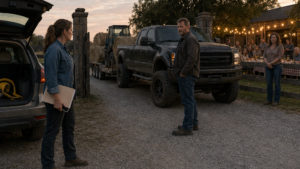
Gregory walked to his trailer and pulled a folder from the passenger seat of his pickup. He opened it on the hood.
There was a county parcel printout, a copy of his deed, and several pages David could not identify from where he stood.
“The line runs along the fence,” Gregory said. “That’s how the property was represented when we bought it.”
David looked at the parcel sketch.
It was the kind of simplified map that could make a creek look straight.
“You need a survey.”
“So do you, apparently.”
David stared at him.
Gregory’s tone was still calm, but something had changed. The conversation no longer felt like two men trying to solve a mistake.
Gregory tapped the folder.
“We’ve maintained this side since we moved in. The previous owner said he did too. There are possession issues when land’s been used openly for years.”
David almost laughed.
“You’ve lived here six months.”
“I’m telling you what I was advised.”
“By an attorney?”
Gregory closed the folder halfway. “I’m telling you I’m not just guessing.”
David looked again at the cedar posts waiting on the trailer.
“What are those for?”
“Garden fence.”
“Not here.”
Gregory’s jaw tightened for the first time.
“Carolyn and I are putting in raised beds. We’re keeping deer out.”
“You can keep every deer in the county out. Just don’t build on my ground.”
For a few seconds neither man spoke.
From the ridge behind David’s barn came the hollow clang of a loose gate chain in the breeze.
Gregory finally said, “Why don’t we split a survey? We get somebody licensed, settle it once.”
It was a reasonable suggestion.
David knew that even as something in him stiffened against it.
For thirty-four years he had watched cattle graze that strip. He had reseeded washed places, replaced drain tile, dragged fallen limbs away from the swale, and paid taxes on the parcel every January. His father had walked it with him when David was sixteen, pointing out where the deed line ran beyond the livestock fence.
A fence wasn’t a deed.
And David hated the idea that Gregory could mow across his field, wave paperwork at him, then ask David to pay half the cost of proving what David already knew.
“I’m not paying to prove my farm is my farm,” David said.
Gregory studied him.
“Then I guess we’ll each do what we think is right.”
David felt the answer land between them.
He should have stopped there.
Instead he said, “I’ve been doing that since before you knew this road existed.”
Gregory’s expression hardened.
“That’s exactly the attitude people warned us about when we moved out here.”
“What attitude?”
“That because you’ve been here longer, your memory counts more than everybody else’s documents.”
David looked at the folder.
“Then you ought to read better documents.”
He turned away before he said more.
By noon, Gregory had moved the mower back to his own side. David told himself that was the end of it.
At school the next day, while students measured steel stock for a welding project, David caught himself correcting the same boy twice.
“Measure from the fixed edge,” he said. “Don’t trust the last guy’s mark.”
The boy grinned. “You told us.”
David stood still with the tape in his hand.
Don’t trust the last guy’s mark.
The irony irritated him enough that he shoved the thought aside.
Two days later, he took the tractor down to the lower field to check a patch of thistle.
The mower tracks were gone beneath fresh tire marks.
Five cedar posts stood in the ground.
Not along the old cattle fence.
Beyond it.
Farther into David’s field.
Gregory had not merely kept working.
He had moved the claimed boundary even deeper.
Chapter 2: The Garden Kept Moving Into the Hayfield
The hostas were gone.
David stopped beside the tractor and stared at the bare strip where a dozen broad green plants had grown beneath the cottonwoods for nearly fifteen years.
Fresh mulch covered the soil.
A cedar fence now ran behind it.
On the other side, Carolyn Miller was kneeling beside a new raised bed, pressing tomato seedlings into dark compost.
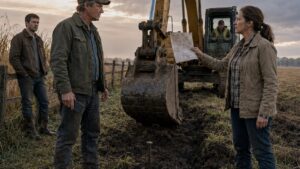
David crossed the field.
“Carolyn.”
She looked up, brushed dirt from her gloves, and followed his gaze toward the missing plants.
“Gregory said those were inside our garden line.”
“They weren’t his to remove.”
Her face changed—not defiant, exactly, but guarded.
“We’re building from the boundary we were shown.”
David pointed toward the cedar fence.
“That isn’t a boundary.”
“It is on everything we were given.”
“You’ve seen a survey?”
“No.”
“Then you haven’t seen a boundary.”
Carolyn stood.
Behind her, the project had grown faster than David realized. Three raised beds were framed in cedar. A load of pale gravel had been spread into a curving path. Metal hoops for row covers leaned against a stack of lumber.
Near the house, a shallow excavation had been lined with black pond membrane.
David looked at it.
“What’s that?”
“Small pond.”
“Small?”
Carolyn gave a tired half-smile. “It looks bigger before the stone goes in.”
He did not smile back.
“Carolyn, you need to stop.”
“David, we put most of our savings into this.”
“That doesn’t move my deed.”
“We aren’t trying to steal from you.”
“Then don’t build on disputed ground.”
She pulled off one glove.
“We bought this place because we wanted to make some income from it. Produce boxes in summer. Maybe two or three garden dinners. Nothing huge.”
David looked at the rows.
For the first time, the project made sense as something more than decoration. They were not just beautifying the yard. They were trying to make the acreage pay for part of itself.
That did not make the fence his.
But it made the situation harder than he wanted.
“Then you should be more careful where you put it.”
Carolyn exhaled.
“We asked about a survey.”
“He asked me to pay for half of one after he mowed my hay.”
“You could still do it.”
David felt his shoulders tighten.
“So this is my fault now?”
“I didn’t say that.”
“You didn’t have to.”
Carolyn looked toward the house.
“Gregory was told that fence was the line when we bought. He walked it with the seller. They stopped at every corner.”
“An old livestock fence isn’t a corner.”
“I know what you’re saying.”
“Do you?”
Her eyes came back to him.
“Yes. I do.”
Something in the way she said it stayed with him.
That afternoon, David photographed everything.
The cedar posts.
The missing hostas.
The new beds.
The stone path.
The beginning of the pond.
He measured from two landmarks he trusted and wrote the distances in a small notebook.
At the kitchen table, he drew the lower field from memory.
The old fence appeared first as a crooked pencil line.
Then he drew where he believed the deed line ran beyond it.
For years, the unused strip between the two had meant nothing more than room for cattle equipment and drainage access.
Now thirty feet of blank paper looked enormous.
Over the next two weeks the garden kept advancing.
Carolyn planted peppers and beans.
Gregory installed more fencing.
Stone arrived for the pond.
A simple pergola frame went up beside the raised beds.
David spoke to Gregory twice.
The first conversation lasted less than a minute.
“I’m documenting all of this,” David said.
“Good,” Gregory replied. “So are we.”
The second happened at the mailbox.
Gregory said, “Our attorney says long-term open use matters.”
“Your attorney also know you’ve been here less than a year?”
“The property history didn’t start when we bought it.”
That stopped David.
“What exactly are you claiming?”
Gregory looked down the road before answering.
“That the strip has been treated as part of this parcel for years. If there’s a discrepancy between old records and actual possession, that’s something lawyers sort out.”
David felt a cold anger replace the hot kind.
“This isn’t a discrepancy. You’re building on land I’ve maintained.”
“And I’m telling you we were sold it.”
Gregory drove away.
Three days later, a certified envelope arrived.
David opened it standing at the kitchen counter.
The letter was formal without being especially long. It described Gregory and Carolyn’s “historic and continuing use” of the disputed strip and warned David against interfering with their improvements while ownership questions were reviewed.
There was no lawsuit attached.
No court filing.
But the words were chosen to sound as if something larger stood just behind them.
Historic.
Continuing.
Possession.
David read it twice.
Then a third time.
The part that angered him most was not the threat.
It was how smoothly the letter turned Gregory’s six months into someone else’s history.
That evening, David walked the lower field alone.
Carolyn had strung small lights under the pergola. They were not turned on, but he could picture them glowing over summer dinners.
Tomato stakes stood in straight rows.
The pond liner had disappeared beneath stone.
David had spent three weeks telling himself this could still be undone with a conversation.
Now every improvement made that less true.
At the old fence, he rested one hand on a post his father had set decades earlier.
His father had never treated it as the property line.
David was certain of that.
But certainty suddenly felt less useful than proof.
Back in the machine shed, he climbed the narrow wooden stairs to the loft.
Dust coated the rafters.
Under a stack of seed-company calendars and an old welding hood sat a gray plastic storage tote.
David dragged it into the light.
Inside were property files going back years—tax receipts, drainage permits, fencing invoices, easement correspondence, county notices, old photographs.
He carried the tote downstairs.
For the first time since Gregory started mowing the strip, David did not feel angry.
He felt methodical.
He set the box on his workbench, opened the lid, and began looking for the oldest piece of paper that described exactly what he owned.
Chapter 3: Nineteen Years Were Sitting in One Plastic Tote
The drainage permit had been issued nineteen years earlier.
David found it at 6:12 Saturday morning beneath a packet of tax receipts and an invoice for two hundred feet of buried tile.
He read the parcel number once.
Then again.
The permit described work along the eastern edge of David’s tract, including the shallow swale beyond the old livestock fence—the same strip Gregory was now fencing into his garden.
David laid the paper flat on the kitchen table.
For three weeks, he had been saying, I know.
This was different.
This said where.
He spent the morning sorting the tote into piles.
Tax statements.
Drainage records.
Farm-insurance correspondence.
Receipts for fence repair.
A utility easement granted years earlier for work that crossed the lower field.
None of the papers alone settled the physical location of the deed line, but together they built a history Gregory’s letter had tried to borrow.
David found an old invoice for clearing storm debris along the eastern parcel edge.
A county notice about drainage maintenance.
Photographs of cattle grazing beyond the fence before the Millers ever saw the place.
He almost smiled when he found a faded receipt for the very fence Gregory believed marked ownership.
The materials had been purchased by David’s father.
The invoice described it simply as “lower cattle fence.”
Not boundary fence.
Not property fence.
Cattle fence.
David leaned back.
There it was.
A small payoff after weeks of being told his memory was just memory.
Then he made himself stop.
At school, he told students not to accept a measurement because they liked the answer.
He could not do that now.
By late morning, he drove to the county recorder’s office with copies of the deed, drainage permit, and several tax records.
The clerk pulled up the parcel history.
David watched from the other side of the counter as lines, numbers, and scanned documents appeared on the screen.
“Your parcel hasn’t changed shape in the recorded history I’m seeing,” the clerk said.
“What about the Miller tract?”
“Same basic configuration since before their purchase.”
“So their land never included this strip?”
The clerk turned the monitor slightly.
“I can tell you what the recorded descriptions say. I can’t locate those descriptions on the ground for you.”
She pulled up the county GIS map.
A colored parcel line appeared over an aerial image.
It ran noticeably beyond the old fence.
David felt vindication rise in him.
Then he saw the small disclaimer printed at the bottom.
Parcel mapping was approximate.
Not a survey.
Not suitable for establishing property boundaries.
The feeling disappeared almost as quickly as it came.
“How accurate is that line?” he asked.
“Accurate enough for tax administration. Not accurate enough to settle what you’re dealing with.”
David looked at the map again.
It appeared to support him.
But “appeared” had become a dangerous word.
The clerk printed the relevant parcel descriptions and slid them across the counter.
“You’ll want a licensed surveyor.”
David gave a humorless laugh.
“I’ve heard that recently.”
On the drive home, he passed Gregory’s place without slowing.
The garden looked almost finished.
The cedar fence had been stained.
The raised beds were green with early growth.
The pond reflected the afternoon light in a perfect dark oval.
David had imagined that finding paperwork would end the uncertainty.
Instead, it had narrowed it.
Gregory’s claim looked weaker.
David’s ownership history looked stronger.
But neither told him precisely where to put his boot and say: here.
At home, he spread the deed descriptions beside his pencil sketch.
The old fence curved.
The recorded calls did not.
That difference bothered him.
His father had always said the fence was set inside the line because the ground closer to the actual edge stayed too wet for cattle.
David remembered hearing it.
But memory was exactly what he had accused Gregory of trusting.
He found himself thinking about the morning Gregory suggested splitting a survey.
David could still hear his own answer.
I’m not paying to prove my farm is my farm.
At the time it had sounded principled.
Now it sounded like pride wearing work boots.
Near sunset, Gregory came to the edge of the cedar fence.
He did not cross it.
David was checking the drainage outlet.
“You’ve been downtown,” Gregory said.
David looked up.
“County records.”
Gregory nodded toward the farmhouse. “Find what you wanted?”
“I found nineteen years of records treating that strip as mine.”
Gregory’s mouth tightened.
“That doesn’t erase what we were told.”
“No.”
The answer seemed to surprise him.
David continued, “But it means I’m done arguing from memory.”
Gregory looked toward the garden.
“So what happens?”
“I get the ground measured.”
Gregory let out a slow breath.
“We could’ve done that three weeks ago.”
David met his eyes.
“Yes.”
It cost him something to say it.
Not land.
Something smaller and harder to surrender.
Gregory nodded once and walked back toward the house.
David waited until he was gone.
Then he carried the paperwork inside and found the number for Deborah Wilson, a licensed surveyor who had worked several farms in the county.
She answered on the fourth ring.
“This is Deborah.”
“Deborah, it’s David Carter.”
A pause.
“Lower Carter farm?”
“That’s right.”
“What did you break?”
“Nothing yet.”
“That’s not much of an answer.”
David looked through the kitchen window at the cedar fence, the raised beds, and the dark oval of the pond.
“I need a boundary survey.”
“Dispute?”
“Yes.”
“Existing monuments?”
“Probably. I don’t trust myself to tell you which ones matter.”
That earned another pause.
Then Deborah said, “Good. That’s why you called.”
She asked for parcel numbers, deed references, and access details.
David gave them to her.
Before hanging up, she said, “Don’t move any stakes. Don’t pull any fence. Don’t let anybody else do it either.”
“I won’t.”
“And David?”
“Yes?”
“Don’t tell me where you think the line is before I run it.”
He looked at his pencil sketch on the table.
“Fair enough.”
When the call ended, David stood for a long moment with one hand resting on the gray plastic tote.
Nineteen years of paper had told him the strip belonged to him.
But the question that mattered now was simpler.
Where, exactly, would Deborah put the first pin?
Chapter 4: The Orange Line Crossed More Than Anyone Expected
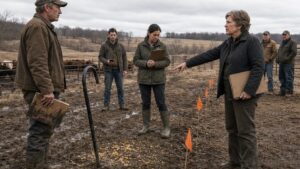
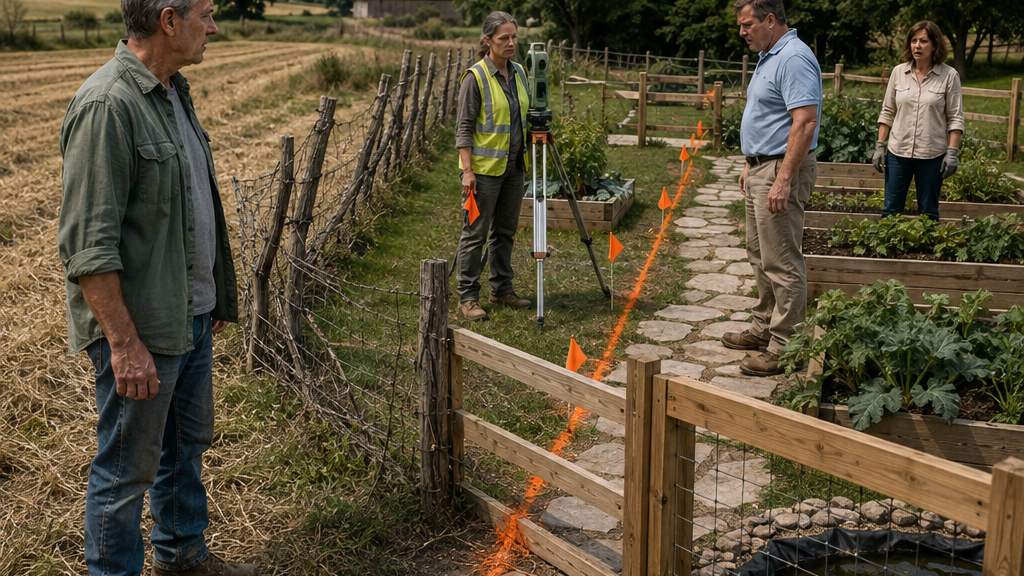
Deborah Wilson’s first pin landed on the wrong side of Gregory’s new fence.
At least, wrong according to everything Gregory had built.
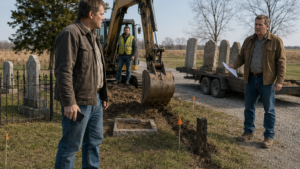
David watched her drive the capped steel marker into firm ground seven feet beyond the cedar boards. The impact of her hammer carried across the lower field.
Gregory, standing near the raised beds with his arms folded, said, “That can’t be right.”
Deborah did not look at him.
“It can be right or wrong after I finish checking it.”
She lifted the prism pole and motioned to her assistant, a role-only crew member David had seen setting equipment near the road. Then she looked at David.
“Same applies to you.”
David nodded.
He had promised himself he would not celebrate early.
Still, seven feet was hard not to notice.
The old woven-wire cattle fence ran crookedly between them, half buried in grass. Gregory’s cedar fence sat farther into the field. Deborah’s first marker sat beyond both.
The three lines told three different stories.
Deborah worked without hurry.
She checked a recorded corner near the county road, then moved toward the back of the parcels. She measured, returned, checked again, and entered numbers into a handheld unit.
Gregory followed at a distance.
David tried not to.
That lasted ten minutes.
When Deborah moved toward the center of the garden, David walked behind her.
“So?” Gregory asked.
“So I’m surveying.”
“You’ve got one pin way off.”
“I’ve got one pin where the evidence puts it.”
Gregory pointed toward the old fence.
“That’s been there for decades.”
Deborah finally looked at him.
“Old doesn’t mean surveyed.”
Gregory’s face tightened.
David said nothing.
Deborah marked another point.
This one fell inside the Millers’ stone path.
Carolyn came out of the house carrying a glass of water. She stopped when she saw where Deborah was standing.
“No,” she said quietly.
Gregory turned.
“What?”
Carolyn pointed toward the orange flag Deborah had just pushed into the gravel.
“That’s through the path.”
“I can see that.”
Deborah moved twenty yards farther.
The next flag went between two raised beds.
The one after that landed near the pergola.
David felt the shape of the dispute changing faster than he could adjust to it.
He had expected the survey to defend the thirty-foot strip.
He had not expected it to keep going.
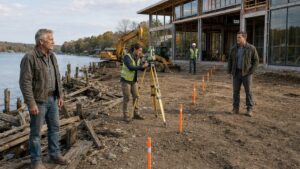
Deborah stretched a temporary orange marking line between two verified points.
It cut across the garden like a sentence nobody had wanted to read.
From David’s hay field, it crossed the cedar fence, ran through the pale gravel path, passed beside the raised beds, then angled toward the black-edged pond.
Gregory walked beside it.
“You’re saying all this is his?”
Deborah said, “I’m saying the recorded boundary is here.”
“That’s not what we bought.”
“That’s a different question.”
Gregory looked at David.
David’s first instinct was to answer with every sentence he had swallowed over the past month.
I told you.
You built anyway.
You sent me a legal letter.
Instead he looked back at Deborah.
“Check it again.”
Gregory blinked.
Deborah’s expression did not change.
“I already planned to.”
“Check every corner.”
“I already planned to do that too.”
David nodded.
Carolyn sat down slowly on the edge of one raised bed.
The tomatoes behind her were nearly knee-high.
Gregory rubbed both hands over his face.
For the next hour Deborah repeated measurements from separate control points.
Nothing moved in Gregory’s favor.
If anything, the later measurements made the problem clearer.
The strip Gregory had claimed was David’s.
So was additional ground on the other side of Gregory’s new cedar fence.
The orange line clipped one corner of the pergola area. It crossed part of the stone path. Two raised beds lay wholly or partly over it.
At the pond, Deborah stopped.
David’s stomach tightened.
The pond had seemed ornamental when Carolyn first described it. Now it was finished with stacked stone and a small recirculating pump. Water plants floated near one edge.
Deborah measured.
Then measured again.
She marked a point several feet into the landscaped bank.
Gregory stared at it.
“How much?”
Deborah checked her field notes.
“The improvement extends across the boundary. Exact dimensions go on the plat.”
“How much?”
“At the widest point I’ve measured so far, you’re substantially inside the Carter parcel.”
Gregory laughed once, but there was nothing amused in it.
“This is ridiculous.”
David looked at the orange line touching the pond.
Weeks earlier he had imagined a survey marker as relief.
Something clean.
Something final.
Instead the line seemed to carry a price tag wherever it went.
Cedar boards.
Stone.
Soil.
Irrigation tubing.
Plants.
Labor.
The pond.
Carolyn’s entire garden plan had been arranged around the wrong assumption.
David should have felt vindicated.
He did feel vindicated.
But not only that.
Deborah handed him a preliminary field sketch.
“The thirty-foot area you’ve been disputing is on your side of the recorded boundary.”
David looked down at it.
That was the answer he had wanted.
The small payoff he had worked toward since seeing Gregory’s mower tracks.
His farm had not shrunk because somebody else spoke confidently.
But the sketch also showed the garden encroachments.
Those were harder to enjoy.
Gregory walked toward the old livestock fence and kicked lightly at one weathered post.
“This doesn’t make sense.”
Deborah packed one instrument into its case.
“It doesn’t have to look sensible. It has to follow the record evidence and monuments.”
Gregory shook his head.
“The seller walked this fence with me.”
David looked up.
Gregory pointed down the old fence line.
“Before closing. We came out here. He showed me every stretch. Said, ‘That’s your east boundary.’ Those were his words.”
Carolyn looked at him.
“You never said he used those exact words.”
“I told you he showed us the line.”
“No. You said he showed you the property.”
Gregory ignored her.
He looked at David instead.
“He walked me from the road to the back corner. This exact fence.”
David glanced from Gregory to the leaning posts.
For the first time, Gregory did not look smug or angry.
He looked genuinely lost.
David remembered the confidence with which Gregory had opened that folder on his pickup hood.
Maybe that confidence had not begun with Gregory.
Deborah closed her case.
“My job ends with where the boundary is. Why somebody believed something else is not part of my survey.”
David folded the preliminary sketch.
Gregory stood beside the old fence with one hand wrapped around the wire.
“You think I’m making that up?”
David looked at the orange line running through the garden.
“No.”
The answer surprised both of them.
Gregory’s grip loosened.
David added, “But I think we need to find out why that fence was treated like a property line when it wasn’t.”
Gregory stared at the marker near the pond.
Then he said, almost to himself, “He sold us this whole garden.”
David looked at the old fence again.
The survey had answered where the land belonged.
It had opened a harder question about how two families had come to believe completely different things about the same strip of ground.
Chapter 5: The Old Fence Had Told Two Different Stories
The old record did not call it a boundary fence.
It called it a livestock setback.
David found the phrase in a county agricultural drainage file three days after the survey.
The document was older than the gray tote in his workshop and had been stored in the county archive with drainage maps from neighboring farms. A hand-drawn notation showed the Carter parcel edge running east of the fence, with a short explanation that livestock fencing had been set inward to avoid saturated ground near the swale.
David read the sentence twice.
So had the recorder clerk.
“That helps explain the physical layout,” she said.
“It doesn’t explain why somebody sold the fence as the line.”
“No.”
David photographed the page.
He should have felt another clean victory.
Instead he thought of Gregory standing beside the pond saying, He sold us this whole garden.
David drove home by the back road.
The orange survey line was still visible from a distance.
It looked almost unnatural against the grass, too bright and too straight.
The old fence wandered beside it.
For decades nobody had cared that the two were different because the unused strip had simply remained part of David’s farm.
A wet margin.
A place to turn equipment.
A place cattle sometimes grazed when the ground was firm.
Then the Millers arrived and treated the visible fence as legal truth.
The mistake had been waiting there longer than any of them.
Gregory was at work when David stopped by the house that afternoon.
Carolyn answered the door.
She looked tired.
David held up copies of the records.
“I found out why the fence is where it is.”
She let him into the kitchen.
The room overlooked the garden. From the table, the orange line could be seen crossing the gravel path.
Carolyn followed his gaze.
“I hate that color now.”
David almost smiled.
“You may hate it more after this.”
He showed her the old drainage record.
Carolyn read slowly.
“So your father put the fence inside the property?”
“Looks that way.”
“For drainage.”
“And cattle access.”
She set the paper down.
“Gregory wasn’t lying about the seller.”
“I didn’t say he was.”
Carolyn looked at him for a long moment.
“You’re being nicer about him than he deserves right now.”
David pulled out a chair but did not sit.
“That’s not the same as saying he’s right.”
“No.”
She folded her hands.
“We should’ve surveyed.”
David waited.
Carolyn continued.
“I told him that before we finished the pond.”
That changed the room.
David sat down.
“When?”
“After you complained about the first posts.”
He looked toward the garden.
“Before the raised beds?”
“Some of them were already framed.”
“Before the stone?”
“Yes.”
David felt his anger sharpen rather than expand.
“You told Gregory to stop?”
“I told him we should verify.”
“And?”
Carolyn looked down.
“He said the seller walked the fence with him, the county map looked close enough, and you were trying to push us around because we’d just moved here.”
David said nothing.
“He also said you’d refused to split a survey.”
That landed where David knew it would.
Carolyn saw it.
“You did, didn’t you?”
“Yes.”
“Why?”
“Because I was angry.”
She gave a small nod.
“Gregory was too.”
“I didn’t build a pond.”
“No.”
The word carried no defense.
Carolyn looked through the window.
“We sold our place outside town. Put more of the money than we should’ve into this property. Gregory wanted it to work fast. I wanted the garden. He wanted to prove we’d made the right decision.”
“And when you told him the line might be wrong?”
“He heard me saying the whole move might be wrong.”
David leaned back.
There it was.
Not a legal secret.
Not a missing deed.
Something worse because it was ordinary.
Gregory had not continued because he secretly knew he owned the land.
He had continued because stopping would have required admitting he might not.
Carolyn’s own hands were not clean either.
“You kept planting,” David said.
She nodded.
“I did.”
“Why?”
“Because every week that passed without something official made it easier to believe maybe Gregory was right.”
David looked again at the orange line.
“And now?”
“Now there’s something official.”
That evening David called his attorney.
He described the survey, the garden, the pond, the old fence record, and Gregory’s letter asserting possession.
The attorney listened.
Then asked, “What do you want?”
“My land.”
“That’s the easy part.”
David frowned.
“What does that mean?”
“The survey supports your boundary. Based on what you’ve sent me, their claim does not look strong. But the physical encroachments need a remedy.”
“Removal?”
“Potentially. Written acknowledgment, relocation, negotiated temporary access, maybe other arrangements depending on what you’re willing to do. But don’t let an improvement remain indefinitely without clear terms if you want to preserve control.”
David looked toward the lower field.
“What if I want it all moved?”
“Then we can demand that.”
“Immediately?”
“We can demand a deadline.”
David imagined the pond drained.
The stone piled.
The cedar beds pulled apart.
For weeks, that picture would have felt satisfying.
Now it felt different.
Not wrong.
Just expensive in ways beyond money.
His attorney said, “You don’t have to decide tonight.”
“I do need to put them on notice.”
“Yes.”
“Thirty days?”
“Reasonable as an opening position.”
They prepared the letter the following morning.
It attached the survey, relevant ownership records, and the old drainage document. It rejected Gregory’s possession claim and required a plan to remove or relocate improvements from David’s property.
David signed it.
The certified envelope went out that afternoon.
For two days, nothing happened.
Then, shortly after five on Friday, a delivery notification appeared on David’s phone.
Received.
David was in the machine shed replacing a hydraulic hose when he heard boots crossing the packed gravel outside.
Not walking.
Coming fast.
He set down the wrench.
Gregory appeared in the doorway holding the certified letter folded lengthwise in one fist.
His face was red.
“You gave me thirty days?”
David wiped his hands on a rag.
“I gave you thirty days to bring me a plan.”
Gregory stepped inside.
“You’re threatening to tear out everything we built.”
“No. I’m telling you it’s on my land.”
“You know what this is going to cost.”
“I know what I asked you to stop building.”
Gregory took another step.
Behind him, across the grass, the orange survey line glowed in the low sun.
Chapter 6: Gregory Came Over Holding the Certified Letter
Gregory slapped the folded letter onto David’s workbench.
“Read your own paragraph.”
David did not pick it up.
“I wrote my name under it. I know what it says.”
“Removal of encroachments. Thirty days.”
“Or an agreed plan.”
“You think moving that pond is a plan?”
“I think building it after I disputed the line was a choice.”
Gregory stared at him.
The machine shed smelled of oil, cut hay, and hot metal. Behind David, a half-disassembled hydraulic fitting sat in a vise.
Gregory pointed through the open doorway.
“You know we can’t move all of that in thirty days.”
“Then don’t waste the first ten arguing with me.”
“I was told that land was mine.”
“And after I told you it wasn’t?”
“You had no survey.”
“Neither did you.”
Gregory’s mouth tightened.
“We had the fence. We had the seller. We had the property as it was presented.”
“And I had a deed.”
“So did we.”
David could feel the argument circling toward the same place it had started.
Two men.
Two versions.
Only now an orange line lay across the ground outside, and neither could pretend there was no answer.
David picked up the letter.
“This is why I got the survey.”
Gregory gave a sharp laugh.
“After refusing one.”
The words hit harder than David expected.
Gregory saw it and pressed.
“You had the chance to settle this before we spent another dollar.”
“You had the chance to stop before you spent it.”
“You told me you wouldn’t pay to prove your farm was your farm.”
“That’s right.”
“You wanted to make a point.”
David set the letter down.
“So did you.”
Silence.
Gregory looked away first.
Then a voice came from outside.
“That’s enough.”
Carolyn was walking toward them from the garden.
Gregory turned.
“Stay out of this.”
“No.”
She stopped at the edge of the orange survey line.
For a moment she did not cross it.
That small hesitation pulled David’s attention more than anything she could have said.
Gregory noticed too.
“Carolyn.”
She looked at him.
“You knew.”
His face changed.
David stayed still.
Carolyn continued.
“You knew we needed to check before the pond.”
“I knew David was complaining.”
“You knew I asked you to call a surveyor.”
“We had the seller’s representation.”
“And David’s objection.”
Gregory looked at David as if he had somehow arranged the conversation.
David said, “I didn’t know this.”
Carolyn stepped over the orange line and came closer.
“I told Gregory after those first cedar posts went in. I said if there was even a chance the fence wasn’t the deed line, we should stop.”
Gregory’s jaw worked.
“You also kept planting.”
“Yes.”
Carolyn did not retreat from it.
“I kept planting because I wanted you to be right.”
That silenced him.
She went on.
“We’d told everybody this was our plan. Produce. Dinners. Maybe workshops later. We’d put the money in. We’d moved. Every time I asked whether we should verify, you heard me saying I didn’t trust you.”
Gregory’s anger collapsed into something smaller.
“I was trying to keep us from throwing away everything we’d started.”
“And now we may have to move it because you couldn’t stand the idea of being wrong.”
He looked toward the garden.
David understood then that Gregory’s arrogance had not come from feeling powerful.
It had come from feeling cornered.
That did not excuse the letter.
Or the fence.
Or the pond.
But it changed the shape of the man standing in front of him.
Gregory rubbed the folded edge of the certified notice with his thumb.
“What do you want from me?”
David almost answered immediately.
Everything moved.
Survey costs.
Attorney fees.
A written acknowledgment.
He had rehearsed those demands in his head.
Instead he looked outside at the orange line.
It crossed the field cleanly.
No emotion in it.
No blame.
Just location.
And beyond it sat the result of three people making choices from pride: Gregory building, Carolyn hoping, David refusing an early survey because he wanted Gregory to understand whose land it was without David having to prove it.
David remembered his classroom.
Measure from the fixed edge.
Don’t trust the last guy’s mark.
He had taught that rule for years.
Then broken the spirit of it when it mattered to him personally.
“I should’ve agreed to the survey the first morning,” he said.
Gregory looked up.
Carolyn did too.
David continued before pride could stop him.
“That doesn’t make your fence mine. Doesn’t make the pond legal. Doesn’t make that letter you sent me reasonable.”
Gregory lowered his eyes.
“But I had a chance to get a neutral answer before this got expensive. I didn’t take it.”
Gregory said, “You didn’t build on my land.”
“No.”
David stepped outside.
The others followed.
He walked until he reached the orange line.
Then he turned.
Gregory remained on the garden side.
For weeks David had imagined this moment as a victory: Gregory finally forced to stand behind the real boundary.
It did not feel like victory.
It felt like responsibility finally becoming visible.
David pointed toward the raised beds.
“Those have to move.”
Gregory nodded reluctantly.
“The fence too.”
Another nod.
“The pond can’t stay across the line permanently.”
Gregory looked toward it.
“That’s the worst one.”
“I know.”
“You want it dug out?”
“I want my boundary restored.”
“Same thing.”
“Not necessarily on the same schedule.”
Gregory looked at him.
David said, “You cover Deborah’s survey. You cover my reasonable legal costs. You acknowledge in writing where the line is. Then you bring me a real relocation plan.”
Carolyn asked, “How much time?”
“I don’t know yet.”
Gregory gave a bitter laugh.
“Very generous.”
David met his eyes.
“No. Generous would be letting it stay. I’m not doing that.”
That stopped the sarcasm.
David continued, “But I don’t need you tearing apart half the garden next week just so I can feel like I won.”
The orange marking line moved slightly in the breeze between them.
Gregory looked down at it.
“So you’re not demanding everything gone in thirty days?”
“I’m demanding a plan in thirty days.”
“And if the plan takes longer?”
“We talk about it.”
Carolyn exhaled.
Gregory did not.
He looked across at David.
“What happens if you don’t like my plan?”
“Then the attorney letter means what you thought it meant when you walked over here.”
For the first time that evening, Gregory gave the smallest nod.
David pointed toward the house.
“Go home.”
Gregory picked up the certified letter.
“You throwing me off your land now?”
David looked at where Gregory stood.
Technically, according to the survey, he was already on David’s side of the orange line.
A month earlier David might have enjoyed saying so.
Instead he said, “I’m giving you until tomorrow.”
“For what?”
“To come back with measurements, costs, dates, and a way to move what needs moving.”
Gregory waited.
David added, “And tomorrow’s conversation starts with a plan. Not possession. Not what the seller said. Not who got here first.”
Carolyn looked at Gregory.
He finally nodded.
“Tomorrow.”
They walked back toward the garden.
At the orange line, Carolyn stepped over first.
Gregory stopped.
He looked down at the bright stripe, then back at David.
For once there was no argument in his face.
Only the uneasy understanding that the next decision could no longer be made by pretending the line was somewhere else.
David returned to the workbench and picked up his wrench.
Through the open machine-shed door, he could see Gregory and Carolyn standing together beside the misplaced cedar fence.
For the first time since the mower crossed his hay field, David was no longer wondering who owned the ground.
He was wondering whether any of them knew how to correct what had happened without turning being right into another kind of mistake.
Chapter 7: The New Boundary Stayed After the Anger Left
Gregory came back the next morning carrying a yellow legal pad instead of a folder from an attorney.
He stopped at the orange line.
“I measured everything,” he said.
David set down the mineral bucket he had been carrying toward the pasture.
Gregory held out the pad but did not cross the line to give it to him.
That detail did not escape David.
He walked over and took it.
The first page contained measurements of the cedar fence, raised beds, stone path, pergola corner, and pond bank. Beside each item Gregory had written a proposed date.
“You did this last night?”
“Most of it.”
Carolyn stood farther back near the garden with a coffee mug in both hands.
Gregory pointed at the list.
“Fence can be moved first. Raised beds after that. Pergola corner is simple. Pond isn’t.”
David read the dates.
The plan stretched over almost two months.
“The tomatoes stay until when?”
“Three weeks.”
David looked toward the beds. Green fruit already hung beneath the leaves.
Gregory said, “We can tear them out tomorrow if that’s the condition.”
There was no challenge in it.
David looked back at the page.
“No.”
Gregory waited.
“Finish the crop.”
Carolyn lowered her mug.
David continued, “You don’t plant anything else there. When what’s growing is done, the beds move.”
Gregory nodded.
“And the fence?”
“Start this week.”
“Survey costs?”
“You cover them.”
“Attorney?”
“Reasonable costs related to the boundary dispute.”
Another nod.
David tapped the page where Gregory had written POND.
“This needs more than a date.”
Gregory exhaled.
“The liner crosses your line. If I pull the stone and shift the bank, I can probably move the edge without rebuilding the whole thing.”
“Probably isn’t enough.”
“I know.”
“Have whoever’s doing it mark the new edge before they touch anything.”
Gregory glanced at the orange stripe beneath their boots.
“Using this?”
“Using Deborah’s permanent points.”
That afternoon, Deborah returned.
She replaced temporary markings with capped monuments at the important corners and confirmed the exact line again for both households. The orange paint remained between them, but now it was no longer the only thing making the boundary visible.
Gregory crouched beside one capped marker.
“Hard to argue with that.”
Deborah gathered her equipment.
“You’d be surprised.”
David almost laughed.
Gregory did.
It was the first time they had shared anything resembling humor since the mower crossed the hay field.
The work began slowly.
Gregory removed cedar boards without asking David to help.
David let him.
Two days later, when Gregory struggled to lift one of the heavier posts from wet ground, David watched from his tractor for several seconds before driving over with the loader.
Gregory looked up.
“I can get it.”
“I know.”
David lowered the bucket anyway.
They pulled the post together without discussing the dispute.
The new fence line followed Deborah’s markers rather than the old livestock fence. Its straightness made the old wire look even more obviously agricultural—a practical barrier placed where cattle needed to be contained, not where ownership changed.
By the third week, the tomato plants were heavy with fruit.
Carolyn harvested them in wooden crates.
She stopped David near the lower gate one evening.
“Thank you for letting us finish them.”
David glanced toward the beds.
“I wasn’t giving you the ground.”
“I know.”
That mattered.
She added, “Gregory knows too.”
David looked across the field where Gregory was measuring lumber for the relocated beds.
“You sure?”
Carolyn smiled faintly.
“He’s learning.”
The legal agreement was signed the following week.
It acknowledged David’s recorded boundary, rejected any ownership claim to the disputed strip, required the Millers to pay the agreed survey and legal expenses, and established deadlines for removing the remaining improvements.
David’s attorney suggested adding a permanent easement for the pond work.
David refused.
Temporary access, yes.
Permanent rights, no.
He had finally learned the distinction between generosity and ambiguity.
When the pond contractor arrived, the problem became physical again.
The small excavator could not reach the far bank from the Miller side without damaging the established garden. The easiest route crossed a narrow strip of David’s hay field.
Gregory came to the machine shed before moving anything.
“We need access for two days.”
David looked at him.
“Where?”
Gregory unfolded a simple sketch.
Not a legal threat.
Not a claim.
A request.
David studied the route.
“You stay inside this path. No equipment after rain. Any rut deeper than four inches gets repaired and reseeded.”
“Fine.”
“And you’re done by Friday.”
“Fine.”
David signed a temporary access note his attorney had prepared.
Gregory folded it carefully.
Neither man mentioned how different the conversation would have been two months earlier.
The pond edge moved without being destroyed.
Several large stones were reset. The liner was trimmed and rebuilt inside the Miller parcel. When the work was done, the water remained, smaller than before but intact.
Carolyn rebuilt the raised beds behind the new fence.
The pergola lost one corner section and gained a shorter replacement.
The garden survived.
So did David’s acreage.
By late summer, the orange paint had begun to fade.
Grass grew through it.
Rain softened it.
The bright stripe that had once seemed to divide everything became difficult to see from the tractor seat.
The capped survey markers remained.
So did the new cedar fence.
One Saturday David replaced the final old post near the lower end of the property. The rotten wood broke at ground level, forcing him to dig around the base.
Gregory was working on his side.
He walked over carrying a tamping bar.
When he reached the surveyed line, he stopped.
David was standing three feet inside his own field.
Gregory raised the bar slightly.
“Want a hand?”
David looked at the marker between them.
Months earlier, Gregory would have stepped across without asking.
David would have noticed.
He would have remembered.
Now Gregory waited.
David straightened.
“Yeah.”
Gregory glanced at the line.
“All right if I come over?”
David looked from the permanent marker to the man standing behind it.
Then he nodded.
“Come on.”
Gregory stepped across.
Together they set the new post exactly where Deborah’s survey placed it. David held the level while Gregory tamped the soil. They adjusted once, then again, until the post stood straight.
When they finished, Gregory wiped his hands on his jeans.
“Looks better than the old one.”
“The old one did its job.”
“Just not the job I thought.”
David looked toward the weathered livestock fence still wandering through the grass.
“No.”
Gregory nodded.
He stepped back across the boundary before returning to his garden.
David remained beside the new post.
The orange line was nearly gone now.
That no longer bothered him.
For years he had believed protecting the farm meant never giving an inch, never letting anyone question what his father had taught him, never paying another man to confirm ground David already knew.
He still had every foot of the land.
But keeping it had required something he had not expected: admitting that certainty without verification could make a stubborn man careless, whether he had lived beside the field for six months or all his life.
The permanent marker caught a flash of afternoon light beside the post.
David pressed the soil once with his boot.
Across the fence, Gregory lifted a hand before walking back toward the garden.
David lifted his own.
The boundary stayed exactly where it belonged.
What changed was that both men finally knew enough to ask before crossing it.
The story has ended.