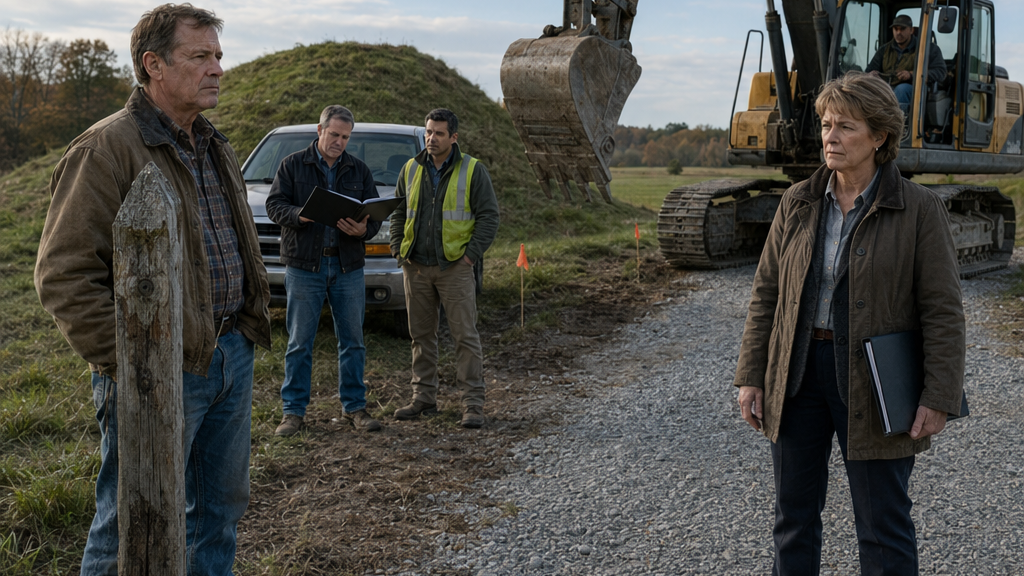
They Brought an Excavator to His Ohio Farm, but the Old Mound Was Never Just a Hill
Chapter 1: The Excavator Was Already Turning Into His Lane
Andrew Nelson heard the diesel before he saw the machine.
He was still carrying a half-empty feed bucket toward the cattle lot when a long flatbed trailer nosed off the township road and began turning into his gravel lane. An excavator sat chained to the deck, its boom folded low, the steel bucket hanging over the rear tires like a clenched hand.
Andrew stopped beside the gate.
The driver eased forward until the trailer cleared the ditch. Behind it came Nancy Baker’s white pickup, followed by Benjamin Scott in his older gray truck.
Andrew set the bucket down.
Nancy parked first.
“You’re early,” he said.
“We’re staging equipment today.”
“You told me Saturday.”
“Work starts Saturday.” She shut the truck door and tucked a blue project folder under one arm. “Staging isn’t work.”
Andrew looked past her.
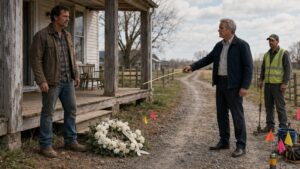
Orange flags had appeared along the edge of the lane during the previous afternoon. They followed the gravel toward a shallow drainage swale, then bent toward a low grassy rise behind the fence.
One flag stood less than six feet from an old cedar post.
The post leaned slightly east. Its top had gone silver with age, and one side was split where countless winters had opened the grain. Andrew’s father had replaced nearly every other fence post along that stretch.
Not that one.
Nancy followed his eyes.
“We need that post out before morning.”
“No.”
She gave him the look she used at association meetings when someone had repeated an argument she considered settled.
“Andrew.”
“It stays.”
“It’s inside the widening line.”
“That line’s wrong.”
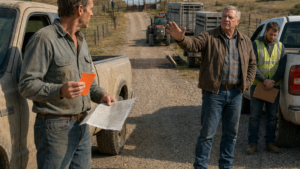
Benjamin climbed from his truck carrying a thick black binder. “County engineer marked it off the approved drawing.”
Andrew wiped his palm against his jeans.
“Which drawing?”
Benjamin hesitated. “Current project sheet.”
“That wasn’t my question.”
Nancy stepped between them before Benjamin could answer.
“We’ve had this conversation three times. The lane has to be widened here so the ditch can be reshaped without pushing drainage back toward the east properties.”
Andrew glanced toward the trailer.
The operator remained in the cab, wisely pretending to study his mirrors.
“You bring a machine onto my place before we’ve settled the line,” Andrew said, “and somehow I’m the one repeating myself.”
“The association has the easement.”
“Not where you’ve flagged it.”
Nancy opened the folder. “Your objection is in the minutes.”
“That doesn’t make it wrong.”
“It means you were heard.”
“No. It means somebody wrote down that I spoke.”
For a moment only the cattle made noise, shuffling behind the gate.
Nancy exhaled through her nose.
“Saturday at seven, we start at the road and work inward. We need the shoulder cut back, the swale opened, and the turn radius widened before the wet stretch sets in.”
Andrew looked at the mound.
Most people driving past would not have called it anything. It rose gently beyond the fence, uneven under late-summer grass, no taller than a person at its highest point. Goldenrod had grown along one side. A walnut sapling leaned near the far edge.
But near the cedar post stood another marker, lower and older, protected by a rusting metal frame.
Andrew pointed toward it.
“You ever read that?”
Nancy did not turn.
“I’ve seen it.”
“That wasn’t what I asked.”
Benjamin looked over.
Nancy finally faced the mound.
“It says the site was recorded decades ago.”
“Recorded as what?”
Her mouth tightened.
“Andrew, we are not excavating the mound.”
“You’re cutting the shoulder beside it.”
“On the approved line.”
“The line is wrong.”
“We’ve been over this.”
Andrew walked past her and stopped beside the cedar post. He placed one hand on the cracked top.
“This post doesn’t move.”
Nancy followed him to the fence.
“You know what it looks like from our side?”
“I expect you’re about to tell me.”
“It looks like you’ve decided an old fence post is more important than every farm using this lane.”
Andrew’s grip tightened.
“That’s not what this is about.”
“Then tell me what it’s about.”
He looked at Benjamin’s binder.
He could have answered.
There was a folder in his farm office. Inside it were copies that had not been opened in years. Old survey notes. A faded map. His father’s handwriting in the margin of one sheet.
Andrew thought of the meetings where he had mentioned the missing references. Thought of Nancy saying they would check. Thought of newer maps arriving with cleaner lines and less information.
He let his hand fall from the post.
“You’re too close to the site.”
Nancy’s expression hardened.
“And you signed the drainage agreement.”
That landed harder than Andrew expected.
Benjamin lowered the binder slightly.
Nancy continued.
“Your name is on the original participation sheet. You agreed to the drainage improvements when the association applied for the cost-share work.”
“I agreed to drainage work.”
“You signed the project.”
“Those aren’t the same thing.”
“They are when we’re standing here twelve years later trying to finish what everybody asked for.”
Andrew stared at her.
He remembered the folding table in the old machine shed. His father still alive then, coughing into a handkerchief while maps were passed around. He remembered where the proposed line had been drawn.
It had not been where the orange flags stood now.
Nancy closed the folder.
“I’m not fighting about this all day. The operator leaves the machine here. Tomorrow morning, the county engineer checks the grade. Saturday we begin.”
“Move the flag away from that post.”
“No.”
“Then don’t touch the ground.”
“Your objection is recorded.”
Andrew almost laughed.
Instead he nodded.
“All right.”
Nancy studied him.
The sudden lack of resistance unsettled her more than another argument would have.
“All right what?”
“You heard me.”
“That doesn’t sound like agreement.”
“It isn’t.”
She waited.
Andrew picked up the feed bucket.
Behind them, the operator started lowering the trailer ramps.
Nancy called after him.
“If you block the equipment Saturday, the association will document the delay.”
Andrew kept walking.
“And if the grant schedule slips because of it,” she added, “that cost won’t disappear.”
He turned once.
“I won’t block your machine.”
Benjamin looked toward Nancy.
Nancy’s face changed by a fraction.
Andrew carried the feed bucket through the gate.
That afternoon Sharon Nelson found him repairing a loose latch behind the equipment shed.
She had already heard.
“You told Nancy you wouldn’t stop them?”
Andrew drove the pin through the hinge.
“I told her I wouldn’t block the machine.”
“Andrew.”
He tested the latch.
Sharon stepped closer. “There’s a difference between being stubborn and being reckless.”
“They’ve been told.”
“Not everything.”
He looked up.
She knew that look because she had seen it since they were children: the flat silence he used when he had decided the conversation was over.
This time she refused it.
“If that bucket gets anywhere near that mound—”
“It won’t.”
“How do you know?”
Andrew looked beyond the shed toward the old cedar post.
The excavator now sat at the edge of his lane, dark and motionless against the pasture.
“They want to bring it back Saturday,” he said.
Sharon waited.
Andrew wiped the grease from his fingers.
“I’m going to let them.”
Chapter 2: The Old Marker Nobody Wanted to Read
Sharon found Andrew with a faded map spread across the hood of his pickup and one boot pressed against the grass beside the cedar post.
“What are you doing?”
“Checking something.”
“You checked it twenty years ago.”
Andrew did not look up.
A thin red line crossed the paper, faded almost brown. Near one corner, somebody had drawn a small square and written a number beside it in pencil. Andrew held the sheet against the morning light, then looked from that mark to the cedar post.
Sharon stepped beside him.
“That’s Dad’s copy.”
“Part of it.”
“Where’d you get it?”
“Office.”
“That folder still in the cabinet?”
Andrew folded the map before she could reach for it.
Sharon stared at him.
“So you do have it.”
“I didn’t say that.”
“You didn’t have to.”
Andrew tucked the map under his arm and walked toward the mound.
The grass was damp enough to darken his boots. The old interpretive marker stood crooked inside its metal frame. Time had faded its surface, but the important language remained legible: the rise had been recorded as a cultural site decades earlier.
Sharon brushed dirt from one corner.
“Nancy says they’re not touching it.”
“They don’t have to touch the top to damage what’s protected.”
“Then show her.”
Andrew crouched beside the cedar post. Near its base was a shallow indentation nearly hidden by grass.
He pressed two fingers into the soil.
“What?”
“Old survey nail.”
Sharon bent closer.
A corroded metal head sat almost flush with the dirt.
She looked from it to the faded map under Andrew’s arm.
“That post marks the line.”
“It marks a corner.”
“And you knew that yesterday.”
“I knew what Dad told me.”
“That’s not what I asked.”
Andrew stood.
His father’s voice came back without invitation.
Don’t let anybody turn it into another piece of dirt on a plan.
At the time Andrew had thought the sentence overly dramatic. His father had been angry after a county worker referred to the rise as an obstruction during drainage discussions.
Years later, Andrew understood why the phrase stayed with him.
Plans got redrawn.
People retired.
Binders changed hands.
A thing that was known by everyone became known by somebody, then remembered by one person, then treated as a rumor.
Sharon held out her hand.
“Give me the map.”
“No.”
“Why?”
“Because it isn’t the whole set.”
“Then get the whole set.”
Andrew walked toward the house.
She followed.
Inside the kitchen, he put the folded sheet on the table and poured coffee that had been sitting too long in the pot.
Sharon did not sit.
“You told them the line was wrong.”
“Yes.”
“You told them the mound was recorded.”
“Yes.”
“Did you tell them you had the old project maps?”
Andrew took a drink.
“No.”
“Why not?”
“They have their own records.”
“That’s childish.”
He set the mug down.
“They had years to keep their records straight.”
“And if they didn’t?”
“Then maybe they should find out before they dig.”
Sharon stared at him.
There it was.
Not caution.
Not merely stewardship.
Resentment.
“You want Nancy embarrassed.”
“I want her to stop acting like a binder makes her right.”
“You want both.”
Andrew looked toward the window.
The excavator was visible beyond the barn roof.
Sharon pulled out a chair.
“You know why they’re pushing this so hard?”
“Grant deadline.”
“Not just that.”
He said nothing.
“The east lane washed out twice last spring.”
“I know.”
“One of the cattle trailers nearly went into the ditch.”
Andrew glanced back.
“Whose?”
“Does it matter?”
“It does if you’re using it to make a point.”
“A neighboring farm had to unload calves at the road because the trailer couldn’t make the turn safely after three days of rain.”
Andrew frowned.
He had heard complaints about the lane. He had not heard that.
Sharon continued.
“And the ambulance that came out in May had to back nearly a quarter mile because there wasn’t room to turn around.”
“That’s a different issue.”
“No, Andrew. That’s the problem. You think every piece is a different issue.”
He leaned against the counter.
“The mound stays.”
“I agree.”
“The post stays.”
“I agree.”
“They don’t cut that shoulder.”
“If the line is wrong, no.”
“Then what are we arguing about?”
“You letting them walk into a mistake because you enjoy knowing they’re wrong.”
Andrew’s face hardened.
“You weren’t in those meetings.”
“I was in enough of them.”
“You weren’t farming this place while people kept telling Dad they’d remember the boundary. You didn’t sit through the years after he died while every new map got simpler.”
Sharon’s expression softened, but only slightly.
“No. I didn’t. I also didn’t promise him I’d punish everybody who came later.”
Andrew looked away.
By noon, he was in the equipment shed with the map again.
He laid it beside a measuring tape and an old notebook. The cedar post was not labeled by name, but the dimensions lined up.
Road centerline to exclusion corner.
Exclusion corner to drainage break.
His father had added one sentence in the margin:
POST SET TO MATCH APPROVED AVOIDANCE LIMIT.
Andrew ran his thumb over the words.
The old man had written in block capitals whenever he wanted something remembered.
A pickup slowed outside.
Andrew folded the map immediately.
Benjamin appeared in the doorway.
“Got a minute?”
“Depends.”
Benjamin ignored that.
“County engineer will be out at six-thirty tomorrow.”
Andrew nodded.
“Michael Ramirez is coming too.”
That caught Andrew’s attention.
“Why?”
“Grant office wants cultural-resource compliance confirmed before we start.”
“Since when?”
Benjamin shifted his weight.
“Since Nancy told them you were threatening to dispute the work zone.”
Andrew almost smiled.
Benjamin noticed.
“What?”
“Nothing.”
“You know him?”
“No.”
“Then why do you look pleased?”
“I don’t.”
Benjamin leaned against the doorway.
“I checked the binder again.”
Andrew waited.
“There’s a cultural-resource section.”
“And?”
“Old correspondence. Site reference. Nothing that says this particular lane work is prohibited.”
Andrew looked at him.
“What year?”
“Most of it is old.”
“What year?”
Benjamin sighed. “Two thousand eight. Two thousand nine.”
“And the appendix?”
Benjamin’s eyes narrowed.
“What appendix?”
Andrew turned back to the workbench.
“That’s what I thought.”
“Andrew.”
He picked up a wrench.
Benjamin stepped inside. “If you know something that affects this job, now would be a good time.”
“You’ve got the binder.”
“And you keep saying it’s incomplete.”
“I said the line was wrong.”
Benjamin watched him for several seconds.
“You could save everyone a lot of trouble.”
Andrew tightened the vise around a rusted bracket.
“People had twelve years to save themselves trouble.”
Benjamin’s expression changed.
Not anger.
Disappointment.
“That sounds less like protecting a mound and more like settling a score.”
Andrew stopped turning the vise.
Benjamin left before Andrew answered.
At 6:18 that evening, Andrew’s phone buzzed on the kitchen table.
He read the message once.
Then again.
PROJECT START CONFIRMED. EXCAVATOR ACTIVE AT 7:00 A.M. CULTURAL REVIEW ON SITE BEFORE GROUND DISTURBANCE.
Sharon was washing a glass at the sink.
“Well?”
“Seven.”
She dried her hands.
“You going to get the folder?”
Andrew locked the phone and put it facedown.
“No.”
Sharon stared at him.
Outside, beyond the darkening pasture, the excavator waited beside the lane.
Chapter 3: One Missing Appendix Stopped the Bucket
At seven twelve Saturday morning, the excavator bucket lowered toward the gravel shoulder.
Andrew stood behind the fence with both hands resting on the top rail.
The machine’s engine filled the lane with a deep mechanical vibration. Orange flags trembled in the disturbed air. Beyond them, the cedar post stood where it had stood for decades, one weathered face catching the pale morning light.
Nancy raised one arm toward the operator.
“Take the shoulder first. Stay inside the paint.”
The bucket descended another foot.
Andrew did not move.
Sharon, standing near his pickup, looked at him sharply.
“Andrew.”
“I see it.”
Michael Ramirez stood twenty yards away with a safety vest over a brown field jacket. He had arrived before seven, reviewed Nancy’s project sheet, and walked the edge of the mound without saying much.
Benjamin had the black binder open on the hood of his truck.
The county engineer watched from beside a survey rod.
Nancy glanced at Andrew.
“You have something to say, say it now.”
Andrew looked at Michael.
“Has he reviewed the cultural-resource appendix?”
Nancy frowned.
Michael turned.
“The what?”
Andrew kept his eyes on Benjamin.
“The appendix attached to the original drainage participation agreement. Cultural-resource avoidance map.”
Benjamin flipped back several pages.
Nancy lowered her hand.
“Andrew, we already covered this.”
“No. We covered the current work sheet.”
The excavator bucket remained suspended.
The operator looked toward Nancy for instruction.
Andrew nodded toward the binder.
“Ask Benjamin if it’s in there.”
Benjamin began turning pages faster.
Michael walked over.
“What appendix number?”
Andrew answered immediately.
“Attachment C. Cultural-resource avoidance and monitoring limits.”
Benjamin stopped.
Nancy looked at Andrew.
“You remember the title word for word?”
“Yes.”
“From twelve years ago?”
“Yes.”
Michael held out his hand.
“Let me see the index.”
Benjamin gave him the binder.
Andrew felt Sharon watching him.
Michael ran a finger down the contents page.
“Environmental determination. Drainage calculations. Right-of-way acknowledgments. Cost-share certification.”
He turned the page.
“No Attachment C listed.”
Benjamin shook his head.
“There are older loose sheets farther back.”
They searched together.
The excavator engine continued idling.
Nancy walked toward Andrew.
“Why haven’t you mentioned an Attachment C until now?”
“I told you the work line was wrong.”
“That isn’t an answer.”
“It was enough to stop and check.”
“You could have named the document yesterday.”
“Yes.”
The word came out flat.
Nancy stared at him.
For the first time that morning, Andrew saw genuine uncertainty replace irritation.
Michael pulled several yellowed pages from a plastic sleeve.
“Historic-property correspondence.”
He read silently.
The county engineer came closer.
Michael looked toward the mound, then toward the cedar post.
“Who established this work line?”
The engineer answered. “Current plan set supplied by the association and county GIS base.”
“Was an archaeological avoidance boundary transferred into that plan?”
The engineer looked at Benjamin.
Benjamin looked down at the binder.
Nancy said, “The recorded site is outside the excavation area.”
Michael pointed toward the flags.
“According to which document?”
“The plan.”
“The plan shows a mound symbol. I’m asking what source established the buffer or avoidance limit.”
Silence.
Andrew felt something cold and satisfying settle in his chest.
This was the moment he had expected.
Not a shouting match.
Not Nancy backing down because he told her to.
A question she could not answer.
Michael closed the binder halfway.
“Nobody disturbs soil until we resolve this.”
Nancy turned to him.
“We have a grant schedule.”
“I understand.”
“The operator is here. County staff is here. We’re not excavating the mound.”
Michael’s voice remained calm.
“If there’s a documented avoidance area and we don’t know where it is, I can’t tell you this shoulder cut is outside it.”
Nancy looked toward the bucket.
“Can we at least widen the first section by the road?”
“Not if it’s part of the same undertaking and the review record is incomplete.”
The county engineer nodded reluctantly.
Nancy pressed her lips together.
“Raise the bucket.”
The operator complied.
Steel lifted away from the gravel.
For the first time since the trailer had entered his lane Friday, Andrew let himself breathe fully.
Sharon did not look relieved.
She looked angry.
Michael approached the cedar post.
“Why is this here?”
“Boundary corner.”
“Property boundary?”
“Not exactly.”
Michael crouched near the base.
Andrew added, “There’s an old survey nail.”
Michael brushed the grass aside.
Nancy heard him.
“You knew that too?”
Andrew did not answer.
Benjamin shut the binder.
“I want to understand something.”
He sounded different now.
Less defensive.
“You knew the exact name of a missing appendix. You knew the post corresponded to something that isn’t on the current map. And you waited until the operator had the bucket down before you said it.”
“I said the line was wrong.”
Benjamin looked toward the excavator.
“That’s not the same as telling us how you knew.”
Nancy stepped closer.
“Do you have a copy?”
Andrew met her eyes.
“A copy of what?”
“Don’t do that.”
Her voice was low.
Sharon crossed her arms.
Andrew felt the satisfaction draining out of the moment.
Michael stood.
“If anyone has historical project documents, I need them.”
Andrew said nothing.
Nancy laughed once, without humor.
“You do.”
“I have old farm records.”
“Does that include Attachment C?”
Andrew looked at the mound.
A breeze moved through the taller grass at the crown.
His father’s words returned.
Don’t let them turn it into another piece of dirt on a plan.
He had kept the promise.
Hadn’t he?
The bucket had stopped.
The mound was untouched.
Yet everybody around him was now looking at him as though the missing record existed not only because institutions had failed, but because he had decided failure should have consequences.
Benjamin opened a different section of the binder.
“Wait.”
He pulled out a signed sheet.
Nancy took it.
“What is it?”
“Original participation agreement.”
Andrew already knew.
Benjamin turned the sheet so Nancy could read.
Her eyes moved down the page.
Then stopped.
She looked up.
“Andrew Nelson.”
He said nothing.
“You signed this.”
“Yes.”
Sharon closed her eyes briefly.
Nancy read from the page.
“Drainage improvement participation. Shared access work. Easement acknowledgment.”
“That isn’t the whole agreement.”
“But this is your signature.”
“Yes.”
One of the neighboring farmers, who had been standing near the road, stepped closer.
“You supported this project?”
“The original one.”
Nancy’s confidence returned, but it was no longer the same confidence she had carried Friday. This one was sharper because it had found something solid to stand on.
“You’ve spent months telling us this work crosses a line you never properly identified,” she said. “Now we learn you signed the underlying project.”
“I signed a project with conditions.”
“Conditions you apparently kept in your own drawer.”
Andrew’s jaw tightened.
“That appendix was supposed to be in the association record.”
“And when you realized it wasn’t?”
He did not answer.
Nancy held the signed page between two fingers.
“You knew we didn’t have it.”
“I suspected.”
“You knew enough to ask for it by title.”
Michael glanced between them but did not intervene.
This was no longer his question to answer.
Nancy stepped to the fence.
“You could have brought your copy to a meeting.”
“Yes.”
“You could have brought it yesterday.”
“Yes.”
“You could have shown Benjamin before the excavator ever came onto this farm.”
Andrew looked at the cedar post.
“Yes.”
The neighboring farmers shifted uncomfortably.
The victory Andrew had imagined was gone.
The machine was stopped, but the silence around him felt nothing like vindication.
Nancy raised the page containing his signature.
“So tell me something, Andrew.”
He looked at her.
“If you signed the project, and you had the missing information all along, why didn’t you ever mention that?”
Chapter 4: His Signature Changed What Everyone Believed
By one o’clock Saturday afternoon, photocopies of Andrew Nelson’s signature were sliding from hand to hand across a folding table in the association machine shed.
Nobody raised a voice.
That made it worse.
Nancy Baker sat at the far end with the original participation agreement beside her elbow. Benjamin Scott had brought the black binder, a portable printer, and three stacks of documents that seemed to multiply every time somebody touched them. Two neighboring farmers stood near the open overhead door, work jackets still dusty from the morning.
Andrew took the empty chair nearest the wall.
Nancy pushed one photocopy toward him.
“You recognize it.”
“Yes.”
“You signed the drainage project.”
“I signed that agreement.”
A farmer across from him tapped the page. “Looks like the same thing from here.”
Andrew kept his hands in his lap.
“The project changed.”
Nancy leaned back.
“Then explain that without making us guess.”
Andrew looked at the page again. His signature was darker than he remembered, written with the heavy pen the township clerk had passed around the meeting twelve years earlier.
He could still picture his father beside him.
The old man had objected to the first drainage route. Not to the project itself. The lower fields stayed wet after spring storms, and everybody knew the shared lane needed work.
So the plans had been revised.
That distinction felt simple inside Andrew’s memory.
On the paper in front of everyone else, it did not.
“The original agreement covered drainage improvements,” Andrew said. “It did not give permission to cut through the protected area.”
Nancy pointed at the current map.
“And this map says we aren’t.”
“That map is missing information.”
Benjamin spoke quietly. “Which puts us back where we were this morning.”
Andrew looked at him.
Benjamin did not sound hostile. If anything, he sounded tired.
“We had an incomplete binder,” Benjamin continued. “That part is on us. But you knew something was missing.”
“I suspected it.”
“You named the missing attachment.”
Andrew said nothing.
One of the farmers shifted his chair.
“So if the project really had an exclusion line, why didn’t you bring it to the board?”
Andrew looked toward the open shed door.
Outside, the excavator sat motionless on its trailer again. Michael Ramirez had left after placing the work on hold and requesting every historical project document the association could locate.
The machine that had seemed like a threat that morning now looked like an invoice.
Every idle hour cost somebody something.
Nancy folded her arms.
“You wanted this stopped.”
“I wanted it outside the mound boundary.”
“You could have helped make that happen before today.”
Andrew felt the old defensive answer rise in him.
They should have listened.
They should have kept the records.
They should not have needed him to rescue them from their own carelessness.
Then Nancy pulled a photograph from her folder.
It showed the east stretch of the shared lane after heavy rain. Brown water filled the ditch, and the gravel shoulder had collapsed beneath one tire track.
“This was April.”
Andrew glanced at it.
“I’ve seen washouts.”
“You haven’t seen this one.”
She placed a second photograph beside the first.
A livestock trailer sat crooked at the edge of the lane. One rear wheel had sunk into the soft shoulder. Men were standing around it with chains.
“The trailer had calves in it,” Nancy said. “They couldn’t pull it forward without risking the ditch. They unloaded at the road.”
Andrew studied the picture longer.
Nancy added a third.
An ambulance was backed into a farm entrance farther east.
“May. Driver couldn’t turn around after they came through. Had to reverse nearly a quarter mile.”
Andrew looked at Sharon.
She had told him some of this Friday.
The photographs made it harder to file away as somebody else’s argument.
Nancy’s voice stayed level.
“I didn’t wake up one morning and decide I wanted an excavator beside your mound. People have complained about that lane for four years. We finally have money to fix the drainage and widen the bad turn. If we don’t use the cost-share award this cycle, we may lose it.”
Andrew looked back at the participation agreement.
For the first time, the signature did not feel like evidence Nancy was misusing.
It felt like evidence that he had once wanted the same thing she did.
Just not this way.
Benjamin opened his laptop.
“I pulled the digital plan history from the county portal.”
He rotated the screen.
Two maps appeared side by side.
The older scan was rough, its lines blurred from repeated copying. The newer plan was clean and color-coded.
Benjamin enlarged the area near Andrew’s farm.
“The old file shows a note here.”
Andrew leaned forward.
The image was too poor to read the entire notation, but a leader line extended toward the grassy rise.
Benjamin switched to the newer map.
The line was gone.
So was the cedar post.
The mound remained as a small symbol, detached from any visible buffer.
Nancy stared at the screen.
“When was that converted?”
“Eight years ago, maybe nine. County GIS update.”
“Who did it?”
“Could have been a consultant. Could have been copied from an intermediate plan. I don’t know yet.”
Andrew pointed at the old scan.
“There was more than that note.”
Benjamin looked at him.
“The appendix.”
“Yes.”
“Which you have?”
Andrew hesitated.
The shed went silent.
He could have lied.
Instead he said, “I may.”
Nancy’s chair scraped backward.
“You may?”
“I have old records from my father.”
“And you didn’t think they mattered before the machine showed up?”
“They mattered every time I told you the line was wrong.”
Nancy stood.
“And every time I asked you why, you gave me half an answer.”
Andrew stood too.
“You had a duty to verify your plan.”
“Yes.”
The immediate agreement stopped him.
Nancy put both palms on the table.
“Yes, Andrew. We did. I did. I should have halted things when you raised the site boundary. I’m not pretending otherwise.”
She tapped the photocopied signature.
“But you don’t get to act like this happened while you were helpless.”
Andrew looked at the page.
Nobody in the shed seemed eager to defend him.
Not even Sharon.
Benjamin closed the laptop.
“There’s another problem.”
Nancy turned.
“The grant administrator called back.”
“And?”
“If the project requires redesign and additional review, we need a revised plan submitted quickly. They wouldn’t give me an exact cutoff, but the construction authorization expires this fall.”
“How quickly?”
“Days matter.”
One farmer muttered under his breath.
Nancy rubbed the bridge of her nose.
“So we’ve stopped the work, we don’t know the correct boundary, and now the funding clock is running.”
Andrew felt the satisfaction from that morning disappear completely.
He had imagined Nancy being forced to stop.
He had not imagined the neighboring farms losing the project with her.
By Sunday afternoon, the association shed was empty and Andrew’s farmhouse kitchen had become quieter than he could stand.
Sharon sat across from him.
“You know what I keep thinking about?”
He stared at the cold coffee in front of him.
“What?”
“Dad never said nobody else was allowed to know.”
Andrew’s jaw tightened.
“He trusted people with it once.”
“And the records got lost.”
“Yes.”
“So your answer was to make sure the only complete copy might be locked in this house?”
Andrew looked toward the hallway leading to the farm office.
Sharon followed his gaze.
For years, there had been a locked metal box beneath the lowest shelf.
Tax records.
Old deeds.
His father’s papers.
Things Andrew told himself he kept because somebody had to.
Sharon lowered her voice.
“Do you still have his complete copy of that agreement?”
Andrew did not answer.
She did not let him look away.
“Andrew.”
He saw again the suspended excavator bucket. Nancy’s face when Michael stopped the work. The momentary satisfaction he had felt because, finally, somebody else had to admit they did not know what he knew.
Sharon’s question stayed between them.
“Do you still have Dad’s complete copy?”
Andrew looked toward the farm office door.
“Yes.”
Chapter 5: The Map His Father Refused to Throw Away
The key stuck halfway into the lock.
Andrew had to pull it out, wipe a film of dust from the teeth with his shirt, and try again.
The metal file box sat beneath the bottom shelf of his farm office exactly where it had sat since his father died. Paint had chipped from the corners. One dent on the lid came from a tool dropped years earlier.
Sharon stood in the doorway.
“You haven’t opened that in how long?”
“Long enough.”
The lock clicked.
Andrew lifted the lid.
The smell of old paper rose from inside.
He removed tax envelopes, a rolled plat, two property abstracts, and a brown accordion folder tied with cotton string.
Sharon stepped closer.
“That it?”
Andrew recognized his father’s handwriting before he saw the label.
DRAINAGE PROJECT—KEEP COMPLETE.
He sat at the desk.
For several seconds, neither of them touched it.
Then Andrew loosened the string.
The first pages were familiar: meeting notices, cost estimates, easement discussions. His own signed participation sheet lay near the front.
Behind it were copies he had not shown anyone.
A revised site plan.
A cultural-resource review letter.
And Attachment C.
Sharon let out a slow breath.
“There it is.”
Andrew unfolded the map.
The paper had yellowed at the creases, but the lines remained sharp.
A hatched area covered the mound and extended beyond its visible slope. A heavy dashed line marked an avoidance boundary. One corner terminated at a small square beside the lane.
His father had circled that square in pencil.
Beside it, in block capitals, he had written:
CEDAR POST SET TO MATCH APPROVED AVOIDANCE LIMIT.
Andrew stared at the note.
Sharon looked at him.
“You knew.”
“I knew Dad said the post marked it.”
“You knew there was a map.”
“I knew there had been one.”
“Andrew.”
He looked up.
“You asked Benjamin for Attachment C by name Saturday morning.”
Andrew folded his hands.
“I remembered the title.”
“Because you’d seen this.”
“Yes.”
“Recently?”
He did not answer.
Sharon’s expression changed.
Not surprise.
Understanding.
“You checked it before they came.”
“Part of it.”
“The faded sheet on your truck.”
Andrew nodded.
“You already knew enough.”
“I knew enough to know their line was wrong.”
“And you still let the excavator come.”
He pushed back from the desk.
“They were warned.”
“That isn’t what I said.”
Andrew stood.
“Every time I raised the boundary, Nancy treated it like I was trying to stop the whole project.”
“So you decided to prove her wrong in the most expensive way possible.”
“I didn’t put the wrong map in their binder.”
“No.”
“I didn’t remove the appendix.”
“No.”
“I didn’t order that machine.”
“No.”
Sharon’s voice became quieter.
“You just knew where the brake was and waited until the truck was rolling downhill.”
Andrew looked away.
The words landed because there was nothing dramatic about them.
He had wanted the work stopped.
But beneath that had been something less honorable.
He had wanted the stopping to happen publicly.
He had wanted Nancy to feel, for once, what it was like to speak with certainty and discover that certainty did not make her right.
Sharon touched the margin of the map.
“Dad asked you to protect the mound.”
Andrew said nothing.
“He didn’t ask you to teach Nancy a lesson.”
Andrew gathered the papers.
“I’m going to the county.”
The archive office opened Monday morning.
A clerk brought out scanned project files while Andrew and Sharon sat beneath fluorescent lights at a narrow table. Benjamin joined them after nine. Michael arrived later with a laptop and a measuring scale.
The county copies confirmed parts of the story but not all of it.
The original participation agreement was there.
So was correspondence noting the recorded cultural site.
But the complete Attachment C was absent from the county’s routine project packet.
Benjamin compared page numbers.
“There’s a jump.”
Michael leaned over.
“From B to D.”
“Exactly.”
Andrew placed his father’s copy beside them.
Michael examined it without touching it at first.
“Do you mind?”
Andrew nodded.
Michael unfolded the sheet.
For several minutes, he said nothing.
Then he looked at Andrew.
“This is consistent with the older correspondence.”
“That mean the post is the corner?”
“It means it appears intended to mark one. We still verify it in the field before treating it as a modern control point.”
Benjamin pointed to the dashed boundary.
“And the drainage work?”
Michael traced the route.
“The original undertaking allowed it.”
Andrew looked at Nancy’s project corridor.
Just as he remembered, the drainage improvement had never been prohibited.
It had been routed around the protected area.
Michael tapped the new alignment.
“The problem isn’t that nobody could ever improve this lane. The problem is that the modern plan appears to have lost the avoidance geometry.”
A small, bitter part of Andrew wanted that sentence repeated at the association meeting.
Then Sharon looked at him.
He let the thought go.
They returned to the farm before noon.
Michael measured from the lane centerline. Andrew walked him toward the cedar post.
The numbers came close.
Close enough that Michael stopped beside the post and looked down at the old survey nail.
“This wasn’t put here randomly.”
Andrew crouched beside him.
“No.”
Michael aligned a measuring rod toward the mound.
“The historical corner appears to be here within the tolerances we’d expect from the old survey.”
Benjamin let out a breath.
“So Andrew was right.”
Michael looked at him.
“About the line, yes.”
Andrew heard the distinction.
Nancy arrived ten minutes later.
Benjamin gave her the abbreviated version. She read the map without speaking.
Finally she looked at Andrew.
“You had this Saturday.”
Andrew did not soften it.
“Yes.”
Her lips pressed together.
“How long did you know it was still in your records?”
“Friday.”
Nancy gave a short nod.
That seemed to hurt more than anger would have.
Michael folded his arms.
“There’s still a practical problem.”
Nancy looked at him.
“If we establish this avoidance limit, the current ditch section conflicts with it.”
“So we move the ditch.”
“To where?”
Nobody answered.
Michael continued.
“The historical map proves what the earlier project intended. It doesn’t design the project you’re trying to build now.”
Nancy looked toward the lower pasture.
“What happens if we submit this and stop?”
“Then you have a compliance problem resolved by abandoning work. Whether that preserves the funding is a grant question.”
“And if we still need the drainage fixed?”
“You need a new alignment that avoids the protected area and still functions hydraulically.”
The county engineer, who had joined them at the mound, studied the land.
“That may mean moving farther downslope.”
Nancy’s shoulders sank.
“Which means more pipe, more excavation, more cost.”
“And another review,” Michael said.
Andrew looked beyond the mound toward his lower pasture.
Years of water movement had left patterns that no plan showed clearly: darker grass, shallow depressions, a line where sedges grew after wet springs.
His father had known those patterns.
So did Andrew.
He saw something he had not considered because he had spent months thinking only about what the association must not do.
There was an older path.
Not a road.
A drainage line.
Long ago, before the newer ditch was cut, runoff had moved naturally through the lower pasture toward the western swale.
Andrew walked away from the group.
Nancy called after him.
“Where are you going?”
He stopped at the fence.
“Thinking.”
She almost smiled, but did not.
“You’ve done plenty of that without us.”
Andrew accepted the remark.
That afternoon Sharon found him walking the lower field with a shovel handle, pressing it into low spots and watching where the soil stayed dark.
He returned to the house after sunset and called Nancy.
She answered on the fourth ring.
“What?”
Andrew looked at the old map spread across his kitchen table.
“Give me twenty-four hours.”
“For what?”
“I want to walk a different drainage line.”
Silence.
Then Nancy said, “You have one day.”
Chapter 6: Saving the Mound Meant Saving the Road Too
Andrew led Nancy away from the planned trench Tuesday morning and straight through the lower pasture.
She stopped at the first gate.
“The project is the other direction.”
“I know.”
Benjamin climbed through behind her carrying the black binder. The county engineer followed with a measuring rod and handheld receiver.
Andrew pointed downslope.
“Water used to run there.”
Nancy stared across the grass.
“There’s no ditch.”
“Not anymore.”
“That helps.”
Andrew ignored the remark.
He walked toward a shallow depression barely visible beneath the pasture grass.
“Before the upper swale was straightened, runoff crossed here, followed this low line, then emptied west of the lane.”
The engineer studied the ground.
“How long ago?”
“Before I was running the place.”
“So you don’t know.”
“I know where water stands after three inches of rain.”
“That’s not the same thing as a drainage calculation.”
“No.”
Andrew looked at him.
“That’s why you’re here.”
Nancy raised an eyebrow.
It was the first time Andrew had seen her almost amused since Saturday.
They continued downslope.
At the western fence, Andrew stopped beside a low area where thicker grass followed a gentle curve toward the roadside ditch.
“If you take the new run through here, you stay below the mound boundary.”
The engineer checked his receiver.
“You’d add length.”
“Yes.”
“More fall too.”
“That’s the idea.”
“And cross your pasture.”
Andrew nodded.
Nancy looked at him.
“You’d give an easement through here?”
“If the line works and the avoidance boundary stays permanent.”
Benjamin opened the binder to a blank page.
“I’m writing that down.”
Andrew looked at the binder.
Two days earlier he had regarded it as the symbol of everything wrong with the association.
Now Benjamin wrote slowly and deliberately, leaving space for conditions.
Nothing assumed.
Nothing omitted.
The engineer spent nearly an hour taking elevations.
Michael joined them near the cedar post after the first set of measurements. Andrew showed him where the alternative line began.
Michael looked from the old post to the proposed route.
“This stays entirely outside the historical avoidance area if your western alignment holds.”
“That’s what I want.”
Michael nodded toward Andrew.
“And the original plan?”
Andrew handed him a copy.
Not the original.
A copy.
The original had already been scanned for the county archive that morning.
That small act cost Andrew more than he expected.
For years, possession had felt like protection.
Now protection meant making sure no single person—including him—could become the only keeper of the record again.
By early afternoon, the engineer had sketched a rough alternative.
He stood at the hood of his truck while the others gathered around.
“It can work.”
Nancy exhaled.
Then he added, “But it costs more.”
Her relief vanished.
“How much?”
“Too early for exact numbers. Longer excavation. Additional pipe. More restoration through the pasture.”
“Enough to kill it?”
“Possibly.”
Benjamin flipped toward the budget section.
“How much contingency did we leave?”
Nancy looked at him.
“Not enough.”
“Maybe.”
He ran a finger down a column.
“The culvert replacement came in under estimate.”
“That money was already reassigned.”
“Not all of it.”
He turned the binder toward her.
“There’s a remaining contingency line.”
Nancy read it.
The engineer leaned closer.
“That could cover part.”
“Part doesn’t help if the grant won’t allow the change.”
Benjamin took out his phone.
“I’ll ask.”
Nancy stopped him.
“No.”
Everyone looked at her.
She stared at the rough field sketch.
“If we call with another half-answer, we’re doing the same thing again.”
Andrew recognized the sentence for what it was.
An admission.
Not to him.
To herself.
Nancy looked at the engineer.
“Get me a defensible estimate.”
Then to Michael.
“Tell me exactly what review language you need.”
Then to Benjamin.
“Find every dollar still legitimately available. Not money we wish is available.”
Finally she looked at Andrew.
“And I need the easement terms you’ll actually sign. Not something you change after we submit.”
Andrew felt the old instinct to take offense.
Instead he said, “Fair.”
They worked into Wednesday.
The engineer returned with measurements.
Benjamin found enough contingency to make the reroute plausible if the grant administrator accepted a revised scope.
Michael marked the protected avoidance area on the updated field map and required the construction limits to remain clearly outside it.
Andrew walked the proposed line twice.
The second time Nancy came with him alone.
At the lower swale she stopped.
“I should have stopped the mobilization when you first challenged the boundary.”
Andrew looked toward the lane.
“Yes.”
She gave him a sideways glance.
“You make apologies easy to give.”
“I wasn’t asking for one.”
“No. You were waiting for one.”
Andrew could not deny it.
Nancy kicked lightly at a clod of dry soil.
“You know what I thought?”
“What?”
“That if I let every objection reopen this project, we’d never build anything.”
“That’s probably true.”
She looked at him.
He continued.
“Doesn’t mean every objection is wrong.”
“No.”
They walked several more yards.
Andrew said, “I could have shown you the map Friday.”
Nancy stopped.
He did too.
“I knew where it was,” he said. “I wanted you to have to stop.”
“I know.”
“That wasn’t the same as protecting the mound.”
“No.”
He waited for something harsher.
Nancy only said, “At least we agree on one thing.”
At the machine shed Wednesday afternoon, the revised field sketch lay on the same folding table where Andrew’s signature had been passed around three days earlier.
This time, every page was numbered.
Every attachment was listed.
Michael’s avoidance map was clipped behind the engineering sketch. Andrew’s proposed easement conditions were included. Benjamin had added an index sheet with a line for each attachment.
The two neighboring farmers sat near the door.
Nancy stood at the head of the table.
“We mobilized before confirming that the current construction map carried forward the historical avoidance boundary.”
Nobody moved.
Nancy continued.
“That was premature. I authorized it.”
Andrew watched her.
She did not blame the county map.
Did not blame Benjamin.
Did not blame him.
One farmer asked, “Does that mean we lose the grant?”
“We don’t know yet.”
“That’s a pretty big thing not to know.”
“Yes.”
Nancy’s fingers rested on the field sketch.
“The alternative adds cost but appears workable. We submit it tonight.”
Benjamin slid the signature page toward her.
Nancy looked at Andrew once before picking up the pen.
“The grant administrator hasn’t approved this.”
“No,” Benjamin said.
“And if they reject the modification?”
“We revisit.”
Nancy signed.
The pen scratched across the paper.
Not triumphantly.
Not ceremonially.
Just a name placed beneath a decision whose outcome remained uncertain.
She handed the page to Benjamin.
“Send the full packet.”
Andrew looked toward the open shed door.
Far beyond it, beside the narrow lane, the cedar post remained visible against the grass.
For the first time in years, its meaning no longer existed only in his memory.
Benjamin scanned the signed page, attached the revised maps, and pressed send.
No one spoke while the message left.
The grant administrator now had the correction.
Whether it had arrived in time was something none of them could control.
Chapter 7: The Post Stayed Where It Had Always Stood
Three weeks later, the excavator came back.
Andrew heard it from the barn and stepped outside before the truck reached the lane. For one uneasy second, the scene looked exactly as it had before: steel tracks chained to a trailer, folded boom above the cab, morning light catching the worn teeth of the bucket.
Then the driver passed the old orange flags.
Instead of turning toward the mound, the truck continued another hundred yards and entered through the lower-pasture gate.
Andrew stood beside the fence until the trailer disappeared downslope.
The cedar post remained untouched.
A new set of survey stakes now formed a wide arc around the grassy rise. The temporary flags had been replaced with taller markers placed from Michael Ramirez’s verified avoidance map. There was no ambiguity left between the mound and the work corridor.
Benjamin Scott pulled up a few minutes later.
He carried the black binder under one arm and a cardboard document box under the other.
“Grant administrator signed the modification yesterday.”
Andrew nodded.
“How much did we lose?”
“Not much. They accepted the contingency transfer and the revised scope. We eat some extra local cost for pasture restoration.”
“We?”
Benjamin looked at him.
“You signed the easement.”
Andrew almost smiled.
“That doesn’t mean I volunteered for everything.”
“No. But I thought you’d appreciate the word.”
Benjamin set the box on the tailgate.
Inside were four complete copies of the revised project record.
Every attachment was numbered.
The old cultural-resource appendix had been scanned behind the modern avoidance map. The original agreement, the new engineering sketch, the revised drainage route, Michael’s field confirmation, and Andrew’s pasture easement were all there.
Nothing existed only in Andrew’s file box anymore.
“One for the county archive,” Benjamin said. “One stays with the association. One goes into the grant closeout. This one is yours.”
Andrew lifted the top folder.
His father’s faded note appeared in the scan beside the cedar-post symbol.
He ran a thumb over the plastic cover.
Benjamin watched him.
“I also sent electronic copies to every participating landowner.”
Andrew looked up.
“Every one?”
“That was the idea.”
“You trying to make sure nobody gets to be important anymore?”
Benjamin’s expression stayed straight.
“I’m trying to make sure nobody has to remember which important person had the only copy.”
Andrew gave a short laugh.
“Fair enough.”
The lower-pasture work lasted four days.
The new drainage line curved well away from the mound, following the older low ground Andrew had shown them. The excavator opened a narrow trench, and new pipe disappeared beneath soil that would be reseeded once the work was finished.
The lane turn was widened farther downslope where the ground allowed it.
After the first rain, Andrew walked the field alone.
Water moved through the restored line toward the western swale instead of backing against the lane shoulder. At the road, the ditch carried a steady brown ribbon without spilling over the gravel.
The mound stood dry above it.
Nothing dramatic had happened.
That felt important.
On the final inspection morning, Nancy Baker arrived with Michael, Benjamin, and the county engineer.
They walked the completed work line first.
The engineer checked the outlet.
Michael checked the marked avoidance boundary.
Then everyone ended up where the trouble had started—beside the cedar post.
Nancy stared at it.
“That thing looks worse every time I see it.”
Andrew rested one hand on the cracked top.
“It’s older than your binder.”
Benjamin said, “Low bar.”
Nobody laughed loudly, but the tension eased.
Michael crouched beside the new boundary marker.
“This location is now tied to the revised project coordinates. Future work should reference the recorded avoidance line, not the post itself.”
Andrew looked down.
“So the post doesn’t matter anymore?”
Michael stood.
“It matters historically. It just shouldn’t have to carry the whole burden.”
Andrew understood more than Michael probably intended.
Nancy looked toward the mound.
“I owe you something.”
Andrew glanced at her.
“Don’t.”
“I’m going to say it anyway.”
Benjamin and the engineer moved several steps away.
Nancy kept her voice low.
“When you challenged the boundary, I treated uncertainty like disobedience. I thought if I stopped every time somebody objected, I’d never get that road fixed.”
“You had people needing the road fixed.”
“I did.”
“That part wasn’t wrong.”
“No. Ordering the machine in before confirming the boundary was.”
Andrew rubbed the splintered cedar beneath his palm.
“I knew where the map was Friday.”
Nancy looked at him.
“I know.”
“I wanted you to find out in front of everybody.”
“I know that too.”
He met her eyes.
“I told myself I was protecting this place.”
“And?”
“And part of me wanted you embarrassed.”
Nancy considered him for a moment.
“Were you satisfied?”
“About thirty seconds.”
That drew a tired smile from her.
“Good.”
“Why good?”
“Would’ve been irritating if you enjoyed the whole thing.”
Andrew looked toward the lower field.
“I should’ve brought the file sooner.”
“Yes.”
“You could pretend to hesitate.”
“I’ve spent three weeks learning not to ignore accurate information.”
This time Andrew laughed.
Their relationship was not repaired by the exchange.
He did not expect Christmas cards.
Nancy would still chair meetings in a way he found too rigid. Andrew would still challenge decisions longer than she wanted. Some things did not need to become friendship to become better.
Before leaving, Nancy handed him a copy of the final closeout sheet.
“The county archive confirmed receipt of the complete historical packet.”
Andrew folded it once.
“So now everybody knows.”
“That bother you?”
“A little.”
Nancy nodded as if that made sense.
Sharon came by that afternoon carrying two glasses of iced tea.
Andrew was at the cedar post with a small sledgehammer and a new permanent boundary marker.
She stopped beside him.
“Thought Michael said the post wasn’t the official control anymore.”
“It isn’t.”
“Then what are you doing?”
“Making the corner obvious.”
The new marker was plain, durable, and deliberately placed beside rather than through the old cedar.
Sharon handed him a glass.
“Dad would’ve liked that.”
Andrew positioned the marker.
“Dad liked being right.”
“Runs in the family.”
He gave her a look.
She smiled.
Andrew lifted the hammer and drove the marker into the ground.
Once.
Twice.
Then again until it stood firmly beside the cedar.
The new marker held the surveyed coordinates.
The county held the record.
The association held the complete file.
Every landowner on the project had a copy.
And the old post stayed where it had always stood—not because Andrew alone remembered what it meant, but because he no longer had to be the only one who did.
The story has ended.