He Used My Farm Lane Like His Own Until One Quiet File Changed Everything
Chapter 1: The White Truck Was Back Before Sunrise
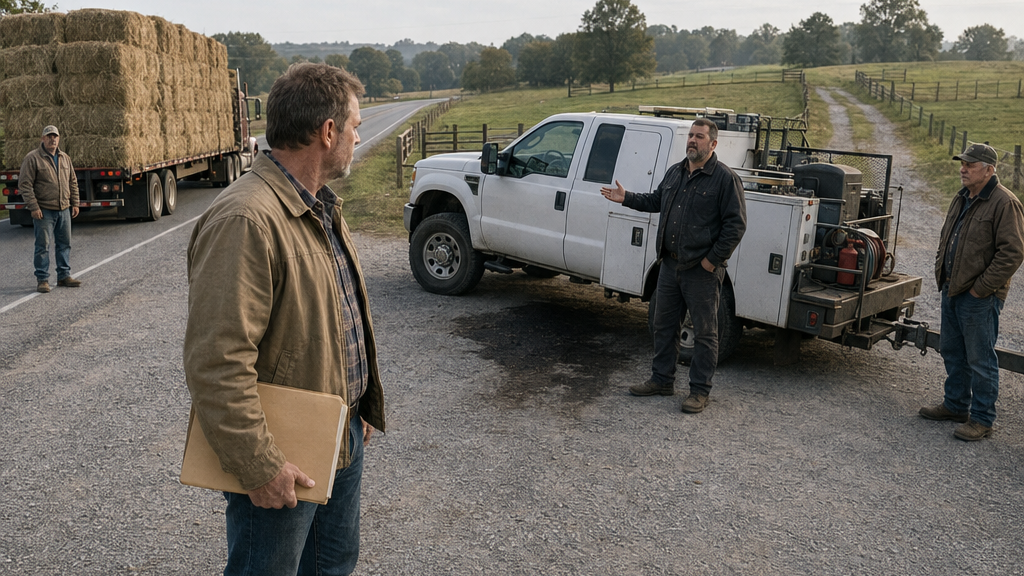
The white service truck was sitting exactly where the hay trailer needed to turn.
Timothy Campbell saw it before he reached the end of the lane, its boxy rear end angled across the gravel turnout like somebody had parked it there on purpose. The truck was old enough for rust to show around the wheel wells, but the refrigeration and HVAC equipment mounted behind the cab was expensive, organized, and unmistakably commercial.
Behind Timothy, diesel brakes hissed.
The hay-delivery driver had stopped his loaded tractor-trailer partly on the county road.
Timothy looked at the truck, then at the approaching daylight over his lower pasture.
“Give me a minute.”
The driver leaned out his window. “That yours?”
“No.”
“Then he picked a bad morning.”
Timothy already knew whose it was.
Dennis Roberts had been leaving the truck there off and on since early July. At first, it had been one evening. Then a Friday night. Then three nights in one week. By August, Timothy could step outside before breakfast and almost expect to see white paint through the cedar branches at the end of the lane.
He had left a note under Dennis’s windshield wiper two weeks earlier.
Please don’t park here. I need this turnout clear for farm access.
The note disappeared.
The truck returned the next night.
Timothy had asked Dennis in person after that.
Dennis had nodded toward the gravel and said, “I’m not hurting anything.”
Timothy had answered, “You’re blocking access.”
“I’ll move if you need through.”
That had sounded reasonable for exactly as long as it took Timothy to realize it meant Dennis intended to keep parking there until someone physically made him move each time.
Now forty-eight round bales were waiting on the county road.
Timothy crossed the turnout toward Dennis’s house, which sat beyond a thin line of trees on the neighboring property. Before he reached the ditch, a screen door slapped shut.
Dennis came down his back steps already wearing work pants and boots. He had a travel mug in one hand.
“You need the truck moved?” Dennis called.
Timothy stopped.
“Yes.”
Dennis looked toward the road as if he had only just noticed the tractor-trailer.
“Could’ve texted.”
“I shouldn’t have to.”
Dennis took a drink from the mug.
For a second neither man moved.
Then the hay driver sounded one short burst of the horn.
Dennis gave a humorless smile. “Everybody’s in a hurry this morning.”
He walked toward the truck.
Timothy followed far enough to watch him unlock it.
The driver had climbed down by then. He stood beside the front tire of his rig and studied the turnout.
“You got oil here,” he said.
Timothy looked where the man was pointing.
A black wet line ran between the pale stones beneath Dennis’s engine compartment. It wasn’t one old stain. The center still reflected the early light.
Timothy crouched and touched the edge of it with one finger.
Fresh.
Dennis had opened the truck door.
“That thing leaking?” Timothy asked.
Dennis glanced underneath.
“Old truck.”
“That isn’t an answer.”
“It’s probably a seal. I’ve got a pan at the shop.”
“The pan’s not here.”
Dennis’s face tightened. “You want me to move or you want to inspect it?”
“I want it off my turnout.”
There was the smallest pause.
Dennis looked directly at him.
“Your turnout?”
The words were mild. The tone wasn’t.
Timothy stood.
Dennis pointed with his mug toward the gravel widening between the lane and the county shoulder. “That’s been used for turning around longer than either of us has been driving.”
“It’s part of the farm.”
“It’s access.”
“It’s my access.”
Dennis shook his head once, almost patiently. “Your dad never acted like that.”
Something in Timothy’s chest tightened, but he kept his voice level.
“My dad isn’t here.”
“No. He isn’t.”
The driver looked away.
Dennis climbed into the white truck and started it. A rough diesel rattle filled the turnout. He pulled ahead ten yards, backed toward the ditch, then stopped with half the truck still on the gravel.
The hay driver walked the turning radius with his eyes.
“That’ll work if I take it wide.”
Timothy wanted Dennis to move farther.
Instead he stepped aside.
The tractor-trailer eased forward. Its right tires came within inches of the grass edge before the driver swung the long trailer into the farm lane. Dust lifted behind it.
Dennis watched from inside his cab.
When the hay truck cleared, he rolled down the window.
“See?” he said. “Nobody had to make a federal case out of it.”
Timothy stared at him.
“I’ve asked you twice.”
Dennis’s expression changed slightly.
Not guilt. Not embarrassment.
Annoyance.
“Tim, people have been pulling off here forever. Delivery trucks. Vets. Contractors. Your dad let half the county use it when they needed to.”
“For turning around.”
Dennis shrugged. “Same gravel.”
Then he drove toward the highway.
Timothy remained at the entrance until the white truck disappeared around the bend.
The fresh oil stain stayed behind.
By nine, the hay was stacked along the east side of the barn. Timothy should have been relieved. Instead he kept thinking about Dennis’s phrase.
Same gravel.
After lunch he came back with a shovel, absorbent material, and a bucket. He worked the darkest part of the stain until the stones no longer shone.
Near the fence, something metallic caught beneath the weeds.
Timothy set down the shovel and pulled the grass apart.
A heavy, rusted mechanical housing lay against the bottom wire, greasy inside and chipped along one edge. It looked like part of a transmission or gearbox, too heavy to have blown off a passing vehicle and too far from the road to have fallen there accidentally.
Timothy stared at it.
There were fresh drag marks through the gravel.
They began near the place Dennis had been parking.
Chapter 2: A Deed Line Hidden Under Gravel
Timothy found the parcel number before he found the deed.
It was typed on a yellowed property schedule folded inside the closing file from when he had taken over the farm. The paper listed the house tract, pasture acreage, barn lot, and then one narrow additional description Timothy had barely noticed in years.
He read it twice.
Then he carried the file to the kitchen table and opened the county tax map on his laptop.
The gravel turnout was there.
Not marked as a turnout. Not labeled as shared access. It appeared only as a strange angled corner of the Campbell parcel reaching toward the county road.
Timothy zoomed in until the boundary lines blurred.
He leaned back.
For the first time since Dennis had said your dad never acted like that, Timothy felt something close to satisfaction.
He had remembered correctly.
The gravel was his.
By eleven Saturday morning, he was standing under fluorescent lights at the county records office with the parcel number written on an envelope.
The land-records clerk pulled up the current map, then an older survey image.
“You’re looking at this piece?” she asked.
She tapped the screen.
“Yes.”
“The access widening?”
“I guess that’s what people call it.”
She enlarged the map.
The boundary ran beyond Timothy’s fence line, crossed nearly the entire gravel fan, then met the highway right-of-way.
Timothy pointed. “So this isn’t county property?”
“The road right-of-way begins here.”
Her finger moved along a separate line.
“And this?”
“Private parcel.”
“Mine?”
She read the owner field.
“Campbell.”
The word landed with more force than Timothy expected.
He asked for certified copies of the relevant parcel documents and tax history. The clerk printed them without interest in the conflict behind the request.
To her it was ink and coordinates.
To Timothy it felt like an argument finally reduced to something clean.
At home he spread the pages across his office desk.
There was no easement granting Dennis access.
No commercial-use agreement.
No notation giving neighboring contractors a storage right.
The taxes had been paid with the rest of the farm every year.
Timothy found the old closing statement next. The narrow strip had been included with the additional acreage acquired when his parents consolidated several small pieces around the original homestead.
Nothing dramatic.
No secret title.
Just land that looked unimportant because gravel covered it instead of corn or grass.
He slipped the documents into a plain manila folder.
Then he photographed the oil stain.
Then the rusted mechanical housing.
Then the tire marks where Dennis’s truck had been parked.
By late afternoon, he had built a tidy sequence on his desk.
Dates.
Photographs.
Property map.
Tax record.
Two requests to stop.
He looked at it and felt his breathing settle.
There was a comfort in evidence.
Evidence did not change its story depending on who had known whom for thirty years.
A pickup came up the lane just before supper.
Kathleen Campbell parked beside the farmhouse and brought in a sack of tomatoes from her garden.
She found Timothy standing over the desk.
“What are you doing?”
“Proving something I shouldn’t have to prove.”
She set the tomatoes down.
He handed her the county map.
Kathleen adjusted her glasses and studied it.
“That corner?”
“Yes.”
“That’s what this is about?”
“That’s where Dennis keeps leaving the truck.”
“I know where he parks.”
“Then look.”
Timothy pointed to the boundary.
“It’s all inside our parcel. Every bit of it until the road right-of-way.”
Kathleen did not react the way he expected.
She kept reading.
“I went to the county this morning,” Timothy said. “No easement. No agreement. Nothing.”
Kathleen looked toward the window.
“What?”
“Nothing.”
“That’s not a nothing face.”
She placed the map down carefully.
“Have you talked to Dennis again?”
“I already talked to Dennis.”
“I mean talked. Not told him to move.”
“He dumped a transmission beside the fence.”
“You know it was him?”
“The drag marks start where he parks.”
“That’s not what I asked.”
Timothy folded his arms.
“He’s been using the place like his own equipment yard.”
Kathleen nodded slowly.
“I’m not saying he should.”
“Good.”
“I’m saying you’re acting like a map answers every part of this.”
“It answers who owns it.”
“Yes.”
“That’s the question.”
Kathleen looked at him for several seconds.
“No,” she said. “That’s your question.”
Timothy felt irritation return.
“What’s Dennis’s?”
“Probably why something he’s seen people use his whole life suddenly belongs behind a line nobody ever talked about.”
“It always belonged behind the line.”
Kathleen sighed.
“You sound like the clerk.”
“At least the clerk knows where the boundary is.”
“That isn’t what I meant.”
Timothy pushed the folder closed.
For a moment he considered showing her the photographs, the oil, the mechanical housing, the note Dennis had ignored.
Instead he said, “Dad paying taxes on something doesn’t make it public because he didn’t put a gate across it.”
Kathleen’s expression shifted.
There it was again.
Not disagreement exactly.
Something withheld.
Timothy noticed.
“What?”
She picked up one of the tomatoes and turned it in her hand.
“Dad didn’t put a gate there for a reason.”
“What reason?”
Kathleen hesitated.
“He liked people being able to turn around.”
“That’s not the same as parking a commercial truck overnight.”
“No.”
“Then we agree.”
She looked back down at the map.
Timothy waited.
Kathleen did not leave.
Finally she said, “You remember the ice storm when we were kids?”
“Barely.”
“The one when the milk cooler went down at the Henderson place?”
Timothy shook his head.
“Dad let service trucks stage right there for two days because the county road was blocked farther up.”
“That was an emergency.”
“Yes.”
“Thirty years ago.”
“Yes.”
Timothy opened the folder again.
“None of that creates a legal right.”
Kathleen’s mouth tightened.
“I didn’t say it did.”
“Then why are we talking about it?”
“Because Dennis isn’t looking at that gravel and seeing a parcel number.”
“What’s he seeing?”
Kathleen met his eyes.
“Our father.”
The room became very quiet.
Timothy disliked the answer because a boundary map gave him nothing useful to do with it.
Kathleen touched the edge of the folder.
“Timothy, Dad never treated that strip like it was only his.”
Chapter 3: He Said the Lane Belonged to Everyone
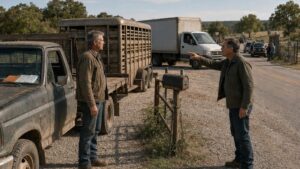
The following Saturday, Dennis parked across the turning radius again.
This time Mark Davis was standing beside him.
Timothy saw both men before he saw the truck, and that made the situation feel less accidental.
Dennis’s white service vehicle sat over the darkened patch of gravel. A utility trailer was hooked behind it, loaded with ladders, a compressor, and metal service boxes. Mark’s pickup stood on the county shoulder.
Another hay delivery was coming from the west.
Timothy could hear its diesel engine before it reached the bend.
He had the manila folder under his arm.
Dennis noticed it immediately.
“Morning,” Mark said.
Timothy looked at the truck.
“You need to move.”
Dennis put one hand on his hip.
“Again?”
“Yes. Again.”
The hay rig appeared around the bend and slowed.
Mark glanced between the road and the turnout.
“Dennis said you’re claiming this whole pull-off now.”
“I’m not claiming anything.”
Dennis gave a short laugh. “That folder says otherwise.”
Timothy ignored him.
“The trailer needs the turn.”
“There’s room.”
“There isn’t.”
Dennis pointed toward the rough field entrance farther south. “He can go in there.”
“That entrance isn’t built for loaded trucks.”
“It’s an entrance.”
“So is this one.”
The hay driver stopped on the road.
A car came up behind him and slowed sharply.
Timothy felt the scene widening around them.
It was no longer two men disagreeing beside a fence.
Now there was a blocked road, a witness, Mark watching, and Dennis behaving as if the turnout were a public square where Timothy had suddenly arrived with private rules.
Dennis nodded toward the folder.
“You go get a survey done?”
“No.”
“Then what is it?”
Timothy said nothing.
Mark rubbed the back of his neck.
“Tim, I don’t want in the middle of this.”
“You’re already standing in it.”
“That’s fair.” Mark looked down at the gravel. “But Dennis isn’t making up the part about people using this.”
“I know people have turned around here.”
“More than turned around.”
Timothy looked at him.
Mark continued, reluctantly now.
“Your dad let the vet park there during calving season. Repair guys too. Sometimes fertilizer trucks waited there if somebody was unloading ahead of them.”
“For hours?”
“Sometimes.”
“For weeks?”
Mark shook his head.
“No.”
Dennis spoke before Timothy could.
“Your father never came out here measuring minutes.”
Timothy turned toward him.
“My father also never told you to store your business equipment here.”
“Store?” Dennis said. “I park a truck.”
“And a trailer.”
“Sometimes.”
“And mechanical parts.”
Dennis’s jaw shifted.
“You saying I dumped something?”
“I’m saying I found a gearbox against my fence.”
“Then say what you mean.”
“I just did.”
The hay driver climbed down from his cab.
“You fellas want me to back a half mile to the intersection?”
Nobody answered.
Timothy looked at the folder under his arm.
Inside were the parcel map, tax record, certified ownership documents, and a clean legal answer.
He could have opened it in ten seconds.
He could have placed the map on Dennis’s hood and pointed to the boundary.
Instead Kathleen’s voice returned to him.
Dad never treated that strip like it was only his.
Timothy hated that sentence more now than when she had first said it.
Not because it proved Dennis right.
Because it made proving Dennis wrong less satisfying than Timothy had expected.
Dennis saw his hesitation.
“There it is,” he said.
“What?”
“You don’t know.”
Timothy looked up.
Dennis spread his hands toward the gravel.
“You’ve got some papers, and now suddenly this place that everybody’s used forever is your private driveway.”
“It is part of my farm.”
“According to you.”
“According to the county.”
Dennis’s expression changed for a fraction of a second.
Mark noticed it too.
Timothy almost reached for the folder.
Instead he stopped.
“If that’s what you believe,” Dennis said, “show us.”
The hay truck idled behind them.
Timothy’s face felt hot.
He realized Dennis expected a performance now. Open the folder. Point at the line. Win in front of Mark. Make the other man smaller.
The temptation was stronger than Timothy wanted to admit.
He closed his hand around the folder.
Then he walked past Dennis toward the hay driver.
“Can you make the south entrance if I guide you?”
The driver looked down the road.
“It’ll be ugly.”
“I’ll fix the rut.”
“You sure?”
“No.”
The driver smiled once. “Good enough.”
Dennis called after Timothy.
“That’s your answer?”
Timothy turned.
“I’ve asked you twice to keep this clear.”
“That doesn’t make it yours.”
Timothy lifted his phone and photographed the truck, trailer, oil-stained gravel, and blocked entrance in one frame.
Dennis stared at him.
Timothy took a second photograph.
Then he walked south.
It took fifteen minutes to get the hay rig through the field opening.
The right trailer wheels dropped into soft ground and carved two deep grooves through Timothy’s grass. He guided the driver inch by inch until the tires found firmer soil.
When it was done, the driver climbed out and looked back toward the main entrance.
“You know,” he said, “most fellows would’ve just called somebody and had that truck moved.”
Timothy looked at the ruts.
“Most fellows don’t have my sister asking inconvenient questions.”
The driver laughed, unsure whether Timothy was joking.
By the time Timothy returned to the turnout, Mark’s pickup was gone.
Dennis was closing the trailer door.
“You made your point?” Timothy asked.
Dennis faced him.
“I’m trying to keep working.”
“So am I.”
“That spot saves me forty minutes some days.”
“That isn’t my problem.”
“No.” Dennis looked toward the pasture. “That’s the difference between you and your dad.”
Timothy felt something inside him harden.
“Don’t use him to make this simpler than it is.”
Dennis’s expression sharpened.
“I’m not the one making it simple.”
He got into the truck.
Before driving away, he leaned out the window.
“Ask around, Tim. That lane belonged to everybody who needed it long before you started carrying folders.”
Then he left.
Timothy stood alone on the gravel.
The oil stain had spread darker beneath where the truck had been.
He could prove ownership.
What he could not yet prove was when a favor had become an expectation.
That evening, he took a trail camera from the equipment cabinet in the barn.
He walked to the pine tree overlooking the turnout and strapped it chest-high against the trunk. From there, the camera could see the gravel, the fence line, and the entrance from the county road.
Timothy adjusted the angle until the white stones filled the lower half of the small preview screen.
For several seconds he looked at his own property through the camera.
Then he armed it.
Chapter 4: The Camera Saw More Than Parking
At 12:47 Monday morning, the trail camera caught Dennis backing a loaded utility trailer into the turnout.
Timothy watched the clip twice before breakfast.
The infrared image flattened everything into gray—the fence, the pine branches, Dennis’s white truck—but the sequence was clear. Dennis backed until the trailer sat parallel to the fence, got out, unhooked it, and drove away.
The trailer remained there until nearly six the following evening.
Timothy wrote the date and times in a notebook.
He told himself that was all he was doing.
Documenting.
By Wednesday he had six entries.
Thursday made eight.
Dennis sometimes parked only the truck. Other nights he left the trailer too. Once he unloaded two metal cylinders and a compressor before driving home. Another night he transferred boxes from a second service vehicle.
Nothing about it resembled someone briefly pulling off the road.
Timothy created folders on his computer for each date and copied the camera images into them.
The organization soothed him.
It also gave him a reason not to call Kathleen.
On Friday morning he found another object beside the fence.
This one was unmistakable: a failed transmission casing, greasy and dark, resting partly on the grass. The earlier housing Timothy had discovered had been smaller. This one looked as though it had been dropped from a trailer and dragged several feet.
He photographed it from three angles.
Then he photographed the oily depression beneath it.
He did not confront Dennis.
Instead, he added another line to the notebook.
That afternoon, while replacing a mineral feeder in the lower pasture, Timothy noticed the truck’s rear plate more carefully than before.
Commercial registration.
He took a photograph from his side of the fence.
Back in the farmhouse, he searched the business name painted in small letters on the truck door. Dennis operated an independent agricultural refrigeration and HVAC service. The county business listing gave an office address, but the equipment-storage address appeared to be the same.
Timothy leaned closer to the screen.
The listed location was not the gravel turnout.
It was a leased industrial yard several miles away.
He searched again.
The property listing for that yard showed a recent ownership change.
For the first time, Timothy understood why Dennis might suddenly be using the farm entrance more heavily.
Understanding did not make him less angry.
It made the pattern clearer.
The turnout was not convenience anymore.
It was storage.
By the end of the second week, Timothy had photographs of sixteen separate overnight uses, four trailer drop-offs, two instances of scrap equipment being left beside the fence, and several dark spots in the gravel that had not been there in July.
He called the county zoning office.
The officer on the phone did not promise anything.
“You own the parcel?”
“Yes.”
“Any written easement?”
“None I can find.”
“Any history of permission?”
Timothy paused.
“Not from me.”
“That wasn’t quite my question.”
Timothy looked toward the kitchen.
“No written permission.”
There was silence on the other end.
“We can look at commercial storage and possible contamination,” the officer said. “Property-access disputes can get more complicated if there’s prior permissive use.”
Timothy wrote that phrase down.
Prior permissive use.
He disliked it immediately.
After the call, he printed another batch of photographs and put them in the manila folder.
Kathleen arrived that evening without calling.
She walked into the office, saw the photographs spread across the desk, and stopped.
“How long have you been doing this?”
“Two weeks.”
Her eyes moved from the truck photos to the notebook.
“You put up a camera?”
“On our property.”
“That wasn’t my question.”
Timothy pushed his chair back.
“He’s leaving equipment overnight. That’s his trailer there. That’s the same transmission I found by the fence.”
Kathleen picked up one photograph.
“I’m not defending that.”
“Then what are we arguing about?”
“You.”
He almost laughed.
“Me?”
“You’re building a case like there’s going to be a jury.”
“There’s damage.”
“Yes.”
“He ignored me.”
“Yes.”
“He told Mark the turnout belongs to everybody.”
Kathleen placed the photograph down.
“And you still haven’t asked what Dad actually allowed.”
“I know what he didn’t allow.”
“No, you don’t.”
That stopped him.
Kathleen folded her arms.
“You know what you want the answer to be.”
Timothy stared at her.
“I called zoning today.”
Her face changed.
“You called the county before calling me?”
“I’m calling you now.”
“No. I drove here and found out.”
He heard himself preparing the legal explanation—the ownership records, the lack of easement, the commercial use—but for once the words sounded exactly like what Kathleen had accused him of.
A case.
He looked at the photographs.
“I needed something that couldn’t be argued with.”
Kathleen’s expression softened, but only slightly.
“Everything can be argued with if you leave half the story out.”
She went to the hallway closet where old family photographs and documents had been stored since their mother died.
Timothy followed.
Kathleen pulled out a shallow cardboard box.
“You remember this?”
“No.”
“You never cared about pictures.”
“That’s because half of them are tractors nobody labeled.”
“That’s why Dad kept them.”
She sat at the kitchen table and worked through faded prints.
Timothy waited impatiently.
Then Kathleen stopped.
Her thumb remained on one photograph.
She turned it around.
The image was old enough that the colors had shifted toward yellow. Timothy recognized the farmhouse immediately, though the maple tree by the road was much smaller.
His father stood near the gravel turnout.
Beside him was a service truck.
Not Dennis’s white truck.
Older.
Red.
But the lettering on the door carried the Roberts name.
A second truck was partly visible behind it.
Timothy took the photograph.
“Dennis’s uncle,” Kathleen said.
“You’re sure?”
“Yes.”
“What were they doing?”
“Keeping equipment here.”
“For how long?”
Kathleen looked at him.
“That,” she said, “is the question you should’ve asked before you mounted a camera.”
Chapter 5: The Favor That Outlived the Man
Kathleen tapped the red service truck in the photograph.
“That was the winter the Henderson dairy lost refrigeration.”
Timothy kept his eyes on the picture.
Their father looked younger than Timothy was now. One hand rested on the truck’s hood. Behind him, the gravel turnout was crowded with equipment, hoses, and another service vehicle.
“How long were they here?”
“Two days that time.”
“That time?”
Kathleen nodded.
“Dad let them stage there during emergency calls. Dennis’s uncle did refrigeration work all over the county. Sometimes roads were bad. Sometimes farms didn’t have room for two service rigs.”
Timothy set the photograph on the kitchen table.
“So temporary.”
“Yes.”
“Not overnight storage for months.”
“No.”
The clean distinction relieved him more than it should have.
Kathleen noticed.
“Don’t look so pleased.”
“I’m not.”
“You are.”
“I wanted the truth.”
“You wanted the part that proves you right.”
Timothy started to answer, then stopped.
Kathleen slid another photograph from the box.
A veterinary truck sat in the same turnout beside a cattle trailer.
Then another showed a fertilizer delivery vehicle pulled onto the gravel while something larger blocked the lane.
“It wasn’t public,” Kathleen said. “Dad never said it was. But he let people use it when they needed it.”
“Did Dennis know that?”
“You should ask Dennis.”
Timothy looked toward the window.
The turnout was barely visible through the trees.
For two weeks he had watched Dennis through a camera because watching required nothing from him except patience.
Talking was messier.
That evening, he crossed the road.
Dennis was outside his shop building, sorting copper pipe into a rack.
He saw Timothy coming and continued working.
“If you’re here about the trailer, it’s gone.”
“I’m here about my father.”
That made Dennis stop.
Timothy held the old photograph.
Dennis recognized it before Timothy reached him.
“Haven’t seen that in years.”
“Kathleen says your uncle used the turnout.”
Dennis wiped his hands on his pants.
“Your dad let him.”
“For emergencies.”
“For work.”
“For emergencies,” Timothy repeated.
Dennis looked at him.
“Sometimes.”
The answer mattered.
Timothy lowered the photograph.
“So you knew there were limits.”
Dennis exhaled through his nose.
“I knew nobody ever had to ask permission every time they stopped there.”
“That isn’t what I asked.”
“No. You asked it like a lawyer.”
Timothy felt the familiar urge to retreat into facts.
Instead he waited.
Dennis leaned against the workbench.
“My uncle would call your dad if he was leaving anything overnight. Most times your dad said not to worry about it.”
“So he asked.”
“Usually.”
“Did you?”
Dennis looked away.
There it was.
Not innocence.
Not complete deceit either.
Just the moment when a man understood exactly where his argument had weakened.
Timothy said, “Why didn’t you use your own yard?”
Dennis gave a short laugh.
“What yard?”
“The leased place off the highway.”
Dennis’s face tightened.
“You checking my business records now?”
“I saw the address.”
“Then you saw it sold.”
“Yes.”
Dennis picked up a length of pipe and set it back down.
“The new owner tripled the rent.”
Timothy said nothing.
“I had thirty days to clear out,” Dennis continued. “Every storage place around here wants city prices because companies are buying everything near the highway.”
“So you decided to use mine.”
“I decided to keep working.”
“You could have asked.”
“And you’d have said yes?”
Timothy opened his mouth.
Dennis waited.
Timothy could not honestly say he would have.
“That’s what I thought.”
“That doesn’t give you permission.”
“No.”
The word came without argument.
It surprised Timothy.
Dennis looked toward the road.
“I’ve got three grocery stores, two dairies, and half a dozen poultry houses that call me when refrigeration goes down. A forty-minute detour to get equipment matters when somebody’s cooler is warming.”
“That explains why the turnout is useful.”
“It explains why I need it.”
“No. It explains why you wanted it.”
Dennis looked back at him.
Timothy continued, quieter.
“You knew my father’s arrangement wasn’t permanent.”
Dennis rubbed a hand over his jaw.
“I knew he wouldn’t have made this into what you’re making it.”
That hurt because Timothy suspected part of it was true.
“My father also would’ve expected you to ask.”
Dennis did not answer.
For several seconds they stood with the old photograph between them.
Timothy finally held it out.
Dennis did not take it.
“He was a good man,” Dennis said.
“So was your uncle, from what I remember.”
“Yeah.”
“That doesn’t make the gravel yours.”
“No.”
It was the first time Dennis had admitted it plainly.
Timothy should have felt victorious.
Instead he felt tired.
When he returned home, Kathleen was gone. The kitchen table still held the other photographs.
Timothy placed the one of his father among them.
He sat for a while without opening the manila folder.
The next morning he walked the fence line before feeding cattle.
Near the turnout, a chemical-dark sheen lay across a fresh patch of gravel.
He crouched.
Oil.
More than before.
It had moved beyond the center of the turnout in a thin black thread.
Timothy followed it downslope.
The stain disappeared into grass at the edge of the drainage swale that carried runoff toward the lower pasture.
He stood.
Whatever sympathy Dennis’s explanation had created lasted exactly long enough for Timothy to see where the oil was going.
He took out his phone.
This time he did not photograph the truck.
He photographed the drainage.
Chapter 6: The Folder Opened at the Farm Gate
The first county vehicle turned into the farm lane at 8:12 Tuesday morning.
The second arrived less than a minute later.
Dennis’s white service truck was still sitting on the turnout.
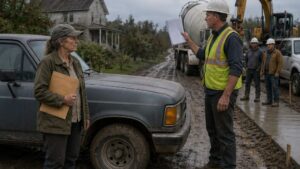
Timothy watched from beside the barn as both vehicles slowed near the oil-darkened gravel. One carried the county zoning/code officer. The other belonged to an environmental and soil-and-water inspector.
Dennis came out of his house before either official had finished parking.
He looked at Timothy first.
Not the officers.
Timothy had the manila folder under one arm.
The zoning officer introduced himself, then asked Timothy to show them the parcel in question.
Timothy walked toward the turnout.
Dennis followed.
“This about his complaint?” Dennis asked.
“We’re here to look at property use and the runoff concern,” the officer said.
“What runoff?”
Timothy pointed toward the swale.
Dennis looked at the darkened gravel.
“That’s an old truck. It drips.”
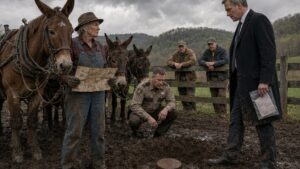
The environmental inspector crouched near the edge and used a small hand tool to pull aside the stones.
“How long has it been parked here?”
Dennis answered before Timothy could.
“Off and on.”
“How often?”
Dennis shrugged.
Timothy felt the folder under his arm.
Inside it were dates.
Photographs.
Camera images.
He could answer every question Dennis was trying to make vague.
The inspector walked the stain toward the grass.
“This drains into pasture?”
“My lower field,” Timothy said.
“Surface water?”
“Only after heavy rain.”
The inspector nodded and took photographs.
Dennis turned toward Timothy.
“You called environmental over a couple oil spots?”
“I called because I asked you to stop.”
Dennis’s face flushed.
“Then show them.”
Timothy knew what he meant.
“Show them what?”
“The proof.”
Dennis pointed at the folder.
“You’ve been carrying that thing around for two weeks. Show everybody that this is yours.”
The sentence landed almost exactly as it had the previous Saturday.
But there was no hay truck waiting now.
No audience except two officials, Dennis, and the gravel itself.
Timothy opened the folder.
He removed the certified parcel map first.
Then the ownership record.
Then the tax documentation.
He walked past Dennis and handed them to the zoning officer.
The officer unfolded the map against the hood of his vehicle.
Dennis stepped closer.
Timothy watched his eyes move along the boundary.
For a few seconds, nobody said anything.
Then Timothy spoke.
“My father also let people use this turnout.”
Dennis looked at him sharply.
The zoning officer looked up.
Timothy continued.
“Service trucks. Veterinarians. Deliveries. Sometimes overnight in emergencies.”
Dennis’s expression changed from anger to confusion.
“You telling them that?”
“Yes.”
“You didn’t tell me you were going to.”
“You didn’t ask.”
The officer held the map flat with one hand.
“Was there a written agreement?”
“Not that we’ve found,” Timothy said. “No easement. It was informal.”
Dennis crossed his arms.
“My family used it for years.”
“For temporary work,” Timothy said. “And you knew that.”
Dennis stared at him.
The environmental inspector remained by the swale, giving the argument no visible interest.
The zoning officer finally said, “Historical permission matters when people start using the word trespass. It doesn’t automatically create a right to operate commercial storage on somebody else’s parcel.”
Dennis looked toward him.
“I’m not running a business here.”
“Do you store business vehicles here?”
“Sometimes.”
“Equipment?”
Dennis hesitated.
“Sometimes.”
“Trailers?”
“Yes.”
“For multiple nights?”
Another pause.
“Yes.”
The officer nodded toward Timothy.
“And he asked you to stop?”
Dennis’s jaw tightened.
“Yes.”
Timothy could almost feel the argument rearranging itself.
Not into the simple victory he had imagined at his desk.
Into separate pieces.
Ownership.
Past permission.
Current use.
Damage.
Each one mattered differently.
The environmental inspector returned carrying a sample bag.
“I can’t tell you from looking at it what remediation will be required,” he said. “But contaminated stone may need removal. You should keep vehicles off this section until we determine the extent.”
Dennis rubbed his forehead.
“That truck is how I make my living.”
“Nobody told you not to drive it,” the inspector said. “We’re telling you not to park it over affected ground.”
Dennis looked at Timothy.
“There. You happy?”
Timothy thought about saying no.
Instead he said, “I want the oil out of my drainage.”
Dennis gave a bitter laugh.
“And what else?”
The zoning officer turned several camera printouts in the folder.
“These yours?”
“Yes.”
Trail-camera images.
Dates.
Trailer.
Equipment.
Dennis noticed them.
“You were filming me?”
“Recording my entrance.”
“My house is right there.”
“The camera faces the turnout.”
Dennis stepped toward Timothy.
The officer raised one hand, not dramatically, just enough.
Dennis stopped.
“So while I’m trying to keep my business alive,” Dennis said, “you’ve been sitting in that house building a file.”
Timothy felt Kathleen’s accusation again.
A jury.
A case.
A version of the story in which every page proved something and nothing had to be said aloud.
“I should have asked you about Dad’s arrangement sooner,” Timothy said.
Dennis blinked.
The anger did not disappear.
But it lost its shape.
Timothy continued.
“I should have asked before putting the camera up.”
Dennis looked at the officials, then back at Timothy.
“That supposed to make this better?”
“No.”
“Then why say it?”
“Because it’s true.”
The zoning officer returned the property documents to Timothy.
“Here’s where we are. Ownership looks clear from what you’ve provided. The old permissive use means I’m not going to stand here and make sweeping statements about every vehicle that ever stopped on this gravel.”
Timothy nodded.
Dennis exhaled.
“But current commercial storage after the owner requested it stop is another issue. So is leaving equipment. We can address those.”
Dennis’s relief disappeared.
The officer continued.
“You’ll need to remove the trailer and any stored materials from this parcel. Until the environmental review is complete, no regular parking on the turnout.”
“What kind of fine?”
“That depends on compliance and what the inspection finds.”
Dennis looked at Timothy again.
Timothy recognized the opening.
He could insist.
He could describe every ignored request, every night on the camera, every piece of scrap.
He could push for the hardest interpretation available.
Instead he said, “I want the damaged gravel fixed.”
Dennis stared at him.
“And the equipment off the lane,” Timothy added. “I need farm access.”
“That it?”
“That’s what I called about.”
The officer glanced between them.
“If remediation is handled promptly, that usually matters.”
Dennis looked away toward his truck.
The environmental inspector marked several points along the stained gravel.
For the next half hour they measured, photographed, and discussed removal of affected stone. The process was duller than Timothy had imagined.
No dramatic citation.
No one raising a voice.
No moment when a document transformed Dennis into a defeated man.
Only practical consequences arriving one item at a time.
When the officials finally returned to their vehicles, the zoning officer told Dennis he would receive written instructions.
Dennis nodded without looking at Timothy.
The county vehicles backed out first.
Dust settled behind them.
Timothy remained beside the turnout.
Dennis walked to his white truck and rested one hand on the door handle.
He did not get in.
“You could’ve buried me with that file,” he said.
Timothy looked at the folder.
“I could’ve tried.”
“Why didn’t you?”
“Because you weren’t lying about everything.”
Dennis gave a small, humorless smile.
“Just the part that mattered.”
“You knew Dad’s permission had limits.”
Dennis nodded once.
“Yeah.”
The admission sat between them.
Then Dennis looked across the gravel toward the old fence.
“So what do you actually want, Timothy?”
Timothy frowned.
“I told the officer.”
“No.”
Dennis shook his head.
“You told him what you want me punished for.”
He pointed toward the turnout.
“What do you want this place to be when all this is over?”
Chapter 7: A Gate Where Permission Used to Be
The excavator bucket bit into the gravel before sunrise.
Timothy stood beside the fence with his hands in his coat pockets while the operator peeled back the darkest section of the turnout. Each scoop exposed another layer of stained stone beneath the surface.
Dennis was already there.
His white service truck was parked on the opposite side of the county road.
Not on the turnout.
Timothy noticed that before he noticed anything else.
The county environmental office had approved a simple remediation plan: remove the affected gravel, dispose of it properly, replace the contaminated layer, and keep commercial vehicles off the area until the work was complete. Dennis had agreed to pay the contractor directly rather than drag the matter through enforcement.
There was no handshake when he arrived.
Only a nod.
By eight, the transmission casing was gone too.
The operator loaded the last stained gravel into a dump trailer, then spread clean stone across the exposed ground.
Fresh limestone always looked too bright at first.
The turnout seemed larger without Dennis’s truck occupying it.
Kathleen arrived near nine carrying coffee.
She stood beside Timothy and watched the operator grade the new surface.
“So this is what victory looks like?”
Timothy accepted the cup.
“Apparently it looks expensive.”
“Dennis paying?”
“His share.”
Kathleen glanced toward the road, where Dennis was speaking with the contractor.
“He could’ve fought it.”
“Yes.”
“So could you.”
Timothy drank his coffee.
Neither of them said more.
A week earlier, the zoning officer had sent the formal notice. Dennis had to stop using the parcel for regular business storage. The environmental report required cleanup but found no serious contamination beyond the turnout and the edge of the drainage swale.
It could have been worse.
Timothy knew that now.
Dennis knew it too.
The leased yard problem had not disappeared. He had moved most of his equipment to a smaller place fifteen miles away and kept only what fit at his home shop.
It made his work less convenient.
It did not end his business.
That difference mattered to Timothy more than he expected.
The operator finished grading around noon.
When the machinery pulled away, Timothy walked across the new gravel.
No black stains.
No metal parts.
No trailer tracks pressed into the edge.
Only stone.
Kathleen followed.
“What are you going to do with it?”
“I ordered a gate.”
She looked at him.
“A gate.”
“Yes.”
“Dad would hate that.”
Timothy looked toward the road.
“Dad isn’t the one who has to explain where permission starts and stops.”
Kathleen smiled faintly.
“No. He was never very good at that.”
It was the closest either of them had come to criticizing him without immediately defending him afterward.
Timothy appreciated the honesty.
The gate arrived three days later.
It was nothing grand.
Two galvanized steel posts, a simple farm gate, and enough room for a hay trailer to make the turn before reaching it. Timothy deliberately placed it farther inside the property rather than at the road.
The turnout remained open enough for a driver to pull safely off the highway.
The farm lane did not.
Mark Davis stopped while Timothy was hanging the chain.
“So everybody can still turn around?”
“Yes.”
“But not drive up the lane.”
“Not without asking.”
Mark studied the gate.
“That probably should’ve been there twenty years ago.”
Timothy looked at him.
“That your way of saying I was right?”
“No.”
Mark smiled.
“It’s my way of not getting involved again.”
He drove away.
Timothy laughed despite himself.
That afternoon he walked to the pine tree.
The trail camera was still strapped to the trunk.
He had checked it less and less since the county visit.
For weeks, the camera had felt like control. Something that watched when Timothy could not. Something that turned uncertainty into dates and photographs.
Now it looked different.
Like a habit he no longer wanted.
He loosened the strap.
The camera came away from the bark, leaving a pale rectangle where sunlight had not reached.
Timothy carried it back to the barn and put it in the cabinet.
He did not move it to another tree.
By late fall, the new gravel had dulled to the same gray as the old.
Dennis did not park there.
He did not leave trailers.
He did not test the gate.
Their conversations remained brief.
Sometimes a nod.
Sometimes nothing.
There was no dramatic apology.
Timothy had stopped expecting one.
Then, in January, the temperature dropped hard enough to freeze water lines across half the county.
At 6:20 one morning, Timothy’s phone rang.
Dennis.
Timothy stared at the name before answering.
“What happened?”
“Mark’s milk cooler went down.”
Timothy sat up.
“Bad?”
“He says temperature’s climbing.”
“What do you need?”
A pause.
“I’ve got a second service truck coming. Road shoulder’s iced over.”
Timothy knew what Dennis was asking before he said it.
“Can I use the turnout?”
The words were simple.
No argument attached.
No reference to Timothy’s father.
No reminder of old habits.
Just a question.
Timothy looked out the bedroom window toward the lane.
The gate was barely visible in the blue morning light.
“Yes,” he said.
“Just the turnout?”
Timothy considered that.
“If you need equipment closer, call me when you get here.”
Another pause.
“Okay.”
Twenty minutes later, Dennis’s white truck pulled onto the gravel.
It stopped before the gate.
The second truck arrived shortly afterward.
Neither vehicle crossed onto the farm lane.
Timothy dressed and walked down.
Dennis was unloading tools.
He nodded toward the gate.
“We need power for a compressor.”
“There’s an outlet at the barn.”
Dennis looked toward the lane.
“You want me to bring the truck up?”
Timothy took the chain off the gate.
“For this, yes.”
Dennis did not move immediately.
“You sure?”
Timothy swung the gate open.
“I said yes.”
Dennis nodded once.
Then he drove through.
The moment was so ordinary Timothy almost missed what had changed.
Permission was not weakness.
A boundary was not hostility.
The trouble had never been that his father shared the turnout.
The trouble was that no one had been required to remember where sharing ended.
Dennis finished loading equipment before noon.
When he returned from Mark’s place, he stopped beside Timothy near the barn.
“Cooler’s running.”
“Good.”
Dennis looked toward the gate.
“I’ll be out in five minutes.”
“No rush.”
Dennis gave him a strange look.
Then a small smile appeared.
“Careful. People might start thinking you’re reasonable.”
Timothy smiled back.
“Don’t spread it around.”
Dennis drove out.
At the turnout, he stopped again.
Timothy watched from the barn as Dennis climbed from the truck, walked back, and closed the gate behind him.
He did not lock it.
Neither did Timothy.
The fresh gravel carried two tire tracks from the morning’s work, clean and temporary, leading in and then back out again.
For the first time in months, Timothy looked at the turnout and did not see an argument.
He saw exactly what it was.
His land.
And, when he chose, a place where someone else could stand.
The story has ended.