He Turned My Farm Lane Into Wedding Parking Until the Easement Changed Everything
Chapter 1: The Wedding Sign Hanging From My Cattle Gate
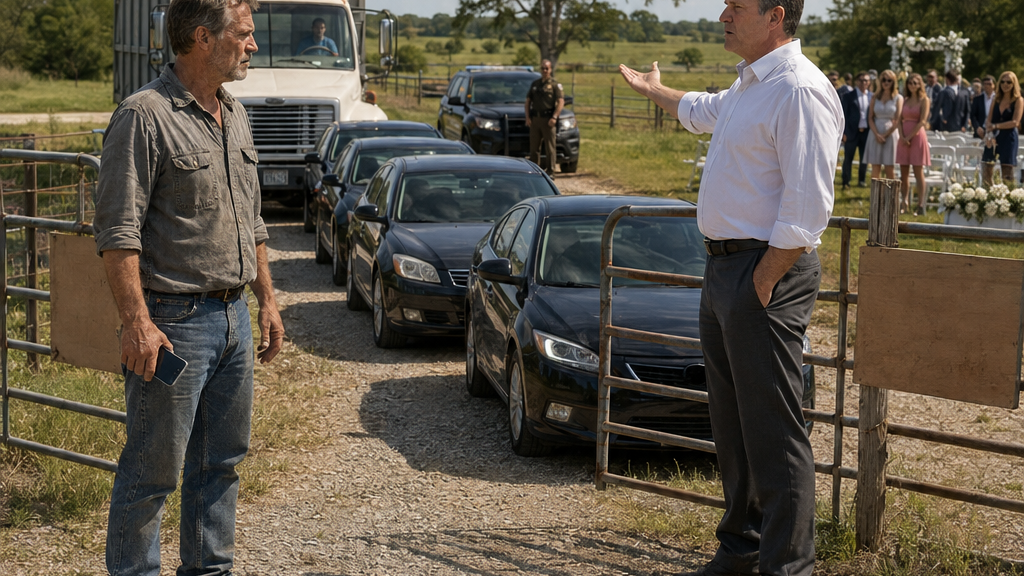
There were eleven cars in my farm lane when there should have been none.
I counted them twice from the cab of my pickup, because the first count felt too ridiculous to trust. Sedans, two SUVs, a spotless black crossover, and a silver rental van sat nose-to-tail on the gravel stretch between the county road and my cattle gate. Orange cones had been set along the ditch as if somebody had authority to direct traffic there.
The gate itself had been chained open.
Hanging from the top rail was a white board with an arrow painted across it.
WEDDING PARKING.
For several seconds, I just looked at it.
Beyond the gate, my cattle were gathered near the lower fence, restless from the morning feeding routine being late. Farther uphill, past the line of cottonwoods, I could see white rental chairs arranged in Timothy Allen’s field and strips of fabric tied along the fence. A delivery van stood beside his barn. Someone was testing music loud enough that the bass carried across my hay ground.
I shut off the pickup.
Two weeks earlier, Timothy had asked whether his daughter’s wedding guests could use my lane.
I had said no.
Not maybe. Not if they were careful. Not depending on the weather.
No.
I stepped out and pulled my phone from my pocket.
The first photograph was the sign.
The second was the gate.
Then I walked the line slowly, taking a picture of every vehicle, every license plate, and every cone.
A man in a blue shirt came down from Timothy’s side carrying a cardboard tray of coffee. He slowed when he saw me photographing the cars.
“Morning,” he said.
“Morning.”
He glanced back toward the wedding field. “We’re supposed to park along here.”
“I figured that from the sign.”
He gave me an uncertain smile. “Timothy said it was okay.”
That sentence bothered me more than the cars.
“Did he?”
The man’s smile disappeared.
I kept walking.
At the far end, one SUV had two wheels off the gravel and pressed into the grass shoulder I used when bringing wide equipment through. A folding chair had been set beside it. Somebody had put a cooler under the fence.
They had not mistaken my lane for Timothy’s.
They had arranged it.
I called him.
Timothy answered on the fourth ring.
“What?”
“Come down to the gate.”
A pause.
“Thomas, I’m in the middle of things.”
“So am I.”
“You see the cars?”
“I’m standing beside them.”
Another pause, shorter this time.
“We talked about this.”
“We did.”
“And you know how I answered.”
His voice hardened without getting louder. “They’ll be gone after the ceremony.”
“That wasn’t the answer.”
“Thomas, it’s one morning.”
“It’s my lane.”
“It’s an access lane.”
“My access lane.”
He exhaled into the phone. “I am not doing this with you twenty minutes before people start arriving.”
“People have already arrived.”
“They’re not hurting anything.”
I looked at the SUV sinking into the grass.
“Move them.”
“I can’t start pulling guests out now.”
“You can ask them.”
“No.”
It was such a simple word that for a moment I almost laughed.
Then I heard the diesel engine behind me.
I turned.
A bulk feed truck had stopped at the county road with its hazard lights flashing.
The driver leaned forward over the steering wheel, studying the line of vehicles packed into the lane he was supposed to use.
“Timothy,” I said, “my feed delivery is here.”
“That truck can come back later.”
“No. It can’t.”
“Then have him wait.”
I looked at the eleven parked cars.
My anger became cleaner.
“I’ll call you back.”
I ended the call.
The feed truck’s air brakes sighed as I approached.
The driver rolled his window down. “This you?”
“The lane is.”
He pointed with two fingers. “I can’t make that turn with those cars there. Even if I get in, I don’t have room to swing at the lower bend.”
“I know.”
“I’ve got another stop after you.”
“I know that too.”
He studied me for a second. “Wedding?”
“Apparently.”
He looked toward the handmade sign.
“You approve it?”
“No.”
That changed his expression.
I asked him to take a photograph from where he was sitting, showing the truck, the gate, and the blocked lane.
“For the delivery record?”
“For both of us.”
He nodded and reached for his phone.
I walked back toward the gate.
People were beginning to notice me now. A woman in a flowered dress stood beside one of the cars with her keys in her hand. A couple near the ditch stopped talking when I passed. Nobody said anything.
I photographed the tire marks near the shoulder.
Then the cone in front of the hinge post.
Then the chain holding my gate open.
My father had hung that gate twenty-six years earlier. He had welded one hinge himself after the original cracked during a winter freeze. It had never been ornamental. It kept cattle where they belonged and equipment routes clear.
Seeing a wedding sign hanging from it made something inside me feel less like anger than erasure.
I took the sign down.
I did not tear it.
I placed it against the fence.
Timothy came walking down the hill before I reached my pickup.
He wore dark slacks and a white shirt with the sleeves rolled to his forearms. No jacket yet. His face was flushed.
“Put that back.”
“No.”
“That’s how people know where to park.”
“They’re not parking here.”
“They already are.”
“Then they can move.”
He glanced toward the feed truck. “You could have scheduled that for Monday.”
I stared at him.
“You think I schedule feed around your daughter’s wedding?”
“I think neighbors make accommodations.”
“Neighbors ask.”
“I did ask.”
“And I answered.”
His jaw worked once.
Behind him, music stopped abruptly. Someone near the barn called his name.
Timothy looked back, then at me again.
“After the ceremony,” he said. “I’ll have every car gone.”
“The truck needs through now.”
“Then tell him to wait an hour.”
“He has another delivery.”
“That’s not my problem.”
The words hung there between us.
I saw him realize what he had said.
He could have corrected it.
He didn’t.
Instead, he pointed toward the lane.
“This has always been shared access, Thomas. You know that.”
“Not for a parking lot.”
“You don’t get to change history because you inherited the paperwork.”
There it was.
Not just the wedding.
Not just the cars.
Something older.
I felt the familiar urge to answer him with everything I had stored for years: the widened shoulder he had never asked about, the tractor he had left across the lower turn one harvest, the way every favor between our fathers had somehow become a permanent right after mine died.
Instead I said, “Move the cars.”
Timothy shook his head.
“No.”
He walked back toward the wedding field.
I stood beside the open gate until he disappeared behind the barn.
Then I called the non-emergency number for the sheriff’s office.
After that, I told the feed driver I would cover any rescheduling charge if we could not clear the lane.
“You sure?” he asked.
“No,” I said. “But write down the time you arrived.”
He did.
I went inside my farm office.
The room smelled of dust, machine oil, and paper that had spent too many summers without air-conditioning. I opened the bottom drawer of the metal filing cabinet and pulled out the folder containing the deed, survey copies, tax maps, and the easement my father had told me never to lose.
I found the paragraph I remembered.
Third-party access.
Written consent.
Non-agricultural use.
The language looked as solid as a fence post.
I slid the document into a plastic sleeve and headed back toward the blocked lane.
Only when I reached the door did I notice there was another page folded underneath it.
Chapter 2: The Clause Timothy Thought I Would Never Read
Two weeks before the wedding, Timothy had stood on my porch and called what he wanted a favor.
“Just for a few hours,” he had said.
He had come over near supper, when I was washing grease from my hands at the utility sink. I found him outside with one boot on the porch and the other on the ground, as if he did not intend to stay long enough to be invited inside.
“Emma’s guest list got bigger than expected,” he said. “We’re short on parking.”
I knew where the conversation was going before he finished.
“No.”
He blinked.
“I haven’t asked yet.”
“You want the lane.”
His mouth tightened. “I want to use the edge of it. Cars along one side. People can still get through.”
“No.”
“Thomas.”
“That lane is for the farm.”
“It’s a gravel road.”
“It’s how I get feed trucks to the bins. It’s how I get equipment to the lower field.”
“On a Saturday?”
I wiped my hands on a rag.
“Yes, Timothy. Farms work on Saturdays.”
He looked past me toward the yard as though searching for a more reasonable version of me.
“It’s Emma’s wedding.”
“I know.”
“She grew up here.”
“I know that too.”
“And you can’t give us one afternoon?”
The question was shaped carefully. Not about access. About generosity.
That irritated me enough that I became shorter than I should have.
“No parking.”
He gave a small laugh with no humor in it.
“Our dads never carried on like this.”
“Our dads asked each other.”
“They didn’t have to. That was the point.”
I folded the rag.
“The lane is on my parcel.”
“And there’s an easement.”
“For farm access.”
“Exactly.”
“Wedding guests aren’t farm equipment.”
Timothy stared at me.
He had expected resistance, but not a flat refusal.
Finally he said, “You still keep that old document?”
“Yes.”
“Then maybe you ought to read all of it.”
I almost asked what he meant.
Pride stopped me.
“I have read it.”
He gave me a look that lasted half a second too long.
“Fine.”
He stepped off the porch.
I followed him as far as the gate.
“What’s that supposed to mean?”
“It means our families have used that lane since before either of us owned these places.”
“For farm work.”
“For whatever needed doing.”
“That isn’t what the easement says.”
Timothy put a hand on the gate rail.
“My father hauled hay through here. Your father brought a combine across our lower ground. We moved cattle both ways when the creek flooded. Nobody stood around quoting clauses.”
“That doesn’t make it public parking.”
“I didn’t say public.”
“You’re inviting more than a hundred people.”
“Not a hundred cars.”
“How many?”
He did not answer immediately.
That was answer enough.
I reached for the gate.
“Find somewhere else.”
His hand remained on the rail.
“You’ve been shutting this place down one piece at a time since your father died.”
I stopped.
“What?”
“You heard me.”
“My father kept this farm working.”
“So did mine.”
“I didn’t say otherwise.”
“You don’t have to. You put up another sign, another chain, another rule. Every year there’s something we used to do that suddenly needs Thomas Green’s permission.”
The words landed because there was enough truth in them to be irritating.
I had changed things.
After my father died, I replaced the loose cable at the south entrance with a proper gate. I stopped letting hunters cut across the lower hayfield. I told Timothy’s hired man not to leave machinery overnight near the cattle lot.
Each decision had a reason.
Together, perhaps they looked like something else.
“That still doesn’t give you my lane for a wedding.”
Timothy released the gate.
“No. I suppose it doesn’t.”
He walked home.
I closed the gate between us.
At the time, the click of the latch felt like the end of the conversation.
On wedding morning, standing in my office with the easement open on the desk, I remembered his expression when he had told me to read all of it.
The first page was exactly as I remembered.
The agreement had been recorded decades earlier when the original parcel was divided. My family retained the main lane. The adjoining parcel received access for specified agricultural purposes.
Farther down, another clause limited third-party use not connected to those purposes. No commercial staging. No recreational traffic. No parking without the servient owner’s written permission.
I ran my finger beneath the sentence.
Wedding guests did not fit any definition I could imagine.
Neither did caterers, rental vans, or a line of parked SUVs.
For a moment I felt the clean satisfaction of being right.
I took a yellow marker from the desk and highlighted the paragraph.
Then I unfolded the second page.
A faded county stamp sat at the top.
I had seen the page before, but years earlier. In my mind, it held legal descriptions—the kind of bearings and measurements nobody remembered unless they were selling land.
It did contain those.
But halfway down was another provision.
The owner of Timothy’s parcel retained the right of ingress and egress across the lane when reasonably necessary for agricultural operation, livestock management, delivery, maintenance, or emergency access.
I read it twice.
The wording did not permit wedding parking.
That much remained clear.
But Timothy had not invented the idea that he possessed a right across my property.
He did.
A limited one.
And the document used the word necessary, not convenient.
I sat down.
Outside, faint through the office wall, I could hear the feed truck idling on the county road.
My phone rang.
It was the sheriff’s office.
A deputy was on the way.
I slipped both pages into the folder.
Then I stopped and removed the highlighted copy.
For several seconds, I considered taking only the first page.
It was the page that made my case simple.
The thought embarrassed me.
I put the second page back in the folder.
When I returned to the lane, Timothy was speaking with a woman wearing a headset near the gate. The wedding coordinator, I assumed. She held a clipboard against her chest and kept glancing toward the road.
Timothy saw the folder under my arm.
“There it is,” he said.
“The agreement?”
“The Bible according to Thomas.”
The coordinator looked from him to me.
I ignored the remark.
“You told these people they could park here.”
“I told them where parking had been arranged.”
“By you.”
“Yes.”
“After I refused.”
His face hardened.
“You refused guest parking. You never said anything about deliveries.”
“You parked cars across the lane.”
“They can be moved if something needs through.”
“The feed truck has been sitting there twenty-five minutes.”
He glanced toward the road.
“Then move the cars closest to the gate.”
“All eleven need to move. He needs turning room at the lower bend.”
Timothy looked genuinely surprised.
That gave me a satisfaction I did not entirely deserve.
Because I had never told him about the delivery.
I had simply expected the word no to be enough.
The coordinator said quietly, “How long would it take?”
“To clear the lane? Ten minutes if everybody has keys.”
Timothy shook his head. “People are already seated. We’re not doing that right now.”
“You’re choosing not to.”
“I’m choosing not to throw the wedding into chaos because you scheduled a feed truck.”
Again, the wording.
My feed truck.
My choice.
His event somehow outranked my work simply because more people could see his inconvenience.
A patrol vehicle turned from the county road.
The conversations around the gate changed at once.
Some guests looked away. Others took out their phones, though nobody came closer.
The deputy parked behind the feed truck, stepped out, and walked toward us.
Timothy folded his arms.
I opened my folder.
The deputy listened first, without interrupting. Then he asked me for the recorded easement.
I handed him the page with the restriction.
He looked at it.
Then at the number printed at the bottom.
He turned it over.
“Where’s page two?”
I felt Timothy watching me.
I reached back into the folder and handed over the page I had almost left on my desk.
Chapter 3: When the Deputy Read the Second Page
The deputy did not look at the paragraph I had highlighted first.
He read page two.
That bothered me more than it should have.
We stood around the hood of his patrol vehicle while the feed truck idled behind us and wedding music started again across Timothy’s field. The easement lay flat beneath the deputy’s palm, the old paper protected by its plastic sleeve.
Timothy stood across from me.
He looked almost calm.
The deputy read the agricultural-access clause once, then returned to the first page.
“This is the complete recorded instrument?”
“As far as I know,” I said.
“As far as you know?” Timothy repeated.
I looked at him.
He reached inside his shirt pocket and pulled out several folded pages.
“You brought your own copy?” I asked.
“I knew this was coming.”
That answer changed the morning.
Until then, some part of me had believed the parking might have grown through carelessness. A few guests directed by somebody who did not understand the boundary. A coordinator making assumptions.
But Timothy had brought the easement to his daughter’s wedding.
He had known there would be a dispute.
The deputy took his copy and compared the recording number.
“Same document,” he said.
Timothy tapped the second page.
“It says I have access.”
“It says you have access for listed purposes.”
“I still have access.”
The deputy looked at him. “Are any of these vehicles being used for livestock, agricultural delivery, maintenance, or emergency access?”
Timothy’s jaw tightened.
“No.”
“Then that provision doesn’t appear to cover the parking.”
Timothy shifted his weight.
“What about my right to reach my property?”
“Are you unable to reach it?”
“That’s not the point.”
“It matters.”
Timothy pointed uphill. “The lane has always served both places.”
“For some things,” I said.
He turned on me. “You don’t get to decide which history counts.”
The deputy raised a hand.
“I’m not here to settle forty years of neighbor history.”
That quieted both of us.
He looked down the line of cars.
“What I have right now is a private lane, an easement for specified uses, vehicles parked outside those specified uses, and the property owner saying he did not consent.”
He glanced at me.
“Correct?”
“Yes.”
Then at Timothy.
“Do you dispute that he told you not to use the lane for guest parking?”
Timothy could have lied.
For a second, I thought he might.
“No,” he said.
That single answer brought me a rush of vindication so sharp it almost felt physical.
The deputy nodded.
“Then those vehicles need to be moved.”
Timothy looked toward the field.
“The ceremony starts in half an hour.”
“I understand.”
“Some of those people are elderly.”
“I understand that too.”
“You’re going to make them walk half a mile?”
The deputy said, “I didn’t park their cars here.”
Timothy’s face reddened.
Behind us, the wedding coordinator was already making calls. Guests began moving toward the lane, some confused, some irritated. One older couple stood beside a sedan while the man searched his pockets for keys.
The deputy started documenting the vehicles.
He explained that citations could be issued where the unauthorized parking interfered with private access and created a roadside obstruction. A tow operator could be called if vehicles were not removed.
That should have been the moment I felt the problem ending.
Instead, it became messier.
The first SUV pulled out too quickly and stopped partly in the county road while another driver tried to reverse from behind it. A pickup coming around the bend had to brake.
The deputy immediately stepped into the road and waved the pickup through.
“No more cars out until we stage them,” he said.
The wedding coordinator pressed both hands against her headset.
“Where are they supposed to go?”
Nobody answered.
Timothy looked at me.
“You wanted them moved.”
“Off my lane.”
“To where?”
“That’s not my responsibility.”
I heard my own voice and recognized his words from earlier.
That’s not my problem.
The resemblance made me uncomfortable.
The deputy pointed toward the feed truck.
“What needs to happen first?”
“That truck needs through,” I said.
“How much space?”
“All of it to the lower bend.”
He looked down the line.
“We can clear enough for the truck, but if I push every car onto the county shoulder at once, we create another problem.”
Timothy seized on that.
“So now what?”
The deputy ignored his tone.
“We move them in groups. Find somewhere legal to stage them.”
The coordinator said, “There isn’t anywhere.”
Timothy looked toward his property. “The front pasture.”
“You put chairs there,” she said.
“The north edge.”
“The caterer is there.”
I watched the discussion with a growing awareness that being right had not produced an empty lane. It had produced eleven drivers, a blocked public road, a feed truck losing time, a wedding coordinator close to panic, and a deputy trying to keep somebody from causing an accident.
None of that changed what Timothy had done.
But consequences had spread beyond him.
The deputy handed me the easement.
“You have every right to require unauthorized parking off your property,” he said quietly. “But we need to clear this safely.”
I nodded.
The words should have sounded like victory.
They did not.
Timothy had moved several feet away and was speaking to guests. I heard him say, “Thomas called the sheriff,” more than once.
Not we parked without permission.
Not I knew he said no.
Thomas called the sheriff.
I started toward him.
Then stopped.
Arguing about the story people would tell was exactly how this had started.
Instead, I walked to the feed driver.
“We’re clearing a path first.”
He checked the time on his dash.
“I’ve got maybe twenty more minutes before dispatch sends me on.”
“We’ll make it.”
The next ten minutes were controlled confusion.
Three vehicles moved to Timothy’s equipment yard. Two were directed temporarily onto a mowed strip near the barn after the caterer shifted a van. Another driver left entirely. The deputy kept cars from stacking onto the county road.
When enough space opened, the feed truck eased through the gate.
Its front tire crushed one of the orange cones.
Nobody said anything.
I stood beside the gate and guided the driver past the stone drainage edge. The truck cleared the final parked car by less than two feet.
As it rolled down the lane toward my bins, I felt my shoulders loosen for the first time that morning.
The farm could work again.
That mattered.
The deputy returned to the remaining vehicles and began writing citations for those whose owners had not responded or whose parking had contributed to the obstruction.
Timothy came back down the hill.
“You happy now?”
“No.”
He seemed surprised.
“You got exactly what you wanted.”
“I wanted an open lane.”
“You got that.”
“After I called law enforcement.”
His mouth twisted. “That was your choice.”
“So was putting the cars here.”
“For one wedding.”
“After I told you no.”
“Because you’ve been telling me no for years.”
There was something almost tired beneath the anger now.
I looked at the second page of the easement in my hand.
“You do have agricultural access.”
“I told you.”
“You don’t have wedding parking.”
“I never said I did.”
“You acted like you did.”
Timothy looked away.
That was the first moment all morning when I saw something other than defiance.
Before I could press him, someone called from behind me.
“Mr. Green?”
I turned.
A woman in a white wedding dress was walking down the edge of the field.
Emma Allen held the skirt several inches above the gravel with one hand. Mud had already marked the hem. Small white flowers were pinned into her hair, and her expression was controlled in the way people look when they are trying not to break down in public.
Timothy stepped toward her.
“Emma, go back. I’ve got this.”
She did not look at him.
She looked at me.
“Can I ask you something?”
“Of course.”
She glanced at the citations tucked beneath two windshield wipers, then at the open folder in my hand.
“My dad said you already agreed to the parking.”
Timothy went still.
Emma’s eyes stayed on mine.
“He told me this was settled three weeks ago.”
The lane was finally open.
For the first time that morning, I had no idea what I was supposed to say.
Chapter 4: The Promise Timothy Made Without Asking Me
Emma stood beside the cited cars in her wedding dress, looking at me as if I had the answer to a question she had been afraid to ask.
“My dad said you already agreed to the parking.”
Timothy took one step toward her.
“Emma, this isn’t the time.”
She finally looked at him.
“That means you didn’t.”
He opened his mouth.
Nothing came out.
The deputy moved away from us to help another driver back toward the county road. The wedding coordinator stood near the gate speaking into her headset, trying to find somewhere for the remaining cars. Guests pretended not to watch.
I wished they would stop pretending.
Emma turned back to me.
“Did you tell him no?”
“Yes.”
“When?”
“Two weeks ago.”
Her face tightened.
“Was there any misunderstanding?”
I could have made Timothy look very small with one sentence.
I could have told her exactly how he had stood on my porch, how I had refused, how he had used the lane anyway and brought his own copy of the easement because he expected a fight.
Instead I said, “I don’t think there was.”
Timothy gave me a sharp look, as if even that answer were an accusation.
Emma lowered the hand holding her skirt.
“So everybody parked here because you told them to.”
“Emma—”
“You told the coordinator this was handled.”
“I said we had access.”
“That isn’t the same thing.”
“It should have been.”
Her expression changed.
Not louder. Not more dramatic.
Just disappointed.
That seemed to hurt Timothy more.
He rubbed both hands over his face.
“You had enough to worry about.”
“So you lied to me?”
“I handled it.”
“No. You made it somebody else’s problem.”
The sentence was quiet enough that only those nearest us heard it.
Timothy glanced at me.
I looked away.
I did not want to become a weapon in a conversation between a father and daughter.
The coordinator hurried over.
“We still have six cars to move, and I have nowhere to put three of them. The road shoulder is too narrow past the mailbox.”
Emma closed her eyes for a moment.
“How long until the ceremony?”
“Twenty-eight minutes.”
A gust pushed the hem of her dress against the gravel. She lifted it away with one hand, revealing mud along one edge.
I looked toward Timothy’s north field.
White chairs filled most of the mowed area. The caterer’s trucks occupied the strip beside the barn. The equipment yard had already taken three vehicles.
“What about the shuttle lot?” I asked.
Emma opened her eyes.
The coordinator looked at Timothy.
That was enough.
“What shuttle lot?” I said.
Nobody answered.
Emma turned slowly toward her father.
“You canceled it?”
Timothy stared at the ground.
“Dad.”
“It was twelve hundred dollars.”
Her face went still.
“I thought it was paid.”
“It was reserved.”
“You told me it was paid.”
“I was going to make this work.”
The coordinator lowered her clipboard.
Timothy’s voice hardened, but the anger had turned inward.
“We were already over budget. The tent cost more. The refrigeration unit went out. The rental company changed the chair count. I wasn’t going to come to you a week before your wedding and tell you I couldn’t cover transportation.”
Emma whispered, “So you used Thomas’s lane.”
“I thought he’d get over it.”
There was the real decision.
Not confusion about a map.
Not an old family custom.
He had calculated that once the cars were present and his daughter was dressed for her wedding, I would be too embarrassed to enforce the boundary.
I felt my anger narrow until it fit one person.
“You knew I said no,” I said.
Timothy looked at me.
“Yes.”
Emma flinched as if the admission had landed on her.
The deputy returned with another citation pad.
“We need those last vehicles off the lane.”
One older woman was standing beside a sedan holding the passenger door. She looked uncertain about climbing back inside. Another guest had apparently arrived with someone who had already left.
The satisfaction I had felt when the deputy confirmed the easement restriction had disappeared.
These people had trusted directions given to them.
Timothy was responsible.
But if I insisted on the harshest possible response now, they would carry the inconvenience.
Not him.
I looked beyond the barn toward the western edge of my property.
There was another entrance.
It was rough, narrow, and rarely used except when I moved hay equipment into the upper field. The ground was firm after several dry days. It connected with a mowed strip that could hold cars temporarily without interfering with cattle or feed access.
I had not considered offering it because I had been too busy proving they had no right to the lane they had taken.
“Wait,” I said.
The deputy looked at me.
“So does Emma.”
“I’ve got a hayfield entrance on the west side.”
Timothy’s head came up.
“No.”
I almost laughed.
“You’re objecting to my solution?”
“That entrance is rough.”
“It’ll hold passenger cars.”
The coordinator said, “How many?”
“Six easily if they park where I tell them.”
Emma stared at me.
“You’d let us use it?”
“Not the main lane.”
“I understand.”
“And not because your father already arranged anything.”
Timothy’s face tightened.
I continued.
“The remaining unauthorized cars leave this lane. The feed route stays completely clear. Nobody drives past the flagged edge of the hayfield. After the reception, every vehicle is gone before dark.”
The coordinator was already nodding.
“We can do that.”
Timothy said, “And the citations?”
“That’s between the drivers, you, and the deputy.”
His expression hardened again.
“So you get to save the day and still make everybody pay.”
“No.”
I kept my voice level.
“You made the parking decision. I’m offering a way to stop that decision from becoming Emma’s entire wedding.”
Emma looked at her father.
“Take it.”
He did not answer.
“Dad.”
He stared past me at the cattle gate.
The white wedding sign was still leaning where I had put it against the fence.
Finally he said, “Fine.”
“That isn’t enough.”
His eyes came back to mine.
“What?”
“You tell the coordinator. You tell the drivers. You tell anyone asking why they’re moving that I did not approve the original parking.”
His face changed.
There it was—the price he had not expected.
Not money.
Not humiliation for sport.
Responsibility.
“You want me to make an announcement?”
“No.”
I pointed toward the six remaining cars.
“I want you to stop telling people I caused the problem.”
Emma folded her arms.
“That seems fair.”
Timothy looked at her, then at me.
For a moment I thought his pride would beat common sense again.
Then he turned to the coordinator.
“I told everybody the lane was available. Thomas had already told me it wasn’t.”
She waited.
“So this is on me,” he said.
It came out flat, but it came out.
The coordinator nodded once.
“Then show me the other entrance.”
I drove my pickup around by the west field while she followed in a golf cart borrowed from the caterer. We opened the old wire gate and moved a few loose branches from the track.
Within fifteen minutes, the remaining cars had been relocated.
The deputy kept the county road clear.
The feed truck completed its delivery.
Music resumed.
People started walking back toward the ceremony.
I returned to the main gate just as the feed truck came out empty. I swung the cattle gate shut behind it and dropped the latch.
For the first time that morning, the lane was mine again.
Emma stood on the other side of the fence holding a small cluster of white flowers somebody had handed her.
“Thank you,” she said.
“You should go get married.”
A tired smile touched her face.
“I intend to.”
She glanced toward Timothy, who was helping an older guest into the golf cart.
“He shouldn’t have done that.”
“No.”
“But you two have been angry at each other a long time.”
I did not answer.
She looked at the closed gate.
“He thinks you’ve been trying to cut us off since your dad died.”
“That’s not what I’m doing.”
“Maybe.”
She left before I could ask what that meant.
I watched her walk back toward the white chairs.
Then I turned toward my office.
The deputy had confirmed what Timothy could not do.
Emma had exposed why he had done it.
But her last word stayed with me.
Maybe.
By the time the ceremony music began, I had decided to find the original easement file again.
Not the recorded copy I kept near the deed.
The old one.
The one my father had stored with his farm ledgers.
Chapter 5: The Old Map Behind My Father’s Ledger
The handwritten note was behind the map.
I found it less than ten minutes after I entered the equipment shed, wedged between an old livestock ledger and a cardboard folder my father had labeled ACCESS in block letters.
Outside, the wedding ceremony had begun.
The music reached the shed only faintly.
Inside, all I could hear was the buzz of the fluorescent light and the dry scrape of paper against the workbench.
The map was older than the copy filed with the county.
Survey lines had faded to brown. The lane ran from the county road between the two parcels, then bent toward my lower pasture.
Someone had drawn the cattle gate in pencil.
Beside it, my father had written:
KEEP CLEAR BOTH WAYS.
I stared at the words.
Not keep them out.
Not Green property.
Both ways.
Behind the map were half a dozen folded notes, fuel receipts, and scraps of paper from years when neither family used email and almost nothing informal was written properly.
The first note mentioned Timothy’s father borrowing access during a broken culvert repair.
The second recorded a cattle move after the creek flooded.
Another said:
ALLEN COMBINE THROUGH WEST GATE. RETURN FAVOR AFTER FIRST CUTTING.
I sat on the edge of the workbench.
I remembered pieces of those days.
Not enough.
A tractor crossing at dusk. Men standing around a stuck wagon. My father drinking coffee with Timothy’s father beside the fence after a storm.
At the time, none of it had seemed important enough to remember precisely.
That was the trouble with inherited land.
You inherited the records.
You inherited the fences.
You inherited stories.
And eventually you forgot which parts had been rules and which parts had been favors.
I unfolded another note.
The handwriting was shakier.
FLOOD YEAR—ALLEN STOCK THROUGH OUR LANE UNTIL SOUTH CROSSING DRIES. NO CHARGE. SAME AGREEMENT AS BEFORE.
I read it again.
My father had told me about that flood.
The lower crossing disappeared under muddy water for almost a week. We had lost fence posts and a section of drainage pipe. I remembered sleeping on a cot in the barn because cattle kept pushing toward the damaged corner.
I did not remember Timothy’s family using our lane.
But they had.
Not because the easement forced my father to tolerate anything they wanted.
Because their livestock needed a way out.
The distinction should have comforted me.
Instead, it made me restless.
I laid the county easement beside the handwritten notes.
The legal document was cleaner.
It gave rights.
It imposed limits.
It defined who could cross and why.
My father’s notes were messier.
They contained judgments.
Flood.
Harvest.
Broken machinery.
Return favor.
No charge.
Those were not permanent permissions.
But neither were they the behavior of a man trying to make every crossing difficult.
I thought about the years after he died.
The first gate I replaced.
The chain I added.
The hunting signs.
The argument over a tractor left overnight.
Each one had made sense by itself.
I could defend every decision.
Maybe that was why I had never noticed the pattern Timothy saw.
I heard applause from the direction of the wedding field.
The ceremony must have ended.
I looked again at the map.
A memory came back unexpectedly.
My father and I had been fixing the hinge on that same cattle gate one winter. I had complained because Timothy’s father had driven through without closing it.
My father had said, “A gate’s only useful if everybody knows whether it’s supposed to be open or shut.”
At the time I thought he meant cattle.
Now I was less certain.
My phone buzzed.
A message from the feed supplier confirmed the truck had reached its next stop late and listed an additional waiting-time charge.
There was the practical damage.
Real.
Measurable.
Not sentimental.
Timothy had caused it.
Understanding history did not erase Saturday morning.
That mattered too.
I gathered the old notes into a stack.
One receipt slipped to the floor.
On the back was a line written in my father’s hand:
TOLD ALLEN BOYS THEY CAN USE MAIN LANE IF SOUTH ACCESS FAILS. ASK FIRST IF TIME ALLOWS.
Ask first.
I sat very still.
That was the part both Timothy and I had discarded.
He remembered use.
I remembered permission.
My father had expected both.
A knock sounded against the open shed door.
Rebecca Martin stood outside holding a county archive envelope.
I had called her earlier in the week about another property matter, and when I had phoned that morning asking whether older supporting records existed for the easement, she had told me she might be able to check the scanned files.
“I’m not interrupting?” she asked.
“No.”
She stepped inside.
“I can’t give you legal advice.”
“I know.”
“And this isn’t some magic extra document.”
“I know that too.”
She handed me a printed copy of an old filing index.
“What it does show is that the easement was created when the parcel was split for agricultural operations. The access language was amended once after a flood damaged the southern crossing.”
I looked at the date.
It matched my father’s note.
“So the agricultural access wasn’t just boilerplate.”
“No.”
“It was added because they actually needed it.”
“Yes.”
Rebecca looked at the papers spread across the bench.
“You found family records?”
“My father kept everything.”
“So did mine.”
She smiled faintly, then became serious.
“Old rural easements are dangerous when people start treating them like simple stories.”
“What does that mean?”
“One owner remembers the rights. The other remembers the restrictions. Usually both are reading real words.”
She tapped the copy.
“But the document doesn’t tell you how the families behaved around those words.”
I looked at the note saying ask first.
“No,” I said. “It doesn’t.”
Rebecca left a few minutes later.
I remained in the shed until the wedding music changed and voices drifted across the pasture again.
The anger I had carried all morning had not vanished.
Timothy had still known I refused.
He had still sent cars onto my land.
He had still told Emma the issue was settled because he did not want to admit he could not afford the shuttle.
But another fact had become impossible to ignore.
When Timothy accused me of shutting the farm off piece by piece, he had not invented that feeling.
I had used the easement as proof that I was right.
I had never asked whether I was also settling old irritation one gate, one chain, one refusal at a time.
The afternoon light shifted across the workbench.
I folded the map carefully.
The wedding sign was still leaning in the corner where I had carried it after clearing the lane.
I had intended to throw it away.
Instead I set it beside the map.
Near sunset, footsteps sounded on the gravel outside.
Timothy appeared in the doorway.
He had removed his jacket and tie. His shirt collar was open. The anger had gone out of his face, leaving him looking older than he had that morning.
He glanced at the papers.
Then at the wedding sign.
“Emma’s married,” he said.
“I heard the applause.”
He nodded.
For several seconds neither of us spoke.
Then Timothy said, “I’ll pay the feed truck charge.”
“That’s a start.”
His eyes lifted to mine.
“I’ll pay the citations too, if I can.”
“They weren’t issued to you.”
“I caused them.”
That was more responsibility than he had shown all morning.
I waited.
He stepped inside the shed.
“I don’t want this following Emma.”
“What does that mean?”
“I don’t want every family dinner for the next ten years turning into the story of how her wedding started a war between two farms.”
I looked down at my father’s map.
“This didn’t start today.”
“No.”
“Then what do you want?”
Timothy took a breath.
“What will it take to end it before it reaches her too?”
Chapter 6: What the Lane Had Cost Both Families
“I’ll pay every citation if you drop the rest.”
That was Timothy’s first offer.
Not an apology.
A settlement.
We stood near the cattle gate as the last of the wedding guests drifted toward their cars in the west field. The gate was open now because I had moved equipment through after the feed delivery, but neither of us crossed it.
He remained on his side.
I remained on mine.
“What exactly is ‘the rest’?” I asked.
“The complaints. The access argument. Whatever you were planning to file with the county.”
“I wasn’t planning to file anything.”
“You called Rebecca Martin.”
“I asked about the easement.”
“Same difference.”
“No.”
Timothy exhaled.
“Thomas, I’m trying to make this simple.”
“That’s been the problem all day.”
His eyes narrowed.
“I said I’d pay.”
“Money isn’t the only thing that happened.”
“I know.”
“Do you?”
He looked toward the emptying field.
“I lied to Emma.”
“Yes.”
“I put the cars here after you said no.”
“Yes.”
“I thought once they were parked, you wouldn’t make a scene.”
There it was again.
Not legal confusion.
A gamble on my embarrassment.
“You were wrong.”
“I noticed.”
He rubbed his jaw.
“But you could’ve told me about the feed truck.”
The accusation irritated me immediately.
Then I remembered the second page.
My father’s notes.
Ask first if time allows.
“I could have,” I said.
Timothy looked surprised.
I did not enjoy giving him that.
“I told you the lane was for farm traffic,” I continued. “I assumed that was enough.”
“You always assume everybody should know what you mean.”
“That doesn’t excuse what you did.”
“I didn’t say it did.”
For once, neither of us tried to interrupt the next silence.
A cow called from the lower pasture.
The gate shifted slightly in the breeze, metal rubbing against the latch post.
Timothy rested one hand on the top rail.
“When your father was alive, I never wondered whether that gate would be locked.”
“My father was here every day.”
“So are you.”
“That’s not the point.”
“It is to me.”
I waited.
He stared toward the lane.
“After he died, first came the new lock at the south entrance. Then the signs. Then you told my hired hand not to leave the tractor overnight. Then you stopped us cutting across after rain because you said the ground was soft.”
“It was soft.”
“I know.”
“Then why bring it up?”
“Because every one of those things had a reason. And every year, there was less we could do without asking you.”
“You should ask if it’s my land.”
Timothy looked at me.
“That sentence right there.”
I felt my jaw tighten.
“My father spent half his life helping keep both places running.”
“So did mine.”
“I’m not denying it.”
“But you inherited the side with the main lane.”
I looked at the gate.
That was the part neither document nor memory changed.
His family had inherited dependence.
Mine had inherited control.
He said, “You think I resent you because you’re strict.”
“Don’t you?”
“I resent having to ask permission for things I grew up believing were normal.”
“That doesn’t make wedding parking normal.”
“No.”
He said it without resistance.
That took some of the force out of my next answer.
“No,” he repeated. “That was me being desperate and proud.”
I watched him.
He continued before I could respond.
“The shuttle deposit was nonrefundable. The remaining balance was due Monday. I didn’t have it.”
“You could have told Emma.”
“I know.”
“You could have told me.”
His face tightened.
“That would’ve gone well.”
“You didn’t try.”
“Would you have helped?”
The question came too quickly.
I almost said no.
That was what he expected.
Maybe what I expected too.
Instead I thought about the unused hayfield entrance I had offered only after the sheriff arrived.
I had possessed a workable alternative before the first guest ever parked on my lane.
I had never mentioned it.
“I don’t know,” I said.
Timothy gave a short laugh.
“At least that’s honest.”
“I might have said no because I was tired of you assuming.”
“Exactly.”
“And you might have taken that as proof I was trying to isolate your property.”
“Exactly.”
We looked at each other.
It was not reconciliation.
It was worse in some ways.
It was recognition.
Both of us had built explanations for the other man’s behavior because those explanations were easier than asking another question.
Timothy had decided my boundaries were punishment.
I had decided his requests were entitlement.
Sometimes we had both been right.
Not always.
I walked to my pickup and brought back the folded papers from the cab.
The old map sat on top.
Timothy recognized it immediately.
“Your dad’s?”
“Yes.”
I showed him the handwritten notes.
He read them slowly.
When he reached the flood-year entry, he stopped.
“My father talked about that.”
“So did mine.”
“He said your dad saved half our herd.”
“I never heard that part.”
Timothy touched the edge of the paper.
“He probably wouldn’t have called it saving anything.”
“No.”
The old men had apparently managed a level of cooperation neither of us had inherited intact.
I showed him the line on the receipt.
ASK FIRST IF TIME ALLOWS.
Timothy read it twice.
“Well.”
“Yeah.”
He looked almost embarrassed.
“That cuts both ways.”
“It does.”
I folded the note.
“So here’s what I want.”
His posture changed at once.
Back to negotiation.
I almost smiled.
“You pay the waiting charge from the feed supplier.”
“Yes.”
“You reimburse any guest citation that was issued because you directed them here, if they ask you to.”
His mouth tightened.
“All right.”
“The lane stays clear of parked vehicles. Always.”
“For weddings?”
“For everything unless we put something else in writing.”
He nodded once.
“Agricultural access stays exactly as recorded.”
“Good.”
“But if you need access outside that purpose, you ask.”
“What if you’re not home?”
“We write down a phone procedure. If it’s an emergency, you don’t wait for permission. You notify me as soon as you can.”
Timothy studied me.
“You’ve thought about this.”
“Since this afternoon.”
“And what do you give up?”
The question annoyed me.
Then I realized it was fair.
I looked at the gate.
“I stop treating every request like an attempt to take something.”
He waited.
“And?”
“If there’s a practical way to accommodate something without disrupting the farm, I’ll tell you before I say no.”
“That isn’t much.”
“It is for me.”
He almost smiled.
“Fair enough.”
“But there’s one more condition.”
His face closed again.
“Of course there is.”
“Emma hears this from both of us.”
He stared at me.
“No private version where you say I called the sheriff because I wanted to ruin the wedding.”
“I never said that.”
“You started telling guests I called the sheriff.”
“Because you did.”
“You left out why.”
He looked away.
I continued.
“I’m not asking you to humiliate yourself. I’m asking you not to rewrite what happened.”
“What are you going to tell her?”
“That I was right about the parking and wrong to assume being right meant I had handled everything well.”
Timothy looked back at me.
That was the hardest sentence I had said all day.
Maybe because it was the first one that cost me anything.
After a long silence he said, “All right.”
I had already drafted a one-page access outline in the office.
Nothing fancy.
Farm access preserved.
Emergency access preserved.
No parking or event staging without written permission.
Notification procedures.
Temporary exceptions by mutual agreement.
Any damage or commercial delay paid by the party causing it.
I retrieved it and returned to the gate.
Timothy read it against the top rail.
“You write this yourself?”
“Yes.”
“Rebecca see it?”
“Not yet.”
“You planning to record it?”
“If we both agree after review.”
He handed it back.
“I want Emma to read it too.”
“Good.”
That surprised him.
“You mean that?”
“Yes.”
The wedding field behind him was nearly empty now. A few workers folded chairs while the caterer loaded equipment. Emma stood near the barn talking to the coordinator.
Timothy glanced toward her.
“You know she thinks I’m an idiot.”
“She got married today. She has other things to think about.”
“That isn’t an answer.”
“No.”
He gave a tired laugh.
I laid the proposed agreement on the flat top of the gatepost and placed a small wrench over one corner so the evening breeze would not take it.
Timothy looked at the page.
Then at me.
“You’re not going to come over tonight and work this out?”
“No.”
“Why not?”
“Because I’m done making arrangements that only two people know about.”
His expression shifted.
I nodded toward Emma.
“We discuss it in the open. You, me, and her. Nobody gets to tell a different version later.”
For several seconds Timothy said nothing.
Then he looked down at the paper on the gatepost.
The same gate that had carried his wedding sign that morning now held a different kind of agreement.
Whether he could accept it without changing the story was no longer something I intended to decide for him.
Chapter 7: The Day I Opened the Gate on Purpose
Three weeks later, a delivery truck stopped at my cattle gate and did something Timothy’s wedding guests never had.
It waited.
I was repairing a loose board on the lower fence when I heard the diesel engine idle near the road. By the time I reached the lane, the driver had stepped down from the cab but had not touched the gate.
He held a clipboard under one arm.
“Delivery for the Allen place,” he said.
I looked past him at the truck.
Bagged seed.
Nothing unusual.
“You were told to come through here?”
“Yes, sir. Mr. Allen said this access could be used for agricultural deliveries, but only after checking with you.”
The wording stopped me for a second.
Not because it was complicated.
Because it was precise.
I walked to the gate.
A new laminated card was fastened beside the latch. It listed the access procedure Rebecca Martin had helped us turn into something both parcels could live with.
Agricultural traffic could cross when necessary.
Emergency access remained open.
Anything else required advance permission.
Damage and commercial delays belonged to the party who caused them.
There were no grand legal phrases.
Just rules people could actually follow.
Timothy had signed the final copy.
So had I.
Emma had read it before either of us put our names on the page.
She had made only one comment.
“If somebody has to explain what they meant afterward, the rule probably isn’t clear enough.”
Rebecca had smiled at that.
Neither Timothy nor I had.
Mostly because Emma was right.
The driver shifted his weight.
“You want me to turn around?”
“No.”
I unlatched the gate.
“Stay to the gravel through the bend. Ground’s still soft beside the south edge.”
“Yes, sir.”
I swung the gate open.
The truck passed slowly.
Its tires rolled over the same stretch where eleven wedding vehicles had sat bumper-to-bumper three weeks earlier.
This time nothing felt taken.
That surprised me.
The lane was still mine.
The easement still existed.
Timothy still had rights.
I had not lost anything by opening the gate.
The difference was that nobody had assumed.
I waited until the truck disappeared behind the rise, then left the gate open for its return.
Later that morning, Timothy came over.
He did not walk through the open gate.
He stopped at the post.
“You let the seed truck through.”
“That’s what the agreement says.”
“I know.”
He held out an envelope.
Inside was a copy of the feed supplier’s waiting charge marked paid.
There were also receipts from several wedding guests whose citations Timothy had reimbursed.
I counted them.
“Not everyone asked you?”
“Two said it was their fault for not checking.”
“You directed them.”
“I told them that.”
I looked at him.
He shrugged.
“I’m learning.”
The sentence could have been sarcastic.
It wasn’t.
I folded the receipts and handed them back.
“You keep those.”
He slipped them into the envelope.
For a moment we stood with the gate between us, though it was open.
“How’s Emma?” I asked.
“Good.”
“Still speaking to you?”
“Most days.”
That earned a small smile from me.
Timothy looked toward the hayfield.
“She wants to pick up the last rental pieces this afternoon.”
“What pieces?”
“Some table frames. Two storage bins. They’ve been sitting behind the barn because the rental company couldn’t get a truck out here sooner.”
“The main lane is clear.”
“She asked about the west entrance.”
I understood why immediately.
The rental equipment sat closer to the hayfield track. Using the main lane would mean driving farther around the barn and backing near the cattle lot.
“When?”
“Three.”
“What kind of truck?”
“Box truck.”
“Ground should hold.”
Timothy waited.
It would have been easy to say yes without thinking.
It also would have been easy to say no because three weeks earlier he had made that word necessary.
Instead I pictured the route.
The field edge was dry.
No hay was stacked there.
No machinery was scheduled through that entrance.
Nothing about the request interfered with the farm.
“Yes,” I said.
He nodded.
“I’ll tell her.”
“Tell her to call me when they arrive.”
“She already planned to.”
That mattered more than I expected.
At three fifteen, Emma pulled up behind the rental truck.
She was wearing jeans and work boots instead of a wedding dress. Her hair was tied back, and she carried the same practical expression she had worn beside the cited cars.
She got out and walked to me before the driver moved.
“West entrance still okay?”
“Yes.”
“Where do you want him?”
I pointed.
“Stay inside the mowed strip. Don’t cut toward the low corner.”
She repeated the directions to the driver.
No assumption.
No argument.
No story about what someone else had supposedly agreed to.
I opened the wire gate.
The truck crossed.
Emma stayed beside me while it rolled toward Timothy’s barn.
“My dad paid the feed bill?”
“Yes.”
“He was worried you’d refuse it.”
“It was his bill.”
“I told him that.”
“I’m starting to think you tell him a lot of things.”
“He needs it.”
She smiled.
Then her attention shifted toward my equipment shed.
Through the open door, the old wedding-parking sign was visible against the wall.
“You kept that?”
“I forgot to throw it away.”
“That doesn’t look forgotten.”
I followed her gaze.
She was right.
The sign had been sitting there for three weeks.
At first I kept it because I wanted proof.
Not legal proof. I had photographs for that.
Something simpler.
A reminder that Timothy had taken a favor I refused and turned it into an arrangement.
Then I found my father’s map.
The sign began to mean something different.
It reminded me how quickly a boundary could become personal if nobody agreed on what crossing it meant.
Emma said, “I hated that sign.”
“So did I.”
“My dad made it himself.”
“I guessed.”
“He thought it looked professional.”
I looked at the crooked arrow.
“It didn’t.”
She laughed.
It was the first time anything about the wedding morning had sounded funny.
The rental truck stopped behind Timothy’s barn.
Emma started toward it, then turned back.
“For what it’s worth, I’m glad you didn’t let him blame you.”
“He had help making the mess.”
She understood what I meant.
“You’re talking about yourself.”
“Partly.”
She nodded.
That was all.
No speech about forgiveness.
No demand that I forget what Timothy had done.
She simply walked back toward the truck.
Near sunset, I went into the shed and picked up the wedding sign.
The cardboard had curled at the edges. Mud marked one corner from the morning it had leaned against the fence.
I carried it down to the gate.
Timothy was on his side of the property checking a fence latch.
He noticed what I was holding.
“You finally throwing that thing away?”
“I think so.”
He came closer.
For a moment we both looked at it.
WEDDING PARKING.
The arrow still pointed toward my lane as confidently as it had that morning.
Timothy rubbed the back of his neck.
“That was a bad idea.”
“Yes.”
“I mean the sign too.”
“That was just the most visible bad idea.”
He nodded.
Neither of us needed to review the rest.
The feed truck.
The deputy.
Emma standing in the gravel.
My father’s map.
The one-page agreement.
All of it was already there between us.
I tore the cardboard once down the middle.
Then again.
Timothy held out his hand for half of it.
I gave it to him.
We dropped the pieces into the trash barrel beside the gate.
A few minutes later, the seed delivery truck returned from Timothy’s property.
It slowed before reaching us.
The driver leaned out the window.
“All clear?”
I looked down the lane.
No parked cars.
No cones.
No sign claiming permission that had never been given.
Just gravel, fence, pasture, and an open route between two pieces of land that had been connected longer than either Timothy or I had been responsible for them.
“All clear,” I said.
The truck rolled through.
After it passed, Timothy reached toward the gate.
I put my hand on the rail first.
He stopped.
For a second, the old version of our argument seemed to return: who touched it, who controlled it, who decided whether it stayed open.
Then I pushed the gate wider.
“I’ve got equipment coming through in the morning,” I said. “Leave it open until dark.”
Timothy looked at me.
“You sure?”
“Yes.”
He nodded once.
No gratitude.
No apology.
Just understanding.
That was enough.
I stood there after he walked back toward his place.
My father had once told me a gate was useful only if people knew whether it was supposed to be open or shut.
For years, I had thought strength meant being the man who decided when to close it.
I knew better now.
The boundary still mattered.
So did permission.
But permission meant more when refusal was real, and a gate meant more when opening it was a choice.
I left it open.
The story has ended.