The HOA Towed His Restored Mustang—Then He Checked Who Actually Owned the Road Beneath It
Chapter 1: The Tow Truck Came Before Sunrise
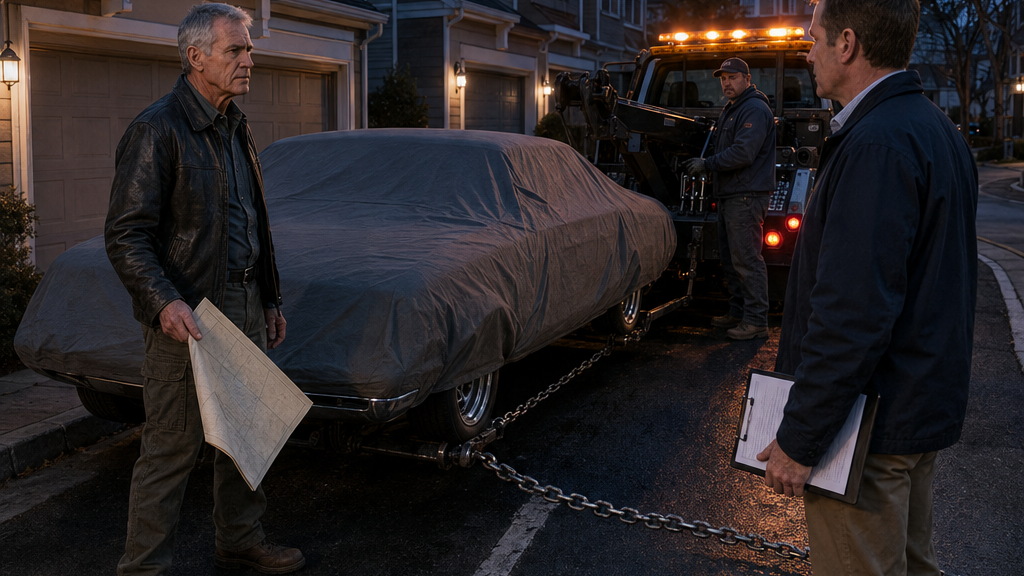
The chain snapped tight beneath the Mustang just as Mark Anderson reached the curb.
“Hold it.”
The tow-truck driver looked toward him but kept one hand on the control lever. Amber lights swept across the row of townhouses, flashing against garage doors and bedroom windows. Mark’s restored 1968 Mustang sat beneath its gray cover in the painted guest bay, its front end already lifted several inches.
Nicholas Baker stood beside the truck in a windbreaker, holding a clipboard.
“Mark, don’t interfere with the driver.”
“I’m asking him not to move the car.”
“It’s being removed under the parking rules.”
Mark looked at the chain disappearing beneath the front suspension. He had spent four years rebuilding that car. He knew every bracket beneath it.
“What rule?”
Nicholas exhaled as though the question had already been answered too many times.
“Abandoned vehicles. Long-term storage in guest parking.”
“It has current registration.”
“That isn’t the issue.”
Mark reached into his jacket and pulled out a folded sheet. “I notified the board Monday. My garage slab is being replaced. I asked for temporary use of this bay until Friday.”
Nicholas barely glanced at it.
“You informed us. You weren’t granted an exemption.”
Mark unfolded the email printout. Near the bottom was the manager’s reply acknowledging the contractor schedule and telling him the board had been notified.
“That looks like acknowledgment to me.”
“It isn’t approval.”
The tow driver shifted his weight. “You two need to settle this before I load it?”
Nicholas answered first. “The authorization is valid.”
Across the lane, a porch light came on.
Mark felt the humiliation before he felt the anger. Someone moved behind blinds. A second porch light appeared farther down.
Nicholas lowered his voice.
“We’ve had complaints, Mark. People think they can leave whatever they want out here because somebody else got an exception. Guest parking is for guests.”
“It’s been here six days.”
“Covered.”
“Yes. That’s what people do with restored cars.”
Nicholas gave a tired half-smile. “If you need long-term storage for old toys, there are facilities for that.”
The words landed harder than Mark expected.
He stepped toward the Mustang, then stopped himself. Years in surveying had taught him that the fastest way to ruin a disagreement was to turn a disputed line into a physical one.
Instead he took another folded document from his back pocket.
It was old enough that the paper had gone soft at the creases.
Nicholas looked at it. “What is that?”
“The original subdivision plat.”
“At four in the morning?”
“Three forty-seven.”
Nicholas glanced at his phone. “That doesn’t make this your parking space.”
“I didn’t say it did.”
Mark opened the plat against the hood of his pickup. Streetlight fell across the faded lines.
He pointed to the guest bay.
Then to a thin boundary line running along its outer edge.
“What recorded instrument gives the association authority over this strip?”
Nicholas stared at him.
“What?”
“You authorized a private company to remove a vehicle. I’m asking what recorded instrument puts this pavement under HOA control.”
“The HOA maintains the lane.”
“That wasn’t my question.”
Nicholas’s jaw tightened. “You’re turning a parking violation into something it isn’t.”
“I spent thirty-eight years reading plats. I know exactly what I’m asking.”
For the first time, the tow driver released the lever.
Nicholas looked from Mark to the old paper.
“This whole street is common property.”
“Maybe.”
“There is no maybe.”
Mark traced the faded line with one finger.
“Then show me where this line went.”
Nicholas stared at the plat for several seconds, then shook his head.
“I’m not litigating property boundaries at the curb. Remove the car.”
The tow driver hesitated. “You sure?”
“Yes.”
Mark folded the plat.
He could have stood in front of the truck. Could have called the sheriff and created a scene for half the neighborhood to watch through their windows.
Instead he stepped back.
“Document the condition before you move it.”
The driver nodded.
When the winch pulled again, Mark heard metal scrape.
A short, ugly sound.
He stepped forward.
“Stop.”
The Mustang’s front valance had caught at the edge of the wheel lift. A fresh silver mark cut across the dark paint beneath the bumper.
The driver swore quietly and lowered it an inch.
Nicholas looked away.
Mark took out his phone and photographed the scrape, the chain, the truck number and the Mustang’s position inside the painted bay.
Then he photographed Nicholas’s clipboard.
“Don’t photograph my paperwork.”
“I’m photographing the authorization number.”
“You’re being difficult.”
Mark looked at him.
“No. Difficult would have been stopping the truck.”
By sunrise, the bay was empty.
The gray cover had been folded into Mark’s pickup. A faint dark patch on the pavement marked where the Mustang’s tires had sat.
Inside his garage, contractors’ tools waited beside the torn-out slab. Mark set the old plat on a workbench and opened the HOA’s current community map on his laptop.
He had expected to prove Nicholas wrong about the parking approval.
Instead, something else caught him.
On the original plat, the faded boundary line curved behind the guest bay and continued to the end of the lane.
On the HOA map, that line did not exist.
Mark enlarged the image until the pixels blurred.
The road was drawn as one continuous piece of common area.
He put the old plat beside the screen.
The shapes matched.
The boundary did not.
Chapter 2: The Guest Bay Was Never That Simple
The towing notice had been issued forty-three minutes after the HOA office acknowledged Mark’s temporary parking request.
He read the timestamps twice.
Monday, 2:18 p.m.: Mark’s email explaining that the garage contractor needed the slab clear for approximately one week.
Monday, 3:06 p.m.: the management office replying that the board had been notified.
Monday, 3:49 p.m.: an internal violation entry classifying the covered Mustang as improperly stored in guest parking.
Mark printed all three pages and placed them side by side on his kitchen table.
At nine that morning, he drove to the tow yard.
The Mustang was parked between a damaged minivan and a delivery van with a missing mirror. The front valance carried the scrape he had photographed, and one mounting bracket had bent inward.
The employee at the desk slid a release form toward him.
“One hundred twenty-five.”
Mark paid.
He hated paying it.
He hated even more that arguing there would accomplish nothing.
Back home, the garage contractor was setting forms for the replacement slab.
“I thought the car was staying in the guest bay,” the contractor said.
“So did I.”
“We’re pouring tomorrow.”
“I’ll make room.”
Mark put the Mustang in the driveway, partly blocking his pickup, and covered it again.
At noon he walked to the HOA office carrying a folder.
Nicholas was there with Justin Perez, another board member.
Justin looked uncomfortable when Mark entered.
Nicholas did not.
“We’ve already discussed this.”
“No,” Mark said. “You decided it.”
He set the timestamps on the table.
“I notified management before the car went into the bay. Management acknowledged it. Then the violation was entered.”
Nicholas studied the pages.
“Again, acknowledgment is not approval.”
“Then why didn’t anyone tell me it was denied?”
“You know the parking rules.”
“I know guest spaces aren’t for permanent storage.”
“Exactly.”
“Six days while concrete work is underway isn’t permanent.”
Justin shifted in his chair.
“There were complaints before Monday.”
Mark looked at him. “About what?”
“The cover.”
“The cover?”
“People couldn’t tell whether the car moved.”
Mark stared at him.
Justin rubbed a hand over his jaw. “A few residents said it had been sitting there for weeks.”
“It hadn’t.”
“I’m telling you what was reported.”
Mark thought about the car cover. To him it meant protection: dust kept off fresh paint, sun kept off the restored interior.
To somebody passing twice a day, it apparently meant abandoned.
Nicholas folded his arms.
“We’ve had problems with people using guest spaces as extensions of their garages. Boats, trailers, project cars. If we ignore one because someone says his car is special, the next resident demands the same treatment.”
Mark nearly answered too quickly.
He stopped.
That was the part he had not wanted to hear: Nicholas had a reason.
Not a good enough reason for the tow, but a real one.
“So you treat every covered car as abandoned?”
“No. We enforce duration.”
“Then show me the duration.”
Nicholas opened a binder and pointed to the rule.
Mark read it.
Seventy-two consecutive hours without board authorization.
He tapped his email.
“I requested authorization.”
“You didn’t receive it.”
“And nobody denied it.”
“That doesn’t create permission.”
It was a bureaucratic loop, but not the one that bothered Mark most.
He pulled out the old plat.
“I want a copy of the association’s property exhibit.”
Nicholas looked at it. “Why?”
“Because your map and mine don’t match.”
Justin leaned forward.
Nicholas opened a cabinet and removed a laminated community map.
“This is the current exhibit.”
He spread it across the conference table.
The lane, guest bays, landscaped islands and sidewalks were shaded uniformly as HOA common area.
Mark placed his old plat beside it.
On his version, a narrow parcel line separated the final section of roadway from the larger subdivision tract.
Justin noticed it.
“What’s that?”
“A boundary.”
Nicholas shook his head. “Or an obsolete line.”
“Could be.”
“You said you were sure last night.”
“I said I knew what question to ask.”
That quieted the room.
Mark studied both maps.
The newer exhibit was professionally prepared but simplified. It showed maintenance areas and common facilities. It did not cite the underlying deed book beside the end parcel.
Nicholas tapped the laminated sheet.
“This is what every board has used for years.”
“That doesn’t tell me where it came from.”
“It’s the association map.”
“That still doesn’t tell me where it came from.”
Nicholas’s patience thinned. “What are you suggesting? That your mother owned the street?”
Mark looked down at the faded line.
“I’m suggesting I don’t know.”
The admission surprised Nicholas.
It also bothered Mark.
He had spent his career telling clients never to confuse a map with title. Now irritation had made him close to doing exactly that.
He gathered the documents.
At home that afternoon, concrete trucks crowded the driveway. Mark moved boxes from an old cabinet so the crew could reach an outlet.
Behind a stack of tax folders, a yellow envelope fell to the floor.
His mother’s handwriting covered the front.
CAROL ANDERSON — TAX RECORDS.
Mark opened it.
Most documents concerned the house.
At the bottom was a small county tax notice from years earlier.
A parcel number had been circled in blue ink.
Beside it, Carol had written two words:
LANE PARCEL.
Mark sat down on the garage step.
The parcel number was not the number for his house.
Chapter 3: His Mother Kept One Parcel Separate
The county database still recognized Carol’s handwritten parcel number.
Mark found it at 7:12 the next morning.
He had expected an archived reference, maybe a parcel consolidated years ago and left behind in old tax paperwork.
Instead the screen showed an active identifier.
The description was sparse: a narrow irregular tract, less than an acre, classified for access.
Owner information directed him to a family trust.
Mark leaned closer.
Anderson Family Revocable Trust.
He printed the page.
For a moment, satisfaction came too easily.
Nicholas had towed his car from land the HOA might not even own.
Mark could already imagine walking into the next board meeting and sliding the record across the table.
Then his professional instincts caught up with his anger.
A tax record was not title.
By ten, he was at the county recorder’s office.
The clerk brought up the indexed documents and showed him how the older records had been scanned.
Mark worked backward.
His mother’s trust.
A deed into the trust.
An older deed.
A subdivision filing.
An access agreement.
He took notes on a legal pad, writing book and page references the way he had done hundreds of times before retirement.
The original subdivision plat appeared on the monitor.
There was the line.
Not faint now, but sharp in the scanned image.
It ran behind the guest bay, curved across the end of the lane and closed around the small tract.
Near the parcel was a notation:
PRIVATE ACCESS.
Mark felt the first clean jolt of confirmation.
He ordered a certified copy.
“What are you trying to establish?” the clerk asked.
“Whether this parcel was ever conveyed to the association.”
She searched by grantee.
Nothing obvious appeared.
She searched the developer name.
Several conveyances surfaced: landscaping tracts, drainage areas, clubhouse property, roads.
Mark opened each.
The lane parcel was not among them.
He worked through lunch.
Still nothing.
By midafternoon, he had a folder thick enough to support his suspicion but not enough to prove the whole story.
The absence of a deed in one search did not mean no deed existed.
Mark knew that better than anyone.
That evening he called Emily Lee, a property attorney he had worked with years earlier on boundary matters.
Her office fit two people comfortably and three only if nobody moved.
She studied the certified plat first.
“You’ve already decided what this means,” she said.
“I’ve decided what it appears to mean.”
“Those are different sentences.”
“That’s why I called you.”
Emily gave him a brief look that suggested she was pleased he had remembered that.
She reviewed the deed into Carol’s trust, then the earlier description.
“The description tracks the plat.”
“Yes.”
“And you didn’t find a later transfer.”
“Not yet.”
“Good answer.”
Mark sat back.
Emily opened the old access agreement.
“This matters.”
He leaned forward.
The document granted passage over the private-access parcel to several lots created during the subdivision phase.
Mark read the language.
Ingress. Egress. Service access.
The words changed the shape of his imagined victory.
“So the trust owns it, but the neighbors have rights across it.”
“Possibly. We need the complete chain and any amendments.”
“Can the HOA tow from it?”
Emily closed the document.
“That depends on what authority was granted, by whom, and whether the association ever received enforcement rights separately.”
“But ownership matters.”
“Of course it matters.”
Mark waited.
Emily knew him well enough not to soften the next part.
“It just may not matter in the way you want it to.”
The following morning, Mark returned to the recorder’s office.
A survey office technician helped him locate the developer’s dedication package.
There were utility easements, drainage rights, sidewalk dedications and street transfers.
The main subdivision roads had been conveyed.
The final lane parcel had not.
Instead, one document referred back to the private-access tract and the access rights benefiting adjoining lots.
Mark sat very still.
For nearly twenty years, everybody had treated the lane as part of the subdivision roadway system. The HOA had resurfaced it twice. Landscaping crews edged it. Snow contractors cleared it. Parking rules were painted and repainted on it.
Habit had done what paperwork had not.
It had made the boundary invisible.
He thought of Carol.
She had known.
Of course she had.
The tax envelope proved she had tracked the parcel separately.
What Mark did not know was why she had never forced the issue.
At home he went through more of her papers.
He found no angry letters to the HOA. No demand for rent. No attempt to close the lane.
Instead there were receipts for patching asphalt and one note attached to an old contractor invoice:
Leave turning area open for neighbors.
Mark read it twice.
The words irritated him because they complicated the story he wanted.
He had been wronged. That part remained.
But Carol had apparently treated ownership less like a weapon than an obligation.
Late that afternoon, he and Emily stood at the end of the lane with the plat open across the hood of her car.
Mark pointed to the painted guest bay.
“The line runs directly under the outside stripe.”
Emily nodded.
“And this section?”
“Inside the parcel.”
“The turnaround?”
“Most of it.”
She pointed toward two homes beyond the curve.
“And their recorded access?”
“Across here.”
Mark folded his arms.
“So I can stop the HOA from pretending it owns the parcel.”
“Maybe.”
“And revoke their towing authority.”
“Maybe.”
He frowned. “You keep saying that.”
“Because you keep asking ownership questions as if they’re control questions.”
Mark looked down the lane.
A delivery van turned in, used the wide end to reverse, then headed back toward the main street.
Emily tapped the private-access notation.
“This is significant. It may be very significant. But if the trust owns the parcel subject to access rights, you don’t get to pretend those rights disappear because Nicholas made a bad decision.”
“I never said I wanted to close it.”
“You haven’t said what you want at all, except to stop him.”
Mark looked at the guest bay where the Mustang had been chained.
For two days, he had imagined the satisfaction of telling Nicholas that the HOA had no business there.
Now the boundary line seemed less like a blade and more like a responsibility Carol had left unfinished.
Emily folded the certified copy and handed it back.
“Mark, you may own the ground.”
He waited.
“But owning it and controlling every use of it are not the same thing.”
Chapter 4: The Board Had Inherited a Mistake
Emily called Mark before nine Friday morning.
“I found the dedication package.”
Mark was already in the garage, standing beside the Mustang with a flashlight under the damaged front valance. He straightened so quickly his back complained.
“And?”
“There’s no conveyance of the lane parcel in it.”
He looked toward the covered car.
“No deed?”
“Not in the dedication package. Don’t turn that into a conclusion yet.”
“You called me before nine to tell me not to reach a conclusion?”
“I called because there’s more. Come in.”
An hour later, the original subdivision documents covered Emily’s conference table.
The streets had been transferred through one recorded instrument. Drainage areas through another. The clubhouse tract had its own legal description. Each instrument corresponded cleanly to the original plat.
The private-access parcel did not.
Emily placed three HOA exhibits beside the original.
One was nearly fifteen years old. One had accompanied a resurfacing contract. The newest was the laminated map Nicholas had shown Mark.
The same thing was missing from all three.
The boundary line.
“They copied from each other,” Mark said.
“Looks that way.”
He studied the sequence.
The first HOA exhibit had simplified the original plat by removing title information irrelevant to maintenance crews. The next map had apparently been traced from that one. By the time the current version was prepared, the private parcel looked indistinguishable from common property.
Mark felt some of his anger change shape.
Nobody had forged anything.
Nobody had needed to.
A useful maintenance map had slowly become something people treated like proof of ownership.
That evening, the HOA meeting room was fuller than usual.
Nicholas sat at the front with Justin and two other board members. Mark took a seat near the end of the table and placed Emily’s copies in front of him.
Nicholas looked at them.
“I assume this is about the lane again.”
“It’s about the board’s authority on the lane.”
Nicholas’s expression hardened.
“We have exercised authority there for years.”
“That’s the problem.”
Mark slid the original dedication package forward.
“The association received the main roads. It received several common tracts. I cannot find a recorded conveyance of this parcel.”
Nicholas didn’t touch the papers.
“We maintain it.”
“Maintenance isn’t title.”
“We insure it.”
“That may matter. It still isn’t title.”
One of the other board members leaned toward the documents.
Justin remained unusually still.
Nicholas said, “You’re asking us to overturn years of established practice because you found an old line on a map.”
“No. I’m asking you to suspend enforcement on one parcel until you verify what authority the association actually has.”
Nicholas looked toward Justin.
That was when Justin spoke.
“We never verified it.”
Nicholas turned.
“What?”
“When we renewed the tow contract last year.” Justin’s voice was quiet. “We checked the parking policy and the maintenance map. We didn’t run title.”
Nicholas stared at him.
“Neither did the board before us.”
“You don’t know that.”
“I asked the former treasurer this afternoon.”
The room changed.
Mark had expected resistance from Justin. He had not expected confession.
Justin continued.
“He said towing authority on the lane was already in place when their board took over. They assumed it came with the rest of the streets.”
Nicholas pushed back from the table.
“So did everyone.”
“That doesn’t make it correct,” Mark said.
Nicholas looked at him sharply.
“No, but it matters.”
Mark waited.
Nicholas opened a folder and pulled out several printed complaints.
“Since you want the full picture, here it is. Eleven complaints about guest parking in six months. Two about your Mustang specifically. People were leaving trailers overnight. One resident couldn’t get a delivery truck through the turnaround because somebody parked half outside a marked bay.”
He held up another page.
“And emergency access has been raised twice.”
Mark’s certainty cooled.
Nicholas continued.
“I didn’t wake up one morning and decide to tow your car because I dislike Mustangs. Residents wanted enforcement. The board was accused of ignoring its own rules.”
“You still had my notice.”
“I had a request. I did not have an approval.”
“You also had no verified title authority.”
Nicholas’s face tightened.
“And you knew your family might own this parcel?”
The question landed where Mark had not expected it.
“I knew there had been a separate tract years ago.”
“Did you ever tell the board?”
Mark said nothing.
Nicholas leaned forward.
“You lived here while the HOA resurfaced it. You watched us stripe the guest bays. You watched us pay snow removal. Did you ever say, ‘By the way, my family may still hold title to this road’?”
“No.”
“Why?”
Because Mark had assumed it was obvious.
Because Carol had known.
Because the old plat had always been in his files.
None of those answers sounded as strong aloud as they had in his own head.
“I should have,” he said.
Nicholas nodded once.
“That doesn’t excuse the tow.”
“No.”
“And it doesn’t excuse the damage.”
“No.”
Nicholas looked down at the dedication package.
For the first time, he seemed less like a man defending power than one realizing the floor beneath his argument might not be where he thought it was.
Then he closed the folder.
“I’m not suspending enforcement based on an unresolved title question.”
Justin looked at him. “Nick.”
“If we stop enforcing every time someone produces a disputed document, we have no rules.”
Mark felt Emily shift beside him.
“You could suspend towing on that parcel,” she said, “without suspending parking enforcement elsewhere.”
Nicholas shook his head.
“Not until counsel reviews it.”
“Then don’t tow there until counsel reviews it.”
Another pause.
Nicholas looked at Mark.
“No.”
Mark felt anger return, sharper because the mistake was no longer hypothetical.
Nicholas picked up the enforcement calendar.
“We have a scheduled parking sweep Monday morning. The lane remains included unless our attorney tells us otherwise.”
Justin stared at him.
“You’re going to do this again?”
“I’m going to follow the policy currently in force.”
Mark gathered the old plat and the dedication papers.
On his way out, he stopped beside Nicholas.
“You know now that the map may be wrong.”
Nicholas met his eyes.
“I know you believe it is.”
Mark folded the plat along its worn crease.
By Monday morning, one of them was going to have to act before the record caught up.
Chapter 5: Proof Did Not Give Mark a Free Hand
The fresh survey stake stood six inches from the white stripe of the guest bay.
Mark pushed a second stake into the grass, sighted along the old bearing, and looked across the pavement.
The boundary ran almost exactly where the faded line on Carol’s plat said it did.
Across the outer edge of the guest bay.
Through the turnaround.
Along the final section of lane.
He had spent most of his adult life setting lines for other people. Seeing this one return physically to the ground should have felt like victory.
Instead it made the problem larger.
Emily arrived as Mark was measuring the turning radius.
“You did this yourself?”
“I’m retired, not helpless.”
“I was asking whether you intended to use your own work in a dispute.”
Mark looked at her.
“No. I had the survey office verify the control points yesterday. I’m checking them.”
“Good.”
She stepped around the stake.
“So this is it.”
“This is it.”
A vehicle approached from one of the houses beyond the curve. It slowed beside them.
The neighbor behind the wheel lowered the window.
“You’re not closing this, are you?”
Mark frowned.
“No.”
“That’s what people are saying.”
“People say a lot.”
The neighbor glanced at the stakes.
“My mother lives with us. Ambulance came last winter. They backed in through here because they couldn’t turn from the other side.”
Mark looked toward the house.
He remembered seeing emergency lights that night but had not thought about how the vehicle approached.
The neighbor continued.
“I’m not defending what they did to your car. I just need to know we can still get through.”
“You can.”
The answer came quickly.
Too quickly for the plan Mark had emailed Emily the night before.
After the neighbor drove away, Emily opened her folder.
“Then we need to discuss this.”
She handed him his own draft.
At the top he had written: REVOCATION OF ASSOCIATION AUTHORITY.
The language below was broad. Too broad.
It revoked HOA authority to regulate parking, place signs, authorize contractors, perform maintenance or direct vehicle removal anywhere within the parcel without written consent from the trust.
Mark had written it angry.
At two in the morning.
Emily tapped the paragraph.
“If you sign this as written, you don’t just stop Nicholas from ordering another questionable tow.”
“That was the point.”
“You also make routine maintenance dependent on your permission.”
“They can ask.”
“Every time?”
“If that’s what ownership means.”
Emily folded her arms.
“That isn’t what you told that neighbor.”
Mark looked down the lane.
She continued.
“And what happens when someone blocks the turnaround for real?”
“Call me.”
“At three in the morning?”
“Then call a tow company.”
“Under whose authority?”
Mark did not answer.
Emily put the draft on the hood of her car.
“You’re thinking about this as a boundary dispute. It isn’t only that anymore.”
“It became one when Nicholas towed my car.”
“No. That exposed it.”
The distinction irritated him because it was accurate.
They walked the line together.
Near the turnaround, Mark found an older iron pin below the grass. He cleaned the top with his boot.
Carol had once shown it to him.
He remembered being younger, still working full-time, while she pointed toward the lane and complained about a delivery truck cutting too close to her shrubs.
“Why didn’t you make them move the road?” Mark had asked.
Carol had looked at him as if the question were foolish.
“Because people need to get home.”
At the time he had thought she was avoiding paperwork.
Now he wondered if he had mistaken restraint for carelessness.
Emily had brought copies of Carol’s old access documents. One handwritten note appeared beside a contractor invoice:
Keep turn open. Neighbors need access.
Mark traced the words with his thumb.
“She knew exactly what this was.”
“Looks that way.”
“She could have forced everyone to formalize it.”
“So could you.”
He glanced at Emily.
She did not soften the point.
After Carol died, the trust documents had gone into Mark’s cabinet. The HOA kept paving. Mark kept letting them.
He had told himself there was no need to create conflict.
What he had really done was assume the old understanding would survive without explanation.
The same assumption he now accused the board of making.
By afternoon, an emergency-services reviewer met them at the lane.
The reviewer walked the turnaround, checked the width and pointed toward the guest bay.
“If a vehicle sits fully inside the markings, we’re fine. If it hangs out here, that becomes a problem.”
“So removal needs to remain possible,” Emily said.
“Yes. Especially overnight.”
Mark stared at the white stripe.
His Mustang had been entirely inside it.
That fact still mattered.
But so did the possibility of a different car, badly parked, on a different night.
Back in Emily’s office, Mark crossed out the first paragraph of his revocation.
Then the second.
He rewrote it.
Resident and emergency ingress would remain unchanged.
Routine maintenance could continue after notice.
The HOA could issue parking warnings consistent with recorded access rights.
But towing from the private parcel would require authorization from the trust or an emergency condition documented under the agreement.
Emily read it.
“You’re giving up some control.”
“I’m defining it.”
“That sounds healthier.”
Mark ignored the comment.
He added one final provision requiring the HOA to correct maps used for enforcement.
The faded boundary line would no longer disappear merely because it was inconvenient.
Emily turned the document toward him.
“This means you won’t get the satisfying version.”
“What version?”
“The one where you tell Nicholas the whole lane is yours and he never gets to touch it again.”
Mark looked toward the window.
“That version would make me exactly as certain as he was.”
Emily said nothing.
Mark signed the draft for circulation, not execution.
At the bottom he added a handwritten condition:
No unilateral HOA towing authority within private-access parcel.
He slid the paper back across the desk.
“Send that to the board.”
Emily nodded.
Mark picked up Carol’s old plat.
For years the faded line had represented something his family knew and nobody else bothered to ask about.
Now it would either become part of a workable agreement or the start of a lawsuit.
Chapter 6: The Lane Could Not Stay Informal
Nicholas had brought an attorney.
Mark saw the man the moment he entered the special HOA meeting and understood that the board had stopped treating the dispute as a parking argument.
Emily sat beside Mark with two folders and a rolled survey exhibit.
Justin was already at the table.
Nicholas called the meeting to order.
“We’re here to address ownership and access questions concerning the end-lane parcel, related enforcement authority, and Mr. Anderson’s damage claim.”
No mention of abandoned vehicles.
No mention of old toys.
That alone felt like movement.
The board’s attorney began with the original dedication documents.
“Our review has not located a recorded transfer of fee title to the association.”
Nicholas’s expression did not change.
The attorney continued.
“However, the parcel is subject to recorded access rights, and the association has maintained it openly for a significant period. There are questions regarding maintenance obligations and enforcement practices that should be resolved by agreement rather than assumption.”
Mark looked at Nicholas.
“What about towing?”
“We’re getting there,” Nicholas said.
Emily unrolled the new survey exhibit.
Unlike the simplified HOA maps, this one showed the boundary clearly. The line that had faded on Carol’s old copy was crisp and black.
The guest bay sat partly within the private-access parcel.
The turnaround was almost entirely inside it.
Mark felt something unexpected when he saw the clean line.
Not triumph.
Relief.
The ambiguity could finally stop reproducing itself.
Emily presented Mark’s proposal.
Resident access unchanged.
Emergency access protected.
Routine maintenance allowed under defined notice procedures.
Parking regulation possible within agreed limits.
Towing authority restricted.
One board member objected immediately.
“So if someone abandons a vehicle there, we have to call Mark?”
“The trust,” Emily said. “And there are emergency exceptions.”
“That’s inefficient.”
“So is towing a vehicle from land you may not control,” Mark said.
Nicholas gave him a look, but Mark kept his voice level.
The board’s attorney turned to Nicholas.
“The current tow contract describes association-controlled common property. If this parcel is not common property, relying on that language creates exposure.”
For several seconds, nobody spoke.
Then Justin leaned forward.
“We should correct it.”
Nicholas looked at him.
Justin did not look away this time.
“We didn’t verify title when we renewed the contract. I didn’t verify it either. We relied on the old map.”
One of the other board members said, “Everybody relied on it.”
“That doesn’t make Mark’s tow valid.”
Nicholas rubbed his forehead.
“You supported the tow.”
“I supported enforcement. I thought we had authority there.”
“So did I.”
“That’s why we fix it.”
Mark watched Nicholas absorb the distinction.
It would have been easy to enjoy the moment.
Instead Mark remembered standing in Emily’s office, crossing out his own overbroad revocation.
Certainty had been tempting on both sides.
Nicholas finally looked at him.
“I should have paused the tow when you raised the boundary issue.”
Mark said nothing.
Nicholas continued.
“I still believe your parking request was never formally approved.”
“It wasn’t formally denied either.”
“I know.”
“And the car wasn’t abandoned.”
Nicholas hesitated.
“No.”
It was not an apology.
It was more useful than one.
The discussion moved to damage.
Mark had brought photographs of the Mustang before and after the tow, the repair estimate for the valance and bent bracket, the towing receipt and photographs from the guest bay.
The board’s attorney proposed reimbursement if the parties settled the property and access dispute together.
Emily immediately shook her head.
“The damage claim should not be used to purchase title concessions.”
“I’m not suggesting that.”
“It needs separate language.”
Nicholas looked tired.
“How much is the repair?”
Mark told him.
Nicholas glanced at the estimate.
“And the tow fee?”
“One hundred twenty-five.”
Nicholas turned to the board.
“Pay it.”
One board member started to speak.
Nicholas stopped him.
“We ordered the tow. The authority is disputed. We damaged the car. Pay it.”
That was the first moment Mark saw responsibility rather than defense.
The reimbursement was approved separately.
Then came the harder part.
The access agreement.
The board wanted automatic towing authority for vehicles blocking emergency access.
Mark agreed, provided the condition was documented and narrowly defined.
They wanted routine snow removal and resurfacing rights.
He agreed, with notice and liability provisions.
They wanted parking enforcement.
Mark allowed warnings and citations under agreed rules, but not unilateral physical removal except for genuine obstruction or emergency conditions.
Nicholas objected.
“You’re creating two enforcement systems inside one neighborhood.”
“No,” Mark said. “We already have two property systems. We just pretended we didn’t.”
Nicholas leaned back.
“You understand how confusing that will be for residents.”
“Yes.”
“So?”
“So we correct the map.”
Mark pointed at the survey exhibit.
“And we put the rules in writing.”
Nicholas looked at the black boundary line.
“You could have raised this years ago.”
Mark felt the accusation because it was true.
“I should have.”
The room quieted.
“My mother handled the parcel informally. After she died, I let that continue because it was easier. I knew the old boundary existed. I didn’t make sure anybody else understood it.”
Nicholas’s expression shifted slightly.
Mark continued.
“That doesn’t make the tow right. But I’m not pretending I had nothing to do with the confusion.”
Justin looked down at the table.
The negotiation became easier after that.
Not easy.
Easier.
Two days later, Mark and Emily met the board at the county filing office.
The final agreement lay open on a counter.
Attached was the new survey exhibit.
There was the parcel.
There was the lane.
There was the line.
Before signing, Mark read the towing provision again.
The board’s attorney had changed one phrase.
It allowed removal “at the direction of the association when reasonably necessary.”
Mark uncapped his pen.
Then stopped.
“No.”
Nicholas looked over.
“What now?”
“This puts us back where we started.”
The attorney reread the line.
“It’s intended for obstruction.”
“Then say obstruction.”
Emily nodded.
After several minutes, the clause was revised.
Removal could occur without trust authorization only when a vehicle materially blocked recorded access or created a documented emergency-access condition.
All other towing required authorization from the parcel owner or trust.
Mark read it twice.
Then signed.
Nicholas signed for the association.
The recorder stamped the package.
For the first time in decades, the lane’s actual boundary and the rules governing it existed together in one recorded set of documents.
Outside, Nicholas paused beside Mark.
“I suppose you’re going to put up a sign.”
“Probably.”
“Something large?”
Mark almost smiled.
“Readable.”
Nicholas nodded.
Then his phone rang.
He looked at the screen and frowned.
“The tow company.”
Mark’s smile disappeared.
Nicholas answered.
His face changed as he listened.
“They still have the old contract in their dispatch system.”
Mark looked back through the recorder’s glass doors at the newly stamped agreement.
The paper was correct now.
The question was whether the road would obey it.
Chapter 7: The Same Tow Truck Came Back
The amber lights appeared at the end of the lane just after seven on a Thursday evening.
Mark saw them through his garage doorway.
For one second, his body reacted before his mind did. His shoulders tightened. His hand stopped on the polishing cloth resting against the Mustang’s fender.
Three weeks had passed since the agreement was recorded.
The garage slab was finished. The Mustang was back inside, its repaired valance aligned beneath the bumper. The HOA had reimbursed the tow charge and the documented repair bill. New private-access notices stood at both entrances to the parcel, and the association had circulated a corrected parking map to residents.
Mark had almost started believing the problem was over.
Then the tow truck turned into the lane.
It was the same company.
Possibly even the same truck.
The driver slowed beside the new sign.
PRIVATE ACCESS — TOWING BY AUTHORIZATION ONLY.
He read it, looked down at something in his cab, then continued toward the guest bay.
Mark set down the cloth.
A sedan sat crooked near the turnaround, one rear tire outside the white line. It was not blocking the lane. Mark could see daylight between its bumper and the travel path.
The tow truck stopped behind it.
The driver climbed out carrying a tablet.
Mark walked toward him.
“Evening.”
The driver looked up.
“You Mark Anderson?”
“Yes.”
The man seemed relieved.
“I was hoping you were home.”
Mark glanced at the sedan. “What’s the call?”
“HOA dispatch. Parking violation.”
“Who authorized removal?”
The driver turned the tablet toward him.
The screen displayed the old account language.
ASSOCIATION AUTHORIZED — COMMON AREA / GUEST PARKING.
Mark felt the strange pull of the past three weeks narrowing into one moment.
He could have told the driver to get off his property.
He could have called Nicholas and made him come explain himself in front of whoever was beginning to watch from nearby porches.
Instead Mark said, “Give me a minute.”
He returned to the garage and opened the top drawer of the workbench.
Inside was a clean copy of the recorded agreement.
Not Carol’s folded plat.
Not an old tax envelope.
Not something only Mark understood.
A recorded document with the revised survey exhibit attached.
He carried it back outside.
The driver looked at the first page.
“This went into effect already?”
“Three weeks ago.”
“Nobody updated our system.”
“I figured.”
Mark pointed to the towing provision.
“You can remove a vehicle without trust authorization if it materially blocks recorded access or creates a documented emergency-access condition.”
The driver looked toward the sedan.
“It’s not blocking anything.”
“No.”
“So I need authorization from you?”
“From the trust.”
The driver looked back at Mark.
“And you’re the trustee?”
“Yes.”
“Are you authorizing it?”
Mark studied the sedan.
A parking warning was tucked beneath its windshield wiper.
The rear tire crossed the painted line by perhaps eight inches.
Three weeks earlier, Mark might have enjoyed saying no simply because he could.
Now he walked to the narrowest part of the turnaround, looked down the travel path and imagined an ambulance trying to reverse.
There was room.
“No tow.”
The driver nodded.
“That works for me.”
He tapped the screen, canceled the call and began entering notes.
Mark expected relief.
What he felt instead was something quieter.
The procedure had worked.
Not because the HOA had been humiliated.
Because the question had gone to the person who actually had authority to answer it.
A car pulled into the lane behind the tow truck.
Nicholas got out.
He looked from Mark to the driver to the sedan.
“What happened?”
The tow driver raised the tablet.
“Your dispatch still has the old authorization.”
Nicholas frowned.
“We sent the updated agreement.”
“Maybe somebody hasn’t entered it yet.”
Nicholas looked at Mark.
There was tension in his face, as if he had arrived prepared for a different scene.
“You stopped the tow?”
Mark nodded.
“The vehicle isn’t blocking access.”
“It’s outside the bay.”
“By eight inches.”
“That’s still a violation.”
“It can still get a warning.”
Nicholas glanced toward the sign.
“So this is how it works now.”
“This is how we agreed it works.”
The words could have been sharp.
Mark kept them plain.
Nicholas looked down the lane.
Several residents were watching, but nobody had gathered. There was no crowd, no performance waiting to happen.
The tow driver closed the compartment on his truck.
“I’ll tell dispatch the account needs to be updated before they send another truck.”
Nicholas nodded.
“I’ll call them tomorrow.”
The driver climbed into the cab.
The amber lights moved across Mark’s garage as the truck backed away.
Three weeks earlier, those lights had reflected off the Mustang as a chain pulled tight beneath it.
Now the truck left without touching a vehicle.
Nicholas remained beside the guest bay.
For a moment neither man spoke.
Finally Nicholas said, “I thought you were going to make a point of this.”
“I did.”
“That wasn’t what I meant.”
Mark knew.
He looked toward the new sign.
“You expected me to tell you the road was mine.”
Nicholas gave a small, uncomfortable smile.
“Something like that.”
“I thought about it.”
“I figured.”
Mark glanced toward the houses beyond the turnaround.
“But people still have to live here.”
Nicholas nodded slowly.
“So do you.”
“Yes.”
Another silence.
Then Nicholas looked toward Mark’s garage, where the Mustang sat uncovered beneath bright work lights.
“The repair looks good.”
Mark followed his gaze.
“It came out all right.”
Nicholas put his hands in his pockets.
“I shouldn’t have called it an old toy.”
Mark looked at him.
“No.”
“I was irritated.”
“I know.”
“That’s not an excuse.”
“No.”
Nicholas nodded once.
That was as close to an apology as Mark needed.
He did not offer one back for raising the boundary late. He had already admitted that failure where it mattered, at the meeting and in the agreement.
Some things did not need balancing.
They only needed naming.
The next morning, Mark went to the HOA office.
Justin was replacing the old laminated map on the wall.
The new version showed the private-access parcel with a clear boundary and a note referring to the recorded agreement.
Justin stepped off the chair.
“Better?”
Mark studied it.
“Yes.”
Justin smiled. “Nicholas insisted we replace every copy.”
Mark raised an eyebrow.
“He did?”
“He said if we’re going to enforce rules, we should at least know where they apply.”
Mark almost laughed.
Instead he nodded.
“That’ll help.”
Back home, he returned to the cabinet where Carol’s records had been stored for years.
He took out the yellow tax envelope.
The paper had become brittle at the edges. Her handwritten parcel number remained dark blue.
Beneath it lay the original plat.
Mark unfolded it carefully.
The boundary line was faint where the crease crossed it. Decades of opening and closing had nearly erased that small section.
He placed the new recorded survey exhibit beside it.
On the new copy, the same line was precise.
Black.
Measured.
Referenced.
Impossible to mistake for decoration.
Mark thought about how easy it would have been to blame the entire mess on Nicholas.
That version of the story had once felt clean.
An overreaching HOA president had ordered a careless tow. Mark had discovered the truth. Mark had won.
Most true things were less convenient.
Nicholas had acted beyond authority he had never verified.
The board had inherited assumptions and repeated them.
Carol had relied on informal understanding.
And Mark, who had spent a career telling people that boundaries should be made clear, had allowed his own family’s boundary to remain unspoken because explaining it seemed unnecessary.
Until it wasn’t.
He took a new folder from the cabinet.
On the tab he wrote:
LANE — RECORDED ACCESS AGREEMENT.
Inside he placed the stamped agreement and the new survey exhibit.
Then he folded Carol’s plat along its familiar creases one final time.
For years it had been proof understood by almost nobody.
Now it no longer had to carry that burden.
Mark slipped it into the folder beside the recorded document.
Outside, tires rolled slowly over the lane.
A delivery van entered the turnaround, reversed cleanly and drove away.
Nothing stopped it.
Nobody argued.
Nobody had to ask whose road it was before using it for what it had always been meant to do.
Mark closed the cabinet.
The story has ended.