They Fined His Twelve-Inch Farm Sign, So He Used the County Rules They Had Never Read
Chapter 1: The Sign Patrick Pulled Before Breakfast
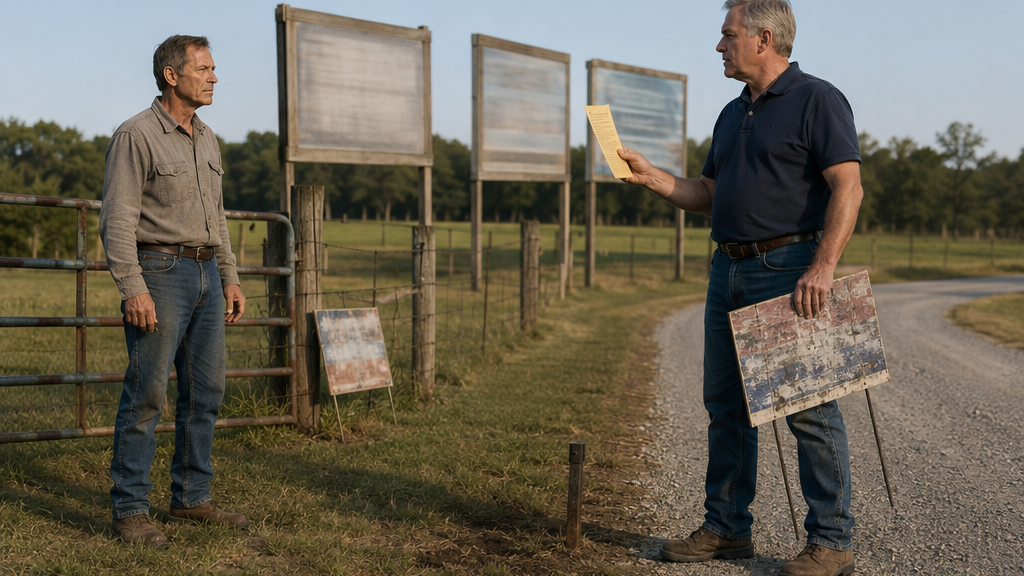
Patrick Williams was already holding Benjamin Carter’s sign when Benjamin reached the gate.
The little board looked ridiculous in Patrick’s hands. Twelve inches high, maybe eighteen across, hand-painted white with dark blue letters by the livestock club kids the previous Saturday. It had been planted in the grass beside Benjamin’s pasture fence, far enough from the gravel lane that a truck could turn without coming near it.
Patrick had pulled both stakes clean from the ground.
Three much larger signs stood twenty yards behind him at the shared-road entrance. One announced the annual farm-tour weekend. Another advertised the road association’s barbecue fundraiser. The third pointed visitors toward parking.
Benjamin stopped beside the cattle gate.
“You mind telling me what you’re doing?”
Patrick turned. He wore work jeans and a clean polo, as if he had dressed specifically to perform association business before breakfast.
“Enforcing the sign policy.”
He held out a yellow sheet.
Benjamin did not take it immediately.
The pasture behind him smelled of damp hay and mineral feed. Somewhere down the lane, a diesel engine started and settled into a low idle.
“My sign was on my grass.”
“It faces the association road.”
“So do those.”
Patrick glanced toward the larger boards.
“Association notices serve a shared purpose.”
Benjamin finally took the paper.
The notice cited unauthorized roadside signage and carried a fifty-dollar assessment if the sign was not removed by the stated deadline.
Benjamin read it twice, though the second reading was unnecessary.
“What boundary are you using?”
Patrick frowned.
“For what?”
“For the road easement.”
“The policy applies along the entrance corridor.”
“That isn’t what I asked.”
Patrick’s jaw tightened. “Benjamin, I’m not going to stand here before seven in the morning and argue property language over a fundraiser sign.”
Benjamin looked down.
Beside Patrick’s right boot, half hidden by packed grass and dirt, was an old iron survey pin. Only the rust-dark top showed above the ground.
Benjamin had walked past it for years.
He had also once spent a decade looking at markers exactly like it for the county.
He said nothing about that.
Instead, he went back to the truck parked beside the barn, opened the rear toolbox, and returned with a tape measure.
Patrick watched him with growing irritation.
Benjamin hooked the tape beside the pin and walked it toward the gravel.
“What are you doing?”
“Measuring.”
“You don’t need to measure anything.”
Benjamin crouched and read the distance.
“Which recorded easement description are you enforcing?”
Patrick stared at him.
“The association has maintained this road for thirty years.”
“That wasn’t my question either.”
For a moment, neither man moved.
The little sign remained under Patrick’s arm.
Benjamin could feel an old habit returning—the quiet satisfaction of finding the weak place in somebody else’s certainty. It was a feeling he had once known too well at the county planning counter.
He disliked that he still enjoyed it.
Patrick recovered first.
“The board adopted a roadside-sign policy. You received the same copy everybody else did. We have the farm tour coming up, and we cannot have people putting handmade signs all over the entrance.”
“All over?”
“Don’t twist my words.”
Benjamin looked toward the three association boards.
Patrick followed his gaze.
“Those are different.”
“Because you say they are?”
“Because the association put them there.”
Benjamin almost smiled.
That was exactly the kind of answer he remembered from boundary disputes: authority offered as proof of authority.
But instead of pushing, he rolled the tape back into its case.
“All right.”
Patrick seemed surprised.
“All right?”
“I heard you.”
Benjamin took the violation notice, folded it once, and slipped it into his shirt pocket.
Patrick handed over the little sign.
“You can keep it at the barn. Just don’t put it back along the road.”
Benjamin accepted it.
The plywood was still damp where the stakes had come through the morning grass.
The words advertised the youth livestock fundraiser at Carter Farm, nothing more. No political message. No commercial brand. No attack on the association.
Patrick walked back toward his pickup.
Benjamin called after him.
“You’re sure you don’t want to check the easement description?”
Patrick opened his door.
“I’m sure we don’t need to turn every simple rule into a courthouse project.”
Then he drove away.
Benjamin stood there until the truck disappeared around the bend.
He should have been satisfied.
Patrick had not answered the question. That alone told Benjamin something.
But the emotion that remained was not satisfaction. It was humiliation—small, hot, and unwelcome.
He had let another man remove something from his land and tell him where he could put it.
And worse, part of him had allowed it because he wanted to see how far Patrick would go.
Benjamin carried the sign into the equipment shed and slid it behind his workbench.
For the rest of the morning he repaired a hay rake, checked mineral tubs, and drove a load of square bales to the lower barn. Yet every time he passed the entrance, he saw the association’s three clean boards standing in full view.
By noon the contradiction had begun to bother him more than the fine.
By evening, it was the unanswered boundary question.
After supper he went back to the small office attached to the equipment shed. The room had filing cabinets older than some of the tractors outside, county tax maps in one drawer, equipment receipts in another, and records his father had kept because throwing away paper had seemed to him almost immoral.
Benjamin searched longer than he expected.
Near the bottom of a steel cabinet, beneath an old drainage agreement and a faded aerial photograph, he found a manila folder with his father’s handwriting on the tab.
ROAD EASEMENT — EAST ENTRANCE.
Benjamin carried it to the desk.
Inside was a folded survey exhibit.
He opened it carefully.
The first dimension he saw made him stop.
Then he reached for a ruler.
The number on the old recorded drawing did not look anything like the width Patrick had acted as though the association controlled.
Chapter 2: The Rule That Reached Past the Gravel
Charles Green arrived eight days later holding a yellow violation notice in one hand and a photograph of a missing calf in the other.
Benjamin was tightening a belt on the baler when Charles walked into the shed.
“You get one of these too?”
Benjamin wiped his hands on a rag.
Charles handed him the notice.
Same paper. Same association heading. Same reference to unauthorized roadside signage.
The fine was seventy-five dollars.
“What’d you put up?”
Charles lifted the photograph.
A red heifer stood beside a feeder, one white sock on the rear leg.
“I put her picture on a piece of cardboard by my mailbox. Phone number underneath. She pushed through the west fence sometime Tuesday night.”
Benjamin looked again at the notice.
“How long was it up?”
“Half a day.”
“Did you find her?”
“Yesterday. She got into the creek lot behind the old tobacco barn.”
“Then what’s the fine for?”
Charles gave him a tired look.
“Apparently finding the calf doesn’t cure the offense.”
Benjamin set the paper on the workbench.
Behind them, partially hidden between a grease gun and a box of hitch pins, his own little fundraiser sign leaned against the wall.
Charles noticed it.
“You still mad about yours?”
“Wasn’t aware I’d stopped.”
Charles snorted.
“It’s fifty bucks, Ben.”
“That yours?”
“No.”
“Then why are you here?”
Charles looked at the notice again.
“Because seventy-five feels different when it has my name on it.”
They stood in silence for a moment.
Benjamin disliked how satisfying that answer felt.
He opened the old easement folder and placed the survey exhibit on the bench.
Charles leaned closer.
“What’s that?”
“The recorded road easement.”
“You planning to sue somebody?”
“No.”
“Good. I need you available when my rake breaks.”
Benjamin ignored that.
He pointed at the dimension along the entrance.
“The association maintains the gravel. That doesn’t automatically mean it controls every foot of ground visible from the gravel.”
Charles studied the paper without understanding much of it.
“So Patrick’s wrong?”
“I didn’t say that.”
“You sounded like you wanted to.”
Benjamin folded the map.
That was the problem.
He did want to.
He wanted Patrick to be plainly wrong, publicly wrong, and stubborn long enough that nobody could mistake the result.
It was an ugly desire, especially now that Charles had been dragged into the same rule.
That afternoon Benjamin drove to the feed store and found Susan Harris beside the counter checking invoices for the road association’s barbecue supplies.
She saw the folded yellow notice in his hand.
“If this is about your sign, the next board meeting is Tuesday.”
“It’s about Charles Green’s.”
Susan’s expression changed slightly.
“What about it?”
“Did the board review where his sign was located?”
“The rule is about roadside signs.”
“That wasn’t my question.”
She sighed.
“You and Patrick are starting to sound alike.”
Benjamin let that pass.
“Did anybody check whether Charles’s mailbox frontage is inside the easement?”
Susan looked at him for a second longer than before.
“No.”
“Mine?”
“No.”
“Anybody’s?”
“The board didn’t discuss individual property lines.”
That was the first useful answer Benjamin had received from anyone in the association.
“What did you discuss?”
“Keeping the entrance clean during farm-tour season. Too many hand-lettered notices, sale boards, temporary banners. Patrick brought complaints from two members about it. The board agreed we needed a policy.”
“Agreed how?”
Susan’s eyes narrowed.
“You’re asking secretary questions now.”
“I’m asking what the policy actually covers.”
She folded the invoice sheet.
“It says roadside signs visible from association-maintained lanes require approval unless posted by the association for association purposes.”
“Visible from.”
“Yes.”
“That’s broad.”
“It was meant to be simple.”
Benjamin looked through the feed-store window toward the road.
Simple rules were often written by people who assumed the world would stay simple for them.
“What happens to Charles’s fine?”
“He can appeal.”
“He won’t.”
“How do you know?”
“Because he already told me seventy-five dollars is cheaper than losing a morning arguing with the board.”
Susan’s mouth tightened.
“That’s his choice.”
“Yes.”
But on the drive home, Benjamin kept thinking about those words.
That’s his choice.
Technically, it was.
So had Benjamin’s been.
He had known enough on the first morning to challenge Patrick. He had seen the survey pin. He had asked the right question.
Then he had stopped.
Not because he was uncertain.
Because he had wanted Patrick to keep going.
Two days later Charles paid the fine.
The association deposited it with the others.
Benjamin learned that from Susan when she dropped off road-maintenance receipts at his farm.
Before leaving, she glanced at the fundraiser sign still behind the workbench.
“You could appeal yours too.”
Benjamin said, “I know.”
“You don’t seem interested.”
“I’m interested in the rule.”
“That’s what worries me.”
He looked at her.
Susan picked up her ledger.
“You spent years at the county office. People around here remember. When you get quiet about paperwork, somebody usually finds out later why.”
It was the first time anyone had referred directly to his old work.
Benjamin gave no answer.
The following Monday morning, a flatbed truck stopped beside the shared entrance.
Two workers unloaded a new association sign.
It was professionally printed, framed in treated lumber, and almost six feet across.
Patrick stood nearby directing its placement.
Benjamin watched from his tractor.
The new board advertised the road-maintenance fundraiser and farm tour.
It stood closer to the gravel than his twelve-inch sign ever had.
Chapter 3: Community Purpose Became Patrick’s Answer
By the time Tuesday’s association meeting began, the new fundraiser board was the largest object at the entrance that was not a fence, a tree, or a vehicle.
Benjamin had measured it before supper.
Not because he needed the number.
Because measuring kept him from doing something less useful.
The meeting was held in the equipment shed the association used twice a month during busy seasons. Folding chairs faced a worktable. A coffee maker sat beside a box of road invoices. Mud from half a dozen pairs of boots dried in pale flakes on the concrete.
Patrick called the meeting to order.
Benjamin waited through culvert repairs, gravel delivery, ditch mowing, and a disagreement about the west cattle guard.
Then Patrick reached signage.
“We’ve had good compliance overall,” he said. “A few violations, but the entrance is looking better.”
Benjamin raised a hand.
Patrick saw it and paused.
“Yes?”
“I want the exemption explained.”
Patrick knew which one.
“Association signs?”
“The new board at the entrance is roughly twenty times the size of the one you removed from my frontage.”
“It is an official association notice.”
“What makes that exempt?”
“The policy does.”
“Because the association wrote the policy?”
One of the board members shifted in his chair.
Susan looked down at the minutes.
Patrick folded his hands.
“Because the signs serve a community purpose. They direct visitors, advertise the fundraiser, and support the roads every member here uses.”
Benjamin nodded.
“So visibility isn’t the problem.”
“Unapproved clutter is the problem.”
“My livestock-club fundraiser was clutter.”
“It was unapproved.”
“Charles Green’s missing-calf notice?”
Patrick exhaled through his nose.
“If we start deciding which private sign has a good enough reason, then the rule stops being a rule.”
There it was.
Benjamin had expected arrogance.
Instead, he heard something closer to fatigue.
Patrick reached into a folder and pulled out a sheet of numbers.
“We are almost fourteen thousand dollars behind where we need to be for the lower-road resurfacing.”
The room changed.
Even Benjamin had not known the gap was that large.
Patrick continued.
“The drainage work last spring cost more than projected. Gravel is up. The culvert by the Green place needs replacing before winter. Last year’s fundraiser barely covered the grading contract.”
He tapped the figures.
“If farm-tour weekend looks disorganized, people drive through and keep going. If they keep going, we lose vendor traffic, donation money, and half the reason the county tourism office puts us on the route.”
Nobody spoke.
Benjamin looked at the road figures.
Patrick was still wrong about the boundary.
That did not make the numbers imaginary.
“We’ve spent years trying to make this road look like something worth visiting,” Patrick said. “I’m not apologizing for keeping homemade signs from multiplying along the entrance.”
Benjamin leaned back.
For the first time, he understood why Patrick had become so absolute.
Control was cheaper than uncertainty.
Patrick could not lower gravel prices, repair a culvert alone, or guarantee fundraiser income. But he could remove signs.
And once people complied, it probably felt like proof that the policy worked.
Benjamin asked, “Then why not create the same setback and size rule for everybody?”
“Because association signs are temporary operational notices.”
“So was mine.”
“Yours was private.”
“That’s the distinction?”
“Yes.”
Not safety.
Not sight distance.
Not easement width.
Not obstruction.
Ownership of the message.
Benjamin glanced at Susan.
She was no longer taking notes.
Patrick said, “We are not going to debate every hypothetical. The policy stands. And because some members are ignoring warnings until the last possible day, repeat violations will increase beginning next month.”
“How much?”
“One hundred fifty dollars after the first offense.”
A murmur moved around the chairs.
Charles, seated near the wall, looked at Benjamin for half a second and then away.
Benjamin could have opened the easement map then.
He had brought it folded inside his notebook.
He could have asked Patrick to point to the recorded strip.
He could have said, in front of everyone, that visibility from a private parcel and control of an easement were not the same thing.
Instead, he waited.
Partly because Patrick’s financial explanation deserved consideration.
Partly because Benjamin still did not know whether the old survey exhibit had been superseded.
And partly because the meaner part of him wanted Patrick to put the higher fine into the record before Benjamin showed him the flaw underneath it.
That realization spoiled the pleasure.
The meeting moved on.
After adjournment, chairs scraped back and members drifted toward pickups.
Benjamin remained at the table with his notebook open.
He had sketched the entrance from memory: gravel lane, fence, survey pin, his frontage, association boards.
Susan stopped beside him.
“What are those marks?”
“Approximate sign locations.”
“You measured them?”
“Some.”
She studied the drawing.
“You really are doing this.”
“I’m trying to understand what we’re enforcing.”
Susan looked toward Patrick, who was loading folders into a plastic crate.
Then she lowered her voice.
“Have you seen the recorded easement exhibit?”
Benjamin’s pencil stopped.
“I have an old copy.”
“From when?”
“My father’s files.”
Susan frowned.
“I mean the exhibit attached to the association records.”
“I assumed you had one.”
“So did I.”
Benjamin looked up.
“What do you have?”
“A written legal description in the old binder. Policy copies. Maintenance agreements. Amendments.”
“No map?”
“Not in the current file.”
Patrick called across the shed, asking Susan whether she had the receipt packet.
She answered that she did.
Then, more quietly, she said to Benjamin, “There should be an exhibit. The legal description references one.”
“Maybe it was separated.”
“Maybe.”
But her expression said she did not believe that was a good enough answer.
Benjamin closed his notebook.
On the drive home, the fundraiser board appeared in his headlights before the turn into his farm.
For weeks he had been asking why Patrick believed the association’s signs were exempt.
Now another question had become more important.
If the association’s own records no longer contained the map showing where its authority ended, what exactly had Patrick been enforcing all this time?
Chapter 4: The Boundary Was Narrower Than Everyone Remembered
The first number Benjamin checked on Wednesday morning was wrong.
Not a little wrong.
The old survey exhibit showed the road easement ending several feet closer to the gravel than the line Patrick had been treating as association territory.
Benjamin laid the map flat on the desk, set a steel ruler along the scale, and measured again.
Same result.
He turned to the written legal description Susan had copied for him after the meeting. Bearings. Distances. Monument references. The kind of language most people skimmed until a disagreement made every word expensive.
At the east entrance, the description called for a fixed-width access easement centered on the established roadbed.
It did not say anything about controlling every piece of private land visible from the road.
Benjamin leaned back.
For ten years at the county office, he had watched people arrive certain that a fence, ditch, driveway, tree line, or habit established ownership. Most disputes began with the same mistake: somebody confused what had always been done with what had actually been granted.
He had left that job partly because he grew tired of being the man who had to tell neighbors their memories were not records.
Now he was sitting in his farm office hoping a thirty-year-old memory was wrong because the alternative was worse.
He needed the recorded document.
By ten, he was at the county records counter.
The clerk recognized him.
“Haven’t seen you on this side of the counter in a while.”
“Trying to keep it that way.”
She smiled and took the parcel information.
Benjamin asked for the recorded easement, any amendments, and the referenced exhibit.
While she searched, he walked to a wall map of the eastern part of the county. His old instincts returned immediately. Road right-of-way. Parcel lines. drainage corridors. frontage.
He disliked how natural it still felt.
The clerk came back carrying a thin packet.
“This what you need?”
Benjamin opened it standing at the counter.
The recorded exhibit was clearer than his father’s copy.
Same dimensions.
Same centerline.
Same width.
No amendment expanding it.
He checked the recording history.
Nothing.
“You have anything later tied to this instrument?”
The clerk looked again.
“No enlargement. There’s a maintenance agreement from twelve years ago, but it references the original easement.”
Benjamin read that too.
The association had authority to grade, gravel, ditch, drain, and maintain the shared lane within the recorded corridor. It had certain temporary access rights necessary for repairs.
Nothing gave it broad aesthetic control over adjoining private frontage.
He closed the packet.
That should have felt like victory.
Instead, he thought of Charles paying seventy-five dollars because arguing cost more than surrendering.
“How much for copies?”
The clerk told him.
Benjamin paid and carried the documents to the planning counter.
He almost turned around before reaching it.
Appealing his fifty-dollar fine would have been simple now. He could write a short letter, attach the easement exhibit, and force the association to answer.
But that would settle Benjamin Carter’s sign.
It would not answer the larger problem.
At the planning counter, he asked about temporary agricultural and community-event signage on private rural frontage.
The clerk there pulled up the current county standards.
“On your parcel?”
“Yes.”
“Outside public right-of-way?”
“Yes.”
“Not obstructing sight distance?”
“No.”
“How large?”
Benjamin hesitated.
He had not intended to ask for anything large.
Then he remembered the fundraiser board at the shared entrance.
“What’s the maximum before it changes category?”
The clerk turned the monitor slightly.
“For a temporary event structure on agricultural property, you can go larger than a yard sign if you meet setback, duration, height, and anchoring requirements. Depending on placement, you’ll need a temporary permit.”
She printed a page.
Benjamin read it slowly.
Four feet by eight feet would fit within the temporary category he had in mind, provided it met the setback and sight-triangle requirements.
The clerk pointed to the relevant line.
“You’d need a site sketch.”
“I can do that.”
“Property line too.”
“I have the recorded exhibit.”
She looked at him.
“You used to work here, didn’t you?”
“Long enough to know not to guess.”
That afternoon Benjamin returned to the entrance with the county copy, measuring tape, marking flags, and a carpenter’s level.
The old iron survey pin was where it had always been.
He measured from the road centerline, then from the pin, checking each distance against the exhibit.
The grass Patrick had treated as part of the association corridor extended well beyond the recorded easement.
Benjamin’s first sign had been planted roughly four feet outside it.
He measured again.
Then he drove to Charles’s place.
Charles’s mailbox stood near the gravel, but the patch where his missing-calf board had been tied to a fence post was also outside the association easement.
Benjamin continued down the road.
Another sign location he remembered from a recent warning fell outside.
Then another.
By late afternoon, the issue no longer resembled one mistaken interpretation at Benjamin’s gate.
Patrick had been enforcing the association’s sign policy according to visibility, not jurisdiction.
Benjamin sat on his tailgate with the folded map beside him.
For a few minutes, the old satisfaction returned.
He could already imagine Patrick’s face when he saw the recorded exhibit.
That was when Benjamin understood what bothered him.
He had known enough on the first morning to suspect this.
He had known more than Charles when Charles walked into the shed with the calf photograph.
Yet Benjamin had stayed quiet, telling himself he needed certainty.
Some of that was true.
Not all of it.
A part of him had wanted Patrick to keep making the mistake until the mistake became undeniable.
That meant Charles’s seventy-five dollars was not Benjamin’s fault.
But Benjamin could no longer pretend his silence had cost nothing.
He drove back to the farm before supper and took the little hand-painted sign from behind the workbench.
The children’s blue lettering looked smaller than he remembered.
He set it beside the county map.
Then he drew a site plan.
Not for the little sign.
For a temporary four-by-eight-foot information board promoting the youth livestock fundraiser and the upcoming farm-tour activities at Carter Farm.
He placed it well inside his property boundary.
Outside the association easement.
Outside the required sight triangle.
Far enough from the gravel that no reasonable safety argument could touch it.
The next morning, Benjamin returned to the county office with the application.
At the counter, he paused with the pen over the signature line.
This was the point where research turned into action.
He could still appeal his fifty dollars and let Patrick save face.
Instead, Benjamin signed.
When the clerk stamped the application received, the sound was softer than he expected.
He folded his copy and put it in the same folder as the easement exhibit.
For the first time since Patrick pulled the twelve-inch sign from the grass, Benjamin was no longer waiting to see what Patrick would do.
Now Patrick would have to respond to something Benjamin had chosen.
Chapter 5: Four Feet by Eight Feet Inside His Own Line
The sign contractor’s truck rolled through the gate at 7:12 on Friday morning, ten business days after Benjamin filed the application.
Patrick did not know it had been approved.
Benjamin intended to keep it that way until there was something physical to argue about.
The contractor stepped down, looked at the marked stakes, then at the gravel lane.
“You sure about this spot?”
Benjamin handed him the site sketch.
“Three feet farther in than the county requires.”
The contractor studied it.
“And the road people?”
“Don’t own this strip.”
“That usually means they think they do.”
Benjamin almost laughed.
The structure was deliberately plain: two pressure-treated posts, bracing, and a four-by-eight-foot panel advertising Carter Farm’s youth livestock fundraiser and farm-tour information.
No insults.
No accusation.
No reference to Patrick.
Nothing that would turn a boundary question into a personal attack.
That restraint had taken Benjamin longer than the permit application.
For three evenings he had considered sharper wording.
In the end, he removed all of it.
If the sign was going to prove anything, it needed to prove it by existing.
The auger had just started biting into the first post hole when Patrick’s pickup came around the bend.
He braked hard enough to scatter loose gravel.
Benjamin watched him get out.
“What is this?”
The contractor shut off the auger.
Benjamin said, “Morning.”
Patrick pointed at the panel lying on the grass.
“You cannot put that there.”
“I can.”
“The association prohibits unauthorized roadside signs.”
Benjamin reached into the cab of his truck and took out the permit packet.
“This one is authorized.”
Patrick barely looked at the county stamp.
“That’s a county permit.”
“Yes.”
“It doesn’t override association rules.”
“Not by itself.”
Patrick’s expression sharpened, as though he had heard the trap in the sentence.
Benjamin opened the recorded easement exhibit.
“This does the rest.”
He spread the paper across his hood.
“The association controls maintenance and use inside this recorded corridor. The sign is outside it, entirely on my parcel.”
Patrick did not lean closer.
“We’ve enforced the policy along this whole entrance for years.”
“Maintenance isn’t ownership.”
“I didn’t say it was.”
“You’ve been acting like it.”
The contractor took two steps away from them.
Patrick looked toward the survey flag, then toward the gravel.
“You’re splitting hairs.”
“Property lines are mostly hairs until somebody crosses one.”
Patrick’s face reddened.
“You think because you found somebody at the county office willing to stamp your form, you’ve beaten the policy?”
Benjamin shook his head.
“I used to be the person at that counter.”
Patrick stopped.
The words hung there more heavily than Benjamin intended.
“You what?”
“County land-use technician. Ten years.”
“You never mentioned that.”
“You never asked.”
Patrick looked down at the permit again.
For the first time since the dispute began, uncertainty replaced irritation.
Only briefly.
Then he pointed to the contractor.
“Stop work until the board reviews this.”
Benjamin said, “No.”
The single word surprised both of them.
Patrick turned toward him.
Benjamin kept his voice level.
“The county approved the structure. It meets the setback. It’s outside the easement. Unless you can show me recorded authority over this ground, work continues.”
“You’re a member of the association.”
“I am.”
“You agreed to association rules.”
“Inside association authority.”
Patrick stared at him for several seconds.
Then he took out his phone.
By the time the first post was set, Charles’s truck had stopped near the entrance.
A second neighbor pulled over ten minutes later.
Benjamin had not invited anyone.
That made the gathering worse.
The large panel rose slowly behind the two workers while people watched from pickups and fence lines.
The original twelve-inch sign sat in Benjamin’s truck.
He had planned to leave it there.
At the last moment, he carried it to the new structure and fastened it low between the posts, almost like a footnote.
The little handmade board looked absurd beneath the larger professional sign.
Charles walked over.
“That the one Patrick pulled?”
“Yes.”
Charles looked from one sign to the other.
“You always this subtle?”
“Apparently not.”
Patrick overheard.
“This is exactly the kind of circus I was trying to prevent.”
Benjamin looked at the road.
Nobody was cheering.
Nobody was laughing now.
The neighbors were simply watching two men who still had to share a road after the sign came down.
That took some of the pleasure out of Benjamin’s victory.
Patrick stepped closer.
“You could have brought the easement issue to the board.”
Benjamin felt the accusation land because it was partly true.
“I asked which easement you were enforcing.”
“You asked me at a gate while you measured around my boots.”
“And you fined me anyway.”
“Because I believed the policy applied.”
“That’s the problem.”
“No,” Patrick said quietly. “The problem is you knew more than you said.”
Benjamin had no quick answer.
Patrick looked toward the large board.
“The county letting you build that doesn’t mean the association has to accept your interpretation.”
“Then show me another recorded right.”
“I’ll call a meeting.”
“Do that.”
Patrick got back into his pickup.
Before leaving, he looked once more at the original little sign beneath the four-by-eight-foot panel.
His expression was not humiliation.
It was anger mixed with something Benjamin recognized from his county years: the realization that a rule somebody had relied on might not reach as far as they thought.
By noon the sign was finished.
It stood square, level, and entirely inside Benjamin’s private frontage.
The contractor packed his tools and left.
Benjamin should have felt satisfied.
Instead, the entrance looked different to him now.
Not because of the sign’s size.
Because every neighbor who drove past knew it was an argument made out of lumber.
Late that afternoon Susan arrived alone.
She parked inside the gate rather than by the road.
Benjamin was cleaning the post-hole dirt from the grass.
She did not look at the big sign first.
She looked at the little one attached beneath it.
“So that was the plan.”
“Part of it.”
“Patrick called an emergency meeting for tomorrow night.”
“I figured.”
Susan held a folder tight against her side.
“He asked me to revise the previous meeting minutes.”
Benjamin stopped raking.
“Revise how?”
“To clarify that the board had already authorized enforcement on all visible frontage before the notices went out.”
Benjamin studied her face.
“Did it?”
“No.”
“Was there a vote?”
“No.”
“Discussion?”
“Not like that.”
He set the rake down.
“What did you tell him?”
Susan looked toward the entrance.
“I told him I’d check my notes.”
“That isn’t an answer.”
“No,” she said. “It bought me an afternoon.”
Then she handed him a photocopy of the original minutes.
At the bottom, beside the sign-policy discussion, was a sentence far narrower than Patrick’s enforcement had become.
Susan tapped it with one finger.
“This is what was actually adopted.”
Benjamin read the line twice.
The association had approved a policy for signs placed within the maintained road corridor.
Not all visible frontage.
Not all roadside private land.
The distinction was small enough to overlook.
And large enough to unravel weeks of fines.
Susan took the copy back.
“Tomorrow night,” she said, “Patrick is going to ask the board which version it wants to remember.”
Chapter 6: Susan Would Not Rewrite the Meeting
Susan began the emergency meeting by reading the unchanged minutes aloud.
Patrick was still arranging papers when she reached the sentence that mattered.
“Temporary private signs placed within the maintained road corridor require prior association approval.”
She stopped.
Nobody moved.
The equipment shed felt smaller than usual. Folding chairs had been pulled into two uneven rows. Charles sat near the door. Benjamin had placed the old easement map on the table beside his twelve-inch fundraiser sign.
Patrick looked at Susan.
“You left out the clarification.”
“I left out what wasn’t voted on.”
“It was understood.”
“By you, maybe.”
Patrick’s face hardened.
Susan kept her hands flat on the ledger.
“My job is to record what happened, not what would be useful now.”
One board member cleared his throat.
Patrick turned toward the room.
“Fine. Then let’s deal with what happened. We adopted a sign policy to control the entrance. Everybody understood that.”
Benjamin said, “I didn’t.”
“You understood enough to wait until after enforcement before producing a thirty-year-old map.”
There it was again.
This time Benjamin did not dodge it.
He stood and unfolded the recorded easement exhibit.
“The map isn’t thirty years out of date. It’s the recorded easement. I checked the county records. No expansion. No amendment.”
He laid it flat.
“The maintained corridor stops here.”
His finger traced the boundary.
“My first sign was outside it. Charles’s calf sign was outside it. At least two other notices I checked involved locations outside it.”
Charles shifted forward.
Patrick said, “And you knew this from the beginning?”
Benjamin looked at him.
“I suspected it.”
“When?”
“The morning you pulled my sign.”
A murmur went through the chairs.
Benjamin continued before anyone could turn the answer into something cleaner than it was.
“I saw the survey pin. I knew the corridor probably wasn’t as wide as you were treating it.”
Charles stared at him.
“You knew when I brought you my fine?”
“I knew enough to tell you it needed checking.”
“You didn’t.”
“No.”
The word cost more than Benjamin expected.
Charles leaned back.
Benjamin could have defended himself. He had not yet verified the record. He had not known whether there was an amendment. He had not been responsible for Patrick’s decisions.
All true.
None complete.
“I wanted proof,” Benjamin said. “And if I’m being fair, I wanted Patrick to keep pushing until there wasn’t any room left to pretend the rule meant what he said it meant.”
Patrick gave a humorless laugh.
“So this was a setup.”
“No.”
Benjamin looked at the little sign.
“But I let it become one.”
The room went quiet.
Susan watched him differently now.
Not warmly.
More accurately.
Charles rubbed a thumb along the edge of his folded notice.
“I paid seventy-five dollars.”
“I know.”
“You could’ve saved me the trouble.”
“Maybe.”
That was harder to say than anything Benjamin had said to Patrick.
Patrick seized on it.
“This is exactly why the board cannot govern by individual interpretations. Benjamin had information and chose not to share it.”
Susan turned toward him.
“And you had authority you chose not to verify.”
Patrick stopped.
She opened another folder.
“I checked the resolutions going back six years. There is no vote expanding sign enforcement beyond the maintained corridor.”
One of the board members asked, “None?”
“None.”
“What about the policy memo?”
“A memo isn’t an easement.”
The phrase sounded like something Benjamin might have said.
He was glad Susan had said it instead.
Patrick lowered himself into a chair.
For the first time, he looked tired rather than angry.
“The purpose was to protect the entrance.”
“No one is disputing the purpose,” Susan said. “We’re disputing where the association had the right to enforce it.”
Patrick stared at the table.
“The fundraiser is three weeks away. The lower road needs gravel. The culvert estimate went up again yesterday. If we turn around now and refund every sign fine, we pull more money out of an already short account.”
There was no threat in his voice.
Just arithmetic.
Benjamin understood then that Patrick had not been defending the sign rule alone.
He had been defending the illusion that one manageable problem could compensate for several unmanageable ones.
Charles said, “You still can’t collect money where you had no right to fine us.”
“No,” Patrick said.
It was the first uncomplicated concession Benjamin had heard from him.
Susan slid a clean sheet of paper onto the table.
“We have two choices. We defend the existing fines and risk a larger dispute, or we identify which ones were outside the easement, void them, and rewrite the rule.”
A board member asked, “What happens to Benjamin’s big sign?”
Patrick looked at Benjamin.
Benjamin answered.
“The county permit allows it. That doesn’t mean it has to stay forever.”
Patrick’s eyes narrowed.
“So now you’re offering to take it down?”
“When the underlying rule is fixed.”
“And until then?”
“It stays.”
For a moment, the old contest returned.
Then Benjamin added, “Not because I need you to lose. Because if I remove it tonight, this turns back into an argument about whether I was being difficult.”
Patrick looked at the map.
“What do you want?”
“The actual boundary marked. Same rule for everybody. Association signs included. Refund fines issued where you had no authority.”
“And the road fund?”
“We deal with the road fund as a road fund.”
The room stayed quiet.
No applause.
No dramatic shift.
Just people calculating what correction would cost.
Susan looked at Patrick.
“We need to walk the line.”
He shook his head once.
“We have the map.”
Benjamin said, “Maps are easier to argue with when you’re sitting indoors.”
Patrick almost smiled, but did not.
Benjamin pointed to the old iron pin marked on the exhibit.
“Sunrise. We start at the entrance. Measure the corridor on the ground. Put temporary stakes at the recorded limits.”
Patrick rubbed both hands over his face.
Then he looked at Susan.
“You’ll record it?”
“Yes.”
At Charles.
“You coming?”
Charles shrugged.
“I paid seventy-five dollars. I figure I bought a ticket.”
A few people laughed, but softly.
Patrick finally looked at Benjamin.
“All right.”
Benjamin folded the map.
Patrick added, “And if the line is where you say it is?”
“Then we stop arguing about what we remember and write a rule for what’s actually there.”
Patrick nodded once.
“Six thirty.”
The meeting broke without anyone feeling victorious.
Benjamin carried the little fundraiser sign back to his truck.
Outside, Patrick stood beside his pickup staring toward the dark entrance where the large county-approved sign could barely be seen.
Benjamin expected another argument.
Instead Patrick said, “You really worked land use for ten years?”
“Yes.”
“Why’d you leave?”
Benjamin considered giving him the easy answer.
Long hours. County politics. Farming needed him.
Instead he said, “Too many people came in wanting a map to prove they were right instead of wanting to know where the line was.”
Patrick looked at him.
“That supposed to be about me?”
“Not only you.”
Benjamin opened his truck door.
At six thirty the next morning, the iron pin, the tape measure, and the ground itself would have to settle what neither man had been willing to concede inside the shed.
Chapter 7: The Line They Finally Agreed to See
At sunrise, the iron survey pin was easier to see than any of them expected.
Charles found it first.
“There.”
He pointed with the toe of his boot, careful not to touch the rust-dark cap breaking through the grass.
Patrick stood three feet away with his hands in his jacket pockets. Susan held the association ledger against her chest. Benjamin carried the recorded exhibit, a tape measure, and a bundle of thin orange marking stakes.
Nobody had brought coffee.
It felt too much like work for that.
Benjamin crouched beside the pin and compared its position to the plat.
“Start here.”
Patrick looked toward the gravel.
“That far in?”
“That’s what we’re checking.”
Benjamin hooked the tape beside the marker and handed the reel to Charles.
They stretched it across the frontage.
The tape passed through grass Patrick had treated for weeks as part of the association entrance. It stopped well short of Benjamin’s large permitted sign.
Susan wrote down the measurement.
Benjamin checked it twice.
Patrick said nothing.
They moved to the opposite side of the lane and repeated the process from the next monument called for on the exhibit.
Same result.
The maintained road corridor was wide enough for the gravel, drainage, shoulders, and routine work the association had performed for decades.
It was not wide enough to include all the adjoining land Patrick had been regulating.
Benjamin pushed an orange stake into the earth at the recorded limit.
Patrick stared at it.
“That’s where you say the association authority stops?”
“That’s where this easement stops.”
“That’s not exactly the same thing.”
Benjamin looked at him.
“No. And that distinction is part of how we got here.”
Patrick seemed to expect an argument.
Benjamin gave him none.
They walked farther down the lane.
At Charles’s mailbox, the difference became impossible to ignore.
The fence post that had held the missing-calf notice stood several feet beyond the easement.
Charles folded his arms.
“So my seventy-five dollars bought us a measurement lesson.”
Susan said, “You’ll get it back.”
Patrick looked at her.
“We haven’t voted.”
“We haven’t voted on the refund procedure,” she said. “I’m not recording a position that says we properly fined a sign outside our own corridor.”
Patrick turned away.
Benjamin watched him study the road.
For weeks, Patrick had seemed largest whenever he stood near an association sign or held a violation notice. Out here, with thin orange stakes showing the actual limits, he looked less like an authority figure and more like a man trying to understand how much of his certainty had depended on nobody measuring.
They continued until they had marked the entrance and the most disputed stretches.
By eight, the pattern was obvious.
Some past sign locations had been inside the corridor.
Several had not.
The policy itself was not meaningless.
Its enforcement had outrun it.
As they walked back toward Benjamin’s gate, Patrick stopped beside the four-by-eight-foot sign.
“You planned this to be impossible to ignore.”
“Yes.”
“At least you admit it.”
Benjamin looked up at the large panel.
The little original sign remained attached near the bottom.
“I also planned it because I knew exactly how irritating it would be.”
Charles gave a short laugh.
Susan did not.
Benjamin continued.
“That part wasn’t necessary.”
Patrick looked at him.
“No. It wasn’t.”
The answer irritated Benjamin more than denial would have.
He took the smaller sign down from beneath the large board and held it by the wooden stakes.
“This was enough to start the argument.”
Patrick’s gaze settled on it.
“It looked like one more homemade board at the entrance.”
“It was one more homemade board.”
“That’s what I was trying to stop.”
Benjamin nodded.
For once, they were not arguing over that fact.
Patrick rubbed a hand over the back of his neck.
“The county tourism office told us last year that the route looked scattered. Vendors complained people couldn’t tell which signs were official. Then the drainage bill hit. Then the gravel estimate.”
He looked toward Susan.
“I thought if the entrance looked organized, the fundraiser would carry more of the road work.”
Susan said, “You could have told the membership how bad the numbers were.”
“I did.”
“You gave us totals. You didn’t say you were scared we couldn’t cover the lower road.”
Patrick’s face changed slightly.
Benjamin understood the word before Patrick answered.
Scared.
That was what had been underneath all the talk about clean entrances and community purpose.
Not greed.
Not a private scheme.
A man responsible for a deteriorating road had found one part of the system he believed he could control, and then kept tightening his grip on it because the problems he could not control kept getting larger.
Patrick glanced at Benjamin.
“I should’ve checked the easement.”
“Yes.”
The blunt answer hung between them.
Then Benjamin added, “I should’ve shown it to you before Charles paid his fine.”
Charles looked over.
Benjamin met his eyes.
“I’m sorry.”
Charles studied him, then nodded once.
“Next time you know something useful, try being annoying sooner.”
That broke the tension enough for Susan to smile.
The board reconvened that evening.
This time Benjamin did not begin with the map.
He began with a proposed rule.
Any temporary sign placed within the recorded association easement would require association approval. Signs on adjoining private property would follow county requirements. A uniform setback from the traveled gravel edge would apply to association event signs and member signs alike when placed near the entrance. Sight-distance and safety standards would apply regardless of who owned the message.
Patrick read the proposal slowly.
“And size?”
“County limits outside the easement. Reasonable association limits inside it.”
“What about emergency notices? Missing livestock?”
“Temporary exemption if they don’t obstruct travel or sight distance.”
Charles said, “That seems like something we could’ve thought of before charging me seventy-five dollars.”
Susan wrote without looking up.
The board reviewed the disputed fines one by one.
Not every fine vanished.
Two signs had actually been placed inside the maintained corridor without approval.
But Benjamin’s fifty-dollar assessment was voided.
Charles’s seventy-five was refunded.
Several others followed.
Then Susan calculated the total.
The number was large enough to change the room.
Patrick stared at it.
“That comes out of the road account.”
“Yes,” Susan said.
The lower-road resurfacing would have to be delayed unless the association raised money another way.
For the first time, correction had a visible cost.
Nobody liked it.
That made Benjamin trust the decision more.
Patrick tapped the proposed rule with his pen.
“If we approve this, the association fundraiser board moves too.”
“Yes,” Benjamin said.
“To the same setback.”
“Yes.”
“And your large sign?”
“My permit runs another few weeks.”
Patrick looked up.
Benjamin let him wait.
“After the fundraiser,” Benjamin said, “I’m taking it down.”
Charles raised an eyebrow.
“You could keep it.”
“I could.”
Patrick asked, “Why won’t you?”
Benjamin looked toward the shed door, beyond which the road disappeared toward his farm.
“Because it did its job.”
The vote was not unanimous.
One board member thought the refunds were unnecessary.
Another wanted a broader association sign exemption.
But Patrick voted for Susan’s motion.
That mattered more to Benjamin than he expected.
Over the following month, the road fund became the argument it should have been from the beginning.
Members debated a temporary maintenance assessment. The fundraiser budget was revised. Patrick brought actual culvert estimates instead of speaking vaguely about appearance and reputation.
Nobody enjoyed those meetings.
They were better meetings.
The four-by-eight-foot sign came down after the farm-tour weekend.
Benjamin kept the lumber.
He returned the small hand-painted fundraiser sign to the grass near his gate.
Not where it had originally stood.
A few feet farther back, comfortably inside his unquestioned frontage.
One afternoon he drove toward the entrance and noticed something had changed.
The association’s fundraiser board had been moved.
It now stood at the same agreed setback as every other temporary sign.
Patrick was beside it, tightening a brace.
Benjamin slowed his truck.
Patrick looked up.
Neither man waved.
Then Patrick stepped back, checked the distance to the gravel, and glanced toward the orange stake still marking the easement limit.
Benjamin continued home.
At his gate, the little sign moved slightly in the breeze.
It no longer looked like evidence.
It looked like what it had been before any of them made it carry more weight than twelve inches of painted plywood should have had to bear.
A sign on a farmer’s land.
A rule with a boundary.
And, at last, people willing to see the difference.
The story has ended.