The Association Fenced Off His Daughter’s Favorite Farm Corner—Then One Survey Exposed What Their Easement Never Allowed
Chapter 1: The Fence Was Already Around Emily’s Bench
Jack Anderson knew something was wrong before he shut off the truck.
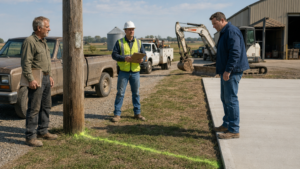
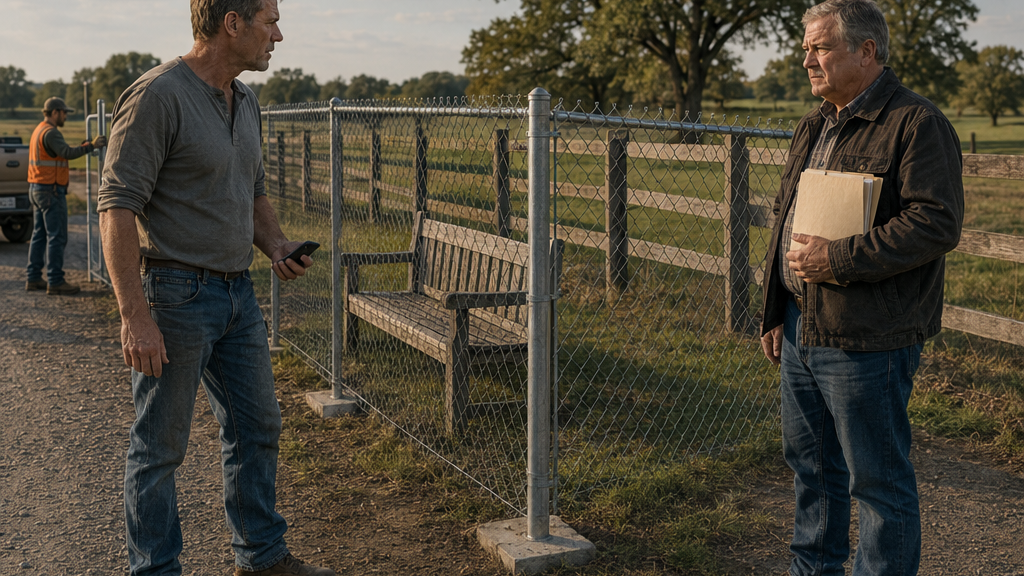
Three men in orange vests stood on the narrow strip between his pasture fence and the gravel road. One steadied a roll of chain-link while another swung a gate into place.
Inside the new enclosure sat Emily’s cedar bench.
Jack left the engine running.
The bench had been there so long that one leg had sunk slightly into the soil. He had built it from leftover cedar boards when Emily was six, sanding the edges because she liked to climb onto the backrest to watch calves in the pasture.
Now somebody had fenced it in.
Jack stepped from the truck and pulled out his phone.
The nearest worker looked up. “You Jack?”
“Yes.”
“Good. We’re about finished.”
Jack photographed the gate. Then the fresh concrete around the posts. Then the line of galvanized fencing running parallel to his pasture.
A small association placard hung from the gate, identifying the enclosure as a shared waiting and recreation area for families along the private road.
Jack read it twice.
“Who ordered this?”
The worker pointed toward the road.
Scott Miller’s pickup was coming around the bend.
Scott parked on the gravel shoulder and climbed out carrying a folder. He was a few years older than Jack, broad through the chest, with the deliberate walk of a man accustomed to being the person people called when culverts washed out or snow blocked the lane.
“Jack,” he said. “I was hoping to catch you before dark.”
“You could’ve caught me before you put posts in my ground.”
Scott glanced toward the fence.
“That’s what we need to talk about.”
Jack kept his voice level. “Start with who authorized it.”
“The road association.”
“The association doesn’t own this strip.”
Scott opened the folder. “There’s an easement.”
Jack felt his anger hesitate.
Not disappear. Hesitate.
“What easement?”
Scott read from a photocopied page. “Recorded access and maintenance easement along the east side of the Anderson parcel. Book reference is here.”
Jack did not take the paper.
“I know there’s road access along here.”
“Then you know it isn’t as simple as saying we’re trespassing.”
Jack looked at the posts again. The closest one stood only a few feet from the pasture fence.
“Access isn’t a playground.”
“It’s a waiting area.”
“With a locked gate?”
“It won’t be locked during use.”
“You put permanent concrete in my land.”
Scott’s jaw tightened. “The children have been using this area for years.”
“Because I let them.”
“And nobody understood that to be a problem.”
Jack almost answered too quickly.
Instead, he looked toward the bench.
One of Emily’s old initials, carved shallowly into the armrest, showed through the fence.
He walked to the nearest new post.
“Did anybody survey this before you dug?”
“The contractor worked from the association map.”
“That wasn’t my question.”
Scott looked toward the crew.
“We had the recorded easement.”
Jack crouched beside the concrete footing. Grass had been torn away in a rough circle, exposing hard soil and a patch of rust-brown metal almost hidden under the edge.
He scraped at it with the heel of his boot.
Scott stepped closer.
A short iron pin emerged from the dirt.
Jack stared at it.
He remembered his father pointing out pins like that when Jack was a teenager. Never move one. Never guess where a line runs when the ground already knows.
The new fence post stood on the farm side of it.
“Scott.”
Scott saw it too.
“That could be an old marker.”
“It is an old marker.”
“You don’t know what it marks.”
“I know enough not to pour concrete beside it without checking.”
The contractor had stopped working.
Jack stood and photographed the pin, the footing, and the distance between them.
Scott lowered his folder.
“We’re trying to make the road safer for the kids.”
“Then we can talk about making the road safer.”
“That’s what this is.”
“No.” Jack looked at the fence around Emily’s bench. “This is what you decided before talking to me.”
Scott’s expression changed—not apology, exactly, but irritation mixed with something more defensive.
“We had to act. The board approved it. We believed the easement gave us the right.”
“Believed?”
Scott did not answer.
Jack took one final photograph.
“Don’t add anything else tonight.”
“We’re essentially finished.”
“That isn’t permission.”
Scott’s face hardened. “And I’m telling you the association believes this is within its recorded rights.”
Jack nodded once.
Then he got back into his truck.
He did not pull at the gate. He did not tell the crew to leave. He did not give Scott the argument Scott seemed prepared to have.
At the house, Emily met him near the kitchen door.
“Dad, why is there a fence around our bench?”
“I don’t know yet.”
That answer bothered him more than anger would have.
After supper, Jack opened the metal file box where he kept deeds, tax records, livestock paperwork, and the survey from when he had refinanced the farm.
He unfolded the deed across the kitchen table.
The property description was familiar.
Then he found the line Scott had cited.
Recorded easement for ingress, egress, maintenance, and related roadway purposes along the eastern boundary.
The book and page numbers matched Scott’s photocopy.
Jack sat back.
For the first time since seeing the fence, he considered the possibility that the thing he had thought was obvious might not be obvious at all.
Emily stood in the doorway.
“Is it ours?”
Jack looked again at the easement language.
“The ground is.”
She waited.
Jack touched the line on the deed.
“What somebody else can do on it,” he said, “I’m going to have to find out.”
Chapter 2: The Fourteen Feet Everyone Had Started Sharing
“Then why do they get to call it theirs?”
Emily stood at the kitchen window Saturday morning, staring toward the strip.
From there, only the top rail of the new fence was visible beyond the lilacs. The bench was hidden.
Jack set his coffee down.
“They didn’t exactly call it theirs.”
“They put a fence around it.”
“That part is hard to argue with.”
She looked at him.
“And a sign.”
Jack had no answer that improved things.
The strip measured roughly fourteen feet at its widest point. It was too narrow for equipment and too close to the lane to graze cattle safely. For most of Jack’s life it had simply been grass between useful places.
Then Emily had made it useful differently.
When she was small, she picked dandelions there while Jack repaired fence. Later she sat on the cedar bench waiting for the school bus.
Other children began waiting there too.
Jack remembered the first time clearly now because he was trying to remember things he had once considered too ordinary to matter.
A neighbor had pulled up one wet October morning with two children in the back seat.
“Mind if they wait by Emily? The shoulder’s a mess down our way.”
Jack had waved toward the bench.
“Sure. Anytime.”
Anytime.
The word came back with uncomfortable precision.
Later there were four children. Then five on certain mornings. Someone’s father left a plastic tote under the bench with umbrellas inside. A mother once brought a thermos of cocoa in January.
Jack had never objected.
Why would he?
They were children waiting twenty minutes for a bus, not strangers claiming land.
During road repairs, neighbors had also stepped onto the strip to let trucks pass. The association had trimmed brush near the gravel edge. Once, Scott had asked whether a maintenance crew could stack two culvert sections there overnight.
Jack had said yes without looking up from the tractor.
By noon, the distinction that had seemed insulting Friday evening had become harder to describe cleanly.
Emily followed him down to the road.
The gate was closed but not locked.
She gripped the chain-link and looked through at the bench.
“They moved my rock.”
Jack saw it beside one leg—a flat gray stone Emily had painted years earlier, its colors mostly gone.
“Probably when they dug.”
“Can we go get it?”
He nearly opened the gate.
Then he stopped.
The fact that he hesitated on his own land irritated him more than the fence itself.
“Not yet.”
“Why?”
“Because I don’t want anybody saying I interfered with their project before we know what the paperwork says.”
Emily frowned. “But they interfered with us.”
“I know.”
She kicked gently at the grass.
“Scott’s bad.”
Jack glanced toward her.
“No.”
“He did this.”
“He made a decision I think he had no right to make.”
“That sounds bad.”
“It might be.”
She looked unconvinced.
Jack crouched beside her.
“If I decide what kind of person he is before I know why he did it, I’m doing the same thing I’m mad at him for doing to me.”
Emily considered that.
“So you’re not mad?”
“I’m very mad.”
That earned the first small smile of the morning.
Later, Jack walked the full length of the fence with a tape measure and notebook.
The new enclosure used almost the entire grassy strip. At one end, it narrowed toward the ditch. At the other, it reached the place where parents usually parked briefly during bad weather.
He wrote down distances.
Then he stopped at the iron pin he had exposed the night before.
It sat three inches above the dirt now, undeniable.
Yet the deed’s easement language stayed in his mind.
Ingress. Egress. Maintenance. Related roadway purposes.
The phrase “related roadway purposes” was broad enough to bother him.
He called the county records office, but it was closed.
Then he searched through older files until he found the survey from his refinance.
The drawing clearly showed his property line.
It also showed a shaded easement corridor overlapping the roadside edge.
Jack rubbed his forehead.
Emily came in carrying the faded rock she had apparently retrieved anyway.
“You went inside?”
“The gate wasn’t locked.”
“Emily.”
“It’s our rock.”
Jack almost laughed, but stopped himself.
“That isn’t the point.”
“It kind of is.”
He held out his hand.
She gave him the rock.
He could not honestly tell her the neighbors had never been invited onto that land. They had. Repeatedly. By him.
What he had never imagined was that hospitality might later be described as precedent.
Late that afternoon Scott texted him.
The board’s position hasn’t changed. We can discuss Monday.
Jack read it twice, then called a licensed surveyor whose number had been given to him years earlier.
The surveyor listened without interrupting.
“You have the deed?”
“Yes.”
“Existing survey?”
“Yes.”
“Visible monument?”
“At least one.”
“And somebody installed permanent improvements?”
“Friday.”
There was a pause.
“I can be there Monday morning.”
“How early?”
“Seven-thirty.”
Jack looked toward the window.
Beyond it, the top of the chain-link fence cut across a view that had been open for decades.
“Seven-thirty works.”
After he hung up, Emily set the faded rock on the kitchen table beside the deed.
Jack looked from one to the other.
He had spent years believing a handshake, a wave, or a casual “sure” was enough among neighbors.
On Monday morning, someone with instruments and recorded measurements would tell him whether that confidence had cost him more than he understood.
Chapter 3: The Easement Ran Through His Ground, Not Over His Rights
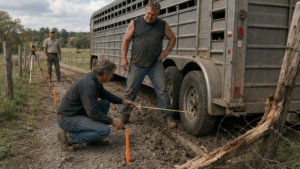
At seven thirty Monday morning, the surveyor planted a tripod less than a foot from the newest fence post.
Jack stood beside him with coffee cooling untouched in his hand.
Scott’s truck was nowhere in sight.
The surveyor sighted through the instrument, checked a handheld receiver, then walked toward the iron pin Jack had uncovered Friday.
“You didn’t disturb this?”
“No.”
“Good.”
He brushed dirt from the cap.
Then he moved nearly a hundred feet down the strip and began searching near the ditch.
Jack watched him sweep a locator slowly over the grass.
A sharp tone sounded.
The surveyor dug carefully with a hand spade.
Another iron monument appeared.
Jack felt some of the tightness in his chest ease.
The surveyor stretched no string. He relied on measurements Jack barely followed, moving between monuments, instrument, and electronic readings.
Finally, he pointed toward the chain-link.
“Your fee-simple boundary is where your older survey shows it.”
“So the fence is mine?”
“The fence isn’t yours. The ground under most of it appears to be.”
“Most?”
The surveyor nodded toward the gravel lane.
“You also have an easement burdening this parcel. We need to plot its exact width.”
That word—burdening—landed differently than ownership.
By nine, several small stakes marked the property line and the easement corridor.
The result was not as simple as Jack had hoped.
Near the southern end, part of the area where children traditionally stood fell within the recorded easement.
But the enclosure extended well beyond it.
The cedar bench sat entirely outside the corridor.
So did four fence posts.
The surveyor tapped one of them with his boot.
“This footing is several feet past the easement limit.”
Jack looked toward the next.
“And that?”
“Also outside.”
He checked another measurement.
“And that.”
Jack counted silently.
Scott had been right about one thing: there was a real easement.
But an easement was not the invisible ownership line Scott had treated it as.
“What does the easement let them do?”
“I can tell you where it is,” the surveyor said. “I’m not your attorney.”
“Your best non-attorney answer.”
The man smiled slightly.
“Access and road maintenance language usually means exactly what it sounds like until another recorded document expands it. Driving through. Maintaining the road. Drainage associated with it. Maybe necessary incidental activity. Permanent fenced recreation space is a different animal.”
“Even inside the corridor?”
“Ask a lawyer.”
Jack appreciated that answer because it did not promise him what he wanted.
By afternoon, the surveyor had enough field data to prepare a preliminary drawing.
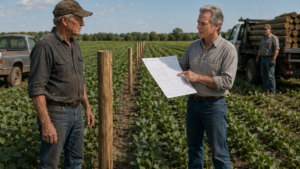
Jack took a copy to the county records office Tuesday morning.
The clerk brought up the easement document Scott had cited.
The original was decades old.
It granted the owners along the private road nonexclusive rights of ingress and egress and permitted maintenance, grading, drainage work, and repairs necessary to keep the lane usable.
Jack read it slowly.
“Nonexclusive,” he said.
The clerk nodded. “That’s what it says.”
“Meaning they can use it, but it’s still my property.”
“I can’t interpret legal effect for you.”
“Everybody’s careful around here.”
“We try to stay employed.”
Jack smiled despite himself.
He kept reading.
There was no mention of playgrounds, waiting enclosures, benches, fences, or permanent occupation.
The relief that came was substantial but incomplete.
He thought about the children.
Part of where they had stood all those years was inside the easement. Scott had not fabricated the document. He had stretched its meaning.
Jack pulled out the surveyor’s preliminary sketch.
The clerk compared the recording reference.
“You might want the later road-association filings too.”
“There are later filings?”
“Several.”
She searched the index.
Jack leaned closer.
One was a routine maintenance agreement. Another changed contribution percentages among parcel owners.
Then she stopped.
“Huh.”
“What?”
“There’s a memorandum filed with the road papers about six years ago.”
“Amending the easement?”
“Not exactly.”
She opened the scanned document.
It appeared to be an association memorandum dealing with permitted improvements along the shared corridor. The first page referenced mailboxes, drainage structures, visibility, and owner consent.
Jack felt his attention sharpen.
“Can you print that?”
“Sure.”
The printer behind the counter began feeding pages.
Jack picked up the first sheet.
A sentence near the bottom referred to permanent structures placed outside the traveled lane and the need to confirm underlying owner authorization.
Not enough to answer everything.
Enough to raise a new question.
“Who filed this?”
“The association.”
“When?”
She pointed to the recording stamp.
Six years earlier.
Long before Friday’s fence.
Jack stared at the date.
Scott had spoken as if the board had only the old easement to guide it.
But the association itself had later created a memorandum specifically addressing permanent improvements and owner consent.
The clerk handed him the remaining pages.
Jack folded none of them.
He carried them flat against his chest as he walked out.
The question was no longer only whether Scott had misunderstood an old easement.
It was whether the board had already written down the limits of that understanding—and ignored them anyway.
Chapter 4: Scott Had A Reason Jack Had Never Heard
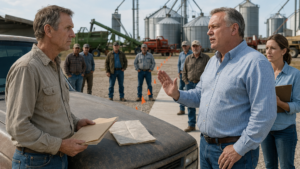
Scott pushed the survey back across the folding table without picking it up.
“I’m not taking the fence down today.”
Jack had expected resistance. He had not expected those exact words after laying the surveyor’s marked drawing in front of him.
The road-association meeting room occupied the back half of an old equipment shed where members stored salt bags, traffic cones, and the association’s battered snow blade. Fluorescent lights hummed over a long table. Through the open side door, Jack could see the gravel lane and, beyond it, the silver line of the fence around his strip.
He kept both hands flat on the table.
“Four posts are outside the easement.”
“I see the marks.”
“The bench is outside it.”
“I see that too.”
“Then what are we discussing?”
Scott rubbed a thumb along the edge of the survey.
“What happens if I pull it out this afternoon and tomorrow morning six kids go back to standing on the gravel shoulder?”
“That isn’t an answer to whether you had the right to put it there.”
“No,” Scott said. “It’s the reason I’m not pretending the other problem disappeared because a surveyor found four posts in the wrong place.”
Jack felt the familiar heat rise behind his ribs.
He had spent two days waiting for certainty. Now that he had it, Scott was changing the subject.
“Move the waiting area somewhere you own.”
“We looked.”
“Then look again.”
Scott leaned back.
“You think we woke up one morning and decided we wanted your fourteen feet?”
“I think you decided you could use them.”
“Yes.”
The bluntness stopped Jack.
Scott glanced toward the open door.
“My granddaughter waits for that bus.”
Jack said nothing.
“Three months ago,” Scott continued, “she stepped off the shoulder because a pickup came through too fast. Driver was trying to get around the bus before it stopped. She slipped in the ditch.”
Jack’s anger did not leave, but it lost its clean edges.
“Was she hurt?”
“Bruised hip. Torn coat. Nothing that made the emergency room keep her.”
Scott looked at him.
“That’s the good version.”
Jack remembered hearing something about a child falling near the lane. He had never connected it to Scott’s family.
“The bus driver called me that afternoon,” Scott said. “Said if we couldn’t provide a stable waiting point, he was going to request a different stop farther out.”
“How far?”
“Almost three-quarters of a mile.”
“For some of the younger kids?”
“Yes.”
Jack looked toward the road again.
The strip had always seemed safe because the children stood on grass instead of gravel.
That was why he had let them.
Scott pulled another page from his folder.
“Then our insurance representative came out after the incident.”
Jack took the page.
It was not a threat or violation notice. It was a risk recommendation: improve sight distance, designate a stable waiting location, reduce pedestrian exposure along the traveled lane.
No address was specified.
No authority to build on Jack’s property appeared anywhere.
“This doesn’t tell you to use my ground.”
“I know what it says.”
“Then why are you showing it to me?”
“Because I want you to understand why I moved fast.”
“You moved before you knew you could.”
Scott’s mouth tightened.
“We had an easement. The children were already using the area. The association had maintained the roadside there for years. I thought we had enough.”
“Thought.”
“Yes.”
Jack waited.
Scott did not soften the word.
That mattered.
It would have been easier if Scott had lied or shouted. Easier if Jack could walk out believing the man simply wanted power.
Instead, Scott looked tired.
“I should’ve talked to you first,” he said.
Jack’s jaw shifted.
“But?”
“But I still had five families asking what I was going to do before another kid ended up under a truck.”
Jack stood.
“You could’ve asked me.”
“I could have.”
“You could’ve asked the surveyor before concrete went in.”
“Yes.”
“You could’ve waited forty-eight hours.”
Scott’s gaze dropped.
“Maybe.”
That was the answer Jack disliked most.
Not because it was defiant.
Because it sounded like a man who still believed the risk justified some part of the shortcut.
Jack gathered his papers.
“The fence comes down.”
Scott looked up.
“I said I’m not doing that today.”
“And I’m telling you I’m not agreeing to leave it there while you decide when my property becomes convenient again.”
A chair scraped behind them.
Kathleen Moore had been sitting near the wall with the association ledger open in front of her. She had said almost nothing since Jack arrived.
Now she closed the ledger.
“Scott.”
He turned.
Kathleen’s face looked more troubled than Jack expected.
“We need to stop talking like nobody raised a question beforehand.”
The room changed.
Scott’s shoulders went still.
Jack looked from one to the other.
“What question?”
Kathleen hesitated.
Scott said quietly, “Not now.”
“That’s exactly why it needs to be now.”
Kathleen reached into her binder and removed a stapled packet.
“When we got the first fence estimate, I asked whether the easement covered structures.”
Scott stared at her.
“You asked generally.”
“I asked enough that you sent it out for review.”
Jack stopped gathering his papers.
“Review by who?”
“The association’s insurance contact forwarded it to someone who handles their property-risk files. It wasn’t a legal opinion.”
Scott stood.
“Kathleen.”
She ignored him.
“They sent back a warning. Preliminary. Nothing final.”
“What warning?”
Kathleen looked at the fenced strip visible through the doorway.
Then she looked at Jack.
“One that said we should confirm owner consent before anybody installed anything permanent.”
Chapter 5: The Sentence Missing From The Board’s Version
The sentence was fourteen words long.
Jack read it three times at his kitchen table.
Permanent recreational or waiting-area structures should not be installed without confirming underlying owner consent.
The rest of the page was ordinary caution: sight lines, trip hazards, maintenance responsibilities, fencing specifications, winter access.
That one sentence changed the character of everything around it.
Scott had not received a definitive legal ruling saying the fence was forbidden.
But he had received a warning telling him exactly what to verify.
He had built first.
Jack laid the paper beside the survey.
Emily’s cedar bench appeared in a photograph attached to the contractor packet. Someone had stood across the lane and photographed the proposed site before construction.
The bench was plainly visible.
So was part of Jack’s pasture fence.
His property had not been invisible.
His use of the strip had not been invisible.
Yet on the contractor diagram, the area was simply marked as the proposed waiting enclosure.
Jack’s attorney tapped the photograph later that morning.
“This helps.”
They were sitting in a small office above a farm-supply business in town. The attorney had already warned Jack twice not to confuse strong facts with automatic victory.
“How much?”
“It shows notice that this wasn’t an empty roadside shoulder. The survey shows where the property and easement limits are. The memorandum shows the association knew owner permission mattered for permanent improvements.”
“So they trespassed.”
“Likely, yes. But we still separate several questions.”
Jack leaned back.
“Ownership. Easement rights. Damage. Removal. Costs. Whether anybody relied on prior permission. Whether they claim some broader roadway purpose.”
“That last one sounds weak.”
“It may be weak. Weak isn’t the same as nonexistent.”
Jack looked at the photograph again.
Emily’s bench sat in the center of it.
“What can I make them do?”
The attorney folded his hands.
“Before we get there, tell me what you want.”
“The fence gone.”
“That part’s easy.”
“Easy?”
“Compared with the rest of the question.”
Jack frowned.
The attorney continued.
“You have survey costs. Possible restoration costs. Attorney fees may or may not be recoverable depending on how this resolves. You could demand written acknowledgment of the property line and limits of the easement. You could insist the association amend its records.”
“Yes.”
“You could also pursue damages beyond that.”
“How much?”
“I didn’t say you should.”
Jack looked toward the window.
“Scott knew.”
“He knew there was uncertainty.”
“He was told to get consent.”
“Yes.”
“And he didn’t.”
“Yes.”
The satisfaction Jack expected did not come.
Instead, he remembered Scott saying, That’s the good version, when he described his granddaughter slipping near the road.
The attorney slid the warning page toward him.
“Evidence can tell you what leverage you have. It doesn’t tell you what kind of outcome you’ll respect six months from now.”
That afternoon Kathleen came to the farm.
She did not drive up to the house. She parked near the entrance and waited beside her car until Jack came down.
“I should’ve read the attachment myself,” she said.
Jack stopped several feet away.
“You approved the payment.”
“Yes.”
“Without reading it?”
“I saw the email summary. Scott said there was no prohibition, only a recommendation to verify.”
“That sounds like a creative summary.”
Kathleen winced.
“It does now.”
“Did it then?”
She took a breath.
“We’d already been arguing about costs for two months. Gravel went up. Snow removal went up. The insurance premium went up after the incident. Every time we asked members for another contribution, half of them accused the board of wasting money.”
“So you chose the cheap site.”
“We chose the site children were already using.”
“My site.”
“Yes.”
The admission was quiet.
Jack looked through the chain-link.
The faded gray rock Emily had retrieved was no longer there. He had put it back in the kitchen.
“You all saw this bench.”
“I did.”
“And nobody thought maybe the person who built it should be asked?”
Kathleen lowered her eyes.
“I assumed Scott had.”
That answer was worse than a conspiracy and more believable than one.
No secret meeting.
No scheme to steal acreage.
Just one person moving too quickly and another person assuming someone else had checked.
“What happens now?” Kathleen asked.
“The fence comes down.”
She nodded.
“I’ll support that.”
“And the records get corrected.”
“Yes.”
“My survey gets reimbursed.”
“I think that’s reasonable.”
Jack studied her.
“What about Scott?”
“That’s for the board.”
“No. I mean what does he think should happen?”
Kathleen looked toward the lane.
“He thinks pulling it immediately puts us back where we started.”
That evening Scott called.
Jack nearly let it ring out.
Then he answered.
“I’m not arguing ownership,” Scott said.
“That’s new.”
“I’ve seen the final survey.”
“Good.”
“I’m asking for time.”
“How much?”
“Until we have another waiting site.”
“No.”
“Jack—”
“You already had time. You used it to pour concrete.”
A pause.
“If that fence is removed tomorrow, the kids go back to the shoulder.”
“That’s not permission to keep my property.”
“I know.”
Scott sounded less certain than he had in the meeting room.
“But it’s still the consequence.”
After the call, Jack stood at the kitchen counter while Emily worked on school papers at the table.
He had what he wanted: proof.
The board’s legal position was weakening by the day.
He could push until every expense, mistake, and embarrassment landed on them.
His attorney called before dark.
“The association is ready to discuss terms,” he said. “Before I respond, I need an instruction from you.”
“What kind?”
“What remedy are we actually demanding?”
Jack looked through the window at the fence.
For days, that question had seemed obvious.
Now it was the only one he could not answer quickly.
Chapter 6: Winning The Land Was Not The Hardest Choice
“If they take the fence down,” Emily asked, “where do the little kids stand?”
Jack stopped halfway through buttering a piece of toast.
It was Saturday morning.
He had spent the previous night making a list of demands.
Fence removal.
Post-hole restoration.
Survey reimbursement.
Attorney costs.
Written acknowledgment of ownership.
Correction of association records.
Not once had he written bus stop.
“Scott said they’d have to go back near the road.”
Emily frowned.
“Where I used to stand?”
“Yes.”
“That ditch gets icy.”
“I know.”
She returned to her cereal.
Jack looked at the legal pad beside his coffee.
Winning the land was becoming easier.
Deciding what winning required was not.
An hour later, he drove slowly along the association road.
He passed the fenced strip without stopping.
Past Scott’s place, the lane widened near an old turnaround used by snowplows and delivery trucks. The association controlled the corner as part of a common maintenance parcel.
Jack parked.
The ground was farther from the traveled lane than his strip. A drainage swale ran along one side, but there was enough flat space for a gravel pull-off and a small waiting pad.
He paced it.
Then he paced it again.
By noon, he had the survey sketch on his kitchen table with a second sheet of paper beside it.
Emily leaned over his shoulder.
“What’s that?”
“Maybe a different place.”
“For the kids?”
“Yes.”
“It’s farther from our house.”
“That’s sort of the point.”
He called the surveyor, then the association’s road-maintenance contact.
Neither promised anything.
By afternoon, though, Jack had enough information to know the site was workable.
It was also more expensive.
The existing strip had cost the association almost nothing beyond the fence because the grass was level and children already gathered there.
The alternate corner would require compacted gravel, drainage work, reflective markers, and a widened entrance so parents could pull off without blocking the lane.
Jack estimated the difference and understood immediately why nobody had preferred it.
At an informal association discussion that evening, one board member said exactly what Jack expected.
“So we tear out a nearly finished project and spend several thousand more because four posts crossed a line?”
Jack set his coffee down.
“Not four posts.”
The man looked at him.
“The entire enclosed use depends on land you don’t own. Four posts are simply the part the survey makes impossible to argue about.”
Scott sat at the other end of the table.
He did not interrupt.
Another board member rubbed his forehead.
“We’re not made of money.”
“Neither am I.”
Kathleen opened the association ledger.
“The alternate site will cost more,” she said. “So will defending the current one.”
Silence followed.
Jack slid a page toward Scott.
“I’ll support the alternate site.”
Scott looked surprised.
“With conditions.”
He picked up the sheet.
The conditions were plain.
No claim that Jack’s prior permission created continuing rights.
No permanent structures on his parcel without written consent.
Written acknowledgment that the recorded easement remained limited to its stated purposes.
Removal of the fence and restoration of the strip.
Reimbursement of Jack’s survey and reasonable repair costs.
The association could build the waiting pull-off on the common corner after proper review.
Scott read to the bottom.
“You had your lawyer draft this?”
“No.”
“It reads like you did.”
“I’m learning.”
Kathleen almost smiled.
The same board member who had complained about cost shook his head.
“You’re asking us to admit fault.”
“I’m asking you to write down what the survey already says.”
“That has consequences.”
“So did the fence.”
Scott continued studying the page.
Finally he said, “What about temporary use?”
Jack knew what he meant before he explained.
The association wanted the fence to remain until the alternate site was completed.
“No.”
“Two weeks.”
“No.”
“One week.”
Jack shook his head.
“You don’t get to keep occupying the land as the price of agreeing you had no right to occupy it.”
Scott looked at him.
“The kids still need somewhere.”
“Yes.”
“And you’re willing to help solve that?”
“Yes.”
“But not let them use the existing fenced area for a few more days?”
Jack felt the contradiction.
So did everyone else.
For years he had let children stand on that ground freely.
Now he was refusing temporary continued use because a fence had transformed permission into a claim.
He chose his words carefully.
“They can wait on my grass the way they did before, if weather and safety allow, until the new site is ready.”
Scott blinked.
“But the fence comes down.”
“Yes.”
“You’d still let them stand there?”
“If I decide to.”
The room went quiet.
Jack tapped the page.
“That’s what everybody missed. I’m not trying to keep children off my land. I’m trying to keep permission from being rewritten as authority.”
Scott looked away first.
By Sunday afternoon, the association’s attorney had sent Jack a proposed settlement.
It reimbursed the survey. It acknowledged disputed boundary issues. It promised to explore relocation.
And it required confidentiality.
More importantly, it allowed the current enclosure to remain “temporarily” while the board considered alternatives.
Jack read that sentence twice.
His attorney called moments later.
“It’s not terrible as first offers go.”
“No.”
“You want revisions?”
“I want it rejected.”
“Entirely?”
“Yes.”
“Because of confidentiality?”
“Partly.”
“And the temporary fence?”
“Mostly.”
The attorney paused.
“You understand they may dig in.”
“I understand.”
Jack looked outside.
Emily stood beside the fence, fingers hooked through the wire, looking at the cedar bench.
He had spent years saying yes casually because he believed neighbors understood that kindness had edges even when nobody drew them.
Now he understood the cost of leaving those edges invisible.
“Tell them the offer for the alternate site stays open,” Jack said. “Tell them I’ll cooperate with a lawful solution.”
“And the fence?”
“Comes down first.”
His attorney was silent for a moment.
“All right.”
Jack ended the call.
Across the strip, Emily looked toward him.
He lifted one hand.
She lifted hers back through the chain-link.
By Monday morning, the board would have to choose between removing a fence it could no longer justify or defending it in a dispute that was no longer only about where four posts stood.
Chapter 7: The Same Crew Came Back For The Fence
The contractor truck came down the gravel lane just after eight Monday morning.
Jack saw the orange vests through the kitchen window and felt his stomach tighten before he noticed what the men were carrying.
Not fence panels.
Wrenches.
A post puller.
A cutoff saw.
Emily came to the window beside him.
“Are they taking it down?”
Jack watched the truck stop beside the strip.
“I think so.”
He did not hurry outside.
By the time he reached the road, the crew chief had opened the gate and was removing the hinges.
“Morning,” the man said.
“Morning.”
“We got authorization to remove everything.”
“Everything?”
“Fence, posts, concrete where we can get it cleanly. We’ll fill and seed afterward.”
Jack looked at the cedar bench.
For more than a week, he had only seen it through wire.
Now the first chain-link panel lifted away from it.
The change was immediate and oddly unsettling. The land looked wider without the fence, although no measurement had changed.
Jack took out his phone.
The crew chief noticed.
“You documenting?”
“Yes.”
“Fair enough.”
Jack photographed the removal the same way he had photographed installation: each section, each footing, each exposed hole.
He did not film the men’s faces.
They had not made the decision.
Scott arrived twenty minutes later.
He parked across the lane and stood beside his pickup without approaching.
Jack acknowledged him with a nod.
Scott returned it.
That was all.
The crew worked steadily.
A post near the iron survey pin resisted the puller. When it finally came free, a cylinder of gray concrete rose from the earth with dark soil clinging to it.
The survey pin remained untouched beside the hole.
Jack looked at it longer than necessary.
The first evening, the little piece of rusted iron had been the only thing in the ground that seemed willing to contradict everyone else.
Now nobody needed convincing.
By late morning, the last panel was stacked on the trailer.
The cedar bench stood alone again.
Emily walked down from the house carrying the faded gray rock.
“Can I put this back now?”
Jack looked at the bare holes where the fence posts had been.
“Yes.”
She slipped past him and placed the rock beside the bench leg.
Then she sat down.
The crew chief looked over while tightening a strap on the trailer.
“That your bench?”
“My daughter’s.”
He glanced at the removed fencing.
“Sorry we boxed it in.”
Jack nodded.
“You were doing a job.”
The man hesitated, then said, “Still.”
Jack appreciated the word.
That evening, the association held a special meeting.
Jack expected Scott’s chair to be empty.
It was not.
Scott sat at the far end of the folding table with a stack of papers in front of him.
Kathleen called the meeting to order.
There were no speeches.
The first motion concerned the survey expenses.
Approved.
The second covered repair of the strip, including filling the post holes, reseeding damaged grass, and repairing any harm to the bench or pasture fence.
Approved.
Then Kathleen slid a typed statement into the center of the table.
“This is the correction for the association records.”
One board member read aloud portions of it.
The easement granted access, egress, and road-maintenance rights.
It did not grant possession.
It did not authorize permanent recreational or waiting structures outside those purposes without consent from the underlying landowner.
Jack listened without interrupting.
The language was not triumphant.
That made it stronger.
Scott signed after Kathleen.
His pen paused briefly before touching the paper.
When he finished, he pushed it toward Jack.
“There.”
Jack looked at the signature.
“Thank you.”
Scott’s expression flickered.
“I don’t know if that’s the word I’d use.”
“It’s the word I’m using.”
Kathleen then raised another item.
“The association has received a records request from the county weekly.”
Several people looked up.
Scott did not.
“A reporter?” one board member asked.
“Yes.”
“About this?”
Kathleen nodded.
“They heard there was a dispute over the waiting area and asked for meeting minutes, invoices, and the correction approved tonight.”
The room became uncomfortable in a new way.
Jack recognized it immediately.
The dispute had stopped being private.
One member glanced at him.
“Did you call them?”
“No.”
It was true.
Jack had not.
Kathleen closed the folder.
“The records they requested are association records. I’m not going to hide them.”
Scott finally looked up.
“Neither am I.”
That surprised Jack.
The meeting continued another half hour.
They approved reimbursement of Jack’s survey costs. The attorney fees remained unresolved, but Jack had already decided not to make them the center of the fight.
When the meeting adjourned, people left in small groups.
Scott stayed.
Jack was halfway to the door when he heard him.
“Jack.”
He turned.
Scott stood beside the folded survey map.
“I stepped down as chair.”
Jack had not heard that motion.
“When?”
“Before the meeting.”
“Why?”
Scott shrugged once.
“Because I moved something from urgent to permanent without making sure I had the right.”
Jack waited.
Scott looked embarrassed rather than defeated.
“I still think the kids needed a safer place.”
“So do I.”
“I know.”
He tapped the paper Jack had drafted over the weekend.
“The alternate corner.”
“What about it?”
“Is the offer still real?”
Jack studied him.
Outside, through the open shed door, he could see the roadside strip again.
No chain-link.
No gate.
Just the bench and the disturbed earth around it.
“Yes,” Jack said. “If the association wants to do it properly.”
Scott nodded.
“Properly sounds expensive.”
“It probably will be.”
For the first time in days, Scott almost smiled.
“I walked into that one.”
“A little.”
Scott folded the alternate-site sketch.
“Can I bring this to the maintenance group tomorrow?”
“Yes.”
He started toward the door, then stopped.
“I should’ve called you before we built anything.”
Jack said nothing.
Scott looked at him.
“I’m not asking you to make that easier.”
“I know.”
Scott left.
Jack remained alone in the meeting room for another minute.
The correction had been signed.
The fence was gone.
The expenses were being repaid.
If that had been all Jack wanted, the story could have ended there.
But on the table in front of him sat the sketch of another piece of ground, another boundary, and another chance to decide what permission ought to mean before somebody else decided for him.
Chapter 8: He Put The Bench Back Where Permission Meant Something
Fresh grass had begun to show where the fence posts once stood.
For several weeks, the line of old holes remained obvious as darker circles across the strip. Then rain settled the soil, seed took hold, and the marks softened.
Emily still noticed them.
Jack did too.
One Saturday morning, they carried two boards, a sander, and a can of weatherproofing down to the cedar bench.
Emily ran her hand over one armrest.
“They scratched it.”
“A little.”
“Can we fix it?”
“That’s why we brought this.”
They worked without hurry.
Jack tightened one leg where the bench had shifted during construction. Emily sanded the rough marks near her old carved initials.
Across the gravel lane, a compacted stone pad now occupied the association’s turnaround corner.
It was not fancy.
That had been part of Jack’s proposal.
No playground.
No permanent enclosed recreational area.
Just a widened pull-off, a raised gravel waiting pad, drainage improvements, two reflective posts, and enough space for children to stand well away from moving vehicles.
The school bus could stop without forcing traffic into the ditch.
Parents could pull off the lane in bad weather.
It had cost more than using Jack’s strip.
Nobody pretended otherwise.
What surprised him was how quickly the argument about cost changed once ownership was no longer available as something to ignore.
The association debated dimensions.
Drainage.
Gravel depth.
Insurance recommendations.
Maintenance responsibilities.
All the things they should have debated before putting the first post around Emily’s bench.
Kathleen handled most of the paperwork now.
Scott had stepped down as chair but continued helping with the road-maintenance crew. Jack saw him twice during construction, once driving the association tractor and once setting reflective markers beside the pull-off.
Their conversations stayed short.
They were not suddenly friends.
That would have felt dishonest.
But neither man crossed the lane to avoid the other.
A few days before the new waiting area opened, Jack met with Kathleen and Scott at the kitchen table.
A document lay between them.
Two months earlier, Jack would have hated it on sight.
Three pages governing something neighbors once would have settled with a sentence.
Permission for limited temporary use of designated space.
No transfer of ownership.
No expansion without written agreement.
No permanent structures on Jack’s parcel.
Any future use could be withdrawn under specified conditions.
The alternate waiting area itself sat on association-controlled ground, but one narrow drainage-maintenance path crossed the edge of Jack’s property. Jack was granting defined access for that purpose.
Scott read the paragraph twice.
“You really want all of this for six feet of drainage access?”
Jack looked at him.
Scott nodded before Jack answered.
“Never mind. I heard it.”
Kathleen smiled faintly.
Jack signed.
His pen stopped for a second over the signature line.
He thought about every time he had said, Sure, anytime.
He had meant those words kindly.
He still meant them kindly.
The mistake had been assuming everyone would always understand the invisible conditions attached to them.
You can use this because I trust you.
You can stand here because I don’t mind.
You can cross here because we are neighbors.
None of those sentences meant this belongs to you.
Kathleen signed as witness to the association acknowledgment.
Scott signed beneath her.
When they finished, Jack gathered copies into separate folders.
Emily entered the kitchen.
“Is that all the boring stuff?”
“Yes.”
“Can the kids use the new place now?”
Scott looked at Jack.
Jack said, “Starting Monday.”
Emily considered that.
“So everybody won?”
Kathleen laughed quietly.
Scott did not.
Jack looked at his daughter.
“No.”
She frowned.
“Then who lost?”
He folded his copy of the agreement.
“We all paid for a mistake that didn’t need to happen.”
“That sounds like losing.”
“A little.”
Scott rubbed one hand over his jaw.
“But the new spot is safer.”
Jack nodded.
“And our bench is ours.”
“Yes.”
Emily seemed satisfied with that accounting.
Monday morning, Jack carried his coffee down to the restored strip.
The cedar bench was dry from its new finish.
Emily sat beside him wearing her backpack.
Years earlier, she had needed help climbing onto the seat. Now her shoes nearly reached the ground.
Across the lane, three younger children stood on the new gravel pad.
A parent’s pickup waited in the pull-off without blocking traffic.
Scott was there too, checking one of the reflective posts with his boot.
The bus appeared at the bend.
Jack instinctively watched the road.
The driver slowed early.
The red lights flashed.
The children waited several feet back from the lane until the bus stopped completely.
No one stepped into the ditch.
No vehicle tried to squeeze past.
The door opened.
Emily stood.
“Aren’t you coming over?”
“You’re old enough to cross when the driver signals.”
She rolled her eyes.
“You always say that.”
“Because you always ask.”
The driver waved.
Emily crossed and climbed aboard.
Before the door closed, she turned toward the window and pointed at the bench, then at Jack.
He lifted his coffee in reply.
The bus pulled away.
Scott remained across the lane.
For a moment neither man moved.
Then Scott looked toward the new waiting area.
“Works better over here.”
“It does.”
“Should’ve done it the first time.”
“Yes.”
Scott nodded.
No excuse followed.
That mattered more to Jack than an apology made because somebody expected one.
Scott walked back toward the maintenance tractor.
Jack sat down on the cedar bench.
The repaired wood felt smooth beneath his palm, except where Emily’s initials remained. He had deliberately sanded around them.
At the edge of the grass, the old iron survey pin was visible again.
Jack had considered covering it.
Instead, he had trimmed the grass around it.
Not as a warning.
As a reminder.
The ground could belong to one person while still serving more than one.
A neighbor could say yes without giving away the right to say no later.
And a boundary, properly understood, did not have to be a wall.
Jack took another drink of coffee and watched the empty road where the school bus had disappeared.
Across from him, the new waiting pad sat on ground chosen openly, measured carefully, and used with everyone knowing exactly why they were there.
Behind him, cattle moved through the pasture.
Beside him, Emily’s gray painted rock rested against the repaired bench leg.
Nothing about the little corner looked important enough to start a dispute.
That had always been part of the problem.
Jack rested one hand on the cedar armrest.
The bench was back where it belonged.
So was the choice to share what surrounded it.
The story has ended.