He Let the Farm Festival Use His Field for Years—Then Their Letter Claimed It Was Never His
Chapter 1: The Fence Posts Arrived Before the Festival Opened
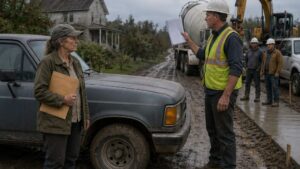
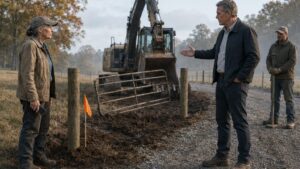
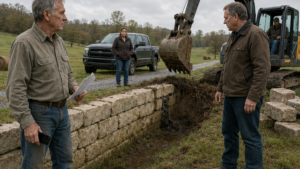
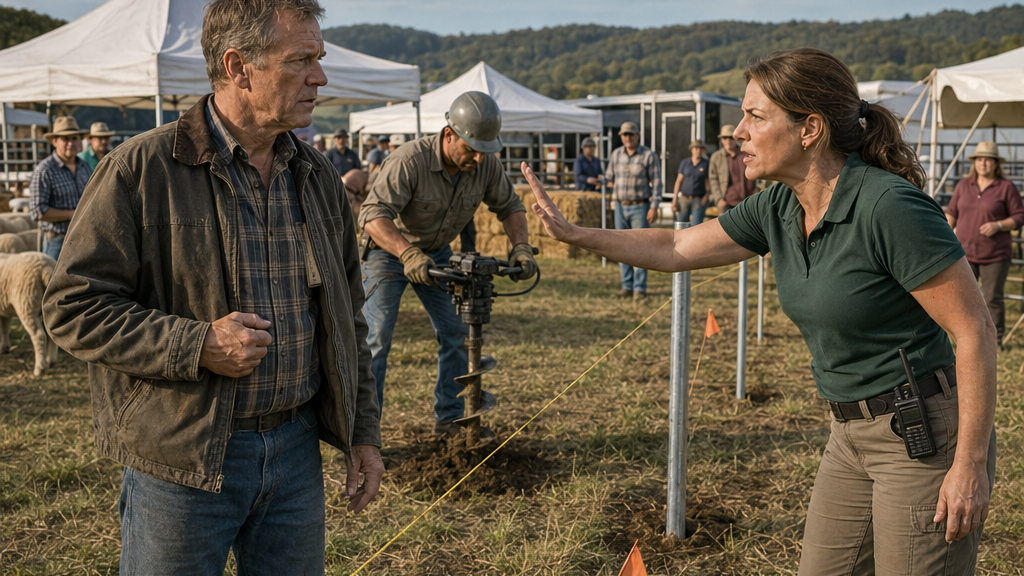
The auger bit into the ground between two white festival tents at 7:58 Saturday morning.
A volunteer carrying a box of paper cups stopped so abruptly that another man nearly walked into him. Twenty feet away, a livestock vendor lowered the tailgate of a trailer and stared as the contractor backed the machine out of the fresh hole.
Joseph Martin stood on the grass with a folded survey in one hand.
“Next one’s twelve feet,” the contractor said.
Joseph looked down the taut yellow string stretched from an orange flag near the gravel entrance to another flag beside his hayfield.
“Stay on the string.”
The contractor nodded.
The second hole went in.
By then people had begun gathering.
The agricultural association’s annual farm-and-harvest festival did not officially open until nine, but setup had started before sunrise. Folding tables stood beneath tents. A portable stage had been rolled onto the grass. Two youth livestock pens were being assembled near the demonstration ring. Vendors were unloading pies, preserves, tack, handmade signs, and produce.
For years, the whole arrangement had flowed naturally from the association grounds onto Joseph’s narrow strip of land.
Nobody had noticed where one ended and the other began.
That morning, everyone noticed.
A steel post rose from the first hole.
The volunteer with the cups came closer.
“Joseph, what are they doing?”
“Putting in my fence.”
“Today?”
Joseph glanced at him.
“They had today available.”
The man looked toward the tents, then back at the post.
Joseph knew exactly what the question really was.
Why today?
He had asked himself the same thing at four that morning while sitting at his kitchen table with coffee cooling beside the certified letter.
He had known what the answer was then.
Because they had picked a deadline.
Because they had written his land into a sentence as though his name had never been attached to it.
Because after twelve years of being easy to deal with, he was tired of people confusing quiet with permission.
The contractor began setting the first post.
A truck door slammed near the association building.
Pamela Roberts crossed the grass fast enough that the heels of her work boots kicked clippings behind her. She wore an association polo and had a radio clipped at her waist. A laminated festival schedule was folded in one hand.
“Stop.”
The contractor looked up.
Pamela pointed at the auger.
“Stop the work. Right now.”
The contractor killed the engine.
For a second, all Joseph could hear was the ticking of hot machinery and a calf bawling from a trailer near the road.
Pamela turned to Joseph.
“What do you think you’re doing?”
He held up the survey slightly.
“Fencing my property.”
“This is festival grounds.”
“No.”
“It has been used as festival grounds for years.”
“That’s different.”
Her face tightened.
“We have vendors arriving. We have children coming through here. You cannot put a fence down the middle of an active event.”
Joseph looked toward the yellow string.
“It isn’t down the middle of anything I own.”
Pamela turned back toward the contractor.
“I’m the chair of the association. I’m telling you to stop.”
The contractor wiped one hand on his jeans.
“Ma’am, who owns the property?”
Pamela stared at him.
Joseph answered.
“I do.”
The contractor looked at Joseph.
“You want us to continue?”
Joseph felt the attention around him settle.
A vendor stood motionless beside a stack of folding chairs. Two volunteers near the stage had stopped talking. Even the man with the box of cups was still there.
Joseph had imagined this moment several times.
In those versions, he had felt satisfaction.
Instead, he felt his jaw tighten.
“Stay on the survey line,” he said.
The auger started again.
Pamela stepped away from the machine.
“This is unnecessary.”
Joseph did not answer.
“You could have handled this like a neighbor.”
That made him look at her.
“For twelve years, I did.”
Pamela’s mouth opened, but before she could respond, a steel post dropped into the second hole.
The sound carried farther than Joseph expected.
Metal against earth.
A simple, hard sound.
The invisible line was becoming real one post at a time.
By eight-thirty, the fence had reached the edge of a vendor row.
Festival workers dragged one canopy six feet toward the association building. Another tent had to be turned sideways. A table holding registration packets was moved because two of its legs sat on Joseph’s side of the string.
Nobody applauded.
Some people looked irritated with Pamela.
Some looked irritated with Joseph.
One older farmer shook his head and muttered that there had to have been a better day for this.
Joseph heard him.
He did not disagree.
Kevin Brown arrived in his pickup just before eight-forty. He parked crookedly beside the gravel lane, stepped out, and took in the steel posts.
He walked toward Joseph slowly.
“You actually did it.”
Joseph folded the survey.
“You saw the stakes.”
“I saw stakes. I didn’t think you’d fence it this morning.”
“That was the point.”
Kevin gave him a long look.
“There it is.”
“What?”
“The part where this stopped being only about a boundary.”
Joseph slid the survey into his jacket pocket.
Before he could answer, a volunteer wearing a fluorescent safety vest came running from the far end of the grounds.
“Pamela.”
She turned.
The volunteer held a printed map.
“We’ve got a problem with the emergency lane.”
Pamela took the paper.
Joseph saw the change in her face immediately.
She looked from the map to the new posts, then farther down the line toward his field.
“What problem?” Kevin asked.
The volunteer pointed.
“The ambulance route comes through here.”
Joseph stepped closer.
A thick red arrow crossed the printed festival layout from the county road, behind the livestock pens, then over the exact strip the fence crew was closing.
Across Joseph’s ground.
He looked at Pamela.
“How long has that been on there?”
She did not answer.
The volunteer said, “It’s the route they gave us.”
“Who’s they?”
Pamela folded the map.
“We’re not doing this in the middle of setup.”
Joseph’s earlier satisfaction thinned.
He looked down the row of posts.
He had expected inconvenience.
He had expected anger.
He had expected Pamela to make a scene.
He had not expected an emergency route.
“Was this approved through my property?” he asked.
Pamela’s eyes hardened.
“You received our notice.”
“That isn’t what I asked.”
“The association has already addressed the status of this strip.”
Joseph took one step toward her.
“What status?”
Pamela held his gaze.
“The status we put in the certified letter.”
The contractor called from behind them.
“Joseph? We’re ready for the next post.”
Pamela looked at the yellow string.
Then at him.
“You want to make a public fight out of this, fine. But don’t stand here pretending you didn’t know the association had already claimed the right to use this ground.”
Joseph said nothing.
Because ten days earlier, when he had opened that letter at his kitchen table, the first sentence had made him read it twice.
The second had made him go looking for his deed.
And the third had made him wonder when twelve years of saying yes had somehow become proof that the land was no longer his.
Chapter 2: For Twelve Summers, Nobody Needed a Contract
Ten days before the festival, Joseph opened the certified letter beside an old event map that showed no boundary at all.
He had found the map under a stack of feed invoices.
It was from six summers earlier, printed on glossy paper and creased into quarters. The association grounds were shaded pale green. Parking was marked along the road. Vendor rows sat near the main building.
Joseph’s strip looked like part of the same field.
No line.
No note.
No indication that eight-tenths of an acre belonged to somebody else.
He had never cared before.
The first year the festival expanded onto his ground, Pamela had called him personally.
“We’re tighter than expected,” she had said. “Would you mind if a few overflow cars use that strip along your fence?”
Joseph had looked out the window toward the field.
“As long as nobody blocks the hay entrance.”
“Of course.”
That had been all.
The next year it was parking again.
Then a produce tent.
Then a children’s tractor display.
One summer, heavy rain turned part of the association grounds to mud, and Joseph let them shift almost an entire vendor row onto the higher section of his land.
He never charged them.
Never wrote a lease.
Never asked for insurance certificates.
He was not running a rental lot.
They were neighbors.
At least that was how he had thought of it.
By the fifth or sixth year, nobody called beforehand.
A volunteer might stop at his mailbox and say, “We’ll probably need the usual strip Saturday.”
Joseph would nod.
Sometimes he simply noticed the stakes appearing in the grass a few days before the festival.
He had never told them to remove one.
Now he unfolded the certified letter.
Pamela Roberts’s signature was at the bottom.
The first paragraph referred to “the community-use grounds adjoining the eastern festival property.”
Joseph read it again.
Community-use grounds.
Not Martin property.
Not borrowed field.
Not permitted overflow area.
The second paragraph said the association had maintained continuous seasonal use and expected the area to remain unobstructed for festival access and public safety.
The third demanded that Joseph remove recent boundary markers and refrain from installing barriers that would interfere with established association use.
Ten days.
If he failed to comply, the letter said the association would consider legal remedies.
Joseph sat still.
The kitchen clock clicked behind him.
He had walked the line with a surveyor only the week before because he intended to replace an old livestock fence before winter.
The orange flags had barely been in the ground three days when the letter arrived.
He picked up the phone, then put it back down.
Calling Pamela angry would give her exactly what she expected: a dispute over memory.
He went to the file cabinet instead.
His 2019 deed was in a blue folder with tax records, a plat copy, and the closing documents from when he had consolidated two family parcels under one title.
He spread the deed beside the festival map.
The contrast irritated him more than the letter had.
The deed was precise.
Bearings.
Distances.
Recorded corners.
The festival map was casual.
Colored blocks.
Arrows.
Friendly labels.
Yet the casual document had somehow become the one everybody behaved as if it mattered.
He traced the eastern boundary with one finger.
One hundred sixty feet along the disputed stretch.
The next morning he emailed Pamela.
I received your letter. Please provide the recorded easement, agreement, or deed basis for the association’s claim to use my property.
Her response came that afternoon.
Joseph, this use is longstanding and has been recognized by both parties for many years. We would prefer to resolve this without unnecessary escalation.
No document attached.
He wrote again.
Please send the recorded instrument.
There was no answer that day.
Instead, Joseph spent part of the evening searching old emails.
He found more than he expected.
Seven years earlier:
Sure, parking is fine. Just keep the gate clear.
Five years earlier:
You can use the upper strip if the lower lot is muddy.
Three years earlier:
No problem. Same as last year.
One message was only four words.
That should be fine.
Joseph leaned back in his chair.
There were no conditions except practical ones.
No yearly expiration date.
No sentence saying permission could be revoked.
No reminder that the land remained private.
He had assumed all of that was obvious.
Looking at the emails now, he could see how easily convenience had hardened into routine.
Not ownership.
Not a legal right, as far as he knew.
But expectation?
That was harder to deny.
Sarah Lopez returned his call the next morning.
He had used her once for a farm-access agreement on another parcel, and she listened without interrupting while he described the letter.
“Do you have the deed?”
“Yes.”
“Survey?”
“Recent.”
“Any written easement?”
“Not that I know of.”
“Any contract with the association?”
“No.”
“Any payments?”
“No.”
She paused.
“What do you have?”
“Emails where I said they could use it.”
“How many years?”
Joseph looked at the computer screen.
“Enough.”
“That’s not the same as conveying ownership,” Sarah said. “But don’t assume the history is meaningless just because nobody signed a formal agreement.”
“They called it community-use grounds.”
“I heard you.”
“It’s mine.”
“Then verify that first. Completely.”
Joseph disliked the caution in her voice.
He wanted somebody to say the letter was ridiculous and nothing else mattered.
Instead, Sarah told him to pull the county record, confirm the title chain, and have the surveyor mark the disputed stretch clearly.
“Do not tear anything out,” she added.
“I wasn’t planning to.”
“And don’t block access until we understand how they’ve been using it.”
Joseph looked through the window toward the orange flags.
“That sounds a lot like leaving it alone.”
“It sounds like learning what problem you actually have before you solve it.”
He ended the call less satisfied than when it started.
That afternoon he drove to the county records office.
The clerk pulled the parcel index and helped him locate the associated recorded instruments.
Joseph checked the deed.
Then the prior deed.
Then neighboring parcel references.
He searched for an easement benefiting the agricultural association.
Nothing.
The clerk searched under the association’s name.
Nothing.
Joseph asked about access agreements, utility rights, road dedications, anything tied to the strip.
Nothing appeared.
The absence did not feel dramatic.
There was no gasp, no revelation stamped across a page.
Just empty search results where Pamela’s certainty suggested something should have been.
Joseph stood at the counter with his copied deed in one hand.
“If there was a recorded easement,” he asked, “it would show up here?”
“If it was properly indexed against this parcel, yes.”
“And you’re not seeing one.”
“No.”
He folded the festival map once more and laid it over the deed.
On the map, the boundary vanished.
On the deed, it did not.
For the first time since opening Pamela’s letter, Joseph felt something close to relief.
Then he remembered Sarah’s warning.
The documents answered who owned the ground.
They did not explain why Pamela was willing to put the association’s name behind a claim with no recorded right beneath it.
Chapter 3: The Survey Pin Said Less Than the Letter Did
The surveyor found the old iron corner pin under four inches of sod and twenty years of grass.
He scraped the dirt away with a hand trowel, then stood and sighted toward the next marker.
“There.”
Joseph crouched.
The pin was rust-dark and unimpressive, barely wider than his thumb.
“That’s it?”
“That’s it.”
Pamela’s certified letter had filled two pages.
The thing contradicting it looked like a piece of forgotten farm hardware.
The surveyor set a bright flag beside the pin, checked his instrument, and walked toward the far end of the disputed strip.
Joseph followed.
The measured line ran exactly where he had expected: along the edge of the association grounds, through the open grass everyone had used as though it belonged to nobody in particular, then toward the gravel approach near Joseph’s hayfield.
The surveyor stopped beside one of the festival stakes already driven into the ground.
“This one’s about fourteen feet onto you.”
Joseph looked at the little wooden stake.
A faded strip of ribbon marked it as part of the vendor layout.
“Fourteen.”
“Give or take an inch.”
“And the next?”
“Looks farther.”
By noon the surveyor had marked the full disputed stretch.
One hundred sixty feet.
Joseph walked it twice.
The boundary crossed part of the festival vendor area and the edge of what had been used for overflow parking. The physical truth was almost disappointingly ordinary.
No crooked line.
No mysterious deed gap.
No disputed monument.
Just a boundary nobody had bothered to respect because nobody had ever needed to.
A pickup rolled slowly down the farm lane.
Kevin Brown pulled onto the shoulder and climbed out.
He glanced at the new flags.
“So you had it surveyed again.”
Joseph nodded.
Kevin put his hands on his hips.
“Pamela said you were making this into something bigger than it needs to be.”
Joseph looked toward the association grounds.
“Pamela sent me a legal threat.”
“She sent a notice.”
“It threatened legal action.”
Kevin exhaled.
“Fine. It was a strong notice.”
“She called my land community grounds.”
Kevin did not answer immediately.
That hesitation told Joseph more than the words did.
“You agree with her?”
“I think everybody knows you own the farm.”
“That’s not what I asked.”
Kevin walked over to the exposed iron pin.
He nudged the dirt beside it with his boot.
“I think this got sloppy.”
“Sloppy doesn’t explain the letter.”
“No.”
“Is there an easement?”
“Not that I’ve seen.”
Joseph stared at him.
Kevin raised a hand.
“I’m not the records guy.”
“You’re vice chair.”
“And I trusted that the paperwork had been checked.”
Joseph almost laughed.
Instead he looked down the marked line.
Kevin’s voice softened.
“Don’t turn a paperwork mistake into a war.”
Joseph looked up.
“A paperwork mistake?”
“You know what I mean.”
“No, I don’t.”
“The festival’s next week. People have planned around the same layout they’ve used for years. Vendors paid. Livestock exhibitors are coming. Families are coming. Fix the papers after.”
Joseph felt something harden.
“That’s what you’re asking?”
“I’m asking you not to use the busiest weekend of the year to prove a point.”
“You already made it the busiest weekend of the year when you told me I didn’t control my own ground.”
Kevin rubbed the back of his neck.
“Joseph.”
“No.”
The answer came quicker than Joseph intended.
Kevin looked at him for several seconds.
“You’ve always let us use it.”
“I let you.”
“That distinction matters more to you than it did to anybody else.”
“It matters now.”
Kevin looked toward the flags.
“That’s what worries me.”
After he left, Joseph called a licensed fence contractor.
He asked for chain link rather than board fence because it could be installed quickly and would make the line unmistakable without blocking sight across the grounds.
The contractor visited that afternoon.
He paced the marked stretch, checked access for equipment, and gave Joseph a price.
“You want the whole one-sixty?”
“Yes.”
“When?”
“As soon as you can.”
The contractor checked his schedule.
“Friday afternoon maybe. Saturday morning for sure.”
Joseph looked across the association property.
Workers were already delivering sections of portable stage.
“Saturday.”
The contractor followed his gaze.
“That’s their event, isn’t it?”
“Yes.”
“You sure?”
Joseph folded his arms.
“Eight o’clock.”
The contractor wrote it down.
Sarah was less accommodating.
“You hired them?”
“I booked them.”
“For Saturday?”
“Yes.”
There was silence on the phone.
“Joseph, I told you not to block anything until we understand the access history.”
“We understand ownership.”
“That is not the only issue.”
“They have no recorded easement.”
“Good. That matters.”
“They threatened me anyway.”
“That also matters.”
“Then what exactly am I waiting for?”
Sarah answered carefully.
“To make sure your response doesn’t create a different problem.”
Joseph walked toward the field while she spoke.
The orange survey flags moved lightly beside him.
“What different problem?”
“I’m still trying to determine whether that strip has been used for emergency circulation, service access, insurance compliance, anything beyond overflow festival space.”
“They don’t own it.”
“Stop answering a question I’m not asking.”
Joseph went quiet.
Sarah continued.
“You may have every right to fence your land. But if they have built their event operations around a route you have allowed for years, timing matters. Notice matters. Safety matters. None of that transfers title to them. It does mean the cleanest legal answer may not be the cleanest practical one.”
Joseph looked toward the association grounds.
“So I let them threaten me, then reward them by waiting.”
“That’s not what I said.”
“It’s what it amounts to.”
“No. It amounts to deciding whether your goal is to protect the property or punish the people who challenged you.”
That landed harder than he wanted it to.
Joseph stared at the yellow cap on the nearest survey stake.
“I’ll call you back.”
He ended the call.
For several minutes he stood alone on the marked line.
His father had once kept an old wire fence along this same general edge, but years ago the posts had rotted and the cattle operation shifted farther west. After that, the boundary lived only in papers and memory.
Joseph had thought that was enough.
A person knew where his ground ended.
A neighbor knew where a favor began.
You should not have to paint every understanding on a sign.
Yet the certified letter in his truck suggested otherwise.
He returned to the house.
The contractor had emailed the work order.
Installation date: Saturday.
Start time: 8:00 a.m.
Joseph opened it.
His cursor hovered over the confirmation button.
Sarah’s question stayed with him.
Protect the property or punish the people?
He told himself the answer was obvious.
If the association had chosen any other week to threaten his ownership, the fence would still belong in the same place.
If the festival happened to be there when it went up, that was not his doing.
But he knew that was only partly true.
He knew exactly what Saturday morning would mean.
Joseph clicked Confirm.
Chapter 4: The Victory Lasted Until the Fire Chief Arrived
“Where do you expect an ambulance to turn around?”
The volunteer fire chief stood with one hand pressed against the new chain-link fence and the other holding a festival map that had been folded so many times the creases had gone white.
Joseph did not answer immediately.
Behind the chief, the festival was trying to continue around the obstruction. Volunteers shifted tables. A livestock trailer backed several feet toward the road. Someone dragged a stack of plastic barriers away from the fence line while parents steered children around the work crew.
The contractor had already set more than half the posts.
The fence was no longer theoretical.
It divided the grounds exactly where Joseph’s survey said it should.
The fire chief flattened the map against the wire.
“This is the route we were given.”
A thick red line entered from the county road, curved behind the livestock pens, crossed Joseph’s strip, and returned toward the association building.
Joseph leaned closer.
There was no property line on the drawing.
His eight-tenths of an acre was simply part of the circulation plan.
“How old is that?” he asked.
“This version? This year.”
“I mean the route.”
The chief glanced toward Pamela.
“I’ve seen roughly the same configuration at least four festivals.”
Joseph looked at her.
Pamela stood ten feet away, speaking into her radio. When she saw him watching, she ended the call.
“You knew about this?” Joseph asked.
“I knew we had an emergency plan.”
“Through my field.”
“We’ve used that lane for years.”
“For the festival.”
“For access.”
“That’s not the same thing.”
Pamela’s expression hardened.
“It becomes the same thing when two hundred people are standing out here.”
Joseph felt the answer rise in him, sharp and ready.
Then a small child ran past carrying a paper flag, followed by a mother who caught the child’s shoulder just before he stepped into the contractor’s work area.
Joseph looked back at the map.
Sarah’s warning returned almost word for word.
Safety matters.
The fire chief tapped the red route.
“If we have a medical emergency near the demonstration ring, our original plan brings a unit in here and out through the strip. With this closed, we have to reverse the flow.”
“Can you?”
“Yes.”
Pamela turned quickly.
“But?”
The chief looked toward the vendor tents.
“But we’ll need to move two tents, clear the south lane, and keep that section empty all day.”
“How long?”
“Forty-five minutes if people cooperate.”
Pamela looked at Joseph as though the delay belonged entirely to him.
He almost told her to read her own letter again.
Instead he said, “Move them.”
Her eyebrows lifted.
“You’re authorizing use?”
“No. I’m telling you I won’t interfere with you rearranging your side.”
The distinction sounded small even to him.
The chief folded the map.
“Then let’s clear it.”
For the next hour, the grounds turned into controlled disorder.
A craft vendor protested when volunteers moved her canopy.
A livestock exhibitor complained that the new route put vehicle traffic too close to the pens.
Christine Adams appeared with a clipboard and began assigning people to move barriers, tents, and equipment.
She looked exhausted already.
When she passed Joseph, she stopped.
“You could have told us earlier.”
Joseph stared at her.
“I got your letter ten days ago.”
“Our letter?”
“Pamela signed it for the association.”
Christine’s face changed slightly.
“What letter?”
Pamela called her name from across the grounds.
Christine looked toward her, then back at Joseph.
“I’ll find you later.”
She hurried away.
That bothered him more than he expected.
By nine-thirty the festival had opened.
Families arrived carrying folding chairs. Tractors lined the far side of the grounds. Children gathered near the livestock ring. The smell of grilled sausage drifted from the food tents.
And through all of it ran the new fence.
People stopped beside it.
Some asked questions quietly.
Others did not bother lowering their voices.
“I heard he warned them.”
“I heard they offered to settle.”
“My cousin said he waited until today on purpose.”
“That land always looked like association property.”
“Looking like it isn’t the same as being it.”
Joseph heard fragments as he walked the line.
He had imagined the day as a clean demonstration.
Here was the deed.
Here was the survey.
Here was the fence.
End of argument.
Instead, every steel post seemed to create a new version of the story depending on who stood beside it.
Near noon, Pamela approached with the fire chief again.
This time she carried a plastic folder.
“We found the older emergency layouts.”
She handed one to the chief, not Joseph.
He unfolded it across a picnic table.
The date was from three years earlier.
The same red route crossed Joseph’s strip.
Another map beneath it showed the previous year.
Same route.
Joseph frowned.
“Who submitted these?”
Pamela said, “The association.”
“Who approved putting my land on them?”
“The route existed before I became chair.”
“That doesn’t answer the question.”
“It was an existing arrangement.”
“With who?”
Pamela crossed her arms.
“With you, apparently. You let people use it.”
“For festival overflow.”
“And vehicles.”
“Parking.”
“Service vehicles too.”
Joseph thought back.
There had been delivery trucks. Utility carts. Once an ambulance had sat near the demonstration ring because of the heat.
He had never asked how it got there.
He had never asked what lines were drawn on anyone’s paperwork.
That omission settled uncomfortably in him.
The fire chief said, “Whatever happened before, today’s plan is fixed. We’ve got the south lane clear.”
“Good,” Joseph said.
Pamela gave him a look.
“You say that like you solved something.”
Joseph turned toward her.
“I didn’t create an access plan across land you never bothered to secure.”
“No. You just waited until the crowd arrived to make sure everyone saw the correction.”
There it was.
The thing Sarah had asked him.
Protect the land or punish the people?
Joseph looked toward the fence crew.
The contractor was stretching chain link between two posts while children watched from the other side.
“I wanted the line respected.”
Pamela’s voice dropped.
“You wanted me embarrassed.”
Joseph met her eyes.
He could have denied it.
He did not.
Pamela seemed almost surprised by his silence.
Then she said, “At least we finally agree on something.”
She walked away.
The small satisfaction Joseph had carried since sunrise was gone by early afternoon.
Not because the fence was wrong.
It was where it belonged.
Not because Pamela was right about ownership.
She was not.
But because the day had shown him that legal clarity did not erase every consequence built during the years before it.
At three, Christine found him near the equipment barn.
She was holding an old accordion file.
“I went looking for the board approvals.”
Joseph glanced at the file.
“Find them?”
“Some.”
She opened it and pulled out several sheets.
Festival layouts.
Insurance notes.
Meeting summaries.
Then she removed a photocopied letter on county-office stationery.
“I don’t think you’ve seen this.”
Joseph took it.
The letter was dated four months earlier.
It referred to the association’s request for confirmation of access across the eastern festival boundary.
The language was cautious, but one sentence was unmistakable.
No recorded easement benefiting the association had been identified across the Martin parcel, and ownership should be independently verified before the association represented the strip as permanent access.
Joseph read the sentence twice.
“When did the board get this?”
Christine looked toward the main building.
“That’s the problem.”
“What problem?”
“I’m treasurer. Kevin’s vice chair. Neither of us remembers seeing it.”
Joseph looked at Pamela across the grounds.
She was speaking with a group of volunteers near the stage.
“Who received it?”
Christine’s mouth tightened.
“The copy in the file is addressed to Pamela.”
Chapter 5: The Board Had Never Seen the Whole File
Kevin arrived at Joseph’s farm Monday morning carrying a photocopy in a clear plastic sleeve.
He did not bother with small talk.
“Pamela never showed us this.”
Joseph looked at the letter through the plastic.
It was the same county-office warning Christine had found during the festival.
No recorded easement.
Verify ownership before making claims.
The sentences looked even worse without tents and crowds around them.
Kevin placed the copy on Joseph’s workbench.
“I asked Christine to check the meeting packet from that month.”
“And?”
“It wasn’t in it.”
Joseph leaned against the bench.
“What was?”
“A summary.”
“Whose?”
Kevin looked embarrassed.
“Pamela’s.”
Joseph waited.
Kevin finally said, “It said the county records were inconclusive and that long-standing access needed to be protected.”
Joseph gave a short laugh with no humor in it.
“That’s not what the letter says.”
“I know.”
“You voted based on that?”
Kevin nodded.
Joseph looked toward the open barn doors.
The new fence was visible in the distance, a straight silver line beside the association grounds.
“So when you came down here telling me not to start a war—”
“I thought you were fighting over paperwork nobody had settled.”
“You thought I was overreacting.”
“Yes.”
Kevin did not soften it.
That helped more than an apology would have.
He continued.
“I should’ve read the underlying file.”
“You trusted her.”
“I did.”
“Why?”
“Because somebody has to assemble the packets. Because she’s been chair four years. Because ninety percent of this work is boring and unpaid and nobody has time to recheck every line.”
Joseph looked at him.
“That ninety percent doesn’t include telling somebody they don’t control their own ground.”
“No.”
Kevin rubbed both hands over his face.
“No, it does not.”
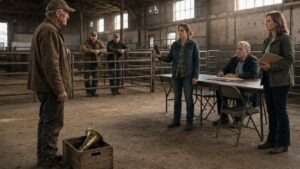
That evening the association called a special meeting.
Joseph attended with Sarah.
The room was smaller than the festival stage and considerably quieter.
Pamela sat at one end of the table. Christine had binders stacked beside her. Kevin sat opposite Pamela rather than beside her.
That placement did not go unnoticed.
Several association members filled folding chairs along the wall.
Pamela opened the meeting without ceremony.
“We need to address what happened Saturday and determine next steps.”
One member immediately asked how much legal counsel had already cost.
Christine answered from her papers.
“Not enough to be catastrophic. Enough that I want authorization before another invoice.”
Another voice asked why the association had threatened litigation over property it did not own.
Pamela’s jaw tightened.
“That characterization assumes the access question is fully resolved.”
Sarah spoke for the first time.
“Ownership is resolved.”
Pamela looked at her.
“Use rights are not necessarily the same question.”
“Correct,” Sarah said. “Which is why your letter should not have described the strip as association-controlled grounds.”
The room went quiet.
Joseph watched Pamela.
She looked tired rather than angry.
For the first time since the dispute began, he wondered how many hours she had spent trying to hold the festival together before deciding that certainty on paper would be easier than uncertainty in public.
Christine opened the county letter.
“Why wasn’t this in the board packet?”
Pamela did not answer immediately.
Kevin did.
“That’s what I want to know.”
Pamela folded her hands.
“The county did not issue a legal opinion.”
“No,” Christine said. “It warned us to verify ownership.”
“We were verifying it.”
“You sent Joseph a demand before verification was finished.”
Pamela looked toward Joseph.
“Yes.”
The admission shifted the room.
Not dramatically.
Nobody gasped.
But several people stopped looking at Joseph and started looking at her.
Kevin leaned forward.
“Why?”
Pamela stared at the table for a moment.
Then she said, “Because if I put unresolved access into the festival permit package, we risked losing the route approval.”
Christine said, “So you left it out?”
“I used the route we had used for years.”
“And the title issue?”
“I believed long-standing use gave us a basis to preserve access until it was sorted.”
Sarah said, “That is different from ownership.”
“I know that now.”
Joseph studied her.
Pamela looked up.
“The festival covers almost a third of our annual operating budget. Vendor fees, sponsorships, livestock entries. If we lost the permit or had to redesign the entire site weeks before opening, we would have taken a serious financial hit.”
Kevin said, “So you decided the board didn’t need to see the warning?”
“I decided I needed time.”
“You didn’t buy time,” Christine said. “You sent a certified threat.”
Pamela’s face sharpened.
“Yes. And Joseph responded by scheduling a fence crew for the first morning of the festival.”
Several people shifted.
Joseph felt Sarah glance at him.
Pamela continued.
“He knew exactly what would happen. We can argue about my letter all night. It does not make Saturday accidental.”
Joseph leaned forward.
“No. It wasn’t accidental.”
The words landed harder than denial would have.
Pamela held his gaze.
“You wanted to make a point.”
“Yes.”
“At everybody’s expense.”
Joseph almost answered immediately.
Then he remembered the fire chief pressing the emergency map against the fence.
“I wanted you to stop treating my permission like ownership.”
“That isn’t what I asked.”
The room stayed silent.
Joseph looked at the people along the wall.
Some had volunteered at the festival for years.
Some had probably never seen his deed and never cared where the line sat.
Finally he said, “No. Everybody else wasn’t the point.”
“But they were there.”
“Yes.”
That answer cost him something.
He could feel it.
Yet afterward, the room seemed less divided into sides.
The meeting continued for another hour.
Kevin formally requested that the board record the county warning in the minutes.
Christine proposed that no further legal expense be approved without a vote.
Pamela did not resign.
Nobody demanded she be removed.
Instead, the board instructed its attorney to compare the historical use with Joseph’s title and explore a written solution.
Outside, Sarah walked with Joseph toward his truck.
“You probably can force this.”
“The fence stays.”
“I’m not talking about the fence.”
“What, then?”
“Total exclusion. If the title record stays as clean as it looks, and there’s no enforceable access right, you have leverage.”
Joseph unlocked the truck.
“That sounds good.”
“It might not feel as good later.”
He looked at her.
Sarah nodded toward the association grounds beyond the road.
“That strip is the easiest emergency connection between the county entrance and the back side of the site. They can redesign around it, but they’ll lose space, money, and probably some flexibility.”
“That’s their problem.”
“It can be.”
Joseph heard the qualification.
“And the other option?”
“Limited written access. Defined purpose. Defined dates. Emergency use. Explicit acknowledgment that the land remains yours.”
Joseph looked toward the silver fence in the distance.
For ten days he had wanted one thing.
Proof that Pamela was wrong.
Now he had it.
The board knew.
Kevin knew.
Christine knew.
Pamela herself had admitted she moved ahead after receiving the warning.
The legal argument was becoming cleaner.
His own answer was becoming less so.
Sarah opened her car door.
“You need to decide what winning means before somebody else decides it for you.”
Joseph stood beside his truck after she drove away.
For the first time since the certified letter arrived, he was not wondering whether he could keep the association off his land.
He was wondering whether he truly wanted to.
Chapter 6: Owning the Ground Did Not Settle Everything
Joseph found the old gate hinges in a coffee can behind a row of rusted cultivator parts.
He had gone into the barn looking for a tape measure.
Instead, the can came down with a shower of dust, and two heavy black hinges rolled onto the workbench.
He recognized them immediately.
His father had saved hardware from everything.
Gate latches.
Bent hooks.
Usable bolts.
Pieces of chain too short for one job and exactly right for another.
Joseph turned one hinge over in his hand.
It had once hung on a pasture gate somewhere along the eastern side of the farm, years before the fence disappeared and the festival expanded.
He remembered his father complaining about a neighbor who borrowed the hay entrance every fall.
Not because the neighbor used it.
Because he stopped asking.
His father had said, “A favor without an edge turns into a road.”
Joseph had been young enough to think the complaint petty.
Now he understood it differently.
Not as a warning against helping.
As a warning against letting help become undefined.
He carried the hinges outside.
The chain-link fence stood straight along the boundary.
Joseph walked to the point nearest the association’s old emergency route and measured sixteen feet between posts.
Wide enough for a controlled gate.
He wrote the number on his palm.
Then he stared at it.
A week earlier, opening anything in that fence would have felt like retreat.
Now the thought did not bother him as much as the reason for opening it.
He was not interested in restoring what existed before.
Before meant assumptions.
Before meant maps without boundaries.
Before meant Pamela deciding that twelve years of permission could be converted into language about association grounds.
If a gate went there, it would need rules.
Sarah came to the farm two days later.
Joseph placed a handwritten page on the kitchen table.
She read it without speaking.
At the top he had written:
Ownership acknowledged.
Below it:
Emergency access only unless separately approved.
Festival use by annual written request.
No permanent association right created by permission.
Gate controlled by Martin property owner.
Sarah looked up.
“This is more useful than the last three phone calls we had.”
Joseph ignored that.
“Can it be done?”
“Yes.”
“Recorded?”
“A limited-access license or agreement can be drafted clearly enough to protect the title.”
“No easement.”
“You’re sure?”
“Yes.”
“An easement would be more durable for emergency planning.”
“That’s why I don’t want one.”
Sarah studied him.
“You’re still thinking about permanence.”
“I’m thinking about ownership.”
“There’s overlap.”
Joseph leaned back.
“An emergency vehicle gets through. The association doesn’t get to point at the gate ten years from now and say it owns the opening.”
Sarah nodded.
“That can be addressed.”
She tapped his handwritten conditions.
“You also wrote annual festival request.”
“Yes.”
“You might say no.”
“Yes.”
“You might say yes.”
“Yes.”
A slight smile touched her face.
“That’s different from where you were.”
Joseph looked out toward the field.
“It’s different from them assuming.”
That afternoon he walked the fence again.
A neighboring farmer stopped his pickup near the road and asked whether the gate rumor was true.
“Maybe.”
“Wouldn’t blame you if you kept it shut.”
Joseph looked toward the association grounds.
A group of volunteers was repairing turf damaged during the festival.
“Most of them didn’t send the letter.”
“No.”
“They still got the fence.”
The farmer shrugged.
“That’s what happens when boards make decisions.”
Joseph looked at him.
It was exactly the answer he would have accepted two weeks earlier.
Now it felt too easy.
Pamela rejected Sarah’s first draft the next morning.
Not the emergency provisions.
Not the gate control.
Not even the annual written requests.
She objected to one sentence:
The association acknowledges that the subject property is owned solely by Joseph Martin and that prior permissive use created no ownership interest.
Her response said the wording was unnecessarily prejudicial and might be interpreted as an admission regarding past association conduct.
Joseph read the email twice.
Then he called Kevin.
“Is she serious?”
Kevin sighed.
“Yes.”
“She wants access but won’t acknowledge whose land she’s accessing.”
“That’s how it reads.”
“What does the board think?”
“Split.”
Joseph stood at the kitchen counter.
“On ownership?”
“No. On whether she should have to sign language that sounds like blame.”
Joseph almost laughed.
“It sounds like blame because she blamed me first.”
“I know.”
“Do you?”
“Yes.”
Kevin’s voice sharpened.
“I’m the one who told you not to turn paperwork into a war because I trusted the version she gave us. I know.”
Joseph went quiet.
Kevin continued more calmly.
“She thinks signing it personally makes her the entire mistake.”
“She signed the letter personally.”
“As chair.”
“So?”
“So that matters to her.”
Joseph looked at the old festival map still sitting on his counter.
The green shading crossed his property without hesitation.
“Then it can matter.”
The board met again at the end of the fourth week.
Joseph attended without expecting agreement.
Pamela sat with a revised draft in front of her.
Sarah had already marked the clauses they could accept and the ones they could not.
Christine spoke first.
“We need emergency access settled before the next event application.”
Pamela nodded.
“I agree.”
Joseph said, “Then acknowledge the property.”
Pamela looked at him.
“The association can acknowledge title without me signing language that implies intentional wrongdoing.”
Joseph felt the old anger rise.
Then he looked at the people around the table.
This time there was no crowd.
No contractor.
No auger.
No festival waiting to be split.
Just a problem that would remain after everyone went home.
He pushed the draft back toward Pamela.
“I’m not asking you to say you tried to steal my land.”
Her expression changed slightly.
“I’m asking you to correct the statement you signed.”
Pamela said nothing.
Joseph continued.
“You called it association-controlled ground. Put in writing that it isn’t.”
“And then?”
“Then we can talk about the gate.”
Christine looked from one to the other.
Kevin leaned back in his chair.
Pamela rested both hands on the document.
Joseph could see how much she disliked the choice.
That was no longer enough reason for him to make it easier.
He had spent twelve years believing people should understand what he meant without being told.
He was finished with that.
“If the ownership sentence doesn’t stay,” he said, “there is no access agreement.”
Pamela looked down at the unsigned page.
For once, Joseph did not fill the silence for her.
Chapter 7: The Gate Opened Only After the Record Changed
Pamela Roberts was already seated when Joseph entered the association meeting room.
In front of her lay three copies of the revised agreement.
Beside them was a single sheet of paper with her signature at the bottom.
Joseph stopped before taking his chair.
Sarah Lopez sat to his right. Kevin Brown and Christine Adams were across the table. Nobody spoke while Joseph picked up the signed page.
The first paragraph corrected the language from the certified letter.
The disputed strip was identified as property owned solely by Joseph Martin.
The association did not own it.
Previous festival use had occurred by permission and had not transferred ownership.
Joseph read those lines slowly.
For six weeks he had wanted them written somewhere nobody could reinterpret later.
Now that they were in front of him, the feeling was quieter than he expected.
He set the page down.
Pamela said, “Is that sufficient?”
“For the correction?”
“Yes.”
Joseph nodded.
“Yes.”
Pamela looked at the agreement.
“Then we should finish the rest.”
Her tone was controlled, but Joseph could see the effort behind it.
The board’s position had changed since the last meeting.
The association would no longer contest title.
Instead, Sarah and the association’s attorney had drafted a limited-access agreement covering emergency use through a gate in Joseph’s fence.
The language was precise.
Emergency vehicles could cross the strip when necessary.
The association could request temporary festival access each year.
Any approval had to be written.
A yes in one year did not become a yes the next.
No seasonal use created an easement.
No unlocked gate created a public road.
No map could describe Joseph’s property as association grounds.
Christine turned to the page with the festival provision.
“We added a deadline.”
Joseph looked up.
“For requests?”
“Thirty days before setup.”
“That works.”
“And if there’s an unusual situation after that?”
“You ask.”
Christine gave a small nod.
It sounded almost embarrassingly simple.
You ask.
Joseph thought of twelve years during which that single act had slowly disappeared.
Kevin tapped another clause.
“The board also agreed the emergency gate can remain locked when there’s no event or emergency use.”
Pamela said, “Provided the fire department has an approved access method.”
Joseph looked at Sarah.
She nodded.
“That’s standard enough.”
Pamela folded her hands.
“So if the correction is accepted and the access terms are accepted, I assume the fence can come down.”
Joseph looked at her.
“No.”
The room went still.
Pamela’s face changed.
“You said you were willing to restore access.”
“I am.”
“The fence blocks the access.”
“A gate doesn’t.”
Pamela sat back.
“So the fence stays.”
“Yes.”
Christine looked toward the plans.
“A sixteen-foot gate opening?”
“That’s what I measured.”
Pamela stared at him.
“You want that fence there permanently.”
Joseph considered the word.
Permanently had once been exactly what frightened him about the association’s claim.
“I want the boundary visible.”
Pamela shook her head once.
“You could mark it without chain link.”
“I did mark it.”
“With survey flags.”
“And ten days later you sent me a letter telling me to remove them.”
Pamela’s mouth tightened.
Joseph did not raise his voice.
“That is why the fence stays.”
For a moment, the old conflict returned to the room.
Not the legal argument.
Something more personal.
Pamela saw the fence as the public evidence of her mistake.
Joseph saw it as proof that he would never again rely on other people remembering where his permission ended.
Kevin broke the silence.
“The fence staying doesn’t stop the agreement from working.”
Pamela looked at him.
“No. It just makes sure nobody forgets what happened.”
Joseph answered before Kevin could.
“It makes sure nobody forgets where the property line is.”
Pamela looked back at him.
“Those are not entirely different things.”
“No,” Joseph said.
“They aren’t.”
The honesty seemed to take some of the force out of the disagreement.
Sarah moved the agreement toward Joseph.
“There’s one remaining decision.”
He looked down.
The document included two possible versions of the emergency-access clause.
One gave the association limited access solely for emergencies.
The other also allowed Joseph, at his discretion, to open the gate for approved festival operations.
Sarah had left both because Joseph had not decided.
Christine said, “We can redesign the festival without your strip.”
Pamela glanced at her.
Christine continued.
“It costs us some parking and probably two vendor spaces. But we can do it.”
Joseph looked at her.
“You’re not asking for festival access?”
“I’m saying we shouldn’t build next year’s event around assuming you’ll provide it.”
The difference mattered.
Pamela said nothing.
Joseph looked again at the agreement.
For weeks he had imagined keeping the gate closed except for an ambulance or fire truck.
That would have been clean.
His land.
Their land.
No overlap.
No confusion.
It would also have meant that the only lesson anyone learned was to stop asking him.
He thought about his father’s old sentence.
A favor without an edge turns into a road.
The problem had not been the favor.
The problem had been the missing edge.
Joseph picked up the pen.
“I want the second version.”
Pamela looked at him.
“The discretionary festival access?”
“Yes.”
Christine asked, “You’re willing to let us use it again?”
“I’m willing to consider a request.”
Pamela gave a short breath that was not quite a laugh.
“That’s a careful answer.”
“It should have been careful twelve years ago.”
Nobody argued with that.
Joseph signed.
Sarah signed as witness.
The association officers signed after him.
Pamela signed last.
She paused over the corrected ownership clause, then wrote her name in a firm, deliberate line.
There was no apology.
Joseph had stopped expecting one.
The signature did something more useful.
It changed the record.
Two weeks later, the contractor returned.
He cut an opening into the same 160-foot chain-link fence installed on festival morning.
Joseph watched as the crew set heavier posts and hung a wide steel gate.
The old fence line remained untouched on either side.
The gate opened inward toward Joseph’s field.
A lockbox approved for emergency access was mounted near the latch.
Joseph kept the primary key.
Pamela came by during installation with Christine.
She stayed on the association side of the fence.
When the contractor swung the gate open for the first time, the opening looked almost too wide.
Joseph could see the old emergency path through it.
He remembered the fire chief pressing the festival map against fresh chain link while people moved tents behind him.
Christine stepped through the opening, then stopped.
“Feels different.”
Joseph looked at her.
“What does?”
“Knowing we’re allowed through instead of assuming we are.”
Pamela looked at the new gate.
“That difference cost us six weeks.”
Joseph slipped the key into the lock.
“It cost me longer than that.”
Pamela met his eyes.
Neither of them smiled.
But neither looked away.
The first permitted use came three days later when the volunteer fire department conducted an access check.
Joseph unlocked the gate himself.
A rescue truck passed slowly through, turned on the grass, and exited back toward the county road.
The whole exercise lasted less than ten minutes.
When it was finished, the fire chief thanked him.
Joseph swung the gate closed.
Pamela and Kevin stood on the other side with the updated emergency map.
This version showed the property boundary.
The route crossed it only at the marked gate.
Joseph pushed the latch home and turned the key.
The click was small.
Nothing like the auger that had stopped the festival crowd six weeks earlier.
He removed the key and put it in his pocket.
Everyone standing there knew who owned the ground.
Everyone also knew the gate could open.
For Joseph, those two facts no longer contradicted each other.
Chapter 8: The Next Festival Asked Before Crossing the Line
Christine Adams arrived at Joseph’s farmhouse one year later with a one-page request before the first festival tent stake touched the ground.
Joseph saw her coming from the barn.
She held the sheet in one hand and a rolled site plan under the other arm.
“No certified mail?” he asked.
Christine stopped at the gate.
“I thought about making it dramatic.”
“You missed your chance.”
She handed him the page.
The request was straightforward.
The association wanted temporary use of part of Joseph’s strip for overflow parking from eight Saturday morning until six that evening.
A separate line requested permission to place two vendors near the gate if the main grounds filled.
Dates.
Hours.
Purpose.
Cleanup responsibility.
Insurance information.
A blank line for Joseph’s approval.
He read the whole page.
Christine waited.
“The parking is fine,” he said.
She nodded.
“The vendors?”
“No.”
Her expression did not change.
“Reason?”
“I want the gate lane clear.”
“All right.”
That was it.
No argument.
No reminder of previous years.
No claim that the festival had always used the space.
Christine crossed out the vendor request, initialed the change, and handed the page back.
Joseph signed the parking section.
“I’ll unlock at eight.”
“We’ll be done before six.”
“If you’re not, call.”
“I will.”
She rolled the site plan back under her arm.
As she turned away, Joseph said, “Christine.”
She looked back.
“Thanks for asking.”
A small smile appeared.
“It turns out paperwork is cheaper than chain link.”
By nine, the festival grounds were full.
The fence remained where it had been since the previous year, but it no longer looked like an interruption.
Cars entered Joseph’s field through the open gate and parked only inside the flagged area he had approved.
The emergency lane stayed clear.
No tent crossed the boundary.
No table leaned against the fence.
Joseph spent most of the morning working on his own side of the farm.
He did not hover over the gate.
That surprised him.
A year earlier, he had watched every post go into the ground as though looking away might surrender something.
Now the signed request sat in his kitchen drawer.
The boundary did not depend on his vigilance anymore.
Near noon, Joseph walked toward the festival for lunch.
A man he did not recognize stood beside the fence talking with a volunteer.
The newcomer pointed toward Joseph’s field.
“So all that belongs to the association too?”
The volunteer shook his head.
“No. That’s Martin property.”
“But people are parking there.”
“He lets us use part of it for the festival.”
The newcomer looked confused.
“So it’s shared?”
“No.”
The volunteer said it without irritation.
“We asked.”
Joseph stopped several yards away.
The conversation lasted only a few seconds.
The newcomer nodded and moved on.
The volunteer never noticed Joseph had heard.
That made the moment better.
Nobody needed Joseph to produce a deed.
Nobody needed a surveyor.
Nobody needed Pamela to explain the history.
The distinction had become ordinary.
His land.
Their event.
Permission between them.
At the food tent, Kevin handed Joseph a paper plate.
“Looks less exciting this year.”
“That your complaint?”
“No.”
Kevin glanced toward the gate.
“It’s a compliment.”
Pamela was helping near the registration table.
She and Joseph had spoken several times during the year, mostly about practical matters.
Their conversations were courteous.
Not warm.
Not hostile.
Something in between.
When she came over that afternoon, she held the updated festival map.
“Parking is almost full.”
Joseph looked toward his field.
“You’re inside the approved section.”
“Yes.”
“Then you’re fine.”
She hesitated.
“We may need another row.”
Joseph waited.
A year earlier, he might have resented even the question.
Now he simply looked at the ground.
“How much?”
“About twenty feet farther west.”
“No.”
Pamela blinked once.
Then nodded.
“All right.”
“No room?”
“We’ll redirect cars to the south lot.”
Joseph looked at her.
“That’s it?”
She gave him a dry look.
“What were you expecting?”
“Nothing.”
“Good.”
She turned to leave.
Then stopped.
“For what it’s worth, the south lot should have been part of the plan years ago.”
Joseph looked at her.
“For what it’s worth, I should have put the permission in writing years ago.”
Pamela considered that.
“Probably.”
There was no grand reconciliation.
No apology delivered in front of the crowd.
No moment when the entire community agreed on who had been right.
Joseph had come to prefer it that way.
By late afternoon, the parking rows began to empty.
Volunteers picked up paper cups and folded signs. Livestock trailers pulled onto the county road one at a time.
At five-forty, Christine walked the approved strip with Joseph.
“No trash left.”
Joseph looked across the grass.
One plastic ribbon had caught against the fence.
Christine retrieved it.
“Now no trash left.”
He nodded toward the gate.
“Good year?”
“Good enough to do it again.”
“That sounds dangerous.”
“I’ll bring a form.”
At six, the last festival car drove out of Joseph’s field.
He waited until the vehicle cleared the opening.
Then he swung the gate shut.
The fence still ran the same 160 feet.
The deed had not changed.
The land had not changed.
What had changed was everything people expected before crossing it.
Joseph slid the key into the lock.
On the other side, volunteers were still taking down tents in the evening light.
Nobody watched him.
Nobody needed to.
He turned the key and heard the latch settle.
The gate had been open because he had said yes.
Now it was closed because the agreed time had ended.
For years, Joseph had thought generosity meant leaving the line invisible.
He knew better now.
A boundary did not end neighborliness.
Sometimes it was the only thing that allowed neighborliness to survive.
The story has ended.