When the New Neighbor Moved the Fence, Nancy Harris Let the Survey Stakes Answer Him
Chapter 1: The Morning They Pulled Out Her Gate
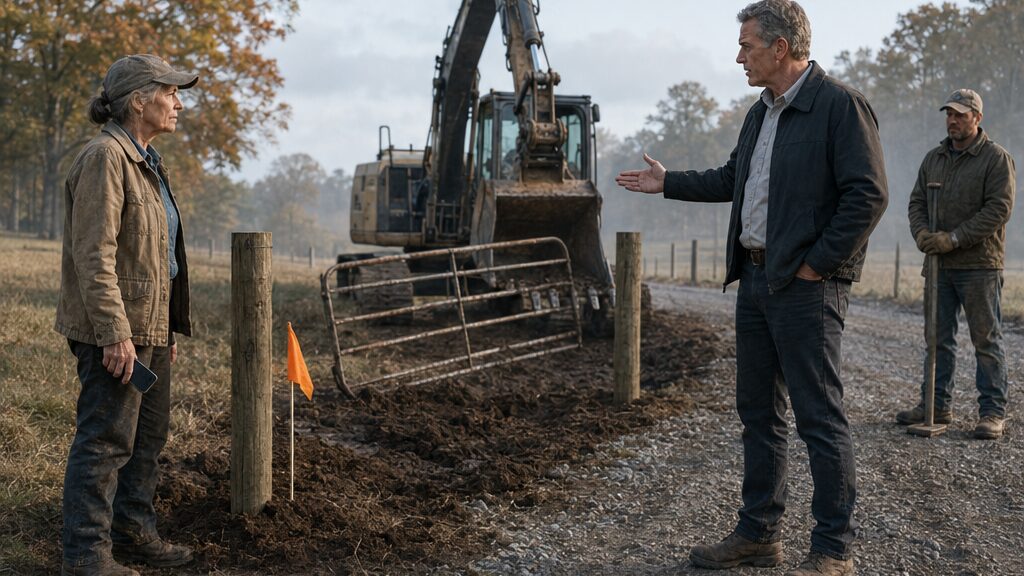
The excavator bucket was already under Nancy Harris’s gate when she reached the lower pasture.
Steel teeth lifted the weathered wooden frame until the hinges screamed. One cedar post leaned, resisted for half a second, then tore free with a clot of dark soil hanging from its base.
“Stop.”
The operator couldn’t hear her through the engine.
Nancy walked closer and raised one hand.
This time he saw her. The bucket froze with the gate hanging crooked above the ground.
Nancy had opened that gate thousands of times. Her father had set the original posts. Her husband had replaced the hinges twice. One hinge still carried a small weld where he’d repaired it rather than spend money on a new one.
Now the whole thing dangled from a machine belonging to someone who had owned the adjoining property less than a year.
The fence contractor climbed out of his truck.
“Ma’am, we’re working off the approved site plan.”
“This is my gate.”
A second vehicle came down the freshly graded lane.
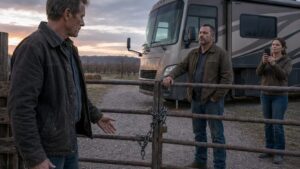
Gregory Mitchell stepped out wearing clean work boots and a field jacket that had not yet collected much field dirt.
“Nancy.”
“Tell him to put it back.”
Gregory glanced toward the excavator.
“We’re relocating the fence to the current property line.”
“The current property line is where that gate was.”
“No. That’s the old fence.”
Nancy looked past him.
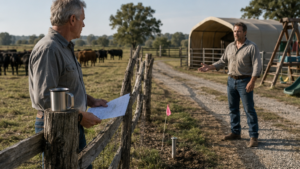
Fresh wooden stakes ran toward the creek. They stood several feet inside the pasture she had mowed, fenced and paid taxes on for decades.
“Who gave you permission to put those there?”
“The survey information did.”
“That wasn’t my question.”
Gregory’s jaw tightened.
His project had been growing on the hill since spring: first trucks, then grading equipment, then stone deliveries. He planned cabins and a renovated farmhouse for what he called a rural retreat. He had once told Nancy it would keep the surrounding land from being carved into subdivisions.
She had not objected to what he did on his side.
The trouble was that Gregory increasingly seemed to believe his side extended wherever his project required it to.
He pointed toward the new stakes.
“Your fence has been wrong for years.”
The words hit harder than Nancy expected.
Not because she believed them.
Because he said them with the easy certainty of someone correcting a clerical error.
“My father put that fence there.”
“That doesn’t make it a surveyed boundary.”
“No,” Nancy said. “It doesn’t.”
That answer surprised him.
Nancy turned toward the contractor.
“What plan are you using?”
Gregory answered instead.
“The revised parcel map. Book forty-three, page eighteen.”
Nancy looked at him.
For the first time that morning, Gregory’s confidence shifted.
Only slightly.
But she saw it.
“Recorded what year?”
“I don’t have that memorized.”
“Then don’t tell me what it proves.”
The fence contractor glanced from one of them to the other.
Nancy had spent thirty-one years working around county land records. She knew how often people looked at the newest drawing and assumed newest meant controlling.
It didn’t.
Not always.
She also knew something she wished she didn’t.
She had never ordered a modern boundary survey of her own parcel.
Her father had trusted the old monuments. Her husband had trusted her father. Nancy had trusted both of them.
Memory was not measurement.
Gregory folded his arms.
“We’ve already lost two days over this.”
“You’ve lost two days because you’re building beside a disputed line.”
“There wasn’t a dispute until this morning.”
“There is now.”
Nancy walked back toward her pickup.
Behind the seat was a short bundle of orange marking flags she’d bought after Gregory’s dump trucks first began clipping the edge of the pasture.
She pulled one out.
Gregory watched her return.
Nancy pushed the wire stem into the ground beside the nearest new fence post until the orange plastic stood bright against the brown grass.
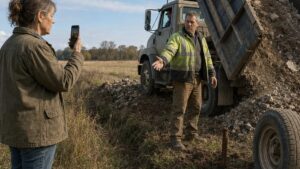
Then she took out her phone.
One photograph of the post.
One of the excavator holding her gate.
One of Gregory standing beside the new line.
She checked the time and wrote it in the small notebook she kept in her jacket.
Gregory gave a short, frustrated breath.
“What exactly is that supposed to accomplish?”
Nancy straightened.
“It tells me where this post was at eight forty-three this morning.”
“You think I’m going to move your flag?”
“I think nobody should.”
The excavator idled behind them.
Nancy looked at the operator.
“I am formally disputing this boundary. Please don’t remove anything else until it’s verified.”
The operator looked toward Gregory.
That bothered her more than she wanted it to.
Gregory was paying him.
Gregory nodded at last.
“Set the gate down.”
The operator lowered it onto the grass.
Not back where it belonged.
Just down.
Nancy watched the old wood settle flat.
Gregory stepped closer.
“I am trying to improve this property, Nancy. The old cattle place was falling apart. Half these fields haven’t been productive in years. I’m putting money into roads, drainage, buildings. That helps everybody out here.”
“Then it shouldn’t require my pasture.”
“It doesn’t.”
He pointed toward the orange flag.
“That’s what I’m trying to tell you.”
Nancy held his gaze.
“And I’m telling you we measure first.”
Gregory left without answering.
The contractors packed up shortly afterward, but they did not replace the gate.
Nancy spent the afternoon tracing the old fence.
Near the creek, rusted wire disappeared into blackberry vines. Farther uphill, one cedar post still leaned exactly as she remembered it from the winter her husband had backed the tractor into it.
She could read the history of the place through small damages.
At the northwest corner, she stopped.
There should have been an iron pin near an old sycamore root.
Her father had shown it to her when she was young. Years later, when Nancy worked at the county office, she had checked the old plat and found a monument notation in roughly the same location.
She pushed aside grass with her boot.
Nothing.
Nancy crouched and scraped leaves away with her fingers.
The soil looked wrong.
Loose.
Recently disturbed.
She widened the search until her knees began complaining.
Still nothing.
The old corner marker was gone.
Chapter 2: The Map Nancy Thought She Knew
The two county maps placed the same boundary in two different places.
Nancy stood at her kitchen table staring at them while her coffee went cold beside her.
On the older plat, the northwest line referenced an iron monument near the former county road. On the newer parcel drawing Gregory had cited, the line appeared to begin from a different road reference and ran several feet farther into Nancy’s pasture.
Both documents carried recording information.
Both looked official.
They could not both describe the ground the way Gregory claimed.
Nancy rolled the newer copy and set it beside the orange flags she’d brought in from her truck.
She disliked what the maps were telling her.
More precisely, she disliked what they weren’t telling her.
She called Laura that morning.
Her daughter answered on the fourth ring.
“Everything okay?”
“Fine.”
“You don’t call at eight-fifteen to tell me things are fine.”
Nancy looked at the maps.
“The new neighbor moved part of the fence.”
There was a pause.
“Moved it where?”
“That’s what I’m working out.”
“Do you need me to come over?”
“No.”
“Mom.”
“I worked in records longer than you’ve been paying property taxes.”
“That wasn’t what I asked.”
Nancy rubbed the rim of her chipped metal mug with her thumb.
“I’ll call you when I know something.”
She ended the conversation before Laura could turn concern into a plan.
At the county records office, Nancy recognized the smell before anything else: paper, dust, old carpet and toner.
The land-use clerk was young enough that Nancy had never worked with her.
That was almost a relief.
Nancy requested the historical parcel material, road records and recorded plats touching both properties.
For two hours she worked quietly.
The problem gradually emerged.
The road along the western edge had been relocated decades earlier. The old alignment curved closer to the pasture. The newer road had been straightened, and later maps referenced the improved right-of-way differently.
A handwritten road note finally made Nancy sit back.
The county had retired part of the former alignment.
That meant a person could copy measurements from one generation of mapping into another and create a line that looked convincing without necessarily following the original controlling monuments.
Nancy found something else.
Gregory’s contractor map referenced the newer road line.
It did not show the older iron monument at all.
That did not prove Nancy was right.
But it proved Gregory’s drawing was incomplete.
She paid for copies and drove home.
At the pasture, the orange flag still stood where she’d planted it.
For some reason, seeing it there loosened something in her chest.
Gregory had kept his word about that much.
She placed the old plat on the hood of her pickup and tried to sight the described line toward the creek.
The farther she looked, the less certain she became.
Trees had grown.
Posts had been replaced.
The road had changed.
Her father’s fence had always felt permanent because it had existed longer than most things in Nancy’s adult life.
Now she understood the dangerous part.
Permanent was not the same as precise.
A truck slowed on the road.
Gregory pulled onto the shoulder.
He got out but remained on his side of the ditch.
“Figure it out?”
“Not yet.”
He seemed surprised by the answer.
Nancy held up the contractor map.
“This drawing leaves out an older monument.”
Gregory approached just far enough to see where she pointed.
“My engineer used the recorded parcel information.”
“Some of it.”
“You’re saying the county’s own map is wrong?”
“I’m saying maps serve different purposes. That’s why boundary surveys exist.”
Gregory looked toward his project.
Equipment stood idle near the unfinished stone lane.
“You know what a full delay costs me?”
“No.”
“Thousands a day by the time crews get rescheduled.”
“Then verifying the line before grading would’ve been cheaper.”
His expression hardened, but not into the smugness Nancy had expected.
He looked tired.
“We’re not building a shopping center. I’m trying to make that old property viable. The farmhouse needed everything. The barns were collapsing. If this project stops, it doesn’t just hurt me.”
Nancy understood the argument.
She simply did not accept the conclusion.
“Your financing doesn’t move my boundary.”
Gregory left without another word.
That evening Nancy called three survey companies.
The first could not come for six weeks.
The second quoted a number that made her take off her glasses and recalculate her checking balance.
The third belonged to Daniel Roberts.
He could begin preliminary work the following week.
His price was fair.
It was still more than Nancy wanted to spend.
Laura had offered months earlier to help with repairs around the farm. Nancy had refused then too.
She could call her now.
She didn’t.
Instead, she transferred money from the account she kept for replacing the house roof.
Then she signed Daniel’s agreement.
The next afternoon, Nancy heard machinery from the lower pasture.
She went outside expecting fence work.
It wasn’t.
A small excavator sat near Gregory’s new stone lane. Its bucket bit into the earth and pulled a shallow channel downhill.
Nancy walked toward the operator until the construction foreman intercepted her.
“What is that?”
“Drainage swale.”
“Where’s it draining?”
He pointed toward the low ground.
Nancy followed the direction of his hand.
The low ground was hers.
“Stop digging.”
“We’re inside the project limits.”
“Those limits are disputed.”
“The fence crew stopped. Drainage is separate.”
Nancy looked at the fresh channel.
Then at the orange flag fluttering less than thirty feet away.
The ditch had already begun forming a path toward her pasture.
No rain had fallen yet.
But Nancy knew exactly where the water would go when it did.
Chapter 3: Four Feet of Ground and One Bad Assumption
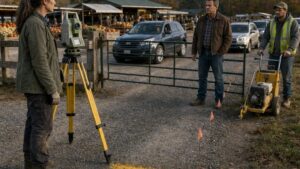
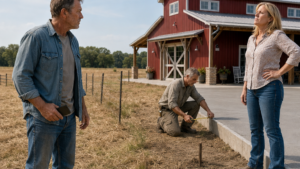
Daniel Roberts planted an orange flag beside Nancy’s equipment shed, and Nancy immediately told him it was wrong.
Daniel did not look offended.
He checked the screen mounted on his survey pole.
“Which part?”
“The line can’t be there.”
“It can.”
“My father built that shed.”
Daniel nodded toward the concrete apron extending from its doors.
“I didn’t say the shed was over.”
Nancy followed his finger.
“The easement line is.”
She folded her arms.
“That apron has been there thirty years.”
“That doesn’t change where the recorded easement is.”
A week earlier, Nancy would have argued harder.
Now she looked at the flag.
“All right. Show me.”
Daniel had spent two days reconstructing the boundary from recorded descriptions, road history, surviving monuments and field measurements.
He explained each point without trying to soften it for her.
The old fence was close to the true boundary along most of the pasture.
Close was not identical.
At the shed, a narrow utility and maintenance easement clipped the outer edge of Nancy’s concrete apron.
Not Gregory’s land.
But not an area she had the unrestricted right to obstruct either.
“How much?”
“About eighteen inches at the widest point.”
Nancy stared at the concrete.
Her husband had poured that apron.
She remembered him dragging a board across wet cement while she complained that he was making it too wide.
He had laughed and told her nobody ever regretted having extra concrete.
Apparently somebody could.
Daniel moved on.
Near the road, his measurements shifted in Nancy’s favor.
One orange flag went into the grass.
Then another.
Then another.
A bright line slowly appeared across the pasture.
When they reached Gregory’s stone access lane, Daniel stopped in the middle of it.
He checked his instrument twice.
Nancy said nothing.
Daniel walked to the opposite edge and planted another flag.
The legal boundary ran through the lane.
Gregory’s construction foreman came down from the project entrance.
“What are you marking?”
“Recovered boundary,” Daniel said.
“How far off are we?”
Daniel measured again.
“At the widest section here, approximately four feet.”
The foreman swore under his breath, then caught himself.
Nancy looked down the orange line.
Four feet.
It wasn’t much if you said it quickly.
A long step for a tall man.
The width of a kitchen table.
But stretch four feet down a property edge, cover it with compacted stone, reshape the drainage around it and move a fence to match, and four feet became something else.
It became possession by assumption.
The foreman called Gregory.
He arrived twenty minutes later.
He looked first at Daniel, then at the flags, then at Nancy.
“This final?”
“Field determination based on the evidence recovered so far,” Daniel said. “I’ll issue the signed survey after calculations and review.”
Gregory pointed toward Nancy’s shed.
“And what about over there?”
Daniel’s face remained neutral.
“There is an easement issue affecting a portion of Mrs. Harris’s concrete apron.”
Gregory looked at Nancy.
For one uncomfortable moment, neither spoke.
Then he said, “So I wasn’t the only one wrong.”
Nancy could have explained the difference.
She could have said his lane occupied her land while her concrete touched an easement created for access.
Both statements were true.
Instead she said, “No.”
Gregory seemed unprepared for that.
“No?”
“I was wrong there.”
The words cost less than Nancy expected.
Perhaps because Daniel’s orange flags had already removed the luxury of pretending.
Gregory looked toward the lane.
“Then maybe we ought to stop treating this like I stole your farm.”
“You moved my gate.”
“Based on the plan I was given.”
“And you kept digging after I disputed it.”
His mouth tightened.
Daniel stepped away to record another measurement.
Gregory lowered his voice.
“I have crews booked months out. Loan draws tied to completion dates. Every time somebody says stop, the whole schedule moves.”
Nancy looked toward the hill.
For the first time, she saw the project less as a mansion-sized expression of Gregory’s ego and more as a machine he’d built around himself.
Lenders.
Contractors.
Reservations he hoped to sell.
Deadlines.
None of it gave him four feet of her pasture.
But it explained why he kept behaving as if stopping were impossible.
“You could have ordered a boundary survey before you started,” she said.
Gregory looked away.
“Yes.”
It was the first answer he’d given her without defending it.
By late afternoon, Daniel had marked nearly the entire disputed stretch.
Orange flags ran from the roadside toward the creek like a stitched seam.
Nancy walked it slowly.
At some points the true line fell inches from the old fence.
At others, more.
Her father had been remarkably close.
He had not been perfect.
That realization unsettled her almost as much as Gregory’s encroachment.
For years Nancy had treated the land as something handed down intact: father to daughter, husband to wife, one generation’s certainty becoming the next generation’s responsibility.
But the ground did not care what anyone remembered.
Daniel was packing equipment when Nancy stopped him.
“The old northwest pin.”
“I haven’t recovered it.”
“It was there.”
“I believe you.”
“You think the road work took it?”
“Possible.”
“Or Gregory’s grading?”
“Possible.”
Nancy disliked his repeated word.
“Can you tell?”
“Maybe.”
They walked toward the sycamore.
Daniel crouched near the place Nancy had searched after the gate was removed.
He brushed leaves aside.
Then he took a narrow probe from his equipment bag and worked it into the soil at several points.
Nancy watched his expression change.
“What?”
Daniel scraped away the upper layer with a small hand shovel.
The darker topsoil gave way to a patch of lighter earth.
“This ground’s been disturbed.”
“How recently?”
“I can’t date dirt.”
He widened the shallow opening.
A few inches down, he exposed crushed stone fragments unlike the surrounding soil.
Nancy recognized them.
The same pale aggregate used beneath Gregory’s new access lane.
Daniel sat back on his heels.
“Something was dug or pulled out here after that stone was brought onto the site.”
Nancy stared at the empty place where the iron marker had once stood.
For the first time, the question was no longer whether her memory had failed.
Someone—or some machine—had disturbed the exact ground where the old corner monument should have been.
Chapter 4: The Warning Gregory Chose to Ignore
The email was buried in a county project file Nancy had almost decided not to request.
She found it because one phrase caught her eye.
Boundary discrepancy—verify before pour.
Nancy read the line twice.
The message had been sent from Gregory’s construction foreman three weeks before the stone access lane was compacted. It referred to a mismatch between the contractor’s site stakes and an older monument shown on archived parcel material.
The foreman had not claimed the old monument controlled the line.
He had done something more important.
He had warned that the boundary was uncertain.
Nancy asked the county land-use clerk for a certified copy of the page and the permit correspondence attached to it.
The clerk slid the file back across the counter.
“This wasn’t a stop-work notice.”
“I know.”
“And the county didn’t determine the property line.”
“I know that too.”
Nancy kept her voice even.
She had spent too many years behind a counter like this one to make a clerk responsible for decisions somebody else had made.
The email did not prove Gregory had ordered anyone to move a marker. It did not prove fraud. It did not erase the problem with Nancy’s own concrete apron.
But it narrowed the question.
Gregory had not built through certainty.
He had built through doubt.
At home, Nancy spread the new documents beside Daniel’s preliminary survey.
She made a timeline.
Foreman’s warning.
Concrete deliveries.
Fence relocation.
Her first objection.
Drainage excavation.
Formal survey.
She added the photographs from the morning her gate was removed. In one image, the orange flag she had planted leaned beside Gregory’s new fence post.
The time stamp came two days before heavy grading reached the northwest corner.
Nancy stared at that photograph for a long time.
She still wanted the missing iron pin to mean something deliberate.
That bothered her.
Wanting the worst explanation because it made the rest easier to judge was not the same as proving it.
So she crossed out a sentence she had written in her notes.
Marker intentionally removed.
She replaced it with:
Marker location disturbed after construction stone arrived. Cause unknown.
That was the kind of sentence she trusted.
Gregory was standing near his project entrance when Nancy drove up that afternoon.
She carried copies, not originals.
He saw the folder and looked tired before she said a word.
“What now?”
Nancy held out the foreman’s email.
Gregory read it.
His eyes stopped at the same phrase hers had.
Boundary discrepancy—verify before pour.
He handed it back.
“That was an internal caution.”
“Yes.”
“We were trying to figure out whether the old reference mattered.”
“And did you?”
“We had the engineer’s site plan.”
“That isn’t what I asked.”
Gregory looked toward the stone lane.
Workers were setting forms farther uphill.
Finally he said, “No. We didn’t resolve it before moving ahead.”
Nancy had expected resistance.
The admission unsettled her more.
“Why?”
He laughed once, without humor.
“You want the short answer?”
“I want the true one.”
Gregory rubbed the bridge of his nose.
“My lender had milestone dates. I had crews already booked. The cabins were tied to spring reservations I’d started taking deposits on. Every delay rolled into another one.”
Nancy said nothing.
He continued.
“I was already over budget on the farmhouse. The barns needed more structural work than anybody expected. Then the road base came in high. Then the septic design changed.”
“That sounds expensive.”
“It is.”
“That still doesn’t make the line move.”
“I know that now.”
“You knew it might not move then.”
Gregory’s expression hardened.
“Yes.”
There it was.
Not malice.
Not ignorance.
A choice.
Gregory had been presented with uncertainty and decided uncertainty was less dangerous than delay.
Nancy folded the email.
“That’s the part the county is going to care about.”
“They’ll care that your apron is in an easement too.”
“I expect them to.”
He looked at her sharply.
“You’re not fighting that?”
“If Daniel’s final survey confirms it, I’ll fix what’s mine.”
For a moment, Gregory seemed to have no answer.
Then a pickup rolled down the project lane. His foreman stopped nearby but stayed in the cab.
Gregory lowered his voice.
“You think I came out here to push people around.”
“I think you came out here believing money spent gave you the right to make other people adjust.”
“That’s not the same thing.”
“No.”
Nancy tucked the papers under her arm.
“But it can do the same damage.”
When she returned home, Laura’s car was parked beside the house.
Nancy almost turned around and drove back down the road.
Instead she went inside.
Laura stood at the kitchen table.
Daniel’s invoice lay open beside Nancy’s checkbook.
“You went through my mail?”
“It was on the table.”
“That isn’t an answer.”
Laura held up the invoice.
“You paid this from the roof account.”
Nancy set down her folder.
“I know where I paid it from.”
“The back bedroom still leaks.”
“I know that too.”
“And now you’ve got legal consultation on top of the survey.”
“It isn’t much.”
“Mom.”
Nancy disliked the tone because it carried worry disguised as impatience.
Laura lowered the paper.
“How long are you going to keep doing this?”
“Doing what?”
“Acting like every problem has to be solved by you before anybody else is allowed to know it exists.”
Nancy opened the refrigerator although she wanted nothing inside.
“This land isn’t your responsibility.”
“That doesn’t mean you aren’t.”
Nancy shut the door.
Laura glanced toward the window overlooking the lower pasture.
“Sell the far acreage.”
“No.”
“You don’t even use all of it anymore.”
“That doesn’t make it Gregory’s.”
“I didn’t say give it to Gregory.”
“You said sell.”
“I said stop spending money you need for the house just to prove you can hold every acre exactly the way Grandpa did.”
The words landed wrong.
Nancy turned.
“This has nothing to do with proving anything.”
Laura’s face softened, which somehow made Nancy angrier.
“Then what does it have to do with?”
Nancy thought of her husband’s hand resting on the old gate after his diagnosis, when he had asked her not to let the farm be broken up because grief made decisions feel temporary.
She had promised.
At the time, it had seemed simple.
Keep the land.
Now she was beginning to understand that promises could age too.
“I’m not selling it because somebody made it inconvenient to keep.”
Laura picked up her purse.
“That wasn’t what I asked either.”
She left before Nancy could answer.
That night the rain began.
It struck hard enough to wake Nancy twice.
By dawn, the sound had changed.
Not rain on the roof.
Water moving across open ground.
Nancy stepped onto the porch and looked toward the lower pasture.
A broad brown sheet poured through the fresh drainage swale and spilled across her grass.
One of the orange survey flags was already bent nearly flat beneath the current.
Chapter 5: The Water Crossed Before Either of Them Did
By the time Nancy reached the lower pasture, water was running where no channel had ever existed.
It came fast out of Gregory’s newly cut swale, carrying pale gravel, leaves and clumps of red clay. The flow spread across Nancy’s grass, then gathered again near the old culvert.
The culvert could not take it.
Water backed toward the farm track.
Nancy stood in ankle-deep mud and watched another orange flag disappear beneath the brown surface.
The boundary had become visible in the worst possible way.
On Gregory’s side, the drainage cut was neat.
On hers, the water wandered wherever the land allowed.
Nancy called the county road office first, not Gregory.
She reported the obstruction risk at the culvert and gave the parcel location.
Then she took photographs.
Upstream.
Downstream.
Survey flags.
Stone washed from Gregory’s lane.
The water line against her fence.
Documentation steadied her.
It always had.
What did not steady her was the sound of water climbing the ditch beside the farm track.
Nancy found a rake in the equipment shed and started pulling branches away from the culvert mouth.
The mud sucked at her boots.
She cleared one branch, then another.
A third was wedged deeper.
She leaned forward, braced one foot on the bank and pulled.
The branch released suddenly.
Nancy’s boot slid.
For one sharp second, the whole world tilted toward brown water.
She caught the fence wire with one hand.
Pain shot through her shoulder.
The rake disappeared into the current.
Nancy stayed frozen until her footing returned.
Then she climbed back onto the track and sat on the wet ground.
Her hands shook.
Not badly.
Enough.
She hated that more than the fall itself.
A car horn sounded from the road.
Laura came running through the open gate.
“What happened?”
“Nothing.”
Laura stopped.
Nancy was sitting in the mud, one trouser leg soaked to the knee, with water roaring through the pasture behind her.
“Nothing?”
“I slipped.”
Laura crouched.
“Did you hit your head?”
“No.”
“Your arm?”
“Pulled it.”
“Can you stand?”
Nancy looked away.
“Yes.”
Laura waited.
That was worse than if she had argued.
Nancy finally held out her good hand.
Laura helped her up.
Neither mentioned it.
At the house, Laura wrapped a cold towel around Nancy’s shoulder while Nancy sat at the kitchen table.
The chipped metal mug stood near her elbow.
Laura poured coffee into it and then took a second mug from the cupboard for herself.
For years, Nancy had drunk alone at that table after her husband died.
The presence of another cup felt strangely intrusive.
Then, after a moment, it did not.
“You called me?” Nancy asked.
“No.”
“Then why are you here?”
“The road crew called me.”
Nancy frowned.
“One of them knows I’m your daughter. He said there was flooding near the farm and asked if you had help.”
Nancy looked down.
Laura blew across her coffee.
“You were going to clear that culvert yourself.”
“I was clearing it.”
“You almost went into it.”
“I didn’t.”
Laura set down the mug.
“Do you hear yourself?”
Nancy’s first instinct was to defend the difference.
Almost was not did.
Then she remembered the fence wire biting into her palm.
“No,” she said.
Laura waited.
Nancy stared at the steam rising from her coffee.
“Stay today.”
Laura did not smile.
That helped.
“Okay.”
They spent the morning working around the edges of the problem rather than inside the water.
Laura photographed additional damage while Nancy called Daniel and the county land-use office.
A road crew cleared the culvert once the flow dropped enough to work safely.
Daniel arrived near noon.
He walked the drainage path with Nancy and Laura.
“The swale concentrates runoff,” he said. “Whether that creates compensable damage is a separate question, but this is not how the pasture was taking water before.”
Nancy pointed to pale gravel lodged against the fence.
“That came from his lane.”
Daniel nodded.
“Photograph it before anybody cleans it.”
Gregory arrived soon afterward.
His truck stopped at the edge of the mud.
He got out slowly.
For once, there was no impatience in him.
He looked at the flooded grass and said, “I didn’t expect this.”
Nancy almost laughed.
Instead she said, “Water doesn’t care what you expected.”
Gregory walked toward the swale.
“The contractor sized it for the project drainage.”
“On your land.”
He nodded.
“I can have them cut a temporary diversion today.”
“After the county looks at it.”
Gregory glanced at Daniel.
Then at Laura.
Perhaps seeing Nancy with someone beside her changed his calculation.
Or perhaps the flooded pasture did.
He lowered his voice.
“Can we talk?”
They moved a few yards away.
Gregory looked toward the house before speaking.
“I’ll pay for the drainage repair.”
Nancy said nothing.
“I’ll cover reseeding too.”
“What do you want?”
His eyes narrowed slightly.
“You assume I want something.”
“You drove over here during a boundary dispute offering to write a check.”
Gregory looked at the mud on his boots.
“Withdraw the county complaint.”
Nancy felt a surprising calm.
There it was.
Not an apology.
A transaction.
“You want me to drop the encroachment claim.”
“I want us to solve this without a hearing.”
“You had that chance before the gate came out.”
“I am giving you another one.”
“No. You’re giving me money to make the record stop.”
His face tightened.
“I’m trying to keep both of us from spending more.”
“Then put the agreement in writing.”
Gregory hesitated.
Nancy continued.
“Remove the lane where Daniel’s final survey says it crosses. Restore the drainage. Rebuild my gate on the surveyed line. Share the survey cost. I correct my own apron issue.”
“That is not a settlement. That is everything you asked for.”
“No.”
Nancy looked toward the flooded pasture.
“What I asked for first was for you to stop until we knew where the line was.”
Gregory said nothing.
Nancy felt Laura watching from near the house.
She did not need Laura to speak for her.
But for the first time, she was glad somebody else was there.
Gregory finally said, “The lane removal alone could put the cabin schedule back months.”
“Then propose another lawful access.”
“You know there isn’t an easy one.”
“I know that isn’t my fault.”
His frustration returned.
“I’m not trying to take your farm.”
“You keep saying that as if four feet doesn’t count because I own more than four feet.”
Gregory looked toward the water.
When he answered, his voice was quieter.
“I need to think.”
“Do that.”
He returned to his truck.
Laura came over.
“What happens if he says no?”
Nancy looked at the orange flag nearest the culvert.
Mud had stained the lower half, but the top still moved in the wind.
“We go to the hearing.”
Laura nodded.
Nancy lifted her coffee mug from the porch rail, then held it out toward the house.
“Make another pot?”
Laura took the mug.
“Sure.”
Nancy watched Gregory’s truck disappear up the road.
For the first time since the gate had been pulled out, she understood that asking someone to stay did not make the decision less hers.
That afternoon she sent Gregory a written restoration proposal.
By evening, his reply came back.
He rejected the terms.
The county hearing would go forward.
Chapter 6: The Hearing Where Both Maps Stayed on the Table
Gregory’s attorney put a photograph of Nancy’s equipment shed on the screen before Nancy had said a word.
A red line crossed the edge of the concrete apron.
The county hearing room was small enough that Nancy could hear papers shifting at Gregory’s table.
His attorney pointed to the image.
“Before we discuss alleged encroachment by Mr. Mitchell, the county should note that Mrs. Harris herself occupies a recorded easement.”
Nancy felt Laura turn toward her.
Daniel sat two chairs away.
Gregory did not look at Nancy.
The hearing officer adjusted his glasses.
“Mrs. Harris, do you dispute that?”
Nancy stood.
“No.”
The attorney paused.
Nancy continued.
“The licensed survey shows approximately eighteen inches of my concrete apron inside the easement at its widest point.”
The room remained quiet.
“I intend to correct it.”
Gregory looked up then.
The hearing officer said, “You’re not contesting that portion of the survey?”
“No.”
Nancy sat down.
Her heart was beating harder than she wanted anyone to know.
For weeks she had prepared for the hearing as if preparation meant removing every weakness.
Now the first useful thing she had done was admit one.
The hearing moved slowly.
Daniel explained the boundary reconstruction.
He described the old road alignment, later relocation, surviving reference evidence and the reason Gregory’s contractor drawing was insufficient by itself to establish the disputed property line.
The attorney challenged the certainty of the historical monument.
Daniel agreed that the missing pin could not be physically recovered.
Then he explained that the controlling boundary did not depend on that pin alone.
Measurements from other recovered monuments supported the line he had marked.
On the screen appeared Nancy’s photographs.
Orange flags along the pasture.
The displaced gate.
The stone lane crossing the surveyed boundary.
Then the image of the flooded lower field.
Gregory’s attorney objected to treating the drainage damage as proof of intentional wrongdoing.
Nancy almost spoke.
She stopped herself.
The hearing officer said, “Intent is not necessary for us to evaluate site compliance.”
The distinction mattered.
Nancy had come wanting the county to understand what Gregory had chosen.
But she was beginning to see that proving his character was not the same as proving responsibility.
When her turn came, Nancy carried one folder to the front table.
She did not bring every paper she had gathered.
Only the chronology.
“The first date is the foreman’s warning,” she said.
She placed the certified email into the record.
“Boundary discrepancy—verify before pour.”
The hearing officer read it.
Gregory’s attorney said, “That was not a county directive.”
“No,” Nancy said. “It was information available to the project.”
“When did you first formally notify Mr. Mitchell that you disputed the line?”
Nancy gave the date.
The attorney looked at his notes.
“That was after some construction had already begun.”
“Yes.”
“Why did you wait?”
The question irritated her because it was fair.
Nancy looked toward Gregory.
Then toward Laura.
“Because I thought an old fence and my own experience with county records were enough to tell me where the line was.”
She paused.
“They weren’t.”
The attorney seemed uncertain what to do with the answer.
Nancy continued.
“I should have commissioned a survey sooner.”
The hearing officer made a note.
Gregory’s attorney sat down.
When Gregory testified, his tone was controlled.
He explained the project financing.
The rehabilitation of the old farmhouse.
The unsafe barns.
The planned retreat business.
The jobs tied to contractors.
The deadlines tied to loan draws.
Nancy listened.
Most of it was true.
That was what made the conflict harder to flatten into a story where one person cared and the other did not.
Gregory cared very much.
He cared about the project.
About the investment.
About proving that the neglected property could become something productive.
What he had failed to care about, at the critical moment, was whether his urgency transferred its cost onto someone else.
The hearing officer asked him directly about the foreman’s warning.
Gregory took a breath.
“I believed the engineer’s drawing was sufficient.”
“That wasn’t the question,” the officer said. “Did you know there was a discrepancy before the lane work continued?”
“Yes.”
“Why did you continue?”
Gregory looked toward Nancy.
“Because stopping the project at that point risked triggering financing penalties and losing scheduled contractors.”
The answer hung in the room.
No one gasped.
No one needed to.
Nancy remembered Gregory standing beside the flooded pasture saying he had not expected the water.
The pattern was clearer now.
He had repeatedly treated consequences as unlikely until they belonged to somebody else.
The hearing officer reviewed the site plan conditions and county drainage requirements.
The county could not determine private damages.
It could, however, enforce compliance with approved construction limits and drainage conditions.
The stone lane crossed the surveyed property boundary.
The altered swale had directed concentrated runoff toward Nancy’s lower pasture.
Both would need correction.
Gregory’s attorney argued that full removal of the lane would impose disproportionate cost.
Nancy waited until he finished.
Then she stood.
“I don’t need the county to punish him.”
Gregory turned toward her.
Nancy continued.
“I need the water restored to a lawful drainage pattern. I need my gate rebuilt on the surveyed line. I need the part of the lane on my property removed.”
She placed another page on the table.
“And I’m prepared to remove the portion of my concrete apron interfering with the easement.”
The hearing officer read her proposed restoration terms.
Gregory looked almost offended by the concession.
Perhaps he had expected Nancy to use his mistake the way he had tried to use hers.
She did not want that.
She wanted the line.
Nothing more.
After a recess, the decision came.
Gregory was ordered to remove the encroaching portion of the lane, restore compliant drainage and rebuild disturbed boundary access at his expense. The county also required correction of the work within a stated period and documented the survey as the basis for future site compliance.
Nancy would correct her apron separately.
Gregory was ordered to pay a portion of the survey and restoration-related costs associated with the disputed construction.
The hearing officer looked at both of them.
“There is one issue the county cannot solve for you.”
He tapped the site plan.
“The practical access arrangement after restoration.”
Gregory’s proposed retreat still required maintenance access near part of the boundary. Nancy still required usable access to the lower pasture.
The county could enforce what had to be removed.
It could not make two neighbors trust each other.
“You have thirty days,” the hearing officer said, “to submit a compliant restoration plan. I strongly suggest you agree on access before either of you brings another disagreement back into this room.”
Outside, Gregory caught up with Nancy near the courthouse steps.
Laura and Daniel walked ahead.
Gregory stopped a few feet away.
“You got what you wanted.”
Nancy looked at him.
“Not yet.”
He frowned.
“The order says—”
“I know what the order says.”
Nancy nodded toward the folder under his arm.
“That paper can tell you where you can’t build. It can’t tell us how we’re going to live beside the line afterward.”
Gregory was silent.
Nancy continued toward the parking lot.
Behind her, he said, “Thirty days.”
She turned.
He looked exhausted.
Not defeated.
Just finally unable to pretend the problem could be pushed farther down the schedule.
“Thirty days,” Nancy said.
The boundary had been decided.
What they did with it was still unresolved.
Chapter 7: The Line They Chose to Rebuild
The excavator came back to Nancy’s gate thirty days after the hearing.
This time, the operator stopped before the bucket touched anything.
Nancy stood beside the pasture entrance with Daniel Roberts, Laura Davis, Gregory Mitchell, and the construction foreman. Fresh orange survey flags ran down the property line, bright against the winter-browned grass.
The old gate itself lay on two sawhorses near the fence.
Its wood had dried crooked after being pulled from the ground.
One hinge was bent.
The other still carried the weld Nancy’s husband had made years ago.
Gregory unfolded the restoration drawing.
“We cut the lane back here,” he said, pointing to the surveyed boundary. “Regrade this shoulder. Restore the drainage to the approved outlet.”
Daniel checked the dimensions.
“And the gate?”
“Back on the Harris parcel. Clear of the maintenance strip.”
Nancy looked at the drawing.
Something about it bothered her.
Not Gregory’s lane.
Her shed.
She turned toward Daniel.
“Show me the apron again.”
Daniel seemed to understand immediately.
He walked with her toward the equipment shed.
The orange flag marking the easement still stood beside the edge of the concrete.
Nancy had spent the last month looking at that eighteen inches every time she passed.
At first, it had felt like an accusation.
Then it became something else.
A measurement.
Nothing more.
Nothing less.
Gregory followed them.
Nancy pointed at the apron.
“Take this section out first.”
Gregory blinked.
“What?”
“My concrete.”
“That isn’t part of my restoration order.”
“I know.”
“You can deal with it separately.”
“I could.”
Nancy looked at the excavator.
“But the machine is already here.”
The operator glanced toward the foreman.
Gregory studied Nancy for several seconds.
“You’re serious.”
“Yes.”
Laura had come up behind them.
Nancy could feel her daughter watching.
A month earlier, Nancy might have refused to remove the concrete simply because Gregory had used it against her at the hearing.
Now that seemed childish.
The boundary did not care which mistake belonged to whom.
Nancy stepped aside.
“Cut it to Daniel’s mark.”
The excavator operator repositioned the machine.
The bucket came down carefully.
Concrete cracked.
The sound carried across the pasture.
Nancy flinched despite herself.
Her husband had mixed part of that apron by hand before they rented a small mixer for the rest. She remembered him smoothing the edge with a trowel while mosquitoes worked at the back of his neck.
For years, she had treated every piece he touched as if preserving it preserved him.
The excavator lifted the first broken section.
Nothing happened.
No promise shattered.
No memory disappeared.
It was only concrete.
Nancy exhaled.
Laura stepped beside her.
“You okay?”
Nancy nodded.
“Yes.”
This time it was true.
By noon, the apron had been cut back clear of the easement.
Then the crew moved to Gregory’s lane.
The same kind of machine that had lifted Nancy’s gate now peeled back the compacted stone lying across her property.
Layer by layer, the encroachment disappeared.
Nancy watched from a folding chair near the fence.
Laura brought coffee.
She handed Nancy the chipped metal mug and kept a second cup for herself.
Gregory approached while the excavator worked.
For several minutes, he said nothing.
Then he pointed toward the upper section of the lane.
“I’m dropping two cabins.”
Nancy looked at him.
“Because of the access?”
“Partly.”
He rubbed his jaw.
“The financing changed after the delay. Trying to force the original plan doesn’t make sense anymore.”
There was no self-pity in the statement.
Only arithmetic.
“You appealing?”
“No.”
Nancy had not expected that.
Gregory looked at the excavator.
“I spent enough money pretending the easiest plan was the only plan.”
Nancy took a sip of coffee.
“That sounds expensive.”
A small smile appeared at one corner of his mouth.
“It was.”
They watched the crew reshape the shoulder.
The tension between them had not vanished.
Nancy did not suddenly like Gregory.
She still remembered the gate hanging from the excavator bucket.
She still remembered water running through her pasture.
But the hearing had changed something.
Gregory no longer spoke as if his deadlines were natural laws.
Nancy no longer spoke as if every old thing on her farm was beyond question.
In the afternoon, Gregory brought another document from his truck.
“Before you say no, just read it.”
Nancy took it.
It was a proposed maintenance easement.
Narrow.
Recorded.
Limited to a strip near the upper boundary, well away from Nancy’s lower pasture.
It allowed maintenance access for drainage and utility work, prohibited general guest traffic, and required restoration after any entry.
Nancy read it twice.
“You had somebody draft this?”
“Yes.”
“Why?”
“Because I still need occasional access.”
“You had access before.”
“I took access before.”
The correction was deliberate.
Nancy looked at him.
Gregory continued.
“I’m asking now.”
That mattered.
Not enough to sign.
Enough to consider.
“I want Daniel to review the description.”
Gregory nodded.
“I expected that.”
“And Laura.”
Laura looked surprised.
Nancy was surprised herself.
Gregory glanced toward her daughter.
“Fine.”
“And if we agree, it gets recorded. No handshake arrangement.”
“Agreed.”
Nancy folded the paper.
“Then maybe.”
Gregory nodded once and walked back toward the crew.
Laura waited until he was out of earshot.
“You want me to look at it?”
“I want you to look at all of it.”
Laura’s expression softened.
Nancy held up a finger.
“Looking isn’t deciding.”
“I know.”
“Good.”
They returned to the gate.
The crew had set two new posts on the surveyed line.
Daniel checked them before anyone hung the frame.
Nancy had insisted the old gate be reused if possible.
The carpenter had replaced one rotten lower board and straightened the bent hinge.
The welded hinge remained.
Nancy ran her thumb over it.
Laura stood beside her.
“You saved that.”
“I save too much.”
“That isn’t always bad.”
“No.”
Nancy lifted the hinge.
“But sometimes you have to decide what you’re saving it for.”
The carpenter asked where she wanted the gate hung.
Nancy looked down the line of fresh orange flags.
For weeks, those flags had meant dispute.
Then proof.
Then correction.
Now they simply showed where one person’s responsibility ended and another’s began.
She pointed.
“Right there.”
The gate went up.
It swung cleanly.
No scraping.
No sagging.
Gregory stopped on the other side.
For a moment, the rebuilt gate stood between them.
Not as a wall.
As a clear place to stop.
Gregory tested the latch once from his side, then stepped back.
“Good?”
Nancy opened it.
Closed it.
The latch settled into place.
“Good.”
By sunset, most of the equipment was gone.
The drainage had been reshaped.
The lane sat entirely on Gregory’s side.
Nancy’s pasture still showed scars where stone had been removed, but seed and straw covered the bare ground.
Laura was loading empty coffee cups into her car when Nancy called her back.
“Wait.”
Nancy went to the shed and returned carrying the old hinge the carpenter had replaced.
Not the welded one.
The other, too bent to reuse.
She placed it in Laura’s hand.
Laura turned it over.
“What am I supposed to do with this?”
Nancy looked toward the new gate.
For years, her answer would have been to put it somewhere safe.
A drawer.
A shelf.
A coffee can full of bolts and washers.
Something preserved because letting it go felt too much like admitting an ending.
Instead Nancy said, “Help me pick a place to hang it.”
“Hang it where?”
“On the porch, maybe. Or the shed.”
Laura smiled.
“As decoration?”
“As a reminder.”
“Of Gregory?”
Nancy shook her head.
“Of the gate.”
Laura waited.
Nancy looked across the pasture.
Orange flags moved lightly along the rebuilt line.
The land was still hers.
But that was no longer the only thing that mattered.
She had kept the boundary without pretending she could keep time from changing anything inside it.
She had corrected what was hers to correct.
She had accepted help without handing over the decision.
And when Gregory finally asked instead of assuming, she had allowed herself to listen without mistaking listening for surrender.
Nancy took the hinge back for a moment.
Her husband’s old weld was on the gate.
Her father’s fence line had been close, but not perfect.
Her daughter stood beside her.
That was enough continuity.
More than enough.
She handed the hinge to Laura again.
“You choose.”
Laura looked toward the porch.
“I think by the door.”
Nancy nodded.
“Then by the door.”
They walked back toward the house together, leaving the new gate latched behind them.
The story has ended.