They Turned the Neighboring Farm Into a Weekend Party Venue—Then One Farmer Started Recording Every Violation
Chapter 1: The Weekend Cars Reached Ronald’s Farm Gate
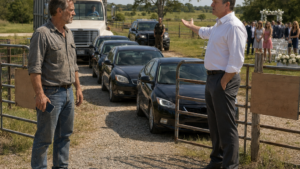
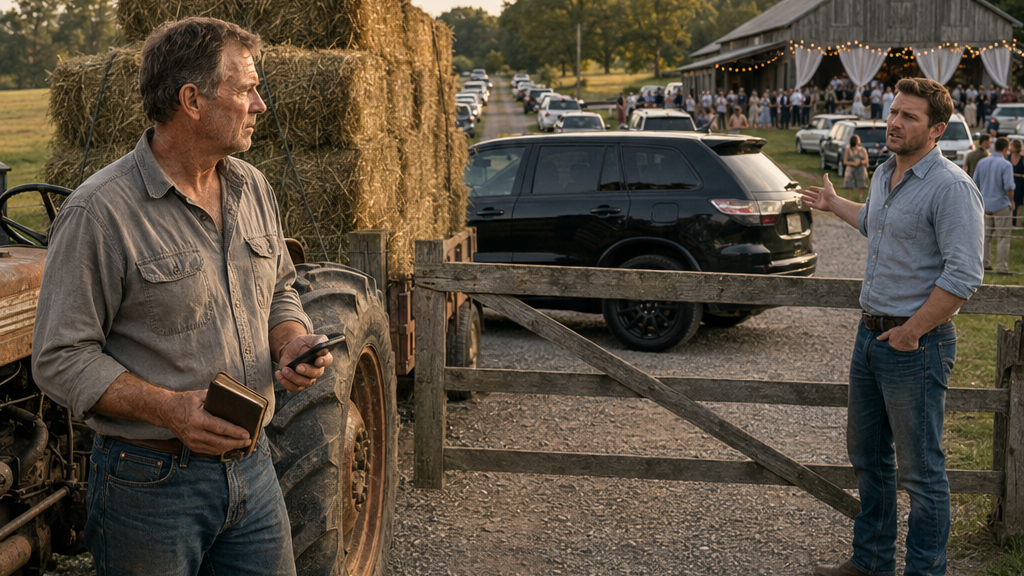
Ronald Walker stopped the tractor thirty feet from his own gate because a silver sedan was parked across it.
Behind him, the hay wagon sat heavy with square bales, its tires pressed deep into the gravel. Ahead, beyond the sagging wooden gate, the narrow lane dropped toward his lower field. There was no room to turn the tractor around, and no way to squeeze the wagon past the sedan without taking out a fence post.
Ronald shut off the engine.
Music carried over from the Allen place next door, loud enough that he could feel the bass between songs. Cars lined both shoulders of the gravel entrance. A white pickup had two wheels in the grass. Three younger people stood beside it holding plastic cups, talking over one another.
Ronald climbed down.
“Whose car is this?”
One of them pointed toward the Allen barn.
Ronald walked past a row of vehicles and found Brandon Allen near a folding table under string lights. Brandon wore a clean work shirt with the sleeves rolled up, though Ronald had never seen him work livestock in it.
“Brandon.”
Brandon turned and smiled as if Ronald had arrived early for the party.
“What’s up?”
“There’s a car across my gate.”
Brandon looked toward the lane without moving.
“Oh. Yeah. We’re tight on parking.”
“I’ve got a loaded wagon sitting out there.”
“It’ll move.”
“When?”
Brandon glanced toward the crowd. “Couple minutes.”
Ronald waited.
Brandon seemed to take the silence as permission to explain.
“We’ve got more people than expected. I told them to use the edges.”
“The edge of my gate isn’t parking.”
“I know.”
“You told them otherwise.”
“I told them to get off the road.”
Ronald looked back toward the entrance. “That gate is how I reach the lower hayfield.”
Brandon rubbed one hand over the back of his neck.
“Can’t you take the west track?”
Ronald stared at him.
The west track was a narrow dirt run between an equipment shed and a drainage ditch. A pickup could manage it. A tractor pulling a loaded hay wagon could not.
“No.”
Brandon gave a short laugh. “You’ve taken equipment through there before.”
“Not this wagon.”
“Well, let me find the driver.”
He disappeared into the barn.
Ronald remained where he was.
A woman carrying a plate of food squeezed past him. Someone shouted from inside. A burst of laughter followed. Ronald could smell grilled meat, beer, and the sweet dust kicked up by vehicles turning on gravel.
The Allen farm had never been quiet, exactly. Farms were not quiet places. Tractors started before sunrise. Cattle bawled. Gates slammed. Hay balers ran past supper when rain was coming.
That kind of noise had never bothered him.
This was different.
Three weekends earlier, there had been perhaps twenty cars.
The next weekend, more.
Last Saturday, Ronald had found two vehicles nosed into the grass beside his mailbox, their tires flattening the shoulder where water drained after a storm.
Each time he had told himself the same thing: Brandon would settle it down.
Each time he had chosen not to make a larger issue of it.
Brandon returned with a young man wearing sunglasses despite the late afternoon light.
“That your sedan?”
The young man nodded.
“You’re blocking his gate.”
“Oh.”
The word carried no alarm.
They walked back toward the entrance. Ronald followed.
The young man unlocked the sedan and moved it fifteen feet down the road, stopping with one wheel still in the grass.
Ronald said nothing.
Brandon spread his hands.
“There. You’re good.”
Ronald looked at the gate, then at the line of vehicles stretching beyond it.
“For now.”
Brandon’s expression changed slightly.
“Look, Ronald, we’re trying something over here. It’s good for the place.”
“What are you trying?”
“Private events. Reunions. Birthdays. Small weddings.”
Ronald glanced toward the barn again.
There were easily sixty people on the property.
“This is small?”
Brandon ignored the question.
“Mom needs the income. I’m not trying to cause trouble.”
“Then don’t block my access.”
“I said I’d handle it.”
“You said that last weekend.”
Brandon’s jaw tightened.
“Next weekend I’ll have somebody managing parking.”
“Next weekend?”
“Wedding.”
“How many?”
Brandon hesitated just long enough for Ronald to notice.
“Not crazy.”
“That wasn’t what I asked.”
“Maybe eighty.”
Ronald looked down the narrow lane.
Eighty people did not arrive in ten cars.
He walked back to the tractor and opened the gate. The hinges gave their familiar dry squeal. For years, that sound had meant nothing more than work ahead: a field to cut, cattle to check, fencing to mend.
Now he found himself looking at the gravel shoulder before he drove through, checking whether another stranger had claimed part of it.
He climbed onto the tractor.
The engine caught.
As he eased the hay wagon through the gate, a man carrying a cooler stepped aside at the last moment and shook his head as though Ronald were the inconvenience.
Ronald felt anger rise hot and quick.
He swallowed it.
By the time he reached the lower field, he had decided he would speak to Brandon one more time before the wedding.
That evening, after unloading the wagon, Ronald sat at his kitchen table with a mug of coffee gone cold beside his elbow.
He took a small weathered notebook from the drawer where he kept feed receipts and equipment serial numbers.
For several seconds he simply looked at the blank page.
Writing it down felt excessive.
Formal.
Like admitting that a neighborly conversation had failed.
Then he wrote the date.
Saturday.
He checked his phone.
4:18 p.m.—gate blocked by silver sedan.
Below it he added:
Approx. 54 vehicles by 4:30.
He paused.
Then he turned back through his phone calendar and began reconstructing the previous weekends.
May 9—cars along mailbox shoulder.
May 16—two vehicles partly across entrance.
May 23—music after midnight.
The list grew longer than he expected.
Ronald stopped writing when he reached the bottom of the page.
Across the lane, the music was still going.
He turned to a fresh page and wrote one more line.
Next Saturday—wedding. Brandon says approximately 80 guests.
Then he underlined the number.
Chapter 2: The Party Farm Was Bigger Than Margaret Knew
The tire tracks started beside Ronald’s gate and ran twenty yards through the grass.
He found them Monday morning while checking the fence line.
Two deep arcs had cut through the shoulder where rainwater normally spread before dropping toward the drainage ditch. One track had clipped a wooden marker Ronald had driven years earlier. The marker now leaned toward the field.
He stood over the damage with his hands on his hips.
The wedding had not happened yet.
Whatever Brandon was doing next door was already getting bigger.
Ronald took out his phone and photographed the tracks.
Then, reluctantly, he pulled the notebook from his shirt pocket.
Monday, 7:12 a.m. Fresh vehicle tracks inside Walker frontage.
He stopped.
“Inside” sounded stronger than he could prove.
Ronald scratched the word out and wrote:
Fresh tracks through grass beside Walker gate.
That was the problem with writing things down. The page forced him to separate what irritated him from what he could actually establish.
Later that morning he searched the county website from the computer in his farm office.
He expected to find nothing useful.
Instead, one search led to another.
Private event use.
Temporary parking.
Gathering capacity.
Fire access.
He did not understand half the language, and some requirements seemed to depend on the number of guests or whether food vendors were present. Ronald resisted the urge to decide what applied before he knew.
So he opened another browser tab and searched the neighboring farm’s address.
The first result was a social-media page.
Ronald leaned closer.
There were photographs of the Allen barn dressed with lights and white tablecloths.
A family reunion.
A birthday dinner.
A bridal shower.
Then a photograph of rows of folding chairs facing the pasture.
Under it was a booking announcement for weekend events.
Ronald scrolled.
The page did not look new.
Several posts went back more than two months.
One advertised “country gatherings” for groups much larger than anything Brandon had mentioned when the events first began.
Ronald reached for the notebook.
Then stopped himself.
An advertisement was not the same thing as an event that had actually occurred.
He printed three pages anyway and laid them beside the notebook.
Around noon, he drove to check a mineral feeder near the north pasture. On the way back he saw Rebecca Green standing beside her mailbox with a rake.
She glanced at his truck, then at the Allen property.
Ronald slowed.
“You lose some grass too?”
Rebecca gave him a tired smile.
“You noticed?”
“Mine’s got tracks.”
She leaned the rake against the post.
“Last weekend they had a pickup half across my drive for maybe forty minutes.”
Ronald switched off the truck.
“You tell Brandon?”
“I told one of the guys directing cars.”
“And?”
“He said they’d move it.”
“Did they?”
“Eventually.”
Ronald nodded.
Rebecca studied him.
“You planning to make a complaint?”
“I’m planning to figure out what’s happening first.”
“That sounds like a yes.”
“It isn’t one yet.”
Rebecca folded her arms.
“I don’t want to get mixed up in a neighbor war.”
“Neither do I.”
“You and Brandon have already gone at it twice.”
“We talked.”
“I heard him from my porch.”
Ronald looked toward the road.
That stung more because it was true. He had believed his conversations with Brandon were private matters between neighboring landowners. Apparently everyone nearby had noticed.
Rebecca softened.
“I’m not saying you’re wrong.”
“But?”
“But I borrow Margaret’s stock trailer sometimes. You’ve helped me with hay. Brandon fixed my water line last winter. I don’t want to pick a side.”
Ronald nodded.
“You shouldn’t have to.”
She looked relieved.
Before he restarted the truck, Ronald asked, “How many cars did you count Saturday?”
Rebecca frowned.
“I didn’t count.”
“Roughly.”
“Thirty on this stretch. More up by the barn.”
Ronald wrote nothing until he returned home.
Then he entered:
Rebecca reports driveway partly blocked previous weekend. Did not witness personally.
That sentence mattered.
He was beginning to understand that the notebook would only be useful if he resisted turning it into an argument.
By Wednesday, he had added vehicle counts from photographs, times when music carried past his bedroom window, and two occasions when traffic had backed onto the county road.
He also wrote what he could not verify.
Guest count unknown.
Permitting status unknown.
Margaret’s knowledge unknown.
That last line bothered him.
Margaret Allen had owned the neighboring farm since her father died, but she was rarely there during events. Ronald saw her truck some weekday mornings and almost never on Saturdays.
For years, their conversations had been ordinary rural exchanges—storm damage, hay prices, calves getting loose, whose tree had fallen across which fence.
Ronald could have called her.
He did not.
Partly because Brandon was an adult and running the place.
Partly because involving his mother felt like going around him.
Partly because Ronald still believed he ought to be able to settle a gate problem face-to-face.
Friday evening, he opened the event page again.
A new post sat at the top.
Saturday wedding.
Guest parking instructions.
Overflow vehicles directed toward the south entrance.
Ronald knew the south entrance.
It was the shared gravel lane beside his gate.
He scrolled farther.
The guest estimate was visible in the booking description.
One hundred twenty.
Ronald sat back from the screen.
Brandon had told him eighty.
He took the notebook from beside the keyboard and wrote the number carefully.
120 advertised guests.
Then, after a moment, he added:
More than I have seen before.
Outside, a truck rolled past his house toward the Allen farm carrying folded rental tables.
Another followed with portable lights.
Ronald watched both disappear toward the barn.
The wedding was still a day away, and the road already felt narrower.
Chapter 3: Ronald Stopped Arguing and Started Writing Everything Down
Ronald came around the bend with the tractor in low gear and saw the SUV sitting squarely across his gate.
He stopped hard enough that the front bales on the wagon shifted against their straps.
For a second he simply gripped the steering wheel.
The black SUV had been parked diagonally, nose toward the ditch, rear bumper almost touching the gate latch. Beyond it, cars crowded both sides of the gravel lane. A temporary sign pointed guests toward the Allen barn.
Ronald checked the time.
3:47 p.m.
He shut off the tractor.
The sudden silence around him made the wedding music from the next property seem louder.
A photographer was arranging a group near the barn. Guests in summer dresses and pressed shirts crossed between parked vehicles. Two children ran along the fence.
Ronald climbed down, took out his phone, and photographed the SUV from three angles.
Then he opened the notebook.
Saturday, 3:47 p.m.
Black SUV fully blocking lower-field gate.
He wrote the plate description beneath it.
“Seriously?”
Ronald looked up.
Brandon was walking toward him quickly.
“What?”
“You’re taking pictures now?”
“My gate’s blocked.”
“I can see that.”
“Then we agree.”
Brandon glanced at the tractor and loaded wagon.
“We’re getting it moved.”
Ronald wrote another line.
Brandon arrived 3:49.
“Come on, man.”
Ronald looked up.
Several guests had stopped nearby. Not close enough to join the conversation, but close enough to listen.
Brandon lowered his voice.
“It’s a wedding.”
“I know.”
“They’re doing pictures. The owner of that SUV is probably inside.”
“That doesn’t change the gate.”
“Give me ten minutes.”
“No.”
Brandon stared at him.
Ronald felt the old instinct rise—the urge to explain every previous weekend, every tire track, every vehicle, every time he had already asked.
Instead he closed his mouth.
Brandon pointed past the fence.
“Use the west track.”
“No.”
“You keep acting like there’s no other way onto your own land.”
“There isn’t another way for this wagon.”
“You could unhitch it.”
Ronald almost laughed.
“You want me to unhitch a loaded hay wagon because your guest parked across my gate?”
“I want you to be reasonable for ten minutes.”
The words landed harder than Ronald expected.
Around them, the wedding continued. Someone carried flowers toward the barn. A man holding a drink watched from beside a pickup.
Ronald looked at the gate.
Then at Brandon.
He realized that if he argued now, the scene would become exactly what Brandon seemed to think it was: two stubborn men fighting over inconvenience.
So Ronald opened the notebook again.
3:51—Brandon suggests west track or unhitch wagon.
Brandon’s face changed.
“You writing me down?”
“I’m writing down what happened.”
“That’s ridiculous.”
“Maybe.”
Ronald slipped the notebook into his pocket.
“But the lane goes in the same record as everything else from now on.”
For several seconds neither man spoke.
Then Brandon turned sharply and walked toward the barn.
Ronald waited beside the tractor.
At 3:58, a woman hurried down the lane carrying a small purse and apologizing before she even reached the SUV.
“I didn’t know this was a working gate.”
Ronald believed her.
“That’s all right. I just need through.”
She moved the SUV immediately.
Seven minutes.
Ronald wrote that down too.
The gate swung open, but before he climbed back onto the tractor he noticed another vehicle turning from the county road.
A sheriff’s cruiser.
It slowed beside the packed shoulder.
Ronald had not called.
The deputy rolled down the window.
“Everything okay here?”
Brandon was already heading toward the cruiser.
Ronald stayed where he was.
A driver on the county road had apparently reported vehicles narrowing the entrance. The deputy spoke first with Brandon, then walked toward Ronald.
“You own this gate?”
“Yes.”
“Was it blocked?”
Ronald pointed to the fresh tire marks where the SUV had been.
“Until a few minutes ago.”
“You call it in?”
“No.”
The deputy glanced at the line of cars.
“Been happening often?”
Ronald hesitated.
This was the moment he had spent weeks avoiding.
He could say no and keep it between neighbors.
Or he could say what was true.
“Yes.”
“How often?”
Ronald reached into his pocket.
He opened the notebook.
The deputy’s eyebrows lifted slightly.
Ronald turned through the pages.
“Three weekends I can document clearly. More if you count vehicles partly across the entrance.”
The deputy looked at the notes but did not take the book.
“Noise too?”
“Some.”
“Parking?”
“Yes.”
“Any livestock or emergency access affected?”
“This gate is equipment access to my lower field. Cattle can come through it when I rotate pasture.”
The deputy looked again at the gate, then at the loaded wagon.
“That matters more than whether somebody’s music is annoying you.”
Ronald said nothing.
The sentence shifted something in him.
For weeks, even Ronald had privately reduced the dispute to irritation: noise, strangers, disrespect.
The deputy saw function.
Access.
The deputy gave him the county code-enforcement number.
“I’m not telling you what violation exists. That’s their job. But if this is recurring commercial event use and it’s creating access issues, send them dates. Photos if you have them. Keep it factual.”
Ronald looked at the notebook.
“Been trying.”
“Good. Don’t guess. Don’t embellish.”
Brandon came back toward them.
“Officer, we already moved the vehicle.”
The deputy nodded.
“I see that.”
“So we’re good?”
“For right now, your entrance needs to stay clear enough for traffic to pass safely. I’m not code enforcement.”
Brandon looked at Ronald’s notebook.
“This is getting blown out of proportion.”
The deputy did not respond.
Ronald did.
“No. It’s finally getting written down in proportion.”
Brandon shook his head and walked away.
Ronald hated how satisfying the line felt.
That bothered him enough that he said nothing else.
He moved the tractor through the gate and spent the next hour unloading hay in the lower field. On the final trip, he could still hear the wedding music. Cars still lined the lane, but no one blocked the gate.
That was a small victory.
It also proved something Ronald did not particularly want proved.
The access could have been kept clear all along.
Monday morning, he called county code enforcement.
A woman took his address, then the neighboring property address.
“What are you reporting?”
Ronald looked at the notebook.
He could have said illegal events.
He could have said dangerous parking.
He could have said Brandon Allen was running a business that did not belong there.
Instead he said, “I don’t know what rules apply. I’m reporting repeated obstruction of agricultural access during paid gatherings next door.”
There was a pause while she typed.
“Do you have dates?”
“Yes.”
“How many?”
Ronald turned the pages.
“Eight entries that might matter. Four with photographs.”
“Send all eight.”
Ronald sat straighter.
“All?”
“Dates, times, photographs, what you personally observed. If somebody else told you something, mark it that way. We’ll determine what’s relevant.”
She gave him an email address and case number.
After the call, Ronald opened the notebook to the first page.
The handwriting looked uneven because the earliest entries had been reconstructed from memory. Later ones were cleaner.
Exact times.
Vehicle counts.
Photographs.
What he knew.
What he did not.
He spent nearly an hour typing it into a simple chronological list.
Before sending it, he removed two sentences that sounded angry rather than useful.
Then he attached the photographs.
His finger rested over the mouse.
For most of his life, problems between neighboring farms had been settled at gates, fence lines, equipment sheds, and kitchen tables.
Sending the file felt like crossing a boundary.
Ronald clicked Send.
Less than twenty minutes later, a reply arrived.
The county code-enforcement officer thanked him for the chronology and asked one question.
Can you provide every event date you have recorded, including weekends when access was not fully blocked?
Ronald looked toward the Allen farm through the office window.
Then he pulled the notebook closer and began turning pages.
Chapter 4: One Citation Did Not Stop the Next Booking
The county truck arrived at the Allen farm on a Thursday morning, two days before the next event.
Ronald saw it from the cab of his tractor while carrying mineral tubs toward the north pasture. The white pickup stopped near the barn, and a county code-enforcement officer stepped out with a clipboard.
Brandon was already walking toward him.
Ronald kept driving.
He had spent the previous week answering questions, sending photographs, and correcting his own assumptions. The county wanted dates, not opinions. Vehicle counts, not guesses about motives. Photographs showing where cars actually sat. Ronald had supplied what he had and admitted what he did not.
That restraint had been harder than he expected.
By noon, the county officer called.
“I’ve looked at your materials and the property.”
Ronald leaned against his kitchen counter.
“And?”
“There are several issues we need the owner to address. I’m not going to tell you they’re all violations until our review is complete.”
“All right.”
“But parking is being handled differently from what was represented to us.”
Ronald straightened.
“How?”
“The event operator indicated guest vehicles remained entirely on the Allen parcel.”
Ronald looked through the window toward his gate.
“They don’t.”
“We can see that.”
The officer asked whether Ronald could bring his original notebook to the county office the next morning.
Ronald hesitated.
“The original?”
“We’ll copy the relevant pages while you’re here. You keep it.”
He arrived shortly after eight.
The officer placed Ronald’s notebook beside a printed county map and several photographs.
Seeing his own cramped handwriting next to official forms made Ronald uncomfortable. The notebook had begun as something he barely wanted to admit he was keeping.
Now someone was photocopying it.
The officer turned to one entry.
“May twenty-third. You wrote ‘music after midnight.’ Did you measure sound?”
“No.”
“So that stays background information, not proof of a noise violation.”
Ronald nodded.
Another page.
“June sixth. Gate fully blocked. That one is stronger.”
“Because of the photograph?”
“Because of the access function.”
Ronald thought of the deputy’s words.
The officer tapped the county map.
“This isn’t just about whether guests annoy somebody. Agricultural access, road clearance, and emergency access all create separate concerns.”
Ronald felt the peculiar relief of hearing someone else say it.
He had spent so long wondering whether he was simply becoming the kind of neighbor who counted cars.
The officer slid a copy of the map toward him.
“We’re issuing a formal notice requiring corrections before continued event use at the current scale.”
“Does that mean they have to stop?”
“It means exactly what the notice says. Don’t turn it into more than that.”
Ronald almost smiled.
“You sound like my notebook.”
“Your notebook is useful because you didn’t turn it into more than it was.”
That afternoon Brandon came across the lane carrying a folded sheet of paper.
Ronald was repairing a loose board near the equipment shed.
“You happy?”
Ronald kept the hammer in his hand but stopped working.
“About what?”
Brandon held up the notice.
“This.”
“I didn’t write it.”
“You sent them eight weeks of stuff.”
“I sent them what happened.”
Brandon unfolded the page.
“They’re talking about parking controls and capacity review. That doesn’t mean we’re shut down.”
“I didn’t say it did.”
Brandon studied him as though searching for the argument Ronald refused to give him.
“This whole thing started because one car blocked your gate.”
“No.”
“That’s what you photographed.”
“That’s the first time I stopped relying on you to remember it.”
Brandon’s face tightened.
“You make it sound like we’re running some huge operation.”
“I don’t know what you’re running.”
“It’s farm events.”
“Then follow whatever rules apply to farm events.”
Brandon gave a short, humorless laugh.
“You think the county makes that easy?”
Ronald said nothing.
Brandon lowered the paper.
“You know what this place costs to keep up?”
“No.”
“Exactly.”
For the first time, there was something behind the anger besides pride.
Brandon looked toward his mother’s barn.
“Roof repairs. Insurance. Property tax. Fencing. Equipment that sits eleven months out of the year. Everybody loves the idea of keeping farms in families until somebody has to pay for one.”
Ronald set the hammer down.
“I’m not telling you not to make money.”
“Could’ve fooled me.”
“I’m telling you not to make it by blocking my access.”
Brandon folded the notice.
“We’ve got an event Saturday. Already paid.”
Ronald stared at him.
“The county just came.”
“And they told us what to fix.”
“You can fix it by Saturday?”
“I can handle parking.”
Ronald looked toward the lane.
Brandon followed his gaze.
“No one parks across your gate. Happy?”
“That would be a start.”
Brandon walked away.
Saturday afternoon, Ronald heard traffic before he saw it.
The first dozen cars stayed mostly on the Allen property.
Then more came.
A young man in a reflective vest began directing vehicles into a mowed section beyond the barn.
For almost an hour, Ronald thought Brandon might actually have solved it.
Then a delivery van stopped partly in the travel lane.
Two pickups queued behind it.
Another guest pulled onto the shoulder near Rebecca’s drive.
Ronald took out the notebook.
He recorded only what he could see.
At 6:16, the county officer arrived.
Brandon hurried across the field before the truck had fully stopped.
Ronald remained by his fence.
He could not hear most of the conversation.
He saw Brandon gesture toward the mowed parking area.
The officer pointed toward the lane.
Brandon gestured again, sharper this time.
Ten minutes later, the officer attached a formal notice to the paperwork Brandon was holding and photographed the entrance.
The event continued.
That surprised Ronald more than the citation.
Music started near sunset.
People laughed under the barn lights.
Whatever consequence Brandon had just received, he had decided it was worth absorbing.
Ronald wrote the time.
He did not feel victorious.
Near nine, his phone rang.
The caller ID showed a name he had not seen in months.
Margaret Allen.
“Ronald?”
“Yes.”
Her voice sounded controlled but strained.
“I need to ask you something.”
“All right.”
“Brandon says the county issue is coming from complaints you’ve been making.”
Ronald looked across the dark field toward the lights.
“I’ve made reports.”
“He says you’re the only neighbor who has a problem with what they’re doing.”
Ronald went still.
Margaret continued.
“He told me this is mostly between you and him.”
The music across the lane carried through Ronald’s open kitchen window.
He looked at the notebook lying beside the phone.
“No,” he said. “That isn’t what this is.”
There was a pause.
Then Margaret asked quietly, “Then why hasn’t anybody else said anything to me?”
Chapter 5: Three Neighbors Finally Told the Same Story
Margaret’s question was still on Ronald’s mind the next morning when Rebecca knocked on his kitchen door.
She stood on the porch holding her phone.
“I heard Margaret called you.”
Ronald opened the door wider.
“How?”
“Because she called me too.”
That changed the room before either of them sat down.
Rebecca placed her phone on the table.
“What did you tell her?”
“The truth.”
“Which version?”
Ronald looked at her.
Rebecca sighed.
“I’m not accusing you. I mean did you tell her about me?”
“I told her I wasn’t the only person affected. I didn’t speak for you.”
Rebecca pulled out a chair.
“She asked if Brandon’s guests had ever blocked my drive.”
“And?”
“I said yes.”
Ronald waited.
Rebecca rubbed one thumb across the edge of her phone.
“She wants me to put it in writing.”
There it was.
The thing Rebecca had refused to do two weeks earlier.
Ronald did not smile.
“You don’t have to.”
“I know.”
“I mean it.”
“I know.”
She looked toward the window.
“I kept telling myself this would settle down.”
Ronald almost said, So did I.
Instead he asked, “What changed?”
Rebecca gave him a flat look.
“Friday night a truck stopped across my drive while I was trying to get home.”
“You didn’t tell me.”
“Because I was still trying not to be part of your fight.”
Ronald felt the words land.
“My fight.”
“That’s what I thought it was.”
He looked down at the notebook.
Rebecca noticed.
“I was wrong.”
Ronald did not answer immediately.
He had wanted corroboration. Now that it sat across from him, he found no satisfaction in it.
Rebecca unlocked her phone.
“I have pictures.”
She showed him three.
A pickup partly across her gravel drive.
A line of cars extending toward the county road.
Another vehicle parked with two wheels in the shallow drainage strip.
“Send those to the county,” Ronald said.
“You’re not going to use them?”
“No. They’re yours.”
Rebecca studied him.
“You really have gotten particular about this.”
“That’s the point.”
By Tuesday, a third landowner had submitted a short written statement. His complaint was not about noise at all. Twice, guests had parked too close to a pasture gate used for moving cattle.
The county scheduled a meeting.
Margaret came in person.
Ronald had not seen her up close in nearly a year.
She looked tired.
Brandon sat beside her, arms folded.
Rebecca took a seat two chairs away from Ronald. The third landowner remained near the wall.
The code-enforcement officer placed several pages on the table.
Margaret looked directly at Ronald.
“I want to understand something before we start.”
Ronald waited.
“If this has been going on for as long as you say, why did you never call me?”
The question found the part of the story Ronald had preferred not to examine.
“Brandon runs the place.”
“That isn’t what I asked.”
Ronald shifted in his chair.
“I thought I could settle it with him.”
Margaret’s expression hardened.
“And when you couldn’t?”
“I started documenting it.”
“You still didn’t call me.”
“No.”
Brandon leaned back.
“Because he wanted a case.”
Ronald turned toward him.
“That’s not true.”
“You made a log.”
“After asking you more than once.”
“You could have called Mom any time.”
Ronald stopped.
That was also true.
The room fell quiet.
Rebecca broke it.
“I didn’t call her either.”
Margaret looked at her.
Rebecca continued.
“I didn’t want to get involved. I thought Ronald and Brandon were both dug in.”
Brandon looked at her sharply.
Rebecca met his eyes.
“Then your guests started blocking my drive too.”
The county officer slid copies of the submitted records across the table.
Ronald saw dates.
His dates.
Rebecca’s dates.
The third landowner’s dates.
Separate notes, written by different people, lined up around the same weekends.
Margaret stared at the pages.
“Three households?”
“Three documented accounts,” the officer said.
Brandon leaned forward.
“They’re all talking to each other.”
Rebecca shook her head.
“I didn’t even know Ronald was counting cars until after mine got blocked.”
The officer pointed to one weekend.
“Same date. Three separate access complaints.”
Another.
“Same date. Two reports of vehicles narrowing the lane.”
Margaret looked at Brandon.
“You told me Ronald was the only one.”
“He was the only one filing formal complaints when I said that.”
“Were other people complaining to you?”
Brandon did not answer quickly enough.
Margaret’s mouth tightened.
The door opened.
A fire marshal entered carrying a folder.
The county officer had requested an access review because of the size of the gatherings.
The fire marshal did not care who had insulted whom.
He did not care about midnight music.
He looked at the property map, asked where vehicles parked, and measured the effective width of the lane when both shoulders were occupied.
Then he pointed to Ronald’s lower-field gate.
“What comes through here?”
“Farm equipment,” Ronald said. “Cattle sometimes.”
“Anything else?”
“Emergency vehicles if they had to reach the lower acreage.”
The fire marshal looked toward Brandon.
“If guest parking reduces this lane below workable access, that becomes more than a neighbor dispute.”
Brandon’s tone sharpened.
“We’ve already changed the parking layout.”
“For what attendance?”
Brandon named a number.
Margaret turned toward him.
Ronald saw it happen.
Not anger first.
Confusion.
The number was larger than she expected.
“How many?”
Brandon repeated it.
Margaret sat back.
“You told me these were mostly fifty-person events.”
“Some are.”
“Some?”
The fire marshal flipped through the booking information the county had obtained during review.
Margaret reached for the pages.
Brandon put one hand over them.
“Mom.”
She removed his hand.
The room became very still.
She scanned the first page.
Then the second.
Her eyes moved faster.
“How far out are these booked?”
Brandon said nothing.
Margaret looked up.
“How far?”
“Fall.”
She turned another page.
“There’s November.”
Brandon exhaled.
“We’ve got deposits.”
Margaret kept reading.
Ronald’s anger shifted.
He had expected her to defend the events.
Instead, she looked as if someone had opened a door in her own house and shown her rooms she did not know existed.
The meeting ended without a dramatic ruling.
The county required revised parking and capacity information. The fire marshal requested a workable access plan for larger gatherings.
Outside, Ronald stood beside his truck while Margaret remained on the courthouse steps with Brandon.
He heard only fragments.
“You told me—”
“Because you said—”
“How many total?”
Brandon’s answer was too quiet to carry.
Margaret turned away from him.
Then she walked back inside.
Ronald had already opened his truck door when she called his name.
He turned.
Margaret held the booking pages against her chest.
“I want the complete calendar.”
Ronald glanced at Brandon.
Margaret did not.
“All of it,” she said. “Every booking he’s taken.”
Chapter 6: The Farm Was Being Saved the Wrong Way
The calendar covered the Allen kitchen table from one end to the other.
Ronald had not expected to be invited.
Margaret had called him two days after the county meeting and asked him to come because she wanted him to hear Brandon’s explanation in the same room where she heard it.
Ronald almost refused.
Then she said, “I’m tired of everybody telling me separate versions.”
So he went.
Rebecca was not there. Neither were county officials.
Just Ronald, Margaret, Brandon, and several printed pages covered in dates.
June.
July.
August.
September.
October.
November.
Some weekends had one booking.
Others had two events listed on the same weekend.
Margaret tapped a date in October.
“What is this?”
“Reception.”
“You told me fall was mostly tentative.”
“It was when we talked.”
“And this?”
“Family reunion.”
“This one says one-fifty.”
“Maximum requested.”
Margaret looked up.
“Requested by who?”
“The client.”
She pushed the calendar away.
“How many deposits?”
Brandon did not answer.
“Brandon.”
“Most of them.”
Margaret closed her eyes briefly.
Ronald stood near the counter with his notebook in his pocket.
He felt intrusive.
This was a family argument now.
But his lane sat inside the consequences of it.
Margaret looked at him.
“How many weekends did you record?”
“Eight that seemed relevant.”
Brandon made a small sound.
Margaret turned on him.
“No.”
He stopped.
“I want to hear him.”
Ronald took out the notebook.
He opened to the marked pages.
Then he saw Brandon’s expression.
Not defiance.
Something closer to exhaustion.
Ronald closed the book.
Margaret noticed.
“You don’t need it?”
“I know the pattern.”
Brandon looked at him for the first time without hostility.
Margaret sat down.
“Why?”
The question was for her son.
Brandon leaned both hands on the table.
“You know why.”
“I know what you told me.”
“I told you the farm needed income.”
“You told me a few small events could cover taxes and repairs.”
“They did.”
Margaret gestured at the calendar.
“This is not a few.”
“No, because a few didn’t cover enough.”
The words came out sharper than anything Brandon had said so far.
Margaret went still.
Brandon continued before she could interrupt.
“The barn roof alone was thirty thousand if we wanted it done right. The south fence needs replacing. Insurance went up. The tractor note didn’t disappear because Grandpa died. Every month something else comes due.”
Margaret’s face tightened.
“We could have dealt with that.”
“How?”
“Together.”
“You don’t want to sell anything.”
“Neither do you.”
“Exactly.”
Brandon pushed one of the pages toward her.
“The first wedding paid the property taxes. The next two covered the roof deposit. The reunion paid for fencing materials.”
Ronald looked toward the window.
Outside, the Allen barn stood in afternoon light, its roof newer than he remembered.
Brandon pointed toward it.
“You think I did all this because I like telling people where to park?”
Margaret said nothing.
“I was trying to make the place carry itself.”
“And you lied to me about the size.”
“I told you what you could handle hearing.”
Margaret’s chair scraped backward.
“That is not your decision.”
“I knew what you’d say.”
“You had no right.”
“You’d have shut it down after the first complaint.”
“Maybe I should have.”
Brandon looked at Ronald.
“There. Happy?”
Ronald’s jaw tightened.
“No.”
Brandon seemed almost disappointed.
Ronald continued.
“I wanted my gate clear. I still do.”
“That’s what all this is about?”
“It was.”
“Was?”
Ronald looked at the calendar.
“Now I’m trying to understand how many people you’re bringing down a lane that was never meant for them.”
Brandon folded his arms.
“You got the county involved. You got the fire marshal involved. What do you want me to say?”
“The truth would be a decent start.”
Brandon laughed once.
“I’m trying to keep this farm from being sold.”
The room went quiet.
Margaret looked at the table.
When she finally spoke, her voice had changed.
“My father nearly lost this place twice.”
Ronald knew that much.
Most nearby farmers did.
Bad cattle prices one year. Medical bills another.
Margaret ran one hand over the calendar.
“When he died, there were repairs everywhere. I kept telling myself I’d catch up.”
Brandon sat down.
She continued.
“I didn’t.”
There was no accusation in the words.
Only admission.
“I let you take over because you sounded sure.”
Brandon stared at the floor.
Margaret looked toward Ronald.
“And I let myself believe these were little gatherings because that was easier than asking questions.”
Ronald felt something uncomfortable move through him.
He had blamed Margaret for not stopping what happened on her land.
She had not even known the shape of it.
But he had helped create that ignorance.
He had never called.
He had let Brandon carry every message between the two properties.
Ronald touched the notebook in his pocket.
It suddenly felt less like evidence and more like proof of how long everyone had been speaking around one another.
Margaret asked, “What happens if we cancel all of it?”
Brandon answered immediately.
“We refund deposits we don’t have.”
“How much?”
He named a figure.
Margaret looked away.
Ronald did not ask him to repeat it.
A large wedding was scheduled for the coming weekend. Its deposit had already paid part of a repair invoice.
Margaret pressed both hands flat on the table.
“So we can’t just shut the door.”
Brandon looked at Ronald.
“That’s what he wants.”
Ronald pulled out a chair and sat.
“No.”
Brandon frowned.
“I want the lane usable.”
“You think the county’s going to let us keep doing this?”
“I don’t know.”
Ronald looked at Margaret.
“But if there’s a number of people this property can handle without using my access, that’s different from pretending there’s no limit.”
Margaret studied him.
“You’d agree to events?”
“It isn’t my farm.”
“That wasn’t my question.”
Ronald took a breath.
“I’d agree that your farm needs income. I’m not agreeing that my gate becomes part of your parking plan.”
Brandon’s expression shifted.
The fight had become harder for him now.
Ronald was no longer asking for punishment.
He was asking for a boundary.
That afternoon the county called Margaret.
She put the phone on speaker.
The code-enforcement officer’s voice filled the kitchen.
The upcoming wedding could not proceed under the parking and access arrangement currently submitted.
Margaret closed her eyes.
Brandon stood up.
“What does that mean exactly?”
“It means the current plan does not maintain the required access. If you submit a compliant reduced-capacity plan, we’ll review it.”
“How fast?”
“Before the event? You need to send it today.”
Brandon looked at the calendar.
“This wedding is in three days.”
“Yes.”
Margaret stared at the phone.
“What if we can’t?”
“Then it cannot proceed under the current plan.”
After the call ended, nobody moved.
The biggest event Brandon had booked was now three days away, and the money from its deposit had already been spent.
Margaret looked at the calendar, then at her son.
“We either make it smaller,” she said, “or we cancel it.”
Brandon looked toward Ronald.
For once, there was no easy accusation left to make.
Chapter 7: The Biggest Wedding Could Not Use Ronald’s Lane
The temporary parking signs appeared before breakfast.
Ronald saw the first one from his kitchen window: a white board on two metal legs, an arrow painted toward the gravel entrance beside his gate.
By the time he walked outside, there were three.
One pointed toward the Allen barn.
One pointed toward the field Brandon had used for overflow.
The third pointed directly toward Ronald’s lane.
Ronald stood in front of it for several seconds.
Then he pulled out his phone and took a picture.
He did not take out the notebook yet.
Across the road, a rental van unloaded folding chairs. Another truck carried flowers. Two workers stretched a canvas awning beside the barn.
The wedding was still six hours away.
Ronald walked toward the Allen property.
Brandon saw him coming and met him halfway.
“Before you say anything,” Brandon said, “that sign isn’t permanent.”
“It points at my gate.”
“It points at the turnaround.”
“There is no public turnaround there.”
“We’re using it to redirect cars.”
“Onto what?”
Brandon looked past Ronald toward the lane.
“Just long enough to stack them before sending them around.”
Ronald stared at him.
“You submitted that?”
“No.”
“Then why is it out here?”
“Because the shuttle plan changed.”
Ronald felt the familiar heat start in his chest.
He had seen the same pattern too many times.
An explanation first.
A correction later.
An apology only if something went wrong.
He took the notebook from his pocket.
Brandon’s eyes dropped to it.
“You don’t have to do that.”
Ronald opened to a clean page.
“Apparently I do.”
Brandon stepped closer.
“This wedding is already cut down.”
“How many?”
“Ninety.”
“The county approved ninety?”
“They approved the revised plan.”
“With my lane?”
Brandon did not answer.
Ronald wrote the time.
7:36 a.m.—temporary directional sign toward Walker gate.
Brandon exhaled through his nose.
“I’m trying to keep this thing from collapsing.”
“I know.”
The answer stopped him.
Ronald closed the notebook.
“I know what you’re trying to do.”
“Then help me.”
“I am.”
“How?”
“By keeping you from solving your problem with my access.”
Brandon looked away.
A woman carrying flower boxes walked past them.
The morning had none of the chaos of earlier weekends yet. That almost made the pressure worse. Everything was organized. Scheduled. Paid for.
There would be no pretending this time that one careless guest had misunderstood where to park.
Ronald walked back to the sign, lifted it, and carried it to the edge of the Allen property.
He set it down with the arrow facing the barn.
He did not hide it.
He did not break it.
He simply moved it off his access.
At nine, Margaret drove up.
She stopped beside Ronald’s gate.
“Can we talk?”
Ronald nodded.
She looked older than she had three days earlier.
“The county approved the smaller plan.”
“That’s what Brandon said.”
“We have shuttles coming from a church lot.”
Ronald waited.
“But there’s a problem.”
Of course there was.
“One shuttle is delayed,” Margaret said. “Maybe two hours.”
Ronald looked toward the Allen barn.
“So?”
“We need somewhere for maybe ten cars to wait.”
“No.”
Margaret’s face tightened slightly.
“I’m asking for one exception.”
“No.”
“Ronald, I’m not asking to park them all day.”
“I know.”
“Thirty minutes.”
He looked at her.
This was the moment he had imagined for weeks.
Not this exact request, but the reversal.
The Allen family needed something from him now.
He could make them feel every inconvenience they had made him feel.
Instead, he heard the deputy’s voice in his head.
Function.
Access.
He opened the gate and pointed down the lane.
“I’ve got cattle in the lower pasture. I’m moving them this afternoon. If those cars are here when I need through, we’re right back where we started.”
Margaret said nothing.
“I’m not saying no because I want the wedding to fail.”
“I know.”
“Do you?”
She looked toward the barn.
After a moment, she nodded.
“Yes.”
Ronald took out the notebook.
He showed her the previous entries.
Not all of them.
Just the blocked-gate dates.
“Every time it was supposed to be temporary.”
Margaret read them.
Seven minutes.
Twenty-three minutes.
Forty-one minutes.
Unknown duration.
She handed the notebook back.
“All right.”
Brandon came down the lane as she turned away.
“What’d he say?”
Margaret answered before Ronald could.
“He said no.”
Brandon shook his head.
“Of course.”
Margaret stopped.
“No. Listen to me. He said no, and he’s right.”
Brandon stared at her.
She pointed toward the gate.
“That access stays open.”
“But the shuttle—”
“We solve the shuttle.”
Ronald watched the conversation continue without him.
That mattered more than he expected.
For the first time, Margaret was not asking him to defend the boundary.
She was defending it herself.
At eleven, the county truck arrived.
The code-enforcement officer checked the temporary signs, the overflow field, and the lane width. A fire official came with him.
Brandon walked beside them carrying the revised parking plan.
Ronald stayed at his gate.
The officer stopped at the third sign.
“This used to point toward Walker’s access?”
Brandon looked at Ronald.
“Yes.”
“Not part of the approved plan.”
“I know.”
The officer looked down the lane.
“This gate remains clear all day.”
Brandon gave a tight nod.
The officer continued toward the barn.
No citation.
No dramatic shutdown.
Just a rule spoken clearly enough that nobody could pretend not to understand it.
By early afternoon, guests began arriving.
The missing shuttle still had not come.
Cars slowed at the entrance.
A volunteer directed them past Ronald’s gate without stopping.
Some turned around and left for the remote lot.
Others waited along a wider county shoulder farther away.
The wedding started late.
Ronald could hear music from his lower field while moving cattle through the gate.
For the first time all summer, he opened it without walking ahead to check whether a vehicle was blocking the other side.
On the return trip, he saw Brandon near the entrance directing traffic himself.
One driver started turning toward Ronald’s lane.
Brandon stepped into the road and waved the car back.
“Not there.”
The driver rolled down the window.
“Sign said overflow.”
“Old sign. Keep going.”
Ronald slowed the tractor.
Brandon looked up.
Neither man smiled.
Ronald raised two fingers from the steering wheel.
Brandon gave one short nod.
That evening, after the wedding ended, Margaret came to Ronald’s porch.
The barn lights still glowed in the distance.
“We lost some people,” she said.
Ronald waited.
“Not guests. Future bookings.”
He understood.
“Because of the cap?”
“And because we can’t promise unlimited parking anymore.”
“Probably shouldn’t.”
“No.”
She sat on the edge of the porch step.
For a while they listened to trucks leaving the Allen property.
Then Margaret said, “I don’t want to do this again.”
“What?”
“Wait for a county notice before we know where the line is.”
Ronald looked at her.
She gestured toward his gate.
“You know this land better than Brandon does.”
“That’s not the same as knowing your business.”
“I’m not asking you to run it.”
“What are you asking?”
Margaret looked toward the dark lane.
“Help me write down what can’t happen again.”
Ronald looked through the open kitchen door.
His notebook lay on the table.
For months it had recorded every failure.
Now Margaret was asking whether it could become something else.
Chapter 8: The Logbook Became a Boundary Instead of a Weapon
The first fall event arrived with twenty-eight cars and not one of them stopped near Ronald’s gate.
He noticed because he had been watching for ten minutes.
That embarrassed him.
Ronald stood beside the hay wagon pretending to inspect a tire while vehicles turned toward the Allen barn in an orderly line.
A small sign directed overflow traffic toward the approved field on the far side of the property.
Nothing pointed toward him.
He checked his watch.
Then laughed quietly at himself and put his hands in his pockets.
The new access agreement was inside his office.
Margaret had written the first draft.
Ronald had crossed out three vague phrases.
Brandon had argued over two of them.
The county had clarified one.
The final version fit on two pages.
No guest parking along Ronald’s gate or farm-access lane.
No temporary staging of vehicles there.
Maximum event capacity tied to approved parking.
Emergency and agricultural access to remain unobstructed.
Problems reported directly between the properties before they became formal complaints, when possible.
Ronald had insisted on that last part.
It was the sentence he wished he had followed months earlier.
Near noon, one late guest pulled too far toward Ronald’s entrance.
Ronald saw the front tire cross the edge of the gravel.
Before he could move, Brandon walked over.
He tapped on the driver’s window and pointed toward the Allen field.
The car backed out.
Brandon did not look toward Ronald until it was done.
When he finally did, there was no apology in his face.
No challenge either.
Just acknowledgment.
Ronald nodded once.
That was enough.
The events had changed.
Margaret kept only the smaller bookings that fit the property without borrowing space from its neighbors.
Brandon still handled maintenance and some setup, but he no longer accepted reservations alone.
There were fewer string lights in the barn now.
Fewer cars.
Less money.
But the roof stayed repaired.
The fence replacement continued one section at a time.
The farm did not disappear.
Neither did the strain between Ronald and Brandon.
Some things did not need to disappear to improve.
Late that afternoon, Ronald sat in his office with the old notebook open.
The first pages looked almost angry despite the careful wording.
Dates.
Times.
Vehicle counts.
Blocked gate.
Music.
Tracks in grass.
Every entry had once felt like another reason the neighbors could no longer trust one another.
He turned to the final page.
Nothing had been written there since the wedding.
Ronald considered adding:
Fall event—no obstruction.
Instead, he closed the notebook.
He placed it in the drawer beside the signed access agreement.
For a moment he rested his hand on both.
His father had always believed a man’s word ought to be enough between neighboring farms.
Ronald still wanted that to be true.
But he understood something now that he had resisted all summer.
Writing down a boundary did not necessarily mean trust had failed.
Sometimes it was how people stopped testing the boundary long enough for trust to return.
Outside, the light was dropping over the lower hayfield.
Ronald climbed onto the tractor and started toward the gate with an empty wagon behind him.
He could hear music from the Allen barn, low enough that it blended with the engine.
At the shared entrance, the gate stood open.
No car blocked it.
No guest waited beside it.
No temporary sign pointed across it.
Ronald did not slow down.
The tractor rolled through, the wagon following cleanly behind, and the old gate remained open in his mirror as he crossed into the field.
The story has ended.