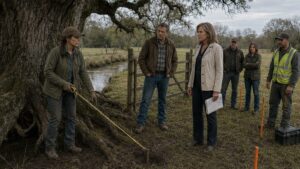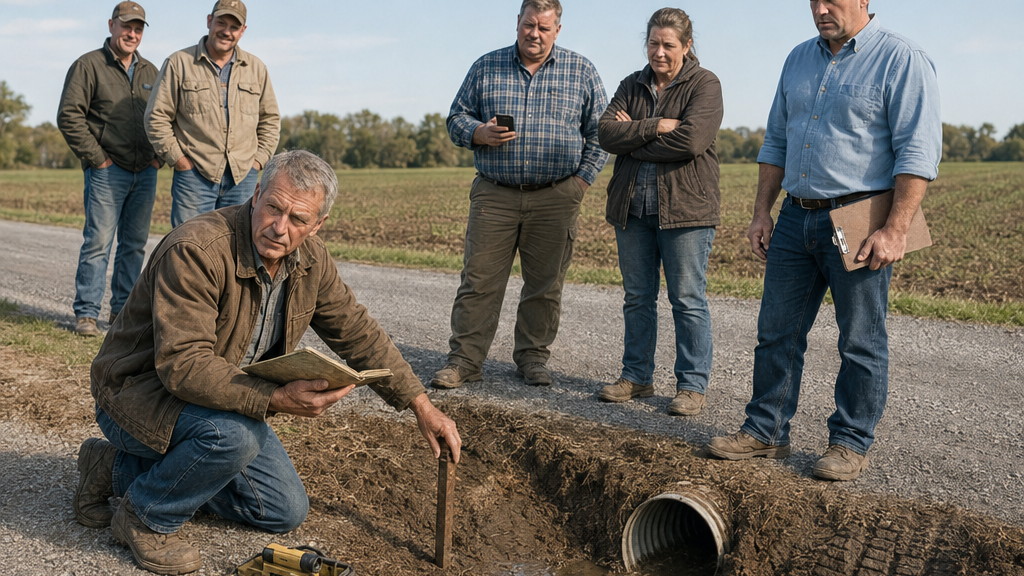
They Called His Farm Drainage Complaints Obsessive—Then the County Opened the Trench They Had Approved
Chapter 1: The Ditch Robert Would Not Stop Measuring
Three dry days had passed, and there was still water standing above the new culvert.
Robert Wright stopped his pickup at the farm entrance and stared through the windshield.
The puddle was not deep. Maybe two inches at the center. A person driving past would have seen muddy water beside a gravel road and thought nothing of it.
Robert saw a grade that was not working.
He shut off the engine, took his weather-stained field notebook from the passenger seat, and walked down the shoulder.
The association had replaced the old culvert two weeks earlier as part of a shared-lane improvement project. Fresh gray stone covered the road. The shoulders had been widened. A grader had scraped a cleaner drainage strip along the fence line.
Everything looked improved.
That was part of the problem.
Robert crouched beside the outlet. The new corrugated pipe sat beneath the gravel, dark and dry at its lower edge. Water pooled several feet uphill from it, trapped in a shallow depression the grader had created.
He laid a folding rule across the ground, checked the distance to the pipe lip, then wrote two figures in his notebook.
Behind him, tires cracked over gravel.
Alexander Hall stopped his truck beside the ditch and lowered the window.
“You’re measuring it again.”
Robert kept writing.
“That’s what it looks like.”
Alexander rested one arm on the window frame. He was younger by almost twenty years, clean-shaven, wearing a pressed work shirt despite the heat.
“We went over this Friday.”
“We talked about it Friday.”
“Same thing.”
“No.”
Alexander looked at the standing water. “It hasn’t rained since Thursday.”
“That’s why I’m looking at it.”
Alexander gave a small breath through his nose.
The shared road served six properties and had been maintained informally for years before the owners formed a road-and-drainage association. Alexander had become chairman because he was organized, answered messages, and knew how to keep meetings from stretching past supper.
Robert had voted for him.
That seemed to irritate Alexander more than if Robert had opposed him from the beginning.
“The contractor’s coming back this week to finish the shoulder,” Alexander said. “After that we’re closing out the job.”
Robert stood.
“You close it out with that water sitting there, you’ll be reopening it.”
“Robert.”
“The outlet’s too high relative to the channel.”
“You said that.”
“And nobody checked it.”
“The contractor checked it.”
“The contractor built it.”
Alexander opened his door and stepped onto the road.
“You’ve filed three written objections.”
“Four.”
“That doesn’t help your case.”
Robert looked at him.
Alexander immediately seemed to regret the sentence, but he did not take it back.
A breeze shifted through the hayfield behind Robert’s barn. Farther downslope, the second cutting stood thick and nearly ready.
Robert pointed with the end of his folding rule.
“Water used to follow that strip all the way down.”
Alexander barely glanced.
“The ditch was reshaped.”
“That’s what I’m saying.”
“It was supposed to be reshaped.”
Robert closed the rule.
“Not uphill.”
Alexander folded his arms.
“This road was washing out every spring. Samuel got us a decent price. We finally have enough stone down to hold a loaded truck. Everybody wanted it done before fall.”
Robert heard what sat beneath the words.
Everybody except you.
He could have answered by explaining exactly why a road shoulder could look solid while sending water someplace it had never gone before.
He did not.
For years after leaving county work, he had made a habit of not mentioning it unless someone asked. He had seen too many retired men introduce every opinion with what they used to do, as if a former job title gave them permanent ownership of a room.
So he said only, “The drainage is wrong.”
Alexander gave him a tired look.
“That’s your opinion.”
Robert slipped the notebook into his jacket pocket.
“Water doesn’t care about opinions.”
That sentence traveled faster than he intended.
By noon, Linda Mitchell had heard it.
She slowed her utility vehicle beside Robert’s lower field while he was repairing a gate latch.
“Alexander says you two had words.”
“We had sentences.”
Linda smiled despite herself.
Then she looked toward the lane.
“You really think they have to tear it back out?”
“I think they need to check it.”
“That’s not what I asked.”
Robert straightened.
Linda owned the pasture below the shared drainage run. Her cattle grazed there in spring, though she kept them on higher ground during wet months.
“If the grade is wrong,” Robert said, “they may have to redo part of it.”
Her expression tightened.
“We already paid the assessment.”
“I know.”
“I can’t keep writing checks because people change their minds halfway through a project.”
“I didn’t change mine.”
“That isn’t what I meant.”
Robert went back to the latch.
Linda stayed another few seconds.
“Alexander says you never liked the road plan.”
“I didn’t like widening the east shoulder without checking where the water would go.”
“That sounds a lot like not liking the road plan.”
Robert pushed the pin through the hinge.
There it was again: the old argument.
Two years earlier, he had objected when the association proposed widening part of the lane near his fence. The final design had been adjusted, and several owners remembered the delay more clearly than they remembered why it happened.
He had been right then too.
He had never said that aloud.
Linda drove off.
That afternoon Robert walked the ditch again.
This time he started farther uphill, where the scraped drainage strip curved toward his entrance. The sun caught something dark beneath loose gravel near the edge.
He stopped.
A rust-dark metal stake lay almost flat against the soil, its top bent sideways.
Robert knelt and brushed stone away from it.
He knew that stake.
It had marked the original drainage reference point long before the new work began.
He looked toward the culvert, then at the smooth track left by a grader tire.
The track ran directly across the place where the stake had stood.
Robert took out his phone.
One photograph.
Then another from the opposite direction.
He opened an older photograph from early summer. In it, the stake was upright beside a narrow grassed channel. The old ditch line could be followed clearly behind it.
He moved back and forth between the images.
The difference was no longer memory.
It was visible.
The next morning, he printed both photographs and placed them beside his written complaint on the association table in Samuel Lewis’s equipment shed.
Samuel studied them longer than Alexander did.
“That could’ve been knocked over anytime,” Alexander said.
“The grader tracks are fresh.”
“So?”
“So the old reference was still there when the machine crossed it.”
Alexander pushed the photographs back.
“We’re not surveying the county line, Robert. We’re fixing a farm road.”
“It isn’t a property marker.”
“Then why do you keep treating it like one?”
Robert looked around the table.
Linda sat near the open shed door. Two neighboring landowners avoided his eyes.
Samuel tapped one photograph with a thick finger.
“Wouldn’t hurt to shoot the grade.”
Alexander turned toward him.
“We already paid for grading.”
“I didn’t say regrade it. I said check it.”
Alexander’s jaw tightened.
Every delay cost something. Equipment had to be scheduled. Stone deliveries moved. Harvest season was coming.
Robert understood all of that.
What he could not understand was why nobody else seemed bothered that water was sitting where gravity should have moved it.
Alexander gathered the papers into one stack.
“Friday morning,” he said. “We’ll walk it once more with everybody who wants to come. Contractor finishes after that.”
Robert said nothing.
Alexander slid his complaint back across the table.
“Then I’m closing this.”
Robert looked at the photographs. At the bent stake. At the words he had written carefully enough that nobody could call them emotional.
Friday.
Four days.
After that, fresh stone would cover more of the ground he was trying to preserve.
Robert picked up the complaint.
“I’ll be there.”
Alexander nodded.
“And after Friday, Robert, this one is done.”
Chapter 2: They Laughed Until Robert Set the Level Line
By eight Friday morning, five people were standing beside the ditch to watch Robert be wrong.
Nobody said that was why they had come.
They did not need to.
Alexander had parked near the culvert with a clipboard under one arm. Samuel stood beside his flatbed. Linda remained on the road shoulder with her arms folded. Two other owners had brought coffee as though the walk-through were an errand before work.
Robert came from his barn carrying a small case and a coil of bright mason’s line.
Alexander looked at the case.
“What’s that?”
“A level.”
One of the neighbors laughed softly.
Alexander did not, but his mouth tightened.
“Robert, we’re not turning this into an engineering project.”
Robert set the case on the tailgate of his pickup.
“It already is one.”
Nobody answered.
He walked to the rust-dark stake.
During the week he had straightened it carefully but had not driven it back into the soil. Now he placed its point into the small packed hole he had uncovered beneath the grader track.
Alexander watched.
“You’re putting that thing back?”
“I’m putting it where it was.”
“You know exactly where it was from a picture?”
Robert pressed the stake down.
“No.”
Alexander gave Samuel a look.
Robert continued.
“I know where it was from the remaining socket in the compacted soil.”
The amusement faded slightly.
He stretched the mason’s line from the stake toward the culvert and fixed it at a measured height. From the case he removed a compact optical level he had not used regularly in years.
His hands remembered the sequence before he consciously thought through it.
Set.
Level.
Sight.
Check.
He had spent enough mornings behind instruments like that to know that people often became quieter when numbers arrived.
Alexander remained impatient.
“How long is this going to take?”
“Five minutes.”
“You’ve been measuring the same ditch for six weeks.”
That got another laugh.
Not cruel.
Worse, perhaps.
Familiar.
The kind of laugh people gave when a joke had already been agreed upon before the subject entered the room.
Robert felt heat rise along his neck.
He kept his eye at the level.
In his younger years he would have corrected Alexander immediately. He would have explained slopes, fall, outlet elevations, channel bottoms, and why a few inches in the wrong place could redirect acres of runoff.
Instead he called out a measurement to Samuel.
Samuel looked around.
“You want me to write it?”
“Yes.”
Alexander frowned.
“Why Samuel?”
“He’s treasurer. He can put it in the association record.”
Samuel hesitated, then took out his phone.
Robert moved the rod to the low point in the scraped channel.
Another measurement.
Then to the culvert lip.
A third.
He checked them again.
The numbers were not dramatic.
That was often how trouble worked.
Robert stepped away from the instrument.
“The channel bottom is higher than the effective inlet approach.”
Alexander stared at him.
“In regular English.”
Robert pointed.
“The water has to climb to get into the pipe.”
Linda looked from the ditch to the culvert.
“That can’t be right.”
“It isn’t.”
Alexander stepped down from the shoulder.
“There’s less than an inch difference there.”
“At this point.”
“So we’re talking about an inch.”
“We’re talking about the wrong direction.”
The group went quiet.
Robert loosened the line and let it sag.
“An inch low still drains. An inch high holds water. Add sediment, tire rutting, frozen ground, or a heavy storm and you stop talking about an inch.”
Samuel walked closer to the culvert.
“That explains the puddle.”
Alexander’s voice hardened.
“It explains why there’s a low spot after construction. We can feather that out with stone.”
“No,” Robert said.
The word came sharper than he intended.
Alexander looked at him.
Robert lowered his voice.
“Stone will raise it more.”
For a moment nobody moved.
Then one of the neighbors said, “How do you know all this anyway?”
Robert could have let Samuel answer. Samuel knew part of it. Linda probably knew too.
Instead Robert closed the level case.
“I worked county drainage design.”
Alexander blinked.
Robert continued because stopping there would make it sound like theater.
“Twenty-seven years. Field grades, culverts, agricultural runoff, road crossings. Mostly county work.”
Linda’s arms dropped from their folded position.
Samuel stared at Robert.
“You never said twenty-seven years.”
“You never asked.”
Alexander gave a short, humorless laugh.
“So now we’re supposed to accept your measurement because you used to work for the county?”
“No.”
Robert held out the notebook.
“You should accept it if the measurement checks out.”
That changed the air more than his résumé had.
He had not asked them to trust him.
He had asked them to verify him.
Samuel took the notebook.
The other owners moved closer.
Robert showed them the three figures, the old stake position, and the corresponding points in his early-summer photographs. He kept his explanation short.
Alexander listened without interrupting until Robert finished.
Then he said, “Field conditions change.”
Robert looked at him.
Alexander pointed toward the shoulder.
“The contractor hit soft ground. They had to modify things. You know as well as anybody that plans get adjusted once equipment is actually in the dirt.”
That was true.
It was the first thing Alexander had said all morning that Robert could not dismiss.
Field changes happened constantly.
Pipes encountered rock. Soils failed. Utilities appeared where maps said they did not. Good plans met actual ground and sometimes lost.
Robert nodded.
“Yes.”
Alexander seemed surprised.
“Yes?”
“Yes. Field conditions can justify a change.”
The tension eased from Alexander’s shoulders.
Then Robert asked, “What revision did they use?”
Alexander did not answer.
“The drainage revision,” Robert said. “If they changed the outlet elevation and shifted the channel, what revision number was approved?”
Samuel looked at Alexander.
Alexander glanced at his clipboard as if the answer might be hidden there.
“It was handled onsite.”
“By who?”
“The contractor. Me. Samuel was there part of the time.”
Samuel lifted both hands.
“I wasn’t making grade calls.”
Alexander ignored him.
“We looked at it and made the practical adjustment.”
Robert felt something in his chest settle.
Not satisfaction.
Something colder.
He had hoped Alexander would name a revision.
A stamped sketch.
An email from county review.
Anything.
“Practical adjustment,” Robert repeated.
“Don’t start.”
“I’m not starting anything.”
“You’ve been starting something for six weeks.”
Robert took the original complaint from his truck.
He opened it to the last page, wrote the morning’s measurements beneath the photographs, and dated them.
Then he held the paper toward Alexander.
“Put this in the association file.”
Alexander did not take it.
Samuel did.
Nobody laughed now.
Alexander stared at the level case, the line, the small rust-dark stake Robert had put back into the earth.
His expression had changed from annoyance to something more guarded.
Robert recognized it.
He had seen it on contractors years ago when a field improvisation stopped being an inconvenience and became a question somebody might have to answer in writing.
Robert packed the instrument away.
As the others began drifting toward their vehicles, Alexander said, “We’ll have the contractor smooth the low spot and be done.”
Robert stopped.
“Not until I see the approved revision.”
Alexander’s eyes narrowed.
“There may not be a separate revision number.”
Robert turned toward him fully.
“Then what exactly did the county approve?”
For the first time since the complaints began, Alexander had no immediate answer.
Chapter 3: The Drawing Said the Water Went Elsewhere
The approved drawing put the culvert twelve feet from where Robert had measured it.
He sat at his kitchen table Monday morning with the county copy spread beneath both hands, staring at the alignment line as if distance alone might make it change.
It did not.
The printed drainage channel curved along the edge of the shared road, passed the old reference stake, then entered the culvert farther downslope and farther from Linda Mitchell’s pasture.
Robert checked the scale again.
Twelve feet at the outlet.
Less farther uphill.
Enough to matter.
He looked through the kitchen window toward the lane.
From there, the new road appeared solid and ordinary.
That ordinary appearance bothered him more now.
On Friday, after the walk-through, Alexander had sent a brief association message saying the contractor would delay final shoulder work until documentation could be reviewed.
It sounded reasonable.
Robert had almost allowed himself to believe that would be the end of it.
Then he went to the county office.
The records clerk had placed the project file on the counter without ceremony. Application. Site sketch. Drainage plan. Review comments. Approval sheet.
Robert read every page standing up.
Then he read them again.
There was no revision.
The clerk returned from a back room carrying another thin folder.
“That’s everything attached to that permit number.”
“No field amendment?”
“Not in the file.”
“No revised culvert location?”
She shook her head.
Robert tapped the approved drawing.
“If the outlet moved after approval, where would that be?”
“If they submitted a revision, it should be indexed here.”
“Should?”
She gave him a patient look.
“If it came through this office.”
That distinction stayed with him all the way home.
Now, at the kitchen table, he laid his own photographs beside the drawing.
The rust-dark marker stake appeared in the corner of one image.
On the approved plan, a small reference notation sat almost exactly where he remembered it.
He took out a scale ruler.
Measured.
Checked.
Measured again.
His memory had not created the discrepancy.
The documents had confirmed it.
Robert leaned back.
Vindication should have felt better.
Instead he felt an old pressure behind his ribs.
Years earlier, during his first stretch with the county, he had learned that finding an error was often the easy part.
The harder question was how much had been built on top of it.
He closed the plan and drove to Samuel Lewis’s equipment yard.
Samuel was repairing a hydraulic hose beneath the open side of the machinery shed.
When Robert approached, Samuel wiped his hands on a rag.
“You find anything?”
“Yes.”
Samuel looked at Robert’s folder.
“That kind of yes?”
“That kind.”
They went to the small office at the rear of the shed.
Samuel sat behind a metal desk crowded with receipts, fuel tickets, and association paperwork. Robert placed the approved drawing in front of him.
Samuel studied the highlighted alignment.
“That’s not where the pipe is.”
“No.”
“How far?”
“Twelve feet at the outlet.”
Samuel leaned back.
“That much?”
Robert nodded.
Samuel rubbed his jaw.
“Alexander said they shifted it around soft ground.”
“That may be why.”
“But?”
“But there’s no revision in the county file.”
Samuel’s eyes moved to the office door.
“Does there have to be?”
“For a minor field adjustment, maybe not always. For changing the drainage alignment and outlet elevation? I would’ve required review.”
“You would’ve.”
“Yes.”
Samuel heard the distinction.
Robert was careful not to pretend a retired employee could declare current county policy from memory.
“What I need,” Robert said, “is the project billing.”
Samuel’s expression changed.
“Why?”
“Because if the route changed for site conditions, the invoices may show what they encountered.”
Samuel did not move.
Robert waited.
Finally Samuel opened a drawer.
“You think we cheated something?”
“I think I don’t know why it changed.”
“That isn’t the same answer.”
“No.”
Samuel pulled out a folder and set it down.
“I’m treasurer, Robert. I’m the one who kept telling everybody we had to stay inside the assessment.”
“I know.”
“Pipe prices went up after the estimate. Stone too. Equipment hours ran long because the east shoulder was softer than expected.”
Robert said nothing.
Samuel opened the folder.
The first invoices were ordinary.
Gravel.
Machine time.
Delivery.
Labor.
Then Robert found the pipe purchase.
He checked the quantity against the approved plan.
“Where’s the rest?”
Samuel looked at the page.
“What rest?”
“The plan calls for another section.”
Samuel took the drawing and compared it.
His face tightened.
“We didn’t buy that much.”
“No.”
Robert turned to another invoice.
Extra fill material.
Additional stone.
Less pipe.
More grading.
The pattern was beginning to form.
Instead of extending the culvert and preserving the designed channel, someone appeared to have built up the area and shifted the runoff path.
Samuel stared at the figures.
“That doesn’t mean anything by itself.”
“No.”
“You keep saying no like you mean yes.”
Robert closed the invoice folder.
“It means I need to know what changed in the field.”
Samuel looked uncomfortable.
“There was a meeting out there.”
“With who?”
“Alexander. Contractor. Me for maybe twenty minutes.”
“Was anything written down?”
Samuel hesitated.
“I don’t remember.”
Robert believed that he did.
They spent the next half hour going through receipts and project notes.
Most were harmless.
Then Samuel pulled a clipboard from a cabinet.
“Here.”
A yellow carbon-copy sheet had been folded behind a delivery ticket.
Robert flattened it.
The handwriting was brief.
Soft shoulder. Avoid additional pipe. Shift outlet west. Build grade with fill.
Below that was a line about reducing added cost.
And beside it, two initials.
A.H.
Robert stared at them.
Samuel exhaled slowly.
“I forgot that was in there.”
“Alexander wrote this?”
“I think the contractor wrote the note.”
“The initials?”
Samuel rubbed the back of his neck.
“Alexander approved the change.”
Robert did not speak.
Samuel seemed to take his silence as accusation.
“We were already over. People were complaining about the assessment. Linda asked twice if there’d be another one. One of the other owners said he’d stop paying until we showed him where the money went. Alexander was trying to get the road finished.”
“I know what he was trying to do.”
“You make it sound worse when you get quiet.”
Robert looked again at the note.
There was still room for an innocent explanation.
Maybe Alexander believed approval was unnecessary.
Maybe the contractor told him the shift fell within tolerance.
Maybe a phone call had been made and never filed.
Robert wanted one of those possibilities to be true.
Not for Alexander.
For everyone attached to the road.
He copied the note, the pipe invoice, and the extra-fill charge.
Before leaving, he asked Samuel one question.
“Did anybody call the county before moving it?”
Samuel stared at the desk.
“I didn’t.”
“That wasn’t what I asked.”
Samuel looked up.
“I don’t know.”
Robert carried the copies home.
At his kitchen table he placed the approved drawing beside the handwritten field note.
Twelve feet.
Less pipe.
More fill.
A shifted outlet.
Alexander’s initials.
The evidence no longer showed simply that the ditch was wrong.
It showed someone had made it different on purpose.
What Robert still did not know was whether Alexander had understood what he was approving.
Chapter 4: The Shortcut Was Cheaper Until the Rain Came
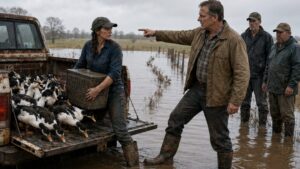
Water crossed the gravel lane before Robert reached the gate.
It came in a broad brown sheet, shallow enough to look harmless until one watched what it carried with it—fine stone, loose soil, bits of cut grass, everything the new shoulder was supposed to hold.
Robert stopped his pickup uphill and left it there.
Rain struck his jacket hard enough to hiss.
He walked toward the culvert, boots sinking at the road edge. The ditch that had held two inches of water after dry weather was now full and moving, but not toward the pipe.
It was moving sideways.
Across the lane.
Toward Linda Mitchell’s lower pasture.
Robert pulled out his phone and began recording.
He filmed the water backing above the culvert, then the overtopped drainage strip, then the muddy current cutting across the gravel.
The rust-dark marker stake was barely visible. Only its top two inches remained above the brown water.
A truck horn sounded behind him.
Robert turned.
A feed truck had stopped on the higher part of the lane. The driver lowered his window.
“Can I get through?”
Robert looked at the softened shoulder.
A loaded truck could probably cross.
Probably was not good enough.
“Not on that edge,” Robert called. “Hold there.”
The driver leaned forward to study the road.
“I’ve got a delivery for Mitchell.”
“She can meet you up here.”
Robert called Linda.
She answered on the third ring.
“What?”
“Don’t bring anything heavy down your driveway.”
There was a pause.
“What happened?”
“Come look.”
She arrived five minutes later in a raincoat over work clothes, her utility vehicle left on higher ground.
The moment she saw the water crossing toward her pasture, she stopped.
“That never did that.”
“No.”
“Not even in spring.”
“No.”
Linda walked closer until Robert caught her arm.
“Stay off the shoulder.”
She looked down.
The gravel had begun to slump at the edge where runoff was eating beneath it.
Her face changed.
“My cattle are in the north lot.”
“They’re fine for now.”
“And if this keeps coming?”
“We move them higher.”
Robert called Alexander next.
Alexander arrived with Samuel twenty minutes later.
By then the feed truck had backed almost a quarter mile to turn around at another entrance.
Alexander climbed from his pickup and stood in the rain, staring at the crossing water.
For once, he did not say Robert was overreacting.
Samuel walked toward the culvert and stopped when mud swallowed his boot nearly to the ankle.
“This shoulder’s going.”
Robert pointed downstream.
“So is Linda’s outlet.”
Alexander looked toward the pasture.
“We’ve had a lot of rain.”
“Not enough to make water run uphill,” Robert said.
Alexander’s jaw tightened.
“There it is.”
“What?”
“That tone.”
Robert almost laughed.
Instead he turned his phone screen toward Alexander.
The video showed water ponding above the pipe before spilling across the lane.
“This is not about tone.”
“We can cut a temporary relief.”
“No.”
Alexander stared at him.
“We’re not standing here while the road washes out.”
“If you cut wherever you feel like cutting, you may send all of it through her pasture.”
Linda stepped closer.
“Robert’s right.”
All three men looked at her.
Linda folded her arms against the rain.
“I said he’s right about that. Nobody cuts anything until we know where the water’s supposed to go.”
Alexander’s expression hardened.
“You were the one asking me to keep the cost down.”
“I was asking you not to send another assessment.”
“And this is what that looks like sometimes.”
The words landed badly.
Linda’s face went still.
Robert watched Alexander recognize it half a second too late.
Samuel rubbed rain from his forehead.
“We need to get out of the road.”
They moved into the equipment shed, leaving the doors open so they could watch the runoff.
Rain hammered the metal roof.
Robert spread his copies across a workbench: approved drawing, pipe invoice, fill invoice, field note.
Alexander looked down at the papers.
“So Samuel gave you everything.”
“He gave me records I asked for.”
“You went through association billing without coming to me?”
“You couldn’t tell me what revision you used.”
Alexander picked up the handwritten note.
His initials sat beneath the field change.
For several seconds, nobody spoke.
Finally Alexander said, “We were already over budget.”
Robert waited.
“The shoulder failed compaction twice. We needed more stone. Pipe was higher than quoted. The contractor said if we extended the run the way the drawing showed, we’d have to undercut another section and bring in more fill.”
Samuel looked at the floor.
Alexander continued.
“He said we could shift the outlet and make the grade work from there.”
“Did he say the county approved that?”
“He said it was a field adjustment.”
“That’s not the same thing.”
“I know that now.”
Robert studied him.
That was the first admission Alexander had made.
Not enough.
But real.
“You signed it.”
“Yes.”
“Without review.”
Alexander slapped the paper onto the bench.
“I signed a cost change. I wasn’t pretending to be an engineer.”
“You moved a drainage outlet.”
“I approved a contractor’s recommendation.”
“And you knew the plan showed something different.”
Alexander leaned forward.
“You want the truth? I knew everybody was already furious about the cost. Linda had called twice. Another owner threatened to quit paying. Samuel told me the maintenance account couldn’t take another hit.”
Samuel nodded reluctantly.
“That part’s true.”
Alexander looked at Robert.
“And you had fought the road project from the beginning.”
“I questioned one section.”
“You questioned everything.”
“No. You heard everything as a challenge.”
“And you made every question sound like we were incompetent.”
Robert opened his mouth.
Then stopped.
Because somewhere inside Alexander’s anger was something Robert did not want to examine.
He had never called them incompetent.
He had also never bothered to explain himself.
He had written objections in the same clipped language he once used on county correction notices. Elevation inconsistent. Outlet requires verification. Existing drainage path compromised.
To Robert, those were facts.
To people who did not know where that language came from, they could sound like verdicts.
Linda spoke before either man continued.
“I knew he was worried before the work was accepted.”
Robert turned.
Alexander frowned.
“What?”
Linda stared out through the shed opening.
“He came by my place. Asked whether I’d noticed more water at the lower fence.”
Robert remembered.
Two months earlier.
She had told him she had enough problems without getting involved in another road argument.
Linda swallowed.
“He told me if the outlet was moved uphill, my pasture might take the extra runoff.”
Alexander stared at her.
“You never told me that.”
“No.”
“Why?”
“Because I didn’t want another assessment.”
Her voice was quiet.
“I figured Robert was probably right about something, but I also figured if I backed him, you’d stop the job, and then everybody would blame me when the bill went up.”
Rain struck the roof.
Robert felt none of the satisfaction he might have expected.
Linda had believed him.
She had stayed silent anyway.
Not because she disliked him.
Because she was afraid of the cost.
Alexander sat on the edge of the workbench.
For the first time the problem no longer had a convenient villain.
Just a line of choices, each one easier than the next until the water arrived.
A sharp cracking sound came from outside.
They rushed to the door.
Part of the road shoulder had collapsed into the drainage strip.
Not much.
Maybe eighteen inches.
Enough.
Alexander stared at it.
“We need the county out here.”
Robert looked at him.
“You’re agreeing now?”
“I’m agreeing we need to know what we’ve got.”
“That means they may look beyond this culvert.”
Alexander’s face tightened.
“I understand.”
Robert was not sure he did.
That evening, after the rain weakened, Robert sat at his kitchen table.
He had one folder open.
Photographs.
Videos.
The approved plan.
The field note.
Invoices.
His measurements.
He drafted a short cover letter to the county drainage office.
No accusation.
No demand for punishment.
Only dates, observations, locations, and a request for inspection.
Before sending it, he read the final paragraph twice.
He thought about Alexander admitting the budget pressure.
Linda admitting her silence.
Samuel handing over records that did not make himself look particularly good.
Then he thought about the feed truck backing away from a road that had been rebuilt to make access safer.
Robert attached the files.
For six weeks he had tried to keep the issue inside the association.
At 8:43 p.m., he pressed Send.
Chapter 5: The County Did Not Stop at One Culvert
The county drainage inspector drove a measuring rod into the soil beside the rust-dark stake and said, “Don’t move this.”
Robert almost smiled.
Three days earlier, Alexander had wanted the stake gone beneath fresh stone.
Now it was the first thing the inspector had asked to preserve.
Robert stood beside the lane with his hands in his jacket pockets while the inspector sighted down the drainage strip. A soil-and-water conservation technician worked farther uphill, taking elevations at intervals.
Alexander and Samuel waited near the association shed.
Nobody had brought coffee.
The inspector called Robert over.
“This your reference?”
“It was there before the project.”
“You documented it?”
Robert handed him two dated photographs.
The inspector studied them.
Then he looked at Robert.
“You worked drainage?”
“Retired.”
“What side?”
“County design.”
“How long?”
“Twenty-seven years.”
The inspector handed back the photos.
“That explains the package.”
Robert was not sure whether it was praise.
He did not ask.
The county crew spent the next hour on the culvert itself.
They measured inlet and outlet elevations, checked the existing ditch line, photographed erosion at the road edge, and compared the constructed route to the approved drawing.
Alexander followed them until the inspector finally said, “I’ll come find you when I need you.”
That was the first visible shift in control.
Alexander stopped following.
Robert noticed the strain in his face.
For weeks Alexander had decided when the complaint was discussed, when contractors worked, when meetings ended.
Now someone else decided where everyone stood.
Robert found less pleasure in that than he expected.
By midmorning the inspector had confirmed the obvious.
The culvert and drainage channel did not match the approved plan.
But he did not stop there.
He walked downstream.
Robert followed at a distance.
The technician flagged a shallow lateral crossing near one neighboring driveway.
“What’s this tied to?” the inspector asked.
Samuel answered.
“That carries runoff off the upper field.”
“Was it replaced during the road job?”
“Cleaned and reshaped.”
The inspector checked the plan.
“Not like this.”
Alexander stepped forward.
“That wasn’t part of Robert’s complaint.”
The inspector looked at him.
“It’s part of the same drainage system.”
That sentence changed the day.
They crossed the lane to another lateral.
Then Linda’s pasture outlet.
The inspector photographed fresh sediment gathered against her lower fence.
Linda stood beside Robert, silent.
The technician scraped mud away with a shovel.
“There used to be a defined outlet here?”
“Yes,” Linda said. “Before the road work.”
The inspector looked toward Alexander.
“Who directed the field changes?”
Alexander hesitated.
“I approved the contractor’s recommendations.”
“All of them?”
“Most.”
The inspector wrote something on his pad.
By noon, three deviations had been identified.
By one, there were four.
The original culvert.
Two lateral drainage crossings.
Linda’s pasture outlet.
Each one had been adjusted during the same project.
Each change made sense if considered alone.
Shorter pipe here.
More fill there.
A quicker outlet.
Less excavation.
Together, they had changed how water moved along nearly the entire shared lane.
Robert stood looking down the road.
He had spent six weeks staring at one puddle.
The puddle had been telling him about the whole project.
The inspector called Alexander and Samuel to the back of his truck.
“This work is stopped effective now.”
Alexander went pale.
“You mean drainage work.”
“I mean work associated with the approved road-and-drainage plan until we determine what needs correction.”
“The road’s already in use.”
“You can use what’s safe. No additional grading, excavation, pipe placement, shoulder construction, or modification.”
Alexander glanced at Robert.
“When can we get that lifted?”
“When we have a compliant correction plan.”
“We’ve got hay coming out next week.”
The inspector nodded.
“Then you need a plan quickly.”
Alexander’s frustration broke through.
“You understand what shutting this down does to us?”
“I understand why I’m shutting it down.”
The answer was not angry.
That made it final.
The inspector attached a bright stop-work notice to a temporary project board beside the equipment shed.
Robert watched the paper move slightly in the wind.
For a moment, he felt the clean satisfaction he had imagined during all those meetings.
He had been right.
The county had confirmed it.
Nobody could call his complaint obsessive now.
Then a loaded hay wagon came over the rise.
The driver slowed at the narrowed section where the shoulder had collapsed.
The wagon’s right tires passed within inches of the soft edge.
Robert’s satisfaction vanished.
The inspector saw it too.
“How many loads come through here during harvest?”
“Depends on the week,” Robert said.
“Emergency vehicles?”
“Same road.”
“Milk trucks?”
“Not anymore. Feed, livestock trailers, fuel delivery.”
The inspector looked down the lane.
“If we require full excavation all at once, access gets ugly.”
Alexander seized on that.
“That’s what I’ve been saying.”
The inspector turned toward him.
“No. You’ve been saying you wanted the project accepted as built. That option is gone.”
Alexander said nothing.
The inspector continued.
“The question now is correction sequence.”
That afternoon they marked every affected section.
The findings were worse than Robert had expected but not catastrophic.
Nothing suggested houses were about to move or the entire lane needed rebuilding.
It was more ordinary than that.
More expensive than that.
Pipe lengths wrong.
Grades inconsistent.
Outlets shifted.
Fill placed where flow needed room.
Several small decisions that collectively forced water into places it had not gone before.
Linda stood beside one flagged section in her pasture.
“I kept telling myself one wet corner wasn’t worth fighting over.”
Robert looked at the silt line on her fence.
“No one likes paying to dig up something they just paid to build.”
“That why you didn’t tell us what you used to do?”
He glanced at her.
Linda waited.
Robert looked back toward the stake.
“Partly.”
“What’s the other part?”
He did not answer.
She did not press.
Near sunset, the inspector completed his notes.
“The original complaint is substantiated,” he told the group. “The constructed drainage configuration differs materially from the approved layout. We’ll issue written corrective requirements.”
Samuel exhaled as if he had been holding his breath all day.
Alexander asked, “How much has to come out?”
“Potentially all affected sections.”
Alexander closed his eyes briefly.
The inspector continued.
“But I’d rather not sever access if there’s a compliant way to phase it.”
He looked at Robert.
Not Alexander.
Robert felt it immediately.
The request forming before the inspector spoke.
“You know this ground,” the inspector said. “And you know the approved intent.”
Robert did not respond.
The inspector pointed down the lane.
“If you were sequencing the correction, is there a way to rebuild the drainage and keep one usable lane through most of it?”
Behind Robert, nobody moved.
Six weeks of dismissal sat between him and the answer.
So did harvest.
So did Linda’s cattle.
So did every truck that used the road.
Robert looked toward Alexander.
Alexander looked back without defiance now.
Only fatigue.
The inspector waited.
Robert could have said it was no longer his problem.
Instead he heard himself say, “I’d have to look at it.”
Chapter 6: Winning the Argument Would Close the Road
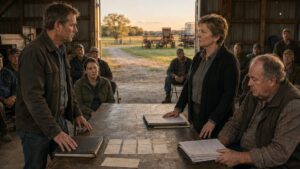
Alexander opened the machinery-shed meeting by saying, “Robert has every right to insist we follow the county order exactly as written.”
Robert knew immediately what Alexander expected him to do.
The folding table was crowded with copies of the stop-work notice, contractor estimates, and the county’s preliminary correction list.
Linda sat across from Samuel.
The two other owners occupied chairs near the open shed door.
Robert remained standing beside a rolled drawing.
Alexander continued.
“If that means opening every affected section at once, then that’s what we’ll have to deal with.”
Nobody looked at Robert directly.
A week earlier, he might have enjoyed the silence.
Now he understood what it contained.
Fear.
The first contractor estimate had arrived the day before.
Even phased, the repair would require a special assessment.
Done all at once, it would be worse—not merely in cost, but in access. The shared lane would be difficult for loaded farm vehicles and possibly impassable at points during excavation.
Alexander slid the county letter toward Robert.
“You wanted outside review. We got it.”
There was no sarcasm in the words.
That made them harder to answer.
Robert unrolled his drawing.
“I don’t want everything opened at once.”
Alexander frowned.
Samuel leaned forward.
Robert placed four marked sections along the lane.
“Start at the lowest outlet. Reestablish discharge first. Then Linda’s pasture connection. After that, correct the lower lateral and culvert while keeping the west half of the lane compacted for traffic.”
Alexander stared at the drawing.
“You worked this up?”
“Yes.”
“When?”
“Last three nights.”
Robert pointed to a narrow shaded strip.
“Temporary travel lane stays here. No loaded traffic during excavation hours. Plate the crossing overnight if the county accepts it. Upper lateral waits until the lower system is functioning.”
Samuel came around the table.
“That keeps the road open?”
“Most of the time.”
“To feed trucks?”
“If they stay under the temporary limit while work is active.”
Alexander looked from Robert to the plan.
“Why would the county agree?”
“They may not.”
“You said—”
“I said this is how I’d propose it. They decide whether it complies.”
Robert heard the old precision in his own voice.
The habit of leaving no sentence wider than necessary.
He almost stopped there.
Then he looked at Linda.
She had spent months afraid of an assessment.
Samuel had spent months trying to keep one from happening.
Alexander had turned those pressures into a bad decision.
And Robert had spent months expecting all of them to understand warnings he had deliberately stripped of context.
He pulled his weather-stained notebook from his jacket.
Its cover had softened at the corners. Several pages had warped from rain years ago.
He opened it near the back, then flipped farther.
Older entries.
Different handwriting.
His own, but younger.
Robert rested one finger on a page.
“The reason I kept pushing this wasn’t just because I worked drainage.”
Nobody interrupted.
“When I was new with the county, I reviewed a farm crossing after the field inspector called in a change. The numbers looked close. I approved it from the office.”
Alexander’s expression shifted.
Robert kept his eyes on the notebook.
“First heavy spring, the outlet backed up. Took part of a field entrance and flooded a machine shed.”
Samuel asked quietly, “Anybody hurt?”
“No.”
Robert paused.
“Which made it easier for everybody to call it a lesson instead of what it felt like.”
He closed the notebook.
“I had signed my name to something I hadn’t checked on the ground.”
Alexander stared at him.
“That was what? Thirty years ago?”
“Close.”
“And you’ve been carrying it since?”
Robert gave a small shrug.
“Water has a long memory.”
Nobody laughed.
The phrase might have sounded theatrical from somebody else.
From Robert, holding a notebook older than some of their tractors, it did not.
Linda spoke.
“I need to say something.”
Alexander turned toward her.
She folded her hands on the table.
“Robert warned me before the work was accepted.”
Samuel looked down.
The other owners shifted in their chairs.
Linda continued.
“He asked whether I’d seen more water near my lower fence. He told me the outlet shift could matter.”
Alexander said, “You told us that in the shed.”
“I’m telling everybody now.”
Her voice tightened.
“I didn’t back him because I was scared of another bill.”
She looked at Robert.
“And when people started saying he was making a problem out of nothing, I let them.”
Robert said nothing.
“I knew enough to know he might be right,” Linda continued. “I just wanted him to be wrong because wrong was cheaper.”
Samuel leaned against the table.
“That might be the most accurate thing anybody’s said about this project.”
Even Alexander smiled faintly.
The tension loosened, but only for a moment.
Samuel tapped the new estimate.
“Cheaper isn’t available anymore.”
The total sat at the bottom of the page.
It was not ruinous divided among the owners.
It was still painful.
Alexander rubbed his forehead.
“We don’t have enough reserve.”
“No,” Samuel said.
“How bad?”
Samuel named the assessment each property would likely face.
Linda closed her eyes.
One neighbor swore softly under his breath.
Robert looked at the correction plan.
This was the part no county notice could make satisfying.
Money had to come from somewhere.
Harvest schedules would change.
Somebody would have to supervise contractors.
Neighbors who already blamed one another would still meet on the same lane afterward.
Alexander finally looked at Robert.
“You could have gone to the county sooner.”
“Yes.”
The answer surprised everyone.
Alexander sat straighter.
Robert continued.
“I thought the measurements should be enough. Then I thought the photographs should be enough. Then I thought if I kept writing it plainly, eventually somebody would check.”
“You also could’ve told us what you did for twenty-seven years.”
“Yes.”
Alexander’s mouth tightened.
“You let us think you were just mad about the road.”
Robert considered denying it.
Instead he said, “I let you think whatever you wanted because I didn’t think I should have to explain myself.”
Linda looked at him.
“That sounds a little like Alexander.”
Robert met her eyes.
After a second, he nodded.
“A little.”
Samuel laughed once.
Not mockery this time.
Something closer to relief.
They spent the next hour working through Robert’s sequence.
Temporary lane width.
Excavation order.
Pipe delivery.
Drainage stabilization.
Emergency access.
Robert refused two shortcuts Samuel suggested.
He accepted one contractor staging change Alexander proposed.
By the end, the drawing had notes from all four of them around its margins.
It no longer looked like Robert’s plan.
That mattered.
Alexander collected the documents.
“I’ll send this to the inspector tonight.”
Robert reached for his notebook.
Alexander did not move.
“There’s one thing.”
“What?”
“The county wants a responsible technical contact for the proposed sequence.”
Robert understood.
Alexander placed a pen on the table.
“I can submit it as association chairman. Samuel can handle billing. But they’re going to ask who stands behind the grade sequence.”
Robert looked at the pen.
For decades, he had been comfortable finding mistakes in other people’s work.
Signing meant something else.
It meant being wrong was possible again.
He could see the old machine shed in his memory, water across a floor, a farmer holding a county approval with Robert’s signature at the bottom.
Alexander pushed the drawing toward him.
“I’m not asking you to own what we did.”
Robert looked up.
“I’m asking whether you’ll put your name on what we do next.”
The shed was silent.
Robert rested his hand on the closed field notebook.
Then he picked up the pen.
Chapter 7: The Same Stake Marked a Different Kind of Boundary
The test water reached the culvert without stopping.
Robert stood beside the rebuilt drainage strip and watched the clear stream slide past the rust-dark marker stake, gather speed through the new channel, and disappear into the corrugated pipe.
No puddle formed.
No water turned toward the road.
The county drainage inspector waited another thirty seconds before looking down at his tablet.
“Run it again.”
The excavator operator opened the temporary tank valve farther uphill.
A second surge entered the ditch.
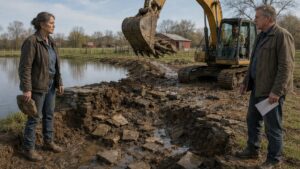
Six weeks of reconstruction had changed the whole edge of the lane. The oversized fill had been removed. The outlet had been shifted back toward the approved alignment. Linda’s pasture connection had been reopened at a lower elevation, and both laterals had been rebuilt before crews touched the main culvert.
Robert’s phased sequence had not worked perfectly.
Two deliveries had been delayed. A section of temporary lane had required additional stone after a loaded livestock trailer rutted it. The county had rejected Robert’s first proposal for overnight steel plating at one crossing and required a wider compacted bypass instead.
He had revised the drawing.
Then he had signed the revision.
That signature had bothered him less the second time.
The inspector walked along the channel, stopping at each flagged station.
Alexander followed several steps behind.
He had followed county inspectors differently during the first visit—close enough to answer before questions were finished, still trying to manage the process.
Today he mostly waited.
Samuel stood near the equipment shed with a folder of invoices tucked beneath one arm. Linda had come down from her pasture and was watching the test from the opposite side of the lane.
The inspector checked the culvert outlet.
“No standing water.”
Robert nodded.
“I see that.”
The inspector glanced at him.
“You know you’re allowed to sound pleased.”
“I’ll wait until you finish.”
“That sounds like county training.”
“Bad habits last.”
The inspector almost smiled.
He continued downstream.
At Linda’s pasture outlet, the soil-and-water technician removed a temporary flag and inspected the stabilized slope. Grass had not fully established yet, but erosion fabric held the bank in place.
Linda walked beside Robert.
“My lower corner stayed dry after Tuesday’s rain.”
“That was not much of a rain.”
“It was enough that I went out and looked.”
Robert glanced at her.
She shrugged.
“I’ve learned to measure ditches.”
That got a laugh out of him before he could stop it.
Across the lane, Alexander heard.
His expression softened briefly.
The inspector returned to the project board near the shed.
“All right,” he said. “The corrective work shown on the revised sequence is acceptable.”
Nobody applauded.
Samuel breathed out.
Linda lowered her chin.
Alexander simply asked, “Restrictions lifted?”
“With one condition. Keep heavy traffic off the new shoulder until final compaction settles. Otherwise, yes.”
Samuel opened his folder.
“I can live with that.”
Alexander looked toward the lane as if seeing it for the first time in months.
The inspector handed him the signed field sheet.
“One more thing. Future changes to this drainage system need written review before construction if they affect alignment, elevation, pipe length, or discharge location.”
Alexander nodded.
“We already changed the association rules.”
Robert had seen the new language.
No single officer could approve material drainage changes in the field. Any revision required written documentation, and at least two property owners had to sign before the association submitted it for review.
Samuel had voted for it.
Linda had seconded the motion.
Alexander had not opposed it.
The inspector packed his equipment and drove away.
Only then did Samuel pull the final accounting from his folder.
“We might as well do this while everybody’s standing here.”
Alexander looked tired.
“Go ahead.”
Samuel placed the pages on the hood of his truck.
The total was several times what the original culvert correction would have cost if the alignment had been fixed before the project was accepted.
Extra excavation.
Replacement pipe.
Stone.
Temporary access.
Engineering review.
Erosion control.
County reinspection.
The association reserve absorbed part of it.
The rest became the special assessment everyone had feared.
Linda stared at the figure.
“Could’ve fixed the first problem for less than a quarter of that.”
Samuel nodded.
“Probably.”
Alexander looked at Robert.
“You going to say it?”
Robert knew what he meant.
I told you so.
For weeks, some small part of him had imagined the opportunity.
Not a speech.
Just one sentence.
Enough to make Alexander carry the same humiliation Robert had carried beside the ditch when everyone laughed.
Robert looked at the invoice.
Then at the repaired road.
“No.”
Alexander waited.
Robert added, “The bill already says it.”
Samuel folded the accounting sheet.
Nobody had much to say after that.
The two neighboring owners left first. Linda walked back toward her pasture after asking Robert whether he thought the erosion fabric would hold through winter.
Samuel drove his truck into the shed.
Alexander stayed.
Robert began collecting the remaining survey flags along his entrance.
He pulled one fluorescent marker from the shoulder, then another.
When he reached the rust-dark stake, he stopped.
The new ditch ran beside it now, clean and shallow, exactly where the grade allowed water to move without crossing the road.
Alexander came up behind him.
“You leaving that?”
Robert rested one hand on the top.
“I was thinking about it.”
“County doesn’t need it anymore.”
“No.”
Alexander kicked lightly at the gravel.
For a while they watched the water from the test disappear downstream.
Finally Alexander said, “I was wrong.”
Robert looked at him.
Alexander kept his eyes on the ditch.
“Not just about the grade.”
Robert waited.
“I decided what your complaint meant before I checked whether it was true.”
There was no audience now.
No meeting table.
No clipboard.
Robert found that made the apology easier to hear.
Alexander continued.
“I thought you were trying to prove I shouldn’t be chairman.”
“I wasn’t.”
“I know.”
Robert pulled one glove off.
“I didn’t make it easy.”
Alexander glanced over.
“That’s generous.”
“It isn’t generosity.”
Robert looked toward the lane.
“I knew what I was seeing. I thought that should be enough. When nobody listened, I got shorter with everybody.”
“You were already pretty short.”
Robert almost smiled.
“I know.”
Alexander hesitated.
“You could’ve told us about the county work.”
“I could have.”
“Why didn’t you?”
Robert considered the old answer.
Because I shouldn’t have had to.
It was still partly true.
But it was no longer the whole truth.
“Because I didn’t want my old job to be the reason people listened.”
Alexander frowned.
“And?”
Robert looked at the marker stake.
“And because if I told you what I knew, then I had to admit how certain I was. I spent a lot of years avoiding that.”
Alexander seemed to understand without needing the old story repeated.
“You signed the correction plan.”
“Yes.”
“How’d that feel?”
“Bad.”
Alexander gave a small laugh.
“Comforting.”
“Then better.”
They stood quietly.
A pickup approached from uphill, slowed at the repaired section, and passed without dropping a tire toward the shoulder.
Alexander watched it go.
“I’m staying chairman until the winter election.”
“I heard.”
“Some people wanted me out immediately.”
Robert said nothing.
“I told them I’d finish the accounting first.”
“That seems reasonable.”
Alexander turned toward him.
“You really mean that?”
“Yes.”
There had been a time when Robert would have thought justice required removal.
Maybe resignation.
Maybe public embarrassment.
But Alexander had not hidden the invoices once the problem surfaced. He had accepted the county order, signed the new review rule, and spent six weeks coordinating access through a project his own decision had made necessary.
Responsibility did not always look like punishment.
Sometimes it looked like staying long enough to clean up the mistake.
Alexander gestured toward the stake.
“So?”
Robert looked down.
Rust had roughened the metal. The grader had bent the top slightly, and straightening it had never quite restored its original shape.
For weeks it had been evidence.
Before that, an annoyance.
Before that, merely a reference point most people had forgotten existed.
Robert pushed it deeper with his boot.
“I’ll leave it.”
“Why?”
Robert looked along the restored drainage strip.
“So next time somebody says a few inches don’t matter, we don’t have to start from scratch.”
Alexander nodded.
He walked back toward his truck.
At the door, he stopped.
“Robert.”
“Yeah?”
“Next project, maybe tell us what you know before the fourth complaint.”
Robert looked at him.
“Next project, maybe read the first one.”
Alexander smiled.
“Fair.”
He drove away.
Robert remained beside the ditch.
The water from the test had nearly drained away now. Only a thin moving ribbon remained, catching light between the stones before slipping beneath the road.
He opened his weather-stained field notebook.
For months its pages had held measurements nobody wanted, photographs nobody trusted, and numbers Robert believed should have spoken for themselves.
He turned to the last page.
Beside the final inspection date, he wrote only three words.
Flow confirmed. Accepted.
Then he closed the notebook.
The rust-dark stake stood beside the channel, bent but firm, marking no property line and no victory.
Just the place where everyone had finally agreed that water had to be allowed to go where the ground required.
Robert left it there.
The story has ended.