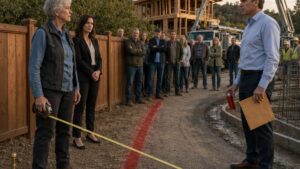
The HOA Ordered a Disabled Veteran to Remove His Ramp—Then Its Own Funding Rules Came Due
Chapter 1: The Notice Waiting Beside the New Ramp
The white envelope was taped to the handrail William Harris needed to reach his own front door.
He saw it before the wheelchair’s front casters cleared the last turn of the new ramp. The envelope had been fixed at chest height with a neat strip of blue painter’s tape, as though whoever left it had taken care not to damage the fresh stain.
William stopped.
For three days, he had been trying not to look at the ramp any longer than necessary.
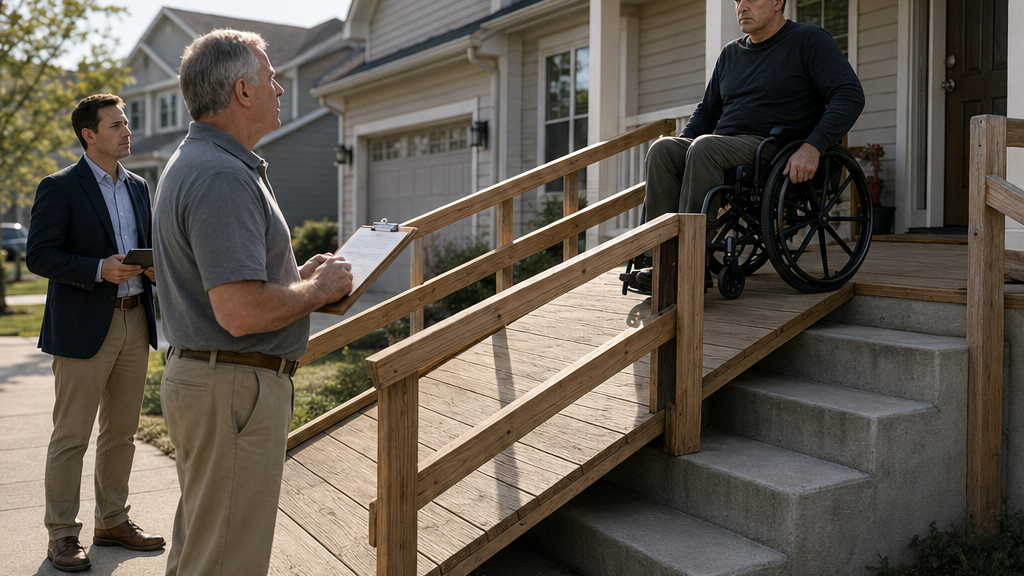
The contractor had done good work. Pressure-treated lumber. Proper slope. Railings solid enough that William could pull himself upright when he wore his prosthetic legs. A broad landing at the top so the wheelchair could turn without catching a wheel against the porch post.
Everything about it worked.
That was the problem.
It worked because he needed it.
William reached for the envelope, peeled it from the rail, and saw the property-management logo through the little plastic window.
He almost laughed.
Instead, he carried it inside.
The kitchen scissors were in the second drawer, but he opened the envelope with his thumb. The first line identified his address. The second identified the structure.
UNAPPROVED EXTERIOR ALTERATION.
He read the phrase twice.
Then he read the rest standing at the kitchen counter, one palm flat against the laminate.
The association had received no architectural application before construction. Exterior modifications required approval. A retroactive review could be requested. A five-hundred-dollar administrative and review fee would be charged.
William exhaled through his nose.
Five hundred dollars irritated him. The word retroactive irritated him more.
He had hired a licensed contractor after his doctor and physical therapist had both told him that the two porch steps were becoming an unnecessary risk. He had delayed the ramp for almost a year, first because he could still manage the steps with his prosthetics on good days, then because he told himself he would get stronger.
Eventually, a fall in the entryway settled the argument.
He had not told the neighbors.
He had not told the board.
He had called a contractor.
The ramp had appeared over two quiet weekdays while most of the subdivision was at work.
William lowered himself into a kitchen chair and continued reading.
Near the bottom, the language changed.
If retroactive approval was not granted, the owner could be required to restore the exterior to its prior condition.
He stopped at that sentence.
Restore the exterior.
The prior condition had two concrete steps from the walk to the porch.
William folded the page once, then opened it again as though the words might have changed.
They had not.
His phone rang while he was still looking at the paragraph.
It was the ramp contractor calling to ask whether one of the railing caps had settled correctly overnight.
William glanced toward the front window.
“Rail’s fine,” he said.
“Good. I can swing by Friday if you want me to check the landing.”
William looked at the notice.
“Did we miss anything?”
A pause.
“Miss anything how?”
“Code. Slope. Width. Whatever.”
“No. We built it to the accessibility specs we discussed. I’ve got the measurements and permit documentation for the work that required it. Why?”
William hated how quickly the explanation rose into his throat.
Instead he said, “HOA sent something.”
Another pause, shorter this time.
“Architectural?”
“Yeah.”
“You want copies of the plans?”
William stared at the five-hundred-dollar figure.
“Send me everything.”
“Will do.”
That should have made him feel better.
It did, briefly.
The ramp was not unsafe. It was not poorly built. It was not some weekend platform thrown together with scrap wood.
There was a file behind it.
Measurements.
Invoices.
Plans.
William put the notice beside the coffee maker and tried to get on with his morning.
He lasted nineteen minutes.
Then he picked it up again.
He went through the association rules online, searching exterior alteration, structural modification, architectural review. The wording was broad. Decks. Fences. Sheds. Roofing changes. Permanent additions visible from common areas.
There was no section labeled wheelchair ramp.
No obvious exemption.
There was also no obvious sentence saying a disabled homeowner could be told to remove the only accessible entrance to his house.
William leaned back.
He knew what someone else would tell him to do.
Call the manager. Explain everything.
He hated that idea more than the fee.
He had spent enough years explaining his body to strangers.
Airports.
Insurance offices.
Physical therapy clinics.
Government desks where somebody needed a form proving that what they could see was, in fact, permanent.
He had no intention of telling an HOA committee what happened in Afghanistan, what kind of prosthetics he used, or why some mornings he woke up with pain in parts of his legs that were no longer there.
The board did not need his history.
It needed one fact.
The ramp was medically necessary.
William opened his email.
He attached the contractor’s preliminary specifications, then typed three sentences.
The ramp installed at my property is medically necessary due to a permanent mobility disability. It was professionally constructed for safe access to my residence. I am requesting that the violation and associated fee be withdrawn.
He reread it.
It felt clean.
Enough.
He sent it before he could start adding anything.
The reply did not come until the following afternoon.
The property manager thanked him for the information and wrote that medical necessity did not eliminate architectural-review requirements. The matter had been referred to the board president and architectural committee.
William read that line on his phone from the top landing of the ramp.
His wheelchair was angled toward the street.
Across the road, a neighbor was unloading groceries and gave him a small wave.
William lifted one hand.
He did not want anyone asking what was wrong.
By Friday, the contractor had sent a complete file. William printed it and put it in a plain folder.
He told himself the paperwork would end the problem.
Saturday passed.
Sunday passed.
On Monday morning, another email arrived.
The association wanted to inspect the modification on site.
The appointment was already proposed for Thursday at ten.
The board president, Gary Clark, would attend with a representative of the architectural committee.
William read the message twice, then looked through the front window at the structure they were coming to inspect.
The ramp ran from the porch to the walk in a simple switchback, its rails still brighter than the older wood around the house.
For the first time since it had been built, William did not see an accommodation.
He saw a line somebody intended to make him defend.
Chapter 2: Show Me the Entrance You Expect Me to Use
Gary Clark arrived three minutes early carrying a clipboard with a removal-compliance checklist clipped to the front.
William noticed the heading before Gary reached the gate.
That told him enough.
He had positioned his wheelchair at the top landing of the ramp, partly because the morning was a bad prosthetic day and partly because he was tired of pretending the physical question was abstract.
The architectural committee member stood a few feet behind Gary with a tablet.
The property manager had not come.
“Morning, William,” Gary said.
“Gary.”
Gary looked at the ramp before he looked at William.
He was in his early sixties, square-shouldered, gray-haired, wearing a polo with the subdivision logo stitched over one side of his chest. William knew him mostly from annual meetings and occasional emails about trash cans or landscaping schedules.
Gary did not look angry.
That almost made the situation worse.
He looked prepared.
“We’re here to document the alteration and determine what needs to happen next,” Gary said.
William nodded toward the folder resting on his lap.
“I’ve got the contractor plans.”
“We received them.”
“And you know why it’s here.”
“Yes.”
Gary said it without hesitation.
William studied him.
“So we’re not debating whether I need it.”
“No. We’re talking about approval.”
The committee member shifted slightly, eyes on the tablet.
Gary stepped toward the bottom of the ramp and examined the first post.
“Our governing documents require exterior modifications to be submitted before construction. That protects everyone. It keeps the process consistent.”
William said nothing.
Gary continued.
“You had the ramp built without an application. The board can’t simply ignore that because the work was already completed.”
“I didn’t ask you to ignore it.”
“You asked us to withdraw the violation and fee.”
“Yes.”
“That would be ignoring it.”
William gripped one wheel rim, then released it.
He had promised himself he would not get dragged into an argument about tone.
“Are you planning to make me remove it?”
Gary glanced down at the sheet.
“If retroactive approval isn’t completed, removal is one of the available enforcement steps.”
There it was.
Not a threat, exactly.
A category.
A box on a form.
William looked at the two men standing below him.
Behind them, the driveway was empty. His truck sat in the garage where he had left it after an appointment the previous day. From the sidewalk, the house looked almost unchanged except for the clean new lines of the ramp.
“Gary.”
“Yes?”
“Show me the entrance you expect me to use.”
Gary frowned.
William pointed toward the porch.
“If that comes out, show me how you expect me to get inside.”
For the first time, Gary looked away from the clipboard.
His eyes moved to the porch steps beside the ramp.
Two concrete steps.
Then the narrow side path.
Then the garage.
“The garage entrance may be—”
“There’s a step into the mudroom.”
Gary stopped.
“The back?”
“Three steps.”
The committee member looked at the side of the house, then at William.
William kept his voice level.
“I’m not asking which entrance exists. I’m asking which one you expect me to use.”
A car slowed on the street.
The neighbor across the road was leaving. William could feel the driver looking without turning his head.
Gary lowered the clipboard.
“No one is suggesting you should be unable to access your home.”
“That’s what removal means.”
“That’s not what I said.”
“It’s what the form says.”
Gary’s mouth tightened.
“The form identifies enforcement options. We haven’t ordered physical removal today.”
“Then suspend it.”
“The violation?”
“Yes.”
“Until what?”
“Until you finish whatever review you think you need.”
Gary shook his head.
“We don’t suspend enforcement simply because someone disputes a violation.”
William looked at him for several seconds.
“You know why the ramp is here.”
“Yes.”
“You don’t have another safe entrance.”
Gary did not answer.
“And you still won’t pause this.”
Gary took a breath.
“This isn’t about whether your disability is legitimate, William.”
The word struck harder than William expected.
Legitimate.
He felt something old and immediate tighten behind his ribs.
He could have told Gary exactly how legitimate it was.
He could have described the blast.
The surgeries.
The first time he woke up and reached for legs that were gone.
Instead he said, “I never asked you to decide whether it was.”
Gary’s expression changed slightly.
“I’m saying the board has a process.”
“And I’m saying your process ends with me at the bottom of my own steps.”
The committee member looked down.
Gary glanced toward him, perhaps aware now that the inspection had become something different than he expected.
“We have other homeowners who have been required to correct unapproved changes,” Gary said. “If the board makes exceptions whenever someone has a reason, then the rules don’t mean much.”
William almost smiled.
“A reason.”
“You know what I mean.”
“I’m not sure I do.”
Gary lifted the clipboard again, and the gesture seemed less confident this time.
“We can review the application retroactively. The fee is part of that process. Submit the full package, and the board will consider it.”
“And while you consider it?”
“The violation remains open.”
William looked at the checklist.
“Why?”
“Because the structure was installed without approval.”
“No. Why does the violation have to stay active while you know removing the structure would make my house inaccessible?”
Gary’s face reddened faintly.
“Because the rules have to apply consistently.”
There it was again.
Not cruelty.
Not even anger.
Something colder because Gary clearly believed the sentence settled the matter.
William rolled backward a few inches.
He was finished helping Gary make the inspection feel ordinary.
“Take your measurements.”
The committee member hesitated.
Gary said, “William—”
“You came to inspect it. Inspect it.”
They spent twelve minutes measuring a ramp whose dimensions they already had in the contractor file.
William watched from the porch.
He felt embarrassed by how exposed he suddenly was.
Every tape-measure click made the structure seem like evidence.
The neighbor across the street returned before they finished and carried two grocery bags inside without looking over again.
Gary finally clipped the tape measure back to the board.
“We’ll document that the installation appears professionally constructed.”
William looked at him.
“That sounds almost like approval.”
“It isn’t.”
“I figured.”
Gary handed the committee member the clipboard.
“We’ll send the next steps through management.”
William rolled toward the door.
Behind him, Gary said, “For what it’s worth, I’m not trying to make this harder than it needs to be.”
William stopped with one hand on the door frame.
He almost turned around.
Instead he said, “Then stop making it harder than it needs to be.”
Three days later, the second notice arrived by certified mail.
William opened it at the kitchen table.
The inspection had confirmed the ramp was structurally sound.
The association still required retroactive architectural approval.
The five-hundred-dollar fee remained due.
And beneath those lines was a deadline.
Ten calendar days.
By then, William had to submit a complete approval package or provide a plan for restoring the property to its prior condition.
He folded the notice along the crease and slid it into his jacket pocket.
For the first time, he did not open his laptop to answer the HOA.
He opened his phone and searched for someone who knew what rules applied to the people enforcing the rules.
Chapter 3: The Difference Between Equal and Accessible
“Did you ever actually request an accommodation?”
Heather Flores asked the question before William had finished taking the folded violation notice out of his pocket.
He looked at her across a small conference table.
“I told them the ramp was medically necessary.”
“That’s not what I asked.”
William sat back.
Heather’s office belonged to a regional fair-housing nonprofit in a converted commercial building between a tax service and a pediatric dental practice. There was nothing dramatic about it. Beige walls. Metal filing cabinets. A copier humming behind a closed door.
He had expected sympathy.
He had not expected cross-examination.
“I emailed management,” he said. “I explained why it was there. I asked them to drop the violation.”
Heather held out her hand.
William passed her the copies.
She read his email first.
Then Gary’s response.
Then the ten-day notice.
When she finished, she tapped William’s three-sentence message with one finger.
“You gave them enough information to understand disability was involved.”
“Good.”
“But you did not clearly ask for a reasonable accommodation from the preapproval requirement or the fee.”
“I asked them to withdraw both.”
“That isn’t quite the same thing.”
William felt irritation rise.
“The ramp exists because I need it. They know that.”
“Yes.”
“They saw me sitting in the chair.”
“I believe you.”
“Then why are we acting like I used the wrong password?”
Heather leaned back.
“Because you came here asking what they can legally do next, not whether what they’re doing feels ridiculous.”
William looked away.
Through the glass wall of the conference room, someone walked past carrying a stack of case folders.
Heather let the silence sit.
Then she said, “There are two separate questions here. One is whether the HOA can have an architectural-review process. Usually, yes. The other is whether that process has to be modified when necessary for a person with a disability to use and enjoy their home.”
William looked back at her.
“Modified.”
“Potentially. Waived in part. Accelerated. Applied differently. It depends on the circumstances.”
“So they can still review the ramp.”
“They may be able to review reasonable safety or design issues. That doesn’t automatically mean they can insist you remove necessary access while they do it.”
William glanced at the papers.
Heather continued.
“And you have a problem of your own.”
He gave her a flat look.
“I figured you were getting to that.”
“You skipped their process completely.”
“I hired a professional.”
“That helps with safety. It doesn’t answer the procedural point.”
William said nothing.
Heather slid his email back toward him.
“You assumed the necessity spoke for itself.”
“It should.”
“Maybe morally. Administratively, assumptions create room for people to hide behind paperwork.”
The sentence landed harder than he wanted to admit.
For years, William had treated explanation as surrender.
If somebody could see the prosthetics, he did not tell them what he needed unless they asked.
If he was in the wheelchair, he expected them to understand stairs without a conversation.
Most people did.
Some did not.
And when they did not, he usually found another way instead of asking twice.
Heather placed the second notice beside his first email.
“You do not have to give them your entire medical history. You don’t have to describe your service. You don’t need to prove your worth. But you do need to make the request unmistakable.”
William stared at the phrase prove your worth.
He disliked how accurately she had found the thing he had not said.
“What would you write?”
“I’d write what you mean.”
“I mean leave the ramp alone.”
Heather almost smiled.
“Then we make that slightly more useful.”
They spent the next forty minutes building the request.
Not a plea.
Not a biography.
William disclosed that he had a permanent mobility disability substantially affecting walking and stair use. He stated that the ramp was necessary for safe access to his residence. He requested reasonable accommodation from advance-approval penalties and asked that enforcement be suspended while any legitimate architectural review occurred.
Heather asked whether the five-hundred-dollar fee would create financial hardship.
“No.”
“Then don’t say it does.”
William looked at her.
“I wasn’t going to.”
“I know. I’m showing you the difference between the arguments we could make and the arguments we should make.”
That earned the first genuine smile from him all morning.
Back home, Heather asked him to photograph the ramp.
William stood at the bottom with his phone, then stopped.
The ramp looked different through a camera.
Its geometry became obvious.
The porch steps beside it.
The turn in the landing.
The rail height.
The short distance between the sidewalk and front door that had once required more planning than anyone passing the house would ever know.
He took four photographs.
In one, his wheelchair was visible at the top landing.
He almost deleted it.
Instead, he attached it.
Heather sent the completed request that afternoon by email and certified mail to management, Gary, and the association’s official correspondence address.
For the first time, William felt less like he was defending an accusation and more like he had put a question in front of them that required an answer.
Three days passed.
Then five.
On the sixth day, Heather called.
“They responded.”
William was in the kitchen making coffee.
“Already?”
“Yes.”
“That sounds promising.”
“It isn’t.”
He set the mug down.
Heather read the important section aloud.
The board acknowledged receipt of William’s accommodation request and stated that it did not discriminate on the basis of disability.
William waited.
Heather continued.
The association maintained that architectural standards and approval requirements were applied uniformly to all property owners. Allowing one owner to bypass procedures, the response said, could create unequal enforcement and weaken the association’s ability to administer its covenants consistently.
William closed his eyes.
“Did Gary write that?”
“His name is on it.”
“What about suspending enforcement?”
“Denied.”
“The fee?”
“Still due.”
“Removal?”
“They say all enforcement options remain available if the application isn’t completed.”
William looked toward the front window.
The ramp was visible beyond the living room, bright in the afternoon sun.
It had been measured.
Photographed.
Explained.
Documented.
Gary knew exactly what it was for.
William no longer had the comfort of telling himself this was a misunderstanding caused by his own short email.
Heather was quiet for a moment.
Then she said, “There’s one sentence in here I want you to remember.”
“What sentence?”
“‘The association must apply the same standards to every owner.’”
William let out a dry breath.
“That’s their defense?”
“For now.”
He picked up the folded violation notice from the counter. He had started carrying it without noticing, moving it from jacket to table to truck and back again.
He unfolded it and looked at the ten-day deadline.
“What happens now?”
Heather answered carefully.
“Now we find out whether they’re confused about what equal treatment means.”
William looked through the window again.
“And if they’re not confused?”
There was a short silence on the line.
“Then we find out what they’re trying to protect.”
Chapter 4: The Exceptions Nobody Called Exceptions
“You know they approved my handrail after it was already installed.”
William stopped with one wheel on the edge of the sidewalk.
The neighbor who had spoken was standing beside a hedge two houses down, clipping dead leaves into a paper yard bag. She was older, small-framed, with one hand wrapped around the handle of a cane she had leaned against the fence.
William had only stopped because she asked how he was doing.
He had answered, “Fine.”
Apparently, he had not sounded convincing.
“What handrail?” he asked.
She pointed toward her porch.
A black metal rail ran beside three brick steps.
“That one. My son had it put in after I fell. We didn’t ask first. Board sent me a letter, I sent pictures, and they approved it after the fact.”
William looked at the rail.
“When?”
“Two years ago, maybe three.”
“Did they charge you five hundred dollars?”
She frowned.
“No.”
“Did they threaten to make you remove it?”
Her pruning shears stopped.
“No.”
William looked back toward his own house.
The ramp was visible between the parked cars, pale wood against darker siding.
For weeks, Gary’s position had rested on one idea: the board could not make exceptions without undermining the rules.
William had believed him on that much.
He had assumed the board was rigid with everyone.
That assumption had made the fight simpler.
Now it did not.
That evening, he called Heather.
“You ever request old meeting minutes?”
“All the time.”
“I think we need some.”
“What happened?”
William told her about the handrail.
Heather was quiet for a moment.
“One exception won’t prove much.”
“I know.”
“But it may tell us where to look.”
The association’s public records were not organized for easy reading. William found three years of meeting minutes on the resident portal, each saved as a scanned PDF with inconsistent file names.
He searched for handrail first.
Nothing.
Then accessibility.
Nothing.
Then emergency repair.
That produced results.
A storm-damaged fence had been replaced before architectural approval and ratified at the next meeting.
A resident with a leaking roof had installed a different shingle color temporarily and received retroactive approval.
A set of hurricane shutters had been added before review because the owner claimed an urgent installation schedule.
William kept reading.
There were notes about a temporary ramp at another property, though the circumstances were vague. The board had allowed it to remain while paperwork was completed.
He leaned closer to the screen.
The wording was almost casual.
No warning of removal.
No five-hundred-dollar fee.
No language about equal standards.
By midnight, he had printed eleven pages.
The next board meeting was three days away.
Heather told him not to walk in accusing anyone of discrimination based only on selective examples.
“Ask questions,” she said.
“I’m tired of questions.”
“I know.”
“They already answered the important one.”
“Then ask the questions they haven’t rehearsed.”
The clubhouse meeting room was half full when William arrived.
He hated public meetings.
Not because crowds bothered him.
Because they changed people.
A person who might admit uncertainty in a hallway became certain behind a microphone.
A person who might listen across a kitchen table started performing once chairs were lined in rows.
William took a seat near the aisle.
Gary sat at the board table with Barbara Wright, the treasurer, and two other board members. The property manager arranged papers beside a laptop.
When homeowner comments opened, William waited until two landscaping complaints and one parking dispute were finished.
Then he rolled forward.
Gary’s expression tightened almost imperceptibly.
“William.”
William placed copies of the minutes on the front table.
“I have a question about retroactive approval.”
Gary glanced at the pages.
“We’ve discussed your application.”
“I’m not asking about mine yet.”
The room shifted.
William tapped the first document.
“This fence replacement was approved after installation.”
Gary glanced down.
“Emergency storm damage.”
William moved to the next.
“These shutters?”
“Time-sensitive weather preparation.”
“This handrail?”
Gary did not answer immediately.
The property manager leaned closer to the paper.
William continued.
“And this temporary ramp was permitted while review was pending.”
Gary looked at him.
“Those situations aren’t identical.”
“I didn’t say they were.”
“Then what’s your point?”
“My point is I was told the board couldn’t suspend enforcement for me because rules have to apply consistently.”
“They do.”
William looked at the pages spread across the table.
“Consistently doesn’t seem to mean the same thing every time.”
A murmur started behind him, not loud enough to become interruption.
Gary straightened.
“The board has discretion in circumstances involving emergencies, temporary conditions, and maintenance.”
“Disability access isn’t enough for discretion?”
“That’s not what I said.”
William felt the familiar frustration rise.
He slowed himself before answering.
“What category does it need to fit?”
Gary’s jaw tightened.
“The issue remains that your structure was installed without prior approval.”
“So were these.”
“Under different circumstances.”
William looked at Barbara.
She had been following the documents closely, one finger resting on the margin of the minutes.
He expected her to defend Gary.
Instead she asked, “Was the five-hundred-dollar fee applied in these cases?”
Gary turned toward her.
“Barbara, those were handled under prior board decisions.”
“That wasn’t my question.”
The room changed again.
Not dramatically.
But enough.
Gary looked at the property manager.
“I’d have to check.”
Barbara nodded once.
William saw something in her face then—not sympathy for him, exactly.
Concern.
The financial kind.
Gary returned to William.
“If your objective is to resolve the ramp, there is a path.”
William waited.
“Submit the fee. Complete the architectural packet. The board is prepared to approve the existing structure assuming the final documentation matches what we inspected.”
For one second, William felt relief.
It came so quickly he almost distrusted it.
“You’ll approve it?”
“Yes.”
Heather’s warning came back to him.
Listen to what they want in exchange.
Gary slid a single sheet across the table.
William read the first paragraph.
The association would accept the existing ramp.
The second paragraph confirmed payment of the administrative fee.
The third stated that William acknowledged construction had violated governing procedures and that the accommodation did not alter the association’s authority to apply those procedures uniformly in future cases.
William read it twice.
“So this ends my violation.”
“Yes.”
“But changes nothing else.”
“It resolves your property.”
William looked up.
“And I admit you were right.”
“You acknowledge you built without approval.”
“You also want me to agree your process was properly applied.”
Gary said nothing.
That was answer enough.
William pushed the paper back.
“No.”
Someone behind him shifted in a chair.
Gary’s voice lowered.
“This is the outcome you asked for.”
“No. I asked you to stop treating the ramp like it should never have been built.”
“We’re approving it.”
“For five hundred dollars and a confession.”
“That’s an unfair description.”
William gathered the meeting minutes.
“Then why do you need my signature?”
Gary looked toward the other board members.
For the first time, he seemed less annoyed than impatient.
As if William had failed to understand that the practical part was being offered and should be enough.
Barbara was still reading the old minutes.
The meeting moved on.
William rolled back to his seat, but his attention stayed on the board table.
Near the end of the meeting, while the property manager was discussing a landscaping contract, Barbara leaned toward Gary and spoke quietly.
William could not hear the first sentence.
He heard the second.
“Why wasn’t counsel copied on his accommodation request?”
Gary turned sharply toward her.
Barbara did not look away.
The property manager stopped speaking for half a second, then continued.
William sat very still.
Until that moment, he had thought Gary was trying to settle a dispute.
Now he wondered what Gary was trying to settle before someone else looked at it.
Chapter 5: The Grant File Behind the Board Budget
Barbara stopped the finance meeting by placing one page flat on the table and saying, “Gary, your signature is on this.”
William was not supposed to be part of the finance committee.
He was there because Barbara had asked Heather whether he could attend the open portion involving neighborhood improvement funds.
Heather had told William to listen more than he spoke.
That became difficult almost immediately.
The meeting was smaller than a normal board session. Gary sat at one end of the clubhouse table. Barbara had three binders open in front of her. A county reimbursement schedule was projected onto the wall.
At the top of Barbara’s page was a certification heading.
William could not read the small print from where he sat.
Gary could.
His face changed.
Not panic.
Recognition.
“What exactly are you asking?” he said.
Barbara tapped the page.
“This annual certification says the association is complying with applicable fair-housing requirements connected to the improvement program.”
Gary leaned back.
“That’s standard grant language.”
“I know what standard language is.”
“You’re making this sound more dramatic than it is.”
Barbara looked toward William, then back to Gary.
“I’m asking whether our attorney reviewed the Harris matter before you signed correspondence saying we were applying the correct standard.”
Gary’s voice sharpened.
“This is a private architectural dispute.”
Heather, seated beside William, spoke for the first time.
“It stopped being only architectural once a disability accommodation was formally requested.”
Gary looked at her.
“This isn’t a legal hearing.”
“No,” Heather said. “Which is why I’m not arguing the case. Barbara asked a compliance question.”
Barbara flipped several pages.
The subdivision had entered a county-administered neighborhood improvement program three years earlier. Federal community-development money flowed through the county for drainage repairs, sidewalk improvements, and accessibility upgrades in qualifying areas.
William had seen the projects.
Orange survey paint near the storm drains.
A planned sidewalk connection at the south entrance.
Residents had paid special assessments for portions not covered by outside funds.
He had never cared where the rest came from.
Now Barbara pushed another document toward the center.
“We certified this last year and again this year.”
Gary glanced at it.
“Because we’re compliant.”
Barbara’s eyes narrowed.
“Are we?”
The question landed harder than William expected.
Gary looked at William then.
Not angrily.
Almost accusingly.
As though William’s ramp had somehow entered a room where it did not belong.
Barbara continued.
“If there’s an open fair-housing complaint, I need to know whether it affects reimbursement.”
“There is no finding against us.”
“I didn’t ask whether there was a finding.”
Gary’s hand tightened around his pen.
Heather leaned toward William and whispered, “Don’t jump in.”
He had not realized he was leaning forward.
After the meeting, Barbara agreed to contact the county community-development office.
William expected days of silence.
Instead, the county administrator scheduled a call the next morning.
The explanation was careful.
No one said the HOA had lost funding.
No one said the grant was automatically revoked because of William’s complaint.
The administrator did say that compliance certifications mattered, that unresolved fair-housing issues could require review, and that future reimbursements or draws were not guaranteed while questions remained unresolved.
“Does that mean the sidewalk money stops?” Barbara asked.
“Not automatically.”
“The drainage work?”
“Again, not automatically.”
“What does it mean?”
“It means the county may need documentation showing corrective action before certain future funds are released.”
William looked at Heather.
There it was.
Not revenge.
Not a magic switch.
Leverage.
The exact kind Gary had used against him, only larger.
Later that afternoon, Heather laid the documents across William’s kitchen table.
His ramp photograph was clipped to the accommodation complaint.
Beside it sat copies of the funding certifications.
The juxtaposition made him uncomfortable.
A month earlier, the whole dispute had seemed absurdly small: a wooden ramp, a form, five hundred dollars.
Now the same ramp sat in a file connected to federal compliance language and neighborhood infrastructure.
Heather tapped the certification.
“This doesn’t prove fraud.”
“I know.”
“It doesn’t mean funding disappears.”
“I know.”
“It means their decisions have consequences outside your property.”
William looked at her.
“You keep saying that like you think I’m enjoying this.”
Heather paused.
“Are you?”
He almost answered no immediately.
Instead he looked toward the front window.
For one brief moment at the finance meeting, when Gary had seen his signature on the certification, William had felt something close to satisfaction.
Not because of the money.
Because Gary had finally been forced to look at a rule that applied upward.
William did not like admitting how good that felt.
“A little,” he said.
Heather nodded.
“Then remember that feeling before you decide what you want.”
“What I want is the ramp left alone.”
“That was what you wanted.”
William frowned.
“What’s changed?”
“Now you know this may affect more than you.”
The first consequence appeared two days later.
A notice went out to residents stating that the scheduled drainage improvement contract might be delayed pending administrative review.
It did not mention William.
It did not mention disability.
It did mention funding documentation.
By evening, neighborhood social-media posts were speculating about cost overruns, county bureaucracy, and board incompetence.
William read none of the replies.
The neighbor across the street knocked on his door instead.
“Is this connected to your ramp?”
William hesitated.
“I don’t know yet.”
The neighbor nodded toward the structure behind him.
“For what it’s worth, I still think they should’ve handled that differently.”
William appreciated the sentence.
He also heard what had not been said.
But I don’t want my street torn up all summer because of it.
The next board meeting was tense before it began.
Gary gave a short update saying the association was responding to routine county questions and that planned work had not been canceled.
Barbara corrected him.
“Delayed reimbursement is not routine for us.”
Gary stared at her.
She stared back.
William watched the alliance between them crack in public.
There was no dramatic denunciation.
Barbara simply refused to soften the numbers.
Afterward, William waited outside while Heather spoke with the property manager.
Gary came through the clubhouse door alone.
He stopped near the bottom of the concrete steps.
For a moment, neither man said anything.
Gary looked older than he had during the ramp inspection.
“You got what you wanted,” he said.
William’s hands tightened on the wheel rims.
“My violation is still open.”
“You know what I mean.”
“No. I don’t.”
Gary looked toward the parking lot.
“We had drainage work scheduled for spring. Sidewalk repairs people have been asking about for years. We committed reserve money because the reimbursement was expected.”
“That sounds like a board decision.”
“It affects everybody.”
“So does telling someone they might have to remove the entrance they use.”
Gary flinched at that.
Small, but visible.
“You think I don’t understand that now?”
William said nothing.
Gary lowered his voice.
“I should’ve paused enforcement.”
It was the first admission William had heard from him.
Then Gary added, “But if this becomes a full compliance problem, people who had nothing to do with your dispute are going to pay for it.”
William looked at him.
There was no clipboard now.
No polo logo visible under Gary’s jacket.
Just a tired man standing outside a clubhouse trying to make the cost visible.
Gary said, “You can win this and still hurt your neighbors.”
Then he walked toward his car.
William stayed where he was.
For weeks, he had wanted leverage.
Now that he had it, the weight of it felt disturbingly familiar.
Chapter 6: The Settlement That Fixed Only One Ramp
The first sentence of the settlement gave William everything he had originally asked for.
The existing ramp at his property would be approved in full.
The violation would be withdrawn.
No removal would be required.
He read the paragraph twice.
Then he turned the page.
Heather watched him from across the mediation table.
Gary sat to one side with the property manager. A federal mediator occupied the end seat, taking notes on a yellow legal pad.
The room had no windows.
William had imagined feeling relieved when he finally saw the words.
Instead, he felt suspicious.
“Keep going,” Heather said quietly.
He did.
The five-hundred-dollar fee would be waived as part of settlement.
The association would acknowledge the ramp as a disability-related modification.
William looked up.
“That’s everything.”
“For you,” Heather said.
Gary shifted in his chair.
The mediator said, “There are additional provisions.”
William continued.
The agreement stated that the settlement did not constitute an admission that the HOA’s architectural-review process was unlawful.
Fine.
He had expected that.
Then came the paragraph about future requests.
The association retained discretion to enforce architectural requirements while evaluating accommodations case by case.
No automatic enforcement pause.
No deadline for review.
No written accommodation procedure.
No requirement that the board consult counsel before threatening removal of an accessibility modification.
William stopped.
“What changed?”
Gary looked at him.
“Your ramp is approved.”
“That isn’t what I asked.”
Gary’s eyebrows rose.
“It was exactly what you asked at the beginning.”
William looked at Heather.
She did not rescue him.
He understood why.
This part belonged to him.
William turned the pages back.
“If someone else puts in a ramp next year because they need it, you can send the same violation.”
Gary shook his head.
“We’ve learned from this.”
“That isn’t in here.”
“We don’t need to write a rule for every unusual situation.”
Heather finally spoke.
“That position is part of why the matter escalated.”
Gary looked at her.
“And writing an automatic exception creates another problem.”
“Pause,” William said.
Gary turned toward him.
“I didn’t say automatic approval. I said pause enforcement.”
The mediator made a note.
Gary leaned back.
“You want the board to stop enforcement any time someone uses the word disability.”
“No.”
“That’s what this becomes.”
“No. It becomes the board not threatening to remove something until it knows whether the thing is necessary.”
Gary rubbed one hand over his forehead.
“This is what I was trying to avoid from the beginning.”
William waited.
Gary looked at the mediator, then at Barbara’s empty chair. She had submitted written comments but had not attended.
“You all think this was about a ramp,” Gary said.
“What was it about?” William asked.
Gary gave a tired laugh with no humor in it.
“Three years of people telling us enforcement was arbitrary.”
William said nothing.
Gary continued.
“Fence height. Parking pads. Roof colors. Storm shutters. Half the neighborhood thinks the board makes exceptions for friends. The other half thinks we’re too strict. Every time we loosen something, somebody brings up the last case.”
Heather said, “That doesn’t justify ignoring an accommodation request.”
“I know that now.”
The room went quiet.
Gary looked directly at William.
“When your ramp went in without an application, I saw another owner deciding the rules didn’t apply to him.”
William felt heat move up his neck.
“You saw me in a wheelchair.”
“Yes.”
“And still thought that.”
“Yes.”
Gary did not look away.
“That was the mistake.”
William had expected excuses.
He had not expected the bluntness of the admission.
Gary continued.
“But there was more after that. Once the first notice went out, backing off meant admitting we had enforced other cases differently. Then the funding issue surfaced. Then every decision we’d made started looking like evidence of inconsistency.”
“So you kept going.”
“Yes.”
“To protect the board.”
“To protect the process.”
William shook his head.
“Those aren’t the same thing.”
Gary’s expression tightened.
“No. They’re not.”
For the first time, William understood the real shape of Gary’s fear.
It was not hatred of disability.
It was exposure.
If William became an exception, then the board’s claim of perfect consistency collapsed.
If that collapsed, past decisions came under scrutiny.
If those decisions came under scrutiny, the annual compliance certifications looked less certain.
Gary had not set out to trap William.
He had trapped himself, then kept tightening the rule because loosening it felt more dangerous.
The realization did not absolve him.
It made the damage more believable.
The mediator asked for a recess.
William rolled into the hallway with Heather.
She leaned against the wall.
“You can sign this.”
William looked at her.
“You think I should?”
“I think you need to decide what outcome you can live with.”
“My ramp stays.”
“Yes.”
“The fee disappears.”
“Yes.”
“The funding review continues?”
“That’s between the association, county, and federal program. Your settlement may help if it shows corrective action.”
William looked down at his hands.
“So if I sign, they can say they fixed it.”
“They will have fixed your case.”
“My case.”
Heather nodded.
William thought of the neighbor’s handrail.
The temporary ramp in the minutes.
The careful phrase equal standards.
He thought of how many times he had refused to explain what he needed because explanation felt like asking permission to be taken seriously.
If he signed, he could go home.
He could stop being the issue people whispered about near mailboxes.
He could use the ramp and let somebody else fight the next version.
The thought was tempting precisely because it was so ordinary.
He had wanted ordinary from the start.
Heather said, “You don’t owe the neighborhood a crusade.”
“I know.”
“You also don’t owe Gary humiliation.”
“I know.”
“What do you owe yourself?”
William looked at the closed mediation-room door.
The answer surprised him.
“Not doing this again.”
They returned to the table.
William placed the settlement in front of him.
Gary watched.
William picked up the pen.
Then he set it down.
“I’m not signing this version.”
Gary’s shoulders dropped.
“William.”
“I don’t want the grant canceled.”
Gary stared at him.
“I don’t want people losing drainage work. I don’t want you fired. I don’t want an apology in the newsletter.”
The mediator stopped writing.
William tapped the settlement.
“I want the next person who says, ‘I need this because of a disability,’ to get a pause before somebody threatens removal.”
Gary shook his head.
“We can’t write something that broad.”
“Then write it narrow.”
“How?”
William pulled the draft toward him.
He found the paragraph on future procedures.
“One sentence.”
Heather looked at him but said nothing.
William spoke slowly.
“When a homeowner credibly identifies an exterior modification as necessary because of disability, enforcement related to removal or penalties pauses while the accommodation request is reviewed.”
Gary stared at him.
William continued.
“You can still ask for documents. You can still review safety. You can still deny something unreasonable. But you don’t keep the clock running while you decide whether somebody needs the thing.”
The mediator wrote the sentence down.
Gary looked at it for a long time.
“This changes how we enforce.”
“Yes.”
“That’s your condition?”
“That’s my condition.”
Gary leaned back.
The fight had finally become smaller and larger at the same time.
No longer about five hundred dollars.
No longer about whether William’s ramp stayed.
One sentence now stood between the board and a settlement that might help release funding.
The mediator turned toward Gary.
“Can the association agree to that principle?”
Gary did not answer.
William folded the original violation notice once beneath his hand.
For the first time, he was not carrying it because he felt accused.
He was waiting to see whether the board was finally willing to change the rule that had created it.
Chapter 7: The Ramp Stayed, but the Rules Changed
The first item on the meeting agenda was William’s violation.
The second was a proposed disability-accommodation policy.
The third was a vote on Gary Clark’s authority as board president.
William read the page twice before rolling through the clubhouse doors.
Six weeks had passed since the mediation session. In that time, the county had not canceled the neighborhood-improvement funding, but it had placed future draws under compliance review. The association had been told that corrective action would matter.
So would documentation.
So would what happened tonight.
The meeting room was fuller than usual.
Some residents had come because of the delayed drainage work. Others because rumors had finally connected the delay to William’s ramp dispute. Nobody said anything directly to him as he entered, but several people looked.
That used to bother him enough to make him leave early.
Tonight, he moved to an aisle seat and stayed.
Heather sat near the back. She had asked whether he wanted her beside him.
William had said no.
Not because he no longer needed help.
Because this part was his.
At the board table, Barbara Wright sorted papers into three neat stacks. Gary sat beside her, shoulders square, expression unreadable.
The property manager called the meeting to order.
Routine business moved quickly.
Then Barbara looked down at the first resolution.
“The board will consider withdrawal of the architectural violation issued to William Harris, including rescission of the five-hundred-dollar review fee.”
A rustle went through the room.
William felt the folded original notice inside his jacket pocket.
He had brought it without deciding why.
Gary spoke first.
“The proposed resolution recognizes that the ramp serves a disability-related need and that enforcement should have been paused once that need was formally identified.”
William looked at him.
The sentence was close to the one he had demanded in mediation.
Not identical.
Close enough to matter.
One board member asked whether approving the resolution meant admitting the original notice should never have been issued.
Barbara answered before Gary could.
“No. It means we are correcting how enforcement continued after the accommodation request.”
William noticed the difference.
Not pretending the process never existed.
Not pretending he had followed every step perfectly.
Correcting the part where the board had chosen procedure over access after it knew better.
The vote was called.
Barbara voted yes.
One board member followed.
Then another.
Gary was last.
He looked down at the papers for several seconds.
“Yes.”
The property manager marked the result.
“The violation is withdrawn. The fee is rescinded.”
There was no applause.
William was grateful for that.
A few people shifted in their chairs. Someone behind him whispered something he could not hear.
The relief he expected came quietly.
No rush.
No triumph.
Just the realization that the five-hundred-dollar number he had carried in his head for weeks no longer belonged to him.
Barbara moved to the second resolution.
“This is the proposed accommodation procedure.”
Copies had been placed near the entrance.
William already knew the important part.
When a homeowner credibly identified an exterior modification as necessary because of disability, penalties and removal enforcement would pause while the request was reviewed.
The board could still request reasonable documentation.
It could still evaluate safety.
It could still deny a request that fundamentally conflicted with legitimate requirements.
But the clock would stop.
No homeowner would be threatened with losing needed access while the board decided whether access counted.
Gary cleared his throat.
“I want one thing in the record.”
Barbara looked at him.
He turned toward the residents.
“We did not have a written procedure for this kind of request. We should have.”
His voice was steady, but William could see the effort in it.
Gary continued.
“I believed consistent enforcement meant continuing the violation while the request was reviewed. That was the wrong decision.”
A resident near the front raised a hand.
“What about the grant money?”
The question shifted the room instantly.
Gary looked toward Barbara.
She answered.
“The county has not terminated the funding.”
Several shoulders visibly relaxed.
“But future reimbursements remain subject to compliance review. Adoption of corrective procedures is part of what the county requested.”
“So the drainage work is still delayed?”
“Yes.”
A man across the aisle said, “Because of one ramp?”
William felt every eye turn without anyone actually moving.
Barbara’s expression hardened.
“No.”
The man frowned.
“The review started because of this dispute.”
“The review started because the association had compliance obligations attached to the funding.”
The distinction hung in the room.
William looked at Barbara.
Months earlier, he had assumed she was simply another board member who would protect Gary.
Instead she had become the person least willing to blur numbers or responsibility once the finances were involved.
Not his ally.
Something more useful.
A person who had decided her own duty required a different answer.
The man across the aisle did not argue again.
The accommodation policy passed.
Barbara voted yes.
So did the two other board members.
Gary was last again.
For a moment, William thought he might abstain.
Instead Gary said, “Yes.”
Then came the third agenda item.
Gary folded his hands.
“I’m resigning as board president effective at the end of this meeting.”
The room became still.
One resident asked whether he was leaving the board.
“No.”
Gary looked toward William only once.
“I live here. I’m staying on the board until my term ends, unless the membership decides otherwise.”
There was something strangely appropriate about that.
No dramatic exile.
No public destruction.
Gary would still collect his mail on the same street. Still pass the clubhouse. Still see the ramp whenever he drove by William’s house.
He would have to live beside the rule he had tried to defend and the rule that had finally restrained him.
When homeowner comments opened, William felt Heather watching from the back.
He had prepared nothing.
That was deliberate.
He rolled forward.
The microphone stood too high, so the property manager lowered it.
Months ago, that small gesture would have irritated him.
Tonight, he simply waited.
“I don’t want the grant canceled,” William said.
Several people looked surprised.
“I never did.”
He glanced toward Gary.
“I wanted to get into my house without being told the structure that made that possible was a violation first and an accommodation second.”
He stopped there.
No story about Afghanistan.
No explanation of surgeries.
No attempt to make the room understand everything he had lost.
He did not owe them that.
But neither did he need to hide the obvious anymore.
“The new policy is better than the one we had,” he said. “That’s enough for me tonight.”
He returned to his seat.
Heather gave him a small nod.
Nothing more.
After the meeting, people gathered in knots near the exit.
Barbara stopped beside William.
“The county wants the revised policy and training records next week.”
“Sounds like you’ll be busy.”
“I will.”
She hesitated.
“For what it’s worth, I should’ve asked more questions earlier.”
William looked at her.
“So should I.”
Barbara seemed surprised.
Then she nodded.
Across the room, Gary was stacking papers.
William considered going over.
He decided against it.
Not every conflict needed one final conversation.
Outside, the air was cool.
He rolled across the parking lot toward his truck, then stopped when Gary called his name.
William turned.
Gary stood near the clubhouse steps.
“I signed the withdrawal.”
“I saw.”
“And the policy.”
“I saw that too.”
Gary looked down at the concrete.
“I still think homeowners should follow the process.”
William almost smiled.
“So do I.”
Gary looked up.
“That’s not what I expected you to say.”
“I should’ve filed before construction.”
Gary nodded once.
“And I should’ve stopped the clock when you explained why it was there.”
They stood with that between them.
Not reconciliation.
Not friendship.
Just two admissions that could coexist without canceling each other.
Gary extended his hand.
William looked at it for a second.
Then shook it.
The next morning, William opened the kitchen drawer where he had kept copies of every notice.
The original violation sat on top.
The fold lines had gone soft from being carried.
He read the first sentence one last time.
Unapproved exterior alteration.
Then he tore the page once down the center.
Not dramatically.
Just enough that he would never be tempted to carry it again.
He dropped the pieces into the recycling bin.
At the front door, sunlight cut across the porch boards.
The ramp waited where it had always waited.
Same wood.
Same rails.
Same turn toward the sidewalk.
Nothing about it had changed.
William rolled onto the landing and started down.
Halfway around the first turn, he realized he had not thought about whether anyone could see him using it.
He did not look toward the clubhouse.
He did not look across the street.
He kept going.
The ramp was no longer an argument.
It was simply the way home worked.
The story has ended.