The HOA Treated Him Like a Trespasser Until They Learned Why He Returned the Four Thousand Dollars
Chapter 1: The Sandwich Beside the Clubhouse Dumpster
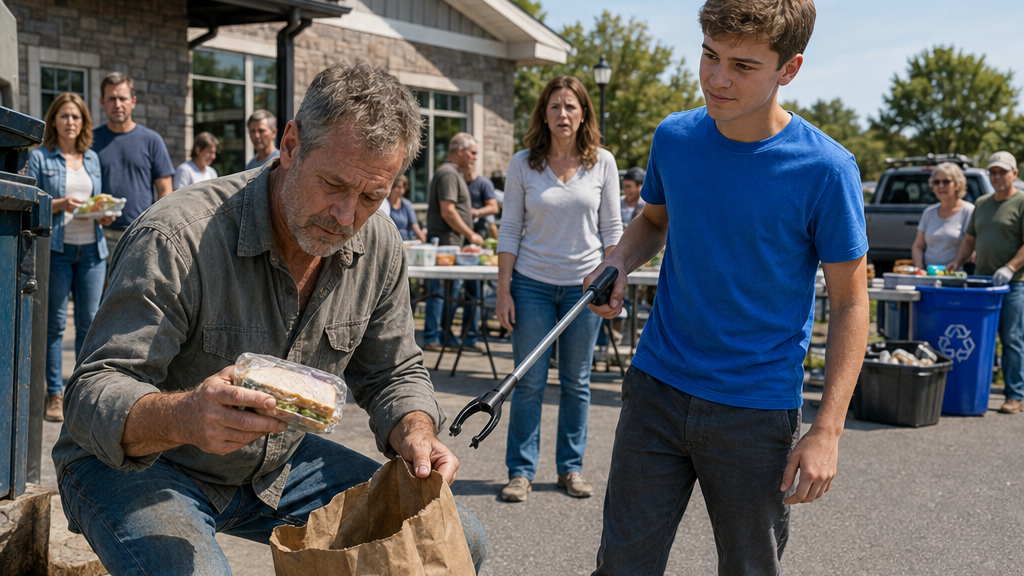
Patrick Martin had one hand inside the brown paper bag beside the clubhouse dumpster when Kevin Nelson said, loud enough for half the picnic area to hear, “That food is for registered volunteers.”
Patrick stopped.
His fingers were resting on a wrapped sandwich. The plastic was still sealed. Beside it sat an apple without a bruise and two unopened packets of crackers.
The bag had been placed on top of a collapsed cardboard box rather than thrown into the dumpster itself.
Patrick slowly lifted the sandwich.
Kevin stood ten feet away in a bright volunteer shirt, one hand hooked around the handle of a trash grabber. At eighteen, he had inherited his father’s square shoulders and his habit of speaking as though hesitation weakened an argument.
“I said the food’s for volunteers,” Kevin repeated.
A woman sorting recycling glanced over. So did two homeowners near the picnic tables.
Patrick looked at the sandwich, then at the overflowing trash barrel beside Kevin.
“It was being thrown away.”
Kevin gave a short laugh.
“That doesn’t mean you just take it.”
Patrick placed the sandwich in the grocery bag he had brought from home. The bag was soft at the folds from being used more than once.
Behind him, aluminum cans rattled into a bin. Conversation lowered without quite stopping.
Patrick knew what the neighbors saw.
His work boots needed replacing. The cuffs of his jeans were frayed. He had missed a haircut by several weeks. His truck, parked beyond the clubhouse, carried a ladder with one bent rung and a magnetic door sign faded nearly white from years of sun.
He also knew what they knew.
Three months behind on assessments.
Two late fees.
A notice from management.
A hardship form that still had several blank lines.
Kevin stepped closer.
“There were people who signed up for this cleanup.”
Patrick folded the top of the bag over.
“I know.”
“You didn’t.”
“No.”
Kevin looked toward the tables where leftover sandwiches were being gathered.
“So you show up at the end and take whatever you want?”
Patrick felt heat move up his neck.
It would have been easy to explain that he had only come because the property manager had asked him to look at the loose hinge on the storage shed. Easy to say he had fixed that same hinge twice over the years without charging the association. Easy to point out that the volunteer carrying food toward the dumpster had told him the leftovers were being discarded.
But explanations had begun to feel like small invoices he owed the world.
He picked up the brown bag.
Kevin’s voice followed him.
“My dad says homeowners who don’t pay still expect everybody else to cover things.”
That stopped Patrick more effectively than shouting would have.
He turned.
Kevin’s expression shifted, just slightly. He had probably meant it as a general observation. Or perhaps he had not expected Patrick to hear.
Patrick said, “Your dad discusses owner accounts with you?”
Kevin flushed.
“No. I mean, everybody knows.”
That was worse.
A shadow crossed the concrete.
Scott Nelson came around the corner of the clubhouse carrying a clipboard and a case of bottled water. He looked first at Kevin, then Patrick, then the brown bag in Patrick’s hand.
“What’s going on?”
“Nothing,” Patrick said.
Kevin spoke at the same time.
“He was taking event food.”
Scott frowned.
Patrick held up the sandwich.
“It was in the discard pile.”
One of the volunteers finally spoke from beside the tables.
“I was throwing those out. They’ve been sitting, but they’re sealed.”
Scott’s eyes moved to her.
“So you told him he could take them?”
The volunteer hesitated.
“I told him they were going in the trash.”
Scott exhaled through his nose.
“Fine.”
For one second, Patrick thought that would end it.
Then Scott looked at him again.
“Patrick, while you’re here, the manager said she still hasn’t received the complete hardship package.”
Patrick’s grip tightened on the bag.
“This isn’t the place.”
“I agree. But we’ve tried email. We mailed another copy.”
“I got it.”
“You left the income section incomplete.”
A few people who had returned to sorting bottles now seemed deeply interested in their work.
Patrick lowered his voice.
“I’ll deal with the office.”
Scott did the same, though his voice still carried.
“The board can’t consider hardship based on half the information. We have to apply the same standard to everyone.”
Patrick almost laughed at the word same.
His wife had been dead seven months. For nearly a year before that, Patrick had arranged jobs around medication schedules, medical appointments, nights when she could not sleep, mornings when he could not leave her alone. Clients who had once called him first began calling someone else.
None of that fit neatly beneath a box labeled MONTHLY HOUSEHOLD INCOME.
Scott continued.
“If you want us to pause collection activity, we need documentation.”
Patrick looked at Kevin.
The boy had gone quiet now.
“Then send me what you need.”
“We have.”
Patrick’s embarrassment hardened into something cleaner.
“Then send it again.”
He turned before Scott could reply.
At the parking lot, he opened the driver’s door of his truck and placed the brown bag on the passenger seat. The sandwich slid against the apple with a soft paper scrape.
He had eaten half a bowl of oatmeal before leaving home that morning.
There was bread in his kitchen. Peanut butter, too.
He was not starving.
He repeated that distinction to himself because it mattered.
At least he wanted it to matter.
He started the truck.
Before pulling away, he saw Rebecca Walker crossing the lot toward him.
She had been near the far picnic table with Emma when the argument started. Patrick had noticed them only at the edge of his vision.
Rebecca raised one hand.
He considered pretending not to see.
Instead he rolled down the window.
“Patrick.”
“Morning.”
Her gaze dropped to the bag on the passenger seat.
For a moment neither of them spoke.
Then Rebecca asked, “Was that your lunch?”
“No.”
“What was it?”
“Rebecca.”
Her face changed.
Not pity. He could have dismissed pity.
This was alarm.
“I thought you were doing better.”
“I am.”
“You just took food out of a discard pile.”
“It was sealed.”
“That isn’t what I asked.”
Patrick looked toward the clubhouse. Kevin was carrying a trash bag now, his head down. Scott was talking with one of the board members.
“I need to go.”
Rebecca put her hand on the edge of the open window.
“Do you still have it?”
Patrick looked at her.
She did not say what she meant.
She did not need to.
His stomach tightened harder than it had during the exchange with Kevin.
“That’s my business.”
Rebecca’s fingers loosened from the door.
“Patrick, if things are this bad—”
“They’re not.”
“You’re taking sandwiches from trash piles.”
“They were being thrown away.”
Her eyes held his.
The same sentence sounded different the third time.
Patrick shifted into reverse.
Rebecca stepped back.
He could see that she wanted to say more, but Emma was approaching from behind her, and Rebecca stopped herself.
Patrick backed out of the space.
At the subdivision entrance, he glanced toward the brown bag.
The sandwich was still untouched.
So was the apple.
He drove home with both sitting beside him, while behind him Rebecca stood in the clubhouse parking lot realizing that whatever Patrick had refused to tell the HOA was only part of what he had refused to tell her.
Chapter 2: The Hardship Form He Would Not Finish
The certified delinquency notice was taped inside Patrick’s storm door Monday morning.
He found it when he opened the front door carrying a mug of coffee and nearly tore it in half with the handle.
FINAL REQUEST FOR COMPLETE HARDSHIP DOCUMENTATION.
Below that, in smaller print, the notice stated that collection-related charges could continue to accrue while review remained incomplete.
Patrick stood barefoot in the entryway reading the same paragraph twice.
Then he looked toward the kitchen.
The brown paper bag from Saturday sat on the counter.
He had eaten the sandwich Saturday evening.
The apple had become Sunday breakfast.
Now the bag held three cans of soup, a loaf of discounted bread, and a box of pasta from the grocery store.
He folded the notice once and set it beside the bag.
The house was too quiet.
Not peaceful. Quiet in the way a room became after someone had stopped needing things from it.
Patrick carried his coffee to the small table and opened the hardship form.
He had completed the easy sections.
Name.
Property address.
Years of ownership.
Reason for delinquency: loss of income.
Then came the boxes he had avoided.
Current monthly income.
Average deposits for previous ninety days.
Available savings.
Financial assistance received from others.
Patrick stared at that last line.
He placed the pen down.
Seven months earlier, he would have filled out any form handed to him. He had spent nearly a year filling out insurance forms, pharmacy forms, hospital forms, home-health forms. He had learned which parts required signatures and which parts required initials.
By the end, forms had come to mean permission for strangers to measure the worst parts of his life.
How sick was she?
How much did he make?
How much did they owe?
Could they prove it?
Could they prove it again?
He pushed back from the table.
At ten thirty he drove to the HOA management office.
The office occupied one storefront in a small professional plaza two miles from the subdivision. The property manager met him across a desk stacked with folders.
“I’m glad you came in,” she said.
Patrick placed the incomplete form in front of her.
“I filled what matters.”
She looked through it.
Her expression remained neutral until she reached the second page.
“You still haven’t listed recent deposits.”
“I do repair work. It changes every month.”
“That’s why we ask for statements.”
“I brought invoices.”
He slid a thin folder toward her.
Inside were copies of small jobs: a garbage disposal replacement, drywall repair, a porch handrail, two ceiling fans.
The manager reviewed them.
“This helps.”
Patrick felt some tension leave his shoulders.
Then she turned another page.
“But the board’s hardship procedure requires bank statements or equivalent records.”
“I don’t want my bank statements passed around a board.”
“They aren’t passed around casually.”
“Scott discussed my account where his son could hear about it.”
Her eyes lifted.
“Did Scott give Kevin specific information?”
“He knew I hadn’t paid.”
The manager paused.
“I can address confidentiality with the board. But that doesn’t change the documentation requirement.”
Patrick leaned back.
“What happens if I don’t give you more?”
The manager folded her hands.
“We’re getting close to lien-preparation costs.”
The room seemed to sharpen.
“How close?”
“The account has already been referred for pre-lien review. If the hardship application is completed promptly, I can ask that additional action be paused while the board considers it.”
“And if it isn’t?”
“More fees.”
Patrick looked toward the blinds covering the office window.
“How much?”
She gave him the range.
It was not enough to take his house.
It was enough to make climbing out harder.
That was how these things worked, he thought. Not one dramatic number. A stack of smaller numbers, each one making the next month more expensive.
The manager tapped the invoices.
“I can document that your income dropped.”
Patrick said nothing.
“You also wrote that the decline began during family caregiving.”
“My wife was sick.”
“I’m sorry.”
He nodded once.
“Toward the end, I couldn’t take full-day jobs. Sometimes I couldn’t take morning jobs either. If she had a bad night, I stayed home.”
“That explains the interruption.”
“It should.”
“It explains it. It doesn’t complete the financial picture.”
Patrick’s jaw tightened.
She softened her voice.
“I’m not asking because I think you’re lying.”
“Scott does.”
“I can’t speak for Scott.”
Patrick looked at the form again.
He filled in an approximate average for current monthly income.
He added the balances of his checking and business accounts.
When he reached assistance received from others, his pen stopped.
The manager waited.
Finally Patrick drew a line through the field.
“I’m not answering that.”
“If the board sees unexplained deposits—”
“They won’t.”
“That’s exactly why they’re asking.”
Patrick capped the pen.
“I’ve given you enough to show why I fell behind.”
“You’ve given me enough to support part of the request.”
“That’s what I can give.”
She studied him.
Then she pulled the papers together.
“I’ll submit this as partial documentation.”
Patrick stood.
“At least pause the extra fees.”
“I’ll ask.”
He was halfway to the door when she said, “Patrick.”
He turned.
“Scott sent a note this morning asking specifically for proof of all deposits over five hundred dollars from the last six months.”
Something cold settled beneath Patrick’s ribs.
“Why?”
“He believes the board needs to know whether funds were available before hardship consideration.”
Patrick stared at her.
“Did you tell him there were funds?”
“I told him your application was incomplete.”
“That’s not what I asked.”
The manager’s expression tightened.
“No. I did not tell him about funds because you haven’t given me records showing them.”
Patrick nodded slowly.
He left without another word.
At home, the brown bag still sat beside the folded delinquency notice.
He put away the soup and pasta.
The bag collapsed inward when he removed the last can.
Patrick stood looking at the nearly empty counter.
For months he had told himself he was managing.
His mortgage was current.
Electricity was on.
The truck still ran.
He had work scheduled Wednesday and Thursday.
Managing had become his favorite word because it asked no follow-up questions.
He went into the bedroom.
His wife’s side of the closet remained mostly untouched. Patrick opened the top shelf, moved a folded blanket, and reached behind an old shoebox.
His hand found a plain white envelope.
He brought it to the kitchen.
Rebecca was written across the front in his own block printing.
Nothing else.
Patrick sat down.
Inside the envelope was something he had refused to count as his, even while every other number in his life had been shrinking.
He rested both hands on the table.
Then, for the first time since the manager mentioned lien costs, Patrick allowed himself to consider using it.
Chapter 3: Four Thousand Dollars Changes the Story
Patrick placed forty hundred-dollar bills on the property manager’s desk Thursday afternoon.
She stared at them before she looked at him.
“Patrick.”
“Four thousand.”
“I can see that.”
He had carried the money into the office inside the same brown paper grocery bag.
The white envelope now lay empty inside it.
For three days, he had argued with himself about what the money meant.
Not legally.
Morally.
That had always been the harder question.
The manager counted the bills twice, fed them through a small counter, then printed a receipt.
“This will bring the account down substantially.”
“How substantially?”
She turned the monitor slightly and showed him the revised balance.
Patrick studied it.
The original assessments were still there. So were late charges and collection-related costs already added.
But the number no longer looked impossible.
“If I pay the rest over a few months?”
“That depends on what the board approves.”
“I’m asking what you think.”
She considered him.
“I think a payment plan is realistic now.”
Patrick felt the first genuine relief he had felt since finding the notice on his door.
Then the office door opened.
Scott Nelson stepped inside.
He carried a folder under one arm and stopped when he saw Patrick sitting there.
“Patrick.”
“Scott.”
The manager looked uncomfortable.
“I was just processing a payment.”
Scott’s gaze moved to the receipt printer, then the cash tray.
“How much?”
The manager hesitated.
Patrick answered first.
“Four thousand.”
Scott’s eyebrows rose.
Silence filled the office.
Patrick knew the question before Scott asked it.
“Where did that come from?”
Patrick looked at him.
“That’s not your business.”
Scott set the folder down.
“It becomes relevant when you’ve requested hardship relief.”
“I owe the association money. I’m paying the association money.”
“And last week you were saying you couldn’t complete the financial disclosures.”
“I said I wouldn’t complete some of them.”
“That distinction matters less when four thousand dollars suddenly appears.”
The property manager stepped in.
“Scott, the payment can be accepted independently of the hardship review.”
“I know.”
Scott did not look away from Patrick.
“But if the application suggested he lacked available funds—”
“It didn’t.”
Patrick’s voice had sharpened.
Scott turned toward the manager.
“Did he disclose this?”
The manager chose her words carefully.
“His application remains incomplete regarding certain assistance and deposit information.”
Scott nodded once, as though something had been confirmed.
Patrick saw it happen.
A theory settling into place.
“That money wasn’t in my checking account,” Patrick said.
Scott’s expression barely changed.
“Where was it?”
Patrick stood.
He could have ended it then.
He could have said Rebecca gave it to me.
He could have explained the evening she had come to his door with an envelope and refused to leave until he accepted it.
He could have said he had put it away untouched because money given out of fear and kindness did not feel the same as income.
But Rebecca’s circumstances were not Scott’s business either.
Patrick picked up the brown bag.
“You have the payment.”
Scott said, “And we have a hardship request asking other homeowners, effectively, to absorb delayed payment.”
Patrick turned back.
“No. I asked for time.”
“Time has a cost.”
“So do collection fees.”
Scott’s mouth tightened.
“I have people emailing me every month asking why assessments went up. They pay on time. Some of them have medical bills. Some lost jobs. If we make exceptions, we need a documented basis.”
Patrick understood that.
He hated that he understood it.
Scott was not wrong to require standards.
He was wrong in the speed with which he turned missing information into character judgment.
“There’s your documented basis,” Patrick said, pointing to the invoices the manager had copied earlier in the week. “My work dropped while my wife was dying.”
Scott’s expression softened for perhaps half a second.
“I know you had a difficult year.”
Patrick almost laughed.
Difficult.
The word was so clean.
Scott continued.
“But hardship review is about current ability to pay, too.”
“And I just paid.”
“After saying you couldn’t.”
“I never said that.”
Scott opened the folder he had brought.
“There are board notes stating you requested additional time because of financial hardship.”
“That’s true.”
“And now you have four thousand dollars.”
“Also true.”
“Then you understand why the board needs clarification.”
Patrick stepped closer to the desk.
“No. I understand why you want clarification.”
Scott’s eyes narrowed.
“What’s that supposed to mean?”
“It means you decided I was hiding something before you knew whether I was.”
The manager said quietly, “We don’t need to resolve this in the lobby.”
No one responded.
Patrick looked at Scott.
Saturday returned to him in fragments.
Kevin’s voice.
Everybody knows.
The sandwich in his hand.
The neighbors pretending not to listen.
“Did you tell your son I was behind?”
Scott’s face changed.
“No.”
“He knew.”
“People talk.”
“You’re the board president.”
“That doesn’t mean I control neighborhood gossip.”
“No. But it means you should be more careful than everybody else.”
Scott glanced at the manager.
“I haven’t disclosed Patrick’s balance to anyone.”
Patrick believed him.
That made the situation worse in a quieter way.
Kevin had not needed a number.
Only a category.
Delinquent.
Trouble.
The man taking discarded food.
Scott took a breath.
“Look, I’m not trying to embarrass you.”
“You already did.”
“I’m trying to administer the same rules to every owner.”
“Then administer them.”
Patrick pushed the receipt into his pocket.
“Don’t administer my character.”
The manager looked down.
Scott’s jaw moved once.
“Your payment will stop the immediate pre-lien action while the board reviews the remaining balance.”
Patrick turned to the manager.
“For how long?”
“Until the next scheduled review, at minimum.”
“When?”
She checked her calendar.
“Tuesday evening.”
Patrick nodded.
That was something.
A small thing, but real.
No new lien-preparation cost before Tuesday.
No letter arriving over the weekend.
He picked up the grocery bag.
Scott said, “I’m going to recommend that the hardship request be reviewed in open session.”
Patrick stopped.
The relief vanished.
“Why open?”
“Because the board needs to address the inconsistency.”
“There is no inconsistency.”
“There’s an unexplained four-thousand-dollar payment after a request for hardship consideration.”
Patrick stared at him.
Scott seemed to hear how it sounded, because he added, “I’m not accusing you of anything.”
“You don’t have to.”
The manager spoke firmly now.
“Owner financial details should generally be handled carefully. We can structure the agenda without unnecessary disclosure.”
Scott nodded, but his attention remained on Patrick.
“The board still needs answers.”
Patrick left.
Outside, the afternoon heat had built under a flat white sky.
He sat in his truck without starting it.
The brown bag rested on the passenger seat, collapsed around the empty white envelope.
Four thousand dollars had bought him several days of breathing room.
It had also changed the story everyone thought they understood.
Before, Patrick had been the man who could not pay.
Now he was the man who could pay but apparently had chosen not to.
He knew which version Scott found easier to believe.
Patrick started the truck and drove home.
At his kitchen table, he unfolded the payment receipt.
Then he took out the hardship form and read the blank line again.
Financial assistance received from others.
He placed the pen beside it.
He could write Rebecca’s name.
He could write the amount.
He could make the contradiction disappear.
Instead he thought about Rebecca standing in the clubhouse parking lot asking, Do you still have it?
Patrick folded the form closed.
An hour later an email arrived from management.
NOTICE OF BOARD REVIEW — OWNER ACCOUNT.
Tuesday. Seven p.m.
Open session.
Patrick read it twice.
Then he looked at the empty white envelope on the table and understood that keeping Rebecca’s secret was no longer going to cost him only money.
Chapter 4: The Gift Bag Kevin Thought Was Stolen
Kevin Nelson caught the handle of the gift bag just as Patrick stepped through the clubhouse door.
“Hold on.”
Patrick stopped so abruptly that the brown paper grocery bag tucked beneath his arm crumpled against his ribs.
Music drifted from the multipurpose room behind them. Someone had taped paper streamers above the windows, and a folding table near the wall held grocery-store cupcakes, cans of soda, and a small stack of wrapped gifts for Emma Walker.
Patrick had planned to stay less than five minutes.
Walk in. Give Emma the present. Say happy birthday. Leave before anyone had reason to ask about Tuesday’s board review.
Instead Kevin stood between him and the exit, one hand still gripping the glossy handle of the gift bag.
“Where’d you get this?”
Patrick looked down at Kevin’s hand.
“Let go.”
Kevin did, but not immediately.
“I’m asking because those look like the bags from the donation table.”
“They aren’t.”
Kevin glanced toward the room. “We had extras for the raffle.”
Patrick’s voice stayed flat.
“I bought it.”
Kevin looked at the brown grocery bag under Patrick’s arm, then at Patrick’s worn work shirt.
The glance lasted less than a second.
It was enough.
Patrick felt the same pressure he had felt beside the dumpster—the sense that a conclusion had already been reached and he had only been invited into the conversation afterward.
“Move,” he said.
Kevin shifted half a step but did not clear the doorway.
“I’m just checking.”
“You’re eighteen. You’re not checking anything.”
Kevin’s face reddened.
“I’m volunteering.”
“At a birthday party.”
“It’s an HOA event space.”
Patrick almost smiled.
Before he could answer, Rebecca’s voice came from behind Kevin.
“What exactly is the problem?”
She crossed the room quickly, Emma several steps behind her.
Kevin turned.
“I thought he might’ve taken one of the raffle bags.”
Rebecca stopped beside Patrick.
“He did not.”
Kevin raised both hands.
“I said I thought—”
“I heard what you said.”
Patrick wanted to leave.
That was the old instinct. Remove himself before defense became spectacle.
But Emma had reached them now, and she was looking between the adults with the embarrassed patience of someone whose birthday had suddenly become about everyone except her.
Patrick held out the gift bag.
“Happy birthday.”
Emma blinked.
“You didn’t have to get me anything.”
“I know.”
She took it carefully.
Inside was a small wrapped box.
Kevin shifted backward.
“I didn’t mean anything by it.”
Patrick looked at him.
“That’s usually when people mean the most.”
Rebecca shot Patrick a warning glance, not because he was wrong but because Emma was standing there.
Emma opened the box.
Inside was a simple silver-colored keychain shaped like a tiny crescent moon.
For the first time since Kevin stopped him, Patrick’s shoulders loosened.
Emma stared at it.
Then she looked up.
“You remembered.”
Patrick nodded.
“What?” Rebecca asked.
Emma ran her thumb over the crescent.
“That lamp.”
Rebecca’s expression changed.
Patrick wished it hadn’t.
Years earlier, during the final months of his wife’s illness, Emma had spent afternoons at Patrick’s house often enough to know every object in the living room. His wife had owned an old brass lamp with a moon-shaped pull chain. Emma used to tug it each evening before leaving and announce that she was “turning on the moon.”
Patrick had found the keychain in a hardware-store gift rack after finishing a paid faucet repair that morning.
It had cost eighteen dollars.
He had stood in the aisle nearly five minutes before buying it.
Emma closed her fingers around it.
“Thank you.”
“You’re welcome.”
That should have been the end of it.
Then Scott Nelson appeared at the doorway.
He looked first at Kevin, then at Patrick, then at the gift in Emma’s hand.
“What happened?”
“Nothing,” Rebecca said.
Kevin answered anyway.
“I thought Patrick had one of the raffle bags.”
Scott frowned at his son.
“Did he?”
“No.”
Patrick started toward the exit.
Scott’s gaze fell on the brown grocery bag under Patrick’s arm.
Then he said, “Patrick, since you’re here—”
Rebecca closed her eyes briefly.
Patrick stopped.
Scott continued, “The board review is still Tuesday. The manager told me the four-thousand-dollar payment cleared.”
Patrick said nothing.
A nearby conversation faltered.
Scott apparently noticed because he lowered his voice.
“I’m mentioning it because if your financial situation has changed, there may not be a need for hardship consideration.”
Rebecca stared at him.
“At Emma’s birthday?”
Scott looked uncomfortable.
“I’m not trying to turn this into something.”
“You just announced his payment in a room full of people.”
“I didn’t announce his balance.”
Patrick felt every muscle in his back stiffen.
Scott was technically right.
That was what made his mistakes dangerous.
They could always be phrased as something smaller than they were.
Patrick said, “I bought Emma an eighteen-dollar gift.”
Scott looked at him.
“I didn’t ask what it cost.”
“You didn’t have to.”
Rebecca stepped forward.
“The gift has nothing to do with the HOA.”
Scott’s expression hardened slightly.
“Rebecca, with respect, Patrick has asked the association to consider financial hardship. Then he makes a four-thousand-dollar cash payment and is spending money at a community event. The board is entitled to understand the discrepancy.”
“There is no discrepancy,” Patrick said.
“Then explain it.”
Patrick looked around.
Emma had gone still.
Kevin was staring at the floor.
Two homeowners across the room had become silent.
Patrick could tell Scott regretted the setting. But not enough to stop.
The answer was sitting beneath Patrick’s arm.
Inside the brown paper bag was the empty white envelope that had once held Rebecca’s money. He had brought it intending to return the envelope privately, because for reasons he could not explain even to himself, throwing it away had felt wrong.
Rebecca saw the corner of white paper through the folded top.
Her face changed.
“Patrick.”
He shook his head once.
Not here.
She understood.
Scott did not.
“I’m not asking for personal details,” Scott said. “I’m asking for financial transparency.”
Patrick met his eyes.
“You don’t get to call it transparency when you’re asking in front of my neighbors.”
Scott opened his mouth, then stopped.
Patrick turned to Emma.
“Enjoy your birthday.”
“I will.”
He walked outside.
Rebecca followed him into the parking lot.
“Patrick.”
He kept moving toward his truck.
“Don’t.”
“You can’t keep doing this.”
He stopped.
“Doing what?”
“Protecting everybody from the truth except yourself.”
Patrick turned.
Rebecca folded her arms.
“You took my money.”
“Because you wouldn’t leave.”
“And then apparently refused to use it.”
“That was my decision.”
“You were taking food people were throwing away.”
“It was sealed.”
Her eyes flashed.
“I am tired of hearing that sentence.”
Patrick looked away.
The clubhouse door opened behind them, then closed again.
Rebecca lowered her voice.
“If Scott puts this in front of the board Tuesday, I’m telling them where the money came from.”
“No.”
“Yes.”
“It’s not your account.”
“It was my money.”
“It stopped being yours when you gave it to me.”
“Then why are you trying so hard to give it back?”
Patrick said nothing.
Rebecca looked at the brown bag under his arm.
“You kept it.”
He knew she meant the envelope.
“I kept the envelope.”
“Why?”
“Because I did.”
“That isn’t an answer.”
“It’s the one I have.”
Rebecca took a slow breath.
“Emma asked me this morning why you gave her something after what happened Saturday.”
Patrick looked toward the clubhouse.
Through the window he could see Emma standing near the cake, the crescent keychain still in her hand.
Rebecca said, “She remembers more than you think.”
Patrick’s throat tightened.
“About what?”
“Your wife.”
He looked back at Rebecca.
She held his gaze.
“Tuesday, Patrick. Either you explain the four thousand dollars yourself, or I will.”
Chapter 5: What Rebecca Had Seen Through Her Windshield
Rebecca laid the unopened white envelope on her kitchen table between them.
Patrick stared at his own handwriting.
REBECCA.
The envelope should have been empty.
It was not.
He had returned the four thousand dollars to her the previous afternoon.
She had put the cash back inside the same envelope.
Now it sat between two coffee mugs like an accusation neither of them wanted to make.
“I’m not taking it back,” Patrick said.
Rebecca pulled out the chair across from him.
“Neither am I.”
“Then we’re going to be here awhile.”
“Good.”
Patrick nearly stood.
Rebecca pointed at the chair.
“Sit down.”
He gave her a look.
She did not move.
Patrick sat.
Emma was upstairs. The house was quiet except for the refrigerator motor and the faint hum of an air-conditioning vent.
Rebecca tapped the envelope.
“You want to know why I gave you that money?”
“You told me why.”
“No. I told you I wanted to help.”
“That’s the same thing.”
“It isn’t.”
Patrick looked toward the window.
Rebecca continued.
“It was February. About six weeks after you stopped taking regular jobs.”
“I was still working.”
“Sometimes.”
“I was working.”
“I saw you behind the grocery store.”
Patrick’s eyes returned to her.
She had never told him that.
Rebecca leaned back.
“I was picking Emma up from school. We stopped because she wanted something for dinner. You were in the side parking lot.”
Patrick remembered the place.
He remembered more than he wanted to.
A grocery clerk used to set damaged but usable produce in a box near the loading area before disposal. Not officially. Quietly.
Bananas with bruised skins.
Bread one day from expiration.
A carton with eleven good eggs because one had broken.
Patrick had found out by accident while repairing a handrail for another shop in the same plaza.
Rebecca said, “You thought nobody could see you.”
Patrick’s mouth went dry.
“I wasn’t digging through a dumpster.”
“I didn’t say you were.”
“You’re making it sound—”
“I watched you take a loaf of bread out of a box beside one.”
Patrick pushed back from the table.
Rebecca’s voice sharpened.
“Sit.”
He remained standing.
“I don’t need a reconstruction of my worst month.”
Rebecca’s expression softened but she did not apologize.
“I do.”
He stared at her.
“Because you keep acting like I gave you money on a whim.”
“You felt sorry for me.”
“No.”
“Rebecca.”
“I was scared.”
That stopped him.
She folded her hands.
“My hours had been cut the year before. You knew that. You fixed my water heater and wouldn’t take payment.”
“It needed a thermostat.”
“You replaced the thermostat.”
“It cost thirty dollars.”
“You also fixed my gate.”
“Ten minutes.”
“You drove Emma to school twice when my car was in the shop.”
Patrick looked away.
“That’s what neighbors do.”
“Yes.”
Rebecca pushed the envelope toward him.
“That’s what I thought I was doing too.”
Patrick did not touch it.
She said, “I had money then. More than enough for that month. I gave you four thousand because I thought it would cover groceries, utilities, maybe give you time to start working normally again.”
“You needed savings.”
“I still had savings.”
“You were raising Emma alone.”
“And you were eating bread stores were throwing out.”
Patrick flinched.
Rebecca saw it.
Her voice lowered.
“I’m sorry.”
“No, you’re not.”
“No. I’m sorry it hurts. I’m not sorry I noticed.”
Patrick finally sat again.
The anger had gone somewhere less useful.
Rebecca opened the envelope and removed the bills.
They were still banded exactly as Patrick had returned them.
“All of it?”
He said nothing.
“You never used any?”
“Not from there.”
“You paid the HOA with it.”
“And then replaced it.”
Rebecca stared at him.
Patrick rubbed a hand across his mouth.
“I had two jobs come through. One deck repair. One bathroom. I was going to pay part of the account anyway.”
“So you used my money temporarily, then put your earnings back.”
“Yes.”
“Why?”
“Because the lien fees were about to start.”
“That’s not what I mean.”
Patrick knew.
He looked at the cash.
“I didn’t know if your situation might change.”
“My situation.”
“Your hours. Emma. Your mortgage. Whatever.”
Rebecca gave a disbelieving laugh.
“You were worried I might need back money I gave you?”
“You might.”
“So you starved instead?”
“I did not starve.”
“Patrick.”
“There was food.”
“Discarded food.”
“Food.”
Rebecca closed her eyes.
For several seconds neither spoke.
Then she asked, “Do you know what this looks like from the outside?”
He gave her a tired smile.
“I’ve had an educational week.”
“It looks like pride.”
“It is pride.”
She seemed surprised by the admission.
Patrick leaned forward.
“But that isn’t all of it.”
Rebecca waited.
“When people give you money because they’re worried, it changes something.”
“Only if you let it.”
“Easy for you to say.”
“No, it isn’t.”
Patrick looked at her.
Rebecca glanced toward the stairs.
“When my hours got cut, I counted every grocery receipt. I knew exactly how many weeks I could cover the mortgage without touching Emma’s school savings. I didn’t tell anyone.”
Patrick remembered.
“You told me.”
“After the water heater died.”
“You needed help.”
“So did you.”
“That was different.”
Rebecca smiled without humor.
“There it is.”
Patrick sat back.
She was right, and he disliked her for being right.
Rebecca gathered the bills and returned them to the envelope.
“You want to know the other reason I noticed you at the grocery store?”
Patrick looked at her.
“Emma.”
His expression changed.
“She saw your truck.”
“When?”
“That day.”
Patrick said nothing.
“She asked why you were behind the store. I told her you were probably doing a repair.”
Rebecca paused.
“Then she said you hadn’t been taking many jobs since your wife died.”
Patrick’s fingers tightened around the coffee mug.
Rebecca continued carefully.
“She had been checking on you.”
“I didn’t know.”
“No. Because she knew you hated being checked on.”
Despite himself, Patrick almost smiled.
“That sounds like her.”
Rebecca looked toward the staircase again.
“She learned it from your wife.”
The room seemed to narrow.
Patrick saw the old brass lamp in his memory. The moon-shaped chain. Emma, younger then, sitting cross-legged near the couch with a schoolbook while his wife slept.
He had never asked why Emma came so often.
He had assumed Rebecca sent her.
Rebecca said, “Emma told me something after the birthday party yesterday.”
Patrick swallowed.
“What?”
“She said your wife used to ask her not to tell you when the bad afternoons were really bad.”
Patrick went completely still.
Rebecca touched the envelope.
“That’s why Emma stayed.”
Patrick’s voice came out quieter than he intended.
“What did she do?”
Chapter 6: The Birthday Gift Was Never About Money
Patrick found Emma’s note inside a box of his wife’s papers the following evening.
He had been looking for nothing in particular.
That was the lie he told himself as he opened the closet box and sorted through appointment cards, pharmacy receipts, sympathy notes, and folded instruction sheets from home-health visits.
The note was written on lined notebook paper.
At the top, in Emma’s younger handwriting, were three words.
TURNED ON MOON.
Patrick sat on the edge of the bed.
Beneath the words was a crude drawing of the brass floor lamp from the living room, complete with its crescent-shaped pull chain.
Then two lines.
She ate half the soup.
I stayed until you got back.
Patrick read them again.
He remembered that afternoon.
He had driven twenty minutes across town to repair a leaking kitchen sink because the customer had said they could only meet between three and five. He nearly canceled. His wife had insisted he go.
“I’m fine,” she had told him.
Emma had arrived ten minutes before he left.
Patrick had assumed Rebecca asked her to stop by.
He had returned two hours later to find his wife asleep and Emma doing homework at the dining table.
No emergency.
No problem.
Nothing worth discussing.
That was what they had let him believe.
Patrick carried the note into the kitchen.
The brown paper grocery bag sat folded on the counter.
He opened it and put the note inside.
Then he walked.
He left through the back door and followed the subdivision path that curved between the detention pond and the rear property lines. At that hour, sprinklers clicked over several lawns. A dog barked behind a fence, then stopped.
Patrick needed the movement.
Rebecca’s words from the night before had rearranged old memories.
Emma sitting with his wife.
Emma carrying soup bowls to the sink.
Emma asking whether Patrick needed anything from the store.
Emma tugging the lamp chain at dusk.
Turning on the moon.
He had thought she was simply a kind teenager passing time with a sick neighbor.
He had not understood that she had been giving him something he refused to ask anyone for.
Hours.
Enough hours to earn a little money.
Enough hours to buy groceries.
Enough hours to keep pretending he could manage both work and caregiving by himself.
Patrick stopped near the pond.
Someone approached from the opposite direction.
Emma.
She wore headphones around her neck and nearly turned off the path when she recognized him.
Patrick raised a hand.
“Got a minute?”
She hesitated.
“Sure.”
They stood near a bench beneath one of the path lights.
Patrick took the folded note from the grocery bag.
Emma saw it and groaned.
“Oh no.”
“You recognize it?”
“I was, like, fourteen.”
“Fifteen.”
“Even worse.”
Patrick handed it to her.
She read the lines and smiled reluctantly.
“I forgot I wrote these.”
“I didn’t know you were keeping track.”
“Your wife asked me to.”
Patrick looked toward the water.
“What else did she ask?”
Emma’s smile faded.
“Mostly little stuff.”
“Emma.”
She tucked the note against her palm.
“Sometimes she didn’t want you to know she’d had a rough afternoon.”
“I figured that out.”
“She thought you’d stop working.”
“She was right.”
Emma looked at him.
“That was the problem.”
Patrick almost objected.
Then he let the words remain.
Emma continued.
“She knew you were turning down jobs. She felt bad.”
“She was dying.”
“I know.”
“She had nothing to feel bad about.”
“I know.”
Patrick heard the repetition.
The same impossible argument from different sides.
Emma said, “She used to tell me you thought being useful was the same as being okay.”
Patrick looked at her sharply.
Emma shrugged.
“Her words.”
“That sounds like her.”
“She worried about what would happen after.”
Patrick’s throat tightened.
“After what?”
Emma looked away.
“You know.”
He did.
For months after his wife’s death, Patrick had treated grief like a damaged cabinet hinge. Identify the problem. Find the tool. Keep pressure on the right point until the thing held together.
But there was no right point.
Emma handed the note back.
“That’s why I stayed sometimes. So you could work without worrying for two hours.”
“Your mother knew?”
“Not all of it.”
“And you never told me.”
“Your wife told me not to.”
Patrick shook his head.
“She recruited a teenager into lying to me.”
Emma smiled.
“She called it selective reporting.”
Patrick laughed once before he could stop himself.
The sound surprised both of them.
Emma’s eyes moved to the brown bag.
“Is that the same bag?”
“What?”
“The one from the cleanup.”
Patrick looked down.
“Yes.”
“You really reuse everything.”
“It still works.”
She nodded toward the note.
“So did the moon thing, apparently.”
Patrick folded the paper carefully.
“That’s why I got the keychain.”
“I figured.”
“No.”
Emma looked at him.
“I mean, I knew I remembered the lamp. I didn’t understand why it mattered to you.”
Patrick slid the note back into the bag.
“It mattered because I thought I was the one taking care of everybody.”
Emma did not answer.
“And apparently,” Patrick said, “I missed some things.”
“You were busy.”
“That isn’t an excuse.”
“It might be.”
Patrick looked at her.
For once, he did not argue.
They walked together toward the next intersection.
At Rebecca’s corner, Emma stopped.
“My mom thinks you’re mad at her.”
“I am.”
Emma smiled.
“She thinks you’re mad because she’s right.”
“I’m reconsidering the quality of your birthday present.”
Emma laughed and headed toward home.
Patrick continued alone.
By the time he reached his house, he knew what he would do Tuesday.
Not because Scott deserved an explanation.
Not because the board had earned access to every painful detail.
Because Patrick had finally understood that his silence was no longer protecting the people he cared about.
It was forcing them to carry the truth around him.
The next evening, Rebecca came by.
Patrick opened the door before she knocked twice.
“I’m going to the meeting.”
She studied his face.
“I assumed you were.”
“I’m going to speak.”
Rebecca waited.
“But I decide what gets said.”
Her shoulders eased.
“Okay.”
“No bank-history performance. No grocery-store story unless I bring it up. No explaining Emma’s part for me.”
“Okay.”
“And the four thousand?”
Patrick looked toward the kitchen.
The white envelope rested beside the folded brown bag.
“I’ll explain it.”
Rebecca nodded.
Then she asked, “Do you want me there?”
Patrick’s first answer rose automatically.
No.
He felt it reach the back of his throat.
He thought of the note in the grocery bag.
I stayed until you got back.
Patrick opened the door wider.
“Yes.”
Rebecca said nothing.
She simply stepped inside.
Patrick closed the door behind her, knowing that Tuesday night he would have to do something harder than prove Scott wrong.
He would have to let people see how much of the truth he had helped hide.
Chapter 7: The Board Finally Heard What Silence Cost
Scott Nelson waited until the room had settled before looking directly at Patrick.
“There’s one issue the board still needs clarified,” he said. “The four-thousand-dollar payment.”
The clubhouse meeting room felt smaller than it had during neighborhood events. Folding chairs faced a long table where Scott sat with two board members and the property manager. A dozen homeowners occupied the rows behind Patrick, some because they had business before the board, some because open meetings attracted people who liked knowing what other people were doing.
Rebecca sat two chairs to Patrick’s left.
She had not spoken since they arrived.
Patrick had asked her not to.
On the floor beside his chair lay the brown paper grocery bag, folded flat.
He had brought it without deciding why.
Scott continued.
“Patrick requested hardship consideration based on reduced income. He later made a four-thousand-dollar cash payment while leaving portions of the hardship disclosure incomplete. The board needs to understand whether funds were available during the period in question.”
Patrick rested both hands on his knees.
The old instinct came immediately.
Tell them nothing.
Pay what you can.
Leave.
He looked at Rebecca.
She did not rescue him.
That was what he had asked for.
Patrick stood.
“The money came from Rebecca.”
A movement passed through the room—not dramatic, just enough chairs shifting that he could hear it.
Scott glanced toward her.
Rebecca remained silent.
Patrick continued.
“She gave it to me months ago.”
Scott’s expression tightened in concentration rather than triumph.
“So it was financial assistance.”
“Yes.”
“And you didn’t disclose it.”
“No.”
“Why?”
Patrick almost gave the answer he had practiced.
Private matter.
Not relevant.
Instead he looked down at the folded grocery bag.
“Because I didn’t consider it mine.”
One of the board members leaned forward.
“You accepted four thousand dollars but didn’t consider it yours?”
Patrick nodded.
“I accepted it because she wouldn’t let me refuse it.”
A faint sound came from Rebecca that might have been a laugh.
Patrick looked at her.
“Is that inaccurate?”
“No.”
The board member said, “Did you use the money?”
“Not for months.”
Scott frowned.
“But you used it to make the HOA payment.”
“Yes.”
“Then it was available.”
Patrick let the silence hold for a second.
“That’s where I made this harder than it needed to be.”
Scott looked surprised.
So did Rebecca.
Patrick continued.
“My wife was sick for a long time. I stopped taking full-day work. Then I stopped taking jobs that put me too far from home. After she died, some of those customers didn’t come back. That part of the hardship form was true.”
The manager nodded slightly.
Patrick kept his attention on the board.
“Rebecca gave me money when she realized things were worse than I was saying.”
Scott asked, “And why didn’t you use it for living expenses?”
Patrick looked at him.
“Because she has a daughter. A mortgage. Her own bills.”
Rebecca shifted beside him.
Patrick raised a hand without looking at her.
“I know. I know what you’re going to say.”
A few people smiled uneasily.
He continued.
“I told myself if I could still find food, keep the power on, keep working, then I had no right to spend money somebody else might need later.”
The room had become very quiet.
Patrick did not mention the grocery-store box.
He did not need to.
Scott’s eyes moved briefly toward the folded brown bag.
Patrick saw the recognition.
Saturday.
The dumpster.
Kevin.
Scott said, more carefully now, “But you were behind on association dues.”
“I was.”
“And you had the four thousand.”
“Yes.”
“So from the board’s standpoint—”
“I understand your standpoint.”
Patrick’s voice stayed even.
“That’s what I didn’t understand before. I thought because I knew why I was doing something, everybody else should know I wasn’t being dishonest.”
He paused.
“They couldn’t.”
Scott leaned back.
Patrick felt Rebecca looking at him.
“My silence made the suspicion easier,” he said. “That’s on me.”
No one moved.
Then Patrick added, “What isn’t on me is being discussed in parking lots, being treated like I was stealing food, or having my hardship questioned in front of neighbors before the review was finished.”
Scott’s face changed.
Not anger.
Recognition mixed with resistance.
“I never told Kevin your balance.”
“I believe you.”
Scott seemed caught off guard.
Patrick said, “But he knew enough to decide what kind of person I was.”
Kevin sat near the back wall.
Patrick had noticed him when he entered but had not looked at him directly until now.
Kevin’s face had gone red.
Scott followed Patrick’s gaze.
Then he looked down at the papers in front of him.
“I should have been more careful with how the account was discussed,” Scott said.
It was not an apology.
It was close enough to one that Patrick did not push.
The second board member turned to the property manager.
“How much of the current balance is actual assessment, and how much is late or collection-related cost?”
The manager pulled up the account.
She gave the figures.
The difference was not enormous, but it was enough.
The board member frowned.
“Some of these processing charges occurred after he submitted the hardship request?”
“Yes.”
“Before the review was complete?”
“Yes.”
Scott said, “Because the application remained incomplete.”
The board member looked at him.
“Still, if the association was actively requesting documents, I’m not sure every escalation fee should have continued simultaneously.”
Scott did not answer immediately.
Patrick felt the balance of the room shift.
Not toward him.
Toward the problem.
That mattered more.
The board discussed procedure for several minutes.
Patrick stayed standing until the manager gestured that he could sit.
He did.
The folded paper bag brushed against his boot.
Eventually Scott looked at Patrick again.
“There’s a proposal to remove the processing fees added after your partial hardship submission, maintain the underlying assessments and standard late charges, and place the remaining balance on a payment plan.”
Patrick nodded.
“How long?”
They gave him the term.
He calculated it silently.
It would be tight.
Possible.
Scott said, “We can also waive the remaining late charges if—”
“No.”
Scott stopped.
Patrick said, “I owe the assessments. I paid late.”
One of the board members studied him.
“You don’t have to make this harder on yourself.”
“I’m not.”
Patrick looked at Scott.
“I’m asking you to separate what I owe from what got added because the process kept moving while everybody was still figuring out whether I qualified for help.”
The manager nodded.
“That’s a reasonable distinction.”
Scott looked at the other board members.
The motion passed.
No applause followed.
Patrick was grateful for that.
The next item should have begun.
Instead the second board member said, “I think we also need to revisit the hardship procedure.”
Scott rubbed his forehead.
“What specifically?”
“Confidential review.”
The manager spoke next.
“We can designate financial documentation for management review first and provide the board a summary rather than distributing raw statements unless necessary.”
“And account discussions?” Rebecca asked from her chair.
Patrick turned toward her.
She had waited until the matter moved beyond him.
The board member nodded.
“We should clarify that too.”
Scott looked toward the back of the room.
Kevin had disappeared.
The board agreed to put revised hardship procedures on the next agenda.
It was not a transformation.
Nobody resigned.
Nobody confessed to cruelty.
Patrick still owed money.
Scott still believed rules mattered.
Patrick did too.
But when the meeting adjourned, the account in the folder had become an account again instead of evidence about who Patrick was.
Outside, Kevin was waiting near Patrick’s truck.
Patrick almost walked past him.
Kevin said, “Mr. Martin.”
Patrick stopped.
Kevin shoved his hands into his pockets.
“I shouldn’t have said that stuff Saturday.”
Patrick waited.
“The food thing,” Kevin added. “And the gift bag.”
“Okay.”
Kevin looked up.
“I thought—”
“I know what you thought.”
Kevin nodded.
“My dad didn’t tell me your balance.”
“I know.”
“I heard people talking after one of the meetings.”
Patrick looked toward the clubhouse windows.
“Then maybe next time you hear people talking, remember they probably don’t know everything either.”
Kevin swallowed.
“Yeah.”
Patrick opened his truck door.
Kevin started to leave.
Patrick said, “Kevin.”
He turned.
“Checking something before accusing somebody is still allowed.”
Kevin gave a small, embarrassed nod.
Then he walked away.
Rebecca was standing beside Patrick’s truck now.
She had the brown grocery bag in one hand.
“You forgot this.”
Patrick took it.
“It’s empty.”
“I noticed.”
She reached behind her and produced a wrapped sandwich from the clubhouse refreshment table.
Patrick stared at it.
Rebecca held it out.
“No dumpster involved.”
He looked at her.
“Was that necessary?”
“Yes.”
He almost refused automatically.
His hand remained at his side.
Rebecca waited without changing expression.
Patrick thought of Emma’s note.
I stayed until you got back.
He thought of the four thousand dollars moving from Rebecca to him, from him to the HOA, from new jobs back to Rebecca. Each exchange complicated because he had insisted kindness needed to be repaid before it could be accepted.
Finally he opened the brown bag.
Rebecca placed the sandwich inside.
Patrick folded the top once.
“Thank you.”
Rebecca smiled.
“You’re welcome.”
The following Saturday, the clubhouse picnic tables were crowded again.
Patrick had come to repair a loose latch on the storage shed. This time the manager had put in a work order and insisted he submit an invoice.
He did.
When he finished, he found Rebecca and Emma at a table beneath one of the trees.
Emma’s crescent keychain hung from her backpack zipper.
Patrick noticed it but said nothing.
Rebecca moved a cooler aside and made room on the bench.
Patrick sat.
There were sandwiches on a tray in the middle of the table.
Rebecca picked one up and held it toward him.
Patrick looked at it for half a second.
Then he took it directly from her hand.
The story has ended.