The HOA Tried to Shut Down His Backyard Welding Shop—Then Their Complaint Made It Official
Chapter 1: The Morning They Called His Workshop Illegal
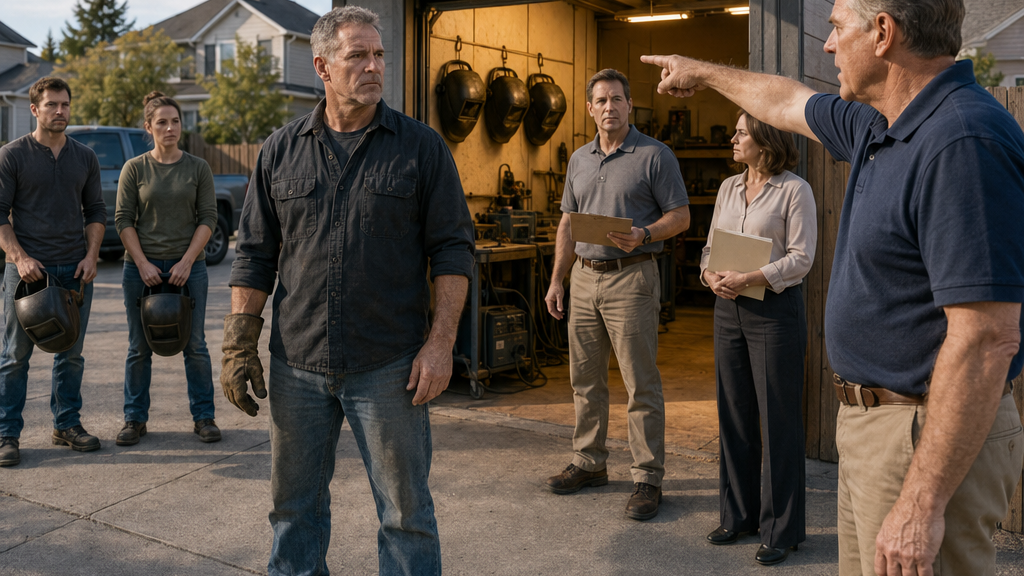
The welding machine was still humming when Samuel Lewis saw Robert Nelson pointing down his driveway.
Not gesturing. Pointing.
Beyond Robert stood a woman Samuel recognized from HOA emails and a man in a county polo shirt carrying a clipboard. Two of Samuel’s students had stopped halfway between their cars and the detached shop, welding helmets tucked under their arms.
The side door of the shop stood open behind Samuel. Fluorescent light spilled across the concrete. Three older helmets hung from hooks just inside.
Robert looked directly at the county inspector.
“That’s what I’ve been talking about. People coming in and out with torches. He’s running a business back there.”
Samuel reached behind him and switched off the welder.
The sudden quiet made Robert’s voice seem louder.
Michelle Roberts, the HOA’s community manager, stepped forward. She held a folder against her chest.
“Mr. Lewis?”
“You know who I am.”
Her mouth tightened slightly. “I’d like to keep this professional.”
Samuel removed his gloves one finger at a time.
“So would I.”
The county inspector glanced toward the students.
“Anyone welding right now?”
“We were practicing fillet welds,” Samuel said.
Robert gave a sharp laugh. “Listen to him. Practicing. Like that changes what it is.”
Samuel looked at him but said nothing.
He had learned years ago that there was a point in most arguments when another man’s impatience became more useful than anything Samuel could say.
Robert filled the silence.
“There are cars here all the time. Sparks at night. Grinding. Strangers walking up the street. I’ve been reporting this for months.”
“Daytime and early evening,” Samuel said.
“That’s not the point.”
“It is if you’re calling it an emergency nuisance.”
Michelle opened the folder.
“We received a complaint alleging unapproved commercial activity, recurring traffic, noise, and possible safety concerns involving welding equipment.”
Samuel looked at the inspector.
“Possible safety concerns according to him?”
The inspector did not answer immediately.
“According to the complaint.”
Samuel nodded toward the open shop.
“You want to look?”
Robert’s expression shifted.
Michelle noticed it too.
The inspector stepped inside.
Samuel followed him past the welding table, tool chest, two steel practice plates and the three helmets on the wall. Nothing had been hurriedly hidden. There was no customer inventory. No racks of finished gates. No stack of invoices.
The inspector examined the electrical panel.
“This building original to the property?”
“Detached structure was here when I bought the place. Electrical was redone after that.”
“Permit?”
“Yes.”
Robert had moved to the doorway.
“He can have a permit and still be running an illegal business.”
Samuel opened a metal cabinet and removed a plastic folder.
The paper inside was worn at the corners.
“Electrical inspection. Accessory-building permit. Final signoff.”
The inspector studied the documents, then checked a number on his clipboard.
“You a licensed welder?”
“Yes.”
“Commercial fabrication?”
“Not out of here.”
Robert scoffed.
Samuel turned toward him.
“You see any customer’s work?”
“I see welding.”
“That wasn’t my question.”
Michelle raised a hand. “Let’s not turn this into an argument.”
Robert pointed toward the helmets.
“Then ask him why three grown men show up with welding gear.”
One of the students shifted uncomfortably near the driveway.
Samuel looked at him, then back at Michelle.
“They’re not customers.”
Robert folded his arms.
“Then what are they?”
Samuel hesitated.
It lasted only a second, but Michelle saw it.
So did Robert.
Samuel disliked the fact that both of them seemed to believe they were entitled to an explanation of every person who crossed his property. The shop had stood behind his house longer than most of the newer homes around it. His father had helped rewire the place before the newer subdivision phases were finished.
He had permits.
He kept reasonable hours.
He paid his dues.
That ought to have been enough.
“They’re here with me,” he said.
Robert smiled as though Samuel had admitted something.
“Exactly.”
The county inspector came back outside.
“I don’t see an immediate hazardous condition. The electrical work in my system matches the permit number he gave me.”
Robert’s smile vanished.
“And the business?”
“That’s a separate question.”
Samuel watched Michelle.
For the first time that morning, she looked less certain.
The inspector continued.
“The building itself appears to be lawfully permitted as an accessory structure. Whether what’s happening inside qualifies as a different use requires review.”
Samuel felt some pressure leave his shoulders.
Not much.
Robert stepped closer to Michelle.
“So he gets to keep doing this while everybody waits?”
Michelle lowered her eyes to the papers in her folder.
“No.”
Samuel’s attention sharpened.
She removed a single page and handed it to him.
The HOA letterhead sat at the top.
TEMPORARY CEASE-USE NOTICE was printed beneath it.
Samuel read the first paragraph, then the second.
“You already wrote this.”
“We prepared it based on the complaint and the board’s direction.”
“Before the county inspected anything.”
“Mr. Lewis—”
“You came here with the answer.”
Michelle’s face reddened slightly.
“I came here with a temporary measure while we determine whether recurring instructional or commercial activity violates the governing documents.”
Samuel looked at the inspector.
“You’re ordering this?”
“No,” the man said. “The county isn’t issuing a stop-work order today.”
Samuel looked back at Michelle.
“So the building passes your safety scare, and now we’re calling it something else.”
Robert moved forward.
“Nobody said it passed everything.”
Samuel ignored him.
Michelle kept her voice even.
“Until the association completes its review, we’re directing you to suspend group instructional activity in the structure.”
The word instructional settled over the driveway.
Robert glanced toward her.
It was the first time anyone from the HOA had used it.
Samuel noticed.
So did the two students.
He folded the notice once.
Then again.
“Can I finish today’s session?”
Michelle shook her head.
Samuel stared at her for a moment, then turned toward the students.
“Pack it up.”
Neither argued.
One carried the practice plates back to the rack. The other returned a helmet to its hook.
Robert stepped away from the fence looking relieved.
Samuel walked into the shop last.
The fluorescent fixtures still burned above the benches. His father’s old workbench sat against the far wall beneath a smaller light with a pull chain.
Samuel switched off the main row.
The room dimmed.
Then he reached back and killed the last light over the doorway.
Outside, Michelle was still discussing documents with the inspector.
Samuel locked the shop.
For the first Saturday in years, he stood beside the building with students waiting to learn and no permission to teach them.
Chapter 2: The Students Robert Never Asked About
On Monday evening, the workshop stayed dark.
Samuel could see the black rectangle of its windows from his kitchen table.
For years, that light had marked the useful part of his day. He might come home tired, eat, change shirts and walk across the yard because someone was waiting to learn how to hold a torch steady or read a bead.
Now three helmets hung inside where no one could reach them.
His phone buzzed.
A message from one of the trainees.
Do we come Saturday or no?
Samuel typed No.
He stared at it before adding, I’ll let you know.
The first student Samuel had taught there had been an electrician’s helper who wanted enough welding experience to qualify for better industrial work. Then came a warehouse employee in his forties. Then a nineteen-year-old who had aged out of foster care with a duffel bag, a temporary room and no idea what a union apprenticeship actually required.
Samuel had never advertised.
People came because somebody knew somebody.
He charged no tuition.
When reimbursement was available through workforce programs, he accepted it for material, gas, consumables and instructional time. When it wasn’t, he taught anyway.
That distinction seemed enormous to Samuel.
To Robert, apparently, it looked like cars.
Three nights into the suspension, Rachel Garcia sat across from Samuel at the kitchen table with a laptop and a thick binder.
“We lose another scheduled cycle, we’re going to have trouble justifying the reimbursement line,” she said.
“How much?”
“Enough.”
“Rachel.”
She turned the laptop toward him.
Samuel read the figures.
His jaw tightened.
“That’s not just my money.”
“I know.”
“That’s gas, coupons, plate, PPE.”
“I know.”
He leaned back.
Rachel watched him for a moment.
“You could have told the HOA months ago.”
Samuel looked up.
“About what?”
She gave him a tired stare.
“Samuel.”
“It’s my shop.”
“Yes.”
“My property.”
“Yes.”
“And I’m not asking them for money.”
“No. You’re asking them to tolerate recurring traffic while you’re working with us toward a program that could eventually bring eighteen trainees through there.”
“We’re not at eighteen.”
“That’s not the point.”
Samuel almost laughed.
“You sound like Robert.”
“No. Robert thinks you’ve got a cash business hiding behind your garage. I think you have a good program that you’re pretending is still three guys doing favors for each other.”
Samuel’s eyes went to the window.
The workshop remained dark.
Rachel opened the binder.
“You know how close this is.”
He did.
Curriculum outlines.
Instructor credentials.
Insurance requirements.
Community-college coordination.
The beginnings of a pre-apprenticeship pathway that could give people documented hours instead of informal instruction that disappeared the moment they left Samuel’s driveway.
He had helped prepare all of it.
He had simply avoided the final steps.
“We’re not talking about that yet,” he said.
“We are if this suspension keeps going.”
Samuel stood and carried his coffee to the sink.
Rachel did not follow.
“What happened Saturday?” she asked.
He told her.
Not everything.
He described Michelle’s notice, Robert’s claims, the inspector confirming the structure was permitted.
Rachel listened until he finished.
“Why didn’t you tell them who the students were?”
Samuel turned.
“Why should I have to?”
“Because they asked.”
“Robert doesn’t get to interrogate people who walk onto my land.”
“I didn’t say Robert.”
“Michelle showed up with the letter already written.”
“Then tell Michelle.”
Samuel dried his hands slowly.
Rachel closed the binder.
“You’re so determined not to ask anyone’s permission that you’re making everybody guess.”
“They’re choosing what to guess.”
“Yes,” she said. “And you’re helping them.”
That irritated him more than Robert had.
Partly because she was right.
Samuel remembered the Thursday before the complaint that finally brought the inspector.
Six students had arrived within fifteen minutes.
Two parked in his drive.
One squeezed beside the shop.
Three stopped along the curb.
Another had nearly blocked the turn near Robert’s mailbox until Samuel made him move.
Robert had come outside.
“You running another shift tonight?”
Samuel had kept unloading steel.
“They’ll be gone by eight.”
“That’s not what I asked.”
Samuel had looked at him.
“Then ask somebody who works for you.”
He had enjoyed that answer.
Now it seemed less impressive.
Rachel slid a sheet across the table.
“If they focus on commercial use alone, you may be fine. If they focus on recurring parking and nuisance provisions, that’s messier.”
Samuel frowned.
“You read the covenants?”
“Enough to know you should have somebody who does this for a living read them.”
The next morning Samuel called Jack Thomas.
Jack’s office occupied the second floor of a low brick building near the county courthouse. By lunch, Samuel had emailed him the cease-use letter, permits and HOA declaration.
Jack called back near five.
“I found something you are going to like.”
Samuel leaned against his truck.
“And?”
“I found something else you are not.”
Samuel waited.
Jack rustled paper.
“The association’s commercial-use language isn’t nearly as broad as they’re acting like it is. They can’t just see a welding machine and say business, therefore prohibited.”
Samuel felt himself straighten.
“So we’re done.”
“No.”
The word came immediately.
Jack continued.
“They have another section covering recurring vehicle congestion, nuisance activity and uses that materially interfere with neighboring lots.”
Samuel stared toward Robert’s house.
The curb beside the mailbox was empty now.
“Robert complained about parking.”
“I know. It’s in the notice.”
“People park on streets.”
“Sometimes.”
Jack paused.
“Samuel, how many vehicles were out there at once?”
Samuel said nothing.
“Samuel?”
“Six one night.”
The silence on Jack’s end lasted just long enough.
“Send me everything,” he said. “Including anything you think makes you look bad.”
Samuel’s gaze shifted to the dark workshop.
For the first time since the shutdown, the question was no longer whether Robert had exaggerated.
He had.
The question was whether Samuel had given him just enough truth to make the exaggeration matter.
Chapter 3: The Rule That Helped Both Sides
Robert Nelson had taken twenty-seven photographs of Samuel’s property.
Jack spread them across the conference table as if they were evidence in a trial.
Samuel stood over them.
“You’ve got to be kidding.”
“Dates are printed on the complaint index.”
Samuel picked up the first.
The photograph had been taken through the gap above Robert’s rear fence. Samuel was visible carrying steel stock toward the shop.
Another showed two men in work clothes.
Another showed the glow of the workshop doorway after sunset.
Another showed a pickup with welding leads visible in the bed.
“He photographed everybody who came over.”
“Looks that way.”
Samuel tossed the picture down.
“That’s normal to you?”
“I didn’t say normal.”
Jack tapped the stack.
“I said relevant.”
Samuel sat.
Jack had organized the HOA’s complaint packet into three piles: useful to Robert, useless to Robert, and ambiguous.
The useless pile was larger than Samuel expected.
Photos of the workshop light.
Photos of Samuel rolling a welding cylinder.
Photos of helmets.
A shot of a delivery from a metal supplier.
“None of this proves commercial sales,” Jack said. “No customers identified. No invoices. No advertising. No merchandise displayed for sale.”
Samuel nodded.
“So we answer them.”
“We answer that part.”
Jack slid another photograph toward him.
Six vehicles lined the street.
Samuel recognized the night immediately.
One car sat partially opposite Robert’s driveway. Another was close to his mailbox. A pickup was parked near the bend where the subdivision road narrowed.
Jack tapped it.
“This is your problem.”
“Nobody blocked his driveway.”
“That’s not the standard.”
“They were there two hours.”
“Recurring?”
Samuel looked at him.
Jack already knew.
“Probably once or twice a week.”
“How many people?”
“Usually three or four. That night, six.”
Jack sat back.
“The good news is the HOA appears to be overselling its authority on the business prohibition.”
“And the bad news.”
“The nuisance clause is broad enough that if they establish a recurring interference, they’ve got room to regulate the impact even if they can’t prohibit the underlying activity.”
Samuel stared at the photograph.
It felt different now than it had at Rachel’s kitchen-table lecture.
He remembered Robert standing beside the curb that night, saying nothing while one student reversed twice to clear the mailbox.
Samuel had assumed the silence meant Robert had given up.
Apparently he had gone inside for his camera.
That evening, the HOA clubhouse was fuller than Samuel expected.
Not crowded, but enough folding chairs were occupied that he could feel people watching when he entered with Jack.
Robert sat near the front beside two board members. Michelle stood behind a table stacked with folders.
Samuel caught Robert’s eye.
Robert looked away first.
Michelle opened the meeting by describing it as an enforcement review.
Samuel disliked the phrase.
Jack leaned toward him.
“Let them talk.”
Robert spoke first.
He described years of increasing activity.
Grinding.
Welding.
Cars arriving after work.
People walking through the neighborhood who did not live there.
Samuel gripped the edge of his chair when Robert said, “It’s become a commercial operation in everything but name.”
Jack touched Samuel’s sleeve once.
Wait.
Robert continued.
“I’m not saying Mr. Lewis can’t have a hobby. I’m saying the rest of us bought homes here expecting residential use.”
One of the board members asked, “Have there been incidents?”
Robert hesitated.
“Incidents?”
“Property damage. Fire. Injury.”
“No fire.”
“Police calls?”
“No.”
The second board member looked toward Michelle.
“County cite him?”
Michelle glanced at her paperwork.
“The inspector did not issue an immediate county violation at the initial visit.”
A small shift passed through the room.
Samuel felt it.
Robert did too.
Jack spoke when invited.
He did not raise his voice.
“The structure predates the present dispute. It’s permitted. Its electrical system was inspected. Mr. Lewis holds appropriate professional credentials. The declaration does not categorically prohibit a homeowner from teaching someone a trade skill on his property.”
Robert leaned forward.
“Teaching six people every week isn’t helping a neighbor fix a lawn mower.”
Jack nodded.
“That’s fair.”
Samuel turned toward him.
Jack continued before Samuel could react.
“And that’s why we should separate what this is from how it affects adjacent owners.”
Michelle looked interested now.
Jack pointed to the language in the declaration.
“The association’s letter characterizes any repeated welding instruction as prohibited commercial activity. I don’t think the text supports that conclusion. But the association does have legitimate authority over recurring parking congestion and nuisance impacts.”
Samuel heard a chair creak behind him.
Robert looked almost satisfied.
Jack slid the photograph of the six vehicles onto the table.
“There was congestion.”
Samuel hated seeing it there.
Large.
Public.
Undeniable.
Michelle looked at him.
“Mr. Lewis, is this accurate?”
Samuel could have explained that one student had gotten off late. Another had brought a friend. Someone’s truck had broken down, forcing two people to drive separately.
All of it was true.
None of it changed the photograph.
“Yes.”
Robert exhaled loudly.
Samuel looked at him.
“But that’s one night.”
“I’ve got others.”
“I know. Twenty-seven pictures. Most of them show lights.”
Robert’s jaw tightened.
“Lights attached to a building with strangers coming and going.”
Samuel felt the old answer rise.
My property.
My shop.
My business.
Instead he looked at the board.
“The parking was sloppy.”
The admission surprised the room enough that nobody interrupted.
“I should’ve controlled it better.”
Robert’s expression changed slightly.
Not softened.
Just disrupted.
Samuel continued.
“But sloppy parking doesn’t make the shop illegal.”
Michelle folded her hands.
“No. It doesn’t.”
That was the first clear thing anyone from the HOA had said in his favor.
For a few seconds, Samuel believed the fight might be nearly over.
Then Michelle opened another section of the declaration.
“The problem is that the association doesn’t have to prove illegal commercial activity to regulate recurring impacts.”
There it was.
The false victory disappearing.
Jack had warned him.
Michelle continued.
“The board needs more information about frequency, occupancy, parking and the nature of the instruction before deciding whether the temporary suspension should be modified.”
Samuel leaned back.
Robert was wrong about the shop.
Samuel had been wrong to think that settled everything.
After the meeting, his phone rang before he reached his truck.
Rachel.
“You still at the clubhouse?”
“Walking out.”
“How bad?”
“Complicated.”
“Samuel, I need you to listen.”
Her voice had the clipped edge it got when a deadline was no longer theoretical.
“The community-college side needs confirmation that the site can move forward. If this stays suspended another full cycle, they’re going to shift resources.”
“To where?”
“Another provider.”
Samuel stopped beside the truck.
Robert came through the clubhouse doors behind him, saw Samuel on the phone and turned toward his own car.
Rachel continued.
“We can’t keep an application alive indefinitely for a site you won’t formally define.”
Samuel looked past the houses toward the faint outline of his workshop roof.
For months he had treated formalization as something he could delay until he felt ready.
Now delaying meant losing it.
“How long?”
“A week, maybe two, before this gets much harder.”
Samuel closed his eyes.
Rachel lowered her voice.
“You have to choose what you’re protecting. The old arrangement, or the program.”
When the call ended, Samuel remained beside the truck with his keys in his hand.
Across the parking lot, Robert started his car.
For once, Samuel wasn’t thinking about how to prove Robert wrong.
He was thinking about the binder he had kept closed for months—and what would happen if he finally opened it.
Chapter 4: The Application He Had Kept Quiet
Rachel Garcia set the binder on Samuel’s father’s workbench hard enough to stir a thin line of metal dust from the back edge.
“That,” she said, “is what you’ve been refusing to finish.”
Samuel stood beside the welding table with his arms folded.
The workshop had been dark for nine days except when he came in alone. No grinders. No arc flash. No students calling over each other through their helmets. Just the faint smell of steel, old oil, and the cold ventilation fan he had not bothered switching on.
Rachel opened the binder.
Curriculum.
Insurance.
Instructor credentials.
Equipment lists.
Emergency procedures.
Community-college correspondence.
Samuel had seen every page before.
He had helped write half of them.
“You said we had another month.”
“We did before your HOA suspended the site.”
“My HOA didn’t suspend the site. They suspended instruction.”
Rachel looked around the empty shop.
“Tell me the practical difference.”
Samuel did not answer.
She turned several pages.
“The college needs a defined location. The workforce board needs an occupancy number. Insurance needs operating hours. We need a parking plan, accessible entry, ventilation review, fire inspection—”
“I know the list.”
“Then stop acting surprised by it.”
Samuel walked to the far wall.
Above his father’s old workbench hung a small metal lamp with a dented shade. The pull chain ended in a brass bead blackened from years of hands.
His father had wired that light before the subdivision behind them had finished its third phase.
Samuel pulled the chain.
A warm circle appeared across the bench.
Rachel’s voice softened.
“You always turn that one on.”
“It still works.”
“That’s not what I meant.”
Samuel ran his thumb along a burn mark in the bench top.
His father had made it while teaching him not to set hot stock where he couldn’t see it.
Samuel had been thirty-two and already welding for a living.
His father had still treated every mistake as teachable.
Rachel closed the binder halfway.
“Why haven’t you submitted?”
“I told you. We weren’t ready.”
“You’ve said that for four months.”
“Because we weren’t.”
“The curriculum was ready.”
Samuel said nothing.
“Insurance was ready.”
Silence.
“Your credentials were ready.”
He turned.
“The building wasn’t.”
“That’s what inspections are for.”
Samuel’s jaw tightened.
Rachel waited.
He could have blamed the cost.
Some of the upgrades would cost thousands.
He could have blamed the HOA, or the college schedule, or the county.
Instead he looked back at the old lamp.
“My father built this place into what it is.”
Rachel did not interrupt.
“He helped wire it. Built that bench. Put the first rack on that wall. After he died, everybody kept asking what I was going to do with the shop.”
Samuel pressed his palm against the edge of the bench.
“I said I was going to use it.”
“You are using it.”
“Not the way this makes it.”
He tapped the binder.
Rachel studied him.
“What does it make it?”
“A facility.”
The word came out harsher than he intended.
“A site. A program location. Something with occupancy numbers and signs and inspections and people who can tell me where to put a parking space.”
Rachel leaned one hip against the welding table.
“You think paperwork erases him?”
“No.”
“You think students do?”
“No.”
“Then what?”
Samuel stared at the light.
“I think once I make it official, it stops being mine.”
Rachel let that sit between them.
Outside, a car passed slowly on the subdivision street.
The workshop remained otherwise silent.
Finally Rachel said, “Maybe that’s what you’ve been scared of since the first student showed up.”
Samuel gave her a sharp look.
She did not retreat.
“You started with favors. Then three people became five. Then five became regular sessions. Then I brought you reimbursement paperwork. Then the college got interested.”
“I didn’t ask them to.”
“No. Your results did.”
Samuel looked away.
Rachel opened the binder again.
“The thing you’re defending as private stopped being completely private a while ago.”
She slid out a checklist.
“Here’s what formal approval actually requires.”
Samuel took it.
Accessible parking space.
Marked pedestrian route.
Ventilation capacity confirmation.
Fire extinguisher placement.
Occupancy review.
Controlled arrival and departure plan.
Instructor insurance.
Scheduled operating hours.
He had known each requirement separately.
Together, they looked like a different future.
“Robert would love this.”
Rachel frowned.
“What?”
“A bigger program. Signage. Students every week. He’ll say it proves he was right.”
“He’ll say whatever he says.”
Samuel tossed the checklist onto the bench.
“That’s easy for you.”
“No, it isn’t. I’m the one who has to explain to the college why our strongest instructor refuses to finish an application because he doesn’t want his neighbor thinking he won an argument.”
That landed.
Samuel looked at her.
Rachel lowered her voice.
“This isn’t about Robert anymore.”
He hated that too.
She flipped to the last section.
“The county already has an open review because of the complaint. That can hurt us.”
Samuel nodded.
“Obviously.”
“Or it can save time.”
He looked up.
Rachel tapped the paperwork.
“If they’re already reviewing the site use, we can ask them to coordinate that review with the pre-apprenticeship application instead of doing everything twice.”
Samuel stared at her.
“You knew that?”
“I confirmed it this morning.”
“And you waited until now?”
“I wanted you to tell me you actually wanted the program first.”
He almost argued.
Instead he looked around the shop.
The practice booths were homemade partitions.
The helmet hooks were mismatched.
One wall still carried shelves his father had built from lumber left over from their old garage.
Formal approval would change things.
Maybe a lot.
But the shop had already changed.
The empty room during the suspension had made that plain.
Its usefulness no longer came from preserving it.
It came from people entering it.
Samuel picked up the checklist again.
“What happens if the county says no?”
“Then we know what has to change.”
“And if the HOA fights it?”
“Then Jack deals with what they can actually regulate.”
Samuel frowned.
“Jack doesn’t deal with this for me.”
Rachel’s expression shifted.
It was small, but he saw approval there.
“No,” she said. “He doesn’t.”
Samuel turned toward the old workbench.
He switched the lamp off.
For several seconds the room sat in gray daylight from the windows.
Then he turned back to Rachel.
“Submit it.”
She did not move.
“All of it?”
“All of it.”
“Samuel—”
“While the county review is open.”
Rachel studied him one more moment, making sure he had not said it from anger.
He had not.
That surprised him.
She reached for the binder.
“Then we stop defending an informal shop.”
Samuel nodded.
“And start proving what it can be.”
Chapter 5: The Complaint Opened the Wrong Door
The county inspector returned carrying a checklist Samuel had never seen before.
Not the complaint form.
Not the HOA letter.
A vocational training site review.
Samuel recognized him the moment he stepped from the county vehicle.
The inspector recognized Samuel too.
“Different paperwork this time,” he said.
“I noticed.”
Behind him, Rachel was unloading folders from her car. A community-college representative stood near the driveway, studying the detached shop.
Samuel looked toward Robert’s fence.
No one was visible.
That did not mean Robert was not watching.
The inspector opened his clipboard.
“We’re coordinating the open zoning review with the occupational-use application. Saves duplication.”
“That the official version?”
The inspector glanced at him.
“You want the unofficial one?”
Samuel almost smiled.
“The complaint brought the property into an active file. Your new application gave us something broader to evaluate while it was open.”
There it was.
Robert’s complaint had not vanished.
It had changed shape.
Samuel led them inside.
For two weeks the workshop stopped looking like a place under suspension and began looking like a place under construction.
The ventilation contractor measured airflow above the welding bays.
The county reviewed occupancy.
Rachel marked out a proposed accessible parking space near the side entrance.
Samuel hated the location.
“It takes away where I unload steel.”
“It also gets someone from a vehicle to the door without crossing gravel,” Rachel said.
“I can unload somewhere else.”
“That was my assumption.”
He gave her a look.
She smiled.
A few days later, the fire marshal arrived.
Samuel expected the ventilation system to be the problem.
Instead, the fire marshal spent most of the inspection measuring separation around the compressed-gas storage area and checking the path from the rear work area to the exit.
Finally he pointed toward a section of wall beside the welding stations.
“You need rated separation here if you want the proposed occupancy.”
Samuel frowned.
“The wall’s already sheathed.”
“Not to the rating required for this use.”
“What if I reduce occupancy?”
“That changes the calculation.”
Rachel, standing behind them, said nothing.
Samuel knew what she wanted.
He looked at the fire marshal.
“How much wall?”
The answer was enough to make Samuel stare at the ceiling.
Later, after the inspector left, he stood beside the workbench with the contractor’s estimate.
Rachel read the number.
“That hurts.”
“That money was three booths.”
“We can adjust equipment purchases.”
“Those booths were for the first cohort.”
“We have equipment now.”
“Not enough if the college sends what they’re talking about.”
Rachel folded the estimate.
“Then choose.”
Samuel looked at her.
“Choose what?”
“What matters first. Capacity or approval.”
He disliked the question because there was only one responsible answer.
Two days later, the wall came open.
Samuel spent evenings after the contractors left cleaning dust and moving tools. The workshop light stayed on long past the hour when students used to leave.
Robert finally appeared at the fence on the third night.
“Expanding?”
Samuel was carrying a length of conduit.
“Upgrading.”
“For the business?”
Samuel stopped.
Six weeks earlier he would have answered with something sharp enough to end the conversation.
Instead he set the conduit down.
“For the training application.”
Robert’s mouth tightened.
“So it is a business.”
“No.”
“Then why do you need county approval?”
“Because I’m done explaining the same distinction to you.”
Robert looked toward the open shop, where new ductwork ran above the stations.
“I told the board this was going to grow.”
Samuel wiped his hands on his jeans.
“You also told them it was illegal.”
“I told them it was changing the neighborhood.”
For once, Robert said it without triumph.
Samuel looked at him more carefully.
Robert’s house had once been near the outer edge of the development. Then additional phases had been built, traffic had increased, and the quiet cul-de-sac feel he expected had eroded one change at a time.
Samuel knew that.
He had simply never cared enough to consider what it felt like from Robert’s side of the fence.
“You were right about the cars,” Samuel said.
Robert blinked.
Samuel continued before either of them could turn the admission into something larger.
“You weren’t right about everything else.”
Robert folded his arms.
“We’ll see.”
He went inside.
The following week the fire marshal returned.
The new wall passed.
The ventilation readings passed.
The accessible path required one minor correction.
Occupancy limits were noted.
Arrival and departure scheduling became a formal condition.
Samuel initialed more boxes in ten minutes than he had during the previous year.
When the county inspector finished, Samuel walked him toward the driveway.
“So what happens to the original complaint?”
“It stays part of the record.”
Samuel frowned.
“That sounds worse than it is?”
“Depends how you look at it.”
The inspector closed his clipboard.
“The complaint alleged an unlawful operation. We’re not making that finding based on what we’ve reviewed.”
Samuel let out a breath.
“But?”
“But your proposed formal instructional use is more structured than what was happening before. Different standards apply. You’re meeting them.”
Samuel looked back at the shop.
The accessible space had fresh striping.
The ventilation fan was louder but steadier.
The new wall still smelled faintly of joint compound.
“So the complaint didn’t shut it down.”
“The complaint created a review.”
“And the application?”
“Turned the review into something else.”
The inspector walked toward his vehicle.
Samuel stood alone in the driveway.
For weeks he had imagined the best outcome as returning everything to the way it was before Robert complained.
Now that seemed smaller than what was happening.
Not cheaper.
He had spent most of the money reserved for new student equipment.
Not easier.
Every inspection created another condition.
But stronger.
That afternoon, Michelle Roberts received the county’s preliminary findings before Samuel did.
She called him just after four.
“I thought you should know before the board meeting.”
Samuel leaned against the workbench.
“Know what?”
“The county says they’re considering provisional approval for the training-site use.”
Samuel looked toward the new ventilation duct.
Michelle continued.
“That changes the association’s position.”
“How?”
A pause.
“We’ll need to discuss that.”
Samuel almost laughed.
Six weeks earlier the HOA had arrived with a letter already written.
Now the county was preparing to recognize the very activity Robert’s complaint had been meant to stop.
“When?”
“Thursday.”
Samuel rubbed a hand over his jaw.
“Robert know?”
Another pause.
“Yes.”
Samuel looked through the shop window toward the neighboring fence.
For the first time, he did not wonder how angry Robert would be.
He wondered what the board would do when the complaint it had trusted no longer supported the outcome it wanted.
Chapter 6: When Winning Wasn’t the Same as Being Right
Michelle Roberts opened the Thursday meeting with a sentence that made Robert Nelson sit forward.
“Our original cease-use demand may not be enforceable as written.”
No one spoke.
Samuel sat beside Jack Thomas near the end of the board table, though Jack had made it clear before the meeting that Samuel would do most of the talking.
Robert looked from Michelle to the two board members.
“What changed?”
“The county review.”
“The county doesn’t control our covenants.”
“No,” Michelle said. “But their findings affect some of the assumptions underlying the notice.”
Robert’s face hardened.
“What assumptions?”
“That the use was unlawful simply because welding instruction occurred repeatedly.”
Samuel felt Jack shift beside him.
Michelle continued.
“The declaration restricts prohibited commercial activity, nuisance impacts, and certain recurring traffic conditions. It does not clearly state that all compensated or organized instruction inside a permitted accessory structure is automatically prohibited.”
One board member looked at Samuel.
“So we shut him down without knowing that?”
Michelle chose her words carefully.
“We issued a temporary suspension based on the information presented and concerns about possible safety and use violations.”
“Presented by him,” the other board member said, glancing at Robert.
Robert’s shoulders stiffened.
“I documented what was happening.”
“You described it as an illegal fabrication business,” Samuel said.
Jack touched the edge of his folder.
Not a warning exactly.
A reminder.
Samuel stopped.
Michelle looked at him.
“The county has not supported that characterization.”
Something hot and satisfying moved through Samuel’s chest.
This was the line he had wanted for weeks.
Robert had been wrong.
Publicly.
Officially.
Samuel could have sat back and let the room turn against him.
Then Michelle slid the photograph of the six parked vehicles onto the table.
“And the parking concerns were real.”
The satisfaction disappeared as quickly as it had arrived.
She looked directly at Samuel.
“Correct?”
Every instinct Samuel had once followed told him to qualify the answer.
One unusual night.
Nobody completely blocked access.
They were gone within two hours.
He saw Rachel’s binder in his mind.
Saw the accessible parking stripe.
Saw the money he had spent because “good intentions” had stopped being enough.
“Yes,” Samuel said.
Robert turned toward him.
Samuel continued.
“The parking was my responsibility.”
One of the board members lowered the photograph.
Samuel heard someone in the folding chairs behind them shift.
“I let too many people arrive at once. I didn’t give them clear instructions. I thought because nobody was getting hurt and nobody was there very long, it wasn’t anybody else’s concern.”
Robert stared at him.
Samuel met his eyes.
“I was wrong about that.”
No applause.
No dramatic reaction.
Just silence.
It felt more exposed than being accused.
Michelle nodded once.
“That matters.”
Robert leaned forward.
“It doesn’t change the basic issue.”
Samuel looked at him.
“What is the basic issue?”
“You’re building a school behind my house.”
“Training site.”
“Fine. Training site. Eighteen people. Deliveries. Signs. Cars. You think calling it formal makes it smaller?”
Samuel had expected anger.
What he heard instead was fear.
Robert looked toward the board.
“When I bought my house, that street was quiet. Then another phase opened. Then more traffic. Then short-term rentals started becoming an issue. Every time somebody says it’s one small change.”
Michelle said, “Short-term rentals aren’t part of this hearing.”
“I know that.”
Robert rubbed both hands over the table.
“I’m saying everybody keeps treating this like I’m angry because I don’t like welding.”
His eyes went to Samuel.
“It’s the light every night. Cars. People I don’t know. Now the county wants to make it official. What am I supposed to think comes after that?”
Samuel remembered every time he had dismissed Robert with some version of My property.
He also remembered Robert photographing through the fence.
“You could have asked,” Samuel said.
“I did.”
“You accused.”
“I asked first.”
Samuel nearly contradicted him.
Then he remembered the night Robert had said, You running another shift tonight?
Samuel had answered with a joke.
Ask somebody who works for you.
He looked down.
Robert had not invented Samuel’s stubbornness.
He had simply answered it badly.
Jack spoke quietly beside him.
“The question isn’t whether Mr. Nelson likes the use. The question is what reasonable controls protect both rights.”
Samuel turned toward him.
There it was.
The path Jack had been trying to point out from the beginning.
Not victory.
Definition.
Michelle opened the county’s preliminary conditions.
“Provisional approval would cap occupancy. The association can also address hours, recurring street parking, delivery windows, exterior lighting impacts, and signage within the limits of its documents.”
Robert frowned.
“So we’re just negotiating how big the problem gets.”
Samuel felt the old irritation return.
Then he looked at the photograph again.
Six cars.
One near Robert’s mailbox.
His own doing.
“What if there’s no student parking on the street?” Samuel asked.
Robert looked at him.
Michelle did too.
Samuel continued.
“Scheduled arrivals. Onsite parking only. If the spaces are full, the session is full.”
Jack said nothing.
“Weeknight cutoff,” Samuel said. “No grinding after that. Deliveries during normal daytime hours. Exterior lighting shielded toward my lot.”
Robert’s expression changed from anger to suspicion.
“You’re offering that?”
“Yes.”
“Because you have to?”
Samuel looked toward Michelle.
“Do I?”
Michelle shook her head slightly.
“Not all of it.”
Samuel turned back to Robert.
“Then no.”
The room grew still again.
Samuel leaned forward.
“I want the program.”
He paused.
“And I don’t want to spend the next five years pretending what happens on my property can’t affect yours.”
Robert did not answer.
One board member looked toward Michelle.
“Can we draft something around those conditions?”
“Yes.”
Robert shook his head.
“Eighteen people is still too many.”
Samuel said, “Eighteen is capacity. Doesn’t mean eighteen every night.”
Robert looked at him.
For the first time since the dispute began, they were arguing about how the shop might operate rather than whether it had a right to exist at all.
The distinction mattered.
Michelle began listing points for a revised operating agreement.
Parking.
Hours.
Deliveries.
Occupancy.
Signage.
Samuel listened.
Each condition would reduce some freedom he once assumed was his alone.
Strangely, he no longer felt stripped of anything.
He felt responsible for something.
When the meeting ended, Robert gathered his papers without looking at Samuel.
At the door, however, he stopped.
“You really keep the cars off the street?”
Samuel looked at him.
“If that’s what we agree to.”
Robert nodded once.
Not approval.
Not friendship.
Just acknowledgment.
Then he left.
Michelle remained at the table.
“I’ll circulate a draft.”
Samuel picked up the photograph of the six cars one last time before sliding it back into the folder.
Six weeks earlier he would have wanted that photograph thrown out.
Now he understood why it belonged there.
“Put the parking limit in writing,” he said.
Michelle looked up.
“You’re sure?”
Samuel nodded.
“And the hours.”
Jack gave him a sideways glance.
Samuel stood.
“If we’re going to make it official,” he said, “make the responsibilities official too.”
Chapter 7: Eighteen Helmets and One Narrow Agreement
The county approved eighteen trainees.
Samuel had room to park twelve vehicles.
He stood in Michelle Roberts’s office with the provisional approval letter in one hand and a site sketch in the other, staring at the numbers as if one of them might change.
Michelle tapped the parking diagram.
“Those twelve include your own truck.”
“I can park behind the shop.”
“That helps one.”
“Rachel can park offsite.”
“That helps another.”
Jack Thomas leaned back in his chair.
“You’re solving the wrong problem.”
Samuel looked at him.
“The county says eighteen.”
“The county says your maximum occupancy can be eighteen under the approved configuration. It doesn’t say you have to put eighteen people there every session.”
Samuel set the letter down.
For months, eighteen had been the number Rachel used when she talked about what the program could become.
Eighteen meant legitimacy.
Eighteen meant enough students to justify the partnership.
Eighteen meant the shop was no longer a few people borrowing Samuel’s evenings.
Now the number felt less like a goal and more like a temptation.
Michelle slid the draft operating agreement across the table.
“No recurring student parking on association streets. Deliveries between nine and four. Exterior instructional activity limited. Weeknight cutoff at eight-thirty. Shielded exterior lighting.”
Samuel read the next paragraph.
“Signage subject to architectural review.”
“Reasonable signage,” Michelle said.
Robert sat two chairs away, quiet so far.
He finally spoke.
“And eighteen people.”
Samuel looked at him.
Robert tapped the county letter.
“That’s what it says.”
“Capacity,” Samuel said.
“You keep using that word like it means nobody will ever actually show up.”
Samuel felt the familiar irritation rise, but it no longer controlled the room the way it once had.
He looked at the parking diagram again.
Rachel had already proposed two staggered groups.
Nine earlier.
Nine later.
Samuel had dismissed the idea because it required more scheduling and reduced the sense of one unified class.
Now he saw something else.
Nine people were easier to teach.
Fewer bodies around hot steel.
Less waiting at stations.
Less congestion.
He set the diagram down.
“Two cohorts.”
Rachel, seated near the end of the table, looked up.
Robert frowned.
Samuel continued.
“Nine and nine. Not on the same night.”
Michelle picked up a pen.
“So maximum daily attendance?”
“Nine students plus instructor and program staff.”
Robert looked almost suspicious.
“You’d voluntarily cut it in half?”
“I’m not cutting anything.”
Samuel tapped the approval letter.
“I’m using the capacity when it makes sense, not because I can.”
Jack’s mouth moved slightly, almost a smile.
Rachel said, “We can rotate lab days and classroom work. That was always possible.”
Samuel looked at her.
“You suggested it.”
“I did.”
“I ignored it.”
“You did.”
Michelle began revising the agreement.
The room settled into details.
Arrival windows.
Parking assignments.
Delivery procedures.
Where a small identification sign could sit without turning Samuel’s side yard into a commercial entrance.
For the first time, the negotiation did not feel like someone measuring how much of his property he was allowed to keep.
It felt like designing something that had to work.
When they finished, Robert read the last page twice.
He did not look pleased.
But he signed.
Samuel signed after him.
Outside, Rachel stopped beside Samuel’s truck.
“You realize what just happened?”
“I agreed to too many rules.”
“You designed a better program.”
Samuel opened the driver’s door.
“Don’t get sentimental.”
She laughed.
“I’ve been trying to get you to stagger cohorts for six months.”
“I needed better parking.”
“You needed an HOA complaint, apparently.”
Samuel gave her a flat look.
Rachel held up both hands.
“Too soon.”
Back at the property, the physical changes made the agreement impossible to pretend was temporary.
The new accessible space was finished.
Directional markings guided students toward the side entrance.
A compact formal sign, approved through the HOA process, stood near the driveway.
Nothing oversized.
Nothing flashy.
Still, Robert could see it from his rear windows.
So could Samuel.
Inside, a carpenter had installed a new helmet rack.
Samuel stood in front of it with three old helmets in his hands.
Their shells were scratched from years of use. One had a faded strip of tape across the crown. Another had a cracked exterior knob Samuel had repaired twice.
He hung them on the first three hooks.
Then stepped back.
Fifteen empty spaces stretched beside them.
For years, the three old hooks had represented enough.
Three students.
Three favors.
Three people who knew when to arrive and where to stand and how Samuel liked the shop kept.
The new rack looked different.
Organized.
Public.
Responsible to people who had not even entered the room yet.
Rachel came through the side door carrying a stack of protective sleeves.
“Sign looks good.”
Samuel shrugged.
“You hate it?”
“I don’t hate it.”
“That’s progress.”
A diesel engine rumbled somewhere beyond the subdivision entrance.
Samuel ignored it at first.
Then the sound grew louder.
Rachel walked to the open shop door.
“That yours?”
Samuel joined her.
A medium delivery truck turned onto the subdivision street.
Strapped upright in the back were three prefabricated welding booths.
Samuel stared.
“I thought those got pushed.”
“They did.”
“With what money?”
Rachel smiled.
“Equipment funds cleared after provisional approval.”
Samuel looked at her.
“You knew?”
“Since this morning.”
The truck slowed near Robert’s house.
Robert was standing at the edge of his driveway.
For a second, Samuel felt the old satisfaction return.
Three new booths.
Formal sign.
County approval.
Exactly the kind of visible expansion Robert had tried to stop.
Samuel could almost hear the version of the story other people would tell.
Neighbor complains.
Complaint backfires.
Workshop gets bigger.
Simple.
Clean.
Wrong.
Robert watched the truck pass, then looked across the fence toward Samuel.
Samuel did not smile.
He only stepped into the driveway and raised one hand to guide the delivery driver toward the designated unloading area.
The truck turned neatly off the street without blocking Robert’s curb.
That mattered more than Samuel would have admitted six weeks earlier.
The rear doors opened.
Three new welding booths waited inside.
Chapter 8: The Light Stayed On for a Different Reason
Fourteen students arrived for the first approved training evening, and not one car stopped along Robert Nelson’s curb.
Samuel noticed before he noticed anything else.
Two students rode together.
Three came in the earlier group.
Others used the assigned spaces according to the arrival sheet Rachel had sent them.
Nobody blocked a mailbox.
Nobody idled in the street.
Nobody wandered toward the wrong house carrying a helmet under one arm.
Samuel stood near the side entrance holding a clipboard he had once sworn he would never need.
Rachel checked the time.
“Seven minutes early.”
“Who?”
“The first group.”
Samuel looked down the driveway.
“Good.”
“You’re becoming institutional.”
“Don’t push it.”
Inside, the shop no longer looked like the room Robert had photographed through the fence.
The old equipment was still there.
The steel table.
His father’s workbench.
The dented lamp.
But three new welding booths stood along the rated wall. The ventilation system pulled air with a steady low hum. A full row of helmets hung beside the original three.
The formal sign outside was visible through the side window.
Samuel had resisted every piece of it in isolation.
Together, it looked less like someone else’s facility than he had feared.
It still looked like his shop.
Just prepared for more people.
A young trainee stood near the first booth adjusting a helmet that was slightly too large.
Samuel walked over.
“Ratchet in the back.”
“I got it.”
“You don’t.”
The trainee stopped fighting the knob.
Samuel adjusted it two clicks.
“Now you got it.”
The trainee nodded.
Samuel moved on.
He did not tell anyone the story of the shutdown.
Rachel had suggested mentioning it during orientation.
He refused.
The students did not need Robert.
They did not need the HOA.
They needed to know where the exits were, how to handle cylinders, what time class ended and why nobody ever stepped into a booth without checking the person beside them.
By seven-ten, the first arcs flashed.
Blue-white light pulsed behind the screens.
The ventilation system carried the smell away faster than Samuel was used to.
Outside, the street remained quiet.
Halfway through the session, Samuel stepped into the driveway to check a delivery note clipped near the door.
Robert stood at his fence.
Not leaning over it.
Just standing there.
Samuel saw him looking toward the parking spaces.
Then toward the open workshop.
Robert raised his voice enough to cross the distance.
“Only seven tonight?”
“Nine scheduled.”
Robert counted again.
“Looks like seven.”
“Two are in classroom instruction with Rachel.”
Robert nodded.
The exterior lights cast downward now instead of spilling toward the neighboring yard.
Robert looked up at them.
“They changed those?”
“I did.”
“Better.”
Samuel waited.
Robert seemed uncomfortable with the silence.
Finally he said, “Fan’s quieter than the old one.”
“It moves more air.”
Another pause.
“You still welding until eight-thirty?”
“That’s the limit.”
Robert nodded once.
Samuel could have asked if he was satisfied.
Could have asked whether all those photographs had been worth it.
Could have reminded him that the county had approved eighteen trainees and that the complaint meant to stop the shop had helped force the application into active review.
He wanted to.
For a moment, he wanted that clean final exchange.
Robert admitting he had been wrong.
Samuel telling him what his interference had created.
Instead Robert said, “Traffic’s better.”
Samuel looked toward the empty curb.
“Yes.”
“That part was bad before.”
Samuel rested one hand on the doorframe.
“Yes.”
Robert looked at him, perhaps expecting an argument.
Samuel gave him none.
After a moment Robert said, “I still don’t love having a training operation behind my fence.”
“I know.”
“You planning to expand again?”
“No current plan.”
Robert almost smiled.
“That sounds like paperwork language.”
Samuel looked back into the shop.
“Been learning.”
Robert nodded.
He turned toward his house, then stopped.
“For what it’s worth, the noise is lower.”
It was not an apology.
Samuel realized he no longer needed one.
“Good,” he said.
Robert walked away.
Inside, the young trainee with the oversized helmet had stopped a practice bead halfway down the plate.
Samuel stepped beside him.
“What happened?”
“I lost the puddle.”
“No. You started chasing it.”
The trainee lifted the helmet.
“Difference?”
“Big one.”
Samuel picked up a piece of chalk and drew a short line beside the weld.
“You don’t fix drift by moving faster. Slow down. Reestablish where you are.”
The words caught him after he said them.
Rachel, standing several feet away, heard them too.
She gave him a look.
Samuel pointed at the student’s plate.
“Don’t.”
“I didn’t say anything.”
“You were about to.”
The student glanced between them.
“Am I missing something?”
“Yes,” Samuel said. “Your next bead.”
The student lowered the helmet.
Rachel laughed quietly and moved on.
At eight-fifteen, Samuel called the final exercise.
At eight-twenty-five, machines went off.
By eight-thirty, the shop was quieter than it had ever been after one of the old informal sessions.
Students cleaned their stations.
Helmets returned to numbered hooks.
Scrap went into the correct bin.
One trainee asked if he could stay ten more minutes to redo a weld.
Samuel almost said yes automatically.
Then he looked at the clock.
“Next session.”
The trainee frowned.
“I can fix it fast.”
“That’s usually when people make the second mistake.”
The trainee nodded and put the plate aside.
Samuel watched him leave with the others.
That was another thing the old Samuel would have resisted.
A cutoff time.
A written rule.
A limit that applied even when he believed he had a good reason to ignore it.
Outside, cars departed in order.
No doors slammed near Robert’s house.
No headlights sat pointed through his windows.
Rachel remained behind to finish paperwork.
Samuel walked through the bays shutting things down.
First booth.
Second.
Third.
Ventilation.
Main fluorescents.
The new portion of the shop dimmed.
Only his father’s old workbench remained lit.
Rachel stood in the doorway.
“You forgot one.”
Samuel looked at the dented metal shade.
“No.”
She followed his gaze.
For a while neither spoke.
Samuel ran his hand across the bench.
The wood still carried old marks.
Burn circles.
Saw cuts.
A gouge from the vise.
Nothing in the renovation had removed them.
He had worried about that without ever saying it clearly.
That a formal site would clean the place until there was no evidence of the man who had helped build it.
Instead the new bays stood beside the old bench.
Not over it.
Beside it.
Rachel picked up her bag.
“Fourteen in the first cohort.”
“County gave us eighteen.”
“You disappointed?”
Samuel looked at the full helmet rack.
“No.”
Outside, the formal training sign caught the edge of the workshop light.
Beyond it, the street was empty.
Robert’s house was quiet.
Samuel reached toward the pull chain, then stopped.
His father used to leave that lamp burning whenever Samuel was still working, even if he had already gone inside.
A small practical signal.
Someone’s still out there.
The shop is still being used.
Samuel lowered his hand.
“Leave it,” he said.
Rachel smiled but did not answer.
They stepped outside together.
Behind them, the new welding bays were dark.
The old workbench light remained on.
Not because Samuel was trying to prove the shop belonged to him.
Not because Robert needed to see it.
Not because the HOA had finally agreed to anything.
It stayed on because fourteen students would come back.
And because, after all his effort to keep the place from changing, Samuel finally understood that usefulness had always been the part worth preserving.
The story has ended.