The HOA Called His Side Yard “Unused”—Then Their Garage Plan Revealed Who Actually Needed It
Chapter 1: The Men Measuring Behind His Garage
The tape measure was stretched across Scott Harris’s side yard before anyone thought to knock on his door.
He saw it through the garage window Saturday morning: a bright yellow line running from the brick wall of Ashley Roberts’s house toward the narrow strip behind his own garage. One man held the end near the fence. Another stood beside a tripod, looking down at a handheld instrument.
Scott set his coffee on the workbench and walked outside.
“Can I help you?”
The man with the tape straightened. “Morning. We’re taking measurements for the Roberts property.”
“You’re standing on mine.”
Both men looked toward Ashley’s house.
Scott followed their glance. That irritated him more than an argument would have.
The strip was not much to look at. Roughly twelve feet wide, long and straight, it ran nearly ninety feet from the front corner of his garage to the back fence. Scott kept a mower under a cover near the rear, two weatherproof storage bins against the garage wall, and an old kayak on brackets. The rest was grass and packed soil.
People saw empty space.
Scott saw part of the property he had paid taxes on for eleven years.
One of the men reeled in the tape.
“We were given the site plan,” he said. “We can stop.”
“That would be good.”
Scott watched them gather their equipment. Neither man argued. That told him they were contractors, not decision-makers.
As they walked toward Ashley’s driveway, Scott noticed fresh white marking paint near the edge of the grass.
He crouched and rubbed one mark with his thumb.
Someone had already been planning where things would go.
Ashley had moved in less than two months earlier with her husband. She had been friendly from the start—waving from the driveway, bringing over a plate of cookies during the first week, apologizing for the moving truck blocking half the street.
Scott had no reason to dislike her.
That made the survey crew harder to understand.
“Scott?”
Laura Campbell was standing near the sidewalk with a watering wand in one hand.
She lived two houses down and had a talent for noticing things without making it obvious she was watching.
“You saw them?” Scott asked.
Laura lowered her voice. “Yesterday too.”
Scott looked back at the strip.
“Yesterday?”
“One man. Walking up and down with a wheel.” She hesitated. “Ashley asked me something earlier this week.”
“What?”
“She wanted to know if you really used that side yard.”
Scott stared at her.
Laura gave a small shrug. “I told her I’d seen your mower back there.”
“That wasn’t the question.”
“No.”
“What exactly did she say?”
Laura thought for a second. “She said, ‘Scott doesn’t really use that strip, does he?’ Something like that.”
Scott felt a slow pressure behind his ribs.
Not anger yet.
Something colder.
He thanked Laura and went inside.
From a filing cabinet in the spare bedroom, he pulled the folder containing the closing documents from when he bought the house. He had worked thirty-three years in utility maintenance. He trusted records because records did not remember conversations differently six months later.
He spread the property survey across the kitchen table.
Lot line.
Garage.
Rear fence.
Side parcel.
The narrow corridor was there exactly as he remembered it, attached cleanly to his lot.
He found the recorded deed and traced the legal description with his finger.
Nothing had changed.
Nothing had been transferred.
Nothing had been granted.
Scott sat back.
Years earlier, an HOA landscaping crew had occasionally trimmed along the outer edge near the sidewalk. He had never cared. It saved him ten minutes with an edger.
Once, after a drainage problem, he had even allowed workers to cross the rear portion for a repair.
That had been temporary.
He remembered how temporary it had felt afterward.
For months, maintenance workers had opened his gate without asking because someone had told them they had permission. Scott finally had to call the property manager and explain that one repair had not created permanent access.
It was exactly the kind of misunderstanding he hated.
The doorbell rang after lunch.
Ashley stood outside holding a folder.
“Hey,” she said. “I heard there was some confusion this morning.”
Scott opened the storm door but stayed inside.
“There were people measuring my property.”
“They were just confirming setbacks.”
“They were on my side.”
Ashley’s smile tightened slightly.
“I told them they might need to check that area because of the garage.”
“What garage?”
Her expression changed, not dramatically, but enough for Scott to notice surprise.
“Oh. I thought you knew.”
“No.”
“We’re putting a detached garage behind the house. Nothing huge. The architectural committee already has the preliminary plans.”
Scott looked past her toward the property.
“You submitted plans before talking to me?”
“The garage is entirely on our lot.”
“Then why were surveyors on mine?”
Ashley paused.
For the first time, the friendliness looked like work.
“It’s not really about the garage itself.”
Scott waited.
She shifted the folder from one hand to the other.
“There’s one small access issue we need to talk through.”
Chapter 2: The Red Line Through His Property
Two days later, Ashley unrolled a drawing across Scott’s kitchen table, and a red line ran almost the full length of his side parcel.
Scott did not sit down.
Ashley flattened the curling corners with two coffee mugs.
“The garage goes here,” she said, pointing to the rectangle behind her house. “And this is the proposed utility route.”
The red line entered from the street, crossed near the front edge of Scott’s strip, then continued toward the rear.
Scott followed it with one finger.
“That’s my property.”
“I know.”
“You’re showing electrical?”
“Electrical and water. Possibly communications conduit while they have it open.”
“So a trench.”
Ashley exhaled.
“A narrow trench.”
“How deep?”
“I’d have to ask the contractor.”
“How long would it stay open?”
“A few days, probably.”
“Equipment?”
“They’d need access.”
“What kind?”
“I don’t know exactly.”
Scott looked at her.
Ashley gave him a tired smile.
“This is why I wanted us to sit down instead of turning it into something bigger.”
Scott stepped away from the table.
“It already got bigger when people started measuring before you asked.”
“They were checking feasibility.”
“On my land.”
“I understand that bothered you.”
“That isn’t the issue.”
“What is?”
“Permission.”
The smile disappeared.
For several seconds neither spoke.
Ashley finally pointed toward the plan.
“The contractor says your side is the only economical route to the back.”
“Economical for who?”
“For us.”
“Exactly.”
She folded her arms.
“There is another route, but they’d have to go around the far side of the house. There’s a retaining wall, landscaping, the air-conditioning units. It adds excavation.”
“So use that route.”
“It adds thousands of dollars.”
Scott said nothing.
Ashley glanced toward the window overlooking the strip.
“You barely use that area.”
There it was.
Not cruelly said.
Almost reasonably.
That bothered him more.
“I use it.”
“You store a few things there.”
“Yes.”
“I’m not saying it isn’t yours.”
“You’re explaining why I shouldn’t care that it is.”
Ashley shook her head.
“That’s not fair.”
“Then explain it differently.”
She gathered herself.
“The work would be temporary. They trench, install the utilities, close it, reseed whatever grass gets disturbed. We’d put everything back. Better, probably.”
“And afterward?”
“Afterward what?”
“If the line needs repair.”
She hesitated.
“I assume they’d need access.”
Scott looked at the red path again.
Temporary work.
Permanent utility.
He had spent most of his career around lines no one thought about until something failed. Water lines leaked. Electrical conduit got damaged. Shutoffs had to be located. Contractors returned.
A buried line was not temporary simply because the trench disappeared.
“I’m not agreeing to this,” he said.
Ashley’s shoulders dropped.
“Can you at least meet with the contractor? Walk it with us?”
“I’ve seen enough.”
“You haven’t heard the options.”
“I don’t need options for putting your utilities on my property.”
Her expression hardened.
“We already put money into the design.”
Scott knew what she wanted him to say.
That he understood.
He did understand.
That did not change the line on the paper.
“I’m sorry you spent money before settling access.”
Ashley stared at him, then rolled up the drawing.
“I thought we were going to be neighbors about this.”
“We are neighbors.”
“That’s not what this feels like.”
When she left, Scott remained in the kitchen looking at the empty space where the drawing had been.
By evening, he had written a short email.
He read it twice.
I do not consent to construction access, utility installation, excavation, or placement of permanent infrastructure on any portion of my property.
He attached a copy of the recorded survey.
Then he sent it to Ashley, the property manager, and the HOA architectural committee.
No explanation.
No conversation.
No room for confusion.
It felt clean.
For about an hour.
Then Laura stopped him near the mailbox.
“Ashley’s upset.”
Scott kept sorting the envelopes in his hand.
“She asked. I answered.”
Laura studied him.
“You know she’s not trying to steal your yard.”
“I didn’t say she was.”
“She told me the contractor said your side makes the project workable.”
“Then her contractor should have figured out access before designing it.”
Laura nodded slowly.
“I told her that too.”
Scott looked at her.
“She didn’t mention that part.”
“I also told her you can be stubborn when you decide something should be obvious.”
Scott almost laughed.
“Whose side are you on?”
“I’m on the side where I don’t spend the next ten years watching you two glare across twelve feet of grass.”
Scott put the mail under his arm.
“The deed is clear.”
Laura glanced toward the strip.
“Maybe legally.”
“What does that mean?”
“It means if I moved in tomorrow and nobody showed me a survey, I’m not sure I’d know where your yard stops.”
Scott followed her gaze.
The HOA’s landscapers had trimmed along the street edge for years. The grass flowed continuously between properties. There was no fence down the length of the strip. No hedge. No marker except an old iron pin almost hidden at the rear.
Scott disliked her point because it was not entirely wrong.
“But Ashley had a survey,” he said.
“Yes.”
“That ends the ambiguity.”
Laura gave him a look that said she knew better than to argue further.
The next morning Scott called a licensed surveyor.
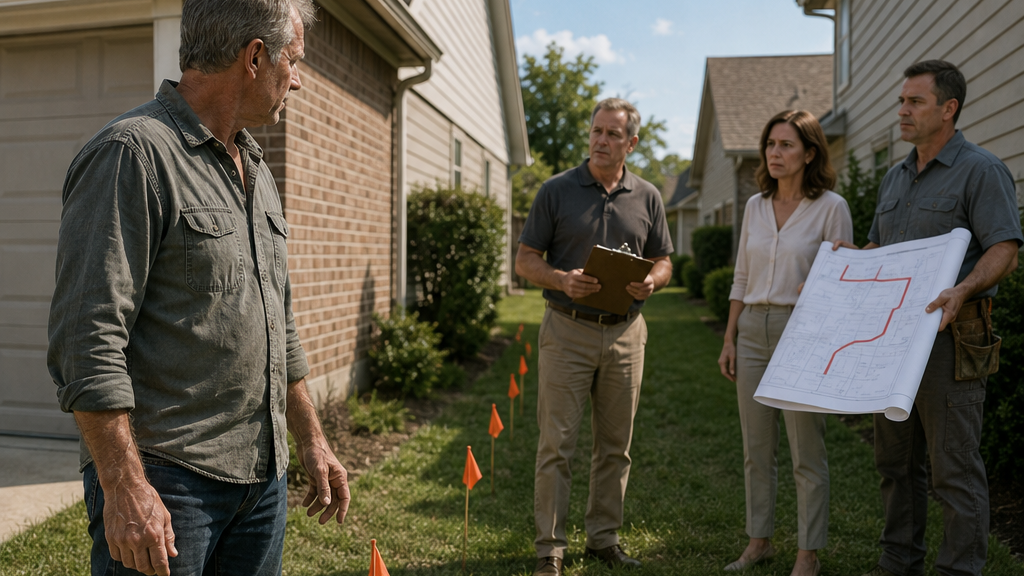
By Thursday, small orange flags appeared from the front corner of his parcel to the rear fence, each marking a surveyed point.
The narrow strip suddenly looked different.
Not larger.
Defined.
Scott stood near the garage and followed the orange markers with his eyes. A line that had existed only in documents now existed in the grass.
He felt better.
Then his phone buzzed.
An email from Gary Mitchell, chair of the HOA architectural committee.
Scott opened it.
Gary thanked him for providing his survey. The committee, he wrote, wanted to schedule an on-site review concerning the Roberts garage application and the association’s historical maintenance responsibilities.
Scott read the next sentence twice.
The committee would like to inspect the shared maintenance corridor between the Harris and Roberts properties.
Scott looked out the window at the orange flags.
Shared maintenance corridor.
Not private side parcel.
Not Harris property.
Shared.
For the first time since the surveyors appeared, Scott wondered whether Ashley had not simply misunderstood the situation.
He wondered who had told her she was entitled to believe it.
Chapter 3: Orange Flags Against the HOA Plan
Scott came home Thursday afternoon to find three people standing among his orange survey flags.
Gary Mitchell had a clipboard tucked beneath one arm. Ashley stood beside him. A contractor in work boots was holding the same rolled plan Scott had seen in his kitchen.
No one had called to say they were already there.
Scott parked, shut off the engine, and walked straight toward them.
Gary raised a hand.
“Scott. Good timing.”
Scott stopped at the first orange flag.
“Is it?”
Gary seemed not to hear the edge in his voice.
“We were just looking at how equipment might enter if the committee approves the garage.”
Scott looked at the contractor.
“You’re discussing equipment access?”
The contractor glanced at Gary.
“Potential access.”
“Across my property.”
Ashley stepped in.
“Scott, we’re trying to see whether there’s a way to make this work.”
Scott pointed at the bright line of flags.
“The way to make it work starts with staying on the other side of those.”
Gary shifted his clipboard.
“I think we should clarify something before this becomes adversarial.”
Scott almost smiled.
“You’re standing on my property discussing construction access I already denied.”
Gary looked down at the grass as if only now remembering where his shoes were.
“The association has maintained this corridor for years.”
“Maintained what?”
“The common landscaping edge.”
“Common?”
Gary opened the clipboard and pulled out a printed map.
Ashley unrolled the contractor drawing on the hood of her car.
The red utility line crossed the orange survey line almost immediately.
For a moment the conflict looked absurdly simple.
Red line.
Orange flags.
Two competing versions of the same twelve feet.
Gary tapped his map.
“The association’s maintenance vendor has serviced this side for quite a while. Mowing, edging, seasonal treatment.”
Scott looked at the map but did not take it.
“Show me the easement.”
Gary frowned.
“The maintenance history—”
“No. Show me the recorded easement that lets the association authorize utility installation.”
“That isn’t exactly what we’re saying.”
“Then show me Ashley’s signed access agreement.”
Gary glanced toward her.
Scott waited.
The contractor quietly rolled the plan halfway closed.
Gary said, “There may not be a separate agreement because the corridor has historically been treated as part of the association’s maintained area.”
“Maintained is not owned.”
“I didn’t say it was owned.”
“Then who authorized you to bring a contractor onto it?”
Ashley spoke before Gary could answer.
“We’re doing a site review.”
“You’re doing one on my property.”
“Scott, nobody has started construction.”
“That isn’t the standard.”
Gary exhaled.
“Let’s lower the temperature.”
“My temperature is fine.”
The contractor looked down, perhaps hiding a reaction.
Scott held out his hand.
“Show me one document that gives the HOA authority to grant access across this parcel.”
Gary looked again through his papers.
He had architectural guidelines.
A landscape-maintenance map.
A page from the Roberts application.
Meeting notes.
No easement.
No license.
No signature from Scott.
Scott let the silence do the work.
Finally Gary said, “I don’t have that with me.”
“Does it exist?”
“I don’t know.”
Scott nodded.
“Then the site review is over.”
Ashley’s face flushed.
“You can’t just end a committee review.”
“I can end people entering my property without permission.”
Gary’s expression tightened, but he did not challenge him.
“Fine,” he said. “We’ll continue at the management office.”
The contractor stepped back toward the driveway.
Ashley stayed where she was.
“You really want to do this?”
Scott looked at her.
“What am I doing?”
“You know this strip has been treated like common landscaping forever.”
“By who?”
“The HOA.”
“They trim an edge.”
“They maintain it.”
“Those are not the same thing.”
“You didn’t complain when they maintained it.”
Scott felt the sentence land harder than he expected.
Because it was true.
He had watched crews trim there for years. Sometimes he had appreciated it.
He had never written a letter saying they could.
He had never written one saying they could not.
Gary must have seen the hesitation.
“That’s what we need to sort out,” he said more calmly. “No one is claiming title. But there is a history here.”
Scott looked down the length of the corridor.
The orange flags seemed suddenly less absolute.
Not legally.
Socially.
Practically.
A boundary could be perfectly clear on paper and still become blurred by a decade of habits no one had bothered to examine.
“Send me whatever you have,” Scott said.
Gary nodded.
“Everything.”
“I will.”
“And nobody comes back onto this strip until we resolve it.”
Gary hesitated.
Then: “Agreed.”
Ashley did not answer.
That evening the property manager sent Scott a packet.
It was larger than he expected.
Landscape contracts.
Vendor invoices.
Old HOA maps.
Seasonal maintenance diagrams.
Scott spread them across the same kitchen table where Ashley had shown him the red utility route.
Several years of invoices used vague phrases: perimeter edging, common-area trimming, east-side maintenance.
None identified his parcel number.
Then he found a colored maintenance map from six years earlier.
A pale green band ran along the street-facing edge of his side strip.
Scott leaned closer.
The green did not cover the full twelve-foot corridor.
It covered only the outer section nearest the sidewalk and extended partly down one side.
He felt some relief.
Then he found a newer map.
On that version, the shading had widened.
No explanation.
Another revision from two years later widened it again.
By the most recent map, nearly the entire outer edge of his side parcel appeared inside an HOA-maintained zone.
The deed still said the property was his.
The maps did not claim otherwise.
But Scott could suddenly see how Gary had reached his conclusion.
More importantly, he could see how Ashley had.
His phone rang.
The property manager.
“I wanted to make sure you received the documents,” she said.
“I’m looking at them.”
There was a pause.
“Scott, I need to be careful how I phrase this.”
“That usually means I’m not going to like the next sentence.”
“The association’s legal ownership records do not show your parcel as common property.”
Scott leaned back.
“Good.”
“But our operations map does label part of that area as maintained common landscaping.”
“Maintained common landscaping or common property?”
“The map says maintained common landscaping.”
“On my parcel.”
“Yes.”
“How did that happen?”
“I don’t know yet.”
Scott looked again at the widening green band.
The answer he had expected—a simple mistake, easily dismissed—was no longer enough.
Because somebody had changed the map.
Not once.
More than once.
And for years, everyone had trusted it.
Chapter 4: The Map Everyone Had Trusted Too Long
The green shading on the HOA map crossed Scott’s property line as casually as if the line were not there.
He sat in the management office the following Monday with the map spread between himself, Gary Mitchell, and the property manager. The current version showed a narrow band labeled for association landscaping along the street and down the side of Scott’s lot. On paper, the color was pale and harmless.
In practice, it had become someone’s argument for access.
Scott placed his recorded survey beside it.
“Which document controls ownership?”
The property manager answered first.
“The deed and recorded plat.”
“So this map doesn’t.”
“No.”
Gary leaned forward.
“But that’s not the only issue.”
Scott looked at him.
Gary tapped the green band.
“This is what our landscapers have been using for years. That matters when we’re trying to understand how the area was treated.”
“It matters for mowing.”
“It may matter for expectations.”
Scott felt his jaw tighten.
Expectations.
A word people used when they did not have permission.
The property manager pulled an older map from the file. “This one is from eight years ago.”
The green shading barely touched Scott’s parcel. It covered the sidewalk edge and a small corner near the front.
Another map followed.
Then another.
Scott saw the change happening in slow motion.
The maintenance area widened over successive revisions. First a few feet. Then a longer section along the side. Eventually, the green band reached far enough that someone unfamiliar with the original survey might reasonably assume the HOA maintained the whole edge.
“Who changed these?” Scott asked.
The property manager shook her head. “The maps were updated with vendor contracts.”
“By who?”
“Different managers. Different boards.”
“So nobody knows.”
“We’re checking.”
Scott looked at Gary.
Gary did not look defensive now. He looked annoyed, but not at Scott.
“That explains why I thought the corridor was under association maintenance,” he said.
“Maintenance,” Scott repeated. “Not access.”
“I understand the distinction.”
“Do you?”
Gary held his gaze.
“Yes.”
It was the first answer that did not feel rehearsed.
The property manager opened a folder of invoices.
Most were broad enough to be useless: edging, seasonal treatment, perimeter mowing. Scott read through line after line until one invoice specified the east entrance landscaping and sidewalk border.
Another mentioned trimming around utility boxes.
None mentioned contractor access through Scott’s parcel.
None mentioned excavation.
None mentioned an easement.
Scott felt some of his confidence return.
“This is lawn care,” he said.
Gary nodded slowly.
“It looks that way.”
The manager turned another page.
“There’s no recorded access agreement in the HOA files.”
Scott sat back.
There it was.
Not a complete victory, but something solid.
Years of landscaping had created confusion.
They had not created ownership.
They had not created a right to bury somebody else’s utilities.
Scott expected to feel satisfied.
Instead, he thought about every Saturday he had watched the landscaping crew edge the grass without saying anything.
He remembered standing at the window once, coffee in hand, pleased that someone else was doing a job he disliked.
Convenience had worked both ways.
The thought irritated him because it complicated the clean story he preferred.
Ashley had assumed too much.
Gary had assumed too much.
But Scott had also benefited from the ambiguity when it suited him.
That afternoon, he stopped at the strip before going inside.
One of the orange survey flags leaned slightly after a mower had passed nearby.
Laura was walking toward him with a grocery bag.
“So?” she asked.
“The HOA doesn’t own it.”
“I didn’t think they did.”
“They’ve just been maintaining more of it over time.”
Laura nodded as if that confirmed something.
Scott noticed.
“What?”
“Nothing.”
“Laura.”
She shifted the grocery bag to her other arm.
“I told you how it looked.”
“I know.”
“You were mad at me.”
“I wasn’t mad.”
“You did that thing where you get very quiet and decide the conversation is finished.”
Scott looked down at the flag.
“That’s not the same thing.”
“It feels the same from the other side.”
He almost dismissed it.
Instead, he let the sentence sit.
Laura continued toward home.
At his kitchen table that evening, Scott went through the packet again.
One note from an architectural committee meeting caught his attention. It concerned another landscaping dispute years earlier. The language was casual: existing maintenance practice to continue unless owner objects.
Unless owner objects.
Scott read the line twice.
He had never objected.
Not because he had surrendered anything.
Because trimming grass had not seemed worth fighting about.
He picked up the phone and called Gary.
“I found something.”
“The old committee note?”
“You saw it too?”
“Yes.”
“Then you understand why maintenance continued.”
Gary was quiet.
“I do.”
“And you understand why it doesn’t authorize Ashley’s utilities.”
“Yes.”
Scott waited.
Gary exhaled into the phone.
“I need to tell you something.”
Scott stood straighter.
“What?”
“When Ashley first asked me about the strip, I told her the HOA had always handled it.”
Scott did not speak.
Gary continued.
“I didn’t tell her we owned it. I said we’d always handled it, and I told her the committee could probably work through the access issue.”
“You told her that before checking.”
“Yes.”
“So when she came to me, she thought the HOA was already behind her.”
“I think she thought there was a path.”
“You gave her that path.”
“I gave her too much confidence. I can admit that.”
Scott walked to the window.
Across the side yard, Ashley’s house was dark except for one room upstairs.
“Why?”
Gary’s answer came without much delay.
“Because most architectural disputes are setbacks, paint colors, fences. Things we can solve by looking at past practice. I treated this like one of those.”
Scott almost said, That’s your job.
He stopped.
Gary already knew.
“You should have checked the title first.”
“Yes.”
“And Ashley should have asked me before she paid anyone.”
“Yes.”
“Then why are we still talking?”
“Because her application is already moving through municipal review.”
Scott turned from the window.
“What?”
“She submitted it.”
“When?”
Gary told him.
Scott opened his email and checked the date of his written refusal.
Ashley had received his objection three days before filing.
Scott felt the situation rearrange itself.
Until that moment, he had been able to believe she was acting on bad information.
Now he knew she had moved forward after the information was no longer bad.
She had known he had said no.
And submitted anyway.
Chapter 5: The Decision Ashley Never Mentioned
The municipal planning clerk looked over Scott’s survey, then asked a question so simple it made the entire dispute feel different.
“Did you ever sign an access agreement?”
Scott sat across the desk from her with his property records in a folder.
“No.”
“Temporary license?”
“No.”
“Utility easement?”
“No.”
“Letter of consent?”
“No.”
The clerk looked toward the garage application on her monitor.
“Then we need clarification.”
Scott had expected a denial.
Instead, she typed a note into the file.
“The project itself may still be compliant,” she said. “The access and utility route are the issue.”
“You can’t approve a route across private property without permission.”
“Correct.”
“So deny it.”
“We may require revision before denial. The applicant can submit another route.”
Scott frowned.
The clean answer was moving away from him again.
“What happens now?”
“We pause review and notify the applicant that property-control documentation is missing.”
“For how long?”
“That depends on how they respond.”
Scott left with less satisfaction than he had expected.
Outside, the planning-office parking lot shimmered with heat. He stood beside his truck reading the clerk’s printed note.
Missing property-control documentation.
Three words that turned his side yard into an administrative defect.
Not yet a victory.
Not yet a refusal anyone had to respect.
When he returned home, Ashley was in her driveway talking to her contractor.
She saw him and ended the conversation.
Scott could have gone inside.
For most of his life, that would have been his preference.
Let the documents do the talking.
Instead, he walked toward her.
“The planning office paused your application.”
Ashley folded her arms.
“I know.”
“They asked whether I signed anything.”
“I know.”
“You submitted after I told you no.”
Her face changed.
Not surprise.
Weariness.
“Yes.”
Scott waited for the explanation.
Ashley looked toward the narrow strip between their houses.
“I thought the committee would work something out.”
“You thought they’d overrule me?”
“No.”
“That’s exactly what you thought.”
“I thought they’d tell us what was reasonable.”
Scott stared at her.
“Reasonable for who?”
“For everyone.”
“That usually means the person being asked to give something up.”
Ashley looked away.
For several seconds, neither spoke.
Then she said, “Do you know how much money we already put into this?”
“No.”
“Plans. Engineering. Contractor deposit. Structural drawings. We changed the whole back layout because the original garage attached to the house was too expensive.”
“That doesn’t create access.”
“I know that.”
“Do you?”
Her eyes sharpened.
“Yes, Scott. I know it now.”
“Now?”
“I knew you objected.”
The words landed harder than the explanation he had imagined.
Ashley pressed her lips together.
“I’m not pretending I didn’t.”
“Then why file?”
“Because Gary said the HOA had always maintained that side. Because the contractor said there were options. Because I thought once everyone sat down, you’d agree to something limited.”
“I said no.”
“You emailed one sentence.”
“It was clear.”
“It was clear legally.”
Scott heard Laura’s words in the answer.
From the other side.
Ashley continued.
“You wouldn’t meet with the contractor. You wouldn’t walk the route. You didn’t ask what protections we could put in writing. You just sent a refusal.”
Scott felt the old instinct rise.
The deed was clear.
Permission was clear.
None of that was wrong.
But Ashley was not arguing that his property belonged to her.
She was telling him how his silence had looked.
“You still filed,” he said.
“Yes.”
“Knowing I hadn’t agreed.”
“Yes.”
“Why?”
Her shoulders dropped.
“Because I hoped approval would force all of us to sit down before we lost the money.”
There it was.
Not confusion.
Pressure.
And a choice.
Scott looked at the garage stakes visible behind her house.
“Force.”
Ashley winced.
“That’s not how I meant it.”
“That’s how it works.”
She nodded once.
“I know.”
For the first time since the dispute started, she sounded less defensive than tired.
“We stretched to buy this place,” she said. “The garage was part of why it worked for us. My husband needs the storage. We planned around it. If we reroute the utilities, the estimate jumps enough that we may have to delay everything another year.”
Scott said nothing.
He could understand every part of that.
He still did not owe her the strip.
Ashley looked at him directly.
“I should have asked you before we let anyone measure.”
“Yes.”
“I should not have filed after your email.”
“No.”
A faint, humorless smile touched her mouth.
“You could at least let me finish the apology.”
Scott almost smiled back.
Almost.
The planning office called him the next afternoon.
The Roberts application remained paused. The applicant could either submit a new utility route or provide documented permission for the proposed one.
“There is another possibility,” the clerk said.
Scott waited.
“If both parties agree, you can execute a temporary construction license.”
“Temporary?”
“For equipment access and installation.”
“What about future utility maintenance?”
“That would need to be addressed separately.”
Scott looked through the kitchen window.
The side strip was bright in the afternoon sun. Orange flags stood every few yards.
“What if I don’t agree?”
“Then the applicant will need to redesign.”
Simple.
Except now he knew what that meant for Ashley.
The following day the contractor delivered a proposed license for Scott to review.
It included restoration language.
Insurance requirements.
Access dates.
A promise to reseed disturbed grass.
A defined construction period.
Scott read it twice.
It looked careful.
Reasonable, even.
Then he found a paragraph near the bottom addressing future access to installed facilities.
Reasonable entry as required for inspection, repair, maintenance, or replacement.
Scott stopped reading.
Temporary permission.
Permanent reason to return.
He set the document on the table.
The contractor’s cover note said the alternate route estimate would be finalized Friday.
Scott had until then to decide.
For the first time, the question was no longer whether he could say no.
It was whether understanding Ashley’s reasons should change his answer.
Chapter 6: One Temporary Permission With Permanent Consequences
“The trench closes in three days,” the contractor said, “but the service route doesn’t disappear.”
Scott stood beside him in the narrow strip on Friday morning.
The orange survey flags had been out long enough to lose their sharpness. One leaned toward the garage wall. Another had faded at the fold.
Ashley stood near the driveway.
Gary had come at Scott’s request.
Scott held the proposed license in one hand.
“Show me exactly what happens after installation.”
The contractor pointed along the grass.
“Electrical conduit here. Water line here. Boxes toward the rear.”
“If a line fails?”
“We’d need to access it.”
“With what?”
“Depends on the repair.”
“Hand tools?”
“Maybe.”
“Excavator?”
“Possible.”
“And if I sell?”
The contractor paused.
“That depends on the recorded agreement.”
Scott looked down at the paper.
The title called it temporary.
The obligations were not.
“How often do buried lines need service?” Gary asked.
“Could be never for twenty years,” the contractor said. “Could be next month. Nobody can promise.”
Ashley shifted.
“But we can restrict access.”
“You can restrict procedure,” Scott said. “You can’t remove the reason for access.”
She did not answer.
Scott walked to the rear of the strip.
His mower cover had collected dust. The kayak had not moved since spring.
For weeks, those facts had been used against him.
Unused.
Barely used.
Not important.
Now he understood why the argument had bothered him so much.
It was not about whether he currently needed every square foot.
It was about who got to decide what his future use could be.
He had worked utility maintenance long enough to know that infrastructure changed land. Once installed, it acquired needs of its own.
Access.
Clearance.
Repair.
Replacement.
A route that today belonged entirely to him would forever contain someone else’s reason to enter.
Scott returned to the group.
“I’m not signing this.”
Ashley looked down.
Gary nodded slowly.
The contractor only said, “Understood.”
There was no explosion.
That surprised Scott.
Perhaps he had been preparing for one because conflict felt easier when the other side behaved badly.
Ashley looked at the strip.
“So that’s it.”
“For this route.”
She gave a short laugh.
“You know the other route costs almost eight thousand more.”
“I heard the estimate.”
“And adds six weeks.”
“I heard that too.”
“Does that matter to you?”
Scott could have answered with the deed.
Two weeks earlier, he would have.
Instead, he folded the license.
“Yes.”
Ashley looked at him.
“It matters,” he said. “I know this costs you money. I know you planned around what Gary told you. I know the HOA maps made this look different than it was.”
Gary lowered his eyes.
Scott continued.
“But if I sign this, the cost becomes mine in a different form. Your utility line stays. Future access stays. The strip changes permanently.”
Ashley said nothing.
“I should have told you that from the beginning,” Scott added.
She looked surprised.
“I told you no. I never told you why.”
Gary looked between them.
Scott almost regretted saying it.
Then Ashley nodded.
“That would have helped.”
“It might not have changed anything.”
“No.”
“But it would have helped.”
The HOA meeting that evening was quieter than Scott expected.
Only the architectural committee, the property manager, Ashley, Gary, and Scott were present.
The current maintenance map sat on the table beside Scott’s recorded survey.
Gary began.
“We made an assumption based on long-standing landscaping practice.”
He did not say mistake at first.
Scott noticed.
Gary continued.
“That assumption was carried into the Roberts review before we verified property rights.”
One committee member asked whether the HOA could simply discontinue maintenance and leave the access question to the city.
Gary shook his head.
“The access question is already answered unless Scott consents.”
Ashley stared at the table.
Another member asked, “Does maintenance create anything legally?”
The property manager answered.
“Not from what we’ve found. There’s no easement or license.”
Scott listened.
No one was praising him.
No one was condemning Ashley.
The room felt closer to the truth than it had during the confrontation in the yard.
Messy.
Ordinary.
Preventable.
Gary turned to Scott.
“Would you explain your concern with the proposed temporary license?”
Scott felt everyone waiting.
His instinct was to slide the document across the table and point to the permanent-access clause.
Let the paper speak.
Instead, he kept it in front of him.
“The issue isn’t three days of digging,” he said. “The issue is what happens after the digging is gone.”
He explained the line.
Future repair.
Equipment.
Successive owners.
The difference between allowing someone across the grass once and installing infrastructure that would create a continuing reason to cross it.
He kept his voice even.
“I’m not trying to stop the Roberts garage. I’m saying their permanent utilities need to be on property they control.”
Ashley looked at him.
For once there was no argument in her expression.
Gary sat back.
“That should have been the committee’s starting point.”
Silence.
Then he looked toward the property manager.
“I want the application conditioned on a route that does not use Harris property.”
Ashley closed her eyes briefly.
Gary continued.
“And I want an audit of every operational maintenance map we use.”
The property manager looked up.
“All of them?”
“All of them. If we’ve shaded private property into common maintenance zones anywhere else, we need to know.”
One committee member frowned.
“That could be a lot of work.”
Gary gave a tired smile.
“It’s less work than repeating this.”
The vote was not dramatic.
The committee agreed to require a revised route.
Then it agreed to review the maps.
When the meeting ended, Ashley gathered her papers slowly.
Scott stood.
She looked at him.
“I’m still not happy about the eight thousand.”
“I wouldn’t be either.”
“But I understand the difference now.”
Scott nodded.
She left.
Gary remained near the table.
“I made this worse,” he said.
“Yes.”
Gary glanced at him.
Scott added, “So did I.”
That seemed to surprise him.
“You were protecting your property.”
“I was also acting like a legal description was a conversation.”
Gary folded the outdated maintenance map.
“Maybe both things can be true.”
Scott looked at the green shading crossing the line where it never should have been.
Gary handed the map to the property manager.
“Start with this one,” he said. “Then check every other map.”
For the first time, the problem had grown larger than Scott’s side yard.
Not because his ownership was unclear.
Because the HOA finally understood how many other boundaries it might have been treating as if no one needed to ask.
Chapter 7: The Garage They Built Without His Land
The excavator showed up on Ashley’s property six weeks later.
Scott heard it before he saw it—a diesel engine settling into a steady idle on the opposite side of the Roberts house. When he stepped into his driveway, the machine was nowhere near his narrow strip.
Instead, fresh utility markings curved along Ashley’s far property line.
The new route went around the air-conditioning units, past the retaining wall, and toward the rear garage pad from the other side.
Scott stood beside the first orange survey flag and watched the bucket lower into Ashley’s yard.
For weeks, he had imagined this moment as proof.
He had expected satisfaction.
What he felt was mostly relief.
The contractor noticed him and gave a small wave.
Scott returned it.
No one asked to cross the strip.
No equipment rolled across his grass.
No trench opened beside his garage.
The old mower remained under its cover. The storage bins stayed where they had always been. The kayak still hung unused against the wall.
The space looked almost embarrassingly ordinary.
That was the point.
It did not need to become important to anyone else in order to matter.
Ashley came outside while the crew was exposing the first section of the alternate route.
She stood with her arms folded, watching.
Scott considered going back inside.
Then she looked over.
For a second they both seemed unsure whether the last several weeks required a conversation.
Ashley crossed the driveway first.
“They started at seven.”
“I heard.”
“We lost another week because of the retaining-wall engineer.”
Scott nodded.
“And the final price?”
She gave him a look.
“You really want to know?”
“Only if you want to tell me.”
“More than the eight thousand.”
Scott winced despite himself.
Ashley noticed.
“That expression almost makes me feel better.”
“Almost?”
“Almost.”
Behind them, the excavator scraped through compacted soil.
Ashley looked toward the orange flags.
“You know, I hated those things.”
“The flags?”
“They made it look like you were building a wall without building one.”
Scott glanced down the line.
“That wasn’t what I intended.”
“I know that now.”
She took a breath.
“I was angry for a while.”
“I assumed.”
“At you. Gary. The contractor. Mostly myself.”
Scott waited.
Ashley rubbed at a spot of dried soil on the edge of her shoe.
“I kept telling myself I wasn’t asking for much. That’s how I justified filing after your email.”
Scott said nothing.
“I thought if everyone agreed the request was reasonable, then you’d have to see it that way too.”
“You mean agree.”
“Yes.”
She looked at him.
“I’m sorry for that.”
It was not a dramatic apology.
No tears.
No sudden friendship.
Just a sentence Ashley appeared to have spent time deciding whether she could say.
Scott nodded.
“Thank you.”
She gave a short breath that might have been a laugh.
“I’m still mad about the money.”
“You’re allowed to be.”
“And I still think you could have talked to me sooner.”
Scott looked at the strip.
“So do I.”
That surprised her.
He continued before he could retreat into silence.
“I thought saying no clearly was enough. Legally, it probably was. Neighbor-wise, maybe not.”
Ashley considered that.
“You would still have said no.”
“Yes.”
“At least you’re consistent.”
He smiled.
“So I’ve been told.”
She went back toward the crew.
Scott remained beside the flags for another minute, then returned to his garage.
The corrected HOA map arrived three days later.
The property manager had attached both the old and revised versions.
On the old map, the pale green maintenance band crossed onto Scott’s parcel.
On the revised map, it stopped cleanly at the recorded property line.
The accompanying notice was short. The association had completed an initial review of its operational landscaping records and identified several locations where maintenance boundaries did not match recorded ownership boundaries.
The notice did not dramatize what had happened.
It simply stated that future maintenance on privately owned parcels would require documented owner authorization.
Scott read that paragraph twice.
The changes went further at the next HOA meeting.
Gary sat at the front table with a packet much thicker than the one he had brought into Scott’s yard weeks earlier.
“We found four other maintenance-map discrepancies,” he said.
A committee member asked whether any involved construction access.
“No.”
Scott felt a tension leave his shoulders that he had not known was there.
Gary continued.
“But that’s not really the point. We shouldn’t be relying on operational maps to answer ownership questions.”
The committee adopted new procedures that evening.
Architectural applications requiring access across adjoining private property would not move to final review without written consent from the owner.
Maintenance contractors would receive parcel-specific maps where private boundaries mattered.
Temporary landscaping work would no longer be treated as evidence of association authority.
Scott listened from the second row.
No one mentioned his name during the vote.
He preferred it that way.
Afterward, Gary approached him near the door.
“I owe you an apology too.”
Scott looked at him.
“You already admitted the mistake.”
“That isn’t quite the same thing.”
Gary tucked the meeting packet under his arm.
“I told Ashley we could probably work through the corridor because I wanted the project to stay simple. I treated the map like an answer because checking everything properly would have slowed us down.”
Scott nodded.
“I’ve done versions of that.”
Gary raised an eyebrow.
“Not often, I imagine.”
“More than I like admitting.”
Gary smiled.
“The audit isn’t finished.”
“Find anything worse?”
“Mostly little things. Shrub beds. Irrigation heads. Corners that crews have been cutting for years.”
“Little things become big when somebody needs them.”
Gary gave him a tired look.
“I think we finally learned that.”
The garage framing began the following week.
From Scott’s kitchen window, he could see lumber rising behind Ashley’s house. The project had survived.
Just differently.
That mattered to him more than he expected.
He had never wanted Ashley to lose the garage.
He had wanted her need to stop becoming his obligation.
By late afternoon, Scott walked down the side strip with a small bucket.
The surveyor had told him the flags could be removed once he no longer needed the visible markers.
He pulled the first one from the ground.
Then the next.
The narrow corridor changed as he worked.
Without the orange markers, it stopped looking like disputed territory.
It became grass again.
Storage bins.
A mower.
A kayak he kept promising himself he would use more often.
At the rear fence, he found the last flag leaning beside the old iron pin.
He crouched and worked it loose.
Before standing, he looked back toward the street.
On one side stood his garage.
On the other, Ashley’s house.
Beyond it, he could hear the contractor working on the new garage route entirely within the Roberts property.
Laura was passing the front sidewalk when she saw him carrying the flags.
“Taking down the wall?” she called.
Scott looked at the handful of orange plastic.
“Apparently.”
She stopped.
“So who won?”
He considered the question.
Weeks earlier he would have answered immediately.
Now he looked toward Ashley’s yard, where the garage was finally taking shape.
“Her garage is getting built.”
Laura nodded.
“And your strip?”
“Still mine.”
“That sounds suspiciously like two people got what they needed.”
Scott shook his head.
“She got a larger bill.”
“And you got several HOA meetings.”
“Fair point.”
Laura smiled and continued down the sidewalk.
Scott carried the flags into the garage.
On the workbench lay the corrected HOA map he had printed that morning.
He set the orange markers beside it, then picked up the last one.
For weeks, the flags had meant defense.
Proof.
A line people were not supposed to cross.
Now the line existed on the map where it should have existed all along, and the association finally understood the difference between maintaining something and having a right to it.
Scott walked back outside.
Ashley was standing near the new trench on the far side of her home. She saw him without the flags and glanced toward the strip.
Then she raised one hand.
Not an apology.
Not permission.
Just the same ordinary neighborly wave she had given him when she first moved in.
This time Scott did not leave the answer to a document.
He raised his hand and waved back.
The story has ended.