He Mowed His Elderly Neighbor’s Overgrown Lawn—Then the HOA Forced Them Both to Answer for It
Chapter 1: She Ordered Him to Stop Mowing the Lawn She Had Already Condemned
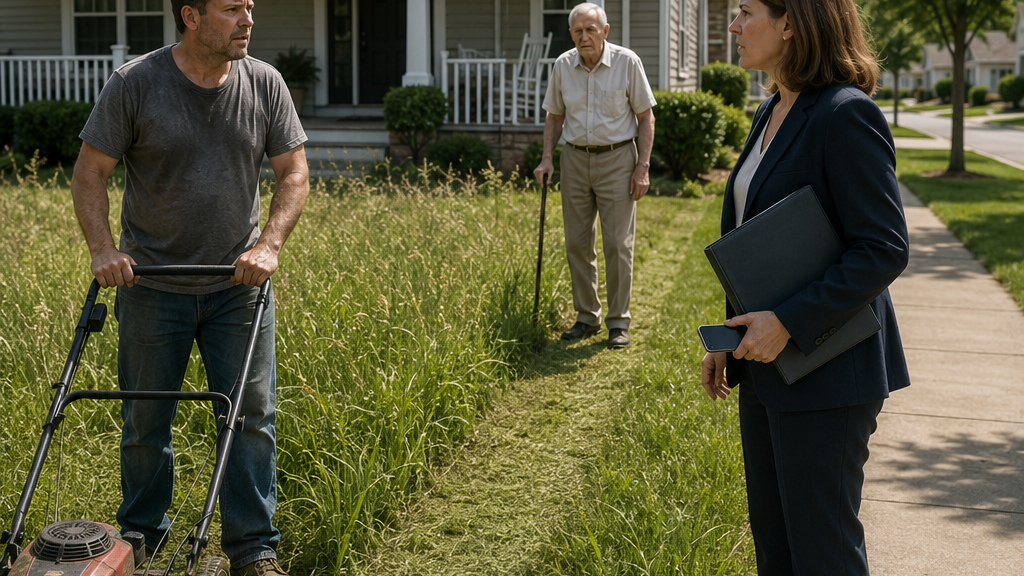
“Turn that mower off.”
Michael Wilson heard the command over the engine but kept both hands on the handle for another second, finishing the strip he had already started.
The mower chewed through grass that reached halfway up his shins, leaving a flat green lane behind it. On either side, the rest of Edward Harris’s front yard stood high and uneven, seed heads bending over the sidewalk.
“Michael. Turn it off.”
He released the safety bar.
The engine coughed twice and died.
The sudden quiet felt larger than it should have.
Deborah Martin stood near the curb in a dark jacket despite the heat, one hand holding a folder against her hip. Michael had seen her at annual HOA meetings but had never spoken to her for more than thirty seconds. She chaired the compliance committee and had a way of standing very still when she was angry.
Behind her, Edward remained near the porch steps with one hand resting on his cane.
Michael wiped his forehead with his forearm.
“Morning, Deborah.”
“This isn’t funny.”
“I didn’t say it was.”
She looked over the torn clumps of grass scattered beside the mower. “You’re making a mess all over the sidewalk.”
Michael glanced down. A few clippings had blown across the concrete.
“I’ll sweep it.”
“That’s not the point.”
Michael looked from Deborah to the lawn.
The contradiction was so obvious that for a moment he assumed he had misunderstood her.
“You sent him notices because the grass was too high.”
“The association sent notices.”
“All right.”
“And that does not give you permission to come onto another owner’s property and start doing whatever you want.”
Michael felt his jaw tighten.
Edward shifted behind her.
“He has permission,” Edward said.
His voice was quiet, but Deborah heard him.
She turned slightly. “Edward, I’m trying to keep this from becoming a bigger issue.”
Michael almost laughed, but Edward’s face stopped him.
The older man looked smaller outside than he had from across the street. He wore loose khaki pants and an old short-sleeved shirt. His cane trembled faintly against the concrete where his hand rested on the handle.
Michael had noticed that tremor earlier.
Now Deborah was pretending not to.
“He asked me to mow,” Michael said.
Deborah looked back at him. “That’s between you and him.”
“Then why did you tell me to stop?”
“Because this property is already under active compliance review. We’ve had complaints. There are procedures.”
Michael glanced at the lawn again. Half of one strip was cut. The rest looked like a neglected field planted between two tidy suburban houses.
“So the procedure is to leave it high?”
“The procedure is not for you to interfere.”
Michael took one slow breath.
His father had taught him plenty of bad habits, but the worst had been the certainty that the loudest person in an argument owned the room. Michael had spent years learning not to copy him.
He kept his voice level.
“Edward’s been sick.”
Edward looked up sharply.
Michael continued before he noticed.
“He had surgery. He was in the hospital for weeks. He can barely get through the yard right now, and he’s already got two violation letters sitting inside.”
Deborah’s expression changed, though not in the way Michael wanted.
It tightened.
“His medical situation is private.”
“Exactly.”
“And you’re the one announcing it in the front yard.”
Michael stopped.
The words landed harder than Deborah probably intended.
He turned toward Edward.
The older man’s eyes had lowered.
Michael had meant to defend him. Instead, he had just listed Edward’s weaknesses in the middle of the street like evidence in a case.
Deborah opened the folder.
“Michael, I’m asking you once. Put the mower away and let the owner deal with management.”
“He is dealing with it.”
Edward said nothing.
Deborah waited.
Michael felt heat crawling up the back of his neck.
“What happens if the lawn stays like this?” he asked.
“That isn’t your concern.”
“Does he get fined?”
“That’s between the association and Edward.”
“That sounds like yes.”
Deborah closed the folder.
“Do not make this harder than it needs to be.”
“I’m mowing grass.”
“You’re refusing a direct request from a compliance officer while an active violation is being addressed.”
Michael looked at the mower between them.
A red push mower. A bag half full of wet clippings. One clean strip of lawn.
Nothing about it looked threatening.
Deborah reached for her phone.
“If you start that again, I will call the police and have an officer come out so we can establish exactly who has authority to be on this property.”
Michael stared at her.
“You’re going to call the police because I’m mowing the lawn you told him to mow?”
“I’m going to call because you are refusing to step away from a dispute that does not involve you.”
Edward’s cane tapped once against the porch.
Michael saw his hand shaking again.
Not dramatically. Just enough.
That was what changed Michael’s anger.
Until then, he had been arguing with Deborah.
Now he understood that Edward was standing behind both of them while two younger people discussed his house, his health, his yard and his ability to manage any of it.
Michael stepped away from the mower.
Deborah lowered the phone slightly.
“There,” she said. “That’s all I’m asking.”
Michael looked at Edward.
“Do you want me to leave?”
For several seconds, Edward said nothing.
Then he raised his eyes.
“I asked you to cut it.”
Deborah exhaled. “Edward—”
“I asked him.”
Michael nodded once.
He reached for the mower handle.
Deborah lifted her phone again.
“Michael.”
He stopped before touching the safety bar.
“I’m not trying to fight you,” he said.
“Then don’t.”
“I’m trying to help him.”
“And I’m trying to enforce the same rules for every house on this street.”
For the first time, Michael heard something beneath her irritation: fatigue.
That did not make her right.
But it made the argument less simple than he wanted it to be.
A curtain shifted in a house across the street.
Michael noticed and hated that he noticed.
Edward noticed too.
His shoulders drew inward.
Michael let go of the mower.
“I’m going inside for some water,” Edward said.
He turned toward the porch.
His first step was careful.
The second was slower.
Michael moved automatically.
“You need a hand?”
Edward’s head came around.
“No.”
The answer was sharper than anything he had said all morning.
Michael froze.
Edward climbed the steps by himself, cane first, then foot, then the other foot.
At the door he paused.
Deborah closed her folder.
“I’ll contact management Monday,” she said. “Edward needs to respond properly. That’s all.”
She walked toward the sidewalk.
Michael remained beside the silent mower.
The lawn was divided directly in front of him: tall grass on one side, the clean strip he had cut on the other.
A problem and a solution separated by six inches.
It should have felt simple.
It no longer did.
Edward opened his front door, then looked back.
His voice was low enough that Deborah, already at the curb, did not hear it.
“You didn’t have to tell her all that.”
Chapter 2: The Letters on Edward’s Kitchen Table Were Not the Whole Story
Three hours earlier, Michael had not known there were any letters.
He had only known the grass was too high.
He was walking home from a small repair job when he saw Edward sitting on his porch with a coffee mug beside him and a cane leaning against his chair. The yard had grown so far past ordinary neglect that the sidewalk edge had almost disappeared.
Michael stopped at the driveway.
“You planning to raise livestock?”
Edward looked at him for a moment, then gave a tired half-smile.
“Cheaper than mowing.”
Michael nodded toward the grass. “Your mower break?”
“No.”
That answer was enough to make him look more closely.
Edward’s face seemed thinner than Michael remembered. They had waved across the street for years, exchanged brief comments about weather and trash pickup, nothing more.
Michael had always thought of him as the older man who kept his property almost unnaturally neat.
Now weeds crowded the mailbox post.
“Everything okay?”
Edward reached for the cane.
“I had some trouble earlier this year.”
He stood slowly.
That was when Michael first noticed the tremor.
Inside the house, the air smelled faintly of coffee and antiseptic wipes. Edward had invited him in after Michael offered to look at the mower, though neither of them had gone near the garage.
On the kitchen table sat a plastic pill organizer, a printed medication schedule and three white envelopes bearing the HOA management company’s return address.
Two had been opened.
One had not.
Michael looked at them without touching.
“Those about the yard?”
Edward followed his eyes.
“Among other things.”
“What other things?”
“Mostly the yard.”
Michael pulled out a chair but waited until Edward sat first.
Edward lowered himself carefully, one hand gripping the tabletop.
“Had surgery in the spring,” he said. “Nothing dramatic.”
Michael looked at the cane.
Edward caught the look.
“That’s temporary.”
“I didn’t say anything.”
“You didn’t have to.”
The silence between them lasted a moment.
Edward reached for one of the envelopes.
“They kept me in the hospital longer than they expected. Then I had therapy. By the time I got home, the grass was already getting ahead of me.”
“Why didn’t you hire somebody?”
Edward gave him a look that made Michael regret the question.
“Because people like to be paid.”
Michael nodded.
Edward’s retirement check covered the house, utilities, insurance, groceries and whatever insurance did not cover from the surgery. He did not list numbers. He did not need to.
Michael had worked in enough homes to recognize the arithmetic of a fixed income.
Something breaks, something else waits.
“You have family nearby?”
“No.”
“Anybody checking on you?”
“My physical therapist checks on whether I can stand up without falling over. That’s enough company.”
Michael almost smiled.
Edward did.
Then the expression disappeared.
He pushed one violation letter across the table.
Michael read the first paragraph.
The association had observed excessive grass height and weeds. The property was to be brought into compliance.
The second letter was firmer.
Repeat violation.
Potential fine.
Hearing rights.
“Twice?” Michael asked.
Edward nodded.
“You answer them?”
“I called once.”
“What’d they say?”
“That I needed to correct the property.”
Michael looked through the kitchen window.
Grass leaned against the fence outside like grain before harvest.
“You tell them about the surgery?”
“I told them I’d been in the hospital.”
“And?”
“They said to submit whatever was required.”
“What was required?”
Edward lifted one shoulder.
Michael waited.
Finally Edward said, “I don’t know.”
That bothered Michael more than the letters.
“You don’t know because they didn’t tell you?”
“I don’t know because I didn’t ask.”
Michael leaned back.
Edward looked down at his hands.
“There’s a difference between being unable to do something today and becoming somebody everybody has to manage.”
“No one said that.”
“They don’t have to.”
Michael thought of his father then.
Years earlier, after a fall he had tried to hide, his father had started refusing help with small things. Groceries. Driving. A loose handrail Michael could have fixed in twenty minutes.
Michael had mistaken stubbornness for strength until the day strength was no longer part of the choice.
He had told himself afterward that if he ever saw someone struggling again, he would act sooner.
Maybe that promise had been sitting in him ever since.
“How far can you walk?” Michael asked.
Edward looked irritated.
“I can walk.”
“That’s not what I asked.”
A long pause.
“To the mailbox, most days.”
“And back?”
Edward looked toward the front window.
“Usually.”
Michael heard what he did not say.
Edward rubbed two fingers over the curved handle of his cane.
“Some days I get back in here and sit down for twenty minutes.”
Michael looked again at the letters.
The threatened fine suddenly felt obscene.
Not because property rules had no purpose. Michael lived in the same neighborhood. He had seen neglected homes pull down an entire block.
But the grass outside had not grown because Edward did not care.
It had grown because his body had stopped cooperating.
“I’ve got a mower,” Michael said.
Edward shook his head immediately.
“No.”
“It’ll take me an afternoon.”
“No.”
“Edward.”
“I said no.”
Michael sat back.
Edward’s voice softened.
“I appreciate it.”
“Then let me do it.”
“That’s not the same thing.”
Michael studied him.
“What is?”
Edward looked through the window.
The tall grass moved slightly in the breeze.
“I used to do that yard every Saturday before breakfast.”
Michael said nothing.
“Forty years in one house,” Edward continued. “You get used to having your own hands on things.”
The answer was not about mowing.
Michael understood that much.
He also understood that another violation letter was sitting unopened on the table.
He pointed to it.
“What if that one says they’re fining you?”
Edward did not answer.
Michael stood.
“I’m getting my mower.”
Edward frowned. “Michael.”
“I’m not handling the HOA. I’m not paying anything. I’m cutting grass.”
“I didn’t ask you to.”
“Then ask.”
Edward stared at him.
Michael waited.
It took nearly ten seconds.
Finally Edward exhaled.
“Cut the front.”
Michael smiled.
“And the side.”
Michael picked up his keys.
“Anything else?”
“Don’t get carried away.”
That had been before Deborah arrived.
Now, after the confrontation, Michael sat across from Edward at the same kitchen table.
The third envelope was open.
Neither man spoke about Michael’s mistake at first.
Michael had apologized once.
Edward had said, “All right,” in a tone that meant the subject was not finished.
Then someone knocked.
Michael opened the door.
A delivery driver stood outside holding a flat envelope.
“Certified for Edward Harris.”
Edward signed for it himself.
He carried it back to the table and opened it with his thumb.
Michael watched his eyes move down the page.
“What is it?”
Edward slid the paper across.
A formal compliance hearing had been scheduled.
The notice gave a date, a time and warned that continuing violations could result in monetary penalties.
Michael felt his irritation return.
“I can call them Monday.”
Edward reached out and placed his hand over the letter.
“No.”
“Edward—”
“No. You can mow the grass. You are not handling them for me.”
Michael looked at the older man’s hand.
It was trembling again.
But it stayed firmly on top of the notice.
Chapter 3: Michael Finished the Yard and Made the Problem Worse
Michael restarted the mower twenty minutes after Deborah left.
He did not do it to prove anything to her.
At least that was what he told himself.
Edward had asked him to finish the front and side, and Michael intended to do exactly that. He walked the mower back to the half-cut strip, pulled the cord and let the engine swallow the silence.
The work was ugly at first.
Tall grass clogged the deck twice. Wet clippings stuck to Michael’s shoes. He had to raise the cutting height and make two passes over the worst sections.
But progress was visible.
Every few minutes another clean stripe appeared.
By noon, Edward’s front yard looked like a lawn again instead of an abandoned lot.
Edward watched from the porch.
Michael tried not to hover over him.
When he brought water, he left the bottle on the railing rather than asking if Edward needed it.
It felt ridiculous to think so carefully about such small things.
It also felt necessary.
A nearby homeowner stopped while walking a dog.
“Looks better.”
Michael nodded.
The homeowner glanced toward Edward, then lowered his voice.
“Deborah give you trouble?”
Michael shut the mower down.
“You saw that?”
“Half the street saw that.”
Michael wiped grass from the side of the mower.
“She’s doing her job.”
The homeowner gave a short laugh.
“That’s one way to say it.”
Michael looked up.
“What’s the other?”
The neighbor hesitated.
“Some houses get three notices. Some get six months. Depends who complains and who’s on the committee.”
“That true?”
“I’m saying people have been arguing about enforcement since spring.”
The neighbor walked on before Michael could ask more.
Twenty minutes later another resident offered almost the same complaint in different words.
Too strict with one house.
Too lenient with another.
Everybody had an example.
Michael began to understand something Deborah had said.
Uniform enforcement.
Maybe she was not inventing the pressure.
That still did not explain why she had tried to stop the very work required to correct Edward’s violation.
By late afternoon, the yard was finished.
Michael swept the sidewalk.
He trimmed the worst growth along the driveway but resisted the urge to keep going.
Edward stood at the porch rail.
“It looks like mine again,” he said.
Michael looked over the short grass.
There was satisfaction in the sight of it that had nothing to do with the HOA.
The first clean strip from that morning had disappeared into all the others.
“Not bad.”
“Little uneven.”
Michael looked at Edward.
Edward’s mouth twitched.
“That your thank-you?”
“That’s my professional assessment.”
Michael laughed.
For the rest of Saturday, the problem seemed solved.
On Sunday, Edward sat outside longer than usual.
On Monday morning, Michael drove past on his way to a job and saw the lawn still clean beneath the early sun.
He felt vindicated.
Then, shortly after lunch, Edward called.
“There’s another letter.”
Michael turned his truck around.
The notice was on Edward’s kitchen table when he arrived.
Michael read it once.
Then again.
“This makes no sense.”
Edward sat opposite him.
“Apparently it makes sense to somebody.”
The property had been visually corrected.
The notice acknowledged that.
But the case remained open pending confirmation of an ongoing maintenance plan and resolution of the scheduled hearing.
Michael tapped the paper.
“They wanted the grass cut. It’s cut.”
“They want to know how it stays cut.”
“I’ll do it.”
Edward’s eyes hardened.
Michael stopped.
“Right. Sorry.”
He read the notice again.
There was a phone number at the bottom for the management company.
“I’m just asking what this means.”
Edward said nothing.
Michael took that as permission.
It was not.
He called from the porch while Edward stayed inside.
After two transfers, a woman answered.
“Ashley Scott, property management.”
Michael explained the situation in less than a minute.
Ashley listened without interrupting.
Then she asked, “Are you the owner?”
“No. I’m his neighbor.”
“I can explain general policy. I can’t discuss Mr. Harris’s account with you.”
“Fine. General policy. If somebody had surgery and temporarily couldn’t maintain a lawn, what happens?”
A pause.
“There’s a temporary hardship review.”
Michael straightened.
“A what?”
“A homeowner can request temporary accommodation for certain compliance matters based on documented hardship. Medical recovery can qualify depending on circumstances.”
Michael looked through Edward’s front window.
The older man was still sitting at the kitchen table.
“No one told us that.”
“I can’t speak to what was communicated in this case.”
“What does somebody have to do?”
“Submit a request. Usually there’s a short form, supporting information if applicable, and a proposed maintenance solution.”
Michael felt something shift.
Not relief.
Suspicion.
“If that exists, why is there a hearing?”
“Again, I can’t discuss a specific owner with you.”
“Can Edward call?”
“Yes.”
“Can he come in?”
“Yes.”
Michael thanked her and ended the call.
He went inside.
Edward looked at him.
“Well?”
“There’s a hardship process.”
Edward’s expression did not change.
Michael expected surprise.
Instead he saw something closer to resignation.
“You know about that?”
“I know there was paperwork.”
Michael stared at him.
“What paperwork?”
Edward looked toward the window.
Michael followed his gaze.
Outside, the clean lawn stretched toward the sidewalk, neat enough now that nothing about it suggested the argument that had happened there two days earlier.
“Edward.”
“I got something after the first notice.”
“And you didn’t fill it out?”
“It asked questions.”
“That’s what forms do.”
Edward’s eyes came back to him.
Michael immediately regretted the tone.
“What kind of questions?”
“Medical information. How long I expected the problem to continue. What arrangements I’d made.”
“That sounds pretty normal.”
“To you.”
Michael opened his mouth, then closed it.
Edward folded the newest notice and set it beside the others.
“I didn’t ask for an exception.”
“You were about to get fined.”
“I was trying to take care of it.”
“You couldn’t.”
The words came out before Michael could stop them.
Edward’s face went still.
Michael felt the mistake immediately.
He had done it again.
Reduced the man’s whole situation to what he could not do.
Before either of them spoke, Michael’s phone rang.
Ashley.
He stepped toward the porch.
“Hello?”
“I checked one thing I can tell you generally,” she said. “The hardship process is available to any owner who meets the criteria. It is not automatic.”
“So if Edward never filed—”
“There would be nothing for the board to review.”
Michael rubbed his forehead.
“Did anyone explain that to him?”
“I can’t answer that without authorization.”
He looked through the screen door.
Edward sat with his cane beside him and the letters spread across the table.
Michael had spent two days believing there were only two sides to the story: an unreasonable HOA and an old man who needed help.
Now there was a form Edward had refused to complete, a process Michael had never known existed, and a hearing still moving toward them.
Ashley spoke again.
“If Mr. Harris wants to contact me himself, I can walk him through the options.”
Michael thanked her.
When he returned to the kitchen, Edward was stacking the notices into a neat pile.
Michael sat down.
“There is a process,” he said.
Edward did not look up.
“And apparently you never filed for it.”
“No.”
“Why?”
Edward aligned the corners of the papers.
“You keep asking the wrong question.”
Michael frowned.
“What’s the right one?”
Edward finally looked at him.
“Why did nobody think I should get to decide how much of my life I had to explain just to keep my own yard?”
Chapter 4: The Rule Deborah Never Mentioned Changed Michael’s Version of Events
Ashley Scott slid a single sheet of paper across the management-office desk.
Michael read the heading twice.
Temporary Hardship Review.
For a few seconds he simply stared at it.
The office was small and aggressively ordinary—gray carpet, two filing cabinets, a printer humming behind Ashley’s chair. Nothing in the room matched the size of the anger Michael had carried inside with him.
“This is current?” he asked.
“Yes.”
“And it applies to exterior maintenance violations?”
“In certain circumstances.”
“Like surgery?”
“Potentially.”
Michael put one finger on the page.
“So Deborah knew this existed.”
Ashley leaned back slightly.
“I didn’t say that.”
“She chairs compliance.”
“That doesn’t mean I’m going to speculate about what another volunteer knew at a particular moment.”
Michael looked at the form again.
It asked for the nature of the hardship, an estimated duration, and a proposed method for maintaining the property during the temporary condition. Supporting documentation could be requested but was not automatically required.
It was bureaucratic.
It was also nowhere near as invasive as Michael had imagined from Edward’s reaction.
“Why wasn’t this in the violation notice?”
Ashley turned the form around and tapped a paragraph near the bottom.
“It was referenced.”
Michael read the line.
Owners experiencing circumstances affecting timely compliance may contact management regarding available review procedures.
“That’s it?”
“That’s the reference.”
“That doesn’t say hardship.”
“No.”
“That doesn’t say medical recovery.”
“No.”
“That doesn’t say there’s a form.”
Ashley’s mouth tightened.
“I didn’t write the template.”
Michael sat back.
He had arrived expecting to find a clean mistake he could carry home like proof. Instead, the page in front of him opened two directions at once.
The association had a process.
Edward had not used it.
And the notice had technically pointed toward help without making the help easy to recognize.
“Was Edward sent this?”
Ashley looked at her monitor.
“I can answer that if he authorizes me.”
Michael almost argued.
Then he heard Edward’s voice from the day before.
You are not handling them for me.
He stopped himself.
“Fair.”
Ashley looked mildly surprised.
Michael stood.
“Can I take a blank copy?”
“Yes.”
She handed it to him.
At the door, Michael turned back.
“One general question.”
Ashley waited.
“If an eighty-two-year-old man tells somebody on the phone he’s recovering from surgery and can’t mow, would that normally be enough for someone to tell him this exists?”
Ashley took longer to answer.
“I would hope so.”
That stayed with Michael all the way home.
His mower sat beside the garage where he had left it after washing the deck. Strands of dried grass still clung beneath one wheel.
For two days, Michael had looked at the mower as evidence that he had fixed something.
Now it looked more like evidence that he had entered a problem halfway through and decided he understood the beginning.
Edward was on the porch when Michael crossed the street.
Michael held up the blank form.
“I went to management.”
Edward’s expression changed before Michael reached the steps.
“You did what?”
“I didn’t discuss your account.”
“I told you not to handle this.”
“I didn’t handle anything. I asked about the process.”
Edward pushed himself upright with the cane.
“That is handling it.”
Michael stopped at the bottom step.
“There’s a hardship form.”
“I know.”
“You knew there was an actual form?”
Edward looked toward the street.
“I got one.”
Michael felt his frustration return.
“When?”
“After the first notice.”
“What happened to it?”
Edward said nothing.
“Edward.”
“I threw it away.”
Michael stared at him.
“You threw it away.”
“Yes.”
“Why?”
Edward lowered himself back into the chair.
“Because I read it.”
“So?”
“So I didn’t like it.”
Michael climbed one step, then stopped himself from coming farther.
“What part?”
Edward looked at the blank copy in Michael’s hand.
“The part where I explain what happened to me. The part where I say how long I expect to be weak. The part where I promise strangers I’ve arranged for someone to do the things I used to do myself.”
“They’re trying to determine whether you qualify.”
“For permission not to be fined while I recover.”
“That’s what a hardship process is.”
Edward’s jaw shifted.
Michael heard his own impatience and tried again.
“Look, I’m not saying it’s pleasant.”
“No. You’re saying it’s reasonable.”
Michael said nothing.
Edward tapped the cane once against the porch.
“You know what the hospital was like?”
Michael waited.
“Everybody asks the same questions. Can you stand? Can you dress yourself? Can you use the bathroom without help? Can you get from the bed to the chair?”
His voice stayed even.
“That’s their job. I know that.”
Michael lowered the form.
“Then I come home, and now the neighborhood wants a form asking what I can do too.”
“That’s not exactly what it says.”
“It’s what I read.”
The distinction mattered less once Edward said it that way.
Michael sat on the porch step.
“What did you tell them on the phone?”
“That I’d been in the hospital.”
“And?”
“They told me I needed to submit a request if I wanted special consideration.”
“That’s when they sent the form?”
“Yes.”
“Why didn’t you tell me any of this?”
Edward gave him a dry look.
“You met me properly three days ago.”
Michael almost smiled.
It disappeared quickly.
“I thought Deborah was just ignoring your condition.”
“She may have been.”
“But you also didn’t finish the process.”
“No.”
The answer was not defensive.
That made it harder for Michael to keep assigning blame cleanly.
He unfolded the form.
“You could still submit it.”
Edward looked at him.
“There you go again.”
Michael stopped.
“What?”
“Finding the next thing for me to do.”
“I’m trying to keep you from getting fined.”
“I know.”
“Then what am I supposed to do?”
Edward’s eyes narrowed slightly.
“Maybe wait until I ask.”
The words stung because they were deserved.
Michael looked down at the clean lawn.
A few uneven patches showed where the mower had struggled through the thickest growth. He had noticed them Saturday and considered going back over them.
He understood now how easily usefulness could become momentum.
Once he decided to help, he kept finding new things to fix.
Edward’s phone rang inside.
He did not move immediately.
Then he stood.
“I’m expecting my therapist.”
Michael rose too.
“I’ll go.”
Edward reached the door, then stopped.
“Leave the form.”
Michael handed it over.
Edward took it without promising anything.
Michael crossed the street.
He had barely reached his driveway when he heard the screen door behind him.
“Michael.”
He turned.
Edward stood on the porch holding the form.
“Did they tell you anything else?”
Michael considered how to answer.
“They said the process exists. That’s all I was authorized to know.”
Edward nodded.
It was the first time Michael had answered less than he knew because more was not his to give.
Later that evening, Edward came across the street.
Michael was putting tools into his truck.
Edward held the blank form folded in half.
“I found the old one.”
Michael waited.
“I didn’t throw it away.”
“You just said you did.”
“I put it in the trash. Then I took it back out.”
Michael rested one hand on the truck bed.
Edward seemed irritated by his own admission.
“I thought maybe I’d fill it out.”
“But you didn’t.”
“No.”
“Why not?”
Edward looked at the driveway instead of at him.
“I decided I wasn’t going to beg.”
That was the midpoint Michael had been missing.
Not a hidden conspiracy.
Not a cruel rule written specifically to hurt an old man.
Pride.
Fear.
A poorly explained process.
And Deborah’s rigid insistence that procedure mattered more than understanding why it had failed.
Michael nodded slowly.
“I get that.”
“No, you don’t.”
“Probably not.”
Edward looked at him then.
The answer seemed to surprise him.
Michael closed the truck toolbox.
“I’m trying to.”
Edward unfolded the form once, then folded it again.
“I’ll decide what I’m doing about the hearing.”
“Okay.”
“And I don’t want you calling management anymore.”
Michael hesitated.
Every instinct in him wanted to say they needed information.
Instead he said, “Okay.”
Edward started back toward his house.
Halfway across the street, he stopped.
“And Michael?”
“Yeah?”
“Stay out of the hearing.”
Michael watched him continue toward the porch.
For the first time since he had pulled the mower cord Saturday morning, the thing Michael wanted most was also the thing Edward had specifically told him not to do.
Chapter 5: Edward Was Tired of Everyone Deciding What He Could No Longer Do
The mower Michael had left beside Edward’s garage had not moved an inch.
By Wednesday morning, the grass beneath its wheels had begun to pale.
Michael noticed it from across the street while loading a drill case into his truck.
He had lent Edward the mower after finishing the yard, thinking the gesture would make things easier when the grass needed another pass.
Now the untouched machine looked less like help and more like a question.
He almost walked over.
He did not.
At noon, Edward called.
“Can you come outside?”
Michael found him at the end of his driveway with his cane in one hand.
No mower.
No letters.
“You all right?”
“I want to walk the yard.”
Michael looked at him.
Edward’s expression hardened.
“I said walk it. Not climb a mountain.”
Michael nodded.
“All right.”
They started along the driveway.
Edward moved slowly, placing the cane ahead of each step. Michael kept himself half a pace back.
At the edge of the lawn, Edward turned onto the grass.
The ground was uneven where thick clumps had been cut down.
Michael instinctively raised a hand toward his elbow.
Edward saw it.
Michael lowered his hand before touching him.
They continued.
The mower lines were still visible.
Straight bands crossed the yard where Michael had cut through the worst growth.
Edward followed one of them toward the sidewalk.
“Used to take me forty minutes,” he said.
“To mow?”
“Front and side.”
Michael glanced at the size of the yard.
“You were fast.”
“I was seventy-five.”
Michael smiled.
Edward did too.
Then his breathing changed.
Only slightly.
He stopped near the mailbox.
Michael pretended to inspect the curb while Edward rested.
After half a minute Edward said, “This is the part everybody sees.”
“The yard?”
“No.”
He tapped the cane against the ground.
“This.”
Michael looked at him.
Edward stared toward his house.
“Hospital people see a patient. Therapist sees a recovery schedule. HOA sees a violation. You saw an old man who needed somebody to cut his grass.”
Michael started to answer.
Edward raised a hand.
“Let me finish.”
Michael closed his mouth.
Edward took another breath.
“You did me a kindness.”
The words were quiet.
“You did. I’m not pretending otherwise.”
Michael felt some tightness ease from his chest.
Then Edward continued.
“But you started talking for me before you even knew me.”
Michael looked down at the mower line beneath their feet.
“You’re right.”
Edward seemed prepared for an argument.
When it did not come, his shoulders lowered slightly.
“I was angry at Deborah,” Michael said. “I wanted her to understand.”
“So you told her what I couldn’t do.”
“Yes.”
“And then you called management.”
“Yes.”
“And then you brought me their form.”
Michael nodded.
Edward looked at the sidewalk.
“You know what the worst part of getting old is?”
Michael did not answer.
“People become very efficient around you.”
Michael frowned.
“They carry things before you reach for them. Answer questions before you open your mouth. Make appointments because it’s easier. Decide where you should sit.”
His hand tightened on the cane.
“Most of them mean well.”
Michael thought of his father.
The groceries he had carried without asking.
The keys he had once taken off a counter because he thought his father should not be driving.
The handrail he had installed while his father complained the entire time.
Back then Michael had believed the complaints were pride talking.
Maybe they had been.
That did not mean pride had no right to speak.
“I’m sorry,” Michael said.
Edward looked at him.
Michael did not add an explanation.
He did not say he was only trying to help.
He did not say anyone would have done the same thing.
The silence after the apology was uncomfortable.
Michael let it stay that way.
Finally Edward nodded.
“All right.”
They continued toward the porch.
At the steps, Edward stopped again.
“I’m going to the hearing.”
Michael looked at him.
“You sure?”
Edward’s eyebrows lifted.
Michael caught himself.
“Sorry.”
A faint smile appeared.
“Yes. I’m sure.”
“Do you want me there?”
“No.”
The answer hurt less than it would have two days earlier.
Michael nodded.
“Okay.”
Edward looked across the lawn.
“I am going to fill out part of the hardship form.”
“Part?”
“I’ll tell them what is relevant. Not everything they ask for just because there’s a blank line.”
Michael wanted to explain that incomplete forms caused delays.
He kept quiet.
Edward noticed.
“That nearly killed you, didn’t it?”
“A little.”
Edward chuckled.
It was the first easy sound Michael had heard from him all week.
The next morning, Michael saw Edward’s physical therapist leaving the house.
Later, Edward walked to the mailbox alone.
Michael watched from his garage but did not move toward him.
Edward made it back.
Slowly.
Without help.
That evening, Edward crossed the street carrying a manila folder.
Michael was sitting at the workbench in his garage.
Edward placed the folder down.
“I need something.”
Michael straightened.
“Okay.”
“I want copies of every notice.”
Michael glanced at the folder.
“And the dates they were sent?”
“Yes.”
“Anything else?”
“Anything showing when I called management.”
“That might be in their records.”
“I know.”
Michael waited.
Edward rested both hands on the cane.
“I’m not asking you to make my argument.”
“Understood.”
“I’m asking you because you know how to organize things better than I do.”
Michael nodded.
“That I can do.”
Edward slid the folder toward him.
“Then do that.”
It was such a small request that Michael nearly underestimated it.
For the first time, Edward had not accepted help Michael offered.
He had chosen the help himself.
Michael opened the folder.
Inside were every HOA letter Edward had kept, including the crumpled hardship form rescued from the trash.
Michael arranged them on the workbench by date.
First notice.
Follow-up.
Hardship form.
Second warning.
Hearing notice.
He stared at the sequence.
Something about the dates bothered him.
He picked up the first warning again.
Then the form.
Then the second notice.
Edward watched him.
“What?”
Michael placed the pages side by side.
“I’m not sure yet.”
Edward leaned closer.
Michael traced the dates with one finger.
The hardship form had been sent before the second warning.
The second warning stated that no qualifying circumstances had been presented.
But Edward had already called management before the form was mailed.
Michael looked toward him.
“Do you remember exactly when you told them about the surgery?”
Edward nodded toward the first notice.
“The next morning.”
Michael wrote the date on a blank sheet.
Then he added the date of every document.
Edward remained silent.
Michael felt the old impulse rising—the urge to take the folder, make the calls, build the case.
He pushed it back.
“I can check the public association records and make you a timeline.”
Edward nodded.
“That’s what I’m asking.”
Michael gathered the papers.
No more.
No less.
By the time Edward reached the garage door, Michael had already noticed a second inconsistency.
“Edward.”
The older man turned.
Michael held up the second notice.
“If these dates are right, Deborah’s statement Saturday that there was no alternative until you complied doesn’t match what management had already sent you.”
Edward looked at the paper.
“Find the dates,” he said.
Not prove she lied.
Not take her down.
Just the dates.
Michael nodded.
“I will.”
Chapter 6: The Dates on the Notices Exposed the Choice Deborah Had Made
The dates did not match Deborah’s story.
By Thursday evening, Michael had checked them six times.
He sat at his kitchen table with Edward’s notices arranged in a row, his laptop open to the HOA’s member records portal, and three photographs of the lawn spread beside the keyboard.
The first photograph showed grass beginning to climb.
The second showed it near Edward’s knees.
The third showed Michael’s clean mower paths cutting through it.
He had printed the pictures only because Edward had asked for a complete timeline.
Now the sequence told a story more complicated than either man had understood.
Michael wrote the dates again.
First violation notice.
Edward’s phone call to management.
Hardship form mailed.
Compliance committee review.
Second warning.
Hearing notice.
Saturday confrontation.
The second warning had been authorized after the hardship form was sent but before the deadline on that form had fully expired.
Michael leaned back.
That did not automatically make the notice improper.
But it meant Deborah’s insistence that Edward had simply failed to present any alternative was incomplete.
His laptop chimed.
Ashley had returned his message.
Michael almost answered before remembering Edward’s instruction.
He looked at the folder beside him.
Edward had authorized him only to organize records.
Not argue.
Not negotiate.
Michael let the call go to voicemail.
A minute later, a text appeared.
Call me regarding general compliance timeline. No account details.
Michael stared at it.
Then called.
Ashley answered quickly.
“I need to be careful here.”
“So do I.”
“That’s encouraging.”
Michael looked at the papers.
“I’m not asking about Edward’s private account. I’m trying to understand sequence. When somebody calls after a violation and mentions a medical issue, is compliance supposed to pause?”
“Not automatically.”
“Is hardship supposed to be offered?”
“Yes, generally.”
“And while the form is pending?”
“That depends on circumstances.”
Michael picked up the second warning.
“Would the committee normally continue escalating before the response date?”
Ashley was silent.
Michael waited.
Finally she said, “Normally, management would recommend holding additional monetary escalation while a timely hardship request was being evaluated.”
“He hadn’t submitted the request.”
“Correct.”
“So technically nothing was pending.”
“Correct.”
Michael rubbed his forehead.
“Then Deborah can say she followed the rules.”
“She can say the formal process had not been activated.”
“That’s not the same sentence.”
“No.”
The distinction sharpened the whole case.
Edward had refused to complete the form.
That mattered.
But someone had also known why he was struggling.
That mattered too.
Michael looked at the portal.
“I found compliance committee minutes from two months ago.”
Ashley was quiet.
“There’s a note about inconsistent enforcement complaints.”
“Yes.”
“Residents were angry.”
“Very.”
“That’s why Deborah got stricter.”
Ashley did not answer immediately.
Michael sat forward.
“Ashley?”
“I’m choosing my words.”
“Choose them.”
“The board had received complaints that some owners were getting informal extensions while others were getting immediate notices. Deborah’s position was that informal exceptions were part of the problem.”
“That sounds reasonable.”
“It can be.”
“But?”
Ashley exhaled.
“She pushed for all owners to use the formal process. No verbal exceptions. No committee members telling people, ‘Don’t worry about it for a few weeks.’ Everything documented.”
Michael looked at Edward’s first notice.
“And hardship referrals?”
“The process still existed.”
“That’s not what I asked.”
Another pause.
Ashley lowered her voice.
“Deborah discouraged staff from doing what she called ‘pre-screening for excuses.’”
Michael stopped writing.
“What does that mean?”
“It means if an owner reported a problem, the direction was to refer them to the written notice and require them to make a formal request rather than staff suggesting possible relief.”
“So Edward says, ‘I was in the hospital,’ and instead of somebody saying, ‘There’s a hardship form for that,’ he gets told to follow the notice.”
“That could happen under that approach.”
Michael pushed his chair back.
Anger came fast.
“She knew.”
“Michael.”
“She knew the process existed.”
“Yes.”
“And she chose not to make it easy to reach.”
Ashley’s response was careful.
“She believed making exceptions easier to initiate would recreate the inconsistent system residents were complaining about.”
Michael laughed once, without humor.
“So she fixed selective enforcement by making everybody equally miserable.”
“That is not how she would describe it.”
“I’m sure.”
Ashley’s voice hardened.
“This is exactly why I told you to be careful. Deborah did not invent the compliance complaints. Residents accused the association of favoritism. One owner got months to fix a fence while another was cited twice for trash cans. Another family received an informal grace period after a job loss, and somebody else demanded the same treatment for a rental property.”
Michael said nothing.
“She was under pressure to make the process consistent,” Ashley continued. “That part was real.”
“And threatening police over a mower?”
“I’m not defending that.”
Michael stared at the photographs.
The one from Saturday showed the mower stopped halfway through a strip.
For days, that image had been simple to him.
Kindness on one side.
Rules on the other.
Now even Deborah’s mistake had a history.
People had demanded fairness.
She had decided fairness meant removing discretion.
Edward had needed discretion at exactly the wrong time.
“What happens at the hearing?” Michael asked.
“There are broader enforcement-policy concerns on the agenda now.”
“Because of Edward?”
“Not only because of Edward.”
Michael frowned.
“Other residents?”
“Several owners have submitted complaints about inconsistent treatment and about the recent move toward stricter enforcement. The board is going to discuss procedure as well as individual cases.”
Michael looked at Edward’s folder.
“That could turn into a circus.”
“It could.”
“And Edward hates being discussed.”
“Yes.”
Michael noticed the certainty in her voice.
“You figured that out?”
“I met him once last year about an architectural form. He corrected me three times when I tried to fill it out for him.”
Despite himself, Michael smiled.
“That sounds right.”
Ashley softened.
“He isn’t incapable, Michael.”
“I know.”
He said it differently this time.
Not defensively.
Ashley continued.
“If he wants an accommodation, the strongest thing he can do is tell the board what he needs and what he is willing to provide.”
“What if he wants Deborah removed?”
“That’s a different question.”
Michael looked again at the timeline.
He had spent the first half of the week wanting exactly that kind of outcome.
Expose Deborah.
Force an apology.
Make somebody pay for humiliating Edward.
Now the evidence did not feel like ammunition.
It felt like context.
Deborah had made a harmful choice.
Edward had made a stubborn one.
Management had relied on language too vague to guide someone already overwhelmed.
And Michael had barged into all of it with a mower and the certainty that good intentions exempted him from asking permission.
He thanked Ashley and ended the call.
Then he printed one final page.
A timeline.
No accusations.
No conclusions.
Just dates, notices, Edward’s documented phone contact, the hardship-form mailing, the second compliance action, and the Saturday confrontation.
He placed it at the front of the folder.
Edward arrived twenty minutes later.
Michael did not launch into an explanation.
He set the folder on the table.
“I found what you asked for.”
Edward sat.
Michael gave him the timeline.
Edward read it slowly.
His finger stopped beside the date of the hardship form.
“They sent the second warning before this deadline.”
“Yes.”
“Does that matter?”
“Maybe.”
Edward looked up.
Michael continued carefully.
“It doesn’t erase the fact that you never submitted the form.”
“I know.”
“But Ashley confirmed the committee had been pushing strict formal enforcement because residents complained about favoritism.”
Edward nodded once.
“That sounds like Deborah.”
“She also discouraged staff from informally steering people toward exceptions.”
Edward’s eyes stayed on the page.
“So she didn’t want exceptions.”
“She wanted people to request them formally.”
“After figuring out on their own what to request.”
“That’s about right.”
Edward leaned back.
For several seconds, he said nothing.
Michael expected anger.
Instead Edward looked tired.
“That woman probably thought she was fixing something.”
Michael nodded.
“I think she did.”
“Still threatened to call the police.”
“Yes.”
“That was foolish.”
“Yes.”
Edward turned another page.
Michael watched him.
“I also heard the board is discussing broader enforcement complaints at your hearing.”
Edward looked up sharply.
“Other people will be there?”
“Probably.”
“That wasn’t what I wanted.”
“I know.”
The room went quiet.
This was the moment Michael would once have filled.
He would have said what Edward should demand.
He would have suggested a strategy.
He would have outlined exactly how Deborah should be confronted.
Instead he waited.
Edward closed the folder.
“What do you think I should do?”
Michael was surprised by the question.
He considered it.
Then shook his head.
“I think you should decide what you want before you decide what you’re going to say.”
Edward studied him.
“That’s annoyingly careful.”
“I’ve been practicing.”
A faint smile appeared.
Michael pointed toward the folder.
“If you want me to tell you what the dates mean, I can. If you want me to tell you what outcome to ask for, I’m probably the wrong person.”
Edward tapped the cover.
“I don’t want to punish anybody.”
Michael said nothing.
“I don’t want my lawn exempt from the rules forever either.”
“Okay.”
“I want enough time to get stronger.”
Michael nodded.
“And I want the next person who says, ‘I just got home from the hospital,’ to hear something better than ‘read the notice.’”
There it was.
Not revenge.
Not surrender.
Correction.
Michael felt something in himself loosen.
Edward rose slowly.
Michael moved the folder closer to the edge so he could reach it.
Nothing more.
Edward slid it beneath one arm.
At the door, he paused.
“You’re coming Tuesday.”
Michael blinked.
“You told me to stay out.”
“I changed my mind.”
Michael almost smiled.
“What do you want me to do?”
Edward looked down at the folder.
“Sit there.”
“That’s it?”
“If I need you, I’ll ask.”
Michael nodded.
Edward tucked the folder more securely against his side.
“And if somebody asks you a question before I’m finished?”
Michael knew the answer now.
“I wait.”
Edward gave one satisfied nod.
Then he took the timeline, the photographs, the notices and the hardship form home with him.
For the first time, Michael did not know which pages Edward intended to use.
And for the first time, he understood that he did not need to know.
Chapter 7: This Time Michael Let Edward Speak Before Anyone Spoke for Him
Deborah Martin had been talking about Edward for less than a minute when his cane struck the floor.
Not hard.
Just once.
The sound was enough.
Deborah stopped midway through a sentence and looked toward the second row of folding chairs.
Edward raised one hand.
“I’m sitting right here.”
The meeting room went still.
Michael sat beside him with both hands clasped between his knees.
On the table at the front of the room were copies of the compliance notices, the hardship policy and several written complaints from other homeowners. Ashley Scott sat at one end with a laptop open. Two board members occupied the remaining chairs.
Deborah had begun by summarizing the case.
Repeated lawn violation.
Failure to submit a hardship request.
Property corrected only after intervention by another resident.
Everything she had said was technically recognizable.
And somehow, hearing it arranged that way made Michael understand exactly what Edward had meant.
A person could disappear inside an accurate list of facts.
Deborah adjusted the papers in front of her.
“Of course. Mr. Harris, you’ll have an opportunity—”
“I’d like it now.”
One of the board members looked toward Ashley.
Ashley gave a small nod.
Deborah sat down.
Edward planted his cane carefully beside his chair and stood.
Michael’s first instinct was to rise with him.
He stayed seated.
Edward took a few seconds to steady himself.
Nobody rushed him.
When he spoke, his voice was not loud.
“I’m not asking you to pretend my grass wasn’t too high.”
Deborah looked up.
“It was.”
Edward glanced toward the printed photograph showing the yard before Michael cut it.
“If I lived across the street from that, I wouldn’t like looking at it either.”
A few people shifted in their chairs.
Michael had expected Edward to begin with the surgery.
He did not.
“I got your first notice. I called. I said I’d been in the hospital and was having trouble getting the yard done.”
Ashley looked at her screen.
“That contact is documented.”
Edward nodded.
“Then I got a form.”
He held up the wrinkled hardship request.
“I didn’t fill it out.”
Deborah leaned forward slightly.
Edward looked directly at her.
“That part is mine.”
The room seemed to settle around the admission.
Michael felt some of the tension leave his shoulders.
Edward continued.
“I read questions about how long my condition would last and what arrangements I had made. At that point, I was tired of explaining what I couldn’t do.”
His thumb moved slowly along the edge of the paper.
“So I put it in the trash.”
One of the board members frowned.
“You received the form and deliberately declined to submit it?”
“Yes.”
Deborah’s posture straightened.
Michael could almost see the argument forming.
Edward did too.
“I’m not saying that was smart.”
That stopped it.
He looked down briefly.
“It was pride.”
The word carried no self-pity.
“I’d spent weeks being asked whether I could stand, walk, dress, eat, get from one room to another. I came home wanting my own life back. Then I got another form asking how I intended to manage my own house.”
No one interrupted him.
“I should have filled out what was relevant. I know that now.”
Edward turned toward Deborah.
“But someone there also knew I’d just gotten out of the hospital.”
Deborah folded her hands.
“We cannot make exceptions based on verbal statements alone.”
“I’m not asking you to.”
“Then I’m not sure—”
Edward lifted his hand.
Deborah stopped.
Michael watched her face change.
Not anger exactly.
Discomfort at losing control of the sequence.
Edward opened the manila folder.
“The second warning was approved before the response date on the hardship form expired.”
He placed the timeline on the table.
Ashley leaned over it.
One board member read the date aloud.
Deborah responded immediately.
“No formal hardship request had been submitted.”
“That’s correct,” Ashley said.
Deborah looked relieved.
Then Ashley continued.
“But the committee was aware that Mr. Harris had reported a recent hospitalization before the second notice.”
Deborah’s expression tightened.
“We were trying to remove informal discretion from enforcement.”
Edward looked at her.
“Why?”
The question was so simple that Deborah seemed unprepared for it.
She glanced at the board.
“Because homeowners had been complaining for months that the rules weren’t applied evenly.”
A man near the back murmured something.
The board member raised a hand for quiet.
Deborah continued.
“One owner would get extra time because someone knew their circumstances. Another owner wouldn’t. People called it favoritism. They weren’t entirely wrong.”
Michael remembered what Ashley had told him.
The fence.
The trash cans.
The informal grace periods.
Deborah was not inventing the problem.
“We needed documentation,” she said. “We needed the same procedure for everybody.”
Edward nodded.
“That makes sense.”
Deborah blinked.
Michael almost did too.
Edward tapped the hardship form.
“What doesn’t make sense is creating a procedure for people in trouble and then making sure nobody helps them recognize when it applies.”
Deborah looked toward Ashley.
Ashley did not rescue her.
Edward continued.
“I called and told somebody I had just been in the hospital. Nobody had to approve anything over the phone. Nobody had to excuse the grass. Someone could have said six words: ‘There is a hardship process available.’”
The room stayed quiet.
“That would have been enough.”
Deborah’s gaze dropped to the table.
Michael felt the old impulse rise again.
This was where he could talk about Saturday.
The police threat.
The absurdity of being told to stop mowing a lawn that had been cited for being too high.
He had rehearsed versions of that argument without meaning to.
A board member looked toward him.
“Mr. Wilson, you were present during the confrontation?”
Michael felt Edward beside him.
“Yes.”
“Would you describe what happened?”
Michael opened his mouth.
Then stopped.
This was the moment.
A week earlier he would already have been standing.
He looked toward Edward.
Edward did not signal.
He did not need to.
Michael turned back to the board.
“I can answer questions about what I did.”
The board member waited.
“But Edward hasn’t finished.”
A small silence followed.
Michael sat back.
The board member nodded toward Edward.
“Go ahead.”
Edward’s hand closed around the top of his cane.
Michael saw the tremor.
He also saw that Edward was standing anyway.
“Saturday,” Edward said, “Michael was mowing because I asked him to.”
Deborah looked down.
“When Deborah told him to stop, he argued with her. He also said things about my health that I hadn’t given him permission to say.”
Michael felt the sentence in his chest.
He did not look away.
“That bothered me.”
Edward turned slightly toward him.
“Michael knows that now.”
Michael nodded.
Edward faced the board again.
“So I am not here to tell you one person was right and everybody else was wrong.”
That changed the room more than any accusation could have.
“I made a bad decision because I was proud. Michael made a bad decision because he wanted to help. Deborah made one because she wanted the rules to be consistent.”
Deborah looked up.
Edward paused.
“But only one of those decisions came with the authority to fine somebody.”
No one moved.
“That matters.”
Deborah’s face lost some of its defensiveness.
For the first time, Michael thought she looked tired rather than formidable.
She turned toward Edward.
“I was afraid if we started making exceptions informally again, we would be right back where we started.”
“I believe you.”
“We had people demanding extensions for everything.”
“I believe that too.”
Deborah pressed her lips together.
Edward continued.
“But I wasn’t asking you to ignore my lawn forever.”
“What are you asking for?”
There it was.
Not what was wrong.
What did he want?
Edward unfolded one page.
“A temporary accommodation while I finish therapy. Ninety days.”
Ashley began typing.
“I’ll arrange maintenance during that time. After that, if I need more time, I’ll ask.”
He glanced toward Michael.
Michael stayed quiet.
“And the fines?”
“I’m asking that they be withdrawn because the association knew there was a potential hardship before escalation and the process was not clearly explained.”
One board member looked at Deborah.
She did not answer immediately.
Then she said, “I would support waiving the pending fine.”
Michael looked at her.
There was no dramatic apology.
No collapse.
No public humiliation.
Just a woman changing position in a folding-chair meeting room.
Somehow that felt more believable.
The board discussed the matter for another twenty minutes.
They approved Edward’s ninety-day accommodation subject to a simple maintenance arrangement.
The pending fine was withdrawn.
But the discussion did not stop with him.
Ashley recommended that future violation notices identify the hardship process by name instead of hiding it behind the phrase available review procedures.
One board member proposed a written short-term assistance policy for residents recovering from hospitalization, injury or other documented temporary conditions.
Not an exemption.
Not automatic forgiveness.
A clear route.
Deborah objected to one provision that allowed management staff to proactively mention hardship review.
Then she looked toward Edward.
Her objection weakened.
“Mention it,” she said finally. “Just don’t promise an outcome.”
Ashley nodded.
“That’s workable.”
The change passed.
People began gathering papers.
Edward lowered himself into his chair.
Michael leaned slightly toward him.
“You okay?”
Edward gave him a sideways look.
Michael corrected himself.
“You want anything?”
“My folder.”
Michael handed it to him.
Edward smiled faintly.
“Better.”
Deborah approached before they left.
Michael expected her to speak to him.
She spoke to Edward.
“I should not have threatened police involvement over the mowing.”
Edward studied her.
“No.”
“I was frustrated.”
“So was I.”
Deborah nodded.
She seemed to be waiting for something—perhaps absolution, perhaps an argument.
Edward offered neither.
Then she looked at Michael.
“You still should have stopped when asked.”
Michael almost answered.
Edward glanced at him.
Michael smiled slightly.
“I probably should have asked more questions before I started doing anything.”
Deborah looked surprised.
“So should I,” she said.
That was all.
Three weeks later, Michael heard a mower start across the street.
He stepped out of his garage.
Edward stood behind the red machine.
For one alarming second, Michael nearly ran over.
Then he stopped himself.
Edward pulled the mower into the yard.
The grass had barely grown past normal height.
He pushed forward.
Slowly.
The mower cut one narrow strip from the driveway toward the porch.
By the time Edward reached the end, his shoulders were rising harder with each breath.
Michael remained where he was.
Edward shut the engine off.
He stood for a moment with one hand on the mower handle.
Then he looked across the street.
“Michael.”
Michael walked over.
Edward nodded toward the machine.
“Finish it?”
Michael took the handle.
“You sure?”
Edward stared at him.
Michael laughed.
“Right. Bad question.”
Edward stepped aside.
Michael started the mower.
Before he moved, he looked down at the strip Edward had already cut.
It was not perfectly straight.
There was a slight bend near the middle where Edward had shifted his weight.
Michael left it exactly as it was.
Then he placed the mower beside Edward’s line and began the next strip.
The story has ended.