The HOA Let a Contractor Fill His Backyard Creek—Then the Water Started Rising Behind Every Fence
Chapter 1: The Gravel Reached the Water Before Robert Reached the Truck
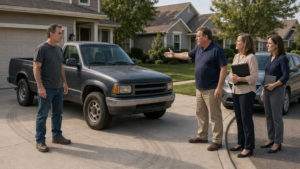
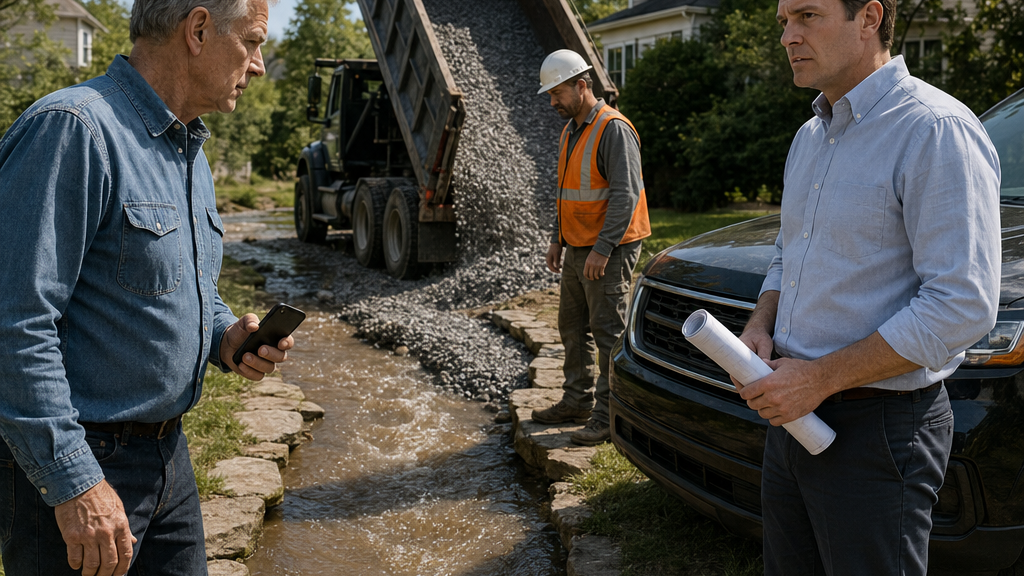
The dump truck was already lifting its bed when Robert Walker came through the back door.
He had heard the reverse alarm first—three hard beeps cutting through the quiet behind his house—then the deeper hydraulic whine that told him the truck was doing more than turning around.
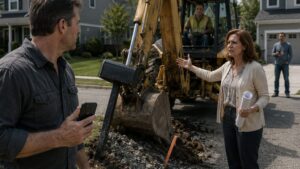
By the time he crossed the lawn, gray crushed stone was sliding from the raised bed toward the creek.
“Hold it!”
The driver either did not hear him or chose not to. The stone rolled down the bank in a hard rattling sheet. Fist-sized pieces struck the water and threw up brown splashes. Smaller gravel spread across the shallow channel like a fan.
Robert stopped ten feet from the bank.
For nineteen years, the creek had run behind his house along the same uneven course, slipping around old stones and exposed roots before disappearing beneath the fence toward Lisa Rivera’s yard. It was barely knee-deep most of the year. Children called it a creek. Some neighbors called it a ditch.
Robert had spent thirty-four years working around municipal water and utility systems.
He called it conveyance.
Stephen Adams stood beside a compact excavator with one hand on his hip and the other holding a radio. White hard hat. Orange vest. Work boots dusted gray.
Robert pointed at the truck.
“Get that out of the channel.”
Stephen looked toward him, then toward the truck as if Robert had asked him to move a parked car.
“We’re stabilizing the bank.”
“You’re filling the flow line.”
Stephen shook his head. “We’ve got authorization.”
“From who?”
“Association.”
A second vehicle was parked beyond the fence opening: Brandon Young’s dark SUV.
That explained the orange survey flags Robert had noticed near the creek the previous Friday.
He had assumed they marked mowing work.
Brandon came around the rear of the SUV carrying a rolled plan in one hand.
“Robert.”
Robert disliked the calm way he said the name. It sounded like the beginning of a conversation that had already been decided.
“Tell him to stop dumping.”
Brandon glanced at the gray stone spreading into the brown water.
“This is maintenance work.”
“That doesn’t answer me.”
“The board approved creek stabilization last week.”
“You approved putting fill in a drainage channel?”
“We approved correcting erosion and giving maintenance equipment stable access.”
Robert looked back at the truck. Another load of stone shifted inside the raised bed.
“Stephen,” Brandon called, “you can continue.”
Robert turned so quickly the muscles in his neck tightened.
Stephen lifted the radio.
Robert said, “If you dump another yard into that channel, you’re going to narrow it.”
Brandon’s jaw moved once.
“We’ve been getting complaints for two years. Standing water. Mosquitoes. Mud. The landscaping crew can barely get back here without tearing up lawns.”
“So you solve standing water by making less room for water?”
“Robert, please.”
There it was.
Not anger. Not argument.
Please.
The word people used when they wanted him to hear how difficult he was being.
The driver released more stone.
Robert did not step in front of the truck. He did not touch the equipment. He pulled his phone from his pocket.
Stephen watched him.
“You filming us now?”
Robert walked downstream instead of answering.
At the old stone edging near the corner of his property, the water had always lapped against the bottom third of a flat sandstone slab. His grandson used the slab as a seat when he came over with a small fishing pole.
Today the water was already touching the stone higher.
Not much.
Maybe an inch.
But the water was coffee brown, and the fresh gravel upstream was visibly forcing the active flow toward one side.
Robert crouched.
Photo one: upstream.
Photo two: across the filled bank.
Photo three: the stone.
He walked farther.
Photo four: the narrow opening where the creek crossed beneath the rear fence.
Photo five: Lisa’s side of the channel.
Photo six: a wide shot showing the dump truck, gravel pile, creek and fence line together.
He checked the time stamps.
9:17.
9:18.
9:19.
When he returned, Stephen was standing at the edge with Brandon.
Robert pointed at the creek.
“What’s your designed flow width?”
Stephen stared at him.
“Your what?”
“The width you’re required to leave unobstructed.”
“We’re not building a culvert.”
“I know what you’re not building. I asked what flow width is on your plan.”
Stephen looked at Brandon.
That brief glance mattered more to Robert than any answer.
Brandon unrolled the document.
“You’re making this sound more complicated than it is.”
“Water usually does that for people.”
Brandon’s expression hardened.
“You worked for the city. I understand that. But this isn’t a municipal project. This is an HOA maintenance area.”
Robert almost smiled.
Almost.
Instead he said, “Water doesn’t know who issued the check.”
For the first time, Stephen stepped closer to the channel and looked carefully at the stone edging.
The brown line had risen another fraction.
He lowered his radio.
Brandon saw it.
“Stephen?”
“We’ve got some displacement because the truck just dumped,” Stephen said. “It’ll settle.”
Robert said nothing.
That irritated Brandon more than another argument would have.
He held out the rolled document.
“You keep saying we don’t have authority to be here.”
“I said you’re narrowing a drainage channel.”
“You told the property manager this morning that nobody had permission to cross your rear lot.”
“Did I?”
Brandon flattened the plan against the hood of his SUV.
“Look.”
Robert did.
The drawing was old. Older than the current landscaping contract, older than Brandon’s time on the board. The subdivision name sat in the title block, faded from repeated copying.
A shaded strip followed the rear property lines.
Drainage and maintenance easement.
Robert read the words twice.
The shaded strip crossed the back of his lot.
Not beside it.
Across it.
Brandon tapped the page.
“We didn’t invent this.”
Robert felt something inside him shift—not surrender, but the first uncomfortable movement away from certainty.
He leaned closer.
The easement existed.
That much was obvious.
But the creek on the old drawing was represented by two thin lines, and the shaded maintenance strip was much wider.
Robert looked from the paper to the growing wedge of gravel in the water.
Brandon rolled the plan again.
“We have the right to maintain it.”
Robert straightened.
“That’s not the same as the right to change it.”
Brandon’s face gave nothing away.
Behind them, the creek pressed brown water against the stone.
And for the first time that morning, Robert knew the argument was no longer about whether the HOA had been allowed onto his property.
It was about what, exactly, they had been allowed to do once they got there.
Chapter 2: The Easement Was Real, but the Drawing Left Something Out
The sentence Robert had hoped not to find was printed in black type six pages into his closing documents.
Permanent drainage and maintenance easement.
He sat at his kitchen table Monday afternoon with the deed packet open beneath his reading glasses and the six photographs arranged across his laptop screen.
He read the sentence again.
The association, its contractors and authorized agents had access rights over a strip along the rear portion of the property for inspection, drainage maintenance and related work.
Robert leaned back.
“Fine,” he said to the empty kitchen.
The word sounded childish.
He closed his eyes.
All morning he had treated Brandon’s presence behind his fence as proof of overreach. That argument was gone.
Not weakened.
Gone.
His phone lay beside the computer with three missed calls from the property manager.
He ignored them long enough to enlarge the first photograph.
Clearer water at 9:17.
More gravel at 9:18.
Higher brown line by 9:19.
The easement gave them access.
It did not explain why the creek looked different after they used it.
Robert opened the county’s online subdivision archive.
Most of the documents were poor scans: plat sheets, drainage exhibits, grading notes and engineering revisions from when the neighborhood had been built. He found the plan Brandon had shown him and downloaded a cleaner copy.
At normal size it told him little.
He zoomed in.
The drainage corridor crossed eight rear lots before discharging into a larger swale beyond the subdivision.
The maintenance easement was broad.
The active channel was not.
Near Robert’s lot, a tiny numbered note pointed toward the creek.
Robert enlarged it until the letters pixelated.
Maintain positive drainage. Preserve design conveyance section.
He sat still.
Then he printed the page.
At the HOA management office the next morning, the property manager met him at a conference table with a thick binder already open.
“I figured you’d come.”
“Did Brandon tell you that?”
“No. You left me a voicemail saying the contractor was reducing hydraulic capacity.”
Robert looked at her.
“I said that?”
“Twice.”
He rubbed his jaw.
The manager slid the binder toward him.
“Here’s what the board approved.”
The meeting minutes were brief. Residents had complained about mud and mosquitoes in the rear drainage corridor. Landscaping crews had difficulty entering after rain. The board had accepted a proposal for erosion stabilization and maintenance access.
No dimensions.
No cross section.
No explanation of how far stone could extend toward the water.
Robert turned the page.
“Where’s the contractor scope?”
She handed him another sheet.
It described geotextile fabric, compacted stone, minor grading and access improvement.
Again, no flow width.
“Who reviewed this against the original drainage plan?”
The property manager hesitated.
“The board considered it maintenance.”
“That isn’t what I asked.”
“No engineer reviewed it.”
Robert let the sheet fall flat.
She folded her hands.
“Robert, people have been complaining about that area for a long time.”
“I know.”
“You also know the association has to maintain it.”
“I know that now.”
Her eyes narrowed slightly.
That answer was not what she had expected.
Robert placed his printout beside the board packet and pointed at the old note.
“Preserve design conveyance section.”
She leaned over.
“I can barely read that.”
“It’s there.”
“What does it mean?”
“It means you can maintain the corridor without making the waterway smaller.”
“Does it say the contractor did?”
“No.”
“Then we need somebody qualified to determine that.”
Robert wanted to tell her he was qualified enough to recognize it. Instead he looked at his six photographs.
He had spent years in trenches with men who could tell a half-inch grade error from the way water gathered around a boot. He knew what narrowed flow looked like.
But knowing was not the same as having authority.
That distinction irritated him because it was reasonable.
The property manager tapped the meeting minutes.
“You were notified about this meeting.”
Robert looked down.
There was his lot number among the properties directly affected.
He remembered the email.
Rear drainage maintenance discussion.
He had deleted it after reading the subject line.
“You didn’t attend,” she said.
“No.”
“You’ve asked the board for years to send written notice before touching your property.”
“They did.”
“Yes.”
He said nothing.
The manager softened her voice.
“They discussed the access path because several homeowners wanted a permanent solution.”
“Several homeowners know what happens when you reduce the channel?”
“They call it a ditch, Robert. Most of them don’t know there is a designed channel.”
“And nobody explained it.”
“You could have.”
The words were not sharp.
That made them worse.
Robert collected the documents.
For years, he had stopped attending most HOA meetings because every technical concern eventually became a personality issue. Robert is against the fence replacement. Robert is arguing about runoff. Robert thinks the landscapers are doing it wrong.
Silence had felt cleaner.
Documentation, he had decided, should be enough.
But documents did not speak until somebody put them on the table.
Back home, he laid the old drainage plan beside the six printed photographs.
His grandson’s stone appeared clearly in three of them.
He found an older picture on his phone from the previous summer: the boy crouched beside the creek, one hand holding a fishing pole, the waterline low against that same stone.
Robert printed it.
The difference was obvious.
He drafted an email to the board.
He deleted the first paragraph.
Then the second.
What remained was four sentences.
The association has maintenance access under the recorded easement. The original drainage plan requires the design conveyance section to remain intact. Photographs taken Monday show fresh fill extending into the active channel and a measurable change in water level. I recommend stopping additional placement until the section is verified.
He stared at the screen before pressing Send.
No accusation.
No lecture.
Just the problem.
His phone rang before he could close the laptop.
Lisa Rivera.
He answered.
“Robert?”
Her voice was tight.
“What happened?”
“I don’t know if it’s from what they did, but the water behind my place looks wrong.”
“How wrong?”
“It’s brown. And it’s not moving the way it usually does.”
Robert stood.
“Where is it?”
“Right behind the patio.”
He looked through the kitchen window toward the rear fence.
Clouds had gathered over the subdivision, thick and low.
Lisa continued, “It’s pooling against the edging.”
Robert reached for his boots.
“Don’t go into it.”
“I wasn’t planning to.”
“Take a picture before you touch anything.”
There was a pause.
Then Lisa said, “You really think this is because of that gravel?”
Robert looked at the old plan on his table.
“I think we’re about to find out.”
Chapter 3: The First Backyard Flood Changed Who Was Calling It a Ditch
By Wednesday afternoon, the brown water had swallowed the lower edge of Lisa Rivera’s patio.
Robert stepped through her side gate and stopped where the lawn dipped toward the rear fence.
Rain struck the patio table in hard silver dots. Water spread across the grass in a shallow sheet, gathering around the pavers where Lisa kept two large planters.
“That’s never happened,” she said.
Robert did not answer immediately.
He was looking upstream.
The creek entered Lisa’s yard through the opening beneath Robert’s rear fence. Usually, water moved through the channel in a narrow, visible current.
Now the water upstream stood high and thick.
Below the filled section, movement was weaker.
Not stopped.
Restricted.
Robert pulled out his phone.
Lisa folded her arms.
“You’re taking pictures?”
“Yes.”
“My patio is flooding.”
“That’s why.”
She stared at him for a moment, then looked away.
On Monday she had told the property manager that Robert was probably exaggerating because he disliked contractors behind his fence.
He knew because the manager had mentioned it without meaning to.
Robert had not confronted Lisa.
Now she stood beside him while muddy water touched the first row of pavers.
He photographed the patio, the fence opening and the upstream waterline.
Then he walked back through his own gate.
Rain had darkened the fresh gravel to almost black.
The creek was pressing against his stone edging nearly four inches higher than it had Monday morning.
He crouched beside the slab his grandson used.
The brown line crossed an old pale mineral mark.
That bothered him, though he could not have said why.
Not yet.
He took a photograph from exactly the same position as Monday’s third image.
Then another.
A message appeared on his screen.
Brandon Young: On my way.
Robert slipped the phone into his pocket.
By the time Brandon arrived, two downstream homeowners were standing under umbrellas along the rear fence line. One had water collecting near a shed. The other kept pointing toward a mulch bed that had begun to wash toward the channel.
Stephen Adams came with Brandon.
No hard hat today. Just a rain jacket and work boots.
Stephen looked at the creek before speaking.
“That’s a lot of water.”
Robert said, “Yes.”
Brandon exhaled through his nose.
“We had nearly two inches in a few hours.”
“Water does tend to show up during rain.”
“Can we not do this?”
Robert looked at him.
“Do what?”
“The part where you act like this proves everything.”
Lisa stepped closer.
“My patio has never flooded.”
Brandon turned toward her.
“I understand. But this is an unusually heavy storm.”
“It has rained here before.”
“I know that.”
Stephen moved to the gravel edge and stared into the channel.
Robert watched him.
“What do you see?”
Stephen ignored the tone.
“The stone settled some.”
“Into the flow line.”
“It moved.”
“Because water moved it.”
Stephen crouched.
Brandon said, “We don’t know whether any of this would have happened without the work.”
That was true.
Robert disliked him for saying it.
More accurately, he disliked the fact that the sentence forced him to slow down.
He pulled up Monday’s photographs.
“This was before the storm.”
He showed Brandon the old stone edging.
Then the image after the first gravel load.
Then the current waterline.
Brandon looked at the screen but did not take the phone.
“Water rises when it rains.”
Robert switched to a wide photograph.
“Look at the channel.”
Stephen leaned closer.
Robert zoomed in.
On Monday, the active water path extended across most of the natural bottom. After the fill placement, stone occupied a portion of that width.
“Upstream storage is increasing,” Robert said. “Downstream discharge looks weak.”
Brandon shook his head.
“That’s an observation, not proof.”
“It’s enough to stop adding material.”
“We already stopped.”
Robert glanced at Stephen.
Stephen said, “We haven’t placed anything since Monday.”
That was a small relief.
Robert had expected another argument and received a fact instead.
Lisa stepped carefully into the grass.
“So what happens now?”
No one answered.
The sound of rain against leaves filled the gap.
Robert realized he could have used the moment differently. He could have said he had warned them. He could have told Lisa she should have listened.
The words were ready.
He let them go.
“We document the high point,” he said. “Then we get somebody from the county who doesn’t care which one of us wins.”
Brandon’s eyebrows lifted.
“I already called the property manager.”
“So did I.”
Stephen straightened.
“If the county wants us to pull stone, we can pull stone.”
Brandon turned sharply.
“Let’s not jump ahead.”
Stephen looked at him.
“I said if.”
The dynamic between them had changed.
On Monday, Stephen had treated Brandon’s authorization as sufficient. Now he was looking at the creek like a contractor imagining the cost of removing everything he had placed.
Robert walked downstream with Lisa.
At the far end of her lot, the creek widened slightly before passing through the next fence opening. Water there moved faster.
He pointed.
“See the difference?”
Lisa nodded.
“Here it’s actually going somewhere.”
“Exactly.”
She watched the current for several seconds.
“I thought you were mad because they were behind your fence.”
“I was.”
“That’s not the same thing.”
“No.”
She looked at him.
“You didn’t explain any of this.”
Robert almost defended himself.
Instead he said, “No.”
That answer seemed to unsettle her more than an argument would have.
They walked back toward the others.
Brandon was on the phone with the property manager, standing beneath the overhang of Lisa’s patio. His voice was controlled.
“Yes, there’s water in several yards. No, I’m not saying the project caused it. I’m saying we need somebody out here.”
Robert heard that last sentence clearly.
Need somebody out here.
Not Robert is overreacting.
Not routine maintenance.
A change, even if Brandon would never call it one.
The rain eased near dusk.
By then Robert had marked the highest water point on the stone with a strip of removable tape and photographed it from the same six positions he had used Monday.
Lisa stood beside him as he worked.
“You always do six?”
“Same angles every time.”
“Why?”
“So later I don’t have to argue about what I remember.”
She gave him a tired look.
“You still argue.”
Robert almost smiled.
“Yes.”
His phone rang.
The property manager.
“County stormwater can send an inspector tomorrow morning,” she said. “Nine-thirty.”
“Good.”
“Brandon will be there.”
“Fine.”
“There’s one other thing. They want copies of the original drainage exhibit and your photographs before they come.”
Robert looked across the creek toward the fresh gravel.
“I’ll send them tonight.”
He ended the call.
Brandon had heard enough to understand.
“Tomorrow?”
“Nine-thirty.”
Brandon nodded once.
For the first time since Monday, he did not tell Robert he was making too much of the problem.
But as everyone began leaving Lisa’s yard, Brandon stopped beside the gate.
“This storm matters,” he said quietly. “If you go into tomorrow saying the gravel caused every inch of this, they’re going to push back.”
Robert met his eyes.
“You think I don’t know that?”
“I think you decided what happened before anybody else showed up.”
Robert felt the old response rise.
Then he remembered the easement he had been certain did not authorize anyone to cross his lot.
He looked toward the muddy line on the stone.
“Then tomorrow we find out what I got wrong.”
Brandon studied him, perhaps searching for sarcasm.
There was none.
The next morning, an independent inspector would stand in the creek and decide whether the gravel had changed the drainage.
For the first time, Robert understood that the answer might not belong entirely to either side.
Chapter 4: The Inspector Found a Problem Robert Had Not Wanted to Admit
Paul Baker did not begin with the new gravel.
He stood ankle-deep in the creek Thursday morning, pointed at a pale brown stain on Robert’s old stone edging, and said, “How long has that been there?”
Robert knew before he answered.
The stain sat below the fresh muddy line from Wednesday’s storm. It was faint, almost the color of tea, but it curved across the stone in a way that water left only after sitting high for a while.
“Last spring,” Robert said.
Paul looked up.
Brandon Young stood on the bank with his arms folded. Stephen Adams was several feet away near the excavator, hands in his jacket pockets.
Paul asked, “You’re sure?”
Robert crouched beside the stone.
“I have a photograph.”
He disliked how quickly Brandon’s attention sharpened.
Paul climbed out of the channel.
“From before this work?”
“Yes.”
“Show me.”
Robert opened his phone and searched backward through months of photographs.
The image was not part of his six-angle documentation set. It was an ordinary picture taken on a Saturday when his grandson had been fishing from the stone.
The boy was smiling at something outside the frame.
Behind him, the creek was clear.
But the waterline was high.
Not as high as Wednesday.
Still higher than Robert remembered admitting to himself.
Paul enlarged the image.
“When was this?”
“April.”
“And nobody reported high water then?”
Robert said nothing.
Brandon did.
“No.”
Robert looked at him.
Brandon’s tone was careful, almost too careful.
“We had complaints about standing water downstream, but nothing about Robert’s section.”
Paul returned the phone.
“Let’s walk it.”
They moved upstream first.
Paul carried a survey rod and a small level. He measured the remaining channel opening where Stephen’s crew had placed stone. He checked elevations at three points, then compared them with the old drainage exhibit the property manager had printed for him.
Stephen watched in silence.
Robert could tell from the contractor’s face that he was doing his own calculations.
Paul finally said, “This section is narrower than the original typical section.”
Brandon straightened.
“By how much?”
“I’m not assigning cause yet.”
“But it is narrower.”
“Yes.”
Robert felt the old satisfaction rise.
He kept it off his face.
Paul pointed downstream.
“Now we look at what was here before the work.”
That sentence erased the satisfaction almost immediately.
Farther along the creek, the bottom widened, then narrowed again where sediment had accumulated against roots and old landscaping stones. Paul pressed the survey rod into the soft deposit.
“Some of this predates Monday.”
Robert nodded.
Stephen said, “That’s what I was wondering.”
Robert looked at him.
Stephen raised both hands slightly.
“I’m not saying our stone didn’t affect it. I’m saying this channel wasn’t clean before we touched it.”
Paul moved to another section.
The sediment there had built up against the inside bend, creating a shallow shelf. Grass had rooted into it.
Robert remembered seeing it.
Not this week.
Months ago.
He had taken pictures.
He had even started an email to the property manager.
Then he had deleted it.
At the time, another HOA dispute had been dragging on over tree trimming near the rear easement. Robert had already sat through two meetings where people rolled their eyes every time he asked for measurements.
He had decided the creek could wait.
Paul looked at him.
“You have older photos of this too?”
Robert could have answered narrowly.
He could have said he had thousands of photographs.
Instead he said, “Yes.”
Brandon’s head turned.
Paul asked, “How old?”
“Late winter. Spring.”
“Did you notify the association?”
“No.”
The word landed harder than Robert expected.
Lisa Rivera stood near her gate listening.
Robert avoided looking at her.
Paul took several more measurements.
“So we have two things,” he said. “Preexisting sediment accumulation and recent fill placement reducing part of the active section.”
Brandon exhaled.
“That’s important.”
“It is.”
Robert heard the relief in his voice.
Brandon turned toward him.
“So this wasn’t all caused Monday.”
“No,” Robert said.
The answer surprised everyone, including Robert.
Brandon seemed to lose the next sentence.
Robert continued.
“But Monday made it worse.”
Paul nodded once.
“That’s the working question.”
Stephen stepped closer.
“We can pull back the stone edge.”
Paul looked at him.
“Maybe. But first I want the approved scope, field instructions, original drainage plans and any change documentation.”
Stephen’s expression tightened.
“There weren’t formal change orders. This was maintenance.”
“Then give me emails. Texts. Revised sketches. Anything showing what you were told to build.”
Brandon said, “The board approved access stabilization.”
Paul looked at the width of the gravel path.
“How wide?”
Brandon hesitated.
“Enough for maintenance equipment.”
“That’s not a number.”
Robert looked at him.
For once, he did not need to say anything.
At the county records counter that afternoon, Robert waited while an engineering clerk retrieved archived project material.
The clerk slid a thin packet under the glass.
“These are the original drainage exhibits and later correspondence we have.”
Robert carried them to a standing table.
The old plan confirmed what Paul had already seen: a defined channel section, maintenance easement and preserved conveyance requirement.
Then Robert found a more recent contractor submittal.
Stephen’s initial sketch showed a narrower stabilized strip along the bank.
It did not extend as far into the channel as the work on Robert’s lot.
Attached to it was an email chain.
Robert read the first message.
Stephen had quoted additional cost for keeping the access path fully outside the active drainage section because it would require more excavation, base preparation and hauling.
Brandon had replied.
Can we widen the stone path toward the channel side instead? We need something equipment can actually use without triggering a special assessment.
Robert read the sentence again.
Below it, Stephen had answered.
We can gain width there, but field conditions will control. Need confirmation you’re comfortable with reduced shoulder on creek side.
Brandon’s next reply was only three words.
Proceed if workable.
Robert stood very still.
The clerk called from behind the counter.
“You find what you needed?”
Robert folded the page back into the packet.
“Yes.”
But what he had found was not simple proof that Brandon had ordered someone to fill the creek.
It was worse in a different way.
A cheaper request.
A vague warning.
A decision made in three words.
And enough ambiguity for two men to spend the next day arguing over what “workable” was supposed to mean.
Chapter 5: The Cheapest Maintenance Plan Had Quietly Become a Different Project
The two drawings looked almost identical until Robert placed them side by side.
Then the difference was impossible to ignore.
At the HOA clubhouse Friday morning, Stephen Adams’s original sketch showed a narrow band of compacted stone set back from the deepest part of the channel.
The field version—drawn later in heavy pencil—pushed the access path several feet farther toward the creek.
Robert placed his Monday waterline photographs beneath both.
Brandon Young stared at the table.
“That second sketch wasn’t presented to the board.”
Stephen leaned against the wall.
“It wasn’t a design revision. It was field layout.”
“You widened it.”
“You asked me to make it usable.”
“I asked if there was a cheaper way.”
“And I told you where the extra width would come from.”
Brandon looked toward Robert, as though he resented having the argument in front of him.
Robert ignored that and pointed at the original sketch.
“This one preserves the active section.”
Then the second.
“This one doesn’t.”
Stephen stepped forward.
“It still left flow.”
“Not enough.”
“You know that after a storm.”
“I knew it Monday.”
“You suspected it Monday.”
Robert almost answered sharply.
Paul Baker, standing at the far end of the table, cut in.
“Keep the distinction. It matters.”
The room settled.
The property manager sat with a legal pad open. The board treasurer had three reserve statements spread in front of her.
Paul said, “The county’s concern is straightforward. The recent fill appears to have reduced channel capacity in a section already carrying sediment buildup. We need corrective work.”
Brandon folded his arms.
“What does corrective mean?”
“Remove material from the active drainage section. Restore the channel geometry. Then determine whether any stabilized crossing or access feature can remain without reducing conveyance.”
Stephen nodded slowly.
“That’s doable.”
The board treasurer looked up.
“At whose expense?”
No one answered immediately.
Robert felt the room shift.
Until then, the argument had been technical.
Money changed the temperature.
Stephen said, “My company built what we were directed to build.”
Brandon replied, “You’re the contractor. You’re supposed to know when something crosses a line.”
“You asked for more width on the creek side after I told you that was where it would have to go.”
“I said if workable.”
“And I considered it workable.”
Paul looked between them.
“This is why field direction gets documented.”
Brandon’s mouth tightened.
Robert could have enjoyed the scene.
Two days earlier, he might have.
Instead he saw what neither man seemed willing to say plainly: they had each heard what they needed to hear.
Brandon had heard cheaper.
Stephen had heard permission.
The creek had received the difference.
The treasurer pushed one reserve statement across the table.
“We don’t have unlimited funds.”
Brandon looked at Robert.
“That’s why this started.”
Robert frowned.
Brandon pulled out a chair and sat.
“For two years we’ve had complaints about mud, mosquitoes, landscaper access and erosion. Every time we priced a more complete drainage project, residents pushed back.”
The treasurer added, “We sent estimates.”
“I remember,” Lisa Rivera said from the doorway.
Robert had not noticed her arrive.
She entered and took a seat along the wall.
Brandon continued.
“A proper engineered access path was going to mean either delaying other work or increasing assessments.”
“So you chose the cheaper version,” Robert said.
“Yes.”
Brandon looked directly at him.
“Because people here complain when dues go up twenty dollars a month. They complain when the common fence needs replacing. They complain when landscaping looks bad. Then they complain when maintenance crews can’t get behind the houses.”
His voice remained controlled, but the strain beneath it was new.
“I’m not asking you to feel sorry for the board. I’m telling you why we were trying to solve it without another assessment.”
Robert glanced at the treasurer’s pages.
He knew the pattern.
Everybody wanted infrastructure.
Nobody wanted infrastructure bills.
Stephen tapped the field sketch.
“I still should have stopped when the bank got softer than expected.”
Brandon looked at him.
“That’s the first time you’ve said that.”
“It’s the first time we’ve had the county sitting here.”
Paul did not react.
Robert did.
Not with anger.
With understanding that stopped short of forgiveness.
Stephen had not been ordered to dump gravel into flowing water with some malicious intent.
He had been given a vague objective and a financial boundary.
Then he had solved the problem in the direction of least resistance.
Robert knew that kind of decision.
He had watched municipal crews make versions of it for decades.
Most worked.
Some became photographs in incident reports.
Paul gathered the plans.
“I need a corrective proposal by tomorrow evening.”
Brandon looked up.
“Tomorrow?”
“There’s another storm system forecast early next week.”
The property manager said, “That’s barely enough time to get an engineer.”
“You don’t need a final engineered reconstruction by tomorrow. I need an interim correction plan that restores capacity and keeps more material out of the channel.”
Stephen nodded.
“We can pull the loose fill.”
Paul looked at Robert.
“And somebody needs to identify the original practical flow section in the field.”
Robert knew why he was looking at him.
“No.”
Lisa turned.
Robert continued.
“I’m not becoming the person responsible for designing the HOA’s repair.”
Paul said, “I didn’t ask you to design it.”
“You’re asking me to mark it.”
“I’m asking whether your historical photos and site knowledge can help us establish where the channel normally carried water.”
Robert crossed his arms.
Brandon said nothing.
That silence bothered Robert more than pressure would have.
He had wanted the board to listen.
Now that they were listening, he wanted distance.
The contradiction sat heavily in his chest.
Paul closed the folder.
“Think about it.”
The meeting broke into smaller conversations.
Stephen spoke with the property manager about equipment.
The treasurer asked about insurance.
Lisa approached Robert.
“You’re really going to walk away now?”
“I reported the problem.”
“Yes.”
“I gave them the records.”
“Yes.”
“What else do you want?”
She looked toward the creek plans.
“I want the person who understands it best to help make sure they don’t fix it badly twice.”
Robert’s jaw tightened.
“That makes me responsible when something goes wrong.”
“No. It makes you involved.”
He looked at her.
Lisa lowered her voice.
“You keep acting like those are the same thing.”
Before Robert could answer, Paul’s phone rang.
He listened for less than a minute.
Then he put it away and addressed the room.
“The county wants interim corrective work started by Monday morning.”
Brandon stood.
“Understood.”
Paul added, “And given the forecast, I strongly recommend you have the channel reopened before then.”
Every face in the room turned toward Robert.
Not because he had authority.
Because he had spent nineteen years watching where the water went.
Chapter 6: Robert Had to Choose Between Winning the Argument and Fixing the Creek
Robert rejected the most satisfying solution first.
“Take all of it out,” one downstream homeowner said Saturday morning. “Every rock they put in. Start over.”
Robert shook his head.
They stood beside the creek with orange flags, measuring tape and Stephen Adams’s revised work proposal clipped to a board.
“Why not?” the homeowner asked. “They caused this.”
“Because some stabilization is useful.”
The homeowner stared at him.
Robert pointed toward the outer bank.
“That edge has been eroding for years. If they strip everything, we go back to mud, soft access and the same maintenance problem.”
Brandon Young stood a few feet away, expression unreadable.
Two days earlier, Robert would have preferred Brandon hearing a different answer.
Pull it all out.
Pay for it.
Admit you were wrong.
Instead Robert crouched beside the old stone edging and placed an orange flag several inches above the normal low-water path.
“This is where the channel needs room.”
Stephen studied the mark.
“That still leaves enough width for a narrow crossing.”
“If you build the crossing up, not out.”
Stephen nodded.
“Reinforced base. Narrow top. Keep the shoulders clear.”
Robert looked at him.
“And no loose fill below this line.”
Stephen almost smiled.
“You planning to inspect my work now?”
“No.”
“Could’ve fooled me.”
The humor helped more than Robert wanted it to.
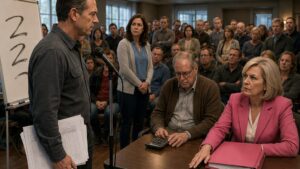
By afternoon, the emergency HOA meeting had moved into the clubhouse because too many residents had shown up to stand comfortably along the creek.
The mood was less interested in engineering than blame.
One homeowner wanted the contractor banned.
Another wanted the HOA to sue.
A third asked whether assessments were going up.
The board treasurer answered that question carefully.
“Some remediation cost may be covered through the contractor’s liability insurance. Some may fall under association reserves depending on responsibility and coverage.”
The room erupted anyway.
Robert sat in the back beside Lisa.
Brandon stood at the front.
He did not defend himself immediately.
That was new.
“We made a maintenance decision without getting engineering review,” he said. “That was a mistake.”
The room quieted slightly.
“We also pushed for a lower-cost access solution because previous options would have required more money than the board believed residents would accept.”
Someone called, “So you flooded us to save dues?”
Brandon’s face tightened.
“No. We made a decision that contributed to a drainage problem.”
Robert heard the difference.
Not confession.
Not evasion.
Something in between.
Stephen explained the revised proposal.
Remove loose gravel from the active channel.
Excavate accumulated sediment where permitted.
Rebuild one narrow stabilized crossing high enough for maintenance equipment but clear of the primary flow section.
Monitor the next storm.
Then the questions turned toward Robert.
“Does that fix it?”
“Will the creek handle the water?”
“Is this what should have been done the first time?”
Robert felt irritation rise with each one.
They wanted certainty from him now because certainty was comforting.
He stood.
“I don’t know.”
The room went still.
Robert looked toward the board.
“I know the proposed crossing is better than what’s there. I know the channel needs more room. I know the county inspector agrees.”
He paused.
“And I know this problem didn’t start Monday.”
Lisa looked at him.
Brandon did too.
Robert had not intended to say the next part publicly.
Then he saw the photograph in his mind: his grandson on the stone in April, the older high-water stain behind him.
“I saw sediment building up last spring.”
No one spoke.
“I photographed it.”
A chair creaked somewhere near the back.
“I didn’t send the pictures to the association.”
Brandon’s expression changed.
Not triumph.
Surprise.
Robert continued before anyone could turn the admission into something cleaner than it was.
“I was tired of being the guy who complained about every drainage issue, every measurement, every contractor. I figured if nobody wanted to hear it, I’d keep it to myself.”
The property manager looked down.
Robert’s voice stayed level.
“That was easier for me. It wasn’t better for the creek.”
Lisa folded her hands in her lap.
Robert looked toward the residents.
“The contractor made the restriction worse. The board approved work without enough review. Both things are true.”
Then he looked at Brandon.
“And I knew the channel was getting weaker before either of them touched it.”
The silence afterward felt different from every HOA meeting Robert had ever attended.
No one applauded.
He was grateful.
Brandon finally said, “You could have told us.”
Robert almost laughed.
“I could have.”
“And we might not have listened.”
Robert looked at him.
“That’s also true.”
For the first time, several people in the room seemed unsure who they were supposed to be angry with.
That was closer to reality.
The insurance adjuster joined by phone near the end of the meeting. Stephen’s company would begin corrective work immediately under a reservation of rights while responsibility was sorted out.
The HOA would cover necessary emergency expenses from reserves if insurance did not.
A planned clubhouse exterior improvement would be deferred.
Someone groaned.
The treasurer said, “That is what reserves are for.”
Afterward, Lisa followed Robert outside.
“You didn’t have to tell them about spring.”
“Yes, I did.”
“Why?”
Robert looked toward the rear houses.
“Because if I’m going to ask Brandon to own his part, I don’t get to hide mine.”
Lisa nodded.
Then she said, “That’s the first useful thing you’ve said all week.”
He gave her a look.
She smiled.
By Sunday morning, Stephen’s crew had placed protective barriers along the banks and begun removing the loose gravel.
Robert stayed out of the equipment path.
He watched from the old stone.
When Stephen reached the section Robert had marked, he shut down the excavator and walked over.
“You want this flag here?”
Robert looked at the orange marker.
It stood near the safe waterline.
Not the property line.
That mattered.
“Move it six inches toward me.”
Stephen did.
“Here?”
“Here.”
Stephen pushed it into the soil.
By late afternoon, the active channel was visibly wider.
The compacted access crossing remained narrow, raised and reinforced instead of spread toward the water.
Paul Baker returned for a quick inspection.
“Better,” he said.
Not finished.
Better.
The forecast on Robert’s phone showed another heavy system arriving within forty-eight hours.
Stephen’s crew worked until the light began to fade.
When Robert finally went inside, the excavator was still moving.
Its bucket lifted another load of gray stone from the place where the creek needed to breathe.
And this time, everyone was watching the waterline.
Chapter 7: When the Water Fell Back Into Its Old Line, Nobody Cheered
The rain came harder than the forecast had promised.
By six-thirty Monday morning, water was already rushing through the restored section behind Robert Walker’s house, dark at first from disturbed soil, then gradually clearing as the fresh gravel settled into place.
Robert stood under the back porch roof with his phone in one hand and coffee cooling in the other.
He had not slept much.
Every twenty minutes during the night, he had checked the radar, then the drainage line, then the strip of orange tape marking the old high-water point on the stone.
The repaired crossing was holding.
So far.
That was not the same as working.
He set the coffee down and pulled on his rain jacket.
At the creek, the difference was visible immediately.
Instead of spreading sideways against the new access path, the water slipped beneath and around the narrow reinforced section in one continuous current. The channel had room again.
Robert crouched beside the stone.
The water had risen above its normal summer line but remained below the mark from the previous Wednesday.
He took the first photograph.
Same angle.
Same stone.
Same section of fence.
He walked upstream and repeated the sequence.
Six photographs.
He did not realize Lisa Rivera was standing behind him until she said, “You’re going to wear that phone out.”
Robert straightened.
She was carrying an umbrella and wearing rubber boots.
“How’s the patio?”
“You tell me.”
They crossed through the side gate.
Rain drummed against the umbrella while Robert followed the creek into Lisa’s yard.
Her patio was wet from the rain.
Nothing more.
No brown water pressing across the grass.
No shallow sheet collecting around the planters.
The lower pavers remained visible.
Lisa stopped beside them and stared.
“That’s it?”
Robert looked toward the creek.
The current was moving fast.
“Yes.”
“You sound disappointed.”
“I’m checking.”
“For what?”
“What I missed.”
Lisa gave him a sideways look.
“Maybe today you didn’t miss anything.”
He did not answer.
At the rear fence, water entered her lot cleanly enough that the grass beside the channel remained exposed. Downstream, the current accelerated through the next opening instead of backing up.
Lisa watched it.
“A week ago I thought that thing was just where mosquitoes came from.”
Robert said, “Still can be.”
She laughed.
It was the first easy sound he had heard around the creek in days.
By eight, Brandon Young arrived.
He did not bring an umbrella.
His jacket was soaked at the shoulders by the time he reached Robert’s yard.
“Lisa’s place?”
“Dry.”
“The other yards?”
“One homeowner texted. No standing water.”
Brandon looked toward the crossing.
For several seconds, neither man said anything.
Then Brandon asked, “You have the old high-water photos?”
Robert held up the phone.
“Of course you do.”
Robert almost took offense, then heard the exhaustion in Brandon’s voice.
Paul Baker arrived twenty minutes later.
He worked without ceremony, checking elevations, looking for displaced material and watching the current through the crossing.
Stephen Adams came shortly after him and stood on the bank with his hands shoved into his rain jacket.
Paul finally said, “The channel is carrying.”
Stephen exhaled.
Brandon asked, “That means we’re done?”
Paul looked at him.
“It means the correction is functioning under this event.”
“So not done.”
“Not until the final maintenance plan is documented.”
Brandon nodded.
This time there was no argument.
The water rose another inch before noon.
Then stopped.
By early afternoon, it began to fall.
Robert photographed that too.
The downward movement felt stranger to him than the rise.
For days, every mark on the stone had meant pressure.
Now the receding line meant release.
Two weeks later, the clubhouse meeting was shorter than usual.
The board formally adopted a drainage-maintenance protocol requiring documented channel measurements before any future fill, grading or access work within the rear easement.
Contractors would receive the original drainage exhibits.
Changes in the field would require written approval.
Residents along the corridor would be asked to report sediment buildup instead of assuming the HOA already knew.
The repair costs were divided between the contractor’s insurance and association reserves.
The clubhouse exterior project planned for fall was postponed.
No one liked that part.
The board treasurer said, “We can do it next year.”
A homeowner near the back muttered something about paying dues for things that never got finished.
Robert heard it and said nothing.
Some habits deserved to die slowly.
Brandon sat at the front of the room with the corrected maintenance plan.
Near the end, he cleared his throat.
“One item for the record.”
Robert looked up.
Brandon continued.
“The board’s previous description of the rear channel as a general maintenance ditch was inaccurate. It is part of the subdivision drainage system, and the records will reflect that going forward.”
That was all.
No apology.
No dramatic admission.
Robert found he preferred it that way.
After the meeting, Brandon caught him near the door.
“I should’ve stopped the work Monday.”
Robert looked at him.
“Yes.”
Brandon nodded.
“And you should’ve sent those spring photos.”
“Yes.”
They stood there for a moment, two men who had spent most of the week waiting for the other one to say the wrong thing.
Brandon finally said, “I guess that makes us both irritating.”
Robert looked at him.
“Don’t get carried away.”
Brandon smiled once.
Outside, Lisa was waiting by Robert’s truck.
“You going home?”
“Eventually.”
She held up a folder.
“The manager asked if you’d drop these at the records cabinet.”
Robert took it.
Inside were copies of the corrected drainage map, the maintenance protocol and a blank inspection sheet.
At home, he carried the folder to his kitchen table.
The six photographs from Monday were still there, stacked beneath the old drainage plan.
He opened his phone and selected the newest image.
The restored creek.
Clear water slipping past the stone.
The level comfortably below the old high-water stain.
He printed it.
Then he drove back to the clubhouse.
The property manager was still there when he entered.
“I thought you forgot something.”
“No.”
Robert opened the permanent drainage file.
He placed the new photograph behind the first six.
The manager watched him.
“You want me to label it?”
Robert thought for a moment.
“Just put the date.”
She did.
No accusation.
No warning.
No note explaining who had been right.
Only the date.
Robert closed the folder.
That weekend, his grandson came over with the small fishing pole.
They walked down to the creek together.
The boy sat on the old stone and looked at the repaired crossing.
“Did they fix it?”
Robert watched the water move beneath the narrow strip of gravel.
“Enough to take care of it.”
The boy frowned.
“That’s not the same as fixed.”
Robert looked at him.
“No.”
The answer pleased him.
They sat quietly while the line drifted in the current.
Across the fence, Lisa was trimming a planter near her dry patio. Farther upstream, the stabilized access path was visible but no longer crowding the water.
The creek did not belong to Robert alone.
Neither did the consequences of ignoring it.
For years, he had thought protecting his property meant drawing the line clearly enough that everyone else stayed on their side.
Now he watched the water pass beneath fences that meant nothing to it.
The creek carried leaves, sediment, rain and whatever mistakes people made upstream.
It also carried the proof that those mistakes could be corrected.
Robert looked at the stone beside his grandson.
The old muddy stain was still there.
He decided not to scrub it away.
The story has ended.