She Kept Throwing Garbage Over His Fence Until the HOA Learned Who Owned the Pickup Lane
Chapter 1: The Bag That Landed in His Marigolds
The black bag cleared the fence just after seven on Monday morning and landed squarely in Michael Hall’s marigolds.
He heard the stems break before he smelled what was inside.
Michael had been kneeling beside the raised bed with a hand trowel when the bag struck the cedar edge, split along one seam, and spilled coffee grounds, wet paper towels, vegetable scraps, and something sour-smelling across the yellow flowers.
For several seconds, he stayed exactly where he was.
Then he looked up at the six-foot wooden fence.
“Margaret.”
No answer.
He stood, wiped his hands on his jeans, and walked toward the gate. On the other side of the fence he heard the hollow clatter of a trash-can lid.
“Margaret, I know you’re there.”
Her voice came back without apology.
“It’s just yard-side trash. I’ll deal with it later.”
Michael stared at the mess soaking into the mulch.
“It’s in my flower bed.”
A pause.
“Then put it in a bag.”
He nearly laughed, not because it was funny but because he could not think of a reasonable response to something so unreasonable.
Michael had lived in the house for eleven years. His backyard was small enough that he could cross it in fifteen strides. There was a narrow gravel path, two raised beds, a coiled green hose, a patch of lawn, and the marigolds he replanted every spring because they survived the summer heat better than almost anything else.
Nothing about it was impressive.
That was partly why he cared.
Every board he had replaced himself. Every bed had been leveled by hand. He knew which sprinkler head leaned slightly east and which corner stayed damp after rain.
He did not want a feud over garbage.
So he put on gloves, photographed the torn bag almost as an afterthought, and cleaned it up.
By Wednesday, there was another one.
This time the bag had not split, but oily liquid had leaked from the bottom and darkened three fence boards. Michael found it at six forty in the morning.
He carried it back around to Margaret’s front door.
She opened the door only halfway.
He held the bag away from his leg.
“This came over the fence again.”
Margaret Carter was several years older than Michael, with silver-gray hair cut short and the permanent expression of someone expecting a salesman she intended to dismiss.
“I didn’t throw that.”
Michael looked at the bag, then at her.
“It came from your side.”
“You have squirrels.”
“Squirrels don’t tie kitchen bags.”
Her mouth tightened.
“You really came over here before seven to argue about trash?”
“I came over because it’s in my yard.”
Margaret leaned against the doorframe.
“That little alley has been used for garbage longer than you’ve lived here. Everybody knows how pickup works.”
Michael frowned.
“I’m not talking about the alley.”
“Well, I am.”
He did not understand why.
“I’m asking you not to throw anything over my fence.”
“I heard you.”
It was not agreement.
Michael waited.
Margaret closed the door.
On Friday, a cardboard takeout container appeared beneath the hedge.
The following Tuesday, wet coffee grounds covered the corner of the bed.
Then a cracked plastic planter that Michael kept near the fence was knocked sideways. He could not prove that Margaret had broken it. He could prove that the newest bag had landed beside it.
He told himself that people made bad habits out of convenience. He told himself that if he did not turn it into a neighborhood war, eventually she would get bored.
He had watched two families three streets over spend nearly a year fighting over a fence stain. First came the certified letters, then the cameras, then complaints about barking dogs, parking, weeds and Christmas lights. By the end, neither family could pull into its driveway without looking toward the other house.
Michael had promised himself he would never live like that.
So he cleaned.
He replaced soil.
He pressed one bent marigold upright around a small wooden stake.
And each time something came over the fence, his patience began feeling less like patience and more like permission.
The next Saturday, the bag was leaking.
A thin yellow-brown line ran from underneath it toward the gravel path. The smell reached Michael before he touched it.
He took out his phone.
One photograph of the bag.
One of the liquid.
One of the flattened flowers.
One wide shot showing the fence.
He checked the time and wrote it into the notes app.
Saturday. 7:18 a.m.
He did not know what he intended to do with the record. He only knew he was tired of every incident disappearing the moment he cleaned it.
The next morning Margaret appeared above the fence line as she lifted another bag.
Michael was already standing in the yard.
She froze.
For half a second they simply looked at each other.
“Don’t,” Michael said.
Margaret still had both hands around the plastic knot.
“I’m moving it.”
“Move it on your property.”
Her face hardened.
“You know, Michael, some of us don’t have time to arrange our garbage like a garden display.”
“That has nothing to do with putting it over here.”
“You bought next to a service lane.”
“I bought a house. That’s my fence.”
“And that lane has worked the same way for decades.”
Again, the lane.
Michael lowered his phone.
“What does the lane have to do with you throwing garbage into my flowers?”
Margaret’s grip shifted on the bag.
“You’ll figure it out.”
She disappeared from view.
A moment later he heard the lid of her bin slam.
Michael remained by the marigolds, bothered less by the insult than by the certainty behind it.
That Thursday he learned what she meant.
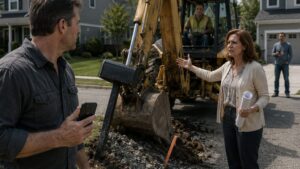
A little after eight, a diesel engine growled behind the houses. Michael stepped outside expecting to see the garbage truck at the street.
Instead, the green collection truck appeared beyond Margaret’s backyard.
It turned slowly into the narrow strip running along the outside of Michael’s fence.
The passage barely looked wide enough for it. One set of tires rolled over packed gravel. The other passed close enough to Michael’s fence that he could hear small stones ticking against the boards.
The truck stopped beside Margaret’s rear gate.
A worker rolled her bins out.
Michael walked toward the far corner of his yard.
The strip continued behind his fence toward the main street, a piece of ground he had always treated as useless space between properties.
He watched the truck roll over it as casually as if it were pavement.
Margaret stood at her gate.
When she saw Michael, she gave him a small, unreadable look.
Not triumph exactly.
Recognition.
As though she had been waiting for him to notice.
Chapter 2: Forty-Two Photographs and One Old Assumption
Michael wrote the number 42 on the back of the newest photograph and stopped with the pen still touching the paper.
Forty-two.
He spread the prints across his kitchen table.
Black bags against the fence. Wet cardboard. Coffee grounds. A broken planter. Orange and yellow flowers flattened beneath leaking plastic. Several photographs were almost identical except for the dates written in the corner.
Five weeks of evidence made the problem look worse than living through it had.
Living through it had been gradual.
On paper, it was a pattern.
Michael slid the photographs into a manila folder and drove to the HOA office.
Lisa Brown met him in a small conference room behind the reception counter. She was younger than Michael had expected, dressed in a navy cardigan with a laptop open in front of her and three other folders stacked beside it.
“I read your email,” she said.
“Did you see the pictures?”
“I saw the attachments.”
Michael placed the folder on the table anyway.
Lisa glanced at the first few prints.
“I’m not disputing that trash ended up on your side.”
“It didn’t end up there. Margaret put it there.”
Lisa chose her words carefully.
“Margaret says some bags were temporarily placed near the service boundary and animals may have moved them.”
Michael pulled out a photograph showing Margaret’s arms above the fence and the black bag in midair.
Lisa looked at it longer.
“All right.”
“That was after I asked her to stop.”
“I understand.”
“No, I don’t think you do.”
The sharpness in his own voice surprised him.
Lisa closed the laptop halfway.
“I’m trying to separate two issues. Dumping waste onto your property is one. Access to the service lane is another.”
“There is no service lane in my backyard.”
“Beside it.”
“Margaret keeps saying that too.”
“Because the waste route predates both your complaint and, apparently, your ownership.”
Michael leaned back.
“How does that give her permission to throw garbage over a fence?”
“It doesn’t.”
For the first time, Lisa sounded unequivocal.
She tapped the photograph.
“This is not acceptable. I can send her a written compliance notice concerning debris placement and nuisance conditions.”
“Good.”
“But if you’re planning to interfere with the waste route, don’t.”
Michael stared at her.
“I didn’t say I was.”
“You asked in your email who authorized truck access.”
“I asked because the truck is driving inches from my fence.”
Lisa reopened the laptop.
“Our maps show established service access along that side of the lots. It has been used for years.”
“Maps?”
“Association maintenance maps.”
“Is there an easement?”
She hesitated only slightly.
“I’d need to pull the property file.”
“That sounds like you don’t know.”
“It means I’m not going to answer a title question from memory.”
Michael gathered his photographs.
Lisa printed two pages before he left. One was confirmation that Margaret would receive a nuisance notice. The second was addressed to Michael.
It warned owners not to obstruct common maintenance or utility access while the association reviewed the matter.
He read that page twice in his truck.
He had gone in with forty-two photographs of trash in his yard.
He had come out with a warning addressed to him.
Margaret stopped throwing full bags for six days.
Michael almost allowed himself to believe the notice had worked.
Then he found a paper grocery sack tucked behind the raised bed, swollen dark from moisture. Onion skins and food scraps had spilled out beneath it.
He photographed it.
Forty-three.
He did not print that one.
Instead, he pulled the original closing papers from the file box in his hall closet.
The documents smelled faintly of cardboard and dust. He had not opened most of them since buying the house.
There were inspection reports, insurance pages, title paperwork, and a photocopy of a subdivision plat so pale that several lines nearly disappeared.
He spread the plat on the kitchen table.
His lot was a narrow rectangle. Margaret’s was beside it.
Behind both properties ran a series of utility markings.
Michael found the fence line by comparing the dimensions.
Then he frowned.
According to the drawing, his eastern property boundary did not appear to stop at the fence.
There was another thin piece of land beyond it.
He took a ruler from a drawer.
Measured.
Checked the scale.
Measured again.
The strip looked approximately four feet wide.
The same four feet the garbage truck used.
Michael sat down.
On Monday morning, he called Lisa.
“I need the document that gives the HOA access along the east side of my lot.”
“We’re still reviewing that.”
“You said it was established access.”
“It is established operationally.”
“That isn’t what I asked.”
Lisa exhaled.
“Michael, the truck has used that route for a long time. The prior owner never objected.”
“Did the prior owner grant an easement?”
“I don’t have that answer yet.”
“What about Margaret?”
“What about her?”
“She keeps acting like that strip belongs to everybody.”
“She told the board it has always been treated as shared service access.”
“Shared by whom?”
A longer pause.
“Michael, don’t put up a barrier while we sort this out.”
He looked through the kitchen window toward the marigolds.
“Did the HOA send her the dumping notice?”
“Yes.”
“Did she answer?”
“She said she disagreed with the characterization.”
Michael almost smiled.
“Of course she did.”
After the call, he drove to the county records office.
The clerk directed him to property records and helped him locate a clearer copy of the subdivision plat. Michael compared parcel numbers until he found his.
There it was again.
His lot line extended beyond the fence.
The strip was not drawn as a separate parcel.
A notation pointed toward utility access farther back, but the garbage route itself carried no obvious label.
Michael asked for every recorded easement associated with his parcel.
The clerk returned with several references.
Drainage.
Utilities.
One old cable agreement.
Nothing that plainly described garbage collection.
He knew enough not to declare victory from a public counter.
He requested copies.
At home that evening, he laid the county plat beside Lisa’s warning letter and his photographs.
The contradiction sat there in black and white.
The HOA called the strip common access.
The recorded plat appeared to put it inside his property.
He reached for the folder of closing papers again.
This time he found the title description.
He traced the measurements with his finger.
Front boundary.
Rear boundary.
Western line.
Eastern line.
His finger stopped.
The legal description matched the wider measurement shown on the county plat.
Michael went outside with a tape measure.
He hooked one end at the reference point near the corner of his patio and walked toward the fence.
The measurement reached the fence.
Then kept going.
He stepped through the side gate and continued onto the narrow gravel strip.
One foot.
Two.
Three.
Nearly four.
Michael stood there with the tape stretched between his hands.
Margaret’s back gate opened.
She looked at the tape, then at him.
“What are you doing?”
“Checking something.”
“That’s a service lane.”
Michael glanced down at the county plat in his hand.
“Maybe.”
Margaret gave a short laugh.
“There’s no maybe. That truck was using it before you ever moved in.”
Michael looked at the line on the paper again.
For five weeks, he had thought the garbage was the problem.
Now he wondered whether the garbage was only the part of the problem Margaret had made impossible to ignore.
Chapter 3: The Four Feet Nobody Had Checked
The surveyor drove an orange marker into the ground almost four feet beyond Michael’s fence.
Michael stared at it.
“You’re sure?”
The surveyor checked the instrument again.
“Within the tolerances of the recorded monuments, yes.”
Michael looked from the marker to the fence and then along the narrow gravel strip.
“So the fence isn’t the property line.”
“No.”
“It’s inside my property.”
“Yes.”
The answer was so clean that for a moment Michael felt something close to relief.
Not joy.
Certainty.
Weeks of smelling spoiled food, repairing planters and being treated as though his complaint were a personality defect suddenly seemed to collapse into one simple fact.
The truck had been driving on his land.
Margaret had been standing at her gate telling him the strip belonged to everyone.
The HOA had warned him not to obstruct it.
And nobody, apparently, had checked.
Michael took photographs of the markers.
By noon he had emailed them to Lisa.
Her response arrived twenty-three minutes later.
Please do not make any changes to site access while association counsel reviews historical use.
Michael read the sentence twice.
Then he called Jonathan Moore.
Jonathan’s office occupied the second floor of a low brick building near the county courthouse. He studied Michael’s survey, deed description, HOA letter and county easement records without giving him the reaction Michael wanted.
Finally Jonathan leaned back.
“Your deed description looks favorable.”
“Favorable?”
“It appears the strip is inside your parcel.”
“So they have no right to use it.”
“I didn’t say that.”
Michael felt his jaw tighten.
“There’s no easement in the records.”
“No obvious recorded easement in the documents you brought.”
“What’s the difference?”
“The difference is why you hired me instead of putting a chain across it this afternoon.”
Michael looked away.
Jonathan tapped the survey.
“Ownership is one question. Right of use can become another. There may be documents we haven’t seen. There may be rights created through some older agreement, depending on the facts and state law. There may simply be a longstanding permissive arrangement that everyone forgot was permissive.”
“But they can’t just tell me it’s common property.”
“No. If it isn’t, they shouldn’t.”
“That sounds pretty simple.”
“The paperwork might be simple. The consequences aren’t.”
Michael folded his arms.
Jonathan studied him.
“What do you actually want?”
“I want Margaret to stop throwing garbage in my yard.”
“She should.”
“And I want the truck off my property.”
“Because it damages your property?”
Michael hesitated.
“It runs close to the fence.”
“That’s not what I asked.”
Michael disliked how quickly Jonathan had found the uncomfortable part.
“For six weeks she’s acted like I have no say in anything over there.”
“So now you want to demonstrate that you do.”
“I want my property respected.”
“That’s legitimate. Just be careful you don’t confuse respect with maximum leverage.”
Michael said nothing.
Jonathan gathered the copies.
“Let me check the title history and whatever the HOA claims to have. In the meantime, don’t build anything permanent.”
Michael nodded.
He did not promise more than that.
Two days later Lisa called.
“We still haven’t located a recorded access easement in the association file.”
Michael leaned against his kitchen counter.
“So your warning was based on what?”
“Historical use and our maintenance map.”
“You warned me not to obstruct my own property based on a map?”
“I warned you not to disrupt an existing service route while we reviewed it.”
“You didn’t review it before sending the warning.”
Lisa went quiet.
“No,” she said eventually. “We relied on the existing file.”
It was the first admission Michael had received from the HOA, and it should have satisfied him more than it did.
Instead he asked, “Who else uses the route?”
“Margaret.”
“And?”
“One property behind the corner lot sometimes gets rear collection through the same approach. Mostly for oversized pickups.”
Michael closed his eyes.
“Sometimes?”
“Not weekly.”
“So if I close the strip—”
“You may affect more than Margaret.”
There it was.
Jonathan’s consequence.
Michael looked through the window at the marigolds. New blooms had opened beside the ones that had been crushed.
“I’m not agreeing to anything,” he said.
“I didn’t ask you to.”
“But I want that clear.”
“It’s clear.”
The next garbage day arrived before the HOA produced anything else.
Michael woke at six thirty.
Margaret’s two bins were already positioned beside her rear gate.
For the first time, there were three.
The third was stuffed so full that the lid stood open.
Michael had sent the waste company a copy of the survey and a written notice that permission to cross the disputed strip was suspended pending clarification of access rights. Jonathan had revised the wording before Michael sent it.
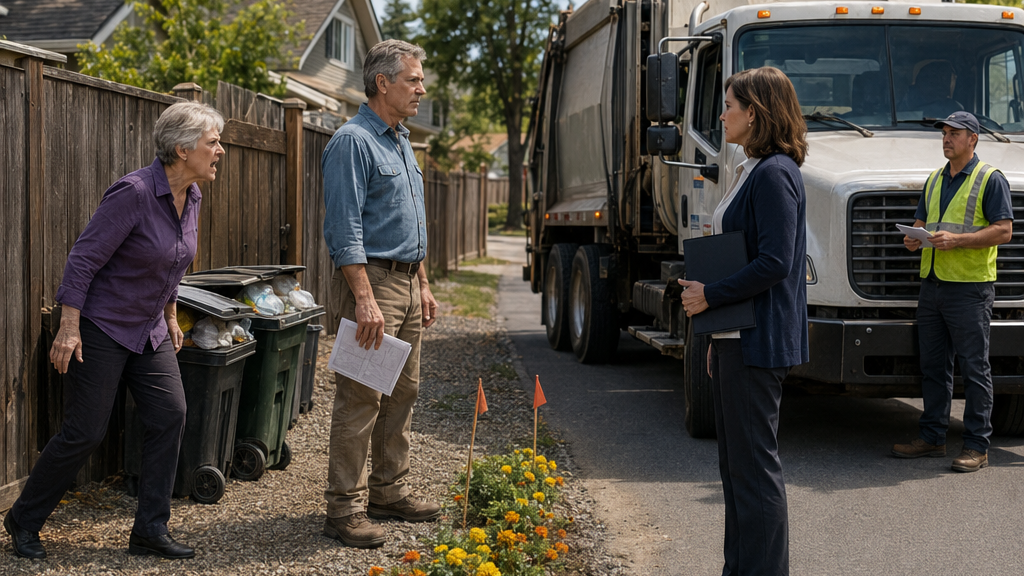
At eight twelve, the truck appeared.
The diesel engine filled the narrow space between the houses.
Michael stepped through his side gate.
The orange survey markers were still visible beside the gravel.
Margaret came out almost immediately.
A few seconds later Lisa’s car stopped at the street.
Michael almost laughed at the timing.
The garbage-truck driver climbed down holding a sheet of paper.
“You Mr. Hall?”
“Yes.”
The driver looked toward the orange marker, then at the fence.
“Dispatch says we’re not to cross the surveyed area until they clear it.”
Margaret pushed through her gate.
“This is ridiculous. You pick up here every Thursday.”
The driver gave her an apologetic shrug.
“I follow dispatch.”
Lisa approached from the front sidewalk.
“Michael, can we not do this today?”
“We’re already doing it.”
“I mean can we allow pickup while counsel reviews the matter?”
Michael looked at the truck.
Its front bumper sat only a few feet from the marigolds on the other side of the fence.
For weeks that truck had been background machinery. Now it was motionless because of four feet of gravel nobody had bothered to verify.
Margaret pointed toward the lane.
“This is HOA access.”
Michael looked at Lisa.
“Do you have the easement?”
Lisa’s expression tightened.
“Not with me.”
“Does the HOA have it?”
“We’re still looking.”
Margaret shook her head.
“This is petty.”
Michael felt the old heat rise in his chest.
He thought of photograph forty-two.
The leaking bag.
The planter.
Her door closing in his face.
“You threw garbage into my garden after I asked you to stop.”
“That has nothing to do with the truck.”
“It has everything to do with why I finally checked.”
The driver looked between them, clearly wishing to be anywhere else.
Lisa lowered her voice.
“Michael, nobody is saying the dumping was acceptable.”
“Then stop asking me to pretend everything else is automatically acceptable.”
Margaret folded her arms.
“You moved here eleven years ago. That lane has been there longer than you.”
“And if someone uses my driveway for eleven years without asking, does it become theirs?”
“That’s not the same thing.”
“No. This is four feet wide.”
For a moment nobody spoke.
The engine idled.
The orange flags trembled in the exhaust.
Michael had imagined this moment differently.
In every version that had played in his head, Margaret would finally have no answer. Lisa would admit he was right. The truck would reverse, and he would feel the clean satisfaction of a boundary restored.
Instead he noticed the third bin.
Then he noticed another homeowner standing farther down the lane beside a bulky discarded chair.
Lisa followed his gaze.
“That’s the other pickup I mentioned.”
Michael’s satisfaction thinned.
The driver shifted his weight.
“I need a decision. Dispatch says no crossing without written clearance.”
Michael looked at the chair, then at Margaret’s overflowing third bin.
He could authorize the truck for the day.
Jonathan had made that clear.
Or he could refuse.
He heard Margaret say, “This is what he wanted.”
Michael turned toward her.
“What?”
“To make everybody deal with his tantrum.”
He almost gave permission then, simply to prove her wrong.
That impulse stopped him.
It was the same kind of impulse that had kept him silent for weeks—the desire to manage how other people saw him instead of deciding what he actually believed.
Michael faced the driver.
“I’m not giving temporary permission today.”
Lisa stared at him.
“Michael.”
“I asked for the ownership question to be answered. It still hasn’t been.”
The driver nodded once, climbed back into the cab, and shifted into reverse.
The warning beeper sounded.
Slowly, the garbage truck backed away from the orange markers.
It never reached Margaret’s bins.
The neighbor with the bulky chair watched it go.
Margaret stood rigid beside her gate.
Michael stayed beside the strip until the truck disappeared toward the main road.
He had finally stopped it.
The feeling he had expected never arrived.
Behind Margaret, three full bins remained exactly where they were.
And for the first time Michael understood that proving where his property ended had not answered the harder question of what he intended to do with that fact.
Chapter 4: When the Trash Stayed on Her Side
For the first time in six weeks, Michael’s marigolds were untouched.
No wet cardboard lay between the stems. No coffee grounds darkened the mulch. No black plastic sagged against the cedar planter.
On the other side of the fence, Margaret’s three garbage bins were overflowing.
By the third missed collection day, two additional bags sat beside them. By the fifth, the lids no longer closed.
Michael could smell them from his patio.
He told himself that was not his doing.
Margaret had another collection point available at the front street. Lisa had confirmed it in an email. The waste company would take her garbage there if she moved the bins before seven on Thursday mornings.
It was less convenient.
That did not make it impossible.
At least that was what Michael believed until Tuesday afternoon.
He was replacing a cracked board on one of the raised beds when he heard plastic wheels scraping against concrete.
The sound came in short bursts.
Roll.
Stop.
Roll.
Stop.
Michael looked through the slats in the fence.
Margaret was dragging one of the large wheeled bins toward the side gate.
She pulled it with both hands, moved several feet, then stopped.
Her shoulders rose and fell.
She tried again.
One wheel struck the edge of the walkway, and the bin tipped toward her.
Margaret caught it against her hip.
A sharp sound escaped her—not quite a cry, more a breath forced out through clenched teeth.
Michael put down the screwdriver.
He walked through his gate.
“Need help?”
Margaret looked at him immediately.
“No.”
“The wheel’s caught.”
“I can see that.”
She pulled again. The bin barely moved.
Michael stopped several feet away.
“I can take it to the front.”
“I said no.”
Her face had gone pale around the mouth.
Michael noticed the way she favored her left leg.
He had seen her move slowly before. He had assumed age, stiffness, maybe arthritis.
He had never watched her try to drag seventy pounds of garbage the length of the house.
Margaret braced one hand against the fence post.
“You happy now?”
Michael’s offer died before he could repeat it.
“What does that mean?”
“You got what you wanted.”
“I wanted you to stop throwing garbage into my yard.”
“And now the truck won’t come back here.”
“Those aren’t the same thing.”
“They became the same thing when you decided to make them.”
Michael looked at the bin.
“I didn’t create the property line.”
“No. You just waited until it was useful.”
That struck closer than he wanted.
He could have reported the garbage after the second incident.
He could have asked the HOA about the lane years earlier.
Instead, he had ignored one thing until the other gave him leverage.
Margaret tried to pull the bin again.
Michael reached for the handle.
She slapped his hand away.
“Don’t.”
He stepped back.
“All right.”
She stood there breathing hard.
For one second, the anger fell out of her face and left something more vulnerable behind.
Then it was gone.
“I’ve gotten those bins picked up there for fourteen years,” she said. “Nobody had a problem until you decided to start measuring dirt.”
Michael looked at the orange survey stake.
“And nobody threw garbage into my flowers until this year.”
Margaret’s mouth tightened.
She left the bin where it was and went inside.
Michael remained beside it.
That evening Lisa called.
“We need you at the board meeting tomorrow.”
“For what?”
“We’re getting complaints.”
“From Margaret?”
“Not only Margaret.”
Michael leaned against the counter.
“About the smell?”
“The smell. Missed bulk collection. Access. People are starting to ask why service was changed without board notice.”
“I didn’t change the service.”
“You withdrew access.”
“To my property.”
“I know what your position is.”
“Do you?”
Lisa paused.
“Yes. I do.”
The answer sounded tired rather than defensive.
The meeting was held in the HOA clubhouse, a beige room with folding chairs and a long table at the front. Fewer than fifteen homeowners attended, but Michael felt every head turn when he entered.
Margaret sat in the second row.
She did not look at him.
The board president opened with routine maintenance business before reaching “waste-service access.”
A homeowner near the back raised a hand.
“So one resident can just shut down a route everybody’s been using?”
Michael answered before Lisa could.
“One resident can ask whether trucks are crossing private property legally.”
Margaret looked up.
“That’s a nice way to say it.”
Michael turned toward her.
“What would you call it?”
“I’d call it trapping an older woman’s garbage behind her house because you’re angry.”
A murmur moved through the room.
Michael felt heat climb his neck.
“That leaves out the part where you threw the garbage over my fence.”
“I put some things near the fence.”
“Forty-three times?”
Margaret’s expression changed.
Not guilt.
Calculation.
“You took forty-three pictures.”
“I documented forty-three incidents.”
Lisa intervened.
“The dumping complaint is separate and has already been addressed through compliance.”
Michael looked at her.
“Has it?”
“No new incidents have been reported.”
Because the truck had stopped.
The thought gave him less satisfaction now.
A second homeowner spoke.
“My old chair is still sitting behind my place because the truck couldn’t get through.”
Michael turned.
“I didn’t know your pickup used that route when I sent the notice.”
“But you know now.”
There was no accusation in the man’s tone.
That made it worse.
Michael looked toward Margaret.
She sat with both hands clasped over one knee.
He remembered the bin nearly tipping onto her.
“I know now,” he said.
Lisa opened a folder.
“The board has been reviewing archived maintenance records. We found something this afternoon.”
Michael’s attention sharpened.
“What?”
She removed a large photocopied sheet and unfolded it across the table.
The paper showed the subdivision before several fences had been built. Utility lines ran behind the homes. A narrow shaded corridor followed the eastern side of Michael’s lot.
Beside it were two typed words.
SERVICE ACCESS.
Margaret leaned forward.
“There.”
Michael did not move.
Lisa slid the map toward him.
“This appears to date back more than twenty years.”
Michael studied the shaded strip.
Its dimensions looked disturbingly close to the four feet marked by the surveyor.
“Where did this come from?”
“An old maintenance binder.”
“Is it recorded?”
“We don’t know yet.”
Margaret gave a small, humorless laugh.
“You wanted proof.”
Michael kept looking at the map.
It was real.
It had existed long before he bought the house.
And for the first time since the surveyor drove the orange stake into the ground, Michael wondered whether the four feet he had been so certain were his might come with a history nobody had yet explained.
Chapter 5: The Map Was Real, but the Right Was Not
Lisa slid the maintenance map across her desk as though she expected it to end the argument.
“There it is.”
Michael did not touch it.
The words SERVICE ACCESS were printed across the shaded corridor beside his lot.
Lisa folded her hands.
“This is what the association has been relying on.”
“For how long?”
“At least since the early 2000s. Maybe earlier.”
“And where’s the document that created it?”
Lisa’s confidence flickered.
“This is the document.”
“No. This is a map labeling something.”
“It’s an association maintenance map.”
“I can label my garage an airport. That doesn’t make it one.”
Lisa frowned.
“That’s not helpful.”
“Neither was warning me not to obstruct property you hadn’t checked.”
They sat in silence for a moment.
Michael had come prepared to enjoy this.
That bothered him.
He had spent the previous evening looking again at the old map, trying to find some reason it might be irrelevant. Instead, it looked professional: lot numbers, utility corridors, drainage markings, maintenance notes.
Not fabricated.
Not careless.
Just incomplete.
Lisa turned the map around.
“I asked the county records clerk to search the referenced parcel documents.”
“And?”
“She hasn’t found a recorded grant matching this strip.”
Michael felt the first clean surge of vindication he had experienced in days.
“So it isn’t an easement.”
“I said she hasn’t found one.”
“That sounds familiar.”
Lisa ignored the remark.
“We’re also checking older association files. It’s possible an agreement existed and wasn’t indexed the way we expect.”
“Possible.”
“Yes.”
“But right now?”
“Right now we have a long-standing service practice, a maintenance map and no matching recorded easement we can identify.”
Michael leaned back.
It was exactly what he had wanted Lisa to say.
Yet all he could see was Margaret struggling with the bin.
He hated that those two truths now occupied the same space.
Later that afternoon, Michael went back to the county records office.
The clerk had assembled copies of older instruments affecting the subdivision.
They worked through them one by one.
Drainage easement.
Utility easement.
Temporary construction access.
Nothing granting the HOA general waste-service rights over Michael’s strip.
The clerk pointed to the old maintenance map.
“This may have been an internal operations document.”
“So somebody drew the route because trucks were already using it?”
“Could be.”
“Would that create a right?”
The clerk gave him a careful look.
“That’s a question for your attorney.”
Michael almost smiled.
Everyone had learned to say that.
He left with another stack of copies.
Back home, he set the paperwork on the patio table and went to the damaged planter.
The cedar side panel had split where one of the heavier bags had struck it. Michael had postponed replacing it because every repair had started to feel temporary.
He removed the screws.
Cut a replacement board.
Measured twice.
When he fitted the new piece into place, he heard Margaret’s gate open.
She stood several yards away.
Michael kept working.
“You’re rebuilding it.”
He glanced up.
“That was the idea.”
Margaret looked at the planter, then at the marigolds inside.
“I didn’t break that.”
“You don’t know that.”
“You don’t know that either.”
“No.”
The admission seemed to surprise her.
Michael drove one screw into the cedar.
Margaret shifted her weight.
“Lisa says they can’t find the paperwork.”
“She told you?”
“She told the board.”
Michael nodded.
Margaret looked down the service strip.
“They used to come farther in.”
“Who?”
“The truck.”
“How far?”
“Almost to the rear corner. Years ago.”
Michael waited.
She seemed irritated that he did not fill the silence.
“My husband used to roll the bins out,” she said.
Michael said nothing.
It was the first time she had mentioned a husband.
“Then after he was gone, one of the drivers told me to leave them at the rear gate. Said it was easier for everybody.”
Michael tightened another screw.
“How long ago?”
“Fourteen years.”
“And nobody asked me after I bought the house.”
“You never complained.”
“I didn’t know it was my land.”
Margaret looked at him sharply.
“That’s the part I don’t understand. You didn’t care until the garbage.”
“Because the garbage made me look.”
“You think that makes this all clean?”
“No.”
That answer seemed to disarm her more than an argument would have.
Michael put down the drill.
“Why not use the front pickup?”
Margaret’s face closed.
“I can.”
“I saw you trying to move the bin.”
“I said I can.”
“You almost fell.”
“I didn’t.”
Michael looked at her left knee.
Margaret caught the glance.
“Don’t do that.”
“Do what?”
“Turn me into some helpless old woman because it makes you feel better about changing your mind.”
“I haven’t changed my mind.”
“Good.”
“I still want the dumping stopped. I still want the HOA to acknowledge the strip is mine.”
Her voice sharpened.
“Then what?”
Michael did not have an answer.
Margaret rested one hand against the gatepost.
“My knee was replaced two years ago. It didn’t heal the way they hoped.”
The words came flatly, almost angrily.
“I can walk. I drive. I do my own shopping. I’m not asking you to carry my groceries.”
“I didn’t say you were.”
“The front curb is eighty-three feet from my back door.”
Michael glanced toward the house.
“You measured?”
“Of course I measured.”
Despite himself, he nearly smiled.
Margaret noticed and did not return it.
“My husband handled the bins. After he died, the rear pickup meant I didn’t have to ask somebody every week.”
There was the thing she had been defending.
Not simply convenience.
Not simply entitlement.
Independence.
Michael looked down at the repaired planter.
“You could have told me.”
Margaret gave a short, bitter laugh.
“And you could have asked before shutting the lane.”
“I asked you to stop throwing garbage over my fence.”
“That wasn’t about the lane.”
“It became about the lane because every time I asked, you acted like I had no right to complain.”
Margaret’s jaw tightened.
“You were going to take it away.”
“I didn’t even know I owned it.”
“You started measuring right after the HOA notice.”
“Because you kept telling me the lane gave you some kind of right over everything beside it.”
“That’s not what I said.”
“It’s what you acted like.”
Neither spoke.
The rebuilt cedar board looked almost too clean beside the older wood.
Michael picked up his drill.
Margaret started toward her gate.
Then she stopped.
“I did throw them.”
Michael looked up.
Her back was partly turned.
“The bags,” she said. “After you came to my door.”
Michael did not move.
Margaret stared toward her own yard.
“The first couple were lazy. I put them too close, one went over, then another. But after you complained…”
She swallowed.
“I did it on purpose.”
The admission landed more heavily than any document.
Michael set the drill down.
“Why?”
Margaret turned.
“Because I thought you were starting something about the access. I thought if I gave an inch, next thing I knew you’d put up a gate and tell me to drag everything to the street.”
“You did exactly the thing that made me investigate it.”
“I know.”
There was no apology in her voice.
Only exhausted recognition.
Michael looked at the marigolds.
For weeks he had wanted proof that Margaret knew what she was doing.
Now he had it.
And instead of making the conflict simpler, it left him with something worse: an explanation he could understand and a choice he still could not excuse.
Chapter 6: The Folder He Almost Used as a Weapon
Jonathan drew one clean line through Michael’s number.
“No.”
Michael stared across the desk.
“You didn’t even calculate it.”
“I calculated enough.”
“Forty-three incidents. Thirty-five dollars each.”
Jonathan capped his pen.
“Why thirty-five?”
Michael opened the manila folder.
“Because there should be a consequence.”
“That isn’t an answer.”
“It’s reasonable.”
“Based on what?”
Michael said nothing.
Jonathan turned the paper around.
Beneath Michael’s proposed total were itemized costs for soil, replacement cedar, damaged planters, cleaning supplies and a landscaping visit after one spill contaminated part of the bed.
Jonathan tapped those figures.
“These I can explain.”
Then he tapped the crossed-out penalty.
“This is you trying to invent a private fine schedule.”
“The HOA fines people.”
“You aren’t the HOA.”
“She deliberately dumped garbage onto my property.”
“Then document your actual damages.”
“I did.”
“Good. Ask for them.”
Michael sat back.
“That’s it?”
“No. Then we deal with the access.”
Jonathan opened another document.
It was a draft agreement allowing the waste company to use a defined portion of the strip during scheduled collection periods only. No storage. No parking. No construction. No expansion of the route. No implied permission for Margaret or other residents to use the land personally.
Michael read the first page.
“This gives her what she wants.”
“It gives the waste company limited access.”
“Which gives her rear pickup.”
“Yes.”
“So after everything she did, nothing changes.”
Jonathan looked at him for a long moment.
“Michael, do you want the behavior stopped or do you want her punished?”
Michael’s eyes moved toward the window.
“I want her to understand.”
“Understand what?”
“That she can’t treat me like I don’t matter.”
Jonathan’s expression softened slightly.
“That isn’t something a property agreement can guarantee.”
Michael looked down at the folder.
Photograph forty-two was near the front.
The black bag lay across the marigolds like something thrown there specifically to ruin whatever was underneath.
Margaret had now admitted that some of it had been deliberate.
For weeks, Michael had imagined handing her a folder containing every photograph and a number large enough to make her finally feel the weight of all forty-three incidents.
He had never called that revenge.
Not to himself.
Now the word sat in the room anyway.
Jonathan leaned forward.
“You own the strip. Based on everything we’ve found, the HOA doesn’t appear to have a recorded blanket easement for waste service. That gives you leverage.”
Michael nodded.
“But leverage is not the same as a requirement to use every inch of it.”
Michael rubbed his thumb across the edge of the folder.
“I watched her struggle with the bin.”
Jonathan waited.
“I still didn’t authorize pickup.”
“Why?”
“Because Lisa still hadn’t answered the ownership question.”
“That’s one reason.”
Michael looked at him.
Jonathan said nothing.
Michael exhaled.
“And because I wanted Margaret to see what happened when the truck stopped.”
There it was.
He expected to feel embarrassed.
Instead, he felt tired.
Jonathan nodded once.
“Now we can write something useful.”
They worked for another hour.
The revised proposal required reimbursement for documented physical damage and cleanup costs. It required Margaret to acknowledge in writing that the service strip lay within Michael’s parcel and that access was by limited permission, not personal entitlement.
The HOA would maintain records of the arrangement and ensure the waste company stayed inside the surveyed corridor.
Any expansion or alteration required Michael’s written consent.
No household trash could be placed, stored or thrown onto Michael’s property.
Violation of those terms could terminate the permission after notice.
Michael read it twice.
“What about the other house?”
“Same service permission for collection where necessary. Narrowly defined.”
“So I’m not giving the HOA general access.”
“No.”
“And Margaret can’t use it as a walkway.”
“Not under this draft.”
Michael nodded.
It was firmer than what the neighborhood had before.
Less satisfying than the shutdown.
He knew that distinction mattered.
At home he placed the folder on the kitchen table.
One marigold bloom sat in a small glass beside it.
The stem had broken during one of the earlier incidents. Michael had trimmed it and brought it inside rather than throw it away.
He looked at the orange petals while he waited.
Margaret arrived at seven fifteen.
Lisa came with her.
Michael opened the door but did not invite either of them farther than the kitchen.
The folder lay between three chairs.
Margaret glanced at it.
“What’s the number?”
Michael almost smiled at how quickly she understood.
“The reimbursement total is itemized.”
She opened the folder.
Her eyes moved over receipts and photographs.
Then to the agreement.
Her expression hardened.
“I’m not signing this.”
“You haven’t read it.”
“I read enough.”
“What part?”
She tapped the ownership acknowledgment.
“This.”
Michael folded his arms.
“The strip is inside my recorded parcel.”
“I’m not signing something that says you can change your mind whenever you feel like it.”
“That isn’t what it says.”
“It says permission.”
“Yes.”
“For something that’s been happening for decades.”
Lisa spoke carefully.
“Margaret, the association can’t currently establish that the old maintenance map created a property right.”
Margaret turned on her.
“So now you’re on his side.”
“I’m on the side of correcting the file.”
“You were perfectly happy calling it service access two weeks ago.”
“Yes,” Lisa said. “And I should have verified the basis before we treated that label like a legal conclusion.”
Michael looked at her.
It was the first time she had said it so plainly.
Margaret pushed the folder away.
“I’m not signing away something I already have.”
Michael did not pick it up.
“If you already have it, show me.”
Her face reddened.
“You know I can’t drag those bins to the street.”
“Yes.”
The answer stopped her.
Michael continued.
“That’s why this lets the truck through.”
Margaret stared at him.
“You expect me to thank you?”
“No.”
“Then what do you want?”
Michael looked at the folder.
Weeks ago, he could have answered immediately.
An apology.
Money.
The truck gone.
A statement from the HOA admitting he had been right.
Now the answer was smaller.
“I want my yard left alone. I want the records to say whose land it is. And I want nobody telling me later that because I allowed something practical, I gave up the right to say where my property begins.”
Margaret looked away.
Lisa quietly closed her laptop.
Margaret stood.
“I’m not signing it today.”
Michael nodded.
“Then don’t.”
“What happens Thursday?”
Michael had already decided.
“One pickup.”
Margaret turned back.
“I thought you suspended access.”
“I did.”
“So why one?”
“Because you need time to decide, not a pile of garbage to make the decision for you.”
She studied him as if searching for the trap.
“And after that?”
“After that, either we have an agreement or we don’t.”
Margaret took the folder.
Michael did not tell her she had to.
She carried it against her side as she walked out.
Lisa remained for another moment.
“That was more reasonable than what I expected.”
Michael looked at her.
“That’s not exactly a compliment.”
“No.”
She stood.
“But I think it’s progress.”
After they left, Michael went into the backyard.
The marigolds were beginning to fill in again.
Thursday morning, the garbage truck entered the strip under the one-time written authorization Michael had sent the waste company.
It collected Margaret’s bins.
Then it left.
No argument.
No celebration.
No extension.
Michael watched from beside the fence until the engine faded.
The temporary permission expired at noon.
Margaret still had the folder.
And now the next move belonged entirely to her.
Chapter 7: A Boundary Both Houses Could See
Margaret came to Michael’s door carrying the folder instead of a trash bag.
He noticed that before anything else.
The manila folder was bent slightly at one corner from being handled. A pen was clipped beneath the flap. Margaret held it against her chest with both hands as if she had spent the walk from her house deciding whether to turn around.
Michael opened the storm door.
“You signed it?”
Margaret looked past him toward the kitchen.
“I signed most of it.”
Michael did not move.
“Most?”
“The part about the truck. The reimbursement. The property description.”
“And?”
“I changed one sentence.”
Michael almost laughed.
“Of course you did.”
Her expression tightened, but there was less heat in it than before.
“You can read it before you decide I’ve committed another crime.”
Michael stepped aside.
Margaret entered.
They sat at the same kitchen table where the photographs had been spread weeks earlier.
The evidence folder looked different now. Thinner somehow, even though nothing had been removed.
Michael opened the agreement.
Margaret had signed at the bottom.
She had initialed each page.
On the section describing waste-service access, one sentence had been crossed out and rewritten in neat block letters.
The original said access could be withdrawn after any violation of the agreement following written notice.
Margaret’s revision added a cure period for violations that could reasonably be corrected.
Michael read it again.
“You want time to fix a violation before access is terminated.”
“I don’t want to miss pickup because a driver rolls six inches outside the line and you decide I violated something.”
“That’s the waste company, not you.”
“It affects me.”
Michael looked at her.
“That’s fair.”
Margaret blinked.
She had clearly prepared for an argument.
Michael turned another page.
The reimbursement amount remained unchanged.
Replacement cedar. Cleanup materials. Soil. The landscaping bill.
No invented penalties.
No price attached to anger.
“You’re agreeing to reimburse all of this?”
“Yes.”
“And acknowledge the strip is part of my parcel?”
Margaret’s jaw tightened.
“Yes.”
The word cost her something.
Michael could see that.
She looked toward the backyard through the kitchen window.
“I still think it’s ridiculous that nobody sorted this out twenty years ago.”
“So do I.”
“And I still think stopping the truck before the HOA finished reviewing everything was unnecessary.”
Michael rested his hands on the folder.
“It probably was.”
Margaret looked back at him.
That answer seemed to bother her more than defensiveness would have.
“You’re admitting that now?”
“I’m admitting I could have handled part of it differently.”
Margaret’s eyes narrowed.
“Part?”
Michael almost smiled.
“I’m not apologizing for checking my property line.”
“I didn’t ask you to.”
“No. You’re not very good at asking.”
For a second, Margaret looked offended.
Then something almost like amusement passed across her face.
It disappeared before Michael could be sure.
He signed beside her initials.
“You still owe me the reimbursement.”
“I brought a check.”
She slid it across the table.
Michael looked at the amount.
Exact.
No note in the memo line.
No apology.
He had once imagined this moment differently.
He had imagined Margaret standing in his doorway, embarrassed and defeated, finally admitting that every photograph had proved him right.
Instead, she sat across from him with her back straight and her pride largely intact.
Oddly, that made the agreement feel more real.
Michael closed the folder.
“One more thing.”
Margaret stiffened.
“What?”
“No more bags over the fence.”
She looked at him as if the statement were almost insulting in its obviousness.
“There won’t be.”
“That’s all.”
Margaret stood.
At the door she stopped.
“I’m not apologizing.”
Michael leaned against the counter.
“I noticed.”
“I shouldn’t have thrown them.”
He waited.
Margaret stared at the doorknob.
“But I’m not going to stand here and pretend I was the only person who made this worse.”
Michael thought of the first HOA warning addressed to him.
The garbage truck reversing.
The other homeowner’s abandoned chair.
His own satisfaction when Margaret’s bins began to overflow.
“No,” he said. “You weren’t.”
Margaret nodded once.
It was not reconciliation.
It was more honest than one.
Two days later, Michael met Lisa at the HOA office.
The old maintenance map lay open beside the new survey.
Lisa had added a typed notation to the association’s property file identifying the service corridor as privately owned land subject only to the newly documented limited waste-service agreement.
Michael read the wording carefully.
“No ‘common access.’”
“No.”
“No general maintenance right.”
“No.”
“No assumption that the HOA can expand the route.”
Lisa pointed to the agreement.
“Any change beyond the defined collection access requires your written approval.”
Michael nodded.
Lisa closed the file.
“I should have checked before sending you that first notice.”
Michael looked at her.
“You already said that.”
“I know. I’m saying it again because this version goes in the file.”
That surprised a quiet laugh out of him.
Lisa smiled.
“We’re also reviewing the other maintenance maps.”
“Probably a good idea.”
“Yes.”
She hesitated.
“For what it’s worth, Margaret was furious when I told her the ownership notation would be permanent.”
“I figured.”
“She signed anyway.”
Michael looked at the closed file.
“That matters more.”
The following week, the waste company sent a supervisor to walk the route.
Michael, Lisa, Margaret and the driver stood beside the orange survey markers while the supervisor measured the clearance.
The arrangement was simple.
The truck could enter during scheduled collection periods.
Its wheels had to remain within the marked corridor.
Nothing could be stored there.
The route could not be widened.
Margaret’s bins could be placed at her rear gate, but not on Michael’s strip before pickup.
The driver listened, nodded and looked toward the fence.
“So basically I stay on the gravel and don’t get creative.”
Michael said, “That works for me.”
Margaret folded her arms.
“It would have worked twenty years ago too.”
Lisa gave her a look.
Margaret lifted one shoulder.
“I’m just saying.”
This time Michael did laugh.
Margaret did not, but she stopped looking angry.
Over the next several days, Michael removed the temporary survey flags one at a time.
He left the permanent markers.
The strip no longer looked like a battlefield.
Just four feet of gravel beside a fence.
Michael repaired the last damaged corner of the raised bed and brought home two flats of marigolds.
He planted them along the edge nearest the surveyed line.
Bright yellow.
Deep orange.
The same colors that had been buried beneath garbage weeks before.
As he pressed soil around the final plant, Margaret opened her gate.
She carried an empty bin.
Michael watched her roll it only a few feet before placing it at the designated rear collection point.
She noticed the new flowers.
“You replaced all of them.”
“Most.”
She looked toward one smaller plant near the middle.
“That one survived?”
Michael nodded.
“Barely.”
Margaret studied it.
Then she said, “They’re tougher than they look.”
Michael brushed soil from his hands.
“So are property disputes.”
She gave him a dry look.
“Don’t ruin it.”
He smiled despite himself.
On Thursday morning, the garbage truck returned.
Michael heard the diesel engine from inside the house and stepped onto the patio.
The truck entered slowly.
Its tires followed the defined gravel lane without crossing the markers.
It stopped beside Margaret’s gate.
The driver rolled her bins to the lift.
Metal arms rose.
Lids opened.
Garbage disappeared into the truck.
No one argued.
No one came outside with a folder.
No one called the HOA.
The truck backed out and left the same way it had entered.
Michael stood beside the marigolds.
For weeks, he had imagined victory as keeping that truck away.
Watching it return should have felt like surrender.
It did not.
The truck was there because he had agreed to it.
The difference was almost invisible from the street.
To Michael, it was everything.
A boundary did not have to stop every person from crossing.
It had to make clear who could cross, why, and under what terms.
Two weeks passed.
Margaret did not throw anything over the fence.
Then three.
One Saturday morning Michael heard plastic rustling on the other side and automatically looked up.
Margaret stood beside her rear gate with a full black trash bag in one hand.
For a moment the old image returned so sharply that Michael could almost smell spoiled coffee grounds.
Margaret lifted the bag.
Michael stopped moving.
She looked toward the fence.
Then toward him.
Neither spoke.
Margaret turned, opened her own garbage bin, placed the bag inside and closed the lid.
The bin stood several feet from Michael’s property.
She rolled it into position for the next pickup.
Before going inside, she glanced once at the marigolds.
Michael looked down at them after she left.
The surviving plant had produced three new blooms.
He did not need Margaret to apologize for them.
He did not need the HOA to announce that he had been right.
He did not need an empty service lane.
The flowers were growing where they belonged.
The garbage stayed where it belonged.
And the four feet between the two houses finally meant exactly what a boundary was supposed to mean.
Not a weapon.
Not a victory line.
A place where respect began.
The story has ended.