They Filed a Lien Against Her Farm Gate—Then She Read the Road Association’s Own Records
Chapter 1: The Lien Was Clipped to Her Farm Gate
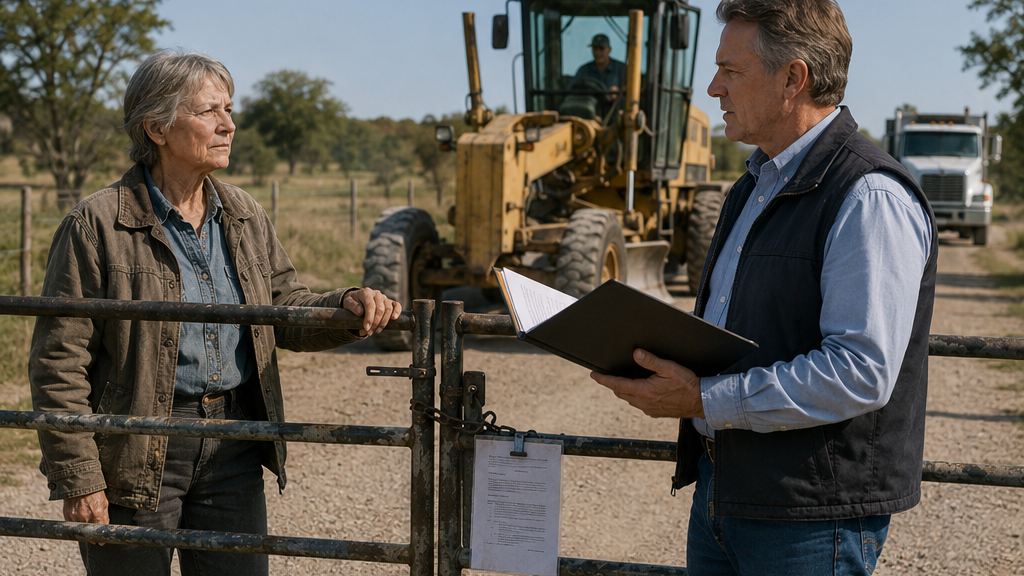
The paper had been clipped to the farm gate with a black binder clip, just above the chain Janet Hall used every night.
She saw it from the cab of her pickup before she saw the truck beyond it.
At first she thought it was another delivery notice. Then she read the first line through the windshield and stopped with one boot still on the running board.
NOTICE OF LIEN.
The words were large enough to read from six feet away.
Janet stood in the gravel with the morning feed sack still in the truck bed and read the page twice. The private road-maintenance association claimed she owed an emergency assessment, administrative charges, and enforcement costs. Until those amounts were paid, the association asserted a lien against her farm parcel.
Below that was a second notice.
REMOVE OR RELOCATE ACCESS GATE PRIOR TO ROAD WORK.
She looked past the gate.
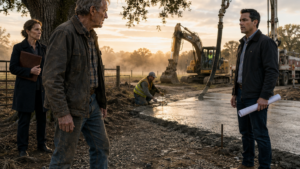
A road grader sat fifty yards up the shared lane, engine idling. Behind it waited a white contractor truck with an equipment trailer. The operator in the grader cab watched her through the glass.
Janet folded the lien notice once along the crease someone else had already made.
Then a black pickup rolled up behind the grader.
Steven Anderson got out carrying a folder.
He had the habit of dressing half a step more formally than the occasion required. Even on a farm road at seven-thirty in the morning, he wore clean boots, pressed jeans, and a button-down shirt tucked in beneath a dark vest.
“Morning, Janet.”
“You recorded this?”
Steven glanced at the paper in her hand.
“The association did.”
“Yesterday?”
“Friday.”
“And you’re grading through here today.”
“That was scheduled before the lien.”
Janet looked at the grader, then back at him.
“My gate opens.”
“That isn’t the issue.”
“It has opened for twenty-three years.”
“The board voted to require unrestricted maintenance access through the association corridor.”
Janet kept her voice level. “Which meeting?”
Steven opened his folder.
“We’ve been over this.”
“No. You’ve sent invoices. That isn’t the same thing.”
He pulled out a typed notice and held it so she could see the heading.
“Emergency maintenance authorization. Approved by the board.”
Janet did not take it.
“What date?”
“Last Thursday.”
“Who was present?”
His expression changed by almost nothing.
“Enough members to act.”
“That isn’t what I asked.”
Behind them, the grader engine dropped to a lower idle.
Steven closed the folder.
“The road is failing at the lower culvert. We’ve had runoff cutting the shoulder twice this summer. The operator needs clear access. Your gate narrows the maintenance corridor.”
“The gate is inside my fence line.”
“The easement crosses your entrance.”
“Yes.”
“So the association has a right to maintain it.”
“A right to maintain the road is not automatically a right to remove a working agricultural gate.”
Steven exhaled through his nose.
“Janet, nobody is trying to take your farm.”
She looked at the lien notice in her hand.
“That’s an odd thing to say while standing beside a lien on it.”
The grader operator looked away.
Steven lowered his voice.
“You disputed the assessment. You ignored the deadline. We have vendors who expect to be paid.”
“I requested a hearing.”
“You received written answers.”
“I requested a hearing.”
“The board considered your objection.”
“Without me?”
“Your presence wasn’t required.”
“Was a quorum required?”
For the first time, Steven paused.
Janet noticed it.
She had spent most of her working life reading the pauses between words like other people read headlines.
She had been a land-records paralegal for more than two decades before retiring. She knew that people who were certain of authority usually answered easy procedural questions quickly.
Steven opened the folder again.
“The authorization is valid.”
“Then tell me the quorum.”
“Three voting members.”
“How many were there?”
He looked toward the grader.
“This road work is happening today.”
Janet stepped to the gate and rested one hand on the weathered steel tube near the latch.
“Then show me the recorded easement paragraph that authorizes permanent gate removal.”
Steven’s jaw tightened.
“You know perfectly well the association has maintenance rights.”
“I know what maintenance rights are. I asked about removal.”
“You’re splitting hairs.”
“No. I’m reading land rights.”
He took a step closer.
“Are you refusing the grader access?”
“I’m refusing to let anyone cut this gate out until you show me the authority you say you have.”
The operator shut off the grader.
The sudden quiet made the birds along the fence line sound louder than they had a moment before.
Steven turned.
“You can leave it running.”
The operator opened the cab door but did not climb down.
“I’m not moving equipment through a disputed gate if the owner says no.”
Steven looked back at Janet.
She hadn’t raised her voice. That seemed to make him angrier.
“This is exactly why the board had to act,” he said. “Every repair becomes an argument.”
“Then the board should be able to show its vote.”
“It can.”
“Good. Send me the minutes.”
“I already sent the notice.”
“The notice is not the minutes.”
His eyes narrowed.
“You’re going to make this expensive for everybody.”
Janet held up the lien paper.
“You started there.”
Steven stared at her for another second, then walked back toward his truck.
“The association attorney will contact you.”
“Fine.”
“The assessment continues to accrue.”
“Fine.”
“And the gate issue isn’t going away.”
Janet looked at the steel gate under her hand.
“Neither is the gate.”
The grader remained where it was.
By eight-fifteen, both vehicles had backed down the lane.
Janet finished feeding later than usual. She kept telling herself she was calm, but she dumped too much grain into one trough and had to shovel half of it back out.
At nine, she carried the lien notice into the farmhouse and put it on the kitchen table.
The farm had been paid for years ago. Part of the purchase money had come from what her mother left her, and Janet had never borrowed against the place after that.
A lien did not mean someone was taking the land that day.
She knew that.
Knowing it did not stop her from feeling as if a stranger had put a hand on the deed.
She opened her laptop and found Steven’s earlier emails.
Emergency assessment.
Road stabilization.
Drainage access.
Administrative surcharge.
None of them contained the minutes.
At 9:42, she sent one sentence to the association’s general email address.
Please provide the full minutes, attendance record, vote tally, and governing provision relied upon for the lien and gate-removal authorization.
The response came eleven minutes later.
Attached.
Janet opened the PDF.
The minutes were three pages.
She read them once as a landowner.
Then she read them again as a paralegal.
The meeting had started at 6:05 p.m.
Steven Anderson, chair, present.
Emily Perez, treasurer, present.
One unnamed voting position was marked absent.
Another was listed as vacant.
The minutes said the emergency assessment and enforcement authority passed “without objection.”
Janet scrolled back to the association bylaws attached to a prior email.
Quorum: three voting members.
She returned to the minutes.
Two had been present.
Janet printed the pages.
The printer pushed them out one at a time, warm and slightly curled.
She laid the lien notice beside them.
For several seconds she simply looked at both documents.
Then she circled two names in blue ink.
Two people.
Not three.
The lien had already been recorded.
The grader had already been sent.
And according to the association’s own minutes, the board that authorized both had never had enough members in the room to act.
Chapter 2: The Minutes Did Not Match the Notice
The recorded easement was longer than Steven’s version by nearly a full page.
Janet discovered that before lunch.
She had driven to the county recorder’s office with a yellow legal pad, a flash drive, and Steven’s association packet tucked inside a worn canvas document bag.
The clerk helped her pull the older instrument by parcel number.
Janet recognized the formatting immediately: dense legal description, typed acknowledgments, recording stamps along the margin, then a hand-drawn exhibit showing the shared lane through several farm parcels.
She compared it to the copy Steven had circulated.
The first pages matched.
The signature page matched.
The exhibit did not.
Janet leaned closer to the monitor.
The recorded exhibit showed her entrance.
A notation beside the gate opening read:
Existing agricultural access structures may remain provided ordinary vehicular passage is maintained.
She read it twice.
Then she looked at Steven’s copy.
That language was gone.
His exhibit had been cleaned up into a simplified road diagram showing only the easement corridor.
No note about gates.
No reference to agricultural access structures.
Janet felt a tight, private satisfaction.
There it was.
Not an opinion.
Not a neighbor’s memory.
Recorded language.
The clerk asked if she wanted certified copies.
“Yes.”
“How many?”
Janet almost said two.
“Three.”
While the machine stamped them, she flipped back through the original instrument.
The road agreement had been executed decades earlier when nearly every parcel along the lane was agricultural. It granted shared access and maintenance rights but repeatedly distinguished road use from ownership of the underlying land.
One paragraph required reasonable accommodation for farm equipment.
Another referred to livestock-control structures.
Steven’s summary did not include either.
By one-thirty Janet was back at her kitchen table with the certified copy open beside the association packet.
She set a ruler across both versions.
It was almost absurd how ordinary the difference looked.
One missing block of text.
One simplified exhibit.
One gate someone now claimed had to disappear.
She called Steven.
He answered on the fourth ring.
“What is it?”
“I’m at the recorded agreement.”
A pause.
“All right.”
“The copy you’ve been using is incomplete.”
“It’s the operating copy the association has used for years.”
“That doesn’t make it complete.”
“What exactly are you claiming is missing?”
“Agricultural access protections. Existing gate language. Farm-equipment accommodation.”
Steven was silent.
Janet continued.
“The recorded exhibit specifically allows existing agricultural access structures so long as ordinary passage remains available.”
“The gate has been modified.”
“No.”
“It’s been rehung.”
“On the same posts.”
“That still changes conditions.”
Janet looked through the kitchen window toward the lane.
“You said this morning the board had authority to require permanent removal.”
“We have authority to maintain the easement.”
“That isn’t the same sentence.”
“Janet.”
“No. This matters.”
“You found an old note on an old drawing.”
“I found the recorded instrument.”
Steven’s voice hardened.
“We’re dealing with current road conditions, not what somebody expected thirty years ago.”
“Then amend the agreement properly.”
“We don’t need every landowner reopening every operational decision.”
“You do if you’re recording liens against them.”
He ended the call first.
Janet sat for a moment with the phone still against her ear.
She should have stopped there.
She knew that later.
At the time, the certainty felt too clean.
She drafted a letter.
She cited the missing quorum.
She cited the recorded gate language.
She cited the difference between Steven’s exhibit and the recorder’s instrument.
Then she added a sentence she would later wish she had softened.
The association appears to be relying on an altered or deliberately incomplete version of the governing road agreement in order to assert authority it does not possess.
Janet read the sentence once.
Then sent the letter to Steven, Emily, the association attorney, and the two other parcel owners whose email addresses she had.
Within an hour, the tone changed.
The association attorney replied first.
Your characterization of the association’s records as altered or deliberately incomplete is unsupported and inappropriate.
Steven sent nothing.
One neighbor wrote only:
This is getting out of hand.
At four-ten Emily Perez called.
Janet almost let it go to voicemail.
Instead she answered.
“You copied everybody,” Emily said.
“I copied the people affected.”
“You accused us of deliberately altering records.”
“I said it appears that way.”
“No, you wrote it so you could deny writing it that way.”
Janet stood at the kitchen counter.
“The recorded document has language your board copy doesn’t.”
“I know what the recorded document says.”
That caught her.
“You know?”
“Yes.”
“Then why are you using the shorter version?”
“Because that’s the binder copy we inherited.”
“Inherited from whom?”
“The previous chair.”
“And nobody checked it?”
“We’ve been using it for years.”
“That isn’t an answer.”
“No, Janet, it is an answer you don’t like.”
Emily’s voice was controlled, but there was strain under it.
“We have a road that needs work. We have invoices due. Half the time someone contests an assessment because they don’t like how it was calculated. Steven pushed this one too fast, and I already told him that. But calling the whole board dishonest before you know what’s happening doesn’t help.”
“You voted for the enforcement.”
“I did.”
“Without quorum.”
Another pause.
“Yes.”
Janet gripped the edge of the counter.
“So you admit it.”
“I admit we handled that meeting badly.”
“Badly?”
“Do you want the truth or do you want me to say the sentence you already wrote?”
Janet did not answer.
Emily lowered her voice.
“You found a real problem. Maybe more than one. But you’re acting like every mistake proves the same motive.”
“The association put a lien on my farm.”
“I know.”
“Then you understand why I’m not feeling generous.”
“I’m not asking for generous.”
Emily stopped for a moment.
“I’m asking you to look at the ledger before you decide you know what this is.”
“What ledger?”
“The unpaid assessments.”
Janet glanced at the documents spread across her table.
“You’re telling me there are delinquent owners.”
“I’m telling you the road account is short.”
“How short?”
“I’m not discussing financial details over the phone.”
“Then send them.”
“I can’t send member account information around casually.”
“You just told me to inspect it.”
“Yes. Come to the equipment shed Wednesday evening. I’ll show you the association ledger in person.”
Janet heard something in Emily’s voice that she had not expected.
Not fear.
Weariness.
“Why?”
“Because you need to see all of it.”
“All of what?”
Emily took a breath.
“The people who haven’t paid.”
The call ended soon after.
Janet went back to the recorded agreement.
For the first time that afternoon, the missing language did not look like the entire answer.
It looked like one answer.
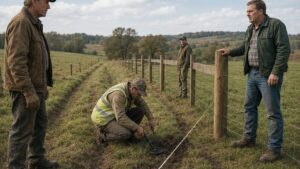
On Tuesday morning she walked down to the gate with a tape measure.
The old exhibit gave a width for ordinary access.
She measured from post to post.
Twelve feet, two inches.
More than enough for pickups, livestock trailers, and the grader blade with room to spare if the gate was fully opened.
She photographed it.
Then she noticed the ground beneath the bottom rail.
A dried line of mud ran across the gravel from the uphill shoulder.
Water had cut a shallow channel under the fence after the last hard rain.
She followed it twenty yards before it disappeared into the roadside grass.
The road did have a drainage problem.
That fact irritated her because it did not fit neatly into the argument she had already built.
At noon, the association attorney sent another email.
The board maintains that current maintenance conditions justify temporary and permanent access measures as necessary.
Janet replied with the recorded easement excerpt.
The attorney wrote back:
We disagree with your interpretation.
Janet nearly answered immediately.
Instead she closed the laptop.
That evening, while stacking the certified copies into a folder, she saw again the sentence she had sent to everyone.
Deliberately incomplete.
It was possible.
It was also possible she had said more than she knew.
At 8:17 p.m., another email arrived.
From Emily.
No greeting.
Before tomorrow, bring the recorded agreement and your lien notice. Also bring the assessment invoice you disputed.
Then one more line:
You should see Steven Anderson’s account before you accuse anybody else of hiding money.
Chapter 3: The Treasurer Showed Her the Missing Money
Steven Anderson’s name was already on the page when Janet sat down.
The equipment shed had no formal meeting room. Someone had cleared a folding table between stacked seed bags and an old parts cabinet. A fluorescent strip hummed overhead.
Emily Perez placed a thick ledger binder in front of Janet and turned it around.
“Read the account column.”
Janet did.
Parcel numbers.
Owner names.
Assessments.
Payments.
Balances.
Steven’s parcel showed three unpaid charges and a running balance large enough to make Janet sit back.
“He’s delinquent.”
“Yes.”
“How long?”
“Several months.”
“And he authorized a lien against me?”
“He supported it.”
“While owing the association more than I do.”
Emily’s mouth tightened.
“Yes.”
Janet looked down again.
The satisfaction came fast and hot.
This was the hypocrisy she had expected.
This was leverage.
“This is selective enforcement.”
“It is inconsistent enforcement.”
“That’s a careful phrase.”
“It’s an accurate one.”
Janet looked up.
“You’re defending him?”
“No.”
“You sound like you are.”
“I’m trying to keep you from doing what you did yesterday.”
“What did I do yesterday?”
“Decide the answer before you finished reading.”
Emily pulled the ledger back and turned several pages.
“Look.”
Three more parcel accounts had balances.
One was only a month behind.
Another had missed two assessments.
A third showed partial payments spread across the summer.
Janet frowned.
“How many owners are current?”
“Four.”
“How many aren’t?”
“Four, counting Steven.”
“And you still hired a grader?”
“We had to.”
“With what money?”
Emily reached for another folder.
“Not enough.”
She opened the road account.
The numbers were smaller than Janet expected.
A recent gravel invoice.
Culvert work.
Equipment rental.
Temporary ditch clearing.
The association’s cash reserve had dropped sharply.
Then came an estimate for more substantial drainage repair.
Janet read the total.
“You can’t cover this.”
“No.”
“Not even close.”
“No.”
“Then why authorize it?”
“Because delaying it also costs money.”
Emily slid a photograph across the table.
It showed the lower stretch of lane after heavy rain. Water had spread across the gravel, carrying stone into the ditch. A vehicle sat farther back near the bend.
“What am I looking at?”
“Last spring.”
Janet studied it.
“That road was closed?”
“For about forty minutes.”
“That’s not what Steven said.”
“Steven says a lot of things badly.”
Emily tapped the vehicle in the photograph.
“That was an ambulance.”
Janet looked up.
“For who?”
“It doesn’t matter.”
“It matters if you’re using it to justify emergency authority.”
“It was called for one of the older residents. The driver stopped because water was across the low section and they couldn’t tell whether the culvert shoulder had dropped.”
Janet looked again.
“They got through?”
“Eventually.”
“How?”
“One of the farm trucks led them around the edge after somebody checked the shoulder.”
The triumph she had felt over Steven’s delinquency began to recede.
Emily folded her hands.
“I voted for the emergency assessment because I don’t want that happening again.”
“You still didn’t have quorum.”
“I know.”
“And you still filed against me.”
“I didn’t file it.”
“You were treasurer.”
“I gave the account balance to the attorney. Steven told him the board had authorized enforcement.”
“You knew how many people were at the meeting.”
“Yes.”
“Then you knew.”
Emily looked directly at her.
“I knew we were short one member. I also knew we had been rescheduling the same repair for six weeks while water kept cutting the road.”
“That doesn’t make the vote valid.”
“No.”
Janet waited.
Emily did not add anything.
That simple refusal to defend the invalid vote unsettled Janet more than an argument would have.
“You should have stopped him.”
“Yes.”
“Why didn’t you?”
Emily rubbed one thumb along the edge of the ledger.
“Because I thought getting the road fixed mattered more than getting the procedure perfect.”
Janet almost answered immediately.
Then she heard her own words from the day before.
Deliberately incomplete.
Emily continued.
“That was my mistake. But it wasn’t because I wanted your farm.”
“I didn’t say you did.”
“You said the board was using incomplete records to claim authority it didn’t possess.”
“That’s what happened.”
“Yes. But you wrote it like we sat around a table planning it.”
Janet glanced toward the open shed door.
Beyond the gravel apron, the shared lane curved downhill. Mud had dried in dark ribbons along both shoulders.
She thought of the channel beneath her own gate.
“Why is Steven behind?”
Emily’s expression changed.
“That’s his business.”
“It becomes association business when he puts liens on other people.”
“I agree.”
“Then why hasn’t he been charged enforcement fees?”
“He should have been.”
“Why wasn’t he?”
“Because he’s chair.”
“That isn’t an answer.”
“It is the ugly answer.”
Janet stared at her.
Emily continued more quietly.
“Steven’s event barn had two slow months. He asked for time. Nobody wanted to start a fight with the person coordinating the repairs.”
“So everybody looked away.”
“For a while.”
“And when I asked for time to dispute an assessment?”
Emily did not answer.
Janet closed the ledger binder.
“There it is.”
“Part of it.”
“What part am I missing now?”
Emily stood and went to the parts cabinet.
She pulled out a narrow three-ring binder with a faded label on the spine.
ROAD AGREEMENT—OPERATING COPY.
“This is the copy Steven inherited.”
Janet opened it.
It was the same shortened version she already had.
“Where did it come from?”
“The previous chair kept it.”
“For how long?”
“At least twelve years.”
“And nobody compared it with the recorder?”
“Apparently not.”
Janet flipped through the plastic sleeves.
“Convenient.”
Emily stiffened.
“That word again.”
“You can’t expect me not to notice who benefits.”
“I expect you to notice. I also expect you to notice chronology.”
“What chronology?”
Emily pointed to the binder.
“That copy was already being used before Steven bought the event barn.”
Janet stopped turning pages.
“So he didn’t create it.”
“No.”
“But he relies on it.”
“Yes.”
“Knowing the recorded agreement is different?”
“I don’t know when he first learned that.”
Janet studied Emily.
“You do know something.”
Emily hesitated.
“The old copy has always been called the clean copy.”
“Clean how?”
“No handwritten notes. No old farm annotations. Just the road language people thought still mattered.”
“People?”
“The previous owners. Previous chairs. I don’t know.”
Janet looked at the faded binder again.
“What happened to the full version?”
Emily shrugged.
“I don’t know if anything happened to it. Jerry Wilson might.”
“Jerry?”
“He’s been on this road longer than any of us.”
Janet leaned back.
Jerry lived at the far end of the lower pasture and had spent years avoiding association meetings whenever he could.
“He never said anything.”
“Jerry doesn’t say much unless somebody asks the right question.”
Janet gathered her documents.
She had come expecting to prove Steven corrupt.
She was leaving with proof that he had accepted favorable treatment, that the board had acted without quorum, and that the association truly was running short of money while the road deteriorated.
None of those facts canceled the others.
That was the problem.
At the shed door, Emily called after her.
“Janet.”
She turned.
Emily held the faded binder against her chest.
“If you go see Jerry, don’t walk in there waving that lien like a weapon.”
Janet’s face hardened.
“It is a weapon.”
“I know.”
Emily looked tired again.
“That’s why I’m telling you.”
Janet stepped outside.
The late light caught the dried mud along the lane, following the same path water had taken weeks earlier.
Behind her, Emily said one last thing.
“Ask Jerry what was in the road agreement before somebody decided they needed a clean copy.”
Janet stopped beside her pickup.
For the first time since finding the lien clipped to her gate, the question was no longer simply whether Steven had exceeded his authority.
It was who had shortened the rules before him—and what, exactly, they had decided no longer mattered.
Chapter 4: The Old Road Agreement Had Another Page
Jerry Wilson laid the missing page on his kitchen table and put one hand over it before Janet could reach for it.
“Before you start making copies,” he said, “tell me what you plan to do with this.”
Janet had arrived with the lien notice in her document bag, exactly as Emily had warned her not to.
Jerry had noticed.
His farmhouse sat at the lower end of the shared lane, where the gravel narrowed between an old hayfield and a line of walnut trees. He had asked Janet inside instead of talking on the porch because the wind kept catching the papers she carried.
Now a stained carbon copy rested beneath his palm.
The page was yellow at the edges and punched for a three-ring binder that no longer existed.
“I plan to determine which agreement governs the road.”
“That wasn’t my question.”
“The association is using an incomplete copy.”
“So you’ve said.”
“And Steven put a lien on my farm using it.”
Jerry looked toward the document bag.
“There it is.”
“What?”
“The thing Emily told you not to bring like a pistol.”
Janet’s shoulders stiffened.
“I didn’t come here to threaten you.”
“No. You came here to make me useful.”
For a moment neither of them moved.
Then Janet set the bag on the floor.
“Fine,” she said. “What do you want me to understand first?”
Jerry removed his hand.
“Read it.”
She pulled the page closer.
The language was dense but clear enough. Maintenance expenses were to be allocated according to ordinary residential or agricultural use, with additional costs attributable to intensified commercial traffic assigned proportionally to the parcel creating that traffic.
Janet read it again.
Below that came another clause.
Existing livestock-control gates and agricultural access structures could remain if they provided reasonable passage to easement holders. Maintenance crews were entitled to temporary access, but permanent alteration required consent of the underlying landowner unless an obstruction made ordinary passage impossible.
Janet looked up.
“This changes both issues.”
Jerry nodded.
“The gate and the assessments.”
“Why isn’t this in the operating copy?”
“Because people stopped using this one.”
“That doesn’t explain why.”
“No. It explains how.”
Jerry sat opposite her.
“When the agreement was written, nearly everything up here was working land. Cattle. Hay. A little corn. Gates mattered. Big equipment mattered. Nobody had wedding traffic every Saturday.”
Janet glanced at the page.
“The commercial-use clause anticipated heavier traffic.”
“It anticipated somebody turning a parcel into something that used the road more.”
“So why remove it?”
Jerry’s expression sharpened.
“You keep saying remove like someone sat down with scissors.”
“The page is missing.”
“From the clean copy.”
“That’s what Emily called it.”
“That’s what everybody called it.”
Jerry got up slowly and crossed to a cabinet. From a drawer he brought out an older ledger with a cracked brown cover.
“Road work used to be simple,” he said. “Somebody bought gravel. Somebody else brought a tractor. Somebody cleared the ditch. We wrote down what each place contributed.”
He opened the ledger.
Rows of handwritten entries crossed the pages.
Diesel.
Stone.
Culvert pipe.
Hours with tractor.
Cash received.
Janet recognized surnames belonging to people who had been gone for years.
Jerry tapped one entry.
“Your place supplied the tractor twice before you owned it.”
Another.
“My father hauled stone.”
Another.
“This parcel paid less because they supplied labor.”
Janet turned several pages.
There were no formal formulas on most of them. Just practical accommodations.
“You ran the road by handshake.”
“We ran it by knowing who was going to answer the phone when the ditch washed out.”
“And that’s why the documents got sloppy.”
“That’s part of it.”
“When did the clean copy start?”
Jerry thought.
“Maybe fifteen years ago. Maybe longer. People wanted something easier to hand new owners. Took out the old notes, old references, things they thought didn’t apply.”
“Who did?”
“A previous chair and a couple owners.”
“Were you involved?”
Jerry did not answer immediately.
That was enough.
“You were.”
“I didn’t type it.”
“But you knew.”
“I knew they were making a simplified packet.”
“Did you know this page was omitted?”
“I knew nobody was using the commercial allocation anymore.”
Janet pushed back from the table.
“So everybody just decided a recorded agreement didn’t matter.”
“That isn’t what happened.”
“It sounds exactly like what happened.”
Jerry’s voice hardened.
“You want everyone before Steven to be guilty because it makes the line cleaner.”
“They changed how costs were allocated.”
“Yes.”
“Without amending the agreement.”
“Yes.”
“And you said nothing.”
Jerry met her eyes.
“So did you.”
Janet stopped.
“I didn’t know about this page.”
“No. But you knew the association had stopped following half the old practices.”
“That’s different.”
“Is it?”
He turned the ledger toward her.
“You remember when they stopped counting volunteer tractor hours?”
She did.
“You remember when assessments became flat shares?”
“Yes.”
“You object?”
“No.”
“Why?”
Janet knew the answer before she spoke.
“Because it was simpler.”
“And when the board started emailing votes instead of gathering everybody?”
“That was convenience.”
“Did you object?”
“No.”
“When they stopped reading minutes aloud?”
“No.”
Jerry leaned back.
“You liked informal rules when they saved you time. You started caring about every comma when one landed on your deed.”
The words hit harder because there was no accusation in his voice.
Janet looked at the carbon copy.
“I never authorized a lien without quorum.”
“No.”
“I never charged somebody under a rule I wasn’t following myself.”
“No.”
“Then don’t make it equivalent.”
“I’m not.”
Jerry closed the ledger.
“I’m telling you the bad system didn’t start with Steven.”
That distinction settled between them.
Janet looked again at the commercial-use clause.
Steven’s event barn had expanded over the last several years. The renovated building brought delivery vans, caterers, guest vehicles, maintenance crews, and sometimes shuttle buses up the road.
Under the original agreement, that mattered.
A great deal.
“Did Steven know about this page?”
“I don’t know.”
“You never showed him?”
“He never asked.”
“Did the previous chair?”
“Probably.”
“That’s not good enough.”
“No,” Jerry said. “It isn’t.”
She took out her phone.
“Can I photograph it?”
Jerry placed his hand on the page again.
“One condition.”
Janet waited.
“You don’t use me as proof that Steven invented this.”
“I wasn’t planning to.”
“You were hoping.”
She said nothing.
Jerry removed his hand.
“That’s what I thought.”
Janet photographed the page carefully, then the ledger entries that showed older cost-sharing practices.
Before leaving, she stood at Jerry’s porch rail.
From there the shared road climbed toward her farm and then farther toward Steven’s event barn. The lane looked like one continuous strip of gravel.
The records beneath it were anything but.
“Why didn’t you fix this years ago?” she asked.
Jerry rested both hands on his cane.
“Because most years the road worked.”
“That’s not an answer.”
“It is when you live beside people for forty years.”
She turned toward him.
“And now?”
“Now it doesn’t work.”
Janet drove home slowly.
At her gate she stopped and looked at the steel frame differently.
She had always thought of it as hers because it stood on her land and kept cattle where they belonged.
The old agreement treated it differently.
It recognized the gate as private property inside a shared system.
Not absolute control.
Not unrestricted access.
Accommodation.
She went inside and spread everything across the kitchen table: the lien, the invalid meeting minutes, Steven’s delinquent account, the association’s depleted road fund, Jerry’s extra page, and the old ledger.
The pattern she had wanted was simple.
Steven had broken the rules.
That was still true.
But another truth sat beside it now.
For years, Janet had accepted an association that ran on shortcuts so long as those shortcuts did not cost her anything important.
She picked up the demand letter she had sent two days earlier.
Deliberately incomplete.
The phrase looked different now.
She crossed it out on her printed copy.
Not because Steven was cleared.
Because she no longer believed one guilty person explained the whole road.
Chapter 5: Steven Finally Explained What He Was Afraid Of
The culvert looked worse from the ditch than it had from the road.
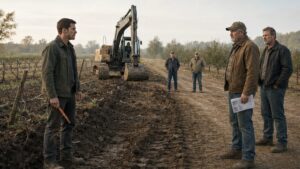
Janet stood below the gravel shoulder Saturday morning with mud pressing around the edges of her boots and watched a thin stream of water find its way around the steel pipe instead of through it.
The soil beside the outlet had collapsed into a rough cavity. Several feet of gravel shoulder hung above it in a broken shelf.
Steven was twenty yards away talking to the contractor.
When he saw Janet, his face closed.
“What are you doing down there?”
“Looking.”
“You could’ve done that before accusing everybody of inventing the problem.”
Janet climbed carefully back toward the road.
“I never said the drainage problem was invented.”
“You implied the emergency was.”
“I said the vote was invalid.”
“There’s always a distinction with you.”
“There should be.”
Steven gave a humorless laugh.
The event barn stood uphill beyond him, freshly painted and larger than anything else along the lane. A delivery van was parked near its side entrance. Rows of folded tables were visible through an open service door.
Janet looked from the barn to the damaged shoulder.
“How much traffic did you have here last year?”
Steven’s eyes narrowed.
“You already found the commercial-use clause.”
“Yes.”
“So Jerry showed you.”
“He showed me the original agreement.”
Steven looked away.
“I figured he would eventually.”
“You knew about the clause?”
“I knew there was older language.”
“That isn’t the same answer.”
“I’d seen references to it.”
“Before you authorized my assessment?”
Steven stared at her.
“Yes.”
The admission landed without drama.
Janet had expected resistance, denial, perhaps another argument about interpretation.
Instead she got one word.
“You knew.”
“I knew there were older provisions. I did not believe they controlled every current maintenance decision.”
“You didn’t ask counsel?”
“We asked counsel about association authority.”
“Using which copy?”
“The operating copy.”
“Of course.”
His jaw tightened.
“You came here to inspect the culvert or conduct a deposition?”
“To understand why you were willing to put a lien on my farm before you had enough votes.”
The contractor walked farther down the ditch, giving them space.
Steven rubbed a hand across the back of his neck.
“You want to know why?”
“Yes.”
“Because that road almost failed in spring.”
“I saw the photograph.”
“You saw one photograph.”
He pointed toward the damaged shoulder.
“Water crossed here twice after that. We patched it. Then it cut under the edge again.”
“Then call a proper meeting.”
“We did.”
“You had two members.”
“We had two members because one was out of state and the other seat was vacant.”
“Then you didn’t have a board capable of acting.”
“And the water was supposed to wait?”
Janet folded her arms.
“No. Temporary emergency work is one thing. Permanent gate removal and liens are another.”
“The grader needed room.”
“My gate opens twelve feet.”
“He wanted more clearance.”
“Then he could ask.”
Steven’s voice rose.
“I was tired of asking.”
The words carried farther than he intended.
The contractor glanced back.
Steven lowered his voice.
“Every time we assess this road, someone delays. Somebody wants another bid. Somebody says their tractor causes less damage. Somebody else says they only use the lane twice a week. Meanwhile vendors want deposits.”
“That doesn’t let you choose which rules apply.”
“No.”
Again, no defense.
Janet studied him.
“What aren’t you telling me?”
Steven looked toward the barn.
When he spoke, his voice had lost some of its edge.
“I had two bookings cancel last spring after the ambulance incident.”
Janet said nothing.
“One family saw the road blocked. Word got around that access could wash out.”
“So this is about the barn.”
“It’s partly about the barn.”
“Your business.”
“My business employs people. It pays property taxes. It pays road assessments.”
“Late.”
He looked at her.
There it was.
“Emily showed me.”
“I assumed she would.”
“You were months behind while you approved enforcement against me.”
“Yes.”
“Why?”
Steven looked toward the culvert again.
“Because I was covering the barn’s slow season.”
“You asked the association for time.”
“Yes.”
“And gave yourself time.”
“I didn’t vote myself an exemption.”
“You didn’t charge yourself enforcement fees either.”
“No.”
“That matters.”
“I know.”
His answer irritated her because it gave her nothing to push against.
“How much did you owe when my lien was filed?”
“You saw the ledger.”
“I want to hear you say you knew.”
Steven’s mouth tightened.
“Yes. I knew I was behind.”
“And you still let the attorney file against me.”
“Yes.”
“Why?”
“Because you weren’t just late. You disputed the assessment and refused the gate condition.”
“That makes it worse, not better.”
“Maybe.”
Janet stared at him.
The man who had stood at her gate Monday morning had seemed almost offensively certain.
This Steven looked tired.
Not innocent.
Tired.
“I thought if we stopped arguing and fixed the road,” he said, “everything else could get sorted afterward.”
“You mean after people had already paid what you told them to pay.”
“I mean after nobody had to wonder whether an ambulance could reach them.”
Janet looked down at the washed-out edge.
That fear was real.
So was his commercial interest.
So was the lien.
“You used a real problem to justify authority you didn’t have.”
Steven nodded once.
“That’s one way to put it.”
“It’s the accurate way.”
“Probably.”
The contractor approached with a measuring rod.
“We need another look at the upper inlet.”
Steven walked with him several yards, then returned.
“Association counsel wants this ended.”
“So do I.”
“He’ll send you something today.”
“What kind of something?”
“A resolution.”
Janet did not like the word.
At noon the email arrived.
The association would release Janet’s lien, waive administrative charges, and suspend the gate-removal demand.
In exchange, Janet would acknowledge the emergency assessment as valid, release all claims arising from the enforcement process, and agree not to challenge prior association actions concerning the operating road agreement.
She read it twice.
Then a third time.
It gave her everything she had demanded for herself.
It also preserved the system that had produced the problem.
Janet called the association attorney.
“This is a waiver.”
“It is a settlement.”
“It fixes my lien and nothing else.”
“It resolves the dispute between you and the association.”
“What about Steven’s delinquency?”
“Not part of your claim.”
“What about the invalid vote?”
“The association is willing to withdraw the enforcement action without admitting invalidity.”
“What about the original cost-allocation clause?”
“That issue can be addressed separately.”
“After I sign away my right to challenge prior actions.”
“You would be buying certainty.”
Janet looked through the kitchen window toward her gate.
For a week, certainty had been exactly what she wanted.
“No.”
The attorney paused.
“Mrs. Hall, I recommend you consider the practical benefit.”
“I have.”
“The lien gets released.”
“Only mine.”
“You cannot negotiate on behalf of every owner.”
“No. But every owner can vote.”
Another pause.
“What are you proposing?”
“A properly noticed owner meeting. Full agreement on the table. Current ledger on the table. Repair estimate on the table.”
“That could significantly expand the dispute.”
“It’s already expanded.”
“The board may not agree.”
“Then they can vote on whether they want to keep defending a lien authorized without quorum.”
She ended the call before her certainty could turn into another accusation she could not take back.
Then she called Emily.
“I rejected the settlement.”
“I figured you might.”
“I want a full owner meeting.”
Emily was quiet.
“To do what?”
“Fix the road agreement.”
“That’s bigger than your lien.”
“Yes.”
“Steven will hate it.”
“Yes.”
“You know some owners will say you’re making this harder.”
“I know.”
Emily exhaled.
“What exactly do you want changed?”
Janet looked at Jerry’s copied page.
“Commercial traffic pays its share. Agricultural access stays protected. Emergency work gets a real emergency procedure. Delinquencies get handled the same way no matter whose name is on the account.”
“And your lien?”
“Released.”
“Obviously.”
“No,” Janet said. “Not obviously. Properly.”
She heard Emily shift the phone.
“You sound different.”
Janet looked again toward the gate.
“I had more certainty on Monday.”
“That’s not what I meant.”
“I know.”
By late afternoon, a notice had gone out proposing a full owner meeting at the volunteer fire hall the following Tuesday.
Janet printed it and put it beside the settlement she had refused.
One paper would have ended her problem.
The other might force everyone to admit they had one.
Chapter 6: She Put Both Ledgers on the Same Table
“I should have objected years ago.”
The volunteer fire hall went still.
Janet had expected Steven to interrupt her before she finished the first paragraph.
Instead he sat at the far end of the folding table, arms crossed, saying nothing.
Emily sat beside the association ledger. Jerry had taken a chair near the wall. Two other landowners occupied the remaining seats, along with the association attorney.
On the table in front of Janet were two ledgers.
One was the road association’s current financial record.
The other was Jerry’s cracked brown book of old contributions and informal cost sharing.
Between them lay a certified copy of the original road agreement and a photograph of Janet’s steel gate with the lien notice clipped beside its chain.
Janet rested one hand on the photograph.
“I didn’t object when we stopped counting labor contributions. I didn’t object when votes started happening by email. I didn’t object when the operating copy got treated like the whole agreement.”
Steven shifted.
Janet continued.
“I objected when the shortcuts reached my deed.”
One of the owners leaned back.
“At least somebody said it.”
Janet looked around the table.
“That doesn’t make the lien valid. It doesn’t make Steven’s account current. It doesn’t make the missing language disappear. But I’m not going to stand here and pretend every bad practice started last Monday.”
Jerry lowered his eyes toward the old ledger.
Steven finally spoke.
“Are we here to confess or fix the road?”
“A little of both,” Janet said.
His mouth tightened.
She slid copies of the recorded agreement down the table.
“The gate provision is clear. Existing agricultural access structures remain unless they prevent ordinary passage. My gate provides twelve feet two inches when fully opened.”
Steven tapped the paper.
“We’ve heard this.”
“Then we don’t need to debate it again.”
That seemed to surprise him.
Janet moved to the next page.
“The larger issue is cost allocation.”
The room changed.
Steven uncrossed his arms.
The association attorney leaned forward.
Janet pointed to the original commercial-use clause.
“This agreement did not require every parcel to pay the same amount regardless of use. It specifically allowed heavier use to carry additional maintenance cost.”
One landowner looked toward Steven.
“You mean the barn.”
“I mean any intensified commercial traffic.”
Steven laughed once.
“Let’s not pretend there’s another event business up here.”
“No,” Janet said. “There isn’t.”
“So say it.”
“Your barn creates more traffic.”
He stared at her.
“Yes.”
Emily spoke before he could continue.
“It also creates more road revenue if we assess it correctly.”
Everyone looked at her.
She opened the current ledger.
“This is the part we keep avoiding.”
Emily turned the binder so the balances faced the table.
“We do not have enough cash to complete the lower drainage repair without another assessment or a revised allocation.”
One owner frowned.
“How short?”
Emily gave the number.
The room became quieter.
Jerry whistled softly.
Steven looked at the ledger rather than at anyone else.
Janet placed the contractor estimate beside it.
“This is the repair we actually need.”
Then she put Jerry’s old ledger beside the modern one.
“This is how the road used to recognize unequal contribution. Not perfectly. Sometimes not formally. But people understood that equal ownership of access didn’t always mean equal cost.”
The association attorney adjusted his glasses.
“A revised allocation would need to be adopted carefully.”
“That’s why we’re here,” Janet said.
Steven looked at her.
“What exactly are you asking me to pay?”
“First, your arrears.”
His expression hardened.
“Those are being handled.”
“They weren’t being handled when my lien was recorded.”
“We’re not doing this again.”
“We have to do it once.”
Emily turned to him.
“She’s right.”
Steven looked at her sharply.
Emily did not move.
“If we create a uniform delinquency policy,” she said, “it has to apply to your account too.”
“I said I’ll bring it current.”
“Then put that in the minutes.”
Steven sat back.
Janet watched the tension move across his face.
She knew what she could do now.
She could press harder.
She could read the exact balance aloud.
She could remind everyone that he had allowed legal fees to attach to her farm while receiving informal time himself.
Instead she turned to the next page.
“My proposal is three parts.”
Steven gave her a wary look.
“Of course it is.”
“Farm and ordinary residential parcels keep a base share. Commercial traffic above an agreed threshold pays an additional maintenance percentage. Emergency work under a stated dollar limit can be authorized quickly, but permanent property changes and liens require full procedure.”
“And who decides what counts as commercial traffic?”
“The owners adopt a formula.”
“You mean you want to count cars.”
“I want to count use.”
“That’s unworkable.”
Emily spoke.
“No, it isn’t.”
Steven turned toward her.
She slid forward a sheet of figures.
“I ran three versions.”
Janet had not known that.
Emily pointed to the middle column.
“This one covers the projected repair reserve without doubling the base assessment.”
One owner took the sheet.
“So the barn pays more.”
“Yes.”
“How much more?”
Emily showed him.
Steven stared at the page.
“That’s ridiculous.”
“It reflects traffic.”
“It punishes success.”
“It funds the road your customers use.”
There was no anger in Emily’s voice.
That made the sentence harder to dismiss.
Steven stood.
“If that’s what this becomes, find another chair.”
Nobody answered immediately.
He looked around the table.
“I’ve coordinated every contractor for four years. I’ve taken calls at six in the morning when trees were down. I’ve dealt with gravel companies, drainage crews, complaints, late payments, and people who somehow want a perfect road with no inconvenience and no bill.”
His eyes settled on Janet.
“And now I’m supposed to sign something that makes me personally responsible for a larger share while tying my hands every time something needs fixing.”
Janet heard the old version of herself preparing an answer.
The technical answer.
The devastating answer.
Instead she said, “You shouldn’t have to carry the road alone.”
Steven blinked.
“But you also don’t get to control it alone.”
No one moved.
Janet continued.
“If you resign because the rules apply to you, that’s your choice. If you resign because you’re exhausted, that’s a different problem and we should solve it.”
Steven looked down at the table.
Jerry spoke from near the wall.
“We used to solve that by sharing the work.”
Steven gave him a tired smile.
“You also used to solve it with tractors and handshakes.”
“Sometimes worked.”
“Sometimes didn’t,” Janet said.
Jerry nodded.
“That too.”
The association attorney cleared his throat.
“There is a path here. The lien against Mrs. Hall can be formally released. The current enforcement authorization can be rescinded. A revised agreement can be circulated for signatures and recording, assuming the owners reach the required consent.”
“And the repairs?” Steven asked.
Emily tapped her projection.
“If the arrears are collected and we adopt the revised allocation, we can fund the culvert work without another emergency assessment.”
Steven stared at the figures.
Janet watched him calculate.
Not merely money.
Status.
Control.
Business risk.
The cost of admitting that the system he had used was defective.
Finally he sat down.
“What happens to the gate?”
Janet slid the photograph toward him.
“It stays.”
“Emergency crews need access whether you’re home or not.”
“That’s reasonable.”
Steven looked up.
She continued.
“I’ll accept an emergency-access mechanism. Fire department access, road emergency access. Not an association master key floating around.”
The attorney nodded.
“That can be drafted.”
Steven drummed two fingers against the photograph.
“A secured emergency box?”
“If access is logged.”
Emily said, “That’s workable.”
Steven looked around the table again.
Then he said, “If that condition is included, I’ll support the revision.”
Nobody applauded.
Janet was grateful for that.
Emily began reading the motion into the minutes.
Rescind the disputed enforcement action.
Release Janet Hall’s lien.
Require uniform handling of arrears, including the chair’s account.
Draft a revised cost formula reflecting intensified commercial traffic.
Restore agricultural-access language from the recorded agreement.
Create a limited emergency-access procedure.
When the vote reached Steven, everyone looked at him.
For several seconds he said nothing.
Then he looked at the photograph of the gate.
“Yes.”
Emily recorded it.
The word was small.
The consequences were not.
As the meeting broke up, Steven remained seated.
Janet gathered her papers.
He touched the corner of Jerry’s old ledger.
“You really think this fixes it?”
“No.”
He looked at her.
“No?”
“I think it gives us rules we can actually follow.”
“That’s your idea of optimism?”
“It’s the most I’ve got tonight.”
For the first time since Monday, something close to amusement crossed his face, then disappeared.
Janet put the lien photograph into her folder.
The gate was staying.
The lien was going.
But neither mattered quite as much as the fact that, for the first time in years, everyone who used the road had agreed that convenience was not the same thing as consent.
Steven stood and picked up his copy of the proposed revision.
At the door, he stopped.
“Make sure the emergency-access language is real,” he said.
Janet nodded.
“I will.”
He looked back once.
“And I’ll bring the account current before we sign.”
Then he walked out into the parking lot, leaving Janet with a promise she did not yet trust—and a road agreement that would mean nothing unless all of them finally learned to live by it.
Chapter 7: The Gate Stayed, but the Rules Changed
The farm-supply truck stopped at Janet’s gate on the first morning the new road agreement was officially in force.
For one uneasy second, she thought something had gone wrong.
The driver leaned from his window and pointed toward the new metal box mounted beside the gatepost.
“Am I supposed to use that?”
“No,” Janet called as she walked down the gravel drive. “That’s emergency access.”
“So I still wait for you?”
“You still wait for me.”
He grinned. “Good. I didn’t want my first delivery under the new rules to be the first violation.”
Janet unlatched the gate and swung it wide.
Twelve feet, two inches.
Exactly the same opening it had provided before anyone declared it an obstruction.
The truck rolled through carrying mineral blocks and fencing supplies, leaving a pale trail of dust behind it. Janet closed the gate after the driver passed, then rested her hand briefly on the new emergency-access box.
It had taken weeks to get there.
The lien release had arrived first.
Not an email promising that it would be handled. Not a private settlement marked confidential. A recorded release bearing the same parcel information as the lien that had started everything.
Janet had taken the document to the county recorder herself.
She watched the clerk verify the instrument number and enter the release.
Only after that did she allow herself to put the original lien notice away.
Steven brought his account current three days before the revised agreement was signed.
Emily recorded the payment in the association ledger without ceremony. The new delinquency policy had been approved at the same time: written notice, a defined cure period, uniform late charges, a hearing opportunity, and no lien action without the vote required by the governing documents.
Steven’s name appeared nowhere special in the policy.
Neither did Janet’s.
That was the point.
The revised road agreement took longer.
The association attorney drafted language from the recorded original rather than the shortened operating copy. Agricultural gates and working access structures were expressly protected. Commercial traffic received an additional maintenance allocation based on use. Emergency repairs received a limited procedure that allowed immediate safety work while reserving permanent property changes for formal approval.
Jerry read every page.
Then he read it again.
“You lawyers can turn a gate into six paragraphs,” he complained.
“I’m not a lawyer,” Janet reminded him.
“Close enough.”
“You signed it.”
“I got tired of reading it.”
But he had not.
Janet had watched him compare the revised cost provision to the stained carbon page he had kept all those years.
When he finally signed, he pressed hard enough to leave an impression on the sheet beneath it.
Now the lower culvert had been repaired.
Stone armored the washed-out shoulder. The ditch had been reshaped so runoff reached the pipe instead of cutting around it. After the first hard rain, Janet drove down to inspect it and found water passing cleanly beneath the road.
The repair had been necessary.
She could admit that now without feeling she had surrendered anything.
Late that morning, after the supply truck had left, another vehicle approached from uphill.
Steven’s pickup.
He stopped outside the gate rather than sounding the horn.
Janet walked down again.
Steven got out and looked at the emergency box.
“Attorney wants confirmation it works before the final contractor file closes.”
“I tested it.”
“I know.”
“Then why are you here?”
His eyes moved toward the box.
“Because I’m still chair until the next election.”
Janet almost smiled.
He had not resigned.
He had stopped threatening to, too.
“That sounds inconvenient.”
“It is.”
He held up a small sealed access tag issued under the new procedure.
“Mind if I test it?”
Janet stepped aside.
“Go ahead.”
The system was deliberately simple. Emergency personnel and designated road representatives could retrieve access under controlled circumstances, with every use recorded. The mechanism released the secondary latch without giving anyone unrestricted possession of Janet’s regular gate key.
Steven followed the instructions.
The latch clicked.
He opened the gate several inches, then closed it again.
“That’s better than I expected.”
Janet folded her arms.
“You expected it not to work?”
“I expected six committees and a keypad nobody could operate in the rain.”
“We don’t have six committees.”
“Give it time.”
He reset the box and checked the latch.
Neither of them mentioned the Monday morning when he had stood at the same spot with a lien notice and a grader waiting behind him.
They did not need to.
The steel posts were the same.
The chain was the same.
Only the authority around them had changed.
Steven stepped back toward his truck.
“The culvert held last night.”
“I drove down.”
“Of course you did.”
“The shoulder looks good.”
“The contractor wants to add stone before winter.”
“Bring the estimate to the owners.”
Steven glanced at her.
“I was planning to.”
There was enough dry humor in his voice that Janet understood the sentence for what it was.
Not an apology.
An acknowledgment.
He opened the truck door, then paused.
“The new commercial assessment is going to hurt.”
“I know.”
“I still think the formula is aggressive.”
“Emily ran the numbers.”
“I know.”
“You voted for it.”
“I remember.”
Janet waited.
Steven looked uphill toward the event barn.
“But the reserve account will be funded by fall.”
“If everybody pays.”
He gave her a pointed look.
“I paid.”
“You did.”
That was as close as either of them came to discussing his delinquency.
He started to climb into the cab, then stopped again.
“For what it’s worth, the old way was easier.”
Janet looked at the emergency box.
“For you.”
“For everybody. Until it wasn’t.”
She considered that.
“Yes.”
Steven nodded once.
Then he drove away.
That afternoon Janet carried the old documents from her kitchen table into the small room she still called her office.
For weeks the table had been buried under exhibits, invoices, copies of minutes, road estimates, photographs, and correspondence.
She sorted them slowly.
The invalid meeting minutes went into one folder.
Jerry’s old ledger copies into another.
The shortened operating agreement remained clipped to the certified recorded version so no one could mistake one for the other again.
Finally she picked up the photograph taken on the first morning.
Her farm gate.
The lien notice clipped beside the chain.
The grader visible behind it.
She studied the image longer than she intended.
On that morning she had believed the problem was Steven.
Then she had believed the problem was the missing quorum.
Then the shortened agreement.
Then the unpaid assessments.
Each answer had been real.
None had been complete.
Janet put the photograph inside the new association binder.
Not as evidence against Steven.
As a record of what happened when a community stopped distinguishing convenience from authority.
Several days later, Jerry stopped his pickup beside her mailbox.
“You hear they’re talking about rotating the chair?”
“Yes.”
“You going to do it?”
“No.”
He laughed.
“That was fast.”
“I spent twenty-five years reading other people’s property problems. Retirement was supposed to involve cattle.”
“You seem to have forgotten that.”
“I’m remembering.”
Jerry looked toward the repaired road.
“Steven might stay on if there’s a maintenance committee.”
“Probably.”
“You all right with that?”
Janet thought before answering.
“I’m all right with rules that don’t depend on whether I trust the chair.”
Jerry nodded slowly.
“That sounds more useful.”
He drove on.
A week later, rain came hard enough to test everything.
Janet woke before dawn to the sound of it striking the metal roof over the back porch.
At first light she drove to the lower culvert.
Water rushed through the ditch, brown and fast, but stayed below the road surface. The new stone held.
A few minutes later Steven’s truck appeared from the opposite direction.
He stopped on the other side.
Neither of them got out.
They simply looked at the culvert, then at each other through rain-streaked windshields.
Steven lifted one hand.
Janet returned the gesture.
Then they drove back toward their separate properties.
By midmorning the rain had eased.
Janet walked down to her entrance.
Water dripped from the gate’s steel tubing. The emergency box sat secure beside the post. Fresh tire tracks from the farm-supply truck remained faintly visible in the gravel.
She opened the gate to move cattle between fields.
Nothing about the motion felt dramatic.
That pleased her.
The gate had never needed to become a monument.
It needed to work.
For her cattle.
For deliveries.
For emergency access.
For the road crew when the procedure required it.
For the neighbors who shared the lane without owning her land.
When the last animal crossed, Janet swung the gate closed.
The latch dropped into place with the same heavy metallic sound it had made for years.
Only now, behind that sound, there was a recorded agreement every owner had read, a cost formula everyone could inspect, an emergency procedure nobody had to invent on the spot, and a lien policy that did not change according to whose name appeared on the ledger.
Janet wrapped the chain once around the post.
She did not feel victorious.
Victory would have been simpler.
She felt something steadier.
The farm was still hers.
The road still belonged to everyone’s use.
Steven was still her neighbor.
And the gate between private land and shared obligation remained exactly where it had always been—except now the rules on both sides of it had finally caught up.
The story has ended.