They Took His Family Nativity From the Farm Gate—Then the Old Road Records Changed Everything
Chapter 1: The Nativity Was Gone Before Sunrise
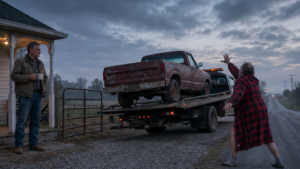
Dennis Harris saw the cedar stable disappear into the back of the pickup before he understood why anybody was touching it.
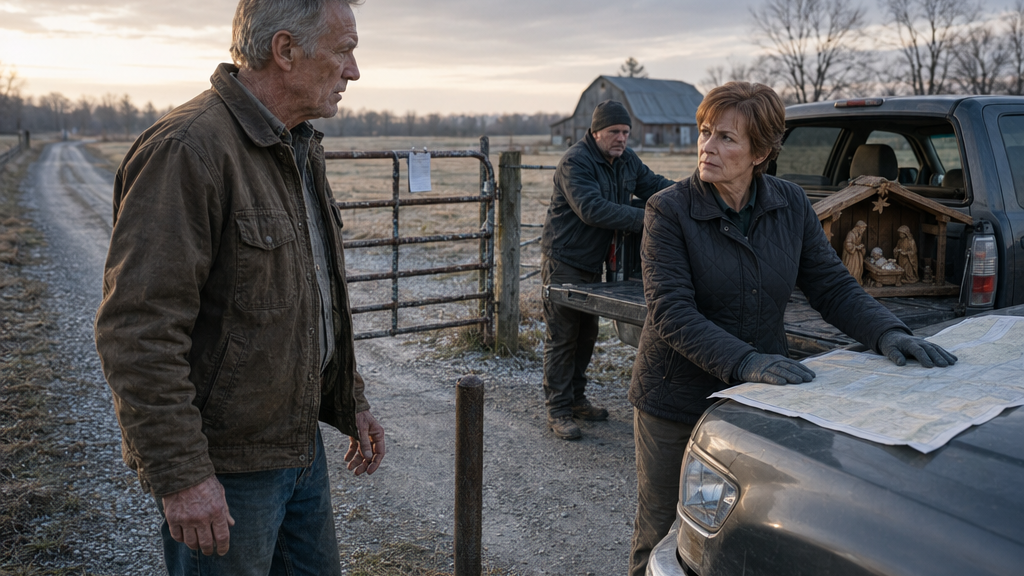
He had come down the lane in his barn coat with one glove tucked under his arm, expecting to check the water trough before feeding. Instead, an association pickup sat half on the gravel near his gate. Its hazard lights flashed against the gray dawn. A man Dennis knew only as the snowplow contractor was holding the little wooden stable against his chest while Margaret Roberts stood beside the open tailgate.
“Put that down,” Dennis said.
The contractor stopped.
Margaret turned. “Morning, Dennis.”
He walked closer. The three cedar figures were already in a cardboard box. Joseph had been wrapped in an old feed sack. The small carved cradle was lying on its side.
Dennis looked at Margaret rather than the contractor.
“That belongs to me.”
Margaret’s face tightened, but her voice stayed even. “It was inside the maintenance clearance.”
“It was beside my gate.”
“That’s the problem.”
Dennis stopped at the edge of the gravel. The nativity had stood in the same place for years, on a low wooden base his wife had insisted they level every December. She had never liked it tilted toward the ditch.
The pieces were older than their marriage. Her father had made the stable from cedar scraps and carved the figures at his workbench. After she died, Dennis kept putting it out because Christmas without it made the entrance look like somebody else’s farm.
He pointed toward the patch of flattened grass where the base had been.
“You knew I filed the request.”
Margaret nodded. “The board received it.”
“Nineteen days ago.”
“It was still under review.”
“So you remove it before answering me?”
“The clearance rule doesn’t stop applying because an application is pending.”
Dennis stared at her.
The snowplow contractor shifted the stable in his arms. “You want me to—”
“Set it in the truck,” Margaret said.
Dennis’s jaw moved once.
He could have taken two steps and pulled it back. He was bigger than Margaret, and even at sixty-eight he could still wrestle a mineral tub into the bed of his pickup by himself. But the thought of two grown men tugging over his wife’s cedar stable beside the county road made something in him go cold.
He stepped aside.
The contractor placed it carefully in the truck.
Margaret opened a folder.
“This also has to be posted.”
She held out a sheet inside a clear plastic sleeve.
Dennis did not take it.
“What is it?”
“Violation notice.”
“For what you just took?”
“For maintaining objects within the designated roadside maintenance corridor.”
She clipped the sleeve to the farm gate.
Dennis looked down the page. Three separate lines carried the same amount.
“One hundred fifty dollars each?”
“Three days.”
“I wasn’t notified three days ago.”
“The violations accrued after the correction period.”
“What correction period?”
“The notice mailed last week.”
“I got nothing last week.”
Margaret folded her arms. “You can appeal it.”
Dennis looked from the paper to the empty patch of grass.
Four hundred fifty dollars.
The money irritated him. The timing angered him. But neither felt as personal as seeing the cardboard box in the association truck.
He stepped past Margaret and crouched near the gravel shoulder.
“What are you doing?” she asked.
Dennis brushed dead grass aside with his glove.
The top of the old iron pin was barely visible, rust-dark and round, two feet behind the edge of the gravel.
He tapped it with one finger.
“This was here when my father bought the south pasture.”
Margaret glanced at it. “That pin isn’t the maintenance line.”
“It marks something.”
“It’s an old survey monument.”
“Exactly.”
She exhaled through her nose. “Dennis, the corridor extends farther than the traveled road.”
“How far?”
“Enough to clear equipment and snow.”
“That wasn’t my question.”
Margaret looked toward the contractor, who had begun tying down equipment in the truck bed.
Dennis rose.
“How far onto my land does this association claim it can come?”
“Eight feet from the maintained edge in this section.”
Dennis looked back at the pin.
The nativity base had been beyond it, farther into his pasture, not toward the road.
“You’re saying that pin doesn’t matter.”
“I’m saying the current corridor map controls.”
“Recorded where?”
Margaret paused.
“Association records.”
“That isn’t what I asked.”
Her expression hardened slightly. “We’ve used the same map for years.”
Dennis pulled off his glove and tucked it into his coat.
“Show me the recorded easement that moved the boundary past that pin.”
Margaret did not answer immediately.
The contractor shut the tailgate.
For the first time that morning, Dennis felt the situation change. Not resolve. Change.
Margaret walked to the cab of the pickup, opened the passenger door, and removed a rolled sheet held by a rubber band.
She spread it across the hood.
The drawing showed the gravel road, adjoining parcels, culverts, and a shaded strip running along both sides. At Dennis’s gate, the shaded area widened.
His fence line sat inside it.
So did the spot where the nativity had stood.
Dennis studied the drawing.
“This has my parcel number.”
“Yes.”
“And somebody’s measurements.”
“Yes.”
“What year?”
Margaret pointed to a notation in the lower corner.
Twelve years earlier.
Dennis remembered that year. There had been talk about widening turns for fire trucks and feed trailers. Meetings. Letters. A survey crew that had driven past his barn once and never returned.
He looked at Margaret.
“This was proposed.”
“It’s what we operate under.”
“That’s not the same thing.”
“It has been for twelve years.”
Dennis straightened slowly.
Margaret rolled the map again.
“We’re not trying to take your land. We’re trying to keep a road open that six farms depend on.”
“Then you should know exactly where the road rights end.”
“We do.”
Dennis looked at the rolled paper in her hand.
“No,” he said. “You know where this drawing says they end.”
Margaret’s mouth tightened.
The pickup engine started.
Dennis stepped toward the gate and unclipped the fine notice.
“Where’s my nativity going?”
“Equipment shed until the violation is resolved.”
“I want it kept dry.”
“It will be.”
“And nothing gets damaged.”
“It won’t.”
He folded the notice once, careful not to crease the printed amounts.
Margaret climbed into the passenger seat.
Before shutting the door, she looked back at him.
“You can challenge the fine at the next board meeting. But Dennis, that map isn’t something we invented this week. The association has governed this road by it for twelve years.”
Then the truck pulled away with the cedar stable in back.
Dennis stood beside the rusted pin until the hazard lights disappeared around the bend.
Twelve years was a long time to use a map.
It was not the same as knowing where the map had come from.
Chapter 2: Nineteen Days Without an Answer
The stamped application was exactly where Dennis remembered leaving it, beneath a stack of cattle receipts on the corner of the kitchen desk.
NOV 14.
He laid the fine beside it.
Four hundred fifty dollars on one sheet. Proof that the association had received his request on the other.
Dennis filled a mug with coffee and never drank it.
The request had seemed ridiculous when he completed it. Margaret’s October notice had required approval for “objects, decorations, markers, planters, temporary structures, or other installations” within the association’s claimed road-clearance corridor.
Dennis had almost thrown it away.
Instead, remembering an argument he and his wife once had about fighting battles simply because they offended him, he had filled out every line.
Approximate dimensions of display.
Distance from gravel edge.
Distance from gate.
Seasonal placement dates.
He had attached three photographs.
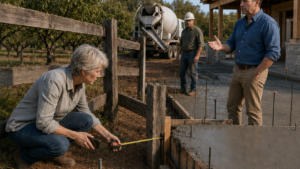
One showed the cedar stable from the road. Another showed the base measured from the gravel with a tape stretched across the grass. The third showed the old iron pin.
He found copies of those too.
Nineteen feet from the traveled gravel at the nearest point.
Dennis checked the number twice.
He had not guessed.
By eight that morning, he was in the barn office with the papers spread over an old steel desk. Mud dried around the toes of his boots while he compared the application with Margaret’s fine.
Three violations.
Three consecutive days.
The first date listed was before anyone had told him his request was denied.
He called Margaret.
She answered on the fourth ring.
“I’m looking at this fine.”
“I figured you would be.”
“You charged me for three days while my application was sitting unanswered.”
“The application didn’t authorize the display.”
“I didn’t say it did. I’m asking why you didn’t answer it.”
There was a pause.
“We were waiting on a board review.”
“And while you waited, I was fined?”
“The correction notice had already gone out.”
“I never received one.”
“It was mailed.”
“To where?”
“Your address on file.”
“This farm has had the same mailbox for forty-three years.”
Margaret’s voice sharpened. “Dennis, I’m not going to argue mail delivery.”
“No. I guess we’re arguing lines on the ground.”
He ended the call before his temper outran his sense.
An hour later, a county deputy pulled into the farm entrance.
Dennis had called the non-emergency number because he wanted a record that property had been removed. He was careful how he phrased it. He did not call it theft. He did not ask anyone to arrest Margaret.
The deputy read the fine, looked at the photographs, then walked with Dennis toward the empty wooden base.
“You own the ground beyond the road easement?” the deputy asked.
“That’s what my deed says.”
“The question is where the easement actually sits.”
Dennis pointed to the iron pin.
“That’s been there longer than the association.”
The deputy crouched to look at it but did not touch it.
“Could be relevant. Could mark something else.”
“It marks the old road line.”
“You have a survey?”
“Old plat.”
“Recorded?”
“Yes.”
“Bring me that before I start agreeing with you.”
Dennis gave him a hard look.
The deputy smiled faintly. “I’m not saying they’re right either.”
He read Margaret’s rule again.
“If the association had lawful rights over the corridor, they may have authority to remove an obstruction under their agreement. Whether a Christmas display counts as an obstruction is another question.”
“And if it was outside that corridor?”
“Then you have a different problem.”
Dennis glanced at the truck tracks where the association pickup had pulled onto the shoulder.
“They came onto my land and took it.”
“If that’s your land free of their easement, yes, that matters.”
It was the first sentence anyone had said that morning that felt like solid ground.
Then the deputy added, “But I can’t tell you where that line is.”
The ground shifted again.
Dennis showed him the application photos.
The deputy studied the tape-measure image.
“You did all this before putting it out?”
“I did it because they told us to apply.”
“And you never got an answer?”
“No.”
The deputy shook his head, more at the paperwork than at either side.
“You need somebody who handles easements.”
“I need my property back.”
“You probably need both.”
After he left, Dennis carried the papers to the barn office and opened the metal file cabinet where he kept deeds, tax statements, old pasture leases, and things his wife used to insist should not be stored beside tractor manuals.
He found the recorded plat in a yellowed folder.
The road easement was drawn narrower than Margaret’s map.
Dennis felt a quick surge of satisfaction.
Then he stopped himself.
He had spent too many years on a farm to mistake one good sign for a finished job.
In the afternoon he drove slowly along the shared gravel road.
At two bends, fence posts stood close enough that a snowplow wing could nearly touch them. Farther up, a newer property had stone landscaping near a culvert. Dennis could see why Margaret had been pushing for clearance. A loaded feed truck met him near the equipment shed, and both drivers had to ease onto opposite shoulders to pass.
The road had changed.
The equipment had changed.
What Dennis did not know was whether the rights had changed with them.
Back at his kitchen table, he laid three things side by side: his recorded plat, Margaret’s fine, and the photocopy of the corridor map she had allowed him to photograph before leaving.
For several minutes he compared the margins.
The association map had parcel numbers, dimensions, and a title block. It looked official enough to convince almost anyone who saw it pinned on a wall.
But Dennis had spent years signing deeds, financing equipment, and dealing with county filings.
Something was missing.
He picked up the recorded plat first.
Along the bottom edge was the recorder’s information: book, page, date, county seal.
He checked the corridor map.
Nothing.
No recording book.
No instrument number.
No county stamp.
No clerk’s certification.
Just the association’s name and a date from twelve years earlier.
Dennis leaned back.
Margaret had said the map had governed the road for twelve years.
Now he had a different question.
Had anybody outside the association ever made it legal?
Chapter 3: The Map Everyone Had Been Using
“I’ve never seen a recorded amendment.”
Timothy Adams said it with one hand still on the equipment-shed padlock.
Dennis had expected resistance. The admission stopped him colder than an argument would have.
“You’re the treasurer.”
“I keep accounts, Dennis. I don’t keep the county books.”
“You vote on fines.”
“Sometimes.”
“You approved mine?”
Timothy looked away.
The association shed stood beyond the road bend, a squat metal building containing salt bags, marker stakes, chainsaws, and whatever else the road group had accumulated over thirty years.
Somewhere inside it was Dennis’s nativity.
Timothy unlocked the door.
“I voted to enforce the clearance policy,” he said. “I didn’t vote specifically to take your Christmas set.”
“That distinction helping you?”
“No.”
They stepped inside.
Dennis saw the cardboard box against the far wall almost immediately. The cedar stable sat on top of it, undamaged.
He crossed the shed and ran his thumb over the roof edge.
Timothy stayed near the door.
“Margaret said it couldn’t be released while the violation was open.”
Dennis looked back.
“I didn’t ask you to release it.”
“You were thinking about it.”
“I was thinking about whether you people understand what taking something means.”
Timothy’s face reddened slightly.
“It’s dry. Nobody’s touched it.”
Dennis let go of the stable.
“That’s something.”
Outside, tires crackled over gravel. A feed truck slowed for the bend, swung wide, and passed within a few feet of the shed.
Timothy watched it.
“That right there is why this became an issue.”
“A nativity didn’t narrow that road.”
“No. But everybody has something. Mailbox. Planter. Fence post. Rock. Then a truck catches one and we hear about it.”
Dennis folded his arms.
“So widen the road legally.”
Timothy frowned. “I thought we had.”
That mattered.
Dennis followed him to a workbench where old association binders were stacked beneath a clipboard.
Timothy pulled down one marked with the year printed on Margaret’s map.
Inside were meeting minutes, contractor estimates, diagrams, and letters.
Dennis found the corridor map almost immediately.
Underneath it was a sheet titled as a proposed road-clearance expansion.
Proposed.
Not adopted.
Not recorded.
He looked at Timothy.
“You knew this?”
“No.”
“You’ve used the map.”
“Everybody’s used the map.”
“That doesn’t answer me.”
Timothy rubbed his forehead. “I knew there had been a widening project. I assumed this was the final plan.”
“Why?”
“Because it’s the map Margaret gave us when I joined the board.”
“When was that?”
“Seven years ago.”
Dennis turned another page.
The minutes described concerns about emergency access, snow removal, and increasingly large agricultural trucks. A contractor had warned that roadside obstacles made winter plowing more expensive and dangerous.
Dennis read the paragraph twice.
Those concerns were not foolish.
He remembered an ambulance struggling to turn around near the upper properties several winters earlier. He remembered feed trailers getting longer. He remembered, too, complaining when the road association raised annual dues to repair shoulders after spring washouts.
Margaret arrived ten minutes later.
She saw the binder open and stopped.
“Timothy.”
“He asked about the map,” Timothy said.
“And you decided to open association records without calling me?”
“He’s a member.”
Margaret set her keys on the workbench.
Dennis pointed at the heading.
“Proposed expansion.”
“I know what it says.”
“Then why are you fining people as though it was completed?”
“Because the corridor was approved for operational use.”
“By whom?”
“The board adopted the plan.”
“That isn’t the same as changing an easement.”
Her eyes narrowed.
“You’ve been talking to somebody.”
“I’ve been reading.”
Margaret pulled out a chair but did not sit.
“Dennis, twelve years ago the road was becoming unsafe. The snowplow contractor threatened to drop us. The volunteer fire department had raised concerns about the narrow turns. We had trailers clipping posts.”
“All reasons to fix it.”
“Yes.”
“Not reasons to pretend land moved.”
“Nobody pretended anything.”
She flipped deeper into the binder and found another page.
“This was sent to every affected owner.”
It was a letter describing a proposed survey and expanded maintenance corridor. Owners were asked to attend a field meeting and allow survey access.
Dennis’s eyes stopped on the date.
He remembered the envelope.
He had been fifty-six, tired from a bad hay year and already angry because an association crew had cut brush beyond what he believed was the old easement. When the survey letter arrived, he had read the first paragraph, decided he knew exactly what they wanted, and thrown it into his barn-office drawer.
Margaret watched recognition cross his face.
“You remember now.”
“I remember a proposal.”
“You refused access.”
“To my land.”
“To the survey.”
“I wasn’t obligated to give you land because you wanted a wider road.”
“No. But we couldn’t establish a clean line through your section because you wouldn’t participate.”
Dennis stared at the letter.
The truth irritated him precisely because part of it belonged to him.
He had spent the last two days telling himself the association had created confusion.
Maybe it had.
But he had helped preserve it.
A feed truck passed outside. Its air brakes sighed before the bend.
Margaret lowered her voice.
“You think I enjoy this? Every winter I get calls about fences, rocks, parked trailers. The contractor raised our rate again because he says he can’t run the wing safely. New families up the road want emergency access. Somebody has to make decisions.”
“Then make ones you have authority to make.”
She looked tired rather than angry.
“We’ve operated under that map for twelve years. No one challenged it.”
“I am.”
“Yes.”
“And you still took my property before answering my application.”
Margaret’s expression closed again.
“That was my decision.”
Timothy looked at her.
Dennis did too.
It was the first time she had said it plainly.
Margaret continued, “I believed letting one exception stand would make enforcement impossible everywhere else.”
“Even if the line was wrong?”
“I believed the line was settled.”
Dennis tapped the word proposed.
“Belief is doing a lot of work here.”
She did not answer.
Timothy reached into the binder.
“There should be survey paperwork after this.”
He turned several pages, then stopped.
His face changed.
“What?”
Timothy slid out another letter.
Dennis recognized the return address before reading the body.
It was addressed to him.
A request for the joint boundary survey.
At the bottom, beside his parcel number, someone had written: owner declined access.
Timothy looked from the page to Dennis.
“You remember this meeting?”
Dennis stared at his own name.
He did.
And suddenly the question was no longer only why Margaret had trusted a map that might never have become legal.
It was how much easier that mistake had become because Dennis Harris had refused to help settle the line when he had the chance.
Chapter 4: The Survey Dennis Refused
The letter was still in the bottom drawer of Dennis’s barn desk.
He recognized it before he unfolded it.
Twelve years had yellowed the edges and softened the crease where he had folded it in half, but the association letterhead and the date were unmistakable. So was the handwritten note he had made across the top in blue ink.
NO ACCESS WITHOUT AGREEMENT.
Dennis stood with the drawer open and the letter in his hand.
At the time, the words had felt sensible.
Now they felt like evidence.
He read the first paragraph again.
The association was proposing a joint field survey to clarify the existing road easement and evaluate whether additional clearance would be needed for emergency and agricultural traffic. Property owners were being asked to allow surveyors to locate existing monuments and compare them with deed descriptions.
It did not say he was surrendering land.
It did not say the road automatically became wider.
It asked for access.
Dennis sat down slowly.
He remembered the year clearly now.
A road crew had cut brush along his south fence without warning. One cedar post had been nicked by a mower. Dennis had argued with the board chairman at the time and gone home furious. When the survey request arrived two weeks later, he saw it as another step toward taking control of ground that was not theirs.
His wife had read the letter too.
“You could at least go hear them,” she had said.
“I know where the line is.”
“That isn’t what I said.”
“They’ll measure until they get the answer they want.”
She had let the matter drop.
Dennis had taken her silence as agreement.
He knew better now.
A truck rattled over the shared road outside, and the barn windows trembled faintly.
He folded the letter again.
By midmorning he was sitting across from Rachel Lewis in a narrow office above a farm-supply store in town. She had handled a drainage easement dispute for one of Dennis’s neighbors years earlier and had the reputation of being patient with land records and impatient with people.
She read the old survey letter first.
Then she read Margaret’s fine.
Then Dennis’s recorded plat.
“You denied access?” she asked.
“I declined.”
Rachel looked over her glasses.
“That’s a polished word for the same thing.”
Dennis said nothing.
“Did you sign anything giving them a wider easement?”
“No.”
“Did you agree verbally?”
“No.”
“Did you receive a proposed amendment?”
“I don’t remember.”
“That answer is better than pretending.”
Dennis shifted in the chair.
“I’m not pretending.”
“You walked in here convinced that old iron pin settles everything.”
“It might.”
“It might help. That’s different.”
Rachel placed the documents in three separate piles.
“Refusing a survey did not give them your land.”
Dennis nodded once.
“But it may have made it harder to establish what everyone understood the line to be at the time.”
He looked toward the window.
“So I caused this.”
“I didn’t say that.”
“You implied it.”
“I said you contributed to uncertainty.”
“That sounds close enough.”
Rachel leaned back.
“You want me to tell you Margaret was wrong to remove your property before verifying her authority?”
“Yes.”
“She may have been.”
Dennis looked at her.
Rachel held up a hand.
“But if you want this fixed, not just won, you need to stop treating every fact that reflects badly on you as if it belongs to the other side.”
That stung because it sounded like something his wife might have said.
Dennis looked down at the letter.
“What do we do?”
“We find out what happened after this survey request.”
Rachel made two calls.
The first was to the county recorder’s office. The second was to the county survey counter.
By early afternoon they were standing beneath fluorescent lights while a clerk brought out scanned records and an older paper index.
The proposed road expansion appeared in meeting references, contractor diagrams, and correspondence.
Then Rachel found the important phrase.
Proposed easement amendment.
Dennis leaned closer.
The packet showed a planned increase in road-maintenance width along several parcels. It listed signatures required from affected owners.
Some lines had signatures.
Some did not.
Dennis’s did not.
“That proves it,” he said.
Rachel kept reading.
“No.”
His irritation returned.
“What else do you need?”
“The completed instrument.”
“If there isn’t one?”
“Then we have something.”
She flipped to the next page.
There was a reference to a future recording number.
The space was blank.
Another page included instructions that the amendment would not take effect until all required landowner consents were obtained and the final instrument was recorded with the county.
Dennis felt the first clean lift of hope in his chest.
Rachel did not smile.
“Still not done.”
“You enjoy saying that.”
“I enjoy not losing cases because somebody stopped reading one page early.”
The clerk searched the electronic index under the association name, the road name, and several parcel numbers.
Original easement.
Drainage agreement.
Maintenance agreement.
Utility crossing.
No obvious amendment.
Dennis watched the results appear one by one.
Nothing matched the proposed expansion.
Rachel asked for older index books.
The clerk returned with another set.
Again, nothing.
Dennis leaned both hands on the counter.
“So the map never became legal.”
Rachel looked at him.
“We know the packet contemplated a recorded amendment. We know this office has not yet found one. That is strong. It is not the same as completing the search.”
Dennis let out a breath.
He understood her caution.
He did not like it.
Back at the farm that evening, he laid the old photograph of the nativity beside the survey letter.
The photograph had been taken years earlier. His wife stood just out of frame; only the sleeve of her red coat appeared at the edge. The little cedar stable sat beside the gate.
Behind it, the gravel road was visibly narrower.
The old iron pin could be seen near the grass.
Dennis touched the corner of the photograph.
For years he had thought defending land meant refusing people who wanted something from it.
Sometimes that had been necessary.
Sometimes it had simply been easier than sitting in a room and listening.
His phone rang.
Rachel.
“I found another reference,” she said.
Dennis straightened.
“To what?”
“The amendment packet.”
“And?”
“It lists the approval requirements. All affected owners, then county recording.”
“That we knew.”
“Yes. But the final instrument was supposed to carry a recorder’s number.”
Dennis waited.
Rachel continued.
“I still haven’t found one.”
“So tomorrow?”
“Tomorrow we search the county records properly.”
Dennis looked at the survey invitation on the desk.
For the first time, he did not see only what the association had failed to do.
He saw his own unanswered line in the story.
But one question remained larger than the rest.
Had the road expansion ever been completed at all?
Chapter 5: What the County Records Did Not Show
The county recorder’s clerk found the original easement in eleven minutes.
The amendment took all morning not to find.
Dennis sat beside Rachel at a public records terminal while the clerk worked through variations of the association name, old road descriptions, parcel references, grantor indexes, and grantee indexes.
Every search produced something.
None produced the document Margaret’s map depended on.
At ten thirty, the clerk returned carrying a thin file.
“This is everything recorded against the Harris parcel during the relevant years.”
Rachel opened it.
Dennis watched her read.
Original agricultural access easement.
Utility rights.
A drainage maintenance agreement.
One temporary construction access authorization.
No widened road corridor.
Rachel turned each page anyway.
Dennis forced himself not to speak.
When she reached the end, she closed the file.
“Nothing.”
The word landed quietly.
Dennis expected satisfaction.
What he felt instead was caution.
Rachel noticed.
“That’s a better reaction than yesterday.”
“I’m learning.”
“Slowly.”
He almost smiled.
The clerk joined them at the counter.
“I also checked the association filings. There is no recorded easement amendment matching the description you gave me.”
Dennis pointed to the proposed packet.
“So this never took effect.”
The clerk glanced at Rachel before answering.
“I can tell you I don’t see a completed instrument in our records.”
Rachel nodded approval.
“Exactly.”
Outside the courthouse, Dennis stopped beneath the stone steps.
“You lawyers all talk like every sentence has a fence around it.”
“Fences are useful when people know where they are.”
He gave her a look.
She ignored it.
They returned to her office with certified copies.
Rachel spread the original recorded plat beside the association corridor map.
The difference was plain now.
The old easement followed the traveled gravel road at a narrower width. The newer association map shaded a broader strip, expanding outward near Dennis’s gate.
Rachel placed a ruler across both.
“The map may be useful for operations,” she said. “It may reflect what the board wanted. It may even reflect what several owners informally tolerated.”
“But it doesn’t change the easement.”
“Not by itself.”
Dennis tapped the spot corresponding to the rust-dark survey pin.
“And the nativity?”
“Based on the recorded plat and your measurements, it appears to have been outside the recorded maintenance easement.”
“Appears?”
Rachel looked at him.
“You want certainty without a current survey.”
Dennis leaned back.
There it was again.
His old habit.
He wanted the record to say what he remembered. He wanted the iron pin to be enough. He wanted the association wrong in a clean, uncomplicated way.
Rachel slid his old survey-refusal letter across the desk.
“You can challenge the fine now. Strongly.”
“And get the nativity back.”
“Yes.”
“Then what?”
“Then everyone still has a road with unclear field conditions and twelve years of habits built around a map that was never recorded.”
Dennis stared at the two drawings.
Rachel continued.
“You have leverage. The question is what you want to use it for.”
He did not answer.
His phone buzzed.
A message from Timothy.
Margaret wants board hearing before any reversal. Says policy stays in effect until board votes.
Dennis showed Rachel.
“She’s doubling down.”
“Maybe.”
“Maybe?”
“She may also be refusing to make a unilateral reversal after making a unilateral enforcement decision.”
“That supposed to make me feel better?”
“No.”
Rachel picked up her pen.
“We can send a demand. Fine rescinded. Property returned. No further enforcement outside the recorded easement. Forty-eight hours.”
“That sounds fine.”
“It also makes this a straight fight.”
Dennis looked at the photograph of the nativity he had brought with him.
Rachel followed his gaze.
“What was it worth?”
“Money?”
“Yes.”
“Not much.”
“And otherwise?”
Dennis was quiet for several seconds.
“My wife’s father made it before we were married.”
Rachel waited.
“She put it by the gate every December. Even when we had ice. Even when nobody was coming over.”
After his wife died, Dennis had considered leaving it in the attic the first Christmas.
He had carried the box halfway down the stairs, stopped, then taken it outside anyway.
He never told anyone that.
Rachel did not ask.
Finally she said, “Then getting it back matters.”
“Yes.”
“But what happens to Margaret matters too, whether you like that or not.”
Dennis frowned.
“She made the decision.”
“She did. And if the board turns her into the sole villain, nobody learns why twelve years of informal practice replaced an uncompleted legal process.”
Dennis looked again at the maps.
“You’re saying let her off.”
“I’m saying decide whether you want punishment or correction.”
The distinction irritated him.
Mostly because it was not an easy one.
That afternoon, Dennis drove the shared road before heading home.
A snowplow contractor was measuring a narrow bend with a tape wheel. Dennis pulled over.
“Margaret send you?”
The contractor nodded.
“Board asked for problem spots.”
“You planning to quit the route?”
The man shrugged. “I told them I’d have to charge more if people keep setting stuff near the edge. Wings are expensive. So are mailboxes.”
Dennis looked at the bend.
A fence corner sat close to the gravel. Beyond it was a shallow ditch.
“Could you plow it inside the old easement?”
“Probably. Slower.”
“That means more money.”
“Usually.”
Dennis nodded.
Margaret’s problem was real.
Her authority was not.
Both facts could exist at once.
At home he found the empty nativity base still lying near the gate.
He carried it into the barn and brushed dried mud from one corner.
His phone rang again.
Margaret.
“I received Rachel’s message,” she said.
“She hasn’t sent the demand yet.”
“She called me.”
Dennis waited.
“I’m not withdrawing anything without the board,” Margaret continued.
“You ordered the removal without the board.”
Silence.
“That was under existing policy.”
“A policy based on a map you can’t show was recorded.”
“We have a responsibility to keep that road usable.”
“So do I. I use it every day.”
“Then you understand why this cannot be reduced to your decoration.”
Dennis looked at the bare place beside the gate.
“No. You reduced it to that when you took it.”
Margaret’s voice softened slightly.
“Dennis, if I reverse this myself, every clearance case on the road becomes an argument.”
“Maybe some of them should be.”
“That is exactly what I’m trying to avoid.”
He nearly snapped back.
Instead, he remembered Rachel’s question.
Punishment or correction.
“When’s the meeting?”
“Thursday night.”
“I’ll be there.”
“With your attorney?”
Dennis looked toward the barn office where the certified copies sat.
“No.”
Margaret hesitated.
“You’re coming alone?”
“I didn’t say that. I said I’ll speak for myself.”
After the call, Dennis phoned Rachel.
“You can prepare the papers.”
“I already am.”
“But at the meeting, I talk.”
“You sure?”
“No.”
Rachel laughed once.
“That may be the smartest thing you’ve said all week.”
Dennis hung up and stood beside the old nativity base.
For the first time since the association truck had pulled away, he had enough evidence to hurt Margaret’s position badly.
What he had not decided was how hard he intended to use it.
Chapter 6: The Rule Could Not Move the Line
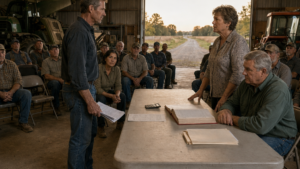
Margaret Roberts began the meeting by defending the removal.
Dennis had expected hesitation.
Instead, she sat at the front table with the association map beside her and spoke in the same controlled voice she had used at his gate.
“The board has a duty to maintain safe passage for agricultural, emergency, and winter-service vehicles. The clearance policy was created for that reason. Mr. Harris’s display was within the corridor we have used operationally for twelve years.”
Dennis sat in the second row with a folder on his knees.
Rachel was behind him.
Timothy sat at the board table, looking less comfortable than anyone else in the room.
Two other board members listened without expression.
Margaret continued.
“The dispute is not about Christmas decorations. It is about consistent enforcement.”
Dennis almost smiled at that.
She was right about one thing.
It was no longer about Christmas decorations.
When she finished, she looked toward him.
“Dennis.”
He stood.
No podium had been set up, so he walked to the end of the table and placed three sheets in front of the board.
First, a photograph.
The cedar nativity beside his farm gate.
Second, the association corridor map.
Third, the certified recorded plat.
Nobody spoke.
Dennis pointed to the first sheet.
“This is what you took.”
Then the second.
“This is what Margaret says gave you the right.”
Then the third.
“This is what the county has recorded.”
One board member leaned forward.
Dennis kept his voice level.
“The two maps do not show the same corridor.”
Margaret folded her hands.
“We know that.”
“I didn’t.”
Timothy looked down.
Dennis continued.
“I filed the approval request. You received it. I measured the display. I sent pictures. Nineteen days passed without an answer. Then the association removed it and charged me four hundred fifty dollars retroactively.”
Margaret started to speak.
Dennis raised one hand.
“I’m not done.”
She stopped.
He had imagined this moment several times.
In those versions, he embarrassed her.
He showed the missing filing, watched the board turn on her, and let everyone in the room understand she had overstepped.
Standing there now, the satisfaction seemed smaller than he had expected.
Dennis reached into his folder.
“There’s something else.”
He placed the old survey invitation on the table.
Margaret’s eyes changed.
“This was sent twelve years ago.”
Timothy shifted in his chair.
Dennis tapped the line beside his parcel number.
“I refused access.”
The room went still.
Rachel said nothing behind him.
Dennis continued.
“I thought the association was trying to take more ground. I had reason to be suspicious. A crew had cut past what I understood the line to be. I was angry.”
He looked at Margaret.
“So when this came, I didn’t attend the field meeting. I didn’t let the survey crew onto my section.”
One board member asked, “Are you saying the wider corridor might be valid?”
“No.”
Dennis turned the certified plat toward him.
“I’m saying my refusal helped leave a mess unresolved. That is not the same thing as signing away an easement.”
Timothy nodded slowly.
Dennis looked around the table.
“I should have participated.”
Saying it aloud cost him more than he expected.
His first instinct was to qualify it.
He did not.
“I should have made them measure it. I should have put my objection in writing and stayed in the process instead of assuming walking away protected me better.”
Margaret looked down at the old letter.
For a moment she appeared almost relieved.
Then Dennis placed the proposed amendment packet beside it.
“But I did not sign this.”
The relief disappeared.
“Neither did every other affected owner,” he said. “And the county recorder has no completed amendment.”
Rachel had told him not to overstate the law.
So he did not.
“The association map may show what the board wanted. It may show what people have followed. It does not show a recorded change to my easement.”
Margaret finally spoke.
“We relied on twelve years of practice.”
Dennis nodded.
“I know.”
“You knew the road needed additional clearance.”
“I knew people wanted additional clearance.”
“The fire department raised concerns.”
“Yes.”
“The plow contractor raised concerns.”
“Yes.”
Her voice sharpened.
“And you refused the survey.”
“Yes.”
The room shifted.
Margaret had expected him to fight that point.
He gave it to her.
There was nowhere for the argument to hide after that.
Dennis stepped closer to the table.
“Now I’m asking you one question.”
Margaret looked at him.
“When you ordered my nativity removed, did you know the expansion paperwork was incomplete?”
Timothy’s head came up.
One board member turned toward Margaret.
She did not answer immediately.
Dennis waited.
Finally she said, “I knew there were old signature issues.”
“How old?”
“Twelve years.”
“And you knew there was no recording number?”
“I knew I had never seen one.”
Timothy stared at her.
“Margaret.”
She looked at him.
“You told us the corridor was settled.”
“I told you it was the corridor we had enforced.”
“That isn’t what I understood.”
Margaret’s cheeks colored.
“You all had the same binders.”
“That doesn’t answer him.”
Dennis felt the power in the room tilt.
He did not enjoy it.
That surprised him.
Margaret looked toward the other board members.
“I believed long-standing operational use, combined with the maintenance agreement, was sufficient for clearance enforcement.”
Rachel shifted behind Dennis but stayed silent.
One board member asked, “Did counsel ever confirm that?”
Margaret’s pause answered before she did.
“No.”
Timothy leaned back.
The sound of his chair scraped across the floor.
“So we fined Dennis under a line we never verified.”
Margaret’s face tightened.
“We enforced a line that has been used without challenge for years.”
“Until now,” Dennis said.
She looked at him.
“Until now,” she repeated.
Nobody spoke for several seconds.
Then Timothy opened the board packet in front of him.
“I move that enforcement of the expanded corridor be suspended pending a joint survey and legal review of the recorded easements.”
Margaret stared at him.
“That affects the entire road.”
“I know.”
“We have snow coming next week.”
“I know.”
“And the contractor needs clear guidance.”
“Then we give him guidance based on what we can prove.”
Dennis recognized the sentence.
It sounded like something he might have said two days earlier, only angrier.
Another board member seconded the motion.
The vote passed.
Margaret voted against it.
Then came Dennis’s fine.
Timothy moved to withdraw the four-hundred-fifty-dollar assessment.
This time Margaret did not vote against it.
She abstained.
The motion passed.
Dennis should have felt victorious.
Instead, he looked at the photograph on the table.
The cedar nativity stood behind the old pin, small and ordinary.
Margaret gathered her papers.
“The property can be returned tomorrow.”
Dennis looked at her.
“Today.”
“The shed is locked.”
“Timothy has a key.”
Timothy nodded.
Margaret closed her folder.
“Fine. Today.”
One of the board members asked Dennis whether he intended to seek damages.
Rachel had warned him the question might come.
He looked at Margaret.
She looked exhausted.
Not defeated.
Exhausted.
“No,” Dennis said. “Not if it comes back undamaged and we fix the line properly.”
Margaret’s eyes narrowed slightly, as though she had expected something harsher.
Dennis continued.
“I don’t want the road unsafe. I don’t want people guessing either.”
Timothy said, “Then we need the survey.”
Dennis looked at the old invitation lying on the table.
Twelve years ago he had refused that sentence.
This time he nodded.
“Yes.”
The meeting ended without applause.
Chairs scraped.
People collected coats.
Rachel waited near the door while Dennis packed the certified plat into his folder.
Margaret approached him.
“You made your point.”
Dennis looked at her.
“No. The county records made one point.”
“And yours?”
He glanced at the old survey letter.
“That I should’ve shown up twelve years ago.”
Margaret’s expression softened, but only slightly.
“And mine?”
Dennis picked up the photograph of the nativity.
“You should’ve checked before you took something that wasn’t yours.”
She held his gaze.
Then nodded once.
Outside, Timothy was already unlocking his truck so they could drive to the equipment shed.
The fine was gone.
The nativity was coming home.
But before anyone could place it back beside the gate, they still had to answer the question both sides had avoided for twelve years.
Where, exactly, did the road end?
Chapter 7: The Gate Line They Finally Measured
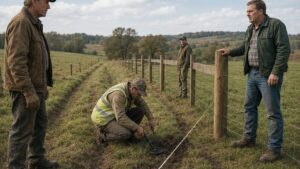
The first survey flag appeared three feet behind the rust-dark iron pin.
Dennis noticed it before he saw the survey crew.
A second flag stood farther up the road near the shallow ditch, and a third marked the inside of the bend where feed trucks usually eased onto the shoulder. Bright plastic ribbons moved in the cold air against the brown grass.
For twelve years, everyone had argued from maps, memories, tire tracks, and habit.
Now there were stakes in the ground.
Dennis parked his pickup beside the barn and walked toward the gate.
The surveyor was setting up a tripod near the road. Timothy Adams stood a few yards away with his hands buried in his coat pockets. Margaret Roberts was there too, holding a folder but giving no instructions.
That alone felt different.
Dennis stopped beside the old iron pin.
“You find out whether my relic means anything?”
The surveyor glanced down.
“It does.”
Dennis waited.
“It matches a monument referenced in the older plat. Not perfectly where somebody might expect from the drawing alone, but close enough that the other control points support it.”
Dennis looked at the pin.
For weeks, he had wanted somebody to tell him it proved everything.
Now that somebody nearly had, the feeling was quieter than he expected.
“And the easement?”
The surveyor pointed toward the new flags.
“The recorded easement falls inside those marks through this section.”
Dennis followed the line with his eyes.
The boundary ran closer to the gravel than Margaret’s twelve-year-old corridor map. At the gate, it stayed several feet away from the place where the cedar nativity had stood.
Timothy let out a low breath.
“So Dennis was right.”
The surveyor adjusted the tripod.
“About the recorded line here, yes.”
Margaret looked toward the road instead of Dennis.
The surveyor continued.
“But there’s another issue.”
Dennis almost laughed.
“There always is.”
The man pointed toward the bend.
“The legal easement is narrow enough that winter maintenance is going to remain difficult in two places. A plow can work it, but not efficiently. Larger trucks will also keep using the shoulder when they meet.”
Margaret finally spoke.
“That’s what we’ve been saying.”
Dennis looked at her.
“I know.”
She seemed surprised that he had not argued.
They walked the marked line together.
Near the farm gate, the answer was clean. Farther up, the practical problem was not.
The recorded easement did not grant the association all the space it had been using. But Dennis’s fence and the drainage ditch left little room for equipment without slowing down.
The surveyor showed them a narrower optional maintenance strip.
“If the affected owner grants limited permission here—not ownership, not a permanent roadway expansion—the contractor could clear snow safely without claiming the entire proposed corridor.”
Dennis studied the flagged ground.
“How wide?”
The surveyor showed him.
It was less than half of what the association map had claimed.
“And only for maintenance?”
“That would depend on the written agreement.”
Rachel had prepared him for that sentence.
Never agree to the idea, she had told him. Agree only to words you have read.
Dennis nodded.
“I’ll review it.”
Margaret closed her folder.
“That’s more than you said twelve years ago.”
Dennis looked at her.
“Yes.”
Neither of them added anything.
By noon the survey crew had confirmed the road limits through Dennis’s parcel. Timothy photographed the stakes for the association records, this time including the surveyor’s references and the recorded plat information.
No one called the old map controlling.
No one tore it up either.
It remained what it had always actually been: a plan that had acquired more authority through repetition than through law.
Dennis found that distinction mattered to him.
Not because it embarrassed Margaret.
Because it made the next mistake harder.
The following afternoon, an association pickup came down the road and stopped at his gate.
Dennis expected Timothy.
Margaret stepped out alone.
In the truck bed sat a cardboard box.
She opened the tailgate.
“I thought I should bring it.”
Dennis walked over.
The cedar stable was wrapped in an old moving blanket. The figures had been packed separately with paper around them.
Margaret lifted the stable carefully.
Dennis took it from her.
He checked the roof, corners, and small crosspiece at the back.
Nothing was broken.
“The cradle?”
“In the box.”
He found it beneath the figures.
One edge had a faint scrape that might have been there before. Dennis rubbed it with his thumb.
Margaret watched him.
“I told them to be careful.”
“I know.”
They carried everything into the barn.
The old wooden base leaned against the wall where Dennis had left it after the board meeting.
Margaret stopped beside it.
“I should have waited.”
Dennis looked at her.
She did not qualify the statement.
“I should have verified the recording before I ordered removal.”
“Yes.”
Her mouth tightened slightly.
“You don’t make it easy.”
“I’m not sure I’m supposed to.”
“No.”
A faint, unwilling smile touched her face and disappeared.
Dennis set the stable on the workbench.
“I should’ve gone to that survey meeting.”
Margaret nodded.
“Yes.”
Now it was his turn to dislike the simplicity of the answer.
They stood there with the cedar figures between them.
Finally Margaret said, “The board approved the new survey process last night. Any future corridor changes require affected-owner signatures, legal review, and recording before enforcement.”
“Good.”
“And Timothy wants the old operational map labeled as historical reference only.”
“Better.”
“We still need your maintenance agreement if the plow is going to use that shoulder.”
Dennis picked up the draft Rachel had reviewed.
He had made two changes.
The association could use a defined strip during snow removal and emergency road maintenance. It could not treat the permission as a transfer of property or expand it without a new written agreement.
Margaret read the page.
“You had a lawyer write this.”
“She stopped me from writing it worse.”
Margaret read it again.
“This works.”
Dennis signed.
Margaret signed for the association.
The paper did not feel like surrender.
That surprised him too.
Three days before Christmas, Dennis carried the nativity back to the gate.
He did not place it exactly where it had been.
The new survey stakes were still visible, and the confirmed easement line ran a few feet beyond the old iron pin. Dennis set the wooden base well behind that line, on firm ground where no plow wing or feed trailer had reason to reach.
He leveled it twice.
The habit made him stop.
His wife had always done that part.
Dennis could hear her telling him the left side was low even when it was not.
He set the cedar stable on the base.
Joseph went on the left.
Mary on the right.
The small cradle in the center.
He stepped back.
A vehicle approached slowly along the gravel.
Margaret’s pickup.
She did not stop. She lifted one hand from the steering wheel as she passed.
Dennis raised his own.
Farther up the road, fresh survey markers stood beside the ditch. They were not attractive. Neither were the new reference stakes beside the gate.
But everybody knew what they meant.
The road association knew where its rights ended.
Dennis knew where cooperation could begin.
He crouched beside the old rust-dark pin and brushed a little dirt away from its top.
For years he had trusted that piece of iron because it had been there longer than most of the people arguing about it.
The pin had mattered.
But it had not been enough by itself.
Neither had his memory.
Neither had Margaret’s map.
A boundary protected nobody if every person standing beside it believed something different.
Dennis rose and looked at the cedar nativity.
The figures were back where they belonged—not because he had refused everyone, and not because the association had finally admitted he was right about everything.
They were there because someone had finally measured the line, recorded what mattered, and stopped pretending that habit was the same thing as permission.
A strand of simple white lights ran along the farm gate.
Dennis plugged them in.
The cedar stable glowed softly behind the newly confirmed boundary.
This time, there was no argument about whose ground it stood on.
The story has ended.