The Drone Kept Crossing His Farm Until One Recorded Flight Changed Who Controlled the Boundary
Chapter 1: The Drone Above the Red Boundary Flag
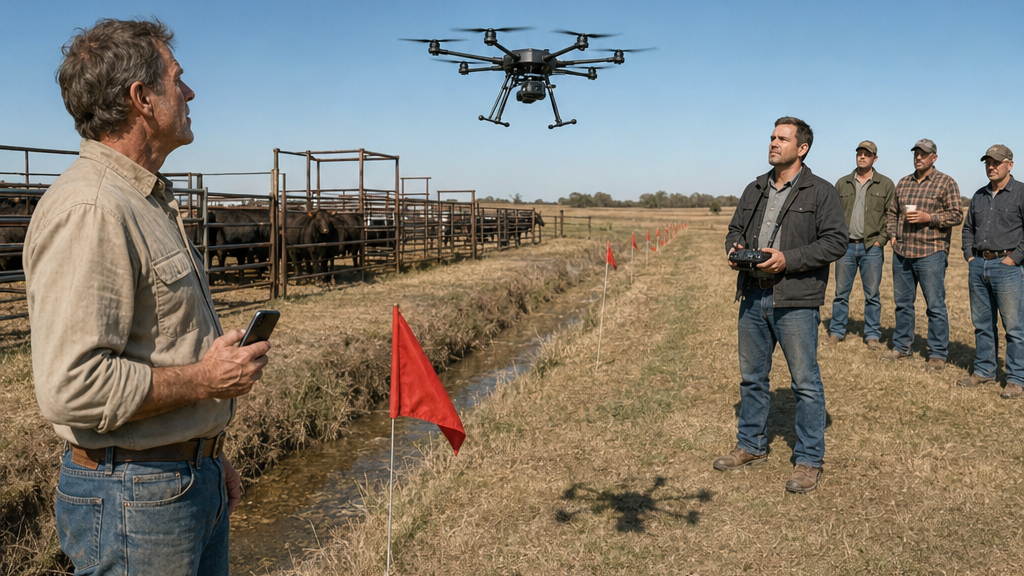
The drone stopped directly above Samuel Clark’s cattle lane.
Not passed over it. Not drifted with the wind. Stopped.
Samuel stood beside the steel gate with one hand still resting on the latch and watched six black rotors hold the machine in place. The sound was a hard mechanical hum, too steady to mistake for anything accidental.
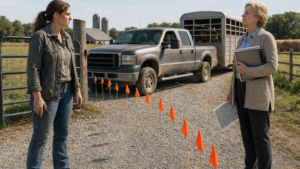
Twenty yards below it, a red survey flag snapped against its thin wire stem.
Samuel had put that flag there himself.
Across the drainage strip, Patrick Anderson stood beside a folding table with a controller hanging from a neck strap. Two neighboring farmers and the cooperative manager watched the flight demonstration from the edge of Patrick’s field. A seasonal assistant stood near the equipment cases.
Patrick had spent the first ten minutes talking about efficiency.
Automated crop scans. Moisture analysis. Drainage modeling. Fewer hours walking fields. Better decisions before fertilizer or seed went into the ground.
Samuel had said almost nothing.
He had agreed to watch because the cooperative manager had asked him to.
He had also marked his boundary before sunrise.
Patrick glanced from the controller toward Samuel.
“It’s on a programmed route,” he called. “It’ll swing back.”
Samuel looked up.
The drone remained where it was.
Its camera assembly rotated beneath the body.
Once.
Then again.
Toward the cattle-loading lane.
Samuel felt the old anger rise so quickly that his jaw locked before he could stop it.
Behind him, three heifers shifted against the rail. One struck the gate with her shoulder. The drone buzz had changed their attention from the feed bunk to the sky.
“Patrick.”
Patrick looked up again.
Samuel pointed to the red flag.
“Where’s your line?”
Patrick gave a short, impatient shrug. “The aircraft knows the route.”
“That wasn’t my question.”
One of the neighboring farmers lowered his coffee cup.
The cooperative manager looked from Patrick to the hovering drone.
Patrick’s mouth tightened.
“This isn’t anything to get worked up about.”
Samuel had heard almost those exact words before.
Six weeks of variations.
It’s only passing over.
It’s high enough.
It isn’t looking at anything.
You’re making more of this than there is.
Samuel removed his phone from his shirt pocket.
Patrick saw it.
“What are you doing?”
“Recording.”
“For what?”
Samuel opened the camera.
“For the same reason I put the flags out.”
Patrick shook his head as though Samuel had confirmed something disappointing about himself.
“This is exactly what I mean. Nobody’s spying on you.”
Samuel did not answer.
He framed the drone first, then lowered the phone enough to include the red flag beneath it. The flag leaned slightly toward the ditch, bright against dry late-August grass.
The machine stayed nearly motionless.
Samuel began recording.
“Patrick,” he said, keeping his voice level, “whose field is that drone above?”
The assistant looked away.
Patrick did not.
He stared at Samuel for two seconds longer than the question required.
Then he checked the controller.
“It’s right on the edge.”
Samuel moved three steps down the fence line.
The drone’s shadow rested squarely inside his side of the flags.
“Whose field?”
Patrick exhaled sharply.
“Yours, technically.”
Samuel kept the camera steady.
“And did I tell you to keep it out?”
The cooperative manager lifted a hand.
“Samuel, maybe we don’t need to—”
“I’m asking one question.”
Patrick’s face reddened.
“You asked me not to cross over your house and yard.”
“I asked you not to cross my property without checking with me.”
“That isn’t how air routes work.”
“Maybe not. But you just told everybody this route would stay off my acreage.”
Patrick looked toward the two farmers, as if expecting one of them to intervene.
Neither did.
For a moment the only sound was the drone.
Then it began moving again.
Slowly.
Not back toward Patrick’s field.
It traveled another forty yards down Samuel’s cattle lane before making a wide turn over the drainage strip.
Samuel followed it with the phone.
That bothered him more than if it had simply crossed and corrected.
The machine had paused.
It had deliberately held position over the same narrow piece of land where the drainage ditch met the loading lane.
Patrick finally pulled the drone back across the flags.
“There,” he said. “Happy?”
Samuel stopped recording.
“No.”
Patrick laughed once without humor.
“You know what your problem is?”
Samuel put the phone back in his pocket.
“I expect you’re about to tell me.”
“You think anything new is automatically aimed at taking something from you.”
The words landed harder than Patrick probably knew.
Samuel’s father had said nearly the opposite thirty years earlier, when lenders, road crews, and neighboring operators had all wanted one more practical accommodation from the Clark place.
A little frontage.
A little access.
A little extension on the note.
Samuel remembered his father standing at the kitchen sink after one such meeting, saying, They never take the whole farm at once.
Samuel shoved the memory aside.
“This isn’t about new equipment.”
Patrick nodded toward the drone.
“Sure looks like it.”
The cooperative manager stepped between the two men before Samuel could answer.
“We’re supposed to be evaluating the system, not starting a property dispute.”
Patrick turned back to the table.
Samuel looked once more at the red flag.
The drone was gone, but its shadow seemed to remain there.
The demonstration continued.
Samuel stayed for another fifteen minutes, though he barely listened. Patrick showed vegetation maps on a tablet and explained how aerial images could reveal wet zones invisible from the road. The neighboring farmers asked about price and acreage rates.
Samuel watched the screen.
Colored bands moved across fields in clean rectangles.
When Patrick zoomed out, the Clark boundary appeared at the edge of the display.
Samuel stepped closer.
Patrick immediately changed screens.
That was small.
Maybe meaningless.
But Samuel noticed.
By noon, the folding table was gone. The vehicles had left. The field returned to its ordinary sounds—cattle shifting in the lot, wind through dry grass, an auger rattling somewhere beyond the machine shed.
Samuel was repairing the lower hinge on the loading gate when his daughter came across the yard carrying her phone.
“Dad.”
He kept tightening the bolt.
“What?”
“Was that Patrick’s drone again this morning?”
Samuel stopped.
“Why?”
She turned the phone toward him.
“I was looking for the video I took when the calf got out last month.”
On the screen was a clip from almost three weeks earlier.
The calf ran along the fence. Their dog barked behind it.
Samuel almost told her he understood and went back to the hinge.
Then he heard it.
That same descending electric buzz.
“Play it again.”
She did.
Samuel watched past the calf this time.
High above the background fence, the drone entered the frame.
It moved across the hayfield.
Then stopped.
His daughter scrubbed backward.
They watched again.
The drone hovered directly over the drainage strip beside the loading lane.
Almost exactly where it had stopped that morning.
Samuel took the phone from her.
“How long does it stay there?”
“I don’t know.”
He watched the seconds climb.
The calf disappeared from view.
The drone did not.
Samuel stared at the small black shape suspended over his land and felt his anger change into something colder.
Once could be a route error.
Twice, in the same place, weeks apart, was a question.
And now Samuel wanted to know what Patrick Anderson kept looking at.
Chapter 2: Eleven Flights Were Not an Accident
By nine that evening, Samuel had found Patrick’s drone in six separate recordings.
He sat alone in the farmhouse office with the lights off except for the desk lamp and the pale glow of the security monitor. The cameras had been installed for fuel theft and cattle problems, not aircraft. Most of the footage was dull enough to punish anyone who watched it—empty gates, passing trucks, shifting shadows, raccoons near the feed bins.
But the drone was there.
June twenty-ninth.
July fourth.
July twelfth.
July nineteenth.
August second.
August ninth.
Samuel wrote each date on a yellow legal pad.
He checked another camera.
August fifteenth.
Seven.
By midnight he had nine.
The next morning, he found two more.
Eleven flights in six weeks.
Some lasted only seconds inside the camera view. Others crossed diagonally from Patrick’s side toward the farmhouse, equipment yard, or drainage strip. Three showed the drone near the cattle lot.
Samuel built a folder on the computer and named each file by date and time.
He did not tell Heather.
That omission bothered him enough that he nearly mentioned it over breakfast.
Instead he asked whether she knew where the old boundary survey was.
Heather looked up from a stack of feed invoices.
“Why?”
“Need to check something.”
“What something?”
“Patrick.”
Her expression changed immediately.
“Again?”
Samuel nodded.
“How many times?”
He reached for his coffee.
“I’m still sorting it.”
That answer was technically true and completely dishonest in the way that mattered.
Heather watched him for another moment.
“Samuel.”
“I’ll tell you when I know what I’ve got.”
She leaned back.
“That usually means you already know what you’ve got and don’t want anybody interfering.”
He left the kitchen before she could continue.
By afternoon he had the survey spread across the office desk. The red-flag line matched the old property description closely enough for the present argument. More important, several cameras captured both the flags and the drone in the same frame.
Samuel selected four still images.
Then he opened the message thread with Patrick.
He typed carefully.
I’ve reviewed security footage from the last six weeks. Your drone has crossed over our farm multiple times, including the cattle lot, drainage strip, and yard. I’m asking again that you keep flights outside our property unless you have permission.
He read it twice before sending.
Patrick replied twenty-three minutes later.
Samuel opened the message while standing beside the fuel tank.
The route is automated for efficiency. These are normal agricultural flight paths and there’s no reason to treat them like some kind of intrusion. I’m not filming your family. You’re making a technical issue personal.
Samuel read it again.
Then a second message arrived.
I can adjust around the house if that makes you more comfortable, but I’m not redesigning every flight because you don’t like drones.
Samuel felt the familiar heat in his chest.
He typed three different replies and deleted all three.
The fourth was one sentence.
Do not cross my acreage without permission.
Patrick did not respond.
Samuel took screenshots of the entire exchange.
That evening, he returned to the recordings.
He created a spreadsheet.
Date.
Time.
Camera.
Direction.
Approximate duration.
Visible location.
At first the process felt excessive even to him. He almost stopped after the sixth entry.
Then he remembered Patrick saying automated.
Samuel went back through the clips and compared the paths.
If they were simply automated routes, he expected consistency.
There wasn’t much.
One approached from the northeast.
Another came straight across Patrick’s bean field.
A third appeared from behind Samuel’s machine shed.
Several, however, shared one detail.
The drainage strip.
By the following afternoon Samuel had eleven dated thumbnails arranged across the monitor.
Heather came into the office carrying a folder.
She stopped behind him.
“What is all that?”
Samuel did not turn immediately.
“Camera footage.”
“I can see that.”
He minimized the spreadsheet too late.
Heather put the folder on the desk.
“You counted them?”
“Eleven.”
Her silence made him look at her.
“You knew about eleven flights and didn’t tell me?”
“I didn’t know until I went through everything.”
“You knew enough to start going through everything.”
Samuel leaned back.
“I wanted facts before I dragged you into it.”
Heather’s face hardened.
“Dragged me into it?”
“That’s not what I meant.”
“It’s our farm.”
“I know.”
“Our daughter’s out there. I’m out there. You’ve been sitting in here building a file like you’re the only one this affects.”
“I was handling it.”
Heather folded her arms.
“There it is.”
Samuel knew better than to ask what.
She answered anyway.
“You always say that right before nobody else gets a vote.”
He looked at the eleven images.
“I asked him twice.”
“And?”
“He says it’s automatic.”
“Do you believe him?”
“No.”
“Then call somebody who knows what the rules are.”
Samuel looked back at the screen.
“I can handle Patrick.”
“That isn’t the same thing.”
The sentence stayed between them.
Heather picked up the folder she had brought in.
At the doorway she stopped.
“Just don’t get so busy proving him wrong that you do something stupid because you’re angry.”
Samuel almost laughed.
Instead he said, “I’m not angry.”
Heather gave him a look that ended the argument more effectively than words could have.
After she left, Samuel opened another recording.
This one came from a camera mounted beneath the machine-shed eave. He had nearly skipped it because the angle showed more roof than field.
The timestamp was July nineteenth.
At first, nothing happened.
Then the drone entered from the upper left corner.
It traveled toward the drainage ditch.
Stopped.
Samuel moved the cursor to the timeline.
Thirty seconds passed.
Then one minute.
The drone did not move.
Two minutes.
Still there.
He increased playback speed.
At three minutes and forty-seven seconds, the drone finally turned north and left the frame.
Samuel reset the video.
He watched it again at normal speed.
The machine was not traveling anywhere.
It was looking.
The ditch itself was unremarkable most of the year—a grassed depression that carried runoff from three farms toward a county culvert. But near Samuel’s loading lane, the ditch narrowed between an old fence corner and a raised section of ground his father had built up decades earlier.
Samuel paused the image.
The drone hung directly above that narrowing.
Not the farmhouse.
Not the yard.
Not his daughter.
The drainage ditch.
His first belief—that Patrick simply enjoyed pushing into places where he was not wanted—suddenly felt incomplete.
Samuel printed a still frame.
He carried it to the kitchen and placed it in front of Heather.
She looked down.
“What am I looking at?”
“Four minutes.”
“What?”
“He held the drone right there for almost four minutes.”
Heather studied the image.
Samuel tapped the ditch with one finger.
“Why would somebody need four minutes of footage of that?”
She looked up at him.
For the first time since the argument in the office, neither of them was talking about privacy.
They were talking about land.
Chapter 3: The Map Patrick Never Mentioned
The county zoning clerk placed a large preliminary map on the counter and flattened one corner with a stapler.
Samuel recognized his farm before she pointed to it.
Not because of the parcel number.
Because of the drainage ditch.
Someone had traced it in blue from the north field, past Patrick Anderson’s acreage, across the shared low ground, and along the edge of Samuel’s cattle lane.
Then the line changed.
A dotted corridor cut across a narrow strip of Clark property.
Samuel leaned closer.
“What is that?”
The clerk followed his finger.
“That’s part of a proposed drainage-access study.”
“Proposed by who?”
“It came in with a cooperative planning packet.”
“Patrick Anderson?”
She hesitated.
“I can tell you the applicant entity.”
Samuel waited.
She checked the cover sheet.
“Anderson Agricultural Imaging is listed as the mapping contractor.”
Samuel stared at the map.
He had expected to find a complaint form.
Maybe a parcel record.
He had not expected to find Patrick’s work laid out across his land.
“Is this approved?”
“No. Preliminary.”
“Has anybody asked me for access?”
“Not through this office.”
The answer sharpened something in him.
Samuel pointed to several tiny markings beside the ditch.
“What are these?”
“Elevation references, probably.”
He looked closer.
There were shallow depressions, fence corners, culvert edges, and a small raised berm beside the cattle lane.
Details that were difficult to see from the county road.
Details Samuel had watched Patrick’s drone hover above.
He asked for a copy.
The clerk printed the public packet and handed it across the counter.
On the drive home, Samuel kept the folded map on the passenger seat.
He wanted it to prove what he had already decided.
Patrick had been surveying his land without permission.
That would have been simple.
It would have allowed anger to remain clean.
At the farmhouse, Samuel spread the map across the kitchen table.
Heather came in from the office carrying a calculator.
“You found something.”
He pointed to the dotted corridor.
“Patrick’s working on this.”
She read the cover page.
“Drainage?”
“And mapping.”
She followed the blue line with her finger.
“This goes through three farms.”
“Four, if you count the low pasture west of him.”
Heather studied the elevations.
Then she frowned.
“This part floods.”
Samuel looked at her.
She tapped the northern section.
“Last spring. Remember? Water sat there almost a week.”
“That doesn’t give him permission to map us.”
“I didn’t say it did.”
Samuel folded his arms.
Heather continued tracing the line.
“If this is accurate, the county culvert backs water up on everybody north of us.”
Samuel knew that.
He just did not like hearing it while Patrick’s name sat at the top of the packet.
Two years earlier, after three days of hard rain, water had covered part of the shared low ground and left mud high enough on fence posts to show exactly how far it had risen. One neighboring farmer had lost newly seeded ground.
Patrick had complained then that nobody wanted to fix the drainage because the necessary route crossed too many property lines.
Samuel had dismissed it as Patrick wanting someone else to pay for improvements.
Now the map made that dismissal less comfortable.
Heather pointed to the dotted corridor on their acreage.
“What happens here?”
Samuel leaned over.
“If they widen or clean that section, water moves faster toward the county culvert.”
“Would that help?”
“Maybe.”
“Would it hurt us?”
“Depends how they do it.”
Heather gave him a level look.
“So this isn’t nothing.”
“No.”
“But he still should’ve asked.”
Samuel looked at Patrick’s company name.
“Yes.”
That distinction became the center of everything.
The drainage problem might be real.
Patrick’s method might still be wrong.
Samuel called Nicholas Rivera that afternoon.
Nicholas’s office was forty minutes away, above an insurance agency in a town large enough to have three traffic lights and a courthouse square.
Samuel brought the map, the screenshots, printed messages, and a flash drive containing the eleven clips.
Nicholas listened without interrupting.
When Samuel finished, the attorney turned first to the map rather than the drone footage.
“This is preliminary?”
“That’s what the clerk said.”
“And nobody has requested an easement or temporary access from you?”
“No.”
Nicholas nodded.
“Good. Then don’t jump from ‘he mapped something’ to ‘he stole a property right.’ Those are different questions.”
Samuel shifted in the chair.
“He flew over me eleven times.”
“I heard you.”
“You sound like Heather.”
“That usually means somebody else has already told you the useful thing.”
Samuel said nothing.
Nicholas opened the service packet Samuel had downloaded from the cooperative’s website.
The document described aerial crop analysis, drainage surveys, and participating-landowner permissions.
Nicholas read slowly.
Then he turned the page sideways and slid it across the desk.
“Look here.”
Samuel read the clause.
Imagery collection over non-participating parcels required documented landowner consent where the parcel itself was part of the contracted analysis.
Samuel read it twice.
“So he couldn’t use my land?”
Nicholas held up a hand.
“Careful. That does not answer every question about an aircraft passing overhead. What it does tell us is that if your parcel was intentionally included in the contracted analysis, the cooperative’s own paperwork expects consent.”
Samuel looked at the map again.
“That ditch is in the analysis.”
“Looks like it.”
“And I never consented.”
“That matters.”
The sentence was quieter than Samuel wanted it to be.
He had imagined something more decisive.
A line in a law book.
A rule that said Patrick was wrong and Samuel was right.
Instead he had a contract clause, a preliminary map, eleven recordings, and questions.
Nicholas opened one of the videos.
The July nineteenth clip played.
The drone reached the drainage strip and stopped.
Nicholas watched almost a minute before skipping ahead.
“It stays there?”
“Three minutes forty-seven seconds.”
Nicholas leaned back.
“That’s more interesting to me than a quick crossing.”
“Because?”
“Because it suggests intentional collection.”
Samuel felt the satisfaction immediately—and disliked himself for it.
Nicholas noticed.
“You need to decide something before this goes farther.”
“What?”
“Do you want him stopped, or do you want him beaten?”
Samuel stared at him.
Nicholas continued.
“Those aren’t always the same goal.”
Samuel gathered the papers more sharply than necessary.
“I want him off my land.”
“Then build around that.”
“What do I do?”
“First, preserve everything. Second, send a clear written notice. Third, ask the cooperative what imagery they received and under what permissions.”
Samuel tapped the map.
“And this?”
“You don’t ignore a real drainage problem because you dislike the contractor.”
Samuel looked toward the office window.
A grain truck moved slowly along the street below.
“That’s what everybody keeps telling me.”
“Maybe everybody’s trying to keep you from making Patrick’s mistake in reverse.”
Samuel turned back.
Nicholas slid the cooperative service document toward him again and put one finger beneath the clause.
“If Patrick knowingly mapped your parcel for this proposal after you withheld permission, that gives you something concrete to challenge.”
Samuel read the sentence one last time.
The question had changed.
It was no longer whether Patrick’s drone had crossed the red flags.
Samuel had already proved that.
Now he needed to know whether Patrick had understood exactly whose land he was mapping—and decided that permission was optional anyway.
Chapter 4: The Warning Patrick Chose to Ignore
The certified letter arrived while another drone was buzzing somewhere beyond Samuel’s machine shed.
He heard the sound before the delivery driver had finished turning around in the gravel.
Samuel signed the electronic pad, tucked the envelope under his arm, and looked toward the western field. The drone was too far away to identify clearly, but the pitch of its rotors rose and fell as it changed direction.
Heather came out onto the porch.
“Patrick?”
“Probably.”
She looked at the envelope.
“That from Nicholas?”
Samuel nodded.
Inside was the final copy of the notice Nicholas had prepared. It did not claim Samuel controlled every foot of sky above the farm. It did not accuse Patrick of crimes. It did not threaten impossible penalties.
It did something Samuel found almost disappointingly simple.
It listed the documented flights, identified the portions of Clark property apparently included in Patrick’s mapping work, referred to the cooperative’s consent language, and instructed Patrick not to intentionally collect imagery of the Clark parcel without authorization.
Nicholas had mailed Patrick an identical copy.
Samuel read the letter again at the kitchen table.
Heather stood at the sink.
“You wanted something stronger.”
Samuel glanced up.
“It’s enough.”
“That wasn’t what I said.”
He folded the pages.
Nicholas had warned him about this exact instinct.
A letter did not feel like action. A red flag felt like action. Closing a gate felt like action. Walking across a field and telling somebody to leave felt like action.
Paper required waiting.
Samuel hated waiting while someone else continued doing the thing he had asked them to stop doing.
Two days passed.
Then Patrick appeared at the roadside boundary shortly before supper.
Samuel was replacing a broken insulator on the fence when Patrick parked his pickup on his own side of the drainage strip and walked toward him.
Patrick had the certified letter folded in his back pocket.
He stopped beside one of Samuel’s red flags.
“So now I need a lawyer to fly a camera?”
Samuel kept working the pliers.
“You need permission to use my property in your project.”
“I didn’t use your property.”
“You mapped the drainage strip.”
“I mapped drainage.”
“Across my acreage.”
Patrick looked toward the ditch.
“You know where the water goes, Samuel. It doesn’t stop because somebody drew a parcel line.”
“Neither does that give you permission.”
Patrick took another step.
His boot crossed the line of red flags before either man seemed to notice.
Samuel did.
He looked down.
Patrick followed his gaze.
For a second he seemed ready to step back simply because the symbolism was too obvious.
Instead he remained where he was.
“You want to know why I’m doing this?” Patrick asked.
“I’ve been asking.”
“No. You’ve been asking me to admit I’m spying on you.”
Samuel put the pliers into his pocket.
“Then explain the four-minute hover.”
Patrick rubbed a hand across his jaw.
“The low spot by your loading lane is the choke point.”
Samuel said nothing.
Patrick pointed downstream.
“When that fills, water backs north through my place and two others. We’ve all seen it.”
“That doesn’t explain why you didn’t ask.”
“I should have.”
It was the first clean admission Patrick had made.
Samuel waited.
Patrick looked irritated at having said it.
Then something changed in his face.
“The cooperative contract isn’t just another job.”
Samuel leaned against the fence post.
Patrick continued.
“I bought the second aircraft in spring. Upgraded the software. Hired help because they said the regional program was coming.”
“The mapping contract.”
“Yes.”
“And you needed a complete drainage model.”
“I needed to prove the service works across connected acreage.”
“Whether the owners agreed or not.”
Patrick’s jaw tightened.
“I thought I could get the technical work done first and straighten out permissions before anything went forward.”
Samuel stared at him.
“You thought permission was paperwork.”
“I thought nobody was changing your land.”
“You were deciding what my land was part of before talking to me.”
Patrick looked away.
A truck passed on the county road and left a ribbon of dust behind it.
When it cleared, Patrick said, “If I lose this contract, I may not make it through winter.”
Samuel had expected another argument.
He had not expected that.
Patrick kicked at the grass.
“The equipment payments don’t stop because the cooperative changes its schedule. Neither does payroll. Everybody kept telling me they wanted better data. Then when I started collecting it, suddenly every property line became sacred.”
“Mine was sacred before you bought a drone.”
Patrick gave him a tired look.
“You hear yourself?”
“Yes.”
Samuel did hear himself.
And despite everything, he also heard the part Patrick was not saying: he had gambled on a business expansion and now needed the world around him to cooperate with the gamble.
That made Patrick easier to understand.
It did not make him right.
Samuel pointed toward Patrick’s boot.
“You’re standing on my side.”
Patrick looked down again.
This time he stepped back.
Neither man spoke for several seconds.
Then Patrick pulled the certified letter from his pocket.
“I’m not agreeing with all of this.”
“You don’t have to.”
“I’m finishing the cooperative work.”
“Not over my farm.”
Patrick folded the letter tighter.
“We’ll see.”
He walked back to the pickup.
Samuel watched him leave and felt no satisfaction.
Understanding Patrick’s pressure had made the conflict worse in a different way. It removed the comfort of imagining him as simply reckless.
A man could be desperate and still choose badly.
That night Samuel opened his laptop in the workshop.
He searched for rules governing unmanned aircraft near private agricultural property.
Then he searched for lawful methods of documenting flights.
Then, after nearly an hour, his searches changed.
Stopping a drone.
Disabling unmanned aircraft.
What happens if drone signal interrupted.
He read enough to understand that most simple answers were either illegal, dangerous, unreliable, or all three.
He kept reading anyway.
The thought had first come to him during the demonstration: what would Patrick understand if one of those expensive machines simply stopped working over the Clark place?
Samuel knew it was anger.
He also knew he was dressing the anger in words like deterrence and protection.
He clicked another result.
Behind him, the workshop door opened.
Samuel turned.
Heather stood there holding two mugs of coffee.
Her eyes moved from him to the laptop.
Then she read the search line still visible across the top of the screen.
She set both mugs down.
“Samuel.”
He closed nothing.
Heather looked at him for a long moment.
“Tell me you’re not trying to figure out how to knock his drone out of the sky.”
Chapter 5: The Choice Beside the Equipment Shed
Heather did not ask whether Samuel wanted the flights stopped.
She asked, “Do you want them stopped, or do you want Patrick punished?”
The question struck him harder than an accusation would have.
Samuel leaned back from the workshop computer.
“I haven’t done anything.”
“That isn’t an answer.”
“I was reading.”
“You searched how to disable a drone.”
“I also searched what’s legal.”
Heather crossed her arms.
“And when the legal answer didn’t feel satisfying?”
Samuel looked at the dark window above the workbench.
Across the yard, a security light threw the equipment shed into a pale rectangle. Beyond it lay the fields Patrick had crossed eleven times.
“I’m tired of asking.”
Heather’s voice softened, which made him more defensive.
“I know.”
“He knew after the first message.”
“I know.”
“He knew after the second.”
“Yes.”
“He has a lawyer’s letter now.”
“And you’re still sitting here trying to solve it with your hands.”
Samuel stood.
“That’s what you think this is?”
“I think you’ve spent six weeks pretending this is just another broken hinge.”
He said nothing.
Heather pointed toward the laptop.
“You don’t get to turn a machine falling out of the sky into some farm repair problem.”
“I wasn’t going to bring it down over anybody.”
“That makes it better?”
Samuel pushed the chair beneath the desk harder than necessary.
“I didn’t say I was doing it.”
“No. You were going to decide everything first and tell me after.”
That stopped him.
Heather had not raised her voice.
She did not need to.
Samuel walked out of the workshop.
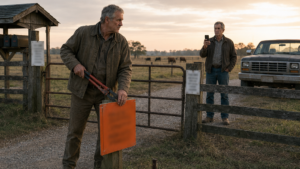
The evening air smelled of cut hay and diesel. Near the equipment shed, one of the older red boundary flags had been bent almost flat by a tire.
Samuel pulled it from the ground.
The plastic flag was torn at one corner.
For an instant he wanted to throw it into the trash barrel.
Instead he stood holding the thin wire stem.
His father had hated markers.
Survey pins. Temporary stakes. Painted lines.
To him, every mark placed by someone else had meant a request, an assessment, or a possible loss.
Samuel had been seventeen when the first section along the county road was surrendered for widening. Later came a utility strip. Then a temporary construction access agreement that somehow took three years to close.
None had destroyed the farm.
But Samuel remembered how his father had treated each signature like an amputation.
“You give a little because they tell you it’s practical,” he had once said. “Then one day you can’t remember which part you ever controlled.”
Samuel had absorbed the lesson without realizing how completely.
Heather came outside.
He held up the damaged flag.
“My dad used to move these.”
“What?”
“Anytime somebody marked something near our place. County. Utility company. Surveyor. He’d pull them and put them by the barn.”
Heather leaned against the shed door.
“You never told me that.”
“I thought it was stupid.”
“Did you?”
Samuel turned the flag between his fingers.
“He was scared.”
That word felt disloyal.
But accurate.
“He was always carrying debt,” Samuel continued. “Every conversation with a bank or county office sounded like somebody asking what piece he could afford to give up next.”
Heather waited.
“I used to think I wasn’t like that.”
She looked toward the workshop.
Samuel followed her gaze.
“No,” he said. “Apparently I just use better search terms.”
Heather almost smiled.
Almost.
Samuel pushed the flag back into the ground, straightening it with his boot.
“I wanted Patrick to feel it.”
“What?”
“The cost.”
Heather said nothing.
“I wanted him to look at a broken drone and understand he couldn’t just cross here because it was convenient.”
“And if you damaged it?”
“I’d be the problem.”
“You’d be part of the problem.”
Samuel looked at her.
That distinction mattered.
She came closer.
“You’ve got the videos. You’ve got his messages. Nicholas found the contract language. Why risk all of that just so you get one satisfying minute?”
Samuel glanced back toward the workshop.
“I won’t.”
Heather studied his face.
“You mean that?”
“Yes.”
“What are you going to do instead?”
“I don’t know yet.”
The answer was uncomfortable, but it was honest.
The next morning supplied the pressure he had been missing.
An email from the cooperative manager announced one final demonstration and mapping flight two days later. Several parcels along the drainage route would be included so the cooperative could decide whether to move forward with Patrick’s broader service proposal.
Samuel read it twice.
Patrick’s company was listed as the contractor.
Heather read over his shoulder.
“He’s still doing it.”
“Looks that way.”
“Did they list our parcel?”
“No.”
Samuel enlarged the attached diagram.
The proposed route ran beside the Clark boundary.
Very close beside it.
At noon, Samuel drove past Patrick’s field on the way back from checking cattle.
Patrick’s seasonal assistant was unloading equipment from a pickup.
Beside the truck sat a hard black flight case larger than the one Patrick usually carried. The lid was open.
Inside rested Patrick’s expensive mapping drone, its arms folded against the body, camera assembly protected beneath a foam insert.
Patrick emerged from the machine shed.
Their eyes met across the drainage strip.
Neither waved.
Samuel drove on.
At home, he called Nicholas.
“I’m not stopping the aircraft,” Samuel said.
A pause.
“That sounds like you’re telling me there was a version where you might have.”
“There was.”
“Good that we’re using past tense.”
Samuel ignored that.
“They’re flying again Friday.”
“Then document what happens. Don’t manufacture what happens.”
Samuel looked toward the bent red flag outside the window.
“What if he crosses?”
“Record it. Record the line. Record your request. If the cooperative is there, make them see it in real time.”
Samuel understood.
Not revenge.
Witness.
That evening he and Heather walked the boundary with a tape and the old survey.
They replaced damaged flags and added fresh ones where the drainage strip curved toward the cattle lane.
Their daughter watched from the utility vehicle.
“You expecting an invasion?” she asked.
Samuel pressed another wire stem into the ground.
“No.”
“What, then?”
He looked along the row of red markers.
“Clarity.”
Before sunrise on Friday, Samuel walked the line alone one more time.
The fresh flags formed a visible corridor from the roadside fence to the cattle lane. There was no fence high enough to stop an aircraft. No physical barrier. Nothing that could force Patrick to respect the line.
That was the point.
Samuel took out his phone and filmed the entire boundary before anyone arrived.
Every flag.
Every gate.
The drainage strip.
The loading lane.
When he finished, he placed the phone in his shirt pocket and looked toward Patrick’s dark field.
A vehicle appeared on the county road.
Then another.
Across the boundary, Patrick’s equipment case was lifted from a truck.
Samuel stood beside the first red flag and waited to see whether a line clearly shown to everyone would matter more than one Patrick thought he could ignore.
Chapter 6: When the Drone Crossed Again
The expensive drone lifted from Patrick’s field while Samuel kept both hands visible at his sides.
That was deliberate.
His phone was already recording from a small tripod beside the cattle gate. A second camera faced the drainage corridor. Heather stood near the farmhouse end of the lane, far enough away that no one could later claim she had interfered.
The cooperative manager watched from Patrick’s side with the two neighboring farmers.
Patrick held the controller.
His assistant monitored a tablet.
The drone climbed fifty feet, paused, then rose higher.
Samuel heard the buzz deepen as it moved away.
Patrick glanced across the flags.
“You getting all this?”
Samuel nodded toward the phone.
“Yes.”
The answer made Patrick frown.
The cooperative manager stepped closer to the boundary.
“Before we start, everybody understands today’s route is limited to participating parcels.”
Patrick said, “Correct.”
Samuel looked at him.
Patrick looked back.
“No Clark acreage,” the manager added.
“Correct,” Patrick repeated.
Samuel raised his phone from the tripod and held it in one hand.
“Say it once more.”
Patrick stared at him.
“You serious?”
“Yes.”
Patrick’s expression showed exactly what he thought of the request, but the manager was watching.
“The flight stays outside your parcel.”
Samuel lowered the phone.
“Thank you.”
The drone began its first mapping run.
For nearly ten minutes, nothing happened.
It traveled in straight, disciplined lines over Patrick’s field, pausing only at the ends of each programmed sweep before turning back. On the assistant’s tablet, colored route segments filled in one after another.
Samuel almost felt foolish.
Maybe the notice had worked.
Maybe the entire morning would end with Patrick proving he could do exactly what Samuel had been asking for.
Then the drone changed direction.
Instead of turning north at the drainage corridor, it continued west.
Toward the red flags.
Samuel watched the shadow first.
It slid across short grass, crossed the ditch, and passed over the first marker.
The drone followed.
No one spoke.
Patrick looked down at his controller.
The machine traveled another twenty yards into Samuel’s side.
Then stopped.
Directly above the narrow section of drainage lane.
The same place.
Again.
Samuel felt every muscle in his shoulders tighten.
This was the moment he had imagined differently in the workshop.
One sharp act.
One damaged machine.
One consequence Patrick could not dismiss.
Instead Samuel lifted his phone.
“Patrick.”
Patrick did not answer.
“Whose parcel is it over?”
The assistant touched the tablet.
Patrick said, “Hold on.”
Samuel stepped closer to the flags but did not cross them.
“Whose parcel?”
Patrick looked at the drone, then at Samuel.
“It’s inside yours.”
The cooperative manager turned sharply.
“You said the route excluded Clark acreage.”
“It does.”
“The aircraft is over his field.”
“I can see that.”
“Is this an automated deviation?”
Patrick’s assistant shook his head before Patrick could answer.
“No.”
Silence.
Patrick turned.
“What do you mean, no?”
The assistant pointed at the tablet.
“That waypoint is in the loaded plan.”
Samuel lowered the phone just enough to see Patrick’s face directly.
“Waypoint?”
Patrick walked to the tablet.
The drone remained suspended above Samuel’s land.
The assistant enlarged the route.
A small programmed point sat over the drainage strip.
Then another appeared farther south near the cattle lane.
Not random drift.
Not a shortcut.
Stops.
Samuel felt something settle inside him.
He had wanted proof for weeks.
Now that it was there, it did not feel triumphant.
It felt precise.
“Bring it back,” the cooperative manager said.
Patrick did not move.
“Patrick.”
He looked at Samuel.
“If I bring it back now, the drainage model is incomplete.”
Samuel almost laughed.
Instead he said, “So you knew.”
Patrick’s face tightened.
“I knew the choke point needed data.”
“That’s not what I asked.”
The two neighboring farmers had moved closer.
One looked from the tablet toward the ditch.
Patrick lowered his voice.
“That section controls the whole flow.”
“Then you ask.”
“I knew what you’d say.”
Samuel stared at him.
Patrick continued before he could respond.
“You’d say no because it came from me.”
“Maybe.”
“That’s the problem.”
“No. The problem is you decided my answer didn’t matter.”
Patrick’s grip tightened around the controller.
For the first time, the anger in his face gave way to something closer to fear.
“You think I’m doing this to win an argument?”
“I think you’re doing it because you need that contract.”
“I need the drainage data because that culvert is failing everybody upstream.”
Patrick pointed north.
“The last heavy rain put water over two planted fields. Another season like that and people lose more than a few acres of hay.”
One of the neighboring farmers spoke quietly.
“He’s right about the water.”
Samuel looked at him.
The farmer nodded toward the ditch.
“We had standing water six days.”
The second farmer added, “And that north crossing is getting worse.”
Samuel knew both things.
The facts did not change because Patrick had behaved badly.
That was what made the moment harder.
Patrick stepped toward the boundary.
“If the cooperative gets a complete model, we can justify the culvert work and the drainage improvements together. If the map has a hole right where the restriction is, they’ll shelve it.”
Samuel looked up at the hovering drone.
“So you filled the hole without asking me.”
“Yes.”
The admission came without excuse this time.
The manager said, “Landowner permission was part of the submission requirement.”
Patrick turned.
“I was going to get it before construction.”
“That isn’t the requirement.”
“No construction has happened.”
“That isn’t the point.”
Samuel could hear Nicholas’s voice in his head: Don’t manufacture what happens.
He lifted the phone again.
“Patrick, did you intentionally program that stop over my parcel?”
Patrick looked at the camera.
Then at the red flags.
Then back at Samuel.
“Yes.”
“And you knew I had not given permission for my acreage to be included?”
Patrick’s mouth opened.
Closed.
Finally he said, “Yes.”
Samuel stopped recording.
Patrick seemed surprised.
“That’s it?”
“That’s what I needed.”
“For what? So your lawyer can shut the whole project down?”
Samuel looked toward the northern fields.
There were places where the grass still showed the flattened traces of spring runoff.
“No.”
Patrick frowned.
“No?”
“I want the part involving my land stopped until it’s done properly.”
Patrick gestured toward the ditch.
“You stop this survey, you delay the drainage work.”
“Then we delay it long enough to ask people.”
The cooperative manager had been studying the route on the tablet.
“Bring the aircraft back.”
Patrick did not answer.
The manager’s voice hardened.
“Now.”
Patrick pressed the controller.
The drone moved.
Its shadow crossed back over the red flags, and the mechanical buzz changed as it returned toward the launch point.
Samuel watched it go.
Nothing fell.
Nothing broke.
The expensive machine landed intact in Patrick’s field.
Samuel felt a brief, embarrassing flicker of disappointment.
Then Heather came to stand beside him.
She did not say anything.
She did not need to.
The cooperative manager spent twenty minutes comparing the loaded flight plan with the submitted parcel list.
Patrick stood several yards away with his arms folded.
Finally the manager closed the tablet cover.
“We’re suspending this proposal.”
Patrick turned.
“What?”
“Not the drainage issue. Your mapping proposal.”
“You can’t make that decision from one waypoint.”
“It isn’t one waypoint.”
The assistant had already opened the historical flight records.
Several of the pauses matched Samuel’s eleven recordings.
The pattern ran back weeks.
The manager looked at Patrick.
“We’ll review every participating parcel, every permission record, and every flight used in the proposal.”
Patrick’s face went pale.
“I can provide explanations.”
“You’ll have the opportunity.”
“And the contract?”
“Suspended pending review.”
Patrick looked across the drainage strip at Samuel.
Samuel expected accusation.
What he saw instead was exhaustion.
The victory he had imagined for six weeks should have felt cleaner.
Patrick had been wrong.
The drainage problem was still real.
The contract might be lost.
The water would still rise when the rain came.
Samuel walked toward the boundary until one red flag stood between them.
Patrick said quietly, “You got what you wanted.”
Samuel looked down the ditch.
“No.”
Patrick gave a bitter laugh.
“What else is there?”
“A way to fix the water without deciding some people’s permission matters less than others.”
The manager, still holding the tablet, heard him.
“So that’s where we start.”
Patrick looked from Samuel to the manager.
For once, he had no answer ready.
The drone sat safely inside its black case.
The red flags were still standing.
And by the end of the morning, the cooperative’s mapping proposal carried a new status beside Patrick Anderson’s company name:
Suspended until every affected landowner’s permission could be accounted for.
Chapter 7: The Boundary They Finally Put in Writing
Patrick arrived without a drone.
Samuel noticed that before he noticed anything else.
No black flight case in the truck bed. No controller hanging from Patrick’s neck. No thin electric buzz descending over the fields.
Patrick parked beside the county road and walked toward the drainage strip carrying only a manila folder.
Three weeks had passed since the cooperative suspended his mapping proposal. In that time, the red flags along Samuel’s boundary had faded slightly in the sun, but every one of them was still standing.
Patrick stopped on his own side.
Samuel was repairing a section of woven wire nearby.
“You got a minute?”
Samuel set the fencing pliers on the post.
“Depends.”
Patrick lifted the folder.
“The cooperative sent the revised corridor.”
Samuel had already seen a preliminary version through Nicholas, but he did not say so.
Heather came from the farmhouse carrying a clipboard. She had known Patrick was coming. This time Samuel had told her before agreeing to the meeting.
That alone changed the feel of it.
Patrick unfolded a map across the hood of his pickup.
The old proposed route had cut directly through the narrow Clark drainage strip. The new one followed Patrick’s acreage farther south, crossed another participating parcel with written permission, then approached Samuel’s property only where the drainage model genuinely required data from the shared outlet.
A narrow shaded corridor ended at the Clark boundary.
Patrick tapped it.
“They can finish most of the survey without entering your parcel.”
“Most?” Samuel asked.
Patrick nodded toward the county culvert.
“They still need measurements here.”
Heather leaned over the map.
“Ground measurements?”
“Mostly. One short aerial pass would make the model cleaner.”
Samuel looked at Patrick.
“Permission first.”
“Yes.”
There was no argument attached to the word.
Patrick opened the folder and removed several pages.
The cooperative had created a new consent form specifying dates, purpose, maximum corridor width, data use, storage, and whether imagery could be reused for later projects.
Samuel read each page.
Patrick waited.
Finally Samuel said, “This is what should’ve happened the first time.”
“I know.”
Samuel looked up.
Patrick’s eyes remained on the map.
For weeks Samuel had imagined that admission arriving with more weight. He had expected satisfaction.
Instead it sounded tired.
Patrick rubbed his thumb along the edge of the folder.
“They pulled the regional contract.”
Heather looked at him.
“All of it?”
“The original award to my company.”
Samuel said nothing.
Patrick continued.
“They’re reopening it after the permission review. I can bid on smaller sections where the paperwork is clean.”
“Your business going to make it?”
Patrick gave a small shrug.
“I’ll find out.”
The answer was not self-pitying.
That made it harder to enjoy.
They stood beside the truck while a combine moved somewhere beyond the neighboring field, its engine reduced by distance to a low steady rumble.
Patrick said, “I treated consent like the part that slowed down the real work.”
Samuel looked at him.
Patrick went on.
“I thought if the model was good enough, everybody would see why it mattered afterward.”
“And if they didn’t?”
“I figured they were being stubborn.”
Samuel almost smiled.
“Convenient.”
“Yes.”
Patrick met his eyes.
“That contract got big in my head.”
Samuel waited.
“I had equipment payments. Payroll. I’d told people we were going to expand. Every time somebody questioned the route, I heard it as another person trying to keep me small.”
That was the first time Samuel understood Patrick’s mistake in terms that sounded uncomfortably familiar.
Not the drones.
The fear behind them.
Samuel looked across the ditch at the red flags.
“My father used to pull survey markers out of the ground.”
Patrick frowned.
“Why?”
“Because he thought every marker meant somebody was about to take something.”
Heather watched Samuel but did not interrupt.
“I spent years thinking he was ridiculous,” Samuel said. “Then you started crossing this place and I was halfway to becoming him.”
Patrick glanced toward the workshop.
Samuel knew what he was about to say before he said it.
“I nearly tried to interfere with your drone.”
Patrick stared at him.
Heather lowered the clipboard.
Samuel continued before pride could stop him.
“I researched it. Ways to bring one down or disrupt it.”
Patrick’s expression hardened.
“You could’ve destroyed a machine worth more than some used trucks.”
“I know.”
“You could’ve hurt somebody.”
“I know that too.”
“Why didn’t you?”
Samuel looked at Heather.
“Because somebody asked whether I wanted the problem solved or wanted you punished.”
Patrick was quiet.
Samuel picked up the revised map.
“I didn’t like my answer.”
For a moment neither man had the advantage.
That felt more useful than winning.
Heather placed the clipboard on the truck hood.
“If this corridor is going to work, it needs measurements everybody can verify.”
Patrick nodded.
“I brought coordinates.”
“And we’ll mark it physically,” Samuel said.
Patrick looked toward the existing flags.
“With those?”
“Not those exact spots.”
For the next hour, the three of them walked the drainage boundary.
Patrick read coordinates from the cooperative map. Heather checked them against the written corridor. Samuel moved the red flags one by one.
Not far.
Sometimes only a few feet.
But their meaning changed with every marker.
Before, the flags had said: stay out.
Now they said: this far, for this purpose, because we agreed.
At the narrowest point near the cattle lane, Patrick stopped.
“If the drone needs to turn here, it may swing wide.”
“Then program the turn earlier.”
“That costs some coverage.”
Samuel looked at him.
Patrick nodded.
“Earlier turn.”
Heather wrote it down.
Nothing about the arrangement depended on trust alone.
That was deliberate.
The final document specified a single aerial pass during daylight, no hovering over the equipment yard or farmhouse, no reuse of Clark imagery outside the drainage project, and no additional flights without fresh permission.
Samuel signed.
Heather signed as co-owner.
Patrick signed as contractor.
The cooperative manager signed later that afternoon.
No speeches followed.
No handshake was required.
Patrick folded his copy and placed it in the manila folder.
Before leaving, he stopped near the first red flag.
“I really did think the drainage work would help everybody.”
Samuel nodded.
“I believe you.”
Patrick seemed surprised.
Samuel added, “That didn’t give you the right to decide for everybody.”
Patrick looked at the flag.
“No.”
Three days later, Samuel stood beside the cattle gate while Patrick conducted the approved pass.
The drone lifted from the neighboring field and followed the new corridor.
Samuel heard the familiar descending buzz and felt his shoulders tighten out of habit.
The aircraft approached the boundary.
For weeks, that sound had meant that someone else had made a decision about his land.
The drone reached the first red flag.
Then it turned.
Exactly where the written route required.
It followed the narrow approved section beside the drainage strip, completed its measurements, and turned back before reaching the equipment yard.
No hovering.
No surprise waypoint.
No argument.
Heather stood beside Samuel.
“Looks boring.”
Samuel watched the drone recede over Patrick’s field.
“Good.”
The drainage project moved forward later that fall through the narrower corridor. Patrick did not recover the original regional contract, but the cooperative allowed him to compete for smaller mapping jobs under the revised permission rules.
The water problem was not magically solved. Neither was the relationship between the two men.
They still spoke carefully.
Patrick still thought Samuel resisted change too quickly.
Samuel still thought Patrick trusted technology more than people.
But neither mistook disagreement for permission anymore.
A month later, Samuel found one of the old red flags lying beside the machine shed.
Its plastic was faded and torn.
He picked it up and turned the thin wire between his fingers.
For years, he had thought control meant preventing anyone from crossing a line.
Now he understood that a line no one recognized was only a mark in the dirt.
He carried the old flag to the drainage corridor and stopped beside the newer ones.
Far across the field, Patrick’s drone was working another approved parcel.
It approached Samuel’s boundary.
Stopped short.
Turned.
Samuel pressed the old flag back into the ground beside the written corridor and left it there.
The story has ended.