His Neighbor Kept Blocking the Farm Lane—Then One Fifteen-Foot Rule Changed Every Weekend
Chapter 1: The Van That Stopped Across Samuel’s Gate
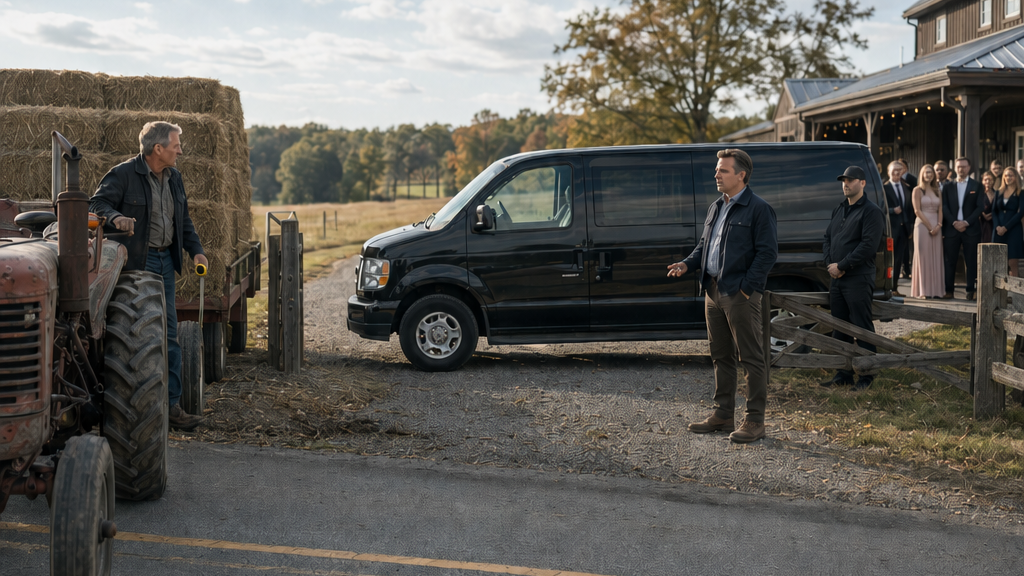
Samuel Walker had just enough time to hit the clutch before the tractor’s front weights reached the black shuttle van.
The hay wagon pushed behind him, eight square bales high, its tires grinding into the gravel as the whole rig shuddered to a stop. Beyond the windshield, the van sat diagonally across the farm entrance with its hazard lights blinking.
Samuel looked once at the county road behind him.
A pickup had already slowed.
Another car was coming.
He could not back the wagon onto the road without blocking both lanes, and he could not pull forward because the shuttle’s rear bumper sat squarely across the opening beside his gate.
A man in a dark suit stepped out of the van carrying a garment bag. Two women followed, lifting their dresses above the gravel.
One of them glanced at Samuel’s tractor and smiled apologetically.
“Sorry,” she called. “We’re just unloading.”
Samuel shut off the engine.
Music drifted from the renovated barn beyond Scott Miller’s property. The old livestock structure had been transformed over the past year into a wedding venue with new siding, tall windows, and strings of lights under the eaves. On Saturdays, cars began arriving before noon and rarely stopped until dark.
Samuel climbed down.
The van driver stood by the passenger door, checking his phone.
“You need to pull ahead,” Samuel said.
The driver looked toward the barn. “They told me pickup and drop-off is here.”
“This is my farm entrance.”
“I’ll be gone in a minute.”
Samuel had heard that sentence before.
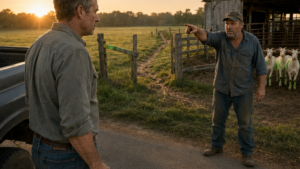
He walked past the weathered gatepost and saw Scott hurrying down from the barn, jacket open, one hand raised as though he were calming livestock.
“Sam,” Scott said. “What’s going on?”
Samuel pointed at the van.
Scott looked at it, then at the wagon. “They’re unloading.”
“I can see that.”
“Give them a minute.”
“I’ve got hay due across town at three.”
Scott checked his watch. “It’s not going to take that long.”
Samuel looked at him.
Behind Scott, several guests had stopped near the barn entrance. They were not trying to stare, but they were staring anyway.
“This isn’t your loading zone,” Samuel said.
Scott lowered his voice. “Nobody said it was.”
“Then quit using it like one.”
The van driver shut the rear door.
Samuel expected him to move.
Instead, another couple came walking down from the parking area, waving toward the van.
Scott pointed toward them. “He’s got one more pickup.”
Samuel felt heat rise behind his ears.
“You told him to wait here?”
“I told the staff this was the easiest place for shuttles to stop without jamming the parking lot.”
Samuel stared at Scott for a second.
There it was.
Not an accident.
Not one lost driver.
A plan.
“You’ve got forty acres over there,” Samuel said. “Find another place.”
Scott’s jaw tightened.
“And I’ve got a business running.”
Samuel almost laughed.
Instead, he walked back to the tractor toolbox.
He opened it, moved a pair of gloves aside, and took out a yellow measuring tape.
Scott watched him return.
“What are you doing?”
Samuel hooked the tape against the inside edge of the old gatepost and walked it toward the road.
The bright strip unspooled over the gravel.
Five feet.
Eight.
Twelve.
Samuel stopped at fifteen and pressed the tape against the ground with his boot.
The shuttle van occupied most of the measured space.
“What’s that supposed to prove?” Scott asked.
“That this approach has to stay clear.”
“For your tractor?”
“For anything coming through that gate.”
Scott exhaled sharply. “Sam, nobody’s stopping you from farming.”
Samuel looked past him at the black van.
“My tractor is sitting in the road.”
“That’s because you showed up during a wedding.”
The words landed harder than Scott seemed to realize.
Samuel wound the tape back slowly.
He had lived with tractors on this lane for thirty-three years. Cattle trucks had come through before sunrise. Veterinarians had arrived in freezing rain. Hay buyers had loaded after dark. Nobody had ever needed a reservation to use the farm entrance.
Now he had apparently arrived at the wrong time.
On his own working day.
He pulled his phone from his pocket.
Scott frowned. “Now what?”
Samuel stepped back far enough to frame the gatepost, the van, and the tractor in one photograph.
The shutter clicked.
Then another.
The van driver glanced toward him.
“You taking pictures of me?”
“The entrance.”
Scott’s face changed.
“Come on, Sam.”
Samuel put the phone away.
He did not answer.
The final guests climbed into the van. The driver finally shut the door, but before he could pull forward, a line of arriving cars turned into Scott’s property from the opposite direction.
For nearly another three minutes, the van remained where it was.
By the time Samuel started the tractor again, his phone showed 2:41.
He drove half a mile before calling the hay customer.
The man answered on the fourth ring.
“I’m fifteen minutes out,” Samuel said.
There was a pause.
“Sam, I’ve got to leave at three.”
“I know.”
“I told you that this morning.”
“I know.”
Samuel looked at the wagon in the mirror.
“I got held up.”
The customer sighed. “We’ll have to do Monday.”
Samuel tightened his hand around the steering wheel.
“All right.”
He turned the tractor at the next safe gravel pull-off.
The wasted trip took nearly an hour.
When he got home, Lisa was at the kitchen table sorting feed invoices. She looked through the window at the loaded wagon returning to the yard.
“What happened?”
Samuel set his phone beside her.
She scrolled through the pictures.
“Again?”
“This time Scott told them to stop there.”
Lisa looked up. “He said that?”
“Close enough.”
She studied the photograph of the measuring tape.
“You measured it?”
“Fifteen feet.”
“Why fifteen?”
Samuel pulled out a chair.
“Because that’s what I remember from when we had the access work done.”
Lisa frowned. “When was that?”
“Years ago.”
“You remember the number, but not why?”
Samuel looked toward the window.
“I remember enough.”
Lisa did not press him.
That evening, after the wedding traffic had thinned, Samuel opened the security-camera application on his tablet. The camera over the machinery shed covered most of the entrance, though he usually checked it only when a gate was left open or a delivery had come.
He dragged the timeline back one week.
Saturday.
A white SUV appeared at 4:12 p.m.
It stopped beside the gate.
Four minutes.
Then another vehicle at 5:03.
A dark sedan.
Six minutes.
Then a passenger van at 6:27.
Samuel leaned closer.
All three had stopped in nearly the same place.
He took screenshots.
Each image carried the date and time automatically.
Lisa appeared in the doorway.
“You find something?”
Samuel turned the tablet toward her.
Three different vehicles.
Three different times.
Same strip of gravel.
Same gate.
Same obstruction.
Lisa looked from the screen to Samuel.
“That’s not one bad driver.”
“No.”
Samuel saved the images into a folder.
For the first time that day, the problem looked less like irritation and more like a pattern.
Chapter 2: The Rule Hidden Beside the Gate
The township clerk slid one more yellowed sheet from the property file and stopped halfway across the counter.
“Here,” she said. “This is probably what you remember.”
Samuel leaned forward.
The document was an old site-access approval attached to improvements made along the Walker entrance years earlier. Most of the language was ordinary enough—driveway grade, drainage, culvert width—but a small diagram near the bottom showed the gate, road edge, and a shaded area labeled for clear access.
Fifteen feet.
Samuel tapped the paper.
“That’s it.”
The clerk adjusted her glasses.
“It says the approach is to remain unobstructed.”
“For farm equipment?”
“Doesn’t say farm equipment.”
Samuel read the line again.
Emergency access shall be maintained.
The satisfaction he had expected came, but only briefly.
He had imagined finding a rule that proved Scott was wrong.
Instead, he had found a rule that was not really about Scott at all.
“When was this filed?”
The clerk checked the stamp. “Seventeen years ago.”
Samuel remembered the culvert work. He remembered the gravel trucks. He remembered someone from the township measuring from the gate, but not much else.
“Who enforces it?”
“That depends on the problem.”
“Vehicles standing there.”
She hesitated.
“If it affects fire access, you should talk to the fire chief.”
Samuel almost said he was not trying to turn it into that kind of matter.
Then he thought of the black shuttle van across the gate.
“What time is she usually in?”
Twenty minutes later he found Deborah Hall behind the volunteer fire station, checking inventory in the side compartment of an engine.
She listened without interrupting while Samuel explained the weddings, the vehicles, the gate, and the old approval.
When he finished, she held out her hand.
“Let me see the diagram.”
Samuel gave her the copy.
Deborah looked at it, then toward the large engine beside them.
“You think this is about keeping somebody from blocking your tractor?”
“I thought it was.”
“It helps with that.”
She traced the edge of the diagram.
“But this is turning clearance.”
Samuel frowned.
“For this truck?”
“And anything roughly this size.”
She stepped out from behind the engine.
“Come on.”
They drove separately to the Walker entrance.
Deborah parked on the shoulder, then stood beside the gate and looked up the lane.
The approach did not seem unusually narrow when it was empty.
That was part of the problem.
She walked the fifteen feet slowly.
“A passenger car can make this look like wasted space,” she said. “A fire engine sees it differently.”
Samuel folded his arms.
“How?”
“Front end swings wide. Rear wheels track tighter. If there’s a vehicle sitting here, the driver either stops, backs up, or risks clipping something.”
She pointed beyond the gate.
“And once somebody gets nervous, everybody else starts improvising.”
Samuel looked toward Scott’s barn.
There were no guests that morning. The quiet made the whole dispute seem smaller.
Deborah handed the diagram back.
“If you’re asking whether vehicles should be stopping there, no.”
“So I can report them?”
“You can report an obstruction.”
“Will anything happen?”
“That depends on what the township documents and how repeated it is.”
Samuel took out his phone.
He showed her the four photographs.
The shuttle.
The white SUV.
The sedan.
The passenger van.
Deborah studied them.
“These all from separate days?”
“Two weekends.”
She enlarged one.
“Time stamped?”
“Yes.”
“That matters.”
Samuel waited.
Deborah lowered the phone.
“But understand something before you start filing complaints.”
“What?”
“The driver in that picture may not know anything about your argument with Scott.”
Samuel’s mouth tightened.
“They’re still blocking the gate.”
“I didn’t say they weren’t.”
She handed the phone back.
“I’m saying rules don’t know who you’re mad at.”
That sentence stayed with him all afternoon.
At home, Samuel spread the copied access diagram beside his photographs.
Lisa stood across the kitchen island, drinking coffee.
“So?”
“It’s real.”
“The fifteen feet?”
He nodded.
“Emergency access.”
Lisa looked at the diagram.
“That’s different.”
“It still means they can’t stop there.”
“I know.”
Samuel heard the hesitation.
“What?”
She rubbed one finger along the rim of her mug.
“If you file against the vehicles, who gets the notice?”
“The registered owner, probably.”
“Not Scott.”
“No.”
She let that sit between them.
Samuel gathered the photographs into a neat stack.
“He knows what he’s doing.”
“Maybe.”
“He admitted he sends them there.”
“I’m not talking about Scott.”
Samuel looked at her.
She nodded toward the pictures.
“I’m talking about these people.”
The first was a white SUV with an out-of-county plate.
The second looked like a rideshare sedan.
The third was a shuttle company van.
“They can move,” Samuel said.
“If they know they need to.”
“They’re drivers. They should know not to block a gate.”
Lisa raised an eyebrow.
Samuel looked away.
That evening he created an online account on the township reporting portal.
The form was plain.
Date.
Time.
Location.
Type of obstruction.
Photograph.
Description.
Samuel filled in everything except the final submission field.
At the bottom was a warning that documented violations could result in citations or other enforcement action against the vehicle operator or registered owner.
He read it twice.
Then closed the page without submitting.
Tuesday passed quietly.
By late afternoon Samuel had almost convinced himself the problem might ease on its own.
At 6:18, the motion alert on his phone sounded.
He opened the camera feed.
A gray event shuttle had stopped across the entrance.
Hazard lights blinking.
No guests in sight.
Samuel watched for one minute.
Then two.
At four minutes, he walked outside.
The driver was leaning against the van.
“Picking up at the barn?” Samuel asked.
“Yes, sir.”
“You know you’re blocking a required access lane?”
The driver straightened.
“They told me to wait here.”
“Who did?”
“Venue staff.”
Samuel looked toward the barn.
Scott stood near the side doors speaking with two employees.
He glanced toward Samuel.
Their eyes met.
Scott did not wave.
The driver shifted his weight.
“You want me to move?”
Samuel could have said yes.
Instead, he took out his phone.
Chapter 3: Every Photograph Had Someone Else’s Name
The first enforcement email arrived Friday morning.
Samuel read the subject line twice before opening it.
The complaint had been reviewed.
The vehicle obstruction had been confirmed.
A notice would be issued.
He sat at the kitchen table with the laptop open and felt something loosen in his chest.
Not pleasure exactly.
Proof.
Lisa came in carrying a basket of laundry.
“You hear back?”
Samuel turned the screen.
She read the message.
“So they cited him?”
“The driver.”
Her eyes stayed on the last word longer than Samuel liked.
“The driver,” she repeated.
“He was blocking the gate.”
“I know.”
Samuel closed the laptop.
Lisa set down the basket.
“Did Scott get anything?”
“Not from this.”
“So Scott tells them where to stop, and they pay.”
Samuel pushed his chair back.
“If nobody reports it, nothing changes.”
“I didn’t say don’t report it.”
“You keep saying everything except that.”
She gave him a tired look.
“Maybe because you keep hearing everything except what I’m saying.”
By Saturday afternoon the argument had settled into silence.
Then another car stopped by the gate.
Samuel photographed it.
Sunday morning, another.
He photographed that one too.
The process became easy.
Date.
Time.
Location.
Image.
Submit.
Each report took less than two minutes.
By the following weekend, four separate complaints had been confirmed.
The gate stayed clear more often.
Samuel began to believe the system was working.
Then a silver sedan pulled in during a Saturday event and stopped exactly where the others had.
Samuel walked down before taking a picture.
The driver lowered his window.
“I need you to move up.”
The man looked confused.
“This is the pickup.”
“No. It’s a required access area.”
The driver lifted his phone.
“This is where they told me to go.”
“Who?”
“The venue.”
Samuel leaned closer.
On the screen was a short arrival instruction attached to the booking.
Wait by wooden farm gate near road. Guests will meet you there.
Samuel felt his jaw set.
“Can I see that again?”
The driver angled the phone toward him.
There was no ambiguity.
The location was deliberate.
Samuel looked toward Scott’s barn.
“So everybody gets that?”
“I guess.”
“You ever been here before?”
“No.”
Samuel stepped back.
The driver looked at him.
“Am I doing something wrong?”
For a moment Samuel heard Deborah’s voice.
Rules don’t know who you’re mad at.
“You need to move,” Samuel said.
“Where?”
Samuel opened his mouth.
There was no obvious answer.
Scott’s parking lot was full.
The lane narrowed beyond the gate.
The shoulder on the county road dropped into a drainage ditch.
“Pull ahead until you’re clear of the gate.”
The driver nodded.
Samuel waited until the sedan moved.
He did not photograph it.
That evening he walked over to Scott’s barn after the final ceremony had begun.
Scott met him behind the building.
“You telling drivers to wait at my gate?”
Scott’s expression shifted.
“I tell them to use the roadside pickup.”
“The instructions say my wooden gate.”
“It’s a landmark.”
“It’s my entrance.”
“They’re there for five minutes.”
“You know the clearance rule.”
Scott folded his arms.
“I know you’ve been filing complaints.”
Samuel said nothing.
“One shuttle company called me,” Scott continued. “They got a citation.”
“They blocked the gate.”
“They were where the instructions told them to be.”
“Exactly.”
Scott’s face hardened.
“So this is about me.”
“It always was.”
“No. You’ve been writing up drivers because you’re mad at me.”
Samuel took a breath.
“I asked you to stop using the entrance.”
“And I told you I’d fix it.”
“You told me they’d move in a minute.”
Scott looked toward the barn.
Music thumped faintly through the wall.
“I can change the pickup instructions.”
“Then do it.”
“I will.”
For the first time in weeks, Samuel believed they might have reached something resembling an agreement.
Scott changed the instructions that night.
By the next Saturday the fifteen-foot strip beside the gate remained empty.
Samuel noticed it at noon.
Again at two.
No vans.
No sedans.
No hazard lights.
At three, he drove the tractor through without slowing.
A small satisfaction followed him halfway to the lower field.
Then Lisa called.
“You need to come back.”
“What happened?”
“Livestock truck’s here.”
“I’m ten minutes away.”
“He can’t get in.”
Samuel turned the tractor around.
When he reached the farm entrance, the gate itself was perfectly clear.
Not a single vehicle stood inside the measured fifteen feet.
The problem had moved.
Three cars were lined up farther inside the lane, just beyond the bend where the gravel narrowed between the fence and drainage ditch.
Their hazard lights blinked in sequence.
Behind them sat the livestock hauler, a long aluminum trailer angled awkwardly from the road.
The driver was outside with both hands on his hips.
Samuel parked and walked over.
“I can back out,” the hauler said, “but I’m going to need traffic stopped.”
Samuel looked at the waiting cars.
One driver rolled down her window.
“We were told to wait inside the property now.”
Another held up his phone.
“Same.”
Samuel did not need to read the instructions.
He knew.
Scott had solved the complaint.
Not the problem.
Samuel walked past the first car and stared down the clogged lane toward the barn.
The fifteen-foot strip behind him was empty, clean, and completely useless.
For the first time, he wondered whether his successful enforcement had made the entrance more dangerous than before.
Chapter 4: The Problem Moved Deeper Into the Lane
The livestock hauler could not move forward, and backing into the county road would require stopping traffic in both directions.
Samuel stood beside the trailer while three waiting cars blinked their hazard lights farther up the lane.
The gate behind him was perfectly clear.
Fifteen feet of empty gravel.
Exactly what he had wanted.
“Tell me where you want me,” the hauler said.
Samuel looked along the fence line. The lane narrowed sharply fifty yards in, where the drainage ditch pressed close on one side and old woven wire bordered the other. The waiting cars had chosen the widest-looking section, which was still nowhere near wide enough for the livestock trailer.
“Stay put,” Samuel said.
He walked to the first car.
The driver lowered her window.
“You’ll have to move.”
“They told us to wait here.”
“I know.”
“Where should we go?”
Samuel had no answer that would not simply transfer the problem somewhere else.
“Pull through toward the barn for now.”
“There are cars coming the other way.”
“I’ll stop them.”
He moved from vehicle to vehicle, directing each one forward. Then he stood in the lane with one hand raised while event traffic slowed behind him.
A guest in an SUV lowered his window.
“Are we allowed through?”
“Not yet.”
“We’re late.”
Samuel glanced back at the livestock truck.
“So is he.”
It took nearly fifteen minutes to untangle the line.
By the time the trailer finally reached the cattle-loading area, Samuel’s shirt was damp beneath his jacket and Scott was walking toward him from the barn.
“You can’t stand in the road directing my guests,” Scott said.
Samuel stared at him.
“You put them here.”
“I moved them off the gate like you wanted.”
“You moved the problem fifty yards.”
Scott looked toward the now-clear entrance.
“The access area is open.”
“The truck couldn’t get through.”
“It did.”
“After I cleared your traffic.”
Scott’s mouth tightened.
Samuel almost reached for his phone.
That had become his habit.
Photograph first.
Document first.
Conversation later, if ever.
But Lisa was coming down the lane from the farmhouse carrying a folder against her chest.
“Samuel.”
Something in her voice stopped him.
She held out several stapled pages.
“I found these with the tax records.”
Samuel took them.
“What are they?”
“Scott’s event-barn packet.”
Scott’s expression changed immediately.
“Where did you get that?”
“The public planning file you gave us when the barn was approved,” Lisa said. “You wanted us to know the property line wasn’t changing.”
Scott stepped closer.
“That was two years ago.”
Lisa pointed at one of the pages.
“Look at the traffic drawing.”
Samuel unfolded it across the tractor hood.
The event barn appeared as a rectangle near the center. Parking occupied the field beside it. Arrows showed vehicles entering from the shared approach, circulating around the parking area, then looping behind the barn before exiting.
At the rear of the property was a broad oval labeled turnaround.
Samuel looked toward the barn.
Beyond it lay grass.
No gravel loop.
No turnaround.
Nothing.
He studied the drawing again.
“This is supposed to be behind the barn.”
Scott shoved his hands into his pockets.
“That plan changed.”
“When?”
“During construction.”
Samuel looked up.
“Was the township told?”
Scott did not answer.
Lisa’s eyes moved between them.
“Maybe there’s another version.”
“There is,” Scott said quickly. “There were revisions.”
“Then show us.”
Scott’s jaw shifted.
“I don’t keep every sheet lying around.”
Samuel tapped the oval on the plan.
“If this was built, your drivers wouldn’t need my gate.”
“They don’t need your gate now.”
“No. Now they need my whole lane.”
Scott looked past him toward the barn, where another vehicle was approaching.
“I said I’d handle the pickup problem.”
“You handled the complaints.”
“That’s what you wanted.”
Samuel felt the accusation hit because part of it was true.
He had focused so tightly on the fifteen-foot strip that he had never asked what happened after the cars moved beyond it.
The rule had worked.
The lane had gotten worse.
Lisa folded her arms.
“Where are the cars supposed to turn around?”
Scott said nothing.
That silence told Samuel more than another argument would have.
He walked past Scott toward the barn.
“Sam.”
Samuel kept going.
Behind the renovated building, the ground flattened into a broad patch of grass. Tire tracks crossed it in shallow arcs, but the soil remained soft and uneven. Near the far edge stood two faded survey stakes.
Samuel stopped.
The dimensions looked almost exactly like the oval on the plan.
Scott had followed him.
“You knew,” Samuel said.
Scott looked at the grass.
“I knew what?”
“You knew this was supposed to be here.”
“It was one option.”
“On an approved plan.”
Scott rubbed a hand over the back of his neck.
Samuel stepped onto the grass. His boot sank slightly into the soft ground.
“You opened without it.”
Scott’s voice hardened again. “You don’t know what you’re talking about.”
“Then tell me.”
“I don’t owe you my construction history.”
“No.”
Samuel looked toward the congested lane.
“But when your construction history starts trapping my livestock truck, it becomes my business.”
Scott stared at the ground.
The music from inside the barn changed songs. Somebody laughed near the patio, far enough away that the argument remained private.
Samuel waited.
For once, he did not fill the silence with another rule or photograph.
Scott finally spoke.
“It never got built.”
Chapter 5: What Scott Could Not Afford to Finish
Scott led Samuel across the grass to a rectangle marked by two old stakes and one length of half-buried orange string.
“This was it.”
The unfinished turnaround did not look like much.
That was what made it worse.
Samuel could see the intended shape now that he knew where to look: a flattened loop behind the event barn, broad enough for vans and larger vehicles to circle without backing. Weeds had grown over compacted soil where machines had once begun grading.
Scott kicked at one of the stakes.
“We got this far.”
Samuel looked around.
“No gravel.”
“No drainage.”
“No base.”
“So you stopped.”
Scott gave him a humorless smile.
“You think I just got bored?”
Samuel said nothing.
Scott walked farther into the rectangle.
“The barn cost more than the estimate. Electrical went over. Septic went over. Then the county required another restroom connection after the occupancy review.”
“You still opened.”
“I had bookings.”
“You had an unfinished traffic plan.”
“I had deposits I’d already used.”
That made Samuel look at him.
Scott’s eyes stayed on the field.
“I borrowed against the place. Then I borrowed against equipment. The bank wasn’t interested in hearing that gravel had gone up or that the contractor found soft soil back here.”
Samuel folded the plan under one arm.
“How much to finish it?”
“More than I had.”
“That isn’t an answer.”
“It’s the only one that mattered at the time.”
Samuel thought of all the Saturdays he had watched polished cars arrive at the barn. The fresh siding. The lights. The photographers. The dressed tables glimpsed through the open doors.
From across the fence, it had looked prosperous.
Scott read something in his face.
“Yeah,” he said. “It looks good from your side.”
Samuel did not respond.
“I needed the first season to survive,” Scott continued. “So we used staff to keep traffic moving. Then we used the roadside pickup. It worked most of the time.”
“Until it didn’t.”
“Until you started reporting everybody.”
Samuel’s shoulders stiffened.
Scott shook his head.
“I’m not saying you were wrong about the gate.”
“Sounds like it.”
“I’m saying once those citations started, I had to move the cars somewhere.”
“You could have told me this.”
“And said what? ‘Sam, I’m broke, so can I borrow your access lane every Saturday?’”
“At least it would’ve been honest.”
Scott laughed once.
“You already thought this whole place was a bad idea.”
Samuel frowned.
“I never said that.”
“You didn’t have to.”
Scott looked toward the barn.
“Every time construction started early, you complained. Every time a delivery truck used the lane, you were standing at the fence. When I put the parking signs up, you asked if I had approval.”
“Because they were pointing vehicles toward my gate.”
“To me, it looked like you were waiting for the thing to fail.”
The accusation was quieter than Samuel expected.
That made it harder to dismiss.
He remembered telling Lisa that the barn would become a headache before Scott had hosted his first event.
He remembered watching contractors unload lumber and thinking nobody needed chandeliers in an old livestock building.
Scott had not imagined all of it.
But he had imagined the part that mattered most.
“I don’t care if you run weddings,” Samuel said.
Scott looked at him.
“I care whether I can get a trailer through my own gate.”
For several seconds neither man spoke.
Then Scott sat on the low concrete edge beside the rear wall.
“I thought the waiting cars would be occasional.”
Samuel stayed standing.
“I told myself five minutes wasn’t a blockage. Then ten minutes. Then only Saturdays.”
He rubbed his hands together.
“Every time it caused trouble, I changed something small so I wouldn’t have to change the expensive thing.”
The admission stripped something out of the argument.
Samuel had expected excuses.
What he heard instead was fear dressed up as practicality.
Scott looked up.
“I can finish the turnaround after the fall season.”
“When?”
“Winter.”
“That’s months.”
“I’ve got six large events before then.”
Samuel unfolded the plan again.
“You want me to ignore this until December?”
“I want you not to take it to the township tomorrow.”
There it was.
The request Scott had been circling.
Samuel looked at the grass where the turnaround should have been.
“If Deborah sees this—”
“I know.”
“Your occupancy approval could be reviewed.”
“I know.”
“You knowingly opened without the final access work.”
Scott stood.
“You think I don’t know what that sounds like?”
Samuel met his eyes.
“Then why risk it?”
“Because if I canceled the first season, I lost the barn anyway.”
Scott’s voice stayed controlled, but the strain had reached it.
“I was already too deep. Couples had deposits down. Vendors were booked. I had loan payments coming before the first event ever happened. So I gambled that I could manage traffic until I could afford the rest.”
“And now?”
“Now I’m asking for six more events.”
Samuel stared at him.
Scott did not beg.
That almost made it worse.
At home that evening, Samuel laid the plan on the kitchen table.
Lisa read it while he explained.
When he finished, she said, “So he knew.”
“Yes.”
“And he’s asking you not to report it.”
“Yes.”
“What are you going to do?”
Samuel looked toward the dark window.
“I don’t know.”
Lisa seemed surprised.
A month earlier, he would have known immediately.
“He still caused this,” Samuel said.
“I know.”
“He still let drivers take the citations.”
“I know.”
“He still moved traffic into our lane.”
“I know.”
Lisa folded the plan.
“But?”
Samuel thought of Scott standing in the unfinished field.
“But I don’t think he built that barn planning to make my life harder.”
“No.”
“He just decided my inconvenience was cheaper than his fix.”
Lisa’s expression tightened.
“That doesn’t make it harmless.”
“No.”
Samuel rubbed his thumb over the crease in the plan.
Years earlier, during calving season, a truck had broken down partly across the farm entrance while a veterinarian was trying to reach a cow in distress. Samuel remembered standing under sleet, waving the veterinarian around the blockage, losing minutes that had felt much longer.
The calf had survived.
The cow had not.
He had never told Scott that story.
He had hardly told Lisa how often he still remembered the sound of the truck idling uselessly in the road.
Maybe fifteen feet was only fifteen feet to anyone who had never needed it all at once.
Samuel’s phone buzzed.
A weather alert filled the screen.
Severe thunderstorms were expected Saturday afternoon into evening.
High winds.
Heavy rain.
Possible localized flooding.
Lisa read over his shoulder.
“That’s Scott’s biggest wedding this month, isn’t it?”
Samuel nodded.
Nearly two hundred guests.
Shuttles.
Rideshares.
A full parking field.
He looked again at the unfinished turnaround.
For the first time, the question was no longer whether Scott deserved another chance.
It was what would happen if those fifteen feet were needed before Scott could afford one.
Chapter 6: The Fifteen Feet Finally Mattered
The first volunteer siren reached Samuel while two cars were still parked nose-to-tail inside the farm lane.
He was standing beneath the equipment shed roof watching rain hammer the gravel when the sound rose above the wind.
One siren.
Then another.
Lisa came to the doorway behind him.
“That’s close.”
Samuel was already moving.
His phone had buzzed less than a minute earlier with a message from Scott.
Medical emergency. Ambulance coming.
Samuel ran toward the gate.
The wedding had moved indoors when the storm reached the farm, but vehicles still crowded every available hard surface. Several guests had decided to leave early. Others had summoned rides. Headlights glowed through the rain along the lane.
The fifteen-foot strip beside the gate was clear.
Beyond it, everything narrowed.
Samuel waved at the first waiting driver.
“You have to move.”
“I’m waiting for passengers.”
“Emergency vehicles are coming.”
That changed things.
The driver pulled forward, but there was nowhere to go. Another sedan blocked him twenty yards ahead.
Samuel ran past.
“Move toward the parking field!”
A driver shouted through an open window, “It’s full!”
“Then keep going until someone directs you.”
Rain ran down Samuel’s neck.
Scott appeared near the barn without a jacket.
“Guest collapsed inside,” he said. “They think it’s his heart.”
“Where’s your staff?”
“Clearing the front.”
Samuel looked toward the entrance.
Red light flashed against the wet trees.
“Get everybody out of this lane.”
“We are.”
“No. Get them out now.”
Scott turned and ran.
The fire engine appeared first, larger than any vehicle currently on the property. It slowed at the entrance.
Samuel knew the driver.
He knew most of the volunteers by sight.
The engine’s front wheels crossed the road edge.
The driver swung wide.
For half a second Samuel thought it would clear.
Then the truck stopped.
Its nose sat beside the weathered gatepost.
The rear wheels were still partly in the road.
A sedan farther inside the lane had nowhere to move because two other cars blocked the bend.
The fifteen-foot approach was open.
The turning path beyond it was not.
Deborah Hall leaned out of the passenger side.
“Samuel!”
He ran toward her.
“What do you need?”
“Clear that inside corner!”
Samuel looked.
The queue had created exactly the problem she had described at the fire station. The engine could enter the opening, but it could not complete the turn without pushing its front end toward the fence.
Scott reached them.
“They’re moving.”
Deborah pointed down the lane.
“They’re not moving fast enough.”
An ambulance siren sounded behind the engine.
Samuel looked toward his equipment shed.
His tractor sat inside with the loader attached.
“Give me two minutes.”
He ran.
The tractor started on the first turn.
Samuel backed it out, drove across the wet yard, and entered the lane from the farm side. He lowered the loader bucket close to the ground, not to push cars but to make the machine impossible to ignore.
He stopped beside the first sedan.
“Follow me,” he told the driver.
“Where?”
“Grass field behind the barn.”
“It’s muddy.”
“I know.”
“I’ll get stuck.”
“Then stay on my tracks.”
One by one, Samuel led three cars beyond the bottleneck. He used the tractor to pull aside a lightweight decorative barrier near the field entrance. Scott and two event staff waved the vehicles through.
The last sedan moved.
Samuel reversed the tractor against the fence line.
Deborah signaled.
The fire engine tried again.
Its front swung through the open fifteen feet.
The rear wheels tracked inside.
The nose cleared the gatepost by several feet and continued down the lane.
The ambulance followed.
Samuel shut off the tractor.
For several seconds all he heard was rain and the heavy diesel engines moving toward the barn.
Scott stood beside him breathing hard.
Neither man said anything.
There was nothing useful to say.
They walked toward the barn.
Inside, guests had been moved away from one side of the main room. Volunteers worked around a man lying near a row of chairs while his family stood several yards back.
Samuel stayed outside the doors.
He did not need to see more.
Deborah came out after several minutes.
“They’re transporting him.”
“Alive?” Scott asked.
“Yes.”
Scott closed his eyes briefly.
Deborah looked from Scott to Samuel.
“What happened with the lane?”
Scott answered first.
“My cars.”
“Your traffic plan,” Deborah corrected.
He nodded.
Deborah wiped rain from her forehead.
“The roadside clearance helped. If there’d been a van sitting at that gate, we’d have lost more time.”
Samuel looked at the post.
The bright yellow tape was not there, but he could see the distance anyway.
Fifteen feet.
For weeks he had treated that distance like a weapon.
A number he could use to prove that somebody else was wrong.
Now, standing in the rain with an ambulance pulling away behind him, it looked entirely different.
Space was not empty when somebody needed it.
It was capacity.
A path.
Time.
Deborah turned toward Scott.
“But the interior lane is unacceptable.”
“I know.”
“No more large events under this setup.”
Scott’s face went still.
“I have bookings.”
“Then you need a compliant traffic arrangement.”
“I can staff it better.”
“This wasn’t a staffing problem.”
Deborah pointed toward the field where the unfinished turnaround lay beyond the barn.
“You need a physical solution.”
Scott glanced at Samuel.
Deborah noticed.
“I’m not refereeing whatever is happening between you two,” she said. “But I am telling you this: tonight proved the current setup doesn’t work.”
Scott rubbed water from his face.
“What happens now?”
“I document what happened. Township reviews it.”
“Are you suspending me?”
“That isn’t my decision alone.”
Scott stared toward the barn.
Samuel could almost see the calculations moving behind his eyes.
Canceled weddings.
Returned deposits.
Loan payments.
The expensive gravel loop still sitting under weeds.
Deborah turned to Samuel.
“And you.”
He looked at her.
“Those reports helped establish the gate problem.”
Samuel waited.
“But if you knew traffic was moving inside and creating another obstruction, you should have called.”
The words struck harder than he expected.
“I didn’t know it was this bad.”
“You saw that livestock trailer.”
Samuel said nothing.
She was right.
He had seen it.
He had also spent most of that afternoon thinking about how Scott had defeated the rule.
Not about what the new problem meant.
Deborah walked back toward the fire engine.
Samuel remained beneath the dripping barn eave.
Lisa approached from the farmhouse side carrying two rain jackets. She handed one to Samuel, then held the other out to Scott.
Scott hesitated before taking it.
“Thanks.”
He put it on without fastening it.
Across the parking field, guests were beginning to leave in small groups. Nobody was laughing now. Drivers moved carefully under direction from the staff.
Scott watched them.
“I kept thinking I could get through one more weekend.”
Samuel did not answer.
“One more booking,” Scott continued. “One more payment. Then I’d fix it.”
Samuel looked at the unfinished field.
“That’s how things get permanent.”
Scott gave a tired nod.
For once, there was no defensiveness in it.
A volunteer came out of the barn and told Scott the guest’s family had left for the hospital.
Scott thanked him.
Then he turned toward Samuel.
“You were right about the access.”
Samuel shook his head.
“That isn’t what tonight was.”
“I know.”
The admission sat quietly between them.
Scott looked at the weathered gatepost, then at the lane Samuel had just cleared with the tractor.
“If the township asks what you want, you can shut me down.”
“I can tell them what happened.”
“That’ll be enough.”
Samuel considered the folded site plan still sitting on his kitchen table.
A week earlier, that knowledge had felt like leverage.
Now it felt like responsibility.
Scott slipped his hands into the borrowed jacket pockets.
“What would you do?”
Samuel looked at him.
“If what?”
“If the barn were yours.”
The question was not a challenge.
That was what made it difficult.
Samuel looked past Scott toward the unfinished turnaround, the empty fifteen-foot strip, and the tracks his tractor had cut through wet grass to make room for the emergency vehicles.
For weeks, he had known exactly what rule Scott had broken.
He had never seriously asked what solution would let both properties keep working.
Now the township would ask.
And this time Samuel could not hide behind a photograph.
Chapter 7: A Gate Wide Enough for Both Lives
“Are you asking the township to suspend Mr. Miller’s event permit?”
Deborah Hall’s question settled over the meeting room without drama.
Samuel sat at the end of a folding table with Lisa beside him. Scott was across from them, a yellow legal pad untouched in front of him. Between the two men lay the old site plan, the fire-access diagram, Samuel’s photographs, and Deborah’s written account of the emergency response.
A month earlier, Samuel would have known exactly what to say.
Yes.
Make him stop.
Make the problem belong to Scott for once.
Instead, Samuel looked at the drawing of the unfinished turnaround.
“No,” he said.
Scott lifted his eyes.
Deborah did not react. “Then what are you asking for?”
Samuel unfolded a second sheet.
It was not an official plan. He had drawn it at the kitchen table after measuring the lane twice with Lisa and walking the route Deborah’s engine had tried to take during the storm.
Red pencil marked the fifteen-foot approach beside the gate.
Blue arrows marked farm traffic.
Black arrows marked event traffic.
Behind Scott’s barn, Samuel had drawn a wider loop over the same grass-covered rectangle that should have been finished two years earlier.
“I want this entrance kept clear permanently,” Samuel said. “Not just during inspections.”
Deborah nodded.
“And?”
“Event pickups shouldn’t be anywhere on the shared lane.”
Scott leaned forward slightly.
Samuel pointed to the rear field.
“Build the turnaround. Put the rideshare and shuttle pickup back here. Separate it from the parking entrance so drivers don’t have a reason to wait by my gate.”
The township representative at the other end of the table studied the sketch.
“You drew this?”
“It’s not engineered.”
“I understand that.”
Samuel tapped another mark.
“This part needs enough width for a cattle trailer to keep moving while event traffic is entering. And Deborah’s truck needs to be able to swing through without somebody backing twenty cars out of the way.”
Deborah looked over the drawing.
“The concept is better.”
Scott finally spoke.
“How much farther back are you putting the pickup?”
“Far enough that nobody mistakes my gate for your front door.”
Scott almost smiled.
Almost.
Then his eyes returned to the page.
“You know what that costs.”
“Yes.”
“And you know I can’t do it in a week.”
“Yes.”
Samuel let the answer stand.
He had learned something about silence over the past month. It could punish, but it could also leave room for somebody else to tell the truth.
Scott looked toward the township representative.
“What happens while it’s being built?”
“Your large events remain restricted until an approved traffic plan is in place.”
Scott’s fingers tightened around his pen.
“I have four weddings scheduled.”
“Then you’ll need to reduce attendance where possible, relocate, or postpone.”
One muscle moved in Scott’s jaw.
Samuel could see the figures assembling in his mind again.
Refunds.
Vendors.
Loan payments.
A month earlier, Samuel might have felt satisfaction at that.
Now he saw only cost.
Necessary cost, perhaps.
But cost all the same.
Scott turned to him.
“You’re all right with that?”
Samuel met his eyes.
“No.”
Scott looked surprised.
Samuel continued.
“I don’t like seeing you lose four weekends. I also don’t want another ambulance sitting behind a fire truck because nobody wanted to pay for gravel.”
Nobody at the table said anything.
Scott looked down at the plan.
After a moment he asked, “If I build this, are we done?”
Samuel considered the question.
Done could mean no more complaints.
No more photographs.
No more meetings.
It could also mean pretending nothing had happened.
“No,” Samuel said.
Scott’s face hardened slightly.
Then Samuel added, “We’re neighbors. I don’t think that gets done.”
Lisa glanced at him.
Samuel kept his attention on Scott.
“But if you build it right, I won’t be looking for reasons to fight you.”
Scott rubbed one thumb across the edge of the paper.
“That’s about as friendly as you get, isn’t it?”
“Usually.”
This time the smile appeared.
Small and tired, but real.
The township required a revised engineered plan before construction. The turnaround had to be widened slightly beyond Scott’s original design, and the pickup point had to be marked on all booking instructions. Event staff would be responsible for keeping the shared lane open during arrivals and departures.
The fifteen-foot entrance strip remained non-negotiable.
Scott signed the corrective agreement.
Then he postponed three weddings and relocated a fourth.
There was no way to make that painless.
For several days, trucks came and went behind the event barn. Gravel was delivered. Drainage pipe was installed. A grader cut the faded rectangle into a recognizable loop.
Samuel watched from his side of the fence more than once.
The old instinct returned occasionally—the urge to check whether every measurement matched the plan, whether every load of gravel was where it belonged.
One afternoon Lisa found him standing by the gate with the yellow tape in his hand.
“You measuring him again?”
Samuel looked at it.
“No.”
“You’re holding a tape.”
“I was fixing the latch.”
Lisa glanced at the perfectly functional latch.
Samuel put the tape back in the toolbox.
She smiled and kept walking.
The first event after the turnaround opened was smaller than Scott’s old Saturday crowds.
Samuel knew it had started because cars began appearing along the county road shortly after two.
But this time they did not slow beside his gate.
A small sign directed them toward the barn entrance.
Later, a shuttle van arrived.
Samuel happened to be crossing the yard when he saw it.
The van passed the weathered gatepost without stopping, followed the new loop behind the barn, and disappeared from view.
Ten minutes later a rideshare sedan did the same.
The fifteen-foot strip remained empty.
Not empty in the way it had been after Samuel’s citations, when the vehicles had simply moved deeper into the lane.
Actually empty.
Useful.
Protected.
Near four, Samuel started the tractor and hooked up the hay wagon.
Lisa came out of the farmhouse.
“Delivery?”
“Same customer I missed the first time.”
She looked toward Scott’s barn.
Music carried faintly across the field.
“You planning to measure anything before you leave?”
Samuel climbed onto the tractor.
“Not unless somebody parks across the gate.”
He started the engine.
As he reached the entrance, Scott was standing near the new pickup loop talking to an event employee.
He saw Samuel coming.
For a second Samuel expected some gesture—a wave, perhaps, or an exaggerated motion telling traffic to clear.
Scott did neither.
He simply stepped aside.
The lane was already open.
Samuel drove through the gate without touching the brakes.
The hay wagon followed cleanly behind him.
As he turned onto the county road, he glanced once in the mirror.
The old gatepost stood where it always had.
Beside it lay fifteen feet of clear gravel.
No argument.
No photograph.
No waiting vehicle.
Just enough room for both properties to keep working.
The story has ended.