The Golden Disgrace: The Disowned Bride Who Bankrupted Palm Beach’s Deadliest Empire
CHAPTER 1: THE SLAP AND THE SIGNAL
The coral-stone foyer of the Cross estate was designed to amplify the sound of money, but at ten o’clock on a Tuesday morning, it amplified the sound of bone meeting bone.
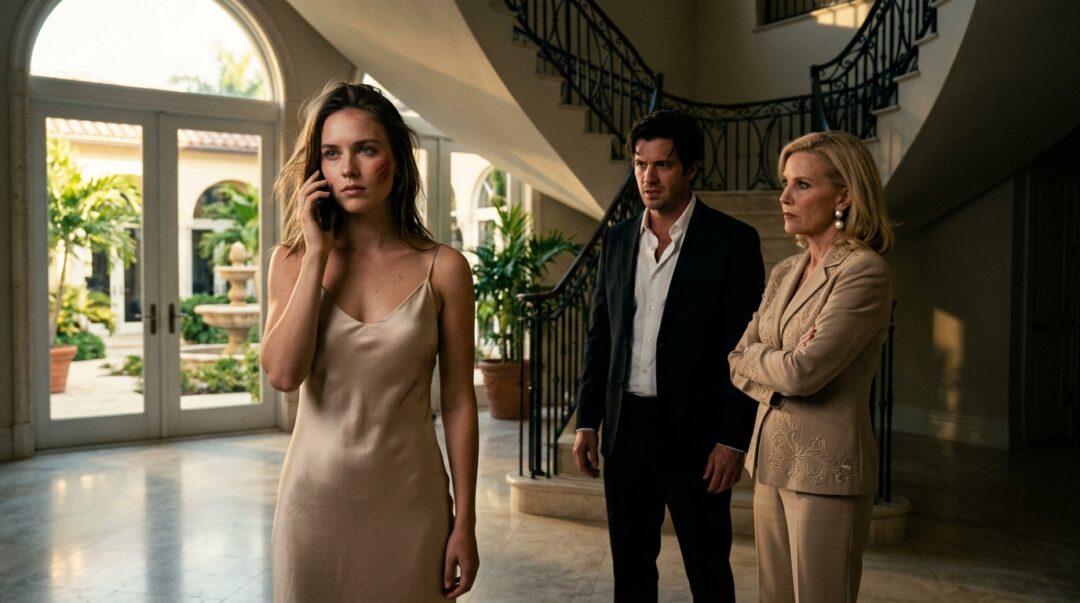
Garrick Cross’s right hand whipped across the air with the sudden, ugly violence of an uncoiling spring. The impact snapped Sloane Vance’s head to the left, her blonde hair spraying across her eyes, the edge of his diamond signet ring scoring three red, bleeding furrows into the skin of her cheekbone. Her champagne satin slip dress hissed against the polished travertine as she stumbled two paces back toward the sweeping wrought-iron staircase, catching herself on the bronze balustrade.
“Get out of my house,” Garrick said. He leaned forward, his black Italian wool blazer unbuttoned, the collar of his white dress shirt damp with sweat, his eyes bulging with the frantic, unhinged adrenaline of a man who smelled smoke in his own cellar. “Did you think I wouldn’t check the server logs in the library? Did you think you could copy the offshore transfer registers and walk out onto Ocean Boulevard like you were leaving a tennis lesson?”
Across the foyer, standing beneath a massive nineteenth-century Venetian crystal chandelier, Beatrice Cross folded her arms over her beige embroidered suit. Her pearl necklace gleamed softly in the blinding tropical sunlight pouring through the sixty-foot arched windows. A smug, dismissive smile curved her lips—the practiced, cruel expression of an old Palm Beach matriarch swatting an insect off her linen tablecloth.
“Let the little charity case go, Garrick,” Beatrice said, her voice smooth as chilled vermouth. “She spent three years playing the grateful orphan from Tallahassee. She thought if she slept under our roof and cataloged our art collection, she might actually inherit a seat on the foundation board. Pack her luggage into plastic bags and throw it over the gate.”
Sloane didn’t touch her bleeding cheek. She didn’t drop her gaze, and she didn’t weep.
She stood up straight, smoothing the champagne satin over her hips. The pain in her jaw was sharp, throbbing in time with her racing pulse, but her hands were entirely still. Her eyes, cool and clear as Atlantic sea glass, pinned Garrick with an expression of such icy, unyielding contempt that the younger man took an involuntary half-step backward.
The foyer felt like a museum after hours, vast and cold beneath the Florida heat. Two security guards stood by the massive bronze pedestals, their thumbs hooked into their equipment belts, their faces impassive as they watched the family business unfold. In Palm Beach, domestic cruelty was merely another private asset class, managed with discretion behind gated bougainvillea.
Sloane could feel the heat radiating from the welt on her cheekbone, a throbbing pulse that made her left eye water. She swallowed the bitterness, refusing to grant them the satisfaction of a tear. She had known the slap was coming; her financial model had predicted Garrick’s collapse down to the hour. When a man like Garrick Cross realizes he is mathematically bankrupt, violence is the only currency he has left to spend.
“You should have kept your hands to yourself, Garrick,” Sloane said. Her voice was quiet, devoid of tremor, slicing through the vast, vaulted foyer like a blade through silk.
She reached into the small black leather handbag resting on the console table behind her. Garrick’s security detail—two armed ex-Secret Service guards in navy blazers stationed by the front double doors—shifted their weight, their hands dropping toward their waistbands. Sloane didn’t pull a weapon. She pulled a slim, black titanium smartphone.
Her thumb tapped the screen twice. She brought the phone to her ear, maintaining unbroken eye contact with the man she had promised to marry three months ago.
“Dad,” Sloane said into the receiver. “It’s time.”
She didn’t wait for a reply. She lowered the phone, slipped it back into her handbag, and turned her back on the entire Cross family.
The sting of the slap had settled into a steady, dull throb along Sloane’s cheekbone, but she welcomed the pain. It was clean. It was real. It was the final physical proof she needed to dismantle the illusion of high-society respectability that Beatrice Cross had spent three decades constructing with stolen capital.
Her four-inch heels clicked with a steady, rhythmic cadence against the marble floor as she walked down the long colonnade toward the towering wrought-iron glass entrance doors.
Behind her, Garrick sneered, stepping toward the center of the foyer. “Call whoever you want, Sloane! Call the county sheriff! Call the local legal aid clinic! By noon today, I will have an emergency restraining order that makes your life in Florida illegal—”
His phone chimed.
It wasn’t a standard ringtone. It was the high-priority, strident klaxon of the Bloomberg terminal app—the warning sound configured only for margin liquidations exceeding eight figures.
A second later, Beatrice’s purple-cased smartphone buzzed violently on the glass console table. Across the foyer, the estate’s head of security felt his private encrypted radio beep twice with an automated alert code from the family’s private banking branch in Zurich.
Garrick pulled his phone from his blazer pocket, his sneer still frozen on his lips. He looked down at the illuminated glass.
The color didn’t drain from his face; it vanished instantly, leaving his skin the shade of dirty limestone.
On the screen was an emergency notification from JPMorgan Securities in Manhattan: Cross Meridian Capital prime brokerage account #094-B liquidated. Position deficit: $142,800,000. All master credit facilities suspended per federal freeze order #FL-8821.
Before Garrick could draw breath, a secondary text message flashed across the display from an unlisted international satellite number:
Look at the security monitors at your north gate.
CHAPTER 2: THE CORAL STONE FORTRESS
“What is that?” Beatrice demanded, her smug smile collapsing into sudden, sharp irritation. She snatched her phone from the console, her manicured fingers tapping furiously on the screen. “Garrick, why is our offshore dividend line showing a red flag? Did the compliance accountants miss a quarterly filing?”
Garrick didn’t answer. He couldn’t. His throat had closed so tight he was making a wet, wheezing sound, his fingers spasming around his titanium phone.
Outside, Sloane pushed open the heavy wrought-iron double doors. The blinding Florida sun hit her champagne dress like a wave of liquid gold. She stepped out into the circular coral-stone motor court, where a jet-black Mercedes-Maybach with diplomatic tinted windows was idling quietly beside the marble fountain. The rear door clicked open, and Sloane stepped inside without looking back.
Inside the foyer, panic spread like an oil fire.
The marble foyer of the Cross estate was echoing with the sound of six different smartphone lines ringing simultaneously. The private banking officers in Zurich were refusing to accept Beatrice’s voice authorization. The London prime brokerage had already sent a formal notice of margin seizure to the Securities and Exchange Commission in Washington.
Captain Miller stood in the center of the hall, his hand resting on his service weapon, his eyes darting between the front gates and the private vault in the basement. He had worked for the Cross family for twelve years; he had seen them bribe state legislators, falsify environmental assessments for their maritime docks, and ruin small competitors with predatory short sales. But he had never seen the federal government arrive with unsealed grand jury warrants at ten o’clock on a sunny Tuesday morning.
“Mrs. Cross,” Miller said, his voice flat, his former deference vanishing into thin air. “The private security contract contains a mandatory severance clause in the event of federal racketeering charges. My team is stepping down. We are not going to federal prison to protect your art collection.”
“Captain Miller!” Garrick yelled, his voice cracking into high-pitched hysteria as he pointed his shaking phone toward the head of security. “Get the monitors on! What is at the north gate?”
Captain Miller pulled his handheld tactical tablet from his belt, swiping to the perimeter camera feed on South Ocean Boulevard. His jaw went slack.
On the high-resolution monitor, two unmarked black Chevrolet Suburbans were parked bumper-to-bumper across the estate’s wrought-iron driveway, blocking both lanes of traffic. Standing on the manicured berm, flanked by four federal agents in tactical windbreakers bearing the yellow lettering INTERNAL REVENUE SERVICE – CRIMINAL INVESTIGATION, was a tall, lean man in a bespoke gray three-piece suit.
“That’s not the sheriff,” Miller whispered, his face gray. “That’s Assistant United States Attorney David Reyes. The lead prosecutor from the Southern District’s anti-money laundering task force.”
Beatrice lunged forward, grabbing Miller’s arm with frantic, claw-like intensity. “Call Arthur Sterling! Call our litigation team at Quinn Emanuel! Tell them armed trespassers are blocking our gates! We pay six million dollars a year to ensure federal agencies give us seventy-two hours of statutory notice before executing civil subpoenas!”
“This isn’t a civil subpoena, Mother,” Garrick whispered, his knees shaking so violently he had to lean against the marble console table to keep from collapsing onto the travertine.
His phone was buzzing continuously now—a relentless drumbeat of panic. The managing director of their prime brokerage in London had sent three urgent voicemails. The private bank in Geneva had sent an automated notice terminating the family’s bearer bond collateral. Cross Meridian Capital, the private equity empire that had funded three generations of polo ponies, Gulfstream charters, and political campaigns in Tallahassee, had been hollowed out from the inside.
The front double doors groaned open again.
David Reyes walked into the limestone foyer, accompanied by two armed federal marshals. He did not remove his aviator sunglasses until he reached the center of the hall, directly beneath the Venetian chandelier. He pulled a thick, white vellum document bearing the gold seal of the United States District Court from his leather briefcase and dropped it onto the travertine.
“Garrick Cross,” Reyes said, his voice flat, professional, and terrifyingly calm. “Beatrice Cross. You are named as primary subjects in an unsealed federal indictment charging thirty-two counts of wire fraud, securities manipulation, and criminal conspiracy under the Racketeer Influenced and Corrupt Organizations Act.”
Beatrice took two steps back, her hands rising to her throat, her pearl necklace trembling against her withered collarbone. “This is an outrage! My family founded the Everglades Foundation! My late husband built the deep-water terminal at Port Everglades! Who authorized this fraudulent theatrical raid?”
Reyes looked at Beatrice with the cold, pitying detachment of an executioner reviewing a condemned cell.
“The raid was authorized by the senior creditor holding ninety-four percent of your defaulted mezzanine debt,” Reyes said, unholstering a pair of stainless-steel handcuffs. “The man who bought your company’s promissory notes twenty-four hours ago in London. Alasdair Sinclair.”
Beatrice’s breath hitched in her throat, a choked, dying gasp. “Sinclair? Alasdair Sinclair died four years ago when his charter helicopter went down over the Gulf of Mexico!”
“He didn’t die, Mrs. Cross,” Reyes said softly. “He spent four years in Zurich, reconstructing his balance sheets—and waiting for his daughter Sloane to finish her audit of your private study.”
CHAPTER 3: THE ANATOMY OF A LEVERAGED TRAP
The high-rise federal building on Brickell Avenue in Miami smelled of ozone, industrial air conditioning, and stale machine coffee. Outside the shatterproof panoramic windows, the bright turquoise waters of Biscayne Bay were dotted with white cargo ships and speedboats, but on the sixteenth floor, the atmosphere was as cold as a morgue.
Sloane sat in a leather swivel chair at the end of a long mahogany conference table, an ice pack wrapped in a linen towel held against her swollen cheek. The purple bruise was dark now, a sharp crescent running from her temple to the corner of her mouth, but her eyes were completely calm.
Sitting across from her was Alasdair Sinclair.
At sixty-two, her father looked like an older, weather-beaten portrait of Sloane: the same pale gray eyes, the same sharp jawline, though his silver hair was cropped short, and his right shoulder held the stiff, rigid posture of a man who had survived three reconstructive surgeries after a high-speed crash into salt water.
“You let him hit you, Sloane,” Alasdair said quietly, his low, gravelly voice carrying the heavy cadence of the Scottish highlands where he had made his first shipping fortune. He didn’t raise his voice, but the knuckles of his right hand were white where they gripped the arm of his chair. “That wasn’t part of the operational plan. You were supposed to trigger the transfer from the guest house.”
“If I had left through the service gate, Garrick would have called his IT team within ten minutes,” Sloane replied, lowering the ice pack. The air-conditioned draft stung her split skin, but her voice was steady. “He would have placed an emergency administrative hold on the domestic clearing accounts. I had to let him catch me in the study. I had to let him believe he had caught an amateur thief.”
She pointed to the stack of black forensic hard drives resting on the center of the conference table.
“The moment Garrick struck me, he committed an unprovoked felony battery on estate property with four witnesses present,” Sloane explained, her voice as clinical as an autopsy report. “Under Florida’s corporate governance statutes, a managing general partner charged with violent moral turpitude is immediately suspended from exercising unilateral voting shares on commercial accounts. It bypassed his seventy-two-hour statutory appeal window. It triggered the automatic proxy clause.”
The forensic technicians in the adjoining room were running optical character recognition software on eighteen banker boxes of shredded paper recovered from the Cross family estate. The steady, mechanical hum of the scanners sounded like locusts in the dry grass. On the wall monitor, the live market ticker for Cross Meridian’s debt-clearing affiliates showed a cascade of flashing crimson numbers, a ninety-four percent drop in value since the opening bell.
Alasdair poured two glasses of ice water from a stainless steel pitcher, placing one in front of Sloane. He studied her swollen cheek, his silver eyebrows drawing together in a grim, tight line that spoke of thirty years of highland labor and maritime combat. “A man who strikes a woman in his own hallway is already dead in the water, Sloane. He just hasn’t felt the cold yet.”
Alasdair sighed, a sound of heavy, paternal exhaustion. He reached across the table, covering her hand with his own calloused palm. “Your mother would have hated every minute of this, Sloane. She wanted you to play the violin in Vienna. Not spend three years listening to Beatrice Cross complain about caterers.”
“Mother died because Cross Meridian shorted our maritime shipping notes while your helicopter was still floating in the Gulf,” Sloane said, her gray eyes narrowing with cold, diamond clarity. “They didn’t just steal our fleet, Dad. They bribed the National Transportation Safety Board inspector in New Orleans to declare the crash an accidental hydraulic failure. Beatrice bought herself a twenty-million-dollar Palm Beach palazzo with the proceeds of our family’s death certificate.”
The heavy double doors of the conference room swung open.
David Reyes entered, carrying a digital audio recorder inside a transparent evidence pouch. He placed it on the mahogany table between Sloane and her father, pulling up a chair with a weary grunt.
“We just finished the preliminary inventory of the safe-deposit box Garrick kept at the Northern Trust on Royal Palm Way,” Reyes said, unbuttoning his suit jacket. “We found eighteen million in bearer bonds, four Panamanian passport templates, and this audio file, extracted from the cockpit voice recorder of your father’s Sikorsky aircraft.”
Sloane looked at the recorder. “The NTSB claimed the cockpit tape was water-damaged beyond forensic recovery.”
“It was,” Reyes said, his voice tightening. “Until Garrick’s private security chief, Captain Miller, decided to trade it this morning to avoid twenty years in federal prison for witness tampering. Listen to this, Sloane. You need to hear what was said twenty-four hours before your father went into the water.”
Reyes hit play.
The small speaker hissed with static, followed by the muffled background drone of an air-conditioning unit, and then—clear, cold, and unmistakable—the aristocratic voice of Beatrice Cross:
“Ensure the tail-rotor servo is drained after the three-hundred-hour inspection, Garrick. Do not feel remorse. A man like Sinclair does not belong in our club. When the wreckage sinks past the continental shelf, his equity belongs to the families who built this state.”
CHAPTER 4: THE BOARDROOM COUP
The executive boardroom of Cross Meridian Capital on the forty-fourth floor of the Brickell Financial Center commanded a three-hundred-and-sixty-degree panorama of the Atlantic Ocean and the Miami skyline. The room was trimmed in Brazilian rosewood and smoked glass, centered around a thirty-foot conference table carved from a single slab of Carrara marble.
At two o’clock that afternoon, seven elderly men in tailored charcoal suits sat around the table in stunned, sweating silence.
Beatrice Cross sat at the head of the table. She had spent three hours with her private defense attorneys in a holding room before posting a five-million-dollar cash bond. Her face was immaculately powdered, her hair pinned back into an unyielding knot, but her fingers twitched violently against the gold casing of her Montblanc pen.
“This is an administrative overreach by a rogue federal attorney,” Beatrice announced, her voice pitched high and tight. “My son Garrick is currently detained under a temporary questioning hold regarding a domestic civil dispute. As the holder of the family founder’s shares, I am calling an emergency executive session to authorize a forty-million-dollar credit drawdown from our Nassau affiliate.”
The board members looked at each other, their faces gray.
The air in the executive boardroom had turned foul with the smell of stale coffee, luxury cologne, and raw adrenaline. Outside, a line of thunderheads was building over the Everglades, casting an ominous, bruised-purple shadow across the glass towers of Brickell Avenue. The seven elderly directors sat with their hands flat on the polished marble, their knuckles gray, terrified that moving a finger might trigger an individual civil liability notice from the Treasury Department.
Arthur Vance looked down at his own trembling hands. He had known Beatrice Cross for forty years; he had danced at her debutante ball at the Breakers in 1978. But as he looked at the cold, clinical proof of forged land grants and fraudulent probate seals, the veneer of aristocratic loyalty vanished into pure, animal survival instinct.
“The audit committee cannot protect you, Beatrice,” Vance said, his voice cracking like dry reed. “The Department of Justice does not care about your family’s cotillion balls.”
“We can’t authorize that drawdown, Beatrice,” said Arthur Vance, the sixty-eight-year-old chairman of the audit committee. “The Federal Reserve Bank of Atlanta issued a stop-payment order on our primary routing number forty-five minutes ago. Every commercial counterparty from New York to Frankfurt is refusing to settle our repo trades. If we don’t post eighty million dollars in unencumbered collateral by three o’clock, the clearinghouse will declare Cross Meridian insolvent.”
“Then liquidate the real estate portfolio!” Beatrice slammed her palm onto the marble, her pearl necklace rattling against her beige suit. “Liquidate the Palm Beach holdings! Liquidate the polo clubs in Wellington! We have six hundred million dollars in unencumbered Florida land!”
“You don’t have six hundred million in land, Beatrice,” a voice called out from the frosted glass entryway.
The boardroom doors slid open with a soft, pneumatic hiss.
Sloane Vance walked in, wearing a sharp, tailored black wool suit and white silk shirt that framed her bruised, bandaged cheek with stark, unapologetic contrast. Walking beside her was Alasdair Sinclair, dressed in a dark gray three-piece suit, his silver hair catching the bright Florida sun, his cold gray eyes sweeping over the board members like a general surveying a conquered garrison.
Two directors gasped aloud. Arthur Vance stood up so quickly his leather executive chair rolled back into the rosewood paneling.
“Sinclair?” the old chairman whispered, his hand clutching his chest. “You… you were declared lost at sea four years ago.”
“I took an extended leave of absence to observe your management practices, Arthur,” Alasdair said, his gravelly Scottish accent filling the room with crushing weight. He walked to the head of the table, pulling out the heavy leather chair directly opposite Beatrice, and sat down with calm, deliberate slowness.
Sloane unzipped her black leather briefcase. She pulled out a heavy bound ledger wrapped in dark blue buckram and dropped it onto the center of the marble table with a sharp, echoing thud.
“This is the physical share register of Cross Meridian Capital, S.A., registered in Road Town, Tortola,” Sloane stated, her voice slicing through the frozen boardroom. “Four years ago, Beatrice, you forced my father’s shell companies into a predatory debt covenant, converting his forty-two percent equity into non-voting debentures under the assumption that he would not survive the Gulf.”
Sloane opened the ledger to page eighty-four, pointing a steady index finger at an official red embossed wax seal.
“What your attorneys failed to verify,” Sloane continued, her gaze locking onto Beatrice’s horrified face, “is that the underlying mortgage deeds on your Palm Beach land parcels were held not by Cross Meridian, but by the Scottish Maritime Syndicate. As of eight o’clock this morning, my father exercised his statutory call option. Every square inch of the South Ocean Boulevard estate, the Wellington equestrian center, and this building belongs to Sinclair Infrastructure.”
Beatrice lunged forward across the table, her composure shattering into a shrill, hysterical screech. “That document is a fraudulent forgery! I signed the deed myself! My signature was witnessed and notarized by the chief justice of the county probate division!”
“It was witnessed by Judge Harold Sterling,” Sloane said softly, her lips parting into a cold, merciless smile. “The same Harold Sterling who passed away from congestive heart failure in a hospice in Naples five years ago. You had your private notary backdate the signatures by fourteen months, Beatrice. And that notary just signed a full sworn confession in the federal building downstairs.”
CHAPTER 5: THE MIDNIGHT MARGIN CALL
By ten o’clock that evening, the tropical sky over Biscayne Bay was black and swollen with heat, the air heavy with the sulfurous scent of approaching summer squalls.
At the private slipway of the Palm Beach Yacht Club, the eighty-five-foot motor yacht Meridian Crown sat with its twin diesel engines idling in a low, rumbling growl. White exhaust churned through the dark water, smelling of burning oil and marine fuel.
Garrick Cross hurried down the wooden dock, wearing dark polo jeans, boat shoes, and a canvas duffel bag slung over his right shoulder. He had posted bail three hours ago through an emergency bondsman in West Palm Beach, using his personal titanium watch and the pink slip to his Ferrari as collateral. He looked like a hunted animal: his hair unwashed, his dark eyes bloodshot, his hands shaking so violently he dropped his yacht keys twice against the wooden planks.
“Cast off the stern lines!” Garrick shouted at the young deckhand standing on the teak aft deck. “We leave now! Clear the channel before the harbor patrol gets the federal harbor hold!”
“The harbor patrol already has the hold, Garrick,” a quiet voice spoke from the shadows of the marina pavilion.
Garrick froze, his boot poised on the yacht’s boarding ladder.
Sloane stepped out from beneath the dark wooden pergola, flanked by two federal maritime marshals carrying tactical shotguns. She wore a simple charcoal trench coat against the damp sea breeze, her face pale under the amber security lights, the purpling bruise along her cheekbone a sharp reminder of the morning.
“Step away from the gangway, Garrick,” Sloane said.
Garrick looked at the marshals, then at Sloane.
The tide in Lake Worth Inlet was running fast against the wooden pilings, churning the dark Atlantic water into greasy white froth that smelled of diesel exhaust and dead jellyfish. Rain had begun to fall in heavy, warm drops, splattering against the teak aft deck of the Meridian Crown. The yacht’s twin Caterpillar engines continued their low, rhythmic vibration, sending tremors through the dock that Sloane could feel through the soles of her boots.
Garrick remained on his knees, his forehead resting against the damp wood, his knuckles bloody where he had scraped them against the boarding ladder. The golden boy of Palm Beach polo, the master of six-thousand-acre equestrian ranches, looked smaller than a dockhand’s boy caught stealing copper wire. His breathing came in wet, shallow hitches, his tailored linen shirt plastered to his ribs by the humid night wind.
“I gave you everything, Sloane,” Garrick sobbed into the boards. “I gave you the apartment on Worth Avenue. I bought you the diamond studs for Christmas. I introduced you to every senator who came through the club—”
“You gave me scraps from a table built on my father’s blood, Garrick,” Sloane answered, her voice dropping into a register of quiet, terrible finality. “And you expected me to say thank you.” He let the canvas duffel bag slide from his shoulder. It hit the dock with a heavy, metallic clink—the sound of dozens of gold bullion bars and diamond jewelry boxes shifting inside.
He didn’t scream. He didn’t try to run. He fell to his knees on the salt-stained wood, burying his face in his hands, his broad shoulders shaking with dry, jagged sobs.
“I didn’t want to hit you, Sloane,” Garrick choked out, his voice muffled by his palms. “You have to believe me. Mother… Mother was listening on the intercom from the library. She told me if I didn’t strike you and throw you out the door, she would release the offshore Cayman audit to the Department of Justice herself. She was going to frame me for the entire three-hundred-million-dollar shortfall.”
Sloane walked slowly down the dock, stopping four feet from the weeping man. She looked down at him with no hatred, no triumph—only the cold, sterile pity of a surgeon reviewing an incurable infection.
“You hit me because you are a coward, Garrick,” Sloane said softly. “You have been a coward your entire life. When your mother ordered my father’s helicopter sabotaged, you stayed silent because you wanted the yacht. When she forged the land deeds, you signed your name as managing partner because you wanted the apartment in Manhattan. You didn’t become a criminal this morning. You became one the day you decided money was worth more than human blood.”
Garrick looked up, tears streaming through the grime on his face. He reached inside the breast pocket of his jacket with trembling fingers, pulling out a heavy, cream-colored vellum envelope.
“Take it,” Garrick whispered, holding the paper toward her like a man offering a crucifix to a demon. “It’s the original corporate resolution from 2020. Beatrice signed it in her own handwriting. It proves I voted against the short position on your father’s fleet. It proves she orchestrated the maintenance override.”
Sloane took the envelope, turning it over in her gloved fingers.
“Why are you giving this to me, Garrick?” she asked.
Garrick let out a bitter, broken laugh that sounded like dry leaves scraping on concrete. “Because I’m not her son, Sloane. Beatrice adopted me from an orphanage in Bucharest when she was thirty-five to satisfy her husband’s trust requirements. And for fifteen years, she has kept my real adoption file locked in her desk, threatening to send me back with nothing if I ever disobeyed an executive order.”
Sloane’s gray eyes narrowed, the last piece of the family puzzle finally snapping into place with chilling clarity.
Behind them, the blue emergency strobes of three state police cruisers illuminated the palms along Ocean Drive, their sirens wailing in the humid night air.
CHAPTER 6: THE FALL OF THE MERIDIAN
By midnight, the South Ocean Boulevard estate had ceased to be a private palace; it had become an archaeological excavation of corporate crime.
Federal marshals and forensic accountants in blue windbreakers carried cardboard evidence boxes through the towering front doors. White museum crates were being loaded into climate-controlled transport vans on the circular motor court, packed with the nineteenth-century Impressionist paintings and antique silverware that Beatrice Cross had spent three decades accumulating.
Beatrice sat on a wrought-iron bench in the center of the dark courtyard, surrounded by four armed marshals.
The limestone walls of the courtyard seemed to loom taller in the glare of the mobile halogen floodlights, their pale coral surfaces scarred by the shadows of federal agents moving evidence crates. The palm trees in the outer garden hissed in the rising Atlantic squall, their fronds clattering like bone dice against the limestone balustrades.
Inside the grand house, the sound of tearing tape and rolling hand trucks echoed through the marble corridors where three generations of Florida governors had toasted the Cross dynasty. Every silver platter, every nineteenth-century maritime bond, every framed photograph of Beatrice smiling beside foreign dignitaries was being assigned a yellow federal barcode and logged into the Southern District’s forensic database.
Beatrice watched the movers carry out a five-foot oil portrait of her late husband in his commodore’s regalia. Her hands remained clamped together in the lap of her beige suit, her knuckles bone-white, the tendons in her throat vibrating with unspoken, suffocating fury. She was fifty-five years old, and for the first time since she entered kindergarten in Boston, she was entirely, utterly alone in a room full of armed men who did not care who her grandfather was. She refused a coat. She sat in her beige suit, her back rigid as an iron bar, watching her empire being dismantled piece by piece under the blinding halogen work lights.
Footsteps clicked rhythmically against the coral-stone pavers.
Sloane walked across the courtyard, accompanied by Assistant U.S. Attorney David Reyes. The warm Atlantic wind whipped her blonde hair across her face, but she walked with the calm, measured authority of a woman who had seen the end of the story before the first chapter began.
She stopped two paces in front of the matriarch.
Assistant U.S. Attorney David Reyes stepped forward, his leather briefcase resting on his knee as he unclipped a manila case file. He didn’t raise his voice, but every word carried the weight of an iron vault door closing.
“The Cayman Islands Monetary Authority ratified the mutual legal assistance request forty-five minutes ago, Mrs. Cross,” Reyes said, holding up a certified bank printout bearing the British crown seal. “The shadow trust you created under the name ‘Meridian Star Investments’ has been placed under emergency judicial administration. The thirty million dollars you attempted to wire to the bank in Singapore this morning was intercepted by the Financial Crimes Enforcement Network. Every single dollar has been frozen.”
Beatrice’s mouth worked silently, her face the color of dry cement. The delusion of absolute immunity that had shielded her for thirty years in Palm Beach society was disintegrating with every second that passed.
“Your private jet was impounded at West Palm Beach airport twenty minutes ago, Beatrice,” Sloane said, her voice quiet against the hum of the federal generator trucks. “The Bahamas trust accounts have been frozen under an international red notice. Your domestic defense counsel resigned forty minutes ago due to an irreconcilable conflict of interest.”
Beatrice looked up. Her eyes were bloodshot, the skin beneath her cheekbones sagged, stripped of the cosmetic illusion of untouchable youth. But the venom in her gaze burned as fiercely as it had beneath the chandeliers that morning.
“You think this is a victory, Sloane?” Beatrice hissed, her thin lips peeling back over her porcelain veneers. “You think you can take my name, take my palazzo, and walk into the Everglades Club as if you belong there? You are a common bookkeeper’s daughter. You spent three years washing my china and curating my catalogs. The people of Palm Beach will never look at you without remembering where you came from.”
“I don’t want to belong to your club, Beatrice,” Sloane replied softly, pulling a black fountain pen from her coat. “Tomorrow morning, the town council of Palm Beach will receive an official land-grant deed from Sinclair Infrastructure. This estate—your forty-room limestone palace, your private beach, your manicured hedges—is being donated to the state of Florida as a public marine research sanctuary.”
Beatrice lunged forward, her handcuffs clattering violently against the iron bench. “You wouldn’t dare! This house has been in the Cross lineage since 1928! It is a designated historical landmark!”
“It was a landmark built on stolen freight notes and forged probate wills,” Sloane said, her voice ringing clear across the courtyard. “In twelve months, school children from Miami will be studying mangrove ecology in your ballroom. Your name will be removed from every brass plaque between Key West and Jacksonville.”
Two federal marshals stepped in, taking Beatrice by the elbows and lifting her to her feet.
As they turned her toward the open doors of the federal transport van, Beatrice looked over her shoulder, her face contorted into a hideous, terrifying mask of spite.
“You forgot one detail, Sloane,” Beatrice whispered, a cold, breathless rattle in her throat. “You forgot to check the registry of the foreign holding company. Cross Meridian didn’t short your father’s fleet alone. The largest private equity investor in our Cayman syndicate… was your own father’s brother.”
CHAPTER 7: THE CLEAR HORIZON
By eight o’clock the following morning, the storm clouds had rolled away across the Atlantic, leaving the sky over Palm Beach an endless, crystalline azure.
The morning tide was running clean, washing the white sand of the outer reef with foaming turquoise rollers that smelled of wild sea oats and clean iodine. On the public pier at Lake Worth, the salt breeze blew crisp and sweet, ruffling the canvas awnings of the small breakfast cafes opening along the boardwalk.
Sloane Vance sat at a weathered wooden table overlooking the ocean, holding a hot paper cup of black coffee between hands that felt light, calm, and free. The dark purple welt on her cheekbone still ached when she smiled, but the cold, clinical mask she had worn for three years had dissolved into a quiet, profound exhaustion.
Alasdair Sinclair walked down the wooden ramp of the pier, holding two brown paper bags of fresh cinnamon pastries. He sat down opposite his daughter, the morning sun catching the deep lines around his eyes, turning his silver hair to bright platinum.
“Reyes just called from the federal courthouse in Miami,” Alasdair said, setting the pastries on the table. “Garrick entered a formal guilty plea to secondary wire fraud under a cooperation agreement. He will serve three years at a minimum-security facility in Pensacola, followed by full financial restitution. He gave the prosecutor the complete digital ledger of Beatrice’s Cayman accounts.”
Sloane took a sip of the scalding coffee, watching a pair of brown pelicans skim the surface of the rolling surf.
The sunlight on Lake Worth Pier was clean and bright, baking the weathered oak boards until they smelled of cedar oil and sea salt. Down on the sandy shoals near the breaker rocks, a father and his young daughter were digging for sand dollars, their laughter drifting up on the crisp northeast breeze. It was the sound of normal life—the ordinary, unpoisoned world that Sloane had forgotten existed during her three years inside the Cross fortress.
She touched the bruised bone beneath her left eye. The skin was tender, but the swelling had begun to recede in the cool morning air. She had spent three years calculating ratios, memorizing safe combinations, and listening to Beatrice Cross lecture her on proper dinner etiquette, wondering every night whether her father’s heart would hold out in Zurich. Now, the ledgers were balanced, the corporate predators were in federal detention, and the Atlantic Ocean was as blue and endless as an unwritten page.
“Your mother always said the violin was the only instrument that couldn’t tell a lie,” Alasdair said softly, watching the pelicans dive into the white froth of the inlet. “You spend three years playing the silent daughter in Palm Beach, Sloane. It’s time you played your own music.” “And my uncle?”
Alasdair was quiet for a long moment, his gray eyes drifting out toward the eastern horizon where the blue water met the pale sky. “Your uncle Duncan boarded a private flight to Singapore at dawn. But the Department of Justice has already forwarded the mutual legal assistance treaty requests to the Monetary Authority. There are no safe harbors left for the money they stole, Sloane. Not anymore.”
Alasdair reached into his breast pocket and withdrew a small, heavy silver signet ring—the original seal of the Sinclair Highland Shipyards, carved with an osprey clutching a broken anchor.
He placed it on the table between them.
“Your father’s company is solvent again, Sloane,” Alasdair said softly, his voice thick with unvarnished emotion. “The restitution funds have been disbursed to the three hundred families whose pensions were frozen during the liquidation. The shipyard in Glasgow is hiring four hundred apprentices next month. It’s all settled. You don’t have to look over your shoulder ever again.”
Sloane looked down at the silver ring. She picked it up, feeling the cool, heavy metal resting against the palm where Garrick’s signet ring had left a scar twenty-four hours before. She slid the ring onto her thumb, where it fit with the comforting, immovable weight of an heirloom that had survived fire, water, and betrayal.
“What are you going to do now, Sloane?” her father asked gently. “You have a degree to finish, or a corporate foundation to run. The choice is yours.”
Sloane looked out over the sparkling expanse of the Atlantic, feeling the warm Florida sun soak into the fabric of her black trench coat, chasing away the last cold shadows of the Cross estate.
“I’m going to take the morning train to New York,” Sloane said, a genuine, radiant smile finally touching her eyes. “I’m going to buy a small apartment near Central Park, and I’m going to practice the violin until my fingers hurt.”
Alasdair laughed—a rich, booming sound that echoed over the crashing breakers and scattered a flock of gulls into the morning air. He reached across the table and took his daughter’s hand, his grip warm, strong, and unbreakable.
The great limestone fortress on Ocean Boulevard was sealed, the poisoned dynasty had collapsed into the sea, and across the wide, sunlit horizon, the future belonged entirely to the woman who had refused to bow.