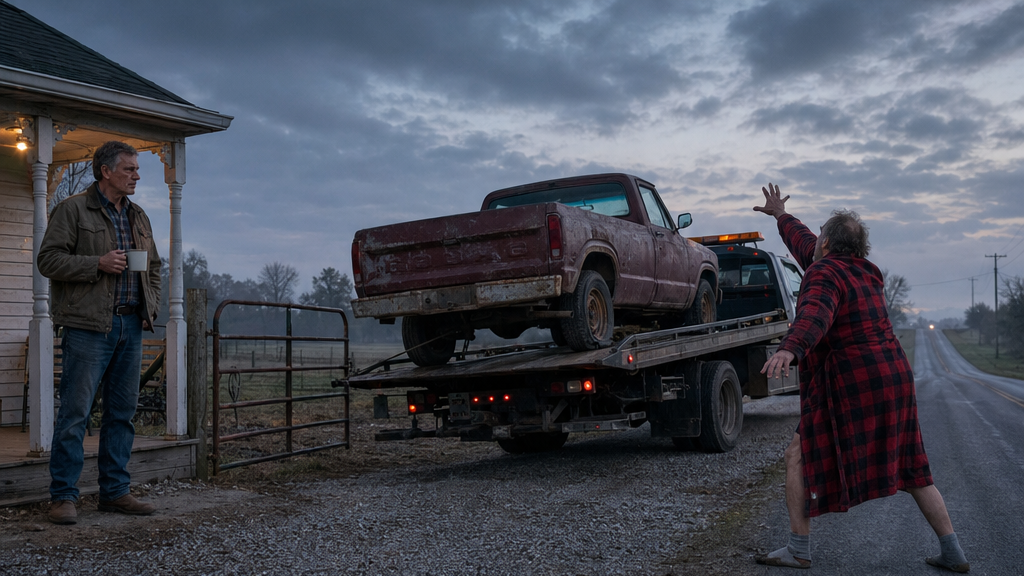
He Left His Dead Farm Truck Across My Cattle Gate—Then Dawn Brought the Tow He Never Expected
Chapter 1: The Truck Was Already Leaving at Dawn
By the time David Lewis came running down the gravel road in a flannel robe and sock feet, the tow truck was already moving.
I stood on my porch with a coffee mug warming both hands and watched him wave one arm over his head.
“Hold up!”
The flatbed driver either did not hear him or had no reason to stop. The truck rolled past my mailbox, diesel humming low in the gray light, carrying David’s old pickup at a steep angle behind the cab.
The pickup looked worse from the rear than it had beside my gate. Rust had eaten through the bottom edges of both quarter panels. The left rear tire was nearly flat. One mud flap hung by a single bolt.
David kept after it for another twenty yards before stopping in the road.
He bent over with both hands on his knees.
Then he looked back at me.
Even at that distance, I knew exactly what expression was on his face.
Eleven days earlier, I had been standing in almost the same spot when I first saw the truck.
It was a Tuesday morning. I had come out before six to check a mineral feeder and open the west pasture. When I walked around the side of the barn, something red-brown interrupted the familiar view through the cattle gate.
At first I thought David had stopped there temporarily.
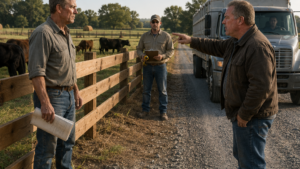
His property sat across the county road and slightly north of mine. People pulled machinery onto the widened gravel apron beside my gate from time to time. During harvest, a wagon might sit there ten minutes while another truck cleared the road. A neighbor hauling cattle might use the extra width to make a turn.
That kind of thing was normal.
This truck was different.
It sat crooked across the widest part of the apron, nose pointed toward the ditch, rear end close enough to the gate that a livestock trailer would have to swing wide around it.
The truck was old enough that the original paint had faded to a dull maroon. Rust had blistered along the wheel wells and cab corners. The bed held two tires, a length of chain, and what looked like a cracked plastic toolbox.
There were no plates on the front.
I walked around it once.
The rear plate was there, but the registration sticker had expired.
The left rear tire had gone soft enough that the sidewall bulged against the gravel.
I looked across the road.
David was standing outside his machine shed with a coffee cup.
He raised two fingers at me.
I raised mine back.
That was the whole conversation.
At the time, I told myself he was probably moving things around.
David had worked as a farm mechanic for years before his back started giving him trouble. His place always had something half-repaired near the shed: a mower deck, an auger, an old tractor hood balanced against a wall.
So I opened the gate, checked the pasture, and went to work.
By noon, the truck was still there.
By evening, it was still there.
The next morning, nothing had changed.
I caught David near his mailbox.
“That pickup staying there long?”
He glanced toward it as though he had forgotten which truck I meant.
“Nah.”
“I need that apron clear for trailers.”
“I’ll get to it.”
There are certain phrases people use in the country that can mean five minutes or five months.
I’ll get to it was one of them.
I should have said more.
I should have told him plainly that I needed it moved by a specific day because the gate served my cattle pens, the feed deliveries, and the south pasture.
Instead, I nodded.
“All right.”
That was my first mistake.
For years I had thought of myself as patient. My father had believed most neighbor problems could be settled at the fence line with ten calm words and no paperwork. He had lived by that rule long enough that people still brought him up after he was gone.
I suppose I wanted to believe I did the same.
But patience and avoidance look nearly identical from the outside.
On the third morning, the truck remained where David had left it.
On the fourth, rain darkened the rust along the hood.
On the fifth, the flat tire looked flatter.
Every time I passed the gate, I felt myself getting irritated all over again.
Instead of walking across the road and telling David exactly why it had to move, I began keeping score.
That was my second mistake.
I noticed how close the rear bumper sat to the gatepost.
I noticed the weeds beginning to stand upright around the tires.
I noticed that David mowed along his own ditch that Saturday and never went near the truck.
He saw me watching once.
“What?” he called.
I shook my head.
Nothing.
That word did more damage than an argument probably would have.
On the eleventh morning, a cattle buyer sent a driver to pick up twelve feeder calves.
I opened the gate before he arrived and moved the calves into the small holding pen beside the lane.
The livestock rig came from the south—a long pickup and gooseneck trailer, loaded light but wide enough that the driver needed nearly the full gravel apron to turn in cleanly.
He slowed.
I saw his brake lights.
Then he stopped in the county road.
The driver leaned out his window and pointed at David’s truck.
“You own that thing?”
“No.”
“You want me to try it?”
I looked at the ditch on one side, the truck on the other, and the line of cattle shifting behind the gate.
“Give me a minute.”
I walked to the truck and stood behind it, judging the space.
There was not enough.
Not safely.
The driver could have forced it, but his trailer wheels would have dropped close to the ditch. If a car came over the rise while he was backing and correcting, we would have half the road blocked.
He tried once.
The trailer came within a few feet of the truck’s rear corner before he stopped.
He rolled down the window.
“I’m not scratching somebody’s trailer—or somebody’s truck—for this.”
“I know.”
He backed into the road again.
A car had to stop behind him.
Then another.
The calves began bawling at the unfamiliar engine noise.
I stood in the apron watching a routine pickup become a road hazard because one neighbor had decided he would get around to moving a dead truck whenever it suited him.
That was the first moment I stopped thinking of it as irritating.
It had become a problem.
And for the first time in eleven days, I decided I was done waiting for David to solve it.
Chapter 2: Eleven Days Beside the Cattle Gate
That afternoon I put a chalk mark on the gravel beside David’s left rear tire.
I felt foolish doing it.
There was no mystery about whether the truck had moved. I had seen it every morning for eleven days.
Still, I crouched beside the wheel and drew a short white line where the rubber met the packed stone.
Then I took a photograph.
The act bothered me more than I expected.
My father would have walked across the road.
I took another photograph instead.
The next morning the chalk line matched the tire exactly.
I photographed it again.
I took a picture of the expired registration sticker through the rear glass. Another of the flat tire. Another showing the truck’s position relative to the gate.
When David came outside, he caught me standing near the bumper with my phone.
“You building a scrapbook?”
I slipped the phone into my pocket.
“I asked you to move it.”
“And I said I would.”
“That was almost two weeks ago.”
He hooked a thumb into the pocket of his work pants.
“It’s not hurting anything.”
“It blocked a cattle trailer yesterday.”
“He got in, didn’t he?”
“After backing onto the county road twice.”
David shrugged.
“He managed.”
That shrug stayed with me.
“Move it today.”
His expression changed slightly.
Not anger yet. More like surprise that I had finally given the request an edge.
“Robert, that apron’s been used by everybody since before you bought this place.”
“For turning.”
“For whatever people needed.”
“Not storage.”
“It’s a truck.”
“It hasn’t run since you put it there.”
“You don’t know that.”
I looked at the tire.
David followed my eyes.
He gave a short laugh.
“I’ll handle it.”
“When?”
“When I get to it.”
There it was again.
I could feel the answer I wanted to give him gathering in my chest, but habit won.
I turned away.
By then, I was documenting because it gave me something to do with my anger.
At breakfast I wrote down the dates.
Tuesday: truck appeared.
Wednesday: first request.
Saturday: still unmoved.
Following Friday: cattle pickup obstructed.
I saved the photos into a folder on my phone.
That afternoon a feed truck came with bulk supplement for the north lot.
The driver had been to my place enough times to know the turn. He slowed at the entrance, stared at David’s truck, then stopped before committing.
I went out.
He pointed.
“That yours now?”
“No.”
“I can back in from the road.”
“You shouldn’t have to.”
He looked at the soft shoulder opposite the apron.
“If I drop the outside wheel there, you’ll be pulling me out with a tractor.”
He was right.
He eventually backed past the gate, corrected twice, and entered at an angle that left tire tracks along the grass.
When he got out, he did not complain. He simply looked at the maroon pickup.
“That thing dead?”
“Pretty much.”
“Then somebody ought to decide where dead things belong.”
It was the sort of sentence that sounded like a joke until the truck left.
I called the county office that afternoon.
I almost hung up while the automated menu played.
Calling an office on a neighbor felt like crossing a line I had spent years trying not to cross.
Then I pictured the livestock trailer stopped in the road.
I stayed on.
The county code officer did not immediately give me the answer I wanted.
“Where exactly is the vehicle?”
“On the gravel apron at my cattle entrance.”
“Public right-of-way?”
“Part of the apron is inside my property line. The edge may overlap the road easement.”
“That matters.”
“I’ve got the deed.”
“You’ll need more than a deed if the location is disputed.”
I leaned back in my kitchen chair.
“What about an expired vehicle that hasn’t moved?”
“There are provisions for unregistered or apparently abandoned vehicles, but jurisdiction depends on where it sits.”
“How long?”
“If it qualifies, more than seventy-two hours can trigger notice and removal procedures.”
I looked toward the window.
The truck sat exactly where it had been all week.
“Mine’s been there eleven days.”
“Then document the condition and location. Don’t touch it yourself.”
I had no intention of touching it.
“What counts as abandoned?”
“Immobile condition helps. Expired registration helps. Duration helps. But if the owner disputes the land or claims permission, we verify.”
Permission.
I thought about David saying everybody had used the apron for years.
After the call, I dug through the filing cabinet in the back room.
The deed was where I expected it. The survey was not.
I found tax statements, fencing receipts, drainage work invoices, even the handwritten estimate for the gravel I had added six years earlier.
No survey.
Eventually I found an older photocopy folded inside a property insurance folder.
The lines were faint, but the southern boundary and road frontage were readable.
The widened apron appeared mostly within my parcel.
Mostly.
The outer edge disappeared into the county-road right-of-way.
That one word irritated me.
I had spent eleven days thinking the matter was simple: David put his broken truck where it did not belong.
Now I had a second question.
What if his claim about old shared use was not entirely nonsense?
I went outside before supper.
David was replacing a blade on his mower.
I stopped at the edge of his driveway.
“You said everybody used that apron.”
He kept working.
“They did.”
“For parking?”
“For equipment. Wagons. Trucks. Whatever.”
“Long-term?”
He tightened a bolt.
“You asking me or interrogating me?”
“I’m asking.”
“My dad used to pull wagons there waiting on the combine. Your dad did too.”
I had seen wagons there as a boy.
That much was true.
I had also seen people use it as a turning pocket, a place to wait while machinery cleared the road, somewhere to pull off during harvest.
I had never seen anybody leave a dead truck there for nearly two weeks.
“That doesn’t make it storage,” I said.
David straightened.
“And you taking pictures doesn’t suddenly make it sacred ground.”
I did not answer.
He wiped his hands on a rag.
“You could’ve just talked to me.”
For a second I nearly laughed.
“I have.”
“No. You asked me when I was moving it. That’s not the same thing.”
The irritating part was that there was enough truth in that to stop me.
I had asked.
I had hinted.
I had simmered.
What I had not done was tell him, plainly, that the obstruction was affecting livestock and commercial deliveries and that I needed it gone by a specific date.
David mistook my silence for flexibility.
I mistook his delay for disrespect.
Neither of those things excused the truck remaining there.
But the argument was no longer as clean as I wanted it to be.
That night I returned to the county website and searched through the vehicle and nuisance provisions until I found the relevant section.
Unregistered.
Apparently immobile.
Left beyond the allowable period.
Subject to notice and removal if located where county authority or verified property rights applied.
I read it three times.
Then I printed it.
At the bottom of the page, beside the contact information for enforcement, was a sentence that made the next step unavoidable.
Ownership or right-of-way disputes may require boundary verification before removal authorization.
I set the paper beside my photographs.
The truck had passed the time limit.
Now I had to prove where it was sitting.
Chapter 3: The Survey Line Did Not Settle Everything
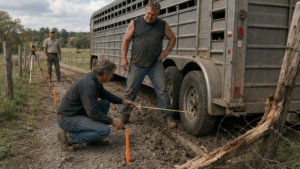
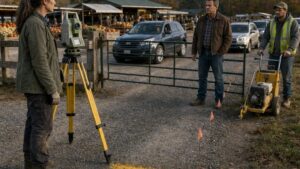
The survey technician pushed a fluorescent flag into the gravel less than a foot behind David’s rear axle.
I stared at it.
He checked the receiver in his hand, moved three steps toward the ditch, then came back.
“That’s your line projected to the road boundary.”
“So the truck’s on me?”
“Most of it.”
I looked at him.
“Most?”
He pointed toward the truck’s front corner.
“The apron widens into the county right-of-way. Your parcel line and the road easement aren’t the same thing. Rear half is clearly within your tract. Front edge sits in the road corridor.”
That was not the clean answer I had hired him to give me.
I knew enough about surveys to know they did not care what answer a landowner wanted.
“Can David claim it’s shared?”
“Claim? Sure. People claim all kinds of things.”
“Can he prove it?”
The technician pulled another flag from his vest.
“That’s a different question.”
He walked along the frontage placing markers.
The little flags made the truck look suddenly ridiculous, a rusted machine sitting in the middle of a geometry problem.
The technician eventually handed me a marked copy of the survey.
“Property’s yours to here. Road easement extends through here. Historic use isn’t something I determine.”
“So who does?”
“Depends what he’s claiming.”
That afternoon I drove to the county records office with the survey, deed, photographs, and printed ordinance in a manila folder.
The code officer spread everything across a counter.
He studied the pictures first.
“Flat tire?”
“Since before it showed up.”
“Registration?”
“Expired.”
“Moved at all?”
“No.”
“You document that?”
I showed him the dated photographs and the chalk line.
He nodded once.
Then he studied the survey.
“This helps.”
“Enough?”
“Enough to send notice and inspect.”
I had expected satisfaction.
Instead, I felt something closer to relief.
Finally, the problem belonged to a process instead of my temper.
The officer tapped the survey with one finger.
“There is an issue.”
Of course there was.
“The right-of-way.”
“I was told that.”
“Also this apron looks older than your current gravel.”
“It is.”
“How old?”
“I don’t know. Decades.”
“Shared use?”
“Turning. Harvest traffic sometimes.”
He looked at me.
“His side too?”
“Yes.”
The answer sounded like a concession.
It was not. It was simply true.
The old farm families along that road had always borrowed inches from one another when equipment got wide and roads stayed narrow.
Nobody wrote agreements for every wagon wheel.
The officer leaned back.
“Customary use doesn’t automatically give him storage rights. But if he says he had permission or a standing agreement, we have to sort that out.”
“He doesn’t.”
“Then we document that.”
When I got home, David was already standing beside the truck.
He had seen the fresh survey flags.
He looked at them, then at me.
“You really hired somebody.”
“I needed the line confirmed.”
“For that?”
“For the gate.”
“You know damn well we’ve all used this turnout.”
“Used it. Yes.”
He spread his hands.
“So what are we doing?”
“We’re not talking about a wagon waiting twenty minutes during harvest.”
“It’s a truck.”
“It’s an unregistered truck with a flat tire that hasn’t moved in eleven days.”
His jaw tightened.
“You call the county?”
“Yes.”
For the first time, he looked genuinely hurt rather than irritated.
“You called them before you came across the road?”
“I came across the road twice.”
“You asked when I was moving it.”
“That is coming across the road.”
“No, Robert. That’s you deciding the answer before the conversation.”
I hated how close that landed.
“You had eleven days.”
“And you had my number.”
“So did you.”
We stood there with the rusted pickup between us.
David kicked lightly at the gravel.
“My dad used that exact apron.”
“So did mine.”
“That mean anything to you?”
“It means they used it to work.”
His eyes came up.
“So now I don’t work?”
“That’s not what I said.”
“You don’t have to.”
There it was—the argument underneath the argument, though I did not understand it yet.
David had not been farming much since his back trouble worsened. He repaired equipment when people brought it to him, but fewer people did. His pasture had shrunk to a handful of acres. One shed needed roofing. Machinery that once moved every week now sat long enough for weeds to grow around it.
I had noticed.
I had never thought about what it might feel like to know your neighbor had noticed too.
Still, sympathy could not turn the truck into a harmless object.
“Move it tonight,” I said. “Anywhere on your side. I don’t care where.”
David looked at the flat tire.
Then at me.
“I said I’ll handle it.”
“When?”
His face closed.
“When I get to it.”
By then, the phrase no longer sounded vague.
It sounded deliberate.
The county officer came the following morning.
He photographed the truck, checked the plate, measured its position against the survey flags, and spoke with David across the road.
I stayed near the barn.
I could see David pointing toward the apron, then toward the road. The officer listened without interrupting.
Afterward he came to me.
“He says both families historically used this area.”
“They did.”
“You agree?”
“For temporary access.”
“That distinction matters.”
“What happens now?”
“He has until tomorrow morning to move it voluntarily.”
“And if he doesn’t?”
“We can authorize removal based on the vehicle condition, duration, and obstruction, assuming nothing changes.”
I glanced across the road.
David had gone inside.
“What time tomorrow?”
“Early.”
The officer gathered his paperwork.
Then he paused.
“For what it’s worth, he’s not claiming he owns your land.”
That surprised me.
“What is he claiming?”
“That you’re using paperwork to end something neighbors handled informally for years.”
I looked at the truck.
“Did you tell him informal use doesn’t mean he can leave that there indefinitely?”
“I told him exactly that.”
“And?”
“He didn’t disagree.”
That bothered me more than if he had.
If David knew the truck had no real right to remain there, then something besides the property dispute was keeping it in place.
“What did he say?”
The officer tucked the folder under his arm.
“He said he needed another day.”
“He’s had eleven.”
“I know.”
“Did he say why?”
The officer looked toward David’s house.
“No.”
By late afternoon, the tow authorization was prepared.
All David had to do was move the truck before morning.
I walked past it once before supper.
The survey flags trembled in the breeze beside the rusted rear quarter panel. Through the passenger window I could see an old pair of work gloves on the dashboard and a spiral notebook wedged beside the seat.
I had never noticed them before.
Across the road, David’s shed door stayed closed.
At six-thirty my phone rang.
For half a second I thought it was him.
It was the county officer.
“Everything’s approved. If that vehicle is in the same position at first light, removal proceeds.”
I looked out the kitchen window.
The truck had not moved.
“Understood.”
“You can cancel before dispatch if you two resolve it.”
After we hung up, I left the paperwork on the table.
For eleven days, I had wanted one simple thing.
Move the truck.
Now the county had given David a final night to do exactly that.
And for the first time since this started, I found myself wondering why he seemed more willing to lose the truck than to move it.
Chapter 4: What David Would Not Say About the Truck
Sarah Lewis came up my driveway carrying a truck key.
Not a key ring. Not her purse. Just one worn brass key between her fingers, the metal darkened where somebody had handled it for years.
I was closing the barn when she stopped near the gate.
“Before tomorrow,” she said, “there’s something you ought to know.”
I looked toward the road.
David’s truck had not moved.
The survey flags still stood around it, bright against the rusted body. The county officer’s notice was tucked beneath the driver-side wiper.
“If David sent you to ask me to cancel it—”
“He didn’t send me.”
Sarah looked back toward their house.
“He doesn’t know I’m here.”
That stopped me.
She held out the key but did not give it to me.
“This was his dad’s.”
I had assumed the truck had come from one of David’s old repair jobs. He had collected enough worn-out equipment over the years that I had never thought to ask.
“His father’s truck?”
She nodded.
“He bought it used when David was still in school. Kept it after everything else got traded off. David learned to drive in it. Learned to pull a wagon with it. Probably learned half of what he knows about engines leaning over that hood.”
The anger I had been carrying did not vanish.
But it changed shape.
“Why put it beside my gate?”
“Because he moved it out of the shed.”
“Why?”
Sarah rubbed her thumb across the worn head of the key.
“The shed roof leaks. He was making room for a tractor somebody brought him. He thought the truck would be outside a day or two.”
“That was twelve days ago.”
“I know.”
“He could have moved it across the road.”
“He tried.”
I glanced at the flat tire.
“With what?”
“Battery’s dead. Fuel pump’s bad. Rear brake’s hanging up.”
“So he parked a truck he knew he couldn’t move.”
“He rolled it out with the tractor.”
“And now?”
Sarah looked down.
“Now the tractor’s got a hydraulic leak, and he doesn’t want to ask anybody for help.”
I almost said that was not my problem.
The words reached the back of my teeth and stopped there.
Sarah seemed to know them anyway.
“I’m not telling you it is.”
“Then what are you asking?”
“Nothing.”
That answer irritated me more than a request would have.
“You came over here the night before a tow with the key to a truck he won’t move. You’re asking something.”
She was quiet for a moment.
Then she said, “I’m asking you to understand why he’s acting like an idiot.”
Despite myself, I gave a short breath that might have been a laugh.
Sarah’s mouth tightened.
“He knows it needs to go. That’s the worst part. He knows.”
“Then he has until morning.”
“He knows that too.”
The sun had dropped behind the machine shed, leaving the truck’s windshield black. From where we stood, I could just make out the spiral notebook wedged beside the passenger seat.
I pointed toward it.
“What’s in the notebook?”
Sarah followed my hand.
“His dad’s maintenance book.”
That explained why it had looked too old for anything David would normally keep in a vehicle.
“Oil changes, part numbers, repairs. Mileage. Notes about what was making noise and what he thought it might be.” She smiled briefly. “Half of it probably makes no sense to anybody but them.”
“And the tools?”
“His father’s too.”
The pickup stopped looking like scrap for a moment.
Not because it had changed. Rust still ran through the wheel wells. The tire still sagged into the gravel. The registration was still years out of date.
But now I could see another version of the thing: a man’s hands opening the hood, a boy standing beside him, both of them writing down what they fixed so they would remember next time.
Sarah turned the key over.
“When his dad died, David said he was going to restore it.”
“How long ago?”
“Five years.”
I looked at her.
She nodded.
“That’s what I mean.”
“He hasn’t started.”
“He’s started a hundred times.”
There was no accusation in her voice.
“He bought brake parts. Then sold them when we needed money for taxes. Found a used seat. Never picked it up. Priced body work and never called the shop back.”
“Why not sell the truck?”
“He says he will.”
“Scrap it?”
“He gets angry if I use that word.”
I understood something then that the survey could never have told me.
David was not fighting to keep the truck on my land.
He was fighting against making a decision about the truck at all.
If it stayed where it was, nothing had to be decided. It was not restored, but it was not gone. Not repaired, not sold, not scrapped.
Just waiting.
Like he was.
Sarah finally put the key in her coat pocket.
“I told him yesterday that leaving it there isn’t saving it.”
“What’d he say?”
“That I didn’t understand.”
“Do you?”
“No.”
Her answer came without hesitation.
“I just understand what he’s doing to himself.”
A light came on in David’s kitchen across the road.
Sarah saw it.
“He’ll be mad I came over.”
“Probably.”
“He’ll be madder if he finds out I told you.”
“Probably.”
She looked at me directly.
“Don’t let him put it back.”
I had not expected that.
“What?”
“If it gets towed, don’t let him bring it back to the apron.”
“I wasn’t planning to.”
“I mean it. Don’t give in because you feel sorry for him.”
The words landed strangely.
All evening I had imagined that learning some hidden reason would force me into a clean moral choice: mercy or enforcement.
Sarah refused to give me that escape.
“You want me to leave the tow in place?”
“I want David to make a decision. And apparently he won’t until somebody takes away the option of doing nothing.”
I looked toward the truck again.
“If he gets it onto his property tonight, the tow stops.”
“I know.”
“Tell him.”
“I already have.”
Sarah started down the drive.
At the road she turned.
“For what it’s worth, Robert, you should’ve told him sooner how serious the gate problem was.”
The remark caught me off guard.
“I asked him to move it.”
“You asked like you were asking whether he wanted more coffee.”
“That’s how people around here talk.”
“That’s how men around here avoid talking.”
Then she crossed the road.
I stood alone beside the barn.
Her last sentence bothered me because it sounded too much like something my wife used to say when my father was alive and the two of us could go an entire afternoon repairing fence without discussing the thing we were actually angry about.
I went inside.
The tow authorization lay on the kitchen table.
Beside it sat my photographs, survey, printed ordinance, and county notice.
Evidence.
Everything I had wanted.
I could call and cancel. If I did, the truck might still be there next week. Or David might find somebody with a tractor and move it tomorrow. I did not know.
What I did know was that the gate had already been blocked twice.
I picked up my phone.
For several seconds I looked at the county officer’s number.
Then I set the phone back down.
At ten that night I checked the window.
The truck was still there.
At midnight, still there.
I slept badly.
Before turning off the kitchen light, I left the tow request active.
The decision no longer felt like victory.
It felt like a boundary I should have drawn eleven days earlier.
Chapter 5: Seven Minutes on the Gravel Apron
At 5:47 the tow driver slid the first chain beneath David’s truck.
Metal scraped against gravel.
I stood on the porch with coffee I had barely touched.
The driver had arrived without lights flashing, just the low diesel rumble of the flatbed and the white beam of its work lamps across the apron.
He checked the county paperwork with me once.
“That the vehicle?”
“Yes.”
“Owner notified?”
“Yesterday.”
He nodded.
That was all.
No dramatic discussion. No argument. Just procedure.
The driver crouched beside the rear axle, fed another chain underneath, then stepped back to operate the winch.
The cable tightened.
For twelve days the truck had seemed rooted beside my gate.
Now it moved six inches.
The flat tire dragged a shallow groove through the gravel.
I felt something in me loosen with it.
The driver paused.
“Brake’s hanging.”
“I heard.”
“May fight me.”
He repositioned the chain.
The winch pulled again.
The truck came forward another foot, reluctantly at first, then steadily.
Its front end lifted onto the bed.
I glanced toward David’s house.
Dark.
Sarah had said he knew.
I had expected him to move it overnight. Some part of me had almost counted on it.
But he had done exactly what he had done for twelve days.
Nothing.
By 5:51 the truck’s rear wheels reached the base of the flatbed.
The driver adjusted his angle.
The old suspension creaked.
Then a porch light came on across the road.
I saw a figure behind David’s front door.
The door opened.
David stepped outside.
For one second he simply stood there.
He wore a red-and-black flannel robe, pajama pants, and gray socks with no shoes.
The sight would have been funny under any other circumstances.
Then he saw the pickup halfway onto the flatbed.
“Hey!”
The tow driver kept working.
David came down his steps fast.
“Hey! Stop!”
He crossed his yard, hit the road, and started toward us.
The driver looked at me.
“Owner?”
“Yes.”
“Everything’s authorized?”
“Yes.”
He returned to the controls.
David was running now.
Not well. His back had never fully recovered, and he moved with a stiff hitch in one leg, but panic pushed him faster than I had seen him move in years.
“Robert!”
I set the coffee mug on the porch rail.
He reached the apron breathing hard.
“What are you doing?”
“You had notice.”
“I said I’d handle it.”
“The deadline passed.”
He looked at the truck.
The rear wheels were climbing the bed.
“Stop it.”
“I’m not operating the truck.”
“Tell him to stop.”
The driver glanced over.
“I have county authorization. If you want to contest removal, the number’s on the notice.”
David ignored him.
“Robert.”
There was something in his voice that had not been there during any of our arguments.
Fear.
I remembered Sarah holding the key.
“I told you to move it anywhere on your side.”
“I needed time.”
“You had twelve days.”
“You know what that truck is.”
“I know now.”
His face changed.
“Sarah told you.”
I did not answer.
“That wasn’t hers to tell.”
“She didn’t ask me to stop this.”
That hurt him visibly.
For a moment he forgot to be angry.
Then the winch clicked off.
The pickup sat fully on the flatbed.
The driver began fastening the wheel straps.
David walked toward him.
“Give me five minutes. I’ll get my tractor.”
“You said it has a hydraulic leak,” I said.
His head snapped toward me.
“So she told you everything.”
“No. Enough.”
“I can get another tractor.”
“Then why didn’t you?”
He stared at me.
There was no good answer, and we both knew it.
The driver tightened the final strap.
“You need anything out of the vehicle before I leave?”
David looked at the cab.
For one terrible second I thought he might climb onto the flatbed.
Instead he said, “My tools.”
The driver checked the paperwork.
“You can retrieve personal property at the yard. I can’t unload now.”
David turned to me.
“You did this on purpose.”
“Yes.”
The truth came out before I could soften it.
He blinked.
I continued.
“I documented it. I called the county. I left the request active.”
His face reddened.
“At least you admit it.”
“I also gave you every chance to move it.”
“You wanted this.”
That accusation struck closer than I liked.
Had I wanted the gate clear?
Yes.
Had I wanted David to finally face a consequence?
By the tenth day, probably.
That was harder to admit.
“I wanted it moved.”
“No. You wanted to prove you could make me move it.”
The tow driver climbed into his cab.
The diesel changed pitch.
David heard it.
He turned away from me.
“Wait!”
The flatbed eased forward.
David followed.
“Hold up!”
The truck entered the county road.
David walked faster.
Then ran.
His robe flapped behind him.
One sock began slipping from his heel.
He waved both arms.
The flatbed kept moving.
For twenty yards David chased it down the road in his socks, calling after a truck he had spent five years refusing to make a decision about.
At the bend, he stopped.
The flatbed continued north.
I looked at the empty apron.
The gravel underneath the pickup was darker than the rest. A rectangle of flattened weeds marked where it had sat. The fluorescent survey flags stood unobstructed now.
For the first time in twelve days, I could see the full opening of my cattle gate.
I should have felt satisfied.
I did, for perhaps ten seconds.
Then David walked back.
One sock was soaked dark from the roadside grass. His breathing was ragged.
“You happy?”
“No.”
“Could’ve fooled me.”
“I needed the gate open.”
“You got it.”
He pointed at the empty space.
“All yours.”
“That’s not what this is.”
“That’s exactly what it is.”
He started across the road.
“David.”
He stopped without turning.
“The county office has the yard information.”
He laughed once.
“You think I need directions?”
“I’m telling you because—”
“Because you’re helpful?”
He turned then.
“You know what my dad would’ve done if your father left something in his way?”
I said nothing.
“He would’ve walked over and said, ‘Move your junk, Bill.’ And your dad would’ve moved it.”
“My father wouldn’t have left it there twelve days.”
“Maybe. Maybe not.”
David’s voice dropped.
“But neither one of them would’ve built a case file.”
That landed harder than the shouting.
He crossed the road and went inside.
At six-fifteen a livestock trailer came from the south.
The driver slowed at the gate.
With the truck gone, he swung wide across the apron and entered cleanly in one motion.
No backing.
No stopped traffic.
No tires near the ditch.
The practical problem was over.
I watched him pull toward the pens and told myself that was the only measure that mattered.
But when I picked up my coffee, it had gone cold.
By seven-thirty, my phone rang.
David.
I let it stop.
At seven-forty-two, again.
At seven-fifty-eight, a third time.
At eight-eleven, a fourth.
I stared at his name until the ringing nearly ended.
Then I answered.
“What?”
His voice was controlled now, which somehow sounded worse.
“They want a tow fee before they’ll release it.”
“That’s normal.”
“And storage starts today.”
“I assume so.”
“You’re paying it.”
“No.”
“You called them.”
“You left the truck.”
“You put it in motion.”
“I told you the deadline.”
“You’re paying it, Robert.”
“No.”
Silence.
Then he said, “This isn’t finished.”
The line went dead.
I stood in the kitchen with the phone still against my ear.
The gate was open.
The truck was gone.
And somehow the space it left behind felt less settled than it had when the truck was still there.
Chapter 6: The Bill Was Not the Hardest Part
David’s first question when he came to my porch three days later was not where the truck had been taken.
It was, “Do you know how much you’ve cost me?”
He held a folded sheet of paper in one hand.
I did not invite him inside.
“How much?”
“Tow, processing, storage. And it goes up every day.”
“That’s why you should get it out.”
His jaw tightened.
“You still think this is funny.”
“I never said it was.”
“You stood there drinking coffee.”
“I stand there drinking coffee every morning.”
“You watched them take my father’s truck.”
There was no useful answer to that.
David unfolded the paper and held it toward me.
“I want you to pay half.”
“No.”
“Half, Robert.”
“No.”
“You could have canceled.”
“You could have moved it.”
“With what?”
“Ask me.”
The words surprised both of us.
David lowered the bill.
“What?”
“You could have asked me.”
“For what?”
“A tractor. A chain. Help.”
His face hardened immediately.
“I didn’t need your help.”
“Apparently you did.”
There it was again—the place where truth became insult because of how it was said.
David folded the paper smaller.
“You know what? Keep your help.”
He turned away.
“David.”
He stopped.
“I’m not paying the bill.”
“I heard you.”
“But I’m also not pretending I handled everything perfectly.”
That brought him halfway around.
I forced myself to continue.
“I should have told you the first week that if the truck wasn’t gone by a certain day, I was calling the county.”
“You think that fixes it?”
“No.”
“Good.”
He walked off.
Two days later I drove past the impound yard on my way to pick up fencing staples.
David’s truck sat behind chain-link fencing near the back of the lot.
Seeing it there was different.
Beside my gate, it had looked like an intrusion.
Behind the fence, surrounded by wrecked cars and abandoned trailers, it simply looked old.
The rust seemed worse.
For a moment I could picture David’s father behind the wheel when the paint was still red.
I kept driving.
That afternoon Sarah stopped at the mailbox while I was checking a culvert.
“He went down there,” she said.
“To the yard?”
She nodded.
“Got the toolbox out.”
I waited.
“And the notebook?”
“That too.”
Something in my chest eased.
“What about the truck?”
“He signed paperwork saying it won’t come back to your apron.”
“That’s something.”
“He’s deciding whether to tow it home or sell it to the parts yard.”
I looked across the road.
David’s shed doors were open.
Inside, there was an empty space near one wall.
Sarah followed my eyes.
“He spent yesterday clearing a place.”
“So he could have made room.”
“Yes.”
Her answer held no triumph.
“He just couldn’t make himself do it before.”
I nodded.
Sarah looked toward my gate.
“You two are more alike than either of you wants to admit.”
“I moved my truck.”
She gave me a tired look.
“That’s not what I mean.”
A week after the tow, David caught me repairing a strand of fence near the road.
He stood on his side.
“I told the yard they can sell it if the parts place will take it.”
I set the fencing pliers down.
“That’s probably the cheapest way out.”
“I didn’t ask.”
“Right.”
He looked at the clear apron.
“You know that gravel isn’t some private driveway.”
“We covered this.”
“No. The county covered where your line is. I’m talking about use.”
“What about it?”
“My dad used it. Your dad used it. I’ve used it twenty years.”
“For turning.”
“For whatever needed doing.”
“Not anymore.”
David’s eyes narrowed.
“So that’s it?”
“For storage, yes.”
“No wagons?”
“I didn’t say that.”
“Equipment?”
“If it’s temporary.”
“How temporary?”
I almost said, You know what temporary means.
Then I stopped.
That was exactly how this had started.
“Ask me first.”
He gave a bitter smile.
“Now I need permission to turn around.”
“That’s not what I said.”
“You keep saying that.”
He had me there.
I took off my gloves.
“All right. Emergency access, turning, harvest traffic—fine. Leaving equipment overnight, ask first. Storage, no.”
David considered it.
Then his expression changed.
“Funny how rules matter when they’re yours.”
“What’s that supposed to mean?”
“It means don’t come through my west gate anymore.”
I stared at him.
For years, when my lower pasture was muddy, I had occasionally crossed a short section of David’s lane to reach the far fence line. David used my apron. I used his gate.
Nobody had written any of it down.
“You serious?”
“Your property, your rules. My property, mine.”
“Fine.”
“Good.”
He walked away.
At first I told myself I did not care.
Then, three days later, a storm came through hard enough to drop a cottonwood limb across the lower fence.
By morning, three posts were leaning and cattle were nosing the damaged wire.
The pasture lane on my side had turned to slick mud.
I loaded posts, wire, and tools onto the utility trailer and tried it anyway.
The tractor made it halfway down the slope before the rear tires began sliding.
I backed out.
There was another route.
Through David’s west gate.
Normally I would have opened it, crossed the hundred yards of firm ground, repaired the fence, and been done before lunch.
Now the gate had a fresh chain through it.
Not locked.
Just closed deliberately.
I sat on the tractor looking at it.
The irony was almost embarrassing.
A week earlier, I had insisted that old customs did not excuse leaving something on my land.
Now the easiest way to protect my cattle depended on an old custom across his.
I could haul everything by hand.
Three posts, wire, tools, brace material.
Possible.
Stupid, but possible.
The sky to the west was darkening again.
Another round of rain was forecast by afternoon.
One of the cows pushed her nose against the sagging fence.
I shut off the tractor.
For several minutes I sat there listening to the engine tick as it cooled.
Then I climbed down.
I could walk around the road and ask David.
The thought bothered me more than calling the county ever had.
Not because I believed he would refuse.
Because for once, I would have to say exactly what I needed before resentment had time to say it for me.
Chapter 7: A Clear Gate and a Different Kind of Boundary
David was standing beside his west gate when I came up the road.
The chain still hung through the latch.
He saw me before I reached him, but he did not move to open it.
For a moment neither of us spoke.
Behind me, the tractor sat where I had left it near the muddy pasture lane. Beyond the damaged fence, cattle crowded the sagging wire, curious about the gap. Another band of rain was moving in from the west.
David glanced toward the field.
“Fence down?”
“Part of it.”
“How bad?”
“Three posts. Maybe four if the ground gives way.”
He looked at the sky.
“You’re going through there?”
“I’d like to.”
His eyes returned to me.
There it was.
The request.
Not implied. Not disguised as a complaint. Not buried inside a question that expected him to read the rest.
“I need to cross your lane with the tractor and trailer,” I said. “Probably twice. I can be out in an hour.”
David rested one hand on the gatepost.
“Thought my property was mine.”
“It is.”
“And yours is yours.”
“Yes.”
He waited.
I knew exactly what he wanted.
Not an apology for the tow. Not really.
Clarity.
“I should’ve done this with you from the beginning,” I said.
His expression barely changed.
“Done what?”
“Asked plainly. Told you plainly.”
David looked past me toward my cattle gate across the road.
The gravel apron was empty now. No maroon truck. No tow marks except a faint scrape where the flat tire had dragged.
“You were pretty plain when the county showed up.”
“That was late.”
He gave a small nod.
It was not forgiveness.
But it was the first thing that felt like agreement.
I continued.
“The truck needed to move. I’m not changing my mind about that.”
“I didn’t ask you to.”
“I also should’ve told you on day one that I needed the gate clear for cattle trailers and feed trucks, and that I wasn’t going to let it sit there indefinitely.”
David rubbed a thumb along the gate chain.
“Would’ve been useful.”
“Yes.”
“You just kept getting quieter.”
“I know.”
“And taking pictures.”
“I know.”
That almost produced a smile.
Almost.
Then he pulled the chain free.
The gate swung inward.
“Two trips?”
“Probably.”
“You leave ruts, you fill them.”
“Fair.”
“You break the latch, you fix it.”
“Fair.”
He stepped aside.
I started back toward the tractor.
“Robert.”
I turned.
David still held the chain.
“That’s what I meant before.”
“What?”
“Not that I owned your apron.”
The admission came so simply that it took me a second to understand it.
“I know where your line is,” he said. “Always did, mostly.”
“Then why argue the survey?”
“Because once those flags went in, it felt like you were saying none of the old stuff counted anymore.”
“What old stuff?”
“You using this gate. Me swinging a wagon on your gravel. Your dad pulling through our place when the creek came up. My dad parking the combine on your side while he changed a belt.”
He looked toward the road.
“Nobody asked permission every time.”
“No.”
“That’s all I meant.”
I thought of the county officer telling me David had never claimed ownership.
“You still couldn’t leave the truck there.”
“I know.”
This time there was no argument attached.
I waited.
David looked down at the chain in his hand.
“I had nowhere else I wanted to put it.”
Not nowhere else.
Nowhere else he wanted to put it.
That was the deeper truth Sarah had been trying to explain.
“The shed?” I asked.
“Full.”
“Your back lot?”
“Would’ve sunk in.”
“Beside the machine shed?”
He shrugged.
“Could’ve.”
“But then you’d have had to decide what came next.”
His jaw tightened, but he did not deny it.
“I kept thinking I’d get it running.”
“You still could’ve moved it.”
“I know.”
The words sounded different now.
Not surrender.
Recognition.
I drove through his gate ten minutes later.
The ground on his side was firm enough to carry the tractor and trailer. I crossed the short stretch, entered my lower pasture from the back corner, and reached the damaged fence without cutting fresh ruts through my muddy lane.
The repair took longer than I expected.
One post had snapped below ground. Another leaned loose in saturated soil. I pulled both, reset three, stretched new wire, and reinforced the corner brace while the cattle watched from twenty yards away.
Halfway through, David appeared with a post driver over one shoulder.
“I’m not helping,” he said.
“Of course not.”
“You’re just old and slow.”
“Put it down.”
He did.
We worked mostly without talking.
That part came naturally.
He held a post steady while I aligned it. I tightened wire while he reset a brace. When the first rain began ticking against the tractor hood, we had the fence standing again.
On the way back, I stopped the tractor beside his gate.
David was closing it behind the trailer.
“I’ve been thinking about the access.”
He looked suspicious immediately.
“That sounds dangerous.”
“Emergency access stays open between us.”
He said nothing.
“Turning too. Harvest traffic. Same as before.”
“And overnight?”
“Ask.”
“Equipment?”
“If it’s staying, ask.”
“Storage?”
“No.”
David gave a short laugh.
“At least that one’s clear.”
“I’d like yours the same way.”
“My gate?”
“All of it. If I need to cross, I ask unless it’s an emergency.”
He studied me for a moment.
“Could write it down.”
I almost objected on instinct.
Then I remembered where assumptions had gotten us.
“Fine.”
That evening I wrote one page at the kitchen table.
Nothing legal-looking. No county language. No survey references.
Temporary turning and harvest access remained allowed.
Emergency access remained open.
Overnight equipment required a call or conversation first.
No long-term storage without permission.
The same terms applied both ways.
The next morning David came over.
I had two coffee mugs on the porch rail.
He noticed.
“Trying to buy me off?”
“Coffee’s cheaper than towing.”
That got the first real laugh from him since the truck disappeared.
He read the page standing up.
“You put ‘emergency’ in here.”
“Fence. Livestock. Fire. Storm. Somebody stuck.”
“What about broken machinery blocking the road?”
“That too.”
He nodded.
“And if one of us needs a turnout for harvest?”
“Use it.”
“Overnight?”
“Call.”
He took the pen.
Before signing, he looked toward the gravel apron.
The truck had left a pale rectangular patch where sunlight had not reached the stone for nearly two weeks.
“I sold it to the parts yard.”
I did not ask how much.
“Kept the toolbox?”
“Yes.”
“The notebook?”
“Yes.”
His hand went into his jacket pocket.
When it came back out, he was holding the old brass truck key.
Sarah had shown it to me the night before the tow.
David rolled it between his fingers.
“They gave me the ignition cylinder if I wanted it.”
“You want it?”
“No.”
He looked at the key.
“This is enough.”
He signed the page.
I signed beneath him.
Neither of us called it an agreement between friends.
That would have been dishonest.
Some things had been damaged.
The tow bill still existed. So did the things we had said beside the flatbed. I suspected David would remember the sight of his father’s truck leaving on that trailer for a long time.
I would remember that I had watched it happen while holding coffee and telling myself procedure made every part of it clean.
But the gate was clear.
His west gate was open when I needed it.
And neither of us had to guess anymore where temporary use ended and taking advantage began.
David finished his coffee and walked toward the road.
At the empty apron, he stopped.
For a few seconds he looked at the spot where the maroon truck had sat.
Then he slipped the old key into his pocket.
I drove the tractor through his west gate one last time to retrieve a roll of wire I had left near the repaired fence.
David stood beside the post until I passed.
Afterward he swung the gate shut.
The latch clicked.
Then he looped the chain through it—not as a warning, not as a challenge, just the way a gate was supposed to be left when nobody needed it open.
The story has ended.