They Tore Through His Farm Drainage Strip, Then Learned Five Extra Feet Changed Who Controlled the Land
Chapter 1: The Tracks Ran Past the Old Fence Line
The first track ended where Scott Thompson knew no track was supposed to be.
He stopped his pickup beside the lower hayfield and stared through the windshield at two bands of black soil cut through the spring grass. They came through the open service gate, followed the drainage channel for a short distance, then widened toward the west until one set of tracks crossed the line where his old woven-wire fence had stood that morning.
Three fence posts were down.
A fourth leaned toward the ditch with wire twisted around its base.
Scott shut off the engine.
An excavator sat fifty yards away with mud packed into its steel tracks. Beside it, the drainage contractor’s pickup was parked on flattened grass. The operator stood near the channel watching another worker clear branches from a culvert.
Scott got out without calling to them.
He walked first to the fence.
One cedar post had split near ground level. Fresh wood showed pale against its weathered gray surface. A length of irrigation pipe that fed a stock-water line near the pasture had been crushed into an oval beneath a machine track. Farther ahead, the outer roots of a windbreak tree were exposed where the excavator had turned.
The tree bothered him most.
It had been planted after an ice storm years earlier, when the west side of the farm had seemed too open. It was not enormous, but it had taken long enough to become part of the place.
Scott pulled out his phone.
He photographed the pipe.
The broken posts.
The ruts.
The stripped bark where equipment had brushed the tree.
Then he stepped backward and took a wider picture showing the drainage channel on one side and the damage spreading into his hay ground on the other.
The operator finally walked toward him.
“Morning, Scott.”
Scott kept the phone raised. “Who told you to come this far over?”
The man looked back toward the excavator. “We’re cleaning the association drainage.”
“I can see what you’re cleaning.”
The operator’s expression tightened. “This is the regular access.”
Scott lowered the phone.
“The regular access is along the ditch.”
“That’s where we are.”
Scott looked down at the deepest track beside his boots.
“No,” he said. “That’s where part of you is.”
The operator glanced at the ground as if the distinction were smaller than Scott was making it.
“We needed room to swing around the blockage.”
“And the fence?”
“We took enough down to get through. We’ll put something back.”
“Something?”
The man rubbed the back of his neck. “You need to talk to the association. Kathleen authorized the work.”
That name changed the shape of the problem.
Kathleen Roberts chaired the small road-and-drainage association shared by farms along the county road and the lower watershed. Scott had sat through enough winter meetings with her to know how she handled disputes: first as an operating problem, then as a paperwork problem, and only afterward as a human one.
“Did she tell you to drive across my hay?”
“She said use the same route as always.”
Scott stared at him.
“As always.”
“That’s what she said.”
Scott looked toward the ditch. Somewhere under the new mud and flattened grass was an old iron survey pin he remembered seeing when he was younger. His father used to warn him not to catch a mower blade on it. Scott had not thought about the pin in years.
He stepped toward the approximate spot.
The ruts ran past it.
How far, he could not tell.
Not yet.
He resisted the urge to order the excavator off immediately. The words were already in his throat, but sending the crew away would leave Kathleen an easy argument: Scott Thompson had stopped drainage maintenance before anyone could determine what had happened.
Instead he said, “Finish what you’re doing inside the ditch. Don’t move another foot farther into my field.”
The operator studied him. “You want me to call Kathleen?”
“I’ll call her.”
Scott spent the next forty minutes documenting everything.
He measured the broken irrigation pipe with a tape from his truck. He counted damaged posts and photographed each one. He placed a boot beside the deepest rut for scale and measured nearly seven inches from the undisturbed grass to the compacted bottom.
At the windbreak, he crouched and touched torn bark with two fingers.
Mud had been pressed against the trunk.
He took another photograph.
By the time he called Kathleen, he had written a list on the back of an old feed receipt.
Fence.
Pipe.
Hay ground.
Tree.
Ruts.
Possible reseeding.
She answered on the fourth ring.
“Scott.”
“Your drainage contractor is on my place.”
“I know.”
“They’re outside the route.”
A pause.
“They’re performing scheduled maintenance.”
“They knocked down fence and crushed a water line.”
“Have you spoken to the contractor?”
“I’m speaking to you because he says you authorized the route.”
“I authorized necessary access.”
Scott looked at the tracks cutting across the hay.
“Necessary and mine aren’t the same thing.”
Kathleen exhaled, not loudly, but enough for him to hear her impatience.
“We’ve had two years of drainage complaints along that channel. That culvert backs up again, Laura’s lower ground takes water and so does the road shoulder. I wasn’t going to have another season where everybody asks why we didn’t maintain it.”
“I’m not asking why you’re maintaining it.”
“Then what are you asking?”
“Why your equipment is where it has no business being.”
Another pause.
“Submit the damage through the association,” she said. “Pictures, estimates, whatever you have. We’ll review it.”
Scott looked at the broken tree.
“And until then?”
“The crew needs to finish today’s work.”
“Inside the route.”
“Scott, they’ve used that access for years.”
He almost answered immediately.
Instead he looked again toward the half-buried iron pin.
“That’s what the operator said.”
“Because it’s true.”
Scott ended the call before anger could turn into something less useful.
By late afternoon the excavator was gone. The channel was clearer, but the farm looked worse.
Scott walked the damaged strip one more time before going inside. Near the old fence line he found the survey pin beneath a mat of dead grass and mud. Only the rounded rust-dark top showed.
He scraped it with his boot.
The machine track was plainly beyond it.
Whether the pin actually marked the easement edge, he could not remember.
Inside the farmhouse, he pulled a metal file box from the bottom of a closet. Old tax statements, insurance papers, closing documents, farm maps.
He had kept too much because his father had thrown away almost nothing.
An hour later Scott found the deed.
The legal description ran across several dense paragraphs. He followed the lines with one finger until a phrase caught him.
Drainage maintenance easement.
Then another.
A stated width.
Scott leaned closer to the paper.
For the first time that day, the broken fence stopped being the question.
The width was.
Chapter 2: The Claim Came Back With One Sentence
Four days later, the association’s answer arrived in an envelope thin enough to tell Scott there was no check inside.
He opened it at the kitchen table.
The first page acknowledged his photographs and repair estimates. The second contained the decision.
The association accepted no liability because the contractor, it said, had operated within authorized drainage access.
Scott read the sentence twice.
Then he laid the paper beside the estimate for replacement fencing, the irrigation repair, reseeding, grading, and assessment of the damaged tree.
He had not inflated anything.
If anything, he had left out his own labor.
Kathleen’s signature appeared at the bottom.
Scott picked up his phone, found her number, and stopped before pressing call.
The refusal annoyed him.
Calling while annoyed would satisfy him for five minutes and help her for the next five months.
He folded the letter and carried it outside.
The rust-dark survey pin was easier to find now that he knew where to look. He knelt with a screwdriver and scraped packed soil from around it until several inches of iron showed.
Ten yards away, the deepest excavator rut had dried into a hard ridge.
Scott went back inside for the deed.
The wording was clearer than he remembered from Monday night. The easement followed the drainage line across a described portion of the property. It was not simply “access as needed.”
A width was specified.
Ten feet.
Scott sat on the porch step with the deed across one knee.
Ten feet from what reference line was the part he did not trust himself to interpret.
He called the county records office.
The clerk told him she could provide copies of recorded instruments tied to the parcel but could not give him legal advice. Scott told her he did not want advice.
“I want to know whether anything widened that drainage easement after this deed.”
“That’s something we can check in the chain.”
He drove into town before lunch.
The records office occupied part of an older county building where the floors still carried the dull shine of decades of shoes. The clerk brought up the parcel index and worked backward through transfers, easements, releases, and amendments.
Scott stood on the other side of the counter.
One record involved utility access.
Another concerned a boundary correction from years before he bought out his siblings.
Nothing changed the drainage width.
The clerk turned the monitor slightly toward him.
“I’m not seeing a recorded expansion.”
“Nothing from the association?”
“Not under this parcel.”
“Could there be something somewhere else?”
“There can always be something indexed differently, or an unrecorded agreement somebody claims exists. But as far as the recorded chain I’m looking at, the drainage instrument hasn’t been widened.”
Scott nodded.
That was more useful than a victory.
It was something measurable.
At home he laid the copied records beside Kathleen’s denial letter. For the first time, the association’s sentence looked less final than careless.
Authorized drainage access.
That phrase depended on where the access actually ended.
He was making coffee when another envelope appeared in the mailbox the following afternoon.
This one was heavier.
The association warned him not to interfere with scheduled maintenance activities or obstruct contractors exercising established access rights. Future interference, it said, could expose him to costs associated with delays or drainage damage.
Scott read it standing beside the mailbox.
By the time he reached the farmhouse, his jaw hurt from holding it tight.
Kathleen had taken his complaint about damage and converted it into a warning about his behavior.
He called her.
This time he did not stop himself.
“You denied the claim and sent me a threat.”
“It’s not a threat.”
“It says I may be responsible for costs.”
“If you block maintenance.”
“I told your operator to stay inside the route.”
“And I told you we’ve used that route for years.”
“Show me where the deed says sixteen feet.”
Kathleen went quiet.
Scott immediately regretted giving her the number. He had measured roughly from the visible pin, not from a professionally established line.
She caught it.
“Sixteen according to who?”
He looked at the papers on the table.
“According to what I can see.”
“Then you’re making a property-rights argument from a fence post and a tape measure.”
“Survey pin.”
“Fine. A survey pin.”
“It matters.”
“It may. But the association also has an obligation to maintain the drainage.”
“So maintain it where you’re allowed.”
“You’re treating this like nobody else’s land drains through there.”
Scott said nothing.
Kathleen continued more quietly.
“We had water over the shoulder last spring. Laura lost part of a planting because the lower section stayed wet. People were angry. If we leave that channel blocked, they’re angry again. You’re not the only person involved.”
“I’m the person whose fence you knocked down.”
“And I told you to submit the claim.”
“You denied it.”
“Because our understanding is that the work occurred within established access.”
“Your understanding.”
“Yes.”
Scott stared through the kitchen window toward the lower field.
“Then we’ll find out.”
He called Anthony Martin that afternoon.
Anthony had surveyed farm parcels throughout the county for years. He listened without interrupting while Scott described the deed, the pin, and the equipment tracks.
“I can locate the recorded corridor,” Anthony said.
“And tell me if they were outside it?”
“I can tell you where the line is and where the physical evidence is.”
“That’s the same thing.”
“No,” Anthony said. “It’s the part I can prove. Don’t ask me to prove the legal conclusion before I measure the ground.”
Scott disliked the distinction precisely because it sounded sensible.
“When can you come?”
“Tomorrow morning.”
Scott agreed.
Before sunset he returned to the field and stood beside the exposed survey pin.
The excavator tracks no longer looked random.
They looked like evidence waiting for a line.
Chapter 3: Six Feet Beyond What the Deed Allowed
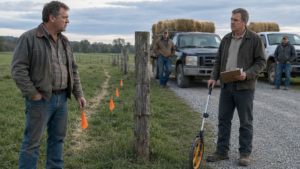
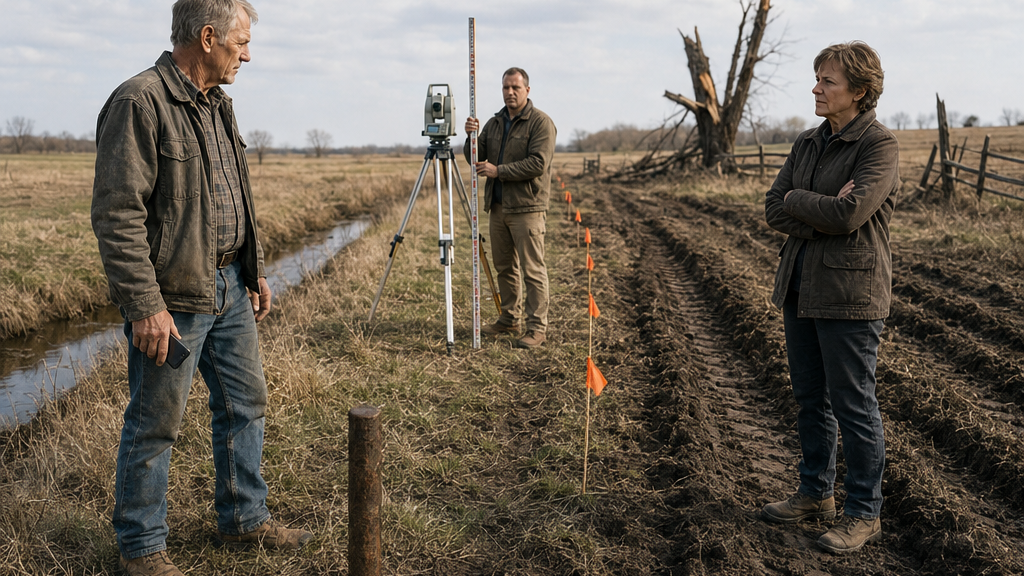
Anthony Martin’s first orange flag went into the ground directly between the two excavator tracks.
Scott stared at it.
“That the edge?”
“Not yet.”
Anthony adjusted the equipment mounted on his tripod and sighted toward another point farther up the field. His assistant moved a measuring rod toward the drainage channel, stopped, then shifted several inches at Anthony’s signal.
Scott had expected something dramatic from a survey.
There was nothing dramatic about it.
Numbers appeared. A rod moved. A flag went into dirt.
Yet every new marker seemed to make the machine tracks harder to excuse.
Anthony worked from the recorded description, monument references, and control points around the parcel. He checked the rust-dark pin Scott had uncovered, cleaned its top, and compared it against the deed information.
“This one’s consistent,” he said.
“So it marks the boundary?”
“It helps establish it. Let me finish.”
Scott shoved his hands into his jacket pockets.
The urge to hurry Anthony irritated him almost as much as Kathleen’s denial.
An hour later, a line of flags stretched beside the drainage route.
Anthony walked back toward Scott carrying the rod.
“The recorded maintenance corridor is ten feet wide.”
Scott nodded toward the tracks.
“And those?”
Anthony looked at them.
“They don’t stay in it.”
Before Scott could ask how far, a white pickup turned in from the county road.
Kathleen Roberts got out.
She closed the door and stood for a moment studying the tripod, the flags, and Scott.
“You actually hired a surveyor.”
Scott said, “You told me I was measuring with a tape.”
“I said you were making a legal argument from your own measurement.”
Anthony glanced between them and returned to his notes.
Kathleen walked toward the flags.
“These don’t change the fact that this route has been used for years.”
Scott felt the old anger rise.
He could have answered with every broken post and every sentence from the denial letter.
Instead he pointed to the deepest track.
“Anthony.”
The surveyor looked up.
“Can you give me the distance from the recorded edge to that rut?”
Anthony did not respond immediately. He positioned the rod, checked the line, then had his assistant hold a point near the outer edge of the compacted track.
Kathleen folded her arms.
Scott took out his phone.
Anthony called the measurement.
“Five feet, eleven inches beyond the corridor at this point.”
Nobody spoke.
Scott photographed the rod.
Then the flag.
Then the rut.
He moved ten yards north, where the excavator had turned near the damaged windbreak.
“What about here?”
Anthony repeated the process.
“Five feet, seven inches.”
Scott took another photograph.
Kathleen stared at the ground.
“The equipment had to turn.”
Scott lowered the phone.
“Outside the easement.”
“The contractor needed working room.”
“Outside the easement.”
“Scott.”
He waited.
Kathleen’s voice hardened. “You can repeat that all morning. It doesn’t answer how maintenance is supposed to happen.”
“It answers where my property starts.”
“You know perfectly well this association didn’t invent that route last week.”
Scott glanced at Anthony.
“Does using it for years make it part of the easement?”
Anthony’s expression changed slightly.
“That’s not a survey question.”
Kathleen seized on it.
“Exactly.”
Anthony held up one hand.
“I didn’t say either of you is right about access rights. I said the recorded corridor is ten feet and the physical tracks extend outside it. Historic use can raise other questions. Permission, agreements, whatever may have existed. That’s for somebody else to determine.”
Scott felt the clean satisfaction of the measurement become less clean.
“What other agreement?”
“I don’t know,” Anthony said. “I’m telling you what the survey establishes and what it doesn’t.”
Kathleen looked almost relieved.
“We’ve maintained from this side as long as I’ve been involved.”
“Six years,” Scott said.
“Longer than that. Before I chaired it.”
“That doesn’t make the ground yours.”
“I didn’t say it was ours.”
“You denied paying for damage because you said the equipment was authorized.”
“Because that’s what I understood.”
“And now?”
Kathleen looked at the orange flags.
“Now I understand the deed line better.”
It was not an apology.
But it was the first sentence she had spoken that morning without complete certainty.
Anthony moved toward the damaged tree and inspected the route where the excavator had swung around it.
Scott followed.
The surveyor pointed to the ground.
“If you’re documenting this, photograph from the flag toward the track. That shows the relationship better than a close-up.”
Scott did.
Orange flag in the foreground.
Dark rut beyond.
Damaged tree farther back.
The image reduced days of argument to one frame.
Kathleen watched him.
“What are you planning to do with those?”
“Send them with the survey.”
“To the association attorney?”
“If that’s where they need to go.”
Her mouth tightened.
“You’re making this bigger than a repair claim.”
Scott looked at the broken bark on the windbreak.
“No. Your denial did that.”
Kathleen started toward her truck, then stopped.
“For whatever it’s worth, I didn’t tell that contractor to tear up your tree.”
“You told him to use the route.”
“The route we’ve always used.”
There it was again.
Not the deed.
Not the ten feet.
The route we’ve always used.
Scott had spent the morning waiting for the survey to prove Kathleen wrong. Instead, it had proved one narrow thing with great precision and opened another question he had no answer for.
Why had nobody challenged the wider tracks before?
His father certainly would have noticed heavy equipment crossing that field. The man noticed if a gate hung an inch lower than it had the day before.
Kathleen drove away.
Anthony finished measurements near noon and packed the tripod into his truck.
“I’ll get you the drawing,” he said. “Probably tomorrow.”
Scott looked down the flagged line.
“Six feet.”
“Near enough at the widest point.”
“That should settle it.”
Anthony shut the equipment case.
“It settles where the recorded corridor is.”
Scott gave him a look.
Anthony continued, “Don’t make the survey carry more than it can. If there was permission for wider use, somebody may argue about what that means. If there wasn’t, that’s different. Either way, the measurement is the measurement.”
After Anthony left, Scott stayed in the field.
The old pin was fully visible now, surrounded by disturbed soil. For years it had been something he worked around without thinking. Today it looked almost accusatory.
He was bending to press grass back around it when another vehicle came down the lane.
Laura King parked near the gate.
She did not get out immediately.
When she finally walked toward him, she carried no association folder and wore no expression of satisfaction.
Scott straightened.
“You here to inspect the flags too?”
“No.”
“Kathleen send you?”
“No.”
Laura stopped beside the nearest orange marker and looked toward the machinery tracks.
“I heard Anthony found them outside.”
“Almost six feet.”
She nodded once.
Scott waited for her to say the association would review the claim, or that Kathleen wanted another meeting.
Instead Laura looked at the exposed survey pin.
“I probably should’ve told you something before this got this far.”
Scott’s shoulders tightened.
“About what?”
“That extra ground.”
He said nothing.
Laura rubbed one thumb along the side of her hand.
“Your father knew they were using it.”
Scott stared at her.
She met his eyes.
“Scott, your father knew about that extra ground.”
Chapter 4: His Father Had Allowed More Than Scott Knew
Laura King placed a folded sheet of yellowed paper on the workbench in Scott’s machinery shed.
“This is why I came.”
Scott did not touch it.
Outside, Anthony’s orange flags still marked the drainage corridor across the hayfield. Through the open shed doors, Scott could see one of them trembling in the breeze beside the dark excavator track.
Laura unfolded the paper herself.
The handwriting was familiar before Scott read a single word.
His father’s.
The letters leaned slightly forward, written in the same blue ink Scott remembered from feed orders, cattle records, and notes taped to the refrigerator.
Temporary access approved during high-water maintenance.
Scott’s eyes moved to the date.
Twenty-three years earlier.
“What is this?” he asked.
“An old association maintenance note.”
“Why do you have it?”
“My father kept the association files before I did.”
Scott read the page again.
The note allowed a contractor to move equipment beyond the normal drainage strip because the channel bank was too wet for machinery. It specified restoration afterward.
Temporary.
That word stood out.
Laura reached into the folder she had carried under her arm.
“There are more.”
She laid down two photographs.
One showed a tracked machine beside the same drainage channel years before. The windbreak was younger then, and the fence had been a different style, but Scott recognized the ground immediately.
The other photograph showed his father standing near the field edge.
Beside him, almost lost in grass, was the same iron survey pin.
Scott picked up the photograph.
The machine tracks extended beyond it.
“How many times?” he asked.
“I don’t know exactly.”
“You said he knew.”
“He did.”
“You also let Kathleen tell me the association had a right to use that ground.”
Laura’s jaw tightened.
“I said the route had been used.”
“That’s a careful difference to make now.”
“Yes.”
Scott set the photograph down harder than necessary.
Laura did not flinch.
“There was a proposal to widen the easement,” she said.
Scott looked at her.
“When?”
“Before Kathleen was chair. Years ago.”
“And?”
“Your father wouldn’t sign it.”
The shed seemed to become very quiet.
Scott pulled the stool away from the workbench and sat.
Laura opened another folder.
This time the paper was typed.
Proposed expansion of drainage maintenance access.
A wider permanent corridor.
His father’s name appeared near the bottom, but not as a signature. Beside it someone had written: declined.
Scott ran a thumb along the edge of the page.
“He let them use it.”
“During bad conditions.”
“But wouldn’t grant it.”
“That’s what the records look like.”
“Why?”
Laura gave a small shrug. “Probably because your father was your father.”
Despite himself, Scott nearly smiled.
His father could lend a neighbor equipment for three days and argue for an hour if the man tried to move it six inches from where he had left it.
Laura continued.
“He didn’t mind helping when the channel had to be cleared. He did mind people assuming help was theirs permanently.”
Scott looked toward the open shed doors.
The orange flags beyond the yard seemed different now.
Until that morning, they had divided right from wrong with satisfying precision.
Ten feet belonged to the easement.
The machinery had gone nearly six feet farther.
Simple.
But his father had known equipment sometimes crossed that line and had allowed it.
Scott felt something uncomfortable rise beneath his anger.
Not doubt about the damage.
Not doubt about the deed.
Doubt about himself.
“How long have you known this?” he asked.
“That he allowed temporary access? A long time.”
“And you stayed quiet.”
Laura looked down at the papers.
“Yes.”
“Why?”
“Because every time this came up, somebody said, ‘That’s the route we’ve always used.’ It was easier than reopening twenty years of arguments.”
“That’s not an answer.”
“It’s the answer I have.”
Scott stood.
“So Kathleen thinks permission became ownership because nobody bothered correcting her.”
“I don’t think she sees it as ownership.”
“What does she see it as?”
“An operating practice.”
Scott gave a short laugh.
“That’s a polite way to say the same thing.”
Laura’s expression hardened.
“No, it isn’t. She’s wrong to treat the wider route as guaranteed. But you’re wrong if you think she invented the problem.”
Scott said nothing.
Laura pointed toward the drainage channel.
“Two springs ago, water backed over the lower crossing. Last year my south field stayed too wet to plant on time. Kathleen got calls from everybody downstream. She took over after people spent years complaining that the association reacted too slowly.”
“That doesn’t give her six feet of my ground.”
“No.”
The answer came so quickly that Scott looked at her.
Laura met his eyes.
“No, it doesn’t.”
That simple agreement did more to unsettle him than another argument would have.
She slid the old note toward him.
“This is why I came. Your father helped when it was necessary. But he made them ask.”
Scott looked again at the handwriting.
Temporary access approved.
Not granted.
Not transferred.
Approved.
A choice made each time.
By late afternoon, Kathleen arrived at the farm.
She had no attorney with her and no association folder. She stood at the edge of the yard, hands tucked into her coat pockets.
“Laura told me she showed you the old files.”
“She did.”
Kathleen nodded.
“I didn’t know about the rejected expansion.”
Scott watched her carefully.
“You expect me to believe that?”
“I knew the wider route had been used. I knew older boards treated it as established access. I did not know your father had refused a permanent widening.”
“Would it have changed what you told the contractor?”
Kathleen took longer to answer.
“It should have.”
“Would it?”
Her eyes shifted toward the damaged field.
“I don’t know.”
Scott appreciated the answer despite not liking it.
Kathleen continued.
“We have another problem.”
“What now?”
“The lower channel is starting to collect debris again. The forecast changed.”
Scott had heard rain mentioned on the radio, but nothing that had concerned him.
“How much?”
“Three to four inches possible beginning in two days.”
Scott glanced toward the ditch.
Kathleen said, “If that blockage builds at the county-road culvert, we may need to get equipment in before the storm.”
“Inside the recorded corridor.”
“If they can.”
“If?”
“The contractor says the bank is soft where the channel bends.”
Scott thought of his father’s note.
Temporary access approved during high-water maintenance.
The past had returned with irritating precision.
Kathleen stepped closer.
“I’m not asking you to forget the damage claim.”
“Good.”
“I’m asking you not to make the drainage problem worse while we sort it out.”
Scott felt anger urge him toward the easiest answer.
No.
One word would put the problem back on Kathleen.
One word would prove that the six extra feet were his.
Then he pictured the handwritten note on the workbench behind him.
His father had never surrendered the land.
But he had never pretended the water stopped at the property line either.
Scott looked at Kathleen.
“If you need access, you ask me.”
“I’m asking.”
“No. Not standing in my yard. Formally.”
Kathleen’s expression tightened.
“You want paperwork before a storm?”
“I want nobody saying later that temporary meant forever.”
For several seconds neither moved.
Then Kathleen nodded once.
“All right.”
That evening, shortly after six, Scott’s phone chimed.
An email from the association.
Attached was a formal request for emergency equipment access across the disputed strip before the approaching storm.
Scott read it twice.
At the bottom, Kathleen had written that failure to clear the obstruction could place downstream fields and the county-road crossing at risk.
The six feet he had spent days proving were his had become the exact six feet other people might need.
Chapter 5: Winning the Boundary Could Cost the Lower Fields
“The machine can’t safely work from ten feet.”
The drainage contractor stood beside Scott and pointed toward the bend in the channel.
Scott looked from the water to the survey flags.
“Anthony measured ten.”
“I’m not arguing the deed.”
“Sounds like you are.”
“I’m telling you how far the excavator needs to sit without sliding into the bank.”
The contractor walked toward the narrowest section, boots sinking slightly into the soft ground.
The channel curved there before passing under the county-road culvert. Branches and dead grass had begun collecting against a partially buried pipe edge.
The contractor pointed.
“If I keep the tracks completely inside that corridor, the boom has to reach across at the wrong angle. Ground gives way under one side, you could have fifteen tons sitting in the ditch.”
Scott looked at the orange flags.
For days they had represented certainty.
Now they looked narrow.
Kathleen stood a few yards away but did not interrupt.
Scott had told her before they met that morning: no equipment outside the recorded ten feet.
He had said it plainly enough that she had brought the contractor out without a machine.
Scott crouched beside the drainage bank.
Water moved beneath the debris, slow but steady.
“How long before it becomes a problem?”
The contractor shrugged. “Depends on the rain.”
“You always say that.”
“Because water doesn’t read forecasts.”
Kathleen almost smiled but stopped herself.
Scott stood.
“Can you reach it from the other side?”
“Not without crossing Laura’s lower ground, and that’s wetter than this.”
“Smaller machine?”
“Possible if we can find one fast enough. Might take longer, might not clear the heavier material.”
Scott rubbed a hand across his jaw.
Kathleen said, “This is what I was trying to explain.”
He looked at her.
“You were trying to explain it after your crew tore through my field.”
“I know.”
It was the first time she had said those two words without adding anything behind them.
Scott walked down toward the culvert.
Laura was already there.
She stood near a fence corner looking across the lower field beyond the road. Darker patches of soil showed where water had lingered after earlier rains.
“That section?” Scott asked.
She nodded.
“Last year it stayed wet nearly three weeks.”
“You lost the planting?”
“Part of it.”
“How much?”
“Enough.”
Scott waited.
Laura looked at him.
“You want a number?”
“I want to know whether everyone is using your field to pressure me.”
Her expression sharpened.
“You think I brought you those papers yesterday so Kathleen could use me?”
“No.”
“Then don’t start treating me like she sent me.”
Scott looked away.
There it was.
His own habit.
Every conversation became a boundary once he thought someone might be pushing him.
Laura walked a few steps into the grass.
“When the channel backs up, water spreads here first. Then it reaches the road shoulder. Two years ago, the county had to bring gravel after part of the edge washed.”
Scott could see the shallow depression through the field.
Nothing dramatic.
That was the problem with drainage. Damage often looked harmless until it had already happened.
Laura said, “Your father understood that.”
Scott stiffened.
“Don’t use him to make your argument.”
“I’m not.”
“You keep telling me what he understood.”
“Because you keep acting like his only lesson was never give anyone anything.”
Scott turned toward her.
Laura did not back away.
“He made them ask, Scott. That’s different from always saying no.”
The sentence landed harder than he wanted it to.
He walked back toward the survey pin.
The rust-dark top stood exposed inside the grass. Water was beginning to collect in a shallow depression several yards beyond it.
Scott put one boot beside the pin.
His father had protected the farm by insisting on choice.
Scott had been protecting it by refusing choice altogether.
Those were not the same thing.
Kathleen joined him.
“I can authorize your repair claim,” she said.
Scott looked at her.
“All of it?”
“Fence, pipe, grading, reseeding. We’ll get an arborist assessment on the tree.”
“And?”
Kathleen hesitated.
There was always an and.
“The association needs the access question settled permanently.”
Scott felt his shoulders tighten again.
“What do you mean settled?”
“A recorded expansion consistent with the route historically used.”
He stared at her.
“You’re offering to pay for damage your contractor caused if I give you the exact land you’re arguing you already had?”
“That isn’t how I’d put it.”
“It’s exactly how you put it.”
“We need reliable access.”
“You need convenience.”
“We need both.”
Scott stepped away from the pin.
Kathleen followed.
“Listen to me. I can’t have every maintenance job depend on whether someone answers the phone that morning.”
“My father managed to make you ask.”
“Your father also created twenty years of ambiguity.”
The words stopped Scott.
Kathleen looked immediately as if she knew she had gone too far.
But she did not take them back.
“He refused the permanent easement,” Scott said.
“And then kept letting crews through.”
“Because people needed help.”
“Yes.”
“So you decided help belonged to you.”
“No. I inherited a practice everybody treated as established.”
“And when I challenged it, you sent me a warning letter.”
Kathleen looked toward the channel.
“That was my mistake.”
Scott had not expected the admission.
He let the silence remain.
Kathleen said, “I was worried you’d block the work and we’d have another flooded season. I treated your objection like an operational obstacle instead of a property dispute.”
“That doesn’t repair my field.”
“No. But I’m trying to repair the part I can.”
Scott looked past her toward Laura’s lower ground.
The contractor was standing beside his pickup waiting.
Everybody seemed to be waiting for Scott.
That irritated him too, until he realized it was exactly what he had wanted.
Choice.
He walked back toward the farmhouse without telling them whether the answer was yes or no.
Kathleen called after him.
“Scott, we need a decision.”
“You’ll get one.”
Inside, he spread the deed, Anthony’s survey, Kathleen’s proposed permanent access, and his father’s handwritten note across the kitchen table.
Temporary access approved.
He read the words again.
The answer had been sitting in front of him since yesterday.
Not no.
Not forever.
Terms.
Scott took a blank sheet of paper and began writing.
Access limited to emergency drainage maintenance.
Route marked before entry.
Ground-protection mats where practical.
Repair of all damage.
No expansion of permanent rights.
Advance notice except in immediate emergency.
He crossed out three sentences that sounded angry.
Then another that sounded like he wanted Kathleen to admit defeat.
By the time he finished, the document fit on one page.
Scott returned outside.
Kathleen was still near the ditch.
He handed her the paper.
She read the first half.
Her eyes lifted.
“This is temporary.”
“For the storm.”
“We need permanent access.”
“Then we can discuss permanent access after nobody’s field is in danger.”
“You want us to admit we have no rights beyond ten feet.”
“I want you to stop turning permission into ownership.”
Kathleen looked at the page again.
Scott pointed toward the channel.
“You want to clear the blockage, I’ll let you. Under those terms.”
“And afterward?”
“Afterward we negotiate something that says exactly where you can go, when you can go there, and who fixes what you damage.”
Kathleen folded the paper once.
“You know the board may reject this.”
Scott looked toward the water moving beneath the debris.
“Then they can explain why having no agreement is better than having a fair one.”
Chapter 6: He Offered Access, But Not the Old Assumption
Scott laid the one-page agreement on the farm-office desk between himself and Kathleen.
“You can use the extra ground today,” he said. “You cannot claim that means you own a permanent right to it tomorrow.”
Kathleen read the document again.
Behind her, through the office window, the first bank of darker clouds had begun gathering over the western fields.
The contractor waited outside with the excavator still loaded on its trailer.
Kathleen tapped one paragraph.
“This clause.”
Scott knew which one before she said it.
Temporary permission does not create, expand, confirm, or acknowledge any permanent easement beyond the recorded ten-foot drainage corridor.
“That clause stays.”
“It prejudices the association’s position.”
“It protects mine.”
“We’re not agreeing that the historical route is invalid.”
“I’m not asking you to.”
“That language comes close.”
Scott leaned back.
“No. It says today doesn’t decide yesterday.”
Kathleen folded her arms.
“And if we sign this, you could refuse next year.”
“Yes.”
“That’s exactly the uncertainty we’re trying to eliminate.”
“Then negotiate a permanent agreement with me.”
“We tried that years ago.”
“With my father.”
“And he said no.”
“He said no to what you offered.”
Kathleen stared at him.
Scott slid Anthony’s survey across the desk.
“The mistake everybody made was thinking the only choices were the old ten feet or whatever width your equipment happened to need. There can be another route. Marked. Limited. Written.”
Kathleen glanced down at the survey.
Outside, the contractor opened the office door.
“Sorry to interrupt.”
Kathleen turned.
“What?”
“I need to know whether we’re working.”
“We’re discussing it.”
The contractor looked at Scott, then back at Kathleen.
“My insurance office called.”
Scott sat straighter.
“And?”
“They know there’s a boundary dispute now. They won’t let me put the machine outside the recorded corridor without written authorization from the landowner.”
Kathleen closed her eyes for a moment.
Scott said nothing.
The contractor continued.
“I can work inside ten if that’s what you want, but I’m not taking the excavator over the marked line on verbal direction.”
Kathleen looked at Scott.
The balance in the room had changed without him saying a word.
Not because Scott had threatened anyone.
Not because Anthony had declared a legal victory.
Because the ambiguity Kathleen had relied on was no longer useful to anybody once it was visible.
She turned back to the contractor.
“Give us ten minutes.”
He closed the door.
Kathleen lowered herself into the chair.
“This is what I was afraid of.”
Scott waited.
“Every contractor,” she said, “every repair, every blocked section. If every landowner starts requiring separate paperwork—”
“Every landowner isn’t me.”
“You know what I mean.”
“I do. You want predictable access.”
“Yes.”
“So do I.”
Kathleen looked skeptical.
Scott tapped his page.
“This is predictable for today.”
“And after today?”
“We negotiate.”
Her gaze moved to the window.
“You’re enjoying this.”
Scott almost answered no.
Then he stopped.
A week earlier, maybe he would have been.
There had been moments since Anthony’s survey when he had imagined simply chaining the field gate and making Kathleen solve the problem from somewhere else.
He had pictured the association attorney reading the measurements.
He had pictured Kathleen having to admit she had overstepped.
Those thoughts had felt good.
Too good.
“No,” Scott said finally. “I enjoyed proving you were wrong about the width.”
Kathleen looked at him.
“That honest enough?”
“Yes.”
“I don’t enjoy Laura’s field flooding.”
Some of the stiffness left Kathleen’s face.
Scott continued.
“I also don’t enjoy learning I nearly turned my father’s insistence on being asked into an excuse to never say yes.”
Neither spoke for a moment.
The office smelled faintly of dust, diesel, and the coffee Scott had forgotten on a shelf.
Kathleen picked up the agreement.
“What about the mats?”
“Use them at the turn and beside the tree.”
“The contractor says mats may sink if the ground gets wetter.”
“Then he tells me before changing the route.”
“Advance notice?”
“For planned work, forty-eight hours.”
“Emergencies?”
“Call me. If you can’t reach me and there’s immediate risk to the road, document it.”
Kathleen looked up.
“That sounds suspiciously reasonable.”
“Don’t sound so disappointed.”
For the first time since the dispute began, she gave a brief tired laugh.
Then she became serious again.
“I can sign temporary access as chair. Permanent terms need the board.”
“I know.”
“And compensation?”
“You already told me you could authorize the repairs.”
“I can recommend them. The tree assessment may need approval.”
Scott nodded.
“I’m not trading away the claim for access.”
“I know.”
He pushed a pen across the desk.
Kathleen did not take it.
“There’s one thing I want changed.”
“What?”
“The clause requiring the association to restore every rut within ten days. If the ground is saturated, going back in could do more damage.”
Scott considered it.
“Within ten days after ground conditions allow repair.”
Kathleen nodded.
Scott crossed out the original sentence and rewrote it by hand. Both initialed the change.
Kathleen read the full page once more.
Then she signed.
The pen made a small scratching sound.
Nothing outside changed.
No applause.
No sudden sense that the dispute had disappeared.
But when Kathleen slid the signed page back across the desk, Scott felt something settle.
The access was his to grant.
The responsibility was his too.
They walked outside together.
Anthony had left several extra flags beside the fence after the survey. Scott took them from the shed and carried them down to the field.
The contractor followed with ground-protection mats loaded in the pickup.
Scott stopped at the rust-dark survey pin.
“This is the recorded edge,” he said.
Then he walked outward into his own ground.
Not six feet everywhere.
Only where the machine needed enough room to turn safely.
He pushed the first temporary flag into the earth.
Then another.
The new line did not follow the old ruts exactly.
Near the windbreak tree, Scott pulled it inward.
“Keep the track off those roots.”
The contractor nodded.
At the bend in the channel, Scott widened it slightly.
“You can set up here.”
Kathleen watched him.
“You’ve thought about this.”
“I’ve been thinking about almost nothing else.”
The excavator came off the trailer twenty minutes later.
This time, before its tracks crossed the original ten-foot line, the operator stopped.
He looked through the cab window toward Scott.
Scott glanced at the temporary flags.
Then nodded.
The machine moved forward over the protective mats.
For the next two hours, Scott remained near the channel.
The contractor lifted branches, accumulated grass, and packed debris from the culvert mouth. Water that had been moving sluggishly began to pull faster through the opening.
Laura arrived before they finished.
She stood beside Scott without speaking.
They watched the water level drop several inches against the bank.
“You said yes,” she said.
“For today.”
Laura nodded.
“That sounds familiar.”
Scott looked at her.
She did not need to mention his father.
The meaning was already there.
Near dusk, the excavator backed out along the marked route. The operator stopped twice to reposition the mats rather than turn across the hay.
The field still bore the scars from the first visit.
But it had acquired no new ones.
Kathleen walked toward Scott with the signed agreement tucked inside a clear plastic folder.
“The board meets next week.”
Scott looked down at the old survey pin.
“And?”
“I’ll recommend we negotiate a permanent corridor instead of arguing that the old informal route is already ours.”
Scott studied her face.
“That won’t make everybody happy.”
“No.”
“You included?”
Kathleen looked toward the cleared channel.
“I’m getting used to the possibility.”
Scott nodded once.
She held out the folder.
“Your copy.”
He took it.
For years the little iron pin had sat beneath grass while everyone behaved as if knowing roughly where the line was amounted to knowing what it meant.
Now temporary orange flags extended from it across the ground Scott had chosen to make available.
The old line had not disappeared.
But neither had the people and water on the other side of it.
Scott carried the signed agreement back toward the house while the drainage channel ran freely behind him.
Chapter 7: The New Line Stayed Where Everyone Could See It
The repair crew stopped at the edge of Scott’s field and waited for him to point.
That alone told him more had changed than the paperwork did.
Three weeks earlier, machines had entered as if habit were permission. Now the foreman stood beside the truck with a folded site plan in one hand, looking from the marked corridor to Scott before moving anything off the gravel lane.
Scott walked down to meet him.
“You’ve got the route?”
The foreman held up the plan.
“Anthony staked it yesterday.”
Scott looked toward the drainage strip.
Fresh markers stood in a clean line from the rust-dark survey pin, then widened only where the new agreement allowed machinery to turn. Protective mats had already been unloaded beside the gate. Replacement fence posts lay stacked on the trailer. A length of irrigation pipe rested beside them.
Nothing was moving yet.
Scott nodded.
“All right.”
The foreman signaled the crew.
The first truck rolled forward slowly.
Its tires stayed between the markers.
Scott watched until it reached the damaged stretch beside the windbreak tree.
The tree had survived, though one side still carried the pale scar where bark had been torn away. The arborist had said it was likely to recover, but there was no honest way to price the years required to grow another one if it did not.
That question had become one of the last unsettled pieces of the claim.
The association had agreed to the fence replacement, pipe repair, grading, and reseeding. It had also agreed to cover the survey cost.
The tree was different.
Kathleen had offered the amount recommended by the insurance adjuster.
Scott had wanted more.
Not because he believed the tree was worth an impossible figure, but because every number they discussed seemed to treat it like a damaged piece of equipment.
Laura arrived while the crew began removing the broken posts.
“You going to stand here all day?” she asked.
“Probably.”
She looked toward the workers.
“They’re doing what you asked.”
“They’re doing what they agreed to.”
Laura smiled faintly.
“That distinction going on your gravestone?”
Scott gave her a sideways look.
“Depends who writes it.”
She laughed once, then grew serious.
“The meeting’s at six.”
“I know.”
“You still planning to hold the tree issue open?”
Scott watched a worker lift the crushed irrigation pipe from the trench.
“I haven’t decided.”
Laura nodded toward the windbreak.
“Your father planted that one?”
“Helped.”
“That explains it.”
“It explains why I don’t like someone putting a replacement value on it.”
“No. It explains why you’re pretending the number is the argument.”
Scott turned toward her.
Laura had developed an irritating habit of saying things he could not dismiss quickly.
“What do you think the argument is?”
“That they treated thirty years of care like open workspace.”
Scott looked back at the tree.
“That sounds close enough.”
“And now?”
“Now they’re fixing it.”
“Then maybe decide what you actually need from the settlement.”
She left before he answered.
By midafternoon the new fence line stood straight again. The ruts had been loosened and graded, and seed had been worked into the torn ground. The irrigation repair held pressure without leaking.
The crew never crossed outside the marked route.
At one point, a worker carrying posts started to take a shortcut across the hayfield. The foreman called him back before Scott said anything.
“Stay inside the access.”
The worker changed direction.
Scott heard the sentence clearly.
Not the old route.
Not the regular way.
The access.
Defined.
At six, the association meeting began in a plain room behind the local fire station.
Scott sat across from Kathleen at a folding table. Laura was beside her with the proposed permanent agreement. Two neighboring farmers occupied chairs along the wall, saying little.
Anthony’s survey lay open between them.
Kathleen began without ceremony.
“The temporary access worked.”
Scott nodded.
“The blockage was cleared before the storm,” she continued. “No downstream field flooding. No road damage.”
One of the neighboring farmers said, “And no new damage on Scott’s side.”
Kathleen glanced at him.
“No new damage.”
She turned a page.
“The permanent proposal creates a conditional maintenance corridor wider than the recorded ten feet only in two locations where equipment needs turning clearance. Those areas are marked on Anthony’s survey.”
Scott leaned forward.
“And the rest stays ten.”
“Yes.”
“Advance notice?”
“Forty-eight hours for scheduled maintenance.”
“Emergency entry?”
“Telephone notice if possible. Documentation afterward if immediate action is necessary.”
“Surface mats?”
“Where ground conditions require them.”
“Restoration?”
“Association responsibility for contractor-caused damage outside ordinary wear within the agreed corridor.”
Scott looked at Laura.
“That last wording changed.”
Laura nodded.
“The attorney wanted ‘reasonable restoration.’ I told them we’d spend another month arguing about what reasonable meant.”
Scott almost smiled.
Kathleen continued.
“The agreement also states that historic use beyond the recorded easement does not create rights outside the newly defined corridor.”
Silence settled around the table.
That sentence was the one the association had resisted longest.
One of the neighboring farmers shifted in his chair.
“So we’re admitting we never had it?”
Kathleen looked at him.
“We’re admitting that using ground for years is not the same thing as having it granted forever.”
Scott said nothing.
Kathleen looked across the table at him.
The words were not dramatic.
They did not need to be.
For weeks, that distinction had been the center of everything.
Scott tapped the tree-compensation line.
“This is still low.”
Kathleen exhaled.
“I expected that.”
“The arborist says it may survive.”
“Yes.”
“May.”
“Yes.”
Scott looked toward the window. Beyond the parking lot, fields stretched into the evening light.
He thought of the tree when it had been small enough to bend under wet snow. He remembered his father holding it upright while Scott tamped soil around the roots.
No settlement could buy that afternoon back.
No larger check would make the association understand it more deeply than the weeks of argument already had.
“What if I accept this amount,” Scott said, “and the restoration language gets stronger?”
Kathleen raised an eyebrow.
“How?”
“If that tree declines because of the documented equipment damage within the next two growing seasons, the association pays removal and replacement costs.”
Laura immediately wrote something in the margin.
Kathleen read it.
“That’s more exposure.”
“It’s less money today.”
One of the farmers said, “Seems fair.”
Kathleen gave him a look, then returned to Scott.
“And if it survives?”
“Then we’re done.”
She considered it.
“Agreed.”
Laura rewrote the provision cleanly.
Scott watched her.
A month earlier, he had wanted full payment because anything less felt like surrender.
Now he understood that winning every number was not the same as protecting the farm.
The agreement mattered more.
The line mattered more.
The requirement to ask mattered most.
Kathleen signed first.
Laura signed as treasurer.
Then the document came to Scott.
He held the pen above the page.
There was a moment when he could still refuse.
The old instinct returned briefly: keep everything exactly as it was, concede nothing, make everyone else solve their problems somewhere else.
Then he thought of the water dropping at the culvert after the emergency work.
He thought of Laura’s field.
He thought of his father’s handwriting.
Temporary access approved.
His father had not protected the farm by shutting everyone out.
He had protected it by keeping permission visible.
Scott signed.
No one applauded.
The neighboring farmers gathered their coats. Laura collected the extra copies. Kathleen remained seated while Scott capped the pen.
“I should’ve called you before I sent that crew in,” she said.
Scott looked at her.
“Yes.”
“And I should’ve reviewed the recorded width before denying your claim.”
“Yes.”
Kathleen almost smiled.
“You could make this easier.”
“I’m trying not to.”
She gathered her papers.
Scott said, “I should’ve come to the first meeting instead of sending that demand and refusing to talk.”
Kathleen paused.
“That would’ve helped.”
“I know.”
It was as close to an exchange of apologies as either of them seemed prepared to manage.
That suited Scott.
The next morning he walked down to the repaired field alone.
The new fence stood clean and tight. Fresh seed covered the graded strip. The protective mats were gone.
Near the drainage channel, Anthony’s permanent markers showed exactly where the conditional corridor widened and narrowed.
Scott stopped beside the old survey pin.
Grass had begun falling back over it again.
For years, that was how it had disappeared—not all at once, but blade by blade until everybody remembered the route and forgot the line beneath it.
Scott bent down.
He pulled the loose grass away from the iron.
Then he cleared a small circle of soil around it with his boot.
Not enough to make a monument of it.
Just enough that anyone walking the field could see where it was.
The drainage channel moved quietly nearby.
Beyond it were other farms, other fields, and people whose water would never care whose deed it crossed on the way downhill.
Scott stood and looked along the new markers.
The line remained.
So did the access.
This time, everyone could see both.
The story has ended.