They Kept Cutting Across His Farm Road Until One Boundary Complaint Exposed What Their Own Deed Had Been Hiding
Chapter 1: The Shortcut Through Ruth’s Flowers
Donald Anderson saw the broken branch before he saw the tire track.
It lay under the front wheel of a white catering van, green leaves mashed into the gravel and three pale blossoms pressed flat against the damp shoulder of his farm lane. The driver had stopped with one wheel still in the grass, waiting for Donald’s tractor to clear the gate.
Donald killed the engine.
For a moment he stayed in the seat, one hand wrapped around the steering wheel.
The flowering hedge ran only twenty feet along the lane, hardly enough to matter to anyone passing through. Ruth had planted it during the last spring when she still had the strength to carry a shovel from the barn herself. She had rejected Donald’s offer to straighten the row.
“Not everything needs a string line,” she had told him.
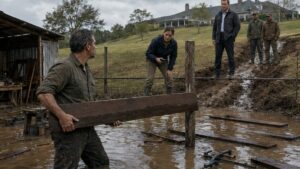
Now a fresh rut curved through the soil beneath it.
Donald climbed down.
The driver lowered his window. “Sorry. Tight turn.”
“There’s no turn here.”
The man glanced toward the lane beyond Donald’s cattle gate. “Michelle told us to come this way.”
Donald looked past the van.
Two more vehicles were waiting where his private lane met the narrow gravel road that ran behind his hayfield. Beyond the tree line, the renovated barn on Michelle Nelson’s property was visible in pieces: new dark siding, strings of outdoor lights, a row of parked cars.
“She told you this was the entrance?”
“Shortcut.” The driver gave an uncertain shrug. “She said the lane’s shared.”
Donald stared at him long enough that the man stopped smiling.
“It isn’t.”
The driver eased backward, careful this time.
Donald crouched beside the crushed branch after the van left. One stem had split close to the base. He could tape it, maybe stake it, but he knew enough about plants to recognize the difference between something bent and something broken.
The lane had always attracted occasional traffic. A neighbor hauling hay. A feed truck avoiding a flooded culvert. Years ago, tractors from the north field had crossed there because there had been no better route.
Donald had never made much of it.
But Michelle’s barn had changed that.
She had bought the old dairy property three years earlier, restored the timber frame, added a gravel parking area and started renting the place for weddings, reunions and farm dinners. At first, guests came from the county road.
Then someone discovered Donald’s lane saved several minutes.
One car became five.
Five became delivery trucks.
Donald had spoken to Michelle once at the mailbox.
“Your guests are cutting across.”
“I’ll mention it.”
He had left it there.
That was his mistake, though he did not call it that yet.
By late afternoon, he had reset the broken branch and packed soil around the roots. He found a rectangular aluminum sign in the machine shed, drilled it into a cedar post and carried it to the lane.
PRIVATE FARM LANE — NO EVENT TRAFFIC.
He set it far enough inside his property that nobody could claim it obstructed the road.
The hammer blows carried across the pasture.
When he finished, he stood beside the sign and looked toward Ruth’s hedge.
The row was uneven now.
That bothered him more than the tire marks.
At dusk, his phone buzzed.
Michelle.
He considered letting it ring out, but answered.
“I heard you put up a sign.”
“I did.”
“We’ve used that cut-through for years.”
“You’ve used it.”
“There’s a difference?”
“Yes.”
A pause.
Then Michelle said, “Donald, I’m not trying to start something. People have always gone through there.”
“People going through doesn’t make it theirs.”
“It’s on the association access map.”
Donald leaned against the kitchen counter.
“What map?”
“The road map. Edward has a copy.”
Donald looked through the window toward the lane. In the fading light, the new sign was a pale rectangle beside the hedge.
“I’ve never seen it.”
“I’ll send it.”
The call ended without either of them saying goodbye.
Ten minutes later an image arrived on his phone.
It was a photocopy of a hand-drawn map bearing the name of the private road association. Several parcel boundaries were sketched in black. One route had been marked in blue.
The blue line crossed directly through Donald’s farm.
He enlarged the image.
Then enlarged it again.
According to the map Michelle had just sent him, the shortcut through Ruth’s flowers was not a shortcut at all.
It was already a road.
Chapter 2: The Saturday Everyone Called It Shared
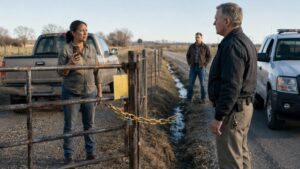
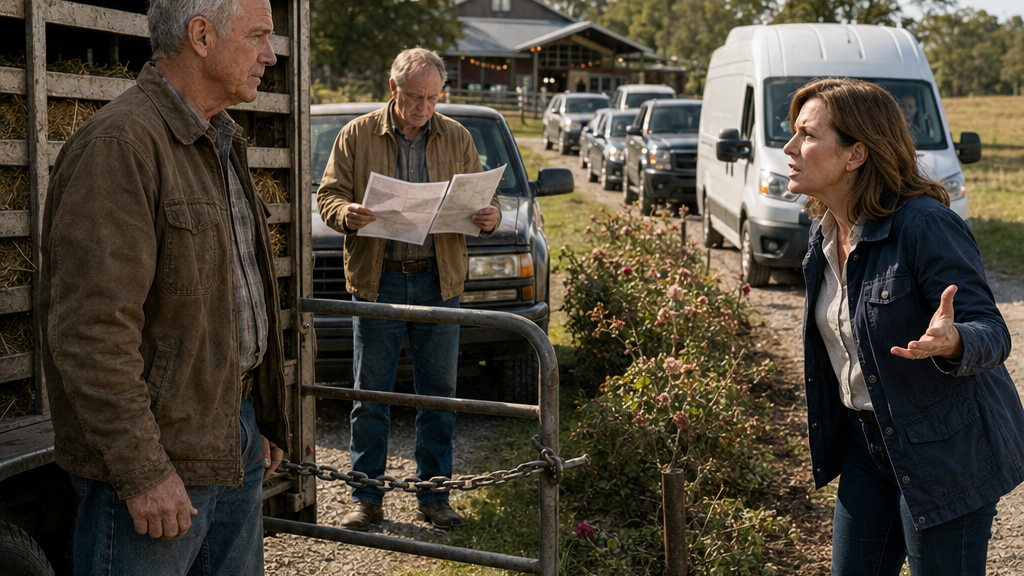
The catering van reached Donald’s gate less than three minutes after he fastened the chain.
He heard it before he saw it—the growl of a diesel engine climbing the gravel rise, followed by the scrape of brakes.
Donald was already backing his cattle trailer toward the lane.
The van stopped.
Behind it came an SUV.
Then another.
Within five minutes, six vehicles were stacked along the road.
Donald stepped out of his truck.
The first driver pointed toward the chained gate. “We need through.”
“No.”
“We’ve got food for the barn.”
“County road goes around.”
“That adds fifteen minutes.”
Donald nodded. “Then it adds fifteen minutes.”
The driver stared at him.
From the direction of Michelle’s barn came the distant sound of music testing through speakers.
A black SUV pulled partly onto the grass to avoid blocking the road.
Donald’s jaw tightened.
He had moved his new sign back into place that morning after finding it lying flat beside the ditch.
He did not know who had moved it.
He had stopped pretending that mattered.
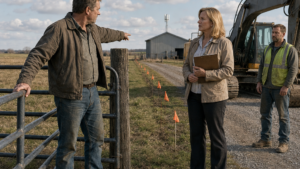
Michelle arrived in a utility cart, driving fast enough to throw gravel behind the tires.
She stopped on the far side of the gate.
“What are you doing?”
“Moving cattle.”
“You closed the road.”
“My lane.”
“Donald, we have a hundred people coming today.”
“That’s your business.”
“They were told to use this entrance.”
“By you.”
Her face changed slightly.
Not guilt. Irritation.
“You can’t just shut down established access.”
Donald unhooked the chain long enough to pull his cattle trailer forward.
Michelle stepped closer.
“You’re letting yourself through.”
“Yes.”
“What exactly do you think that proves?”
“That I own a gate.”
The van driver looked away.
Donald guided the truck and trailer through, stopped, then walked back and replaced the chain.
Michelle folded her arms.
“This is ridiculous.”
Donald could feel the heat rising in his face, but he kept his voice level.
“Show me where I agreed to event traffic.”
“It isn’t about agreement. The lane is shared.”
“That’s what you keep saying.”
“It’s what the road association says.”
As if summoned by the words, Edward King’s pickup appeared at the bottom of the rise.
Edward parked beside the waiting vehicles and climbed out carrying a folded sheet of paper.
Donald recognized the shape before Edward opened it.
The association map.
Edward had chaired the private road association for nearly twelve years. He owned eighty acres west of Donald and had spent most of his life settling practical disputes with a handshake and a load of gravel.
He looked at the blocked traffic, then at Donald.
“Can we sort this out without making a spectacle?”
Donald glanced at the line of vehicles.
“I didn’t invite the spectacle.”
Edward unfolded the map across the hood of his truck.
“There’s been access through here as long as I remember.”
“Show me.”
Edward tapped the blue line.
“Right there.”
“That’s a drawing.”
“It’s the association map.”
“Show me the recorded line.”
Edward frowned.
Donald went to his truck and retrieved a plastic folder from behind the seat. Inside was the current county plat he had received when he refinanced a piece of ground several years earlier.
He laid it beside Edward’s map.
“Find that road on this.”
Edward bent over the papers.
Michelle stood on the opposite side of the hood.
Cars continued arriving behind them. Drivers turned around one at a time when they realized the gate was closed.
Edward traced Donald’s boundary with one finger.
The county plat showed the lane beginning at the county road and running into Donald’s parcel.
It showed field boundaries.
Drainage.
Fence lines.
It did not show the blue route from the association map.
Edward checked again.
Michelle pointed. “That doesn’t mean there isn’t an easement.”
Donald looked at her.
“I didn’t say it did.”
“But you’re acting like this proves you’re right.”
“No. I’m saying your map doesn’t prove you are.”
For the first time all afternoon, nobody answered immediately.
A gust moved through Ruth’s hedge.
The damaged section had been tied upright with green garden tape. Beneath it, the previous day’s tire rut curved toward the gate.
Edward picked up the association map.
“I’ll have to check the old records.”
“Good.”
Michelle shook her head.
“We don’t have time to turn this into a title search every Saturday.”
Donald looked at the cars still queued below.
“Then stop sending people through until you know.”
Her expression hardened.
“You knew people used this road.”
“I knew farmers crossed it sometimes.”
“And guests have crossed it.”
“Not with my permission.”
“You never stopped them.”
Donald felt the sentence land harder than he expected.
Because it was true.
He had complained under his breath.
He had repaired ruts.
He had moved stones back into place.
He had told Michelle once.
What he had not done was set a firm limit before the damage mattered enough to make him angry.
Michelle saw the hesitation.
“That’s exactly the problem. You let everyone use it, and now suddenly you decide nobody can because some flowers got bent.”
Donald’s hand tightened around the edge of the truck hood.
He almost told her.
He almost said Ruth’s name.
Instead he folded his plat.
“They’re not your flowers.”
Michelle stared at him.
Then she nodded once.
“Fine. I’ll file it.”
Edward looked up. “Michelle.”
“No. If he wants this formal, we’ll make it formal.”
Donald slid the plat back into its folder.
“That works for me.”
But the confidence in his voice did not reach as far as he intended.
On Monday morning, a certified envelope arrived.
Donald signed for it at the porch.
Inside was a formal complaint submitted through the private road association.
The language was cooler than Michelle had been on Saturday.
It alleged that Donald Anderson had obstructed an established right-of-way traditionally used for access to adjoining parcels.
It requested immediate reopening pending review.
Donald read the phrase twice.
Established right-of-way.
At the bottom was Michelle’s signature.
Below that was a handwritten notation from Edward:
Records review required.
Donald looked through the kitchen window toward the chained gate.
For the first time since he had closed it, he wondered whether the old blue line might have come from somewhere after all.
Chapter 3: The Plat That Seemed to End It
Deborah Hall drew a red circle around the empty space where Michelle’s road was supposed to be.
“This is the route she’s claiming?”
Donald leaned over the conference table.
“That’s where everyone’s driving.”
Deborah slid the county plat closer.
“And there’s nothing recorded on this plat showing a general access corridor there.”
Donald exhaled.
Not relief exactly.
Something close.
Deborah noticed.
“Don’t celebrate yet.”
“I wasn’t.”
“You were considering it.”
She had practiced land-use and property law in the county for twenty-six years and had the habit of speaking softly whenever the answer was complicated.
Donald had brought her the association complaint, the blue-line map and every property document he could find at home.
Deborah arranged them into three piles.
“The association map is not a deed,” she said. “It’s not a recorded easement. It may reflect something real, but by itself it doesn’t create a property right.”
“So Michelle can’t call this a public road.”
“Correct.”
“And she can’t send wedding traffic across it.”
“Based on what I see here, there is no recorded general right allowing that.”
That was enough for Donald.
For almost thirty seconds.
Then Deborah tapped the complaint.
“But she didn’t call it a public road. She called it an established right-of-way. That’s broader.”
Donald frowned.
“What does that mean?”
“It means we check everything.”
The county records office occupied the back half of an old brick building near the courthouse. Donald met Deborah there Monday afternoon.
The county recorder pulled the current parcel index first.
Donald’s farm had been divided, recombined and renumbered more than once since his grandfather’s time.
They followed references backward.
A 1998 transfer.
A 1972 boundary adjustment.
A 1956 conveyance.
Nothing described a general road through the property.
Donald began to feel foolish for having worried.
The blue line on Edward’s association map was probably what he had assumed from the start: somebody’s convenient sketch copied until people forgot it was only a sketch.
The recorder turned another page on the computer.
“Here.”
Deborah leaned closer.
A notation appeared beneath an older parcel description.
Access instrument, separate recording.
“What year?” Deborah asked.
“Nineteen sixty-one.”
Donald’s stomach tightened.
The recorder searched the scanned index.
The original document had not been digitized.
They had to request the bound record from storage.
While they waited, Donald walked to the window.
Across the street, a grain truck rolled through the courthouse square.
Deborah remained at the counter reading the index notation.
“What does it say?” Donald asked.
“Not enough.”
“Does it say road?”
“It says ingress and egress.”
Donald turned.
“For who?”
“That’s what we’re finding out.”
The bound volume arrived on a cart.
The recorder opened it carefully.
The pages smelled faintly of dust and old paper.
Deborah read in silence.
Donald watched her eyes move down the page.
Finally she said, “Well.”
He hated the word immediately.
“What?”
“There is an easement.”
Donald pulled out the chair beside her.
“Across my place?”
“Across part of what is now your parcel.”
She turned the book slightly.
The language was dense but not impossible.
A strip of ground had been reserved for ingress and egress to agricultural lands lying north and east of the original tract.
Donald followed the description until the bearings and monuments became meaningless.
“Does it go to Michelle’s?”
“I don’t know yet.”
“She said the whole lane is shared.”
“This does not say that.”
“Then what does it say?”
“It says somebody had a legal right to cross part of this ground for agricultural access.”
Donald stared at the page.
He remembered tractors.
Not Michelle’s guests.
Older tractors.
Hay wagons.
Neighbors moving machinery between fields when the creek crossing was bad.
He had been a boy when some of that happened.
Later, after he inherited the property, one or two farmers still asked to pass through.
Most stopped asking because Donald never objected.
Deborah copied the instrument.
Back at her office on Tuesday, she spread several historical parcel maps beside the current plat.
The good news came first.
Michelle’s broad claim was still unsupported.
Nothing in the modern records established a public road, event access, customer access or general passage to her barn.
Donald sat straighter.
“So we answer the complaint.”
“Yes.”
“Tell them there’s no road.”
“I can tell them there’s no recorded general right-of-way serving Michelle’s event property.”
Donald noticed the distinction.
“And the old easement?”
“We have to determine what land it served and where it terminated.”
Deborah pointed to a faded notation on one of the older maps.
A small mark sat near the bend in Donald’s lane.
It looked like a dark dot with a number beside it.
“Monument reference,” she said.
Donald studied it.
Something about the position bothered him.
He pictured the gate.
The hedge.
The shallow ditch.
Then he remembered the rust-dark metal pin that had stood beside the lane for as long as he could remember.
He had struck it with a mower once twenty years earlier and cursed whoever had left it sticking out of the ground.
“Could that still be there?”
Deborah looked at him.
“What?”
“The marker.”
“If it’s an original monument, maybe.”
Donald pointed to the map.
“There’s an iron pin near the hedge.”
Deborah did not smile, but her attention sharpened.
“That could matter.”
“How much?”
“It depends on whether it’s the monument this description calls for.”
Donald looked again at the sixty-one-year-old easement.
For two days he had wanted a clean answer.
His land.
Their mistake.
Gate closed.
Instead the records had given him something more uncomfortable.
Michelle was wrong about the road she claimed.
But she had not invented the history underneath it.
Deborah gathered the copies into one folder.
“There is an easement,” she said. “We need to know where it stops.”
Chapter 4: The Easement Nobody Remembered Correctly
The first problem with the 1961 easement was that the land it described no longer existed under the name written on the page.
Donald sat at his kitchen table Wednesday morning with copies spread around his coffee cup. The old instrument referred to agricultural ground northeast of his farm as Parcel 14-B. On the current county map, there was no Parcel 14-B.
There were three parcels where one had been.
One belonged to a neighboring landowner.
Another had been folded into a larger tract years ago.
The third contained part of Michelle Nelson’s renovated barn property.
Donald read the description again.
“Which one?”
Deborah Hall, seated across from him, rotated the old map.
“That is what the recording history should tell us.”
“Should?”
She looked at him over the top of her glasses.
“Property descriptions written sixty years ago have a way of becoming less conversational with age.”
Donald pushed his coffee aside.
Deborah had brought a chain of historical maps from the county office. They showed the original tract splitting over the decades, lines appearing where fences and family divisions had once been enough.
The 1961 easement had been created when the northeast hayfield had no direct entrance from the public road.
Its owner had needed to cross the southern farm to move tractors, wagons and livestock equipment.
Donald knew the field.
Or what had once been the field.
“There used to be a gate north of the creek,” he said.
Deborah pointed to the older map. “Here?”
“About there.”
“And how did they reach it?”
Donald traced the route with his finger.
“Up my lane. Then east before the hedge. Across the lower pasture.”
Deborah stopped writing.
“Before the hedge?”
Donald looked at her.
“Yes.”
“That matters.”
He knew why.
Michelle’s event traffic did not turn east. It continued north along the newer gravel extension toward her barn.
Deborah studied the easement language again.
“It grants ingress and egress to the agricultural lands described here. That purpose is specific.”
“So if that field was divided—”
“The benefit may follow the relevant successor parcel. But that doesn’t automatically turn every adjoining property into a beneficiary.”
Donald leaned back.
For the first time, he could see the shape of the old arrangement.
It had not been a road through his farm.
It had been a way to reach one field.
The phone on the table rang.
Edward King.
Donald answered on speaker.
“I found another copy of the association map,” Edward said. “Older than mine.”
“How old?”
“Late eighties, maybe.”
“And?”
“The route’s on it.”
Donald looked at Deborah.
“Same blue line?”
“Different ink. Same basic route.”
“That doesn’t tell us where it came from.”
Edward exhaled audibly.
“Donald, I’m trying to tell you people have treated this as access for a long time.”
“I know.”
“Then you understand why Michelle thought she could use it.”
Donald’s fingers rested on the edge of the easement copy.
“I understand why she might think there was access.”
“That sounds like progress.”
“It isn’t the same as saying she has it.”
Silence came through the speaker.
Edward finally said, “Long use can matter.”
Deborah leaned slightly toward the phone.
“Edward, this is Deborah Hall.”
A pause.
“Morning.”
“Do you have any recorded instrument supporting access to Michelle’s parcel?”
“No. I have association maps and decades of use.”
“Then please don’t characterize the legal issue for the association until the survey and title chain are complete.”
Edward’s voice cooled.
“I’m not trying to practice law.”
“No. You’re trying to keep the road open.”
Another pause.
“That too.”
After the call ended, Donald walked outside.
He needed distance from the papers.
The old lane ran pale through the pasture, bending at the cattle gate before passing Ruth’s hedge.
Beyond it, the land widened toward the former hayfield.
Donald had seen machinery there hundreds of times.
He suddenly remembered one particular fall afternoon—an old tractor dragging a wagon stacked with square bales, the driver raising two fingers from the steering wheel as he passed.
Donald had opened the gate for him.
No question.
No discussion.
He had probably done it dozens of times.
That afternoon he went into the hall closet looking for an older farm map Ruth had once kept with tax papers.
He found photographs instead.
They were in a shallow cardboard box beneath a stack of insurance folders.
Donald sat on the floor and turned them over one by one.
Calves.
Harvests.
A Christmas dinner.
Ruth standing on the porch with mud on her jeans.
Then he found one taken beside the lane.
Ruth was kneeling beside a row of freshly planted shrubs, hair tied back, one gloved hand resting on the shovel handle.
Behind her, slightly out of focus, a tractor and wagon were moving across the farm.
Not north toward Michelle’s property.
East.
Toward the old hayfield.
Donald held the photograph closer.
The tractor had passed within yards of where the hedge would grow.
He remembered Ruth waving the driver through.
He remembered her looking at him afterward.
“They asked?”
Donald had shrugged.
“They always ask.”
“Then let them through.”
At the time it had seemed like nothing.
Now, sitting on the hallway floor years after her death, he realized how many years had passed between people asking and people simply going.
By evening Deborah had returned with another piece of the title chain.
The original landlocked field had gained direct county-road access in the 1980s after a parcel division.
The agricultural easement, however, had never been formally released.
“So it stayed on the books,” Donald said.
“Yes.”
“Even after they didn’t need it?”
“Need and legal existence are different questions.”
Donald gave a tired laugh.
“That seems to be the whole problem.”
Deborah smiled briefly.
Then she tapped the old description.
“There’s still something useful here.”
A bearing ended at a monument.
Not a fence.
Not a tree.
A permanent iron monument.
Donald knew where she was looking before she said it.
“The pin.”
“Possibly.”
The rust-dark stake beside the lane had been there longer than the hedge. Longer than the newer gravel extension. Donald had stopped seeing it years ago.
He had treated it as useless metal.
Deborah called a survey crew before leaving.
They could come Thursday morning.
After she drove away, Donald carried Ruth’s photograph outside.
He stood beside the hedge and held the picture at roughly the angle from which it had been taken.
The landscape had changed.
Trees taller.
Fence newer.
Gravel wider.
But the old tractor route was still readable if he looked past what had been built afterward.
It did not continue toward Michelle’s barn.
It turned.
Donald looked down into the grass.
Somewhere beneath the stems and dirt was the top of the old iron pin.
For the first time, he wondered whether everyone had spent years arguing about a road that had never actually gone where they thought it did.
Chapter 5: The Pin Beside the Damaged Hedge
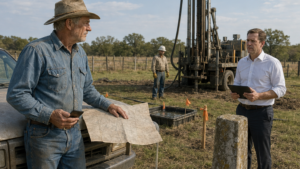
The survey crew chief found the iron pin with the heel of his boot.
“Here.”
Donald stepped closer.
The man scraped away a layer of packed soil and dead grass. A rust-dark circle emerged, no wider than a thumb.
Donald had mowed around it for decades.
Now three people stood over it as though someone had uncovered a buried safe.
The crew chief set his equipment.
Deborah Hall opened the old easement description on a clipboard.
Michelle arrived fifteen minutes later.
She parked at the edge of the county road rather than using Donald’s lane.
Donald noticed.
She walked toward them with her arms folded against the morning chill.
“Edward said you were surveying.”
“We are,” Donald said.
“Without the association?”
“The association doesn’t own my boundary.”
“I didn’t say it did.”
Her eyes went to the equipment.
Then the pin.
“That little thing?”
The crew chief looked up. “If it’s the called monument, size isn’t the issue.”
Michelle gave him a thin smile.
“I wasn’t asking you.”
Donald almost answered for him.
Instead he stepped back.
That was becoming important—allowing facts to exist without immediately pushing them at somebody.
The crew worked from two known corners, checked bearings, reset, then checked again.
The process took longer than Donald expected.
No dramatic line appeared in the ground.
No instant answer arrived.
Numbers accumulated.
Positions tightened.
At one point the crew chief walked fifty yards toward the lower pasture and drove a temporary flag.
Michelle followed him with her eyes.
“That’s not where the road is.”
“No,” Donald said.
She turned.
“What?”
He pointed toward the gravel track used by her guests.
“That’s what we’re trying to determine.”
She looked irritated, but not certain.
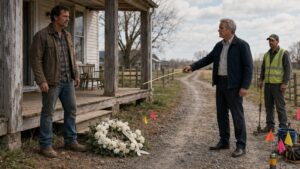
By midmorning a temporary line of flags marked the old access course.
It came up Donald’s lane from the south.
Then, near Ruth’s hedge, it bent east.
Away from Michelle’s barn.
The crew chief checked the final measurement against the original description.
Then he returned to the rust-dark pin.
“This is consistent with the called terminus.”
Deborah asked, “You’re comfortable putting that in the survey?”
“Yes.”
Donald stared down the flagged line.
The answer looked almost embarrassingly simple now.
For sixty years the legal passage had run toward agricultural ground.
Later owners had extended gravel north.
People had followed the gravel instead of the old description.
Convenience had redrawn the route in their minds.
Michelle walked along the flags.
“So what are you saying?”
Deborah answered carefully.
“The recorded agricultural easement crosses part of Donald’s parcel and terminates here before the route continuing to your property.”
Michelle looked from Deborah to Donald.
“My parcel came out of the old tract.”
“Part of it did,” Deborah said. “But the benefitted agricultural parcel was separately conveyed, and this route does not continue to your event-barn entrance.”
Michelle’s jaw tightened.
“We’ve used it for years.”
Donald said, “I know.”
“So this survey suddenly erases that?”
“No.”
She waited.
Donald looked toward the north gravel.
“It tells us what was recorded. It doesn’t erase what people did.”
For a moment neither spoke.
A delivery truck appeared on the county road in the distance, slowed near the old shortcut, then continued toward Michelle’s legal entrance.
The sight gave Donald less satisfaction than he had expected.
He had wanted certainty.
Now he had it.
The gate could stay closed.
Michelle could be forced to reroute everything.
The argument could, in a narrow sense, be over.
But the flags running through his pasture also proved something he had not wanted to admit.
People had not invented the idea of crossing his farm.
They had inherited it.
The use had simply stretched beyond its purpose.
Deborah’s phone rang.
She stepped away to answer.
Donald walked to Ruth’s hedge.
The damaged branch from Friday had wilted despite his tape. He cut the dead portion away with his pocketknife.
Michelle stood several yards behind him.
“That was your wife’s, wasn’t it?”
Donald stopped.
He did not turn immediately.
“Yes.”
“I remember her planting those.”
That surprised him.
Michelle had owned the barn property only a few years, but she had lived in the county longer than that.
Donald folded the knife.
“She planted them the last spring she was well.”
Michelle looked down.
“I didn’t know.”
“I didn’t tell you.”
The admission left more space between them than an accusation would have.
Deborah returned.
Her expression had changed.
“I found something else.”
Michelle gave a weary laugh. “Of course you did.”
Deborah ignored the tone.
“The road-association treasurer sent over Michelle’s improvement file.”
Michelle straightened.
“My what?”
“The turnout application from when the barn parking area was expanded.”
Michelle’s face went still.
Donald looked between them.
Deborah continued.
“The plans show the original entrance from the county road. They do not show the widened connecting turnout onto Donald’s lane.”
Michelle said, “That was gravel work.”
“It changed the traffic connection.”
“It was already being used.”
“Was it approved by the association?”
Michelle said nothing.
That was answer enough.
Donald felt the old anger return, but differently now.
Not hot.
Heavy.
Michelle had believed the passage existed. That was understandable.
She had also widened the connection and directed commercial traffic through it without bothering to settle whether the right extended that far.
That was a choice.
Deborah closed the folder.
“With the survey, Donald has a strong basis to require the event traffic to stop immediately. We can send formal notice today.”
Michelle looked at Donald.
There was no challenge in her expression now.
Only calculation.
Perhaps worry.
Donald imagined the notice.
The closed gate.
The vehicles forced onto the county road.
The expense Michelle would face.
He also imagined Ruth standing beside the new shrubs, waving a tractor through because somebody had asked.
Deborah waited.
“Donald?”
He looked at the iron pin.
It stood inches from the flowering hedge, dividing a legitimate old passage from the newer shortcut everyone had blurred together.
“Don’t send it yet.”
Deborah frowned.
“Why?”
“I want one conversation first.”
Michelle looked as surprised as Deborah.
Donald closed his pocketknife and slipped it into his coat.
“Tonight,” he said to Michelle. “Your place.”
She hesitated.
Then nodded.
Donald looked once more at the survey flags turning east.
He had finally proved where the road ended.
Now he had to decide what he intended the boundary to mean.
Chapter 6: What Donald Had Never Told Them
Michelle was waiting on the barn porch with a folder in her hands when Donald arrived.
She looked behind him.
“No attorney?”
“No.”
“You said conversation.”
“I meant it.”
The renovated barn rose behind her, every improvement visible in the evening light: repaired timber, broad doors, new stone at the entrance, strings of bulbs waiting for the next event.
Donald had resented the place for months.
Standing close to it, he could also see how much money and work somebody had put into keeping an old structure useful.
Michelle tapped the folder against her palm.
“If this is where you tell me you can shut everything down, Deborah already made that clear.”
“I know.”
“Then what are we doing?”
Donald leaned against the porch rail.
“Figuring out what actually needs shutting down.”
She watched him cautiously.
He began with Ruth.
Not the illness.
Not the funeral.
The lane.
Years earlier, the owners of the northeast field had needed to cross Donald’s property with equipment. Some had a recorded right. Others had asked because the legal route was muddy or inconvenient.
Donald had almost always said yes.
“Ruth thought neighbors ought to help neighbors,” he said.
Michelle’s expression softened slightly.
“She did.”
“You knew her?”
“Enough to know she brought food when my mother had surgery.”
Donald looked away.
That sounded exactly like Ruth.
“She also hated arguments over little things.”
Michelle almost smiled. “That sounds familiar.”
Donald let the remark stand.
After Ruth died, people continued using the lane.
Some asked.
Some didn’t.
Donald never made a list.
Never wrote permissions.
Never told Edward which crossings were courtesy and which belonged to an easement.
He simply opened the gate when somebody needed through.
“And when I started sending people?” Michelle asked.
“You were part of a pattern I’d already let get sloppy.”
“That’s not what you said Saturday.”
“No.”
“You made it sound like everybody had been stealing something from you.”
Donald looked at her.
“That was easier.”
“Than what?”
He took several seconds.
“Than saying I was angry because you kept running tires through something Ruth planted.”
Michelle’s eyes moved toward the lane in the distance.
Donald continued.
“I let too many things slide because I didn’t want to become the man who put up chains everywhere after his wife died. Then I waited until I was mad enough that the first clear boundary anybody heard from me sounded like punishment.”
Michelle rubbed her thumb along the folder edge.
“That doesn’t make my traffic legal.”
“No.”
“And it doesn’t make the turnout approved.”
“No.”
Her mouth tightened.
“You came here to admit fault before handing me a bill?”
“I came here because both things can be true.”
She looked at him sharply.
Donald had spent most of his life believing arguments weakened when somebody admitted a mistake.
He was beginning to understand that sometimes they became harder to avoid.
Michelle walked to the porch steps.
“My loan package assumed secondary access.”
Donald frowned.
“What?”
“When we renovated, the lender wanted traffic circulation, emergency access, deliveries, parking capacity. The association map showed your lane. The prior owner said everybody used it. Edward said it had been that way forever.”
“You never checked the deed.”
“No.”
The word came quickly.
Then she looked embarrassed by how quickly.
“I had a survey for my property. I didn’t order a full access review because nobody suggested there was a problem.”
“So you built around an assumption.”
“Yes.”
Donald thought of the blue line.
“How much depends on it?”
“More than I’d like.”
Michelle sat on the step.
“If every delivery comes from the county-road entrance, we need to change staging. Some larger trucks can’t turn near the parking row without moving fencing. Events starting and ending at the same time will stack traffic.”
“That’s fixable.”
“With money.”
“Yes.”
She laughed once without humor.
“Easy word when it’s somebody else’s.”
Donald nodded.
“That’s fair.”
The response seemed to irritate her more than an argument would have.
She opened the folder.
“The next six weekends are booked. I have deposits. Caterers. Families who planned around this place. I didn’t direct people down your lane because I wanted your flowers ruined. I directed them there because I believed it was access.”
“After I told you to stop?”
Michelle looked at the papers.
Donald waited.
That was the part he would not soften for her.
Finally she said, “After you told me to stop, I thought you were wrong.”
“You didn’t check.”
“No.”
“You moved my sign.”
Her head came up.
“I moved it off the travel lane.”
“It wasn’t in the travel lane.”
“Not according to the map I had.”
Donald shook his head.
“There. That’s the part you keep doing.”
“What?”
“Turning what you believed into what you had the right to decide.”
Michelle closed the folder.
The evening sounds from the property filled the pause: insects in the grass, a fan running inside the barn, a truck far out on the county road.
“You want an apology?”
“No.”
“Money?”
“For the shoulder repairs, yes.”
She gave him a tired look.
“At least that’s clear.”
“I’m trying to get better at that.”
This time she did smile, barely.
They walked from the barn toward the edge of her property where the unauthorized connecting turnout met Donald’s lane.
The gravel looked ordinary.
That, Donald thought, was the problem.
Nothing about it announced the years of assumptions underneath it.
At the hedge, he stopped near the rust-dark pin.
“This stays.”
Michelle nodded.
“The agricultural easement?”
“The legitimate one. If the parcel that holds it needs farm access, they get farm access.”
“And my guests?”
“County road.”
She exhaled.
Donald continued before she could answer.
“Deliveries too. Event traffic. Customers. Vendors.”
“So everything connected to the business.”
“Yes.”
“What about emergency vehicles?”
Donald looked toward the barn.
“That’s different.”
Michelle’s eyebrows lifted.
“I’m willing to put emergency access in writing. Fire, ambulance, actual emergency use. Not overflow traffic called an emergency because somebody’s late.”
“That’s narrower than what we’ve been using.”
“It’s supposed to be.”
She studied the hedge.
“Edward won’t like changing the association map.”
“Edward doesn’t have to like accurate.”
“He’ll worry about precedent.”
“He should.”
Michelle looked at him.
Donald continued.
“If one bad line has been copied for thirty years, I’d want to know what else people are treating as fact.”
That landed.
Michelle had filed the complaint expecting the association to force Donald’s gate open.
Instead it had forced everybody to examine what they had relied upon.
Donald reached into his coat and handed her a single folded page.
It was not a legal notice.
Just the points he intended Deborah to turn into one.
Recorded agricultural easement preserved.
Commercial and event traffic prohibited.
Emergency access permitted by written terms.
Unauthorized turnout closed or redesigned.
Shoulder and hedge damage repaired.
Association map corrected.
Michelle read it twice.
“You already wrote the deal.”
“I wrote what I can live with.”
“And if I say no?”
“Then Deborah sends the other letter.”
Michelle looked toward her barn.
Donald could almost see the arithmetic moving behind her eyes.
Repairs.
Traffic changes.
Legal fees.
Pride.
He understood more of her position than he had that morning.
Understanding it did not require him to surrender to it.
Finally she folded the paper.
“I’ll take it to Edward.”
“No.”
She looked back.
“We both take it to Edward.”
Michelle held his gaze.
Then she nodded.
Donald walked home by the lane instead of the field.
When he reached Ruth’s hedge, he touched the cut end where the damaged branch had been removed.
For years he had thought protecting this place meant leaving things exactly as she had left them.
Now the survey flags showed something else.
A boundary could preserve a kindness without allowing it to become a claim.
A permission could remain generous precisely because it was named as permission.
Behind him, Michelle called from near the turnout.
“Donald.”
He turned.
“If the association agrees,” she said, holding up the folded page, “I’ll pay for the shoulder.”
He waited.
“And the hedge.”
Donald nodded once.
It was not an apology.
He had not asked for one.
Two days earlier, that would not have been enough.
Tonight, it was enough to carry into the meeting.
Chapter 7: The Road That Stayed, and the Shortcut That Didn’t
Edward King drew one line through thirty years of assumption.
The road-association map lay flat on the meeting-room table beside the certified survey. Its hand-drawn route crossed Donald Anderson’s farm in blue ink, continuing straight toward Michelle Nelson’s barn.
Edward placed a ruler over the blue line.
Then, with a black pen, he crossed out the section beyond the rust-dark survey pin.
Nobody said anything.
The road-association treasurer sat at the far end of the table with the old improvement files open in front of him. Deborah Hall had brought copies of the recorded easement. Michelle sat opposite Donald, a folder closed beneath both hands.
Edward finally put down the pen.
“I should have checked this years ago.”
Donald looked at the corrected map.
“So should I.”
Edward glanced up.
“You didn’t draw it.”
“No. But I knew people crossed there.”
“That’s not the same thing.”
“No,” Donald said. “That turned out to be the problem.”
The treasurer cleared his throat.
The association’s review had uncovered more than the bad map.
When Michelle expanded the barn parking area, the approved plans showed traffic entering and leaving from the county road. A later gravel turnout connecting her property to Donald’s lane had been widened without a formal amendment.
Nobody had questioned it because the association map already suggested the connection belonged there.
A bad assumption had supported another bad assumption.
Edward tapped the file.
“We can’t leave the turnout as it is.”
Michelle’s jaw tightened, but she did not argue.
The previous two weeks had changed the shape of her choices.
Deborah had explained that Donald could demand immediate closure of the commercial shortcut and seek reimbursement for damage. Michelle could challenge the matter, but doing so would mean spending money to defend access the survey and title history did not support.
She looked toward Donald.
“I had someone price the shoulder repair.”
Donald waited.
“And?”
“I’ll cover it.”
Edward looked surprised.
Michelle continued before anyone could react.
“The rutting, the gravel displacement and the drainage edge. All of it.”
Donald nodded.
“And the hedge?”
A faint irritation crossed her face.
Then it disappeared.
“And the hedge.”
That mattered more than he expected.
Not because the shrubs were expensive.
They weren’t.
It mattered because two weeks earlier Michelle had referred to them as some flowers that got bent.
Now she understood there was a difference between replacing a plant and repairing harm.
The treasurer slid a proposed traffic plan across the table.
Michelle’s event traffic would use the county-road entrance exclusively. Delivery windows would be staggered on large-event days. Her turnout toward Donald’s farm would be narrowed and blocked for ordinary use.
The legitimate agricultural easement would remain untouched.
That parcel still had the recorded right to cross Donald’s ground along the historical route.
Donald had insisted on that.
Edward had asked why.
“You could probably negotiate it away someday,” he had said.
Donald had answered, “It isn’t mine to erase because somebody else abused a different road.”
Now that distinction sat in writing before them.
Permission.
Easement.
Commercial access.
Three different things.
For years everybody had treated them as one.
Michelle read the agreement again.
“I still need emergency access.”
Donald looked at Deborah.
She opened another page.
“That’s addressed separately.”
Michelle read it.
The document granted emergency passage through Donald’s gate for fire, ambulance and other genuine emergency response connected to the barn property. It did not create a permanent commercial easement. It could not be advertised as a guest route. It could not be converted into routine overflow access.
Michelle looked at Donald.
“You didn’t have to offer this.”
“No.”
“Why did you?”
Donald thought about Ruth.
Not the last months.
The spring photograph.
Her gloves.
The shovel.
The tractor passing behind her because somebody had asked.
“Because a boundary doesn’t have to make neighbors useless to each other.”
Michelle held his gaze.
Then she signed.
Edward signed after her.
The treasurer signed as witness.
Donald signed last.
There was no applause.
No one looked triumphant.
Edward gathered the old association maps into a stack.
“I’m checking every marked access route we’ve got.”
Michelle gave a dry laugh.
“That should be a pleasant month.”
Edward almost smiled.
“It’ll be educational.”
Outside, Donald and Michelle stopped beside their trucks.
She had parked near the meeting room instead of using his lane.
“I moved next Saturday’s catering schedule,” she said.
“That fast?”
“I’m learning.”
He looked at her.
She added, “Slowly.”
Donald understood the distinction.
The repair crew arrived the following week.
They rebuilt the damaged shoulder, corrected the drainage edge and removed the unnecessary width from Michelle’s turnout. New posts went in where ordinary traffic would clearly see that the connection was closed.
Donald did not replace the large warning sign.
He no longer needed it.
Instead, a smaller permanent marker went beside the gate, stating that the farm lane was private and agricultural access was by recorded or written permission only.
Clear.
Specific.
Nothing left to guess.
The hedge took longer.
Donald removed the worst damaged shrub himself.
For several minutes he stood with the empty space in front of him.
Years earlier, he would have planted the replacement in exactly the same hole because that was where Ruth had put it.
Instead, he measured two feet inward from the surveyed boundary.
He dug there.
The new shrub looked wrong at first.
The line was no longer perfectly consistent with the old planting.
Then Donald stepped back.
Beside the lane, the rust-dark pin remained visible.
The old agricultural route passed beyond it and turned east exactly as the survey had shown.
Nothing had been erased.
The legal passage remained.
Ruth’s hedge remained.
But neither was being asked to mean something it had never meant.
A pickup approached from the south.
It slowed at Donald’s gate.
The driver was hauling farm equipment toward the parcel that still held the agricultural easement.
Donald walked over and opened the gate.
The driver lowered his window.
“Still okay through here?”
Donald looked at the equipment, then toward the flagged route now made permanent on the corrected map.
“You’ve got the easement.”
The driver nodded.
“Appreciate it anyway.”
Donald stepped aside.
The truck passed through and turned east before the hedge.
Later that afternoon, traffic began arriving for another event at Michelle’s barn.
Donald heard the vehicles before he saw them.
For an instant, old irritation tightened his shoulders.
Then the first SUV reached the intersection.
Its turn signal flashed.
It continued past Donald’s lane and followed the county road.
Another vehicle did the same.
Then another.
No horns.
No argument.
No one moved his gate.
Donald carried the shovel back toward the barn.
Halfway there he stopped and looked behind him.
The new flowers stood slightly inside the old line.
Beside them, the rust-dark survey pin caught the late light.
Beyond it, the road that truly belonged there remained open.
The shortcut did not.
Donald looked at the uneven hedge for another moment.
Then he left it that way.
The story has ended.