They Fined Jack for One Farm Sign—Then He Counted Nine of Theirs Along the Same Private Road
Chapter 1: The Fine Waiting Inside Jack’s Farm Mailbox
The orange sign was gone.
Jack Carter noticed the empty wire stakes before he noticed anything else.
They stood crooked in the grass beside his cattle gate, two thin pieces of metal catching the morning light where the sign had been the night before. Beyond them, the gravel lane curved between his pasture fence and the line of cedars toward the county road.
Jack stopped his truck halfway through the gate.
For three days the sign had read FARM OPEN SATURDAY, with an arrow pointing toward the old equipment shed where his real-estate agent planned to meet people interested in the sixteen-acre parcel Jack was selling from the far edge of the property.
The sale itself already felt like something he preferred not to discuss.
He climbed out, crossed the gravel, and pulled one stake free.
No torn cardboard. No bent sign lying in the ditch. Someone had removed it cleanly.
His black mailbox stood twenty yards farther down the lane.
Inside was a white envelope.
The return line read: PRIVATE ROAD ASSOCIATION.
Jack opened it against the hood of his truck.
The first line used the word VIOLATION.
The second used the number $200.
He read the page twice before the meaning settled.
Temporary signage had been placed within the maintained road easement without authorization. The notice cited Section 5.2 of the recorded road agreement and stated that payment was due within thirty days.
Jack looked back at the two empty stakes.
Two hundred dollars.
For a sign that had stood on what he considered his own ground.
He folded the notice once, sharply, and slid it into his shirt pocket.
The agent answered on the third ring.
“You moved the sign?”
“No,” the agent said. “I put it exactly where you showed me Friday.”
“You didn’t take it down?”
“Jack, I haven’t been out there since Saturday.”
He ended the call and walked the edge of the gravel.
The lane served four properties before reaching the county road. Jack’s family had used it long before anyone started calling the group of landowners an association. His father had hauled square bales down it. Jack had brought his first cattle trailer home over the same gravel.
Years ago, after two newer parcels had been divided farther back, the owners had formalized road maintenance through a written agreement. Someone collected dues. Someone ordered gravel. Meetings were held in folding chairs twice a year.
Jack attended when there was something worth discussing.
Which, in his opinion, was almost never.
He knew the road had an easement. That did not mean the association owned his pasture.
By late afternoon he had convinced himself the notice was probably a misunderstanding.
Larry Thompson lived three-quarters of a mile up the lane in a brick ranch house behind a machine barn. Larry chaired the road association because nobody else wanted the job and because Larry behaved as though this were proof he had been chosen for it.
Jack drove there after feeding.
Larry was closing the sliding door on the barn when Jack pulled in.
Jack held up the folded notice.
“You send this?”
Larry glanced at it without coming closer.
“The association did.”
“You’re the chairman.”
“That doesn’t make it mine alone.”
“My sign was inside my fence line.”
Larry wiped his hands on a shop rag.
“It was inside the easement.”
“No, it wasn’t.”
“It was.”
Jack waited.
Larry had a habit of ending statements as though the conversation had naturally ended with them.
Jack unfolded the notice.
“Show me where you got two hundred dollars from.”
“Section five-point-two.”
“I can read what it says here. I’m asking how a temporary sign on my property became your business.”
Larry’s jaw tightened slightly.
“It became association business when it went inside a shared access easement.”
Jack looked toward the barn. A laminated notice was zip-tied to a post beside the driveway. ROAD WORK THURSDAY was printed across it.
He pointed.
“That yours?”
“That’s an association notice.”
“It’s a sign.”
Larry gave him a tired look.
“Don’t start playing word games.”
“I’m not playing anything.”
“The road’s gotten too cluttered. Delivery signs, auction signs, contractors putting stakes everywhere. We’ve been cleaning it up.”
“That doesn’t answer my question.”
“It answers enough.”
Jack felt the irritation that had carried him there harden.
“I want the fine withdrawn.”
Larry shook his head.
“Then appeal it the proper way.”
“How?”
“It’s in the agreement.”
“You could tell me.”
“You could come to meetings.”
That landed harder than Jack expected because it was true.
He had ignored the last four notices. Before that, he had gone once, stayed twenty minutes, and left after a discussion about culvert gravel became an argument over seven dollars.
Larry took a step toward the barn.
Jack said, “I’m trying to sell sixteen acres, not block the road.”
“I know what you’re trying to do.”
Something in Larry’s tone made Jack straighten.
“What’s that supposed to mean?”
“It means more traffic comes with signs. More traffic comes with people who don’t know the lane.”
“One Saturday.”
“It only takes one vehicle.”
Jack held his gaze.
Larry’s expression was not angry now. It was closed.
“Follow the agreement,” Larry said. “Or use another access.”
Jack almost laughed.
“There is no other access.”
“Then I’d suggest you follow the agreement.”
Larry slid the barn door shut.
The conversation was over because Larry had decided it was.
Jack stood beside his truck with the notice in his hand, feeling less angry than dismissed.
On the drive home he passed two more association notices: one wired to the mailbox shelter and another nailed to a fence post at the bend.
He slowed at the second.
TEMPORARY ROAD NOTICE.
His own missing sign returned to mind.
That evening, instead of turning on the television after supper, Jack pulled open the bottom drawer of the old desk in his kitchen.
Utility bills. Tax statements. Soil reports.
At the back lay a thick folder marked ROAD.
The recorded agreement was inside, copied years ago from the county clerk.
Jack carried it to the table.
He found Section 5.
Then subsection 2.
The language was denser than Larry’s notice had made it sound.
Jack read the first sentence.
Then he read it again.
He put one finger beneath a phrase and moved slowly across the line.
The rule did prohibit temporary signs within the maintained easement.
But the sentence did not end there.
Chapter 2: Three Association Notices Beside One Forbidden Sign
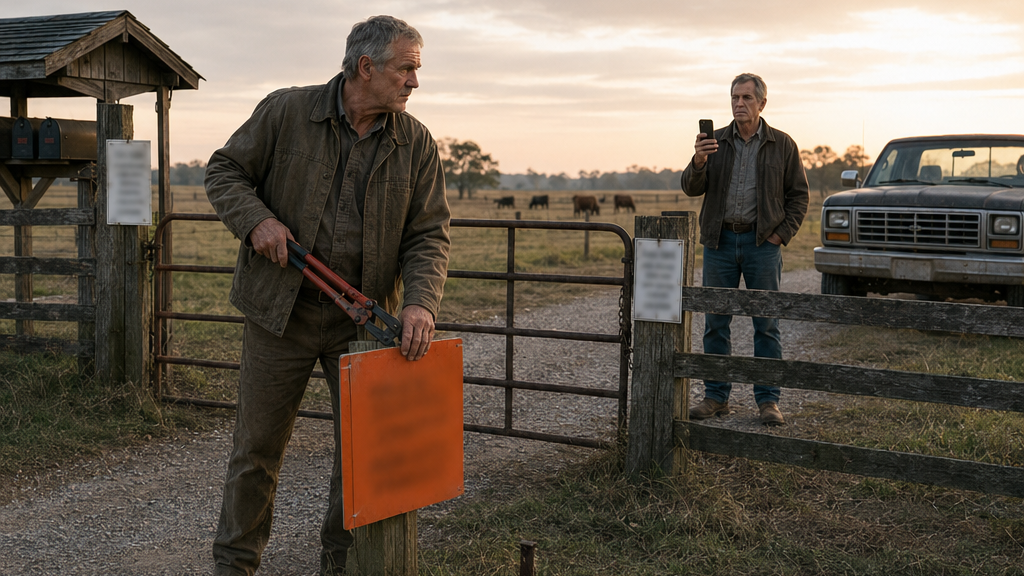
Larry Thompson arrived just after sunrise with a pair of bolt cutters in one hand.
Jack was already waiting beside the cattle gate.
The replacement orange sign stood exactly where the first one had stood, pushed into damp grass just beyond the gravel shoulder.
Behind Larry, almost comically, three other signs were visible without Jack needing to turn his head.
One association notice was strapped to the gatepost.
Another was wired to the fence.
A third stood beside the mailbox shelter farther down the lane.
Larry stopped when he saw Jack leaning against the gate.
“You put it back.”
“I did.”
“I figured you might.”
Jack lifted his phone.
Larry looked at it, then at him.
“You recording me?”
“Taking pictures.”
“Of what?”
Jack took the first photograph.
The orange sign.
The gravel edge.
The gatepost.
The association notice behind it.
“Everything.”
Larry lowered the bolt cutters.
“You think this is funny?”
“No.”
Jack stepped sideways and took another photograph so the second association notice appeared in the frame.
He had spent three evenings reading the agreement.
Not just Section 5.2.
All of it.
The clause prohibited temporary signs, placards, markers, and notices placed within the maintained easement unless prior written authorization had been issued under the association’s procedures.
The wording did not say private signs.
It did not say commercial signs.
And nowhere Jack could find did it say the association exempted itself.
Larry walked toward the orange sign.
Jack did not block him.
“You touch me or those cutters,” Larry said, “and this becomes a different problem.”
“I’m not touching either.”
Larry hesitated.
That seemed to irritate him more than an argument would have.
He crouched, cut the small plastic tie securing the sign to one stake, and pulled it free.
Jack photographed him doing it.
“You finished?”
“Not quite.”
Jack turned his phone toward the notice on the gatepost.
“What’s the written approval number for that one?”
Larry stared at him.
“The what?”
“Written approval.”
“That’s association business.”
“I know who put it up. I’m asking where the authorization is.”
“The board doesn’t need to approve every notice it posts.”
Jack reached into his coat pocket and removed a folded photocopy.
“That’s not what five-point-two says.”
Larry’s face changed only slightly, but Jack saw it.
A pause.
Barely a second.
Enough.
“Read the whole agreement instead of one sentence,” Larry said.
“I did.”
“Then you know there’s a difference between association operations and individual advertising.”
“Show me where.”
Larry looked toward the road.
Jack waited.
A cow bawled from the pasture behind them.
The sound seemed unusually loud in the silence.
Larry pointed toward Jack’s sign.
“You’re selling property. That’s commercial.”
“Maybe.”
“Not maybe.”
“I’m not arguing about what mine is.”
Jack pointed to the notice tied to the fence.
“I’m asking what yours is.”
“Safety information.”
“Still temporary?”
Larry said nothing.
“Still inside the easement?”
Larry’s grip tightened around the cutters.
“You missed enough meetings that you don’t know why those are there.”
“That doesn’t create an exemption.”
“There you go again.”
“With what?”
“Acting like this road stops at your fence.”
Jack’s irritation flashed.
“My land doesn’t stop because you call a meeting.”
“No. But your exclusive control does where the recorded easement begins.”
Larry walked past him and bent to pull the second stake.
Jack nearly told him to leave it.
Instead, he looked down.
A rust-dark survey pin was visible in the grass near Larry’s boot.
Jack had known it was there for years.
His father had once warned him not to hit it with the mower.
He aimed the phone downward and took another picture.
Orange stake.
Association notice.
Survey pin.
Larry noticed what he was photographing.
“There,” Larry said. “That pin matters more than your fence.”
Jack looked at it.
“The easement edge is closer to the gravel.”
“According to what?”
“My survey.”
“Which survey?”
“The one from when the back acreage was redrawn.”
Larry gave a short breath through his nose.
“That isn’t the instrument that created the road easement.”
Jack looked up.
Larry had said it too quickly for bluff.
“What does that mean?”
“It means you’re arguing about a boundary you apparently never bothered to check.”
Larry pulled the second stake from the ground.
Jack let him.
“You have the old survey?”
“County does.”
“Then why not show me?”
“Because I’m not responsible for teaching you what you signed onto.”
Jack’s temper finally pushed through.
“I didn’t sign onto you deciding what counts.”
Larry stepped closer.
“No. You signed onto a road agreement you haven’t cared about in years. You skip meetings. You ignore notices until they affect you. Then suddenly you’re an expert because you read one paragraph.”
The words hit because they were close enough to truth to sting.
Jack looked at the three association signs.
“That paragraph still applies.”
“Maybe you should worry about whether your sign was legal before counting mine.”
Larry carried the orange panel toward his truck.
Jack said, “I want the approval records.”
Larry opened the tailgate.
“Submit the request.”
“I will.”
Larry put the sign inside.
Then he paused.
“For what it’s worth, Jack, this isn’t about your sale.”
Jack did not answer.
“It’s about keeping that lane from becoming a billboard and somebody getting hurt.”
“Then write a rule that says that.”
“We have one.”
“You have a rule you apply when you feel like it.”
Larry shut the tailgate hard.
“That’s your opinion.”
“No. The approvals are either written down or they aren’t.”
Larry got into the truck.
Jack stood beside the gate until the vehicle disappeared around the bend.
Only then did he look again at the old survey pin.
He walked back to the house and pulled the newer property survey from the folder.
The map showed the gravel lane, the pasture boundary, and a narrow access strip.
Jack measured the printed distance from the road centerline to the easement edge.
Then he went outside with a tape.
He measured from the center of the gravel to the pin.
Stopped.
Measured again.
The two numbers did not agree.
By nearly six feet.
Chapter 3: The Older Easement Map Jack Never Saw
Rachel Moore placed the old plat on the counter and said, “This is the one you need to look at.”
Jack had arrived at the county land-records office expecting confirmation.
Instead he stared at a yellowed survey copy large enough to cover half the counter.
The private lane appeared as two parallel ink lines crossing what had once been a single farm.
Rachel kept one finger near the recording stamp.
“This instrument predates the parcel split you brought in.”
Jack unfolded his newer survey beside it.
“This is what I’ve used for fifteen years.”
“I’m not saying it’s wrong.”
“Looks wrong.”
“It answers a different question.”
Jack frowned.
Rachel rotated the older sheet toward him.
“Your survey establishes parcel boundaries. This recorded plat describes the access easement.”
“A boundary is a boundary.”
“Not always the same boundary.”
She said it without impatience, which somehow made it harder to argue.
Jack traced the lane with his finger.
For most of its length, the easement maintained a predictable width.
Near his entrance, however, the line bowed outward.
He leaned closer.
“What’s that?”
“Widened turnout.”
“For what?”
“The notes say agricultural vehicle clearance.”
Jack followed the arc.
It widened exactly where his cattle gate met the road.
Exactly where the orange sign had stood.
He felt something sink behind his ribs.
“That can’t be six extra feet.”
Rachel reached for a scale.
They checked it.
It was.
Jack stared at the old map.
His father had always treated the ground beyond the gravel shoulder as pasture. Jack had fenced it. Mowed it. Repaired it. Paid taxes on the parcel containing it.
None of that erased an easement.
“So Larry was right.”
Rachel looked at him.
“I didn’t say that.”
“The sign was inside it.”
“From what you’ve shown me, it appears the location may fall within the recorded easement.”
“That’s a careful way to say yes.”
“It’s a careful way to say I’m a records technician, not your attorney.”
Despite himself, Jack smiled once.
Rachel pointed to his newer survey.
“This doesn’t cancel the older easement. It references the road agreement by recording number.”
Jack found the notation in tiny print near the bottom.
He had seen it before.
He had never followed it.
For years he had kept copies of every deed, tax receipt, soil report, and fence invoice related to the farm. He considered himself careful.
Yet he had read the documents that confirmed what he owned and ignored the ones describing what he shared.
The realization irritated him more than Larry’s fine.
“When was this turnout last used the way they describe?”
“I wouldn’t know.”
“It hasn’t been. Not for years.”
“That doesn’t remove it.”
Jack folded his arms.
“What about the sign rule?”
Rachel glanced toward the document he had copied from the association agreement.
“That’s private governance. We record it. We don’t administer it.”
“I know.”
He did know.
He also knew he had come hoping she would tell him Larry had no standing at all.
Instead she had given Larry the strongest part of his argument.
Rachel copied the old plat for him.
At the payment counter, Jack looked again at the bowed easement line.
His own orange sign had stood perhaps three feet inside it.
Maybe four.
The number nine he had been privately imagining—the association notices he had already begun noticing along the road—suddenly seemed less decisive.
If his own sign violated the rule, proving that theirs did too did not make his legal.
It only made everyone inconsistent.
Back home, Jack spread both plats across the kitchen table.
The old survey pin sat in his mind like an accusation.
He marked the approximate location of the orange sign in pencil.
Inside the curve.
He erased it.
Marked it again.
Still inside.
At four that afternoon Larry’s truck passed the house without slowing.
Jack watched through the kitchen window.
For the first time since receiving the fine, he understood why Larry had sounded so certain about the easement.
That did not explain the association signs.
Jack returned to Section 5.2.
He read it from the beginning again.
Temporary signage, markers, placards or notices placed within the maintained easement required prior written authorization.
He continued into the next paragraph.
Written authorization was to identify the requesting party, location, purpose, and permitted duration.
Jack sat back.
If the board had approved its own notices properly, Larry could make the problem disappear with a folder.
Jack picked up the phone and called the association secretary.
“I need copies of temporary-sign approvals for the last twelve months.”
There was a pause.
“All of them?”
“All of them.”
“That could take some looking.”
“That’s fine.”
“What are you trying to find?”
“I don’t know yet.”
He gave her the locations of the three signs at his gate and nearby shelter.
She promised to check the files.
The next morning she called back.
“I found meeting notices,” she said. “Maintenance invoices. Nothing labeled sign approval.”
“Could it be filed somewhere else?”
“Maybe with Larry.”
Jack wrote that down.
“Are approvals numbered?”
Another pause.
“I don’t remember us numbering them.”
“But the agreement says written authorization.”
“Yes.”
“So what does one look like?”
“I’d have to ask.”
Jack thanked her and ended the call.
He did not feel victorious.
That surprised him.
A week earlier, discovering missing paperwork would have felt like catching Larry in a lie.
Now Jack saw the widened easement line lying across his kitchen table.
His sign had probably been wrong.
Larry’s signs might be wrong too.
That was messier than innocence.
Jack pulled a legal pad toward him and made two columns.
MY SIGN.
ASSOCIATION SIGNS.
Under his own, he wrote:
Possibly inside easement.
Under the second, he wrote:
Written approvals?
Then he went back to the agreement and read beyond Section 5.2, looking for any clause that gave the association itself an automatic exemption.
He found authority to maintain gravel.
Authority to clear drainage.
Authority to manage emergency access.
Authority to assess shared costs.
But after another hour, the temporary-sign language remained stubbornly unchanged.
Everyone using the easement needed written authorization.
Jack looked at the copied plat, then at Larry’s fine.
For the first time, the question was no longer whether Jack had broken the rule.
It was whether the people enforcing it had ever bothered to follow it themselves.
Chapter 4: Nine Roadside Notices and No Approval Numbers
Jack took the first photograph before sunrise.
The association notice was wired to the mailbox shelter where the private lane met the county road. He framed it carefully enough to show the wooden post, the gravel shoulder, and the time on his phone.
One.
He did not feel clever about it anymore.
The old easement plat rode folded in the passenger seat of his truck, its widening line near his cattle gate now impossible to forget. His own sign had almost certainly been inside the shared strip. That fact had changed the purpose of the morning.
He was no longer trying to prove he had done nothing wrong.
He was trying to find out whether anyone had followed the rule.
Jack drove slowly back up the lane.
At the first bend he stopped beside a temporary notice warning drivers about loose gravel.
Two.
Farther up, a laminated sheet had been fastened to a fence near the drainage crossing.
Three.
He photographed the sign, then the road around it. He stepped backward until the edge of the gravel and fence line appeared together.
No guessing.
No cropped images that made his argument look stronger than it was.
At the livestock turnout, two plastic arrows remained strapped to metal stakes from a hauling day weeks earlier.
Four and five.
Jack almost counted a faded feed-delivery placard on a utility post, then noticed the name of a private supplier in the corner.
He lowered the phone.
Not theirs.
That distinction mattered now.
By seven thirty he had six association notices documented.
At Deborah White’s property, he found the seventh beside her gate.
She was carrying a bucket toward the barn when she saw his truck.
“You conducting an inspection?”
Jack stepped out.
“Something like that.”
Deborah looked at the phone in his hand.
“You and Larry still at it?”
“I’m trying not to be.”
“That would be new for both of you.”
Jack almost smiled.
He pointed toward the notice beside her drive.
“You know when that was approved?”
Deborah followed his finger.
“That one?”
“Yes.”
“It went up before the culvert work.”
“I know why it went up.”
She set down the bucket.
“What are you asking?”
“Written approval. Date. Who authorized it.”
Deborah’s expression changed.
Not defensiveness exactly.
Calculation.
“Larry probably handled it.”
“That isn’t what I asked.”
She sighed.
“Jack.”
“The agreement says written authorization.”
“I know what it says.”
“Then where is it?”
Deborah leaned one hand against the fence.
“We’ve never treated association notices like somebody advertising puppies or putting up an auction board.”
“So there isn’t one?”
“I didn’t say that.”
“You didn’t say there was.”
She looked toward the house.
Jack waited.
Finally she said, “Most things like that were handled verbally.”
“By who?”
“Usually whoever was chairing.”
“Larry.”
“Lately, yes.”
“And before Larry?”
“Whoever had the job.”
Jack took the photograph.
Seven.
Deborah frowned.
“You planning to file something?”
“I’m planning to know what happened first.”
“That’d put you ahead of most people.”
Jack slid the phone into his pocket.
“Why did Larry suddenly care so much about signs?”
Deborah’s face tightened.
“He’s cared about the road for years.”
“Not like this.”
“No.”
Jack waited.
A gate chain knocked softly against steel as one of her cows leaned against the fence.
Deborah said, “There was an incident.”
“What incident?”
“You should ask Larry.”
“I did. He gave me half a sentence about somebody getting hurt.”
Her gaze dropped toward the gravel.
“It came closer than half a sentence.”
Jack said nothing.
Deborah picked up the bucket again, but she did not walk away.
“A delivery van came around the blind bend too fast. There was a livestock trailer coming the other direction.”
“Whose?”
“I’m not getting into that.”
“Did they hit?”
“No.”
“Anybody hurt?”
“No.”
“Then what happened?”
“The trailer left the road. One wheel dropped into the ditch. The cattle shifted. The van went sideways trying to stop.”
Jack pictured the bend near the old sycamore. Narrow even in good weather.
“How close?”
“Close enough.”
“And that made Larry start fining signs?”
“Not by itself.”
She lifted the bucket.
“Ask him about the insurance letter.”
Then she walked toward the barn.
Jack stood there for a moment before continuing up the lane.
The eighth notice was fastened to a post near the blind bend itself.
SLOW—FARM TRAFFIC.
The words were printed large enough to read from inside a truck.
Jack stared at it longer than the others.
If any sign had a reason to exist, it was that one.
He photographed it anyway.
Eight.
The ninth was beside the rear turnout, attached to a temporary wooden stake and directing heavy vehicles away from a soft shoulder.
By then the sun had cleared the tree line.
Jack reviewed the photographs in his truck.
Nine association postings.
Nine locations.
Nine timestamps.
He had expected the number to feel like victory.
Instead he kept coming back to the warning at the blind bend.
He drove there and parked off the road.
From one direction, the curve looked manageable. From the other, the vegetation and slope hid an approaching vehicle until the last seconds.
Jack stood where the trailer must have dropped toward the ditch.
A gouge in the bank had mostly grown over.
He had driven past it dozens of times without asking what caused it.
That bothered him.
Not because Larry had been right to fine him.
Because Jack had assumed Larry had no reason at all.
That afternoon he called Deborah.
“What date was the near miss?”
There was a long pause.
“August seventeenth last year.”
“And the insurance letter?”
“About three weeks after.”
“You have it?”
“I have the date. The secretary has the correspondence.”
Jack wrote it down.
“Deborah.”
“Yes?”
“Did the board vote on the sign policy after that?”
Another pause.
“I said you should ask Larry.”
“That means no.”
“It means I’m tired of being in the middle.”
“You’re the treasurer.”
“That doesn’t mean I enjoy being everybody’s referee.”
Jack looked at the nine photographs spread across his kitchen table.
“I’m not asking you to take my side.”
“That’s what everybody says before they ask.”
“I’m asking whether the rules changed properly.”
Deborah was silent long enough that Jack thought the call had dropped.
Then she said, “Get the insurance letter first.”
“Why?”
“Because if you’re going to accuse Larry of making rules up, you ought to understand what scared him into doing it.”
She gave him the date again.
Jack circled it on his legal pad.
For the first time since the fine arrived, the most important question was no longer why Larry had singled him out.
It was what had happened on August seventeenth that made Larry decide the road could not be managed the old way anymore.
Chapter 5: The Near Miss That Changed Larry’s Rules
Jack measured the blind bend at nine feet, eight inches from the gravel edge to the opposite ditch.
He measured it again.
Nine feet, nine.
Not enough room for a wide livestock trailer and an impatient delivery van to meet comfortably, especially if either driver entered the curve expecting the lane to be empty.
He stood in the middle of the road until the sound of an engine made him step aside.
Larry’s truck appeared around the bend and stopped.
The driver’s window lowered.
“You planning to survey the whole road yourself now?”
“Just this part.”
Larry looked at the measuring tape stretched across the gravel.
“Why?”
“August seventeenth.”
For a moment Larry’s face gave nothing away.
Then he shut off the engine.
“You talked to Deborah.”
“She told me enough to know there was a near miss.”
Larry opened the door and climbed out.
“You want to use that against me too?”
“No.”
That answer seemed to surprise him.
Jack pointed toward the ditch.
“Where did the trailer go off?”
Larry walked several steps and indicated a shallow depression in the bank.
“There.”
“You were driving?”
“No.”
Jack waited.
Larry rubbed a hand along the back of his neck.
“One of the neighbors was hauling cattle. Delivery van came through from the county road. Driver was looking at one of those auction arrows somebody had tied to a post.”
Jack glanced toward the old warning sign.
“The sign caused it?”
“I said the driver was looking at it.”
“That isn’t the same thing.”
“No. It isn’t.”
Larry’s tone had lost its edge.
“The van came in too fast. Trailer moved right. Wheel dropped. Cattle shifted hard enough to nearly tip it.”
Jack looked at the bank.
“You saw it?”
“I got there two minutes later.”
“So why signs?”
“Because afterward everybody had a reason it wasn’t their fault. Driver blamed the curve. Neighbor blamed delivery traffic. Somebody else blamed the auction markers. Insurance company asked what controls we had for temporary roadside distractions and traffic management.”
“Controls.”
Larry gave a humorless laugh.
“That’s their word.”
“And they threatened us?”
“They said another claim could change the road’s risk classification.”
“What does that mean in dollars?”
“Enough.”
“How much?”
“Potentially double the liability portion. Maybe more if they required improvements.”
Jack folded the measuring tape.
“So you started taking signs down.”
“I started trying to keep the lane clear.”
“And issuing fines.”
“After people ignored warnings.”
Jack looked at him.
“Did the board approve that?”
Larry’s jaw shifted.
“We already had Section 5.2.”
“That isn’t my question.”
“It gave us authority.”
“It gave somebody authority to issue written approvals.”
“And to prohibit unauthorized signs.”
“Did the board vote to make you the one deciding which was which?”
Larry looked away.
A breeze moved through the dry weeds along the ditch.
“You missed the meeting after the accident.”
Jack felt the old defensiveness rise.
“I’m aware I missed meetings.”
“Three years’ worth.”
“I paid dues.”
“That isn’t the same as showing up.”
“I didn’t say it was.”
Larry looked back at him.
“You know what happens when nobody wants the job? Somebody still has to call the gravel company. Somebody still has to chase checks. Somebody still has to answer when an insurer wants pictures by Friday.”
There it was.
Not authority.
Exhaustion.
Jack had never considered Larry tired of the position because Larry wore control too comfortably.
“What happened to asking people?” Jack said.
“I asked.”
“To remove signs?”
“To help.”
Jack said nothing.
Larry continued.
“You know how many volunteered after the insurance letter?”
Jack could guess.
“None.”
“One. Deborah. And she already keeps the books.”
That struck close enough to Jack’s own absence that he looked down at the tape in his hand.
Larry kicked loose gravel back toward the road.
“So I handled it.”
“Badly.”
Larry’s eyes hardened again.
“I handled it.”
“You fined me without being able to show me the written process.”
“Your sign was in the easement.”
“I know.”
Larry stopped.
Jack watched the surprise pass over his face.
“You know?”
“I pulled the old plat.”
Larry said nothing.
“It widens at my gate,” Jack continued. “My sign was inside by a few feet.”
Larry’s shoulders lowered slightly.
“Then what are we doing?”
“We’re figuring out whether being right about my sign made you right about everything else.”
Larry’s expression closed again.
“There it is.”
“No. Listen to me.”
Jack pointed up the lane.
“You had a real problem. Maybe a dangerous one. But you started enforcing a written rule with verbal permissions for your own notices.”
“They’re safety notices.”
“Then authorize them.”
“We don’t need paperwork for common sense.”
“You needed paperwork for my two-hundred-dollar fine.”
Larry stared at him.
Jack let the silence stand.
Finally Larry said, “You want your money back.”
“Yes.”
“At least that’s honest.”
“But that isn’t all I want anymore.”
Larry gave him a skeptical look.
“I want the rule to mean the same thing at my gate as it does at yours.”
“You keep saying that like running a road and selling land are identical.”
“They’re not.”
“Then stop pretending.”
“I’m not. Make different categories. Write them down. Vote on them. But you don’t get to invent the difference after you’ve fined somebody.”
Larry’s face reddened.
“You think one paragraph makes you qualified to run this?”
“No.”
Jack folded the measuring tape and put it in his pocket.
“That might be the first thing we agree on.”
He walked back toward his truck.
Larry called after him.
“You file a complaint, don’t expect me to apologize for keeping this road safe.”
Jack turned.
“I’m not asking you to apologize for that.”
Larry looked almost more unsettled by the answer than he had been by Jack’s accusations.
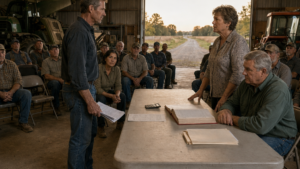
Two evenings later the road association met in the machinery shed behind Deborah’s house.
Folding chairs faced a plywood table. Six landowners attended.
Jack sat near the rear.
Larry explained the insurer’s concerns, the near miss, and the need to control temporary roadside material.
For ten minutes, Jack understood exactly why people had let Larry handle things. Larry knew culvert costs, gravel schedules, ditch problems, insurance deadlines. He had answers before questions were finished.
Then Deborah opened the association binder.
“There is one thing we need to clear up,” she said.
Larry glanced at her.
“What?”
“The enforcement policy.”
“It’s Section 5.2.”
“I mean the fines.”
Larry’s face became still.
Deborah turned several pages.
“I went back through the minutes after Jack asked about approvals.”
Jack watched Larry rather than the binder.
Deborah continued.
“We discussed enforcement after the accident. We discussed signs. We discussed possible penalties.”
Larry said, “Correct.”
“But I cannot find a recorded motion adopting the fine schedule.”
A chair scraped against concrete.
Larry said, “We agreed to enforce the existing agreement.”
Deborah’s voice stayed quiet.
“We agreed something had to be done.”
“That’s what we did.”
“No, Larry.”
She looked up.
“We never voted on your enforcement policy.”
The shed went silent.
Jack had come prepared to challenge Larry.
Instead, Deborah had done something harder.
She had stopped protecting the shortcut she herself had allowed.
Chapter 6: Jack Files the Complaint Against Everyone, Including Himself
Jack placed photograph number ten beside the other nine.
It was his orange sign.
For several seconds he considered removing it.
Nine association violations made a clean argument. Ten signs made a mess.
That was precisely why he left it.
The formal compliance request lay open on his kitchen table. Jack had written and rewritten the first page three times, stripping out every sentence that sounded like anger.
He did not accuse Larry of corruption.
He did not demand that Larry resign.
He listed the recorded rule, the apparent lack of written approvals, the missing vote establishing monetary penalties, and the locations of all ten temporary signs.
Beside photograph ten he wrote:
Protagonist’s sign—placement appears within recorded widened easement; authorization not obtained.
He crossed out protagonist and replaced it with:
Jack Carter.
Then he signed the complaint.
The hearing took place two weeks later in the same machinery shed.
This time nearly every property represented along the lane had someone present.
Larry sat at the plywood table with Deborah and the association secretary. A copy of the road agreement lay between them.
Jack brought one folder.
Larry brought three.
“Before we start,” Larry said, “I want it clear that this association has never claimed the road itself belongs to us.”
Jack nodded.
“That isn’t my complaint.”
Larry glanced down at Jack’s submission.
“I noticed.”
The secretary summarized the request.
Jack listened until she reached the photographs.
“One through nine document association notices or directional postings for which no written authorization has been located.”
Larry folded his arms.
“Safety notices.”
The secretary continued.
“Photograph ten documents Mr. Carter’s own temporary farm-sale sign, which he acknowledges was likely within the recorded easement.”
A murmur moved through the chairs.
Larry looked directly at Jack.
“You included yours.”
“Yes.”
“Why?”
Jack had expected the question.
Still, he took a moment before answering.
“Because it was there.”
“That’s not what I mean.”
“I know.”
Jack looked around the shed.
“I started this because I wanted my fine canceled. I still think it should be, because nobody can show me the fine schedule was properly adopted.”
Larry shifted.
“But my sign was inside the easement. I didn’t get permission. If we’re reviewing compliance, mine belongs in the pile.”
One of the neighboring landowners said, “So you’re asking them to fine you again?”
A few people smiled.
Jack did not.
“I’m asking us to decide what the rule actually is.”
Larry watched him carefully.
Jack continued.
“If the answer is no temporary signs without written permission, that applies to mine. If safety notices get a different process, write the process. If farm-sale signs are allowed for forty-eight hours outside a marked clearance zone, write that too.”
“You’re making this more complicated than it needs to be,” Larry said.
“No. We made it complicated by doing half of it by habit.”
Larry leaned forward.
“And if your new process says that orange sign can’t go where you want it?”
“Then I move it.”
That quieted the room.
Jack felt the cost of the sentence immediately.
The sixteen acres had been slow to attract interest. His agent wanted roadside visibility. Moving the sign farther inside the property would make it harder to see from the county-road approach.
A month earlier he would have called that unreasonable.
Now he knew the blind bend was real.
Larry picked up photograph ten.
“You’re willing to restrict your own sale sign.”
“I’m willing to follow a rule we actually approve.”
Larry put the photograph down.
Deborah opened the binder.
“The second issue is the penalties.”
She summarized what the minutes showed.
Discussion after the near miss.
Agreement that roadside clutter needed control.
No recorded motion adopting the $200 schedule.
No written delegation giving the chair sole authority to issue fines.
Larry interrupted.
“Because we already had enforcement authority.”
Deborah looked at him.
“We had authority to enforce the agreement. That doesn’t mean every enforcement method you chose was automatically adopted.”
“You signed checks for the notices.”
“I paid association expenses.”
“You knew what we were doing.”
“Yes.”
Deborah’s answer came so quickly the room went still.
“Yes, I knew.”
Larry stared at her.
She closed the binder.
“And I should have insisted we vote.”
There was no triumph in her voice.
“I didn’t because after the insurance letter you were the only person willing to handle everything. I told myself keeping things moving mattered more than procedure.”
Jack looked at her.
This was not a sudden betrayal of Larry.
It was an admission against herself.
Deborah continued.
“That was easier for me. It was also wrong.”
Larry looked down at the table.
For the first time Jack saw not the chairman who had removed his sign, but a man who had spent years being useful until usefulness had started to feel like permission.
Larry said, “So now everything I did is wrong?”
“No,” Jack said.
Larry looked at him sharply.
“The blind bend is dangerous. The insurance issue is real. The signs can create clutter.”
“Then what exactly are you accusing me of?”
“Deciding the rules alone because the rest of us made it easy for you to.”
The sentence sat between them.
Jack included himself in it deliberately.
Larry heard that.
“So this is everybody’s fault now?”
“No.”
Jack shook his head.
“You chose to fine people under a policy that wasn’t voted on. That part is yours.”
Larry’s mouth tightened.
“And I chose to ignore meetings until you fined me. That part is mine.”
Nobody spoke for several seconds.
Then one of the neighboring landowners asked the practical question.
“What do we do with the existing fines?”
The discussion lasted nearly an hour.
Some wanted every penalty voided.
Others argued that clearly dangerous obstructions should remain enforceable.
Jack resisted the urge to steer every point.
That was new for him.
Eventually Deborah proposed withdrawing monetary penalties issued under the unrecorded fine schedule while preserving the association’s right to require removal of unauthorized material under the written agreement.
The group agreed to put that question to a recorded vote.
Then they moved to temporary signs.
A designated clearance zone near the blind bend.
Defined locations near individual farm entrances.
Written approvals lasting specific periods.
Emergency and safety notices permitted under a separate expedited process, with each posting recorded by date and location.
Nothing revolutionary.
Just rules that could be found before somebody broke them.
Larry listened with his hands folded.
When the secretary finished reading the proposed framework, he said, “I want the record to show I still believe the enforcement was necessary.”
Jack answered before anyone else could.
“I believe some enforcement was necessary too.”
Larry looked at him.
“That doesn’t make the process right.”
“No.”
Another pause.
“But it doesn’t make the safety problem fake either.”
Larry nodded once.
It was not an apology.
Jack did not need it to be one.
Before the meeting adjourned, Larry cleared his throat.
“One more thing.”
Everyone looked toward him.
“I’ll agree to put the whole policy to a recorded vote.”
Deborah nodded.
Larry continued.
“But I’m not resigning as chair because Jack filed this complaint.”
Jack closed his folder.
“I didn’t ask you to.”
That earned the faintest change in Larry’s expression.
Not warmth.
Recognition, perhaps.
The vote would be held the following month after the easement boundaries were professionally marked and the proposed sign zones circulated to every landowner.
Jack walked out of the machinery shed carrying the same folder he had brought in.
His $200 fine had not yet disappeared.
His orange sign was still down.
And the new rules, if adopted, would restrict him just as surely as anyone else.
For the first time, that did not feel like losing.
The harder question now belonged to all of them.
When the recorded vote came, would the neighbors still want equal rules once those rules required something from them too?
Chapter 7: The New Signs Mark More Than a Boundary
The last unapproved notice came off Deborah White’s fence with more effort than anyone expected.
A year of sun had baked the plastic ties brittle, but not brittle enough. One snapped. The other twisted around the wire until the worker finally cut it loose and carried the faded sign toward the truck.
Jack watched from the shoulder of the private lane.
A month earlier, he would have enjoyed that sight.
Now it felt less like something being defeated and more like something being cleaned up.
Small orange survey flags dotted the roadside at measured intervals. The association had hired a survey crew to mark the recorded easement where it widened, narrowed, and crossed the entrances to each property. At Jack’s gate, the line curved outward exactly where the old plat said it did.
The rust-dark survey pin remained in the grass.
Beside it stood a new marker showing the approved boundary for temporary signs.
Jack’s real-estate agent had already called twice.
“Can I put the farm sign back today?”
“Not yet.”
“The vote passed.”
“I know.”
“So what are we waiting on?”
“The marked location.”
There had been a pause.
“You’re taking this very seriously for a sign you wanted to put wherever you pleased a month ago.”
Jack had looked through the kitchen window toward the lane.
“That was a month ago.”
Now the approved location was finally marked.
It sat farther back from the gravel than Jack would have chosen and several yards from where the original orange sign had stood. A driver coming from the county road would still see it, though not until after entering the lane.
Jack could live with that.
The association vote had passed five to one.
The improperly issued monetary penalties were withdrawn, including Jack’s $200 fine. The written agreement itself remained enforceable. Temporary signs were allowed only in mapped areas or through written permission.
Safety postings had their own expedited process, but each one had to be logged with a purpose, location, installation date, and removal date.
There would be no more permanent collection of temporary notices turning gray on fences because nobody remembered who had put them there.
The change was almost embarrassingly ordinary.
That was part of why it worked.
No one had won control of the road.
They had made control harder for any one person to claim.
Larry Thompson’s truck approached slowly and stopped beside Jack.
Larry lowered his window.
“You supervising?”
“Observing.”
“That what we call it now?”
“Sounds better.”
Larry looked toward the worker removing the final notice.
“I put that one up.”
“I figured.”
“Drainage work last spring.”
“It lasted longer than the drainage work.”
Larry gave him a look.
Jack let the corner of his mouth move.
A month had not made them friends.
It had made conversation possible again.
Larry parked and got out with a folder tucked under one arm.
He had remained chairman after the recorded vote. Nobody challenged him for the position.
Jack had found that revealing.
People could complain about Larry’s methods for hours. When it came time to nominate someone willing to take calls about washed gravel on Sunday mornings, the room went quiet.
Larry handed him a page.
“What’s this?”
“Temporary committee assignments.”
Jack scanned it.
His own name appeared halfway down.
Road Access and Sign Placement Review.
He looked up.
“No.”
Larry nodded as if he had expected exactly that.
“Deborah said you’d say that.”
“She’s right.”
“It’s ninety days.”
“No.”
“Maybe four meetings.”
“Still no.”
Larry leaned against the truck.
“You spent a month explaining how everybody ought to participate in rules they expect other people to follow.”
“I explained that rules need proper approval.”
“Same neighborhood.”
“Different argument.”
Larry gave a short laugh.
“There’s Jack.”
Jack folded the page.
He had spent years believing association meetings were what happened when people had too little real work.
Fence repair was work.
Calving was work.
Clearing a clogged culvert at dusk was work.
Sitting in a shed while six adults argued over roadside markers had seemed like an imitation of work.
Then he remembered Larry’s question at the blind bend.
How many people volunteered after the insurance letter?
One.
Deborah.
Jack looked toward the mapped easement line.
“What exactly does the committee do?”
“Review the first ninety days. See whether the sign zones cause visibility problems. Recommend changes before anything becomes permanent.”
“You already voted.”
“On the framework.”
“And if I think one of the zones is wrong?”
“You bring it up.”
“And if mine is wrong?”
Larry shrugged.
“Same answer.”
Jack stared at the paper.
There was something annoyingly fair about that.
“You planned this.”
“Deborah planned it.”
“That I believe.”
“Are you doing it?”
Jack looked down the road.
The temporary notices were gone now, leaving clean stretches of fence and weathered posts that looked strangely bare.
He thought about his original complaint.
At first he had wanted Larry to admit Jack had been right.
Then the old plat had shown him he was not.
After that he had wanted the association’s nine signs to prove Larry was wrong.
They had.
But not about everything.
The blind bend remained narrow.
The insurance warning had been real.
The delivery van had nearly met a livestock trailer in a ditch.
And Jack had spent years making himself unavailable to the people making decisions, then resented the decisions they made without him.
“Ninety days,” Jack said.
Larry straightened.
“Ninety.”
“No automatic extension.”
“You can argue about that at the committee.”
Jack gave him a hard look.
Larry smiled for the first time Jack could remember seeing it during the entire dispute.
“Fine,” Jack said.
Larry held out his hand for the signed page.
“I haven’t signed it.”
“You will.”
“You’re getting comfortable again.”
Larry’s smile disappeared, but not unpleasantly.
“I’ll work on it.”
That afternoon Jack’s real-estate agent arrived with the orange FARM OPEN SATURDAY sign in the back of a car.
Jack took it himself.
“You sure?” the agent asked.
“I know where it goes.”
He carried it toward the cattle gate.
The old location was still visible if he knew where to look. Two faint holes remained in the ground where the wire stakes had stood.
Jack stopped there.
The new easement marker was six feet farther into the field.
He looked from one to the other.
Six feet had started the whole argument.
Six feet between what Jack believed belonged entirely to him and what the recorded agreement said he shared.
He carried the sign past the old holes.
At the approved marker he pushed the first stake into the soil.
It caught on something.
Jack adjusted the angle and tried again.
The metal sank cleanly.
He set the second stake, stepped back, and checked the sign from the lane.
Visible.
Clear of the turnout.
Far enough from the bend.
Larry’s truck appeared in the distance.
Jack expected him to stop.
Instead Larry slowed, looked toward the sign, then continued toward his farm.
No inspection.
No warning.
No argument.
Jack watched the truck disappear.
The sign stood alone now.
No association notices crowded the gate. No faded placards hung from the fence. The old survey pin remained several feet away, dark against the grass.
Jack crouched and brushed weeds from around it.
He had once thought the pin marked the place where somebody else’s authority ended.
Now it seemed to mark something less satisfying and more useful.
The place where owning land did not mean living without obligations.
The place where shared responsibility did not mean surrendering ownership.
Jack stood and looked at the orange sign.
He still intended to sell the sixteen acres.
That decision had not become easier.
But selling part of the farm no longer felt like admitting he had failed to protect it.
Keeping everything unchanged was not the same as preserving what mattered.
Behind him, a vehicle slowed at the entrance.
The driver saw the sign, made the turn without drifting toward the shoulder, and continued up the lane.
Jack watched until it cleared the bend.
Then he closed the cattle gate.
The orange sign remained exactly where all of them had agreed it could stand.
The story has ended.