He Inherited His Uncle’s Farm Entrance—Then the Road Association Learned What Their Gate Actually Stood On
Chapter 1: The Gate Was Included in the Inheritance
The key Scott Mitchell had inherited from his uncle opened a gate that everyone else seemed to think belonged to them.
He had stopped at the entrance only because a delivery truck was backing out of the narrow gravel road. The driver raised two fingers from the cab, waited for Scott to unlock the black iron gate, then rolled past as if Scott were a caretaker instead of the man whose name now appeared on the deed.
Scott watched the truck disappear between soybean stubble and a row of older maples.
Then he looked at the key in his palm.
Frank had kept it on a faded red plastic tag marked simply FRONT.
Beyond the gate stood a roofed bank of rural mailboxes, a landscaped strip of ornamental grass, two brick-faced posts, and enough gravel for a farm truck to turn without dropping a wheel into the drainage ditch. Someone had trimmed the shrubs recently. Fresh stone filled several low spots.
Nothing about the place looked neglected.
Nothing about it looked like part of Frank Mitchell’s farm either.
Scott pulled the folded parcel map from the passenger seat of his pickup.
The estate lawyer had described the inheritance as “approximately two acres of frontage and residual agricultural ground.” That wording had sounded like the kind of leftover land nobody knew what to do with. Frank had sold most of his workable acreage years earlier but kept the farmhouse, barn, and an irregular strip along the county road.
Scott had assumed the strip was mostly ditch, fence line, and weeds.
He spread the map across the hood.
The boundary line started at the county road, ran east, hooked around the old pasture, then returned south behind the barn. Scott traced it twice with one dirty finger.
The road entrance sat inside it.
So did the gate.
Possibly the mailbox shelter too.
A pickup slowed behind him. Its driver, an older man with gray hair and wire-rim glasses, lowered his window.
“You Scott?”
Scott folded the map halfway. “That depends.”
The man gave a brief smile. “Joseph Davis. Road association.”
Scott had heard the name from the estate lawyer.
Joseph pointed toward the gate. “I figured you’d be around eventually. Sorry about Frank.”
“Thank you.”
“We all miss him.”
Scott nodded, though the words landed strangely. Frank had been dead three weeks, and Scott had spent most of that time discovering how many small arrangements his uncle had never thought worth writing down.
Joseph looked at the map.
“Trying to find your corners?”
“Trying to understand this entrance.”
Joseph rested an arm on the window frame. “What about it?”
Scott pointed toward the gatepost. “According to this, it might be on Frank’s parcel.”
Joseph did not look surprised.
“That entrance has been there nineteen years.”
“That wasn’t my question.”
A small pause followed.
Joseph shut off his truck.
“This whole road is private,” he said. “The association maintains the entrance, drainage, mailbox area, gravel. Frank knew all that.”
“I’m sure he did.”
“He was part of the arrangement from the beginning.”
“What arrangement?”
Joseph’s expression tightened almost imperceptibly.
“The road arrangement.”
Scott waited.
Joseph glanced toward the mail shelter as if an answer might be nailed to one of its cedar posts.
“We’ve always handled the frontage.”
Scott had spent thirty-eight years around excavators, loaders, graders, and men who gave vague answers when they did not want someone measuring what they had done. The habit remained even after retirement: when somebody answered a precise question with a general statement, he listened harder.
“Is there an easement?” Scott asked.
“I’d have to check.”
“Lease?”
“Frank never made an issue of any of this.”
“That still isn’t what I asked.”
Joseph started the truck again.
“Talk to the association before you do anything,” he said. “People depend on this entrance.”
Then he drove through the open gate.
Scott stood beside the iron post until the sound of the pickup faded.
People depend on this entrance.
That sentence bothered him more than an argument would have.
He drove into town before noon and took the estate deed to the county recorder’s office. The clerk pulled up the parcel map, enlarged it, then brought out older records when Scott asked about the frontage.
The aerial image was clearer than the copy he had.
The parcel line did not run beside the entrance.
It ran through the entrance area in a way that placed the gateposts, most of the mailbox shelter, and nearly all the widened turnaround within Frank’s legal description.
Scott leaned closer to the monitor.
“You sure?”
The clerk turned the screen slightly.
“I’m showing you the recorded parcel. Survey would establish the precise ground position, but this is what the county has.”
Scott stared at the black outline.
The inheritance suddenly looked less like leftover acreage.
“How long has that road association been using it?”
“I wouldn’t have that here unless something was recorded.”
“Can you check?”
She searched the parcel number, then Frank’s name, then older versions of the legal description.
Several documents appeared.
Mortgage releases. A utility right-of-way along the county road. A drainage filing farther west.
No road-association easement.
Scott felt a hard little satisfaction that he did not entirely trust.
Frank had always believed a handshake could carry more weight than paper. He had said it about machinery trades, fence repairs, borrowed hay wagons, even money.
Scott had spent years telling him the same thing.
One day, somebody’s handshake would disappear, and Frank would be the only fool still honoring it.
The clerk searched again.
“Nothing obvious,” she said.
“No lease either?”
“Not recorded.”
“What about permission for structures?”
“I don’t see any.”
Scott looked through the office window toward the courthouse square. He could already picture Frank dismissing the concern.
They needed a place for the boxes.
That would have been his explanation.
Or:
They take care of the gravel.
As if gravel settled ownership.
Scott gathered the papers and drove back to the farm.
By late afternoon, shadows from the gate fell across the turnout. A mail carrier stopped, opened the mailbox shelter, loaded several compartments, and left without giving the gate a second glance.
Scott stood beside the iron post with the parcel map open again.
For nineteen years, people had driven through here, collected mail here, spread gravel here, trimmed shrubs here.
The place looked permanent because everyone had behaved as though it were.
But permanence and permission were not the same thing.
His phone rang.
The recorder’s clerk had found one additional historical reference and checked it against the parcel index.
“It doesn’t change what I told you,” she said. “I still don’t see a recorded easement for that association.”
Scott looked at the gate.
“Nothing?”
“Nothing obvious tied to that parcel.”
He thanked her and ended the call.
For the first time since Frank’s funeral, Scott stopped thinking about what his uncle had left him.
He started wondering what Frank had allowed everyone else to believe.
Chapter 2: Nineteen Years Rested on a Handshake
Nineteen years of brickwork, steel, gravel, drainage pipe, landscaping, and mailboxes had apparently produced one thing the county could not find.
A written agreement.
Scott sat at Frank’s kitchen table Wednesday morning with copies of every recorded document spread around a coffee mug. Lisa Adams had told him by phone not to confuse “nothing in the recorder’s index” with a complete legal conclusion, but she had also told him to find everything Frank had kept at home.
That was easier said than done.
Frank had saved invoices from 2003 and thrown away warranty papers from the previous year. He had stored seed receipts inside machinery manuals and tucked tax notices into a metal breadbox.
Scott spent three hours opening drawers and sorting folders.
He found bills for crushed limestone.
Drainage tile.
Fence staples.
Diesel.
A receipt from a welding shop for hinge repair.
Then, inside a faded folder marked ROAD, he found nineteen years of handwritten notes.
Not contracts.
Notes.
April — association spread 12 tons gravel at entrance.
June — Joseph brought tractor, cut ditch.
November — mail shelter roof fixed.
Scott flipped faster.
There were no rent figures.
No annual payments.
No lease renewals.
One entry from years earlier read:
Told road group they can keep using front strip. They maintain it.
Scott sat back.
There it was.
Not legal certainty. Not even a signed memorandum.
But proof Frank knew.
Scott ran his thumb over the handwriting.
His first reaction was irritation so familiar it felt almost comforting.
Of course Frank had done it this way.
No term. No diagram. No plan for what happened when ownership changed.
Scott remembered an argument years earlier over a borrowed manure spreader. Frank had loaned it to a neighbor for an entire season without putting anything in writing.
“What if he breaks it?” Scott had asked.
“Then he fixes it.”
“What if he says it was already broken?”
Frank had shrugged.
“Then I’ll know what kind of man he is.”
Scott had thought that answer foolish then.
He still did.
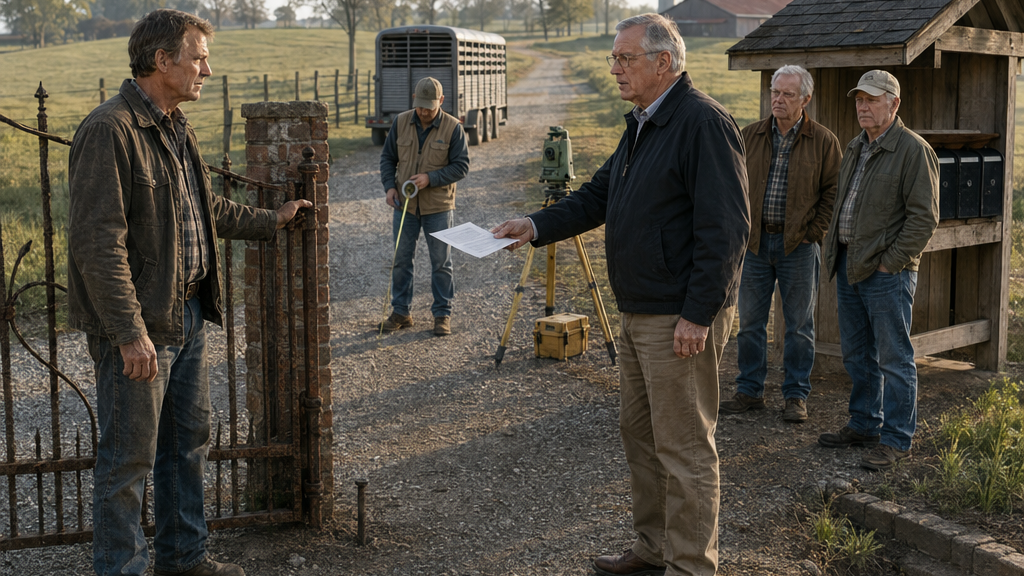
By Thursday morning, a surveyor was at the entrance with a metal detector, flags, stakes, and a roll of bright line.
Scott had not asked Joseph to come.
Joseph came anyway.
He brought two association board members with him.
A cattle trailer waited up the private road while the surveyor worked near the turnout. The mail carrier pulled onto the shoulder, studying the cluster of men before deciding there was room to reach the boxes.
Joseph walked directly to Scott.
“I heard you hired a survey.”
“I did.”
“You could’ve called.”
“I could’ve.”
Joseph glanced at the surveyor. “We’ve maintained this entrance since it was built.”
Scott said nothing.
“One of the board members has the old association minutes,” Joseph continued. “Frank agreed to all of this.”
“I found his notes.”
“Then you know.”
“I know he let you use something.”
Joseph’s mouth tightened.
“Scott, this isn’t some abandoned strip. There are twelve properties up this road. Families. Farms. Deliveries. Mail.”
“I can count mailboxes.”
“There’s no reason to turn this into a fight.”
“I haven’t.”
Joseph lowered his voice.
“Then what exactly are you doing?”
The surveyor called Scott over.
He had uncovered an old iron pin near the grass edge. Rust-dark and almost flush with the ground, it looked too small to carry any importance.
The surveyor set his instrument, checked his readings, then walked toward the opposite marker.
“This is the frontage line,” he said.
Joseph stepped closer.
“No. The association line is over there.”
He pointed toward the ditch.
The surveyor did not argue.
He simply pulled the bright line tight.
It ran from the exposed iron pin across the gravel.
Under the edge of the mailbox shelter.
Past the brick-faced entrance pillar.
And directly beneath the footing of the iron gatepost.
For several seconds, nobody spoke.
The mail carrier closed a mailbox door with a metallic snap.
The cattle trailer idled behind them.
One of the board members looked from the line to Joseph.
Joseph crouched near the pin.
“That can’t be right.”
The surveyor checked his notes.
“This matches the deed description I was given.”
“You’re saying the gate is on Mitchell property?”
“I’m saying this is where the deed line falls based on the monuments and description. I’ll produce the full survey.”
Scott watched Joseph stand.
The man’s confidence had not disappeared, exactly.
It had changed shape.
“This entrance has been here nineteen years,” Joseph said.
Scott nodded. “You’ve mentioned that.”
“We paid for maintenance.”
“I know.”
“We repaired that gate.”
“I know.”
Joseph looked at him. “Then you understand why people are going to have a problem with you treating it like something nobody else has an interest in.”
Scott looked at the bright line stretched across the gravel.
“I’m not saying nobody has an interest.”
“Sounds like it.”
“I’m saying interests need names.”
Joseph stared at him.
“And preferably signatures.”
The surveyor continued measuring.
By afternoon, Scott had a clearer footprint than he expected. The association was not using all two acres. It did not need all two acres.
But the section it did use mattered disproportionately.
The gate.
Most of the mailbox shelter.
The widened entrance.
A strip of drainage.
Part of the landscaped shoulder.
Scott called Lisa.
She listened without interrupting.
“So,” he said, “what now?”
“Now you stop treating this like a courthouse television show.”
“I’m not.”
“You sound pleased.”
“I like facts.”
“You like being right.”
Scott looked through the farmhouse window toward the distant gate.
“Sometimes those overlap.”
Lisa ignored that.
“Send the survey when it’s finalized. I’ll review the title history. In the meantime, if you contact the association, keep the language narrow. You’re not declaring anyone a trespasser. You’re requesting formal terms.”
Scott already had a draft letter on Frank’s desk.
He changed two sentences after the call.
Then he printed it.
The letter acknowledged the long history of use. It stated that Scott did not intend to interfere with ordinary access during discussions. It requested that the association enter a written agreement governing the occupied portion of the parcel.
At the bottom, he gave them thirty days.
Lisa called him when she received a copy.
“Thirty?”
“That’s a month.”
“I know how calendars work.”
“They’ve had nineteen years.”
“That is exactly the kind of sentence you shouldn’t put in the letter.”
“I didn’t.”
“But you’re thinking it.”
Scott said nothing.
Lisa sighed.
“Firm is fine. Artificial urgency can become its own problem.”
“They need a reason not to ignore me.”
“You may also be giving them a reason to panic.”
Scott looked at Frank’s handwritten road notes.
“Frank gave them nineteen years not to panic.”
“And Frank isn’t the one negotiating now.”
Scott mailed the letter anyway.
Two days later, Joseph called.
No greeting.
“We need an emergency board meeting.”
Scott leaned against the kitchen counter.
“That fast?”
“You gave us thirty days.”
“I asked for an agreement in thirty days.”
“People are reading that as a threat.”
“People haven’t seen the letter.”
Silence.
Scott straightened.
“Have they?”
Joseph did not answer directly.
“Friday. Volunteer fire hall. Seven o’clock.”
“Will your attorney be there?”
“Yes.”
“Good.”
Joseph’s voice hardened.
“Bring whatever you think proves your point.”
The call ended.
Scott looked at the iron gate through the kitchen window, too far away to make out clearly.
For the first time, the question was no longer whether the association had something in writing.
It was what they intended to do now that everyone knew they did not.
Chapter 3: The Board Asked for the Land Free
The first document the road association handed Scott would have transferred the disputed land away from him permanently.
He had been in the volunteer fire hall less than four minutes.
Joseph Davis sat at the end of a folding table beneath a bulletin board crowded with fish-fry notices and emergency-number cards. Two board members sat beside him. Their attorney had a leather folder open in front of him.
Scott had expected a proposed easement.
Maybe a counteroffer.
Instead, the attorney slid two stapled pages across the table.
“Before we get into alternatives,” he said, “the association believes the cleanest solution would be conveyance of the entrance parcel.”
Scott read the first paragraph twice.
“Conveyance.”
“A deed transfer.”
“I understand the word.”
Joseph shifted in his chair.
“This avoids having everybody revisit the same issue every few years.”
Scott kept reading.
The proposed description covered more land than the survey showed the entrance actually occupied.
“How much?”
The attorney glanced at Joseph.
“Given the association’s investment in improvements and long-term maintenance, the proposal is for a nominal transfer.”
Scott looked up.
“How nominal?”
Joseph answered.
“No payment.”
Scott set the document flat on the table.
For several seconds, the hum of the vending machine along the wall was the loudest thing in the room.
“You want me to give you the land.”
“We want to resolve an old arrangement,” Joseph said.
“For free.”
“The residents funded the gate. The stone. The drainage work. The mailbox shelter. We’ve maintained that frontage for nearly two decades.”
“You used it for nearly two decades.”
“And maintained it.”
“Because you used it.”
One of the board members leaned forward.
“That seems like splitting hairs.”
Scott looked at him.
“Ownership is mostly hairs until somebody cuts the wrong one.”
Joseph exhaled sharply.
“No one is trying to steal anything from you.”
Scott tapped the document.
“You brought me a deed.”
“A proposed deed,” the attorney said calmly.
Scott turned toward him.
“What’s the alternative?”
“That depends on what you’re asking for.”
“Written permission. Defined footprint. Maintenance responsibilities. Payment.”
Joseph’s eyebrows rose at the last word.
“Payment.”
“Yes.”
“For what?”
“The land.”
“We already paid for everything sitting on it.”
Scott felt something tighten behind his ribs.
He had promised himself on the drive over that he would not let Joseph choose the tone of the meeting.
But Frank’s old habit seemed to be sitting at the table with them now, invisible and irritating.
Give people enough, and eventually they forgot it had been given.
Joseph opened a folder.
“The association reserve is not large. We collect enough to grade the road, handle snow, keep culverts open, maintain the entrance, and cover emergencies. That’s it.”
Scott looked at the figures he had brought.
He had expected that argument.
His own proposed agreement was modest by commercial standards: a monthly use payment, limited increases, continued association maintenance, and restoration if the arrangement ended.
He slid copies across the table.
Joseph read the first page.
His expression changed at the payment clause.
Then again at the annual adjustment provision.
Then a third time at restoration.
“You expect us to pay you every month.”
“I expect a written agreement for continued use.”
“That goes up every year.”
“Within limits.”
“And if it terminates, we remove everything?”
“You restore my property.”
“The gate serves everybody up there.”
“I know.”
“The mailbox shelter serves everybody.”
“I know.”
“Then why would you write something that could force us to tear it out?”
“Because if you stop having permission to use my land, I don’t want abandoned association infrastructure sitting on it forever.”
Joseph leaned back.
“There it is.”
“What?”
“The threat.”
Scott’s voice stayed level.
“No. The consequence.”
The distinction did not calm the room.
Joseph closed the agreement.
“You inherited this three weeks ago.”
“Yes.”
“We’ve taken care of it for nineteen years.”
Scott leaned forward slightly.
“You keep saying that like maintenance transferred title.”
“It establishes that we weren’t freeloading.”
“I didn’t call you freeloaders.”
“You’re charging us like we are.”
“No. I’m charging you like you want to keep using property you don’t own.”
The attorney raised a hand before Joseph could answer.
“I think we should separate legal rights from negotiating posture.”
Scott sat back.
“Fine.”
The attorney looked toward Joseph.
“There are questions we need to research regarding the historical arrangement. Long use can matter. Permission can matter. Improvements can matter. We shouldn’t make broad conclusions tonight.”
That was the first sentence anyone on their side had spoken that Scott considered useful.
Joseph apparently did not.
“We don’t need a law lecture to know what Frank intended.”
Scott turned to him.
“That’s exactly what we need, because Frank isn’t here.”
The words came out sharper than he intended.
The room went quiet.
Scott saw the brief reaction on one board member’s face and knew he had crossed from firmness into something more personal.
He did not apologize.
That was his mistake.
Joseph opened the association budget.
“If we pay your proposed amount, plus insurance changes and legal review, that comes out of reserves. If we relocate, it’s worse. Either way, every household pays because you decided a handshake wasn’t good enough.”
Scott looked at the paper.
“So your position is that because correcting this costs money, I should give you the land.”
“Our position is that Frank made an arrangement everyone relied on.”
“Then formalizing it should protect everybody.”
“Not at your price.”
Scott thought of Lisa telling him not to confuse being right with having a simple outcome.
He also thought of the deed they had handed him before anyone had discussed alternatives.
He pushed the transfer document back across the table.
“This isn’t happening.”
Joseph did not touch it.
“Then extend your deadline.”
Scott could have done it.
Thirty days had been arbitrary. He knew that. Lisa knew it.
But the request came immediately after the free-transfer proposal, and pride answered before judgment.
“No.”
One of the board members frowned.
“You just said you weren’t trying to disrupt access.”
“I’m not.”
“Then what happens on day thirty-one?”
“We’ll deal with that if you decide not to negotiate.”
Joseph stared at him.
“That sounds like a threat to every family up that road.”
“It sounds like you’re trying to make every family part of a negotiation between the association and me.”
The meeting ended twenty minutes later without agreement.
Scott drove home with both proposed documents on the passenger seat.
Halfway there, his phone buzzed twice.
Then again.
He ignored it until he reached Frank’s driveway.
Three messages waited.
The first was from a neighbor he barely knew.
Are you really closing the road?
The second was more hostile.
My wife gets medical deliveries through that entrance. You don’t get to trap people because you inherited two acres.
The third included a photograph.
A sheet of paper had been posted inside the mailbox shelter.
Scott enlarged the image.
The notice said the association was evaluating emergency options after the new owner of the entrance parcel had imposed a deadline that could affect continued access.
It did not say Scott had promised ordinary access would continue during negotiations.
It did not mention the proposed deed transfer.
It did not mention that the association had no recorded agreement anyone had yet found.
Scott read it again.
Then he called Joseph.
No answer.
He called once more.
Voicemail.
Scott lowered the phone and looked down the private road.
The iron gate stood open exactly as it had that morning.
But by nightfall, people who had driven through it for years had been given a new reason to look at Scott as the man who might close it.
Chapter 4: His Uncle Had Never Been Fooled
“He knew exactly what that gate was costing him.”
Patricia Clark said it before Scott had finished crossing the barn aisle.
She stood beside a stack of square hay bales with one gloved hand resting on a fence stretcher. Through the open barn door behind her, cattle moved slowly along the adjoining pasture. Scott had come because she had left a message saying she wanted to talk before “this road mess got any stupider.”
He had expected another argument about access.
He had not expected Frank.
Scott stopped beside the old workbench.
“Then maybe he should’ve written something down.”
Patricia pulled off one glove with her teeth.
“That sounds like you.”
“You called me over.”
“I did.”
“So say what you wanted to say.”
She studied him for a moment.
“You think Frank got taken advantage of.”
Scott looked away.
On the bench sat an old chain binder, two rusted gate latches, and a coffee can filled with cotter pins. Most of it looked exactly as it had ten years ago.
“I think Frank spent his whole life making arrangements nobody else could explain after he was gone.”
“That’s not the same thing.”
“No?”
“No.”
Scott folded his arms.
Patricia stepped around the bales.
“You remember when Frank tore his shoulder?”
“Vaguely.”
“You were working out west then.”
“Indiana.”
“Close enough.”
“I came back.”
“For two days.”
The sentence landed harder than Scott expected.
Patricia did not soften it.
“Frank couldn’t run the loader. Couldn’t lift feed. Could barely pull his own boots on without cussing. Then we got that wet spring. Corn didn’t go in when it should’ve. Hay was late. He was borrowing money just to stay ahead of bills.”
Scott remembered the surgery.
He remembered Frank calling him and saying he was fine.
He also remembered choosing to believe him.
Patricia continued.
“People up that road helped.”
“What people?”
“Me. Two of the families farther in. Joseph too, back then. Hauled feed. Fixed fence. One man ran Frank’s tractor during second cutting. Someone else brought gravel because the county shoulder washed out.”
Scott shook his head.
“Frank never told me any of that.”
“Frank didn’t like telling people when he needed help.”
“That part I believe.”
Patricia gave him a sharp look.
“You’re more alike than you think.”
Scott ignored that.
“What does any of this have to do with the gate?”
“Everything.”
She walked toward a shelf against the back wall and pulled down a battered black notebook.
Scott recognized it before she handed it over.
Frank’s ledger.
He had seen similar books in the farmhouse, but not this one.
The cover had softened at the corners. Dirt had worked into the spine. Several pages were wrinkled as though they had been handled with wet hands.
Scott opened it.
The first pages were ordinary farm records.
Diesel.
Seed.
Fence wire.
Equipment repairs.
Then the entries changed.
Patricia — hauled feed, no charge.
Road group — spread gravel.
Joseph — tractor, six hours.
Neighbors — repaired east fence after storm.
Scott flipped forward.
There were dates beside nearly everything.
No dollar amounts.
No repayment schedule.
No rent.
He found an entry from the year the entrance gate had been installed.
Road association wants to fix entrance, mailboxes, turnout. Told them use front strip if they maintain it. Fair enough after what folks did.
Scott read the sentence twice.
Patricia waited.
“So he knew,” Scott said.
“Yes.”
“And he meant it to be free.”
“For him? Yes.”
Scott closed the ledger.
“That doesn’t make it permanent.”
“I didn’t say it did.”
“That’s what Joseph is acting like.”
“Joseph is scared.”
“Joseph handed me a deed giving him my land.”
“The association’s land.”
“My land.”
“You know what I mean.”
“No. That’s the problem. Everybody keeps saying things like they’re already settled.”
Patricia’s mouth tightened.
“You think I liked that notice they posted?”
Scott looked at her.
“You saw it?”
“Everybody saw it.”
“Then you know it wasn’t accurate.”
“I know it wasn’t complete.”
“That’s generous.”
She sighed.
“I called Joseph about it.”
Scott said nothing.
“He told me your deadline left them no choice but to warn people.”
“They had a choice not to make it sound like I was chaining the gate on day thirty-one.”
“I told him that too.”
Scott looked back at the notebook.
One page carried a short entry in Frank’s cramped handwriting:
No rent. They already paid me when I needed it.
Scott felt his anger shift, not disappear.
For days he had pictured Frank as careless. Weak in the exact way Scott had always criticized him for being—too willing to trust people, too reluctant to force an uncomfortable conversation.
But the ledger did not read like a man who had forgotten what things cost.
It read like a man keeping account in a currency Scott had dismissed.
Hours.
Gravel.
Feed.
Favors.
Scott closed the book carefully.
“You had this?”
“Frank left it in my pickup two years ago after we were figuring a fence repair. I forgot about it until all this started.”
“And you waited until now.”
Patricia looked toward the pasture.
“I was angry.”
“At me.”
“At your letter.”
“My letter asked for an agreement.”
“Your letter gave thirty days.”
“That was enough to start talking.”
“It was enough to make people think you’d already decided what happened if they didn’t.”
Scott looked at her.
“You could’ve called.”
“So could you.”
He almost answered, then stopped.
That was the part he disliked.
She was right.
He had gone to the recorder, the surveyor, the attorney, and the board before speaking to the people who actually drove through the gate every day.
Because he had wanted facts first.
That was the respectable explanation.
The less respectable one was that facts had felt safer than conversation.
“What do you want me to do?” he asked.
“Don’t give them the land.”
Scott blinked.
Patricia nodded toward the ledger.
“Frank helped people because people helped him. That doesn’t mean he wanted some board twenty years later owning his frontage.”
“Then what?”
“Figure out what’s fair.”
“That’s what I was trying to do.”
“No. You were trying to prove you weren’t Frank.”
Scott looked down at the notebook.
Outside, a cow pushed against a steel panel, making it rattle against the post.
Patricia pulled her glove back on.
“Joseph’s wrong about the deed,” she said. “And that notice was wrong. But if you make every neighbor pay for his bad judgment, you’re wrong too.”
Scott carried the ledger back to Frank’s farmhouse.
On the kitchen table, Lisa’s draft removal-demand letter waited beside the survey.
It was direct, professional, and legally cautious.
It gave the association notice that if no agreement was reached, Scott reserved the right to require removal of improvements from the occupied portion of the parcel.
Two days earlier, he had liked the way it sounded.
Now Frank’s notebook sat beside it.
Scott called Lisa.
“You send that letter yet?”
“No.”
“Hold it.”
A pause.
“For how long?”
“I don’t know.”
“That’s unusual for you.”
Scott looked at the line in Frank’s ledger again.
No rent. They already paid me when I needed it.
“Just hold it.”
He ended the call.
The gate still needed a boundary.
But for the first time, Scott understood that the mistake would not be keeping Frank’s handshake alive.
The mistake would be replacing it with something equally thoughtless in the opposite direction.
Chapter 5: The Cheap Solution Was Not Cheap
The estimate to move the entrance was large enough that Scott checked the total twice.
Then he checked it a third time.
Gate removal and reset.
New concrete footings.
Mailbox shelter relocation.
New turnout stone.
Drainage modifications.
Grading.
Utility clearance.
Approach work.
Contingency.
The number at the bottom was more than the road association collected in dues over several years.
Scott laid the estimate on the hood of his pickup while the surveyor measured from the iron gatepost toward the alternate strip near the county road.
Joseph stood twenty feet away with his hands in his jacket pockets.
Nobody had invited him this time either.
But now Scott understood that Joseph showing up was not just control.
It was fear.
The surveyor marked the edge of the existing footprint.
“If they relocate,” he said, “they lose the wide approach unless they buy additional ground elsewhere.”
Scott looked toward the ditch.
“And drainage?”
“Has to be rebuilt. Existing culvert ties into this grade.”
The mailbox shelter complicated matters further. Moving it closer to the county road required a safer pull-off. Moving it deeper into the private road created problems for the mail carrier unless the association changed delivery arrangements.
The iron gate, which had seemed like the center of everything, turned out to be almost the simplest part.
Joseph walked over.
“How bad?”
Scott handed him the estimate.
Joseph read silently.
His jaw tightened.
“This is inflated.”
“Get another estimate.”
“We will.”
“You should.”
Joseph looked at the last page.
“What’s this line?”
“Drainage rework.”
“That ditch was already there before the gate.”
“The ditch was. The turnout wasn’t.”
Joseph handed the estimate back.
“You understand why we can’t do this.”
Scott folded the papers.
“I understand why you don’t want to.”
“There’s a difference?”
“There usually is.”
Joseph gave a tired laugh without humor.
“That’s easy to say when you’re the one holding the deed.”
Scott looked at him.
A week earlier, that line would have irritated him.
Now it did something else.
It explained too much.
Joseph had not just been trying to win.
He had been trying not to be the board president who told twelve households that years of informal decisions had turned into a five-figure or worse relocation problem.
That did not excuse the free-deed proposal.
It did not excuse the notice.
But it made the panic recognizable.
Later that afternoon, Scott sat across from Lisa in her office with Frank’s ledger on one side of the desk and the relocation estimate on the other.
Lisa read the total.
“That will get their attention.”
“It got Joseph’s.”
“I imagine.”
Scott tapped the estimate.
“The original monthly payment I proposed looks cheap next to this.”
“It always did.”
“You could’ve said that.”
“I did.”
“No, you said my position was strong.”
“I said a strong position wasn’t the same as a simple outcome.”
Scott leaned back.
“That sounds familiar.”
“It should.”
Lisa opened Scott’s original agreement.
“You were trying to price leverage.”
“I was trying to formalize use.”
“With an aggressive annual adjustment and a short cure window.”
“They asked me to give them the land for nothing.”
“And you responded like someone insulted you.”
“I was insulted.”
“I know.”
Scott looked toward the window.
A grain truck rolled through the intersection outside.
Lisa closed the agreement.
“If they have weak rights here, you can push harder. You can probably make this expensive. But unless you plan to sell the farm tomorrow, you’ll still have to drive past these people.”
“I’m aware.”
“Are you?”
Scott met her eyes.
She continued.
“Legal leverage is a tool. It doesn’t tell you what job to use it for.”
Scott thought of Patricia’s accusation.
You were trying to prove you weren’t Frank.
“I don’t want to give them the strip.”
“Then don’t.”
“I don’t want another handshake.”
“Then record something.”
“I don’t want to subsidize them forever either.”
Lisa nodded.
“Those are all compatible positions.”
The problem was that Scott’s first proposal had been built before he understood why Frank had allowed free use.
And before he understood the cost of unwinding it.
He went home and measured the gate himself.
Not because the surveyor had missed anything.
Because Scott needed the work.
He measured the opening width.
The footing.
The brick pillar.
The mailbox shelter setback.
The gravel turnaround.
The drainage edge.
Each number made the dispute smaller.
That surprised him.
The association was not occupying “his two acres.”
It was occupying a defined, awkward, important fraction of them.
Enough to matter.
Not enough to justify turning the whole inheritance into a battlefield.
The next morning, an envelope arrived by certified mail.
Inside was the association’s formal response.
REJECTED.
The board had voted against Scott’s proposed agreement.
No counteroffer.
No revised payment.
No extension proposal.
Just a paragraph stating that the board disputed the necessity and fairness of his terms and reserved all rights regarding historical access and improvements.
Scott read it once.
Then again.
The old satisfaction returned for a second.
Fine.
Let them find out what moving everything cost.
Then he saw Frank’s ledger on the counter.
The feeling disappeared.
His phone rang.
Lisa.
“I just got a copy of their response.”
“So did I.”
“Before you say anything, their attorney called me.”
Scott stood straighter.
“What did he want?”
“He wanted to know whether you’d agree to a short standstill while they review the title and survey.”
“Why?”
“Because he asked the board a question they apparently don’t have a good answer for.”
Scott waited.
Lisa continued.
“He asked them to identify the written instrument that gives the association the present right to keep those structures on your parcel.”
Scott looked through the window toward the road.
“And?”
“They couldn’t produce one on the call.”
“That doesn’t settle everything.”
“No.”
“But it changes the conversation.”
“Yes.”
Scott picked up the rejection letter.
The board had voted no because they thought rejecting his agreement preserved the old arrangement.
Now their own attorney was asking what, exactly, preserved it.
“When do they want to talk?” Scott asked.
“Soon.”
“How soon?”
Lisa paused.
“Joseph is supposed to call you.”
Scott set the rejection letter beside the ledger.
For the first time, forcing removal was no longer a bluff either side could casually mention.
It was becoming the alternative both of them might actually have to face.
Chapter 6: Ownership Was the Easy Part
When Joseph finally called, Scott had expected to enjoy the sound of him backing down.
He did not.
Joseph’s voice was flatter than usual.
“Our attorney says we need temporary written permission while this gets resolved.”
Scott stood beside the open iron gate, one hand resting on the cold metal.
Traffic moved normally through the entrance.
A feed truck had passed ten minutes earlier.
Someone had collected mail.
Nobody had been blocked.
“Temporary permission,” Scott said.
“Yes.”
“What happened to nineteen years of understanding?”
Joseph was quiet.
“Can we meet?”
“Where?”
“The gate.”
That surprised Scott.
“No fire hall?”
“No.”
Joseph arrived alone.
He parked outside the turnout and walked in carrying a folder but no board members and no attorney.
Scott stayed beside the gate.
For a moment, neither man spoke.
Joseph looked at the survey marks still visible near the grass.
“Our attorney thinks continued use without something signed puts the association in a bad position.”
Scott nodded.
“Lisa said something similar.”
Joseph looked toward the mailbox shelter.
“We’re not moving all this.”
“That’s not entirely your decision.”
“I know.”
It was the first time Joseph had said that without qualification.
Scott leaned against the gatepost.
Joseph opened the folder.
“I brought a temporary license draft.”
Scott did not take it.
“What changed?”
“You know what changed.”
“I know what your lawyer said. I’m asking what changed for you.”
Joseph closed the folder again.
A pickup passed through the entrance. Its driver slowed, recognized both men, then continued without waving.
Joseph watched it go.
“The board thinks I made this worse.”
“Did you?”
“Yes.”
The answer came too quickly to be rehearsed.
Scott said nothing.
Joseph rubbed a hand across the back of his neck.
“When your letter came, I saw thirty days and figured you were setting up to shut us out.”
“I told you I wasn’t interrupting ordinary access during negotiations.”
“You told me.”
Scott waited.
Joseph looked toward the road.
“I posted the notice because people needed to know there was a risk.”
“You posted it because you wanted them angry at me.”
Joseph’s jaw tightened.
Then relaxed.
“Both.”
The admission changed the air between them more than an apology would have.
“I thought if people started calling you, you’d extend the deadline.”
Scott stared at him.
“You used your neighbors as pressure.”
“I was trying to keep control of the situation.”
“The situation or the board?”
Joseph looked away.
There it was.
Not corruption.
Not some hidden scheme.
Fear.
A man who had spent years being the person everyone called when the road washed out, the snowplow did not come, or a culvert plugged—and who could not bear to stand in front of those same people and admit the association had never secured the ground beneath its own entrance.
“If we had to relocate,” Joseph said, “the reserve is gone. Then we raise dues. People blame the board. They blame me. Some of them already think we spend too much.”
“So you asked for my land free.”
“I thought permanent ownership solved the problem.”
“For you.”
“For everybody.”
“No. For the association.”
Joseph nodded reluctantly.
“Fair.”
Scott looked at the gate.
For weeks, he had imagined this moment differently.
He had imagined Joseph finally realizing that the deed mattered more than habit.
He had imagined feeling vindicated.
Instead, he felt tired.
Frank had created one kind of problem by trusting that goodwill would survive forever.
Joseph had created another by assuming dependence could be converted into entitlement.
Scott had nearly created a third by deciding that because he held the strongest card, he had to play it hard.
“Your original proposal is dead,” Joseph said.
“So is yours.”
“I know.”
Scott pushed away from the gatepost.
“I’m withdrawing mine too.”
Joseph looked up sharply.
“What?”
“The lease I sent. I’m withdrawing it.”
Joseph’s expression shifted from surprise to suspicion.
“Why?”
“Because I wrote it angry.”
“That doesn’t sound like you.”
“You don’t know me well enough to say that.”
Scott walked to his pickup and took out a thinner folder.
He had spent most of the previous night drafting the business terms before sending them to Lisa for clean language.
He handed it to Joseph.
“This is what I’ll agree to.”
Joseph opened it.
The new footprint matched the surveyed area actually occupied by the entrance facilities.
Not the whole two-acre parcel.
The payment was lower than Scott’s original demand.
Annual adjustments were modest and capped.
The association remained responsible for ordinary maintenance.
Any expansion required written approval.
Any major alteration needed Scott’s consent.
If the agreement eventually ended, restoration obligations applied only to association improvements within the defined footprint.
Joseph read slowly.
“This is less.”
“Yes.”
“Why?”
“Because you’re not using two acres.”
Joseph looked up.
“You could’ve charged us based on the leverage.”
“I know.”
Joseph continued reading.
Then stopped.
His finger rested on one paragraph.
“What’s this?”
Scott knew which one.
“The land stays mine.”
“I see that.”
“No purchase option. No automatic transfer. No right of first refusal that forces a sale. No board gets to convert access into ownership later.”
Joseph looked at him.
“You won’t sell the entrance strip?”
“Not to the association.”
“At any price?”
“Not as part of this arrangement.”
“That could make future financing complicated.”
“Then future boards can solve financing without owning my frontage.”
Joseph closed the folder.
“This is about your uncle.”
Scott glanced toward the barn roof visible beyond the field.
“Partly.”
“He would’ve let us use it free.”
“Yes.”
Joseph seemed surprised Scott admitted it.
Scott continued.
“He also thought a handshake fixed everything. It didn’t.”
Joseph looked down at the folder.
“So what are you trying to preserve?”
“The favor.”
Scott touched the gate.
“Not the mistake.”
A long silence followed.
The gate stood open between them.
That mattered to Scott now.
It had once represented the problem itself—a permanent structure on land no one had bothered to define properly.
Now it looked more like a choice.
Open did not have to mean ownerless.
Shared did not have to mean surrendered.
Joseph tucked the draft under his arm.
“The board may not like the no-transfer clause.”
“They don’t have to like it.”
“That sounds like the old Scott again.”
“It’s still me.”
Joseph almost smiled.
“When do you want an answer?”
Scott looked at him.
He could have said thirty days.
Instead he said, “Take it to the board. Give me a written response after you’ve actually read it.”
“No deadline?”
“There’ll be one if you start pretending time doesn’t matter.”
Joseph nodded.
Then he walked back toward his truck.
At the road, he stopped.
“For what it’s worth, I’ll correct the notice.”
Scott did not thank him.
“You should.”
Joseph drove away.
That afternoon, Lisa called after reviewing the final draft.
“You realize the permanent-transfer prohibition is going to get attention.”
“That’s why it’s there.”
“You’re willing to give on money but not ownership.”
“Yes.”
“And no retroactive charges?”
Scott hesitated.
“Not decided yet.”
Lisa was quiet for a moment.
“That may be the harder decision.”
Scott looked at Frank’s ledger on the kitchen table.
The old notebook lay open to the entry about the road group.
Fair enough after what folks did.
Scott closed it.
“No,” he said. “The harder decision was figuring out what I was actually trying to win.”
Two days later, Joseph texted.
Board meeting tonight. Closed session. Your revised agreement is the only item.
Scott read the message twice.
Then another came.
One condition is causing the argument.
Scott already knew which one.
They were no longer debating whether the association could use the entrance.
They were debating whether continued use required accepting that it would never become theirs.
Chapter 7: The Gate Stayed, but the Favor Changed
Joseph arrived carrying a signed agreement instead of the deed he had once expected Scott to surrender.
He parked outside the entrance just after eight on a clear October morning and walked toward the iron gate with the folder tucked under one arm. The gate stood open. Behind it, the mailbox shelter cast a narrow shadow across the gravel, and a pickup from farther up the private road rolled through without slowing.
Scott watched Joseph approach from beside the brick pillar.
“No board members?” he asked.
“They already voted.”
Scott looked at the folder.
Joseph held it out.
“Seven to one.”
Scott did not take it immediately.
“For?”
“The revised agreement.”
“The no-transfer clause too?”
Joseph gave him a tired look.
“That was the part that made it seven to one instead of eight to zero.”
Scott finally accepted the folder.
The signatures were there.
Association president.
Secretary.
Legal acknowledgment.
Attached survey description.
Recorded-footprint exhibit.
The occupied area followed the measurements they had established weeks earlier: the gate, mailbox shelter, turnaround, drainage edge, and only the ground necessary to maintain and use them.
Not two acres.
Not some vague “entrance parcel.”
A defined strip.
Scott turned the page.
The use payment was there, modest enough that no household would notice much once divided across the road association. The annual adjustment was capped. Maintenance belonged to the association. Expansion required written consent. If the road group stopped using the site, the restoration language applied to what it had installed.
And there, halfway down the next page, was the paragraph Joseph had fought hardest.
No provision in this agreement shall create, imply, or require transfer of ownership.
Scott read it twice anyway.
Joseph watched him.
“You satisfied?”
Scott closed the folder.
“I’ll be satisfied when Lisa records it.”
“That sounds about right.”
A truck rattled over the gravel behind them.
Neither man moved until it passed.
Joseph glanced toward the gate hinge.
“We replaced that hinge twelve years ago.”
“I know.”
“Frank wrote that down too?”
“Everything except the thing everybody needed him to write down.”
Joseph nodded.
For once, he did not defend it.
Scott leaned against the pillar.
“What changed the vote?”
“The estimate.”
“That’s what I figured.”
“Not just that.”
Scott waited.
Joseph looked up the private road.
“Patricia came.”
Scott raised an eyebrow.
“She wasn’t invited.”
“That sounds like Patricia.”
“She told the board what Frank told people when the entrance was first built.”
Scott felt something tighten quietly in his chest.
“What did she say?”
“That he wasn’t charging because people had carried him through a bad year, and he figured the road group could use that patch as long as they took care of it.”
Joseph paused.
“Then she said that didn’t mean we owned it.”
Scott looked toward the mailbox shelter.
“That probably went over well.”
“Not especially.”
Joseph almost smiled.
“But she was right.”
The admission still sounded unfamiliar coming from him.
Joseph slipped his hands into his jacket pockets.
“I also corrected the notice.”
“I saw.”
The replacement had been posted three days earlier.
It stated that road access would continue, that the association and landowner had reached terms in principle, and that prior wording about possible closure had overstated the immediate risk.
No apology.
No dramatic reversal.
Just a correction.
Scott had decided that was enough.
Joseph cleared his throat.
“There’s one more thing.”
Scott looked at him.
“The board asked about retroactive payment.”
Scott said nothing.
“They’re worried you might come back later and say nineteen years of use should have been compensated.”
Scott had known the question would arrive eventually.
Lisa had raised it too.
Depending on how aggressively he wanted to frame the history, there were arguments to be made, claims to examine, costs to calculate.
But every version of that argument ran into Frank’s ledger.
No rent. They already paid me when I needed it.
Scott looked at the road.
“I’m not charging retroactively.”
Joseph’s face changed.
“You’re waiving it?”
“I’m saying Frank made his arrangement for his reasons. I’m not going to rewrite his part after he’s dead.”
“That could be a lot of money.”
“Maybe.”
Joseph studied him.
“And going forward?”
“Going forward is mine.”
Joseph nodded slowly.
“Fair.”
That afternoon, Lisa met Scott at the farmhouse with the final recording copy.
She checked the signature pages, survey exhibit, and legal description one last time before sliding the folder toward him.
“You’re sure about the retroactive waiver?”
“Yes.”
“You don’t have to do that to make the rest enforceable.”
“I know.”
“And you’re sure about refusing any future purchase option?”
“Yes.”
Lisa looked at him over the papers.
“You’ve become unexpectedly clear about this.”
Scott gave a short laugh.
“I was clear before.”
“No. You were angry before.”
He did not argue.
She tapped the survey exhibit.
“This version is better.”
“Because it charges less?”
“Because it knows what problem it’s solving.”
Scott looked at the outlined footprint.
A small shape on paper.
That had been the strange thing all along.
The fight had sounded enormous because nobody had defined it.
Once the land was measured, the money counted, the history understood, and the promises separated from assumptions, the actual area of disagreement became almost embarrassingly precise.
Lisa gathered the documents.
“I’ll take this for recording.”
Scott nodded.
At the door, she paused.
“Frank would probably have hated all this paperwork.”
“He would’ve said ink was expensive.”
Lisa smiled.
“Maybe.”
“He also would’ve signed it if somebody put it in front of him and refused to leave.”
After she drove away, Scott took Frank’s ledger from the kitchen drawer and walked to the entrance.
Patricia was standing by the mailbox shelter sorting envelopes into one hand.
She looked at the folder Scott carried.
“Done?”
“Done enough.”
“The board signed?”
“Yes.”
She nodded toward the gate.
“So it stays.”
“It stays.”
“And the road group pays?”
“A little.”
Patricia looked at him.
“Frank would’ve complained.”
“Frank complained about paying for coffee.”
“That’s true.”
She tucked the mail beneath her arm.
Scott opened the agreement to the survey exhibit and showed her the defined footprint.
“Only this area.”
Patricia studied it.
“You didn’t give them the strip.”
“No.”
“Good.”
“You sound more interested in that than the payment.”
“I am.”
Scott glanced at her.
She shrugged.
“Money changes. Boards change. People die. Land has a longer memory.”
Scott looked at the iron post beside them.
For weeks it had felt like evidence.
Then leverage.
Then almost a weapon.
Now it was just a gate again.
But not quite the same gate.
A delivery driver came down the private road and stopped long enough for Scott to step aside.
The truck passed through.
Nobody needed to ask permission in that moment.
That was the point.
The permission existed where everyone could find it.
Recorded.
Measured.
Limited.
Real.
Later that evening, Scott returned to Frank’s farmhouse and opened the file cabinet in the small back room.
He placed the recorded access agreement in a new folder.
Then he hesitated.
Frank’s ledger lay on the desk.
For a while, Scott had treated it like proof of what his uncle had done wrong.
Now he understood it differently.
Frank had known the value of the land.
He had simply counted value in a way Scott had not respected.
That did not make Frank’s method wise.
It made it human.
Scott placed the worn black ledger in the same drawer as the recorded agreement.
Not underneath it.
Beside it.
One held the favor.
The other held the boundary.
Outside, a vehicle crossed the gravel and the iron gate gave a faint metallic rattle as it settled back against its stop.
Scott closed the drawer.
The gate had stayed.
The land had stayed his.
And for the first time, Frank’s generosity no longer depended on anyone pretending those two things were the same.
The story has ended.