The Folded Paper That Broke The County Impound Line
CHAPTER 1: THE FROST ON THE HOOD
The November wind cutting across the cracked asphalt of the Muskingum County licensing bureau smelled of woodsmoke, wet dead oak leaves, and sulfur from the distant coal-fired power plants along the Muskingum River. It was thirty-four degrees, the sky a flat, unbroken ceiling of Appalachian slate gray that threatened sleet before twilight.
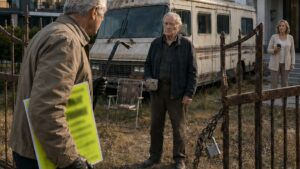
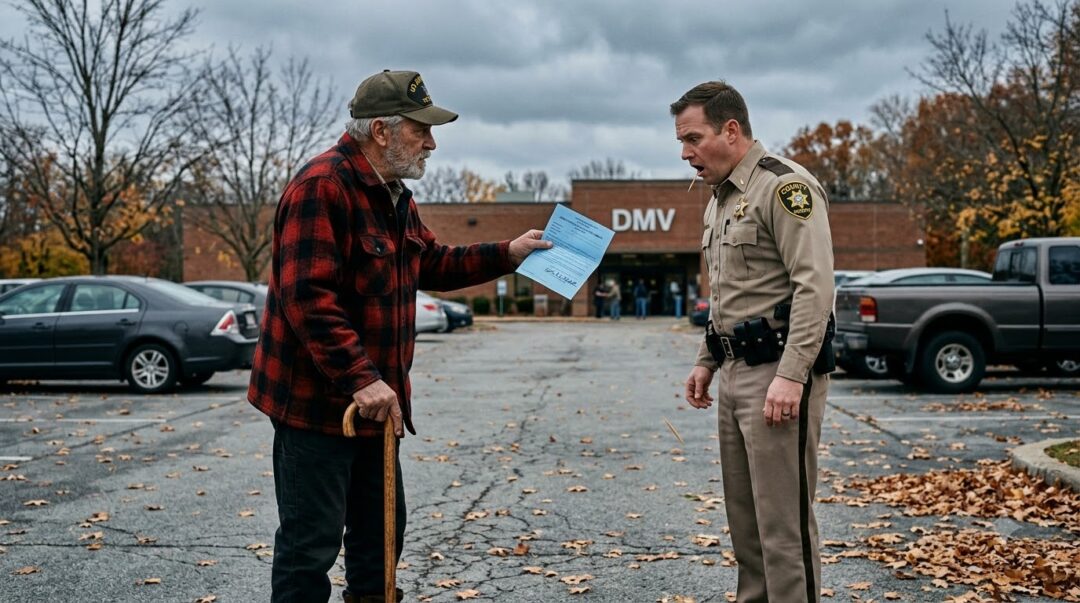
Harold “Hank” Pruitt stood beside the front fender of his 1996 Buick LeSabre, leaning with steady, habitual balance on the brass handle of his turned-hickory cane. He wore a heavy red-and-black wool hunting jacket over a faded chambray work shirt, buttoned to the collar against the damp river chill. At sixty-seven, after thirty years in the Army Quartermaster Corps and an artillery shell fragment that had rebuilt his right knee in Da Nang, Hank moved with slow, patient deliberation. He did not waste footsteps, and he did not waste breath.
Beside him on the asphalt, Deputy Wayne Coleridge took two heavy, aggressive strides forward.
Coleridge was thirty-eight years old, thick in the shoulders and soft around the belt, wearing a khaki sheriff’s department patrol jacket with the zipper pulled halfway down, exposing a gold five-point star pinned crookedly to his pocket flap. Between his front teeth, he rolled a flat birch toothpick from corner to corner with a rhythmic, wet click.
Without saying a word of greeting, Coleridge raised his right hand and slammed a carbon-backed citation form down onto the Buick’s dusty hood.
The heavy aluminum clipboard struck the sheet metal with a loud, ringing crack that startled a flock of starlings from the bare telephone wires overhead.
“License tag is expired four months back, old-timer,” Coleridge said, his nasal Ohio drawl dripping with practiced disdain. “Operating an unregistered motor vehicle on county roadways. That is Section forty-five-oh-three dash eleven of the Revised Code. Fine is two hundred and fifty dollars, plus moving costs and an immediate tow impound.”
Hank didn’t flinch at the sound of the metal hitting his car. He rested both gnarled, liver-spotted hands on the curved handle of his cane, his clear blue eyes taking in the younger man’s posture, the scuffed combat boots, and the fact that Coleridge’s patrol cruiser was parked diagonally across two disabled stalls with its engine idling.
“Afternoon, Deputy,” Hank said softly, his voice gravelly from decades of motor-pool exhaust. “I filed the annual registration renewal inside the clerk’s office last Tuesday morning. Paid sixty-four dollars and fifty cents in certified postal money order.”
Coleridge let out a short, mocking snort through his nose, the toothpick shifting to his left cheek. He tapped the citation docket with the tip of his metal pen, leaning forward until his breath, smelling of cold bologna and peppermint chewing gum, drifted into Hank’s face.
“Sure you did, grandpa,” Coleridge sneered. “They all say that. ‘I paid the clerk, I sent the check, the dog ate the receipt.’ The state database on my laptop says this vehicle has a red-flag revocation from the Columbus registrar. What is on my screen is the law, old man. And what is on my screen says this Buick is getting hooked behind Butch Hatcher’s flatbed in about five minutes.”
Down the county access road, the distinct, grinding diesel rumble of a heavy-duty International rollback wrecker was already approaching. Painted across the wrecker’s door in crude orange lettering was Black Fork Towing & Recovery.
Hank looked past Coleridge’s shoulder at the approaching truck.
In Muskingum County, everybody knew Butch Hatcher. And everybody who lived on a fixed pension knew what happened when Black Fork Towing hooked your car: the mandatory impound fee was three hundred dollars cash, followed by sixty dollars a day in ‘administrative storage fees.’ If an elderly widow or a retired factory worker couldn’t produce six hundred dollars in legal tender within five business days, Hatcher filed a mechanic’s abandonment lien, stripped the vehicle identification plate, and auctioned the car to an out-of-county salvage dealer for three thousand dollars cash.
“You called Black Fork before you even checked my glove box, Deputy,” Hank observed quietly.
“I don’t need to check your glove box,” Coleridge barked, his voice rising as two elderly women walking toward the licensing office paused on the sidewalk to watch. “The tags on that rear bumper have a twenty-four sticker, and we are three weeks from Thanksgiving. You are driving illegal iron on my county roads. Now step away from the front of the vehicle before I cite you for resisting a lawful order.”
Hank did not step away.
Slowly, without sudden movement, he reached his left hand inside the heavy wool lapel of his hunting jacket.
Coleridge’s right hand dropped instinctively to the textured grip of his Glock 21, his thumb snapping the safety strap loose on his leather holster. “Keep your hands where I can see them, Pruitt!”
“Just getting my papers, son,” Hank said calmly.
From his interior breast pocket, Hank withdrew a crisp, neatly folded document printed on heavy blue safety parchment. The paper had two sharp, razor-creased folds, protected inside a clear plastic bank sleeve. With deliberate patience, Hank slid the document out, unfolded the blue sheet, and held it out with both hands at chest level.
The cold autumn wind caught the edges of the paper, rustling the parchment.
Coleridge looked down, his eyes narrowing behind his gold wire-rim aviators. “What the hell is that?”
“State Department of Public Safety Form Eleven-A,” Hank said, his tone as even as a surveyor’s transit. “Temporary Certificate of Operating Authority for Disabled Veterans Awaiting Special Fleet Plates. Filed, stamped, and approved.”
Coleridge snatched the paper from Hank’s hands, intending to crumple it, but as his eyes dropped to the bottom right quadrant of the form, the toothpick stopped rolling between his teeth.
Stamped into the heavy blue paper was the raised, embossed seal of the Muskingum County Sheriff’s Office.
And directly above the gold seal, written in thick black fountain-pen ink with the bold, distinctive handwriting of a man who had commanded three rifle companies in the Central Highlands, was a handwritten endorsement:
Approved for unlimited operation pending special plate delivery. Personal priority.
The signature beneath the line read: Arthur T. Miller, Sheriff.
Coleridge’s breath caught in his throat. The skin around his mouth turned the color of damp skim milk. His eyes darted from the black ink up to Hank’s calm, unblinking face, then down to the bottom line of the waiver, where a typed serial number was logged in red:
Reference: Internal Audit File 2026-B: Unauthorized Database Overrides / Unit 12.
Unit 12 was Deputy Wayne Coleridge’s patrol cruiser.
CHAPTER 2: THE SOUND OF THE WINCH
The heavy International rollback wrecker from Black Fork Towing slammed its air brakes on with a loud, wet sneeze of pressure, pulling sideways across the entrance of the DMV parking lot. Butch Hatcher stepped down from the high steel cab into the gravel, his heavy belly spilling over a grease-caked leather belt, carrying an oily steel bridle chain in his right hand.
“Where’s the scrap, Wayne?” Hatcher hollered, wiping black diesel grime from his chin with the sleeve of his flannel shirt. “I got three more repos down in Roseville before the snow starts falling.”
Deputy Wayne Coleridge didn’t answer. He stood frozen on the cracked asphalt, holding the blue parchment between his gloved fingers, his eyes locked on the red typed text at the bottom of the page.
Reference: Internal Audit File 2026-B: Unauthorized Database Overrides / Unit 12.
Hank leaned on his hickory cane, the cold wind tugging at the frayed collar of his hunting coat. “Something troubling you about the paperwork, Deputy?”
Coleridge’s Adam’s apple bobbed up and down. He swallowed hard, trying to summon the bluster that had carried him through six years of rural shakedowns, but his voice came out thin, strained, and high-pitched. “Where… where did you get this signature, Pruitt? Sheriff Miller has been at the state law enforcement conference in Cleveland since Sunday.”
“Sheriff Miller and I served in the First Cavalry together in sixty-nine, Deputy,” Hank said softly. “I took a piece of mortar shrapnel out of his thigh behind a bunker outside Pleiku. When my annual plate renewal flagged red last week without an explanation from the clerk, I did not go home and wait for a tow truck. I took my bank statements directly to Art Miller’s kitchen table on Tuesday evening.”
Hatcher walked up to the Buick’s rear bumper, his heavy steel J-hooks clanking against the asphalt. He didn’t look at Hank or the blue paper; he bent his knees, preparing to loop the chain around the Buick’s rear axle.
“Stand clear, pop,” Hatcher grunted. “Winch is coming back.”
Hank took three measured steps forward with his cane, planting the heavy rubber tip of the hickory stick directly on top of the steel chain link lying in the gravel.
“Leave the iron on the ground, Butch,” Hank said, not raising his voice by an octave. “You touch this car with that cable, and you are committing grand theft of private property under color of fraudulent process.”
Hatcher froze on his haunches, his thick, red face turning up with a savage glare. “What did you say to me, old man? Coleridge, tell this fossil to back off before I drop him in the gravel.”
Coleridge looked frantically between Hatcher and the blue paper in his hands. The arrogance had evaporated completely, replaced by the sheer, sickening panic of a man who realizes he has just walked into a federal crosshair.
“Butch… wait,” Coleridge stammered, his hand shaking as he tried to slide the blue waiver into his own ticket docket. “Hold up on the hooks for a second.”
Hank’s left hand shot out with astonishing speed, his iron-hard fingers clamping around Coleridge’s wrist like a machinist’s vise.
“That document stays in my sight, Deputy,” Hank said, his grip tightening until Coleridge gasped in pain. “You take that paper into your patrol car, and it will end up in the municipal incinerator behind the jail. Hand it back.”
Coleridge tried to pull his arm free, but Hank’s grip, forged through forty years of handling heavy artillery shells and turning pneumatic wrenches, was unyielding. The deputy’s eyes met Hank’s, and what he saw there was not an elderly retiree begging for mercy; it was thirty years of military logistics discipline, calm and lethal.
Coleridge opened his fingers. The blue paper dropped into Hank’s waiting hand.
“You think you’re smart, Pruitt,” Coleridge hissed, backing toward his idling cruiser as his hand massaged his bruised wrist. “You think old war stories protect you. That waiver is an administrative draft. It is not recorded in the state mainframe. Until Columbus updates the registration, this vehicle is technically unauthorized for public transit.”
“My wife Martha has a chemotherapy session at the Arthur G. James Cancer Hospital in Columbus at four o’clock this afternoon, Coleridge,” Hank said, his eyes darkening to the color of frozen river water. “She has Stage Three lymphoma. We leave this parking lot at one-fifteen, or she misses her treatment cycle. If you stand between my wife and her hospital door, no badge in this state is going to save your career.”
Coleridge’s eyes shifted to the Buick’s passenger seat.
Through the tinted glass, sitting wrapped in a thick wool blanket with a knitted pink cap covering her bald head, sat Martha Pruitt. Her face was pale, thin, and fragile as parchment, but her dark eyes were open, watching her husband with quiet, unshakable trust.
Hatcher stood up from the bumper, spitting into the gravel. “Wayne, what the hell are we doing? You want this car hooked or not? I ain’t wasting diesel standing in the sleet.”
Coleridge reached into his patrol jacket, pulled out his radio microphone, and keyed the dispatch channel with trembling fingers.
“Unit Twelve to dispatch,” Coleridge said, his voice crackling with nervous static. “Run a ten-twenty-eight registration check on Ohio plate Alpha-Bravo-Nine-Eight-Two. Verify the registered owner name and check for active administrative overrides.”
A voice from the county dispatch console answered almost immediately:
‘Unit Twelve, that plate belongs to Harold Pruitt, rural route three, Zanesville. Registration is flagged under administrative hold by order of the State Bureau of Criminal Investigation. All patrol units are instructed to log vehicle location and disengage immediately. Repeat: do not impound. State BCI investigators are en route to your twenty.’
Coleridge’s knees went weak. The radio handset slipped from his fingers, dangling by its coiled black cord against his hip.
CHAPTER 3: THE BLACK FORK COMPOUND
The cold sleet began to fall in earnest now, tiny frozen pellets ticking against the steel roof of the Buick like handfuls of dry rice. Butch Hatcher looked at the radio swinging from Coleridge’s belt, his small, pig-like eyes darting between the deputy and the highway.
“State BCI?” Hatcher whispered, his greasy skin turning pasty gray under the sleet. “What the hell does the Bureau of Criminal Investigation have to do with an expired tag on an old Buick?”
Coleridge didn’t answer. He turned on his heel, climbed into the front seat of his cruiser, and slammed the door. The patrol interceptor’s tires shrieked against the wet asphalt as he backed out of the DMV lot at fifty miles per hour, throwing up plumes of slush, speeding away toward the southern river road without looking back.
Hatcher stood alone in the parking lot beside his sixty-ton rollback, holding his J-hooks in the freezing rain.
Hank walked over to the Buick’s driver side, opened the door, and set his cane on the floorboard. He looked at Hatcher with quiet contempt. “Take your truck and get out of here, Butch. Before the state troopers arrive and start looking under your flatbed.”
Hatcher cursed under his breath, threw his chains onto the steel deck of his wrecker with a furious crash, and scrambled into his cab. The International roared to life, billowing foul black smoke into the gray sky as it sped away toward Black Fork Road.
Hank climbed into the driver’s seat, pulled the door shut against the howling wind, and turned the key. The Buick’s three-point-eight-liter V6 fired instantly with a smooth, reassuring hum, the heater blower blowing warm air across Martha’s cold hands.
“Hank?” Martha asked softly, reaching across the bench seat to touch his forearm. Her voice was weak from the previous round of chemotherapy, but her touch was steady. “Is everything alright?”
“Everything is fine, sweetheart,” Hank said, putting the car in gear and pulling out onto Route 40. “Just an eager young deputy who forgot how to read public records.”
He drove west along the old National Road, watching the rolling hills of Muskingum County disappear beneath the falling sleet. But Hank did not take the interstate toward Columbus immediately. He knew the geography of this county like the palm of his calloused hand, and he knew that between Zanesville and the hospital in Columbus, there was only one place where Coleridge would go to cover his tracks: the salvage yard at Black Fork.
Three miles south of the highway, tucked into a deep limestone ravine beside an abandoned strip mine, sat the Black Fork Towing & Recovery compound.
The entire six-acre parcel was surrounded by ten-foot chain-link fencing topped with rusted razor wire. Inside the perimeter, row upon row of late-model American sedans and pickup trucks sat parked in tight, silent ranks.
Hank pulled the Buick onto an overgrown logging spur overlooking the compound, killed the headlights, and reached into the glove box. He pulled out a pair of military-grade seven-by-fifty binoculars he had carried through three campaigns.
He focused the lenses through the rain-streaked windshield.
Inside the fenced compound, two men were working frantically under the glare of industrial sodium-vapor floodlights mounted to the shop roof. Butch Hatcher was using a pneumatic impact wrench to remove the license plates from a silver Chevrolet Impala, tossing the stamped aluminum plates into a fifty-gallon steel burn barrel that was belching foul, oily smoke into the sleet.
Beside him stood Deputy Wayne Coleridge.
Coleridge was not wearing his uniform jacket. He was in his shirtsleeves, shoving stacks of Manila file folders into the flames of the burn barrel.
Hank adjusted the focus ring on the binoculars, zooming in on the rows of parked vehicles.
Every single car in the front three rows had something in common: a faded purple veteran license plate frame, a disabled parking placard hanging from the rearview mirror, or an AARP member sticker affixed to the back glass.
There were over thirty vehicles parked in the mud.
Hank lowered the glasses, his jaw hardening until the muscles knotted like walnut timber.
“They aren’t just towing cars for quota, Martha,” Hank whispered, the full horror of the scheme settling into his chest. “They are running a systematic title-washing ring. They flag the tags as expired on the mobile terminal, tow the cars out here, falsify the certified mail notices, and burn the paper before the owners can hire a lawyer to get their titles back.”
Beside him, Martha looked through the binoculars, a quiet gasp escaping her lips. “Hank… that blue Ford Taurus in the second row. That belongs to Evelyn Miller. Her husband died in the VA hospital in Dayton last winter. She told me at church that her car was stolen from the pharmacy lot three weeks ago.”
Hank reached down to the floorboard, picked up his cellular phone, and dialed a direct private number he had memorized thirty years ago.
The phone rang once.
A deep, gravelly voice answered on the first ring:
‘Hank? Where are you? The state agents just arrived at the courthouse.’
“Art,” Hank spoke into the receiver, his voice flat as an artillery coordinate. “Get the State Bureau convoy down to Black Fork Road right now. Bring fire extinguishers and bolt cutters. Coleridge and Hatcher have thirty-two stolen veteran titles burning in a barrel in the lower ravine.”
‘We are three minutes out, Hank,’ Sheriff Arthur Miller replied, his voice shaking with righteous fury. ‘Hold your position.’
Hank looked down at the ravine.
Through the binoculars, he saw Butch Hatcher drop his wrench, point toward the logging spur, and grab a twelve-gauge shotgun from the gun rack of his flatbed truck.
CHAPTER 4: THE RECORDS IN THE BASEMENT
The high-intensity sodium floodlights mounted to the Black Fork shop roof flickered as a sharp gust of freezing sleet tore across the ravine. Butch Hatcher raised the pump-action shotgun to his shoulder, racking the slide with a heavy, metallic clatter that echoed off the frozen limestone bluffs.
“Somebody’s up on the logging spur!” Hatcher bellowed, spit flying from his lips as he backed toward the open bay of the repair shop. “Wayne! It’s that old bastard’s Buick! He followed us!”
Deputy Wayne Coleridge dropped the armload of Manila folders he was carrying, the papers scattering across the frozen slush at his feet. His face was twisted with panic, his hands trembling as he reached for the department-issued shotgun locked in the forward bracket of his cruiser.
“Kill the floodlights, Butch!” Coleridge screamed over the wind. “Kill the lights and close the gate! If he took photographs of this yard, we are all going to federal prison!”
On the logging ridge seventy feet above the compound, Hank did not put the Buick in reverse. He reached across the bench seat, gently patting Martha’s trembling hand.
“Stay down beneath the dashboard, Martha,” Hank said softly. “The engine block is between you and the ravine. You are safe.”
“Hank, please be careful,” Martha whispered, her dark eyes filled with tears. “You don’t have your service weapon. You can’t take on two armed men with a wooden cane.”
Hank smiled faintly in the dim interior light. “A quartermaster does not fight with weapons, sweetheart. A quartermaster fights with supply lines and documentation. And their supply line ends right here.”
Hank opened the driver’s door, stepping down into three inches of freezing mud. He did not run. He walked with measured, steady strides to the edge of the timber bluff, leaning on his cane, the rain dripping from the brim of his wool cap.
In his left hand, held high above his head, was the blue certified operating permit bearing Sheriff Arthur Miller’s embossed seal.
“Coleridge!” Hank’s voice cut through the howling wind, carrying the deep, resonant authority of a master sergeant barking orders across a five-hundred-man parade ground. “Step away from that burn barrel! Every vehicle identification number on that lot is logged on the state mainframe! You burn those files, and you are adding federal tampering with evidence to thirty-two counts of grand larceny!”
Coleridge looked up toward the ridge, squinting through the driving sleet. In the glare of the compound lights, Hank stood like an ancient bronze statue against the gray sky—immovable, fearless, and armed with the unassailable truth.
“Shut up, old man!” Coleridge screamed, raising his patrol shotgun toward the bluff. “You are trespassing on private industrial property! Step back, or I will fire!”
“Go ahead and pull that trigger, Coleridge,” Hank replied, his voice cold and steady as the November ice. “Every shell casing from that Remington twelve-gauge has a department lot number stamped on the primer. Shoot an unarmed disabled veteran on a county right-of-way and explain it to the state grand jury tomorrow morning.”
Coleridge’s finger rested on the trigger shoe, but his entire arm was shaking violently. He knew Hank was right. In the military, in law enforcement, in every bureaucratic institution, there was a point beyond which lies could no longer bridge the chasm of evidence.
Behind the shop, a heavy steel door rattled open.
The clerk supervisor from the Muskingum County licensing bureau—a thin, nervous woman named Clara Higgins, wearing a rain poncho over her floral dress—came running out into the yard, clutching a heavy leather ledger against her ribs.
“Wayne!” Higgins wailed, her voice shrill with terror. “The computer system in Columbus just locked us out! My administrative password was revoked five minutes ago! The state auditor is on the landline demanding the physical logbook!”
Hatcher spun around, the shotgun barrel wavering. “You brought the book here? You stupid woman, I told you to shred it in the basement!”
“I couldn’t!” Higgins sobbed, dropping to her knees in the mud as the cold rain plastered her thin hair to her cheeks. “The state investigator was already in the hallway outside my office! I had to climb out the ground-floor window!”
Coleridge stared at the leather book in Higgins’ hands.
That ledger contained the handwritten receipt carbons for every title-transfer fee collected in Muskingum County for the past three years. It contained the proof of every fraudulent abandonment lien, every sixty-dollar daily storage fee, and the cash split that funneled twelve thousand dollars a month into Coleridge’s private safety deposit box at the Zanesville National Bank.
“Throw it in the barrel, Clara!” Coleridge screamed, lunging across the mud toward her. “Throw it in the fire right now!”
Hank looked down the access road toward Route 40.
Through the swirling sheets of sleet, the flashing red and blue strobe lights of six emergency vehicles appeared at the crest of the hill, their sirens cutting through the mountain air like a chorus of righteous thunder.
“Too late, Coleridge,” Hank called down from the ridge, his hickory cane planted firmly in the earth. “The cavalry has arrived.”
Hatcher turned toward the main gate, seeing the fleet of Ohio State Highway Patrol cruisers and unmarked dark sedans barreling down the ravine road. In a fit of sheer, unthinking animal panic, the tow yard owner raised his shotgun toward the padlocked front gate, preparing to blow the chain off and flee into the abandoned strip mine.
CHAPTER 5: THE ROAD TO BLACK FORK
The thunderous roar of a heavy steel push-bumper hitting the chain-link gates of Black Fork Towing sounded like an industrial derailment.
The lead Ohio State Highway Patrol cruiser plowed through the padlocked gate with sixty miles per hour of momentum, sending galvanized steel posts, chains, and razor wire flying thirty feet into the freezing sleet. Behind it came three unmarked black Dodge Durangos bearing the gold shields of the Ohio Bureau of Criminal Investigation, followed closely by Sheriff Arthur Miller’s personal four-wheel-drive command truck.
The cruisers fanned out across the mud in a coordinated tactical formation, their high-intensity searchlights turning the dark ravine into a blinding arena of blue and white brilliance.
“State police! Drop your weapons! Drop them now!” the command boomed from three roof-mounted public address speakers simultaneously.
Butch Hatcher froze with his shotgun halfway to his shoulder, the dazzling glare burning into his retinas. For two seconds, the tow operator stood motionless in the freezing slush, looking like a cornered boar facing a firing squad.
A state tactical officer in black ballistic armor vaulted from the lead cruiser, his short-barreled carbine trained directly on Hatcher’s chest. “Drop the weapon, Hatcher! On your knees!”
Hatcher’s nerve failed him completely. The heavy twelve-gauge slipped from his greasy, calloused fingers, splashing harmlessly into the red clay mud. He dropped to his knees, his hands locked behind his head, sobbing curses into the cold wind.
Deputy Wayne Coleridge did not drop his weapon.
The young deputy bolted toward the rear of the shop, clutching the leather clerk’s ledger under his left arm, his service pistol drawn in his right hand. He knew the geography of the strip mine behind the yard; if he could reach the abandoned railway culvert two hundred yards back, he could disappear into the wooded limestone hollows of the Muskingum valley before the perimeter was sealed.
Hank saw the movement from the ridge above.
He did not wait for the state troopers to navigate the mud. Hank walked back to his Buick, opened the driver’s door, and put the heavy sedan into low gear.
The big American car surged forward along the logging spur, its wide all-season tires clawing through the wet leaves and limestone shale, navigating the steep decline with the steady, measured precision Hank had learned driving heavy ordnance convoys down the jungle trails of Southeast Asia.
The Buick broke through the scrub brush at the bottom of the ravine, its front bumper cutting off Coleridge’s path toward the culvert by less than ten feet.
Hank slammed the transmission into park, kicked open the door, and stepped out into the mud, his hickory cane planted squarely in front of the fleeing deputy.
“End of the road, Coleridge,” Hank said quietly.
Coleridge stopped, his boots sliding in the slick clay, chest heaving with ragged, terrified breaths. Rain dripped from his pale chin, his uniform shirt soaked through, his eyes wide and bloodshot with cornered frenzy.
He raised the Glock 21, the heavy black muzzle pointed straight at Hank’s chest from six feet away.
“Get out of my way, Pruitt!” Coleridge screamed, his voice cracking into high-pitched hysteria. “I swear to God, I will put two rounds through your chest! You don’t know what these people will do to me in state prison! Move!”
Hank did not take half a step backward. His feet remained shoulder-width apart in the cold mud, his hickory cane resting lightly in his right hand, his eyes calm, clear, and steady as an autumn pond.
“I stood on an ammunition depot at Long Binh with twenty thousand pounds of high explosives burning behind me, son,” Hank said, each word falling with absolute, unshakable weight. “I have looked into the eyes of men who were fighting for their homes and their lives. You are not going to shoot me, Wayne. Because deep down beneath that stolen gold star and that cheap pride, you are just a bully who got caught stealing from grandmothers.”
Coleridge stared at the old veteran. His hand was trembling so violently that the gun barrel vibrated in circles. He saw no terror in Hank’s lined face, no plea for mercy, no hesitation—only the ancient, immovable bedrock of an honest man who refused to yield to corruption.
A heavy hand came down upon Coleridge’s right shoulder from behind with the crushing weight of an anvil.
Sheriff Arthur Miller stepped out of the sleet.
The sixty-one-year-old sheriff was tall, broad-shouldered, wearing a dripping brown oilskin coat and a wide-brimmed Stetson hat. His weather-beaten face was grim as granite, his jaw clamped tight around a cold cigar.
With a single, effortless motion of his left hand, Miller clamped down on Coleridge’s gun hand, twisting the deputy’s wrist upward until the Glock clattered into the mud.
“Give me the badge, Wayne,” Miller said, his voice dropping into a register that made the hair on the back of Coleridge’s neck stand up.
Coleridge collapsed against the fender of the Buick, his legs turning to rubber, the stolen ledger tumbling from his arm onto the floorboard.
Miller reached down, unpinned the gold five-point star from Coleridge’s pocket with a sharp snap of tearing fabric, and tossed the metal into the muddy gravel.
“You disgraced the uniform of this county, Wayne,” Miller said softly. “You disgraced the oath you swore, and you disgraced the people who paid your salary.”
Two state troopers moved in, pulling Coleridge’s arms behind his back, clicking the steel transport irons around his wrists with cold, professional finality.
Miller turned to Hank. The two old soldiers stood in the freezing Ohio rain, looking at each other across forty years of shared memory and unbroken brotherhood.
Miller reached out with his heavy, calloused hand, clasping Hank’s right hand in a fierce, trembling grip.
“Are you whole, Hank?” Miller asked softly.
“Whole enough, Art,” Hank replied, a faint smile touching his weathered eyes. “Whole enough to get Martha to Columbus before four o’clock.”
Miller looked through the Buick’s rear window, seeing Martha sitting wrapped in her blanket, smiling through her tears.
The sheriff turned to the State Highway Patrol captain standing behind him. “Captain, I need two cruisers to run code three escort from here to the James Cancer Hospital in Columbus. Clear the interstate lanes from Zanesville to High Street.”
The patrol captain snapped a crisp salute. “Consider it done, Sheriff.
CHAPTER 6: THE SHERIFF’S THRESHOLD
The wail of dual police sirens echoed through the gray Appalachian afternoon as two high-speed Highway Patrol cruisers cleared a sixty-mile corridor of interstate blacktop from Muskingum County to the heart of downtown Columbus.
Hank drove the Buick with calm, rhythmic precision, tucked fifty yards behind the lead cruiser’s flashing blue strobes. Beside him, Martha’s hand rested on his thigh, the warmth of the heater core blowing clean, dry air across their knees. The sleet had turned into a gentle winter rain as they dropped down into the Scioto River valley, the high-rise glass towers of the medical center rising like silver monoliths against the pale gray clouds.
At three-forty-five—fifteen minutes before her scheduled appointment—Hank pulled the Buick into the heated circular ambulance bay of the Arthur G. James Cancer Hospital.
Two oncology nurses in crisp blue scrubs and a wheelchair were waiting at the automatic doors, notified ahead of time by the state police dispatcher.
Hank walked around the front of the car with his hickory cane, opened the passenger door, and helped Martha step down onto the clean concrete floor.
Martha looked up at him, her eyes bright and serene despite her exhaustion. She reached up with both hands, gently straightening the collar of his red-and-black hunting jacket, smoothing away a streak of damp soot from his cheek.
“You did good today, Harold,” she whispered, her voice rich with a quiet, enduring love that fifty years of marriage had only deepened. “You brought the truth out into the light.”
“Go get your treatment, sweetheart,” Hank said softly, kissing her forehead. “I will be right here in the waiting room when you finish.”
He watched her roll through the sliding glass doors into the warm, sterile corridor of the hospital, surrounded by competent, caring hands.
Hank let out a long, slow breath—a breath he felt he had been holding since Tuesday morning. He turned back to the Buick, closed the door, and leaned against the front fender, looking out over the rain-washed city.
His cellular phone buzzed in his pocket.
It was Sheriff Arthur Miller.
“Hank?” Miller’s voice came through the speaker, crisp and clear over the landline. “Where are you?”
“Martha is in the infusion suite, Art,” Hank said. “She made the appointment with ten minutes to spare.”
“Good,” Miller said, a heavy weight lifting from his voice. “Because you need to hear this before the evening news runs the broadcast.”
Miller took a breath, the background noise of dozens of state investigators and forensic accountants murmuring in the county courthouse clear through the line.
“The State Bureau of Criminal Investigation and the Ohio Attorney General just executed search warrants on thirty-four properties across Muskingum, Guernsey, and Coshocton counties,” Miller said. “They found the offshore account records in Butch Hatcher’s safe. It wasn’t just vehicle titles, Hank. Coleridge and Hatcher were working with two municipal court clerks to forge estate abandonment petitions on properties owned by elderly veterans who had moved into assisted living.”
Hank tightened his grip on his hickory cane. “How many, Art?”
“Over one hundred and forty seniors targeted over the last four years,” Miller answered, his voice trembling with controlled fury. “Eight million dollars in laundered municipal bonds, real estate deeds, and commercial salvage sales. The county commissioner who was protecting Coleridge submitted his resignation twenty minutes ago. The state prosecutor is filing eighty-six counts of racketeering, extortion under color of law, and grand theft against Coleridge, Hatcher, and four others.”
“And the cars on Black Fork Road?” Hank asked.
“Every single one of them is being tagged for immediate title restoration,” Miller said. “Evelyn Miller’s Ford Taurus was pulled out of the ravine an hour ago. She is getting her keys back tonight. The County Board of Commissioners just voted unanimously to establish a permanent veteran legal advocacy oversight committee to inspect every municipal impound in the county.”
Miller paused, the silence on the line stretching for a moment.
“Hank… that waiver you had in your pocket today,” Miller said softly. “The one with my signature.”
“What about it, Art?”
“The state auditor looked at the serial number,” Miller said with a quiet, knowing chuckle. “He told me that was the cleanest, most legally airtight administrative defense document he had seen in thirty-five years of public service. Asked me who drafted the statutory citations.”
Hank smiled, looking down at his worn leather boots and the brass handle of his cane.
“Tell him it was drafted by a master sergeant from the First Cavalry, Art,” Hank said. “A quartermaster who remembers that every piece of government property belongs to the people who paid for it.”
“He already knows, Hank,” Miller said softly. “Get some rest tonight. You earned it forty years ago, and you earned it again today.”
Hank looked through the high glass windows of the hospital pavilion, watching the medical helicopters land on the rooftop pad against the lowering gray clouds. The vast institutional machinery of medicine was at work all around him, supported by nurses, technicians, and couriers who moved with quiet, focused dedication. He thought of all the years he had spent ensuring that convoys reached their forward supply depots; in the end, civilian life was no different. Survival came down to keeping the lifelines open for the vulnerable.
Hank clicked the phone shut and slipped it into his breast pocket. He looked up at the sky, where the low November clouds were beginning to break, letting through a single shaft of late-afternoon sunlight that turned the wet streets of Columbus into rivers of shimmering gold.
CHAPTER 7: THE AUTUMN HARVEST ON NATIONAL ROAD
Three weeks after the raid at Black Fork, the first heavy snow of the Appalachian winter fell across the Muskingum valley, laying a clean, silent blanket of white over the frozen limestone hills and the quiet cornfields along the National Road.
In the small gravel driveway of the Pruitt homestead on Rural Route 3, smoke drifted in lazy, fragrant coils from the red-brick chimney of the clapboard farmhouse.
Inside the kitchen, the scent of cinnamon, roasted chicken, and fresh yeast bread filled the warm air. Martha sat at the round oak dining table, wearing a woolen sweater the color of fresh cranberry, her cheeks flushed with healthy color. Her blood counts had normalized following the treatment in Columbus; the oncologist had declared her in complete clinical remission forty-eight hours earlier.
On the table between them sat a registered white parcel bearing the embossed gold seal of the Ohio Bureau of Motor Vehicles.
Hank stood beside the kitchen window, drinking black coffee from a heavy ceramic mug with the faded insignia of the First Cavalry Division. Outside in the driveway, the 1996 Buick LeSabre gleamed beneath the falling snow, its blue paint freshly washed and waxed, its steel fenders free of road grime.
Mounted cleanly to the front and rear bumpers were two brand-new, embossed metal license plates.
The plates were painted in deep navy blue and gold, bearing the Congressional Purple Heart medallion on the left and the bold, stamped letters: HERO-1.
Attached to the parcel was a formal parchment scroll signed personally by the Governor of Ohio and the Director of Public Safety, designating Harold Pruitt as the Honorary Inspector General for Veteran Transit Rights across the state.
A heavy diesel engine hummed down the driveway.
Hank looked through the frosted windowpane. A clean, midnight-blue Ford F-250 pickup truck bearing the official gold seal of the Muskingum County Sheriff’s Office pulled up to the porch, its tires crunching softly in the fresh snow.
Sheriff Arthur Miller stepped down from the cab, wearing his brown oilskin coat and a fresh gray Stetson. He didn’t carry a citation docket or an evidence file; he carried a wooden bushel basket filled with crisp red winter apples and two jars of homemade apple butter from his wife’s orchard.
Hank walked to the front door, pushing the storm latch open, letting the cold, crisp winter air into the warm hallway.
“Art,” Hank said, stepping onto the covered porch with his cane. “You’re out early for a Sunday morning.”
Miller climbed the wooden porch steps, setting the heavy bushel basket down on the cedar bench beside the door. He took off his Stetson, shaking a dusting of fine dry snow from the wide brim.
“Had to check the road conditions on Route Forty, Hank,” Miller said, his gray eyes crinkling with a broad, relaxed smile. “Roads are clear all the way to the river. Not a single unlogged tow truck between here and Wheeling.”
Miller reached into his coat pocket and brought out a small, flat jewelry box lined with dark velvet. He handed it to Hank.
“The County Commissioners held their formal session yesterday afternoon,” Miller said softly. “They passed a resolution naming the new public transportation bridge over the Muskingum River after you, Hank. The Harold ‘Hank’ Pruitt Memorial Crossing.”
Hank looked down at the velvet box. Inside rested a polished bronze medal engraved with the scales of justice resting upon a foundation of crossed hickory walking canes.
Hank looked up at his old friend, his face calm, humble, and unhurried.
“I didn’t need a bridge named after me, Art,” Hank said, his gravelly voice rich with quiet emotion. “I just wanted my wife to get to the hospital without being shaken down by a man with a badge.”
“That is why you got the bridge, Hank,” Miller replied, placing a heavy, affectionate hand on his friend’s shoulder. “Because in a world full of men looking for a shortcut or an easy shakedown, you stood on your cane in the freezing sleet and reminded this whole county what an oath of honor actually means.”
Martha appeared in the kitchen doorway, holding two steaming mugs of hot apple cider with cinnamon sticks. “Art Miller, you get in this house out of that freezing snow before your boots track slush across my clean braided rugs.”
The aroma of woodsmoke and baking pastry settled deep into the heavy oak timbers of the farmhouse, bringing back memories of forty winters lived in these quiet hills. Outside, chickadees fluttered between the frosted cedar boughs, their tiny wings scattering crystalline powder into the stillness. The land possessed an enduring, patient resilience that outlived corrupt politicians and greedy tow operators, enduring through the simple courage of honest men who refused to step aside.
The two old soldiers laughed—a deep, rich sound that seemed to chase away the last lingering chill of the November storm.
Miller stepped inside, taking off his heavy coat, and the three of them sat around the warm kitchen table as the winter afternoon settled into a peaceful, golden twilight.
As evening fell, the distant chime of the county church bells drifted across the snowfields, clear and resonant in the frosty air. Outside on Rural Route 3, the quiet highway stretched straight and open toward the western horizon beneath the falling snow—a clean, safe road winding through the hills of Ohio, where working men and veterans could travel in peace, protected by the law they had fought to defend.