When The Midnight Scanner Caught The Corrupt Bicycle Patrol
CHAPTER 1: THE WET BENCH AT CEDAR HILLS
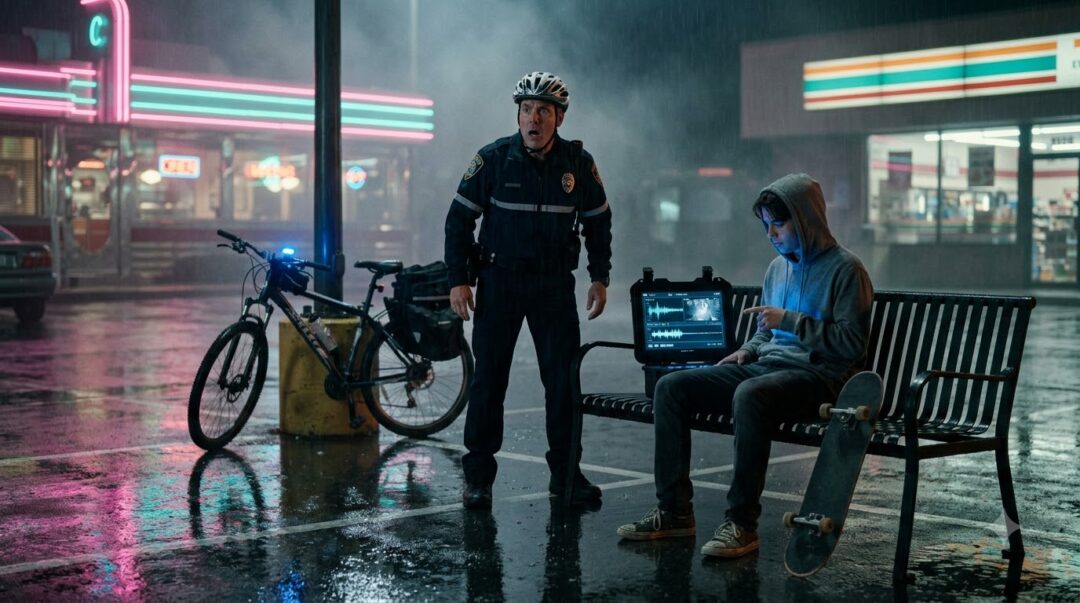
The damp November chill hanging over the suburban parking lot of Cedar Hills Plaza smelled of wet fir needles, cedar bark mulch, and ozone from the neon pharmacy sign that hummed in pink and turquoise above the empty storefronts. At twenty minutes before midnight, the wide expanse of dark asphalt was an empty mirror reflecting the steady mist of the Pacific Northwest drizzle.
Leo Vance sat on the edge of a green-painted municipal park bench, his black high-top sneakers resting lightly on the griptape of his custom maple skateboard. He was seventeen years old, lean and quiet, wearing a heavy charcoal hooded sweatshirt over a gray t-shirt printed with the schematic diagram of an antique vacuum-tube radio receiver. His unruly dark curls were damp with mist, but his eyes were bright, focused, and steady.
Sitting on the slatted wooden bench beside him, nestled inside a padded waterproof nylon field case, was a handheld digital telemetry monitor. The device was an experimental signal analyzer Leo had built for the regional youth science fair: an oversized seven-inch touchscreen connected to a dual-band software-defined radio receiver running open-source frequency analysis code. On the screen, colorful spectral waterfalls cascaded in real time, mapping the wireless chatter of the suburban night.
A sharp, metallic clatter broke the silence of the plaza.
A customized police mountain bicycle—equipped with heavy knobby tires, dual pannier bags, and a blue-and-amber LED strobe array mounted to the handlebars—skidded to an abrupt, aggressive halt directly in front of the bench.
Officer Gary Brant planted his right tactical cycling shoe onto the wet concrete curb with a forceful slap.
Brant was forty-two years old, built like a sprint cyclist, with thick quadriceps stretching the fabric of his dark navy police shorts and windbreaker. An aerodynamic cycling helmet was cinched tight beneath his square, weathered jaw, and wraparound sports sunglasses rested above his brow despite the midnight darkness. He did not step down from the bike; he leaned his weight forward over the aluminum handlebars, a thin, predatory smirk spreading across his face.
“Skateboarding after municipal curfew on private commercial property,” Brant said, his nasal Pacific Northwest accent sharp as a file. “That is an automatic equipment seizure under County Code eight-dash-twelve, son. Stand up and hand over the board.”
Leo did not stand up. He kept both hands resting loosely in the front pouch of his hoodie, his posture relaxed, his gaze meeting Brant’s without the slightest trace of flinch or tremor.
“Good evening, Officer Brant,” Leo said, his voice quiet, calm, and measured. “The municipal juvenile curfew for Washington County takes effect at twelve o’clock midnight on weeknights. My watch says eleven-forty-one. That leaves nineteen minutes of legal public presence.”
Brant laughed—a short, wet bark of contempt—and unclipped his left shoe from the pedal, swinging his leg over the bicycle crossbar in one smooth, aggressive motion. He took two heavy steps into Leo’s personal space, planting his boots six inches from Leo’s skateboard wheels.
He reached up with his gloved right hand and tapped the small, black rectangular camera module clipped to the tactical zipper of his chest vest. The tap was loud, deliberate, and meant to intimidate.
“You really think you are smart, kid?” Brant sneered, leaning down until his breath, smelling of sour energy drink and cinnamon gum, hit Leo’s forehead. “You think citing code protects you out here in the dark? You are on camera. Department-issued digital audio and video evidence system. What my camera logs is what goes to the juvenile prosecutor. I log you as hostile, defiant, and trespassing, and your parents will be paying five hundred dollars to the county diversion board by noon tomorrow to keep you out of the detention center.”
Leo did not look down. He did not pull his hands from his pocket to plead or make excuses.
Instead, he turned his head half an inch to the right, looking down at the illuminated touchscreen resting on the wooden slats of the bench.
“Officer Brant,” Leo said softly, “your bodycam is transmitting on an unencrypted two-point-four-gigahertz digital frequency.”
Brant froze. The cocky smirk vanished from the corners of his mouth. “What did you say?”
“Your camera unit,” Leo repeated, his cadence as steady as a laboratory metronome. “Model Axon Body Three, commercial firmware revision four-point-two. It has an auxiliary wireless broadcast channel intended for squad-car vehicle synchronizers. It is streaming right now.”
Leo lifted his left hand from his hoodie pocket and tapped the touchscreen with his index finger.
The screen shifted instantly from the spectral waterfall display to a high-definition, razor-sharp video monitor window.
On the screen, in vivid color and crisp digital audio, Officer Gary Brant’s own point-of-view camera feed was playing back in real time. The timestamp in the corner read 11:42 PM. The audio speaker on Leo’s field monitor crackled with the crystal-clear sound of Brant’s own voice:
‘You really think you are smart, kid? You think citing code protects you out here in the dark? What my camera logs is what goes to the juvenile prosecutor…’
Brant’s jaw dropped open. His eyes bugged out in sheer, paralyzed disbelief. He looked from the glowing screen to the camera on his chest, then back to the monitor, his face draining of color until his skin turned the shade of wet river gravel.
“Where… where did you get that feed?” Brant stammered, his voice losing all of its previous swagger. “That is an encrypted law enforcement transmission! How did you crack that key?”
“You disabled the WPA-Three encryption protocol yourself, Officer,” Leo answered calmly. “Look at the broadcast banner at the top of the monitor.”
Brant leaned in, squinting at the small text scrolling in green across the top of the display:
Broadcast Target: Private IP 192.168.1.104 / Destination: Westside Storage Facility Unit 14.
Leo looked directly into Brant’s horrified eyes.
“You aren’t streaming to the county dispatch server, Officer Brant,” Leo said, his voice dropping into a register of icy clarity. “You are streaming to an off-site private server. The same server where you logged my sister Maya’s electric scooter two weeks ago before you told our mother it had been impounded and destroyed.”
CHAPTER 2: THE SOLDER ON THE BREADBOARD
The sound of rain dripping from the plastic eaves of the pharmacy canopy was the only noise in the deserted shopping plaza. Officer Gary Brant stood paralyzed on the wet concrete, staring at the small, glowing monitor as if it were an unexploded military mortar shell.
Broadcast Target: Private IP 192.168.1.104 / Destination: Westside Storage Facility Unit 14.
Brant’s left hand, clad in a tight padded cycling glove, began to shake. He reached down instinctively to slap his hand over the camera lens on his chest, but the red recording LED continued to blink with cold, rhythmic indifference beneath his fingers.
“Shut that unit down,” Brant whispered, his voice cracking with sudden, uncontrolled fury. “Shut it down right now, kid! That is unauthorized interception of public safety telecommunications! That is a Class C felony under federal wiretap laws!”
Leo did not flinch. He leaned back against the wet wooden slats of the bench, resting his elbows on his knees, looking up at the towering officer with the calm, analytical detachment of a research scientist observing an unstable chemical reaction.
“Federal wiretap exemptions under Title Eighteen, Section twenty-five-eleven, subsection two-G,” Leo stated with effortless precision. “Radio broadcasts transmitted on open, unencrypted frequencies accessible to the general public carry no statutory expectation of privacy. You chose to bypass the municipal APCO-Twenty-Five digital trunking network and set your transmitter to an open broadcast mode so you could edit your own video before submitting shift reports. You cannot claim an expectation of privacy on a frequency you left open to every baby monitor and Wi-Fi scanner within three hundred yards.”
Brant’s chest heaved. He ripped his sunglasses from his helmet, hurling them onto the wet pavement where the plastic lenses cracked against the curb.
“You think you’re a genius, don’t you, Vance?” Brant hissed, stepping so close that his cycling shoes touched Leo’s sneakers. “You think because your father was an electrical engineer you can play games with me? I know where you live. I know what street your sister walks on to get to middle school. You give me that memory card right now, or I swear to God, I will call three squad cars to this curb and have you booked into juvenile detention for terroristic threats.”
Leo looked down at the monitor. The audio waveform on the screen spiked in sharp, jagged peaks as Brant made his threats, every word digitized, time-stamped, and logged to an internal high-speed solid-state drive bolted inside the Pelican case.
“My sister Maya cried for four days after you took her scooter, Brant,” Leo said, his voice dropping into a register that made the hair on Brant’s arms stand up. “She saved her birthday money and her babysitting wages for two years to buy that Segway Ninebot so she could get to her art classes at the community center. You took it from her outside the public library, claimed the serial number was defaced, and refused to give her a receipt. And then you told our mother that if she filed an administrative complaint, you would have Child Protective Services review our household.”
“That scooter had an altered vehicle identification stamp!” Brant snarled, though his eyes darted nervously toward the empty boulevard.
“That scooter had Maya’s initials engraved inside the battery compartment with an electric engraver,” Leo replied. “And my radio scanner didn’t just pick up your video stream tonight, Officer. It picked up your Bluetooth telemetry ping from your bicycle’s onboard computer. You visited Westside Storage Unit Fourteen three times this week. Every Tuesday and Thursday at two o’clock in the morning.”
Brant’s face turned from gray to an ugly, mottled purple. He reached down to his duty belt, his fingers wrapping around the textured grip of his heavy chemical-spray canister.
“Give me the box, kid,” Brant said, his voice dropping into a harsh, homicidal whisper. “I am not asking again. Give me the box, or I will hose your face with tactical pepper foam, throw you on the concrete, and take it from your hands.”
Leo didn’t reach for the box.
He slid his right foot back, hooking the kicktail of his skateboard with the toe of his sneaker. With a single, explosive snap of his ankle, he popped the maple deck into the air, catching the nose with his left hand, and drove the heavy aluminum front truck of the skateboard directly into Brant’s bicycle front wheel.
The impact was sharp, loud, and decisive.
The high-pressure knobby tire popped with a deafening bang as the spokes crumpled like dry twigs under the heavy cast-aluminum truck. Brant’s four-thousand-dollar patrol bicycle collapsed onto its side in a tangle of twisted rims and severed hydraulic brake cables.
Brant yelled in shock, stumbling backward over his own fallen handlebars, splashing hard onto his back in three inches of cold gutter water.
Leo was moving before Brant even hit the ground.
He grabbed the handle of the Pelican case in his right hand, dropped his skateboard onto the slick asphalt with a hollow clack, planted his back foot on the griptape, and pushed with all the power in his seventeen-year-old legs.
The skateboard shot across the empty parking lot like a missile, its soft urethane wheels carving through the puddles in twin sprays of water, heading straight for the pedestrian footbridge that led into the dark, wooded corridors of the Beaverton wetlands park.
CHAPTER 3: THE ALLEY BEHIND THE PHARMACY
The rush of cold Pacific Northwest rain against Leo’s face cleared his head like a splash of ice water. The skateboard’s bearings hummed a smooth, high-pitched whine as the polyurethane wheels glided over the rain-slicked asphalt of the pedestrian pathway.
Behind him, through the darkness of the shopping center lot, Officer Gary Brant was screaming curses into the wet wind. Brant couldn’t use his patrol bicycle with its shattered front spokes, but he was an elite-level triathlete with heavy aerobic conditioning; the rhythmic, heavy slap of his tactical cycling shoes echoed against the brick walls of the commercial buildings as he pursued on foot.
“Vance! Stop right there, you little bastard!” Brant’s voice roared through the drizzle. “I’m calling the canine units! You won’t make it three blocks!”
Leo didn’t look back. He knew every crack, every expansion joint, and every curb cut in Cedar Hills. He carved a hard right turn off the asphalt path, dipping down onto the wooden boardwalk that wound through the protected wetlands of Fanno Creek. The wet cedar planks were slick as grease, but Leo kept his knees bent low, shifting his center of gravity with effortless muscle memory, holding the heavy Pelican field case tightly against his ribs.
Under the wooden trestle of the Beaverton-Hillsboro light rail line, the ambient darkness deepened into pitch black, broken only by the rhythmic flash of the distant highway crossing signals.
Leo slid his back foot along the tail, locking the wheels against the wooden railing, coming to a silent halt beneath the concrete bridge abutment.
He set the Pelican case down on a dry concrete ledge, pulled his hood low over his forehead, and opened the ruggedized lid.
The monitor was still humming, its blue backlight illuminating the concrete ceiling above. The screen showed an active data log: the Wi-Fi bridge in Leo’s case had successfully downloaded four hundred and twenty megabytes of cached video files directly from Brant’s unencrypted bodycam transmitter before the connection severed.
Leo tapped the playback icon.
On the screen, an unedited video clip from four nights ago played in crisp high-definition.
The video showed the interior of a brightly lit commercial garage bay. Officer Gary Brant was standing beside an open storage roll-up door, holding a pneumatic wrench. Parked inside the storage unit was a row of sixteen high-end electric scooters and customized mountain bicycles, each tagged with handwritten cardboard labels.
And standing beside Brant, reviewing a clipboard with an unlit cigar between his teeth, was Lieutenant Victor Vance—the commander of the county sheriff’s juvenile diversion division.
‘We got eight units cleared from the Eastside sweep, Gary,’ Lieutenant Vance’s voice came through the field speaker, clear and undisturbed. ‘The parents paid the three-hundred-dollar diversion waivers at the front desk. Sell the hardware to the salvage contact in Spokane on Friday. Just make sure the serial plates are ground flat before you load the van.’
Leo felt the cold air tighten in his chest.
It wasn’t just a rogue patrolman shaking down teenagers for pocket money. It was an organized municipal theft ring operating from the top of the juvenile division. Lieutenant Vance was taking the ‘diversion fees’ paid by terrified parents to keep their kids out of court, while Brant was stealing the physical hardware and reselling it across state lines.
A flashlight beam suddenly swept through the trees fifty yards back along the boardwalk.
Brant was jogging through the brush, holding his tactical flashlight in one hand and his department radio in the other. He had anticipated Leo’s route along the creek.
“Unit Twenty-Two to dispatch,” Brant’s voice echoed through the wet timber, panting with exertion. “I am in foot pursuit of a suspected commercial burglary suspect along the Fanno Creek greenway. Subject is male, approximately five-ten, wearing dark clothing, carrying stolen high-end electronic diagnostic equipment. Authorized use of secondary force is requested.”
The county dispatch console crackled back through Brant’s radio speaker:
‘Copy, Unit Twenty-Two. All Westside sector patrol units are on priority code two. K-9 Unit Four is five minutes out from the light rail station.’
Leo looked down at the Pelican case. The internal lithium battery was sitting at thirty-four percent. If he was trapped in the wetlands by a tracking dog, Brant would seize the hardware, crush the solid-state drive under his boot, and claim Leo had thrown the equipment into the swollen creek.
Leo reached into his backpack, pulled out an auxiliary magnetic dipole antenna, and screwed it into the secondary coaxial port on the side of the Pelican case.
He brought up the diagnostic software menu and selected the frequency band labeled Amateur Radio Repeater Network / Washington County Amateur Radio Emergency Service (ARES).
The Washington County ARES network operated on the two-meter VHF band, linking eighty-five amateur radio stations across the Portland metropolitan basin. It was monitored twenty-four hours a day by retired engineers, volunteer emergency responders, and certified federal civil defense operators.
Leo keyed the software-defined push-to-talk button, speaking into the internal field microphone with calm, clear precision:
“Mayday, Mayday, Mayday. This is amateur radio station Kilowatt-Seven-Delta-Bravo-Victor, transmitting from the Fanno Creek light rail overpass. I am an emergency traffic operator in possession of verified digital evidence of active municipal corruption and unauthorized law enforcement wire surveillance. Any monitoring station, please acknowledge immediately.”
For two agonizing seconds, the speaker hissed with empty atmospheric static.
Then, from forty miles away on the crest of Council Crest, a deep, resonant voice answered through the speaker, crisp as a mountain morning:
‘Station K-Seven-D-B-V, this is net control station W-Seven-P-D-X. We copy your emergency traffic loud and clear. State your location and nature of distress.’
CHAPTER 4: THE STORAGE UNIT ON HIGHWAY TEN
The crisp, professional voice from the amateur radio network sounded like a lifeline thrown into a stormy sea.
“Net control, this is Leo Vance,” Leo spoke into the field microphone, his voice dropping low as Brant’s flashlight beam danced through the wet willow branches thirty yards away. “I am transmitting from the concrete abutment beneath the light rail bridge at Cedar Hills. I have four hundred megabytes of verified body-worn camera data showing unauthorized commercial asset sales by officers of the Washington County Sheriff’s Department. I am uploading the raw data packets across the two-meter packet radio digital gateway right now.”
‘Copy that, Leo,’ the operator replied instantly. ‘This is Captain Sarah Lin, callsign Whiskey-Seven-Echo-Alpha. I am the duty officer for the County Internal Affairs Division, monitoring from the regional emergency operations center in Hillsboro. Hold your transmission open. We are logging your digital stream directly to the county district attorney’s secure server.’
Leo remembered the countless nights he had spent in his father’s small garage workshop, learning how to solder micro-surface-mount components under a magnifying lamp. His father had taught him that every circuit was a balance of resistance, voltage, and ground; if you understood the flow of electricity, you could trace any signal back to its source. Out here in the rain, the same principles applied to human behavior: corruption always generated heat, and heat always left an unmistakable forensic trail.
Leo’s heart gave a sudden, hard thump of relief. He didn’t waste a second. He tapped the high-speed packet burst command on his touchscreen. The blue data light on the Pelican case began to flicker in an intense, rapid staccato as forty-two megabytes per second of compressed video streamed over the amateur VHF frequency into the regional network.
A heavy branch snapped violently twenty feet behind him.
“Got you, you little punk!”
Officer Gary Brant burst through the wet blackberries, his face scratched by thorns, his cycling uniform soaked with mud and creek water. He didn’t draw his taser; he launched his entire two-hundred-pound athletic frame forward, tackling Leo from behind with crushing force.
The impact slammed Leo face-first into the cold concrete abutment. The Pelican case was knocked from his grip, skittering across the wet leaves toward the edge of the swollen creek.
Brant scrambled to his knees, his heavy knee pressing violently into the small of Leo’s back, wrenching the boy’s right arm behind his shoulder until the joint popped with agonizing tension.
“You’re done, kid!” Brant screamed, spit flying from his lips in the cold darkness. “You are done! You just committed your last hack!”
With his free hand, Brant seized the Pelican case, holding it above his head, preparing to smash the seven-inch glass screen against the concrete wall.
“Brant, look at the transmission light!” Leo gasped through gritted teeth, his face pressed into the cold, wet gravel.
Brant hesitated for a fraction of a second, his gaze dropping to the glowing screen.
On the display, in bright green alphanumeric characters, the transfer log read: Upload Complete: 100% / Recipient: Washington County District Attorney – Public Integrity Division / Logged by W7EA.
Beneath the confirmation banner, a crisp audio voice crackled from the unit’s waterproof speaker:
‘Officer Gary Brant, this is Captain Sarah Lin, Internal Affairs. We have your video feed, your audio recording, and your GPS coordinates. Step away from the civilian immediately. A tactical interdiction unit is thirty seconds from your location.’
Brant froze. His hand trembled around the handle of the plastic case.
For five seconds, the only sound in the wetlands was the heavy, ragged sound of Brant’s breathing and the distant roar of sirens approaching along Highway 217.
Brant looked down at Leo, his face twisted into an ugly, psychotic snarl of cornered desperation. He didn’t drop the case. He reached down with his left hand, violently yanked Leo up by the hood of his sweatshirt, and dragged him backward toward the access road where a private, unmarked white commercial cargo van sat idling in the shadows behind the water treatment substation.
“You think this is over because of an email, kid?” Brant hissed, shoving Leo through the side sliding door of the cargo van into the pitch darkness inside. “Lieutenant Vance is already at the storage yard loading the transport trailer. We clear the county line in ten minutes, and you are coming with us as collateral.”
The heavy sliding door slammed shut, the automatic locks clicking with the heavy finality of a prison gate.
Inside the cargo van, the air was cold, smelling of gasoline, motor oil, and spray paint.
Leo stumbled against a row of heavy metal objects secured with cargo straps along the van’s interior ribs.
He reached out with his bruised fingers, feeling the familiar, smooth powder-coated aluminum frame of an electric scooter. His fingertips traced the bottom of the battery casing, finding the rough, hand-engraved initials scratched into the metal: M.V.
Maya’s scooter.
Sitting beside it were twenty-four other high-end electric vehicles and competition mountain bicycles, all stripped of their municipal tags, their serial plates ground down to raw silver steel.
Leo took a deep breath of the damp air, steadying his hands against the vibration of the driveshaft. The van’s heavy V8 engine roared to life, throwing Leo backward against the steel bulkhead as the vehicle accelerated wildly onto the highway, heading west toward the dark industrial outskirts of Hillsboro.
CHAPTER 5: THE CIRCUIT IN THE RAIN
The white commercial van bounced violently over the railroad tracks on Highway 10, the heavy steel suspension groaning under the weight of thirty stolen electric vehicles. Inside the lightless cargo bay, Leo Vance scrambled on his hands and knees across the ribbed steel floor, his fingers searching frantically through the dark for his Pelican case.
He found it wedged beneath the rear axle housing of Maya’s scooter.
The ruggedized plastic case was scratched and covered in wet clay, but the green power indicator was still glowing steadily. The glass touchscreen had survived the impact, though a thin hairline fracture ran across the upper right corner.
Leo tapped the screen. The internal telemetry monitor was still alive.
The auxiliary packet radio had lost its direct VHF connection when Brant threw the case inside the metal van—the steel body panels acted like a Faraday cage, attenuating the high-frequency radio waves. But Leo knew that every commercial cargo van had a weak point in its electromagnetic shielding: the unshielded rubber gasket around the rear cargo doors and the plastic emergency release vent set into the lower rear quarter panel.
Leo reached into his pocket, his fingers closing around a three-foot length of insulated copper antenna wire he had grabbed from his workbench before leaving home.
He stripped the plastic coating from the wire with his teeth, looped the bare copper around the center pin of the radio’s BNC connector, and pushed the wire through the rubber weather stripping at the base of the rear door, letting eighteen inches of copper trail into the rushing air outside.
The screen flickered. The signal strength meter jumped from zero to three bars.
The audio speaker crackled back to life, though Leo quickly pressed his thumb over the speaker grille to muffle the sound:
‘Leo? Leo, do you copy? This is Captain Lin. We have lost your primary GPS beacon, but our regional direction-finding towers are tracking your two-meter packet carrier. We are heading west on Highway Ten. Give us a landmark.’
Leo held the field microphone two inches from his mouth, whispering beneath the roar of the van’s exhaust:
“Captain Lin, I am inside an unmarked white Ford Econoline van, license plate unknown. Officer Brant is driving. We just crossed the light rail tracks at Cornelius Pass Road. We are turning into the Westside Mini-Storage facility on Tenth Avenue. Lieutenant Vance is waiting inside Unit Fourteen.”
‘Copy, Leo,’ Captain Lin’s voice replied, tight with controlled urgency. ‘We have four tactical interdiction units two miles behind you. We are setting up a perimeter around the storage complex right now. Stay low, stay out of the line of fire, and do not attempt to engage.’
The van swung violently to the left, tires scrubbing curb as Brant navigated an unpaved industrial access road.
A heavy electronic gate groaned open on rusted rollers. The van rolled inside the high security fence of the Westside Mini-Storage yard, slowing to a halt before a long row of blue-painted corrugated storage bays.
The cold rain drummed in a steady, deafening roar against the thin sheet-metal roof of the van, leaking through the rusted seam welds in freezing rivulets that pooled around Leo’s sneakers. He kept his breathing slow and even, counting the seconds between gear shifts to calculate their speed and heading along the highway corridor. Decades of engineering history had proven that closed systems were inherently vulnerable to external observation; Brant believed he was invisible inside this dark cargo box, but the invisible air around them was saturated with data.
The engine went dead.
Outside, the rain had turned into a steady, freezing downpour, drumming on the van’s steel roof like handfuls of gravel.
A heavy hand rattled the front passenger door.
“What took you so long, Gary?” a deep, harsh voice demanded outside—the voice of Lieutenant Victor Vance. “The transport driver from Spokane has been waiting in the diner since eleven! We were supposed to have this trailer packed by midnight!”
“We had a problem at Cedar Hills,” Brant’s voice answered, breathless and trembling with ragged panic. “The Vance kid was sitting on a bench with a radio scanner. He tapped my bodycam feed. He uploaded the files.”
“What?” Lieutenant Vance roared, the sound of his heavy boots splashing through the puddles. “What do you mean he tapped your feed? You told me that frequency was invisible!”
“He is in the back of the van, Victor!” Brant shouted back. “I grabbed him and his hardware! We have to pack the trailer, take the kid with us across the Columbia River, and wipe the cloud server before internal affairs gets an administrative warrant!”
The heavy sliding side door of the van was yanked back on its rollers with a violent screech.
The glare of a million-candlepower tactical spotlight flooded the cargo bay, pinning Leo against the rear bulkhead.
Lieutenant Victor Vance stood outside in the rain, wearing a heavy leather bomber jacket over his sheriff’s department uniform, an unlit cigar clamped between his yellowed teeth. His weathered, florid face was twisted into a mask of pure, predatory hatred as he looked at the teenager sitting among the stolen scooters.
In his right hand, held at low ready, was a short-barreled pump-action twelve-gauge shotgun.
“Get out of the van, boy,” Lieutenant Vance growled, cocking the shotgun with a heavy, distinct clack that echoed through the industrial yard. “Bring the plastic case with you. Slowly.”
CHAPTER 6: MIDNIGHT AT THE OVERPASS
The freezing rain fell in horizontal sheets through the narrow canyon between the storage units, turning the gravel drive into a churning river of red clay mud.
Leo Vance stepped down from the van into the deluge, his black high-tops sinking into the slush. He held the Pelican case in both hands at his waist, his jaw set, his breathing steady despite the twelve-gauge shotgun barrel pointed directly at his sternum.
Lieutenant Victor Vance stepped within four feet, the rain streaming down his leather jacket, his eyes cold, dead, and remorseless.
“You’re a clever little technician, aren’t you, Leo?” Lieutenant Vance said, his voice quiet, harsh, and steady. “Built a little radio scanner. Thought you could play detective against men who have run this county for twenty-five years.”
“I didn’t need to play detective, Lieutenant,” Leo said, his voice carrying clearly above the roar of the storm. “My sister’s scooter is sitting in the back of your van. Along with twenty-four other vehicles stolen from kids whose parents paid your department five thousand dollars in fraudulent diversion fees.”
Brant came around from the driver’s side, holding a heavy tire iron in his gloved hand, his eyes wild with desperate frenzy. “Shoot the kid, Victor! Shoot him and dump the van in the Tualatin River! If we don’t clear this gate in two minutes, Lin’s people will be all over us!”
Lieutenant Vance did not lower the shotgun. He reached out with his left hand, grabbing the handle of Leo’s Pelican case, trying to wrench it from the boy’s grip.
“Give me the master drive, boy,” Vance ordered, his voice dropping into a lethal whisper. “You give me the drive, and maybe I leave you in an unlocked bay until the morning shift finds you. Refuse, and I put a hole through you that a doctor couldn’t stitch.”
Leo didn’t pull back against the lieutenant’s grip.
Instead, he did something neither officer expected: he reached down with his right thumb and flipped the high-voltage toggle switch on the Pelican case’s auxiliary capacitor bank.
It was the strobe discharge circuit he had built for optical signal calibration—a four-hundred-volt photo-flash capacitor designed to discharge fifteen thousand lumens of blinding white xenon light through the display bezel in a millisecond burst.
A blinding supernova of blue-white light exploded between them.
The sudden, catastrophic flash turned the midnight dark into noon, burning directly into the retinas of both officers from eighteen inches away.
Lieutenant Vance shrieked in agony, stumbling backward into the mud, his hands flying to his blinded eyes, the shotgun discharging into the wet gravel with a thunderous roar that shattered the windows of the storage office thirty yards away.
Brant dropped the tire iron, clawing at his face, completely disoriented by the purple after-images burning in his vision.
Leo spun on his heel, grabbed the nearest heavy industrial steel roll-up door handle of Unit 15, and yanked it upward with all his strength.
Inside the unit sat a mountain of scrap iron, old automobile axles, and commercial shelving. Leo grabbed a six-foot length of heavy structural channel iron and shoved it horizontally through the spokes of the storage compound’s electric roll-up gate, jamming the sliding mechanism solid.
Behind him, Lieutenant Vance was recovering his sight, blinking away tears of rage, raising the smoking shotgun into the gloom.
“Brant! Pin him against the fence!” Vance bellowed, his voice hoarse with homicidal fury. “Do not let him reach the road!”
Brant drew his service Glock from beneath his cycling jacket, lunging through the mud toward the gate, his boots sliding in the red clay.
“Stop right there, kid!” Brant screamed, raising the black polymer pistol with both hands, aiming directly at Leo’s back as the teenager reached the chain-link perimeter fence.
“Drop the weapon! Drop it now!”
A voice like rolling thunder split the night from the highway above.
Four high-intensity searchlights erupted from the elevated embankment of the light rail overpass, pinning Officer Gary Brant and Lieutenant Victor Vance in a crossfire of four-million-candlepower xenon beams.
Four dark armored tactical vehicles bearing the gold emblems of the Washington County Sheriff’s Special Investigations Division smashed through the secondary wooden gate of the facility, their sirens painting the blue storage sheds in brilliant streaks of emergency crimson and sapphire.
The blinding xenon glare cast stark, razor-sharp shadows across the wet corrugated walls of the storage bays, reflecting off the standing water in pools of silver and electric blue. Leo felt the cold spray of the rain washing the mud and sweat from his face, but his pulse remained steady. He had stood his ground against two armed men with nothing more than a scrap of copper wire and an unyielding commitment to the truth; the fear had evaporated, leaving behind a profound, crystalline clarity.
Captain Sarah Lin marched down the embankment, leading six tactical operators in dark body armor with suppressed carbines held at the high ready.
“Lieutenant Victor Vance! Officer Gary Brant!” Captain Lin’s voice thundered through an amplified megaphone. “Drop your weapons and get on the ground! You are completely surrounded!”
Brant looked up at the wall of federal steel, looked down at his trembling pistol, and realized that every frequency in the Pacific Northwest was recording his defeat.
The gun slipped from his fingers, splashing harmlessly into the mud.
Lieutenant Vance stood alone in the glare, his shotgun dangling at his side, his face gray as ash as the tactical operators closed the perimeter in less than four seconds.
CHAPTER 7: THE CLEAR WAVEFORM AT DAWN
The gray Pacific Northwest dawn broke over the cedar ridges of Washington County, casting a soft, pearlescent light across the rain-washed streets of Hillsboro. The clouds tore apart in ragged slivers of silver and pale blue, letting through the first warm rays of morning sun to illuminate the glistening wet asphalt of the county government plaza.
Outside the Public Safety Center on First Avenue, the scene was one of quiet, methodical justice.
Six county transport vans and three state police forensic vehicles were parked along the plaza apron. State investigators in navy windbreakers were carrying out box after box of counterfeit diversion ledgers, falsified title transfers, and unlogged cash envelopes recovered from the private safe inside Unit 14.
Officer Gary Brant and Lieutenant Victor Vance were escorted down the wide granite steps in full transport irons, flanked by four State Police troopers. Both men kept their heads bowed, their eyes fixed on the wet concrete, as three local television news cameras recorded their transfer to the regional correctional facility in Portland.
Standing beside the granite fountain in the center of the plaza was Leo Vance, holding a warm paper cup of hot chocolate.
His gray hoodie was stained with red clay, and his left elbow was bandaged where the gravel had scraped the skin, but his dark eyes were bright, peaceful, and entirely unburdened.
Beside him stood his fourteen-year-old sister, Maya.
Maya was holding the handlebars of her dark blue Segway Ninebot scooter. The vehicle had been thoroughly inspected, cleaned, and polished by the county forensic garage; stenciled neatly across the battery casing, protected beneath a fresh coat of clear marine lacquer, were her engraved initials: M.V.
A tall, sharp-eyed woman in a tailored dark suit and silver lapel pin walked across the plaza toward them.
Captain Sarah Lin smiled—a warm, genuine expression that softened the stern lines of her investigative face—and held out a manila legal envelope to Leo.
“Leo Vance?” Captain Lin asked.
“Yes, Captain,” Leo replied, shaking her hand with a firm, respectful grip.
“The District Attorney just signed the formal order of dismissal for all sixty-two juvenile diversion citations issued by Gary Brant over the last eight months,” Captain Lin said, her voice rich with professional satisfaction. “Over thirty-eight thousand dollars in fraudulent fees are being refunded to local families this week. And every single bicycle, scooter, and electronic device recovered from that storage facility is being returned to its rightful owner before sunset.”
Maya looked up at the captain, her eyes shining with tears of relief, her arms wrapping tightly around her brother’s waist. “Leo… they really gave it back. You really stopped them.”
Leo smiled down at his sister, gently resting his hand on her shoulder. “Told you I’d bring it home, Maya.”
Captain Lin reached into the envelope and brought out a heavy parchment certificate bearing the official gold seal of the Washington County Board of Commissioners, along with an official letter on university letterhead.
“The County Commission passed a special resolution this morning, Leo,” Captain Lin said softly. “A formal Commendation for Extraordinary Civic Courage and Technological Integrity. But there is something else.”
She handed the university letter to Leo.
Leo opened the envelope, his eyes scanning the bold letterhead of the Oregon Institute of Technology’s School of Electrical and Computer Engineering.
It was an official notification of a full four-year undergraduate scholarship in wireless telematics and digital communications engineering, sponsored jointly by the Pacific Northwest Amateur Radio League and the State Law Enforcement Oversight Foundation.
Leo stared at the letter, his breath catching in his throat, a look of pure, unadulterated wonder spreading across his young face. “Captain… this is… this is four years of tuition.”
“You earned every credit hour last night on that bench, Leo,” Captain Lin said, placing a warm, motherly hand on his arm. “You proved that when technology is held in the hands of honest people who refuse to be intimidated by authority, the truth will always cut through the static.”
The early morning traffic hummed along First Avenue in a smooth, continuous rhythm, delivery trucks and city buses moving peacefully beneath the towering Douglas firs that lined the civic center parkway. The damp mist was clearing from the valley floor, revealing the snow-capped peak of Mount Hood rising majestic and clear against the eastern sky. The community had survived months of predatory intimidation, but the resilience of ordinary citizens had restored the balance of justice.
An hour later, the sun was shining bright and clear over Cedar Hills Plaza.
The wet asphalt was drying into warm gray stone, the puddle water evaporating into the fresh, pine-scented morning breeze.
Leo dropped his skateboard onto the smooth concrete apron beside the park bench. He adjusted his backpack, looking across the bustling plaza where parents were walking their children to school and morning commuters were grabbing coffee at the corner bakery.
As they reached the edge of the plaza, neighbors waved from shop doorways, recognizing the young brother and sister who had brought accountability to their streets. Maya rode beside him on her scooter, the electric motor humming a quiet, joyful rhythm on the pavement, her laughter echoing in the crisp autumn air.
Leo put his foot down, pushed twice against the concrete, and glided forward into the warm Oregon sunlight—moving forward with clean hands, an open road, and a signal that was forever clear.