When The Midnight Security Monitor Caught The Corrupt Traffic Stop
CHAPTER 1: THE SNAP OF THE TOW CHAIN
The violent screech of hardened alloy steel tearing through plastic air dams echoed across the wet asphalt of the Prairie Gateway Truck Stop with the force of a gunshot.
Marcus Bell sat motionless behind the steering wheel of his gray Toyota Camry, both hands resting flat at the ten-and-two position on the worn polyurethane rim. He did not curse. He did not jump. Outside the front bumper, twenty-five feet of high-tensile five-sixteenths transport chain jerked taut under the power of a hydraulic winch, violently ripping the lower bumper cover half-free from its mounting clips with a sickening snap of sheared nylon fasteners.
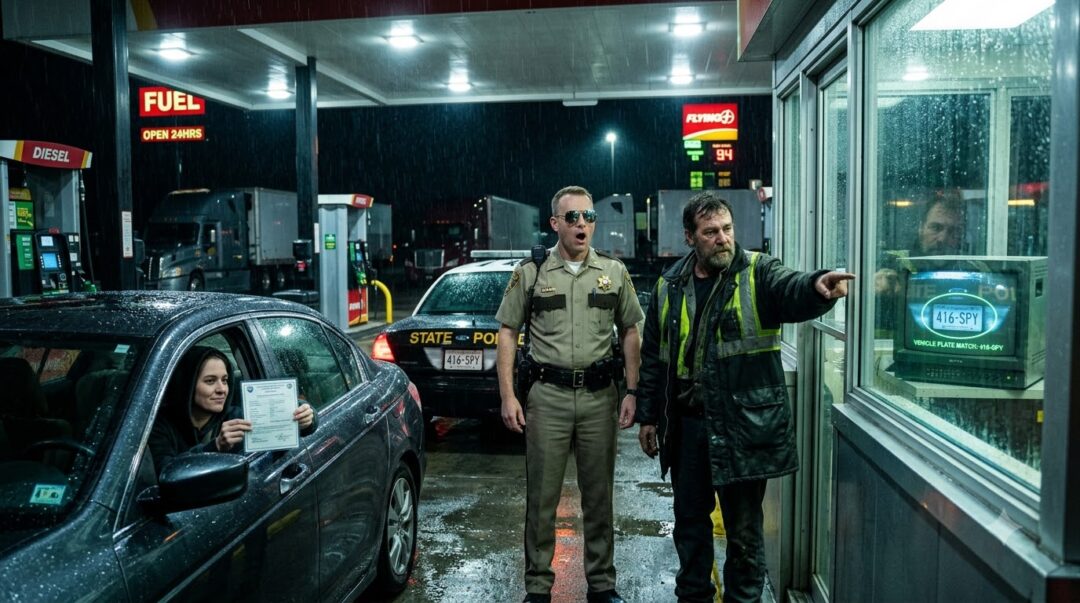
Through the rain-streaked windshield, illuminated by the harsh overhead glare of three-hundred-watt high-pressure sodium canopy floodlights, Officer Dan Rucker leaned into the open driver’s window.
Rucker was forty-three years old, heavy in the belly and thick through the jaw, wearing a dark khaki municipal traffic patrol jacket with the collar turned up against the freezing prairie drizzle. Over his eyes, despite the fact that it was ten minutes past three on a pitch-black Illinois night, he wore a pair of mirrored teardrop aviator sunglasses. His mouth moved in a steady, aggressive rhythm, loudly chewing a wad of pink bubblegum with an open-jawed, theatrical smack.
In his right hand, Rucker held a heavy aluminum Maglite flashlight, rhythmically tapping the knurled metal barrel against the Camry’s steel roof with an irritating, authoritative clack.
“Nice license plate you got hanging on that bumper, buddy,” Rucker said, leaning down so his sour breath, smelling of stale mint and cheap diner coffee, washed through the window gap. “Illinois passenger tag Seven-Eight-Four, King-Lincoln-Paul. We run that tag through the state database, and it flags as an active stolen or cloned registration out of Cook County. Stolen or cloned, genius. Pick one.”
Marcus turned his head slowly, meeting the opaque, mirrored reflections of his own calm face in Rucker’s glasses. At thirty-two, Marcus had spent five years working as an independent field insurance adjuster before taking on night-shift medical and commercial courier contracts to pay his grandmother’s monthly dialysis and insulin copays. He had looked into the eyes of arsonists, fraudulent mechanics, and predatory repossession agents across every county in northern Illinois. He did not rattle easily.
Marcus reached with deliberate, unhurried precision toward the magnetic phone mount clipped to his center vent. He turned the glowing screen toward the officer’s face.
“License plate Seven-Eight-Four King-Lincoln-Paul was issued to this vehicle by the Secretary of State facility in Joliet fourteen months ago, Officer,” Marcus said, his voice quiet, measured, and steady. “The registration is linked directly to my active state commercial courier routing application on this screen. The vehicle identification number on the dash matches the title in the state mainframe. Are you certain you want to proceed with this tow?”
Rucker let out a loud, contemptuous snort of laughter, smacking his metal citation docket against the insulated vinyl delivery hot-bag resting on the front passenger seat.
“Cold burritos and lukewarm takeout,” Rucker mocked, shaking his head with exaggerated pity. “Four-dollar tip for driving thirty miles in the freezing rain. Real high-powered career you got going there, courier boy. But around here, on this stretch of Interstate Eighty, what my terminal flags is what gets hooked. The flatbed is already on the frame. Your car is going to the county impound yard in Ottawa, and you can walk down the access ramp and call a cab.”
From the rear of the vehicle, the sound of heavy work boots crunching through gravel and wet road grime approached.
Ray Kowalski, a fifty-four-year-old independent tow truck operator with thirty years of recovery grease etched permanently into the wrinkles of his hands, walked along the driver’s side of the Camry. He wore a faded, paint-splattered Carhartt canvas coat over denim overalls, his gray beard dripping with rain. He was carrying a secondary steel bridle hook, his shoulders hunched against the biting north wind.
“Hold on a second, Dan,” Ray called out, his deep, gravelly voice cutting through the hiss of the diesel pumps.
Rucker didn’t look back. “Keep cranking the winch, Ray! We got two more commercial drop-offs on the river bridge before shift change!”
“I said hold up, Dan,” Ray repeated, his tone shifting into a sharp, commanding register that made Rucker’s gum-chewing pause mid-cycle.
Ray stopped ten feet from the Camry, not looking at Marcus or the car, but pointing his calloused, oil-stained finger straight toward the glass attendant booth of the truck stop, forty feet across the concrete apron.
Inside the heated glass booth, sitting on a laminate counter beside the cash register, an old green-phosphor closed-circuit security monitor was glowing in the dark, displaying the live four-camera split-screen from the plaza’s perimeter surveillance system.
“Look at Camera Two on the booth screen, Dan,” Ray said quietly.
Rucker frowned, his head turning slowly toward the attendant’s window.
On the glowing green monitor, the surveillance feed from Camera Two was showing a continuous digital playback of the diesel pump lanes from two hours earlier—logged at exactly 1:12 AM.
On the screen, in razor-sharp monochrome contrast, Officer Dan Rucker’s own municipal patrol cruiser, Unit 19, was shown pulling into Pump Four. Mounted securely to the front push-bumper bracket of Rucker’s official police interceptor, illuminated in full glare by the overhead canopy lights, was a stamped aluminum passenger plate.
The characters on the police cruiser’s front plate were unmistakable: 784-KLP.
The exact identical license plate number that Rucker was currently attempting to impound from Marcus’s car.
Rucker stood motionless on the wet asphalt. The gum stopped moving between his teeth. The blood drained from his face so fast that his weathered neck turned the color of dry cement under the yellow lights.
Marcus leaned forward slightly in his seat, his hand reaching calmly into the glove compartment. He withdrew a crisp, laminated blue document bearing the embossed state seal of the Illinois Department of Transportation.
“State Commercial Courier Emergency Transit Permit,” Marcus said, holding the document against the open window. “Authorizing priority pharmaceutical and laboratory transport across all county lines. Signed by the regional director. Valid through next November.”
Ray dropped the secondary bridle hook into the gravel with a ringing metallic clank, wiping his wet hands on his coat.
“Plate’s on your car on the security tape, Dan,” Ray said, taking two steps backward, his face hard as flint. “And the kid’s paperwork is certified. I’m unhooking the winch line. I’m out of this.”
Rucker did not move an inch. He stood frozen under the buzzing lights, his mirrored sunglasses reflecting the glowing green surveillance monitor, his jaw hanging slack as the rain dripped from the brim of his hat into his open mouth.
CHAPTER 2: THE AMBER GLOW OF THE CANOPY
The cold November rain hissed across the corrugated steel canopy of the truck stop like a leaking steam pipe.
Ray Kowalski didn’t wait for Officer Dan Rucker to give an order. He walked to the rear of his Peterbilt flatbed, grabbed the heavy hydraulic control lever, and reversed the winch spool. The steel cable groaned as thirty feet of braided line unspooled onto the wet blacktop, releasing the tension on Marcus’s torn bumper with a dull, hollow clatter.
“Ray, what the hell are you doing?” Rucker hissed, his voice dropping into a harsh, frantic whisper. He took three aggressive strides toward the tow truck driver, his heavy Maglite flashlight trembling in his fist. “I called this dispatch! This is an active municipal seizure! You unhook that vehicle, and I’ll have the county board pull your commercial towing permit before eight o’clock tomorrow morning!”
Ray stopped with his boots planted firmly in three inches of standing slush. At fifty-four, with two artificial hips and thirty years of hauling eighty-thousand-pound rolled-over steel coils off Interstate 80 in sub-zero blizzards, Ray had looked down the barrels of shotguns held by angry truckers and drunk farmers. He was not a man who could be cowed by a small-town patrolman chewing bubblegum.
“You pull my permit, Dan, and I’ll walk into the State Police barracks in LaSalle and tell Captain Miller why you’ve had three different civilian plates hanging off the front bumper of your patrol car this month,” Ray said, his voice flat, heavy, and absolute as a cast-iron skillet. “I haul wrecked iron for the county, Dan. I don’t haul innocent men’s livelihoods to your brother-in-law’s chop shop in Ottawa.”
Rucker’s face turned from pale white to a dark, furious crimson. His hand dropped to his duty belt, hovering two inches above the thumb-break of his leather holster.
Marcus stepped out of the Camry.
He did not rush. He closed the car door with a solid, reassuring thud, stepping out into the cold rain. He wore a heavy charcoal fleece hoodie over his work denim, his dark hair beaded with mist, holding his laminated commercial courier permit in his left hand.
“Officer Rucker,” Marcus spoke with calm, unmistakable clarity, his voice carrying easily over the drone of the idling Peterbilt. “Inside the insulated container in my rear seat is a sealed, temperature-monitored shipment of high-potency pediatric insulin destined for the St. Margaret’s Regional Children’s Clinic in Spring Valley. The delivery window closes at four-fifteen AM. Every minute you delay this vehicle on an unverified tag seizure is logged as unauthorized commercial interference with critical medical supplies under federal public health statutes.”
Rucker’s eyes darted between Marcus and the illuminated attendant booth forty feet away.
Inside the glass booth, a young, sleepy night cashier named Tyler was standing with his nose pressed against the reinforced plate glass, watching the confrontation with wide, terrified eyes. The surveillance monitor beside the register was still looping the video from two hours earlier: Rucker’s cruiser parked at Pump 4, displaying Marcus’s exact plate number while Rucker accepted a thick white envelope from the driver of an unmarked enclosed auto-transport trailer.
“You think you’re clever, courier,” Rucker snarled, stepping into Marcus’s personal space until the brass buttons on his patrol jacket brushed against Marcus’s chest. “You think having a piece of paper from Springfield makes you bulletproof? That plate on your bumper belongs to a car that was crushed in a scrap shredder in Cook County six months ago. My computer says this vehicle does not exist.”
“Your computer says whatever you typed into the local terminal override, Rucker,” Marcus replied, his eyes cold and unwavering. “Six months ago, my previous vehicle—a 2012 Camry—was totaled in a rear-end collision on Route 6. The title was scrapped, but the commercial transport plates were legally transferred to this chassis by the Secretary of State facility in Joliet. The transfer was processed through the LaSalle County municipal clearinghouse. The very precinct where you work night dispatch.”
Rucker’s breath caught in his throat. The gum stopped moving entirely.
The truth hung in the freezing air between them like an iron weight: Rucker had intercepted the transferred plate records inside the precinct records room, kept the duplicate physical tag from the old wrecked chassis, and mounted it to his own patrol car to run toll-free and unlogged through the automated license plate reader gantries along the interstate corridor.
And now, by an impossible twist of midnight fate, he had pulled over the exact courier whose legitimate registration he had stolen.
Rucker’s hand left his holster and reached for his shoulder microphone with frantic speed.
“Unit Nineteen to County Dispatch,” Rucker barked, his voice cracking with hysteria. “I have a Code Ten-Ten in progress at the Prairie Gateway Travel Plaza! Civilian operator is non-compliant and attempting to tamper with official evidence! Requesting immediate priority backup!”
The dispatch radio crackled back with a sharp, electronic chirp, followed by a voice that made Rucker’s chest tighten:
‘Unit Nineteen, be advised: State Police District Seventeen is currently monitoring all commercial corridor dispatches along Interstate Eighty. State Police mobile units are already in your sector. Stand by for supervisor arrival.’
Rucker’s jaw went slack. He stared at the microphone in his hand as if it had just bitten him.
Across the wet parking lot, the glare of high-intensity xenon headlights flared into life on the interstate off-ramp, cutting through the swirling rain as two dark, unmarked pursuit cruisers came rocketing down the approach road at ninety miles per hour.
CHAPTER 3: THE ATTENDANT’S GLASS BOOTH
The twin searchlights of the approaching pursuit cruisers swept across the diesel canopy like blinding white swords, turning the falling raindrops into streaks of silver fire.
Officer Dan Rucker panicked.
He knew that if state troopers stepped onto the asphalt and saw the surveillance feed running inside the attendant’s booth, his career was over, his pension was gone, and he would be facing fifteen years in a federal penitentiary for commercial title trafficking under color of law.
Without saying a word to Marcus or Ray, Rucker pivoted on his tactical boots, drew his heavy aluminum Maglite flashlight like a club, and lunged across the concrete apron toward the glass attendant booth.
“Dan! What the hell are you doing?” Ray shouted, running after him through the slush.
Inside the heated glass booth, nineteen-year-old Tyler saw the crazed patrolman charging toward the door. With instincts born of working the graveyard shift on an interstate corridor, the young cashier slammed the deadbolt home on the heavy steel-framed security door and threw the emergency electronic shutter switch.
A heavy motorized steel roll-down security grate began to descend over the front cashier window with a loud, grinding mechanical screech.
Rucker reached the booth just as the steel grate was two feet from the sill. He shoved his heavy aluminum flashlight horizontally under the bottom rail, jamming the descending steel shutter in its tracks with a scream of slipping electric drive belts.
“Open this door, kid!” Rucker screamed, his face purple with rage, spit spraying against the glass. “Police emergency! Open the damn door right now!”
“No way, man!” Tyler yelled back through the four-inch transaction speaker, backing away against the cigarette racks. “You look crazy! I’m calling the state troopers!”
Rucker reached through the gap under the jammed shutter with his gloved left hand, clawing frantically for the power cables connecting the green surveillance monitor to the wall outlet. “Unplug that video unit, kid! That is an administrative security seizure under municipal code! Pull the cords or I’m putting a charge of felony obstruction on you!”
Marcus moved with explosive, disciplined speed.
He closed the forty-foot gap across the wet blacktop in four seconds, planting his boots on the concrete curb, reaching out with both hands to seize the heavy aluminum body of the Maglite flashlight jammed beneath the shutter.
With a powerful, two-handed twist that utilized his full two-hundred-pound frame, Marcus levered the flashlight free from the track.
The heavy steel security grate, freed from the obstruction, dropped like a guillotine, slamming down against the concrete sill with a thunderous metallic crash that shook the entire glass booth.
Rucker’s hand was yanked violently backward, the heavy steel grate missing his fingers by half an inch.
The officer tumbled backward off the curb, splashing onto his hands and knees in the freezing slush, his cap falling into a puddle of diesel oil, his mirrored sunglasses skittering across the concrete.
Without the dark glasses, Rucker looked twenty years older: his eyes were bloodshot, surrounded by dark rings of exhaustion and terror, his thinning hair plastered to his skull by the rain.
He scrambled to his feet, breathing like a dying steam engine, his hand flying to the retention strap of his duty holster.
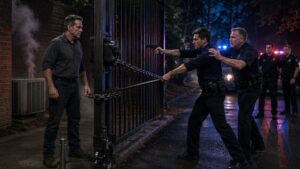
He drew his Glock 22 in one blind, unthinking motion, the black polymer pistol coming up, leveled directly at Marcus’s chest from six feet away.
“You want to play hero, courier?” Rucker wailed, his voice cracking into high-pitched hysteria. “You think you can take my pension? You think you can put me in prison over a piece of stamped tin? Step away from that booth or I swear to God I’ll put three hollow points through your lungs and tell the coroner you were armed!”
The harsh wind blowing across the concrete apron carried the stinging smell of burnt transmission fluid and ozone from the neon canopy lights. Inside the glass booth, Tyler kept his hands flat against the laminated counter, his eyes fixed on the surveillance feed that was recording every second of the confrontation onto unalterable state-archived magnetic tape. The entire travel plaza seemed frozen in time, a solitary island of industrial concrete surrounded by the vast, dark emptiness of the northern Illinois prairie.
Marcus did not flinch. He did not raise his hands. He stood balanced on the curb, his red-and-black delivery jacket open, his eyes fixed on Rucker’s trembling trigger finger with the absolute, unshakable calm of a man who knew that truth had already outrun the bullet.
“Look behind you, Rucker,” Marcus said softly, his voice cutting through the howl of the north wind.
Down the service road behind the patrol cruiser, Ray Kowalski had climbed into the cab of his sixty-ton Peterbilt heavy wrecker.
The big Caterpillar diesel roared like a caged monster as Ray dumped the clutch in reverse, backing the massive steel underlift of the flatbed directly into the front bumper of Rucker’s cruiser with a bone-crushing crunch of radiator support and folding sheet metal.
The two-ton police interceptor was shoved six feet backward across the wet asphalt, pinning the cruiser’s driver door solidly against the steel bollard of Pump 3.
And standing on the concrete apron forty feet away, their long raincoats billowing in the freezing wind, were two tall men in dark navy storm jackets bearing the gold embroidered lettering of the Illinois State Police Special Investigation Division.
The lead state investigator held a nickel-plated Sig Sauer pistol leveled at Rucker’s shoulder with both hands, his voice booming across the plaza like the crack of artillery:
“Officer Dan Rucker! State Police! Drop the weapon and get on your knees! Drop it now!
CHAPTER 4: THE MILE MARKER ON EIGHTY
The heavy crack of the State Police investigator’s command seemed to shatter the freezing midnight air like brittle glass.
Officer Dan Rucker stood frozen between the diesel pumps, his service Glock still pointed at Marcus Bell’s chest, his knuckles white against the checkered polymer grip. Rain poured off his bald crown, streaming down his hollow cheeks, but his eyes darted frantically toward the highway ramps, looking for an exit that no longer existed.
“Dan, don’t do it,” Ray Kowalski’s voice boomed through the open driver’s window of the idling Peterbilt wrecker. “You pull that trigger, and there ain’t a lawyer in Chicago who can keep you off death row. Put the iron on the ground.”
Rucker’s breathing came in ragged, wheezing gasps. He looked at Marcus—the calm, unblinking delivery driver standing with his feet rooted to the curb—and then at the two State Police investigators advancing across the wet blacktop in a coordinated tactical wedge, their weapons held at the low ready.
The pistol slipped from Rucker’s trembling, numb fingers, clattering against the concrete apron with a hollow, metallic clack.
The lead investigator, a tall, weathered veteran named Captain Robert Miller, stepped forward with lightning speed. With a single fluid sweep of his right boot, Miller kicked the Glock ten feet away into the darkness, while his partner, Investigator Sarah Jenkins, seized Rucker by the collar of his patrol jacket, driving him face-down onto the cold, wet asphalt.
The steel handcuffs ratcheted around Rucker’s wrists with two sharp, decisive clicks.
Rucker groaned into the slush, his cheek pressed against a film of diesel fuel, weeping openly as the cold wind whipped across his soaked uniform. “Captain… Captain Miller, listen to me… it was a misidentification… the dispatch computer had an active flag on the plate…”
“Save your breath, Dan,” Captain Miller said, his voice as cold and merciless as the November rain. “We’ve been running electronic surveillance on your private bank accounts in LaSalle for four months. We had the federal wiretap on your brother-in-law’s salvage yard authorized three weeks ago. You picked the wrong night to steal an honest man’s registration.”
Miller turned away from the handcuffed patrolman, stepping up onto the curb beside Marcus. He flashed his gold state credentials and held out a gloved hand.
“Marcus Bell?” Miller asked.
“Yes, Captain,” Marcus replied, shaking the investigator’s hand with a firm, steady grip.
“The LaSalle County 911 dispatch supervisor alerted our regional interdiction desk forty minutes ago,” Miller said, looking at the crumpled front bumper of Marcus’s car. “The cashier inside that booth managed to trigger the silent silent-alarm switch while Rucker was banging on the window. Are you uninjured?”
“I am fine, Captain,” Marcus said, glancing down at his watch. “The time is three-thirty-five. My refrigerated delivery for St. Margaret’s Regional Children’s Clinic has forty minutes remaining on its temperature-control threshold. The insulin shipment is sealed in the rear compartment.”
Miller’s partner, Investigator Jenkins, walked to the rear of the Camry, shining her flashlight through the back glass. She saw the heavy fiberglass medical transport cooler strapped securely to the seat anchors, its digital thermometer display glowing green at thirty-six degrees Fahrenheit.
“Captain,” Jenkins said, turning back with professional urgency. “The kid’s bumper is torn away from the left wheel-well. The tire will scrub if he hits highway speeds.”
Ray Kowalski stepped down from the Peterbilt’s running board, carrying a heavy roll of reinforced duct tape and a pair of heavy-duty aviation shears.
“Give me three minutes with the iron, Captain,” Ray said, kneeling in the slush beside Marcus’s front fender. “I’ll trim the plastic off the tread and secure the bumper to the core support with high-tensile wire. It won’t look pretty for a Sunday church service, but it’ll carry eighty miles an hour all the way to Spring Valley.”
“Do it, Ray,” Captain Miller ordered.
While Ray worked with rapid, practiced mechanical efficiency, Miller walked back to Rucker’s disabled patrol cruiser, which was still wedged against the pump bollard. He pulled a universal key from his belt, popped the cruiser’s rear trunk lock, and lifted the heavy steel lid.
Miller shined his tactical flashlight into the trunk cavity, letting out a long, low whistle that misted in the freezing air.
“Jenkins,” Miller called out. “Look at this.”
Marcus and Investigator Jenkins walked to the rear of the cruiser.
Lined up inside the trunk organizer, stacked neatly beside Rucker’s tactical gear, were six sets of Illinois passenger license plates, each carefully wiped clean and wrapped in clear plastic bags with printed commercial delivery manifests attached.
Every single set of plates belonged to an independent food courier, medical courier, or rideshare driver who had been stopped along Interstate 80 over the preceding ninety days.
“He wasn’t just cloning plates to avoid tolls,” Jenkins whispered, her face pale with disgusted realization. “He was running an automated vehicle-identification harvesting ring. He’d flag an active plate on the state terminal, claim it was stolen, tow the car to his brother-in-law’s yard, and slap the stolen tag onto another impounded chassis to sell across the state line in Iowa.”
Captain Miller reached into the cruiser’s glove compartment, pulling out a thick, hand-written ledger bound in black electrical tape.
“Every cash transaction, every VIN swap, and every kickback paid to the night shift dispatcher,” Miller said, tapping the book against his palm. “We just found the master ledger for the whole LaSalle County network.”
From the front of Marcus’s car, the loud snap of cutting wire sounded as Ray stood up, wiping his grease-blackened hands on a clean blue shop rag.
“Bumper’s secured, Marcus,” Ray said, giving the fender a firm, reassuring slap. “She’s roadworthy. You got thirty-two minutes to make the clinic gate.”
Marcus looked at the weathered tow driver, reaching into his pocket to pull out his wallet, but Ray immediately held up a massive, calloused palm, shaking his head with an affectionate, gravelly chuckle.
“Put your money away, son,” Ray said softly. “The state’s paying my recovery fee tonight. You get that medicine to those children in Spring Valley. And next time you’re passing through Peru on Interstate Eighty, you stop at the diner on Fourth Street. The pie is on me.”
“Thank you, Ray,” Marcus said, his voice thick with genuine respect.
He turned to Captain Miller, who handed Marcus an official State Police Priority Transit Clearance voucher, stamped in red ink with the Governor’s seal.
“You have full state emergency transit authority, Mr. Bell,” Miller said, stepping back and snapping a crisp, formal salute. “Every trooper between here and the Illinois River has your license plate on their mobile screen. Clear the road and make your delivery.”
Marcus climbed into the driver’s seat of the Camry, turned the key, and listened to the smooth, steady hum of the four-cylinder engine as it came alive.
He shifted into drive, pulled away from the diesel island into the dark, rain-swept expanse of Interstate 80, the front tires cutting clean tracks through the slush as he accelerated into the night.
CHAPTER 5: THE DIESEL FOG IN THE BASIN
The four-lane ribbon of Interstate 80 stretched westward through the frozen agricultural flats of LaSalle County like an empty, black runway beneath the November drizzle.
Marcus kept the Camry’s needle locked at seventy-two miles per hour, his headlights cutting twin tunnels of white brilliance through the low ground fog that drifted off the plowed cornfields. On the passenger seat beside him, the digital display of the medical cooler blinked steadily: thirty-six point two degrees Fahrenheit. Safe, stable, and cold.
Behind him in the distance, the flashing red and blue strobes of two State Police interceptors ran fifty yards behind his rear bumper, providing a rolling high-speed escort through the deserted river valley.
At three minutes before four o’clock, the high-intensity halogen floodlights of St. Margaret’s Regional Children’s Clinic rose out of the mist on the outskirts of Spring Valley.
Marcus swung the car into the private delivery lane behind the pharmaceutical annex, pulling to a halt beneath the heated ambulance awning.
Before the engine had even settled into its idle, the pneumatic double doors of the clinic flew open.
Dr. Aris Thorne, the chief of pediatric endocrinology, rushed out into the cold air accompanied by two charge nurses carrying an insulated thermal transport case. Thorne was a tall, middle-aged physician with gray hair and wire-rim glasses, his surgical coat flapping against his legs in the predawn wind.
“Mr. Bell?” Thorne called out, breathless with urgency.
“Shipment is secure, Doctor,” Marcus said, stepping out and opening the rear door.
He unclipped the transport straps, lifted the heavy fiberglass cooler with both hands, and set it carefully onto the rolling stainless-steel gurney held by the nurses.
Dr. Thorne unclipped the digital temperature logger from the cooler’s internal sensor, plugging it into a handheld verification terminal. The device chimed with a clear, two-toned confirmation chirp.
Thorne let out a long, shuddering breath that misted in the morning chill, his shoulders slumping with profound relief.
“Complete thermal integrity,” Thorne whispered, looking up at Marcus with eyes that shone with deep, professional gratitude. “We have four pediatric patients in the intensive care unit who were four hours away from diabetic ketoacidosis. The regional distributor in Chicago had their delivery truck hijacked on the south side yesterday afternoon. If this replacement batch had been delayed past four-thirty, we would have lost two of those children before sunrise.”
Marcus looked at the physician, feeling the cold weight of the night’s exhaustion begin to settle into his bones, replaced by a deep, quiet warmth that spread through his chest.
“They won’t be delayed, Doctor,” Marcus said softly. “The road is open.”
Thorne reached into his coat, signed the electronic delivery manifest on Marcus’s smartphone with his stylus, and clasped Marcus’s hand in a fierce, trembling grip. “The clinic board will be submitting a formal commendation to the Illinois Department of Public Health this morning, Mr. Bell. You saved lives tonight.”
As the clinic team wheeled the medicine through the automated doors into the bright warmth of the hospital, the two State Police cruisers pulled under the canopy, their engines idling softly.
The cold night wind whistled through the steel expansion joints of the clinic ambulance bay, rustling the bare maple branches along the perimeter road. Marcus watched the medical staff move with quiet, heroic dedication, realizing that every mile he had driven through the sleet was an invisible stitch holding a fragile human life together. The highway was not just an artery of commerce; it was a lifeline for families who had no other recourse in the dead of winter.
Captain Robert Miller stepped down from the passenger side of the lead cruiser, holding a fresh ceramic mug of black coffee he had picked up from the hospital security desk. He walked over to Marcus, handing him the hot cup.
“Drink that, son,” Miller said gently. “You’ve got a seventy-mile drive back to Joliet, and you haven’t slept in twenty-four hours.”
Marcus took the hot mug, feeling the warmth seep through his stiff, calloused fingers. “What happened to Rucker’s partner at the salvage yard?”
Miller took a slow sip from his own cup, looking out toward the dark horizon where the first pale slivers of dawn were beginning to tint the clouds over the Illinois River.
“State tactical teams breached the compound in Ottawa forty minutes ago,” Miller answered, his voice rich with satisfaction. “They caught Rucker’s brother-in-law loading eight cloned vehicles onto an interstate auto-carrier destined for a shell dealership in Des Moines. We recovered forty-two stolen titles, seventy thousand dollars in unlogged cash, and the original computerized laser stamping machine they were using to fabricate counterfeit Illinois license plates.”
Miller reached into his pocket, pulled out an official Department of State receipt, and handed it to Marcus.
“The Secretary of State has already reissued your commercial registration with an executive priority flag,” Miller said. “And the state insurance clearinghouse has authorized full payment for a complete replacement front bumper and body detailing on your Camry, courtesy of the LaSalle County municipal liability bond.”
Marcus smiled faintly, looking down at the steam rising from the hot coffee. “Ray Kowalski’s wire did a pretty good job holding it together.”
“Ray is an honest working man,” Miller said softly. “This state could use a whole lot more men like Ray Kowalski. And a whole lot more men like Marcus Bell.”
The hospital chapel bells began to chime four o’clock across the valley, their deep, resonant tones echoing through the morning mist, heralding the end of the long, dark night.
CHAPTER 6: THE WEIGHT OF THE WRENCH
The cold morning light crept slowly over the Illinois River basin, turning the wet fields of LaSalle County into a vast expanse of gleaming silver and slate gray.
At six-thirty in the morning, Marcus pulled his Camry into the gravel driveway of his grandmother’s small, white-clapboard bungalow on the west side of Joliet.
The house was sixty years old, sheltered beneath two towering red oak trees whose remaining golden leaves fluttered softly in the crisp morning breeze. From the red-brick chimney, a thin plume of woodsmoke curled into the pale blue sky, carrying the sweet, comforting scent of burning hickory.
Marcus sat in the idling car for a long moment, his hands resting on the steering wheel, listening to the gentle, rhythmic hum of the four-cylinder engine. The front bumper was secured with Ray’s heavy-gauge industrial wire, the plastic seams held tight by strips of reinforced black tape, but the vehicle had carried him through sixty miles of freezing sleet and corporate corruption without a single mechanical failure.
He turned the ignition key, letting the engine rest, and stepped out into the clean, cold morning air.
The front storm door of the house clicked open.
Evelyn Bell stood on the wooden porch, wearing a thick quilted housecoat over her flannel nightgown, a hand-knit wool shawl draped over her fragile shoulders. At seventy-one, after four years of bi-weekly dialysis treatments, her steps were slow and careful, but her dark eyes were bright, clear, and filled with deep, perceptive wisdom.
“Marcus?” she called out, her voice soft as velvet in the morning stillness.
Marcus climbed the wooden porch steps, his boots making a familiar, creaking sound on the painted cedar boards. He wrapped his arms around her frail shoulders, burying his face into the soft wool of her shawl, breathing in the scent of lavender soap and fresh coffee that had defined his childhood.
“I’m home, Nana,” Marcus whispered, his voice thick with emotion.
Evelyn pulled back slightly, her small, wrinkled hands reaching up to cup his face, her sharp eyes taking in the dark shadows beneath his eyes, the streak of road grime across his jaw, and the torn fabric on the sleeve of his jacket.
“You’ve been through a storm, boy,” she said softly, her fingers gently smoothing the dark hair back from his forehead. “I felt it in my spirit around three o’clock this morning. I got out of bed and set my Bible on the kitchen table and prayed the Lord would keep your tires on the road.”
“Your prayers worked, Nana,” Marcus smiled, taking her hand and leading her back into the warm, yellow-lit kitchen.
On the round oak table sat an open ledger where Evelyn tracked her household expenses, beside a small plastic container holding her daily syringes and medical supplies.
Marcus reached into his jacket pocket, pulled out the official delivery confirmation receipt from St. Margaret’s Clinic, along with a certified bank draft for eighteen hundred dollars—his delivery contract earnings, freshly disbursed by the emergency medical routing authority.
He set the papers on the table beside her Bible.
“The clinic paid the emergency courier bonus, Nana,” Marcus said. “The pharmacy copays are covered for the next six months. And we don’t have to worry about the winter heating bills.”
Evelyn looked at the bank draft, then looked up into her grandson’s tired, honest face. A single tear rolled down her lined cheek, catching the morning sunlight that streamed through the lace curtains.
“The money is a blessing, Marcus,” she said, her voice rich with solemn pride. “But the money isn’t what makes me proud of you this morning. It’s that you walked through the darkness with clean hands. Your grandfather drove a transit bus in this city for thirty-five years, and he always told me that an honest man’s name is the only thing that outlives the grave.”
A sharp knock sounded at the front door.
Marcus turned, his hand dropping instinctively toward his phone, but through the glass of the storm door, he saw the distinctive white-and-gold cruiser of the Illinois State Police parked at the curb, its light bar silent.
Captain Robert Miller stood on the porch, wearing a fresh uniform overcoat, holding a flat, heavy wooden plaque mounted with polished brass.
Marcus opened the door. “Captain Miller.”
“Morning, Marcus,” Miller said, stepping into the entryway, taking off his hat with respectful deference to Evelyn. “Excuse the early interruption, ma’am. But the Director of Public Safety wanted this delivered to your grandson before the morning press briefing in Springfield.”
Miller handed the plaque to Marcus.
Mounted to the solid walnut base was an official Illinois State Police Commendation of Valor, inscribed with gold lettering:
Presented to Marcus Bell, Independent Courier, for Extraordinary Courage, Professional Integrity, and Unyielding Civic Duty in the Preservation of Critical Medical Supplies and the Exposure of Institutional Corruption.
Beneath the brass plaque, mounted inside a custom velvet recess, was an official golden medallion bearing the Scales of Justice and the seal of the State of Illinois.
Marcus looked at the plaque, his throat tightening, looking up at the veteran investigator.
“Thank you, Captain,” Marcus said softly.
Miller smiled—a broad, relaxed smile that reached all the way to his gray eyes. “You earned every letter of that inscription, son. And if you ever decide you’re tired of driving delivery routes, my division has an open investigator position in the commercial vehicle fraud unit with your name on the door.”
Miller shook Marcus’s hand, nodded respectfully to Evelyn, and walked back down the steps into the bright morning sunshine.
Evelyn walked up beside Marcus, her hand resting on the polished walnut plaque, her eyes shining with tears of joy.
“Look at that, Marcus,” she whispered, her voice trembling with pride. “Look at what an honest night’s work can build.”
Outside on the quiet suburban street, the morning sun climbed high into the November sky, burning away the last lingering wisps of prairie fog, leaving the neighborhood bathed in clean, bright, and peaceful light.
CHAPTER 7: THE BLUE DAWN OVER THE ILLINOIS RIVER
Two weeks after the arrests at the Prairie Gateway Truck Stop, the early winter chill over LaSalle County gave way to a crisp, crystalline Saturday afternoon. The sky was an immaculate, pale sapphire blue, stretching unbroken across the rolling hills of the Illinois River valley.
At the entrance to the newly reopened Prairie Gateway Travel Plaza off Interstate 80, the scene was bustling with peaceful, normal commerce.
Dozens of commercial tractor-trailers lined the diesel bays, their chrome exhaust stacks gleaming in the sunlight. Inside the glass attendant booth, nineteen-year-old Tyler was smiling as he rang up coffee and sandwiches for passing motorists, while a newly installed, state-monitored digital security system hummed quietly on the wall, its encrypted feeds connected directly to the State Police post in LaSalle.
Parked in the visitor stall beside the primary diner was Marcus Bell’s Toyota Camry.
The car looked completely transformed: the front bumper had been entirely replaced with a brand-new factory assembly, painted in flawless metallic gray, its mounting brackets reinforced to factory specifications by an authorized body shop in Ottawa, with the full bill paid by the municipal insurance fund.
Mounted cleanly to the front bumper was a newly stamped, state-issued Illinois commercial passenger plate: 784-KLP.
Beside the car stood Marcus, wearing a clean navy blue windbreaker and dark jeans, holding a warm paper cup of cider.
A heavy diesel engine rumbled across the parking apron.
Ray Kowalski’s Peterbilt flatbed wrecker pulled to the curb, its heavy yellow light bar gleaming beneath the afternoon sun. Ray stepped down from the high cab, wearing a clean flannel shirt under his denim coat, his gray beard trimmed, looking twenty years younger than he had on that dark, rainy midnight.
“Marcus!” Ray boomed, his deep voice carrying across the parking lot as he walked over with an outstretched, calloused hand.
Marcus met him halfway, clasping Ray’s hand in a fierce, respectful grip. “Good to see you on your feet, Ray.”
“Good to be on them without looking over my shoulder,” Ray laughed, his eyes crinkling with genuine warmth. “You see the morning paper from Peoria?”
Ray reached into his coat and pulled out a folded copy of the Peoria Journal Star.
The front-page headline ran across three columns in bold black ink:
FEDERAL GRAND JURY INDICTS SIX IN INTERSTATE AUTO-CLONING CONSPIRACY; FORMER TRAFFIC PATROLMAN AND COUNTY MAGISTRATES FACE MULTIPLE RACKETEERING COUNTS.
The article detailed the complete collapse of the vehicle-cloning network, confirming that forty-two stolen vehicles had been returned to their original owners, over three hundred thousand dollars in fraudulent fines had been refunded, and the LaSalle County Sheriff’s Department was being placed under permanent state judicial oversight.
“Dan Rucker pleaded out on three federal counts yesterday afternoon,” Ray said, shaking his head with quiet satisfaction. “He’s looking at seven years at the federal camp in Pekin. And his brother-in-law’s salvage license was revoked by the Secretary of State this morning.”
“What about your recovery business, Ray?” Marcus asked.
Ray smiled proudly, gesturing back toward his Peterbilt.
Stenciled in crisp, gold leaf lettering across the driver’s door was a brand-new municipal seal: Official Primary Recovery Contractor – Illinois State Police District Seventeen.
“Captain Miller stopped by my garage on Tuesday,” Ray said softly, his voice thick with emotion. “Handed me the exclusive state highway recovery contract for eighty miles of Interstate Eighty. Said the state was tired of working with scabs and thieves, and that they wanted a man who knew how to treat an honest driver on the side of the road.”
Ray reached into his pocket and pulled out a small, heavy brass key tag shaped like an anvil. He handed it to Marcus.
“What is this, Ray?”
“That’s the master gate key to my yard in Peru, son,” Ray said, clapping Marcus on the shoulder with his heavy hand. “Any time you’re hauling medical freight along this corridor and you need a warm bay to change a tire, check your oil, or grab a hot cup of coffee, the doors are unlocked for you twenty-four hours a day. You’re family around here now, Marcus.”
Marcus looked down at the brass key, feeling a surge of profound, enduring brotherhood that transcended words.
“Thank you, Ray,” Marcus said softly. “That means more than you know.”
The afternoon sun reflected off the glistening surface of the Illinois River, casting long golden bands of light across the limestone bluffs that guarded the valley. Trucks moved across the distant highway bridges in a steady, peaceful cadence, their horns echoing like faint bugles through the clear winter air. The corruption that had festered in the shadows of the transit corridors had been excised by the simple courage of ordinary men who refused to be complicit in injustice.
Across the parking lot, the horn of an eighteen-wheeler sounded—a friendly, two-tone salute as the big transport truck pulled out onto the westbound lanes of Interstate 80, heading out toward the open horizon.
Marcus finished his cider, dropped the paper cup into a recycling bin, and walked over to his car.
He opened the door, climbed into the clean, warm interior, and adjusted his rearview mirror. The road behind him was clear, peaceful, and open beneath the wide midwestern sky—a road where working men could travel without fear, protected by the integrity of people who refused to let the darkness win.
Marcus shifted into drive, stepped on the accelerator, and merged into the smooth, steady flow of the afternoon traffic, heading west toward home.