The Midnight Tow At The Crossroads Of Interstate Eighty And Despair
CHAPTER 1: THE HOOK IN THE FROZEN DARK
The sub-zero gale howling off the Nebraska sandhills tasted of iron filings, frozen corn stubble, and the bitter sulfur of heavy diesel exhaust. At four minutes past three in the morning, the vast expanse of the Prairie Star Travel Plaza was a deserted archipelago of cracked asphalt, surrounded by an impenetrable black ocean of frozen prairie. Overhead, four high-pressure sodium floodlights vibrated against their rusted steel stanchions, humming with a sickly amber resonance that turned the drifting sleet into needles of golden glass.
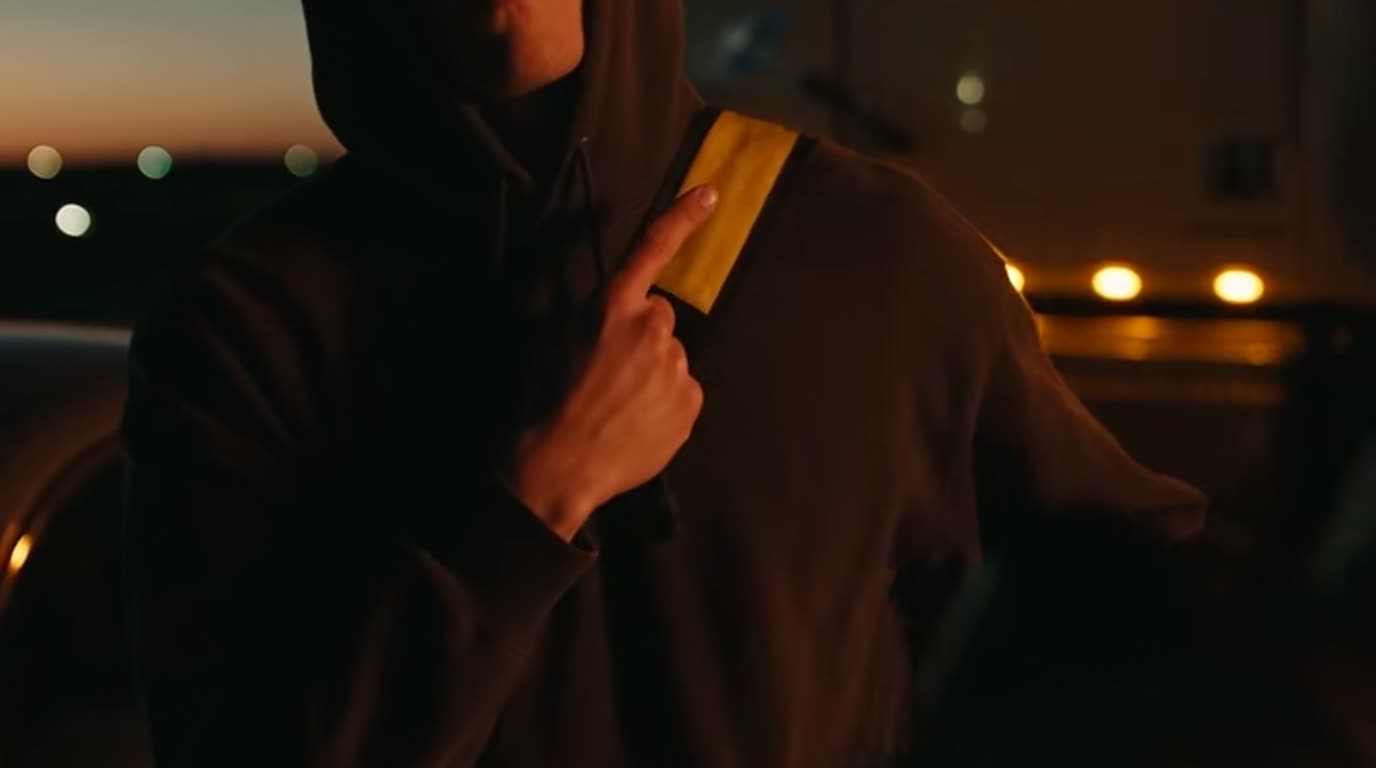
Marcus Bell stood beside the driver’s door of his dark grey 2012 Honda Civic, his breath pluming into the icy air in short, rhythmic pulses. He was twenty-six years old, wearing a thermal waffle-knit shirt beneath an olive-drab tactical hoodie and an insulated high-visibility courier vest. His knuckles were raw and calloused from years spent turning wrenches on heavy transport rigs during his service as an Army logistics specialist at Fort Riley. On his left shoulder, he carried an insulated, square commercial food delivery satchel, the nylon strap biting through his canvas jacket.
Inside the car, mounted securely to the central dashboard vent, his smartphone glowed with a live courier dispatch screen. The interface displayed an active commercial ticket: Order #4489, hot meal pickup from the all-night diner at the rear of the plaza, dispatched at 2:58 AM, accepted at 3:01 AM, vehicle parked in the merchant loading stall at 3:02 AM.
A violent, sickening metallic screech shattered the drone of the wind.
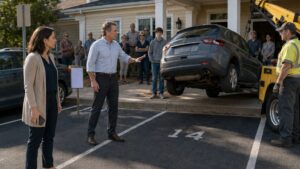
Twenty feet behind Marcus’s Civic, the heavy hydraulic underlift of an international flatbed tow truck groaned as its steel crossbar was rammed violently beneath the car’s rear suspension. A burly tow hook, thick as a ship’s anchor, was snagged carelessly into the structural frame beneath the front plastic skirt. With a deafening crack of brittle polyurethane, the entire front bumper assembly was torn from its plastic retaining clips, dropping onto the frozen blacktop with a hollow clatter.
Marcus did not flinch. He did not curse or charge forward. His pulse remained steady, governed by the cold discipline that had carried him through desert supply convoys. He slowly turned his head to face the man leaning against the quarter-panel of a black-and-white county patrol cruiser idling five yards away.
Officer Dane Krug was forty-four years old, thick-necked and barrel-chested under a bulky Kevlar tactical vest. Despite the pitch-black night and the blinding sodium glare, he wore dark, polarized aviator sunglasses pushed high on the bridge of his crooked nose. A toothpick twirled between his molars, and his right hand rested casually on the grip of his holstered service pistol. Between his fingers, he twirled a stainless-steel citation stylus, clicking the spring mechanism with rhythmic, taunting arrogance.
“Private commercial lot, son,” Krug barked, his voice carrying the harsh, abrasive rasp of a man accustomed to terrifying vulnerable drivers on isolated roads. “No overnight loitering. No unauthorized staging. Your vehicle is forfeit under Keith County municipal municipal trespass code 84-A. Ray’s hauling it to the county impound yard in Ogallala. Cry about it all you want, but you’re walking the shoulder tonight.”
Marcus looked down at the shattered fragments of his front bumper resting in the snow, then raised his gaze directly into Krug’s tinted lenses.
“Good morning, Officer Krug,” Marcus said, his voice flat, level, and entirely devoid of panic. “This stall is marked with blue thermoplastic paint as designated merchant courier loading for thirty minutes or less under Nebraska Revised Statute 60-6,166. My vehicle has been stationary for exactly four minutes and twelve seconds under active dispatch. The property owner has a standing merchant easement filed with the county clerk.”
Krug let out a short, nasal laugh that ended in a wet sneer. He peeled himself off the cruiser’s hood and took two heavy steps forward, his tactical boots crunching over the frost.
“You think you’re a courtroom lawyer, boy?” Krug said, thrusting his face within inches of Marcus’s cheek, his breath carrying the sour reek of chewing tobacco and burnt diner coffee. “Out here on the 80 corridor, I am the municipal magistrate. I don’t care about your delivery app, and I don’t care about your little plastic bumper. You signed your rights away the second your tires touched this blacktop. Step away from the vehicle, or I’m taking you down for resisting an authorized impound.”
Behind Krug, the operator of the flatbed tow truck—a weather-beaten man in his fifties named Ray Holcomb, wearing grease-spattered Carhartt coveralls—stepped down from the high cab, wiping his work gloves with a rag. Ray looked uneasy, his eyes darting between Marcus’s calm posture and the shattered plastic beneath the front axle.
“Dane,” Ray muttered, his voice gravelly and cautious. “We didn’t pull a registered property complaint dispatch from Keith County Central. You told me the travel plaza manager called this in personally.”
“Shut up and run the winch, Ray,” Krug snapped without turning his head. “I’m the designated municipal authority here. Hook the chains and lift the axle.”
Marcus didn’t raise his hands, and he didn’t reach into his pockets. With deliberate slowness, he lifted his right arm and pointed his index finger across the frozen gravel, aiming straight at the center of Krug’s cruiser windshield.
Mounted just below the rearview mirror of the squad car, a compact Axon Fleet 3 camera housing was illuminated by a steady, blinking red diode.
“Your patrol unit’s dashcam is still rolling, Officer Krug,” Marcus said quietly. “The front-facing wide-angle lens has a hundred-and-sixty-degree capture field. It recorded your cruiser entering this plaza lot four minutes ago. You blew past the pedestrian walkway at fifty-two miles an hour without emergency lights, and you ordered this tow hook deployed before you even exited your cab.”
Krug’s arrogant smirk suddenly hitched, his cheek twitching beneath his sunglasses.
CHAPTER 2: TELEMETRY ON THE WINDSHIELD
The silence that settled over the frozen lot was heavier than the prairie blizzard. Only the dull thrum of the cruiser’s eight-cylinder engine and the whining hydraulic pump of Ray’s flatbed broke the freezing air.
Officer Krug’s head snapped sideways toward his squad car. Through the frosted windshield of the patrol unit, the tiny red indicator lamp continued its rhythmic, relentless pulse. Under standard state law enforcement operating procedures, the camera unit was programmed to buffer continuous thirty-second loops, automatically committing footage to non-volatile solid-state memory the moment vehicle speed exceeded statutory thresholds or emergency lights engaged.
Krug took a quick half-step backward, his hand tightening reflexively on his duty belt. When he turned back to Marcus, the mocking sneer on his thin lips had hardened into a dangerous, defensive scowl.
“You’re real observant for a kid delivering hamburgers at three in the morning,” Krug hissed, stepping directly into Marcus’s personal space. “You think that camera matters? That system is proprietary municipal property under the sole administrative jurisdiction of the county sheriff’s department. You don’t have access to it, your app doesn’t have access to it, and no judge in this district is going to subpoena my daily patrol buffer for a broken Civic bumper.”
“The state prosecutor’s office won’t need to subpoena your buffer, Officer Krug,” Marcus replied without shifting his weight. His voice was steady as a steel rail. “Because my courier terminal operates an independent dual-channel telemetry recorder.”
Marcus reached calmly with two fingers, detaching his smartphone from the magnetic dashboard mount. He kept the screen angled so that both Krug and Ray could see the glowing interface.
The screen displayed a detailed logistics diagnostic map. A luminous green line traced Marcus’s path from the interstate exit ramp, showing speed intervals recorded every four seconds via high-precision multi-constellation GPS. Beneath the telemetry graph, a synchronized video window displayed high-resolution footage from Marcus’s own forward-facing dashcam, powered by a hardwired lithium capacitor.
On the screen, timestamped at exactly 3:02:18 AM, Marcus’s Civic was seen pulling smoothly into the marked commercial stall beside the travel plaza entrance. Two minutes later, at 3:04:45 AM, Krug’s black-and-white county cruiser tore into the frame from the service road, headlights blazing, tires skidding across a patch of black ice as it cut diagonally across three empty parking lanes without signaling, coming to an aggressive halt four feet from Marcus’s driver door.
The audio playback from Marcus’s dashcam was crisp and pristine. It clearly captured the loud crack of the bumper being torn away, followed by Krug’s unprovoked declaration: ‘Your car is gone. Cry about it.’
Ray Holcomb stepped forward, his heavy boots crunching on the brittle ice. He leaned over Krug’s shoulder, his squinted eyes fixing on the timestamped video feed.
“Dane,” Ray said, his tone dropping into a firm, flat warning. “That video shows your unit entering forty seconds after this boy parked. That means you didn’t observe twenty minutes of continuous unattended parking. If the state transportation board sees this, my commercial towing license is on the chopping block for participating in an unauthorized roadside seizure.”
“I told you to run the winch, Ray!” Krug snarled, rounding on the older man with venom in his eyes. “I’m the certified peace officer on this scene! If I declare a vehicle an immediate traffic hazard under county administrative authority, you hook it and you haul it! You want me to pull Holcomb Recovery off the county rotational dispatch list? Because one phone call to the chief deputy and your contract is shredded by breakfast!”
“Threatening a licensed municipal vendor to enforce an unauthorized seizure violates Title 28 of the Nebraska Criminal Code, Officer Krug,” Marcus said calmly. “Furthermore, my commercial courier insurance policy automatically transmits crash impact telemetry to my fleet underwriter in Omaha. The shock sensor in my front frame registered a 4.2 G deceleration spike when your tow hook ripped the bumper bracket. An automated claim notification with exact GPS coordinates was dispatched to their legal desk two minutes ago.”
Krug’s jaw clenched so hard the muscles along his temples bulged against his sunglasses. He reached toward his left shoulder, unhooking the heavy remote microphone pinned to his epaulet.
“Keith County Central, this is Unit Fourteen,” Krug barked into the radio, his thumb pressing the transmit button with savage force. “I have a 10-99 in progress at the Prairie Star Plaza. Hostile subject refusing to comply with municipal impound orders. Dispatch a secondary unit for immediate custodial arrest.”
A burst of static hissed from the cruiser’s roof-mounted speaker. Then a calm, female voice responded from the regional dispatch hub in Ogallala:
The telemetry interface Marcus displayed was not an off-the-shelf consumer tracking application. During his thirty-six months coordinating tactical fuel convoys through the arid expanses of the Kuwaiti border corridor, Marcus had been certified as a master logistics diagnostics technician. He understood that in modern administrative law, raw telemetry was the supreme arbiter of truth. Every byte of data recorded by his terminal was encrypted with a SHA-256 cryptographic hash, tying the vehicle’s engine RPM, wheel speed sensors, and throttle position to the atomic clock broadcast from the United States Naval Observatory.
“In Keith County, Officer Krug, municipal jurisdiction does not supersede federal Department of Transportation commercial corridor regulations,” Marcus added, his voice carrying the measured cadence of an instructor briefing young recruits on a motor pool parade ground. “The Interstate Commerce Act provides express protections for interstate logistics carriers and their authorized local delivery affiliates. When your cruiser entered this stall without emergency beacons activated, you were legally operating a non-emergency municipal conveyance on private commercial real estate. You possess no exigent circumstances warranting an expedited administrative seizure.”
Ray Holcomb stared at the pulsing lines on the screen, his thick eyebrows knotting together as he recognized the precision of the telemetry. In forty years of driving wreckers across western Nebraska, Ray had dealt with hot-headed drivers, intoxicated tourists, and aggressive highway patrolmen. But he had never encountered a courier who spoke with the quiet, devastating technical clarity of a federal transportation inspector.
“Unit Fourteen, be advised, Keith County Central has no record of an active dispatch call for Prairie Star Plaza. State Patrol Troop D is currently conducting routine commercial interdiction on the eastbound scales two miles east of your location. Dispatcher 402 is patching you through to State Trooper Lindstrom.”
Krug froze, his thumb locked frozen on the radio microphone.
CHAPTER 3: THE WINCH CABLE SNAPS COLD
The radio speaker went silent save for a low carrier hum. Across the frozen lot, the sudden mention of the State Highway Patrol hung in the air like a butcher’s blade suspended by a thread.
Troop D of the Nebraska State Patrol was based out of North Platte, notorious for rigorous roadside oversight and zero tolerance for small-town municipal corner-cutting. For an off-duty or rogue county patrolman operating on the fringes of an interstate corridor, an encounter with a state interdiction sergeant was the worst possible scenario.
Krug released the radio button, his knuckles white. He whipped off his polarized sunglasses, revealing bloodshot, watery eyes surrounded by deep lines of exhaustion and mounting panic.
“You think this is over, Bell?” Krug sneered, pointing the metal stylus directly at Marcus’s chest. “You think some state trooper rolling down the interstate gives a damn about a two-bit delivery driver? You’re an out-of-town kid driving a ten-year-old rust bucket. In twenty minutes, this entire lot will be cleared, your phone will be booked into county evidence under a suspect obstruction charge, and you’ll be sitting on a concrete slab in the county annex waiting for an arraignment that won’t happen until Monday morning.”
Marcus met Krug’s glare with tranquil, unyielding focus.
“My father bought this car when he retired from the Union Pacific maintenance yards in North Platte,” Marcus said softly, his voice cutting through the wind. “He spent fifteen years keeping the mechanical components in factory condition. Every bolt, every bracket, every service stamp in that glovebox has his signature on it. It’s not a rust bucket, Officer Krug. It represents the labor that put food on my family’s table. And the four hundred dollars I’m earning on this overnight logistics run is paying for my sister Cora’s physical therapy session at Omaha Regional on Friday morning.”
Ray Holcomb stood beside the flatbed’s control box on the passenger side of the truck. His hand was resting on the hydraulic lever, but his fingers had relaxed. He looked from Marcus’s quiet, composed face down to the torn bumper lying in the slush.
“Ray!” Krug yelled, stepping toward the tow truck. “What the hell are you waiting for? Engage the primary cable! Lift the rear wheels off the asphalt right now!”
“No, Dane,” Ray said. His voice was quiet, but it carried the unshakeable weight of an old prairie mechanic who had seen too many corrupt schemes collapse.
“What did you say to me?” Krug demanded, his voice cracking with rage.
“I said no,” Ray repeated, pulling his heavy leather work gloves off his fingers and slapping them against his thigh. “Look at that bumper bracket, Dane. That’s a sheared mounting flange. If I crank this winch another two inches, that tow hook is going to rip through the lower radiator core support and puncture the transmission cooler. That’s three thousand dollars in structural and mechanical damage. Holcomb Recovery carries a one-million-dollar commercial liability bond. You don’t have a signed property impound authorization, you don’t have a verified central dispatch ticket, and you don’t have probable cause.”
“I am the law in this township!” Krug roared, stepping onto the truck’s steel running board.
“You’re a county road deputy with an expired municipal impound agreement,” Ray countered, pointing a calloused finger straight at the squad car. “I’ve been hauling wrecks on this interstate since before you graduated from the academy in Grand Island. I know about the kickback pool you and Councilman Vance set up at the east yard. Eighty dollars cash per hook, split under the table before dawn. I kept my mouth shut because I thought you were only picking up abandoned scrap. But hooking a working boy’s car while his dinner order is sitting in the diner? That’s not law enforcement, Dane. That’s highway robbery.”
Krug’s face turned an ugly, mottled crimson. With a violent jerk of his right arm, he unsnapped the retention thumb-break on his Safariland duty holster. The heavy polymer grip of his Glock 21 shifted upward half an inch.
“You touch that lever to lower that car, Ray, and I’ll arrest you right alongside him for interfering with an officer in the performance of duty,” Krug spat.
Before Ray could answer, the glass double doors of the Prairie Star Travel Plaza burst open.
A woman in a heavy quilted down jacket and steel-toed work boots strode out onto the salted concrete walkway under the bright canopy lights. In her hands, she carried a heavy, reinforced clipboard and a high-brightness LED inspection lantern.
The memory of his father’s hands was etched into every seam of the car’s interior. Marcus remembered hot July afternoons in North Platte, the smell of clean grease and solvent lingering in the family garage as his father carefully replaced the engine timing belt, torqueing each bolt by hand with an old Craftsman wrench that had belonged to his grandfather. His father had taught him that a machine was a covenant of trust—if you cared for the steel, the steel would bring you home through any blizzard the plains could conjure. Surrendering this car to an illicit extortion scheme was not merely an economic loss; it was an desecration of his family’s legacy.
Ray Holcomb felt a sharp pang of remorse twist deep in his gut. He knew the history of the Union Pacific yards in North Platte; his own brother had spent twenty years working the diesel shops before lung disease took him. Ray looked at Marcus’s steady hands and saw the same quiet dignity that defined the working people of the Platte Valley. For months, Ray had looked the other way while Krug and Councilman Vance used the tow contracts to pad their off-the-books bank accounts, telling himself it was just small-town politics. But standing under the buzzing sodium lamps with the wind chilling his bones, Ray knew that complicity had an expiration date, and that date had just arrived.
It was Elena Vance, thirty-eight, the night operations manager of the travel plaza—and the estranged daughter-in-law of Keith County Commissioner Harold Vance.
“Krug!” Elena shouted across the lot, her voice slicing through the gale like an axe through dry pine. “Get your hands off that holster before I have the state troopers impound your squad car right where it sits!”
CHAPTER 4: THE MIDNIGHT AUDIT AT THE DINER
Elena Vance marched down the concrete access ramp with purposeful, unhesitating strides, the yellow beam of her lantern cutting through the swirling sleet. Behind her through the plate-glass windows of the 24-hour plaza diner, two long-haul truckers leaned against the Formica counter, their mugs of black coffee steaming as they watched the drama unfold.
Officer Krug took a hurried step away from Ray’s tow truck, his thumb instinctively re-snapping the retention strap on his holster. He tried to muster his former swagger, but his shoulders were stiff and his breathing was shallow.
“Elena,” Krug said, forcing a tight, patronizing smile. “Go back inside where it’s warm. We’re handling a routine commercial parking violation on your perimeter lot. Standard administrative abatement.”
“The hell you are,” Elena said, stopping three feet from Krug and shining her lantern directly at the torn bumper on the asphalt. “This plaza is private commercial property operated under an interstate franchise agreement. Our corporate lease strictly prohibits county tow rotation seizures on these premises without a signed, notarized complaint from the on-duty general manager.”
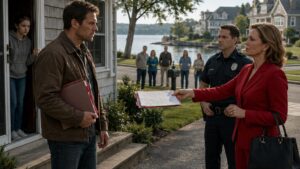
She thrust her clipboard into Krug’s chest. Clipped to the board was a laminated copy of the Keith County Commercial Transportation Easement, signed six months prior by the Keith County Board of Commissioners.
“Section Four, Subsection C,” Elena stated, her eyes burning into Krug. “No municipal patrol officer shall authorize, direct, or facilitate the non-consensual towing of any vehicle parked within marked commercial courier loading bays during active merchant operating hours. Marcus Bell has a registered delivery account with our kitchen. He is here on our express invitation. You have committed felony criminal mischief on private property, Dane.”
Krug looked down at the document, his lips peeling back from his teeth in a snarl.
“Your father-in-law Harold signed the master municipal agreement, Elena,” Krug whispered, lowering his voice so the truckers inside couldn’t hear. “Harold gets fifteen percent of the gross impound administration revenue from the east storage yard. You think you’re protecting some kid with an old Civic? You start throwing corporate easements around, and Harold will have the county health board revoke your commercial food license by noon tomorrow.”
Marcus stepped forward, his boots crunching calmly on the salt crystals.
“Your commissioner won’t have the chance to revoke anything, Officer Krug,” Marcus said, holding his phone steady as the camera recorded every syllable of Krug’s confession. “The cloud storage synchronization on my courier network just completed. The live video buffer, the audio capture of your threats against Mr. Holcomb, and your mention of the revenue kickback pool have already been archived across two external off-site servers in Chicago and Denver.”
Krug’s eyes widened in sudden, horrifying comprehension. He lunged toward Marcus, his gloved hand reaching for the smartphone.
“Give me that phone, you little bastard!” Krug lunged forward.
Ray Holcomb moved with surprising speed for a fifty-four-year-old mechanic. His heavy, insulated forearm came down like a hickory fence post, blocking Krug’s outstretched arm and wedging himself between the officer and Marcus.
“That’s enough, Dane!” Ray roared, his gravelly voice vibrating with genuine fury. “You lay a hand on that boy, and I’ll lay you out across this blacktop myself! You’ve crossed the line, and you know it!”
Krug stumbled back, his boots slipping momentarily on the icy blacktop before catching his balance against his cruiser’s front fender. His breathing was ragged, his chest heaving under his tactical vest.
“You’re all done,” Krug breathed, his voice trembling with manic desperation. “All three of you. You think a few megabytes of video makes you untouchable? You’re in Keith County. I have thirty deputies on this radio network. You have twenty minutes to delete those files and let Ray haul this car, or I will call in a felony narcotics interdiction stop. We’ll tear that Civic down to the bare frame on the side of the road and find whatever we need to put you away for five years.”
Marcus looked past Krug’s shoulder.
Down the long, straight blacktop of the Interstate 80 exit ramp, two pairs of high-intensity pursuit LED headlights were descending through the falling sleet, their reflections shimmering across the wet concrete.
Elena Vance held the inspection lantern steady, its crisp white beam illuminating the fraudulent signature line on Krug’s municipal ticket. As operations manager for the travel plaza franchise, Elena managed over twelve million dollars in annual fuel and freight logistics. She knew every inch of the corporate easement, having personally negotiated the parking covenants with the state highway commission to ensure long-haul truckers and local couriers had guaranteed safe harbor during severe winter storms.
Inside the diner, the two long-haul drivers pushed open the heavy glass doors, stepping out onto the icy curb to stand silently behind Elena. One of them, a broad-shouldered freight hauler from Iowa named Hank, crossed his arms over his heavy denim coat, his eyes locked onto Krug’s shaking hands. In the tight-knit fraternity of interstate transportation, word traveled faster than police radios. The drivers knew about the predatory tow trucks waiting in the darkness along the Keith County line; they had seen colleagues lose entire weeks of freight revenue to fabricated parking violations. The silent wall of witnesses standing beneath the canopy transformed the desolate plaza into an impromptu court of public accountability.
The red and blue strobes were dark, but the silhouette of the vehicles was unmistakable: two heavy-duty Ford Police Interceptor SUVs bearing the distinctive gold-and-black door insignia of the Nebraska State Patrol.
“Your twenty minutes just expired, Officer Krug,” Marcus said softly.
CHAPTER 5: THE PAPER TRAIL ACROSS KEITH COUNTY
The two State Patrol pursuit SUVs rolled into the Prairie Star Travel Plaza lot with quiet, menacing grace. Their heavy studded winter tires crunched over the icy slush, coming to a halt in an angled tactical formation that neatly boxed in both Krug’s cruiser and Ray’s flatbed wrecker.
The driver’s door of the lead SUV opened, and Sergeant Martin Lindstrom stepped out into the freezing wind. Lindstrom was fifty years old, six-foot-two, with iron-grey hair beneath a crisp state trooper campaign hat worn perfectly level. His double-breasted winter patrol coat was buttoned to the collar, and his posture radiated the uncompromising authority of a man who had commanded state traffic interdiction across three decades of highway patrols.
Behind him, Trooper Sarah Jenkins stepped out of the second unit, carrying a ruggedized Panasonic Toughbook laptop and an evidence collection kit.
Lindstrom walked slowly toward the group, his cold blue eyes taking in the entire tableau in a single sweep: the torn plastic bumper lying beneath Marcus’s Civic, the hydraulic underlift jammed into the rear suspension, Ray standing defensively beside the tow controls, and Krug pressed against his patrol cruiser with his hand hovering nervously near his duty belt.
“Step away from that vehicle, Officer Krug,” Sergeant Lindstrom ordered, his voice cutting through the gale like a crack of thunder. “Keep your hands visible, out in front of your belt line. Now.”
Krug’s jaw twitched. Slowly, stiffly, he raised his gloved hands to chest level.
“Sergeant Lindstrom,” Krug stammered, attempting a breezy greeting that fell utterly flat. “Just cleaning up an unauthorized loitering situation on the plaza perimeter. Routine civil abatement. Nothing for Troop D to worry about.”
“Save your breath, Dane,” Lindstrom said, stopping four feet from Krug. He didn’t blink against the stinging sleet. “Troop D received an automated telematics emergency dispatch from the American Commercial Transport Underwriters network ten minutes ago, reporting a high-impact non-collision tow hook deployment on a registered commercial logistics courier. Five minutes later, Keith County Central relayed a patched communication from your unit requesting emergency backup for a 10-99 hostile subject without an incident dispatch number.”
Trooper Jenkins opened her ruggedized laptop on the hood of Lindstrom’s SUV, tapping the trackpad with gloved fingers.
“Sergeant,” Jenkins called out, her voice crisp and clinical. “I have the real-time cloud data feed from Marcus Bell’s terminal on screen. Complete GPS telemetry, vehicle sensor logs, and high-definition dual-channel audiovisual capture from 0300 hours forward. The audio log includes a direct verbal threat by Officer Krug to manufacture false narcotics evidence unless digital files were deleted.”
Krug’s face lost every ounce of color, turning the sickly grey of dirty snow.
“That’s—that’s taken completely out of context!” Krug shouted, his voice shrill. “The suspect was belligerent! He was obstructing an impound!”
“Shut your mouth, Dane,” Ray Holcomb interrupted, stepping forward and extending his grease-stained hand toward Sergeant Lindstrom. In his palm rested the paper municipal towing ticket Krug had signed fifteen minutes earlier.
“Sergeant Lindstrom,” Ray said clearly, “here is the impound authorization form Officer Krug handed me at 0305 hours. You’ll notice the county dispatch tracking code at the top is blank. He pre-stamped it with Commissioner Harold Vance’s administrative seal. Dane told me this was a direct corporate request from the travel plaza. But Elena Vance here will tell you no such request was ever made.”
Elena stepped beside Ray, presenting her corporate lease and the plaza’s digital surveillance logs on her tablet.
“Our external perimeter security cameras recorded Officer Krug’s cruiser running fifty-two miles an hour through our pedestrian crosswalk at 3:01 AM,” Elena said. “He arrived specifically to intercept Marcus Bell’s vehicle. Over the last four weeks, twenty-two long-haul drivers and couriers have had their vehicles seized from this lot under identical circumstances. Each of them was forced to pay an eight-hundred-dollar cash administrative release fee at the East Ogallala Impound Yard before eight in the morning.”
Lindstrom turned his icy gaze back upon Krug.
“Dane,” Lindstrom said in a low, dangerous whisper. “You know who owns that East Ogallala storage lot? The Nebraska Secretary of State’s corporate registry lists Harold Vance as the majority shareholder, with twenty percent assigned to a limited liability company registered to your personal home address in Paxton.”
Sergeant Lindstrom did not raise his voice, but the chill in his tone was colder than the prairie wind. With two decades commanding the state interdiction unit, Lindstrom had prosecuted cartel smugglers, corrupt municipal officials, and rogue highway deputies who believed badge and gun placed them above the law. He walked to the front of Krug’s cruiser, using his heavy Maglite to inspect the Axon Fleet camera mount.
“Trooper Jenkins,” Lindstrom commanded, his eyes never leaving Krug’s pale face. “Initiate an immediate remote administrative lockout of Unit Fourteen’s mobile data terminal. Secure the local solid-state storage drive under chain-of-custody protocol Alpha. If there has been any attempt to scrub the video buffer or alter the GPS log since 0300 hours, add felony tampering with public records to the charging affidavit.”
Trooper Jenkins moved with rapid military precision, connecting an encrypted diagnostic interface cable between her Toughbook and the cruiser’s diagnostic port. The terminal screen illuminated with a cascading series of system audit lines, immediately confirming that the patrol unit had recorded full audio and 1080p video of Krug’s erratic arrival and unprovoked confrontation.
Krug’s knees buckled slightly. He reached out to brace himself against his cruiser, but Trooper Jenkins was already stepping behind him.
“Officer Dane Krug,” Sergeant Lindstrom said with surgical precision. “Under the authority of the Nebraska State Patrol and the State Attorney General’s Public Integrity Task Force, you are relieved of all operational duties. Surrender your sidearm and your county badge right now.”
CHAPTER 6: THE EMERGENCY DAWN ARRAIGNMENT
By five o’clock in the morning, the howling prairie gale had begun to subside, leaving the Keith County Courthouse in Ogallala encased in a shimmering crust of frost and ice. Inside the third-floor municipal courtroom, the steam radiators clanked and hissed against the bitter chill, casting a humid warmth over the polished oak benches.
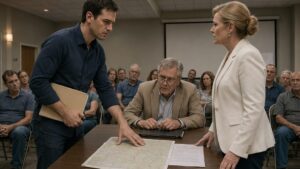
Marcus Bell sat at the plaintiff’s table, wearing a clean dark wool sweater that Elena Vance had brought him from the travel plaza store. Beside him sat Ray Holcomb and Elena, while two senior special agents from the Nebraska Department of Justice Public Integrity Unit reviewed reams of printed telemetry logs and bank statements spread across the mahogany surface.
At the defense table sat Officer Dane Krug, stripped of his badge, duty belt, and aviator sunglasses. His slumped posture and hollow, bloodshot eyes made him look ten years older. To his right sat Commissioner Harold Vance, a rotund, red-faced politician in an expensive sheepskin coat, frantically whispering into the ear of a high-priced defense attorney from Lincoln.
At the bench sat Presiding District Judge Evelyn Cole, a no-nonsense jurist known throughout the Platte River Valley for her uncompromising adherence to statutory law.
“Let the record show,” Judge Cole announced, her gavel coming down with a sharp, resonant crack, “this emergency hearing has been convened pursuant to an immediate ex parte petition for an administrative injunction and criminal asset freeze, filed by the Nebraska State Patrol and the Department of Justice against the Keith County Municipal Impound Authority.”
Commissioner Vance stood up, adjusting his silk tie with trembling fingers.
“Your Honor,” Vance protested, his voice strained and oily. “This is an unprecedented procedural ambush! Officer Krug was acting well within the traditional administrative discretion granted to county patrolmen to clear commercial traffic hazards along interstate transit corridors. The county government cannot function if every routine towing citation is subjected to midnight state judicial intervention!”
“Sit down, Mr. Vance,” Judge Cole said, her voice dropping to a freezing chill that silenced the entire courtroom. “I have spent the last forty-five minutes reviewing the electronic forensic dossier submitted by Sergeant Lindstrom. I have examined the unedited telemetry from Marcus Bell’s logistics terminal, the synchronized audio recordings, and the corporate security video from the Prairie Star Travel Plaza.”
Judge Cole held up a stack of financial ledger sheets.
“Furthermore,” Judge Cole continued, “Special Agent Ramirez has presented financial records from the Keith County Commercial Escrow account. Over the past nine months, over one hundred and forty thousand dollars in ‘expedited cash impound fees’ were collected from out-of-state couriers, commercial drivers, and solo travelers on Interstate 80. Every single dollar was funneled directly into a shell corporation co-owned by you, Commissioner Vance, and Officer Krug.”
Vance’s face turned the color of cold tallow. He sank back into his leather chair without uttering another word.
Judge Cole turned her sharp gaze directly onto Officer Krug.
“Officer Krug,” she said, “the audio recordings captured by Mr. Bell’s vehicle sensors demonstrate beyond any shadow of a doubt that you deliberately caused criminal physical damage to a civilian vehicle, attempted to extort an innocent citizen under color of state law, and threatened to falsify felony narcotics evidence when your unlawful demands were refused. Your conduct is a disgrace to the uniform and a betrayal of the public trust.”
Judge Cole brought her gavel down a second time.
“It is the order of this court that all municipal towing contracts with the East Ogallala Impound Yard are immediately terminated with prejudice. A comprehensive freeze is placed upon all financial accounts associated with Harold Vance and Dane Krug. Officer Krug, you are remanded into the immediate custody of the Nebraska State Patrol pending formal grand jury indictments for racketeering, official oppression, and extortion under color of law. Bail is set at two hundred and fifty thousand dollars cash.”
Two uniformed state troopers stepped forward from the back of the courtroom, clicking handcuffs around Krug’s wrists and leading him through the side security door.
Judge Cole then softened her gaze, looking down at Marcus.
“Mr. Bell,” she said warmly. “This court expresses its profound gratitude for your courage, your restraint, and your remarkable presence of mind under severe duress. Ray Holcomb, your refusal to participate in an unlawful act in the face of professional threats reflects the highest standard of civic integrity. The county risk management fund has been ordered to issue an immediate emergency draft covering the full repair and replacement of Mr. Bell’s vehicle, as well as statutory compensatory damages for lost commercial operating time.”
The oak-paneled courtroom was thick with the scent of wet wool, floor wax, and centuries of prairie jurisprudence. Judge Evelyn Cole adjusted her reading glasses, her pen scratching deliberately across the margins of the state prosecutor’s emergency injunction. She had served on the western district bench for twenty-two years, earning a reputation as a jurist who despised backroom political corruption with ferocious intensity.
“Mr. Vance,” Judge Cole said, her voice echoing off the high plaster ceilings like a bronze bell, “this court has reviewed the corporate filings of Prairie Ridge Asset Management LLC. The registered agent is your personal law firm in Ogallala, and the primary disbursement account received thirty-two separate wire transfers from the East Ogallala Impound Yard over the last three fiscal quarters. To suggest that these payments represented legitimate municipal oversight is an insult to the intelligence of this bench. You have operated a criminal extortion ring disguised as municipal code enforcement, using a sworn county deputy as your personal collector.”
The county commissioner sat frozen, the color draining from his flabby cheeks until he resembled a wax figure melting under the courtroom chandeliers. Behind him, the county attorney leaned over and whispered a stern warning: any further statements made on the record would be used directly in the upcoming state grand jury proceedings.
Marcus stood tall and bowed his head respectfully.
“Thank you, Your Honor.”
CHAPTER 7: THE SUNRISE OVER INTERSTATE EIGHTY
At twenty minutes past seven in the morning, the winter sun broke through the dissipating cloud deck along the eastern horizon, painting the rolling Nebraska prairie in brilliant strokes of amber, copper, and rose gold. The icy crust covering Interstate 80 began to glisten like diamonds as the heavy semi-trucks rolled eastward with steady, rhythmic roars.
In the heated maintenance bay of Holcomb Recovery on the outskirts of Ogallala, the smell of sweet motor oil, welding flux, and fresh roasted coffee filled the warm air.
Ray Holcomb stood beside Marcus’s Honda Civic, wiping his grease-blackened hands on a clean cotton shop towel. With the help of two of his veteran mechanics, Ray had spent the last two hours installing a brand-new factory-original bumper assembly, radiator crossmember, and reinforced mounting brackets sourced directly from the regional parts distributor in North Platte. The fresh paint matched the Civic’s dark grey finish perfectly, and every fastener was torqued to exact factory specifications.
“She’s tighter than the day your daddy drove her off the dealer lot in ninety-eight,” Ray said with a broad, toothy grin, tapping the polished front fender with his knuckles. “Alignment is laser-straight, transmission cooler lines are pressure-tested, and I topped off your synthetic fluids. You won’t feel a tremor all the way to Omaha.”
Elena Vance walked into the bay holding a thermal travel mug of hot coffee and a sealed county voucher envelope, handing both to Marcus.
“County risk management expedited the administrative draft, Marcus,” Elena said, her eyes shining with warmth. “Five thousand dollars for emergency repairs, vehicle downtime, and punitive municipal settlement. And our corporate franchise headquarters in Lincoln has officially contracted your logistics dispatch firm as our designated primary courier for all western Nebraska travel plazas.”
Marcus took the envelope and the coffee, feeling the profound warmth seep through his tired fingers. He looked at his father’s car, standing pristine and gleaming in the morning light, and felt an unshakeable sense of peace settle over his heart.
“Thank you, Ray,” Marcus said, clasping the old mechanic’s calloused hand in an iron grip. “Thank you, Elena. You didn’t have to put your livelihoods on the line for a stranger.”
“Out here on the plains, Marcus,” Ray said softly, looking him in the eyes, “nobody survives if we don’t watch out for each other. That badge Dane wore didn’t give him the right to trample honest people. You taught this entire valley a lesson about standing firm.”
Twenty minutes later, Marcus was cruising eastward on Interstate 80. The Civic’s engine hummed with flawless precision, the tires humming smoothly against the dry blacktop as the prairie wind brushed past the glass.
Marcus tapped the hands-free console on his steering wheel, dialing the direct room extension at Omaha Regional Medical Center.
The phone rang twice before a bright, cheerful voice answered on the other end.
“Marcus?” Cora’s voice sounded clearer and stronger than he had heard it in six months.
“Morning, Cora,” Marcus said, a genuine smile spreading across his face as the sunrise filled his windshield. “How are you feeling?”
“Marcus, you won’t believe it!” Cora said, her voice trembling with joyful tears. “Dr. Reynolds and the physical therapy team just finished the morning evaluation. The spinal inflammation is completely gone. I just walked twenty-two steps on the parallel bars without the brace!”
Marcus gripped the steering wheel, swallowing the lump of emotion that rose in his throat.
“I believe it, Cora,” Marcus said softly. “I always believed it.”
“Where are you?” she asked. “Did you finish that long overnight run?”
“I’m crossing the Platte River bridge right now,” Marcus replied, looking out over the shining water flowing beneath the morning sun. “The car is running like brand new, the delivery is complete, and I’m heading straight to Omaha. I’ll be there in time for lunch.”
“Drive safe, Marcus,” Cora whispered. “I love you.”
The air inside Holcomb Recovery smelled of honest labor—hot iron, gear oil, and the sharp bite of cutting torches. Ray Holcomb stood beside Marcus, watching as the young man ran his fingertips over the flawless alignment of the new bumper seams. Ray had personally checked every torque spec with a calibrated Snap-on wrench, ensuring that every bolt holding the front crossmember was locked with blue thread-locker to prevent vibration loosening over rough highway expansion joints.
“Your dad was a good man, Marcus,” Ray said quietly, his voice thick with unvoiced emotion. “He used to bring his Union Pacific transport trucks through my shop thirty years ago. He never cut a corner, and he never let a subordinate take the blame for a mechanical failure. When I saw you standing your ground out there in the freezing slush, never losing your temper, never backing down from what was right, I knew exactly whose son you were. Working people like us, we don’t have high-priced lawyers on retainer, and we don’t have county commissioners in our pockets. All we have is our name, our word, and the truth of our work. You kept that truth alive tonight.”
“I love you too, Cora. See you in a couple of hours.”
Marcus hung up the phone, took a sip of the hot coffee, and set his cruise control for sixty-five miles per hour. Behind him, the corrupt shadows of Keith County had vanished into the dawn. Ahead of him, the wide American highway stretched endless, open, and free under a clear blue sky.