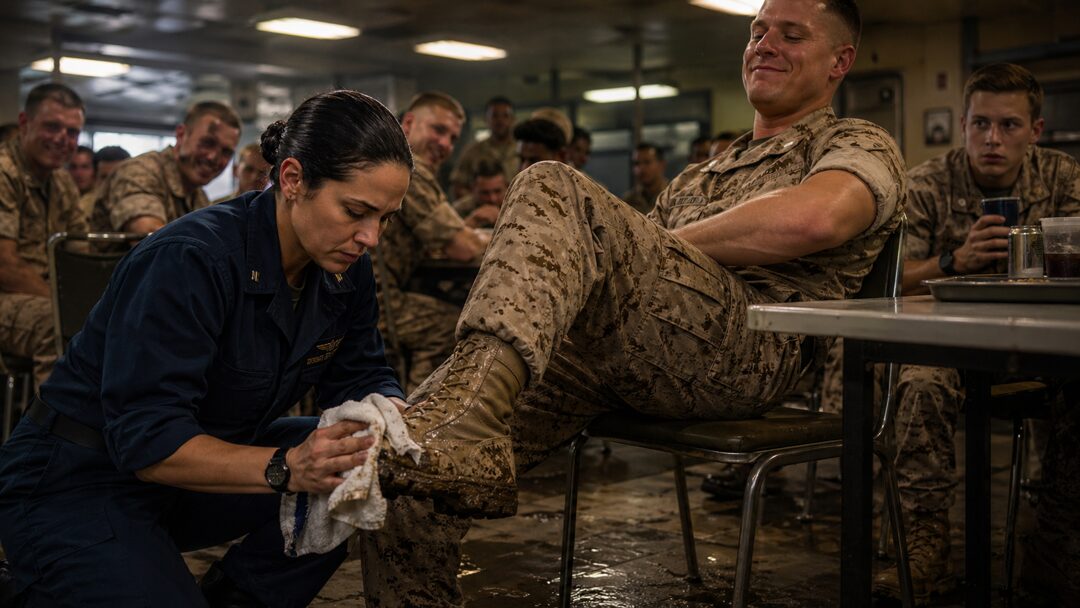
The Mud on His Boot
Part I — The Cloth
Commander Mara Voss was on her knees when the room decided she was weak.
The tile beneath her was sticky with spilled beer and dust. A plastic tray sat beside her hip. In her right hand, she held a white canteen cloth already stained brown at the edges. In front of her, Sergeant Cole Rask leaned back in his chair with one boot lifted, heel angled toward her like an order.
“Don’t miss the heel, ma’am,” he said.
The word landed wrong.
Around him, six soldiers laughed into paper cups and half-eaten meals. Their camouflage sleeves were rolled high. Their faces were flushed from heat, alcohol, and the relief of being far enough from the wire to pretend nothing outside the walls mattered.
Mara wore dark Navy service blues.
That alone made her look misplaced. Too formal for the forward transit canteen. Too clean beside their desert dust. Too still for a room built out of noise.
She lowered her eyes and wiped the mud from Rask’s boot.
A young private near the end of the table gave a short laugh because everyone else did. Then he stopped.
His name was Ellis Rook, though no one in the room had used his first name in weeks. He had the thin, unfinished look of someone still hoping war might explain itself if he stayed quiet long enough. His uniform was too crisp. His hands stayed close to his cup.
He looked from Mara’s dark sleeve to her name tape.
VOSS.
The laugh slipped off his face.
Rask noticed.
“What’s wrong, Rook?” he said. “You look like she’s cleaning your conscience.”
The table laughed again. Ellis tried to smile. It came out sickly.
Mara kept working.
She did not scrub the mud away like someone ashamed. She folded the cloth around it, pressing the stain into one corner, keeping the grit trapped instead of smeared. Her movements were small, exact, almost delicate.
Rask missed that.
Ellis did not.
“Boot’s clean enough, Sarge,” Ellis said.
Rask turned his head slowly. “Did I ask for your inspection?”
“No, Sergeant.”
“Then drink.”
Ellis looked down.
Mara drew the cloth across the welt of Rask’s boot. Red-brown dirt clung in the seam where sole met leather. It was dry at the surface, darker underneath.
Not base dust.
Not Larkspur dust.
She had seen that color in a photograph no one had meant to send her.
Rask tipped his beer toward her. “Navy liaison comes all this way and finally finds honest work.”
A soldier with a shaved head slapped the table. Another muttered, “Careful, Sarge, she’ll write a memo.”
Mara said nothing.
That made them louder.
Cruelty always asked silence for permission, then called the permission proof.
Rask leaned forward, elbows on his knees. His face was broad, sunburned at the nose, younger than his voice pretended. “You do this at headquarters too, Commander? Polish things until they look official?”
The title should have changed the room.
It did not.
The men had heard her rank and decided rank did not count if they could make her kneel.
Mara ran the cloth under the heel.
Rask lowered his voice, but not enough to hide it. “You missed a spot, ma’am.”
The room laughed for the third time.
This time Ellis did not join.
Mara looked up.
Not at Rask.
At Ellis.
Her eyes were tired, gray in the canteen light, and so calm that Ellis felt more afraid than if she had shouted.
“Let him finish,” she said.
Rask smiled. “Hear that, Rook? Officer says I’m not done.”
Then he lifted his other boot.
Part II — Night Heron
By the time Mara moved to the second boot, half the canteen had noticed.
The counter staff slowed. A card game near the vending machines lost its rhythm. Two contractors at the back wall pretended not to watch and watched anyway.
Fort Larkspur had been built for passing through. No one was supposed to stay long enough to belong. Soldiers arrived dusty, ate fast, slept badly, then disappeared into flights, convoys, or orders nobody read twice.
That made the canteen a dangerous room.
Men with no homes made thrones out of chairs.
Rask had one now.
He stretched his leg farther, enjoying the audience. “Careful with that one. It’s seen more country than most Navy officers.”
Mara pinched the cloth around a clump of clay. “Which country?”
The question sounded harmless.
Rask grinned. “The bad parts.”
“Near the north road?”
“Maybe.”
“Or the dry riverbed?”
His grin held, but one second too long. “Lot of dry riverbeds out there.”
Mara nodded and kept wiping.
Ellis watched her hands.
Fold. Press. Preserve.
He remembered a night six weeks earlier, sitting in the radio annex because Corporal Dane had food poisoning and someone had needed to cover the extra monitor. He remembered a broken transmission cut by static. A female lieutenant’s voice saying, “We have civilians pinned east of the crossing.” He remembered the words that followed because he had written them down before the senior tech told him not to.
Hold position.
No deviation authorized.
By morning, the official report had a cleaner shape.
Lieutenant Anika Shaw had broken formation. Lieutenant Shaw had compromised the route. Lieutenant Shaw had died before clarification could be obtained.
Ellis had never met her.
But he had heard her voice once.
Voices were harder to bury than names.
Rask took another drink. “You ever hear of Night Heron, Commander?”
A few soldiers shifted. Someone muttered, “Leave that alone.”
Rask ignored him.
Mara wrung the cloth once into itself. “I’ve heard of it.”
“Bet you have. Headquarters people love names. Makes dead missions sound like birds.”
The table went quieter. Not silent. But the laughter had thinned.
Rask pointed his bottle toward her. “We were told to hold. So we held. Some Navy desk hero lost the evacuation route, and Shaw decided she knew better than the map. That’s what happened.”
Mara’s thumb paused at the boot seam. “Which map?”
“What?”
“Which map did she ignore?”
Rask frowned. “The route map.”
“North road or service track?”
“The north road.”
“From Ridge Three?”
“Ridge Four.”
Ellis looked up sharply.
Rask saw him and snapped, “What?”
Ellis swallowed. “Nothing.”
Mara returned to the boot. “Radio failure was at what time?”
Rask laughed once, too hard. “You taking notes down there?”
“No.”
She was not.
The room was.
Rask leaned back again. “Radio went bad before dusk. Everybody knows that.”
Ellis’s cup bent slightly in his hand.
Before dusk was not true.
The transmission he heard had come after 2100. He remembered because the clock had glowed green over the annex door, and he had been thinking if he made it to 2130, he could eat.
Mara’s voice stayed mild. “And your patrol never crossed the riverbed.”
“That’s in the report.”
“I didn’t ask what was in the report.”
Rask’s boot shifted.
For the first time, he looked down at her as if she were not part of the joke.
“You got a problem, ma’am?”
There it was again. The word polished into insult.
Mara folded the cloth once more, trapping the darker clay inside. “Not yet.”
The canteen held its breath around the answer.
Rask’s face flushed deeper. “You know what your problem is? You people think war happens on paper. Out there, you hold or you move. You save who you can and get blamed for who you can’t. Then someone in a clean shirt writes your courage into a mistake.”
A soldier at the table whispered, “Sarge.”
Rask slammed his bottle down. “No. She wants to ask questions, let her ask.”
Mara looked at the heel.
The mud was thickest there.
“You saved someone at Elian Crossing,” she said.
Rask went still.
The name did what rank had not.
It changed the room.
Ellis heard someone behind him whisper, “Elian?”
Mara drew the cloth away from Rask’s boot and held it in both hands.
Rask’s eyes had narrowed. “Where’d you hear that?”
Mara did not answer.
She stood.
Part III — The Tray
The room had expected anger.
It was ready for anger. Anger would have made everything easier. They could have called her unstable, offended, Navy-proud, unable to take a joke. Rask could have leaned back again. The laughter could have returned with a new shape.
But Mara rose without haste.
She was not tall, but standing changed her. The dark lines of her uniform sharpened. Her ribbon stack caught the fluorescent light. Her hair, pinned tight at the back of her head, had not loosened while she knelt.
She folded the stained cloth into a square.
Once.
Twice.
A third time.
Then she placed it on the clean metal tray beside the plastic cups.
No one laughed.
Rask’s boot remained lifted for one absurd second, as if his body had not yet received the news that the game was over.
Mara looked at him.
“Sergeant Rask,” she said, “why does a soldier who never crossed the Elian riverbed have Elian clay ground into the heel of his boot?”
The silence after laughter is never empty.
It carries everything laughter tried to hide.
Rask lowered his foot halfway. “You don’t know what that is.”
“I do.”
“It’s mud.”
“It is ferric clay from the eastern bank below Elian Crossing. It dries red-brown at the surface and black in the seam. Larkspur dust is pale. You know that. So does anyone who has washed a vehicle here.”
One of the canteen workers looked down at the floor.
Ellis stared at the folded cloth.
Mara had not been humiliated.
She had been collecting.
Rask stood so quickly his chair scraped backward. “You came here for me.”
“I came here for the truth.”
“No.” His voice broke rough. “People like you don’t want truth. You want a shape that fits your report.”
Mara’s jaw tightened.
Only for a second.
Ellis saw it and understood something he did not want to understand.
She had not come untouched.
Rask stepped closer. “You want to know why that mud is there? Because Shaw crossed first.”
Mara’s eyes did not move.
“Say her rank,” she said.
Rask blinked.
“If you’re going to put her name in your mouth, say her rank.”
His face twisted. “Lieutenant Shaw crossed first.”
A murmur passed through the room.
Rask pointed at the tray. “She heard kids. An interpreter family got pinned east of the crossing after the route changed. Two boys, their mother, old man with one leg. Command told us to hold because the road wasn’t clean. Shaw said they’d be dead by morning.”
Mara said, “And you followed.”
“I went after her.”
“With two soldiers.”
“Yes.”
“Against order.”
“Yes.”
The word came out like blood.
The crowd had changed again. The men who had laughed were now listening with their mouths closed. Some looked angry. Some looked ashamed. Some looked relieved to have a story they could stand behind: a disobeyed order, a rescue, a dead officer who had been brave.
But Mara did not let relief enter.
“Then why did the report say Lieutenant Shaw broke formation alone?”
Rask looked away.
That was the answer before he spoke.
“Because she was dead,” he said.
The room did not move.
Rask’s voice lost its performance. Without it, he sounded younger. “Because Pike said the family was never on the manifest. Because command never authorized movement. Because if we said she went for civilians, then someone had to explain why civilians were left out there in the first place.”
Mara’s hand rested near the tray.
Not touching the cloth.
“Because if you told the truth,” she said, “you would have admitted you crossed.”
Rask’s eyes snapped back. “I did cross.”
“After letting her take the blame.”
“I was told the inquiry would reopen.”
“It didn’t.”
“You think I don’t know that?”
“You drank under her name while men laughed.”
He flinched.
It was small, but everyone saw it.
Mara’s voice dropped. “Do not confuse surviving with being clean.”
Rask’s hand closed around the back of his chair.
For a second, Ellis thought he might throw it.
Instead Rask said, “And you? How clean are you, Commander?”
Mara did not answer quickly enough.
The room felt it.
Rask leaned in. “You weren’t sent here as liaison.”
Mara said nothing.
“You came hunting me.”
“I requested temporary assignment.”
“Because of Anika.”
The name, without rank, hurt more this time. Not because he meant disrespect, but because grief had slipped through.
Mara’s face remained controlled.
Too controlled.
Rask saw the crack. He pushed his whole fist into it.
“She sent you something,” he said. “Didn’t she?”
Mara’s eyes lowered once to the tray.
Ellis thought of a voice in static.
We have civilians pinned east of the crossing.
Rask’s expression changed. “A message.”
Mara said, “A voice memo. Unsent. Recovered from her damaged field unit.”
“What did she say?”
Mara’s throat moved.
For the first time since she entered the canteen, she looked like kneeling had cost her something.
“She said the timeline was wrong.”
“That all?”
“She said someone would make her disobedience easier to bury than their hesitation.”
Rask laughed once. It had no humor in it. “Smart woman.”
“She was.”
“She also said your name, didn’t she?”
Mara closed her hand.
Rask’s fury came back, but now it had grief under it. “Tell them.”
Mara looked at him.
“Tell them what you did before you ask me what I did.”
Part IV — Proper Channels
The door at the side of the canteen opened before Mara could answer.
Two base security officers entered first, hands near their belts. Behind them came Major Harlan Pike, clean as a sealed envelope.
His boots were polished. His uniform sat perfectly. Silver hair, clipped close. Calm face. A man who had never needed to raise his voice because rooms had always lowered themselves for him.
“What is this?” Pike asked.
No one answered.
His eyes moved from Rask to Mara, then to the tray.
He understood too quickly.
That was how Mara knew.
Pike stepped forward. “Commander Voss, you will return to your quarters.”
Rask gave a sharp, ugly smile. “Sir, you might want to hear this.”
“I heard enough from the hallway.”
“Then you heard your report’s full of holes.”
Pike did not look at him. “Sergeant Rask, sit down.”
Rask stayed standing.
The room waited to see which kind of discipline would win.
Pike turned to Mara. “Any allegation regarding Operation Night Heron will be submitted through proper channels.”
Mara said, “It was.”
“Then you know this is not the place.”
“It became the place when Sergeant Rask put his boot in front of witnesses.”
Pike’s mouth tightened. “Do not dress insubordination as principle.”
Rask barked a laugh. “That line work on Shaw too?”
Pike finally looked at him.
The look carried warning, command, and something close to fear.
“Careful, Sergeant.”
“No, sir,” Rask said. “I was careful for six weeks.”
Mara watched him. She did not trust his anger, but she recognized its direction now. It no longer pointed only at her.
Pike gestured to one of the security officers. “Secure that cloth.”
The officer moved toward the tray.
Ellis stood.
It happened awkwardly. His chair bumped the table. His knee struck the underside. His cup tipped, and beer spread toward the floor.
Everyone looked at him.
Ellis went pale.
But he did not sit.
“Sir,” he said, voice thin, “there are radio logs.”
Pike turned slowly.
Ellis swallowed. His hands shook where they hung by his sides. “From Night Heron. Backups. The annex system duplicated part of the traffic after 2100.”
Pike’s expression did not change, which made it worse.
“Private,” he said, “you are confused.”
“No, sir.”
The room seemed to shrink around Ellis.
Rask stared at him as if seeing him for the first time.
Ellis took a breath that sounded painful. “The official record says radio failure occurred before dusk. It didn’t. I heard Lieutenant Shaw call in civilians east of the crossing. I heard the hold-order.”
Pike’s face hardened. “You will stop speaking.”
Ellis did not.
“I copied the logs.”
A sound moved through the room, not quite shock, not quite fear.
Mara looked at him then. Really looked. Not as a tool, not as a witness, but as a young man stepping onto ground that would not forgive him.
Pike said, “Do you understand what you are admitting?”
Ellis’s eyes flicked to Mara, then to the tray.
“I think so, sir.”
“You think?”
Ellis’s voice steadied just enough. “I understand nobody laughed until it was safe.”
No one moved.
The line hit the room harder than shouting would have.
Pike’s mask slipped.
Only a little. But enough.
He stepped toward the tray and picked up the folded cloth himself. “This is not evidence. This is dirt on a rag.”
Mara said, “Then leave it.”
Pike looked at her.
“Leave it where everyone can see it,” she said.
Rask lowered his second boot fully to the floor.
The sound was small.
It still felt like surrender.
Pike held the cloth in his hand. “Commander, you are emotionally compromised.”
“Yes,” Mara said.
That answer unsettled him more than denial would have.
She continued, “So was Lieutenant Shaw when she heard children over an open channel. So was Sergeant Rask when he crossed after her. So was the officer who signed a report blaming a dead woman because dead women cannot object.”
Pike’s voice went cold. “Enough.”
Mara did not raise hers.
“No, sir. Not yet.”
Pike turned to the security officers. “Escort Commander Voss out.”
They hesitated.
That hesitation was the first crack in his authority.
Pike saw it and knew the room had changed. He was no longer speaking to subordinates. He was speaking in front of witnesses.
Mara reached into the inner pocket of her jacket.
Both security officers stiffened.
Slowly, she took out a small field recorder. Its casing was scarred along one side, the plastic warped by heat.
Rask stared at it.
His mouth opened, then closed.
Mara placed it beside the tray.
“Lieutenant Shaw’s unit,” she said. “Recovered with her effects.”
Rask looked away.
Pike said, “That item should have been entered into evidence.”
“It was entered into a box marked personal property. Then misplaced.”
“By whom?”
Mara held his gaze.
Pike did not ask again.
The canteen was completely silent now.
Mara touched the recorder once, not pressing play. Not yet.
“She said the timeline was wrong,” Mara said. “She said the hold-order came after the civilian call. She said Rask crossed after her. She said if she didn’t make it back, someone would call her reckless because reckless is easier to file than abandoned.”
Rask’s face had gone gray.
Pike said, “Commander Voss—”
“And she said my name.”
That stopped him.
Mara looked down at the recorder.
When she spoke again, the words came with effort, each one disciplined into place.
“I was the intelligence officer who relayed the hold-order.”
Part V — Witnesses
The room did not gasp.
Real guilt did not produce sounds that clean.
Mara felt every eye shift. Some had wanted her to be righteous. Some had wanted Rask to be the whole rot. Some had wanted Pike to be the only villain, so everyone else could stand safely in the shadow of his failure.
She had wanted that too.
That was the shame of it.
Rask stared at her. “Say it right.”
Mara looked at him.
“You relayed it,” he said, voice shaking, “but you knew the civilian call came first.”
Mara’s answer was quiet. “I knew the report had not confirmed a safe corridor.”
“That’s not the same thing.”
“No.”
“You heard her.”
“I heard a partial transmission.”
“You heard enough.”
Mara did not defend herself.
Rask’s face twisted. “You let me sit here thinking you came to clean your conscience on my back.”
“I did,” Mara said.
The answer cut the room open.
Rask stepped back as if she had struck him.
Mara lifted her chin. “And then I remembered conscience does not get clean if you only use someone else’s blood.”
No one spoke.
Pike moved first.
He placed the folded cloth back on the tray with controlled disgust, as if the dirt itself had offended him. “This has gone far enough.”
Mara turned to him. “No, sir. It has finally arrived.”
“You will surrender the recorder and return to quarters. Private Rook will report to communications command. Sergeant Rask will be confined pending review. This discussion is over.”
Rask laughed again, low and broken. “There it is. Proper channels.”
Pike snapped, “You are still under my authority.”
“Was Shaw?”
The question hung there.
Pike’s eyes sharpened.
Rask’s voice dropped. “Was she under your authority when she called for help? Or only after she died?”
Pike looked at the soldiers around the table. “Every person in this room is one careless sentence away from damaging an active theater operation.”
Mara said, “No. Every person in this room is one honest sentence away from ending a lie.”
Pike pointed at the tray. “You think this is honor? Public disorder? Accusations over canteen beer?”
Mara looked at the cloth.
Then at Rask.
Then at Ellis.
Then back to Pike.
She had planned to expose Rask.
That was the truth.
She had imagined this room differently. Smaller. Cleaner. A private confrontation. A recorded admission. A report that reopened another report. Anika’s name corrected in language cold enough to survive review.
She had not planned to kneel.
She had not planned to understand Rask.
She had not planned to feel, with humiliating clarity, that she had wanted one guilty man because one guilty man was easier than a guilty structure with her own hand inside it.
Pike held out his palm. “The cloth, Commander.”
Mara picked it up.
For a moment, Rask’s eyes followed her hand. He looked afraid now, but not of punishment. Of erasure. Of the mud disappearing into another sealed bag, another locked drawer, another version of events with the human parts removed.
Mara set the folded cloth back down.
Between them all.
“Lieutenant Anika Shaw did not abandon formation,” she said.
Pike’s jaw clenched.
Mara continued. “Sergeant Rask crossed the Elian riverbed after her.”
Rask lowered his head.
“Major Pike’s timeline is false.”
Pike said, “Commander.”
“And I relayed the hold-order that left civilians beyond the crossing.”
Her voice did not break.
That almost made it worse.
She looked at the soldiers who had laughed. “If this dies tonight, it dies with witnesses.”
Pike’s face reddened. “You are making a grave mistake.”
Mara looked at him.
“No, sir,” she said. “I made that six weeks ago.”
Ellis moved then.
He reached into the cargo pocket of his uniform with shaking fingers and took out a small data drive. Cheap. Black. Easy to lose.
He placed it beside the recorder.
“I copied the logs,” he said.
Pike stared at the drive.
Rask stared at Ellis.
The soldiers who had laughed stared at the table as if it had become an altar.
Pike said, “Private, you will pick that up.”
Ellis’s eyes filled, but he did not move.
Rask whispered, “Don’t.”
The word was barely audible.
But Ellis heard it.
So did Mara.
Pike turned toward the security officers. “Remove them.”
Neither officer moved fast enough.
It was only a second.
But authority can bleed out in a second if enough people see the wound.
The older of the two officers looked at the tray, then at Pike. “Sir,” he said carefully, “we may need to notify the inspector general.”
Pike’s face went blank.
Rask sat down.
Not with swagger.
Not casually.
He sat like his legs had finally remembered what they had carried.
Mara did not feel triumph.
She felt the old transmission inside her bones.
Static.
A woman’s voice.
Civilians pinned east of the crossing.
Then her own hand sending forward words she had been trained to trust because they came stamped with authority.
Hold position.
No deviation authorized.
She had obeyed cleanly.
Anika had died in the dirt.
Rask looked up at her. His eyes were wet, though he would have hated anyone for noticing.
“You should’ve shouted when I made you kneel,” he said.
Mara picked up the recorder.
“No,” she said. “You would have understood shouting.”
Part VI — Morning Formation
By morning, Fort Larkspur had grown quiet in the way bases did after something official began moving beneath the surface.
No announcement came over the speakers.
No apology was issued.
No one said Lieutenant Anika Shaw’s name at breakfast.
But Sergeant Cole Rask was confined pending inquiry. Major Harlan Pike had been relieved of duty “for administrative review.” Commander Mara Voss was ordered to remain on base until further notice.
Nothing was fixed.
But something had broken open.
That was different.
Ellis Rook left a second copy of the radio logs outside the inspector general’s temporary office before dawn. He did not sign his name. He did not have to. By sunrise, everyone who mattered knew exactly whose hands had shaken hard enough to do it anyway.
Mara saw him once across the yard.
He stood outside the communications annex, pale and sleepless, his cap low over his eyes. For a moment, he looked like he might come toward her.
He did not.
She was grateful.
Some courage needed privacy afterward.
At 0600, Mara returned to the canteen.
The room looked smaller without laughter in it.
Chairs had been stacked along one wall. The floor had been mopped. Someone had wiped the tables too quickly, leaving streaks under the fluorescent lights. The air smelled of disinfectant, burnt coffee, and the faint sourness of old beer that no cleaning ever fully removed.
The tray was gone.
So was the cloth.
Mara stood at the table where she had knelt.
Her knees ached only when she remembered them.
On the table, placed exactly where the folded cloth had been, lay a small unit coin.
She knew it before she touched it.
Anika had carried it in her left pocket because she said luck should sit close to the pulse. One side bore the Night Heron insignia, a bird cut in dark enamel against a silver moon. The other side was scratched near the edge where Anika had once used it to pry open a jammed battery cover and then laughed when Mara told her coins were not tools.
“Everything is a tool if you need it badly enough,” Anika had said.
Mara picked it up.
The coin was warm from the room, not from the hand that had left it.
There was no note.
Rask had not asked forgiveness.
She was glad.
She did not know what she would have done with it.
The coin was enough. Not absolution. Not friendship. Not peace. Only acknowledgment.
He had known what she was carrying.
Now he had given back what he should not have kept.
Mara closed her fingers around the coin until its edge pressed into her palm.
Outside, the first formation call echoed across the base. Boots struck pavement in uneven rhythm, then gathered into order.
She took a fresh napkin from the dispenser.
For a moment, she looked at it.
White. Clean. Empty.
Then she wiped the table once, slowly, where the cloth had been.
Not to erase anything.
Only to leave the surface ready for what came next.
When she walked out, the sun had just cleared the low concrete roofs of Fort Larkspur. Soldiers were forming in rows beyond the yard. Some turned their heads as she passed. No one laughed.
Mara did not look for respect in their faces.
Respect was too small for the dead.
She put Anika’s coin in her pocket and kept walking, upright beneath the morning call, carrying the truth as far as it would go.