The Courthouse Photograph Remembered Every Lost Year Again
CHAPTER 1: THE LEDGE IN THE MARBLE HALL
Midnight arrived in the Cedar Point County Courthouse with the cold, heavy solemnity of a tomb. Outside, the freezing autumn rain off Lake Erie drove against the three-story stained-glass clerestory windows of the central rotunda, rattling the leaded seams and casting fractured, violet shadows across forty-foot neoclassical limestone columns. Inside the vast, vaulted corridor of the second floor, the air smelled of floor wax, brass polish, ancient vellum bindings, and the lingering, dry scent of hundred-year-old cedar wainscoting.
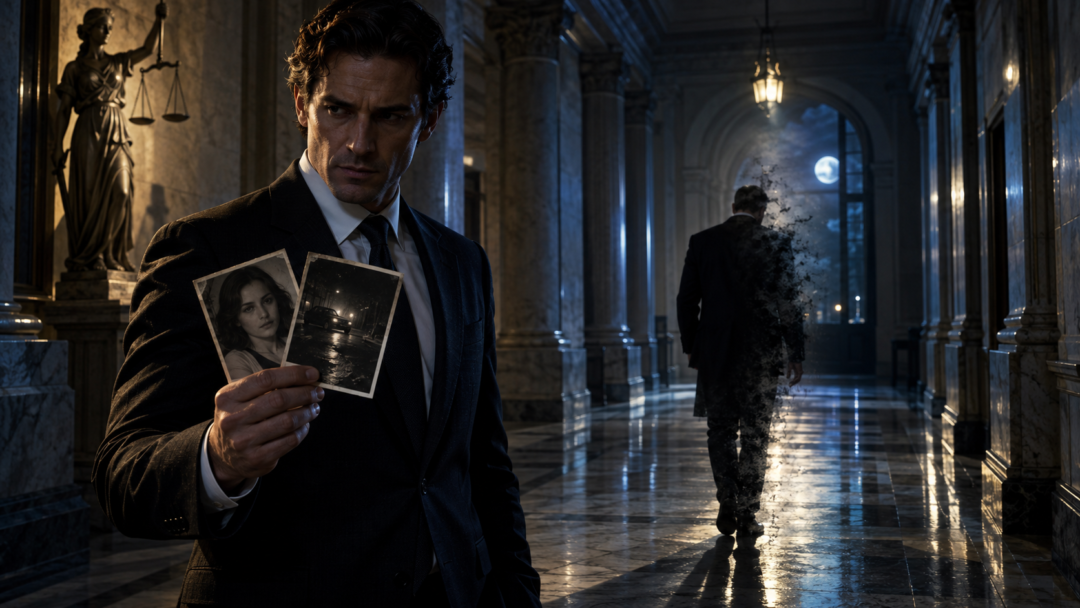
Julian Reyes stood completely motionless on the polished white Vermont marble floor, his right hand gripping the burnished brass handle of his heavy leather litigation briefcase.
He was forty-four years old, built with the erect, disciplined posture of a former collegiate rower, wearing an impeccably tailored charcoal-grey three-piece wool suit, an ice-blue French-cuffed shirt, and a solid silver silk necktie secured with an understated platinum clip. His dark hair was threaded with silver at the temples, his jawline sharp and unyielding, his dark eyes carrying the cold, analytical brilliance of a premier trial defense attorney who had never lost his composure before a jury in fifteen years of practice.
Yet in the quiet spaces between trials, Julian lived with a silent, terrifying secret: an eighteen-month void in his memory—a traumatic neurological chasm left by an open skull fracture sustained on the Lake Erie causeway a decade ago. He compensated with ruthless discipline, indexing every case, every deposition, every receipt into three cross-referenced digital databases.
A solitary overhead halogen sconce flickered with a faint, electrical buzz, dropping long, predatory shadows across the corridor walls.
From the dark archway of Courtroom 3, ten paces away, a man stepped out of the gloom.
The man walked with an uncanny, soundless grace, stopping beside a white Carrara marble balustrade overlooking the dark rotunda below. He was forty-four years old—the exact same age as Julian—wearing an unbuttoned dark navy wool trench coat over a dark crewneck sweater. His face was unlined, youthful, carrying an eerie, frozen stillness that felt entirely outside of ordinary time.
The man reached into his coat pocket, pulled out an antique silver-gelatin photograph, and laid it face-up on the cold marble ledge between them.
Julian did not touch it. His knuckles tightened on the handle of his briefcase.
“You don’t remember me,” the man said. His voice was low, resonant, and carried a melodic, gravelly warmth that reverberated through the limestone vaults like an old cello. “You never do.”
Julian looked down at the photograph beneath the pale halogen light.
The print showed two young men in their early thirties, standing shoulder-to-shoulder on the very steps of this courthouse, their arms thrown over each other’s shoulders, laughing with triumphant, youthful swagger in the autumn sunshine. One of the men was Julian Reyes, ten years younger, his face unscarred, his eyes full of fiery optimism.
The second man was the stranger standing across the ledge.
Julian’s throat went dry. A cold spark of adrenaline ignited behind his breastbone. “I’ve never seen this man in my life.”
The man smiled—a faint, sorrowful expression that carried a decade of endured heartbreak. “We meet here every year on this exact night, Julian. In this exact hallway. You always say the same thing. You always reach for your breast pocket to check your digital calendar.”
Julian’s hand froze two inches from his suit jacket. His pulse hammered against his temples. “Who are you? What kind of game is this?”
“Look closer at the photo, Julian,” the man murmured, nodding toward the print.
Julian took a half-step forward. He picked up the heavy photograph with steady fingers.
The timestamp embossed in silver ink in the lower right corner was unmistakable: OCTOBER 24, 2014. Exactly ten years ago tonight.
Julian looked up from the photograph to the man’s face.
His breath hitched in his throat.
Julian’s own face had aged ten years—lined by fifty grueling trials, greyed at the temples, hardened by long hospital rehabilitation and the chronic migraines that flared every winter. But the man standing before him was identical to the photograph. His skin was smooth, his hair dark, his hands completely unaged.
“This was taken ten years ago,” Julian whispered, his voice trembling despite every ounce of his legendary self-control. “You haven’t aged a single day.”
“Time moves differently when you’re dead on paper, Julian,” the man said softly.
He reached into his trench coat a second time.
He brought out a second photograph—a fresh, glossy color print, smelling faintly of photographic stabilizer chemicals—and placed it gently on top of the first.
Julian looked down.
The second photograph showed the two of them standing in this exact marble hallway, beneath this exact flickering halogen sconce. Julian was wearing his current tailored charcoal suit and silver tie. The stranger was wearing his navy trench coat.
Printed across the bottom border in glowing red digital characters was: TONIGHT — 11:15 PM.
Julian’s vision swam. Vertigo gripped him like a vice. “You took this one an hour ago,” the man said quietly, watching him with infinite patience. “You just don’t remember yet.”
Julian looked down at his own trembling hands. In his left hand, he was holding the second photograph—yet his mind was completely blank. He had no memory of meeting anyone an hour ago. He remembered only walking through the revolving brass doors of the courthouse at 11:45 PM to file an emergency midnight motion.
“How…” Julian choked out, looking up. “Who are you?”
The marble ledge was empty.
The man was gone.
Down the long, shadowed hallway, the sound of rain against stained glass was the only answer. Then, from the air itself—echoing faintly down the limestone vaults as if spoken from every doorway at once—came three whispered words:
“Same time next year.”
Suddenly, thirty feet down the dark corridor, the heavy carved oak double doors of Courtroom 3 swung slowly inward on silent bronze hinges, revealing a solitary, brilliant beam of white light shining down upon the empty defense table inside.
CHAPTER 2: THE NAME ON THE GOLD WATCH
The heavy carved oak doors of Courtroom 3 stood open like the jaws of a subterranean cavern.
Julian Reyes stood in the hallway, his heart hammering against his ribs, staring at the lone spotlight illuminating the empty counsel table inside. In his left hand, he still held the two photographs—the ten-year-old print and the glossy print timestamped barely forty minutes earlier.
He reached up with a trembling hand, loosened his silver silk tie by half an inch, and drew a slow, deliberate breath of the cold marble air.
“Facts, Julian,” he whispered aloud to himself, his voice echoing off the limestone walls. “Rely on physical evidence. Eliminate the impossible.”
He stepped toward the open courtroom, his leather oxfords clicking rhythmically across the Vermont marble floor.
He reached into his pocket to check the time on his smartphone, but stopped. Instead, he unbuttoned his left cufflink and turned his wrist over to look at his watch.
It was an antique 1968 Patek Philippe Calatrava in eighteen-carat yellow gold—a timepiece he had worn every single day since his discharge from the Cleveland Clinic neurological ward nine years ago. He had always believed he bought it for himself to celebrate passing the bar examination.
Julian slid his thumb across the polished gold caseback.
There, engraved in tiny, crisp Roman lettering beneath the Swiss hallmarks, were five words he had never noticed in nine years of daily wear:
REYES & VANE. UNBROKEN. 2014.
A sudden, sharp throb of agonizing pain stabbed behind Julian’s left eye—the unmistakable herald of his post-traumatic migraine. A fragment of memory, vivid as a muzzle flash, tore through the darkness of his mind:
A cramped second-floor walkup office above an Italian bakery on Market Street. The smell of fresh espresso and legal ink. Two brass nameplates bolted to frosted glass: JULIAN REYES, ESQ. and MARCUS VANE, ESQ. And a man with a booming laugh handing him a velvet box containing this exact gold watch: “To the best trial lawyer in Ohio. Happy thirty-fourth birthday, partner.”
“Marcus Vane,” Julian breathed, his voice cracking. “Marcus was my partner.”
He spun around, briefcase in hand, and headed not out the exit, but toward the central bronze elevator bank that led to the subterranean county law archives in the sub-basement.
The elevator descended with a heavy, hydraulic groan, stopping sixty feet below street level.
The sub-basement records vault was an immense subterranean grid of limestone pillars, wire-mesh cages, and towering steel file racks dating back to the late nineteenth century. The air was dry, cool, and thick with the smell of moldering rag paper and decaying leather bindings.
Julian moved quickly to Section R: State Bar of Ohio Registry — Historical Dockets 2010–2015.
He pulled the heavy buckram-bound directory for 2014, laying it flat on the metal reading desk under a naked hundred-watt bulb.
He flipped to page 412.
There, printed in black ink beside a certified state bar registration seal, was the listing:
REYES & VANE, ATTORNEYS AT LAW.
Senior Partners: Julian Reyes, Bar No. 44102; Marcus Vane, Bar No. 44103.
Status: Terminated October 25, 2014.
Reason for Termination: Fatal Casualty (Vane) / Medical Incapacity (Reyes).
Julian’s hands began to shake violently.
Beside the entry was a clipped newspaper article from the Cleveland Plain Dealer, dated October 26, 2014:
TRAGIC ACCIDENT ON LAKE ERIE CAUSEWAY: PROMINENT DEFENSE LAWYER MARCUS VANE PRESUMED DROWNED AFTER SEDAN PLUNGES INTO BAY; PARTNER JULIAN REYES IN CRITICAL CONDITION WITH SEVERE HEAD INJURY.
“He didn’t drown,” Julian whispered into the silence of the stacks. “He’s alive. He’s here in this building.”
“You shouldn’t be reading old newspapers, Mr. Reyes.”
A voice rang out from the shadows at the end of the aisle—harsh, gravelly, and flat.
Julian snapped the directory shut, spinning around.
Stepping into the light were two armed county courthouse bailiffs in full uniform, wearing ballistic tactical vests over their tan shirts. Their hands rested deliberately on the unsnapped holsters of their heavy .40-caliber service pistols.
Leading them was Captain Frank Miller—a veteran bailiff with thirty years on the county bench, a man known to take orders exclusively from Senior County Prosecutor Victor Sterling.
“Captain Miller,” Julian said, his courtroom composure sliding over him like an iron shield. “I am reviewing archived probate filings. The records room is open to officers of the court until midnight.”
“Not tonight it isn’t,” Miller said, taking two slow, menacing steps forward. “Chief Judge Vance signed an emergency administrative sealing order an hour ago. All unauthorized personnel are to be removed from the courthouse immediately. Drop the briefcase on the table, Julian. You’re coming with us to Chambers.”
Julian looked at the two bailiffs. He saw the cold, nervous calculation in Miller’s eyes—the unmistakable posture of men who were not preparing to escort an attorney to an office, but to conduct an execution in an unmonitored basement.
CHAPTER 3: THE ARCHIVE IN VAULT NINE
The tension in the narrow basement aisle was as brittle as dry parchment.
Julian did not drop his briefcase. He stood tall, his three-piece charcoal suit impeccably composed, his silver tie catching the yellow light of the hanging bulb.
“An administrative order signed at midnight without notice to counsel is facially invalid under Ohio Civil Rule 65, Captain Miller,” Julian said, his voice ringing with absolute, icy authority. “You know that. And you know that detaining a licensed defense attorney without a warrant constitutes false imprisonment under federal statute.”
Miller’s jaw clenched. His hand wrapped around the grip of his service pistol, clicking the retention strap open. “I don’t take legal arguments from a brain-damaged defense shyster. Take him, boys.”
The younger bailiff lunged forward with an expandable steel baton raised high.
Julian didn’t retreat. He stepped inside the arc of the swing, pivoted on the ball of his right foot, and drove the heavy brass corner of his leather briefcase directly into the bailiff’s solar plexus.
The concussive blow drove the wind from the man’s lungs with an explosive gasp. As the bailiff doubled over, Julian hooked his ankle with his oxford heel, sending the man crashing into a steel filing rack with a deafening metallic roar.
Captain Miller drew his pistol, but Julian was already moving.
He hurled a heavy, twelve-pound volume of the 1932 Ohio Appellate Reports straight at Miller’s face.
Miller dodged, his gun discharging with a deafening CRACK that pulverized a limestone pillar, filling the aisle with lime dust and cordite smoke.
Julian bolted through the emergency fire doors at the end of the corridor, his leather shoes flying across the concrete.
He knew every service chase, steam conduit, and utility tunnel in the eighty-year-old building. For nine years, he had studied the architectural blueprints during his long hours of insomnia.
He took the spiral iron staircase down to Sub-Level 2—the old probate vault tier constructed beneath Courtroom 3 in the 1920s.
He reached Vault 9: an iron-reinforced cage sealed behind a three-inch circular brass bank-vault door, labeled: SEALED ARCHIVES — CRIMINAL INVESTIGATIONS 2014.
The heavy brass combination dial on the vault was spinning.
The locking bolts retracted with three massive, subterranean thuds: CLANK. CLANK. CLANK.
The five-ton circular door swung open six inches.
Julian stepped inside, his chest heaving, his heart hammering against his ribs.
Standing in the center of the illuminated concrete vault, holding an illuminated tactical tablet in his left hand, was Marcus Vane.
Marcus looked up, his dark eyes steady, his navy trench coat dry despite the storm outside. “I told you to remember the back stairs, Julian. You always took the elevator.”
Julian leaned against a steel filing shelf, catching his breath, staring at his former partner with a mixture of awe, terror, and profound grief. “You… you’re real. You survived the causeway.”
“I survived because federal marshals pulled me out of the water three hundred yards downriver,” Marcus said softly, his voice rich with emotion. “I spent two years in an orthopedic trauma unit in Colorado, and eight years under deep federal witness security in Chicago.”
“Why didn’t you come to me?” Julian asked, his voice cracking with the pain of ten years of solitary torment. “Why did you let me believe I was alone?”
Marcus stepped forward, placing a gentle hand on Julian’s shoulder. “Because after the crash, the neurosurgeons told me you had an open depressed skull fracture. You had eighty percent memory loss. The doctors said that if I tried to force your memory before your brain healed, you’d suffer an irreversible catastrophic stroke. Every year on the anniversary, I came back to Cedar Point to check on your recovery. Every year, you were still trapped in the fog. But tonight… tonight your mind finally fought its way back.”
Marcus held up the digital tablet.
On the screen was a live closed-circuit security feed from the third-floor judicial chambers.
Seated around a mahogany conference table were Chief Judge Harrison Vance and County Prosecutor Victor Sterling. Standing beside them was an industrial cross-cut paper shredder. Two clerks were feeding thick, red-bound legal binders directly into the grinding blades.
“Grand jury case file 2014-99,” Marcus said, pointing to the screen. “The original juvenile detention kickback indictments that we were preparing to file ten years ago tonight. The ten-year statute of limitations expires at 12:01 AM tonight—in exactly twenty-two minutes. If they finish shredding those master copies, Judge Vance and Victor Sterling walk away untouched forever.”
“They aren’t shredding the only copy,” Julian said, his dark eyes narrowing into razor-sharp legal clarity as his memory clicked into place. “David Cole told me where the duplicate was. The duplicate is right here in Vault 9.”
CHAPTER 4: THE LAKE ERIE CAUSEWAY
The air inside Vault 9 was freezing, motionless, and heavy with the scent of beeswax, old linen stationery, and forty years of sealed legal records. The vaulted ceiling arched ten feet above their heads, its curved brickwork damp with mineral seepage from the street overhead. In the silence between words, the muffled, subterranean thrum of the autumn storm pounding against the courthouse foundation sounded like the distant heartbeat of an ancient iron engine.
Marcus watched Julian with a look of quiet, triumphant admiration—the expression of a man who had waited ten years to see his best friend wake up from a living death. “You remember David Cole, don’t you, Julian?”
“I remember everything,” Julian said, his hand reaching out to touch the cold, riveted steel shelf of Section 14. “The pieces are all fitting together now. The fog is finally gone. David Cole was the young investigative reporter for the Erie Herald who brought us the financial wire transfers in the spring of twenty-fourteen. He had spent eight months tracing the shell corporations registered in Delaware.”
Julian closed his eyes for a second, letting the flood of restored memory settle into precise, logical order. “In October twenty-fourteen, Cole discovered that Chief Judge Harrison Vance was receiving six hundred thousand dollars a year in offshore consulting fees from Vanguard Correctional Systems—the private multi-state corporation that built and operated the county juvenile detention facility in Sandusky. Every cent was laundered through a fake judicial educational foundation.”
“And Victor Sterling,” Marcus added, his voice hardening into cold, tempered steel as he leaned against the vault table, “was using his absolute discretion as county prosecutor to aggressively charge minor non-violent teenage offenders—kids caught shoplifting a five-dollar pair of gloves, teenagers trespassing on an abandoned dock, students skipping third-period biology—with felony commercial burglary and aggravated criminal trespass. He refused diversion programs. He refused probation. He guaranteed an eighty-five percent occupancy rate for Judge Vance’s private prison, because the contract stipulated that if occupancy fell below eighty percent, the county had to pay Vanguard a three-million-dollar penalty.”
“They were trading children’s lives and records for private corporate dividends,” Julian said, his jaw clenching until the muscles in his temples throbbed with white-hot fury. “Generations of working-class families broken in secret so two men could buy yachts in Marblehead. We spent eighteen months building the federal civil rights indictment. We had ninety-two victim depositions, twelve bank wire receipts, the original corporate incorporation filings, and an unredacted audio recording of Judge Vance threatening the state juvenile inspector with termination if she documented the overcrowding in the cell blocks.”
“And on the night of October 24, 2014,” Marcus said, stepping beside Julian, his voice dropping into a hushed, reverent whisper, “we loaded the master evidence carton into the trunk of your dark blue Audi sedan. We were driving down the Lake Erie causeway to the federal courthouse in Cleveland to file the emergency petition before the grand jury at midnight. We thought we had won.”
“The headlights,” Julian murmured, the memory washing over him in a cold, visceral wave of sensory recall so vivid he could smell the ozone and wet marsh grass. “We were halfway across the five-mile causeway. The storm was blowing freezing rain off the lake, just like tonight, whipping the waves over the riprap. A commercial snow-plow truck… painted county yellow, with heavy steel push plates… came up behind us with its roof halogen lightbar blinding our mirrors. It didn’t brake. It didn’t swerve. It rammed our bumper three times, shoved us through the concrete guardrail, and watched us drop forty feet into the black, freezing water.”
“You were knocked unconscious on impact,” Marcus whispered, his eyes glistening with unshed tears. “Your head hit the steering column with crushing force. The windshield imploded. The black water was rising over the dashboard in seconds. I unbuckled your seat belt, kicked out the rear tailgate glass, and dragged you to the surface by your collar. But the rip current in the bay was too strong. It swept us apart in the dark. When the county rescue boats arrived, Prosecutor Sterling took personal control of the scene. He told the press that I had drowned and that you were driving under the influence of narcotics.”
“Sterling tried to revoke my law license while I was in a medical coma at the clinic,” Julian said, his mind moving with lightning speed. “He told the state disciplinary board I had destroyed our firm’s records in a fit of drunken mania. He made the world believe I had killed my own partner.”
“He thought the evidence was at the bottom of Lake Erie,” Marcus said, walking to the far corner of the vault where a cast-iron fireproof lockbox sat bolted to the masonry wall. “He didn’t know that before we left the office that night, I had an instinct that Sterling might try an ambush. I brought the master microcassette and the certified wire transfers down here to Vault 9 and slipped them into an uncataloged probate estate from nineteen twenty.”
Marcus pulled an antique brass key from beneath his crewneck sweater, slid it into the lockbox, and turned it firmly clockwise.
CLACK.
The heavy iron door swung open with a smooth, well-oiled mechanical sigh.
Inside, resting on clean archival linen, lay a thick blue-ribbon federal grand jury binder stamped in embossed gold: UNITED STATES DISTRICT COURT — EX REL. REYES & VANE v. VANCE & STERLING.
Taped to the cover was an Olympus microcassette labeled in Marcus’s unmistakable handwriting: EXHIBIT A: CONVERSATION WITH CHIEF JUDGE VANCE — OCT 22, 2014.
Julian reached out, his fingers touching the leather binding. The ten-year nightmare of self-doubt, memory loss, and phantom guilt vanished, replaced by the righteous, unstoppable fury of an officer of the court holding the instrument of justice.
Suddenly, an ear-splitting, deafening screech echoed through the vault.
The building-wide emergency public address system crackled to life, the speakers vibrating with the dry, patrician voice of Chief Judge Harrison Vance:
“Attention all courthouse security units. This is Chief Judge Vance. An armed federal fugitive and a mentally unstable individual have breached the sub-basement archives. The building is officially under Level One lockdown. All exterior exits are sealed. Security personnel are authorized to use lethal force upon contact. Repeat: lethal force is authorized.”
The iron fire doors at the end of the corridor slammed shut with hydraulic concussions.
The hunt had begun.
CHAPTER 5: THE ROTUNDA UNDER SIEGE
The concrete vaults of the sub-basement shook as the heavy magnetic emergency locks engaged across the entire courthouse perimeter. Overhead, the emergency sirens wailed with a high-pitched, rhythmic strobe that painted the limestone walls in flashing pulses of crimson light. Every fire door in the five-story municipal complex was sealed by computer command from the central judicial security desk.
Julian secured the blue-ribbon federal binder inside his leather briefcase, snapping the heavy brass locks shut with crisp, metallic clicks.
“Where is the emergency intercom master override?” Julian asked, turning to Marcus as they stood beneath the glowing red exit sign.
Marcus smiled faintly through the flashing red light. “The old sound technician booth behind the balcony of Courtroom 1. It was installed in nineteen sixty-eight during the county charter convention. The microphone feeds don’t run through the modern fiber-optic network; they run on shielded, analog copper cables embedded inside the structural limestone. Judge Vance’s digital security software can’t touch it, can’t jam it, and can’t turn it off from his desktop console.”
“Then that’s where we make our closing argument,” Julian said. “Take the utility chase.”
They moved through the subterranean utility tunnels, their footsteps muffled by the roar of the ventilation fans. They climbed thirty feet of vertical iron maintenance rungs inside the dry plumbing chase that bypassed the locked stairwells, pulling themselves through an old access hatch behind the second-floor gallery.
The central rotunda opened before them like a vast, neoclassical theater of shadows.
The rotunda was forty feet wide and seventy feet high, crowned by an immense stained-glass dome depicting the blindfolded goddess of justice holding her scales. At midnight, with the storm hurling rain against the exterior dome, the colored glass threw fractured patterns of cobalt blue, crimson, and pale gold across the towering fluted limestone columns.
Below them, across the polished white marble floor of the main hall, stood four armed private security contractors in tactical body armor, their assault carbines leveled, scanning the upper tiers with high-intensity weapon lights.
Standing at the top of the grand marble staircase, wearing a pristine dark wool overcoat and carrying a nickel-plated pump-action shotgun, was Senior County Prosecutor Victor Sterling.
Sterling was sixty-two years old, built like an aging prize-fighter, with a thick neck, slicked-back silver hair, and cold, predatory eyes that had sent a thousand men to prison without an ounce of remorse. He held the shotgun in the crook of his arm, pacing the marble landing with the arrogant, unhurried cadence of a tyrant inspecting his throne room.
“Julian!” Sterling’s voice boomed across the marble rotunda, echoing off the limestone pillars like artillery fire. “Come out onto the balcony, son! Let’s talk about a plea agreement! You’re an officer of the court! You don’t want to throw your life away for a dead man!”
Julian stepped out onto the marble balustrade overlooking the rotunda, his briefcase held firmly at his side, looking down at the prosecutor with unflinching, razor-sharp composure.
“I don’t negotiate with criminals, Victor,” Julian said, his voice projecting across the vast chamber with flawless courtroom acoustic power. “Especially criminals who murder children’s futures for twelve percent private prison stock.”
Sterling’s face twisted into an ugly, venomous sneer. He pumped the shotgun with a heavy clack-clack, raising the barrel toward the balcony. “You should have stayed in the hospital, Reyes! You were a brilliant lawyer! But you never understood how this county works! The judges own the bench, the prosecutors own the docket, and the state legislature looks the other way! You’re a bug on a windshield!”
From the sound booth behind the gallery, Marcus Vane threw the master analog switch.
A sharp, high-frequency squeal of electrical feedback pierced the air.
Every speaker in the courthouse—in the rotunda, the courtrooms, the holding cells, the sheriff’s dispatch room, and the public sidewalk loudspeakers outside—erupted with crystalline clarity.
Marcus hit play on the Olympus microcassette player.
Chief Judge Harrison Vance’s recorded voice boomed through the building, resonant, arrogant, and undeniable:
“…Victor, tell Vanguard Correctional we need twenty more beds filled by Friday. I don’t care if you have to pick up kids for skateboarding in the park. My dividend payout is due on the first, and if that occupancy rate drops below eighty percent, the investment syndicate cuts our allocation…”
Sterling froze on the marble staircase, his eyes widening in pure, paralyzed horror.
Down on the ground floor, the four security contractors lowered their carbines, looking up at each other in stunned, sickening realization of what they were defending.
“Turn that off!” Sterling shrieked, swinging the shotgun toward the sound booth. “Turn it off!”
Sterling pulled the trigger.
BOOM!
The deafening blast of twelve-gauge buckshot shattered a section of the marble balustrade, sending pulverized limestone chips and lead pellets spraying across the gallery floor.
Julian dropped behind the solid stone column, his briefcase protected against his ribs.
“He’s out of control!” Marcus yelled from the booth, grabbing Julian’s arm. “Move to Courtroom 1! The federal marshals are two minutes out!”
CHAPTER 6: THE BENCH IN THE DARK
Julian and Marcus sprinted through the double leather doors into Courtroom 1—the historic, two-story ceremonial courtroom where the county’s most significant constitutional trials had been argued for a century.
The room was shrouded in darkness, illuminated only by the rain-swept streetlights filtering through the two-story arched windows behind the judge’s elevated mahogany bench. Towering fluted walnut pilasters rose to a coffered plaster ceiling, framing the empty jury box and the heavy bronze railing of the counsel tables.
The heavy doors behind them were kicked open with a violent crash.
Victor Sterling stepped across the threshold, his shotgun leveled at waist height, his eyes bloodshot and wild with the frantic, cornered fury of a man whose entire life was collapsing into ruin.
“You’re not leaving this courtroom, Julian!” Sterling roared, pumping a fresh shell into the chamber. “I built this justice system! I decide who walks and who rots!”
Sterling fired a second blast into the center aisle.
The heavy buckshot tore through the mahogany counsel table, blowing oak splinters into the air and shattering the bronze desk lamp.
Julian moved with the calm, calculated precision of a seasoned trial lawyer reading an opponent’s tell. He knew the layout of Courtroom 1 down to the inch.
He dropped behind the oak witness box, slid silently along the recessed judge’s clerk bench, and reached the master lighting console beside the judicial dais.
Julian slammed his palm down onto the emergency halogen cleaning lights.
Twenty thousand watts of overhead commercial floodlights snapped on with a concussive hum, flooding the courtroom in a blinding, incandescent white glare.
Sterling, whose eyes had adapted to the darkness, screamed in pain as the intense light overloaded his retinas, throwing his hands up to shield his burning eyes.
From the shadow of the jury box, Marcus struck.
Marcus leaped over the mahogany railing, driving his shoulder into Sterling’s midsection with the full momentum of an athlete. Both men crashed hard onto the Persian rug before the bench.
The shotgun flew from Sterling’s grip, spinning across the floor and lodging beneath the defense table.
Sterling roared, clawing at Marcus’s face with thick, scarred fingers, but Julian stepped forward from the judicial bench.
Julian didn’t hesitate. He seized the heavy, three-foot solid oak bailiff’s ceremonial mace from its brass bracket beside the witness stand and brought the blunt wooden staff down squarely across Sterling’s right forearm.
CRACK.
Sterling howled in agony, his wrist breaking, his grip releasing instantly.
Marcus pinned Sterling’s shoulders to the floorboards, twisting his arms behind his back, pressing his knee firmly between the prosecutor’s shoulder blades.
Sterling lay defeated on the carpet, gasping for air, weeping in total, unvarnished ruin.
“It’s over, Victor,” Julian said, standing over him, his silver tie straight, his voice like cold iron. “You’re done.”
The private executive elevator behind the judge’s bench chimed with a soft, aristocratic bell.
The bronze elevator doors slid open.
Stepping into the courtroom was Chief Judge Harrison Vance.
He was sixty-eight years old, his silver hair perfectly coiffed, wearing a bespoke three-piece navy pinstripe suit with a gold pocket watch chain draped across his vest. In his right hand, he held a sealed legal parchment embossed with the official gold seal of the State of Ohio.
His face was pale, but his aristocratic lips were curled into a cold, superior sneer.
“A dramatic performance, Mr. Reyes,” Judge Vance said, his voice cultured, resonant, and entirely unbothered. “Truly worthy of your reputation. But as an attorney, you should know that evidence is meaningless without judicial standing.”
Vance held up the parchment.
“Thirty minutes ago, the outgoing governor signed an executive decree granting full executive clemency and complete judicial immunity to Victor Sterling and myself for all administrative decisions rendered between 2010 and 2020. You have no case, Julian. You have no jurisdiction. You have nothing.”
Julian looked at the parchment, then looked into the judge’s dead eyes.
A slow, confident smile touched the corners of Julian’s lips.
“You should have read the United States Code more carefully, Judge Vance,” Julian said quietly.
CHAPTER 7: THE DOCKET AT HIGH NOON
The silence in Courtroom 1 was broken by the sound of heavy tactical boots pounding up the grand marble staircase outside.
The heavy double doors of the courtroom swung open with concussive force.
Stepping across the threshold, flanked by eight tactical agents in olive-drab body armor carrying suppressed carbines, was United States Attorney Sarah Vance-Mercer and Special Agent in Charge Thomas Vance of the Federal Bureau of Investigation.
Agent Vance held up a certified blue-ribbon federal arrest warrant.
“Chief Judge Harrison Vance,” Attorney Mercer announced, her voice echoing with sovereign federal authority across the walnut chamber. “You and Victor Sterling are under arrest for federal conspiracy to violate constitutional civil rights under color of law, interstate racketeering, and twelve counts of mail and wire fraud.”
Judge Vance backed toward his private elevator, waving the state parchment in hysterical indignation. “I have an executive pardon! The governor signed this document less than an hour ago! State executive clemency cannot be challenged by a district attorney!”
“The governor has authority over state misdemeanors and common-law torts, Judge Vance,” Attorney Mercer said, stepping past the counsel table. “The governor has zero constitutional authority over federal civil rights crimes. And under Title 18, United States Code, Section 242, judicial immunity is explicitly waived when a state official uses criminal violence to prevent citizens from petitioning the federal courts.”
Two federal tactical agents stepped forward, wrenched the parchment from Judge Vance’s hands, and twisted his arms behind his back, slapping heavy steel handcuffs onto his wrists.
The judge’s face crumbled into raw, terrified disbelief as the illusion of untouchable power was stripped away forever. Beside him on the floor, Victor Sterling was hauled to his feet in chains, his broken arm secured in a medical sling, weeping openly in front of the federal cameras.
Attorney Mercer turned to Julian Reyes and Marcus Vane.
She took off her glasses, looking at the two men with profound, professional reverence.
“Mr. Reyes. Mr. Vane,” Mercer said, extending her hand. “The Department of Justice has reviewed the microcassette recordings and the grand jury transcripts recovered from Vault 9. Every allegation has been substantiated. Over four hundred young men and women falsely imprisoned by this syndicate will have their records expunged before the end of the week.”
She turned directly to Marcus Vane. “Mr. Vane, by order of the United States Attorney General, your status in the federal witness protection program is formally concluded. You are a free citizen. Your true name is restored to the Ohio State Bar register with full honors.”
Marcus took a deep, shuddering breath, a tear tracing the unaged cheek of his face. He reached out and shook the United States Attorney’s hand, his voice thick with emotion: “Thank you, Attorney Mercer.”
Julian stood beside his partner, feeling the ten years of agonizing fog, medical isolation, and phantom guilt lift from his soul like morning mist off Lake Erie. His mind was clear, whole, and completely restored.
He looked down at his gold Patek Philippe watch. The hands pointed to 6:00 AM. The clock of their exile had officially run out.
Six hours later, the noon sun broke over the carved limestone pediment of the Cedar Point County Courthouse in a breathtaking, crystal-clear expanse of autumn gold and pale blue sky, reflecting off the newly polished bronze statue of Lady Justice.
On the grand marble staircase where their car had departed on that fateful storm night ten years ago, a crowd of eight hundred citizens, freed juveniles, proud parents, defense attorneys, and national television journalists had gathered under the clear sky to witness the dawn of a new, uncorrupted era. The mood was one of cathartic triumph and vindication.
Julian Reyes and Marcus Vane walked down the wide stone steps together.
Julian wore his sharp charcoal three-piece suit, his leather litigation briefcase held lightly in hand, his head held high in the warm autumn light. Beside him walked Marcus, wearing a clean dark wool overcoat, smiling as he looked out over the sparkling, sunlit expanse of Lake Erie.
A reporter thrust a microphone forward from the press throng: “Mr. Reyes! Mr. Vane! Will you two be reopening your firm?”
Julian stopped on the middle landing, looking at the assembled crowd of neighbors and colleagues, then turning to look his best friend and brother in the eyes.
“Reyes & Vane never closed,” Julian said, his voice clear, resonant, and carrying across the entire courthouse plaza with absolute conviction. “We were just waiting for our trial date.”
Marcus laughed—a rich, full-throated sound of pure freedom that had been silent for ten years—and clapped his hand firmly on Julian’s shoulder.
Side by side, unbroken by time, memory, or the darkness of the past, the two partners walked down the courthouse steps into the bright, unshadowed light of the future.