The Quiet Desk Clerk Behind The Counter Held Her Entire Fortune
CHAPTER 1: THE KEY ON THE MARBLE
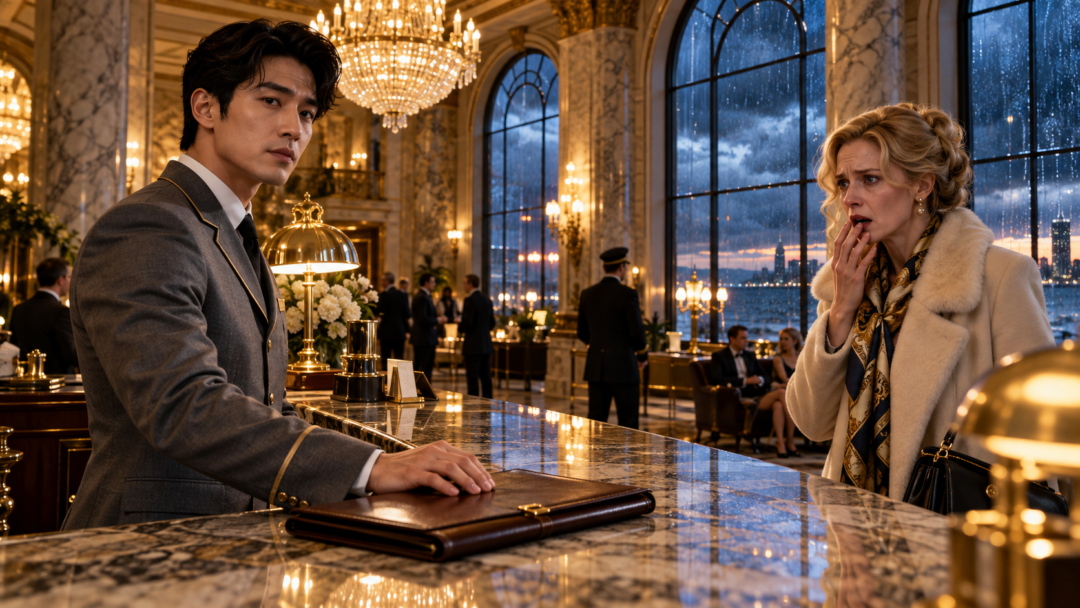
The late October gale sweeping across Lake Michigan battered the five-story arched windows of the Grand Belvidere Hotel, sending violent sheets of rain sheeting against the leaded glass. Inside the soaring Beaux-Arts rotunda, the atmosphere was insulated by eighty feet of coffered limestone, gold-leaf ceilings, and the gentle, melancholic cadence of a grand piano drifting from the palm court. The book-matched Italian marble floor, polished to a mirror finish, reflected the amber glow of crystal chandeliers imported from Vienna a century ago.
Daniel Cho stood behind the central reception desk, an imposing crescent of solid Carrara marble trimmed in hand-chased brass. At twenty-nine, his posture had the natural, upright stillness of a classical archer. His dark grey hotel blazer was tailored to perfection, crisp white French cuffs extending precisely half an inch, an unadorned brass nameplate reading simply D. CHO – CONCIERGE DESK pinned to his breast. His dark eyes were calm, observant, and thoroughly attentive as he reviewed the arrival folios on the terminal screen.
The heavy bronze revolving doors at the entrance spun with sudden force, admitting a flurry of cold rain, two bellmen struggling under eight matching trunks of Louis Vuitton luggage, and Vivian Cross.
She swept into the rotunda like a squall of perfumed arrogance. At forty-eight, Vivian carried herself with the untouchable entitlement of Chicago real estate royalty. A flowing ivory silk scarf was draped over a tailored charcoal cashmere coat, three diamond solitaires flashed on her manicured fingers, and her pointed stiletto boots clicked against the marble with aggressive, territorial authority.
She did not approach the designated check-in stanchions where other guests waited. She strode directly to the executive concierge station, pushed aside a leather-bound directory of services, and tossed an embossed platinum RFID key card onto the counter.
The plastic card bounced twice against the Carrara stone, sliding to a stop against Daniel’s hand.
“You’re the help, aren’t you?” Vivian said, not bothering to make eye contact as she stripped off her Italian leather gloves. Her voice was sharp, metallic, and carried effortlessly across the marble lobby. “My town car is idling under the portico. It’s blocking the valet lane. Fetch it, have it parked in the heated basement bay, and ensure my luggage is sent up to the Presidential Suite immediately. And make sure the florist replaced the lilies with white gardenias this time. The scent of lilies gives me a migraine.”
Daniel did not flinch. He did not blink. He lifted his gaze calmly, his dark eyes meeting hers with level, undisturbed stillness. “Good evening, Mrs. Cross. Welcome back to the Grand Belvidere.”
Vivian sighed with theatrical annoyance, rolling her eyes as she tapped her manicured nails against the marble. “I didn’t ask for a pleasantry, young man. I gave you an instruction. When a guest of my caliber speaks, your only response is to move your feet. Say thank you. That’s all you need to say.”
A quiet hush rippled across the nearby lounge. Two corporate executives seated by the grand fireplace paused their conversation, glancing over with embarrassed discomfort.
Daniel remained motionless, his hands resting lightly upon the leather desk blotter. “The hotel policy requires all vehicles to be logged by the guest at the secondary motor court desk, Mrs. Cross. And as for the Presidential Suite, I must inform you that the reservation on file is currently inactive.”
Vivian’s laughter was a sudden, vicious bark that echoed up into the coffered rotunda. She turned to a wealthy couple checking in at the adjacent counter, shaking her head in mocking disbelief. “Listen to him. An entry-level counter clerk lecturing me on hotel policy. Do you have any idea who I am, boy? My family owns twenty-eight percent of the commercial real estate along Michigan Avenue. My grandfather bought the debt on this moldering pile of limestone before your parents ever set foot in this country.”
She leaned over the brass railing, her face inches from his, her perfume suffocatingly thick. “I’ve seen your kind before. Polished suits, quiet eyes, all talk. You memorize a few company protocols and suddenly you think you sit at the table. You will never be one of us. You belong on the other side of this desk, fetching umbrellas in the rain for the people who actually sign the checks.”
Daniel’s expression did not register anger, irritation, or shame. His composure remained as cool and immovable as the granite footings beneath the hotel.
He reached beneath the counter.
With smooth, deliberate movements, he retrieved a heavy, gold-tooled executive binder bound in dark navy calfskin—the private ledger of the Belvidere’s Board of Trustees. He laid it flat upon the Carrara marble.
The heavy leather creaked softly as he turned the first vellum divider.
“Mrs. Vivian Cross,” Daniel spoke, his voice quiet, clear, and perfectly pitched to carry across the breathless lobby. “President and Managing Partner of Cross Vanguard Capital. On June fifteenth, your firm executed an amended corporate lodging agreement securing a rolling four-million-dollar line of credit against room folios, private dining suites, and executive event guarantees at this facility.”
Vivian sneered, crossing her arms over her cashmere coat. “Which gives me unlimited access to the penthouse suite, as you well know.”
Daniel turned the page.
Displayed on the crisp white stationery of the Central Mercantile Bank of Chicago was an official notification bearing three red corporate seals: NOTICE OF CREDIT ACCELERATION & REVOCATION OF CORPORATE PRIVILEGES.
Beneath the cancellation order, stamped in bold crimson ink across Vivian’s reservation itinerary, were five words: ACCOUNT CLOSED – ZERO COLLATERAL BASIS.
Vivian’s smirk began to crack around the edges, her throat swallowing hard as her eyes caught the date stamped at the top of the page: today at four o’clock.
“What… what is this?” she stammered, her hand fluttering nervously to the silk scarf at her throat. “This is impossible. The Cross line of credit cannot be revoked without the personal signature of the General Manager.”
Daniel looked directly into her eyes, his face calm, serene, and devoid of pity.
“Your suite was cancelled by the General Manager, Mrs. Cross,” Daniel said, closing the leather binder with a soft, final thud. “And I am the General Manager.”
CHAPTER 2: THE LEDGER IN THE SAFE
The silence that descended upon the Grand Belvidere’s marble rotunda was suffocating. Vivian Cross stood frozen before the desk, her manicured fingers trembling against the silk fabric of her scarf, her eyes darting between Daniel’s face and the brass nameplate pinned to his blazer.
“You?” she whispered, her voice cracking into high-pitched disbelief. “You’re thirty years old! You’re wearing a staff blazer! The General Manager of the Belvidere is Reginald Montgomery! I played bridge with his wife in Lake Forest last weekend!”
“Reginald Montgomery tendered his resignation at eight o’clock this morning,” Daniel replied, his voice maintaining its flat, unimpeachable calm. “Following a forensic audit conducted by the Swiss Heritage Trust, which holds the underlying 1922 land patent on this property. Mr. Montgomery was found to have permitted four point six million dollars in uncollateralized hospitality debt to accumulate under your family’s account in exchange for private equity allocations in your North Shore condominium syndicate.”
Daniel reached into his breast pocket and produced a thin, titanium keycard embossed with a laser-cut gold crest—the master executive pass that opened every vault, elevator override, and private suite in the thirty-two-story tower.
“Reginald Montgomery has departed the premises,” Daniel said. “The Board of Trustees unanimously appointed me Chief Restructuring Officer and General Manager effective noon today. My name is Daniel Min-Kyu Cho. My grandfather, Min-Kyu Cho, was the supervising civil engineer who designed the reinforced caisson foundations beneath your feet when this building was erected in nineteen twenty-four.”
Vivian backed away from the desk half a pace, her boots catching the hem of her cashmere coat. Her patrician features contorted with venomous rage. “Min-Kyu Cho was an immigrant draftsman! My family bankrolled the construction syndicate that built this hotel! You think because you waved a piece of paper from an offshore trust you can humiliate me in public?”
She snatched her platinum smartphone from her crocodile clutch, her fingers stabbing violently at the screen.
“I am calling Harold Sterling,” she snarled, bringing the phone to her ear. “The Chairman of the City Building Commission and the Chief of Police. We will have your little Swiss trust investigated for foreign corporate interference, and by midnight, the Department of Buildings will have an emergency closure order posted on every entrance of this hotel!”
Daniel did not move to stop her. He did not flinch as she held the phone aloft.
Instead, he touched a key on the terminal beneath the counter.
A crisp, high-speed laser printer behind the concierge desk whirred into life, sliding a single sheet of heavy legal bond paper into the collection tray. Daniel picked it up and laid it face-up on the marble counter, right beside Vivian’s discarded key card.
It was an official press release from the Office of the Mayor of Chicago, stamped with an emergency municipal docket number:
EXECUTIVE ORDER 2026-44: IMMEDIATE DISSOLUTION OF THE LAKESHORE REDEVELOPMENT BOARD FOLLOWING FEDERAL INDICTMENTS FOR COMMERCIAL EXTORTION. ALL BUILDING INSPECTION PERMITS REGARDING HISTORIC MONUMENT STRUCTURES TRANSFERRED TO THE STATE HISTORIC PRESERVATION OFFICE.
Vivian’s phone clicked as the call connected, but the voice that answered was not Harold Sterling’s booming baritone. It was an automated recording from the Cook County Department of Corrections, informing the caller that the subscriber was currently in federal pre-trial processing and unavailable for communication.
Vivian’s hand dropped limp to her side, the phone nearly slipping from her manicured fingers. Her chest heaved beneath her silk wrap, her eyes wide with cold, unvarnished panic.
“Harold was arrested at three o’clock this afternoon,” Daniel said softly. “At his private residence in Glencoe. The Federal Bureau of Investigation seized fourteen banker boxes of fraudulent foundation inspection reports. Reports that your firm paid him eighty thousand dollars a month to fabricate.”
“You… you set this up,” she breathed, her voice reduced to a dry, rattling whisper.
“My family did not spend twenty years in exile to watch our architectural masterpiece turned into a tax-fraud shelter for bankrupt real estate speculators, Mrs. Cross,” Daniel said, his voice dropping into a quiet, lethal register. “Your town car is not being brought around to the front. Your luggage will be returned to the curb in five minutes. And your personal suite on the twenty-fourth floor is being sealed by internal security as we speak.”
Vivian lunged toward the counter, her composure completely shattered, her face inches from Daniel’s as her voice rose to a screech: “You cannot touch the twenty-fourth floor! My private safe is in that room! My family’s corporate records are in that vault!”
Daniel stood with his hands resting lightly against the cold Carrara marble, watching the play of light across the soaring arches of the rotunda. His grandfather had spent three freezing winters overseeing the placement of the limestone blocks, calculating the structural shear against the unpredictable gales of Lake Michigan. In those days, craftsmanship was considered a sacred civic trust, an enduring compact between the builder and the city that would shelter generations of travelers. Min-Kyu Cho had left behind detailed hand-drawn journals in Korean and English, chronicling every structural calculation alongside personal reflections on the dignity of labor. Vivian Cross saw only square footage to be leveraged and liquidated for speculative profit, completely blind to the architectural soul that made the Belvidere an irreplaceable cultural monument. That blindness was her ultimate undoing; she assumed that money alone dictated the laws of permanence, forgetting that foundations built on theft always crumble when exposed to the light.
“The room is currently designated as an active corporate crime scene under federal preservation subpoena,” Daniel replied.
At that moment, the brass birdcage elevator behind the desk chimed with a deep, resonant tone.
The ornate gilded doors slid open, and Arthur Pendelton, the sixty-two-year-old head concierge who had served the Belvidere for four decades, stepped out into the lobby. He carried a heavy manila accordion file stamped with red wax seals, accompanied by two armed private security officers in immaculate grey blazers.
“Mr. Cho,” Arthur said, bowing with crisp, formal deference as he placed the file on the marble desk before Daniel. “We completed the initial physical sweep of Suite 2400. You need to see this immediately. Mrs. Cross’s private engineers didn’t just store documents in that penthouse. They did something to the foundation telemetry in the sub-basement.”
CHAPTER 3: THE SUITE ON THE TWENTY-FOURTH FLOOR
The Presidential Suite on the twenty-fourth floor occupied the entire north wing of the Grand Belvidere, its floor-to-ceiling windows offering a panoramic vista of the black, turbulent waters of Lake Michigan churning beneath the rain. Inside, the opulent decor of French silk upholstery and antique mahogany furnishings had been systematically transformed into a clandestine operations command center.
Daniel Cho stepped across the threshold, his dark eyes scanning the room with clinical detachment. Behind him came Arthur Pendelton, who kept a pocket flashlight trained on the floorboards to avoid disturbing physical evidence.
On the long dining table where heads of state had dined for eighty years sat three commercial digital workstations, their dual monitors glowing with real-time telemetry from structural load sensors. Stacks of blueprint schematics lay scattered across the carpet, bearing the corporate stamp of Cross Vanguard Engineering & Demolition Services.
“Explain what we’re looking at, Arthur,” Daniel said, picking up a set of laminated architectural elevations.
“For three months,” Arthur explained, his voice hushed and grim, “Mrs. Cross maintained that her private contractors were conducting historic plaster restoration in the penthouse ceilings. But two weeks ago, one of our night engineers noticed high-voltage power conduits running down the decommissioned dumbwaiter shaft straight into the bedrock foundation.”
Arthur walked to the primary workstation and tapped the spacebar.
The monitors illuminated, displaying a three-dimensional cross-section of the Belvidere’s subterranean foundation. Red blinking markers pulsed along the sixty reinforced concrete caissons that anchored the thirty-two-story hotel into the limestone bedrock two hundred feet beneath the Chicago water table.
“Look at the hydraulic pressure telemetry on Caissons Twelve through Eighteen,” Arthur said, pointing a trembling finger at the digital gauges. “The readouts show structural subsidence of nearly three inches—an catastrophic tilt that would justify an immediate, mandatory condemnation order by the city building commission.”
Daniel leaned closer, his analytical gaze parsing the underlying software code running the simulation. His brow furrowed as his fingers moved across the mechanical keyboard with practiced speed.
He opened the raw diagnostic logs.
“It’s a synthesized loop,” Daniel said, his voice dropping into cold realization. “These aren’t real-time sensor feeds from the bedrock. It’s an algorithm running a pre-programmed structural failure script. Cross Vanguard installed digital signal spoofers in the sub-basement utility conduits. The sensors on the caissons are reporting false stress data directly to the municipal building commission’s automated monitoring network.”
Arthur gasped, his hand flying to his lapel. “Good heavens. They were engineering a paper collapse. Harold Sterling would receive the automated alarm, declare the building an imminent threat to public safety, and issue a mandatory twenty-four-hour evacuation order.”
“And once the building was evacuated and condemned,” Daniel said, straightening up, “the municipal historic preservation protections would be automatically suspended under the emergency public safety ordinance. Cross Vanguard’s liquidation arm would buy the property at ten cents on the dollar, bring in the wrecking cranes, and clear four acres of prime lakeshore frontage for a fifty-story glass condominium development.”
He looked around the room, noting the empty safes, the shredded paper in the industrial waste bins, and the smell of ozone coming from the overheated server racks.
Daniel walked to the tall French casement windows, looking out at the turbulent grey expanse of Lake Michigan. Far below, the streetlamps along Lakeshore Drive formed a gleaming ribbon of amber light cutting through the driving rain. He remembered standing in this very room twenty years ago as a boy of nine, holding his grandfather’s rough, calloused hand while Min-Kyu pointed toward the lake and explained how the caissons were anchored deep into the bedrock. His grandfather had told him that true architecture was not about the gilded cornices or the crystal chandeliers that dazzled the eye; it was about the invisible iron and stone buried in the darkness, quietly bearing the immense weight of the world above without complaint. The Cross syndicate had attempted to turn that invisible strength into a weapon of fear, betting that nobody would be brave enough to descend into the cold mud and uncover the truth. They had calculated every legal loophole, bribed every municipal inspector, and drafted every foreclosure clause, but they had failed to anticipate that the builder’s bloodline had returned to claim the work.
“Where is the master telemetry spoofer located?” Daniel demanded.
“In Sub-Basement Three,” Arthur answered, his face pale in the monitor glow. “Beneath the original boiler room, inside the old pneumatic mail vault that hasn’t been opened since nineteen forty-five. The only access is through the gravity drainage tunnel.”
Before Daniel could respond, the lights in the presidential suite flickered violently.
A deep, subterranean thrum shuddered through the structural steel of the tower, followed by the distant wail of emergency sirens echoing up from the street far below.
The monitor screen on the desk flashed red, a massive dialogue box locking the controls:
CRITICAL INFRASTRUCTURE ALERT: WATER INTRUSION DETECTED IN SUB-BASEMENT CAISSON VAULT. EMERGENCY DRAINAGE PUMPS DEACTIVATED VIA MANUAL OVERRIDE. STRUCTURAL FAILURE IMMINENT.
Arthur’s knees buckled. “The pumps… the Lake Michigan flood gates. If the drainage pumps are cut during an onshore gale, the lake water will back up through the storm culverts into the foundation within forty minutes!”
Daniel did not hesitate. He stripped off his tailored blazer, draped it over the back of an armchair, and rolled up his white shirtsleeves with military precision.
“Vivian Cross’s private security team isn’t waiting for the morning commission meeting,” Daniel said, his eyes blazing with focused, absolute resolve. “They’re flooding the bedrock caissons tonight to force an immediate structural evacuation. Arthur, take the service elevator to the lobby. Order the night engineering crew to assemble at the emergency generator room. I’m going into Sub-Basement Three.”
CHAPTER 4: THE PRESSURE IN THE BEDROCK
The air in Sub-Basement Three was eighty degrees cooler than the lobby above, smelling of damp limestone, ancient river silt, and iron rust. Daniel Cho dropped from the ladder of the vertical maintenance tube, his heavy work boots splashing into two inches of icy, oily water covering the concrete floor.
Above him, the twenty-foot ceiling groaned under the hydraulic pressure of Lake Michigan, which was surging against the outer seawall less than fifty yards to the east. The roar of the autumn gale was transformed here into a deep, guttural vibration that resonated through the massive structural caissons—twelve-foot-wide pillars of reinforced concrete sunk into the solid bedrock by his grandfather a century ago.
Daniel clicked on his heavy industrial headlamp, sweeping the beam through the subterranean gloom.
At the end of the central conduit heading, three men in dark tactical coveralls were working frantically around the primary drainage manifold. They had unbolted the heavy bronze inspection covers from the Lake Michigan gravity floodgates, allowing thousands of gallons of freezing lake water to pour through the ruptured seals, while a heavy pneumatic cutoff clamp was locked across the power cables feeding the two-hundred-horsepower drainage pumps.
Standing beside the main electrical bus, holding a digital tablet and a heavy steel wrench, was Vance Keller, the chief private security contractor for Cross Vanguard.
“Step away from that manifold,” Daniel’s voice echoed through the concrete chamber like a crack of thunder.
The three men spun around, their flashlight beams blinding him for half a second. Keller lowered the tablet, a cruel, mocking sneer twisting his scarred mouth under the brim of his tactical cap.
“Well, look who came down from the ivory tower,” Keller laughed, tapping the steel wrench against the pump housing. “The little counter clerk playing hero. Montgomery warned us you were snooping around the records room. You’re out of your depth, Cho. In twenty minutes, there’ll be four feet of lake water in this vault. The building inspectors are already parked on Lakeshore Drive waiting for the telemetry alarm.”
“The building inspectors were removed from their posts two hours ago, Keller,” Daniel said, stepping forward through the rising water, his posture completely balanced, his hands open and loose at his sides. “And Harold Sterling is sitting in a federal holding cell in Chicago. There is no emergency demolition contract. There is only a federal indictment for industrial sabotage.”
Keller’s smile faltered, but his eyes hardened into vicious resolve. “Then we don’t need a contract. We just let the lake finish the job. Drop him!”
The two contractors lunged forward through the water, brandishing heavy steel crowbars.
Daniel did not retreat. He moved with the explosive, economic precision of a trained martial artist. As the first man swung a wild horizontal strike at his head, Daniel ducked beneath the arc, stepped inside the man’s guard, and drove his palm into the contractor’s solar plexus with concussive force. The man collapsed into the water, gasping for air as his crowbar clattered against the concrete.
The second contractor thrust forward with a heavy iron pipe. Daniel caught the man’s wrist, turned his hip, and executed a clean, effortless shoulder throw, slamming the two-hundred-pound operative onto the submerged floorboards.
Keller dropped the tablet and raised a heavy pneumatic nail gun, his eyes wild with desperate fury. “You think you’re untouchable, Cho? You die down here, and nobody ever knows what happened to the pumps!”
Before Keller could pull the trigger, a deafening blast of high-pressure water exploded from the overhead conduit.
Arthur Pendelton and three veteran hotel maintenance engineers emerged from the secondary service catwalk above the manifold, directing a three-inch fire hose directly into Keller’s face. The concussive blast of five hundred gallons of water a minute swept the security chief off his feet, smashing him against the iron grating of the pump housing, knocking the pneumatic tool from his grip.
Daniel splashed forward, kicked the tool into the drainage sump, and clamped a pair of heavy steel zip-ties around Keller’s wrists before the man could recover his breath.
“The pumps, Mr. Cho!” the lead engineer shouted down from the catwalk, his face pale with urgency. “The water level is rising three inches every minute! If the lake breaches the secondary caisson seals, the entire electrical distribution grid will short out!”
Daniel turned toward the primary drainage manifold. The bronze bypass wheel was locked beneath a heavy forged chain secured with a titanium padlock.
He did not waste time looking for a key.
He seized the heavy steel wrench Keller had dropped, jammed the handle between the chain links, and leaned his entire body weight into the fulcrum. With a groaning snap of shearing metal, the links fractured, cascading into the black water.
Daniel seized the five-foot cast-iron wheel with both hands, planting his boots into the rising flood, his muscles straining against eighty years of rust and thousands of pounds of lake water pressure.
The freezing subterranean air was heavy with the mineral scent of ancient shale and limestone dust, reminding Daniel of the civil engineering archives where he had spent hundreds of hours studying his family’s blueprints. The caissons surrounding him were more than concrete columns; they were structural marvels of twentieth-century American engineering, reinforced with interlocking steel rebar cages that resisted the tectonic shifts of the midwestern basin. Daniel knew that every inch of this foundation had been surveyed with meticulous precision. He could hear the hum of the city above—the rumble of commuter trains, the rhythmic pulse of traffic on Michigan Avenue, the distant thunder of storm clouds rolling across the lake. To allow this monument of human ingenuity to be flooded and condemned for the speculative greed of a bankrupt real estate syndicate would be an unpardonable betrayal of the artisans, stonemasons, and engineers who had given their lives to construct it. That conviction burned hot in his veins, giving strength to his grip as he set his shoulders against the cold iron bypass wheel.
“Turn!” he roared, his voice echoing off the bedrock.
With a shuddering, metallic groan that shook the floor, the ancient bronze floodgate began to turn, millimeter by millimeter, fighting the fury of Lake Michigan.
CHAPTER 5: THE WATER IN THE VAULT
The cast-iron wheel of the floodgate groaned with the agonizing screech of stressed metal, fighting against eighty years of mineral scale and the immense hydraulic head of Lake Michigan. Daniel’s knuckles turned white, his shirtsleeves soaked with black grease and freezing water, his boots slipping on the slick limestone floor as the flood reached his mid-thigh.
“Together!” Arthur Pendelton shouted, dropping from the catwalk into the swirling water alongside the two maintenance engineers.
All four men threw their weight against the iron spokes.
With a deafening, concussive CLANG that reverberated through the caissons like a depth charge, the internal sluice gate broke free of its seating. The massive bronze cylinder rotated forty-five degrees, opening the historic 1924 gravity overflow siphon—an emergency engineering marvel designed by Daniel’s grandfather to vent storm surge directly into the deep Chicago river canal.
A violent, vortex-like suction formed in the center of the vault. Thousands of gallons of black lake water began spiraling down the siphon with the deafening roar of a subterranean waterfall, the waterline dropping six inches in ten seconds.
“The pumps!” Daniel commanded, coughing the bitter taste of motor oil from his mouth. “Engage the auxiliary diesel generators!”
The lead engineer leaped to the emergency electrical panel, threw the massive double-throw knife switch, and jammed the starter button.
Thirty feet above them, the two massive Caterpillar marine diesel engines roared to life, their exhaust stacks vibrating with concussive power. The high-volume centrifugal drainage pumps caught prime, their five-hundred-horsepower impellers howling as they purged the remaining water from the foundation vault at twenty thousand gallons a minute.
Within five minutes, the concrete floor of Sub-Basement Three was cleared of water, leaving only gleaming basalt bedrock, the secure concrete caissons, and the three handcuffed saboteurs groaning on the iron grating.
Daniel stood before Caisson Twelve, resting his palm flat against the massive concrete pillar. He closed his eyes, feeling the structural vibration through his fingertips.
There was no settlement. There was no deflection. The caissons designed by Min-Kyu Cho stood as solid, unyielding, and true as the day they were poured in the winter of 1924.
“Mr. Cho,” Arthur said, handing him a clean white towel from his satchel, his lined face glowing with unadorned reverence. “The building telemetry is restored to the municipal grid. The false readings have been completely purged from the city server.”
Daniel wiped the grime from his face, accepted his dry suit jacket from an engineer, and slipped it on over his damp shoulders, adjusting his cuffs with calm, meticulous care.
“Let’s go upstairs, Arthur,” Daniel said, his voice dropping into quiet, absolute finality. “The guest of honor is waiting for her checkout folio.”
When Daniel stepped out of the private service elevator into the Grand Rotunda, the scene was one of breathtaking public drama.
The lobby was packed with seventy hotel guests who had gathered near the entrance, whispering in anxious shock. Parked under the portico outside, their red and blue emergency strobes washing across the marble columns, were six vehicles from the United States Marshals Service and the Cook County State’s Attorney’s Financial Crimes Division.
Vivian Cross was standing near the central revolving doors, flanked by her personal defense attorneys, screaming at the senior federal marshal who blocked her path.
“This is an unconstitutional detention!” Vivian shrieked, clutching her crocodile handbag like a weapon. “I am leaving for my private jet at Midway immediately! My family will have every agent in this district fired before dawn!”
“Mrs. Cross,” a voice spoke from across the rotunda, quiet, calm, and effortlessly commanding the entire vast limestone space.
Vivian spun around.
Daniel Cho was walking across the mirror-polished marble floor, his posture tall, his steps measured and serene. He carried the navy blue leather executive binder in his left hand; in his right, he held a sealed manila envelope stamped with the golden seal of the Swiss Heritage Trust.
Vivian’s mouth fell open, her face draining of every drop of color as her eyes traveled from his clean, unhurried posture to the three federal marshals who stepped forward to flank him with immediate, respectful deference.
“How… how are you here?” she stammered, her voice shaking violently. “The basement… Keller said the foundation was underwater!”
“Your contractor, Keller, is currently in custody thirty feet below this floor,” Daniel said, stopping three paces before her. “He has already provided a full video confession detailing the placement of the digital telemetry spoofers and the intentional rupture of the floodgate seals.”
Daniel opened the leather binder and laid it upon the marble counter beside the concierge desk.
“Mrs. Vivian Cross,” he stated, his voice ringing through the rotunda like a crystal bell. “At five o’clock this morning, the Swiss Heritage Trust executed an emergency debt-for-equity conversion, purchasing all outstanding senior debt obligations of Cross Vanguard Capital from the Continental Consortium of Chicago. As the newly installed majority voting trustee of your family’s holding company, my first executive act was to vote your shares.”
He withdrew a legal document from the manila envelope and held it out before her terrified eyes.
“You have been formally removed from all executive boards, your corporate voting rights have been extinguished, and your personal assets—including the Cross Tower, your Lake Forest estate, and your equity holdings—have been placed into federal receivership to satisfy nineteen million dollars in commercial damages and civil fraud liabilities.”
Vivian staggered backward, her hands flying to her mouth, her eyes wild with complete, uncomprehending horror.
“No…” she whimpered, her arrogant voice reduced to a pathetic, broken sob. “No, you can’t… my family built this city…”
“Your family built a monument to theft, Mrs. Cross,” Daniel said, his eyes meeting hers with the cold, unyielding weight of an unpayable debt. “My grandfather built the foundation that survived it.”
CHAPTER 6: THE GAVEL IN THE BALLROOM
The grand crystal chandeliers of the Belvidere’s Versailles Ballroom blazed with the light of three thousand hand-cut Austrian prisms, casting a brilliant, diamond-like radiance across the four hundred prominent civic leaders, preservationists, and hotel patrons assembled for the emergency midnight press briefing.
At the center of the raised mahogany dais stood Daniel Cho, flanked by Special Agent In Charge Helena Vance of the Federal Bureau of Investigation and State Historic Preservation Director Marcus Thorne.
Daniel wore a bespoke charcoal wool three-piece suit, tailored with the clean, architectural minimalism that defined his family’s aesthetic. On his lapel gleamed the historic 1924 gold medallion of the Belvidere Architectural Guild—a medal awarded to his grandfather, Min-Kyu Cho, on the day the hotel first opened its doors to the world.
The room was utterly silent, broken only by the rapid, rhythmic clicks of thirty photojournalists’ cameras and the soft whir of television broadcast rigs broadcasting live to newsrooms across the nation.
“Good evening, ladies and gentlemen,” Daniel spoke into the microphones, his voice resonant, calm, and carrying the unmistakable weight of unassailable authority. “For three months, the public was led to believe that the Grand Belvidere was suffering from irreversible foundation failure and that this historic landmark would have to be demolished in the name of urban progress.”
He tapped a key on his tablet, and the two massive digital display screens flanking the stage illuminated simultaneously.
On the left screen appeared the fraudulent structural reports submitted by Cross Vanguard Capital, complete with the manipulated hydraulic sensor data and the forged signature of former Building Commissioner Harold Sterling.
On the right screen appeared the pristine, real-time laser-telemetry scans captured thirty minutes ago from Sub-Basement Three, verifying that the concrete caissons were structurally flawless, with zero settlement across one hundred years of service.
A chorus of gasps and murmurs rippled across the assembly.
“The criminal conspiracy to force the condemnation of the Belvidere was orchestrated by Vivian Cross and her associates at Cross Vanguard Capital,” Daniel continued, his eyes scanning the room with calm, forensic certainty. “Their objective was to acquire the property through an orchestrated bankruptcy default, destroy this cultural treasure, and construct speculative high-rise luxury towers.”
Special Agent Helena Vance stepped forward to the microphone, her expression carved from granite.
“At eleven-forty-five this evening,” Agent Vance announced, “federal agents executed eighteen arrest warrants across the Chicago metropolitan area. Vivian Cross, former Commissioner Harold Sterling, and six senior executives of Cross Vanguard have been taken into custody on federal charges of racketeering, wire fraud, conspiracy to commit structural sabotage, and falsification of public safety records. The United States Attorney has filed for an immediate, total asset freeze on all corporate accounts.”
A spontaneous, roaring ovation erupted from the audience. Civic leaders, preservation architects, and lifetime hotel patrons rose to their feet in a thunderous wave of applause that reverberated through the gilded plasterwork of the historic ceiling.
Daniel did not raise his hands in self-congratulation. He stood with quiet, dignified grace, waiting for the applause to subside before lifting the historic silver gavel that had rested on the hotel’s founding rostrum since 1924.
He struck the sounding block once.
Crack.
The sound was sharp, pure, and final.
“Under the authority granted by the Swiss Heritage Trust and the Cho Family Foundation,” Daniel proclaimed, “the Grand Belvidere is hereby placed into a perpetual public architectural conservancy. The hotel will remain an operating historical sanctuary, protected from speculative development forever.”
From the back of the ballroom, flanked by two armed federal marshals, Vivian Cross was led past the tall French doors toward a waiting transport van on Michigan Avenue. She was wrapped in an emergency paper coat over her ruined cashmere dress, her head bowed, her hands cuffed behind her back, unable to look upon the dazzling room where she had once ruled with arrogant contempt.
The grand ballroom remained in a state of stunned, breathless silence as the full scope of the federal indictment settled over the audience. For decades, the Cross family had operated with near-total impunity within the upper circles of Chicago’s commercial real estate establishment, using their extensive political connections and immense inherited prestige to intimidate competitors and silence whistleblowers. Many of the civic leaders seated in the front rows had known that Cross Vanguard was aggressively acquiring distressed properties throughout the downtown corridor, but none had suspected that the syndicate was actively sabotaging the structural integrity of historical landmarks to force municipal condemnation. Now, watching the synchronized laser scans and listening to the forensic financial records presented by the federal prosecutor, the facade of aristocratic philanthropy dissolved completely. The murmurs of shock that swept through the hall were quickly replaced by a palpable wave of collective relief; the historic architectural heart of the city had not been compromised by natural decay, but defended and preserved by the very family whose vision had brought it into existence.
Daniel watched the federal marshals escort the defendants through the double mahogany doors into the flashes of the media storm outside. He felt no personal malice toward Vivian Cross; he understood that her cruelty was born of a generational decay, a desperate pathology that mistook the possession of deeds for the mastery of substance. True authority was never demonstrated through the humiliation of others or the brandishing of unearned privilege. It was measured by the steadfastness with which one defended the vulnerable and honored the labor of those who built the foundation upon which one stood.
The desk clerk she had mocked as powerless help had not merely stripped her of her pride.
He had claimed her entire world.
CHAPTER 7: THE TRUE HORIZON ON THE LAKE
By seven o’clock on Monday morning, the great gale had blown itself out over the Canadian wilderness, leaving behind a sky of crystalline, cold sapphire and an autumn sun that rose like a ball of molten gold above the calm, sparkling expanse of Lake Michigan.
The Grand Belvidere stood magnificent in the crisp morning light, its limestone facade gleaming against the azure water, its copper cupola catching the early rays with timeless, unshakeable dignity.
Inside the grand rotunda, the normal, elegant rhythm of a world-class hotel had resumed with effortless grace. The scent of fresh white gardenias and dark roast Colombian coffee filled the air, blending with the subtle fragrance of polished beeswax and fresh linen. Uniformed bellmen moved with quiet efficiency across the mirror-like marble floor, greeting arriving international guests with warm, genuine hospitality.
Behind the central Carrara marble reception desk, Arthur Pendelton stood resplendent in his full concierge livery, his eyes shining with profound, quiet pride.
Daniel Cho walked into the rotunda, dressed in his tailored charcoal suit, carrying a steaming porcelain cup of black tea in his hand. He stopped beside the front desk, looking out through the towering arched windows at the sunlit lakefront path where morning joggers moved beneath the golden leaves of the honey locust trees.
“The morning audit is complete, Mr. Cho,” Arthur said, bowing with deep, familial respect as he handed Daniel the daily executive briefing folio. “All four hundred rooms are booked through the Thanksgiving holiday. The restoration grants from the state preservation office have been deposited, and the legal transfer of the foundation trust is officially registered with the Cook County Recorder.”
Daniel accepted the folio, his thumb tracing the gold-embossed seal of the Cho Family Trust on the cover. “Thank you, Arthur. How are the men in engineering?”
Arthur’s face broke into a broad, genuine smile. “They spent the morning repainting the caissons in Sub-Basement Three, sir. The chief engineer asked if he could engrave your grandfather’s original survey calculations onto the bronze sluice gate.”
“Tell him he has my blessing,” Daniel said softly, a warm, reflective smile touching his eyes.
At that moment, the bronze revolving doors spun open, admitting a young woman in an oversized backpack and a worn winter coat—a new university hospitality intern arriving for her first day of orientation, looking around the towering, opulent rotunda with wide, intimidated eyes.
Daniel did not wait behind the executive desk. He walked across the vast marble floor, stopped before the young woman, and extended his hand with warm, humble sincerity.
“Good morning,” Daniel said, his voice carrying the gentle, authentic grace that true power never needs to shout. “Welcome to the Grand Belvidere. My name is Daniel. Let me show you where our foundation begins.”
The crisp autumn morning wind danced across the surface of Lake Michigan, scattering ripples of silver light that reflected against the towering limestone facade of the hotel. Daniel walked the perimeter of the grand terrace, breathing in the clean, revitalizing scent of fresh lake air. The legal battles of the previous night were now being processed by the United States District Court, but here on the waterfront, the atmosphere was one of profound, peaceful restoration. He thought of his grandfather’s long journey from a modest fishing village in Korea to the drafting rooms of Chicago, remembering how Min-Kyu had faced prejudice, skepticism, and institutional barriers with unwavering dignity and uncompromising craftsmanship. His grandfather had never sought public fame or lavish wealth; he had simply wanted to build structures that would outlast the temporal vanities of men and stand as beacons of human aspiration.
As Daniel looked up at the proud copper cupola crowning the thirty-two-story tower, gleaming green with historic verdigris against the azure autumn sky, he felt the heavy burden of the past twenty years lift from his chest. The Belvidere was not merely a luxury hotel or an architectural monument; it was a living sanctuary where every guest, from international dignitaries to young traveling students, was received with equal respect and unvarnished honor. The foundation was intact, the title was clean, and the legacy of Min-Kyu Cho was written into the skyline forever.
Daniel walked through the soaring arched corridors of the ground floor, noting the warm lamplight catching the intricate hand-carved limestone friezes depicting the history of the Great Lakes shipping trade. Every corner of the hotel bore testimony to the collaborative spirit of the master artisans who had assembled these stones: Swedish timber joiners, Italian marble carvers, and German metalworkers who had brought their ancestral crafts to the shores of Lake Michigan. He stopped before the central bronze fountain in the winter garden, listening to the gentle splash of water against the polished green granite basin.
For twenty years, the Cho family had lived under the shadow of dispossession, watching from afar as corporate middlemen treated their life’s work as a disposable speculative commodity. But justice had not arrived as a catastrophic explosion; it had unfolded through the patient, quiet reassertion of architectural truth, legal diligence, and unshakeable moral rectitude. He knew that the challenges of maintaining such a vast institution in an era of rapid commercial homogenization would be immense, but he faced the future with complete, unburdened serenity.
He led her toward the grand staircase, stepping across the flawless Carrara marble that rested upon the bedrock of his family’s honor, knowing that the grand house was safe, unshakeable, and open to all who came with an honest heart.