The Silent Woman In The Plain Coat Owned Their Private Club
CHAPTER 1: THE RAIN ON THE GRANITE STEPS
The Atlantic gale screamed off the granite headlands of Casco Bay, driving sheets of salt-laced rain against the towering three-story leaded windows of the Atlantic Maritime Club. Inside the Commodore’s Lounge, the atmosphere was dense with the aroma of aged cedar, Havana cigar smoke, and twenty-year-old Highland malt. A fire of split white birch crackled within the massive granite hearth, casting amber light across the oil portraits of whaling captains, railroad magnates, and shipping dynasts who had governed the Maine coast since 1884.
Marcus Reed leaned back into the tufted burgundy leather of the center wingback chair, his polished calfskin oxfords crossed at the ankles. He was fifty-five years old, possessing the broad, ruddy chest of an ex-rower and a thick shock of silver hair brushed straight back without a part. His bespoke chalk-stripe suit had been fitted on Savile Row, and the gold cufflinks caught the chandelier light with heavy, arrogant certainty every time he swirled his crystal tumbler of Lagavulin.
“It’s about vision, gentlemen,” Marcus declared, his baritone voice easily dominating the low chamber strings emanating from the alcove. “The waterfront cannot remain a sentimental playground for rust-bucket trawlers and diesel-stained lobster co-ops. The municipal bond package passed this morning. By spring, the west wharves will be cleared for the Grand Ocean Marina and Resort. Five hundred slips for mega-yachts. Michelin-starred dining. High-yield luxury equity.”
A murmur of hearty agreement rippled through the half-dozen board members seated around the mahogany table.
At that moment, the heavy brass-studded oak doors at the end of the entrance vestibule clicked open.
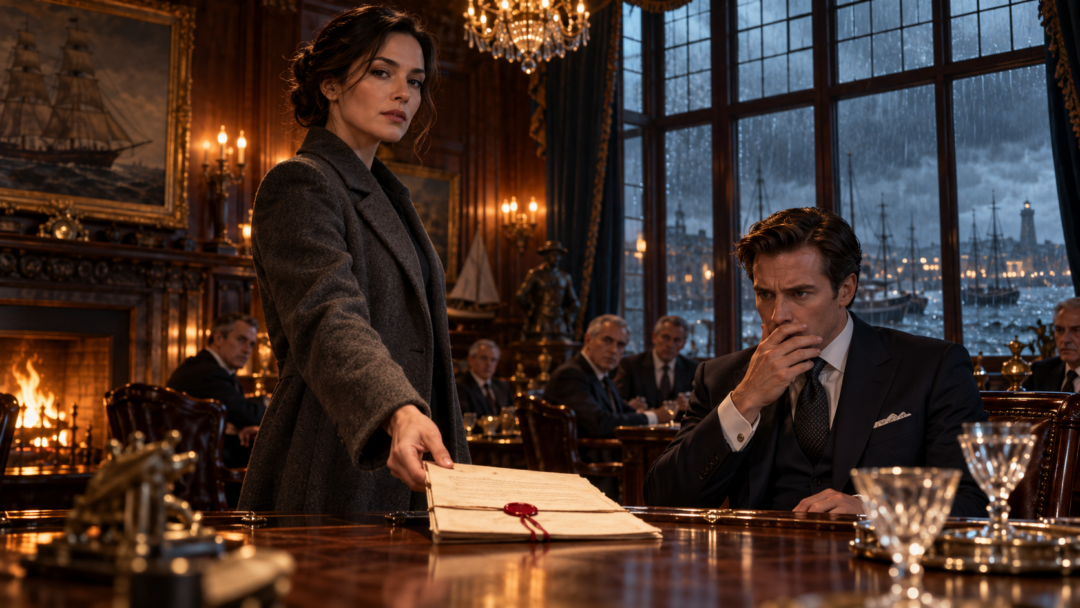
A woman walked into the lounge. She wore a soaking wet, off-the-rack charcoal wool coat buttoned to the collar, its hem dripping onto the Belgian wool runner. She carried no designer handbag, wore no pearls or diamonds, and her dark hair was gathered in a severe, functional twist at the nape of her neck. Her flat leather walking boots squeaked softly against the parquetry as she paused just inside the archway, her calm hazel eyes surveying the room with unhurried discernment.
Marcus glanced up, his thick silver eyebrows drawing together in theatrical annoyance. He held his glass aloft, waving two fingers toward the steward standing by the ice bucket.
“You look lost,” Marcus called out, pitching his voice so that every diner across the dining room could hear. “Someone help this person. The human resources interviews for the kitchen banquet staff were concluded at four o’clock in the service basement.”
The woman did not retreat. She did not blush. She took three slow, deliberate steps forward, stopping at the edge of the mahogany head table, right before the vacant chair reserved for the Club Commodore.
“This table is for members only,” Marcus said, his voice dropping into a cutting, nasal sneer. He glanced around the table, eliciting dry, obsequious chuckles from his fellow developers. “In fact, this entire floor is reserved for voting equity holders. We pay sixty thousand dollars a year in auxiliary dues for the privilege of not having our evening aperitifs interrupted by wandering job applicants.”
“I am not applying for a job, Marcus,” the woman said. Her voice was not loud, but it possessed a strange, resonant density that cut cleanly through the crackle of the hearth and the murmur of conversation.
Marcus set his crystal tumbler down on a silver coaster with an exaggerated clatter. He stood, buttoning his jacket across his broad stomach, leaning forward over the table to loom above her. “You know my name, which proves you can read the masthead on the municipal notices. But you don’t know your place. Look at yourself. A damp thirty-dollar coat, scuffed boots, standing in the inner sanctum of the oldest private maritime institution in New England. You’re a placeholder, my dear. Nothing more. People like you don’t belong in this room, and dress like that, you certainly cannot expect respect.”
The lounge fell into an uncomfortable, absolute silence. A waiter froze with a bottle of champagne poised over a flute.
Elena Voss did not blink. Her breathing remained rhythmic and deep, her hands resting calmly inside the deep pockets of her plain grey coat.
“Respect is not purchased from a tailor, Marcus,” she said softly. “Nor is it acquired by spending sixty thousand dollars of borrowed money on auxiliary dues.”
She withdrew her right hand from her coat pocket.
Between her fingers was a legal document—not modern letter-sized copy paper, but an archaic folio of heavy, deckle-edged cream parchment, tied with a dark green silk ribbon and sealed with a heavy medallion of deep crimson wax.
Elena stepped to the table and laid the document flat upon the polished mahogany. With a single, fluid flick of her index finger, she slid the parchment across the wax-rubbed grain.
It glided three feet across the wood, stopping dead center before Marcus Reed’s silver coaster.
Marcus frowned, casting a suspicious, irritated glance at the red wax seal. The seal was embossed with an anchor entwined with a northern hemlock bough—the ancient, private crest of the Voss Shipping Line.
“What is this theatrical nonsense?” Marcus scoffed, reaching down with two disdainful fingers to flip the parchment open.
His eyes scanned the top margin: AGREEMENT OF ACCELERATED INDEBTEDNESS & SURRENDER OF EQUITY VOTING TRUST.
Beneath the title was a schedule of seven defaulted promissory notes, totaling twenty-two million four hundred thousand dollars, issued by the Portland Commercial Trust to Marcus Reed personally, secured by his majority voting shares in the Atlantic Maritime Club.
And at the bottom of the page, beneath the notary seal dated eight o’clock this morning, was Marcus Reed’s own bold, sweeping signature in black archival ink, countersigned by the Federal Bankruptcy Receiver for the First District of Maine.
Marcus’s ruddy face drained of color with horrifying rapidity. The blood rushed from his cheeks, leaving his skin the shade of wet beach sand. His breath caught in his throat with a dry, rattling gasp.
“This… this is my signature,” he whispered, his hands trembling so violently that his heavy gold signet ring clicked against the glass.
Elena Voss stood over him, her eyes calm, unyielding, and ancient as the granite headlands outside.
“Sit down, Marcus,” she said, her voice dropping into a register of absolute command that shook the crystal pendants of the chandelier above them. “I own this building. I always did.”
CHAPTER 2: THE CHARTER IN THE LEATHER CASE
The silence that locked the Commodore’s Lounge was so profound that the sputtering of the gas wall sconces sounded like whispers of dry paper. Marcus Reed collapsed back into the burgundy leather wingback chair, his fingers clutching the arms of the seat as though the mahogany frame were the only solid object remaining in an unmoored world.
“This is an invalid conveyance,” Marcus stammered, his baritone voice cracking into a shrill, breathless rasp. He shoved the parchment away from him across the table, his eyes darting frantically toward Arthur Vance and Julian Sterling, his two principal partners on the harbor redevelopment consortium. “The Portland Commercial Trust had an informal forbearance agreement on my mezzanine credit facility. I spoke with their vice-chairman on Tuesday. They promised thirty days before executing any acceleration!”
“The Portland Commercial Trust was acquired at midnight yesterday,” Elena said, stepping around the head of the table. She pulled out the high-backed mahogany armchair carved with the club’s twin anchors—the Commodore’s seat that had remained vacant for seven years—and sat down with unhurried grace. She did not remove her wet grey coat. She folded her hands over the green blotter. “The holding company that purchased their distressed maritime portfolio is the Penobscot Heritage Maritime Foundation. I am the sole trustee.”
Arthur Vance, an elderly maritime lawyer with trembling hands and gold-rimmed bifocals, picked up the parchment with reverence. His eyes scanned the legal riders on the third page, his weathered face tightening in dismay. “It’s executed under Chapter 11 expedited maritime salvage provisions, Marcus. The debt was collateralized against your voting shares, your personal residence on Cape Elizabeth, and your commercial leasehold over the pier slips. When the foundation called the default at nine this morning, the shares transferred automatically by operation of law. Miss Voss holds sixty-two percent of the club’s active equity.”
“She’s an impostor!” Marcus shouted, slamming his fist onto the table, rattling the silver coasters. Several elderly patrons at nearby tables looked up in alarm. “Her father, Lawrence Voss, was expelled from this board in nineteen ninety-six! He died a bankrupt derelict in the county infirmary! The Voss name was erased from this institution thirty years ago!”
Elena’s gaze remained fixed on Marcus, cold and level. “My father was not expelled, Marcus. He was framed. In nineteen ninety-five, he discovered that you and your father were diverting municipal harbor dredge bonds into an offshore shell company called Blue Atlantic Dredging, registered in Hamilton, Bermuda. When he refused to sign the audit waiver, you forged his signature on an unauthorized withdrawal from the club’s emergency capital reserve, leaked the allegation to the Portland newspapers, and used the scandal to seize his seat.”
She reached into the inner pocket of her coat and withdrew a brass key on a braided leather lanyard.
“My father did not die a derelict,” she continued, her voice cutting through Marcus’s bluster like a surgical scalpel. “He spent the last twenty years of his life assembling the international banking records, invoice by invoice, wire transfer by wire transfer, tracking the twenty-two million dollars you laundered through the Grand Cayman subsidiaries. And this morning, that audit was delivered to the United States Attorney’s office in Boston.”
Marcus lunged forward across the table, his neck veins bulging against his stiff collar. “Security! Paul! Get in here!”
The double doors of the vestibule swung open, and Paul Cormier, the club’s chief of private security, stepped into the lounge. He was a broad-shouldered retired state trooper with a scarred jaw and a heavy radio strapped to his belt.
“Escort this woman off the property immediately,” Marcus ordered, his voice trembling with fury. “She is trespassing on private corporate property, creating a public disturbance, and making fraudulent legal claims against the managing director.”
Paul looked at Marcus, then looked at Elena seated calmly in the Commodore’s chair. He did not unholster his baton. He did not move toward her.
“Paul!” Marcus roared. “Did you hear me? I pay your salary!”
“Actually, Mr. Reed,” Paul said quietly, his voice carrying the flat neutrality of a professional who had read the writing on the wall hours ago, “my contract is with the corporate entity that holds the real estate deed. Miss Voss’s legal counsel presented certified copies of the equity transfer and the municipal land patent to the security office at four o’clock this afternoon. Under club bylaws, section four, paragraph twelve, the majority equity holder commands all physical plant security.”
Paul stepped aside, revealing two men in plain dark suits standing in the vestibule behind him. Both wore small gold lapel pins and carried thick leather briefcases.
“And furthermore, Mr. Reed,” Paul added, “the gentlemen behind me are special agents from the Internal Revenue Service’s Criminal Investigation Division. They have requested that no documents or digital records be removed from the executive office on the third floor.”
Marcus’s mouth opened, but no sound emerged. He looked at Julian Sterling, but his longtime partner had already turned his chair away, staring intently into the depths of his scotch glass as if Marcus were an absolute stranger.
“You think this is over, Elena?” Marcus whispered, his teeth bared in a feral snarl. “Even if you hold the paper, the municipal city council approved the casino zoning this morning. The bulldozers roll onto the west wharf on Monday. The city needs the tax revenue, and your little heritage trust can’t outbid sixty million dollars in private development capital.”
Elena stood up, smoothing the front of her wet wool coat.
“The city council approved a project based on a fraudulent title, Marcus,” she said, resting her palms flat against the mahogany table. “Because the land beneath the west wharves does not belong to the Atlantic Maritime Club. It belongs to the Working Waterfront Pension Trust. And the original 1884 deed that proves it is locked in the foundation vault beneath this floor.”
CHAPTER 3: THE LEDGER IN THE VAULT
The descent into the sub-basement of the Atlantic Maritime Club was like traveling back through a century of salt, stone, and labor. While the upper floors gleamed with polished brass and French varnish, the lower levels were constructed of massive blocks of rough-quarried Cape Elizabeth granite, fitted together in 1884 by Scottish stonemasons without mortar. The damp air here smelled of low tide, coal dust, and aged tallow candles.
Elena Voss led the way down the spiral iron staircase, her boots ringing against the rusted treads. Behind her came Captain Thomas Thorne, the seventy-two-year-old harbor pilot whose weathered face was lined like a nautical chart, followed by Arthur Vance and the two IRS agents who recorded every step on handheld cameras.
Marcus Reed brought up the rear, guarded closely by Paul Cormier. His tailored suit was now rumpled, his silk tie loosened, his eyes burning with the cornered desperation of a man who realized the ground was crumbling beneath his feet.
“This is an exercise in futility, Thorne,” Marcus sneered, his voice echoing off the damp granite walls. “The basement vaults were inventoried in nineteen eighty-four during the centennial renovation. There are no uncataloged documents down here. Just old wine crates and broken rowing sculls.”
“You never looked behind the coal bunkers, Marcus,” Captain Thorne replied without looking back, his voice gravelly from fifty years of breathing harbor fog. “Because men like you only look where the lights are bright and the carpets are thick. Lawrence Voss knew this building better than any man alive. When you pushed him out in ninety-six, he didn’t run away. He spent three days down here with an acetylene torch and a bag of hydraulic cement.”
At the end of the vaulted stone corridor stood an ancient iron bulkhead door, fitted with three heavy bronze wheel-locks that had turned green with verdigris. Above the lintel, carved into the granite arch, was the original Latin inscription of the founders: MARE NOSTRUM CONSERVANDUM—Our Sea Must Be Preserved.
Elena stepped to the central wheel. She did not use force; she pulled a small tin of neatsfoot oil from her coat pocket, lubricated the bronze spindle, and turned the wheel with a firm, practiced two-handed thrust.
The heavy gears inside the door groaned, a shower of dried rust flaking onto the granite flags. With a shuddering gasp of unsealed air, the four-inch iron door swung open into darkness.
The chamber beyond was the original charter vault, built beneath the low-water line of the harbor basin. The sound of water was everywhere—a steady, rhythmic subterranean slap of waves against the seawall just outside the masonry.
In the center of the room sat a heavy iron safe manufactured by the Herring-Hall-Marvin Safe Company in 1888, its floral gilt scrollwork faded but intact.
Elena approached the safe. She lifted the small brass key she had carried from her coat, inserted it into the secondary keyhole beneath the combination dial, and rotated it four turns counter-clockwise until an internal tumblers dropped with a sharp, heavy clack.
She did not touch the dial. She pulled the heavy steel handle upward.
The safe door swung wide on oiled hinges.
Inside, resting on a shelf of oiled cedar, were not gold bars or stock certificates, but two thick, leather-bound folio ledgers wrapped in heavy tarred sailcloth.
Elena lifted the first ledger and laid it upon the stone examination pedestal beneath the overhead halogen work light. She pulled back the sailcloth.
The leather cover was embossed in gold foil: THE PORTLAND WATERFRONT WORKERS MUTUAL BENEVOLENT & PENSION ASSOCIATION – CHARTER OF 1884.
Captain Thorne drew in a sharp, ragged breath, his calloused hand trembling as he touched the edge of the leather. “The original indenture. The one Marcus’s father claimed was lost in the Great Fire of nineteen twelve.”
“It wasn’t lost,” Elena said, turning the heavy linen rag pages with surgical care. “It was entrusted to my grandfather, Commodore Christian Voss, to prevent the commercial shipping syndicates from seizing the deep-water slips. Look at Section 14, Mr. Vance.”
Arthur Vance leaned over the ledger, adjusting his spectacles. His breath caught in his throat as he read the calligraphic iron-gall script:
‘Be it known in perpetuity: That the twelve hundred feet of granite deep-water frontage between Wharf Street and Fore Wharf are held in irrevocable communal trust for the active dockworkers, boatmen, and fishermen of Casco Bay. No commercial lease, sale, or mortgage may be executed without the unanimous affirmative vote of the Working Waterfront Trustees.’
“And who are the current trustees?” one of the IRS agents asked, his pen poised over his legal pad.
Elena turned the page to the signature register. Beneath the signatures of thirty longshoremen from the nineteenth century were five recent entries:
Lawrence Voss, Executor (Deceased)
Thomas Thorne, Master Harbor Pilot
Sarah Higgins, Longshoremen’s Local 861 President
James O’Donnell, Co-op Director
Elena Voss, Trustee Successor Appointed October 12, 2026
Arthur Vance took off his glasses, his hands shaking so violently he nearly dropped them on the granite floor. He turned to Marcus, his face pale with horror. “Marcus… you sold development rights to a parcel of land you never owned. The club only held an operating easement on the clubhouse structure itself. The waterfront—the slips, the piers, the casino footprint—is public maritime trust property.”
Marcus stepped back toward the iron doorway, his face twisting into a mask of pure, frantic malice. “A piece of yellow paper from the nineteenth century doesn’t stop seventy million dollars in private equity! Nobody cares about dead dockworkers! The city needs that casino!”
Suddenly, a loud, metallic clatter echoed from the corridor outside, followed by the heavy slam of the outer iron security gate and the frantic shouting of voices from the upper staircase.
CHAPTER 4: THE PILOT IN THE STORM
The sudden crash of the security gate overhead vibrated through the granite floor of the vault like an acoustic shockwave. Paul Cormier reacted instantly, drawing his heavy Maglite from his belt and stepping into the arched stone corridor.
“Stay here,” Cormier ordered, his thumb clicking the high-intensity halogen switch. “Someone just breached the service alley entrance.”
Elena Voss did not move from the stone pedestal. She closed the leather cover of the 1884 charter, re-wrapped it in the tarred sailcloth, and tucked it securely beneath her left arm. In her right hand, she held the secondary ledger—the modern operational audit her father had compiled.
Before Cormier could reach the base of the iron spiral stairs, a figure stumbled down the steps into the beam of his light.
It was Sarah Higgins, the forty-year-old president of the Portland Longshoremen’s Local 861. She was drenched to the skin, wearing a high-visibility yellow foul-weather jacket over her work dungarees, her face flushed with frantic adrenaline.
“Captain Thorne!” Sarah shouted, spotting the retired pilot in the vault doorway. “They’re moving the equipment onto the wharf! Three heavy transport flatbeds from Reed Contracting just pulled past the commercial gate with hydraulic excavators! They’re staging to demolish the old cold-storage shed at midnight before the injunction can be filed!”
Marcus Reed let out a barking, triumphant laugh that bordered on hysteria. He straightened his rumpled jacket, a wild, manic gleam returning to his eyes. “You’re too late, Elena! The demolition permits were signed by the city building inspector at five o’clock! Once the historical structures are leveled, the state environmental review is moot! The property becomes a cleared commercial brownfield! You can wave your nineteenth-century paper in front of the wreckage on Monday morning!”
Elena walked past Marcus without acknowledging his existence. She looked directly at Sarah Higgins. “How many men do you have at the union hall on Commercial Street?”
“Seventy on the night shift,” Sarah answered, her jaw clenching like iron. “Another hundred forty on standby. We knew Reed was up to something when the private security detail started clearing the fishing trawlers out of Slip 3 this afternoon.”
“Call them,” Elena commanded, her voice ringing off the stone vault like a brass bell. “Tell them to bring their utility trucks, their forklifts, and their line-tenders. We aren’t waiting for Monday morning. We invoke the 1884 Charter tonight.”
Marcus lunged toward Sarah, his hands reaching to snatch the radio from her belt, but Captain Thorne stepped into his path with the immovable density of a granite bollard. The seventy-two-year-old pilot shoved Marcus backward with a single forearm shiver that sent the developer sprawling against the damp stone wall.
“Don’t touch her, Marcus,” Thorne growled, his voice vibrating with forty years of buried contempt. “You’ve treated this harbor like your private casino for thirty years. Your father stole our grandfather’s boats, and you tried to steal our children’s future. That ends tonight.”
They surged up the spiral staircase, leaving Marcus scrambling to his feet in the dark, cursing in wild, breathless obscenities.
When they emerged from the service corridor into the driving rain of the commercial wharf, the scene was an industrial war zone.
The freezing gale was blowing sixty miles an hour off the bay, tossing white spray over the seawall. Glaring under portable diesel floodlights were three massive yellow Caterpillar excavators, their diesel engines roaring as their hydraulic arms swung toward the seventy-foot cedar walls of the historic 1890s maritime cold-storage shed.
Standing on the hood of a luxury four-wheel-drive SUV parked across the railroad tracks was Donald Reed, Marcus’s younger brother and the head of Reed Contracting, shouting through an electric bullhorn: “Clear the apron! This is a condemned commercial hazard under municipal emergency order! Move back!”
Suddenly, from the darkness of Commercial Street, the deep, concussive blare of two dozen air horns detonated through the storm.
A convoy of twenty heavy diesel forklifts, flatbed lumber trucks, and line-handling utility rigs rumbled down the cobblestones, their orange hazard beacons flashing in wild, spinning arcs against the black rain. Behind the vehicles marched over two hundred dockworkers, deckhands, and commercial fishermen, their yellow and orange foul-weather gear glowing brightly in the dark.
They did not shout threats. They did not brandish weapons.
They moved with the synchronized, practiced discipline of men and women who handled twenty-ton cargo containers in sub-zero gales. Within ninety seconds, the forklifts dropped their heavy steel tines directly beneath the axles of Reed’s three excavators, pinning the multi-ton machines in an inescapable mechanical vise.
The utility trucks formed a solid wall of iron bumper-to-bumper across the pier approach, completely sealing the demolition site from any further corporate intrusion.
Elena Voss climbed onto the steel bed of the lead union flatbed, standing tall against the driving rain, the black wind tearing at her grey coat. She raised the heavy leather-bound 1884 Charter high above her head.
The halogen work lights pinned her in a blinding, crystalline spotlight against the dark Atlantic.
“Donald Reed!” Elena’s voice cut through the storm, amplified by the union truck’s high-output public address system. “By authority of the Working Waterfront Mutual Charter of 1884, and as managing trustee of this sovereign property, I revoke your commercial access immediately! Cut your engines, step down from those machines, and vacate this pier!”
Donald Reed stared up at her through the rain, his bullhorn lowering to his side, his face frozen in stunned disbelief as two hundred dockworkers stepped forward in unison, their presence an unyielding, living wall of iron and stone.
CHAPTER 5: THE GLASS ON THE MAHOGANY
The standoff on the rain-swept pier held for ten agonizing minutes until the sudden wail of emergency sirens echoed across the waterfront. Four black-and-white cruisers from the Maine State Police and two marked units from the Waterfront Police Division rolled onto the cobblestones, their red and blue emergency bars painting the wet brick facades in flashing arcs of crimson and sapphire.
Major William Callahan of the State Police stepped out of the lead cruiser, his waterproof campaign hat pulled low against the freezing gale. He surveyed the wall of union forklifts, the pinned excavators, and the crowd of two hundred silent, resolute workers.
“Who is in charge of this assembly?” Callahan demanded, his voice amplified by his cruiser’s bullhorn.
Elena Voss stepped down from the flatbed truck and walked forward into the glare of the police headlights, accompanied by Captain Thorne and Arthur Vance. She did not raise her voice. She handed Callahan a blue-bound legal folio containing the certified emergency injunction issued thirty minutes ago by Federal District Judge Margaret Sullivan via electronic seal.
“I am Elena Voss, Trustee of the Portland Waterfront Charter,” she said, her tone crisp, professional, and absolute. “Reed Contracting is attempting to execute an illegal demolition on contested historical trust property in direct violation of a federal preservation stay.”
Callahan read the judicial order, his eyes scanning the electronic seal and the federal docket number. He turned toward Donald Reed, who had scrambled down from his SUV, his face pale and furious.
“Shut down the equipment, Mr. Reed,” Callahan ordered flatly. “Key off, crews off the pier. If a single tooth of an excavator bucket touches that wood, your operators are going into custody for felony criminal mischief on federal trust land.”
Donald Reed threw his hard hat onto the wet cobblestones in disgust, barking orders to his operators to kill the diesel engines. Within two minutes, the deafening roar of heavy machinery died away, leaving only the sound of the wind, the sea, and the steady hum of the police cruisers.
“Come with me, Major,” Elena said quietly to Callahan. “The true crime isn’t on this pier. It’s on the third floor of the Atlantic Maritime Club.”
Elena led Callahan and a detachment of four state troopers back up the granite steps of the clubhouse.
The Commodore’s Lounge was in a state of chaotic disintegration. Marcus Reed had returned to the third-floor executive suite and was frantically stuffing armfuls of files, offshore bank statements, and leather ledger books into heavy canvas duffel bags.
The oak double doors flew open with a resounding bang, slamming against the plaster walls.
Marcus spun around, clutching a thick stack of bearer bond certificates to his chest. His hair was plastered across his forehead with cold sweat, his tie torn, his bespoke suit ruined.
“This is private corporate territory!” Marcus screamed, his voice cracking into high-pitched hysteria. “Callahan, arrest this woman! She incited a riot on the commercial pier! She blocked licensed construction equipment!”
“Put the papers on the desk, Marcus,” Callahan said, his hand resting on the snap of his service holster, his expression carved from granite.
Elena walked past the troopers, stopping directly before the antique mahogany executive desk. She picked up a heavy crystal tumbler that Marcus had abandoned on the green blotter and set it aside. In its place, she laid the modern operational audit her father had compiled—Volume 2 of the Voss investigation.
“On October fourteenth,” Elena spoke with clinical, devastating precision, “you wired four point two million dollars from the Atlantic Club’s capital reserve into an account at the Bank of Butterfield in Hamilton, Bermuda, under the name ‘Blue Atlantic Dredging’. On October eighteenth, that exact sum was transferred into a personal brokerage account at Merrill Lynch in New York to cover your failing margin calls on the casino development syndicate.”
Marcus’s eyes darted frantically toward the open window, where the cold ocean gale blew the heavy velvet curtains inward like dark sails. “You don’t understand the complexities of commercial finance, Elena! It was an inter-company loan! It was approved by the finance committee!”
“The finance committee consisted of three men,” Elena said, pointing to the documents. “Julian Sterling, Arthur Vance, and yourself. And Arthur Vance signed a full criminal cooperation proffer with the United States Attorney thirty minutes ago in the vault.”
Julian Sterling, who was standing in the doorway flanked by two state troopers, bowed his head in complete, silent shame, unable to meet Marcus’s wild, accusing glare.
“You’re done, Marcus,” Elena said, her voice dropping into a hush that filled the paneled room with the weight of an unpayable debt. “The casino will not be built. The dockworkers will keep their slips. And the name of Lawrence Voss will be restored to the charter you stole thirty years ago.”
Marcus stared at her, his chest heaving, his fingers clawing at the edge of the mahogany desk until the wood creaked under his grip. For the first time in his life, the aristocratic bluster, the loud laughter, and the expensive suits had failed him. He was not a maritime titan. He was an embezzler caught with his hands in the safe.
Elena stood motionless in the center of the third-floor office, watching the rain beat against the arched dormer windows. Every corner of this room was saturated with the memory of her father’s final days in office. She remembered coming here as a girl of twelve, sitting on the window seat with a brass spyglass, watching the pilot schooners navigate the swirling rip-tides of Hussey Sound while her father dictated navigation notices to his clerks. Lawrence Voss had treated this institution not as a private playground for speculative wealth, but as an austere stewardship—a place where the captains of industry were held accountable to the men who hauled their lines and weathered their storms. Marcus Reed had inverted that sacred compact, turning the club into a gilded laundromat for paper profits and predatory schemes. The stacks of bearer bonds scattered across the floor were nothing more than dry husks of a hollow ambition that had devoured itself from within.
With a strangled, pathetic sob of defeated rage, Marcus Reed let the stack of bearer bonds slip from his fingers, watching them scatter like fallen leaves across the polished parquet floor.
CHAPTER 6: THE GAVEL ON THE TABLE
By eleven o’clock on Sunday morning, the North Atlantic gale had blown out to sea, leaving behind a sky of crystalline, cold sapphire and a sharp mountain wind that made the red-and-white maritime flags snap proudly above the granite cupola of the Atlantic Maritime Club.
The Grand Dining Ballroom on the second floor—an opulent chamber with forty-foot timber truss ceilings, crystal chandeliers, and tall Palladian windows overlooking the sparkling expanse of Casco Bay—was packed to absolute capacity. Over four hundred lifetime voting members, retired sea captains, prominent Portland civic leaders, and thirty uniformed representatives of the Longshoremen’s Union sat in rows of velvet banquet chairs, an electric murmur of tension vibrating through the hall.
At the head of the room, seated behind the massive antique oak tribunal table, sat Elena Voss.
She had finally shed her rain-soaked grey wool coat. She wore a tailored, high-collared navy blue woolen suit with silver nautical buttons—an austere, impeccably cut garment that had belonged to her grandmother, Commodore Christian Voss’s wife. Beside her sat Captain Thomas Thorne, wearing his full-dress maritime service jacket, and Arthur Vance, who had spent the night reviewing the legal covenants for the state attorney.
The center seat at the tribunal—the Commodore’s Chair—was empty no longer.
Elena picked up the historic whalebone gavel, carved in 1884 from the rib of a North Atlantic right whale, and struck the brass sounding block three times.
Crack. Crack. Crack.
The sharp, concussive strikes echoed through the cavernous hall like naval gunfire, instantly silencing the four hundred assembled patrons.
“This extraordinary general assembly of the Atlantic Maritime Club is called to order,” Elena spoke, her voice clear, calm, and effortlessly commanding every corner of the room. “Pursuant to Section 8 of the 1884 Foundation Charter, the equity holders and trustees convene to receive the executive audit and determine the governance of this institution.”
From the back of the ballroom, flanked by two armed federal marshals and Detective Inspector Callahan, Marcus Reed was escorted into the room. He wore no handcuffs, but his bespoke suit was crumpled, his face drawn and hollow, his silver hair uncombed. He looked like an actor who had stumbled onto the stage long after the play had concluded.
Elena did not look at him with malice. She did not raise her voice in triumph.
She tapped the key on her laptop terminal, and the massive high-definition presentation monitors flanking the stage illuminated simultaneously, displaying the forensic audit traces compiled by the IRS Criminal Division.
“For thirty years,” Elena addressed the assembly, “the membership of this club was led to believe that the financial insolvency of 1996 was caused by the mismanagement of Commodore Lawrence Voss. Today, the United States District Court unsealed the true ledger recovered from the foundation vault.”
The screen displayed the 1996 banking wires from Hamilton, Bermuda, showing the systematic diversion of twenty-two million dollars by Marcus Reed, juxtaposed with the forged resignation letter bearing Lawrence Voss’s traced signature.
Gasps of outrage and disbelief rippled across the room. Several elderly members who had known Lawrence Voss rose to their feet, their faces burning with righteous anger.
“The criminal indictments against Marcus Reed and Donald Reed for wire fraud, money laundering, and grand corporate larceny have been unsealed,” Elena continued, turning her gaze toward Marcus standing in the center aisle. “The federal government has placed a total freeze on their personal and corporate assets. The twenty-two million dollars will be repatriated in full to satisfy the club’s municipal liabilities.”
Marcus stepped forward, his voice cracking into a desperate, hollow plea: “I built this modern institution! Before me, this club was a dying relic of dried cod and whale oil! I brought sixty million dollars in development capital to this waterfront!”
“You brought corruption dressed in tailored wool, Marcus,” Captain Thomas Thorne spoke from the dais, his voice booming like thunder. “You sold the birthright of four generations of working seamen to line your own offshore accounts. You forgot that this city was built on honest sweat, not speculative deceit.”
Elena lifted the whalebone gavel once more.
“Under the powers granted to the Trustee Successor by the 1884 Indenture,” she proclaimed, “the board of directors is hereby dissolved. The proposed commercial sale of the west wharves to the casino development syndicate is permanently null and void. The deep-water slips are restored in perpetuity to the Working Waterfront Trust.”
She brought the whalebone gavel down onto the brass block with a final, decisive strike that rang like a church bell across the room.
Crack.
“Marcus Reed,” Elena concluded, looking directly into his shattered eyes. “You are hereby stripped of your membership, your titles, and your privileges. You will never set foot inside this building again.”
The grand ballroom remained in a state of suspended disbelief as the full magnitude of the financial revelations settled across the rows of seated members. For decades, the board had functioned as an impenetrable private fortress, shielding its managing directors behind impenetrable layers of social prestige and unwritten gentleman’s agreements. Many of the older patrons had suspected that the club’s escalating operating deficits were not merely the result of rising maintenance costs, but none had dared challenge Marcus Reed’s booming assertions of commercial inevitability. Now, watching the forensic banking wires illuminated upon the towering screens, the illusion of aristocratic invulnerability dissolved into the cold reality of criminal malfeasance. The whispers that rustled through the crowd were not merely expressions of shock; they were the collective awakening of a membership that realized it had been made an unwitting accomplice to the destruction of the very maritime community that gave the club its name and purpose.
A thunderous, deafening standing ovation erupted from the four hundred patrons, a roar of applause and cheers that shook the crystal chandeliers, while federal marshals took Marcus Reed by the arms and led him through the rear doors into the custody of the United States District Court.
CHAPTER 7: THE TRUE HARBOR IN THE SUNLIGHT
By late afternoon, the sun hung low and brilliant over Casco Bay, painting the rolling swells in dazzling ripples of hammered copper and gold. The brisk northwest wind carried the clean, invigorating scent of ocean salt, pine sap, and drying seaweed, completely scouring away the sulfurous reek of the night’s storm.
On the commercial wharf, the transformation had already begun. The three massive excavators belonging to Reed Contracting were loaded onto flatbed trailers under the watchful supervision of the State Police and hauled off the pier, their yellow steel vanishing down Commercial Street to the cheers of fifty watching dockworkers.
The seventy-foot cedar walls of the 1890s maritime cold-storage shed stood intact, their ancient timber shingles catching the golden light, proud and unbroken against the harbor horizon.
Elena Voss stood at the end of the granite pier, leaning against the massive cast-iron mooring bitt. Her plain grey wool coat was dry now, smelling of cedar shavings and sea wind. Beside her stood Sarah Higgins and Captain Thomas Thorne, both holding mugs of hot black coffee handed out from the union galley wagon.
“The federal judge signed the permanent protective covenant an hour ago,” Sarah said, looking out at the rows of wooden lobster boats and steel-hulled trawlers bobbing peacefully at Slip 3. “The entire twelve hundred feet of deep-water frontage is designated as an irrevocable Working Maritime Sanctuary. No developer, no casino, and no corporate syndicate can ever touch this waterline again.”
Captain Thorne took a slow sip of his coffee, his pale blue eyes misting as he looked up at the towering granite cupola of the Atlantic Maritime Club on the hill above them.
“Your father would have been proud, Elena,” the old pilot said softly, his voice thick with unashamed emotion. “Lawrence spent thirty years in the wilderness carrying the weight of that lie. He never wavered. He always told me that truth is like ballast in a sailing hull—men can tip the ship with their greed, but the ballast will always right her in the end.”
“He knew this day would come, Captain,” Elena replied, looking out across the sparkling blue water toward the lighthouse at Portland Head. “He just needed someone to deliver the paper.”
From the harbor approach, the deep, resonant horn of the morning ferry sounded, signaling its arrival into the channel. Along the docks, the normal, honest rhythm of the working waterfront resumed with energetic vitality: wooden crates of fresh Atlantic cod were hoisted onto the packing docks, ice machines hummed with clean white frost, and fishermen called out greetings in thick, authentic Down East accents that had echoed across these waters for two hundred years.
A young associate from Elena’s legal office in Boston hurried down the pier, carrying a leather dispatch case and a freshly printed municipal charter bearing the official golden seal of the City of Portland.
“Miss Voss,” the young lawyer said, handing her the document with profound respect. “The City Council convened in emergency session. They have formally renamed the commercial waterfront basin: The Lawrence Voss Memorial Maritime District. And the Board of Trustees has unanimously appointed you lifetime Commodore of the Atlantic Maritime Trust.”
Elena looked at the document, tracing the embossed lettering of her father’s name with the tip of her finger.
She did not smile with vanity or triumph. She folded the charter with the same calm, deliberate care she had used when handling the 1884 parchment, slipping it into the inner pocket of her coat.
“Thank you, David,” she said quietly. “Tell the board that the Commodore’s Lounge is open to any working sailor, pilot, or boatman who comes through those doors. We don’t have members-only tables anymore. We have a shared harbor.”
The low afternoon tide revealed the dark, weed-draped granite footings of the ancient wharves, where generations of Maine shipwrights had laid the keels of five-masted schooners that sailed to every continent on the globe. Elena walked along the timber boardwalk, her hand lightly trailing along the rough cedar rail, breathing in the rich, earthy fragrance of salt mud and kelp. The restoration of her family’s name was not a personal victory to be hoarded in quiet pride; it was a public reckoning that returned this stretch of coastline to the people who depended upon it for their daily bread. She knew the work had only just begun—the legal trusts had to be fortified against future corporate litigation, the pension accounts had to be audited and secured under federal oversight, and the physical timber sheds required extensive structural rehabilitation after years of neglect. But as she watched the young deckhands coiling lines on the forward deck of a returning trawler, their laughter carrying clean and bright across the harbor water, she knew the foundation was sound.
She turned back to face the vast, open Atlantic, watching the white sails of a pilot schooner catch the afternoon breeze as it cleared the breakwater.
She took a deep breath of the cold maritime air, feeling the profound stillness that settled over the headland after a lifetime of relentless struggle. The battle was won not with loud posturing or private security forces, but with the quiet, incorruptible authority of the truth inscribed upon parchment and preserved in granite.
The silent woman in the plain grey coat stood tall upon the granite pier, her roots planted deep in the bedrock of her home, knowing that the legacy her father had fought and died to preserve was finally safe under the clean, unyielding Maine sun.