The Stolen Recipe Card On The Silver Tray Exposed Their Dynasty
CHAPTER 1: THE SILVER DOME ON THE LINEN
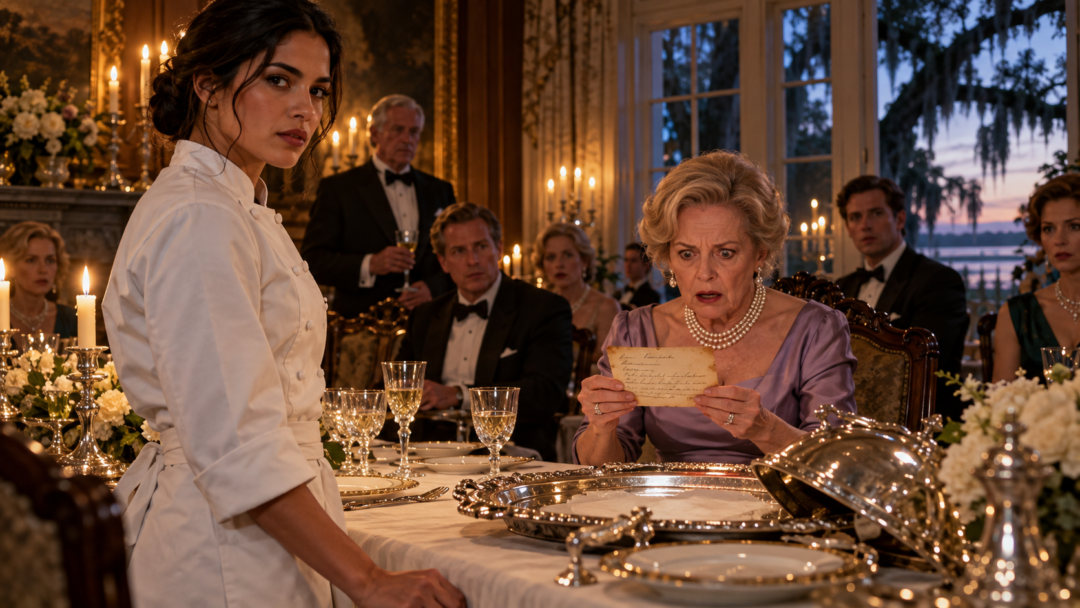
The October humidity of Charleston hung thick over the Cooper River, carrying the rich, swampy perfume of salt marsh, pluff mud, and blooming night jasmine. Through the fifteen-foot French windows of the Carolina Yacht Club, the Spanish moss draped across century-old live oaks swayed in the sluggish evening breeze like frayed grey lace. Inside the Ashley Room, twenty beeswax taper candles flickered in sterling silver candelabras, casting a warm, flattering amber glow across sixty seated patrons who represented the unchallenged pinnacle of Lowcountry society.
Sofia Reyes stood beside the central head table, holding a heavy, circular sterling silver serving tray in her left hand. At twenty-nine, her posture had the quiet, balanced stillness of a dancer who spent sixteen hours a day on her feet in commercial kitchens. Her dark curls were gathered into a neat, functional twist at the nape of her neck, secured with two tortoiseshell pins. She wore an immaculate, double-breasted white chef’s coat of heavy Egyptian cotton, unadorned by badges or corporate embroidery, the cuffs rolled twice above forearms that bore the faint, honorable crosshatches of sugar burns and grill scars.
Beside the vacant place setting at the head of the table sat Eleanor Winslow.
At sixty-eight, Eleanor was the reigning empress of Charleston’s culinary aristocracy. A triple strand of matched South Sea pearls rested against the collar of her lavender silk gown, her manicured fingers adorned with an antique emerald cut that had belonged to the first colonial governor of the Carolina province. Her face, preserved by three generations of European clinics and Southern deference, was set in an expression of languid, practiced supremacy.
She did not look up when Sofia set the small porcelain appetizer plates upon the damask linen. She swirled her crystal glass of vintage Madeira wine, watching the amber legs slide down the glass with bored detachment.
“Dress like that, and you expect respect?” Eleanor’s voice was a soft, melodic drawl that carried a razor-sharp blade beneath its honeyed cadence, pitched to ensure every guest within three tables heard every syllable. “A coarse white coat. No lace. No apron. You look like you stepped off the assembly line at the seafood cannery on East Bay.”
Sofia set down the silver tray on the service sideboard with slow, deliberate precision. The metal did not rattle. Her dark eyes remained level, calm, and impenetrable as deep river water. “The food on this tray was prepared for the Board of Governors, Mrs. Winslow.”
Eleanor gave a delicate, dismissive flutter of her diamond-ringed fingers toward the double louvered doors of the service pantry. “You’re a placeholder, my dear. Nothing more. The agency sends over these young women who take a twelve-week certificate course and suddenly think they belong in the dining rooms of the families who built this state. My grandfather established the Winslow Carolina Sauce company in nineteen twenty-four. We built this family’s name from nothing. From pure grit, ancestral land, and refined Southern taste. You showed up with a tray. Know your place, clear the bread plates, and leave the presentation to the head steward.”
A polite, sycophantic ripple of chuckles murmured across the table from Julian Winslow Jr. and the two bank vice-presidents seated to her right.
Sofia did not step back. She did not blush. Her hands remained steady at her sides.
“You built this family’s name,” Sofia repeated softly, her voice carrying a quiet, resonant gravity that caused the chuckles along the table to die away into awkward silence.
“Yes,” Eleanor said, her chin lifting with haughty arrogance, her pearls catching the candlelight. “We built it. Every bottle, every recipe, and every dollar.”
“You built it,” Sofia said again. “And my grandmother provided the bricks.”
Sofia reached beneath the rim of the silver serving platter sitting on the linen.
Between her fingers was an aged, yellowed three-by-five index card—not fresh cardstock, but brittle linen paper from the nineteen-sixties, its edges worn soft as flannel, stained with dark brown rings of aged molasses, apple cider vinegar, and dried roasted habanero mash.
Sofia laid the card flat upon the pristine white tablecloth, directly beside Eleanor’s wine glass.
Eleanor glanced down with theatrical irritation, her hand lifting to wave the scrap of paper away.
Her breath caught in her throat.
Written across the top of the card in beautiful, flourishing calligraphic script in faded blue iron-gall ink was a single title: Salsa Carolina Tradicional – Formula Maestra No. 4.
And below the title was the list of thirty-two secret botanical spices, the exact boiling temperatures, and the sixty-day barrel-aging ratios that had made the Winslow Sauce company a two-hundred-million-dollar international food conglomerate.
And at the bottom of the card, beneath the handwritten date of 14 de Octubre, 1964, was a single, elegant signature:
Rosa Elena Reyes, Jefa de Cocina.
Eleanor’s hand froze in mid-air, her fingers tightening around her triple-strand pearl necklace until the silk cord bit into her throat. The color drained from her face with terrifying speed, leaving her skin as pale and brittle as parchment. Her jaw worked soundlessly, her eyes locked onto the fading blue ink as if staring into an open grave.
Sofia Reyes looked down at the trembling matriarch, her voice dropping into a register of devastating, sorrowful peace.
“My grandmother’s name was on that card, Eleanor,” Sofia said quietly. “You kept the money for fifty years. You can keep the paper.”
She turned on her heel and walked out through the tall French doors into the courtyard, leaving the grand dining room in a silence so suffocating that the distant chime of St. Michael’s church bells sounded like a tolling bell for the dead.
CHAPTER 2: THE CARD ON THE MAHOGANY
The silence that hung over the Ashley Room was so thick that the flickering of the beeswax tapers seemed to sputter under an unbearable atmospheric weight. Eleanor Winslow sat motionless at the head of the table, her hand frozen against her chest, her breathing shallow and ragged beneath her silk gown.
Julian Winslow Jr., forty-two years old and wearing a bespoke tuxedo that struggled to conceal his paunch, slammed his hand onto the table, rattling the crystal flutes.
“What was that insolent stunt?” Julian barked, glaring at the service doors where Sofia had vanished. He reached across the linen and snatched the yellowed recipe card into his manicured fingers. “Some disgruntled catering cook trying to pull a shakedown at our annual founders’ dinner! Mother, don’t let this upset you. I’ll have the club manager call the city police and have her removed from the property for criminal harassment!”
Eleanor felt the breath freeze in her throat as the weight of fifty years of accumulated deceit pressed down upon her chest. She had known this day was coming; every time she had looked at the framed advertisements in national magazines, every time she had accepted a philanthropic honor from the city council, a cold voice in the back of her mind had whispered that the foundation was built on sand. She had spent decades buying the silence of her own conscience with diamond jewelry and European vacations, but the truth had waited with infinite patience for this exact moment.
“Julian… don’t,” Eleanor gasped, her voice reduced to a thin, terrified croak that startled her son.
Julian looked down at the recipe card. His eyes scanned the flourishing Spanish handwriting, moving past the ratios of smoked paprika and roasted pecans to the signature at the bottom: Rosa Elena Reyes.
Julian’s face went entirely blank.
As the executive vice-president of Winslow Heritage Foods, Julian had spent five years overseeing the commercial bottling plants in North Charleston. He had memorized the patented trade secret formula that had been locked inside the family’s private safe at the Bank of South Carolina since 1964—a formula that had been the subject of eight international corporate buyout offers.
The card in his hand was not a copy. It was not a student’s notes.
The paper, the watermarked seal of the Charleston Cotton Exchange from 1962, the precise mathematical balance of acidity and sweetness—it was the master archetype from which every commercial patent, every bottle label, and every advertising campaign had been derived.
“Where did she get this?” Julian whispered, his arrogance evaporating into a sudden, sour wave of cold sweat. “Grandfather’s personal journal said the original working papers were burned in the plantation kitchen fire sixty years ago.”
“They weren’t burned, Julian,” a gravelly, aristocratic voice spoke from three seats down the table.
Judge Edward Rutledge, seventy years old and a retired senior justice of the South Carolina Court of Appeals, set down his linen napkin with deliberate slowness. His lined, weathered face was carved from granite, his pale blue eyes studying the trembling matriarch with deep, unvarnished gravity.
“Rosa Reyes didn’t burn anything,” Judge Rutledge said, his voice carrying the quiet, unimpeachable authority of a man who had presided over fifty years of Lowcountry estate litigations. “Because that recipe was never Julian Winslow Sr.’s property. I was a young clerk in my father’s law office on Broad Street in the autumn of nineteen sixty-four, Eleanor. I remember when your late husband came into the office with that exact card in his breast pocket.”
Eleanor’s head snapped toward the judge, her eyes wide with desperate, pleading panic. “Edward… please. Not here. Not in front of the board.”
“Your husband told my father that Rosa Reyes had suffered a massive stroke during the harvest dinner and had been admitted comatose to the public charity hospital,” Rutledge continued, his voice ringing across the silent room. “He asked my father to draw up an emergency intellectual property patent assignment, claiming Rosa had sold the rights to her proprietary seasoning blends to the Winslow family for five hundred dollars in cash. When my father pointed out that there was no signature on the transfer deed, Julian Sr. pressed a dark ink pad against the finger of an unconscious woman in Ward Four of Roper Hospital.”
Gasps of horror rippled across the table. Two prominent corporate directors seated opposite Julian Jr. looked at the young heir with expressions of profound disgust.
“That’s ancient history!” Julian Jr. protested, his voice cracking with defensiveness. “The statute of limitations on civil conversion expired forty years ago! The patent is registered to Winslow Heritage Foods! We hold the commercial trademarks in seventy-two countries!”
“The statute of limitations protects against civil recovery of stolen property, Julian,” Judge Rutledge said, leaning forward, resting his palms on the table. “It does not protect against bank insolvency. And it certainly does not protect you from the woman who just walked out of this room.”
“What does a catering chef have to do with our bank?” Julian demanded.
“Sofia Reyes is not a catering chef, you fool,” Rutledge said with cold contempt. “She is the sole proprietor of La Rosa on King Street. Her restaurant was awarded three Michelin stars last month. And at nine o’clock this morning, Sofia Reyes and her investment trust purchased the twelve-million-dollar defaulted mezzanine note that Atlantic Harbor Commercial Bank held against your North Charleston bottling plant.”
Julian’s mouth fell open, his hands shaking so violently that the yellowed recipe card slipped from his fingers, fluttering back down onto the white damask linen.
“She… she bought our debt?” Julian stammered.
“She didn’t just buy your debt, Julian,” Eleanor whispered, her face buried in her hands, her voice breaking into an agonizing, broken sob of defeated pride. “She bought our name. And tomorrow morning, she is going to foreclose on everything we stole.”
CHAPTER 3: THE KITCHEN ON EAST BAY
The kitchen of La Rosa on East Bay Street operated in a state of immaculate, monastic discipline. While the dinner rush had concluded an hour before midnight, the room was still alive with the quiet, rhythmic sizzle of copper pans cooling on the range, the aromatic reduction of roasted veal stock, and the sharp, bright fragrance of crushed fresh cilantro and charred poblanos. Four young line cooks in spotless white aprons moved with silent efficiency across the quarry-tile floor, polishing the stainless-steel prep tables until they gleamed like mirrors.
Sofia Reyes stood at the central wooden butcher block in the rear of the kitchen, sipping a cup of black Mexican coffee from an earthenware mug. Her chef’s coat was unbuttoned at the collar, her dark hair tumbling loosely around her shoulders. On the cutting board before her lay an antique tin biscuit box painted with faded floral patterns—the box her grandmother had kept beneath her bed in the public housing tenements of North Charleston for forty years.
Inside the box were dozens of handwritten culinary journals, bundles of dried vanilla beans from Veracruz, and yellowed hospital receipts dated November 1964.
The heavy oak back door of the kitchen rattled as a hand knocked three times with frantic, arrogant urgency.
Sofia did not turn around. “Let him in, Mateo.”
Mateo, her six-foot-two sous-chef, unbolted the heavy deadbolt.
Julian Winslow Jr. stepped into the kitchen. He had shed his tuxedo jacket, wearing only his rumpled pleated shirt and suspenders, his silk tie loosened, his face flushed with the humiliating desperation of a prince who had discovered his castle was built on sand. He looked around the pristine kitchen with a mixture of inherited disgust and cornered terror.
“Miss Reyes,” Julian said, his voice attempting to reclaim its customary corporate polish but cracking under the strain. “I apologize for my mother’s remarks at the Yacht Club dinner. She is sixty-eight years old, she belongs to an older generation, and she was… startled by your presentation.”
Sofia took a slow sip of her coffee, her eyes studying him over the rim with calm, unwavering amusement. “Your mother wasn’t startled, Julian. She was terrified. She has lived sixty years in fear that someone would walk into her dining room holding the evidence of her husband’s theft.”
Julian stepped closer to the butcher block, pulling a heavy leather checkbook and a fountain pen from his pocket. “Let’s be pragmatic, Sofia. We are both commercial operators in a competitive market. The Winslow Sauce company has eight hundred employees and twelve million dollars in gross annual revenue. Whatever grievances occurred between our grandparents sixty years ago cannot be resolved by destroying an historic Charleston enterprise.”
He laid the checkbook on the wood, clicking the pen open.
“I am authorized by the board of directors to offer you five hundred thousand dollars in immediate cashier’s funds,” Julian said, his eyes gleaming with frantic calculation. “And an ongoing three-percent licensing royalty on all international sales of the master reserve sauce. In exchange, you surrender the 1964 recipe card, sign a perpetual non-disclosure agreement, and transfer the Atlantic Harbor debt note back to our holding company at par value.”
Sofia looked down at the gold-nibbed pen resting on her butcher block. She did not touch it.
She reached into her tin biscuit box and pulled out a certified legal document bearing the blue embossed seal of the United States District Court in Columbia.
She laid it flat before Julian’s eyes.
“This is an emergency Writ of Judicial Attachment, Julian,” Sofia spoke, her voice dropping into a register of absolute, mathematical finality. “Executed at five o’clock this afternoon by Federal Bankruptcy Judge Thomas Campbell. When your holding company defaulted on its quarterly interest payment to Atlantic Harbor Bank in August, the loan agreement permitted the senior debt holder to execute an immediate debt-for-equity conversion.”
Julian’s hands froze over the checkbook, his eyes darting across the legal text:
CERTIFICATE OF EQUITY REORGANIZATION: 100% OF VOTING COMMON STOCK IN WINSLOW HERITAGE FOODS INC. TRANSFERRED TO REYES CULINARY ENTERPRISES LLC AS FULL SATISFACTION OF SENIOR LIEN.
Julian staggered backward, his breath catching in his throat with a dry, choking rattle. “No… no, this is impossible! The board was negotiating an extension with the bank’s commercial division!”
The grand room seemed to shrink beneath the weight of historical memory. The portraits of past commodores and cotton barons hanging along the heart-pine walls looked down upon the shattered table with unseeing, painted eyes. For generations, the aristocratic families of the Battery had convinced themselves that their wealth was the natural product of superior bloodlines, refined taste, and divine providence. They had erased the names of the enslaved cooks, the immigrant seamstresses, and the dockside laborers whose stolen brilliance had filled their silver coffers and built their neoclassical monuments. Now, watching the trembling hands of their reigning matriarch, the illusion of Southern exceptionalism fractured into the cold, indisputable reality of criminal exploitation.
“The bank sold the note to me this morning, Julian,” Sofia said calmly. “Because while you were spending four hundred thousand dollars on private yacht club galas and antique pearls for your mother, your bottling plant in North Charleston was cited for twenty-four OSHA safety violations, your canning machinery was leaking motor oil into the holding tanks, and your four hundred line workers were working without health insurance.”
She stepped around the butcher block, stopping three paces from him, her posture tall and unyielding in the clean kitchen light.
“You don’t own the sauce, Julian,” Sofia said. “You don’t own the factory. And as of midnight tonight, you don’t even own the desk in your office.”
Julian clutched the edge of the prep table, his face turning the color of chalk, his manicured hands trembling violently. “My mother will never survive this. It will kill her. The Winslow name is all she has.”
“Your mother didn’t care about my grandmother’s life when she left her in that charity ward with five hundred dollars in cash,” Sofia replied, her voice soft as velvet and hard as diamond. “Tell Eleanor I will see her at the Historical Commercial Guild meeting at nine o’clock tomorrow morning. She can wear her pearls.”
CHAPTER 4: THE LEDGER IN THE CARRIAGE HOUSE
The Winslow ancestral estate on Meeting Street stood behind towering wrought-iron gates entwined with wisteria and Confederate jasmine, its three-story brick Georgian facade rising like an imperial fortress above the manicured gardens of the Battery. At two o’clock in the morning, the house was completely dark except for the amber glow spilling through the arched leaded windows of the detached carriage house at the rear of the garden.
Inside the carriage house, the air was dense with the smell of old paper, leather bindings, and the bitter reek of burnt matches.
Eleanor Winslow stood before the heavy cast-iron safe manufactured in 1890 by the Mosler Safe Company, its double doors swung wide to reveal rows of cedar-lined compartments. Her lavender silk gown was crumpled, her triple-strand pearls discarded on an antique mahogany writing desk, her hair falling in disheveled silver wisps around her hollow, haggard face.
Beside her, Julian Jr. was frantically tossing bundles of yellowed corporate files, canceled bank checks, and handwritten estate inventories into a heavy brass fireplace grate, feeding the flames with stacks of sixty-year-old paper.
“Burn the 1964 production logs!” Eleanor commanded, her voice trembling with manic, frantic desperation. “Find the correspondence with the patent attorney in Atlanta! If there is no physical record connecting Julian Sr. to Rosa’s hospital admission, the federal judge cannot prove corporate intent!”
“Mother, it’s too late!” Julian shouted, coughing violently as dense grey smoke filled the carriage house. “The bank already turned over their historical credit archives to the federal receiver! Sofia Reyes has the original 1964 recipe card in her possession!”
The heavy oak door of the carriage house clicked open.
A tall, broad-shouldered silhouette stepped across the threshold, silhouetted against the wet garden moonlight.
Judge Edward Rutledge walked into the room, holding his heavy silver-headed walking stick in his right hand. Flanking him were two uniformed deputies from the Charleston County Sheriff’s Office, their brass badges gleaming against their dark rain jackets.
“Drop the papers, Julian,” Judge Rutledge commanded, his voice echoing off the brick walls with the cold authority of an executioner.
Julian froze, a sheaf of half-burned parchment trembling in his fingers. He looked at the deputies, then at his mother, before letting the papers slip from his grip, fluttering down into the ash of the hearth.
Eleanor turned slowly, clutching the edge of the mahogany desk, her eyes wide with wild, aristocratic fury. “Edward! How dare you bring county deputies onto private family property! This is an unconstitutional violation of our domestic sanctuary!”
“This is not a private residence, Eleanor,” Judge Rutledge said, stepping into the room and handing a signed judicial warrant to Deputy Miller. “This carriage house is the registered corporate headquarters of Winslow Heritage Foods. And this warrant authorizes the immediate seizure of all historical archives under a federal grand jury subpoena for multi-decade patent fraud and commercial asset concealment.”
Judge Rutledge walked to the arched window of the carriage house, looking out across the moonlit gardens toward the dark silhouette of Fort Sumter in the harbor basin. The air was cool and fragrant with the scent of damp earth and sea salt. He remembered his father telling him that the law in Charleston was often used as an iron gate to keep the powerful safe from the consequences of their deeds. The Winslows had believed that fifty years of high-society dominance had scrubbed the stain from their name, trusting that money and social deference would outlive the living memory of their crimes. But justice had a patient, unhurried appetite; it waited across generations, gathering strength in quiet kitchens and humble workshops until the day of reckoning arrived with irresistible momentum.
Deputy Miller walked to the open safe, placed a physical evidence seal across the iron hinges, and began cataloging the remaining ledgers.
Rutledge walked to the writing desk and picked up a heavy, black leather-bound ledger that Eleanor had been attempting to hide beneath her cashmere shawl. He opened the brass clasp and turned to the entries for October 1964.
There, recorded in Julian Winslow Sr.’s bold, arrogant fountain-pen script, was the smoking gun that fifty years of high-society silence had failed to bury:
Oct 18, 1964: Rosa Reyes hospitalized at Roper Charity Ward (cerebral hemorrhage). Proffered $500 to husband; refused. Executed emergency patent filing No. 448-912 utilizing trade formula from Rosa’s personal kitchen box. Patent registered solely in my name. The family’s fortune is secured.
Judge Rutledge looked up from the page, his eyes filled with profound, sorrowful disgust as he met Eleanor’s terrified gaze.
“He wrote it in his own hand, Eleanor,” Rutledge whispered, his voice trembling with anger. “He documented his own theft like an accountant recording a shipment of timber. He bragged that he had secured your family’s fortune on the back of a dying woman.”
Eleanor sank slowly into the leather armchair, her face burying into her hands, her body shaking with dry, soundless sobs. “You don’t understand, Edward… Julian was desperate. The plantation was sixty thousand dollars in debt to the cotton merchants. The bank was foreclosing on this very house. If we hadn’t commercialized that sauce, we would have been ruined. We would have had to sell our name!”
“Your name was already ruined, Eleanor,” Judge Rutledge said, closing the black ledger with a heavy, final thud. “You just spent sixty years paying for it with stolen money.”
He turned to the deputies.
“Secure every document, every file, and every ledger in this room,” Rutledge instructed. “And ensure Mr. Julian Winslow Jr. and Mrs. Eleanor Winslow are present at the Historical Commercial Guild Hall at nine o’clock sharp. The master of the house has called for the final reckoning.”
CHAPTER 5: THE GLASS ON THE BATTERY
By eight o’clock in the morning, the thick river fog that had blanketed Charleston began to burn away under a brilliant, golden autumn sun, revealing the sparkling blue waters of the harbor where the Ashley and Cooper rivers merged into the Atlantic.
Along the Battery, the historic white mansions stood gleaming in the crisp morning light, their copper roofs reflecting the sky, their wrought-iron balconies catching the gentle salt breeze.
At the end of Broad Street stood the historic Charleston Historical Commercial Guild Hall—a magnificent 1790s neoclassical brick edifice with soaring Doric columns, hand-carved mahogany council chambers, and three-story Palladian windows that had witnessed two centuries of maritime commerce, slave auctions, civil war surrenders, and corporate boardrooms.
The central guild chamber was packed to absolute capacity. Over one hundred and fifty of Charleston’s most prominent merchant dynasts, banking executives, maritime attorneys, and society matriarchs sat in tiered velvet benches, an electric hum of anxious whispers vibrating through the cavernous space.
At the front of the hall, seated behind the high mahogany council bench, sat the seven senior governors of the Commercial Guild, presided over by Judge Edward Rutledge.
Eleanor Winslow sat in the front row of the petitioners’ bench, flanked by Julian Jr. and three high-priced corporate defense attorneys from Atlanta. She wore an immaculate, tailored black silk suit, her silver hair styled with severe elegance, her hands clasped tightly over her crocodile handbag. She sat with her spine rigid, her chin lifted high, projecting an aura of injured aristocratic virtue that she had spent sixty years perfecting.
“Honored Governors of the Guild,” Eleanor’s lead counsel spoke, stepping to the podium with practiced theatrical indignation. “We are gathered this morning to protest an unprecedented act of corporate piracy. A local restaurant operator, using predatory distressed-debt tactics, is attempting to dismantle one of the foundational culinary institutions of the American South. We demand that the Guild exercise its historic charter powers under Section 4 to declare the Winslow Carolina Sauce a protected cultural asset, immune from debt foreclosure by outside commercial interests.”
A chorus of supportive murmurs rippled across the bench of elderly merchants.
“Outside commercial interests?” a clear, melodic voice echoed from the heavy double doors at the rear of the chamber.
The double mahogany doors swung wide.
Sofia Reyes walked down the central aisle.
She did not wear a designer suit. She did not wear silk or pearls. She walked with calm, measured grace, dressed in her immaculate, double-breasted white chef’s coat, dark trousers, and clean black kitchen clogs. Her curls were neatly tied back, her dark eyes clear, radiant, and utterly devoid of fear.
And walking behind her, dressed in their clean blue work shirts, canvas jackets, and boots, were forty veteran line workers from the Winslow canning factory in North Charleston—the women and men who had chopped the peppers, stirred the boiling copper vats, and loaded the crates for three generations.
The murmurs in the chamber died away in an instant. The bankers and society matriarchs stared in stunned, uncomfortable silence at the sea of working hands filling the rear rows of the velvet gallery.
Sofia stepped to the petitioner’s lectern, right beside Eleanor Winslow’s seat.
She did not shout. She did not gesture with theatrical anger. She set the yellowed 1964 recipe card upon the polished mahogany wood, right beneath the golden gavel of the presiding magistrate.
“Governors of the Guild,” Sofia spoke, her voice carrying through the immense acoustic vault with the terrifying clarity of a church bell. “You speak of protecting cultural assets. But culture is not a trademark registered on a corporate filing. Culture is the life, the sweat, and the sacred knowledge of the human beings who prepare the food that nourishes our community.”
She turned her gaze slowly toward Eleanor Winslow, who sat frozen in her seat, her knuckles turning white against her crocodile bag.
“Sixty years ago,” Sofia continued, her words falling like lead weights into the room, “my grandmother, Rosa Reyes, created the formulation that built the Winslow dynasty. When she suffered a cerebral hemorrhage in the plantation kitchen, Julian Winslow Sr. entered her hospital room, pressed her unconscious finger against an ink pad, and claimed her life’s work as his private property. For sixty years, the Winslow family lived in mansions on the Battery, while my grandmother died in a public housing project with five hundred dollars in cash.”
Sofia looked at the tiered benches of the historic guild hall, observing the uneasy expressions of the assembled merchants and banking executives. These were the men who controlled the commercial lines of credit, the municipal zoning variances, and the private social registries that dictated who flourished and who starved in the Lowcountry. For half a century, they had accepted the Winslow family’s fabricated narrative without question because it reinforced their own comfortable assumptions about power and class. They had dined on Rosa’s sauce, celebrated the Winslow family’s commercial expansion, and toasted their ancestral genius, never bothering to ask whose hands had created the flavors that conquered the culinary world.
She reached into her leather satchel and pulled out the black ledger recovered from the carriage house safe.
“This is Julian Winslow Sr.’s private journal, seized four hours ago under federal warrant,” Sofia said, laying the heavy book beside the recipe card. “In his own hand, he recorded the theft. And this morning, the United States District Court verified that the debt transfer executed by my enterprise is legal, binding, and absolute.”
Eleanor Winslow’s lead counsel stood up, his mouth opening to object, but Judge Edward Rutledge raised his hand, his eyes burning with cold, judicial finality.
“Sit down, counsel,” Judge Rutledge commanded. “The court will hear the trustee.”
CHAPTER 6: THE GAVEL IN THE GUILD HALL
The heavy mahogany gavel in Judge Edward Rutledge’s hand rested on the sounding block, but the silence inside the Historical Commercial Guild Hall was so complete that no strike was necessary. Over one hundred and fifty of Charleston’s most powerful civic leaders sat transfixed, their eyes moving between the black leather journal of Julian Winslow Sr. and the quiet young woman in the white chef’s coat standing before the bench.
Julian Winslow Jr. leaped to his feet, his face purple with frantic, suffocating rage. “This is a kangaroo court! The Commercial Guild has no constitutional authority to review historical patent assignments! We will file an immediate emergency appeal with the Fourth Circuit in Richmond! My mother will not be slandered by an agency cook!”
“Your mother is not being slandered, Julian,” Judge Rutledge spoke, his voice cutting through the young heir’s hysteria like an axe through pine. “She is being held accountable to the law she has hidden behind for sixty years.”
Rutledge stood up, picking up the black journal and holding it aloft before the entire chamber.
“The forensic document division of the Federal Bureau of Investigation completed their analysis of this ledger two hours ago,” Rutledge announced, his voice booming through the Palladian arches. “The ink density, the paper aging, and the handwriting of Julian Winslow Sr. are authentic beyond all legal challenge. The patent obtained in nineteen sixty-four was secured through criminal fraud, forgery, and the unlawful conversion of intellectual property belonging to Rosa Elena Reyes.”
Rutledge turned his gaze down upon Eleanor Winslow, his lined face filled with an immense, unyielding moral judgment.
“Furthermore,” Rutledge continued, “the federal grand jury in Columbia has just returned a ten-count indictment against Julian Winslow Jr. and the executive board of Winslow Heritage Foods for criminal asset concealment, bank fraud, and the intentional falsification of environmental safety records regarding the North Charleston processing facility.”
At that moment, the heavy double doors at the rear of the chamber swung open once more.
Two special agents from the Federal Bureau of Investigation, accompanied by four uniformed Charleston City Police detectives, walked down the center aisle.
The lead federal agent, Agent Marcus Vance, stepped to the petitioners’ bench and placed an official document on the mahogany rail before Julian Jr.
“Julian Winslow Jr.,” Agent Vance stated, his voice flat, professional, and absolute. “You are under arrest for federal bank fraud and the unlawful transfer of corporate assets across state lines. Please stand and place your hands behind your back.”
Julian staggered backward, his knees knocking against the velvet bench, his hands shaking violently as he looked toward his mother for salvation.
Eleanor did not look at him. She sat frozen, her head bowed, her triple-strand pearls hanging loose against her chest, her entire world of inherited prestige and social supremacy collapsing into complete, irrevocable ruin.
With two crisp, sharp clicks, steel handcuffs locked around Julian’s wrists. The disgraced heir was escorted past the silent, watching lines of factory workers he had underpaid for a decade, his head hanging in total public humiliation as he was led out into the blinding morning light of Broad Street.
The chamber remained utterly still until Judge Edward Rutledge lifted the heavy ivory gavel of the Commercial Guild.
He looked at Sofia Reyes standing tall before the bench, flanked by her forty canning workers.
“Under the ancient equity powers of this Guild, and pursuant to the judicial orders of the United States District Court,” Judge Rutledge proclaimed, his voice resonant with timeless justice, “the commercial charter of Winslow Heritage Foods is hereby dissolved. The full legal ownership of the commercial trademarks, the processing plants, the real estate assets, and the master culinary formula is transferred in perpetuity to Sofia Reyes and the Reyes Family Trust.”
He brought the ivory gavel down onto the brass sounding block with a single, concussive strike that rang like a church bell across the room.
Crack.
“The theft of nineteen sixty-four is officially expunged from the commercial registry of South Carolina,” Rutledge concluded. “The name of Rosa Reyes is restored.”
A thunderous, deafening standing ovation erupted from the rear of the chamber. The forty factory workers leaped to their feet, cheering, weeping, and embracing one another, their voices rising to the vaulted ceilings in a roar of triumphant acclaim that drowned out the gasps of the defeated aristocracy.
Eleanor Winslow rose slowly from her seat, leaning heavily against the wooden rail. She looked at Sofia, her eyes hollow, empty, and stripped of all pride.
She reached into her crocodile handbag, pulled out the keys to the Battery headquarters, and laid them upon the mahogany bench before Sofia.
The roar of the factory workers’ applause reverberated through the neoclassical arches of the guild hall, a living, pulsing wave of sound that shook the dust from the crystal chandeliers. These were men and women who had spent decades standing over boiling vats in unventilated canning sheds, earning minimum wage while the Winslow heirs spent millions on European holidays and thoroughbred racehorses. To see the young granddaughter of Rosa Reyes stand before the high court of the city and reclaim their life’s work was a victory that transcended corporate legalities; it was the restoration of their shared human dignity in the very room where their labor had been devalued for generations.
Sofia did not look at the keys. She looked into Eleanor’s eyes with calm, unvarnished mercy.
“You spent your life defending a name that didn’t belong to you, Eleanor,” Sofia said softly, her voice carrying through the applause. “I hope you find peace living with your own.”
Without waiting for an answer, Sofia turned, took the arm of her sous-chef Mateo, and walked out into the sunlight of Charleston, accompanied by the men and women who had reclaimed their dignity under the Southern sky.
CHAPTER 7: THE TRUE HEARTH IN THE LOWCOUNTRY
By late afternoon, the golden Lowcountry sunlight poured across the wide stone terrace of the historic Battery headquarters, illuminating the dark brick facades and casting long, dancing shadows beneath the live oaks. The autumn breeze off the harbor was warm and gentle, carrying the salty fragrance of the Atlantic tide and the sweet, comforting aroma of woodsmoke and roasted spices drifting from the outdoor brick hearths.
The transformation of the commercial facility in North Charleston was already underway. The factory had been closed for three days of deep environmental cleaning and safety retrofitting, with all four hundred workers remaining on full pay under their new permanent union contracts.
On the front gates of the historic Battery property, the gilded brass plaque that had read Winslow Heritage Foods for sixty years had been carefully unbolted and retired to the historical museum.
In its place gleamed a magnificent new plaque cast in solid bronze: La Rosa Heritage Culinary Trust – Est. 1964.
Sofia Reyes stood on the brick terrace overlooking the harbor, dressed in her comfortable linen trousers and a clean white cotton shirt with the sleeves rolled to the elbows, a ceramic mug of spiced chicory coffee resting in her hands. Beside her stood Judge Edward Rutledge and Mateo, both reviewing the finalized corporate charter bearing the signatures of forty employee trustees.
“The employee stock ownership plan was ratified by the state commercial division at two o’clock,” Judge Rutledge said, his lined face glowing with deep, peaceful satisfaction. “Forty percent of the company’s annual equity dividends are permanently allocated to the factory workers’ pension and educational endowment fund. No corporate raider can ever liquidate this enterprise again.”
Mateo laughed, taking a deep breath of the salt air. “The first production batch of the authentic sauce rolled off the line this morning, Sofia. We used Rosa’s original recipe—the real one, with the sixty-day oak barrel aging. The flavor is incredible. It’s like nothing this city has ever tasted.”
Sofia smiled, looking out across the calm blue waters toward the distant silhouette of Fort Sumter. For fifteen years, she had carried the bitter grief of her grandmother’s poverty like an iron weight in her chest, wondering why truth could be so easily silenced by wealth and social pedigree. But standing on the terrace in the afternoon sun, watching the young apprentices preparing the fresh herbs in the courtyard kitchen, she felt the bitterness dissolve into pure, unburdened gratitude.
“She always told me that food was a promise, Edward,” Sofia said softly, looking at the retired judge. “She said that when you feed people with honesty, the truth stays in their blood long after the money is gone.”
“Rosa was wiser than all of us, Sofia,” Rutledge replied, touching her shoulder with paternal affection.
A young carpenter in work overalls walked out onto the terrace, carrying a large, beautifully framed portrait in his hands.
“Miss Reyes,” the carpenter said with deep respect. “We finished the mounting brackets in the grand boardroom above the hearth. We’re ready whenever you are.”
Sofia turned and walked into the grand historic salon—the room where the Winslow directors had toasted their stolen fortune for three generations.
The mahogany paneling had been polished with lemon oil, the heavy velvet drapes opened wide to let the golden sunlight flood across the parquet floor. Above the massive carved limestone fireplace, where Julian Winslow Sr.’s portrait had hung for sixty years, the carpenter mounted the new frame.
It was an enlarged, beautifully restored silver-gelatin photograph of Rosa Elena Reyes, taken in 1962 in the plantation kitchen.
She was thirty-five years old, wearing her simple white cotton apron, a wooden tasting spoon held in her hand, her dark curls framing a face that radiated immense intelligence, warmth, and unshakeable dignity. Her dark eyes looked out from the frame with a quiet, knowing smile, as if she had always known that her granddaughter would come home to finish the story.
Sofia stood before the hearth for a long, silent moment, looking up into her grandmother’s eyes.
She reached into her pocket, pulled out the oil-stained 1964 recipe card, and slipped it into a brass display frame mounted directly beneath the portrait.
She paused by the wrought-iron gates, watching the twilight shadows lengthen across the live oaks. The air was sweet with the fragrance of blooming Confederate jasmine and the distant salt breeze of the Cooper River. She knew that her grandmother’s memory was finally at peace, resting beneath the golden canopy of the Lowcountry sky, honored not in secret tears, but in the daily, triumphant creation of honest food for an honest community.
The promise was kept. The debt was cancelled. The name was home.
Sofia turned to her team, a warm, radiant smile illuminating her face as the dinner bells of Charleston began to chime across the harbor in the golden twilight.
The evening tide began to turn in the harbor, sending gentle ripples of dark water against the granite seawall of the Battery. Sofia walked along the water’s edge, breathing in the clean, invigorating air that blew off the Atlantic. The long struggle was over, but the work of life, of nourishment, and of community was just beginning. She knew that running a multi-million-dollar food enterprise while maintaining the absolute culinary integrity of her grandmother’s standards would require relentless dedication, discipline, and moral vigilance. But she had been trained in the fiercest kitchens in the world, and she carried the enduring strength of a lineage that had survived slavery, dispossession, and poverty without ever losing its soul.
“Let’s get back to the kitchen,” Sofia said softly. “We have people to feed.”