The Severed Cable On The Concrete Pier Proved His Secret Fear
CHAPTER 1: THE SPARK ON THE WET PIER
The salt-grey fog off Massachusetts Bay rolled into the Gloucester commercial drydock like cold smoke, wrapping the towering steel hull of the ninety-foot offshore trawler North Star in a damp, shivering shroud. At seven o’clock on a Tuesday morning, there was no wind, only the relentless, rhythmic slap of harbor swells against the granite seawall and the low, concussive thrum of three-phase diesel generators echoing off the concrete piers. The air was thick with the scent of salt spray and burnt flux.
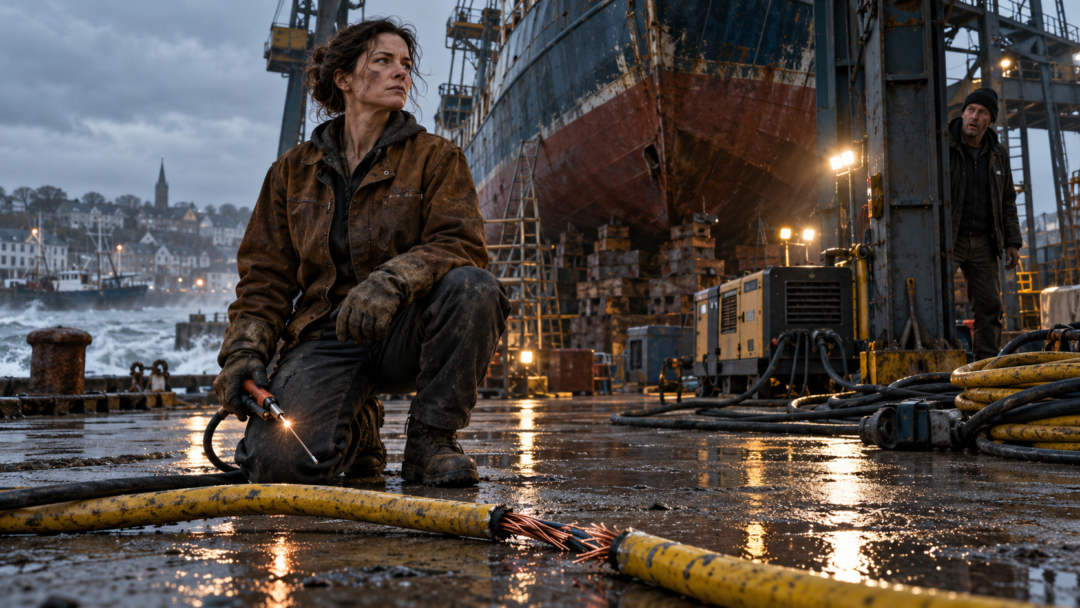
Vera Stone walked across the wet concrete pier, her heavy steel-toed boots leaving dark prints on the slick slime of the slipway. At thirty-six, Vera carried herself with the compact, unhurried density of a structural ironworker who had spent fifteen years working thirty feet above cold water. Her cowhide welding jacket was soot-stained; her hair was bound in a bandana, her grey eyes clear and steady. Over her shoulder hung an auto-darkening welding helmet.
In her right hand, she carried a dented, olive-drab steel toolbox that had belonged to her father, its corners reinforced with brazed brass patches.
Beside Keel Block 4, where the trawler’s new three-quarter-inch manganese-alloy hull plates were tacked into place, a heavy shadow shifted behind the three-hundred-amp Miller inverter rig.
Deke stood with his back to the gantry crane, his arms crossed over a grease-stained canvas shop coat. At fifty-one, Deke was a fixture of the Gloucester yards—a broad-shouldered, thick-necked pipefitter with two days of silver stubble across a jaw set in habitual, cynical contempt. He held an unlit cigar between his yellowed teeth, his eyes darting toward the open access hatch beneath the trawler’s stern.
As Vera approached the machine, Deke’s mouth twisted into a tight, supercilious smirk. With a casual flick of his heavy work boot, he kicked a coiled black rubber cable across the wet concrete.
The severed line uncoiled with a wet slap, coming to rest inches from Vera’s steel-toed boots.
The four-gauge copper conductor had been sheared in a single, violent stroke. The clean, bright copper strands glinted against the black rubber insulation, severed ten inches from the machine’s secondary negative ground terminal.
“Machine’s dead, Stone,” Deke drawled, his voice carrying thirty years of shouting over pneumatic hammers. “Ground lead’s burned out. Inspector Marsh’s cutter is docking at the fuel pier right now. He’s running the ultrasonic scan on that stern seam at seven-fifteen sharp. If the weld isn’t capped when his boots hit this dock, the North Star fails, and the superintendent docks your certification ticket.”
He leaned in closer, his sour breath smelling of stale black coffee and tobacco. “Told you from day one, girl. Heavy hull plate isn’t your world. Pack your tools and go home before you embarrass yourself in front of the Coast Guard.”
Three dock hands working nearby lowered their tools in tense silence, watching from twenty feet away.
Vera did not shout. She did not throw her helmet onto the concrete. She did not even look at Deke’s mocking, florid face.
Anger on a welding line was a fatal distraction.
Vera knelt beside her dented olive-drab toolbox.
She flipped the dual steel latches with a crisp, oily click. Inside, neatly nestled between her chipping hammer, her stainless-steel wire brushes, and her temperature-indicating crayons, lay a heavy, custom-machined solid copper C-clamp ground assembly, wrapped in a square of clean, oil-tanned buckskin.
She had crafted the clamp from heavy industrial copper, fitting it with a high-amperage lug and jaws that bit directly into the keel.
She unwrapped the copper clamp.
Without a word, she stepped to the trawler’s keel plate, clamped the solid copper jaws onto the freshly ground edge of the bilge keel, and tightened the threaded T-handle until the steel creaked under the torque. She unreeled her secondary fifty-foot auxiliary ground lead from the machine’s terminal block and clicked the heavy twist-lock Dinse connector home with a clean, mechanical snap.
Deke’s arms slowly uncrossed. His jaw tightened, the unlit cigar nearly dropping from his mouth as his eyes darted from the copper clamp to the control panel of the welding inverter.
The digital display on the Miller machine blinked to life with a high-pitched electronic hum: 240 AMPS – STABILIZED DC REVERSE POLARITY – READY.
Vera pulled on her heavy split-cowhide gauntlets. She selected an eighth-inch Lincoln Electric 7018 low-hydrogen electrode from her sealed warming canister, loaded the rod into her insulated brass stinger, and pulled her dark helmet down over her face.
With a single, effortless flick of her wrist, she struck the arc against the steel hull.
A brilliant, blinding cascade of white-and-violet electrical fire exploded against the grey morning gloom. The electrical arc roared with the smooth, frying-bacon hiss of absolute, textbook voltage stability.
Vera moved along the vertical seam with machine-like grace. Her left elbow was tucked against her ribs for stability, her gloved right hand weaving the molten puddle with micro-millimeter precision, laying down a continuous, flawless stringer bead that tied the two half-inch hull plates together with structural perfection.
Sparks cascaded down the curved hull like liquid gold, bouncing off the wet concrete.
The dock hands on the timber staging stepped down from their platforms, gathered at the edge of the pier, watching in total, spellbound silence as the molten slag peeled away from the cooling bead in one long, unbroken ribbon of dull amber glass.
Beneath the glass lay a seam of cold, rippled steel so uniform, so clean and dense, that it looked as if it had been machined by a robotic laser welder.
A set of heavy footsteps sounded on the concrete behind them.
Thomas Marsh, senior marine surveyor for the United States Coast Guard Marine Safety Office in Boston, walked onto the pier. He was fifty-eight years old, wearing a waterproof foul-weather coat over his uniform khaki trousers, carrying a digital ultrasonic flaw detector and a leather-bound clipboard.
Marsh stopped beside the hull. He pulled his wire-rimmed inspection glasses from his pocket, leaned within six inches of the cooling weld, and ran his finger along the steel bead.
He nodded twice—a slow, ungrudging gesture of total professional acclaim.
“Remarkable root penetration,” Inspector Marsh said, his voice quiet and resonant. “Zero undercut. Zero porosity. That seam will take twenty-foot breakers off Georges Bank without flexing a millimeter.”
Marsh straightened up, turning his gaze toward Deke, who stood frozen against the crane beam, his face pale and sweating.
The inspector’s eyes traveled down from Deke’s florid face to his canvas jacket pocket.
Protruding six inches from Deke’s right pocket was a severed length of high-voltage yellow rubber insulation, matching the exact diameter and thread count of the cable lying on the wet concrete pier.
Marsh pointed his stainless-steel inspection scribe directly at the yellow rubber.
“That was your own secondary ground cable, Deke,” Inspector Marsh spoke, his voice dropping into a register of cold, devastating authority. “And you just cut it off your own machine.”
CHAPTER 2: THE BEAD IN THE SLAG
The silence that locked the drydock was broken only by the rhythmic, hollow drip of condensation falling from the trawler’s hull onto the concrete slipway. The three dock hands stood motionless on the gravel, their eyes fixed on the bright yellow rubber cable protruding from Deke’s pocket like a flag of caught guilt.
Deke’s hand twitched toward his jacket, his fingers fumbling frantically to shove the severed lead deeper into his pocket. His florid face contorted with desperate, cornered aggression.
“That’s a scrap cutoff, Inspector!” Deke barked, his voice cracking into a defensive rasp that echoed off the granite walls of the drydock. “I was cleaning out the tool crib behind Bay 3 this morning before shift change! That’s discarded scrap wire from the decommissioning of the old tugboat Gloucester Pride!”
Inspector Marsh did not raise his voice. He took three measured steps across the wet pier until he stood eighteen inches from Deke. He reached out with two fingers, took the severed yellow cable from Deke’s pocket, and lifted it into the cold daylight.
The yellow outer jacket was stamped in bold black letters with an inventory tracking number: GLOUCESTER MARINE REPAIR – ASSET #412-M.
Marsh pointed his inspection scribe toward the heavy diesel welding generator sitting ten paces away in Bay 3—Deke’s personal assigned machine.
On the front panel of Deke’s machine, beside the secondary negative terminal, a freshly cut stub of identical yellow cable hung limp, the bright copper strands glinting with identical, unoxidized fresh cuts.
“Asset Four-Twelve-Mike is assigned exclusively to the senior shop steward, Deke,” Marsh said, his voice flat, unimpeachable, and devoid of warmth. “And the copper strands in this cut have zero surface corrosion. This cable was severed less than fifteen minutes ago.”
“Someone set me up!” Deke shouted, stepping backward against the crane beam, his eyes darting toward the silent dock hands. “Stone brought that piece of wire into the yard to frame me! She knew I was up for the lead foreperson position on the new naval patrol boat contract! She’s been trying to take my ticket for three years!”
From the base of the scaffolding, Gabe Ramos, a twenty-four-year-old junior welding apprentice with grease smudged across his forehead, took two steps forward onto the concrete.
Gabe held an industrial smartphone in his gloved hand, the screen glowing in the grey morning gloom.
“Nobody set you up, Deke,” Gabe said, his voice trembling slightly with the terrifying courage of a young worker challenging an entrenched boss, but holding steady. “I was setting up the shielding gas manifold behind the crane gantry twenty minutes ago. I had my camera running on time-lapse to record the pre-heat temperature on the keel block for the quality audit.”
Gabe touched the screen.
On the high-resolution display, clear as a television broadcast, was a ten-second video clip: Deke crouching behind Vera’s machine in the twilight, a pair of eight-inch Klein heavy-duty diagonal cutters in his fists, cleanly snipping the ground lead, shoving the severed cutoff into his jacket pocket, and kicking the remainder across the wet floor before walking away with a cruel, triumphant smirk.
Deke’s mouth opened, but no sound emerged. The air seemed to leave his lungs in a single, deflating gasp.
The three older dock hands who had worked beside Deke for a decade looked away in profound, suffocating disgust. In the hard, dangerous world of maritime shipbuilding, equipment sabotage was not merely a union grievance; it was a treason against human life. A bad ground on a four-hundred-amp arc machine in a wet concrete drydock could electrocute a worker, blind an apprentice, or cause an internal structural crack that would split an offshore fishing vessel in half during a winter storm on the Grand Banks.
Vera lifted her helmet, resting the shell on the top of her head. Her face was calm, her grey eyes studying Deke with quiet, sorrowful gravity.
“You were afraid, Deke,” Vera said softly, her voice carrying through the silent yard with the weight of an unpayable debt. “You’ve been afraid ever since the shipyard installed the new digital ultrasonic testing arrays six months ago.”
Deke backed away, his hands shaking violently as he clutched the lapels of his canvas coat. “Shut your mouth, Stone! I have thirty years of sea-time in these yards! I welded the bulkheads on half the offshore fleet in Essex County!”
“You welded bulkheads using nineteen-seventy stick rods with excessive heat to hide your cold-lap defects, Deke,” Vera replied, stepping closer, holding out her inspection flashlight. “You knew that when Inspector Marsh ran the phased-array ultrasonic scan on the North Star’s engine bed, your welds wouldn’t pass the density threshold. You needed this ship to fail on my seam, because if my root pass held, your structural plates would be the only ones exposed to the beam.”
Inspector Marsh turned to Gabe, his expression carved from basalt. “Gabe, download that video file directly to the Coast Guard Marine Safety server. And call Yard Superintendent Miller down to the slipway immediately.”
Inspector Marsh stood in the cold morning drizzle, his weathered face set in lines of unyielding professional gravity. In his thirty years surveying naval and commercial vessels from Maine to the Virginia capes, he had witnessed the tragic consequences of compromised shipyard integrity. He knew that the North Atlantic did not forgive shortcuts; when a seventy-ton steel hull encountered twenty-foot winter swells off the Grand Banks, every microscopic inclusion in a weld seam became a potential fracture line. A man who sabotaged his coworker’s equipment out of petty professional jealousy was not merely a poor craftsman; he was an active menace to every mariner who trusted his life to the steel.
Marsh turned back to the trawler hull, picking up the high-frequency ultrasonic probe connected to his digital testing console.
“Now,” Inspector Marsh commanded, his eyes locking onto Deke with terrifying judicial coldness. “Let’s put the ultrasound on your structural bulkhead welds, Mr. Vance. Let’s see what thirty years of fear looks like under the beam.”
CHAPTER 3: THE KEEL UNDER THE CRANE
The hum of the digital phased-array ultrasonic scanner sounded like the high-pitched sonar ping of a submarine searching deep water. Inspector Thomas Marsh held the handheld transducer against the freshly completed hull seam, sliding the lubricated probe along the three-foot vertical joint where Vera Stone had laid her molten bead.
On the tablet screen mounted to Marsh’s chest harness, a real-time cross-sectional image of the steel appeared in vivid, multi-colored telemetry.
The image was a solid, flawless band of deep emerald green. The ultrasonic sound waves traveled through the three-quarter-inch steel plate, passed through the welded joint without a single acoustic deflection, and echoed cleanly off the interior backing strip.
“One hundred percent volumetric fusion,” Marsh announced, his voice carrying the unimpeachable finality of a naval court. “Zero inclusions, zero slag pockets, zero micro-porosity. That weld exceeds the structural specifications of the American Bureau of Shipping for unrestricted commercial service.”
Vera did not celebrate. She reached down, picked up her stainless-steel wire brush, and began cleaning the remaining slag dust from the adjacent plate, her breathing steady and deep.
Inspector Marsh turned thirty degrees to his left, moving the transducer three feet forward along the trawler’s keel to the primary transverse bulkhead—the massive structural rib that separated the flooded fish hold from the engine room.
The transverse bulkhead had been welded twenty-four hours earlier, during the Monday evening shift.
By Deke.
Deke stood ten paces away, his back pressed against the timber scaffolding, his eyes wild and bloodshot as he watched the transducer touch the steel. The heavy Klein wire-cutters were still clutched in his trembling right hand, his breathing coming in ragged, shallow gasps.
Marsh applied the acoustic gel and dragged the probe across Deke’s seam.
The tablet screen flickered.
The smooth green band shattered into a jagged, pulsing eruption of bright crimson and warning amber. A high-frequency alarm sounded from the console—a sharp, piercing electronic squeal indicating severe internal structural failure.
Marsh froze. He leaned closer to the monitor, his eyebrows drawing together in cold, professional disbelief.
“Look at this display, Stone,” Marsh said, his voice dropping into a register of quiet horror.
Vera stepped to his side, her trained eyes parsing the acoustic data in two seconds.
Beneath the superficial, polished cap bead that Deke had buffed with a wire wheel to look pristine, the internal root pass was a hollow disaster. The steel had suffered catastrophic “lack of fusion”—a continuous twelve-inch void where the molten filler metal had merely sat on top of cold plate without melting into the base metal.
Worse, running diagonally through the heat-affected zone of the structural manganese plate were three microscopic spiderweb stress fractures, spreading outward like cracks in winter ice.
“Cold-cracking,” Vera stated, her voice tight with anger. “He didn’t pre-heat the plate. He welded seventy-degree manganese steel in forty-degree fog with a damp rod.”
“If this vessel had loaded forty tons of cod in a winter gale off Sable Island,” Marsh said, his face ashen, “the first six-foot wave slamming into the port quarter would have sheared this bulkhead off the keel. The fish hold would have flooded in three minutes, capsizing the trawler and drowning all six men in the engine room before they could launch a liferaft.”
The three older dock hands who had gathered near the scaffolding let out a collective, furious gasp. One of them, a veteran rigger named Sullivan whose two nephews were deckhands on the North Star, took three menacing steps toward Deke, his fists clenched like iron mallets.
“You knew the rods were wet, Deke,” Sullivan snarled, his voice trembling with homicidal fury. “You pulled them from the unheated storage locker behind Bay 2 because the heating ovens were locked! You risked six men’s lives to make your shift quota!”
Deke backed away, brandishing the heavy wire-cutters before him like a weapon, his eyes wild with unhinged, feral panic. “The plate was bad! The steel arrived from the supplier with laminations! You can’t pin a metallurgical flaw on the welder!”
“The steel plate was tested at the mill in Pittsburgh, Deke,” a booming, authoritative voice echoed from the top of the drydock stairway.
Arthur Miller, the sixty-two-year-old general superintendent of the Gloucester Harbor Shipyard, descended the concrete steps. Behind him marched two uniformed officers from the Gloucester Police Department and a maritime investigator from the National Transportation Safety Board.
Superintendent Miller stopped before Deke, looking at the disgraced pipefitter with forty years of buried disappointment and disgust.
“We pulled your personnel archive from the maritime union hall thirty minutes ago, Deke,” Superintendent Miller said, holding out a certified dossier stamped with the blue seal of the Massachusetts Department of Public Safety. “Your master welding ticket. The certification you claimed you received at the Boston Naval Shipyard in nineteen ninety-four.”
Deke’s knees buckled. His back hit the timber scaffolding, rattling the staging boards above him.
“You failed that test, Deke,” Miller continued, his voice cold as freezing rain. “You scored fifty-two percent on the bend test. Both root coupons snapped under thirty tons of hydraulic pressure. You paid three hundred dollars to an assistant clerk in the licensing bureau to stamp your master certificate before the navy yard closed.”
Deke stared at the dossier, his arrogant bluster completely stripped away, revealing only the hollow, terrified ruin of a man who had lived thirty years waiting for the steel to speak the truth.
Suddenly, with the desperate, blind fury of a cornered beast, Deke lunged sideways toward the drydock’s primary hydraulic control station, his heavy boots splashing through the water on the concrete floor.
CHAPTER 4: THE SLAG IN THE BILGE
Deke’s desperate lunge for the hydraulic control station caught the yard officers completely off-guard. He threw his two-hundred-pound frame against the heavy iron security gate flanking the pump house, slammed the steel door shut, and drove the manual deadbolt home before the police could reach the landing.
Inside the glass-fronted pump house sat the master hydraulic controls for Drydock Number 1—an ancient, massive granite basin constructed in 1892, capable of holding twelve million gallons of harbor water.
Through the wire-reinforced glass, Deke’s face was contorted into a mask of manic, unhinged fury. He reached for the primary emergency ballast valve—a massive five-foot cast-iron wheel painted high-visibility yellow, controlling the gravity sea-chest gates that separated the drydock from the thirty-foot tidal surge of Gloucester harbor.
“Nobody touches my ticket!” Deke screamed through the mesh loudspeaker mounted above the door, his voice cracking into high-pitched hysteria. “You think you can drag my name through the mud and hand this yard over to Stone? If the North Star fails inspection, she fails under thirty feet of green water!”
He threw his entire body weight against the yellow wheel, kicking the secondary safety pawl free with his steel-toed boot.
With a concussive, subterranean groan of shifting iron, the massive submerged sluice gates forty feet beneath the granite piers began to grind open.
A deafening, terrifying roar of water erupted from the subterranean drainage tunnels.
High-pressure Atlantic ocean water, driven by the incoming morning tide, exploded into the lower caisson of the drydock in four towering white jets, flooding the concrete floor at forty thousand gallons a minute. The water level around the keel blocks began rising with terrifying speed—two inches, six inches, a foot in thirty seconds.
The North Star, resting ninety tons of deadweight on temporary oak cribbing blocks, shuddered violently as the buoyancy began to lift her flat keel off the timber wedges.
“The shoring blocks!” Superintendent Miller bellowed, retreating up the concrete stairway as the icy water surged across his boots. “If the hull floats before the alignment cables are tensioned, the ship will roll onto her bilge keel and crush everyone on the dock floor!”
“The electrical transformers!” Inspector Marsh shouted. “The four-hundred-amp welding lines are submerged! The water is becoming energized!”
Vera Stone did not run up the stairs.
Her mind worked with the instantaneous, diagnostic calculation of a naval salvage specialist. She knew that the water would reach the secondary electrical distribution bus in less than ninety seconds. If the salt water touched the ungrounded welding inverter in Bay 3, the entire flooded drydock would become an execution chamber of four hundred volts of three-phase current.
She dropped her helmet, sprinted through two feet of rushing, freezing seawater, and reached the primary emergency power disconnect panel mounted on the crane pylon.
She threw her gloved hand against the heavy red emergency cutoff switch, driving the four-inch copper contacts apart with a concussive CLANG.
The high-voltage humming died instantly. The floodlights flickered and extinguished, plunging the flooded drydock into dim, foggy morning half-light, broken only by the roar of the incoming Atlantic surge.
“Gabe!” Vera shouted through the rushing water to the young apprentice clinging to the scaffolding. “Get up to the crane deck! The emergency manual hydraulic brake on the sea-chest gate is on the catwalk behind the pump house!”
Vera paused at the foot of the ladder, feeling the vibration of the rushing water through the soles of her boots. She had spent fifteen years studying the hydraulic engineering of these historic drydocks, understanding the delicate gravitational balance between harbor tides and submerged caisson gates. Her father had always taught her that a true shipwright respected the power of the ocean above all else; if you treated water as a passive element rather than an immense physical force, it would seize the first opportunity to tear your work from its foundations. Deke’s reckless sabotage had compromised the structural equilibrium of the entire slipway, threatening to destroy seventy tons of honest steel and the livelihoods of forty working families.
Vera slung her heavy iron spud wrench into her belt, seized the vertical rungs of the maintenance ladder leading to the roof of the pump house, and began climbing through the spray.
The cold ocean water was already waist-deep on the dock floor, swirling with wooden wedges, oily rags, and floating barrels. The North Star gave a terrifying, metallic groan as her oak blocks shifted, the ninety-foot steel hull leaning five degrees to port, threatening to topple into the flooded granite floor.
She tightened her grip on the iron ladder, her knuckles white against the cold rungs. Every weld she had ever laid in this shipyard had been a testament to her family’s name, an unyielding assertion that true craft was measured by durability, not by seniority or bluster. She would not allow this dock to flood.
Vera pulled herself onto the wet roof of the pump house.
Through the skylight, she saw Deke standing before the control console, holding an emergency fire axe he had ripped from the bulkhead, his eyes wide and bloodshot, watching the water rise toward the windows.
The yellow wheel had jammed in the open position; the ancient gear teeth had stripped under the sudden torque of the water pressure, locking the sea-chest gates permanently open.
The drydock was flooding uncontrollably, and in four minutes, the entire ninety-foot trawler would roll off her blocks, smashing through the pump house and drowning everyone trapped in the stone basin.
CHAPTER 5: THE WATER IN THE CAISSON
The roar of the Atlantic rushing through the forty-foot submerged culverts was a deafening, concussive thunder that vibrated through the granite foundations of the drydock. On the dock floor below, the water level was rising at three inches every ten seconds, churning into a violent, frothing soup of floating timber wedges, diesel fuel, and sea foam.
The North Star groaned again—a sickening, screeching shriek of stressed steel plates as her port bilge keel slipped off the fourth oak cribbing block, tilting her towering seventy-ton hull to an alarming eight-degree list. If the list reached twelve degrees, the center of gravity would tip, rolling the trawler onto her side with the concussive force of an avalanche.
On the roof of the pump house, Vera Stone did not hesitate.
She unhooked her twelve-inch forged steel spud wrench from her belt, wrapped her heavy leather gauntlet around the tapered handle, and drove the hardened steel point through the corner of the wire-reinforced glass skylight.
With a concussive shower of glass shards, the skylight collapsed inward.
Vera dropped through the opening, landing squarely on the steel diamond-plate floor of the pump house, five feet from Deke Vance.
The room was filled with freezing spray leaking through the exterior door seals, the air thick with the smell of hydraulic oil and electrical smoke. Deke spun around, the heavy red fire axe clutched in both hands, his knuckles white, his eyes wild and unhinged.
“Stay back, Vera!” Deke screamed, his voice cracking into a desperate shriek. “The gates are jammed! You can’t turn that wheel! We’re going down with the ship!”
“The manual bypass is frozen, Deke!” Vera shouted over the roar of the water, her voice cold, steady, and commanding. “The hydraulic relief valve on the secondary ram is locked under pressure! If we don’t bleed the fluid lines, the gate won’t drop, and this hull will crush this entire building in two minutes!”
Deke raised the fire axe above his shoulder, his boots slipping on the wet steel floor. “I don’t care! I’d rather see this yard at the bottom of the harbor than spend twenty years in a federal prison!”
Vera did not lunge. She did not reach for a weapon.
She took one slow, deliberate step toward him, her grey eyes locking onto his trembling pupils with the unyielding density of a granite sea wall.
“My father’s boat sank in nineteen ninety-nine, Deke,” Vera said, her voice piercing the roar of the flood with terrifying, quiet clarity. “The Mary B. She was built in this exact drydock. She went down forty miles off Cape Ann with three men aboard because someone skipped the pre-heat on the keel seam to save thirty minutes on a Friday afternoon.”
Deke’s breath hitched in his throat. The heavy axe wavered in his grip, his eyes widening in sudden, horrifying recognition. “The Mary B… you’re Tom Stone’s daughter.”
“I pulled my father’s body out of the water, Deke,” Vera whispered, her voice carrying thirty years of unbroken resolve. “And I swore on his grave that no fisherman would ever sail out of this harbor on a lie. Put down the axe and help me bleed the hydraulic line.”
For three agonizing seconds, Deke Vance stood suspended between thirty years of toxic pride and the undeniable reality of his own mortality. He looked through the glass at the towering steel hull of the North Star leaning toward the windows, then down at the calm, fearless woman standing before him with empty hands.
With a broken, shuddering sob, Deke let the heavy fire axe slip from his fingers, clattering harmlessly against the steel diamond plate.
Vera moved with lightning speed.
She lunged to the secondary hydraulic manifold beneath the floor grating, hooked her heavy spud wrench onto the three-quarter-inch high-pressure bleeder valve, and threw her full body weight into the turn.
The valve resisted, locked under five thousand pounds of hydraulic head.
“Deke! The lever!” Vera roared.
Deke dropped to his knees in the rushing water beside her, his broad shoulders engaging with desperate, frantic muscular power. He clamped his heavy hands over Vera’s wrench handle, adding two hundred pounds of leverage to the turn.
With a deafening, concussive HISS of escaping hydraulic fluid, the pressure valve broke free.
A plume of red hydraulic oil shot against the ceiling, releasing the mechanical lock on the secondary gate rams.
Outside in the flooded caisson, the massive four-ton steel gravity drop-gate responded to the release of pressure. Supported by its immense deadweight, the steel slab plummeted down its vertical guide tracks like a guillotine, slamming into the granite seabed sill with a concussive, earth-shaking THUD that sent a thirty-foot plume of water into the air.
The roar of incoming seawater died instantly.
The water level inside the drydock halted four inches below the critical stability line. The North Star groaned, settled back onto her primary oak keel blocks, and righted herself to zero degrees, safe, upright, and unbroken.
The freezing seawater continued to churn against the granite walls of the basin, throwing up dense curtains of salt spray that coated the pump house windows. Vera kept her boots planted firmly on the wet diamond-plate floor, her breathing steady and disciplined despite the adrenaline surging through her veins. She looked at Deke’s trembling hands, noting the calluses and scars that told the story of thirty years of hard, dangerous labor. It was a tragedy of immense proportions that a man who possessed such physical strength had allowed his soul to be consumed by the fear of being surpassed by a younger, more meticulous artisan.
Inside the pump house, Deke collapsed onto his hands and knees in the pooling water, his head bowed, weeping with the ragged, breathless exhaustion of a man who had finally surrendered his ghost.
CHAPTER 6: THE TORCH ON THE GANTRY
By nine o’clock in the morning, the three massive high-volume municipal drainage pumps had scoured twelve million gallons of seawater from Drydock Number 1, purging the granite basin until the wet concrete floor gleamed clean and grey in the breaking Atlantic sunlight.
The air around the drydock was cold, sharp, and revitalizing, smelling of sea kelp, fresh salt water, and diesel exhaust.
On the high concrete pier flanking the slipway, forty shipyard workers, six naval surveyors from the Coast Guard Marine Safety Office, and three city building inspectors stood assembled beneath the gantry cranes in absolute, solemn silence.
Beside the drydock stairs, surrounded by four uniformed officers from the Gloucester Police Department and two federal agents from the Department of Transportation’s Office of the Inspector General, stood Deke Vance.
He wore no jacket now. His canvas coat had been seized as physical evidence, the severed yellow cable and his heavy Klein cutters sealed inside forensic evidence bags. He sat on an empty wooden cable spool, his head bowed, his hands cuffed behind his back in heavy steel transport irons.
His face was hollow, grey, and completely stripped of the bluster and territorial arrogance that had terrorized the commercial slipway for three decades. He did not look up when the police transport van backed down the pier with its doors open.
Inspector Thomas Marsh walked down the center of the pier, carrying his digital ultrasonic testing console and a signed Certificate of Inspection stamped with the official gold seal of the United States Coast Guard.
Marsh walked directly to Vera Stone, who was standing beside the North Star’s keel block, cleaning the salt spray from her welding helmet with a cotton rag.
“Miss Stone,” Inspector Marsh spoke, his voice carrying clearly to every worker on the pier. “The Coast Guard Marine Safety Office has concluded the comprehensive ultrasonic and radiographic inspection of the North Star’s hull.”
He held out the official document.
“Your vertical butt-joint seam on Hull Plate 14 passed all American Bureau of Shipping Class One radiographic standards with a structural efficiency rating of ninety-nine point eight percent,” Marsh announced. “It is the highest quality weld recorded in this district in twelve years.”
A spontaneous, roaring cheer erupted from the forty assembled dock workers. Riggers, apprentices, pipefitters, and crane operators clapped their heavy leather gloves together, their voices echoing off the granite walls in a thunderous wave of authentic working-class acclaim.
Young Gabe Ramos leaped from the staging, raising his welding stinger into the air with a triumphant shout that was joined by veteran rigger Sullivan, who walked over and shook Vera’s gloved hand with unashamed, emotional gratitude.
“My nephews sail on this boat on Friday, Vera,” Sullivan said, his voice thick with tears. “You saved their lives. Every man on this pier owes you an unpayable debt.”
Vera accepted the handshake, her face serene, humble, and unruffled. “The steel was good, Sullivan. It just needed someone to run the bead true.”
Inspector Marsh looked around the assembled circle of shipyard workers, noting the quiet, profound relief that had settled over their weathered faces. For decades, the culture of the commercial waterfront had been distorted by unwritten codes of silence and the aggressive intimidation of entrenched foremen who covered their technical deficiencies behind political connections. To witness a master craftswoman step onto the slipway, face down sabotage with pure technical excellence, and save both the vessel and the yard was a transformative moment that marked the dawn of an entirely new standard of accountability.
Superintendent Arthur Miller stepped forward, accompanied by the regional president of the Marine Industrial Shipbuilders Union.
“Miss Stone,” Superintendent Miller said, holding out a gold-plated master welder’s credential and an official executive appointment decree from the yard’s board of directors. “Following the emergency termination of Deke Vance for gross sabotage, criminal endangerment, and the falsification of professional licensing credentials, the board and the union have unanimously ratified your appointment.”
Miller presented the credentials into her calloused hands.
“Effective immediately, Vera Stone is appointed Master Shipwright and Head of Structural Integrity for the Gloucester Harbor Drydock.”
Another tremendous round of cheers and applause shook the crane gantries, junior apprentices banging their chipping hammers against steel beams in a deafening, joyful industrial rhythm.
The older riggers and mechanics stood along the crane tracks, their heavy work caps held in their hands, their eyes reflecting the sober realization of how close they had come to disaster. They understood that the integrity of the yard had been preserved not by administrative oversight, but by the courage and precision of a welder who refused to back down in the face of sabotage.
Vera looked at the gold credential, then turned her gaze toward the police transport van fifty yards away.
Deke was being escorted up the rear step by two federal marshals. Before entering the vehicle, he paused, turning his head for half a second to look across the pier at the woman who had stood in the fire and defeated him with pure craft.
Vera met his gaze without malice, without triumph, and without pity.
She nodded once—a slow, solemn acknowledgment of a battle that was finally finished, and a legacy that was finally redeemed.
The van doors slammed shut with a heavy, final thud, and the vehicle pulled away down Commercial Street, its siren remaining silent as it escorted thirty years of stolen pride into the shadows of the past.
CHAPTER 7: THE TRUE SEAM IN THE ATLANTIC LIGHT
By seven o’clock on Wednesday morning, the coastal fog had completely dissolved into the vast expanse of the North Atlantic, leaving behind a sky of immaculate, cold sapphire and an autumn sun that rose like a ball of molten bronze above the granite headlands of Eastern Point.
The Gloucester commercial drydock was alive with the energetic, purposeful rhythm of an honest shipyard operating at peak capacity. High-pressure air lines hissed with clean power; overhead crane cables hummed as twenty-ton steel plates were maneuvered into place, and the sharp, bright smell of burning iron, pine rosin, and sea salt filled the morning air.
Down in the basin of Drydock Number 1, the North Star sat tall, proud, and fully restored upon her freshly aligned oak keel blocks.
Her entire hull had been coated in a fresh layer of dark marine-grade anti-fouling paint, her steel plates gleaming like armor beneath the morning light. On the stern quarter, directly across the vertical joint where Vera Stone had run her flawless seam, the vessel’s official regulatory certification had been stamped into the steel: USCG INSPECTED & CERTIFIED – CLASS 1 HULL INTEGRITY.
Vera stood on the concrete pier beside her father’s olive-drab toolbox, holding a hot ceramic mug of black coffee in her hands. She wore her clean cowhide jacket open over a blue flannel shirt, the fresh salt breeze tossing her dark hair across her forehead.
Beside her stood Gabe Ramos, wearing a new pair of heavy leather welding gauntlets, reviewing a blueprinted welding schedule for the new forty-foot offshore pilot cutter being laid down in Bay 2.
“The pre-heat parameters are dialed to two hundred and fifty degrees, Vera,” Gabe said, his eyes shining with eagerness and respect. “I verified the calibration on the induction heaters myself. Zero moisture on the plate.”
Vera smiled, taking a slow sip of her coffee, her grey eyes warm with quiet approval. “Good work, Gabe. Remember: the machine only does what your hands tell it to do. If your mind is hurried, the puddle will chill. Take your time, breathe with the arc, and let the steel fuse.”
“Yes, Master Stone,” Gabe replied with a proud, crisp nod, turning toward the fabrication shop with purposeful strides.
Superintendent Arthur Miller walked down the pier, holding a small brass plaque mounted on polished mahogany.
“Vera,” Miller said gently, stopping beside her. “The yard’s historical committee asked me to deliver this. We’re mounting it on the gatehouse wall above the drydock.”
Vera looked down at the plaque.
Engraved into the solid brass plate were four lines beneath an embossed anchor:
IN MEMORY OF CAPTAIN THOMAS STONE & THE CREW OF THE MARY B
RESTORED IN HONOR & MASTER SHIPWRIGHT CRAFTSMANSHIP
BY VERA STONE, MASTER SHIPWRIGHT
“BUILT TRUE TO WEATHER EVERY STORM”
Vera ran her calloused thumb over her father’s name, feeling a profound, gentle peace settle over her shoulders—a peace that was fifteen years in the making. The grief that had haunted her youth, the heavy stone of survivor’s guilt she had carried across thousands of hours of blinding electrical fire, had finally been transformed into an enduring, unshakeable monument of truth and service.
She paused by the edge of the granite pier, watching the morning light glint off the brass plaque. The names of the lost fishermen were more than historical records; they were a living conscience that guided every pass of her electrode, every calculation of heat and amperage, and every inspection she conducted. She had honored her father’s memory not with sentimental tears, but with the unyielding, uncompromising excellence of her craft. The commercial fleet of Gloucester would sail with confidence, knowing that the seams binding their hulls were welded true, honest, and unbreakable.
From the harbor basin, the deep, resonant horn of the North Star sounded three long blasts—the traditional maritime salute of gratitude as the captain and crew boarded the vessel for their final sea trials.
Vera looked out past the granite breakwater toward the open Atlantic, where the white-capped swells stretched out to the endless horizon, sparkling like diamonds beneath the morning sun.
The morning tide was turning in the outer channel, sending gentle swells of clean Atlantic water against the granite breakwater. Vera walked along the pier apron, her hand lightly trailing along the cool steel plates of the newly laid keel in Bay 2. She thought of her father, remembering the cold mornings he had spent teaching her how to strike an arc in the drafty barn behind their cottage in Rockport. Tom Stone had never measured a mechanic by their voice, their swagger, or their family pedigree; he had judged a builder by the clean, unbroken integrity of the work they left behind.
As she looked out across the sunlit waters toward the open sea, where the white sails of a schooner were catching the morning breeze, Vera felt the final, lingering shadows of the past dissolve into the golden light. The shipyard was safe, the standard was restored, and the ships built on these piers would carry their crews safely home through every storm the Atlantic could muster.
She took a deep, clean breath of the morning air, feeling the profound stillness that always followed a storm fought and won with honest hands.
She picked up her welding helmet, tucked her father’s toolbox securely beneath her arm, and walked toward the fabrication bay where the fresh iron was waiting, ready to build the ships that would carry her people safely home.