The Silent Judo Master Who Broke The Loud Sergeant’s Fall
CHAPTER 1: THE WOODEN CANE AGAINST THE PINE WALL
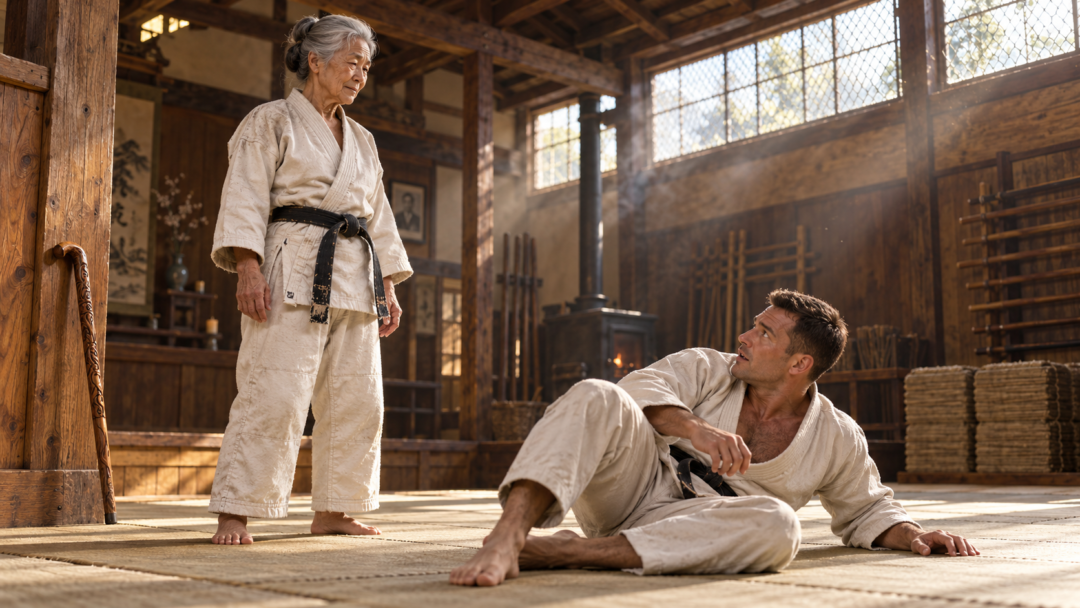
The rain beating against the high wire-reinforced clerestory windows of the Fort Kessler dojo had the steady, rhythmic cadence of a muffled snare drum. Built in the late autumn of 1944 as a specialized unarmed combat training facility for wartime commandos preparing for deployment across the Pacific theater, the hall was lined with aromatic white pine planks that had cured to a deep, honey-dark amber over eight decades. The air inside was cold and sharp, carrying the clean, unmistakable scent of dried straw tatami canvas, camphor liniment, damp wool jackets, and sweet hickory woodsmoke curling from the cast-iron potbelly stove in the eastern corner. Along the western wall hung polished racks of wooden training swords, bokken, and heavy canvas throwing bags weighted with lead shot and river sand.
Hana Mori knelt in the traditional seiza posture on the tatami, her bare feet tucked neatly beneath her hips. She was sixty-eight years old, slender and compact, wearing a heavy, double-weave white cotton judo gi that had faded through thousands of washings to the soft texture of antique sailcloth. Her silver hair was pulled back into a severe, rock-solid bun secured with two carved ebony pins, revealing a face lined with deep, patient creases around eyes as dark and calm as mountain well water. Her hands rested flat against the rough cotton of her thighs—hands with thick, knobby knuckles and weathered tendons like ancient oak roots that had gripped thousand-pound bulls by the horn.
Beside her knee, resting on the raw cedar floorboards at the edge of the mat, lay a hand-carved oak walking cane, its polished shaft worn smooth by twenty years of supporting her left leg through damp Maryland winters. The wood bore the warm patina of human oil, the curve of the handle shaped to fit the palm of an artisan who understood the quiet balance of natural grains.
Sitting in a silent, rigid kneeling line along the opposite edge of the mat were six young recruits in grey physical training sweats. They were nineteen and twenty years old, their eyes wide and completely silent, watching the old woman demonstrate the micro-leverage of a lapel grip with the intense, breathless concentration of acolytes in a monastery. For three weeks, they had come to this drafty hall in their off-duty hours, trading their evening liberty for the rare privilege of learning from a living legend whose name was whispered in hushed, reverent tones across the international martial arts community.
The heavy double oak doors of the dojo flew open with a violent, concussive crash that rattled the glass in the high rafters.
Striding onto the sacred cedar floor with heavy, mud-caked combat boots was Sergeant Viktor Renn.
Renn was thirty-eight years old, six feet two inches tall, and weighed two hundred and twenty pounds of densely packed tactical muscle. He wore modern digital camouflage fatigues, the sleeves rolled tight above biceps corded with black tribal tattoos and vascular veins. His face was broad, red-flushed, and dominated by a heavy, square jaw that thrust forward with aggressive self-importance. In his right hand, he carried a heavy composite training baton; across his chest was the black combat instructor tab of the base readiness division. Two junior corporals from his unit lingered nervously in the rainy shadows of the doorway, clutching clipboard manifests.
Renn walked directly past the bowing area, ignoring the traditional bow to the mat, his boots tracking gritty gravel and brown mud across the polished timber boards. The wet crunch of dirt under rubber was an open insult to every tradition of the hall.
He stopped three feet from where Mori was kneeling. He looked down at her small frame, then down at the wooden walking cane resting beside her knee. A loud, mocking scoff whistled through his flared nostrils.
Without warning, Renn swung his heavy combat boot in a vicious, dismissive kick.
The steel-toed boot struck the oak cane with a sharp, splintering crack. The cane flew ten feet across the cedar floorboards, tumbling end over end before crashing against the rough pine wall with a loud, hollow thud that echoed off the high rafters like a pistol shot.
The six recruits flinched in unison, their breath catching in their throats, but not one of them dared to move or break ranks. The military hierarchy was ironclad, and Sergeant Renn held their upcoming physical readiness certifications in the palm of his hand.
Renn crossed his massive, tattooed arms over his chest, looking down at Mori with sneering, arrogant contempt.
“Go sit down in the dayroom, grandma,” Renn barked, his voice booming through the wooden hall with the harsh, grating volume of a drill field tyrant. “The combat training cycle starts at zero-eight-hundred. The mat’s for fighters, not for seven-hundred-year-old museum pieces running an assisted-living day camp. You’re cluttering my tactical space with your walking sticks and your ceremonial bowing nonsense. Pick up your wood and clear this building before I have base security escort you off the garrison in zip-ties.”
Hana Mori did not flinch. She did not look at the walking cane resting against the wall.
Her dark eyes lifted, meeting Renn’s hostile gaze with an eerie, immovable stillness that seemed to absorb the aggressive energy in the room and turn it into ice.
Beneath the heavy cotton of her gi, her breathing remained slow, rhythmic, and deep, expanding her diaphragm without disturbing the calm line of her shoulders. Her weathered fingers, resting flat on her knees, gave one brief, imperceptible twitch—the natural release of joint tension—and then froze into absolute, granite stillness.
“You should not wear muddy boots on the tatami, Sergeant,” Mori said softly. Her voice was quiet, calm as falling rain, yet it filled every corner of the vast timber hall with an acoustic weight that made Renn’s jaw tighten. “The mat does not belong to your boots. The mat belongs to gravity.”
Renn’s face contorted into red fury, his hand reaching for the metal whistle at his collar to summon the armed gate guards, when a sharp, authoritative voice echoed from the hall entrance. Major Claire Evans, chief medical officer of the garrison hospital, stood framed in the rain, holding a thick red folder: “Touch that whistle, Sergeant Renn, and I’ll open the sealed 2018 medical file in front of the entire battalion before the bugle sounds.”
CHAPTER 2: THE SEVEN MOVES ON THE HEAVY CANVAS
Sergeant Viktor Renn’s face went from ruddy red to an ugly, mottled purple. He was an eight-year combat veteran, a senior combatives instructor who had beaten younger men into unconsciousness in competitive tactical smokers, and he was not accustomed to having his authority dismissed by anyone, least of all a sixty-eight-year-old woman in an antique uniform. The presence of the chief medical officer at the door only inflamed his pride, driving all caution from his mind.
“You want to talk about gravity, old lady?” Renn snarled, ignoring the officer’s warning and taking an aggressive, thumping step onto the canvas mat, his heavy boots sinking into the compressed straw. “I’ll show you gravity! I am ordering you off this mat under Article 91! If you don’t stand up and clear out of this dojo right now, I will physically drag you out by the collar of that bathrobe!”
Renn reached down with his massive right hand, his thick, tattooed fingers hooking into a claw aimed directly at the left lapel of Mori’s white gi. His movement was heavy, arrogant, and telegraphic, loaded with the brute forward momentum of a street brawler used to overwhelming smaller opponents through sheer mass.
Hana Mori rose.
She didn’t scramble. She didn’t use her hands to push off the floor. She rose from the kneeling seiza in one smooth, continuous, vertical ascent, her spine uncoiling like a tempered steel spring, her balance centered so deeply over her hips that her body seemed to float upward without muscular strain. As she reached her feet, her hands hung relaxed at her sides, her bare feet gripping the rough canvas of the mat like the roots of a mountain cypress anchored into bedrock.
Renn’s reaching hand crossed her centerline.
The moment his fingers came within two inches of her lapel, Mori moved.
Move One: The Grip. Mori’s right hand didn’t slap or block; it flowed upward like rising water, her calloused fingers closing around the thick cotton fabric of Renn’s right sleeve just above the elbow. Her touch was not rigid or frantic; it was soft, sticky, and completely connected to his skeletal alignment, feeling the exact vector of his forward intent.
Move Two: Kuzushi, the off-balance. With a subtle, three-inch rotation of her core, Mori drew Renn’s sleeve forward and upward, tilting his massive two-hundred-and-twenty-pound frame onto the tips of his toes. Renn’s forward momentum was not resisted; it was accelerated, pulling his center of mass completely outside his base of support before his nervous system could command his heels to drop.
Move Three: Tsukuri, the entry. Mori stepped her right foot inside his lead stance, her hips pivoting one hundred and eighty degrees in a fraction of a heartbeat. Her back pressed firmly against Renn’s chest, her hip bone locking precisely beneath the crest of his pelvis like a fulcrum sliding under a granite boulder. Her knees remained coiled, ready to spring.
Move Four: Harai Goshi, the sweeping hip throw. Mori’s right leg swept backward in a high, graceful, punishing crescent arc across the front of Renn’s shins. She tilted her head, pulled downward on his sleeve with the full rotational torque of her entire body, and bowed forward from the waist.
The two-hundred-and-twenty-pound sergeant took flight.
Renn’s boots left the tatami with a loud squeak of canvas. His heavy frame arced through the air five feet above the mat in a sweeping, breathless circle, his eyes wide in sheer, disbelieving terror as the high timber rafters spun violently around his vision. For one suspended second, he hung weightless in the freezing air of the dojo.
THUD.
Renn crashed onto the canvas mat with a concussive impact that rattled the wooden racks on the walls and sent clouds of dried straw dust puffing from the tatami seams. He hit flat on his back, the air exploding from his lungs in a ragged, whistling wheeze that sounded like a punctured tire.
Move Five: Kesa-Gatame, the scarf hold. Before Renn could even begin to register the fall, Mori was already on him. She dropped smoothly into a modified chest pin, her right arm wrapping securely behind his neck, her torso compressing his diaphragm with immovable, calculated weight that allowed him to breathe only in shallow, panicked gasps.
Move Six: Juji-Gatame, the cross-body armbar. Without breaking the flow, Mori transitioned her hips, sliding her right leg across Renn’s chest and securing his trapped right arm between her thighs. Her weathered hands locked his wrist with his thumb pointed toward the ceiling, applying gentle, surgical hyperextension to the elbow joint. The lock was absolute; one more ounce of pressure would have separated the ligaments like dry paper.
Move Seven: Shift, Hold, and Release. Mori held the lock for three full seconds—not to cause agony, but to allow the total, inescapable reality of his helplessness to burn into his soul.
Renn’s eyes bulged in pure panic. He frantically tapped his left hand against his thigh three times in rapid, desperate succession: slap… slap… slap.
“I yield!” Renn gasped, his voice cracking into a high, humiliated choke. “Yield! Yield!”
Mori released the tension instantly. She did not shove him away or gloat. She stood up with calm, dignified grace, stepping back two paces to give him room to breathe. She smoothed the lapels of her white gi and bowed toward the mat with quiet, unhurried reverence.
Renn lay on his back on the canvas, staring up at the high wooden ceiling, his chest heaving like a beached carp, his face pale as chalk. He was completely unharmed—not a bone was broken, not a muscle was torn—yet his soul had been stripped bare in front of six of his own recruits.
The six recruits sat along the wall in paralyzed, holy stillness. Not a single man breathed.
Mori walked across the cedar floorboards with her slight, dignified limp. She reached the far wall, bent down, and picked up her wooden walking cane. She set the cane upright against the pine wall, perfectly balanced on its rubber tip.
She looked back at Renn, who was struggling to sit up on the mat.
“The cane is made of oak, Sergeant,” Mori said softly, her voice echoing in the dead silence. “Oak bends in the wind, but it does not break. When you learn how to bend, you may return to my mat.”
Renn staggered up, his mouth opening in rage, but instead of retreating, his hand dipped beneath his tactical vest and pulled an unauthorized high-voltage stun device, thumbing the switch until yellow sparks cracked across the prongs: “Nobody walks away from Viktor Renn! Step back or I’ll burn your heart out right where you stand!”
CHAPTER 3: THE PHOTOGRAPH IN THE GI POCKET
The sharp electric crackle of the stun device cut through the quiet timber hall like a venomous insect. For two agonizing seconds, Sergeant Viktor Renn stood brandishing the weapon, his chest heaving, his face transformed into a mask of feral humiliation. But Major Claire Evans took two rapid strides onto the timber floorboards, her sidearm holster unbuttoned, her voice snapping with the absolute cold command of a senior medical officer: “Disengage that weapon, Sergeant Renn! You are on camera, in front of six witnesses, and if you discharge that unauthorized device, you will be escorted straight to the brig in irons!”
Renn’s bloodshot eyes darted from the chief medical officer to the stone-faced recruits, and finally to Hana Mori, who had not moved an inch. Slowly, trembling with suppressed fury, Renn switched off the device and shoved it back into his vest pocket. He gathered his fallen baton, turned on his heel, and stormed out into the pouring rain, slamming the heavy oak doors so hard that the iron latches rattled in their frames.
The dojo fell into deep, contemplative silence once more. The six young soldiers stood, bowed deeply to Mori from the waist without uttering a sound, and filed quietly out into the mist, their perceptions of martial strength permanently altered.
Hana Mori remained alone with Major Evans in the dim hall. The fire in the potbelly stove crackled softly, throwing dancing orange shadows across the white pine rafters. Mori walked over to the wooden bench beneath the north window, sat down with a quiet sigh, and reached her calloused fingers into the small inner pocket of her judo gi.
She withdrew a small, laminated black-and-white photograph, its edges rounded and worn by years of handling.
The photograph showed a nineteen-year-old soldier in service fatigues with a bright, earnest smile, standing on this very mat with a freshly awarded green belt tied around his waist: Corporal Daniel Vance, her prize student from 2018.
Mori closed her eyes, running her thumb over the plastic film. For five years, the memory of Daniel had been a heavy, jagged stone lodged in her heart. In the summer of 2018, Daniel had died in the garrison hospital from a severe traumatic brain injury suffered during an unarmed tactical training exercise behind the obstacle course. The official base report, signed by the previous garrison commander, had declared it an “unfortunate training accident resulting from improper breakfall technique during an advanced judo drill.”
Mori had believed it. She had blamed herself. She had stepped down from her position as head instructor, retreated into voluntary semi-retirement, and taken up the walking cane, believing her failing reflexes and poor instruction had allowed her favorite student to die.
Major Evans walked across the tatami in her stocking feet, carrying a thick black leather portfolio under her arm. Her waterproof trench coat was damp from the storm, and her expression was set in lines of grim, resolute urgency.
“Hana,” Major Evans said softly, taking a seat beside her on the worn cedar bench. “I told you at the door that I came here with the truth. I need you to read this before the morning inquiry.”
Evans unzipped the portfolio and produced a red-bordered folder stamped DEPARTMENT OF THE ARMY – CRIMINAL INVESTIGATION DIVISION – CASE 18-0422 – UNREDACTED ARCHIVE.
“This file was sealed five years ago by the previous post commander, General Sterling, who happened to be Viktor Renn’s maternal uncle,” Evans said, her voice dropping to a harsh whisper. “When Colonel Harrison Vance took command last month, he ordered a full historical audit of all garrison training fatalities. I had the medical pathology records re-examined by the Armed Forces Institute of Pathology in Bethesda.”
Major Evans opened the file, pointing to three high-resolution forensic autopsy photographs and a set of CT scan printouts showing the cranial structure.
“Look at the fracture pattern at the base of Daniel’s skull, Hana,” Evans said, her finger tracing a circular depression. “That is not a cervical compression fracture from an improper breakfall onto a canvas mat. That is a depressed cranial fracture caused by a direct, downward impact from a cylindrical steel object—specifically, an unauthorized twenty-six-inch tactical expandable riot baton.”
Hana Mori’s breath caught in her throat. Her dark eyes widened, staring at the radiographic images as if waking from a five-year nightmare.
“A baton?” Mori whispered, her fingers gripping her knees until the knuckles turned white.
“Renn had Daniel behind the drill tower at five o’clock that morning,” Evans explained, her voice trembling with righteous fury. “Renn was running an unsanctioned, full-contact initiation drill while high on ephedrine pills. When Daniel refused to submit to an illegal chokehold, Renn struck him with his duty baton. Daniel collapsed. Renn panicked, dragged him onto the dojo mat while you were in the locker room, and told the medics that Daniel had landed on his head during a hip throw. Renn forged your initial on the pre-training risk assessment sheet to make it look like you had authorized the drill.”
The silence that filled the dojo was cold and suffocating.
Hana Mori did not weep. She did not raise her voice. She sat on the cedar bench, her spine perfectly straight, while the five years of guilt and self-loathing that had weighed down her spirit dissolved into a pure, terrifying, diamond-hard resolve.
“He lied,” Mori said softly.
“He lied to save his career,” Evans said. “And tomorrow morning at zero-nine-hundred, Renn has scheduled an emergency garrison board to officially terminate your master fellowship and replace this dojo with a private tactical training concession run by his fraternity brothers. But we have the autopsy records, Hana. We have the unredacted truth.”
Evans leaned closer, lowering her voice to a whisper: “The only problem is the physical evidence locker in the motor pool annex. Renn knows we pulled the file. My duty clerk just reported that two unidentified men in dark rain gear were spotted loitering around the records bunker with cutting equipment.”
CHAPTER 4: THE MIDNIGHT MUSTER IN THE MOTOR POOL
By midnight, the storm over Fort Kessler had intensified into a howling nor’easter, driving sheets of freezing rain against the corrugated metal roofs of the motor pool bays. The garrison was asleep, bathed in the sickly yellow glow of sodium vapor security lights that hummed against the black Maryland sky, casting long, distorted shadows across acres of parked armored transports and five-ton utility trucks.
At the eastern end of the motor pool complex, inside the secure records annex where the historical medical archives were housed, all exterior lights had been cut. The circuit breaker on the outer utility panel was tripped, leaving the concrete alleyway submerged in pitch darkness.
Through the shadows of the rain-slicked gravel alleyway slipped two figures wearing black civilian rain parkas and ski masks, their hands gloved in heavy rubber, carrying heavy steel crowbars and an oxy-acetylene cutting torch with twin pressurized canisters strapped into a backpack harness.
They were Staff Sergeant Miller and Sergeant First Class Hayes—two tactical instructors who had been promised senior executive positions and lucrative six-figure salaries in the private training firm Renn was organizing to privatize the garrison combatives program. Their orders from Renn were simple and merciless: break into the medical records storage vault, locate the original 2018 pathology archives, and douse the filing cabinets with four gallons of industrial solvent before setting a timer that would burn the entire annex to the slab before dawn.
Miller jammed his heavy crowbar into the seam of the heavy steel fire door, bracing his boots against the wet concrete wall.
“Hurry up with that pry bar,” Hayes hissed, looking nervously toward the distant perimeter fence where the yellow headlights of a roving security humvee swept the treeline. “The MP patrol rolls past here every thirty minutes. If the perimeter guard catches us with torch tanks, we’re doing ten years in Leavenworth.”
“The latch is jammed,” Miller grunted, putting his full weight onto the steel bar, his boots slipping on the slick moss that grew along the foundation. “Renn said the secondary deadbolt was disabled, but the cylinder won’t budge.”
From the dark shadows of the open vehicle bay beside them came a soft, dry tap: tap… tap… tap.
Both men froze, their breath pluming in the freezing mist. They spun around, raising their high-intensity tactical flashlights toward the cavernous darkness of Bay Seven.
Standing in the beam of their lights, wrapped in a long black wool Inverness cape with her silver hair gleaming under the rain awning, was Hana Mori.
She stood without an umbrella, holding her hand-carved oak walking cane in her right hand, its rubber tip resting firmly on the wet concrete. The rain cascaded off the brim of her cape in glittering silver beads, but her eyes were fixed on the two masked intruders with the calm, predatory focus of an owl watching mice in an open barn.
“You are breaking military regulations, Sergeants,” Mori said calmly. Her voice was unhurried, carrying easily over the roar of the rain and the wind. “The motor pool annex is closed after twenty-one hundred hours. And arson carries a mandatory sentence of twenty years under the Uniform Code of Military Justice.”
Miller scoffed, lowering his flashlight and stepping forward with his twenty-four-inch steel crowbar raised like a club. He was six-foot-one, heavily muscled, and emboldened by the mask covering his face.
“Get lost, old woman,” Miller growled, his voice muffled behind the synthetic ski mask. “You took out Renn with a parlor trick on a soft mat. This isn’t a mat. This is wet concrete and broken glass. Walk away before we put you in a wheelchair for real.”
Miller lunged forward, swinging the heavy steel bar in a brutal, diagonal slash aimed at her collarbone.
Mori did not retreat.
She didn’t dodge backward into the rain. She stepped directly into the arc of the swing, her body turning forty-five degrees to let the heavy steel bar hiss through the empty air two inches past the wool of her cape. The kinetic rush of the crowbar displaced the humid air with an audible whoosh.
As Miller over-extended, his balance pitching forward over his lead knee, Mori hooked the curved handle of her oak walking cane behind his lead ankle.
With a sharp, lightning-fast snap of her wrists, she pulled the cane while driving the heel of her open left palm into the center of Miller’s chest.
CLATTER-SLAM.
Miller’s boots flew out from under him on the wet concrete. His two-hundred-pound frame crashed onto the asphalt with an agonizing, bone-jarring impact, the heavy steel crowbar clattering across the gravel into the drainage ditch. He lay there stunned, gasping for breath, the wind entirely knocked out of his lungs.
Hayes dropped the cutting torch with a cry of alarm, pulling a heavy tactical stun flashlight from his belt and rushing her with a frantic, looping right hook aimed at her jaw.
Mori’s cane moved like a living serpent.
She pivoted on her good right foot, sliding the oak cane between Hayes’s thighs in an ancient ashi-guruma leg block. She caught his lunging forearm with her left hand, redirected his forward weight with effortless circular torque, and swept him over her hip in a classic standing sacrifice throw.
SMACK.
Hayes slammed onto the pavement directly beside his partner, the breath exploding from his lungs in a wheezing shriek as his head bounced off the curb.
Before either man could scramble to his feet, Mori planted the steel-reinforced tip of her walking cane firmly onto the center of Miller’s sternum, holding him pinned to the freezing concrete with the weight of her entire body.
“Stay down,” Mori whispered softly.
From around the corner of Bay Six, the flashing blue and red emergency strobes of two military police cruisers illuminated the rainy gravel in brilliant, rhythmic bursts. Headlights cut through the mist, pinning the scene in stark relief.
Doors slammed open. Four armed MPs with M4 rifles and tactical flashlights charged into the bay, led by Major Claire Evans and Garrison Commander Colonel Harrison Vance.
“Drop your weapons! Hands behind your heads!” the lead MP bellowed, leveling his rifle at the two men on the ground.
Colonel Vance stepped forward into the rain, his trench coat flapping in the wind, looking down at the two masked instructors groveling in the wet gravel at Hana Mori’s feet, then up at the serene, unyielding face of the silver-haired master standing over them with her cane.
“Good evening, Sensei Mori,” Colonel Vance said with a deep, respectful nod.
“Good evening, Colonel,” Mori replied, lowering her cane with a graceful, formal bow. “I believe these two gentlemen were looking for the 2018 medical files. They are ready for custody.”
As the MPs cuffed the men, Colonel Vance pulled a stamped carbon manifest from Hayes’s pocket, his eyes darkening as he read the handwritten note: “Burn the third filing cabinet. Payment delivered at breakfast. – V.R.” Vance looked at Mori: “Tomorrow morning, Viktor Renn will answer for every drop of blood he spilled on this base.”
CHAPTER 5: THE HEARING AT GARRISON HEADQUARTERS
At nine o’clock the following morning, the grand conference hall of the Fort Kessler Garrison Headquarters was filled with sixty senior officers, enlisted instructors, and department directors for an emergency command inquiry. The room was historic, panelled in dark walnut, decorated with battle streamers from two centuries of American military engagements. Sunlight broke through the parting storm clouds outside, casting bright, crisp rectangles of morning light across the long mahogany conference table where the five-member command board sat.
At the center podium stood Sergeant Viktor Renn, wearing his formal Class A service uniform, his brass insignia polished to a mirror shine, three medals pinned above his pocket. Beside him sat a high-priced civilian defense attorney from Washington, holding a thick leather briefcase and tapping an expensive gold fountain pen against a yellow legal pad.
Renn looked pale, his neck tense, his knuckles bloodless where they gripped the wooden podium, but his jaw remained set in an expression of desperate, belligerent defiance. He believed his political connections and his uncle’s old network would protect him as they always had.
“Colonel Vance,” Renn declared, his voice booming with rehearsed indignation toward the five-member command board seated at the elevated table. “This inquiry is an administrative travesty. Yesterday morning, in front of active recruits, civilian contractor Hana Mori assaulted me on the training mat, causing severe cervical strain and undermining the discipline of my entire training company. Furthermore, I have submitted four sworn affidavits from junior cadre members confirming that Ms. Mori’s antiquated, unregulated Japanese martial arts curriculum presents an ongoing safety hazard that has directly contributed to recruit injuries. I demand her immediate, permanent exclusion from this garrison under Army Regulation 350-1.”
Renn’s attorney stood up, smoothing his Italian suit jacket. “My client has served this country with distinction, Colonel Vance. If this board allows an elderly foreign martial artist to undermine an active non-commissioned officer’s authority, we will seek an immediate federal injunction against this garrison for unlawful contract interference.”
Colonel Harrison Vance did not answer immediately. He leaned back in his leather high-backed chair, his steely grey eyes resting on Renn with the unblinking intensity of an interrogator who already knew the serial numbers of every round in the enemy’s magazine.
“Sergeant Renn,” Colonel Vance said, his voice quiet, icy, and resonant throughout the silent hall. “You speak of safety hazards. You speak of regulations. You speak of contracts. But you fail to mention the events of zero-one-thirty this morning in Motor Pool Bay Seven.”
Renn’s throat constricted. His fingers twitched against the mahogany rail. “Sir… I have no knowledge of any incident in the motor pool. I was in my quarters asleep—”
Colonel Vance gestured to the audio-visual technician seated at the side console. “Play the security feed from Bay Seven.”
The overhead projector hummed to life. On the twelve-foot projection screen at the front of the room, crisp high-definition surveillance footage illuminated the conference hall.
The room watched in absolute, stunned silence as Staff Sergeant Miller and Sergeant First Class Hayes—dressed in black ski masks—crept up to the medical archives door with crowbars and cutting torches. They watched Hana Mori step out from the shadows with her walking cane. They watched her neutralize both armed, two-hundred-pound men on wet concrete in less than four seconds. And they watched the military police arrive and recover two signed written orders from Renn’s personal desk drawer instructing the men to burn the 2018 casualty reports.
Gasps of outrage and disbelief swept through the rows of officers.
Renn’s civilian attorney immediately leaped to his feet, waving his hands in frantic protest. “Mr. Chairman! This footage is unverified! It has not been subjected to chain-of-custody scrutiny—”
“Sit down, counselor,” Colonel Vance commanded, his voice slicing through the room like an axe. “The footage was verified by the Criminal Investigation Division four hours ago. Miller and Hayes are currently in the garrison stockade, and both men have signed sworn confessions stating that Sergeant Renn paid them five thousand dollars each to destroy the medical records of Corporal Daniel Vance.”
Major Claire Evans stood up from the staff table, carrying a thick red-backed dossier.
“And here is the unredacted forensic report from the Armed Forces Institute of Pathology,” Major Evans announced, her voice ringing with absolute authority. “Corporal Daniel Vance did not die of a training accident on a judo mat. He died of a depressed skull fracture inflicted by an unauthorized steel riot baton wielded by Sergeant Viktor Renn during an illegal hazing session behind the drill tower. Sergeant Renn then falsified the training log to blame Master Instructor Hana Mori.”
Renn’s knees gave way. He sank onto his chair, his hands shaking violently on the polished table, his face the color of damp ashes. Every eye in the room was fixed on him in burning disgust.
The double doors at the rear of the hall opened with a slow, solemn creak.
Walking down the center carpeted aisle, her spine straight as an arrow, wearing her spotless white judo gi with her black belt tied firmly around her waist, was Hana Mori.
CHAPTER 6: THE FINAL DEMONSTRATION ON THE MAIN TATAMI
Hana Mori stopped in front of the elevated command dais. She bowed to the American flag, then turned to face the assembly.
Her silver hair gleamed in the morning sunlight streaming through the arched windows. She carried no walking cane. She stood on her own two feet, her balance centered, her dark eyes radiating a quiet, ancient power that silenced every whisper in the room. Sixty officers and non-commissioned officers watched her in utter stillness, sensing that they were in the presence of an elemental force that transcended ranks and uniforms.
Colonel Vance stood up from his chair, his face filled with deep, solemn respect.
“Master Instructor Mori,” Colonel Vance said. “The board recognizes your presence. Under Department of Defense Directive 1322, the Chief of Staff has authorized this command to review your status as Senior Martial Arts Fellow of the United States Armed Forces. Do you have a statement for this board?”
Mori looked across the room at Viktor Renn, who sat slumped in his chair, his uniform soaked in cold sweat, his eyes fixed on the floor in ruined humiliation.
“Words are easily twisted by frightened men, Colonel,” Mori said softly, her voice carrying an unhurried, musical clarity that reached the furthest corner of the hall. “A man who bullies the weak does so because he cannot master himself. He wears medals to hide his shame. He speaks loudly because his heart is hollow. True strength does not crush; it protects.”
Mori walked slowly to the open center floor of the conference room, where a twenty-by-twenty-foot competition tatami mat had been laid out for the demonstration.
“Sergeant Renn claimed on his oath that classical judo is a ceremonial relic that cannot survive against modern military violence,” Mori said, her gaze fixing upon the fallen NCO. “He claims my presence is a safety hazard to this post.”
Mori stepped onto the edge of the mat, slipping off her cloth sandals.
“Sergeant Renn,” Mori called out gently. “Step onto the mat. Bring whatever weapon you carry. Demonstrate your technique before your commanding officers. If you can take my balance in three minutes, I will step down from this garrison forever and allow you to take my place.”
A heavy, breathless hush fell over the sixty assembled officers.
Renn’s civilian attorney frantically grabbed his client’s sleeve, hissing in his ear: “Don’t do it, Viktor! It’s an administrative trap! Refuse the demonstration and let me file our appeal!”
But Renn was a cornered animal. His career was over, his father’s legacy was ruined, his freedom was slipping through his fingers like dry sand. A feral, psychotic desperation flared in his bloodshot eyes. If he was going down, he would take this woman down with him. He shoved his attorney away with a violent elbow, stood up, and ripped his tie and dress jacket from his shoulders, throwing them onto the carpet.
Renn stepped onto the tatami in his stocking feet.
Under the waistband of his trousers, hidden beneath the flap of his belt, was an unauthorized, four-inch black ceramic combat blade—non-metallic, invisible to security scanners, razor-sharp on both edges. He had smuggled it past the perimeter guards that morning in anticipation of a desperate exit.
“You think you’re untouchable, old woman?” Renn hissed, his voice trembling with psychotic rage. “I’ll show this board what happens to relics!”
Renn exploded across the mat like a charging bull, his right hand slipping beneath his belt, drawing the ceramic blade in a blinding, lethal upward thrust aimed directly at Mori’s abdomen.
A collective shriek of horror erupted from the front row of officers. “He’s armed! Guard! Shoot him!”
Hana Mori did not panic.
She did not flinch, and she did not retreat.
Her senses expanded into crystal clarity. She saw the glint of the black ceramic edge, saw the angle of his wrist, saw the desperate, wild over-commitment of his weight. To her, his motion was slow, clumsy, and blinded by hatred.
Waki-Gatame, the armpit joint lock.
With the fluid, effortless grace of a willow branch shedding heavy snow, Mori pivoted ninety degrees to the outside of his thrust. Her left hand clamped onto Renn’s wrist with the precision of an iron vise, twisting his thumb inward to neutralize the blade angle. In the same microsecond, her right armpit clamped down over his extended elbow joint.
She dropped her hips.
CRACK.
Renn’s elbow dislocated with a sickening pop that echoed through the high-ceilinged hall. The ceramic blade tumbled from his paralyzed fingers, clattering harmlessly onto the canvas.
Before Renn could scream, Mori flowed around his back in a circular hip sweep, driving him face-first onto the mat. She locked his dislocated arm behind his shoulder blades in an unbreakable police restraint, her knee resting lightly across the back of his neck.
Total elapsed time: one point eight seconds.
Renn shrieked in agony, slapping the canvas frantically with his free hand. “Stop! God, please, stop! My arm! It’s broken!”
Mori leaned down, her voice a calm, gentle whisper in his ear.
“The blade was unnecessary, Sergeant,” Mori said softly. “When a man has no balance inside himself, steel cannot save him.”
She held him pinned until four armed MPs swarmed onto the mat, snapping steel handcuffs around Renn’s wrists and dragging him screaming into the corridor. As the door swung shut, Colonel Vance stood up, his face dark with fury, holding a sealed envelope handed to him by a courier: “There is one more matter, Sensei Mori. An executive order from the Pentagon has just arrived.”
CHAPTER 7: THE UPRIGHT CANE IN THE MORNING LIGHT
The aftermath shook the Department of the Army to its foundational roots.
Before sundown, Viktor Renn was formally stripped of his rank, his security clearances, and his service benefits, transferred to the maximum-security military stockade at Fort Meade to await a general court-martial for murder, aggravated assault with a deadly weapon, procurement fraud, and perjury. Staff Sergeant Miller and Sergeant First Class Hayes were charged with conspiracy and destruction of federal evidence, cooperating fully with prosecutors in exchange for leniency. The private contractor firm Vanguard Tactical was dismantled by federal court order, its fraudulent service contracts cancelled, and its assets seized to fund military family relief trusts across the eastern seaboard.
One week later, on a crisp, radiant December morning in Maryland, the sun rose over a clean, peaceful garrison. The nor’easter had cleared, leaving a pristine blue sky washed clean of clouds, with a cold, invigorating winter breeze rustling through the bare oak trees surrounding the training grounds.
Inside the Fort Kessler dojo, the air was warm, smelling of fresh pine shavings, sweet beeswax, and boiling green tea. The high clerestory windows had been thoroughly cleaned, letting brilliant golden shafts of sunlight stream across the polished cedar floorboards and the freshly swept canvas tatami mats.
Lined up along the southern edge of the mat were sixty young recruits from the basic combat training battalion, all wearing clean, white cotton judo gis, their posture straight and respectful, their faces shining with youthful eagerness. Among them were the six recruits who had witnessed the first encounter, now proudly assisting the newer arrivals with the proper tying of their white belts.
At the front of the dojo, mounted on the central pine wall beneath the crossed American and Kodokan flags, was a newly dedicated bronze memorial plaque.
Set into the center of the bronze was the smiling photograph of Corporal Daniel Vance. Below his image were engraved the words: HONOR, BALANCE, AND TRUTH — DEDICATED IN MEMORY OF A WARRIOR WHO WOULD NOT YIELD TO INJUSTICE.
Standing before the memorial, her white gi spotless, her faded black belt tied with quiet precision, was Hana Mori. Her silver hair caught the golden morning light, her posture radiating serenity and an unshakable inner strength.
Beside her stood Garrison Commander Colonel Harrison Vance and Major Claire Evans, their hands folded at attention, their service caps tucked neatly beneath their arms.
Colonel Vance stepped forward, holding an official scroll signed by the Secretary of the Army and confirmed by the Senate Armed Services Committee.
“By executive direction of the President of the United States and the Department of Defense,” Colonel Vance announced, his voice carrying clearly to every young recruit in the hall. “Master Hana Mori is hereby confirmed as Permanent Senior Director of Martial Arts and Close-Quarters Combatives for the United States Army, with full lifetime garrison authority and statutory jurisdiction over all training curricula. In recognition of fifty years of unyielding honor, supreme technical mastery, and maternal protection of the American soldier.”
The sixty recruits bowed simultaneously from the waist, their hands slapping their thighs in a thunderous, synchronized salute: “Osu!”
Mori bowed deeply in return, her face radiant with a peace she had not known in five long years.
She turned to the memorial plaque, reached up, and touched Daniel’s bronze image with the tips of her calloused fingers. A gentle, quiet tear slipped down her weathered cheek, not of sorrow, but of completion. The debt of justice had been paid in full, and her student’s honor was restored to the light of day.
Mori walked across the tatami to the corner of the room.
Her hand-carved oak walking cane stood upright against the pine wall, perfectly balanced, gleaming in the morning light.
She looked at the cane for a long moment, smiling softly at the old piece of wood that had carried her through the dark years of doubt and exile. Then, with an unhurried, graceful movement, she picked up the cane, carried it to the memorial wall, and set it horizontally across two polished wooden pegs beneath Daniel’s plaque.
She would not need it anymore. Her balance was whole, anchored in the truth and in the hearts of the young men and women standing before her.
Mori turned back to the sixty young recruits waiting eagerly on the mats.
She raised her hands, her voice ringing clear, warm, and inviting as the mountain morning:
“Let us begin. Show me your first step.”