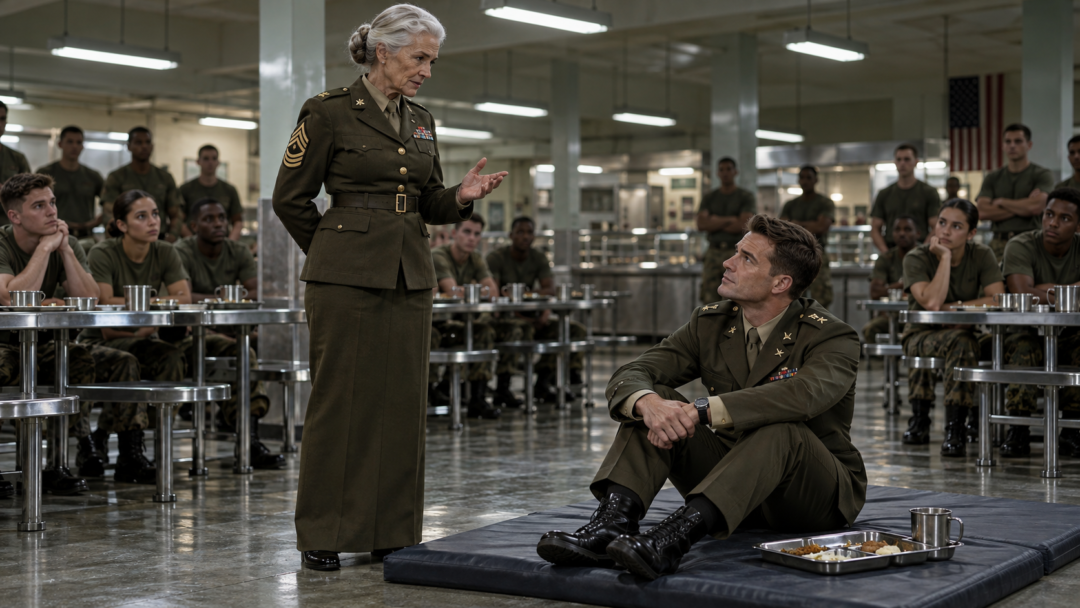
The Veteran Drill Sergeant Who Brought Down The Arrogant Lieutenant
CHAPTER 1: THE ALUMINUM TRAY ON THE COLD CONCRETE
The harsh fluorescent tubes suspended by heavy iron chains from the high industrial rafters of the Fort Arden mess hall buzzed with a low, relentless sixty-cycle hum that had not changed since the height of the Cold War in 1968. Outside, a freezing November drizzle drifted through the dense scrub pitch pines of the New Jersey Pine Barrens, coating the asphalt motor pools, barracks roofs, and chain-link security fences in a slick, oily sheen. The dining facility was a vast cavern of poured reinforced concrete and cinderblock walls painted institutional seafoam green, warmed by clanking steam radiators that smelled of hot cast iron and mineral scale. The air hung thick and dense with the familiar, heavy aromas of military catering: boiled russet potatoes, roasted turkey roll drenched in thick giblet gravy, damp wool utility coats drying on backs of chairs, and the acrid, metallic sharpness of stale chicory coffee bubbling in fifty-gallon urns.
Long rows of stainless steel tables stretched across the polished grey concrete floor, populated by scattered groups of young recruits in grey physical training sweats and muddy running shoes, their shoulders slumped from a grueling ten-mile morning march through the sandy pine trails.
Sitting alone at a corner table near the eastern clerestory window was Vera Kolt.
Vera was seventy-four years old, small of stature at barely five feet three inches, yet possessing a spine as straight, unbending, and proud as a polished steel guidon. She wore an immaculately tailored vintage olive drab service uniform from her active-duty years, every seam sharp enough to slice paper, the brass buttons polished to a mirror gleam that caught the grey light filtering through the rain-streaked window. Pinned above her left breast pocket were her master drill sergeant identification badge, three rows of campaign ribbons, and the combat parachute badge with a bronze service star. Her silver hair was wound into a severe, rock-solid braid pinned tightly against the crown of her skull with black enameled hairpins.
Her face was a masterwork of weathered discipline—deep, sun-cured lines etched into her tanned cheeks and brow by three decades of shouting cadences across sandy drill fields from Fort Jackson to Fort Benning to Baumholder, Germany. Her clear blue-grey eyes were calm, observant, and quiet as a frozen woodland marsh, missing nothing that occurred within fifty yards.
Before her on the stainless steel table sat a standard three-compartment aluminum tray holding a bowl of warm oatmeal, two hard-boiled eggs, a square pat of salted butter, and a small white ceramic mug of black coffee. She ate with unhurried, mechanical precision, peeling the eggshell into a neat pile on a paper napkin.
Her right hand rested flat beside the metal tray. Every few seconds, the knuckles gave a slight, involuntary tremor—a rhythmic, fluttering twitch caused by deep brachial nerve damage sustained thirty-three years earlier. Whenever the tremor began, Vera would calmly press her right thumb against her index knuckle, drawing in a slow, silent breath through her nose until the spasm subsided into still flesh.
The heavy double swinging doors of the kitchen corridor swung open with a loud pneumatic hiss, and Lieutenant Dane Marrow strode into the dining hall.
Marrow was thirty-four years old, six feet one inch tall, broad-shouldered, and impeccably dressed in modern digital camouflage fatigues with a crisp black beret tilted over his brow with razor-sharp alignment. He walked with an exaggerated, aggressive swagger—the heavy-heeled, stomping march practiced by insecure junior officers who were terrified that their subordinates did not take them seriously. He had been assigned to Fort Arden only three weeks earlier as an assistant training officer, and already he had gained a toxic reputation across the installation for arbitrary disciplinary write-ups, surprise locker inspections at two in the morning, and an insatiable need to prove his authority over everyone who crossed his path.
Behind him sat four nineteen-year-old recruits eating scrambled eggs in anxious silence, their eyes fixed on their plates to avoid drawing his attention.
Marrow walked down the center aisle between the rows of tables. As he passed Vera Kolt’s table, his cold, arrogant eyes locked onto the elderly woman sitting in her vintage dress uniform. A sneer of deep, reflexive hostility twisted his thin lips. To an officer obsessed with modern equipment, synthetic tactical gear, and institutional metrics, this silver-haired veteran looked like a ceremonial relic who had outlived her usefulness.
Without breaking his stride, Marrow swung his left arm backward in a casual, vicious arc.
CLATTER-CRASH.
His heavy leather-gloved backhand caught the outer edge of Vera’s aluminum tray with concussive force. The metal tray launched off the table, tumbling end over end through the air before crashing onto the concrete floor with a deafening rattle. The ceramic bowl shattered into jagged white shards, scattering boiling oatmeal, hard-boiled eggs, butter, and scalding black coffee across a six-foot circle of floor directly beside Vera’s spit-shined jump boots.
The four recruits at the adjacent table froze mid-bite, their forks suspended in mid-air, the color draining instantly from their youthful faces.
Marrow didn’t stop. He took two slow, arrogant paces past the table, paused, and turned around with a mocking smirk playing across his sharp features, resting his hands casually on his tactical belt.
“They let anyone on base these days,” Marrow sneered, his voice loud, grating, and dripping with condescension that echoed off the cinderblock walls. “This dining facility is authorized for active military personnel conducting mission-critical training, not for retired pensioners who can’t hold a spoon without spilling their breakfast across the floorboards. If you can’t feed yourself without making a filthy mess on my garrison floor, old woman, pack your knitting and check into an assisted-living facility where nurses can change your bib.”
Vera Kolt did not jump. She did not gasp, and she did not shout.
She sat motionless on her metal bench, looking down at the steaming puddle of black coffee, shattered porcelain, and crushed eggs pooling beside her boots. Her jaw tightened once—a single, controlled flex of the masseter muscle beneath her weathered jawline. Her right hand, resting flat against the steel tabletop, gave one sharp tremor, and then, as her thumb pressed firmly against her index knuckle, it froze into absolute, granite stillness.
She lifted her blue-grey eyes, fixing her gaze upon the young officer with an immovable, chilling intensity that made Marrow’s smirk suddenly flicker.
Vera looked past his shiny first lieutenant bars, past the brand-new parachutist badge on his chest, directly at the black-and-gold nameplate pinned above his right pocket: MARROW.
A subtle, tragic shadow passed through her eyes, instantly replaced by an edge of diamond-hard resolve that seemed to drop the temperature of the hall by ten degrees.
“You have your father’s wide shoulders, Dane,” Vera said softly, her voice carrying a deep, gravelly timbre that commanded the acoustic space of the vast hall without ever rising above a conversational murmur. “But you have a coward’s tongue. And your father would have ripped those bars off your collar before breakfast.”
CHAPTER 2: EIGHT MOVES IN THE FLUORESCENT LIGHT
Lieutenant Dane Marrow’s face darkened from pale arrogance to a mottled, dangerous crimson. The mention of his father struck him like an open-palm slap across the mouth. In eight years of military service, no subordinate and certainly no civilian contractor had ever dared speak to him with such icy, dismissive familiarity. He took two heavy, threatening steps toward her, his combat boots crushing a piece of broken ceramic on the floor with a loud, sickening crunch.
“What did you say to me?” Marrow snarled, his voice dropping into a harsh, vibrating hiss that trembled with violent rage. “You don’t speak my name, old woman! You don’t speak about my father! You stand up and address a commissioned officer of the United States Army, or I will have the military police drag you off this garrison in zip-ties under Article 89 for open disrespect to a superior commission!”
Marrow lunged forward with his right hand, his thick fingers hooking into a claw aimed directly at the collar of Vera’s vintage olive coat, intending to haul her off the bench and throw her into the aisle.
Vera Kolt rose.
She didn’t use her hands to push off the table. She stepped smoothly off the bench, her small five-foot-three frame uncoiling with the fluid, effortless economy of a tempered steel spring. She stepped directly around the puddle of spilled coffee, meeting his forward rush on clean, dry concrete, her hands hanging loose and relaxed at her sides.
What followed was an unbroken, eight-move close-quarters combatives sequence taught to elite airborne pathfinders during the height of the Cold War—a sequence designed to neutralize larger, heavier opponents through pure kinetic geometry.
Move One: Catch. As Marrow’s reaching right wrist crossed her chest line, Vera’s left hand struck like a striking viper. Her palm slapped the base of his thumb, her fingers wrapping into a thumb-lock that paralyzed his forearm tendons before his fingers could brush her collar. The shock sent an electric jolt of numbness up his radial nerve.
Move Two: Redirect. Vera pivoted forty-five degrees to the right, using Marrow’s two-hundred-pound forward momentum to pull his shoulder past her hip, completely collapsing his offensive alignment. His forward momentum became his own trap.
Move Three: Lock. Her right forearm slid beneath his extended elbow like an iron lever. With a subtle, two-inch upward snap of her shoulder, she engaged a standing hyper-extension lock. Marrow let out a strangled gasp as the ligaments in his elbow tightened to the absolute edge of dislocation.
Move Four: Sweep. Before Marrow could pull back or recover his center of gravity, Vera’s right combat boot hooked behind his lead ankle, sweeping his foot forward along the slick concrete in a clean, effortless trip that took his feet completely out from under him.
Move Five: Guide. Instead of letting him crash violently onto the hard stone, Vera controlled his descent with her hip and left hand, guiding his falling mass in a tight, rotational spiral that drained all impact energy without cracking his skull against the floorboards.
Move Six: Pin. Marrow slammed onto his stomach on the floor, the breath knocked from his lungs with a muffled oof. In the same microsecond, Vera dropped her left knee onto the junction of his shoulder blade and neck, trapping his upper torso with immovable, geometric pressure that made it impossible for him to expand his ribcage.
Move Seven: Shift. She wrenched his trapped right arm upward into a classic hammerlock behind his shoulder blades, securing his wrist with her right hand—the hand that had been trembling seconds earlier now held him with the immovable strength of an iron vise.
Move Eight: Hold and Release. She held the lock for two full, agonizing seconds while Marrow lay pinned, completely immobilized, his cheek pressed flat against the cold concrete floor, staring in terrified disbelief at the four recruits watching with wide, frozen eyes from their table.
Then, Vera released the pressure and stepped back two clean paces.
She didn’t breathe hard. Not a single silver hair was out of place. Her hands rested calmly at her sides, perfectly still.
Marrow scrambled to his hands and knees, clutching his aching elbow, his uniform covered in grey floor dust, his face dripping with cold sweat and burning with absolute humiliation. He looked up at her with raw, primitive terror—the look of an amateur who had just realized he had tried to slap a mountain.
Vera looked down at him. She bent down slowly, her eyes fixing upon the white surgical scar running across the base of his right wrist.
“I held that very wrist in my hands when you were three years old, Dane,” Vera whispered, her voice a low, mournful murmur that chilled him to the bone. “In the base clinic at Fort Benning, when you fell off the playground fence and broke your arm. Your father Thomas sat in the waiting room with tears in his eyes, holding my sleeve. He made me promise that if anything ever happened to him in the field, I would keep an eye on you so you didn’t destroy yourself with false pride.”
Vera turned away, walked over to the floor, picked up her dented aluminum tray, and set it upright on the table.
She picked up her service cap from the bench, tucked it neatly beneath her left arm, and walked toward the exit doors with slow, dignified strides, her back straight as an arrow.
Behind her, Marrow remained frozen on his knees on the concrete, his mouth opening and closing in soundless shock, the name Thomas echoing in his ears like a ghost returning from a thirty-year grave.
CHAPTER 3: THE GHOST OF THE DESERT STORM BUNKER
The four recruits sat at their table in complete, absolute silence, their breathing shallow and rhythmic. Not one of them dared to whisper or look in Lieutenant Marrow’s direction. The young officer pulled himself up slowly using the cold edge of the stainless steel table, his knees knocking together, his fingers trembling violently against his damp trousers. The grey concrete dust of the dining hall clung to his knees and chest like ash. His face burned with an all-consuming, toxic humiliation that seemed to choke off his airway, constricting his throat so tightly that he could barely draw a breath of the stale, coffee-scented air.
Without uttering a single syllable to the recruits, Marrow snatched his fallen black beret from the wet floor, wiped the grime from his knees with hurried, frantic strokes of his hands, and fled through the service corridor into the freezing autumn rain.
He did not return to his company office. He did not report to the battalion executive officer. He drove his military pickup truck straight across the rain-swept installation to the subterranean archives housed in the basement of Headquarters Building 200—the Cold War records bunker where Fort Arden kept fifty years of personnel and casualty files preserved under climate-controlled vaults.
For thirty years, Dane Marrow had lived with a dark, hollow, festering wound in his chest. His father, Sergeant First Class Thomas Marrow, had died in the Euphrates Valley during Operation Desert Storm in February of 1991, when Dane was just four years old. All Dane had ever known about his father came from his wealthy uncle, Bradley Marrow—a high-powered defense contractor who had raised him in an atmosphere of cold, demanding perfection in northern Virginia. Bradley had relentlessly drummed into Dane’s head that his father was an irresponsible, reckless enlisted grunt who had abandoned his family, died uselessly in an unapproved firefight, and left behind nothing but debts and dishonor. It was that bitter, corrosive shame that had driven Dane to become an officer, desperate to scrub away the perceived stain of his father’s enlisted service through aggressive, authoritarian discipline.
Now, sitting in the humming fluorescent glow of the underground microfiche viewing terminal, Dane typed in his father’s service serial number: RA-18492004 – SFC MARROW, THOMAS.
The microfiche reel whirred with a mechanical clatter, stopping on a stamped, red-bordered combat casualty report: 18TH AIRBORNE CORPS – 24TH INFANTRY DIVISION – MEDEVAC LOG – 27 FEB 1991.
Dane began reading. As his eyes tracked across the blurry, scanned carbon typewriting, the breath froze in his throat.
The report did not describe a reckless grunt. It detailed an act of extraordinary, breathtaking valor that had saved an entire platoon. On the afternoon of February 27, 1991, an armored personnel carrier carrying twelve wounded infantry soldiers had been struck by an Iraqi anti-tank missile in an oil smoke blizzard near the Rumaila oil field. Thomas Marrow had repeatedly entered the burning hull under heavy sniper fire, dragging six trapped men to safety before collapsing from severe blast trauma and smoke inhalation.
Dane’s fingers trembled as he reached the final paragraph of the field surgeon’s deposition:
RECOMMENDATION: DISTINGUISHED SERVICE CROSS (POSTHUMOUS). SPECIAL COMMENDATION: FIRST SERGEANT VERA KOLT, DRILL CADRE ATTACHE, WHO ENTERED THE BURNING CARRIER TO RECOVER SFC MARROW UNDER DIRECT FIRE. 1SG KOLT SUSTAINED A THROUGH-AND-THROUGH GUNSHOT WOUND TO HER RIGHT SHOULDER AND SEVERE CRUSH NERVE TRAUMA TO HER RIGHT HAND WHILE ATTEMPTING CPR ON SFC MARROW INSIDE THE EVACUATION HELICOPTER. SFC MARROW EXPIRED IN 1SG KOLT’S ARMS AT 1642 HOURS.
Dane leaned back in his chair, his heart thudding violently against his ribs.
Vera Kolt hadn’t just known his father. She had taken a high-caliber round through her shoulder trying to pull him out of an inferno. The tremor in her right hand wasn’t the frailty of old age; it was the physical scar of her desperate, bleeding attempt to keep Thomas Marrow’s heart beating inside a vibrating medevac helicopter flying through smoke.
Dane turned the page on the microfiche reader.
Attached to the casualty record was an administrative annex concerning the disposition of Thomas Marrow’s military personal effects, life insurance payout, and family trust.
Dane’s eyes locked onto the signature line of the legal trustee.
The document was dated April 1991. The sole beneficiary of Thomas Marrow’s military death gratuity and two-million-dollar government life insurance policy was listed not as Dane, but as Bradley Marrow—under a power-of-attorney affidavit stamped with a notary seal that had been flagged by the Army Finance Corps for PENDING AUTHENTICATION.
Dane traced the forged signature of his mother with a cold, shaking finger. His mother had passed away of cancer three years after his father’s death, impoverished, working double shifts at a diner while Bradley claimed the family was destitute.
Before Dane could turn the next page, the heavy oak door of the archive room clicked shut behind him with an ominous, heavy thud.
Standing in the doorway, wearing an expensive cashmere overcoat over a three-piece charcoal suit, was his uncle, Bradley Marrow.
CHAPTER 4: THE BLACK SEDAN BY THE SCRUB PINES
Bradley Marrow was sixty-two years old, silver-haired, impeccably groomed, and radiating the cold, predatory confidence of a corporate executive used to manipulating military defense contracts and congressional subcommittees. He held an unlit Cuban cigar in his leather-gloved hand, his cold blue eyes fixing upon Dane with an expression of sharp, displeased calculation that cut through the basement chill like an icicle.
Behind him in the hallway stood two private security drivers in dark wool coats and earpieces—former private military contractors with dead eyes and scarred faces.
“I received an alert from the garrison provost marshal’s office forty minutes ago, Dane,” Bradley said smoothly, his voice low, cultured, and completely devoid of human warmth. “They told me you were involved in an embarrassing physical altercation with a retired civilian contractor in the dining hall, and that you immediately rushed to the classified historical records annex. You’re behaving like an undisciplined recruit who needs to be reminded of his place.”
Dane stood up slowly from the microfiche desk, his knuckles resting against the cold metal rim of the terminal. The hum of the cooling fan inside the reader seemed deafening in the silence between them.
“Uncle Bradley,” Dane said, his voice shaking with a dangerous mixture of grief and mounting fury. “Why did you tell me my father was a disgraced coward? Why did you tell me he abandoned me and died uselessly in an unapproved firefight?”
Bradley’s eyes narrowed into cold, calculating slits. He stepped slowly into the archive room, closing the heavy oak door firmly behind him and leaning against the doorframe, his gloves creaking softly.
“Your father was an enlisted dreamer with a fatal martyr complex,” Bradley said dismissively, flicking an invisible speck of dust from his cashmere lapel. “He cared more about twelve dirty soldiers in a burning ditch than he did about building a future for our family. If I had let his memory dictate your upbringing, you would have ended up a broken, penniless sergeant living in a trailer park just like him. I took control of his chaotic estate, financed your elite military academy prep, and secured your commission. You owe me everything you have, Dane. Every uniform, every stripe, every door that opened for you.”
“His estate?” Dane took a step forward, his chest heaving, his fists clenching at his sides. “The official record says there was a two-million-dollar life insurance payout and a congressional trust fund meant for my college education and housing! It was flagged for forgery thirty years ago! My mother died working in a hospital laundry because she couldn’t afford chemotherapy! Where did that money go, Uncle Bradley?”
Bradley’s jaw tightened, the polished corporate mask cracking to reveal the ruthless, cold-blooded extortionist beneath.
“That money built Vanguard Defense Logistics, Dane,” Bradley hissed, stepping directly into Dane’s personal space, his eyes burning with venomous menace. “The company that currently holds fifty million dollars in logistics supply contracts with this very garrison. Your commission exists because my board of directors donates heavily to the Senate Armed Services Committee. If you breathe one word of these archival delusions to the post commander, I will ensure that your career is terminated before sunset. You will be court-martialed for assault on that old woman, stripped of your rank, and thrown out the main gate with nothing but the clothes on your back.”
Bradley tapped his cigar sharply against Dane’s shoulder with patronizing contempt.
“Walk away from this, nephew. Pack your bags, take your scheduled leave, and let Vera Kolt rot in her pension. If you go near her quarters, you won’t like what happens to her or to this base.”
Bradley turned on his heel, motioned to his security guards, and strode out of the archives, his heavy dress shoes clicking on the linoleum corridor until the sound faded into the building’s silence.
Dane stood frozen in the cold room, his hands trembling so hard he could barely hold the paper copies he had printed from the microfiche.
For the first time in his thirty-four years, the arrogant, combative shell he had built around his heart crumbled away, leaving behind the terrified little boy who had spent three decades wondering why his father hadn’t loved him enough to stay alive.
He looked at the microfiche screen one last time, reading Vera Kolt’s residential address in the base civilian housing annex: Number 14 Pine Needle Way.
He didn’t obey his uncle. He didn’t pack his bags.
He stepped out into the freezing New Jersey rain, turned his collar up against the wind, and walked toward the small white-clapboard cottage at the edge of the training grounds.
CHAPTER 5: THE FOOTLOCKER BENEATH THE BUNK
The cottage at Number 14 Pine Needle Way sat nestled beneath towering red oaks that shed their golden leaves onto a neat gravel driveway. Smoke curled lazily from a red brick chimney, and a small American flag fluttered gently from the front porch railing in the evening breeze. The house had belonged to base non-commissioned officers since the 1940s, its cedar clapboards painted crisp white, its windows glowing with amber lamplight.
Dane Marrow knocked on the wooden door, his hand trembling with nervous exhaustion and raw, turbulent emotion.
The door swung open. Vera Kolt stood in the entryway, wearing a thick navy-blue wool cardigan over her pressed trousers, her silver braid resting over her shoulder. She looked at his soaked uniform, at the red, grief-stricken circles beneath his eyes, and stepped back into the warm hallway without uttering a single reproach.
“Come inside, Lieutenant,” Vera said softly. “The rain is turning to sleet.”
Dane entered the small living room. The room was warm and quiet, smelling of cedar shavings, beeswax, and fresh lemon tea brewing on the stove. On the mantlepiece sat black-and-white photographs of paratroopers, drill sergeants, and base graduation ceremonies spanning four decades of service. Among them was a framed photograph of a young, broad-shouldered sergeant with Dane’s exact jawline, laughing beside a dusty jeep in Georgia: Thomas Marrow.
Dane stood in the center of the braided rug, his cap held tightly in his trembling hands, staring at his father’s smiling face.
“I read the after-action medevac report, Sergeant Kolt,” Dane whispered, his voice cracking into a ragged choke. “I saw what you did at the burning carrier. I saw what happened to your shoulder and your hand. And… I saw my father’s casualty log.”
Vera looked at him for a long, quiet moment, her blue-grey eyes softening with deep, maternal sorrow.
“Your father was the finest soldier I ever trained, Dane,” she said quietly. “He wasn’t a coward. He was a lion. And he loved you with every beat of his heart.”
Vera walked over to the wooden footlocker resting against the pine wall beneath the window. She knelt down, unlocked the heavy brass padlock with a small iron key she wore on a chain around her neck, and lifted the cedar lid.
From inside the footlocker, she withdrew a thick package tied with faded green parachute cord.
The package contained thirty yellowed, airmail envelopes bearing military postmarks from Kuwait and Saudi Arabia between August 1990 and February 1991. Every single envelope was addressed in neat, block handwriting: FOR MY SON DANE – TO BE DELIVERED UPON HIS COMMISSION.
Vera placed the letters into Dane’s hands.
“Thomas gave these to me in the desert staging area two nights before the ground assault,” Vera whispered, her weathered hand gently covering his. “He had a premonition that he wouldn’t come back. He asked me to keep them safe until you graduated from basic training. But after his funeral, your uncle Bradley obtained a court injunction claiming you were a minor and that all correspondence had to pass through him. When I tried to deliver them to you, Bradley had base security ban me from your school.”
Dane untied the parachute cord with shaking fingers. He opened the top letter, dated February 24, 1991—three days before his father’s death.
My dearest Dane, the letter read in his father’s bold, steady hand. If you are reading this, it means you have grown into a man of honor. Never let anyone tell you that rank makes a leader. True strength is not in pushing people down; it is in picking them up when they fall. I carry your photograph in my helmet band every minute of every day. You are the greatest thing I ever accomplished in this life. Stand tall, my son. Your father is with you always.
Dane turned to the second letter, dated Christmas Eve 1990. In it, Thomas described building a wooden swing set for Dane in their backyard before deploying, describing Dane’s laughter, promising that no matter how dark the desert nights became, the thought of his boy was his beacon.
Tears flooded Dane’s eyes, dripping onto the yellowed paper. Thirty years of buried bitterness, rage, and shame dissolved into a flood of cleansing, cathartic grief. He sank onto his knees on the rug, weeping into his hands, while Vera Kolt stood over him, resting her weathered right hand on his shoulder with the firm, loving warmth of a guardian who had never surrendered her watch.
Suddenly, the front window shattered into a thousand flying shards of glass.
A heavy tear-gas canister bounced across the living room rug, hissing white, choking smoke into the air, followed by the heavy, concussive smash of the front door being kicked off its hinges.
CHAPTER 6: THE HEARING IN THE DIVISION COURTROOM
Two masked men in black tactical assault gear, armed with suppressed pistols and expandable steel batons, burst through the blinding smoke into the cottage.
They were Bradley Marrow’s private security contractors, sent to eliminate the letters and silence the witnesses before morning.
“Get the package! Move!” the lead intruder barked through his respirator.
Dane scrambled up, coughing violently in the chemical fog, but Vera was already in motion.
Despite her seventy-four years, Vera moved with the terrifying speed of a veteran who had fought through gas chambers and ambushes in three different decades. She snatched a heavy cast-iron fireplace poker from the hearth, whipped it through the smoke, and struck the lead intruder’s wrist with a sickening metallic crack.
The suppressed pistol flew from the man’s paralyzed fingers.
Before the second man could raise his weapon, Dane lunged forward. Thirty years of pent-up rage exploded into a textbook low tackle that drove the second contractor through the splintered coffee table onto the floor, disarming him in a shower of broken oak.
Vera hooked the first intruder behind his knee with the poker, bringing him crashing to the floor, where she pinned his neck with her boot heel.
“Call the garrison provost, Dane,” Vera commanded, her eyes clear through the drifting smoke. “It’s time to end this.”
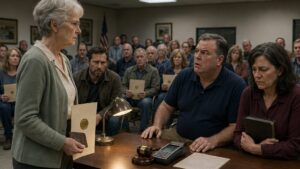
At ten o’clock the following morning, the Fort Arden Division Courtroom was packed with senior officers, legal officers, and base commanders for an emergency military tribunal.
Presiding over the board was Garrison Commander Colonel Patricia Ward, flanked by the Regional Director of the Federal Bureau of Investigation and the chief legal counsel of the Department of Defense Inspector General.
Standing at the respondent’s table was Bradley Marrow, flanked by three high-priced corporate defense attorneys in silk suits. Bradley looked confident, sneering toward the gallery, holding a prepared statement accusing his nephew and Vera Kolt of assault and extortion.
“Colonel Ward,” Bradley declared smoothly. “This hearing is an outrage. My nephew has clearly suffered a psychotic breakdown, influenced by a delusional retired drill sergeant. The allegations regarding trust embezzlement are utterly baseless, and my security personnel were merely conducting a welfare check on my family property—”
“Quiet, Mr. Marrow,” Colonel Ward interrupted, her voice like cold granite. “Lieutenant Marrow, present your evidence.”
Dane Marrow stepped forward to the center podium.
He was in full dress uniform. His face was bruised from the night’s struggle, but his posture was upright, proud, and free from fear. Beside him walked Vera Kolt, wearing her vintage drill sergeant uniform, carrying a sealed steel dispatch case.
Dane placed his father’s thirty wartime letters onto the judicial table, alongside the newly subpoenaed banking records from Vanguard Defense Logistics.
“These are thirty original letters written by Sergeant First Class Thomas Marrow,” Dane announced, his voice ringing with absolute clarity through the crowded courtroom. “In them, my father explicitly references the two-million-dollar trust established for his family. And here are the forensic audit records retrieved this morning from the Army Finance Command, proving that in May 1991, Bradley Marrow forged my mother’s signature on the power-of-attorney forms, transferred the trust funds into his offshore shell corporations, and used that money to launch his defense logistics firm.”
Bradley’s attorney jumped up: “These records are ancient and unverified! You cannot prove forgery thirty years after the fact!”
“We don’t need to,” Colonel Ward said, nodding toward the FBI director. “The FBI seized the original notary ledgers from Mr. Marrow’s Manhattan office three hours ago. The notary has already confessed under federal immunity that Bradley Marrow paid him twenty thousand dollars in 1991 to forge the seals. Furthermore, the two armed contractors arrested at Sergeant Kolt’s home have admitted they were paid one hundred thousand dollars to assassinate both witnesses and destroy the correspondence.”
Bradley’s face drained of color. He staggered backward, his hands grasping for his attorney’s sleeve, but the lawyer stepped away, looking down in disgust.
Colonel Ward struck her gavel with a resounding crack that echoed like a rifle shot:
“Bradley Marrow, by authority of the United States District Court and the Department of the Army, you are remanded to federal custody without bail for grand larceny, mail fraud, perjury, and conspiracy to commit murder. Bailiffs, take him away.”
Federal marshals stepped forward, snapping heavy steel cuffs around Bradley’s wrists and marching him out of the courtroom before the silent assembly.
CHAPTER 7: THE SILVER WHISTLE IN THE MORNING MIST
The nor’easter that had battered the New Jersey coast for days finally blew out to sea, leaving behind a crisp, radiant autumn morning bathed in pure, golden sunlight. The scrub pines smelled fresh and clean, washed of dust, their dark green needles sparkling with melting frost. The air tasted of sweet cedar and pine resin, sharp and invigorating as it filled the lungs.
On the main parade grounds of Fort Arden, the entire 2nd Basic Training Battalion—six hundred young soldiers standing in four precise, rigid companies—stood formed on the lush green turf.
At the front of Company B stood the four recruits from the mess hall, their backs straight as iron bars, their chins held high, their eyes fixed proudly on the reviewing stand where the battalion colors fluttered in the autumn breeze.
Standing before the battalion was Lieutenant Dane Marrow.
His uniform was spotless, his jump boots polished to a glass shine that mirrored the blue sky above. But the arrogant, mocking swagger was gone forever, replaced by a quiet, steady humility and a profound sense of purpose that commanded genuine, silent respect from every soldier in the ranks.
Walking across the green grass toward him, accompanied by Garrison Commander Colonel Patricia Ward, was Vera Kolt.
Vera stopped three paces from Dane. She carried no documents, no legal files, no anger. In her weathered right hand, she held an antique, engraved sterling silver drill sergeant whistle suspended from an olive drab lanyard—the whistle that Thomas Marrow had worn around his neck during his six years training young paratroopers on this very field.
Colonel Ward stepped forward to the microphone, her voice echoing across the quiet parade grounds:
“For thirty-three years, Master Drill Sergeant Vera Kolt guarded the memory and legacy of a fallen American hero,” Colonel Ward announced, her words carrying clearly to every platoon. “Today, that legacy is passed to the next generation of American leadership.”
Vera stepped up to Dane.
She looked up into his eyes. There was no tremor in her hand as she lifted the silver whistle, draping the olive lanyard around Dane’s neck so that the polished silver rested squarely against his heart.
“Your father asked me to give you this when you became a true officer, Dane,” Vera said softly, her voice filled with deep, paternal warmth that reached straight into his soul. “An officer does not lead through fear. An officer does not knock down the weak to make himself feel tall. An officer leads by standing between his soldiers and the storm, lifting them up when their knees fail. You stood tall today. Your father is watching, and he is proud.”
Dane felt a warm, quiet tear slip down his cheek, but he did not wipe it away. He looked down at the silver whistle, running his thumb over the engraved words: TO MY SON DANE – STAND TALL.
He looked up at Vera Kolt, snapped his heels together with a clean, sharp click of leather, and brought his right hand to his brow in the sharpest, most reverent military salute of his life.
“Thank you, Drill Sergeant,” Dane whispered, his voice steady and resolute.
Vera returned the salute with crisp, flawless perfection—her hand steady as granite, her eyes shining in the golden morning light.
Turning to face his battalion, Lieutenant Dane Marrow raised the whistle to his lips and blew one sharp, clear, resonant blast. The piercing note cut across the morning mist, echoing through the pines and rolling across the training grounds like the voice of a guardian returning home at last.
He lowered the whistle, looked out at his six hundred young soldiers, and spoke with calm, quiet authority:
“Battalion… fall in.”
As the sound of the whistle subsided into the pine woods, Dane took three measured steps toward the front rank of Company B. He stopped directly in front of the four young privates who had witnessed his shameful outburst in the dining hall forty-eight hours earlier. He looked each man in the eye, offering no excuses, hiding behind no rank.
“Soldiers,” Lieutenant Marrow said, his voice ringing across the turf with absolute honesty and unvarnished conviction. “Two days ago, you saw me disgrace the uniform of the United States Army. You saw an officer who mistook arrogance for leadership and bullying for authority. Master Drill Sergeant Kolt showed me what a true soldier looks like. Leadership is not a license to look down on others; it is a solemn oath to be the first to sacrifice and the last to complain. I apologize to each of you for the poor example I set, and I promise you on my father’s memory that from this day forward, I will earn your respect through deeds, not demands.”
A murmur of profound respect rippled through the ranks, followed by a resolute nod from each of the four recruits. For the first time since arriving at Fort Arden, Dane Marrow did not feel the crushing weight of an unlived life. He was his father’s son, standing in the light, ready to lead.