The Illusionist Who Swapped The Locked Trunks And Unmasked The Syndicate
CHAPTER 1: THE BRASS KEY ON THE VELVET STOOL
The November wind came tearing off Lake Michigan with the cutting bite of broken glass, whipping black spray across the concrete bulkheads of Wacker Drive before funneling into the dark brick canyons of the Chicago Loop. Beneath the rumbling iron girders of the elevated tracks on Wabash Avenue, the Majestic Theatre stood like a grand, battered fortress from another century. Built in 1922 as a premier vaudeville house, its cavernous limestone facade was framed by tarnished bronze sconces and soot-stained terra-cotta garlands. Inside the auditorium, the scent was an intoxicating blend of aged cedar, ozone, heavy red velvet draperies, and mineral oil from forgotten stage machinery. Two hundred patrons sat scattered across the orchestra stalls, their murmuring voices rising into the shadows of the soaring proscenium arch where gilded plaster cherubs stared blind and hollow-eyed into the dim amber gloom.
In the center of the third row, sitting stiffly with her arms crossed over a tailored wool overcoat, sat Beatrix Lorne.
Beatrix was forty-four years old, a veteran physics and mechanical sciences instructor at Lane Technical High School. She was a woman of rigid postures, sharp angles, and unforgiving scrutiny. Her iron-gray hair was pinned back into a severe twist, and behind her tortoiseshell spectacles, her hazel eyes flicked constantly across the perimeter of the stage, measuring sightlines, calculating ceiling heights, and cataloging the tension cables dangling from the iron catwalks high above. In the inner pocket of her coat, tucked against her ribs, rested a worn leather notebook covered in encrypted column tallies—the last remnant of her younger brother, Thomas Lorne, a forensic auditor who had walked out of his riverfront office ten years earlier and never returned.
The public narrative had been swift, brutal, and convenient: Thomas had stolen two million dollars from the Sterling Development Syndicate and fled the country. But Beatrix had spent every night of the past decade dissecting the numbers. Her brother had not run; he had been erased. And the trail of shell corporations and phantom leases led straight to the decaying commercial basements of the Loop, directly below this theater.
A heavy silence abruptly swallowed the hall as the house lights extinguished, plunging the auditorium into a velvet, breathless darkness.
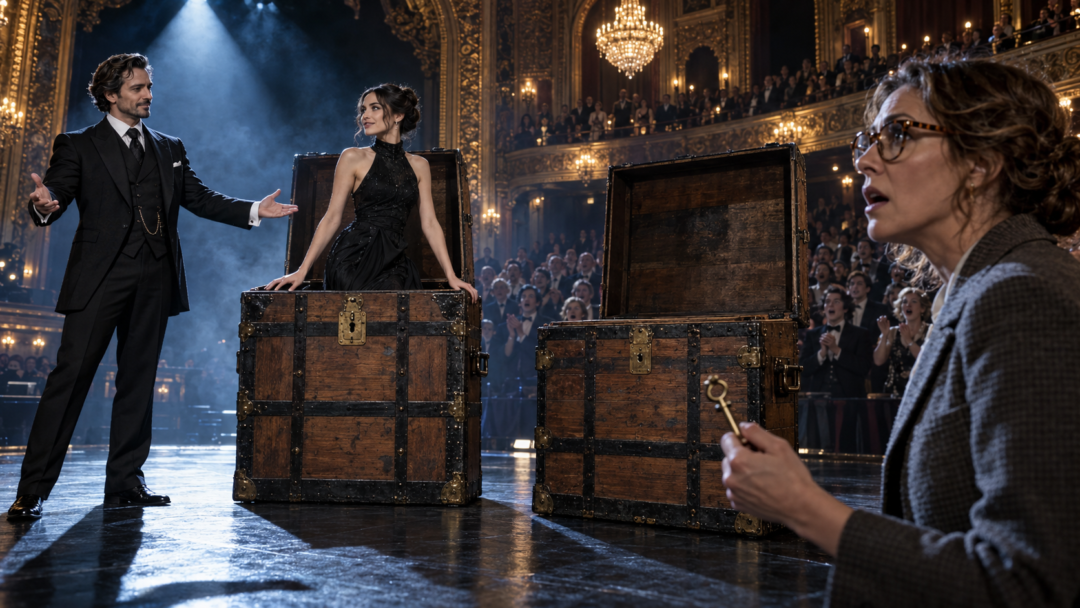
From the projection booth above the mezzanine, a single follow spotlight ignited. The beam was surgical, cold, and arctic white, slicing through the hanging blue theatrical haze to illuminate a bare expanse of dark white-oak floorboards. Resting in the center of the beam was a solitary three-legged wooden stool carved from aged walnut, and behind it stood two towering, identical wardrobe trunks made of quarter-sawn American white oak, reinforced with black iron corner braces and secured with heavy brass hasps.
Stepping into the light with an unnerving, deliberate stillness was Dorian Vale.
Dorian was forty-one years old, tall, broad-shouldered, and possessed of a silence so absolute it felt physical. He wore a bespoke midnight-black three-piece suit without a necktie, his crisp white collar unfastened at the throat. His dark hair was slicked straight back, accentuating high, sharp cheekbones and cold gray eyes that seemed to take in every shadow in the hall without blinking. He did not smile. He offered no theatrical flourish, no bow, and no patter. He walked to the center of the stage, his polished boots making no sound against the boards, and set a single antique brass skeleton key onto the round seat of the stool.
The key gleamed under the surgical light—a heavy, four-inch instrument of solid cast brass with a distinctive double-fluted bitting and an intricate circular bow.
“Two trunks,” Dorian said, his voice a low, resonant baritone that carried effortlessly to the highest balcony without amplification. “Three-inch solid oak planks. Four-gauge cold-rolled steel backing plates. Two Medeco dual-cylinder deadbolts, keyed to a single mechanical cylinder. Inside this hall, doubt is healthy. Deception is common. Therefore, I will not touch the locks.”
His gaze lifted, sweeping over the front rows with chilling precision, before locking squarely onto Beatrix Lorne.
“The woman in the third row. The one with the notebook and the caliper rule in her breast pocket. Step forward, please.”
A low murmur rippled through the spectators. Beatrix felt the hairs on her arms rise, but she did not hesitate. She stood, smoothed the front of her coat, and walked down the carpeted aisle, mounting the wooden access steps at the edge of the stage. Her low-heeled shoes produced sharp, rhythmic clicks on the hollow boards. Up close, the heat of the spotlight was intense, illuminating the fine grain of the walnut stool and the heavy iron banding on the trunks.
“You believe stage magic is an insult to intellect,” Dorian murmured, his eyes never leaving hers. “A series of hidden hinges, double mirrors, and paid confederates.”
“I believe in mass, friction, and structural integrity, Mr. Vale,” Beatrix replied evenly, her voice crisp and steady. “I do not believe in ghosts, and I certainly do not believe in miracles.”
“Good,” Dorian said softly. “Pick up the key.”
Beatrix reached out and took the brass key from the stool. It was noticeably heavy, cold to the touch, and worn smooth along the shaft from decades of mechanical engagement. But as she turned it over in her palm, catching the direct glare of the follow spot, her breath snagged violently in her chest.
Stamped into the flat surface of the circular bow, beneath a fine layer of aged lacquer, was a tiny, hand-struck jeweler’s hallmark: T.L. – 2014.
It was her brother’s personal maker’s mark—the stamp Thomas used on every custom lock cylinder he crafted in his workshop before he vanished into the dark waters of the Chicago River.
CHAPTER 2: THE INSPECTION OF THE SOLID OAK
Beatrix’s fingers closed around the cold brass key with a grip so fierce the metal bit into her palm. Her heart pounded against her ribs like a sledgehammer against stone, but her face remained an impassive mask of academic detachment. She looked up from the key into Dorian Vale’s steady, unblinking gray eyes. There was no mockery in his expression, no hint of a showman’s triumphant smugness. Only an icy, focused gravity that signaled this was not an entertainment; it was a deployment.
“Inspect the enclosures, Miss Lorne,” Dorian said quietly, gesturing toward the two towering structures behind him. “Take all the time your discipline requires.”
Beatrix stepped around the walnut stool and approached the first trunk on the stage left. It stood nearly six feet tall, three feet wide, and two feet deep, built like a munitions locker from the late nineteenth century. She bent low, running her fingertips along the joints where the white-oak planks met the blackened iron angle iron. There were no concealed hinges, no spring-loaded panels, and no hairline fractures in the wood. She rapped her knuckles hard against the side; the sound was a dull, dense thud that vibrated through the floorboards. Solid timber, lined internally with heavy sheet metal.
She stepped inside the open trunk, her boots resting on the bottom plank. She reached up, pressing her palms against the ceiling and the back wall, testing for shifting weight or sliding partitions. Nothing moved. She inspected the floor beneath the trunk; the box rested on four heavy iron casters that lifted the base two inches clear of the stage. The space below was completely open, lit by the harsh spill of the spotlight. No trapdoor could bridge that gap without being visible to the front row.
“Satisfied with the first?” Dorian asked from the edge of the light.
“It is an exceptionally well-built box,” Beatrix replied, stepping out. “Now the second.”
The second trunk was identical in every dimension, matched down to the hand-peened iron rivets securing the corner brackets. She tested the floor, the walls, and the lid. She drew a small steel measuring gauge from her blazer pocket, verifying that the internal depth matched the external height precisely. There was no false bottom. There were no mirrors.
At that moment, a woman stepped into the light from the stage right wings.
She was Ivy Rook, twenty-nine years old, slender and athletic, with dark hair swept back into a severe braided bun that exposed the sharp line of her jaw. She wore a sleeveless, high-collared stage dress of heavy matte-black canvas that reached her ankles, her feet bare against the polished wood. She moved with a feline, silent economy of motion that spoke of years spent inside tight enclosures and high-wire balances. Her gaze was cool, her chin held high, but as she looked at Beatrix, a flicker of profound recognition passed through her dark eyes.
“This is Ivy,” Dorian said. “She will occupy the trunk on your left. I will take the trunk on your right. Once you lock the hasps, you will keep the key in your possession until you are asked to reopen them.”
“And the locks?” Beatrix asked, holding up the heavy brass instrument.
“Original high-security mortise deadbolts, fabricated in 2014 by a master craftsman,” Dorian said, the cadence of his voice deliberate. “Once the bolt throws, the cylinders cannot be bypassed by raking, bumping, or magnetic manipulation. Only the physical key can retract the tumblers.”
Beatrix examined the key’s bitting again. The dual fluting was an asymmetric spline system—a signature mechanism her brother Thomas had designed during his evenings in the workshop behind their grandmother’s home on Lincoln Avenue. Thomas had called it the Catenary Lock, intended for secure safety deposit vaults that resisted thermite drills. To see it here, mounted to a traveling magician’s prop, made her blood run cold.
Ivy stepped smoothly into the left trunk, turning to face forward, her arms folded across her chest. Dorian stepped into the right trunk, his tall frame filling the enclosure until only his pale, composed face remained visible.
“Lower the lids, Miss Lorne,” Dorian commanded softly. “Throw the bolts. And do not let go of the key.”
Beatrix took hold of the heavy oak lid of the right trunk. It weighed at least sixty pounds, counter-balanced by internal torsion springs that allowed it to close with a solid, echoing thump. She slipped the brass hasp over the iron staple, inserted the key into the heavy lock housing, and turned it clockwise. The internal mechanism engaged with two distinct, heavy mechanical clicks that vibrated through the brass shaft into her fingers. Deadbolted.
She moved to the left trunk, taking the second lid and pulling it down over Ivy Rook’s calm, upturned face. As the wood descended, Ivy caught Beatrix’s eye and whispered two words through the final inch of clearance:
“Underneath… listen.”
The lid slammed shut. Beatrix slipped the hasp, inserted the key, and threw the second deadbolt. Both trunks were now sealed, solid monoliths of iron and oak resting in the glare of the white spotlight.
Beatrix backed away toward the edge of the stage, the key clutched tightly in her fist. But as her shoes touched the edge of the wooden riser, a strange, low-frequency acoustic vibration resonated up through the soles of her shoes. It was not the rumble of the nearby elevated train, nor the hum of the theater’s antique air handlers.
It was a sharp, rhythmic metallic tapping from deep below the floorboards—three short strikes, three long, three short.
SOS.
CHAPTER 3: THREE SECONDS IN THE ABSOLUTE DARK
Beatrix froze at the top of the stage stairs, her breath caught in her throat. The rhythmic tapping ceased instantly, swallowed by the cavernous silence of the auditorium. Two hundred spectators sat motionless, leaning forward in their velvet seats, their eyes fixed on the two locked monoliths standing six feet apart under the merciless white beam.
“Step to the wings, Miss Lorne,” Dorian’s voice seemed to echo, though both men were entombed within solid white oak.
Before Beatrix could take another step, the surgical follow spot died.
The extinction was so sudden, so absolute, that it felt like a physical blow. The entire theater plunged into an impenetrable abyss of blackness. There was no ambient city light, no emergency exit glow—only the suffocating, pitch-black void of a subterranean cavern.
In the dark, Beatrix counted.
One.
A high-pressure pneumatic hiss sighed through the silence—the sound of compressed nitrogen venting through a micro-valve, accompanied by a muffled, hydraulic clank that reverberated through the iron framework of the building.
Two.
A sharp, electric snap of static ozone prickled the back of her neck. From the darkness near the footlights came the whisper of fabric—heavy wool brushing against coarse canvas—moving with terrifying, impossible velocity across the empty stage floor.
Three.
The follow spotlight exploded back to life with an audible electrical hum.
The audience let out a collective, concussive gasp that sounded like a breaking wave.
Dorian Vale was standing outside the trunks.
He was standing precisely where the wooden stool had been, his black suit immaculate, his hands resting calmly at his sides. Both oak trunks behind him remained completely upright, their iron brackets gleaming, their heavy brass padlocks hanging flush against the hasps, undisturbed and locked.
Beatrix felt her stomach plummet into freefall. She had been standing less than twelve feet away. She had heard no footsteps on the floorboards, no squeak of iron hinges, no release of heavy spring latches. The air between the two trunks had not even stirred the drifting theatrical haze.
Dorian turned his head slowly, his gray eyes fixing on Beatrix. “Miss Lorne. The key, if you please.”
Beatrix’s fingers were trembling so violently she nearly dropped the brass instrument as she stepped back into the glare of the light. She approached the left trunk—the enclosure into which she had personally locked Ivy Rook less than thirty seconds ago.
“Unlock it,” Dorian instructed softly.
Beatrix inserted the key into the mortise lock. The tumblers aligned with their familiar heavy click, and she pulled the brass hasp free. Grasping the recessed iron handle, she hauled the sixty-pound lid upward.
The trunk was completely, unequivocally empty.
A murmur of nervous laughter and stunned murmurs swept through the front rows. Beatrix stared into the vacant interior. The oak floorboards were dry and seamless; the four-gauge steel backing plate reflected the harsh spotlight with cold indifference. There was no hole, no trapdoor, no slide.
“Now the right trunk,” Dorian said.
Beatrix moved to the second trunk—the one Dorian had stepped into before her very eyes. Her hands felt numb as she inserted the key into the deadbolt. She turned the cylinder. The bolt slid back with a crisp metallic snap.
She hauled the lid open.
Curled inside, her bare feet resting against the iron corner brace and her braided hair perfectly in place, was Ivy Rook.
Ivy looked up, her dark eyes wide and brilliant in the light, before placing her slender hand on the rim of the trunk and vaulting gracefully out onto the stage boards. The audience went wild. Two hundred people rose to their feet in a thunderous standing ovation, their applause hammering against the plaster cherubs and the heavy velvet curtains like an artillery barrage.
Beatrix stood between the two trunks, the heavy key burning like an ember in her hand, her mind racing through every known law of physics, mechanics, and spatial volume. It was an impossible transposition. It defied structural logic.
Then, Ivy turned to face the cheering auditorium, raising her hands in a modest, professional bow.
As her right arm lifted into the glare of the follow spot, Beatrix saw it.
Smeared across the sleeve of Ivy’s black canvas dress, just above the elbow, was a streak of thick, black industrial grease—the specific, heavy lithium grease used on commercial river sluice gates. And clinging to the hem of her skirt was a jagged scrap of damp, water-stained blue manila paper, stamped with red typewriter ink:
OFFICE OF THE SPECIAL AUDITOR – FILE 94-B.
Beatrix’s breath seized. File 94-B was her brother’s confidential audit of the Chicago River tunnel vaults.
She looked toward Dorian Vale. The illusionist had stepped back into the shadow at the edge of the proscenium arch. He was watching the third tier of private theater boxes on the mezzanine level. Sitting alone in Box 4, partially concealed behind the heavy gold fringe of the curtain, was a man in an expensive camel-hair overcoat, speaking urgently into a small radio transceiver.
It was Marcus Vance—the chief of personal security for Victor Sterling.
CHAPTER 4: THE LEDGER BENEATH THE FALSE BOTTOM
The thunderous applause continued to shake the dust from the Majestic’s gilded cornice molding, but on the stage, the reality was turning razor-sharp. Dorian Vale took Beatrix by the elbow—his grip surprisingly gentle yet possessing the unyielding firmness of an iron vise—and guided her toward the heavy maroon velvet curtains of the stage left wings. Ivy followed immediately behind, her bare feet padding silently across the floorboards.
“Keep walking, Miss Lorne,” Dorian murmured, his lips barely moving as he inclined his head toward the cheering house. “Smile as if you are returning to your seat. Do not look up at the mezzanine boxes.”
“That paper on Ivy’s dress,” Beatrix whispered fiercely, her voice tight with suppressed panic. “That was Thomas’s filing code. Where did you get that?”
“Not here,” Dorian replied.
They stepped past the heavy velour tormentor into the deep, drafty gloom of the backstage wings. The temperature dropped ten degrees instantly. Here, away from the surgical heat of the spotlight, the theater revealed its true skeleton: towering brick walls crisscrossed with counterweight cables, iron hemp ropes coiled on giant pin-rails, and the pungent smell of coal dust, ozone, and damp river mud drifting up through the floor seams.
Dorian led them to an unmarked iron fire door set into the backstage masonry. He drew a second, smaller key from his waistcoat pocket, unlocked the door, and ushered Beatrix and Ivy into what had once been the theater’s private quick-change parlor during the heyday of 1920s revues.
Inside, the room was lit by a single bare incandescent bulb hanging from a frayed cloth cord. The walls were lined with peeling floral wallpaper, an antique walnut vanity table, and stacks of wooden shipping crates labeled VALE ILLUSIONS – CHICAGO.
Ivy immediately moved to the vanity, reaching into the deep interior seam of her stage dress. She withdrew a heavy, waterproof cylinder of machined titanium, no longer than a flashlight, sealed with dual rubber O-rings and coated in a thin sheen of brackish river water.
“Did you find him?” Dorian asked, his voice stripped of all performance cadence. It was hard, direct, and freighted with immense strain.
“He’s in the auxiliary pumping chamber beneath Vault 4,” Ivy said, her breath coming in shallow, ragged bursts. Her calm stage persona had vanished, replaced by an exhaustion that turned her skin pale under the yellow bulb. “Sterling’s men have him chained to the structural shoring beam. They only give him two hours of dry floor a day during the low-tide river flush. He’s alive, Dorian. But his lungs are rattling. He won’t survive another freeze.”
Beatrix’s world tilted on its axis. She lunged forward, catching Ivy by the shoulders. “Who is alive? Are you talking about Thomas? My brother is alive?”
Ivy looked into Beatrix’s eyes, her own gaze softening with a deep, ancestral grief. “Ten years ago, my father, Julian Rook, designed the hydraulic security system for Victor Sterling’s riverfront vaults. He believed he was building the most secure commercial archive in the Midwest. But your brother, Thomas, was the state auditor assigned to review the municipal bonds financing the project. Thomas discovered that Sterling was using the deep vaults to siphon sixty million dollars in municipal transit funds into offshore numbered accounts.”
“They staged Julian’s car crash,” Beatrix said, the pieces falling into place with sickening clarity. “They made it look like a suicide on Lake Shore Drive.”
“They forced his car through the bridge railing at Columbus Drive,” Dorian said, his jaw tightening until the tendons in his neck stood out like cords. “Julian knew they were coming for him. Before he died, he hid his master cylinder keys and his structural schematics with Thomas. But Sterling’s security team intercepted Thomas at the Union Station rail yards. They didn’t kill him because Thomas had already locked the ledger vault with an algorithmic deadbolt—the Catenary mechanism. Sterling needed Thomas alive to input the clearance codes every thirty days to keep the federal treasury monitoring system from triggering an automatic seizure.”
Beatrix sank onto the edge of a wooden crate, her hands pressed against her mouth as tears finally broke through her rigid discipline. “Ten years. They kept him in the dark beneath the river for ten years.”
“They kept him alive because of that key in your hand, Beatrix,” Ivy said, unscrewing the titanium cylinder. With a faint hiss of breaking vacuum, she pulled out a tight roll of waterproof drafting vellum covered in dense, hand-written architectural cross-sections and complex mathematical cipher keys.
Beatrix recognized the handwriting instantly. It was Thomas’s tight, left-handed slant, using the mechanical drafting notation their grandfather had taught them at their kitchen table in Rogers Park.
“This is the extraction route,” Dorian said, unrolling the vellum across the vanity table. “The metamorphosis trunk illusion was never an entertainment, Miss Lorne. It was a live calibration test. The oak trunks were positioned directly over the theater’s historic 1906 coal chute, which drops into the abandoned freight tunnels of the Chicago Tunnel Company forty feet below the Loop. For the past six months, Ivy and I have been excavating the blocked drift leading from the coal chute directly into the drainage galley of Sterling’s vault.”
Beatrix leaned over the map, her analytical mind engaging through the shock. “The pneumatic hiss I heard during the blackout—that was the hydraulic counterweight dropping the trunk’s floor into the lower drift.”
“Precisely,” Dorian said. “Ivy made the drop, retrieved Thomas’s latest maintenance cipher, and returned to the stage via the adjacent service hoist in under three seconds. But Marcus Vance saw the paper scrap on her dress. He knows the vault perimeter has been breached.”
At that instant, the single incandescent bulb overhead flickered violently and died.
From the hallway outside the quick-change parlor came the muffled sound of a heavy steel fire door being kicked open, followed by the dry, distinct metallic racking of an automatic slide chambering a nine-millimeter round.
CHAPTER 5: THE ARCHITECT BEHIND THE FATAL BRIDGE
“Down,” Dorian hissed in the dark.
He caught Beatrix by the collar of her wool coat, forcing her flat against the cold hardwood floor behind the solid walnut vanity just as the door frame splintered under a hail of suppressed gunfire. The rounds tore through the thin plasterboard walls with dull, popping thuds, spitting clouds of powdery white drywall dust and shredded floral paper into the dark room.
Dorian did not draw a weapon. Instead, he reached beneath the low baseboard of the vanity and hauled upward on a concealed iron ring.
A square section of the floorboards swung inward on silent phosphor-bronze hinges, revealing a narrow vertical shaft that dropped into an abyss of cold, rushing air that smelled of ancient brick, stagnant bilge water, and raw limestone.
“Ivy, lead,” Dorian commanded. “Take Beatrix down the ladder. Third landing, seal the bulkhead.”
Ivy did not hesitate. She dropped into the opening, her bare feet finding the iron rungs embedded in the brick shaft with practiced ease. “Beatrix, feet first. Don’t look down.”
Beatrix scrambled across the floor, her fingers catching the cold iron rung. Behind them, the hallway door gave way with a concussive crash. A flashlight beam cut through the drywall dust, illuminating the silhouette of Marcus Vance stepping into the room, a suppressed pistol raised in his right hand.
“Vale!” Vance barked. “Step away from the shaft or I drop you where you stand!”
Dorian stood tall in the center of the dust cloud. In his left hand, he held a stage magnesium flare—an industrial flash pot used for theatrical thunderclaps. With his right thumb, he struck the friction igniter.
A blinding, multi-thousand-lumen burst of violet-white flame detonated in the small room with a deafening roar. Vance screamed, dropping his weapon and clamping his hands over his scorched retinas as the intense heat scorched the wallpaper.
Dorian dropped through the hatch, slamming the heavy iron trapdoor shut behind him. He spun the internal bronze dog-latch, locking the solid three-inch plate in place just as a volley of blind bullets ricocheted harmlessly off the outer steel face.
“Move,” Dorian breathed, descending the iron rungs behind Beatrix with terrifying speed.
They climbed down through forty feet of vertical darkness, the temperature plummeting until Beatrix’s breath billowed in thick white clouds. Her hands were raw and freezing against the iron rungs, but the adrenaline surging through her veins numbed the pain.
They hit the bottom with a solid splash.
Beatrix found herself standing knee-deep in freezing, brackish water inside an arched tunnel lined with porous, soot-blackened concrete. It was the forgotten underworld of Chicago: the sixty-mile network of narrow-gauge electric freight tunnels built in the early 1900s beneath the city streets, long abandoned and largely submerged since the great tunnel flood of 1992.
Ivy switched on a narrow-beam tactical torch, sweeping the light across the damp tunnel walls. Rusty narrow-gauge rail tracks lay half-submerged in the silt beneath their boots. Ahead of them, a massive cast-iron floodgate stamped CITY OF CHICAGO – WATER BOARD 1908 blocked the drift, its giant spoke-wheel valve encrusted in orange rust.
“This is the municipal drainage bypass,” Ivy said, shining her light on the locking collar of the floodgate. “Sterling’s private vault sits directly on the other side of this bulkhead, forty feet below the bed of the Chicago River. The only way in without triggering the seismic alarms on Michigan Avenue is through the emergency sediment sluice.”
Dorian stepped forward, drawing the antique brass skeleton key from Beatrix’s hand. He inserted the long fluted shank into an unpainted bronze keyway hidden behind the valve’s grease cap.
“Your brother Thomas designed this bypass for Julian,” Dorian explained as he applied his full weight to the key, turning it against the resistance of ten-year-old packing grease. “He knew Sterling would eventually try to seal the vaults from above. He built an escape hatch that only this key could operate.”
With a groaning shriek of stressed iron that echoed down the subterranean tunnel, the heavy gears inside the bulkhead engaged. The massive iron gate swung inward six inches, releasing a torrent of pressurized river water that surged around their thighs.
Through the opening, illuminated by a sickly yellow emergency floodlight, lay a stark concrete bunker.
Chained to a central structural steel column by a pair of heavy transport shackles sat a man.
He was gaunt, his skin as gray as slate, his hair a tangled white mane that fell past his shoulders. He wore a threadbare denim work shirt and canvas trousers soaked to the knees. Across his lap rested a wooden drawing board covered in mechanical schematics and algebraic equations.
Beatrix took one look at his hollow, exhausted face and broke into a desperate run through the rushing water.
“Thomas!”
The man lifted his head slowly, squinting against the flashlight beam with eyes that were cloudy with cataracts and long confinement. His cracked lips parted, his voice a hoarse, disbelieving rasp that tore at Beatrix’s heart:
“Bea… Beatrix? You’re… you’re forty minutes early for the evening audit.”
CHAPTER 6: THE FEDERAL SEAL ON THE IRON STAGE
“Thomas, it’s over,” Beatrix sobbed, splashing through the final yards of dark water and throwing her arms around her brother’s trembling, skeletal shoulders. “We’re here. Dorian and Ivy. We’re taking you home.”
Thomas let out a ragged, broken sob, his emaciated fingers clutching at the wool of her coat with desperate, claw-like strength. “The ledger… Bea, they wanted the offshore clearance codes. Sterling has forty million dollars loaded into the automated wire transfer queue. It executes at midnight when the European markets open. I held out as long as I could… I salted the cipher with parity errors, but they brought in a programmer from Zurich yesterday… they’re going to wipe the system and flood this chamber.”
“Not tonight,” Dorian said, stepping up to the column.
He inspected the heavy transport shackles securing Thomas’s wrists to the iron beam. They were high-tensile alloy steel, secured with an internal tumbler lock. Dorian reached into his waistcoat, drew out two hardened steel tension wrenches, and inserted them into the keyway. His hands, so unnervingly still on the stage above, moved with blurred, surgical precision. Within four seconds, two distinct clicks sounded, and the heavy cuffs dropped into the rushing water with a splash.
Thomas collapsed forward, but Dorian caught him under the arms, hoisting the frail auditor onto his broad shoulders.
“The tunnel gate,” Ivy warned, looking back toward the opening.
From the dark freight drift behind them came the roar of high-powered industrial bilge pumps suddenly shutting down, followed by the terrifying, concussive sound of an explosive breach.
Sterling’s security team had detonated the upper access hatch. A wall of brown, foam-flecked river water, six feet high, came roaring down the abandoned rail drift like an avalanche of liquid concrete.
“The coal chute hoist!” Dorian shouted above the deafening thunder of the rushing water. “Run!”
They fought their way back through the surging current, dragging Thomas through the iron bulkhead just as the river torrent slammed into the outer tunnel, submerging the rail tracks completely. They reached the base of the theater’s vertical shaft. Above them, hanging on high-tensile aircraft cables, was the steel platform of the stage illusion’s pneumatic lift.
Ivy scrambled onto the platform first, hauling Thomas up beside her. Beatrix pulled herself over the lip just as Dorian leaped onto the grating.
“Hit the ascent valve!” Dorian yelled.
Ivy threw the high-pressure pneumatic lever. With a concussive hiss of venting nitrogen, the steel platform shot upward through the vertical brick shaft like an elevator cab, rising forty feet in three seconds flat.
They exploded through the stage floorboards directly into the interior of the left oak trunk.
Above them, the muffled sound of a microphone feeding back echoed through the wood.
“…regret to inform you that due to a severe mechanical failure in the building’s main electrical conduit, tonight’s performance of the Vale Metamorphosis must be terminated immediately,” a smooth, cultured voice announced over the theater’s public address system.
It was Victor Sterling himself.
Sterling was standing on the stage apron, dressed in a bespoke charcoal tuxedo, a wireless microphone in his hand. Standing in the wings behind him were four armed private security guards in dark suits, their hands resting inside their jackets. In the front row, the two hundred patrons were murmuring in disappointment, beginning to collect their coats.
“Please proceed to the nearest exits in an orderly fashion,” Sterling continued, his smile slick and paternal. “The management will offer full refunds at the box office—”
CLANG.
The heavy brass deadbolt on the left oak trunk sheared in two with a sound like a rifle shot.
The sixty-pound oak lid blew open, slamming against its exterior stops with a violence that made the front-row patrons scream.
Stepping out onto the stage boards under the cold white glare of the follow spot was Beatrix Lorne, her wool coat soaked in black river silt, holding the titanium waterproof cylinder high above her head like a torch.
Beside her, supported by Dorian Vale and Ivy Rook, stood Thomas Lorne.
The silence that fell over the Majestic Theatre was so complete that the distant dripping of water from Thomas’s threadbare trousers onto the stage floor sounded like ticking clocks.
Sterling froze, the microphone lowering two inches from his mouth, his face draining of all color until it matched the white plaster cherubs above.
“Victor Sterling!” Beatrix’s voice rang out through the hall, clear, ringing, and backed by the fierce authority of a teacher who would not be silenced. “Ten years ago, you murdered Julian Rook on the Columbus Drive bridge. And for ten years, you have held my brother, Senior State Auditor Thomas Lorne, prisoner in the illegal drainage vaults forty feet below this stage to conceal your theft of forty million dollars in public funds!”
A collective gasp of sheer horror tore through the auditorium.
“Security!” Sterling snarled, dropping the microphone and lunging toward the wings. “Clear this stage! Clear it now!”
The four armed guards stepped forward, drawing their weapons.
“FEDERAL MARSHALS! NOBODY MOVE!”
The shout erupted not from the stage, but from the back of the auditorium and the mezzanine boxes. A dozen heavily armed tactical agents wearing dark blue body armor with gold federal badges burst through the theater’s exit doors and the upper balconies, their carbines leveled directly at Sterling and his security detail.
Leading them down the center aisle was Postal Inspector Raymond Vance—the estranged brother of Sterling’s security chief—holding an unsealed federal warrant.
“Drop your weapons!” Inspector Vance bellowed. “Sterling, put your hands on your head! Federal agents have already seized your server bank on Wacker Drive!”
The guards looked at the dozen red laser dots painting their chests, slowly raised their hands, and allowed their pistols to clatter onto the hardwood floorboards.
CHAPTER 7: THE MASTER KEY TO THE MORNING LIGHT
The morning sun broke over Lake Michigan in long, golden shafts of autumn light, burning through the blue haze that lingered over the granite spires of Michigan Avenue. Outside the Majestic Theatre, the street was a swirling sea of flashing red and blue emergency beacons. Six federal utility vans and three ambulances blocked the intersection of Wabash and Monroe, while reporters from every major daily and television network in the Midwest swarmed the theater’s brass entrance doors.
On the front steps of the theater, wrapped in a heavy wool emergency blanket, sat Thomas Lorne.
His face was still gaunt, his hands still trembled as he held a steaming paper cup of black coffee, but his eyes were clear, luminous, and filled with a peace they had not known in a decade. Beatrix knelt beside him on the cold stone steps, her arms wrapped tightly around his shoulders, her cheek pressed against his gray hair. They did not speak; they did not need to. The long nightmare of grief, doubt, and whispered slander was over. Thomas was alive, his name was cleared, and the mountain of evidence retrieved from the titanium cylinder was already grinding Victor Sterling’s corporate empire into dust before a federal grand jury.
A few yards away, leaning against the tarnished bronze box-office pillar, stood Dorian Vale and Ivy Rook.
Dorian had changed into a clean, dry overcoat, his silver cufflinks catching the rising sun. Beside him, Ivy was looking down at the antique brass skeleton key resting in her open palm. The key that her father had forged, the key that Thomas had calibrated, the key that had unlocked the darkest vault in Chicago.
Beatrix stood, kissed her brother’s forehead, and walked over to where the two illusionists stood.
“You knew,” Beatrix said softly, looking at Dorian. “You planned this performance six months ago. You chose me because you knew I would recognize Thomas’s mark on the bow.”
“I knew you were the only person in this city whose mind was sharp enough to see through the illusion, and whose heart was stubborn enough not to look away,” Dorian replied, the ghost of a faint, genuine smile touching the corners of his mouth. “Julian always told me: a real miracle isn’t about defying the laws of nature. It’s about restoring the balance when evil tips the scales.”
Ivy took Beatrix’s hand, closing the teacher’s fingers around the antique brass key.
“Keep it, Beatrix,” Ivy said quietly. “My father would want it to stay with the family that helped him build the truth.”
Beatrix looked down at the gleaming brass in her palm, feeling its solid, comforting weight. She looked back up at the soaring limestone facade of the Majestic Theatre, where the marquee lights had finally been switched off against the brilliance of the morning sky.
“What will you do now, Mr. Vale?” Beatrix asked. “The theater will be sealed as a crime scene for months.”
Dorian turned his gaze toward the open horizon of Lake Michigan, where the morning gulls wheeled white against the pale blue dawn.
“There are other theaters, Miss Lorne,” Dorian said, his low baritone calm and resolute. “And unfortunately… there are always other syndicates that believe they can bury their crimes in the dark.”
He nodded to Ivy, turned, and walked down the limestone steps into the bustling morning crowd, vanishing into the bustling light of the city like a man who had never been there at all.