The Shattered Orchid Planter In The Victorian Conservatory And The Botanist
CHAPTER 1: THE SEVERED ORCHID ON THE FLAGSTONES
The October morning sunlight streamed through four thousand panes of hand-blown nineteenth-century glass, illuminating the soaring iron arches of the Palm House at the Kennett Botanical Conservatory. At sixty feet above the flagstone floor, delicate water vapor from high-pressure brass misting nozzles drifted like golden gauze between the towering fronds of century-old Australian tree ferns. The air smelled of damp peat moss, crushed limestone, blooming vanilla orchids, and the rich, dark breath of living earth.
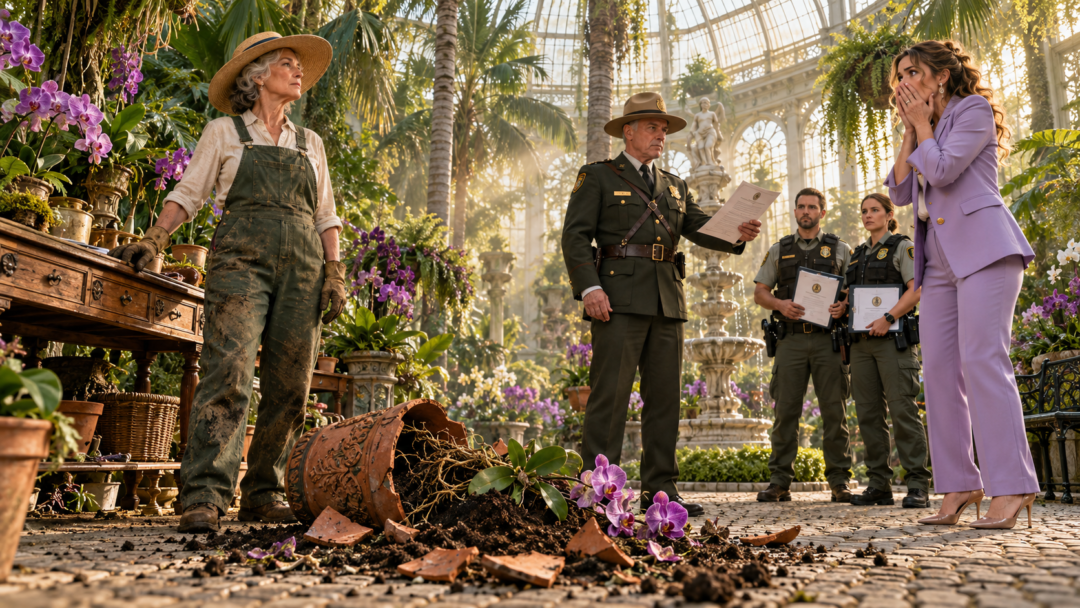
Dame Catherine Sterling stood on the cobblestone walkway of the East Pavilion, holding a heavy brass pump-action misting canister in one hand and a pair of worn Sheffield steel pruning shears in the other. At sixty-eight, she had spent fifty years studying endangered tropical flora across five continents, receiving the Linnean Medal and the Royal Society Fellowship for her work cataloging vanishing cloud forest ecosystems. She wore faded olive-green canvas overalls smudged with potting loam, a wide-brimmed straw hat tied under her chin with a frayed cotton ribbon, and thick calfskin gardening gloves.
Before her grew an eight-foot climbing vine of Orchis spectabilis vancei, a centennial hybrid first propagated in this glasshouse in 1892. Its deep violet blossoms, speckled with crimson lip petals, were so rare that only two living specimens existed on earth.
The tranquil hush of the conservatory shattered with the sharp, aggressive clatter of four-inch stiletto heels striking the wet stone floor.
“Move this disgusting jungle out of the way! Grip, get those light stands over here right now!”
Chloe Kensington stormed down the central walkway, a clipboard tucked under one arm and a venti iced coffee in her manicured hand. She was thirty-two, sharp-jawed, wearing a tailored lavender designer pantsuit that reeked of expensive synthetic musk. Behind her followed four exhausted event assistants carrying photography tripods, velvet-draped banquet tables, and aluminum lighting trusses.
Without stopping, Kensington reached out with her bare, manicured hand, grabbing the central flowering stem of the 1892 heritage orchid. With a violent, dismissive wrench, she snapped the heavy fibrous vine from its cedar trellis, letting the blooming purple clusters crash onto the damp flagstones.
“What do you think you are doing?” Catherine asked, her voice quiet, melodic, and carrying the chilling, crystal authority of an ancient oak.
Kensington did not even look at Catherine’s face. She looked down at Catherine’s loam-stained overalls and straw hat, her upper lip curling into an ugly, venomous sneer.
“I am setting up a VIP bridal photo pavilion for the daughter of a federal senator, old woman,” Kensington barked, taking an aggressive step forward. “My client paid twenty-five thousand dollars to rent this glasshouse for the afternoon! We have three camera crews arriving in fifteen minutes! Clear these weeds off the path before I have you thrown out!”
To make her point, Kensington drew back her designer pump and violently kicked an antique hand-thrown Victorian terracotta planter resting beside the bench.
The heavy clay pot, stamped with the 1892 accession seal of the estate’s founders, struck the flagstone edge and shattered into a dozen jagged shards. Rich, dark potting compost spilled across the stones, exposing the fragile white root network of three rare terrestrial seedling orchids.
When Catherine stepped forward to shield the exposed seedlings with her gloved hands, Kensington shoved her hard against the cedar potting bench. The heavy wooden bench groaned against the impact, and Catherine’s straw hat slipped from her head, revealing thick, silver hair coiled into an immaculate aristocratic chignon.
“Don’t touch me with your filthy dirt hands, peasant!” Kensington screeched, waving her diamond ring in Catherine’s face. “One word from me to Deputy Director Hayes, and your little janitorial pension is terminated before the sun sets! Now pick up this broken clay and get out of my sight!”
Catherine did not flinch, nor did she rub her shoulder where it had struck the cedar timber. She slowly set her brass pruning shears flat upon the bench, brushed a speck of dark peat from her canvas apron, and looked into Kensington’s raging eyes with an unshakeable, royal composure.
Beneath the shattered terracotta pot, hidden in the exposed root ball, lay an aluminum botanical tag marked with a red CITES Appendix One international conservation seal. The orchid was not merely an ornamental flower; it was a sovereign scientific treasure under federal protection. And Kensington had just signed her own ruin in blood and clay.
The humid tropical air within the glass pavilion hung thick and motionless, carrying the primeval, intoxicating sweetness of night-blooming cereus and damp Spanish moss. Catherine kept her balance against the edge of the cedar potting bench, her gloved fingers resting on the smooth grain of the wood. Decades of arduous field expeditions through the cloud forests of Ecuador and the limestone gorges of Madagascar had taught her that nature was neither cruel nor vindictive; it was simply honest. A flower grew where the soil was fertile, reached toward the light, and withered when its roots were severed.
Human vanity, however, was an entirely different creature. It produced men and women who viewed four billion years of biological evolution as nothing more than a temporary backdrop for social media spectacles and commercial vanity. Kensington stood in the cobblestone aisle, her high heels tapping nervously against the flagstones, her eyes darting between her assistants and her designer watch. She was surrounded by the living heritage of a continent, yet she saw only weeds that inconvenienced her photography schedule. Catherine looked down at the severed orchid stem at her feet, feeling a profound, sorrowful resolve settle over her heart. The battle for this sanctuary was no longer about a broken pot; it was about whether reverence for the living world could survive against the corrupting rot of modern greed.