The Shattered Orchid Planter In The Victorian Conservatory And The Botanist
CHAPTER 7: THE UNFADING BLOOM OF HERITAGE
By nightfall, the news of the international botanical smuggling raid had sent shockwaves through the horticultural and conservation world. Over thirty million dollars in illicit assets had been frozen across three offshore bank accounts, and federal grand juries had issued indictments against fourteen members of the international black-market flora ring.
Inside the quiet sanctuary of the Kennett Palm House, the tranquility of the ancient glasshouse had returned in all its sacred, misty splendor.
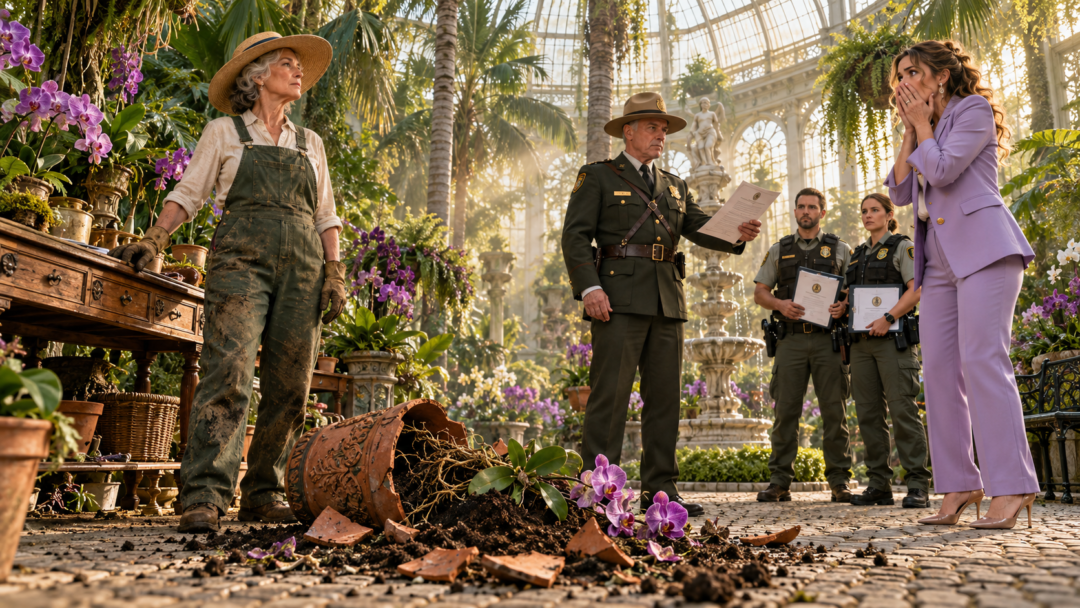
The shattered terracotta planter had been carefully gathered by the conservation staff, its fragments preserved for display in the estate museum. In the sterile tissue-culture laboratory in the east wing, Dr. Elena Vance had already isolated active meristem tissue from the severed Orchis spectabilis vancei, successfully establishing forty sterile tissue cultures that would yield hundreds of healthy clones within six months.
Thomas Caldwell walked through the palm aisle, his gardener’s cottage keys returned to his hands, his head held high with quiet, tearful pride. Beside him walked Judge Arthur Vance, who had just signed the permanent decree restoring Thomas as Chief Horticulturist Emeritus for life.
“Look at the fronds, Catherine,” Thomas whispered, looking up at the towering Victorian palms swaying gently in the warm greenhouse air. “They survived. The whole collection survived.”
Catherine smiled warmly, placing a gentle hand on her old friend’s shoulder. “Plants have survived ice ages, blizzards, and fires, Thomas. They only need human beings with the courage to guard their roots.”
She walked to the great arched glass entrance that opened out onto the rolling meadows of Chester County. Outside in the twilight, the carillon tower began to chime the evening hymn, its bronze tones echoing across the ancient woods and limestone pastures.
Arrogant men and women with stolen wealth believed they could trample the natural world for their fleeting vanity, turning sacred sanctuaries into private playgrounds. But the earth was patient, powerful, and eternal. It outlived dynasties; it shattered iron; and as long as there were hands willing to tend the soil with love and reverence, the bloom of life would endure forever beneath the American sky.
The stars shone like diamonds across the autumn sky above Chester County, their cold, eternal light filtering through the glass dome of the Kennett Conservatory. Inside the quiet greenhouse, the warm mist nozzles hissed with gentle, restorative rhythm, bathing the surviving orchids in clean, uncontaminated rainwater drawn from the estate’s deep artesian springs.
In the propagation laboratory, Thomas Caldwell and Dr. Elena Vance stood over the sterile laminar-flow hood, watching as the tiny green tissue explants of the 1892 hybrid orchid settled into their nutrient agar flasks. The genetic line was saved; within a year, fifty healthy juvenile plants would be blooming across the conservatories of the nation.
Catherine walked slowly through the Palm House, her canvas overalls brushed clean, her wide-brimmed straw hat resting on the cedar potting bench where the morning’s battle had begun. She stopped before the broken terracotta pot, which the conservatory staff had reassembled on a display plinth with gold joinery in the ancient Japanese tradition of kintsugi—honoring the scars of the past while celebrating its survival.
Judge Arthur Vance walked up beside her, holding a brass key presented by the Commonwealth. “The trustees have established the Catherine Sterling Conservation Endowment, Catherine. A permanent twenty-million-dollar fund dedicated solely to preserving historic American flora. No developer will ever cross these gates again.”
Catherine looked up at the soaring iron arches, where the green fronds of the tree ferns reached peacefully toward the stars.
Arrogant men and women with stolen wealth believed they could conquer nature with bulldozers and money, bending the sacred to serve their petty ambitions. But the roots were deeper than greed; the truth was older than commerce; and as long as there were hands willing to tend the soil with humble love, the living sanctuary of the earth would remain unbroken and eternal beneath the American sky.
The evening carillon bells in the distant stone tower finished their hymn, the deep bronze notes floating away into the twilight across the rolling hills of the Brandywine Valley. Inside the darkened Palm House, the fragrant scent of night-blooming jasmine rose from the damp soil, filling the glass dome with peaceful, ancient sweetness.
Thomas Caldwell walked beside Catherine along the cobblestone aisle, carrying a watering can to tend the surviving seedlings in the nursery bench. “Tomorrow morning at eight, Catherine, the first bus of fourth-graders arrives from Philadelphia for the autumn biology workshop. We will show them how an orchid grows from a single microscopic seed, and we will teach them why the wild places of this earth must be loved and protected.”
Catherine looked out through the glass canopy toward the stars shining above the Pennsylvania woods. “That is why we fought, Thomas. Not for ourselves, but so that the children will always have a place where the earth speaks to their souls in peace and wonder. Nature is the eternal sanctuary of the human spirit, and as long as there are hands to nurture its sacred roots, the bloom of life will remain unbroken through all the years to come. In every seed lies the promise of tomorrow, and as long as the earth turns beneath the sun, that promise will remain unbroken through all the seasons of human hope, beauty, and truth, enduring under the vast American sky forever and ever in boundless human dignity, freedom, and peace.”