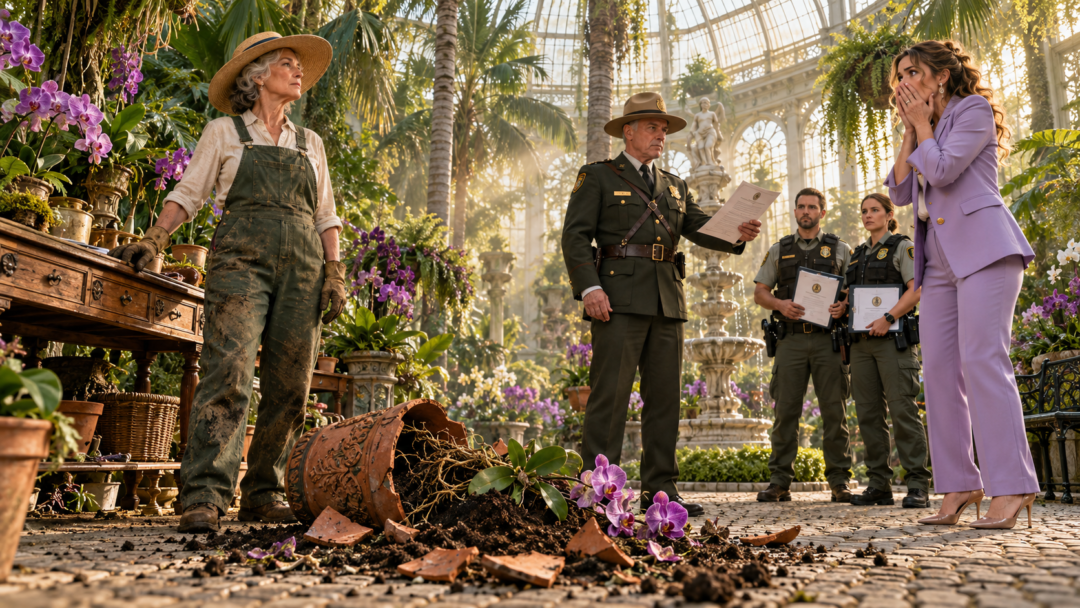
The Shattered Orchid Planter In The Victorian Conservatory And The Botanist
CHAPTER 2: THE COPPER SULFATE IN THE CISTERN
Forty minutes after the confrontation, Catherine walked down the narrow gravel service path leading to the historic potting sheds behind the East Pavilion. Outside, the autumn wind rustled through the massive tulip poplars of Chester County, scattering golden leaves across the brick cold frames.
Inside the potting shed, seventy-two-year-old Thomas Caldwell sat on an upturned wooden crate, examining a test tube of cloudy blue liquid under an optical refractometer. Thomas had been the head horticulturist of the Kennett Conservatory for forty-four years, his fingers permanently stained with moss and soil, his face etched with the gentle dignity of a master plantsman.
“Thomas,” Catherine said gently, closing the heavy wooden door behind her. “What is happening to the west wing water supply?”
Thomas looked up, his weathered eyes rimmed with red, his hands trembling as he set the test tube in its wooden rack.
“It’s deliberate poisoning, Catherine,” Thomas whispered, his voice cracking with grief. “Look at the copper ion concentration. Four hundred parts per million. Someone has been dumping industrial copper sulfate crystals directly into the rainwater cisterns beneath the conservatory floor.”
Catherine stepped to the workbench, her scientific mind evaluating the chemical concentrations instantly. “Copper sulfate is an aggressive algaecide, but at four hundred parts per million, it destroys the mycorrhizal fungi essential for orchid root respiration. Within three weeks, every epiphytic plant in the collection will suffer root necrosis.”
“The board of trustees was told that the collection is dying of an incurable fungal blight,” Thomas said bitterly, pulling a sheaf of internal documents from his canvas tool bag. “Deputy Director Donald Hayes brought in an outside environmental consulting firm last month. They issued an official assessment claiming the hundred-and-thirty-year-old glasshouse is biologically contaminated and structurally obsolete. They recommended demolishing the conservatory and leasing the four hundred acres to Kensington Luxury Events for a luxury resort and private polo club.”
Catherine’s eyes hardened into cold, gray steel. “And when you protested the assessment?”
“Hayes called the campus security guards to my cottage on Tuesday,” Thomas said, tears spilling into the deep creases of his weathered cheeks. “They claimed that fifty thousand dollars’ worth of rare Madagascan cycads had vanished from the research nursery, and that my signature was on the transfer manifest. They fired me on the spot, gave me forty-eight hours to vacate the gardener’s cottage, and warned me that if I contacted the state trustees, they would file grand larceny charges with the county prosecutor.”
Catherine reached out, covering Thomas’s soil-stained hand with her own. “They will not touch you, Thomas. And they will not tear down a single pane of this glasshouse. In fifty years of botany, I have defended ancient rain forests from mining cartels and timber barons. A crooked deputy director and an arrogant wedding planner will not destroy the work of our lives.”
She picked up the shattered aluminum CITES tag from her pocket, placing it on the bench beside the blue copper sulfate solution. “Donald Hayes and Chloe Kensington believe that plants cannot speak, Thomas. But the earth keeps an accurate ledger. And we are going to present that ledger to the law today.”
The potting shed smelled of dry bone meal, sulfur fungicide, and decades of damp burlap sacks stacked beneath the cedar workbenches. Thomas Caldwell picked up a brass hand lens, adjusting his wire-rimmed spectacles as he examined the root fragments Catherine had gathered from the shattered planter. His hands, marked with the rough scars of forty years of pruning knives and rose thorns, were trembling with quiet, righteous indignation.
“When Pierre du Pont deeded this estate to the public in 1937, Catherine,” Thomas recalled, his voice dropping to a fragile whisper that barely stirred the cobwebs in the rafters, “he wrote in the founding charter that these gardens must remain a sanctuary for the common people of Pennsylvania. He said that a city laborer who spends his week in a steel mill or a coal mine should be able to walk beneath these glass arches on a Sunday afternoon and feel the transcendent majesty of the natural world without paying a single dime. Now Donald Hayes wants to turn it into a private playground for hedge fund managers who couldn’t tell an oak tree from a dandelion.”
Catherine leaned against the potting table, her silver hair catching the amber light streaming through the dusty shed window. “They have already forged the board resolutions, Thomas. Hayes knows that if he can force a court-ordered receivership before our annual scientific symposium in November, the state will have no choice but to accept the private commercial lease. But he forgot that a botanical garden is protected not merely by state statutes, but by the federal Lacey Act and international biodiversity treaties. We will not let them extinguish a century of public stewardship for a handful of silver.”
Thomas looked out the small shed window at the brick cold frames where thousands of heirloom alpine primroses were bedding down for the coming winter frost. “We spent forty years collecting these seeds, Catherine. Every botanical garden in North America looks to Kennett as the benchmark for genetic diversity. When I was a young apprentice in the nineteen-seventies, old Dr. Henderson told me that our job was not to cultivate vanity; our job was to be the memory of the forest. Now they want to pave it over for valet parking and champagne bars.”
Catherine placed her hand on the brass microscope body. “They will not pave an inch of it, Thomas. The soil has a memory longer than any hedge fund charter, and the truth will hold fast against their greed. Prepare the clean irrigation filters; the dawn inspection will require our full strength.”