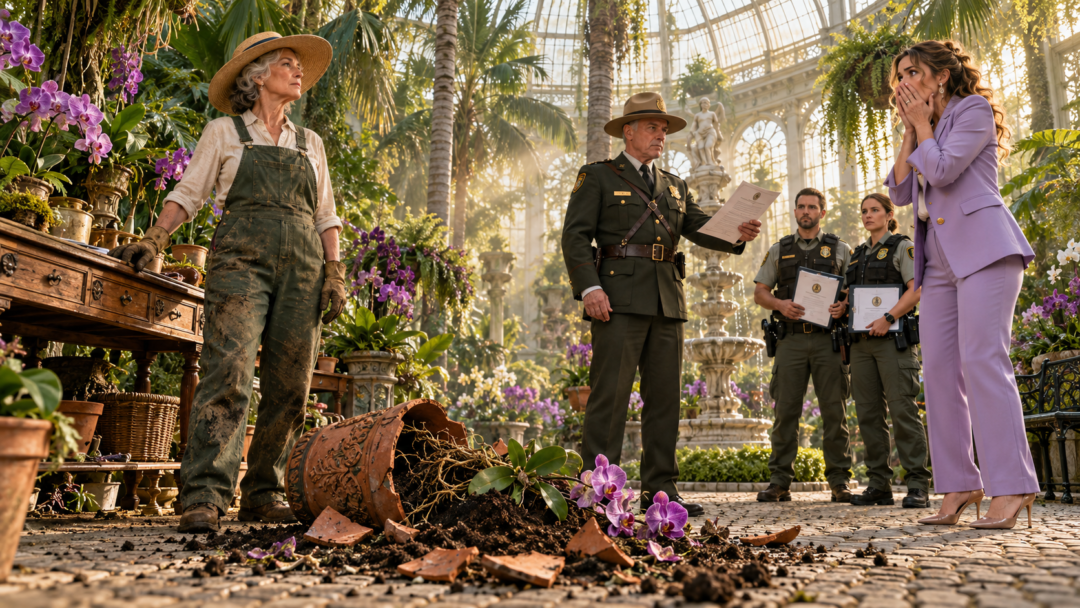
The Shattered Orchid Planter In The Victorian Conservatory And The Botanist
CHAPTER 3: THE CRATES BEHIND THE PALM FRONDS
At 1:30 PM, the greenhouse air was heavy with humidity, heated by the midday sun beating down through the soaring glass canopy. Behind the dense grove of sixty-foot royal palms at the far end of the conservatory, a temporary canvas marquee had been erected to serve as a private VIP staging lounge for Kensington’s bridal shoot.
Catherine slipped behind the thick wall of monstera leaves, moving with the quiet, ghost-like grace of a naturalist who had tracked rare snow leopards through the Himalayas. She wore her dark wool gardener’s sweater over her overalls, her rubber boots making no sound on the wet gravel.
Inside the staging enclosure, hidden behind white velvet drapes, stood eight oversized heavy-duty wooden shipping crates stamped with the logo of an international air cargo forwarder based at Philadelphia International Airport.
Catherine pulled a small pry bar from her apron pocket, quietly wedging the steel blade beneath the top lid of Crate Number Four. The cedar boards separated with a soft, muted creak.
Catherine peered inside. The crate was lined with damp sphagnum moss and battery-powered LED grow lamps. Tucked inside custom foam cradles were twelve mature specimens of Encephalartos woodii—the rarest cycad in the world, an ancient prehistoric plant completely extinct in the wild, protected under the highest tier of international anti-smuggling treaties.
Every single specimen had been ripped from the conservatory’s subterranean research nursery, its permanent botanical accession tags clipped and replaced with forged commercial export certificates labeling them as “Cultivated Common Sago Palms.”
“Step away from those crates, old woman.”
A heavy, rough hand clamped down hard upon Catherine’s shoulder.
Catherine did not jump. She slowly let the pry bar lower to her side, turning around to face a burly, six-foot-two private security operative in a black tactical windbreaker with an embroidered badge reading: Apex Executive Protection.
Behind the guard stood Donald Hayes, the conservatory’s forty-five-year-old deputy director, wearing a sharp navy blue blazer, his face pale and sweating despite the cool breeze blowing from the ventilation louvers.
“I warned Caldwell to keep his people off the grounds,” Hayes hissed, stepping into the enclosure and checking the padlock on Crate Four. “You’ve got your nose where it doesn’t belong, old lady. This is a private commercial delivery authorized by the executive committee.”
Catherine looked directly into Hayes’s eyes, her gaze carrying the crushing, absolute weight of an unyielding moral judge. “These are Appendix One protected cycads from the founder’s collection, Donald. Exporting them without an act of Congress is a federal felony carrying twenty years in a federal penitentiary.”
Hayes sneered, but the panic behind his eyes was naked and raw. “Nobody is going to prison, old woman. These plants are leaving on a private charter from Philadelphia at six o’clock tonight for a private buyer in Geneva who paid three million dollars in cash. And as for you—my security boys will hold you in the cellar until the plane is over the Atlantic. Lock her in the furnace room.”
The midday heat inside the palm grove was suffocating, rising in shimmering waves of humidity that clung to Catherine’s wool sweater. In the shadow of the massive sixty-foot royal palms, the silence was broken only by the distant hum of the automated ventilation louvers and the low, secretive murmuring of Kensington’s private security crew.
Catherine peered through a gap in the dark green philodendron leaves, memorizing the serial numbers stenciled on the corners of the eight wooden export crates. Beside Crate Seven stood a specialized refrigerated transport cooler equipped with a battery-powered oxygen circulation pump—a custom system designed to transport live, critically endangered carnivorous pitcher plants from the Appalachian bogs. Hayes wasn’t merely plundering the tropical collection; he was gutting the conservatory’s native North American rare plant repository, stripping specimens that had been protected under federal law since the Endangered Species Act of 1973.
The private security guard’s grip on Catherine’s arm was heavy and bruising, but she did not give him the satisfaction of a single wince. She looked past him to where Donald Hayes stood pacing frantically across the gravel path, clutching his encrypted satellite phone. “You think you can hide behind corporate proxies, Donald,” Catherine said, her voice cutting through the humid air with devastating clarity. “But every specimen in those crates is microchipped with a radioactive tracer registered to the Smithsonian National Herbarium. The moment those crates enter the cargo scanner at Philadelphia International, every federal wildlife agent on the Eastern Seaboard will be waiting on the tarmac.”
The humid greenhouse breeze rustled the giant fronds of the Australian tree ferns, casting shifting emerald shadows across the moist flagstones. Catherine kept her breath shallow and steady, listening to the clink of metal tools as Kensington’s workers unloaded staging gear in the adjacent aisle. She had survived mountain blizzards in the Andes and armed rebel checkpoints in the Congo; she was not about to be intimidated by a corrupt administrator in a bespoke blazer.
“You speak of private buyers in Geneva, Donald,” Catherine said, her voice dropping into a register of chilling, absolute certainty. “Yet you fail to realize that the international wildlife enforcement network tracks every CITES Appendix One accession number through automated customs manifests. You didn’t arrange an escape route; you built a federal penitentiary cell around yourself and your co-conspirators. The law has already caught up to you. In the ancient silence of these woods, truth will always outlast the corrupt transactions of thieves and mercenaries who seek to commodify the living pulse of nature.”