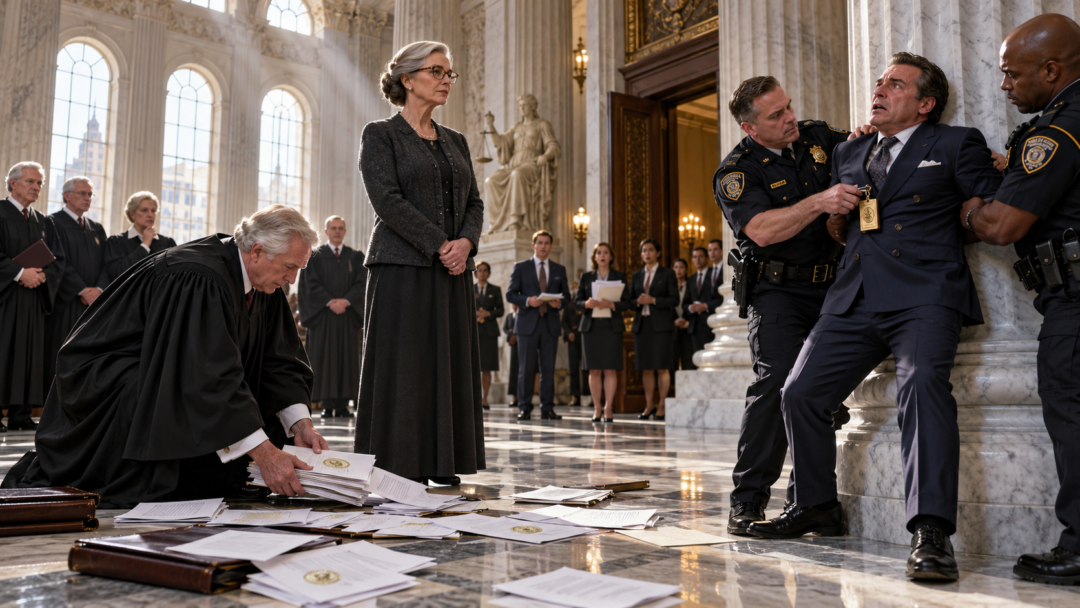
The Scattered Briefs In The Marble Colonnade And The Supreme Justice
CHAPTER 1: THE BRIEFS ON THE WHITE MARBLE
The morning light in the great colonnade of the State Supreme Court was always sharp and unforgiving. It sliced down through the tall arched Roman windows, illuminating every speck of dust dancing between the fluted Corinthian pillars and reflecting off the mirror-polished Vermont marble with the cold brilliance of an operating room. For over a century, those towering columns had stood as silent sentinels over the commonwealth’s greatest triumphs and darkest betrayals. Beneath their vaulted arches, governors had taken their solemn oaths, titans of industry had been humbled, and desperate citizens had pleaded for the protection of the law. Yet on this crisp Tuesday in late October, the echoing corridor belonged not to the spirit of justice, but to the frantic, abrasive stride of naked ambition.
Douglas Sterling marched across the marble tiles as if the entire courthouse had been constructed solely for his convenience. At forty-two, he had already ascended to senior litigation partner at Sterling, Vance and Croft, the state’s largest and most aggressive corporate law firm. His bespoke navy double-breasted suit was cut from eight-thousand-dollar superfine Italian wool, cinched with razor-sharp precision, and accented by heavy eighteen-karat gold cufflinks bearing his firm’s crest. In his manicured right hand, he swung a monogrammed leather briefcase that held what he believed to be the crowning achievement of his career: an ex parte emergency motion to seal the final toxicological findings in the landmark Tri-County aquifer litigation. For three years, Sterling had systematically crushed every attempt by local farming families to prove that his client, Apex Petrochemical Consortium, had dumped two hundred thousand gallons of carcinogenic benzene sludge into the regional groundwater. He had buried evidence, papered municipal judges into exhaustion, and intimidated witnesses into silence. The nine-o’clock docket call was less than thirty minutes away, and if he could slip the motion into the registry before the full appellate bench convened for the annual judicial convention, the settlement would remain permanently locked behind a corporate protective order.
Fifty yards ahead of him, walking quietly along the eastern arcade toward the heavy brass doors of the Supreme Court chambers, was a woman whose presence could not have contrasted more sharply with his frantic velocity. She was fifty-six years old, of modest height, with silver-threaded hair pulled back into a neat, sensible chignon at the nape of her neck. She wore a simple charcoal wool cardigan over a tailored slate-gray cotton dress, sensible low-heeled walking shoes, and tortoiseshell reading glasses resting on the bridge of her nose. Under both arms, she carried two thick leather-bound dossiers, their edges bulging with white linen legal briefs, certified court transcripts, and hand-annotated appellate dockets. She walked with a calm, unhurried cadence, absorbing the quiet dignity of the hall, her fingertips lightly grazing the worn leather binding of the lower volume.
Sterling did not see a dignified fellow human being. He saw an inconvenient obstacle moving at an unacceptable pace down the center of the hall. He had zero patience for subordinates, support staff, or anyone drawing an hourly wage from the state treasury. He checked his rose-gold wristwatch, clicked his polished leather Oxfords aggressively against the stone, and accelerated his pace, his leather briefcase swinging like a weapon.
“Clear the lane!” Sterling barked, his voice echoing sharply against the coffered plaster ceiling. “Move aside, lady!”
The woman paused and turned her head slightly to let him pass on the wider left arcade, but Sterling was already upon her. Rather than taking a single step around her, his frustration erupted into reckless entitlement. He deliberately threw his left shoulder into her arm, swiping his heavy briefcase downward across her forearms with brutal force.
The impact tore the files from her grasp. Thick leather covers snapped open, and a blizzard of crisp white papers exploded outward into the air. Dozens of official briefs, certified affidavits, and red-ribboned appellate transcripts cascaded in every direction, fluttering across the cold white floor like startled doves before settling in disorderly piles across the polished tiles.
Several junior clerks and law students waiting near the rotunda gasped in shock, but none dared approach the towering corporate attorney. Sterling did not offer an apology. Instead, he took another aggressive step forward, deliberately planting the heavy leather heel of his polished shoe directly into the center of a fallen dossier. He ground his heel into the delicate paper, twisting his foot with sadistic contempt, his face contorting into an arrogant sneer.
“Are you completely blind, paralegal?” Sterling snarled, leaning down toward her with a threatening finger jabbed inches from her face. “Do you have any concept of who I am? I am Douglas Sterling, Senior Partner at Sterling, Vance and Croft! My firm generates fifty million dollars a year and sits on the judicial nominating committee! We decide which judges get appointed and which worthless clerks get dismissed!”
The woman did not flinch. She did not scream, nor did she scramble desperately on her knees to retrieve the fallen pages. Instead, she stood perfectly upright, drawing in a measured, calm breath that seemed to pull all the tension of the massive colonnade into her center. With deliberate grace, she reached up with slender, steady hands, lifted her tortoiseshell glasses from her nose, and let them rest gently against the dark charcoal wool of her cardigan. Her hazel eyes were clear, penetrating, and as cold and immovable as the granite foundation beneath their feet.
“You have a very loud voice, Counselor,” she said softly, her tone carrying an effortless resonance that cut straight through his bluster. “And remarkably small manners.”
“Manners?” Sterling scoffed, a vicious chuckle escaping his throat as he ground his heel even deeper into the paper. “Manners are for people who can’t bill a thousand dollars an hour. You just cost me three minutes before my docket call. Pick those briefs up right now and stack them against that pillar, or I swear on my firm’s charter, I will make one phone call to Court Administration and have you blacklisted from every legal office in this commonwealth. You’ll be scrubbing grease off cafeteria tables by lunchtime!”
The woman looked down at his shoe, which remained firmly planted on the thick legal paper. Beneath the edge of his polished welt, a distinctive blue-ink memorandum had slipped out from the folder’s inner pocket. The woman’s gaze lingered on the heading of that document for three silent beats. Printed across the top margin, under the confidential watermarked seal of Sterling, Vance and Croft’s own internal environmental audit, was an unredacted memorandum dated four days prior. It explicitly stated that Apex Petrochemical’s toxic runoff had contaminated the municipal drinking wells of over forty thousand county residents, and that Douglas Sterling had personally authorized the destruction of the water board’s laboratory samples.
The woman raised her eyes back to Sterling, her expression settling into a mask of chilling certainty.
“I would advise you, Mr. Sterling,” she whispered with deadly precision, “to look very carefully at the signature block beneath your heel before you speak another word in this building.”