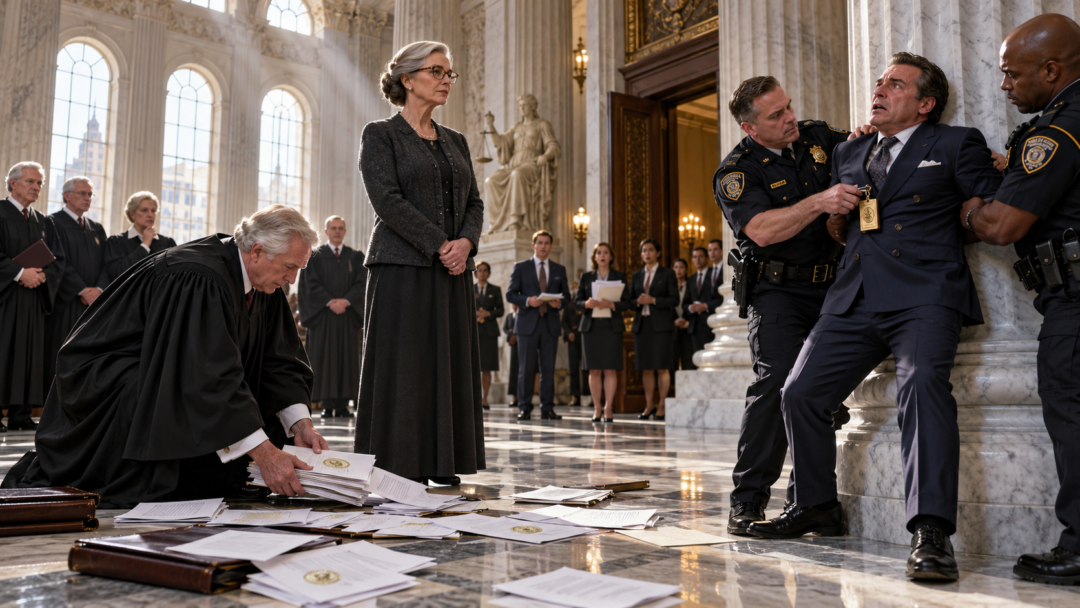
The Scattered Briefs In The Marble Colonnade And The Supreme Justice
CHAPTER 3: THE VAULT BENEATH THE ROTUNDA
The basement vaults of the State Supreme Court existed in a different century. While the upper floors gleamed with freshly polished stone and brass electric chandeliers, the sub-basement repository smelled of damp river stone, aged cedar filing boxes, and two hundred years of decaying acidic linen paper. Rows of heavy steel shelving stretched into the dim gloom beneath barrel-vaulted brick ceilings that supported the immense structural weight of the Capitol rotunda above. Here lay the commonwealth’s forgotten history: territorial land grants signed by royal governors, handwritten eighteenth-century murder trials, and sealed protective orders that had long since faded from public memory into the silent dust of time.
Justice Evelyn Carter stepped off the iron cage elevator, her low-heeled shoes clicking softly against the cold poured concrete floor. She knew this vault intimately. Thirty years earlier, when she had served as a young assistant attorney general prosecuting municipal corruption cases across the state, she had spent hundreds of exhausting nights in these damp aisles hunting through paper records before the advent of computerized databases. She knew how secrets were buried here: slipped between unrelated land easements, mislabeled with obsolete Latin docket codes, and hidden behind iron padlocks where only a court administrator with specialized clearance would ever look.
At the end of aisle fourteen, she found the steel security cage labeled Sealed Protective Dockets: 1990–1999. The cage was secured by a heavy brass Yale padlock requiring an administrative master key. Evelyn retrieved her private master key from her cardigan pocket, slid it into the cylinder, and turned it. The tumblers snapped back with a sharp, resonant metallic click that echoed down the quiet corridor like a gunshot.
She pulled open the grated door, walked to shelf twenty-eight, and pulled down a thick, dust-covered buckram folder tied with frayed red twill tape: Case Record 94-B-412: Municipal Water Authority v. Apex Industrial Chemical.
Evelyn carried the dossier to an old oak reading table illuminated by a single unshaded incandescent bulb. Untying the ribbon, she opened the cardboard cover. The yellowed pages crackled softly under her fingers, releasing the sharp scent of cedarwood and sulfur. As she read through the thirty-year-old handwritten docket sheets, the horrifying architecture of a generational conspiracy began to assemble itself before her eyes with terrifying clarity.
In the autumn of 1994, when Apex Petrochemical had first broken ground on its massive refining facility in the Tri-County river basin, a group of local dairy farmers had filed an emergency injunction after twenty cattle died from drinking runoff water from the surrounding creeks. The presiding magistrate on the case was none other than Judge Marcus Sterling—Douglas Sterling’s father, who had served as chief administrative judge of the county bench before his death fifteen years later. Marcus Sterling had been a legendary figure in state politics, a backroom operator whose baritone voice could swing judicial elections and kill legislative bills with a single whispered phone call.
According to the official docket entry, the farmers’ lawsuit had been dismissed with prejudice for lack of scientific evidence. But as Evelyn examined the final sealing order, her practiced eye immediately caught several glaring forensic anomalies. The official court stamp on page forty-four was dated three days after Judge Marcus Sterling had filed a formal recusal due to an undisclosed conflict of interest. More damningly, the signature on the order was not that of the replacement judge assigned to the case, but an inked facsimile stamp bearing the unmistakable signature of Marcus Sterling himself.
Pinned behind the fraudulent order was an original, handwritten toxicological report compiled by the state environmental commission in October 1994. The report explicitly warned that the subterranean limestone caverns beneath the chemical plant were porous, and that within thirty years, synthetic benzene compounds would migrate into the regional municipal drinking aquifers serving over forty thousand residents. It specifically noted that prolonged human exposure would cause severe clusters of rare pediatric lymphomas and bone cancers.
Attached to the report was a confidential private settlement agreement between Apex and the senior partners of what was then known as Sterling and Associates. Under the terms of that secret addendum, Apex had transferred twenty percent of its non-voting preferred shares into a private family trust registered in the Cayman Islands—a trust administered exclusively by Marcus Sterling’s son, Douglas Sterling, who was then a twenty-four-year-old second-year law student at the state university.
Douglas Sterling’s immense corporate success, his rapid elevation to senior partner, and his glittering bespoke lifestyle were not built upon legal brilliance or courtroom mastery. They were built on a thirty-year-old criminal pact sealed in the dark of this basement vault. Douglas Sterling was not merely representing Apex as their attorney; his family’s offshore trust owned a multi-million-dollar stake in the chemical company. If the aquifer contamination became public record, the corporate shares would collapse, the offshore trust would be seized by federal regulators, and Douglas Sterling would face federal criminal prosecution for generational racketeering and judicial fraud.
Evelyn carefully turned to the final document in the folder: an emergency motion for default dismissal and permanent destruction of judicial archives, drafted just forty-eight hours ago. It was scheduled to be filed and approved under an expedited automated docket rule at nine o’clock this very morning.
Evelyn checked her watch. It was eight-fifteen. She had exactly forty-five minutes before Douglas Sterling presented his fraudulent motion to the court clerk.
She pulled out her personal secure smartphone, photographed every single page of the 1994 docket, including the forged judicial stamps, the toxicological warnings, and the offshore trust agreements, and uploaded the encrypted files directly to the secure internal server of the State Judicial Conduct Commission. Then, carefully tying the red twill tape back around the historic folder, she tucked the dossier firmly under her arm and headed back toward the elevator.
As the iron gate closed, her phone chimed with an encrypted text message from Chief Justice Arthur Harrison: Evelyn, the full appellate bench and the Law School Dean have gathered in the robing room. We are waiting for you before the convention doors open.
Evelyn pressed the button for the main floor. The battle for the integrity of the high court was about to begin.