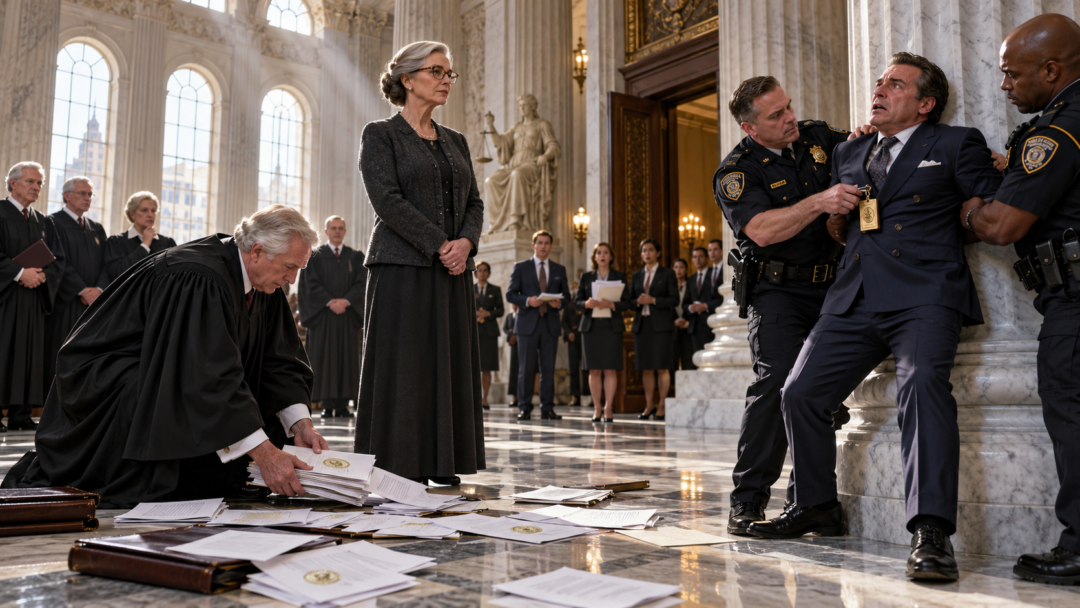
The Scattered Briefs In The Marble Colonnade And The Supreme Justice
CHAPTER 4: THE PENTHOUSE OVERLOOKING THE CAPITOL
Two blocks north of the Supreme Court, fifty stories above the historic cobblestones of Capitol Square, the executive boardroom of Sterling, Vance and Croft was bathed in the cold, opulent glow of morning sunlight. Floor-to-ceiling glass walls looked down upon the copper dome of the Capitol building and the white marble colonnade of the courthouse, making the institutions of democracy appear tiny, fragile, and utterly inconsequential beneath the feet of corporate wealth.
Inside the boardroom, Douglas Sterling was pouring himself an espresso from a polished chrome machine. His double-breasted suit was pristine once more, the slight scuff on his leather shoe buffed away by a shoeshine boy on the ground floor lobby. Surrounding the twenty-foot mahogany conference table were five senior corporate executives from Apex Petrochemical Consortium, along with three junior litigation partners who hung on Sterling’s every word with obsequious deference. The air was thick with the scent of roasted Colombian coffee beans, expensive cologne, and the smug confidence of men who believed they owned the commonwealth.
“Gentlemen, relax,” Sterling said smoothly, lifting his porcelain cup and leaning back against the edge of the table with theatrical confidence. “The crisis is over. In exactly thirty minutes, the nine-o’clock docket call will execute our emergency protective sealing order. The judge sitting on the morning motions docket is Judge Kenneth Wallace—a man whose last three campaign committees were personally funded by our firm’s political action committee. Wallace knows his duty. By nine-fifteen, the Tri-County file will be sealed in perpetuity, and all testing data will be destroyed under court order.”
“What about that girl, Clara Bennett?” asked Apex’s chief financial officer, a nervous man in his fifties clutching a leather binder stuffed with balance sheets. “She had direct access to the raw soil audits. If she goes to the press or the state attorney general’s environmental division—”
“Bennett is a ghost,” Sterling interrupted, his voice dripping with venomous amusement as he swirled his espresso. “She was suspended by the bar ethics board three weeks ago. I personally saw to it that her credentials were flagged in the statewide court registry. If she even attempts to enter the building with a legal brief, security will arrest her for unauthorized practice of law. She has no money, no standing, and no credibility. No judge in this state will take an affidavit from a disbarred paralegal living on canned soup.”
Sterling chuckled, remembering the encounter in the colonnade half an hour earlier. He leaned forward, gesturing grandly with his gold pen. “I ran into one of those pathetic court temps down in the colonnade this morning. Some gray-haired spinster carrying armloads of obsolete case files, blocking the hallway like she owned the place. I knocked her files straight across the marble, stepped on her briefs, and promised to have her blacklisted from the courthouse by lunch. That is how you handle small people, gentlemen. You show them their place immediately, and you never apologize. Power only respects power.”
The junior partners laughed nervously, eager to curry favor with the powerful partner. But one of the senior associates, a quiet thirty-year-old named Raymond Vance whose uncle served as Dean of the Law School, looked up from his tablet computer with a furrowed brow and an expression of sudden, sickening dread.
“Douglas,” Raymond said quietly, his voice cutting through the laughter like cold steel. “Did you say she was carrying leather-bound case files in the colonnade?”
“Yes,” Sterling said, waving his hand dismissively. “Two massive leather folders. Looking like an overworked librarian who hadn’t bought new clothes since the Carter administration. Gray cardigan, reading glasses, walking down the hall alone.”
Raymond tapped his tablet screen, his expression tightening into pale unease. “What did she look like, Douglas? Be very specific.”
“Tortoiseshell reading glasses, gray hair in a bun, charcoal cardigan over a gray dress,” Sterling replied, taking an impatient sip of espresso. “Why? Do you know her? Tell her supervisor to fire her before noon, or I’ll call the building administrator myself.”
Raymond’s hand began to tremble violently against the mahogany table. He turned the tablet around, sliding it across the polished wood until it came to rest directly in front of Sterling. Displayed on the high-resolution screen was the official portal of the State Supreme Court, displaying the keynote program for the morning’s Annual Judicial Convention.
Beneath the gold seal of the Supreme Court was an official portrait of a woman with tortoiseshell reading glasses, silver-streaked hair gathered in a neat chignon, and a calm, penetrating hazel gaze. The caption beneath the photograph read in bold, gold lettering:
KEYNOTE SPEAKER: THE HONORABLE EVELYN CARTER
Senior Associate Justice of the State Supreme Court
Author of the Commonwealth Judicial Ethics Restatement
Former Chief Federal Prosecutor for Public Integrity
Sterling stared at the screen, the porcelain espresso cup freezing halfway to his lips. For three agonizing seconds, the air was sucked clean out of the room. The color drained from Sterling’s face with terrifying speed, leaving his skin the shade of damp chalk.
“No,” Sterling stammered, his confident baritone cracking into a thin, breathless gasp. “No… that’s impossible. She was carrying her own files. Justices have four law clerks and two armed marshals. She was walking alone in a cheap cardigan.”
“Justice Carter doesn’t use drivers or ceremonial escorts when reviewing archival dockets,” Raymond whispered, his voice trembling with horror. “She spent twenty years as a federal prosecutor. She walks everywhere alone. Douglas… you shoved the Senior Associate Justice of the Supreme Court. You stepped on her case files in front of witnesses.”
Before Sterling could formulate a reply, his cell phone on the table began to vibrate violently. The caller identification displayed the private direct line of the Chief Judicial Marshal of the State Supreme Court.
Sterling stared at the vibrating phone as if it were a live rattlesnake. His heart slammed violently against his ribs, his breath coming in shallow, ragged bursts. The sixty-minute countdown to the nine-o’clock docket call was ticking away, but the illusion of his untouchable power had just shattered into a thousand jagged pieces.